E7-5 Use incremental analysis for make-or-buy decision
Pottery Ranch Inc. has been manufacturing its own finials for its curtain rods. The company is currently operating at 100% of capacity, and
variable manufacturing is charged to production at the rate of 70% of direct labor cost. The direct materials and the direct labor cost
per unit to make a pair of finials are $4 and $5, respectively. Normal production is 30,000 curtain rods per year.
A supplier offers to make a pair of finials at a price of $12.95 per unit. If Pottery Ranch accepts the supplier’s offer, all variable manufacturing
costs will be eliminated, but the $45,000 of fixed manufacturing overhead currently being charged to the finials will have to be absorbed by
other products.
Instructions
(a) Prepare the incremental analysis for the decision to make or buy the finials.
(b) Should Pottery Ranch buy the finials?
(c )
Would your answer be different in (b) if the productive capacity released by not making the finials could be used to produce income
of $20,000.
NOTE: Enter a number in cells requesting a value; enter either a number or a formula in cells with a “?” .
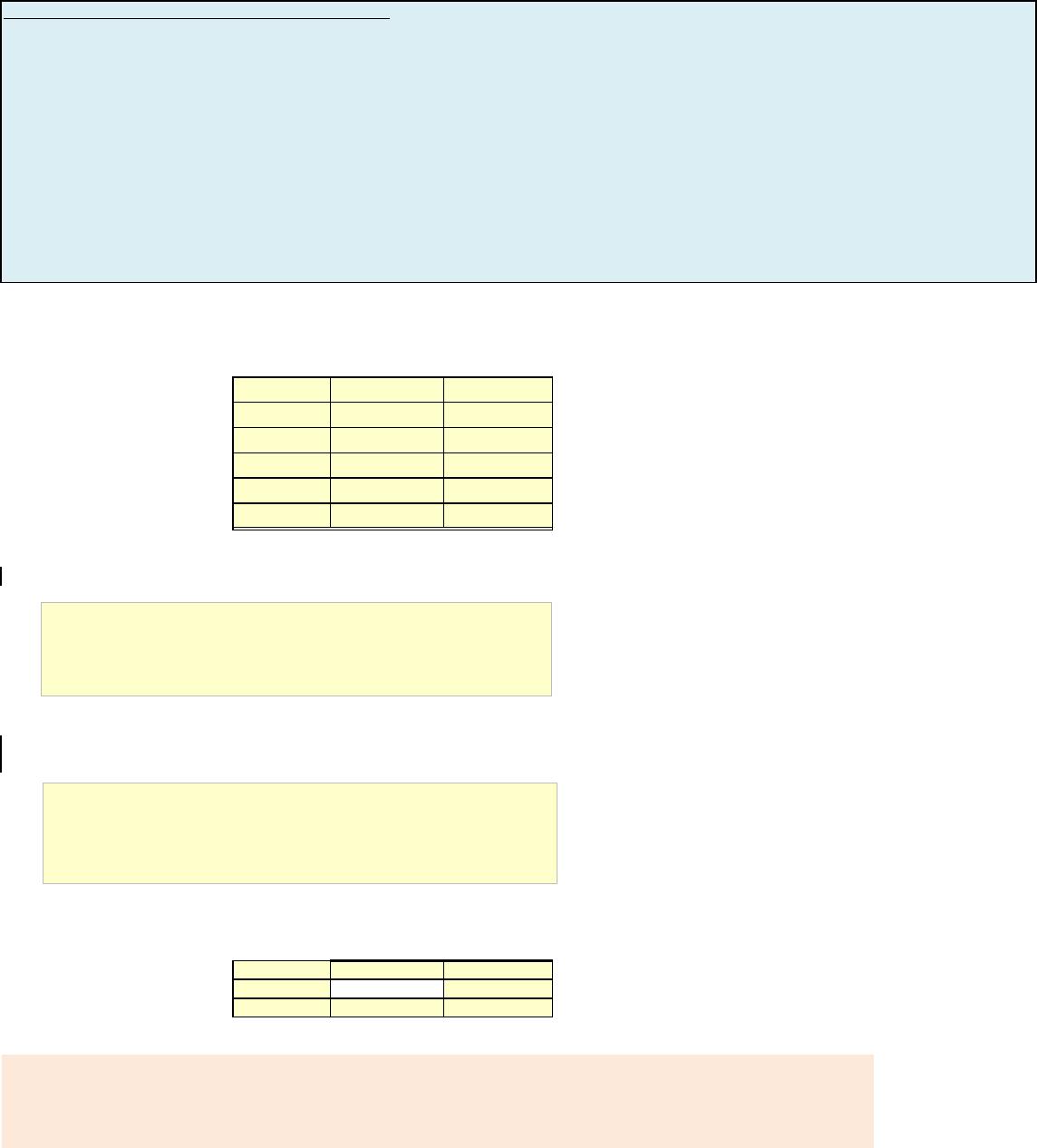
(a) Prepare the incremental analysis for the decision to make or buy the finials.
Make Buy
Net income
Increase
(Decrease)
Direct materials ? Value Value
Direct labor ? Value Value
Variable overhead costs ? Value Value
Fixed manufacturing costs Value Value Value
Purchase price ? Value Value
Total annual costs ? ? ?
(b) Should Pottery Ranch buy the finials?
(c ) Would your answer be different in (b) if the productive capacity released by not making
the finials could be used to produce income of $20,000.
Make Buy
Net income
Increase
(Decrease)
Total annual cost (above) Value Value Value
Opportunity cost Value Value
Total cost ? ? ?
After you have completed E7-5, consider the following additional question.
1. Assume that the direct materials and direct labor cost per unit to make the finials are $4.75 and $5.50, respectively.
What impact do these changes on your analysis and the decision to make-or-buy the finials?
E7-5 Solution
(a) Prepare the incremental analysis for the decision to make or buy the finials.
Make Buy
Net income Increase
(Decrease)
Direct materials(30,000 x $4.00) $120,000 $0 $120,000
Direct labor (30,000 x $5.00) 150,000 0 $150,000
(b) Should Pottery Ranch buy the finials?
(c ) Would your answer be different in (b) if the productive capacity released by not making the
finials could be used to produce income of $20,000.
Make Buy
Net income Increase
(Decrease)
Total annual cost (above) $420,000 $433,500 (13,500)
Opportunity cost 20,000 20,000
Total cost $440,000 $433,500 $6,500
E7-5 Solution to additional question
1. Assume that the direct materials and direct labor cost per unit to make the finials are $4.75 and $5.50, respectively.
What impact do these changes on your analysis and the decision to make-or-buy the finials?
(a)
Make Buy
Net income
Increase
(Decrease)
Direct materials(30,000 x $4.75) $142,500 $0 $142,500
Fixed manufacturing costs 45,000 45,000 0
Purchase price (30,000 x $12.75) 0 388,500 (388,500)
(b) Should Pottery Ranch buy the finials?
(c ) Would your answer be different in (b) if the productive capacity released by not making the
finials could be used to produce income of $20,000.
Make Buy
Net income
Increase
(Decrease)
E7-8 Prepare incremental analysis concerning make-or-buy decision.
Innova uses 1.000 units of the component IMC2 every month to manufacture one of its products. The unit costs incurred to
manufacture the components are as follows:
Direct materials $65.00
Direct labor 45.00
Overhead 126.50
Total 236.50
Overhead costs include variable material handling costs of $6.50, which are applied to products on the basis of direct material
costs. The remainder of the overhead costs are applied on the basis of direct labor dollars and consist of 60% variable costs and
40% fixed costs. A vendor has offered to supply the IMC2 component at a price of $200 per unit.
Instructions
(a) Should Innova purchase the component from the outside vendor if Innova’s capacity remains idle?
(b) Should Innova purchase the component from the outside vendor if it can use its facilities to manufacture
another product? What information will Innova need to make an accurate decision? Show your calculations.
(c ) What are the qualitative factors that Innova will have to consider when making its decision?
NOTE: Enter a number in cells requesting a value; enter either a number or a formula in cells with a “?” .
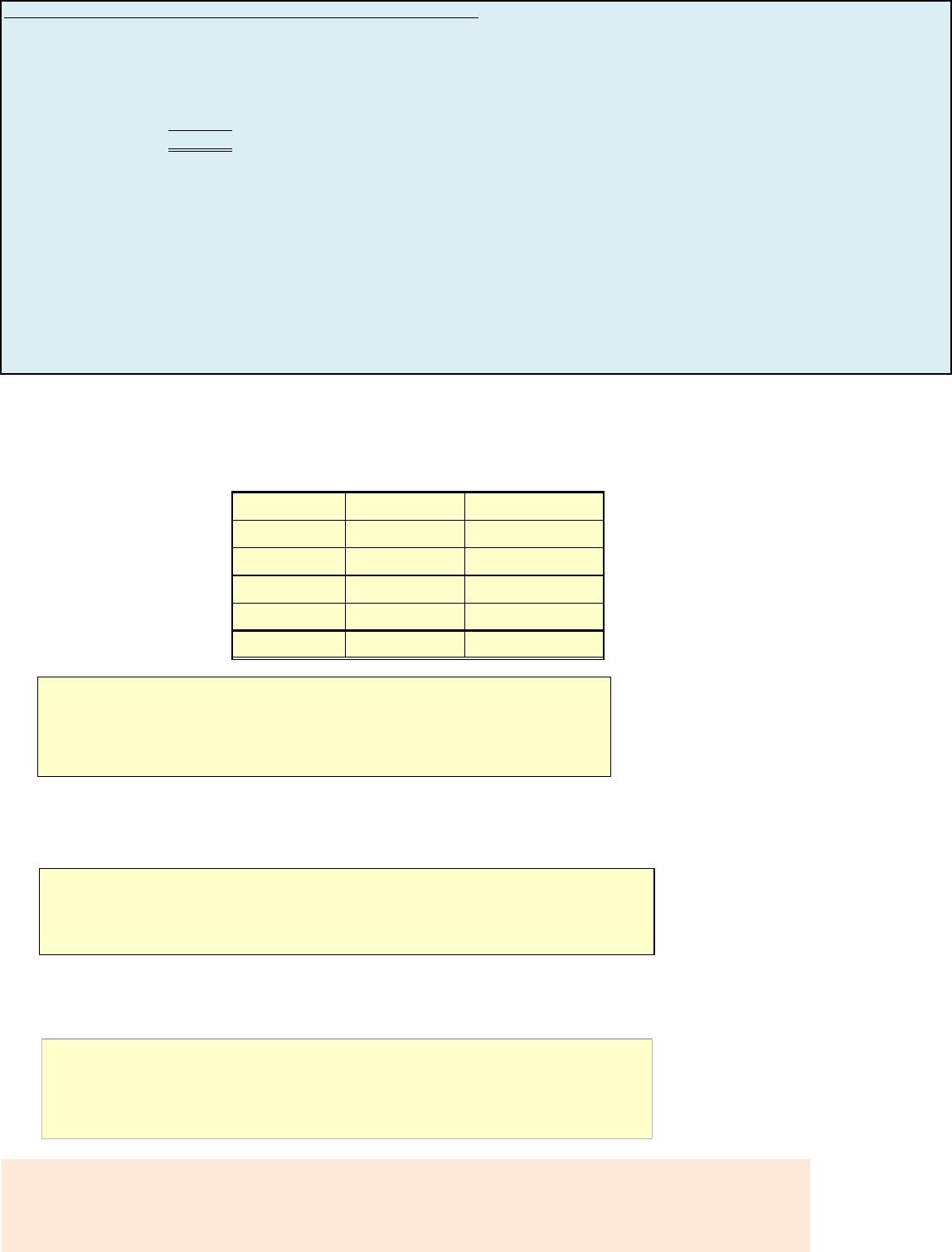
(a) Should Innova purchase the component from the outside vendor if Innova’s capacity remains idle?
Make IMC2 Buy IMC2
Net income
Increase
(Decrease)
Direct materials Value Value Value
Direct labor Value Value Value
Material handling Value Value Value
Variable overhead costs Value Value Value
Purchase price Value Value Value
Total unit cost ? ? ?
(b) Should Innova purchase the component from the outside vendor if it can use its facilities to manufacture
another product? What information will Innova need to make an accurate decision? Show your calculations.
(c ) What are the qualitative factors that Innova will have to consider when making its decision?
After you have completed E7-8, consider the following additional question.
1. Assume that unit cost for direct materials changed to $68.00 and that overhead costs changed to $130.00.
What impact do these changes have on the make-or-buy decision?
Response:
Response:
Response:
E7-8 Solution
(a) Should Innova purchase the component from the outside vendor if Innova’s capacity remains idle?
Make IMC2 Buy IMC2
Net income
Increase
(Decrease)
Direct materials $65.00 0 $65.00
Direct labor 45.00 0 45.00
Material handling 6.50 0 6.50
Variable overhead costs* 72.00 0 72.00
Purchase price 0.00 200.00 (200.00)
Total annual costs $188.50 $200.00 ($11.50)
* Variable overhead = 60% x ($126.50 – $6.50)
(b) Should Innova purchase the component from the outside vendor if it can use its facilities to manufacture
another product? What information will Innova need to make an accurate decision? Show your calculations.
(c) What are the qualitative factors that Innova will have to consider when making its decision?
The unit should not be purchased from the outside vendor, as the per unit cost
would be $11.50 greater than if they made it.
In order for Innova to make an accurate decision, they would have to know the
opportunity cost of manufacturing the other product. As determined in (a),
purchasing the product from outside would cost $11,500 more ($1,000 x
$11.50). Innova would have to increase their contribution margin by more than
$11,500 through the manufacture of the other product, before it would be
economical for them to purchase the IMC2 from the outside vendor.
Qualitative factors to consider would be (1) quality of the component (2) on-time
delivery, and (3) reliability of the vendor.
E7-8 Solution to additional question
1. Assume that unit cost for direct materials changed to $68.00 and that total overhead costs changed to $130.00.
What impact do these changes have on the make-or-buy decision?
Make IMC2 Buy IMC2
Net income
Increase
(Decrease)
Material handling 6.50 $0 6.50
(b) Should Innova purchase the component from the outside vendor if it can use its facilities to manufacture
another product? What information will Innova need to make an accurate decision? Show your calculations.
(c) What are the qualitative factors that Innova will have to consider when making its decision?
In order for Innova to make an accurate decision, they would have to know the
opportunity cost of manufacturing the other product. As determined in (a),
E7-10 Determine whether to sell or process further, joint products
Stahl Inc. produces three separate products from a common process costing $100,000. Each of the products
can be sold at the split-off point or can be processed further and then sold for a higher price. Shown below
are cost and selling price data for a recent period.
Sales Value Cost to Sales Value
at Split-off Process after Further
Point Further Processing
Product 10 $60,000 $100,000 $190,000
Product 12 15,000 30,000 35,000
Product 14 55,000 150,000 215,000
Instructions
(a) Determine total net income if all products are sold at the split-off point.
(b) Determine total net income if all products are sold after further processing.
(c ) Using incremental analysis, determine which products should be sold at the split-off
point and which should be processed further.
(d) Determine total net income using the results from (c ) and explain why the net income
is different from that determined in (b).
NOTE: Enter a number in cells requesting a value; enter either a number or a formula in cells with a “?” .
(a) Determine total net income if all products are sold at the split-off point.
Sales Value
Joint costs Value
Net income ?
(b) Determine total net income if all products are sold after further processing.
Sales Value
Joint costs Value
Additional costs Value
Net income ?
(c) Using incremental analysis, determine which products should be sold at the split-off
point and which should be processed further.
Product 10 Product 12 Product 14
Incremental revenue Value Value Value
Incremental costs Value Value Value
Incremental profit (loss) ? ? ?
(d) Determine total net income using the results from (c ) and explain why the net income
is different from that determined in (b).
Sales Value
Joint costs Value
Additional costs Value
Net income ?
Response:

After you have completed E7-10, consider the additional question.
1. Assume that sales value at split-off point for Product 10 changed to $75,000 and
the cost to process Product 14 further changed to $162,000. What impact do these
changes have on total net income at split-off point and after further processing?
Response:
E7-10 Solution
(a) Determine total net income if all products are sold at the split-off point.
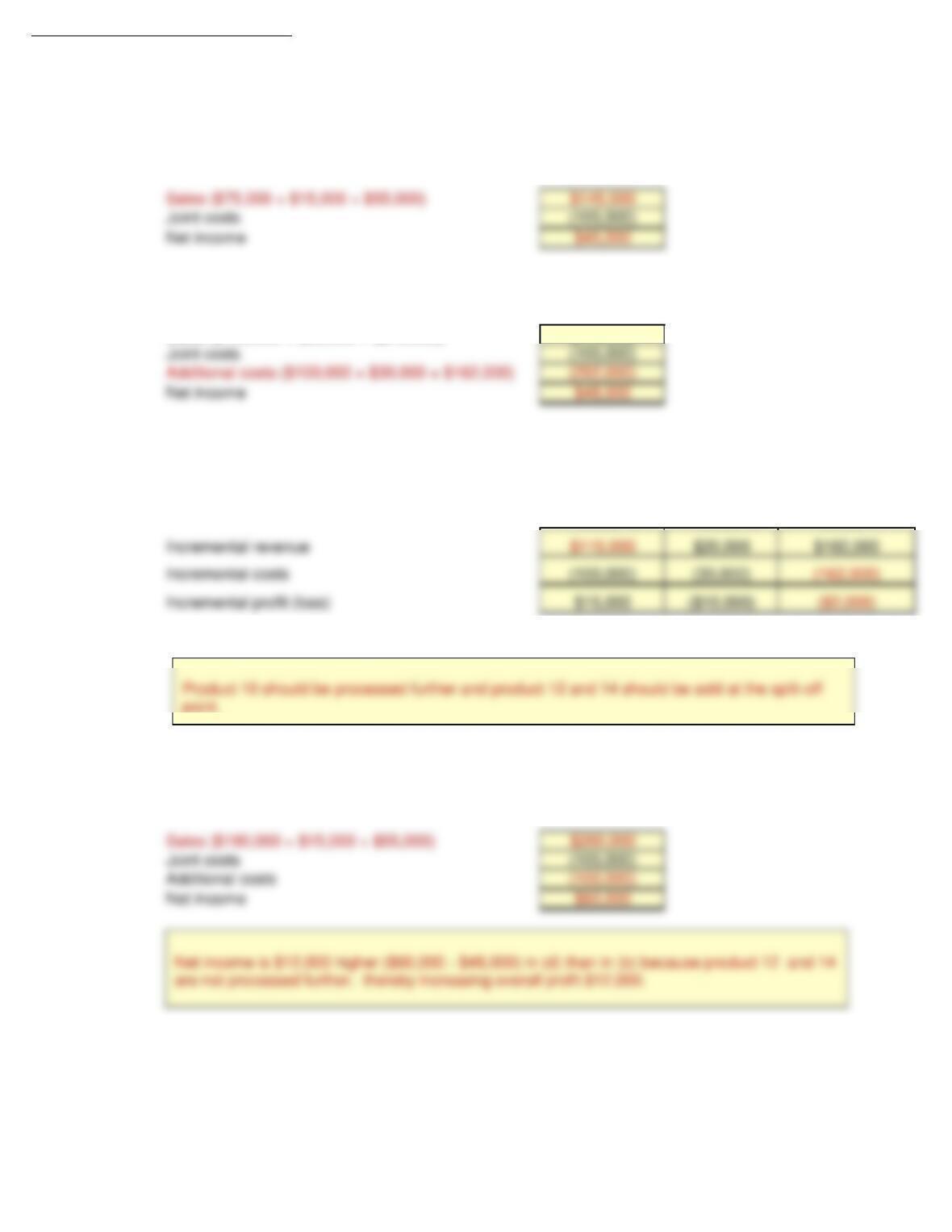
Sales ($60,000 + $15,000 + $55,000) $130,000
(b) Determine total net income if all products are sold after further processing.
Sales ($190,000 + $35,000 + $215,000) $440,000
Joint costs (100,000)
(c) Using incremental analysis, determine which products should be sold at the split-off
point and which should be processed further. Product 10 Product 12 Product 14
Incremental revenue $130,000 $20,000 $160,000
(d)
Determine total net income using the results from (c ) and explain why the net income
is different from that determined in (b).
Sales ($190,000 + $15,000 + $215,000) $420,000
Joint costs (100,000)
E7-10 Solution to additional question
1. Assume that sales value at split-off point for Product 10 changed to $75,000 and
the cost to process Product 14 further changed to $162,000. What impact do these
changes have on total net income at split-off point and after further processing?
(a) Determine total net income if all products are sold at the split-off point.
(b) Determine total net income if all products are sold after further processing.
Sales ($190,000 + $35,000 + $215,000) $440,000
(c) Using incremental analysis, determine which products should be sold at the split-off
point and which should be processed further.
Product 10 Product 12 Product 14
Incremental revenue = Sales value after further processing – sales value @ split-off point
(d) Determine total net income using the results from (c ) and explain why the net income
is different from that determined in (b).
E7-11 Determine whether to sell or process further, joint products
Kirk Minerals processes materials extracted from mines. The most common raw material that it processes
results in three joint products: Spock, Uhura, and Suhu. Each of these products can be sold as is, or each can
be processed further and sold for a higher price. The company incurs joint costs of $180,000 to process one batch
of the raw material that produces the three joint products. The following cost and sales information is available
for one batch of each product.
Sales Value at Allocated Cost to Process Sales Value of
Split-off Point Joint Costs Further
Processed Product
Spock $210,000 $40,000 $110,000 $300,000
Uhura 300,000 60,000 85,000 400,000
Suhu 455,000 80,000 250,000 800,000
Instructions
Determine whether each of the three joint products should be sold as is, or processed further.
NOTE: Enter a number in cells requesting a value; enter either a number or a formula in cells with a “?” .
Spock Uhura Suhu
Sales value of processed product Value Value Value
Sales value @ split-off point Value Value Value
Incremental revenue ? ? ?
Incremental costs Value Value Value
Incremental profit (loss) ? ? ?
After you have completed E7-11, consider the additional question.
1. Assume that sales value at split-off point for Uhura changed to $350,000 and the cost to process
further for Sulu changed to $325,000. What impact do these changes have on the decision to
sell as is or to process further for each product?
Response:
E7-11 Solution
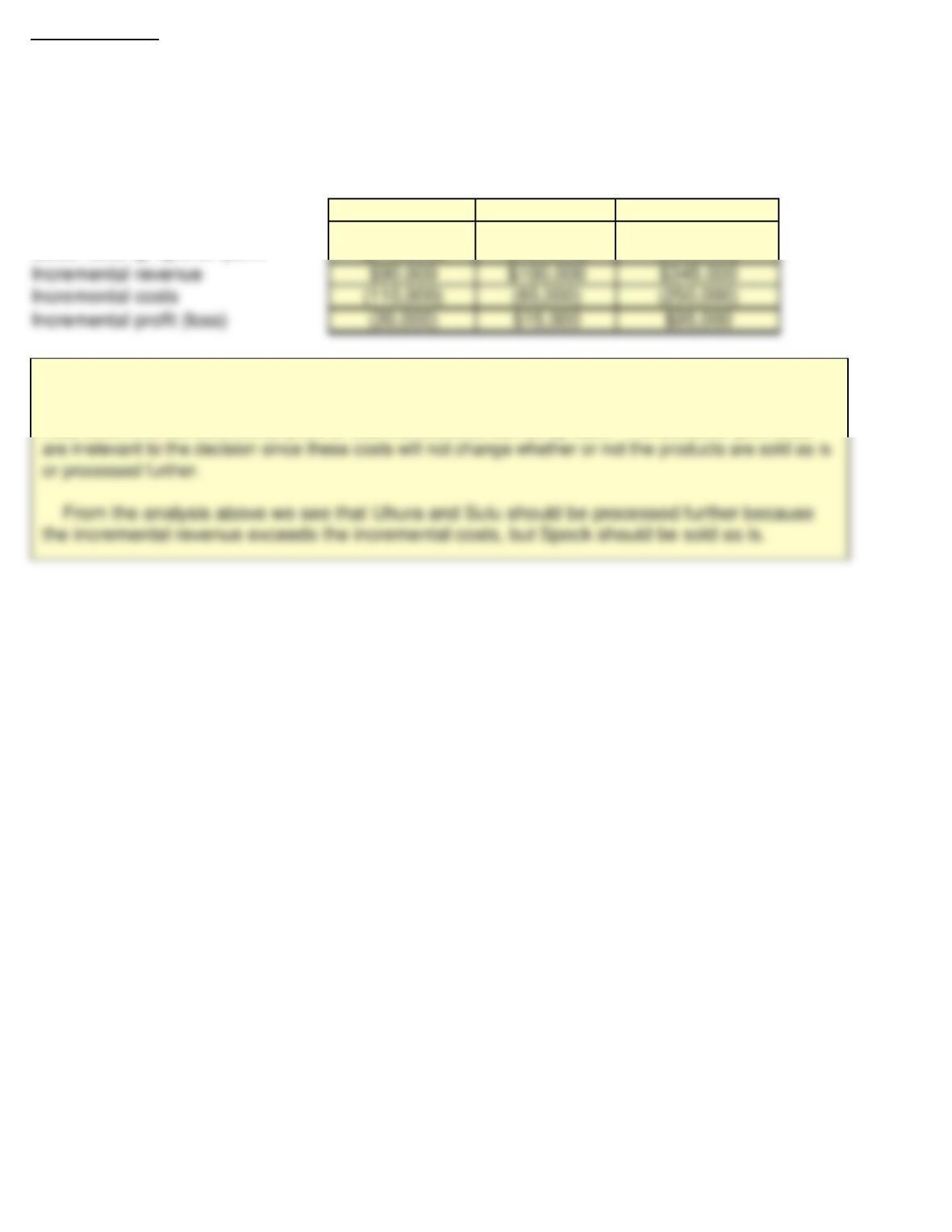
To determine whether each of the three joint products should be sold as is, or processed further,
we must determine the incremental profit or loss that would be earned by each. The allocated
joint costs are irrelevant to the decision since these costs will not change whether or not the
products are sold as is or processed further.
Spock Uhura Sulu
Sales value of processed product $300,000 $400,000 $800,000
Sales value @ split-off point (210,000) (300,000) (455,000)
To determine whether each of the three joint products should be sold as is, or processed further, we
must determine the incremental profit or loss that would be earned by each. The allocated joint costs
E7-11 Solution to additional question
1. Assume that sales value at split-off point for Uhura changed to $350,000 and the cost to process
further for Sulu changed to $325,000. What impact do these changes have on the decision to
sell as is or to process further for each product?
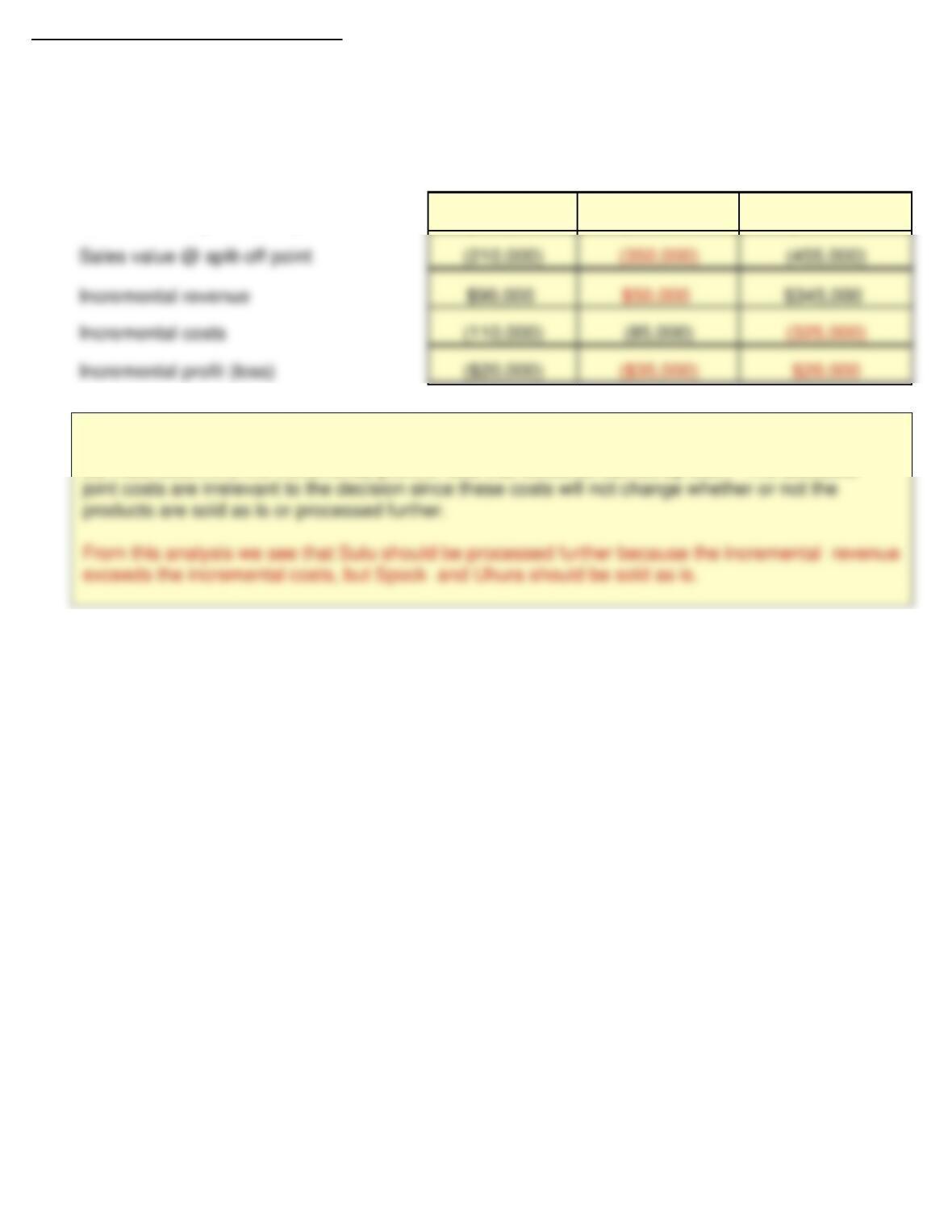
Spock Uhura Sulu
Sales value of processed product $300,000 $400,000 $800,000
To determine whether each of the three joint products should be sold as is, or processed further,
we must determine the incremental profit or loss that would be earned by each. The allocated
E7-15 Use incremental analysis concerning elimination of division.
Veronica Mars, a recent graduate of Bell’s accounting program, evaluated the operating performance
of Dunn Company‘s six divisions. Veronica made the following presentation to Dunn’s board of directors
and suggested the Percy Division be eliminated. “If the Percy Division is eliminated,” she said, “our
total profits would increase by $26,000.”
The Other Percy
Five Divisions Division Total
Sales $1,664,200 $100,000 $1,764,200
Cost of goods sold 978,520 76,000 1,054,520
Gross Profit 685,680 24,000 709,680
Operating expenses 527,940 50,000 577,940
Net income $157,740 ($26,000) $131,740
In the Percy Division, cost of goods sold is $61,000 variable and $15,000 fixed, and operating expenses
are $30,000 variable and $20,000 fixed. None of the Percy Division’s fixed costs will be eliminated if the
division is discontinued.
Instructions
Is Veronica right about eliminating the Percy Division? Prepare a schedule to support your answer.
NOTE: Enter a number in cells requesting a value; enter either a number or a formula in cells with a “?” .
Is Veronica right about eliminating the Percy Division? Prepare a schedule to support your answer.
Continue Eliminate
Net income
Increase
(Decrease)
Sales Value Value Value
Variable costs
Cost of goods sold Value Value Value
Operating expenses Value Value Value
Total variable ? ? ?
Contribution margin ? ? ?
Fixed costs
Cost of goods sold Value Value Value
Operating expenses Value Value Value
Total fixed ? ? ?
Net income (loss) ? ? ?
After you have completed E7-15, consider the following additional question.
1. Assume that variable cost of goods sold for the Percy Division changed to $68,000 and fixed
operating expenses changed to $27,500. There was no change to variable operating costs.
How would these changes impact your answer?
Response:

E7-15 Solution
Continue Eliminate
Net income
Increase
(Decrease)
Sales $100,000 $0 ($100,000)
Variable costs
Fixed costs
Cost of goods sold 15,000 15,000 0
Operating expenses 20,000 20,000 0
Veronica is incorrect. The incremental analysis shows that net income will be $9,000
E7-15 Solution to additional question
1. Assume that variable cost of goods sold for the Percy Division changed to $68,000 and fixed
operating expenses changed to $27,500. There was no change to variable operating costs.
How would these changes impact your answer?
Continue Eliminate
Net income
Increase
(Decrease)
Sales $100,000 $0 ($100,000)
Variable costs
Fixed costs
Cost of goods sold 15,000 15,000 0
Veronica is incorrect. The incremental analysis shows that net income will be
P7-3A Determine if product should be sold or processed further.
Thompson Industrial Products Inc. (TIPI) is a diversified industrial-cleaner processing company. The company’s Dargar plant
produces two products: a table cleaner and a floor cleaner from a common set of chemical inputs (CDG). Each week 900,000
ounces of chemical input are processed at a cost of $210,000 into 600,000 ounces of floor cleaner and 300,000 ounces of table
cleaner. The floor cleaner has no market value until it is converted into a polish with the trade name FloorShine. The additional
processing costs for this conversion amount to $240,000.
FloorShine sells at $20 per 30-ounce bottle. The table cleaner can be sold for $17 per 25-ounce bottle. However, the table
cleaner can be converted into two other products by adding 300,000 ounces of another compound (TCP) to the 300,000 ounces
of table cleaner. This joint process will yield 300,000 ounces each of table stain remover (TSR) and table polish (TP). The
additional processing costs for this process amounts to $100,000. Both table products can be sold for $14 per $25-ounce bottle.
The company decided not to process the table cleaner into TSR and TP based on the following analysis.
Table Table Stain Table
Cleaner Remover (TSR) Polish (TP) Total
Production in ounces 300,000 300,000 300,000
Revenue $204,000 $168,000 $168,000 $336,000
Costs:
CDG costs 70000* 52,500 52,500 105,000 **
TCP costs 0 50,000 50,000 100,000
Total costs 70,000 102,500 102,500 205,000
Weekly gross profit $134,000 $65,500 $65,500 $131,000
*If table cleaner is not processed further, it is allocated 1/3 of the $210,000 of CDG cost, which is equal to 1/3 of the
total physical output.
** If table cleaner is processed further, total physical output is 1,200,000 ounces. TSR and TP combined account for
50% of the total physical output and are each allocated 25% of the CDG cost.
Instructions
(a) Determine if management made the correct decision to not process the table cleaner further by doing the following.
(1) Calculate the company’s total weekly gross profit assuming the table cleaner is not processed further.
(2) Calculate the company’s total weekly gross profit assuming the table cleaner is processed further.
(3) Compare the resulting net incomes and comment on management’s decision.
(b) Compare the resulting net incomes and comment on management’s decision.
NOTE: Enter a number in cells requesting a value; enter either a number or a formula in cells with a “?” .
(a) Determine if management made the correct decision to not process the table cleaner further by doing the following.
(1) Calculate the company’s total weekly gross profit assuming the table cleaner is not processed further.
Sales:
FloorShine ?
Table cleaner ?
Total Revenue ?
Costs:
CDG Value
Additional costs of FloorShine Value
Total costs ?
Gross profit ?
(a) Determine if management made the correct decision to not process the table cleaner further by doing the following.
(2) Calculate the company’s total weekly gross profit assuming the table cleaner is processed further.
Sales:
FloorShine Value
Table Stain Remover Value
Table Polish Value
Total Revenue ?
Costs:
Process Further
Table Cleaner Not Processed Further
Table Cleaner Processed Further
CDG Value
Additional costs of FloorShine Value
TCP Value
Total costs ?
Gross profit ?
(a) Determine if management made the correct decision to not process the table cleaner further by doing the following.
(3) Compare the resulting net incomes and comment on management’s decision.
(b) Compare the resulting net incomes and comment on management’s decision.
Don’t Process Process Net Income
Table Cleaner Table Cleaner Increase
Further Further (Decrease)
Incremental revenue Value Value Value
Incremental costs Value Value Value
Total ? ? ?
1. After you have completed P7-3A, consider the following additional question.
Assume that the selling price of the two table products after further processing changed to $13
for each 25-ounce bottle and the cost of TCP compound to further process changed to $120,000.
How do these changes impact the decision to process or not process further?
Response:
Response:
P7-3A Solution
(a) Determine if management made the correct decision to not process the table cleaner further by doing the following.
(1) Calculate the company‘s total weekly gross profit assuming the table cleaner is not processed further.
Sales:
FloorShine (600,000 ÷ 30) x $20 $400,000
(a) Determine if management made the correct decision to not process the table cleaner further by doing the following.
(2) Calculate the company‘s total weekly gross profit assuming the table cleaner is processed further.
Sales:
FloorShine $400,000
Table Stain Remover (300,000 ÷ 25) x $14 168,000
(a) Determine if management made the correct decision to not process the table cleaner further by doing the following.
(3) Compare the resulting net incomes and comment on management’s decision.
(b) Compare the resulting net incomes and comment on management’s decision.
Don’t Process Process Net Income
Table Cleaner Table Cleaner Increase
Further Further (Decrease)
Incremental revenue $204,000 $336,000 $132,000
Table Cleaner Not Processed Further
Table Cleaner Processed Further
If the table cleaner is processed further overall company profits will be $32,000 higher( $186,000 –
When trying to decide if the table cleaner should be processed further into TSR and TP, only the relevant
data need to be considered. All of the costs that occurred prior to the creation of the table cleaner are
P7-3A Solution to additional question
1. Assume that the selling price of the two table products after further processing changed to $13
for each 25-ounce bottle and the cost of TCP compound to further process changed to $120,000.
How do these changes impact the decision to process or not process further?
(a) Determine if management made the correct decision to not process the table cleaner further by doing the following.
(1) Calculate the company’s total weekly gross profit assuming the table cleaner is not processed further.
Sales:
FloorShine (600,000 ÷ 30) x $20 $400,000
Table cleaner (300,000 ÷ 25) x $17 204,000
(a) Determine if management made the correct decision to not process the table cleaner further by doing the following.
(2) Calculate the company’s total weekly gross profit assuming the table cleaner is processed further.
Sales:
FloorShine $400,000
Costs:
CDG 210,000
Additional costs of FloorShine 240,000
TCP 120,000
(a) Determine if management made the correct decision to not process the table cleaner further by doing the following.
(3) Compare the resulting net incomes and comment on management’s decision.
(b) Compare the resulting net incomes and comment on management’s decision.
Don’t Process Process Net Income
Table Cleaner Table Cleaner Increase
Further Further (Decrease)
Table Cleaner Processed Further
Table Cleaner Not Processed Further
P7-5A Prepare incremental analysis concerning elimination of divisions.
Brislin Company has four operating divisions. During the first quarter of 2017, the company reported
aggregate income from operations of $213,000 and the following divisional results.
III III IV
Sales $250,000 $200,000 $500,000 $450,000
Cost of goods sold 200,000 192,000 300,000 250,000
Selling and administrative expenses 75,000 60,000 60,000 50,000
Income (loss) from operations ($25,000) ($52,000) $140,000 $150,000
Analysis reveals the following percentages of variable costs in each division.
III III IV
Cost of good sold 70% 90% 80% 75%
Selling and administrative expenses 40 60 50 60
Discontinuance of any division would save 50% of the fixed costs and expenses for that division. Top management is
very concerned about the unprofitable divisions (I and II). Consensus is that one or both of the divisions should be discontinued.
Instructions
(a) Compute the contribution margin for Division I and II.
(b) Prepare an incremental analysis concerning the possible discontinuance of (1) Division I and
(2) Division II. What course of action do you recommend for each division?
(c ) Prepare a columnar condensed income statement for Brislin Company, assuming Division II
is eliminated. (Use the CVP format.) Division II’s unavoidable fixed costs are allocated equally
to the continuing divisions.
(d) Reconcile the total income from operations ($213,000) with the total income from operations
without Division II.
NOTE: Enter a number in cells requesting a value; enter either a number or a formula in cells with a “?” .
(a) Compute the contribution margin for Division I and II.
Division I Division II
Sales Value Value
Variable costs
Cost of goods sold
Value Value
Selling and administrative
Value Value
Total variable expenses
? ?
Contribution margin
? ?
(b) (1) Prepare an incremental analysis concerning the possible discontinuance of Division I
Net Income
Increase
Continue Eliminate (Decrease)
Contribution margin (above)
Value Value Value
Fixed costs
Cost of goods sold
Value Value Value
Selling and administrative
Value Value Value
Total fixed expenses
? ? ?
Income (loss) from operations
? ? ?
(b) (2) Prepare an incremental analysis concerning the possible discontinuance of Division II.
Net Income
Increase
Continue Eliminate (Decrease)
Contribution margin (above)
Value Value Value
Fixed costs
Cost of goods sold
Value Value Value
Selling and administrative
Value Value Value
Total fixed expenses
? ? ?
Income (loss) from operations
? ? ?
Division
Division I
Division II
What course of action do you recommend for each division?
(c) Prepare a columnar condensed income statement for Brislin Company, assuming Division II
is eliminated. (Use the CVP format.) Division II’s unavoidable fixed costs are allocated equally
to the continuing divisions.
IIII IV Total
Sales
Value Value Value ?
Variable costs
Cost of goods sold
Value Value Value ?
Selling and administrative
Value Value Value ?
Total variable costs
? ? ? ?
Contribution margin
? ? ? ?
Fixed costs
Cost of goods sold
Value Value Value ?
Selling and administrative
Value Value Value ?
Total fixed costs
? ? ? ?
Income (loss) from operations
? ? ? ?
(d) Reconcile the total income from operations ($213,000) with the total income from operations
without Division II.
After you have completed P7-5A, consider the following additional question.
1. Assume that Division II’s cost of goods sold and selling and administrative expenses changed to $180,000
and $75,000 respectively. How do these changes impact the decision to drop or not drop Division II?
Divisions
BRISLIN COMPANY
CVP Income Statement
For the Quarter Ended March 31, 2017
Response:
Response:
P7-5A Solution
(a) Compute the contribution margin for Division I and II.
Division I Division II
Sales $250,000 $200,000
Variable costs
Cost of goods sold
140,000 172,800
(b) (1) Prepare an incremental analysis concerning the possible discontinuance of Division I
Net Income
Increase
Continue Eliminate (Decrease)
Contribution margin (above)
$80,000 $0 ($80,000)
Fixed costs
Cost of goods sold
$60,000 $30,000 $30,000
$45,000 $22,500 $22,500
(b) (2) Prepare an incremental analysis concerning the possible discontinuance of Division II.
Net Income
Increase
Continue Eliminate (Decrease)
Contribution margin (above)
($8,800) $0 $8,800
Fixed costs
Cost of goods sold
$19,200 $9,600 $9,600
$43,200 $21,600 $21,600
($52,000) ($21,600) $30,400
$24,000 $12,000 $12,000
What course of action do you recommend for each division?
(c) Prepare a columnar condensed income statement for Brislin Company, assuming Division II
is eliminated. (Use the CVP format.) Division II’s unavoidable fixed costs are allocated equally
to the continuing divisions.
IIII IV Total
Sales
$250,000 $500,000 $450,000 $1,200,000
Variable costs
Cost of goods sold
140,000 240,000 187,500 567,500
170,000 270,000 217,500 657,500
Divisions
Division I
Division II
BRISLIN COMPANY
CVP Income Statement
For the Quarter Ended March 31, 2017
Division I should be continued because it is producing positive contribution margin of $80,000.
Fixed costs
Cost of goods sold (1)
63,200 63,200 65,700 192,100
(1) Division’s fixed cost of goods sold plus 1/3 of Division II’s unavoidable fixed cost of goods sold
[$192,000 x (100% -90%) x 50% = $9,600]. Each division’s share is $3,200.
(d) Reconcile the total income from operations ($213,000) with the total income from operations
without Division II.
P7-5A Solution to additional question
1. Assume that Division II’s cost of goods sold and selling and administrative expenses changed to $180,000
and $75,000 respectively. How do these changes impact the decision to drop or not drop Division II?
(a) Compute the contribution margin for Division I and II.
Division I Division II
Sales $250,000 $200,000
Variable costs
(b) (1) Prepare an incremental analysis concerning the possible discontinuance of Division I
Net Income
Increase
Continue Eliminate (Decrease)
Contribution margin (above)
$80,000 $0 ($80,000)
(b) (2) Prepare an incremental analysis concerning the possible discontinuance of Division II.
Net Income
Increase
Continue Eliminate (Decrease)
Contribution margin (above)
($7,000) $0 $7,000
Fixed costs
Cost of goods sold
$18,000 $9,000 $9,000
What course of action do you recommend for each division?
(c ) Prepare a columnar condensed income statement for Brislin Company, assuming Division II
is eliminated. (Use the CVP format.) Division II’s unavoidable fixed costs are allocated equally
to the continuing divisions.
Division I
Division II
Division I should be continued because it is producing positive contribution margin of $80,000.
Income from operations will decrease by $27,500 by discontinuing this division.
IIII IV Total
Sales
$250,000 $500,000 $450,000 $1,200,000
Variable costs
Cost of goods sold
140,000 240,000 187,500 567,500
Selling and administrative
30,000 30,000 30,000 90,000
(1) Division’s fixed cost of goods sold plus 1/3 of Division II’s unavoidable fixed cost of goods sold
(d)
Reconcile the total income from operations ($210,000) with the total income from operations
without Division II.
Divisions
BRISLIN COMPANY
CVP Income Statement
For the Quarter Ended March 31, 2017

CD7 EXCEL Tutorial
CURRENT DESIGNS
Current Designs faces a number of important decisions that require incremental analysis. Consider each
of the following situations independently.
Situation 1
Recently, Mike Cichanowski, owner and CEO of Current Designs, received a phone call from the president
of a brewing company. He was calling to inquire about the possibility of Current Designs producing “floating
coolers” for a promotion his company was planning. These coolers resemble a kayak but are about one-third
the size. They are used to float food and beverages while paddling down the river on a weekend leisure trip.
The company would be interest in purchasing 100 coolers for the upcoming summer. It is willing to pay $250
per cooler. The brewing company would pick up the coolers upon completion of the order.
Mike met with Diane Buswell, controller, to identify how much it would cost Current Designs to produce
the coolers. After careful analysis, the following costs were identified.
Direct materials $80/unit Variable overhead $20/unit
Direct labor $60/unit Fixed overhead $1,000
Current Designs would be able to modify an existing mold to produce the coolers. The cost of these
modifications would be approximately $2,000.
Instructions
(a) Prepare an incremental analysis to determine whether Current Designs should accept this special order to
produce the coolers.
(b) Discuss additonal factors that Mike and Diane should consider if Current Designs is currently operating at
full capacity.
Situation 2
Current Designs is always working to identify ways to increase efficiency while becoming more environmentally
conscious. During a recent brainstorming session, one employee suggested to Diane Buswell, controller, that the
company should consider replacing the current rotomold oven as a way to realize savings from reduced energy
consumption. The oven operates on natural gas, using 17,000 therms of natural gas for an entire year. A new,
energy-efficient rotomold oven would operate on 15,000 therms of natural gas for an entire year. After seeking out
price quotes from a few suppliers, Diane determined that it would cost approximately $250,000 to purchase a new,
energy-efficient rotomold oven. She determines that the expected useful life of the new oven would be 10 years, and
it would have no salvage value at the end of its useful life. Current Designs would be able to sell the current oven for
Instructions
(a) Prepare an incremental analysis to determine if Current Designs should purchase the new rotomold oven,
assuming that the average price for natural gas over the next 10 years will be $0.65 per therm.
(b) Diane is concerned that natural gas prices might increase at a faster rate over the next 10 years. If the company
projects that the average natural gas price of the next 10 years could be as high as $0.85 per therm, discuss
how that might change your conclusion in (a).
Situation 3
One of Current Designs’ competitive advantages is found in the ingenuity of its owners and CEO, Mike Cichanowski. His
involvement in the design of kayak molds and production techniques has led to Current Designs being recognized as an
industry leader in the design and production of kayaks. This ingenuity was evident in an improved design of one of the
most important component of a kayak, the seat. The “Revolution Seating System” is one-of-a-kind, rotating axis seat
that gives unmatched, full contact, under-leg support. It is quickly adjustable with a lever-lock system that allows for a
customizable seat position that maximizes comfort for the rider.
Having just designed the “Revolution Seating System”, Current Designs must now decide whether to produce the seats
internally or buy them from an outside supplier. The costs for Current Designs to produce the seats are as follows.
Direct materials $20/unit Direct labor $15/unit
Variable overhead $12/unit Fixed overhead $20,000
Current Designs will need to produce 3,000 seats this year; 25% of the fixed overhead will be avoided if the seats are
$10,000
purchased from an outside vendor. After soliciting prices from outside suppliers, the company determined that it will
cost $50 to purchase a seat from an outside vendor.
Instructions
(a) Prepare an incremental analysis showing whether Current Designs should make or buy the “Revolution Seating
System.”
(b) Would your answer in (a) change if the productive capacity released by not making the seats could be used to
produce income of $20,000?
NOTE: Enter a number in cells requesting a value; enter either a number or a formula in cells with a “?” .
Situation 1
(a) Prepare an incremental analysis to determine whether Current Designs should accept this special order to
produce the coolers.
Reject Order Accept Order Increase (Decrease)
Revenues Value ?
Costs Value ?
Net income ? ?
(b) Discuss additonal factors that Mike and Diane should consider if Current Designs is currently operating at
full capacity.
Situation 2
(a) Prepare an incremental analysis to determine if Current Designs should purchase the new rotomold oven,
assuming that the average price for natural gas over the next 10 years will be $0.65 per therm.
Retain Oven Replace Oven
Variable mfg. costs ? ?
New oven costs Value Value
Value Value
Total ? ?
Net Income
Increase
Proceed from
scrapping old oven
Net Income
Value
Value
?
?
?
?
?
Response:
Response:
(b) Diane is concerned that natural gas prices might increase at a faster rate over the next 10 years. If the company
projects that the average natural gas price of the next 10 years could be as high as $0.85 per therm, discuss
how that might change your conclusion in (a).
Retain Oven Replace Oven
Variable mfg. costs ? ?
New oven costs Value Value
Value Value
Total ? ?
Situation 3
(a) Prepare an incremental analysis showing whether Current Designs should make or buy the “Revolution Seating
System.”
Make Buy
Direct materials ? Value
Direct labor ? Value
? Value
Fixed mfg. costs Value ?
Purchase price Value ?
Total annual cost ? ?
(b) Would your answer in (a) change if the productive capacity released by not making the seats could be used to
produce income of $20,000?
Make Buy
Total annual cost Value Value
Opportunity cost Value Value
Total cost ? ?
Net Income
Increase
?
?
Value
?
?
?
Proceed from
scrapping old oven
?
?
Net Income
Increase
Value
?
Value
Variable mfg. costs
Value
Value
Net Income
Increase
Response:
Response:
Response:

After you have completed CD7, consider the following additional questions.
1. Assume in situation 1, the unit selling price changed to $195, fixed overhead changed to $1,800 and
the cost of modifications changed to $3,000. Show the impact of these changes on decision to accept or
reject the special order.
2. Assume in situation 2, the purchase price of the new oven changed to $100,000. Would this change
the decision to retain or replace the oven?
3. Assume in situation 3, that the estimated number of seats to be produced changed to 3,500 and the cost to purchase
one seat from an outside supplier changed to $55. Should Current Designs make or buy the seats?
Response:
CD7 Solution
Situation 1
(a) Prepare an incremental analysis to determine whether Current Designs should accept this special order to
produce the coolers.
Reject Order Accept Order Increase (Decrease)
Revenues $0 $25,000
(b) Discuss additonal factors that Mike and Diane should consider if Current Designs is currently operating at
full capacity.
Situation 2
(a) Prepare an incremental analysis to determine if Current Designs should purchase the new Rotomold oven,
assuming that the average price for natural gas over the next 10 years will be $0.65 per therm.
Retain Oven Replace Oven
Variable mfg. costs $110,500 $97,500
Increase
$13,000
Net Income
$25,000
Net Income
Current Designs should accept the special order based on the above calculations. Accepting
Assuming that Current Designs is currently operating with excess capacity, it should accept the
order based on the calculations shown in part (a).
If Current Designs is currently operating at full capacity, it would have to weigh its options. If it
(b) Diane is concerned that natural gas prices might increase at a faster rate over the next 10 years. If the company
projects that the average natural gas price of the next 10 years could be as high as $0.85 per therm, discuss
how that might change your conclusion in (a).
Retain Oven Replace Oven
Variable mfg. costs $144,500 $127,500
New oven costs 0 250,000
Situation 3
(a) Prepare an incremental analysis showing whether Current Designs should make or buy the “Revolution Seating
System.”
Make Buy
36,000
(3, 000 units) (3,000 units)
Direct materials $60,000 $0
Direct labor 45,000 0
(b) Would your answer in (a) change if the productive capacity released by not making the seats could be used to
produce income of $20,000?
Make Buy
(3, 000 units) (3,000 units)
Total annual cost $161,000 $165,000
Opportunity cost 20,000 0
Net Income
Increase
$17,000
(250,000)
Net Income
Increase
$60,000
45,000
20,000
Net Income
Increase
($4,000)
Even with the cost of natural gas increasing at a faster than expected rate, Current
CD7 Solution to additional questions
1. Assume in situation 1, the unit selling price changed to $195, fixed overhead changed to $1,800 and
the cost of modifications changed to $3,000. Show the impact of these changes on decision to accept or
reject the special order.
Situation 1
(a) Prepare an incremental analysis to determine whether Current Designs should accept this special order to
produce the coolers.
Reject Order Accept Order Increase (Decrease)
Revenues $0 $19,500
(b) Discuss additonal factors that Mike and Diane should consider if Current Designs is currently operating at
full capacity.
2. Assume in situation 2, the purchase price of the new oven changed to $100,000. Would this change
the decision to retain or replace the oven?
Situation 2
(a) Prepare an incremental analysis to determine if Current Designs should purchase the new rotomold oven,
assuming that the average price for natural gas over the next 10 years will be $0.65 per therm.
Retain Oven Replace Oven
Variable mfg. costs $110,500 $97,500
New oven costs 0 100,000
$13,000
(100,000)
Increase
Net Income
$19,500
Net Income
Current Designs should not accept the special order based on the above calculations.
Assuming that Current Designs is currently operating with excess capacity, it should not accept
(b) Diane is concerned that natural gas prices might increase at a faster rate over the next 10 years. If the company
projects that the average natural gas price of the next 10 years could be as high as $0.85 per therm, discuss
how that might change your conclusion in (a).
Retain Oven Replace Oven
Variable mfg. costs $144,500 $127,500
New oven costs 0 100,000
3. Assume in situation 3, that the estimated number of seats to be produced changed to 3,500 and the cost to purchase
one seat from an outside supplier changed to $55. Should Current Designs make or buy the seats?
Situation 3
(a) Prepare an incremental analysis showing whether Current Designs should make or buy the “Revolution Seating
System.”
Make Buy
42,000
(3, 500 units) (3,500 units)
Direct materials $70,000 $0
Direct labor 52,500 0
Total annual cost $184,500 $207,500
(b) Would your answer in (a) change if the productive capacity released by not making the seats could be used to
produce income of $20,000?
Make Buy
(3, 000 units) (3,000 units)
Total annual cost $184,500 $207,500
($23,000)
Net Income
Increase
($23,000)
Net Income
Increase
$70,000
52,500
Net Income
Increase
$17,000
(100,000)
When the opportunity cost of $20,000 is considered, Current Designs should still