FINANCIAL ACCOUNTING – Eleventh Edition Solutions Manual
P7-80B
(20-30 min.)
Requirements
Solution:
Req. 1
Iron Ore Rights
2,900,000
Cash 2,900,000
1. Record all of Northeastern Energy’s transactions for the year. Round depletion per
unit to the closest cent.
2. Prepare the company’s single-step income statement for its iron ore operations for
the first year. Evaluate the profitability of the company’s operations.
3. What balances should appear from these transactions on Northeastern Energy’s
balance sheet at the end of its first year of operations?
Journal
DATE
ACCOUNTS TITLES
DEBIT
CREDIT
Chapter 7: Plant Assets, Natural Resources, and Intangibles Page 80 of 98
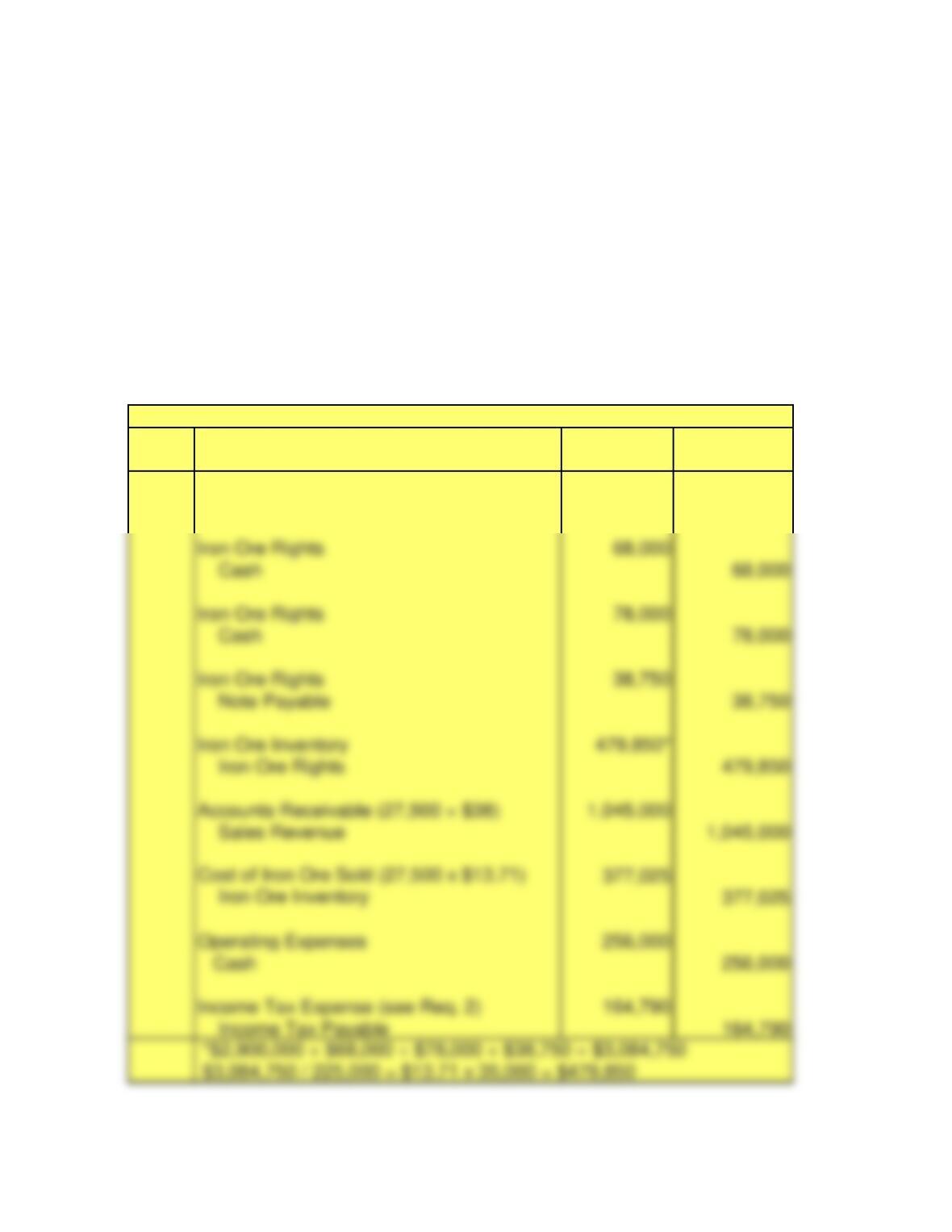
Iron Ore Rights
Cash 68,000
Iron Ore Rights
Cash 78,000
Iron Ore Rights
Note Payable 38,750
Iron Ore Inventory 479,850*
Iron Ore Rights 479,850
Accounts Receivable (27,500 × $38) 1,045,000
Sales Revenue 1,045,000
Operating Expenses 256,000
Cash 256,000
Income Tax Expense (see Req. 2) 164,790
Income Tax Payable 164,790
FINANCIAL ACCOUNTING – Eleventh Edition Solutions Manual
Req. 2
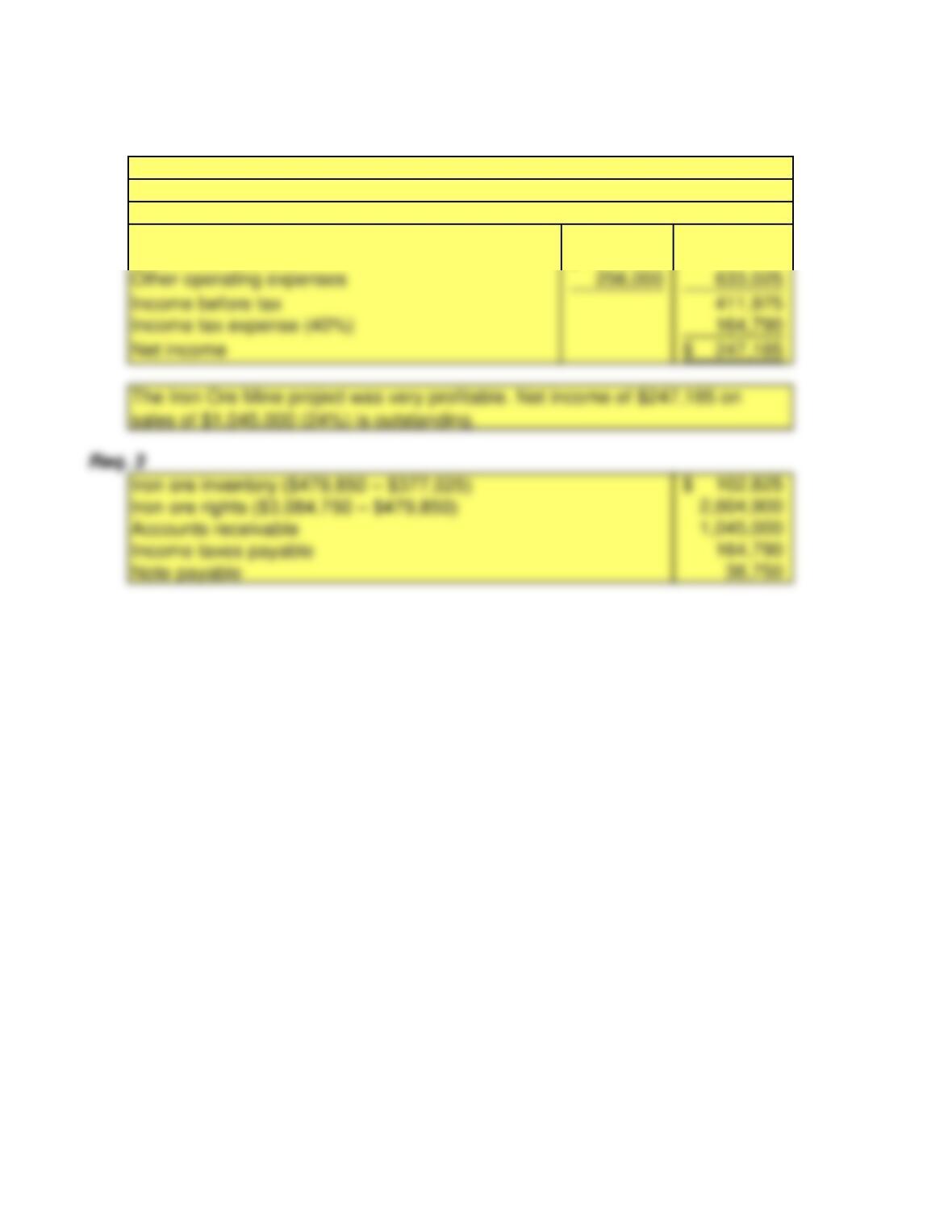
Sales revenue 1,045,000$
Cost of iron ore sold 377,025$
Northeastern Energy Company
Income Statement — Iron Ore Mine Project
Year 1
Chapter 7: Plant Assets, Natural Resources, and Intangibles Page 81 of 98
Req. 3
FINANCIAL ACCOUNTING – Eleventh Edition Solutions Manual
P7-81B
(30-40 min.)
Requirements
Solution:
Req. 1
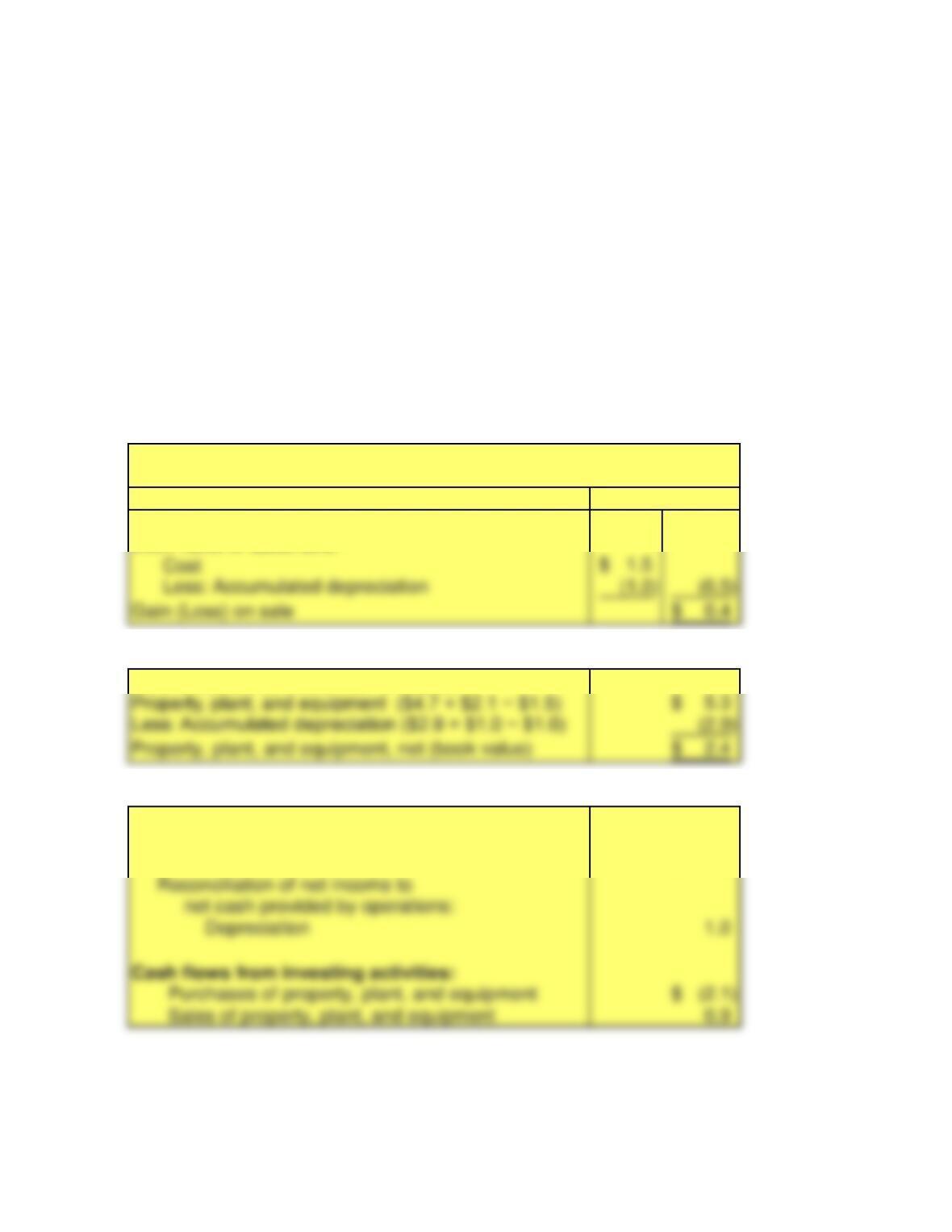
Cash received from sale of asset 0.9$
Book value of asset sold:
Req. 2
Req. 3
Statement of cash flows for 2016:
Cash flows from operating activities:
Net income ($26.8 − $22.0)
4.8$
1. Explain how to determine whether Standard Power had a gain or loss on the
sale of old plant assets during the year. What was the amount of the gain or
loss, if any?
2. Show how Standard Power would report property, plant, and equipment on the
balance sheet at December 31, 2016, after all the year’s activity. What was the
book value of property, plant, and equipment?
3 Show how Standard Power would report its operating activities and investing
To determine the gain or loss on the sale of a plant asset, compare the
cash received to the asset’s book value, as follows:
Billions
Balance sheet at December 31, 2016:
Chapter 7: Plant Assets, Natural Resources, and Intangibles Page 82 of 98
FINANCIAL ACCOUNTING – Eleventh Edition Solutions Manual
P7-82B
(20-30 min.)
Requirements
Solution:
Req. 1
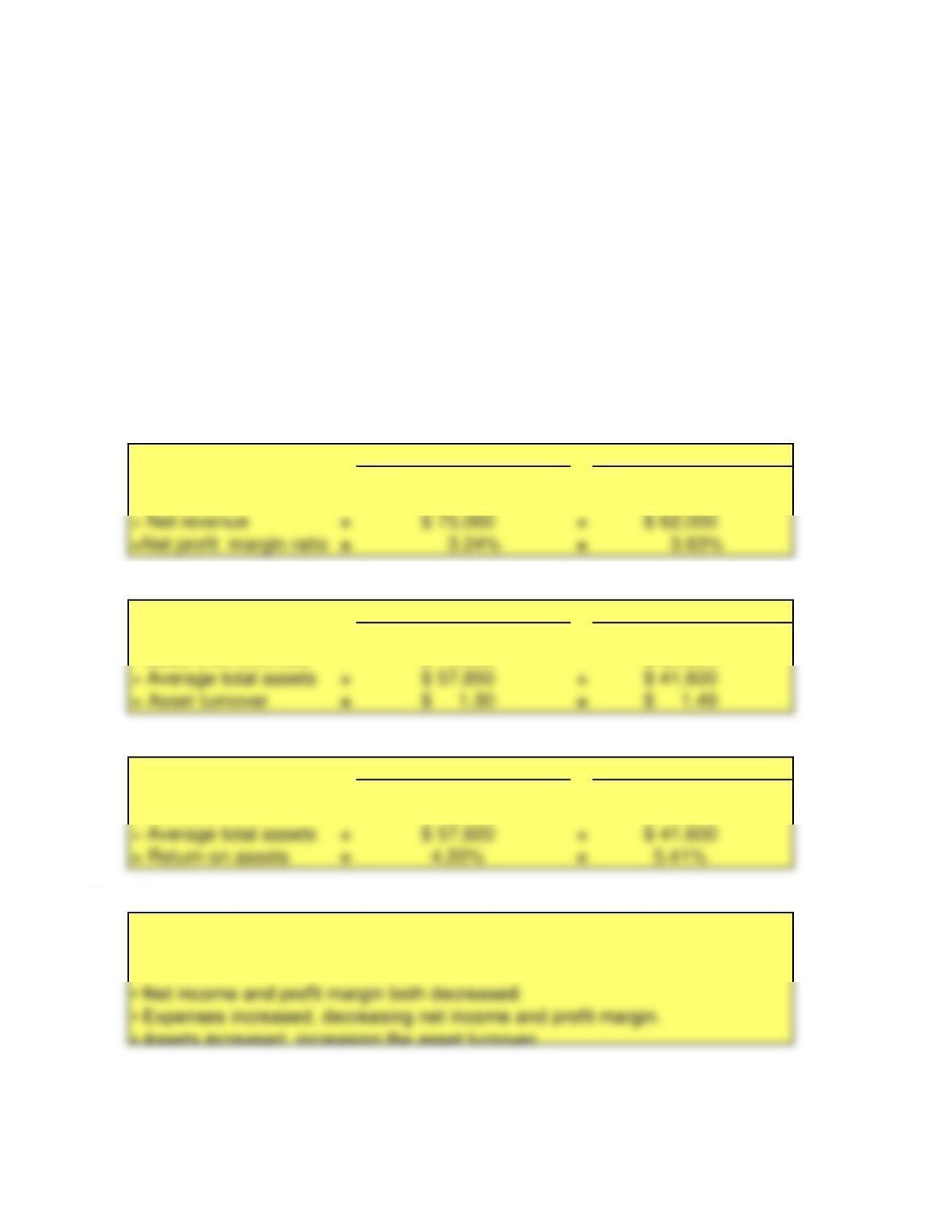
Net income 2,430$ 2,250$
Req. 2
Sales (net revenue) 75,000$ 62,000$
Req. 3
Net income 2,430$ 2,250$
Req. 4
1. Compute net profit margin ratio for Bargain Hut Corporation for the years
ended February 28, 2015, and February 28, 2014.
2. Compute asset turnover for Bargain Hut Corporation for the years ended
February 28, 2015, and February 28, 2014.
3. Compute return on assets for Bargain Hut Corporation for the years ended
February 28, 2015, and February 28, 2014.
4. What factors contributed to the change in return on assets during the year?
All of the following contributed to the decrease in ROA during the most recent
year:
Feb. 28, 2015
Feb. 28, 2014
Feb. 28, 2015
Feb. 28, 2014
Feb. 28, 2015
Feb. 28, 2014
Chapter 7: Plant Assets, Natural Resources, and Intangibles Page 83 of 98
FINANCIAL ACCOUNTING – Eleventh Edition Solutions Manual
P7-83B
(20-30 min.)
Requirements
Solution:
Req. 1
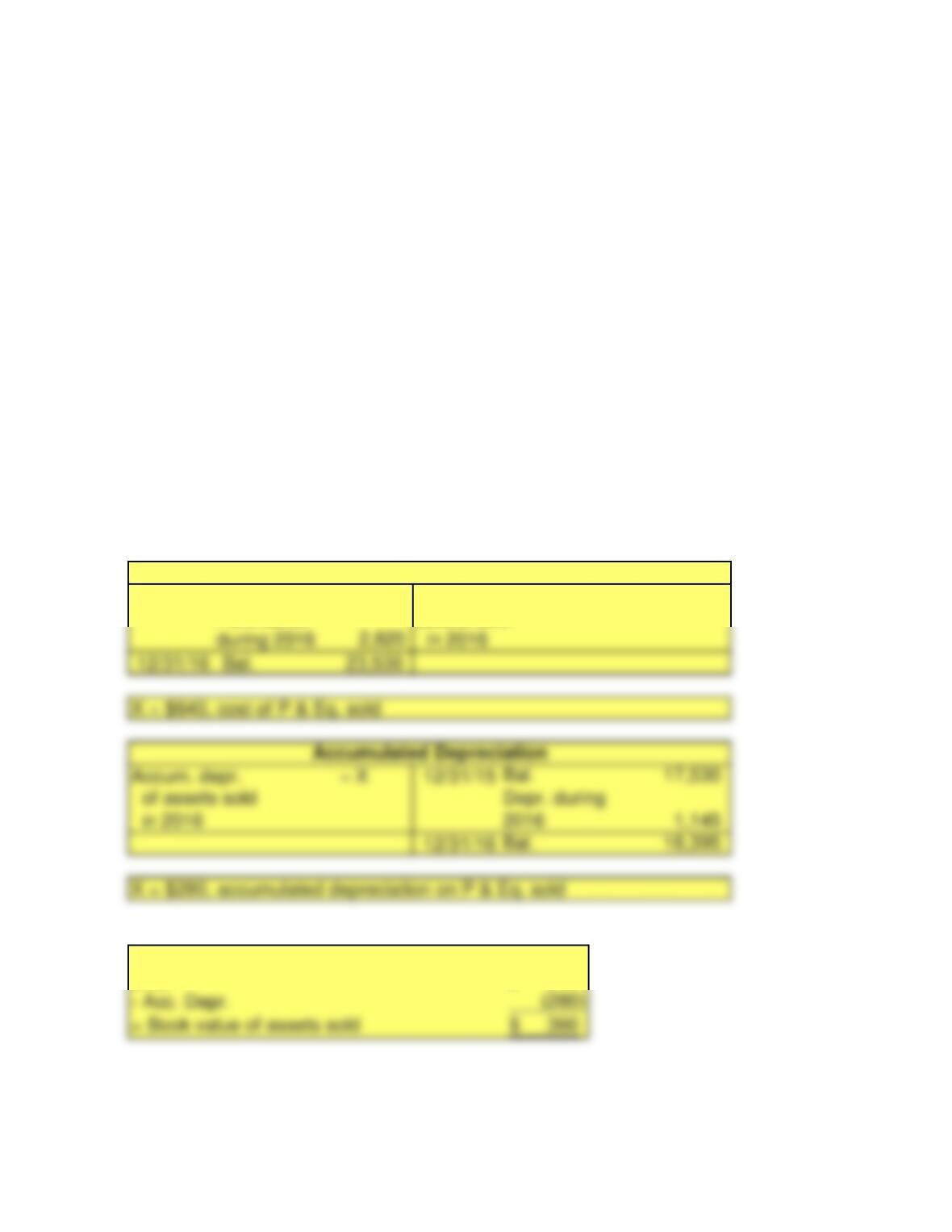
12/31/15 Bal. 21,350 X = Cost of
Purchased assets sold
Req. 2
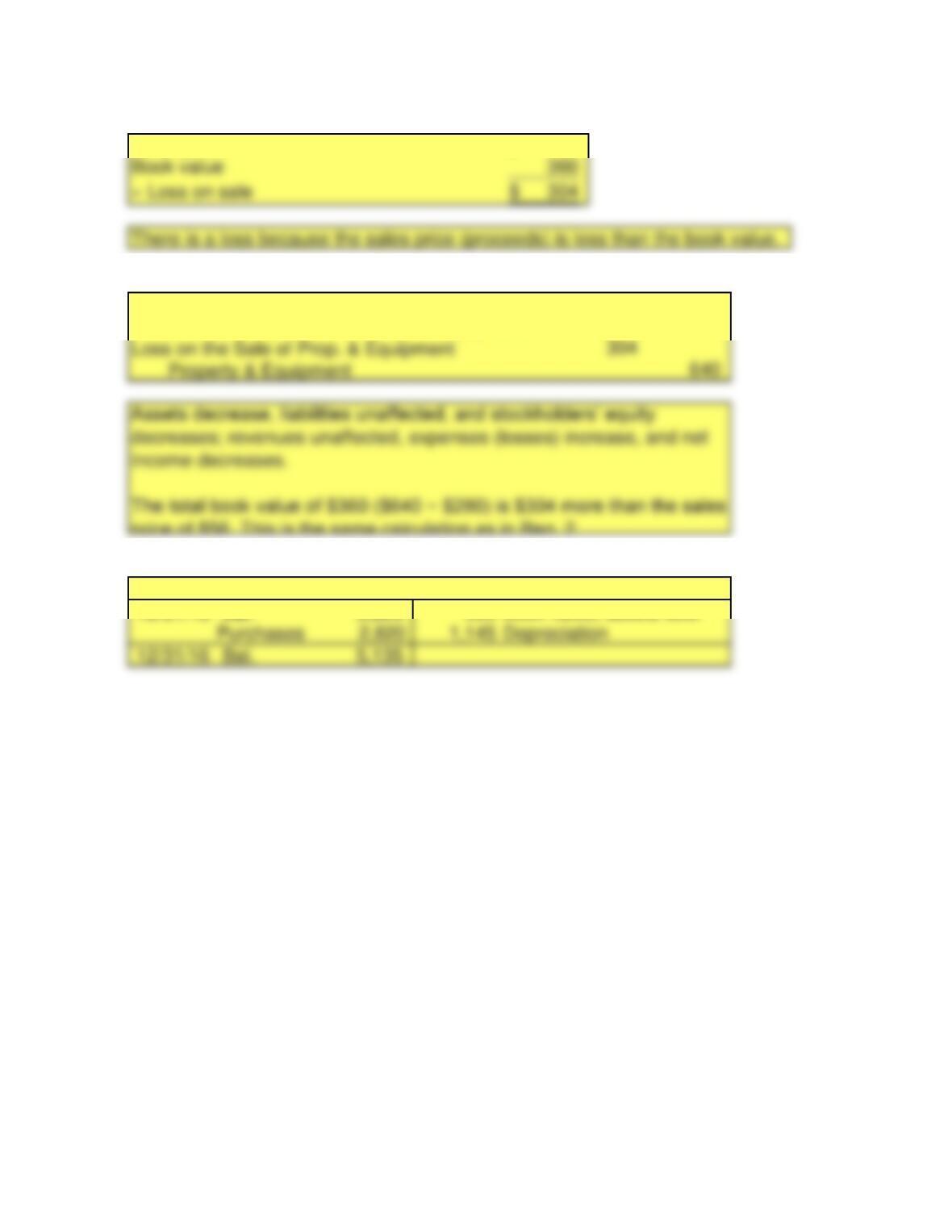
Cost 640$
1. Draw T-accounts for Property and Equipment and Accumulated Depreciation. Enter
information as presented and solve for the unknown in each account. (Hint: Recall the
types of transactions that make each of the two accounts increase and decrease. You
are solving for the cost of Property and Equipment sold and the Accumulated
Depreciation on those assets.)
2. Based on your calculations in requirement 1, calculate the book value of assets sold
during 2016. What is the difference between the sales price and the book value?
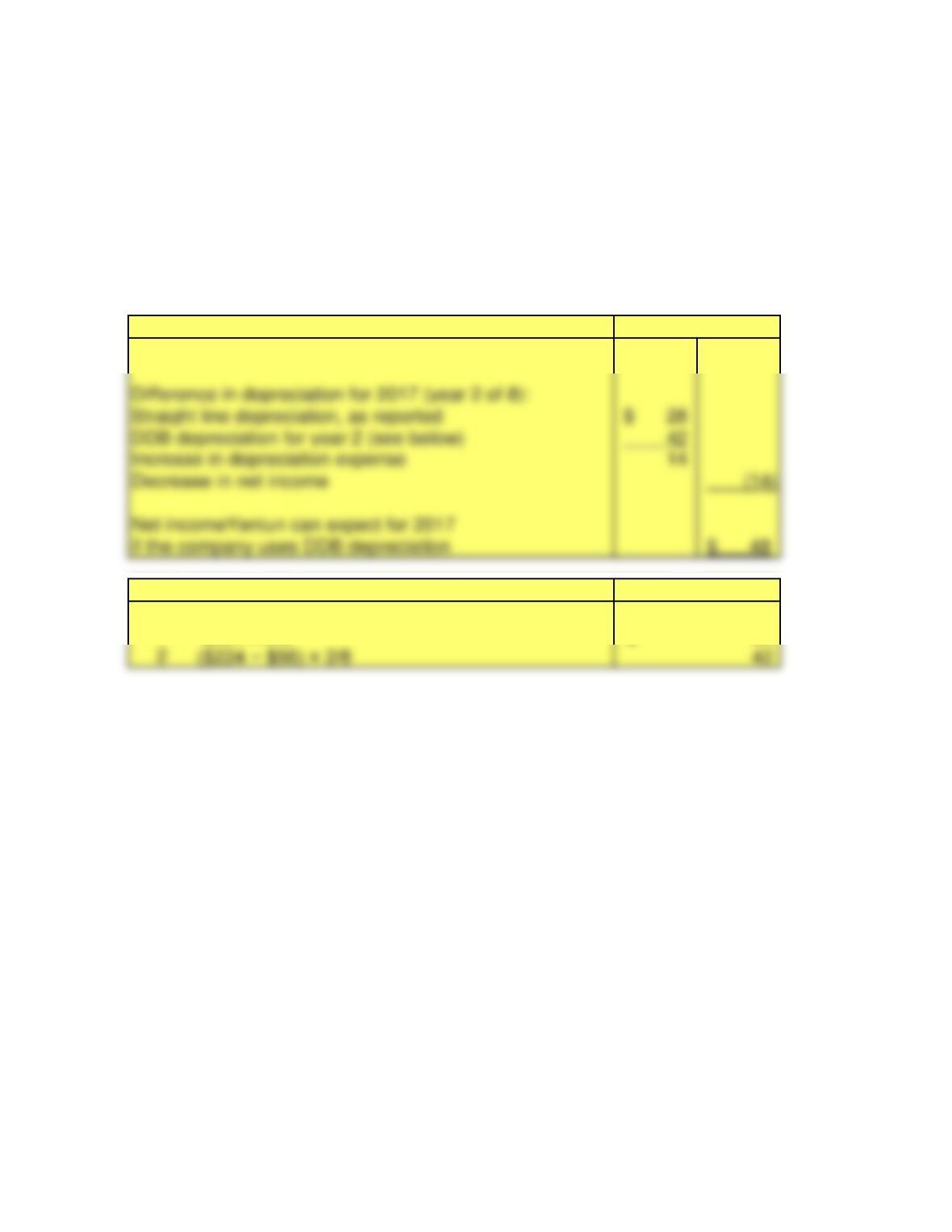
3. Prepare the journal entry for the sale of property and equipment during 2016.
Describe the effect of this transaction on the financial statements. Compare the sales
price and the book value in the journal entry, and compare this to the difference you
calculated in requirement 2. Describe briefly.
4. Prepare a T-account for Property and Equipment, Net. Repeat requirement 1.
Property & Equipment
Chapter 7: Plant Assets, Natural Resources, and Intangibles Page 84 of 98
FINANCIAL ACCOUNTING – Eleventh Edition Solutions Manual
Sales price 56$
Req. 3
56
Accumulated Depreciation – Prop. & Equipment 280
Loss on the Sale of Prop. & Equipment
Req. 4
Cash
Property & Equipment, net
Chapter 7: Plant Assets, Natural Resources, and Intangibles Page 85 of 98
There is a loss because the sales price (proceeds) is less than the book value.
FINANCIAL ACCOUNTING – Eleventh Edition Solutions Manual
E7-84
(15-20 min.)
Solution:
Net income under straight-line depreciation 62$
DDB depreciation by year:
Year
1
2
Millions
$224 × 2/8
$ 56
If Yentun had been using double-declining-balance method of depreciation all
along, how much net income can Yentun, Inc., expect to earn during 2017?
Ignore income tax.
Millions
Chapter 7: Plant Assets, Natural Resources, and Intangibles Page 86 of 98
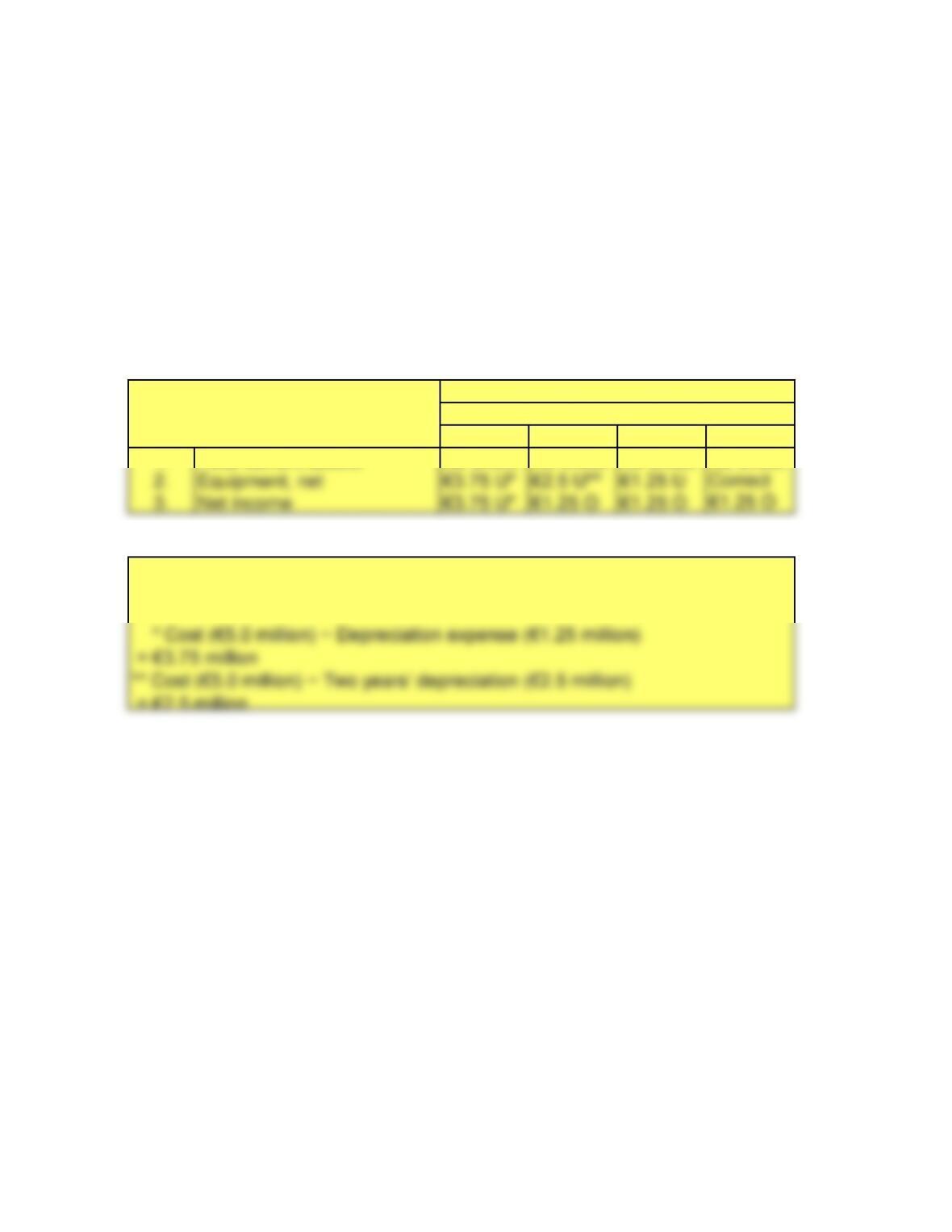
Difference in depreciation for 2017 (year 2 of 8):
Straight line depreciation, as reported 28$
DDB depreciation for year 2 (see below) 42
FINANCIAL ACCOUNTING – Eleventh Edition Solutions Manual
E7-85
(15-25 min.)
Requirements
Solution:
1 2 3 4
1. Total current assets No effect No effect No effect No effect
U = Understated
O = Overstated
Prepare a schedule to show the overstatement or understatement in the following items
at the end of each year over the four-year life of the equipment:
1. Total current assets
2. Equipment, net
3. Net income
Year
Millions of Euros (€)
Chapter 7: Plant Assets, Natural Resources, and Intangibles Page 87 of 98
2.
Equipment, net
FINANCIAL ACCOUNTING – Eleventh Edition Solutions Manual
E7-86
(20-30 min.)
Requirements
Solution:
Req. 1
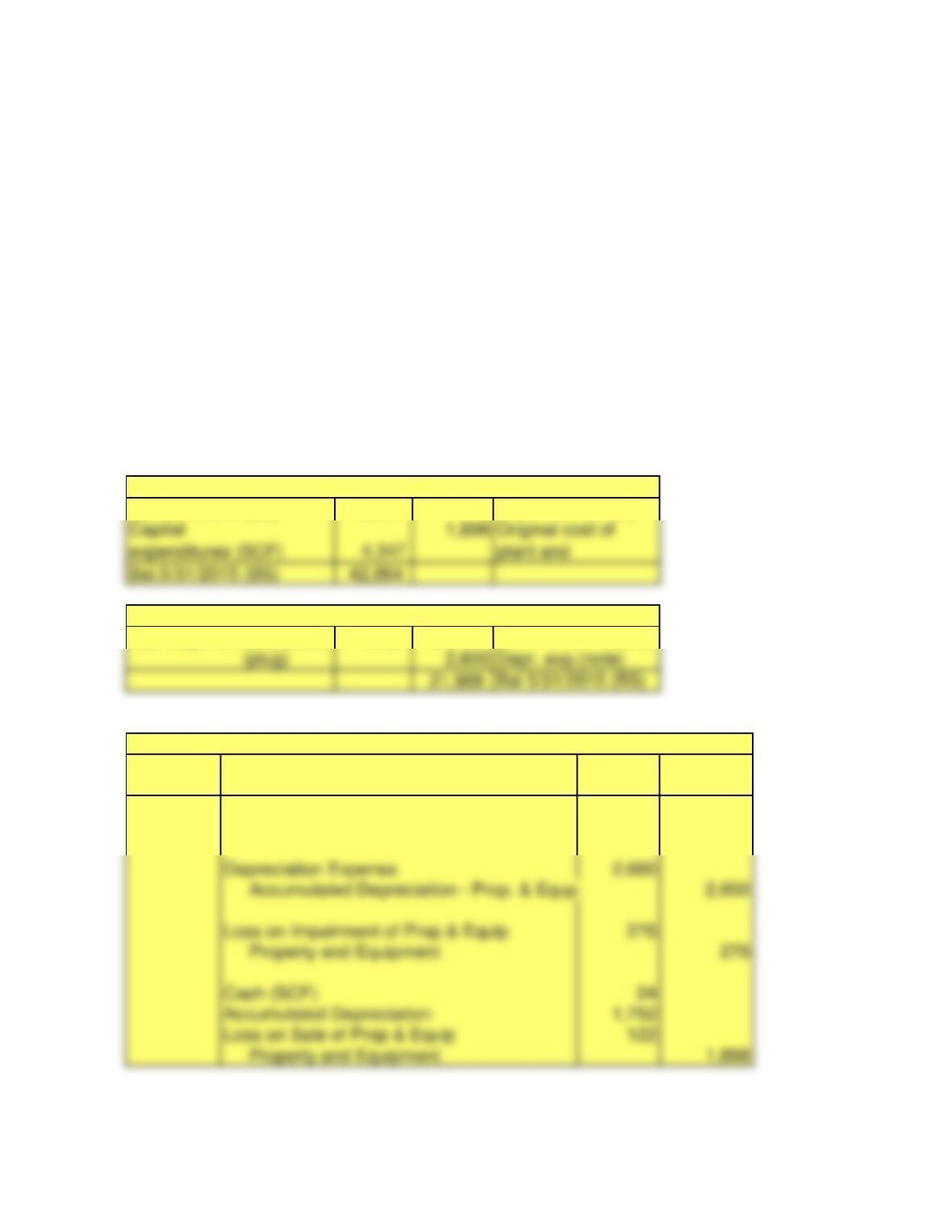
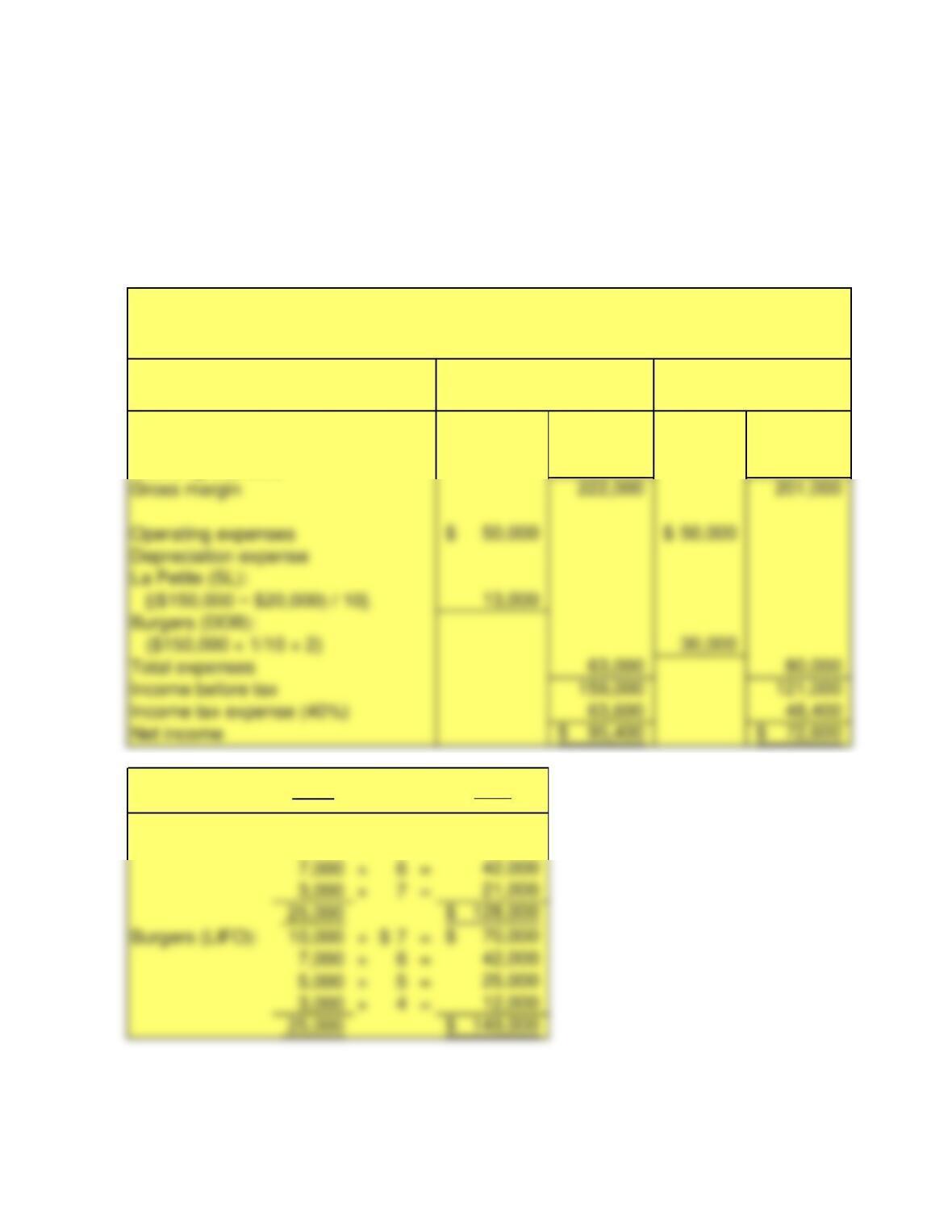
Bal 5/31/2014 (BS) 40,691 276 Impairment (note)
Acc. Depr. on assets sold 1,752 21,141 Bal. 5/31/2014 (BS)
Req. 2
Property and Equipment 4,347
Cash 4,347
Depreciation Expense 2,600
Accumulated Depreciation – Prop. & Equp. 2,600
Loss on Impairment of Prop & Equip 276
Property and Equipment 276
Cash (SCF) 24
Accumulated Depreciation 1,752
Loss on Sale of Prop & Equip 122
Property and Equipment 1,898
Accumulated Depreciation
(All amounts in millions)
1. Using the information provided from the balance sheet and statement of cash flows
for FedEx, reconstruct the Property and Equipment and Accumulated Depreciation
Accounts. You will not have to account for individual asset categories, but only for the
gross cost of property and equipment and accumulated depreciation. You will have to
solve for the original gross cost and accumulated depreciation of the plant and
equipment sold. Ignore business acquisitions for purposes of this part.
2.Prepare the journal entries to record total capital expenditures, total depreciation
expense, asset impairments, and total sales of property, plant, and equipment. You will
have to compute an implied gain or loss on equipment sold based on the information
given.
ACCOUNTS TITLES AND EXPLANATION
DEBIT
CREDIT
Journal
DATE
Property & Equipment
Chapter 7: Plant Assets, Natural Resources, and Intangibles Page 88 of 98
FINANCIAL ACCOUNTING – Eleventh Edition Solutions Manual
Decision Case 1
(30-45 min.)
Requirement 1
Solution:
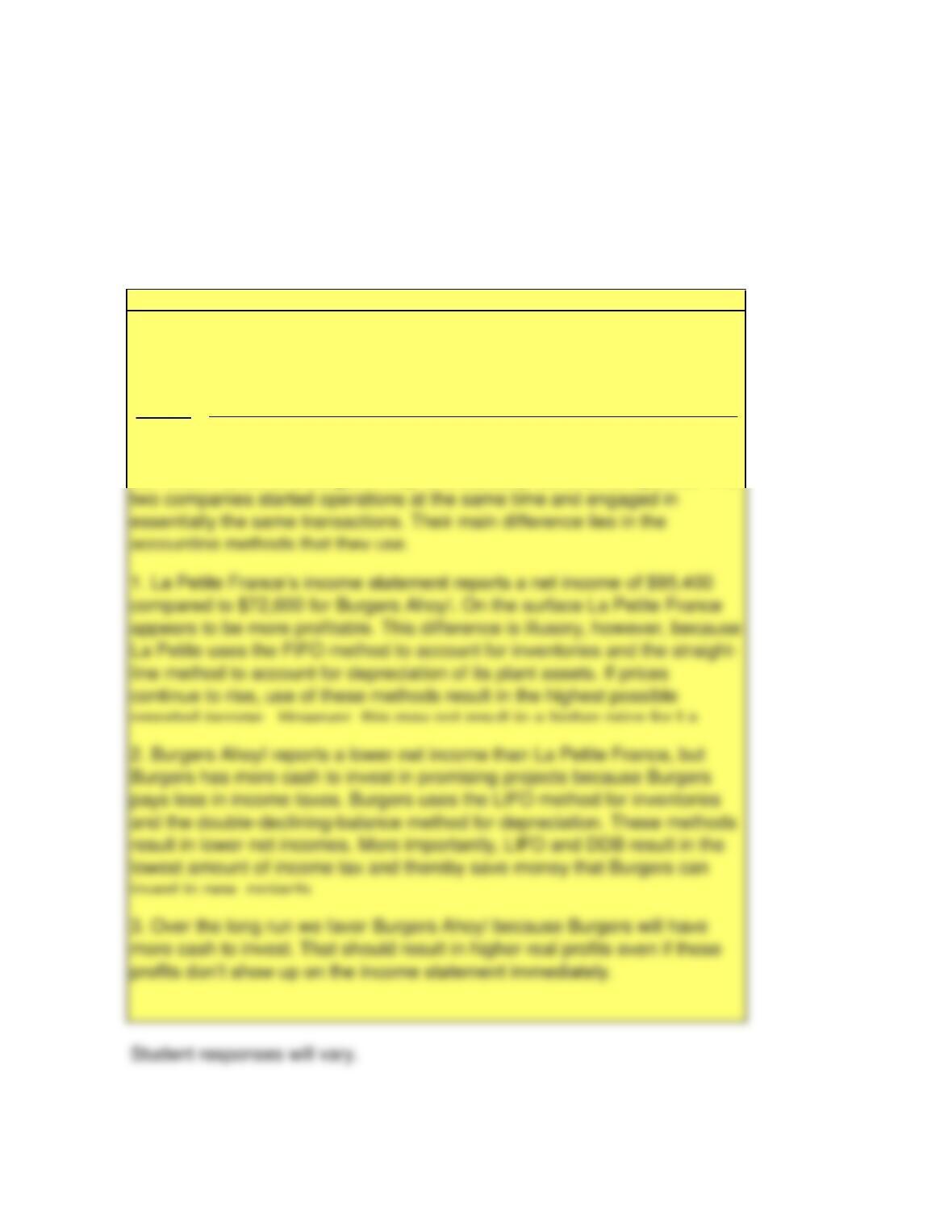
Sales revenue 350,000$ 350,000$
Cost of goods sold 128,000* 149,000*
La Petite (FIFO):
10,000 × 4$ = 40,000$
5,000 × 5 = 25,000
Burgers (LIFO): 10,000 × 7$ = 70,000$
Prepare both companies’ multiple-step income statements.
For the Year Ended December 31
Units
Cost
Income Statements
La Petite France Bakery and Burgers Ahoy!
(FIFO and SL)
La Petite France
(LIFO and DDB)
Burgers Ahoy!
ACCOUNT TITLE
*Cost of
goods sold:
Chapter 7: Plant Assets, Natural Resources, and Intangibles Page 89 of 98
Gross margin 222,000 201,000
Operating expenses 50,000$ 50,000$
Total expenses 63,000 80,000
Income before tax 159,000 121,000
Income tax expense (40%) 63,600 48,400
FINANCIAL ACCOUNTING – Eleventh Edition Solutions Manual
Requirement 2
Solution:
TO: Our Clients
FROM: Student Name
RE: Selecting the stock of La Petite France Bakery or Burgers Ahoy!
INVESTMENT NEWSLETTER
In picking a stock we suggest you consider the following factors:
La Petite France and Burgers Ahoy! are basically identical companies. The
as a long-term investment
Write an investment newsletter to address the following questions: Which
company appears to be more profitable? Which company has more cash to
invest in promising projects? If prices continue rising over the long term,
which company would you prefer to invest in? Why? (Challenge)
Chapter 7: Plant Assets, Natural Resources, and Intangibles Page 90 of 98
3. Over the long run we favor Burgers Ahoy! because Burgers will have
more cash to invest. That should result in higher real profits even if those
FINANCIAL ACCOUNTING – Eleventh Edition Solutions Manual
Decision Case 2
(20-30 min.)
Solution:
Student responses will vary.
1. The manager of Wired Connections Inc. regularly buys plant assets and debits
the cost to Repairs and Maintenance Expense. Why would he do that, since he
knows this action violates GAAP?
2. The manager of Alpine Homes debits the cost of repairs and maintenance of
plant assets to Plant and Equipment. Why would she do that, since she knows she
is violating GAAP?
3. It has been suggested that because many intangible assets have no value
except to the company that owns them, they should be valued at $1.00 or zero on
the balance sheet. Many accountants disagree with this view. Which view do you
support? Why?
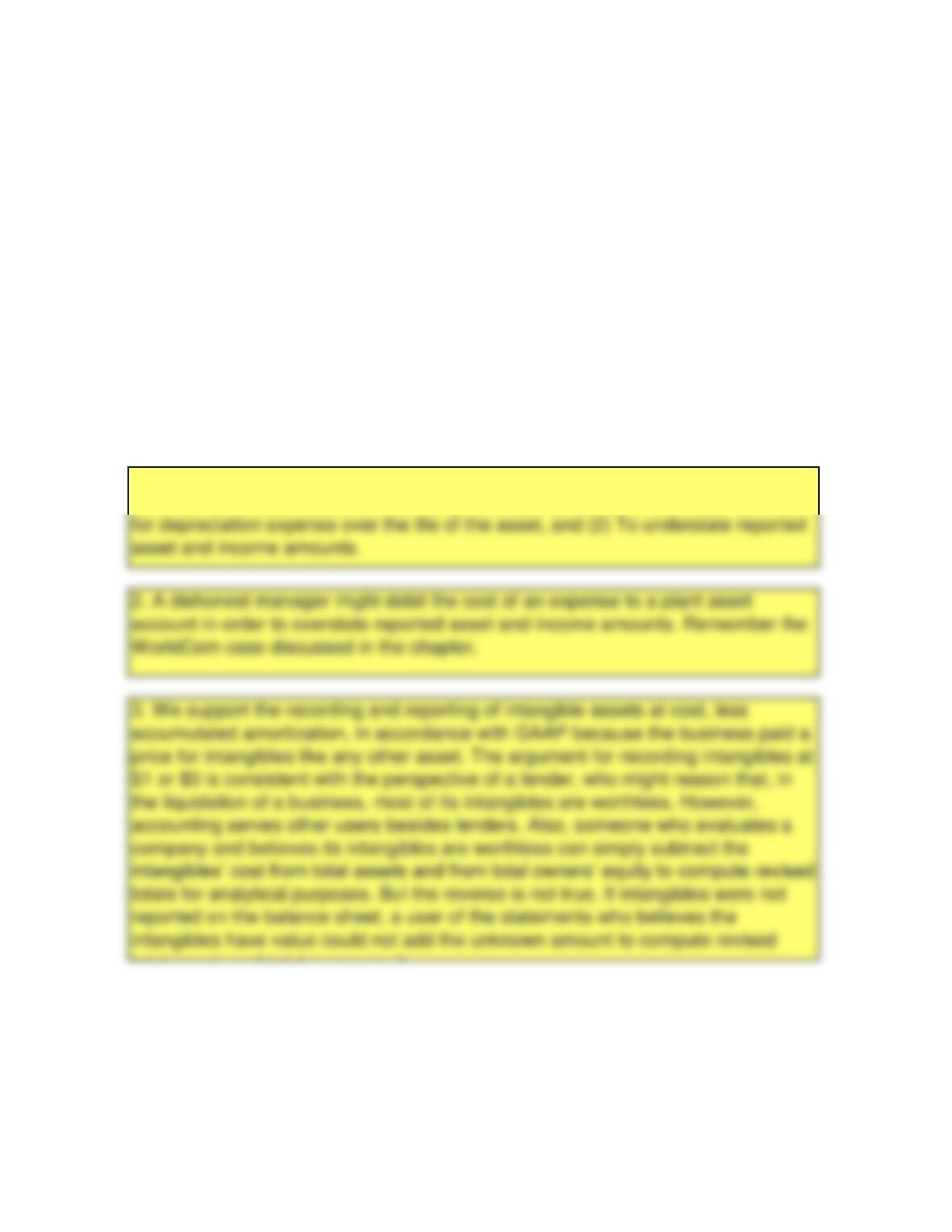
1. A dishonest manager might debit an expense account for the cost of a plant
asset for two reasons: (1) To obtain a quicker tax deduction for the expense than
Chapter 7: Plant Assets, Natural Resources, and Intangibles Page 91 of 98
FINANCIAL ACCOUNTING – Eleventh Edition Solutions Manual
Ethical Issues
Requirements
Solution:
Req. 1
Req. 2 and Req. 3
Req. 4
1. What is the ethical issue in this situation?
2. Who are the stakeholders? What are the possible consequences to each?
3. Analyze the alternatives from the following standpoints: (a) economic, (b)
legal, and (c) ethical.
4. What would you do? How would you justify your decision?
The ethical issue in this case is “What is the proper amount of the purchase
price to allocate to the land and the proper amount to allocate to the building?”
The taxpayer wants to allocate as much of the purchase price as possible to
The stakeholders in this situation include Dellroy National Bank, their
management, their shareholders, the Internal Revenue Service, creditors, and
taxpayers in general. The immediate economic consequences of the decision
Dellroy National Bank should change the allocation of their purchase price to
60% building and 40% land. In the long run, for fair and equitable treatment
Chapter 7: Plant Assets, Natural Resources, and Intangibles Page 92 of 98
FINANCIAL ACCOUNTING – Eleventh Edition Solutions Manual
Apple, Inc.
(30-40 min.)
Solution:
Req. 1
Req. 2
1. Refer to Note 1 and Note 3 of the Notes to Consolidated Financial Statements. What
kinds of assets are included in the Property, Plant and Equipment of Apple Inc.?
2. Refer to Note 1, Property, Plant and Equipment section. Which depreciation method
does Apple Inc., use for reporting to stockholders and creditors in the financial
statements? What type of depreciation method does the company probably use for
income tax purposes? Why is this method preferable for tax purposes?
3. Depreciation expense is embedded in operating expense accounts listed on the
income statement, so you can’t break out the actual figure for depreciation in that way.
Refer to the section on Property, Plant and Equipment in Note 1. How much was Apple
Inc.’s depreciation and amortization expense on plant assets during 2014? What did
this figure include? Now refer to Note 3—Consolidated Financial Statement Details.
How much was Apple Inc.’s accumulated depreciation on fixed assets at the end of
2014? Explain why accumulated depreciation exceeds depreciation expense for the
current year.
4. Refer to Notes 1 and 4 of the Notes to Consolidated Financial Statements. What are
Apple Inc.’s intangible assets? How does the company account for each of these
intangibles over its lifetime?
Property, Plant and Equipment includes buildings, land, machinery, equipment,
Note 1 states that the depreciation method used for the financial statements is the
straight-line method. Note 1 does not state the method used for income-tax purposes,
Chapter 7: Plant Assets, Natural Resources, and Intangibles Page 93 of 98
FINANCIAL ACCOUNTING – Eleventh Edition Solutions Manual
Req. 3
Depreciation (and amortization) expense $6,900
Accumulated depreciation and amortization $18,391
Req. 4
Apple Inc. reports goodwill of $4,616 million on its 2014 balance sheet, and acquired
intangible assets on the balance sheet, of $4,142 million. As explained in Notes 1 and 4
to the Consolidated Financial Statements, the company does not amortize goodwill and
Millions
Chapter 7: Plant Assets, Natural Resources, and Intangibles Page 94 of 98
FINANCIAL ACCOUNTING – Eleventh Edition Solutions Manual
Under Armour, Inc.
(20-30 min.)
Question 1
Solution:
Question 2
Solution:
Question 3
On the statement of cash flows, how much did Under Armour, Inc., pay for property and
equipment during 2014? In what section of the cash flows statement do you find this
amount?
Under Armour, Inc. paid $141 million for capital expenditures during fiscal 2014. They
Which depreciation method does Under Armour, Inc., use? Over what range of useful
lives
does Under Armour, Inc., depreciate various types of fixed assets? You can find
Depreciation and amortization are calculated using the straight-line method over the
following useful lives: 3-10 years for furniture, office equipment, software and plant
Review the information in Note 4 (Property and Equipment, Net). List the categories of
Under Armour, Inc.’s, property and equipment as of December 31, 2014, and
December 31, 2013. How much depreciation expense is included in the calculation of
net income for these two fiscal years? Does it appear that Under Armour, Inc.’s,
property and equipment was proportionately newer or older at the end of 2014 (vs.
2013)? Explain your answer. Challenge)
Chapter 7: Plant Assets, Natural Resources, and Intangibles Page 95 of 98
FINANCIAL ACCOUNTING – Eleventh Edition Solutions Manual
Solution:
Question 4
Solution:
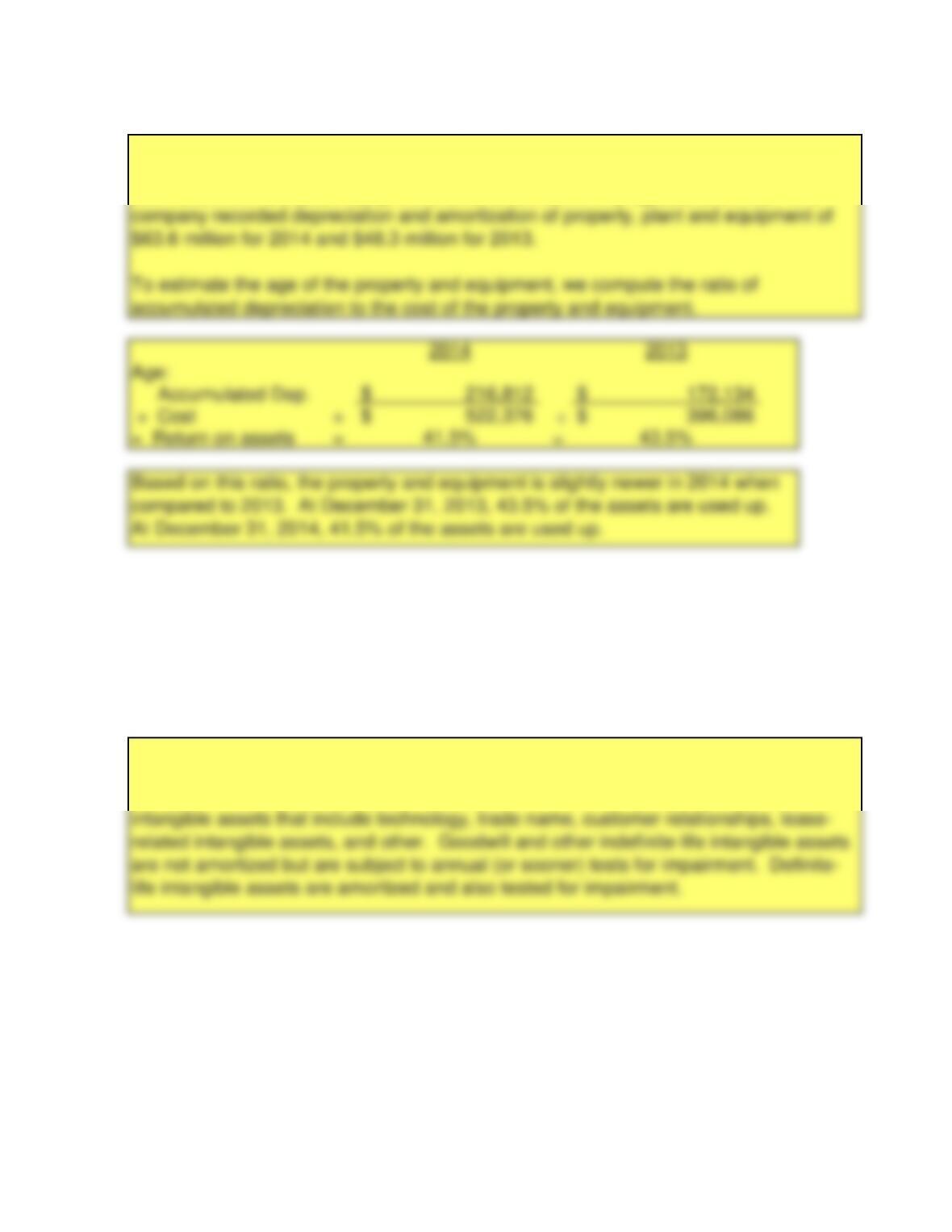
Under Armour includes the following categories in its property, plant and equipment:
leasehold and tenant improvements; furniture, fixtures, and displays; buildings;
software; office and plant equipment; land; construction in progress; and other. The
Examine Note 5 (Goodwill and Intangible Assets, Net) and Note 2. Briefly describe
Under
Armour, Inc.’s, accounting for goodwill and other intangible assets. What other types of
intangible assets did Under Armour, Inc., own as of December 31 2014?
Under Armour records intangibles when it acquires technology, customer relationships,
or another business. An increase in goodwill in 2014 came from an acquisition in other
foreign countries (not North American) of $1 million. The company lists definite-lived
Chapter 7: Plant Assets, Natural Resources, and Intangibles Page 96 of 98
FINANCIAL ACCOUNTING – Eleventh Edition Solutions Manual
Question 5
Solution:
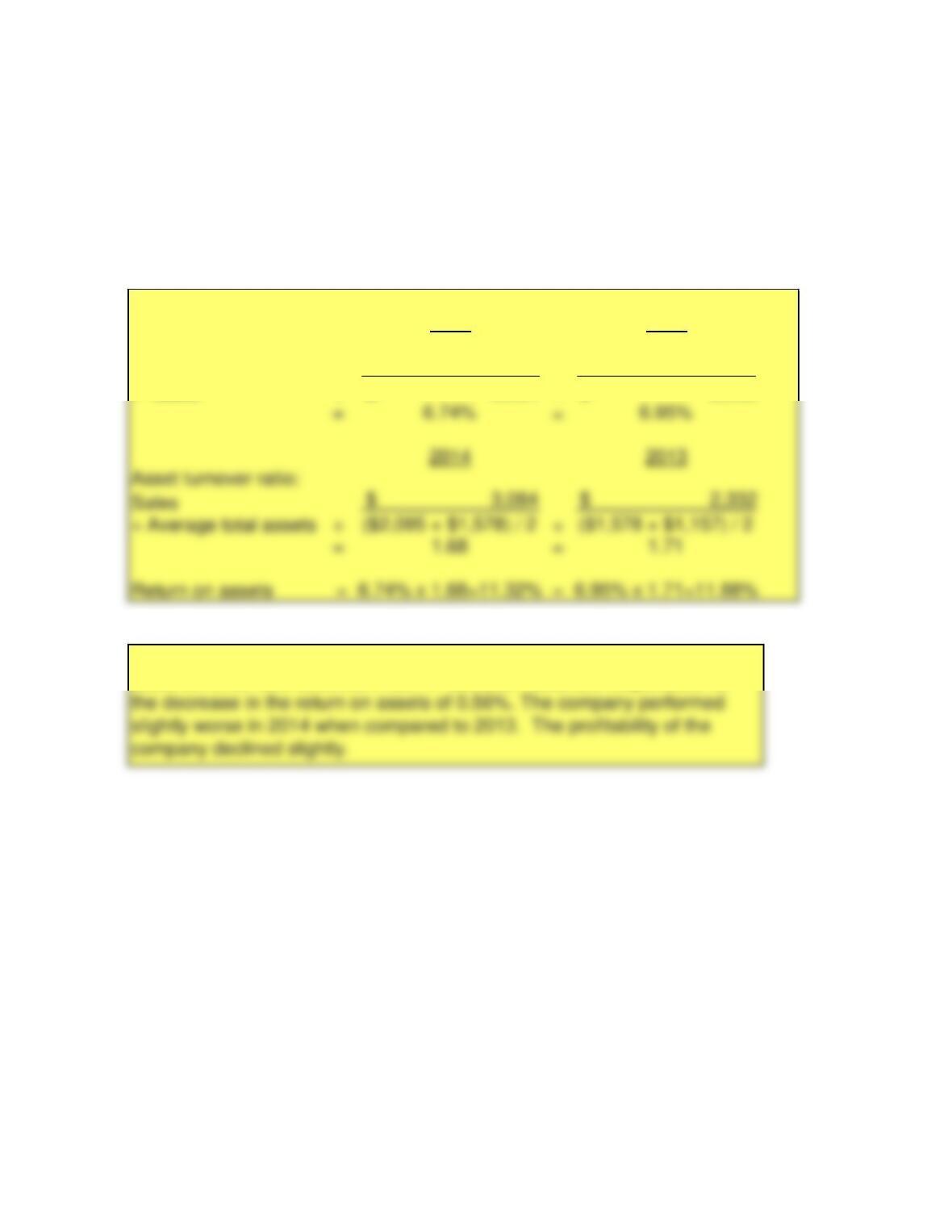
The Dupont formula:
Net profit margin ratio
Net income
÷ Sales ÷
÷
2013
From this analysis, we can see that both the net profit margin ratio and the
asset turnover ratio declined in 2014. So, both ratios are responsible for
Using DuPont Analysis, calculate Under Armour, Inc.’s, rate of return on total assets for
fiscal 2014 and fiscal 2013. Total assets at December 31, 2012 (the end of its 2012
fiscal year), were $1,157 million. Did the company perform better or worse in 2014 than
in 2013?
$ 3,084
$ 2,332
2014
$ 208
$ 162
Chapter 7: Plant Assets, Natural Resources, and Intangibles Page 97 of 98
Asset turnover ratio:
÷ Average total assets ÷ ÷
Return on assets = =
$ 3,084
$ 2,332
2014
2013

FINANCIAL ACCOUNTING – Eleventh Edition Solutions Manual
Group Project
Requirements
Solution:
Student responses will vary.
1. List all its plant assets.
2. If possible, interview the manager. Gain as much information as you can about
the business’s plant assets. For example, try to determine the assets’ costs, the
depreciation method the company is using, and the estimated useful life of each
asset category. If an interview is impossible, then develop your own estimates of
the assets’ costs, useful lives, and book values, assuming an appropriate
depreciation method.
3. Determine whether the business has any intangible assets. If so, list them and
gain as much information as possible about their nature, cost, and estimated
useful lives.
4. Write a detailed report of your findings and be prepared to present your results
to the class.
Chapter 7: Plant Assets, Natural Resources, and Intangibles Page 98 of 98