199
CHAPTER 7
FIXED ASSETS AND INTANGIBLE ASSETS
CLASS DISCUSSION QUESTIONS
1. Fixed assets have the following characteris-
tics:
(a) They exist physically and thus are tan-
gible assets.
2. a. Property, plant, and equipment
b. Current assets (merchandise inventory)
3. Real estate acquired as speculation should
be listed in the balance sheet under the cap-
tion “Investments,” below the Current Assets
section. Investments are long-lived assets
that are not used in the normal operations
and are held for future resale.
4. $475,000
7. a. Capital expenditure
b. Revenue expenditure (Note: Changing oil
is a normal maintenance expense.)
c. Capital expenditure
8. Ordinarily not; if the book values closely
approximate the market values of fixed as-
sets, it is coincidental. Depreciation does not
measure a decline in the market value of a
fixed asset. Instead, depreciation is an allo-
alent outlay of cash in the period to
which the expense is allocated.
b. Depreciation is the cost of fixed assets
periodically charged to revenue over
tion for all fixed assets.
b. No
12. a. An accelerated depreciation method is
most appropriate for situations in which
the decline in productivity or earning
power of the asset is proportionately
greater in the early years of use than in
later years, and the repairs tend to in-
crease with the age of the asset.
asset cannot exceed the cost of the as-
set. To do so would create a negative
book value, which is meaningless.
b. The cost and accumulated depreciation
should be removed from the accounts
when the asset is no longer useful and it
is removed from service. Presumably,
the asset will then be sold, traded in, or
discarded.
EXERCISES
E7–1
E7–2
a. Yes. All expenditures incurred for the purpose of making the land suitable for
its intended use should be recorded as an increase in the land account.
E7–3
Initial cost of land ($100,000 + $400,000) ……………… $500,000
E7–4
Capital expenditures: 3, 4, 5, 6, 7, 9, 10
Revenue expenditures: 1, 2, 8
E7–5
E7–6
a. No. The $8,300,000 represents the original cost of the equipment. Its replace-
E7–7
(a) 50% (1/2); (b) 25% (1/4); (c) 10% (1/10); (d) 5% (1/20); (e) 4% (1/25); (f) 2.5%
(1/40); (g) 2% (1/50)
E7–9
First Year Second Year
a. 2.5% of $240,000 = $6,000 2.5% of $240,000 = $6,000
E7–10
a. 5% of ($210,000 – $30,000) = $9,000, or [($210,000 – $30,000) ÷ 20]
202
E7–11
a. 20Y5: 3/12 × [($42,000 – $6,000) ÷ 10] = $900
E7–12
a.
Year 1 Year 2
Vehicles ………………………………………… $ 5,981 $ 5,519
Aircraft ………………………………………….. 14,616 14,063
Land ……………………………………………… 1,114 1,081
b. A comparison of Years 1 and 2 reveals that each category of asset increased
during Year 2. UPS expanded its operations during Year 2 by $1,321 ($36,541
– $35,220) from purchases of property, plant, and equipment. At the same
time, accumulated depreciation also increased by $1,087 ($18,920 – $17,833).
203
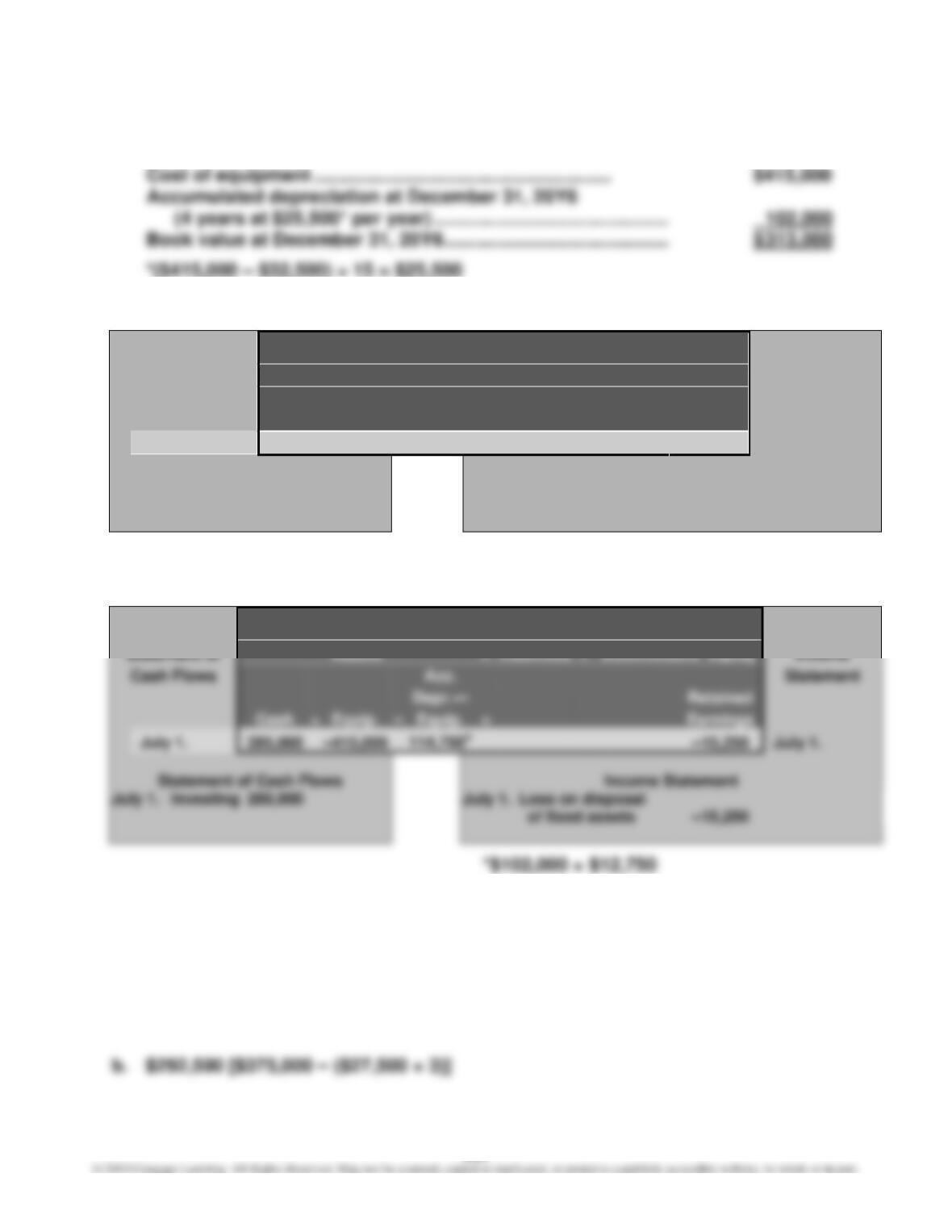
E7–13
a.
b. 1.
Balance Sheet
Statement of
Assets
=
Liabilities
+
Stockholders’ Equity
Income
Cash Flows
– Acc. Depr.—
Retained
Statement
Equipment
=
Earnings
July 1.
–12,750
–12,750
July 1.
Income Statement
July 1. Depr. expense
–12,750*
*$25,500 × 6/12
2.
Balance Sheet
Statement of
Income
–
Equip.
Earnings
July 1.
–15,250
July 1.
–15,250
E7–14
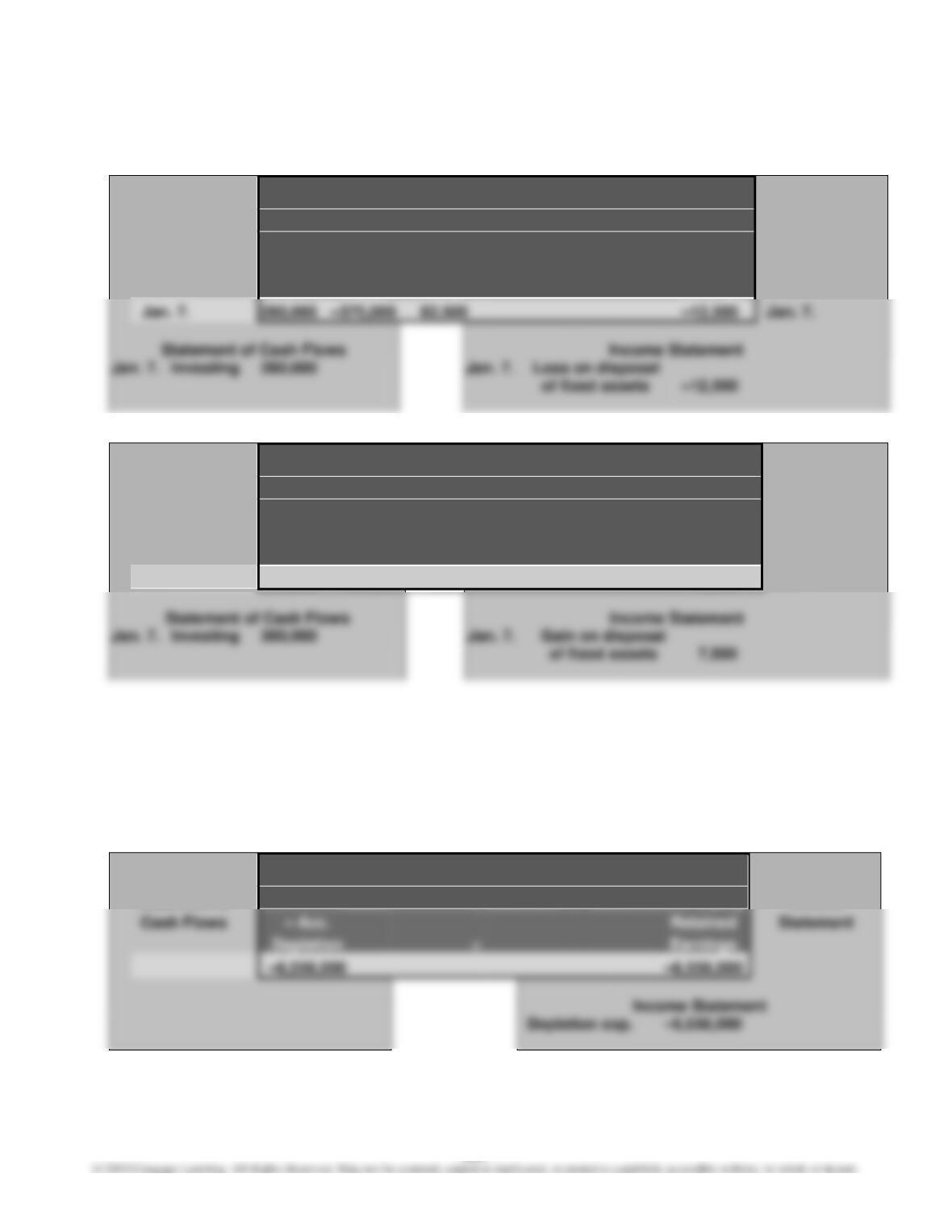
a. 20Y1 depreciation expense: $27,500 [($375,000 – $45,000) ÷ 12]
20Y2 depreciation expense: $27,500
20Y3 depreciation expense: $27,500
204
E7–14, Concluded
c.
Balance Sheet
Statement of
Assets
=
Liabilities
+
Stockholders’ Equity
Income
Cash Flows
Acc.
Statement
Depr.—
Retained
Cash
+
Equip.
–
Equip.
=
Earnings
Jan. 7.
280,000
–375,000
82,500
Jan. 7.
of fixed assets
–12,500
d.
Balance Sheet
Statement of
Assets
=
Liabilities
+
Stockholders’ Equity
Income
Cash Flows
Acc.
Statement
Depr.—
Retained
Cash
+
Equip.
–
Equip.
=
Earnings
Jan. 7.
300,000
–375,000
82,500
7,500
Jan. 7.
of fixed assets
7,500
E7–15
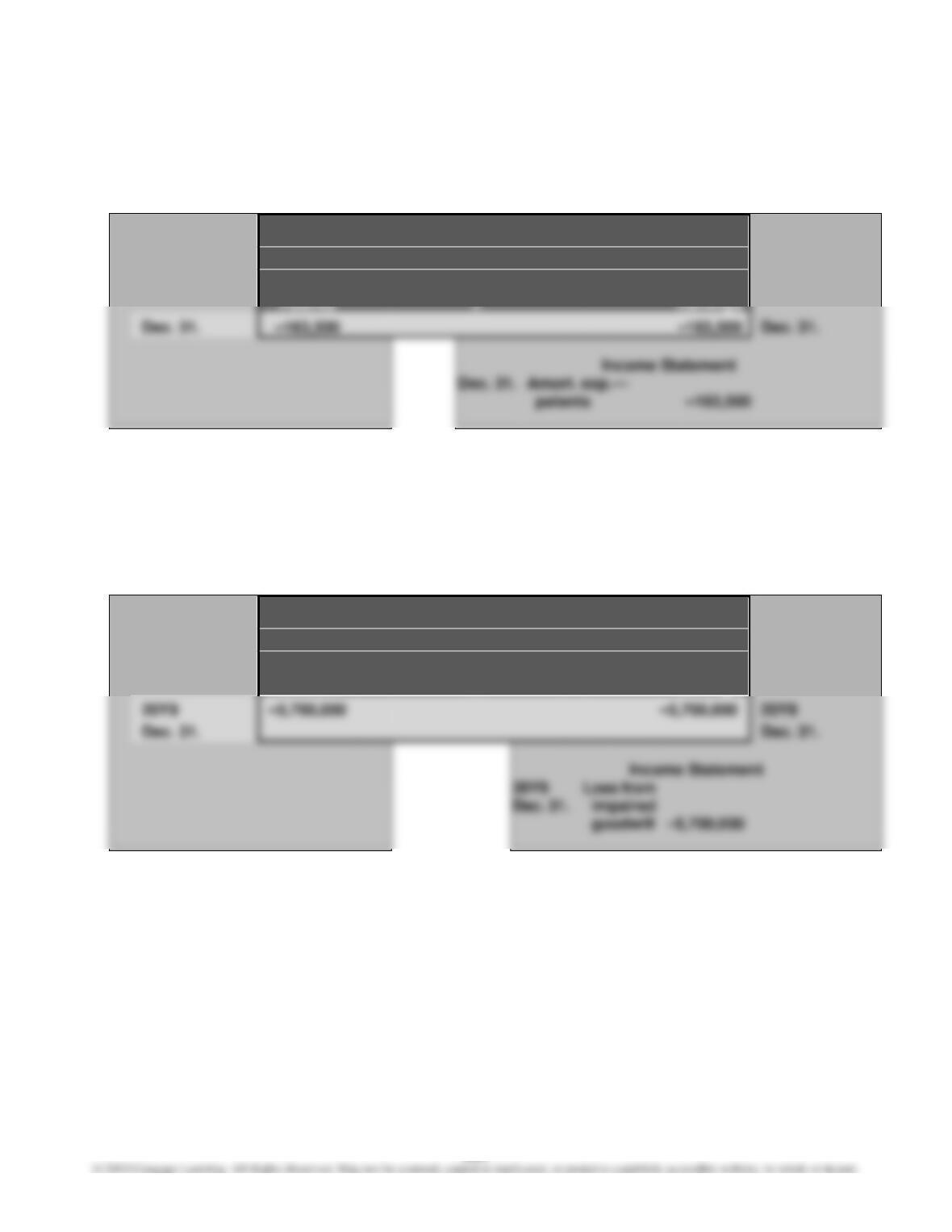
a. $16,500,000 ÷ 75,000,000 tons = $0.22 depletion per ton
29,800,000 × $0.22 = $6,556,000 depletion expense
b.
Balance Sheet
Statement of
Assets
=
Liabilities
+
Stockholders’ Equity
Income
Cash Flows
Retained
Statement
Depletion
=
Earnings
Depletion exp.
–6,556,000
205
E7–16
a. ($1,350,000 ÷ 10) + ($199,500 ÷ 7) = $163,500 total patent expense
b.
Balance Sheet
Statement of
Assets
=
Liabilities
+
Stockholders’ Equity
Income
Cash Flows
Retained
Statement
=
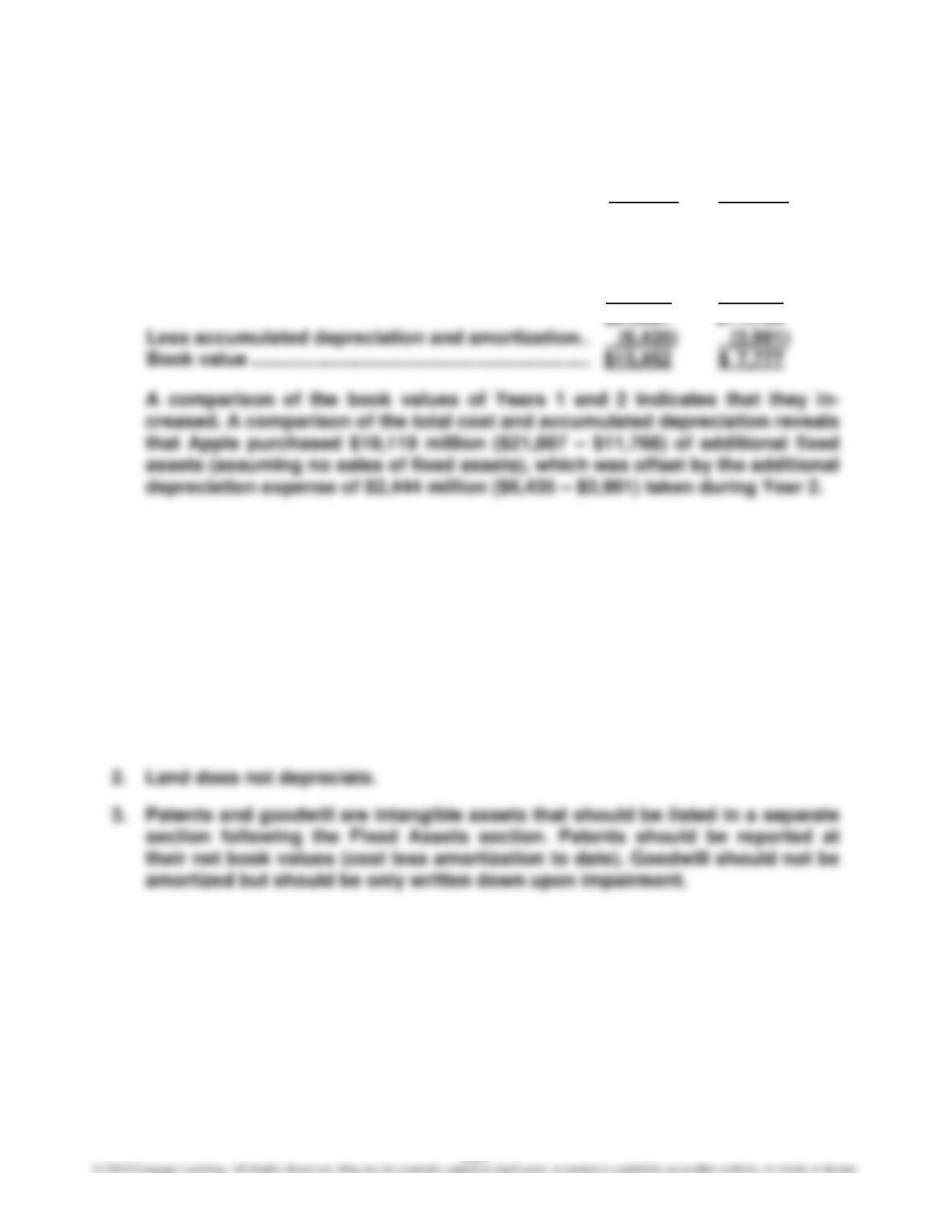
E7–17
a. $8,000,000. The goodwill is not amortized; thus, the book value of goodwill
has remained unchanged since originally recognized on January 1, 20Y3.
b.
Balance Sheet
Statement of
Assets
=
Liabilities
+
Stockholders’ Equity
Income
Cash Flows
Retained
Statement
Goodwill
=
Earnings
206
E7–18
a. Property, Plant, and Equipment (in millions):
Year 2 Year 1
Land and buildings ……………………………………………. $ 2,439 $ 2,059
Machinery, equipment, and internal-use software . 15,743 6,926
Office furniture and equipment ………………………….. 241 184
Other fixed assets related to leases …………………… 3,464 2,599
b. The book value of fixed assets should normally increase during the year.
Although additional depreciation expense will reduce the book value, most
companies invest in new assets in an amount that is at least equal to the
depreciation expense. However, during periods of economic downturn, com-
panies purchase fewer fixed assets, and the book value of their fixed assets
may decline.
E7–19
1. Fixed assets should be reported at cost and not replacement cost.
PROBLEMS
P7–1
1.
Land Other
Item Land Improvements Building Accounts
a. $ 75,000
b. $ 18,000
c. 12,500
d. $ 14,500
m. (775,000)*
n. 800,000
o. (4,500)*
p. 6,000
q. (6,500)*
r. (1,000)*
s. 9,000
2. $ 470,250 $ 26,500 $ 920,000
*Receipt
3. Since land used as a plant site does not lose its ability to provide services, it
208
P7–2
Depreciation Expense
a. Straight- b. Double-
Line Declining-Balance
Year Method Method
20Y4 $ 45,250 $ 95,000
20Y5 45,250 47,500
20Y6 45,250 23,750
20Y7 45,250 14,750*
Total $181,000 $ 181,000
P7–3
a. Straight-line method:
20Y5: [($16,200 – $900) ÷ 3] × 1/2 ……………………………………….. $ 2,550
20Y6: ($16,200 – $900) ÷ 3 …………………………………………………. 5,100
20Y7: ($16,200 – $900) ÷ 3 …………………………………………………. 5,100
20Y8: [($16,200 – $900) ÷ 3] × 1/2 ……………………………………….. 2,550
P7–4
1.
Accumulated
Depreciation Depreciation, Book Value,
Year Expense End of Year End of Year
a. 1 $32,500* $ 32,500 $ 107,500
2 32,500 65,000 75,000
3 32,500 97,500 42,500
2.
Balance Sheet
Statement of
Assets
=
Liabilities
+
Stockholders’ Equity
Income
Cash Flows
Acc.
Statement
Depr.—
Retained
Cash
+
Equip.
–
Equip.
=
Earnings
23,300
–140,000
122,500
5,800*
Statement of Cash Flows
Income Statement
Investing
23,300
Gain on disposal
of equipment
5,800
*[$23,300 – ($140,000 – $122,500)]
3.
Balance Sheet
Statement of
Assets
=
Liabilities
+
Stockholders’ Equity
Income
Cash Flows
Acc.
Statement
Depr.—
Retained
Cash
+
Equip.
–
Equip.
=
Earnings
Statement of Cash Flows
Income Statement
Investing
Loss on disposal
of equipment