7-1
CHAPTER 7
FLEXIBLE BUDGETS, DIRECT-COST VARIANCES,
AND MANAGEMENT CONTROL
7-1 Management by exception is the practice of concentrating on areas not operating as
expected and giving less attention to areas operating as expected. Variance analysis helps
managers identify areas not operating as expected. The larger the variance, the more likely an
area is not operating as expected.
7.2 Two sources of information about budgeted amounts are (a) past amounts and
(b) detailed engineering studies.
7-5 A flexible-budget analysis enables a manager to distinguish how much of the difference
between an actual result and a budgeted amount is due to (a) the difference between actual and
budgeted output levels, and (b) the difference between actual and budgeted selling prices,
variable costs, and fixed costs.
7-6 The steps in developing a flexible budget are:
Step 1: Identify the actual quantity of output.
Step 2: Calculate the flexible budget for revenues based on budgeted selling price and
actual quantity of output.
Step 3: Calculate the flexible budget for costs based on budgeted variable cost per output
unit, actual quantity of output, and budgeted fixed costs.
7-2
7-9 Possible causes of a favorable direct materials price variance are
• purchasing officer negotiated more skillfully than was planned in the budget.
• purchasing manager bought in larger lot sizes than budgeted, thus obtaining quantity
discounts.
lower quality materials).
7-10 Some possible reasons for an unfavorable direct manufacturing labor efficiency variance
are the hiring and use of underskilled workers; inefficient scheduling of work so that the
workforce was not optimally occupied; poor maintenance of machines resulting in a high
proportion of non-value-added labor; unrealistic time standards. Each of these factors would
result in actual direct manufacturing labor-hours being higher than indicated by the standard
work rate.
7-12 An individual business function, such as production, is interdependent with other
business functions. Factors outside of production can explain why variances arise in the
production area. For example:
• Poor design of products or processes can lead to a sizable number of defects.
• Marketing personnel making promises for delivery times that require a large number
of rush orders can create production-scheduling difficulties.
• Purchase of poor-quality materials by the purchasing manager can result in defects
and waste.
7-15 Evidence on the costs of other companies is one input managers can use in setting the
performance measure for next year. However, caution should be taken before choosing such an
amount as next year’s performance measure. It is important to understand why cost differences
7-3
across companies exist and whether these differences can be eliminated. It is also important to
examine when planned changes (in, say, technology) next year make even the current low-cost
producer not a demanding enough hurdle.
7-16 (20–30 min.) Flexible budget.
Brabham Enterprises manufactures tires for the Formula I motor racing circuit. For August 2014,
it budgeted to manufacture and sell 3,000 tires at a variable cost of $74 per tire and total fixed
costs of $54,000. The budgeted selling price was $110 per tire. Actual results in August 2014
were 2,800 tires manufactured and sold at a selling price of $112 per tire. The actual total
variable costs were $229,600, and the actual total fixed costs were $50,000.
Required:
1. Prepare a performance report (akin to Exhibit 7-2, page 253) that uses a flexible budget and a
static budget.
2. Comment on the results in requirement 1.
SOLUTION
7-4
7-17 (15 min.) Flexible budget.
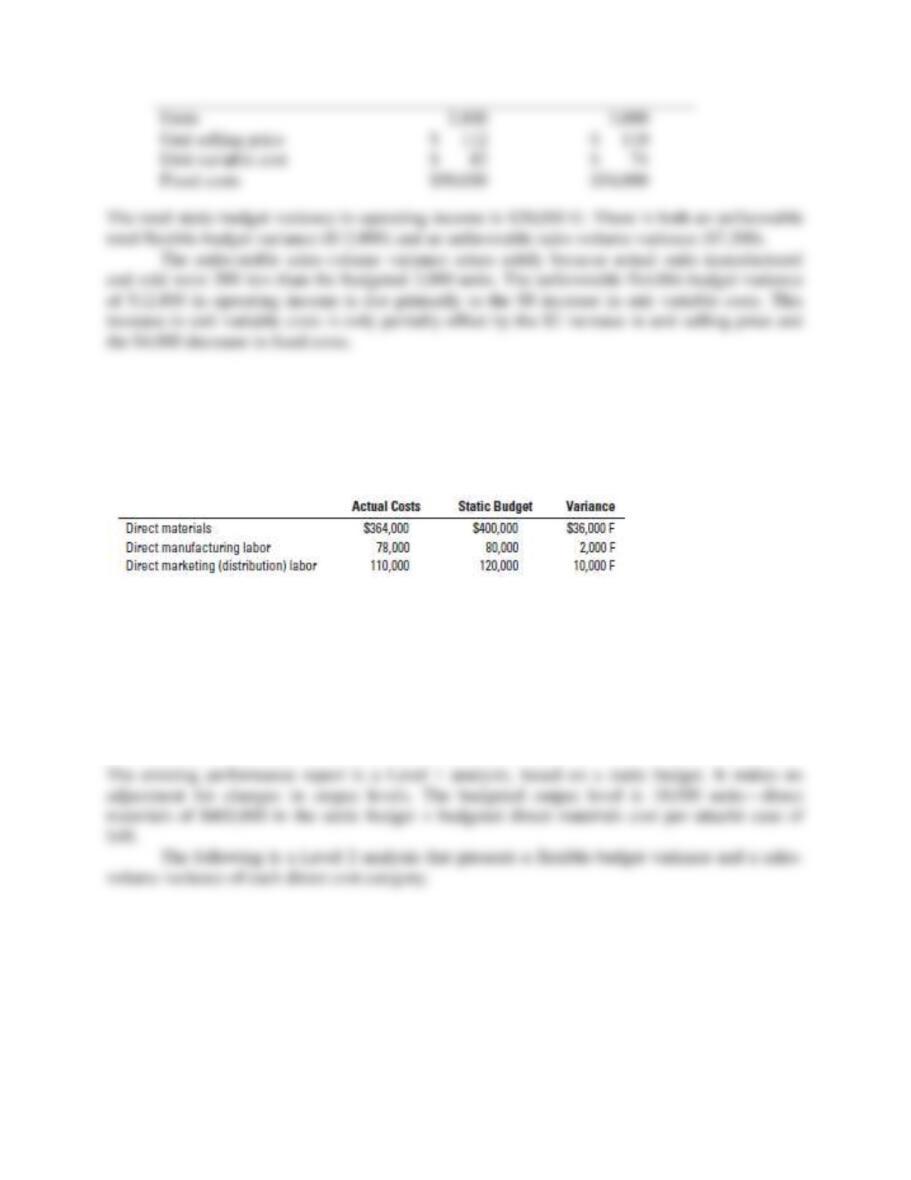
Connor Company’s budgeted prices for direct materials, direct manufacturing labor, and direct
marketing (distribution) labor per attaché case are $40, $8, and $12, respectively. The president
is pleased with the following performance report:
Required:
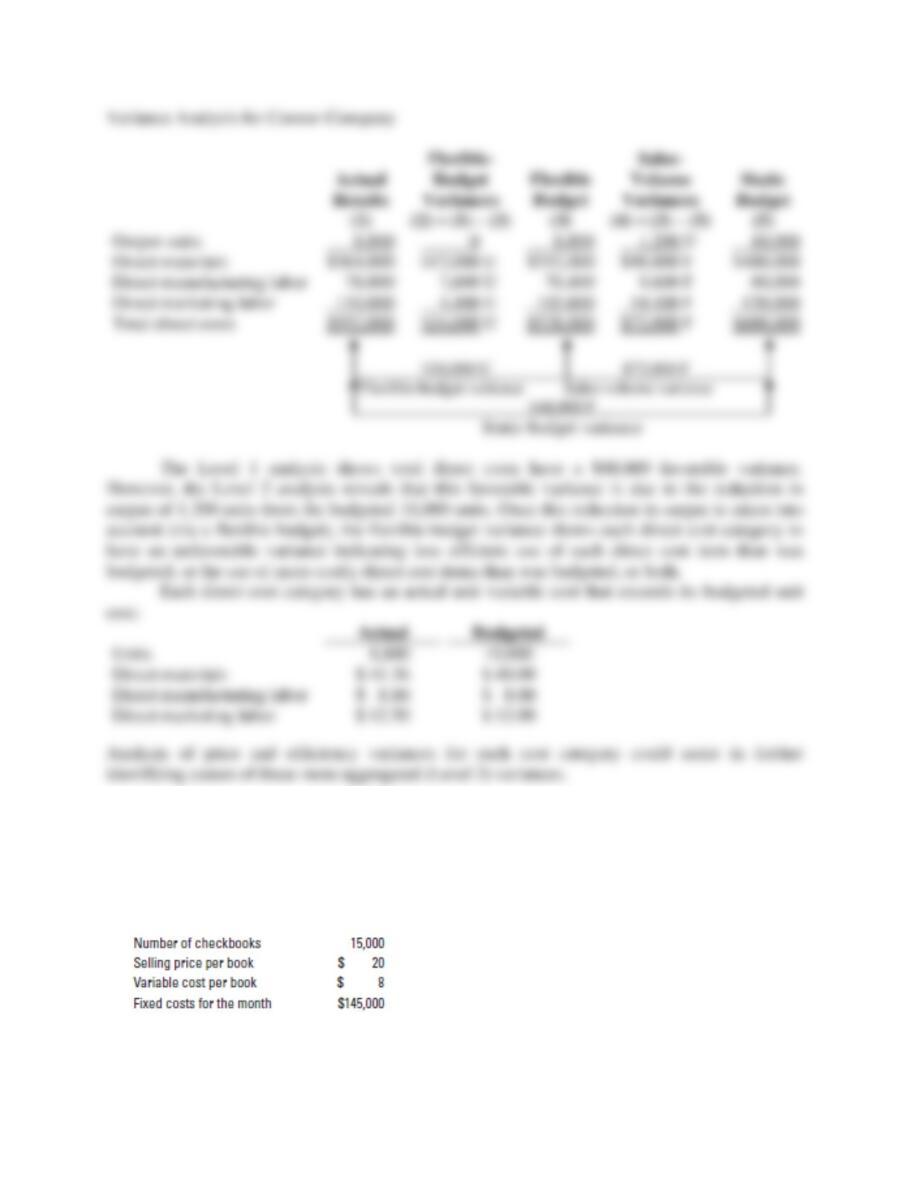
Actual output was 8,800 attaché cases. Assume all three direct-cost items shown are variable
costs.
Is the president’s pleasure justified? Prepare a revised performance report that uses a flexible
budget and a static budget.
SOLUTION
7-5
7-18 (25–30 min.) Flexible-budget preparation and analysis.
Bank Management Printers, Inc., produces luxury checkbooks with three checks and stubs per
page. Each checkbook is designed for an individual customer and is ordered through the
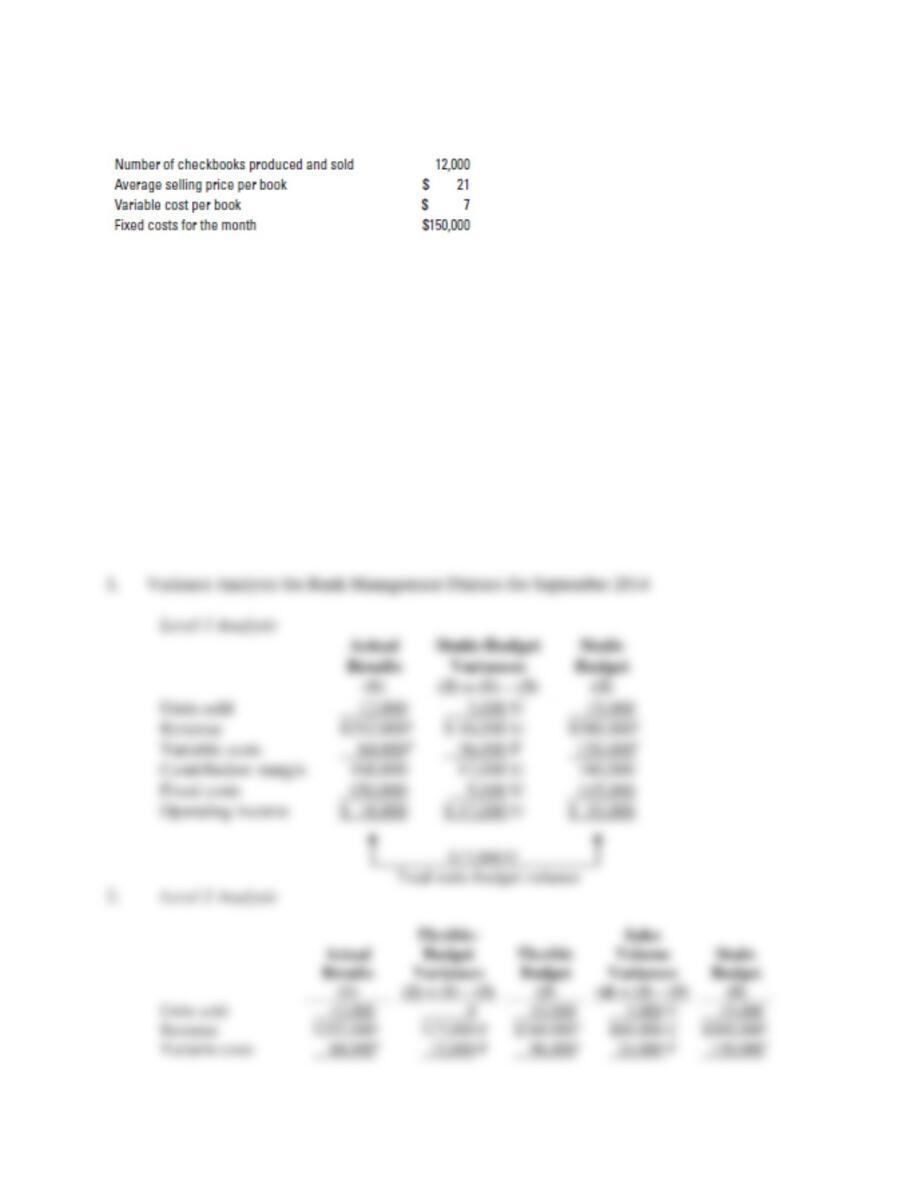
customer’s bank. The company’s operating budget for September 2014 included these data:
7-6
The actual results for September 2014 were as follows:
The executive vice president of the company observed that the operating income for September
was much lower than anticipated, despite a higher-than-budgeted selling price and a lower-than-
budgeted variable cost per unit. As the company’s management accountant, you have been asked
to provide explanations for the disappointing September results.
Bank Management develops its flexible budget on the basis of budgeted per-output-unit
revenue and per-output-unit variable costs without detailed analysis of budgeted inputs.
Required:
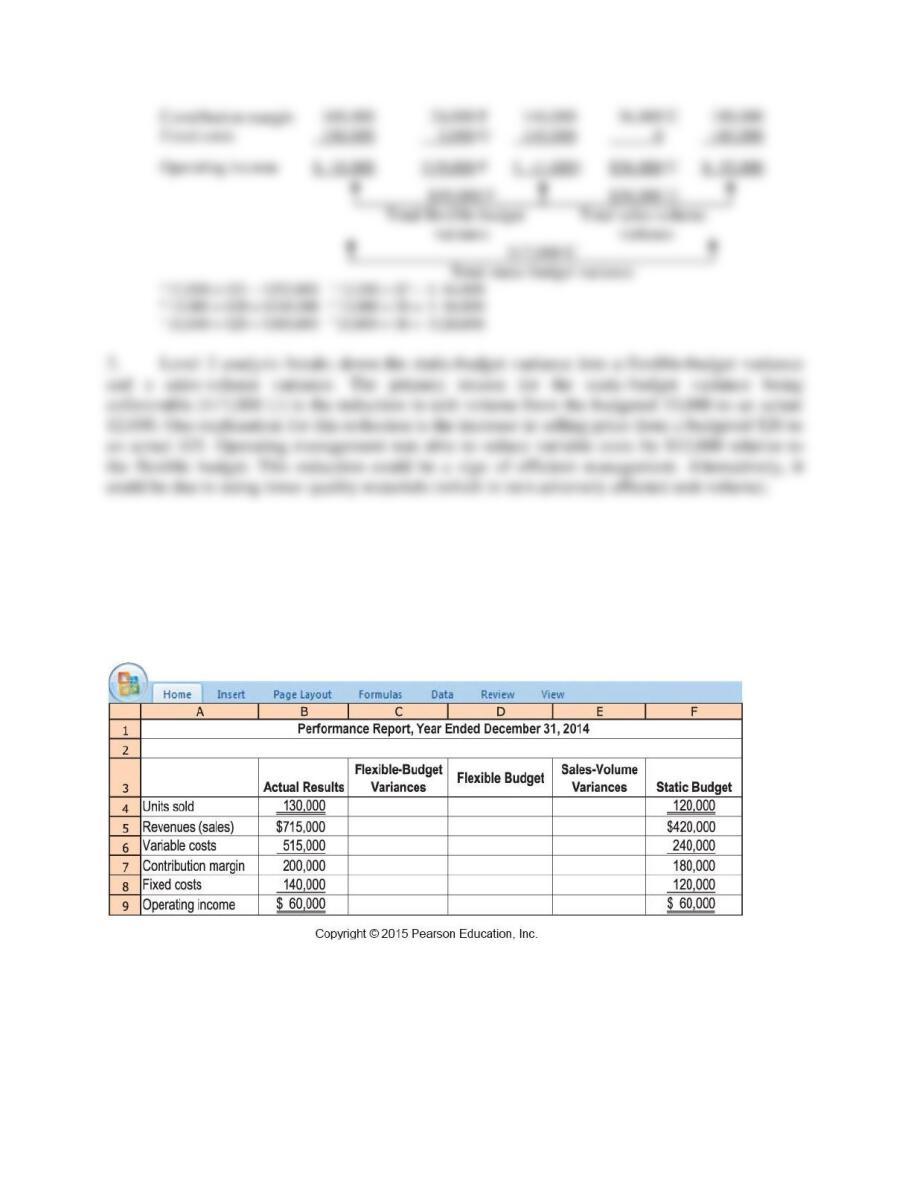
1. Prepare a static-budget-based variance analysis of the September performance.
2. Prepare a flexible-budget-based variance analysis of the September performance.
3. Why might Bank Management find the flexible-budget-based variance analysis more
informative than the static-budget-based variance analysis? Explain your answer.
SOLUTION
7-7
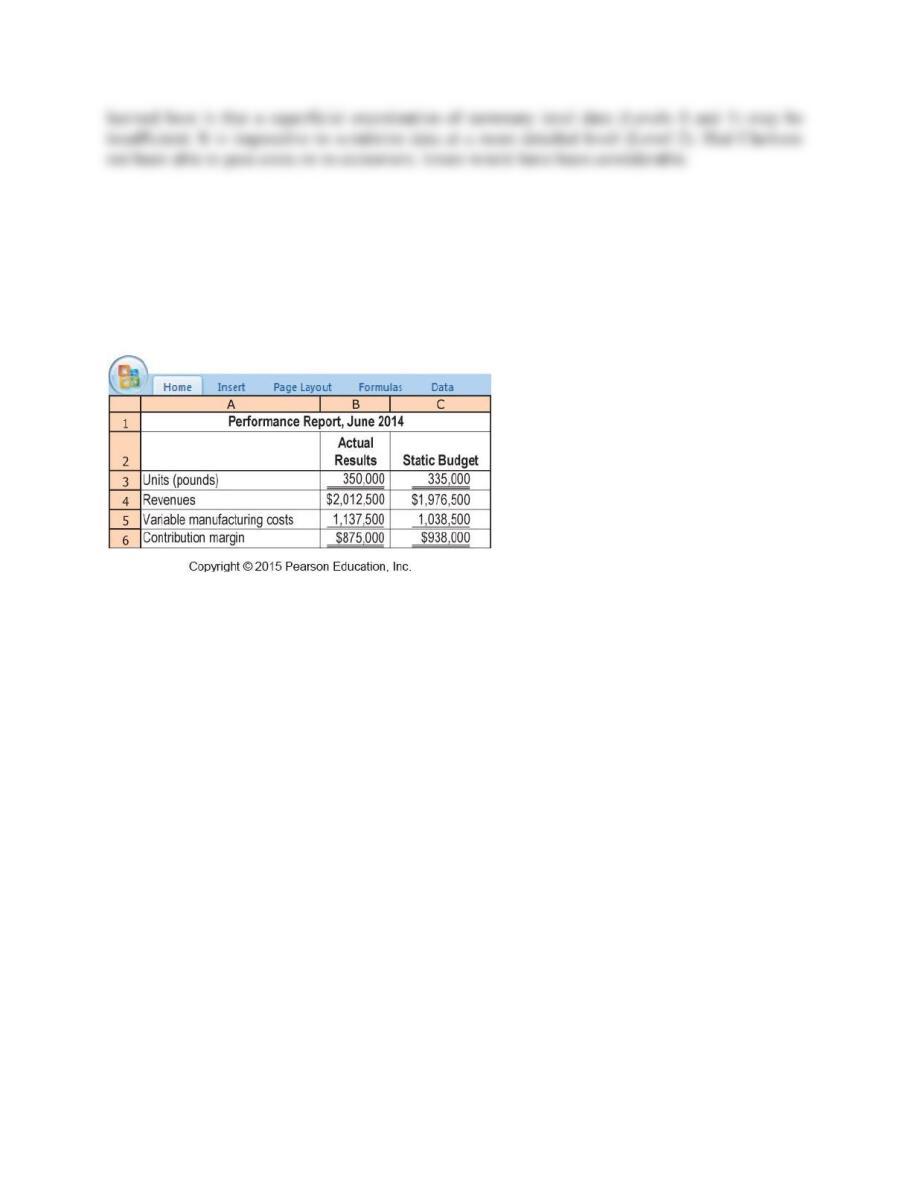
7-19 (30 min.) Flexible budget, working backward.
The Clarkson Company produces engine parts for car manufacturers. A new accountant intern at
Clarkson has accidentally deleted the calculations on the company’s variance analysis
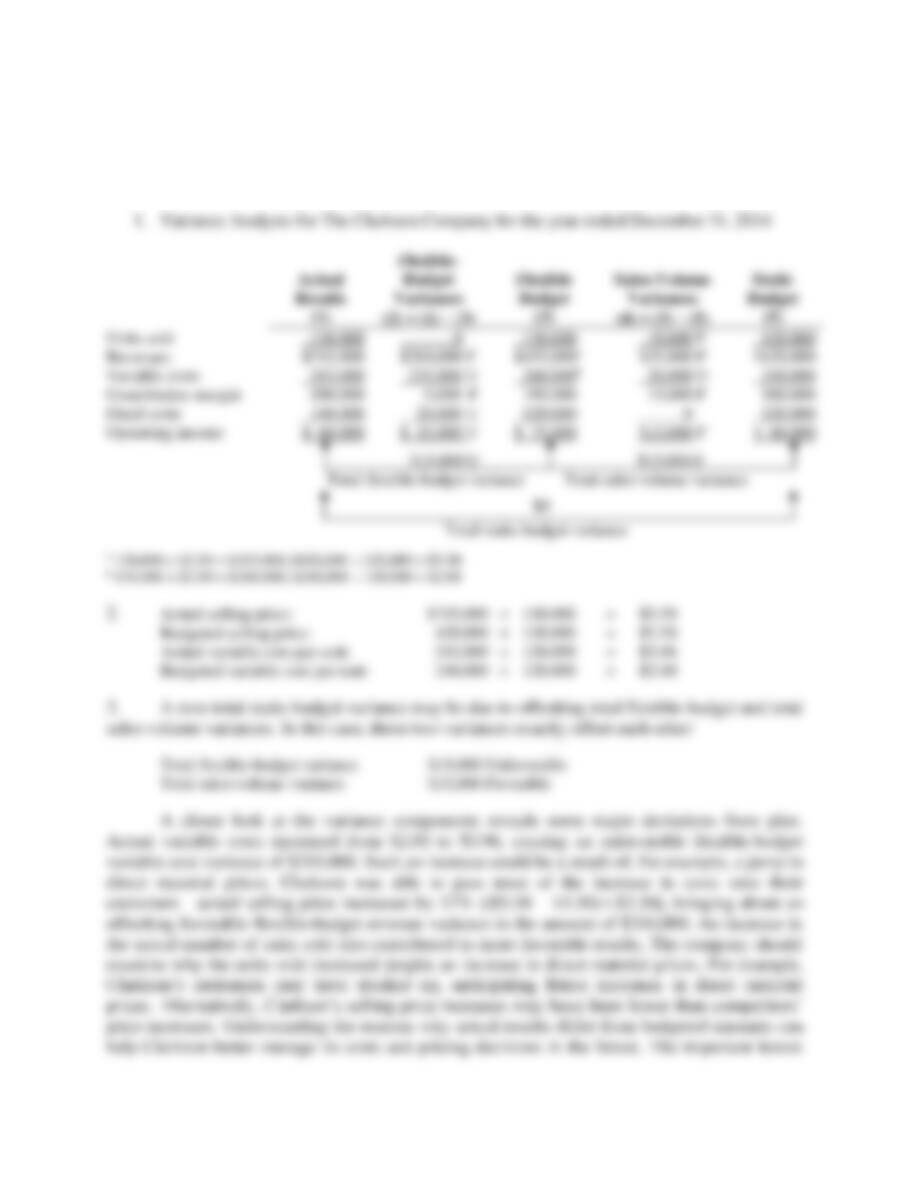
calculations for the year ended December 31, 2014. The following table is what remains of the
data.
Required:
1. Calculate all the required variances. (If your work is accurate, you will find that the total
static-budget variance is $0.)
2. What are the actual and budgeted selling prices? What are the actual and budgeted variable
costs per unit?
7-8
3. Review the variances you have calculated and discuss possible causes and potential
problems. What is the important lesson learned here?
SOLUTION
7-9
7-20 (30-40 min.) Flexible budget and sales volume variances, market-share and
market-size variances.
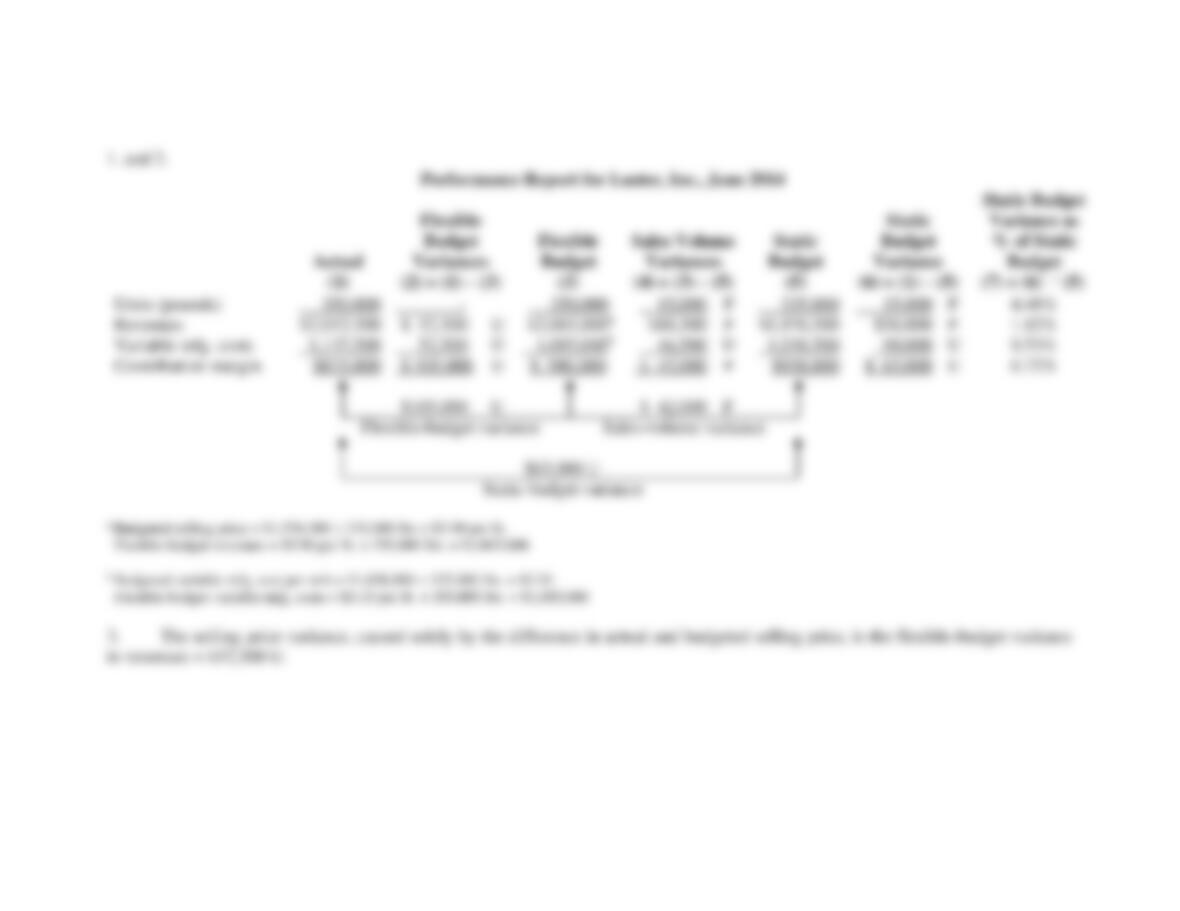
Luster, Inc., produces the basic fillings used in many popular frozen desserts and treats—vanilla
and chocolate ice creams, puddings, meringues, and fudge. Luster uses standard costing and
carries over no inventory from one month to the next. The ice-cream product group’s results for
June 2014 were as follows:
Sam Adler, the business manager for ice-cream products, is pleased that more pounds of ice
cream were sold than budgeted and that revenues were up. Unfortunately, variable
manufacturing costs went up, too. The bottom line is that contribution margin declined by
$63,000, which is less than 3% of the budgeted revenues of $1,976,500. Overall, Adler feels that
the business is running fine.
Required:
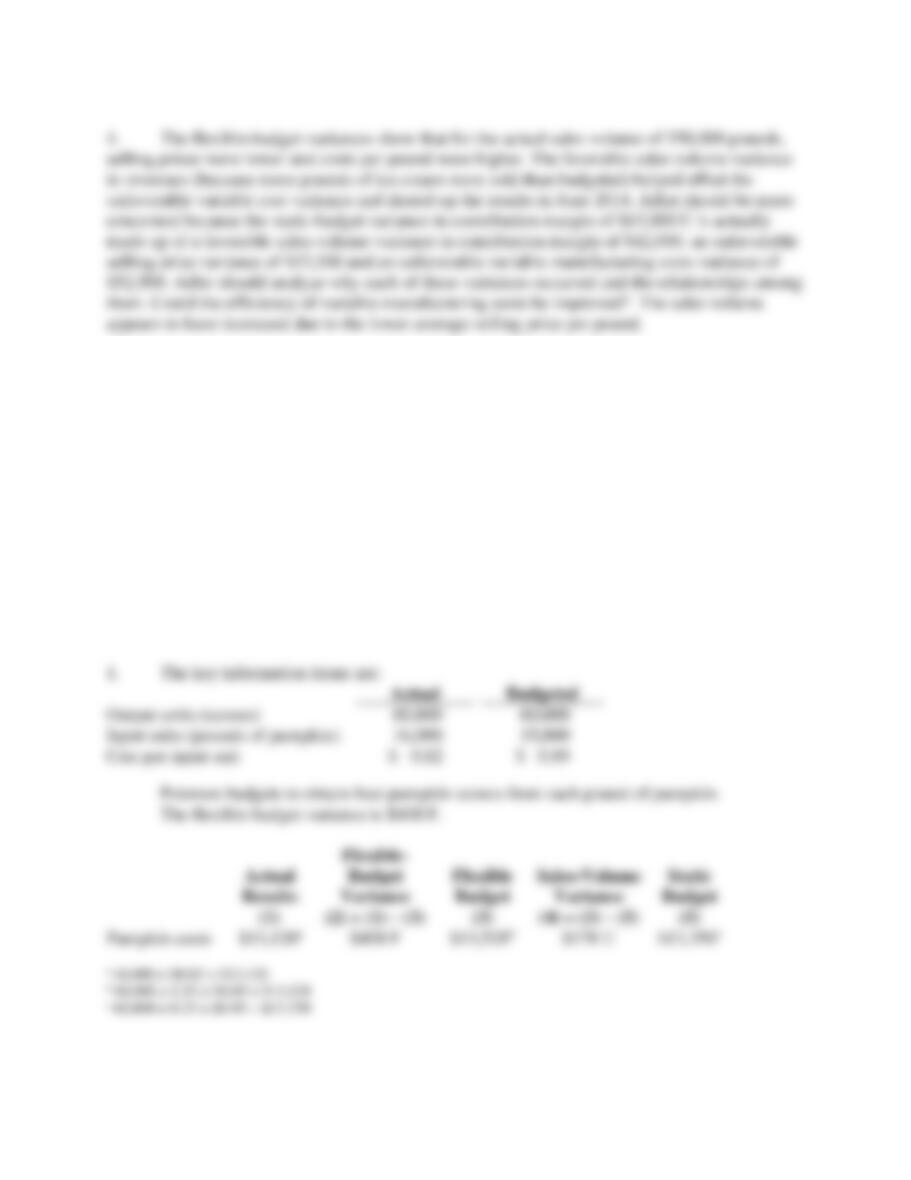
1. Calculate the static-budget variance in units, revenues, variable manufacturing costs, and
contribution margin. What percentage is each static-budget variance relative to its static-
budget amount?
2. Break down each static-budget variance into a flexible-budget variance and a sales-volume
variance.
3. Calculate the selling-price variance.
4. Assume the role of management accountant at Luster. How would you present the results to
Sam Adler? Should he be more concerned? If so, why?
7-10
SOLUTION
7-11
7-21 (20–30 min.) Price and efficiency variances.
Peterson Foods manufactures pumpkin scones. For January 2014, it budgeted to purchase and
use 15,000 pounds of pumpkin at $0.89 a pound. Actual purchases and usage for January 2014
were 16,000 pounds at $0.82 a pound. Peterson budgeted for 60,000 pumpkin scones. Actual
output was 60,800 pumpkin scones.
Required:
1. Compute the flexible-budget variance.
2. Compute the price and efficiency variances.
3. Comment on the results for requirements 1 and 2 and provide a possible explanation for
them.
SOLUTION
7-12
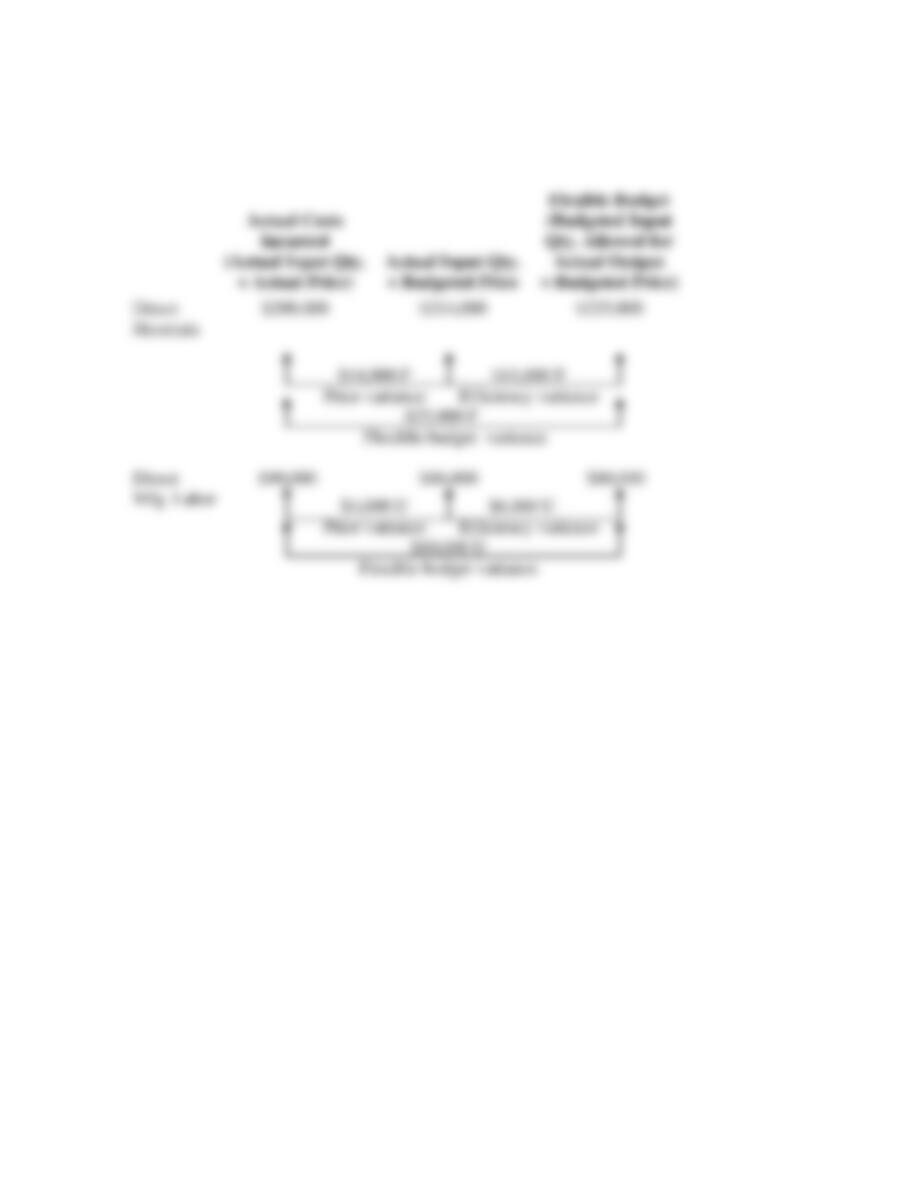
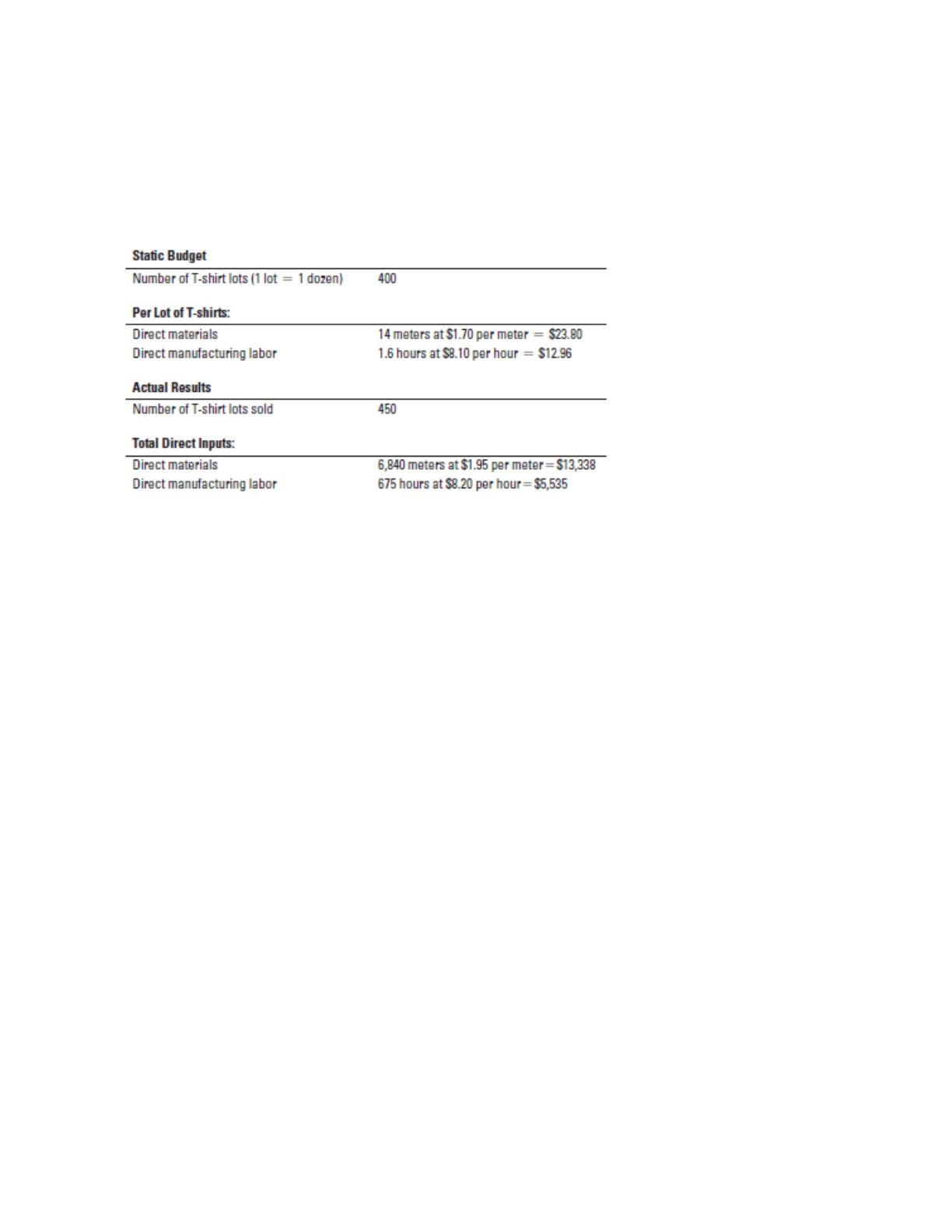
7-22 (15 min.) Materials and manufacturing labor variances.
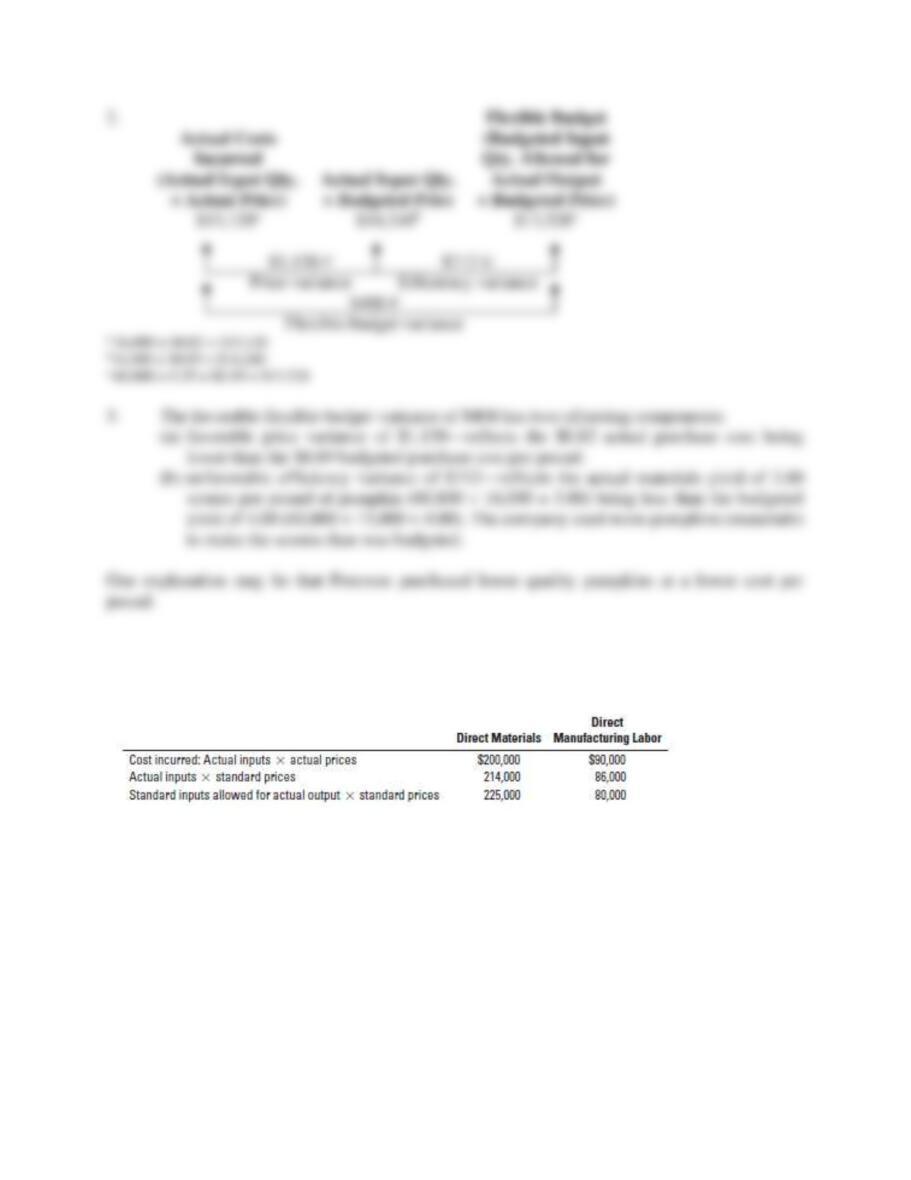
Consider the following data collected for Great Homes, Inc.:
Required:
Compute the price, efficiency, and flexible-budget variances for direct materials and direct
manufacturing labor.
7-13
SOLUTION
7-14
7-23 (30 min.) Direct materials and direct manufacturing labor variances.
SallyMay, Inc., designs and manufactures T-shirts. It sells its T-shirts to brand-name clothes
retailers in lots of one dozen. SallyMay’s May 2013 static budget and actual results for direct
inputs are as follows:
SallyMay has a policy of analyzing all input variances when they add up to more than 10% of the
total cost of materials and labor in the flexible budget, and this is true in May 2013. The
production manager discusses the sources of the variances: “A new type of material was
purchased in May. This led to faster cutting and sewing, but the workers used more material than
usual as they learned to work with it. For now, the standards are fine.”
Required:
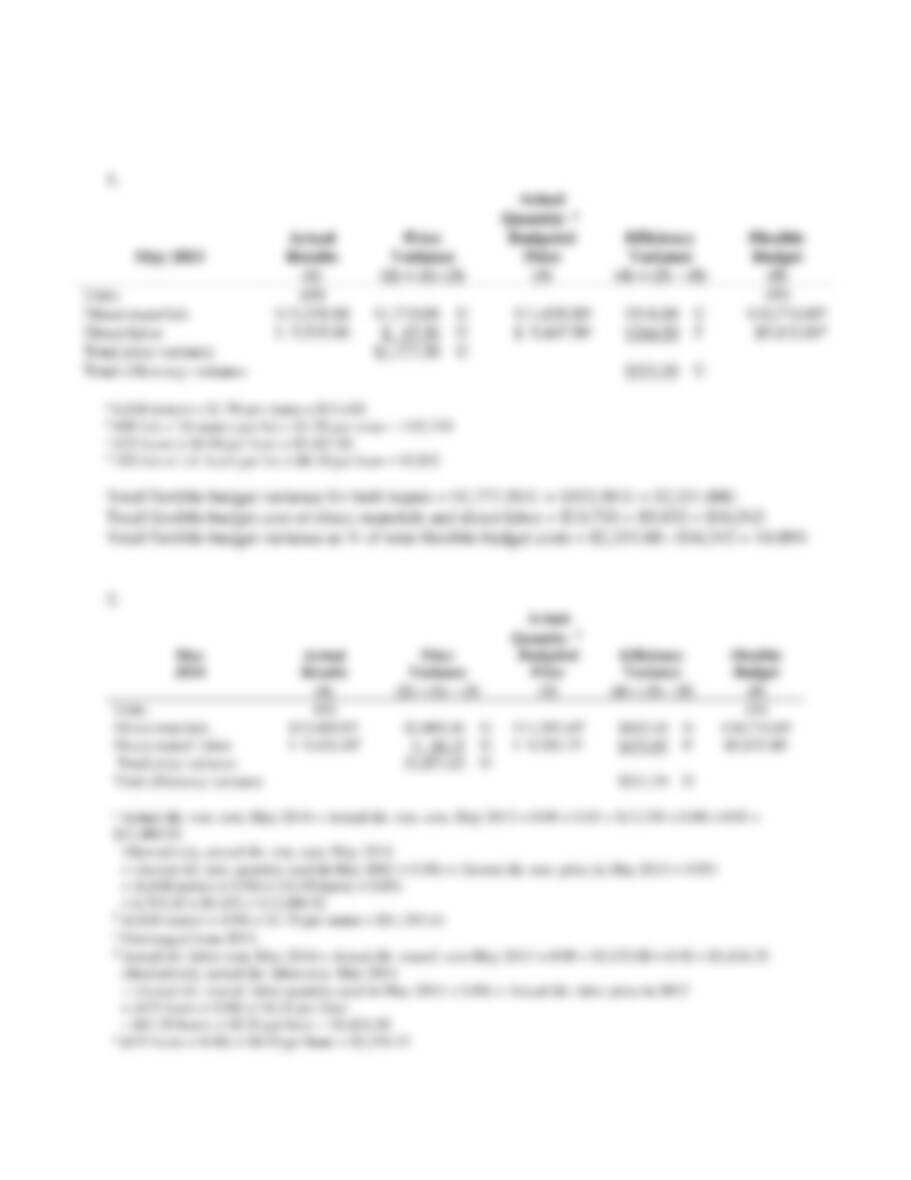
1. Calculate the direct materials and direct manufacturing labor price and efficiency variances
in May 2013. What is the total flexible-budget variance for both inputs (direct materials and
direct manufacturing labor) combined? What percentage is this variance of the total cost of
direct materials and direct manufacturing labor in the flexible budget?
2. Sally King, the CEO, is concerned about the input variances. But she likes the quality and
feel of the new material and agrees to use it for one more year. In May 2014, SallyMay again
produces 450 lots of T-shirts. Relative to May 2013, 2% less direct material is used, direct
material price is down 5%, and 2% less direct manufacturing labor is used. Labor price has
remained the same as in May 2013. Calculate the direct materials and direct manufacturing
labor price and efficiency variances in May 2014. What is the total flexible-budget variance
for both inputs (direct materials and direct manufacturing labor) combined? What percentage
is this variance of the total cost of direct materials and direct manufacturing labor in the
flexible budget?
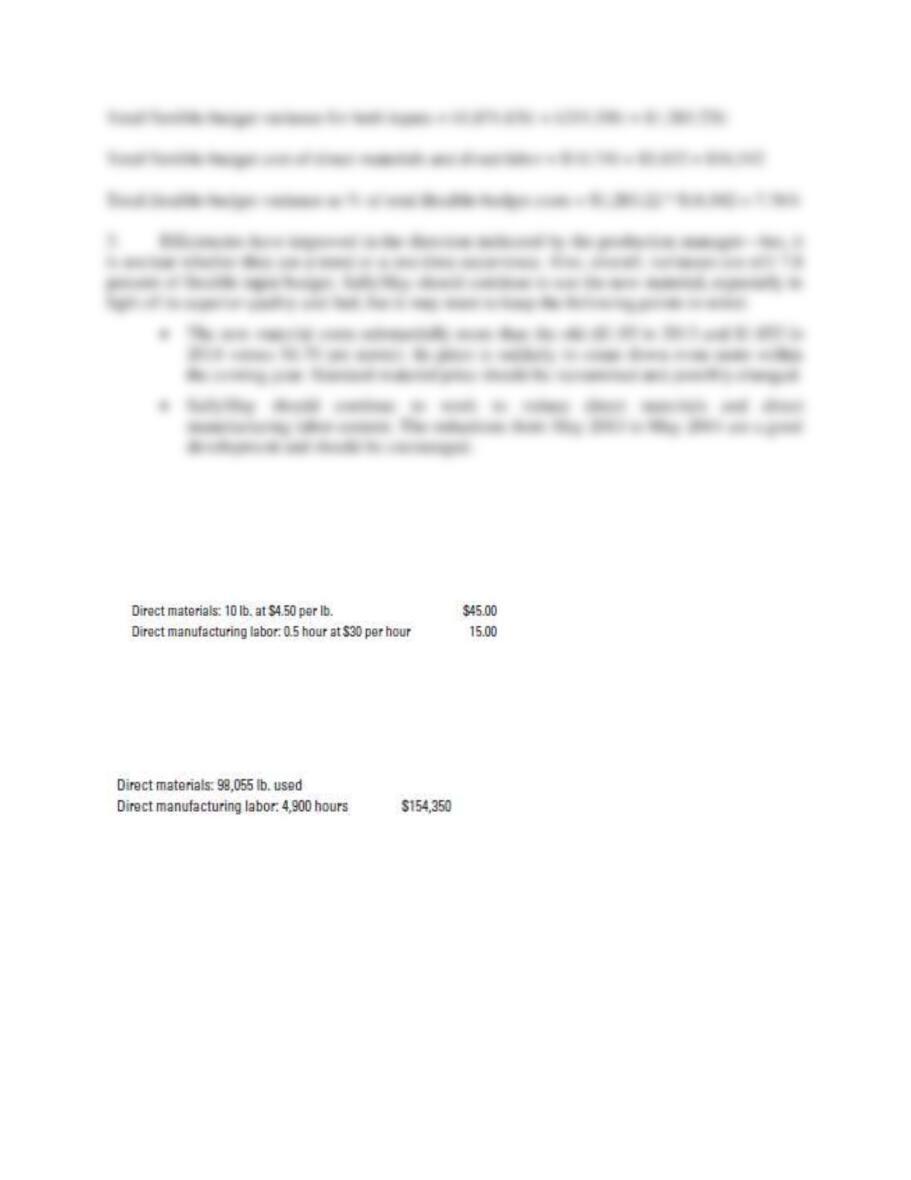
3. Comment on the May 2014 results. Would you continue the “experiment” of using the new
material?
7-15
SOLUTION
7-16
7-24 (30 min.) Price and efficiency variances, journal entries.
The Schuyler Corporation manufactures lamps. It has set up the following standards per finished
unit for direct materials and direct manufacturing labor:
The number of finished units budgeted for January 2014 was 10,000; 9,850 units were actually
produced.
Actual results in January 2014 were as follows:
Assume that there was no beginning inventory of either direct materials or finished units.
During the month, materials purchased amounted to 100,000 lb., at a total cost of $465,000.
Input price variances are isolated upon purchase. Input-efficiency variances are isolated at the
time of usage.
Required:
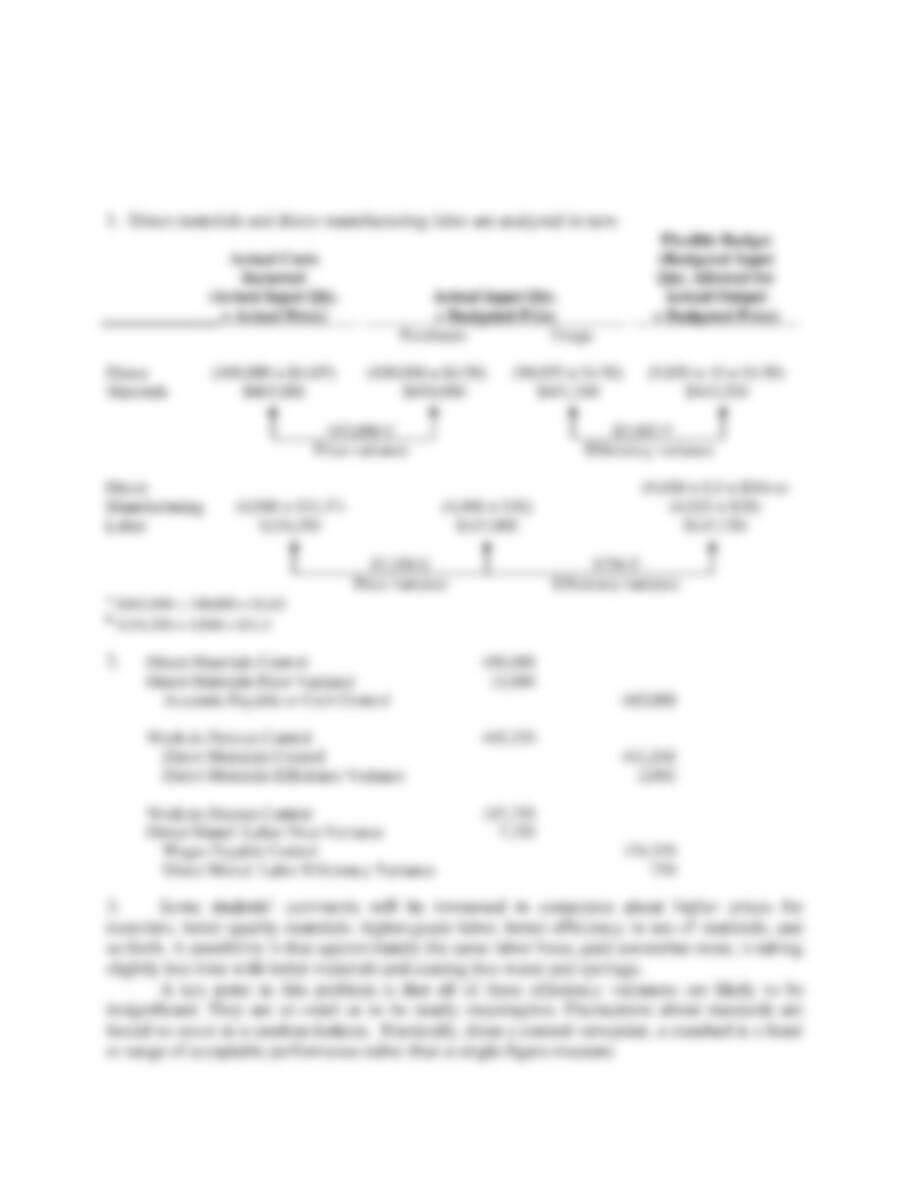
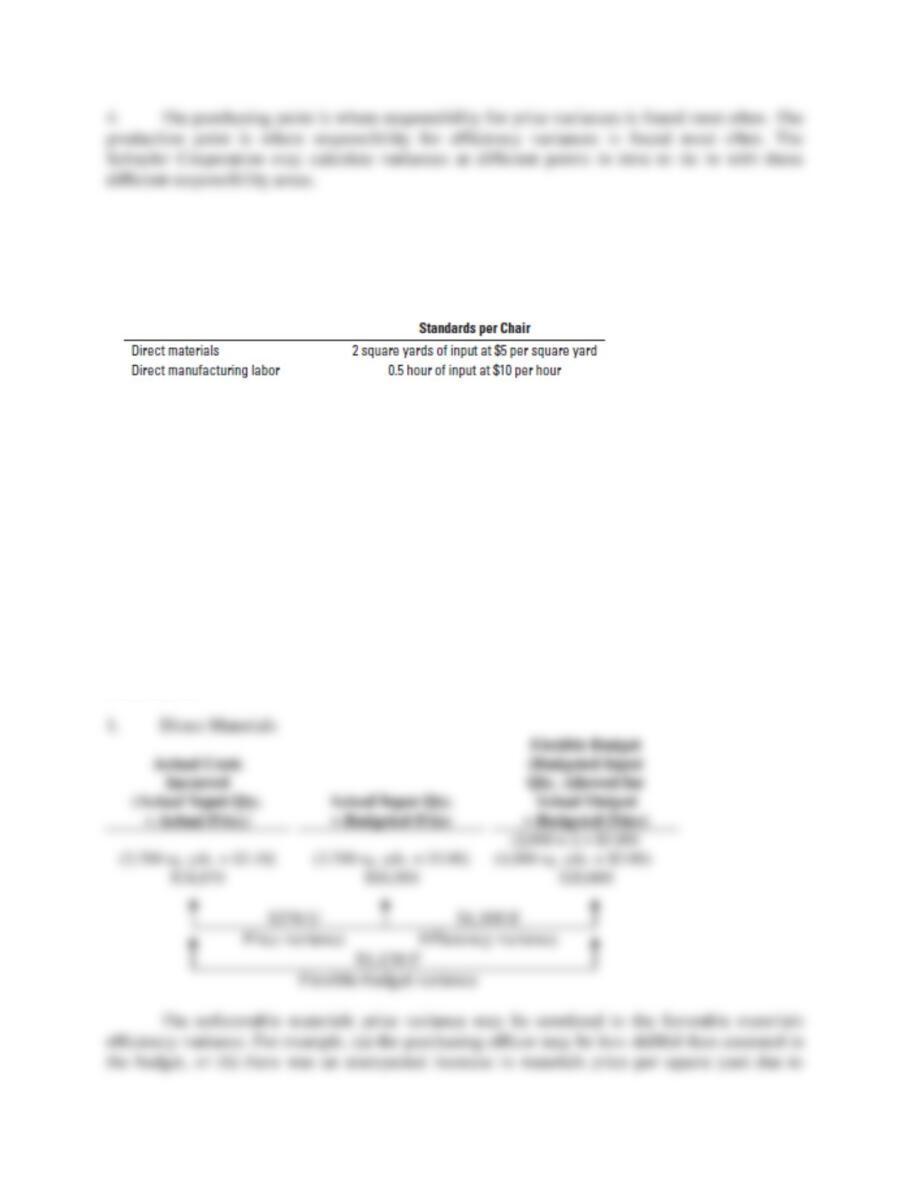
1. Compute the January 2014 price and efficiency variances of direct materials and direct
manufacturing labor.
2. Prepare journal entries to record the variances in requirement 1.
3. Comment on the January 2014 price and efficiency variances of Schuyler Corporation.
7-17
4. Why might Schuyler calculate direct materials price variances and direct materials efficiency
variances with reference to different points in time?
SOLUTION
7-18
7-25 (20−30 min.) Materials and manufacturing labor variances, standard costs.
Dunn, Inc., is a privately held furniture manufacturer. For August 2014, Dunn had the following
standards for one of its products, a wicker chair:
The following data were compiled regarding actual performance: actual output units (chairs)
produced, 2,000; square yards of input purchased and used, 3,700; price per square yard, $5.10;
direct manufacturing labor costs, $8,820; actual hours of input, 900; labor price per hour, $9.80.
Required:
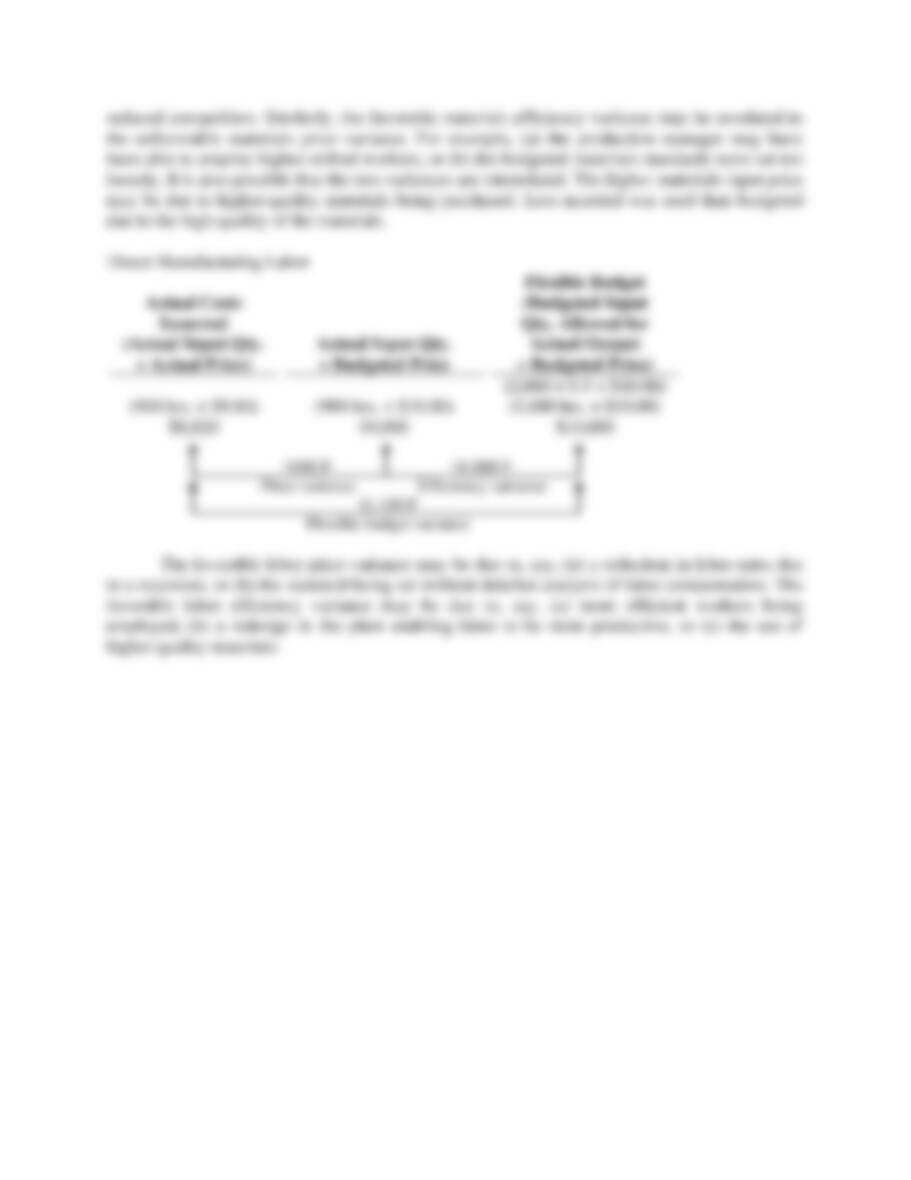
1. Show computations of price and efficiency variances for direct materials and direct
manufacturing labor. Give a plausible explanation of why each variance occurred.
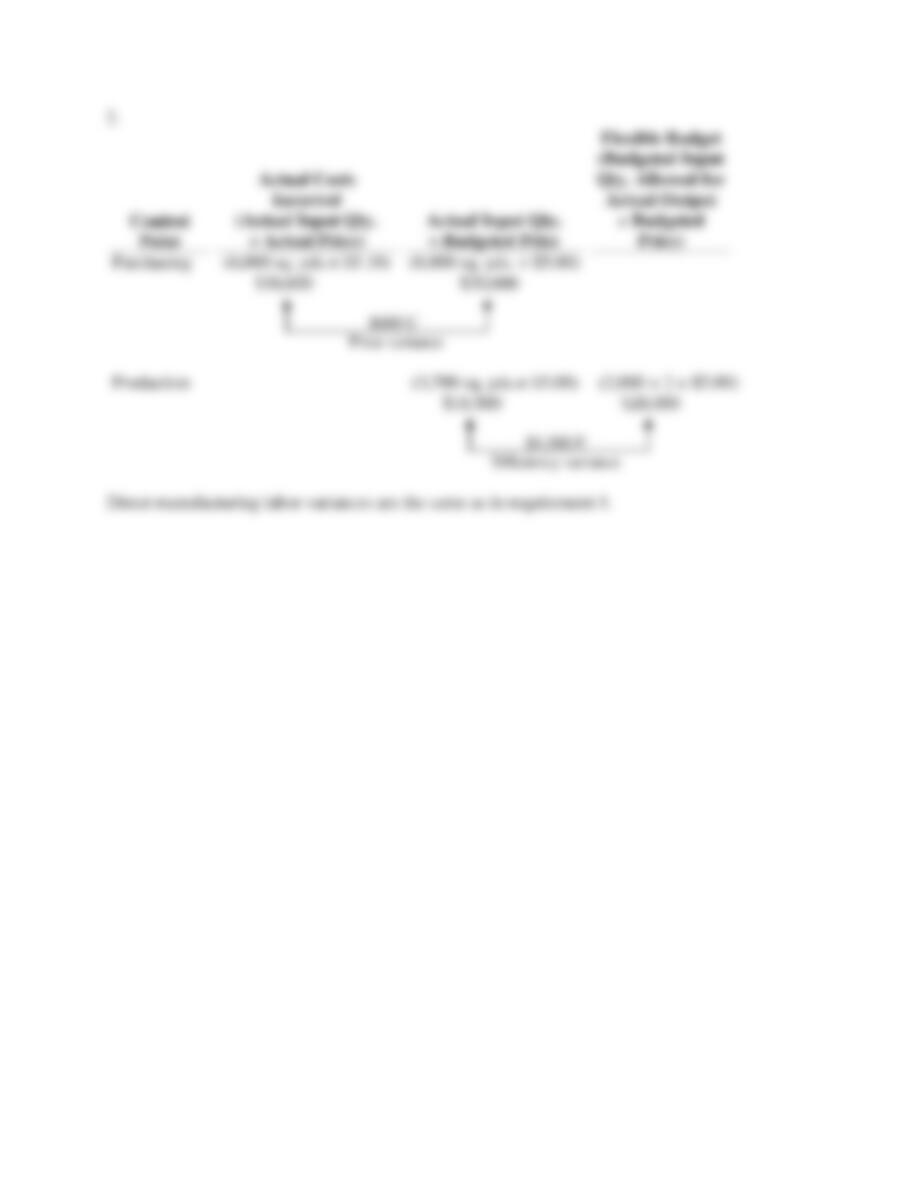
2. Suppose 6,000 square yards of materials were purchased (at $5.10 per square yard), even
though only 3,700 square yards were used. Suppose further that variances are identified at their
most timely control point; accordingly, direct materials price variances are isolated and traced at
the time of purchase to the purchasing department rather than to the production department.
Compute the price and efficiency variances under this approach.
SOLUTION
7-19
7-20