
7-1
CHAPTER 7
Fraud, Internal Control, and Cash
Learning Objectives
1. Define fraud and internal control.
2. Identify the principles of internal control activities.
3. Explain the applications of internal control principles to cash receipts.
4. Explain the applications of internal control principles to cash disbursements.
5. Prepare a bank reconciliation.
6. Explain the reporting of cash.
7. Discuss the basic principles of cash management.
8. Identify the primary elements of a cash budget.
*9. Explain the operation of a petty cash fund.
7-2
Chapter Outline
Learning Objective 1 – Define Fraud and Internal Control
FRAUD—dishonest act by employee that results in personal benefit to the employee at
a cost to the employer. The fraud triangle refers to the three factors that contribute to
fraudulent activity. They are:
Sarbanes-Oxley Act of 2002 (SOX) requires all publicly traded U.S. corporations to
maintain an adequate system of internal controls. SOX imposes more responsibilities on
corporate executives and boards of directors to ensure that companies’ internal controls
are reliable and effective
Internal control consists of all of the related methods and measures adopted within an
organization to:
▪ Safeguard its assets
Internal control has five primary components of internal control systems:
▪ Control environment, or “tone at the top.”
▪ Risk assessment, or identifying and analyzing factors that create risk.
Learning Objective 2 – Identify the Principles of Internal Control Activities
PRINCIPLES OF INTERNAL CONTROL ACTIVITIES—The backbone of the company’s efforts
to address the risks it faces. The six principles of control activities are as follows:
1. Establishment of responsibility
2. Segregation of duties
7-3
o Control is most effective when only one person is responsible for a given task.
o Establishing responsibility includes the authorization and approval of transactions.
o Limiting access only to authorized personnel.
Segregation of Duties—rationale for segregation of duties is that the work of one
employee should, without a duplication of effort, provide a reliable basis for evaluating
the work of another employee. There are two common applications of this principle:
1. Different individuals should be responsible for related activities.
2. The responsibility for record-keeping for an asset should be separate from the
physical custody of that asset.
o Segregation of Related Activities—When one individual is responsible for all of the
related activities, the potential for errors and irregularities is increased.
• Related purchasing activities should be assigned to different individuals. Related
TEACHING TIP
Ask students to recall a trip to the bank. Does the teller receiving the money for deposit take
the money to bookkeeping and record the deposit? Why not?
Documentation Procedures—provide evidence that transactions and events have
occurred.
o Documents should be prenumbered and all documents should be accounted for.
TEACHING TIP
Why are checks and invoices sequentially numbered? What happens to voided checks?
7-4
Physical Controls—Physical controls relate to the safeguarding of assets. These
controls safeguard assets and enhance the accuracy and reliability of the accounting
records. Use of physical controls is essential. Examples of these controls include:
o Safes, vaults, and safety deposit boxes for cash and business papers.
o Locked warehouses and storage cabinets for inventories and records.
TEACHING TIP
Why do you receive a cash register receipt at a fast food restaurant, a grocery store, or a
department store? Why do some stores post signs that say “If you do not receive a receipt,
we will pay you $5”? What should a movie theater do with its Saturday night receipts?
Independent Internal Verification—involves the review, of data prepared by
employees. For maximum benefit:
o Verification should be made periodically or on a surprise basis.
o Verification should be done by an employee independent of the personnel
responsible for the information.
TEACHING TIP
Would the cashier count the money in the cash drawer at the end of the workday? Would the
person writing the checks prepare the bank reconciliation? Why or why not?
Human Resource Controls—activities included the following:
o Bonding employees who handle cash.
TEACHING TIP
Explain to students that insurance companies bond employees of other companies who
handle cash. Bonding employees is much like having an insurance policy that will reimburse
the company if an employee steals money.
7-5
Limitations of Internal Control—Internal control systems are designed to provide
reasonable assurance that assets are properly safeguarded and that the accounting records are
reliable.
o The concept of reasonable assurance rests on the premise that the costs of
establishing control procedures should not exceed their expected benefit.
o The human element is an important factor in every system of internal control.
o A good system can become ineffective as a result of employee fatigue,
TEACHING TIP
Ask students if they would expect a very small company to have as sophisticated a system of
internal control as that of a much larger company? Why not? What are ways in which a small
company can have effective internal control procedures?
Learning Objective 3 – Explain the Applications of Internal Control Principles to
Cash Receipts
Cash Controls—Cash is the asset most susceptible to fraudulent activities.
▪ Because of the large volume of cash transactions, numerous errors may occur in
executing and recording then.
▪ To safeguard cash and ensure the accuracy of the accounting records for cash,
effective internal control over cash is critical.
Cash Receipts Controls—the application of the control activities to the receipt of cash.
▪ Establishment of responsibility – Only designated personnel (cashiers) are authorized
to handle cash receipts.
Over-the-Counter Receipts—In retail businesses cash registers are used which are visible
to the customers for the receipt of cash. The control activities of over-the-counter receipts
are:
7-6
▪ The cash register’s tape is locked in the register until a supervisor removes it.
▪ At the end of the clerk’s shift, the clerk counts the cash and prepares a deposit slip.
▪ Clerk sends cash and deposit slip to bank and Accounting Department.
▪ Supervisor removes tape and sends it to the Accounting Department.
▪ Accounting Department checks that the register tape and deposit slip agree. In some
instances, the amount deposited at the bank will not agree with the cash recorded in the
accounting records based on the cash register tape.
o When a difference occurs between the actual cash and the amount reported on the
cash register tape, the account, Cash Over and Short, is used.
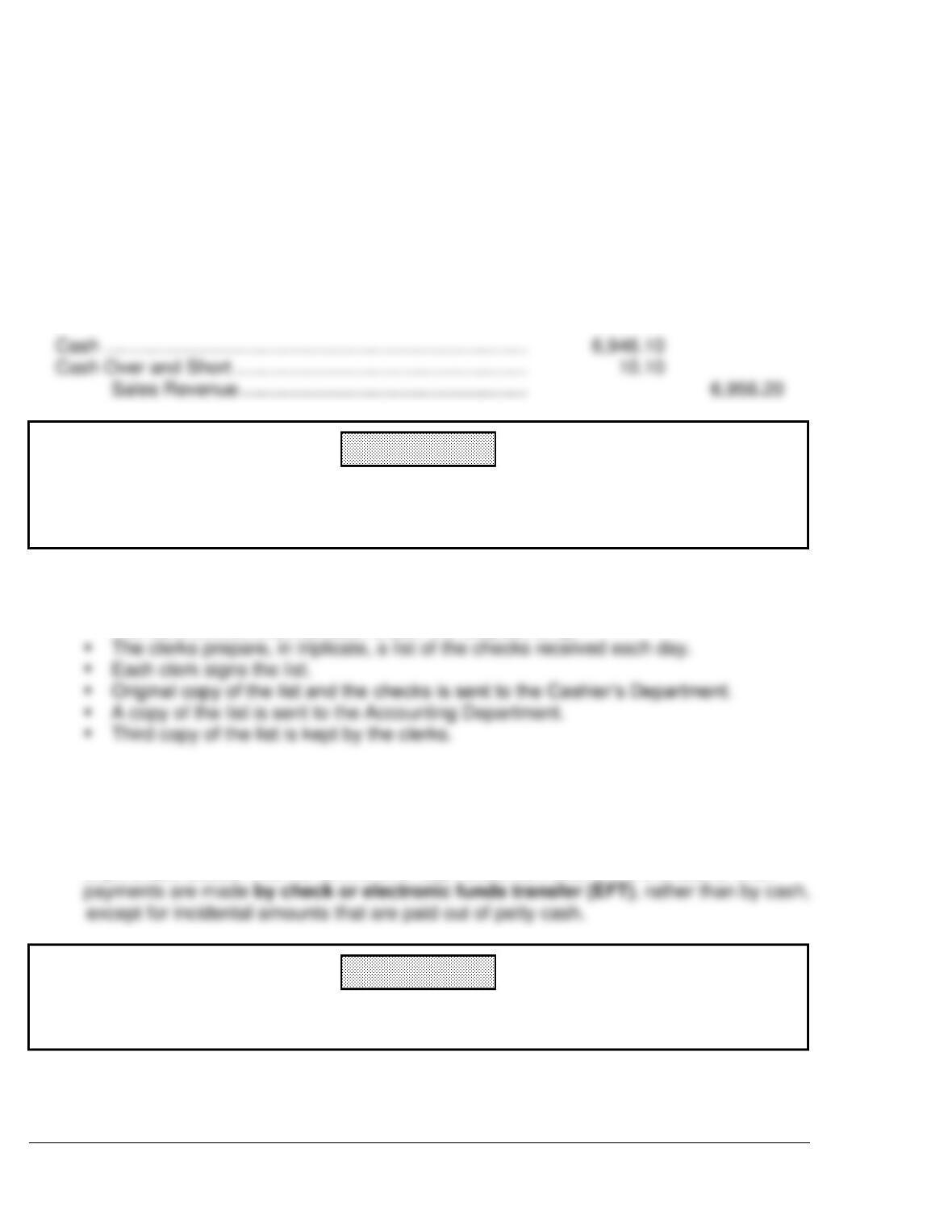
o Assume for example that the cash register tape indicated sales of $6,956.20 but the
amount of cash was only $6,946.10. The cash shortfall of $10.10 would be recorded
as follows:
TEACHING TIP
Explain to students how cash registers can greatly enhance control over cash sales. Discuss
the use of lock boxes, armored car service, and controls over the acceptance of credit and
debit cards.
Mail Receipts—These require special control activities which include:
▪ All mail receipts should be opened in the presence of at least two clerks.
▪ The clerk should endorse each check “For Deposit Only.”
Learning Objective 4 – Explain the Applications of Internal Control Principles to
Cash Disbursements
Cash Disbursements Controls—Cash is disbursed to pay expenses and liabilities or
to purchase assets. Internal control over cash disbursements is more effective when
TEACHING TIP
Ask students why internal control over cash disbursements would be more effective when
payments are made by check rather than by cash.
7-7
▪ The principles of internal control apply to cash disbursements as follows:
o Establishment of responsibility – Only designated personnel (treasurer) are
authorized to sign checks and approve vendors.
o Segregation of duties – Different individuals approve and make payments; check
signers do not record disbursements.
Voucher System Controls—A voucher system is a network of approvals by
authorized individuals, acting independently, to ensure that all disbursements by check
are proper. A voucher is an authorization form prepared for each cash disbursement.
The steps is a voucher system include:
▪ Preparing a voucher from the vendor’s invoice.
▪ Employee in accounts payable records the voucher in a voucher register and
files it according to the date on which it is to be paid.
TEACHING TIP
Why would a business use a petty cash fund? In what instances would the petty cash fund
be used? Ask students to develop a system of internal control for petty cash.
Learning Objective 5 – Prepare a Bank
Control Features: Use of a Bank—–The bank and the company maintain
independent records of the company’s checking account. It contributes significantly to
good internal control over cash. In addition it;
Minimizes the amount of currency that must be kept on hand.
7-8
Bank statements – Each month the company receives a bank statement
showing its bank transactions and balances. Some transactions and balances
shown include:
o Checks paid and other debits that reduce the balance in the depositor’s
account.
o Deposits and other credits that increase the balance in the depositor’s
account.
o The account balance after each day’s transactions.
o Bank statements are prepared from the bank’s perspective.
• Every deposit the bank receives is an increase in the bank’s liabilities
Reconciling The Bank Account—Because the bank and the company keep separate
record of the company’s checking account, the two balances are seldom the same.
Because of this, a process called reconciling the bank is needed. This need has two
causes:
▪ Time lags that prevent one of the parties from recording the transaction in the same
period.
o Days may elapse between the time a check is written and dated and the date it is
paid by the bank.
▪ Reconciliation procedure – In reconciling the bank account, it is customary to
reconcile the balance per books and balance per bank to their adjusted (correct or true)
cash balances. To obtain maximum benefit from a bank reconciliation, the reconciliation
should be prepared by an employee who has no other responsibilities related to cash.
o The reconciliation schedule is divided into two sections – balance per bank
statement and balance per books. The following steps should reveal all the
reconciling items causing the difference between the two balances:
• Compare the individual deposits on the bank statement with the deposits in
transit from the preceding bank reconciliation and with the deposits per company
7-9
TEACHING TIP
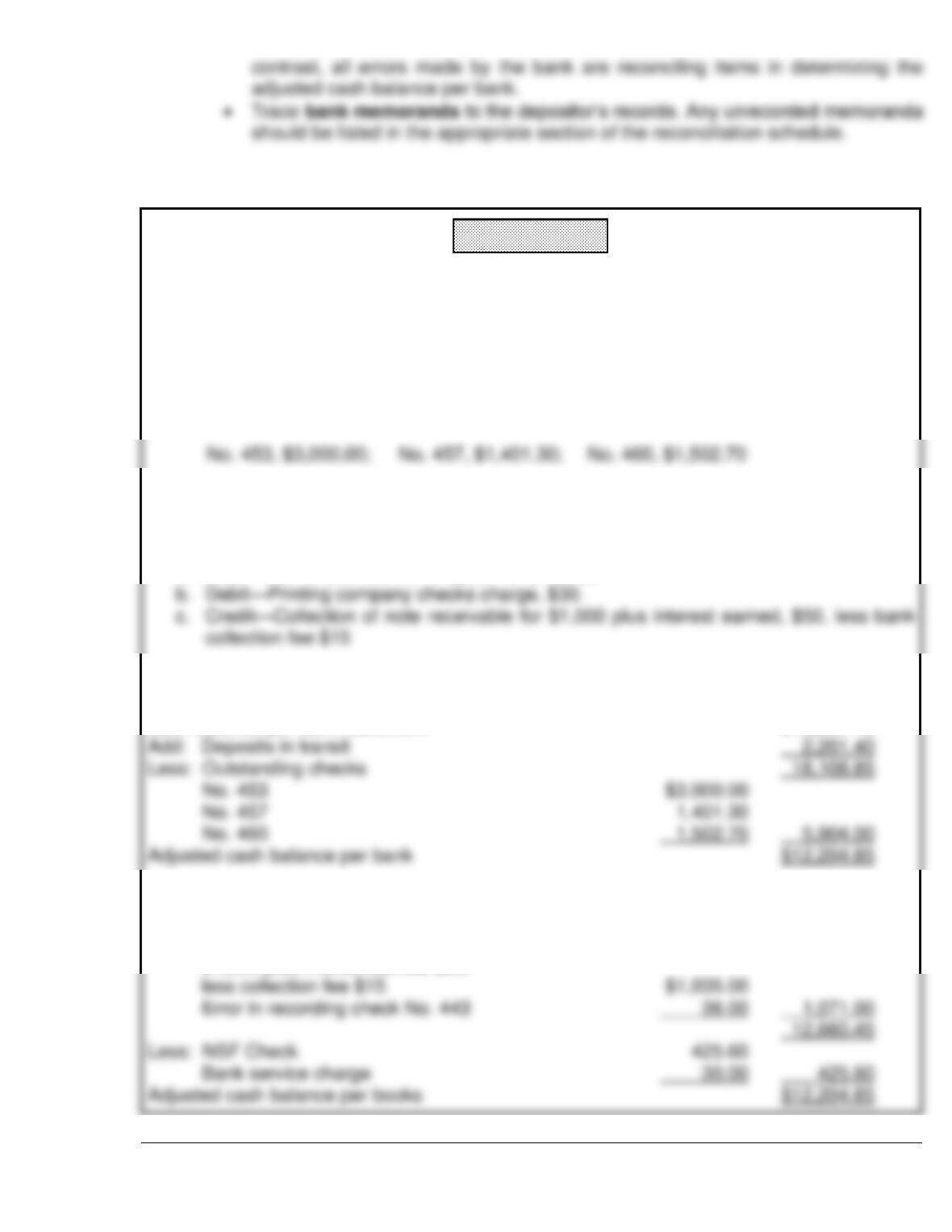
Illustrate preparing a bank reconciliation using the following example:
The April bank statement for Laird Company indicates a balance on April 30 of $15,907.45.
On that date the balance of cash per books is $11,589.45. From the previous steps, the
following reconciling items are determined:
1. Deposits in transit: April 30 deposit (received by bank on May 1) $2,201.40
2. Outstanding checks:
3. Errors: Check No. 443 was correctly written by Laird for $1,226.00 and was correctly paid
by the bank, but recorded for $1,262.00 by Laird.
4. Bank memoranda:
a. Debit—NSF check from J. R. Baron for $425.60.
The bank reconciliation is shown below:
Cash balance per bank statement $15,907.45
Cash balance per books
$11,589.45
Add: Collection of note receivable for
$1,000 plus interest earned $50,
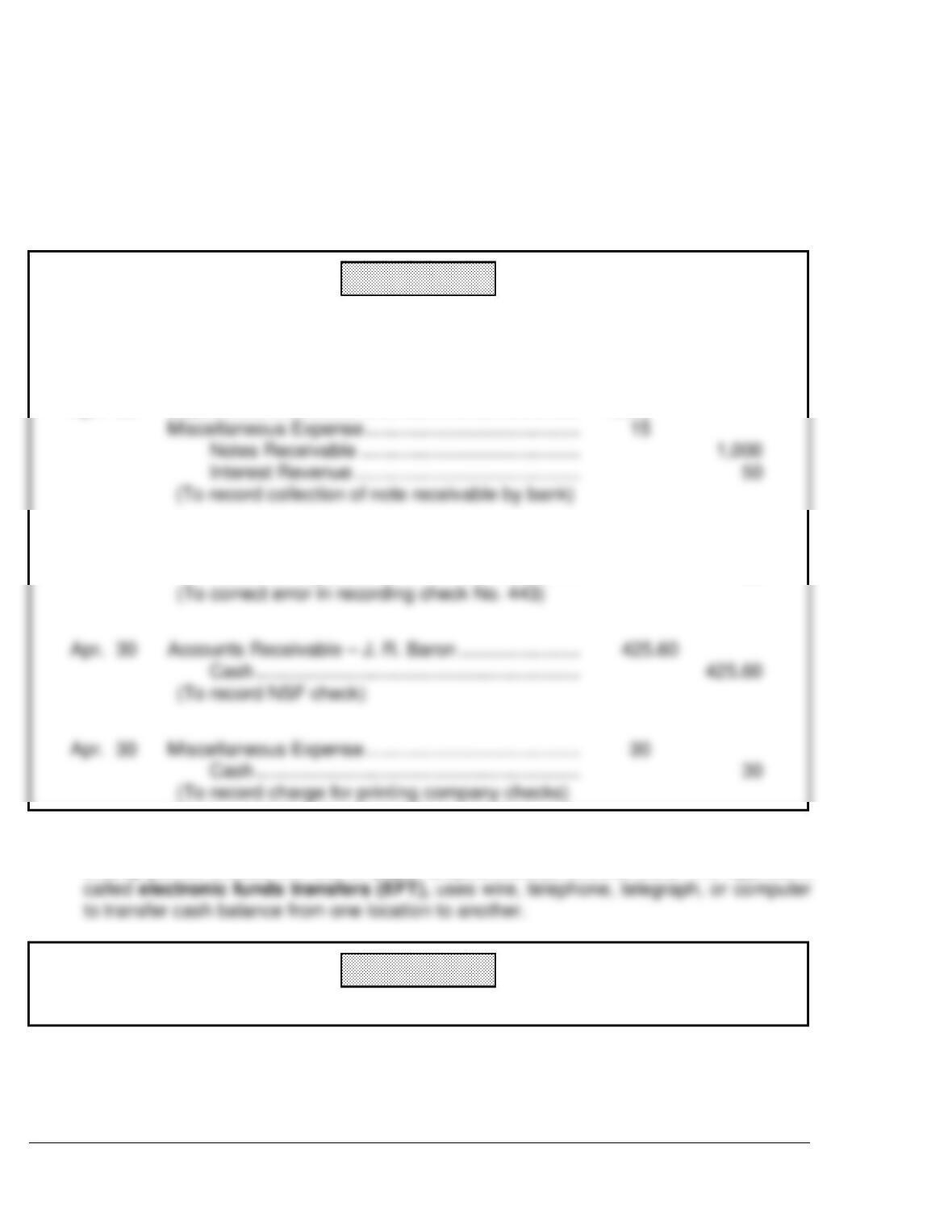
7-10
Entries from Bank Reconciliation – Each reconciling item used in determining the
adjusted cash balance per books should be recorded by the depositor. If these items
are not journalized and posted, the Cash account will not show the correct balance.
TEACHING TIP
Illustrate the process of making adjusting entries from the bank reconciliation using the
entries to adjust Laird Company’s cash account:
Apr. 30 Cash ……………………………………………………………. 1,035
Apr. 30 Cash ……………………………………………………………. 36
Accounts Payable …………………………………… 36
Electronic Funds Transfer (EFT) System—An approach developed to transfer funds
among parties without the use of paper (deposit tickets, checks, etc.). The approach,
TEACHING TIP
In the future will more transfers be made by Electronic Funds Transfers? Why or why not?
7-11
Learning Objective 6 – Explain the Reporting of Cash
Reporting Cash–— Cash is reported in both the balance sheet and the statement of cash
flows.
o Cash consists of coins, currency, checks, money orders, and money on hand or
on deposit in a bank or similar depository.
TEACHING TIP
Which statement, the income statement, the statement of retained earnings, the balance
sheet, or the statement of cash flows, provides the user with the most information about
cash? Discuss the benefits of each statement where cash is reported or reported.
o Cash on hand, cash in banks, and petty cash are often combined and reported
simply as Cash.
o Cash is the most liquid asset and is listed first in the current assets section of the
balance sheet.
Cash Equivalents—Many companies use the designation “Cash and cash equivalents” in
reporting cash. Cash equivalents are short-term, highly liquid investments that are both:
1. Readily convertible to known amounts of cash, and
Restricted Cash—A company may have cash that is not available for general use but
rather is restricted for a special purpose.
▪ Cash restricted in use should be reported separately on the balance sheet as restricted
Learning Objective 7 – Discuss the Basic Principles of Cash Management
Managing and Monitoring Cash––Many companies struggle, not because they
fail to generate sales, but because they can’t manage their cash. Managing the
often-precarious balance created by the ebb and flow of cash during the
7-12
▪ The more quickly customers pay the more quickly a company can use those funds.
▪ Any attempt to force customers to pay earlier must be carefully weighted against
2. Keep inventory levels low
▪ Maintaining large inventories ties up large amounts of cash, as well as warehouse
space.
3. Monitor payment of liabilities
▪ A company should use the full payment period, but not pay late. This could
4. Plan the timing of major expenditures
▪ In order to increase the likelihood of obtaining outside financing, a company
should carefully consider the timing of major expenditures in light of its operating
5. Invest idle cash
▪ Cash on hand earns nothing.
▪ An important part of the treasurer’s job is to ensure that any excess cash is
invested, even if it is only overnight.
TEACHING TIP
Ask students how they would go about increasing the speed of collection on receivables.
7-13
Learning Objective 8 – Identify the Primary Elements of a Cash Budget
Keeping An Eye On Cash—Cash is vital and planning the company’s cash needs is
a key business activity. The cash budget shows anticipated cash flows, usually over a
one– to two-year period. The cash budget contains the following three sections:
1. Cash receipts section—includes expected receipts from the company’s principal
source(s) of revenue, such as cash sales and collections from customers on credit
2. Cash disbursements section—shows expected payments for inventory, labor,
overhead, and selling and administrative expenses. This section also includes
projected payments for income taxes, dividends, investments, and plant assets.
TEACHING TIP
Ask students if they budget their cash. Although students do not have a written record of
their budget, most of them will have thought about when they will receive money and when
they will make cash payments. This is, although very informal, a form of budgeting. Ask
students if they think they would save more money if they budgeted? Why or why not?
Learning Objective 9 – (Appendix) Explain the Operation of a Petty Cash Fund
Operation of the Petty Cash Fund—It involves (1) establishing the fund, (2) making payments
from the fund, and (3) replenishing the fund.
▪ Establishing the Petty Cash Fund:
o Two essential steps in establishing a petty cash fund are:
• appointing a petty cash custodian who will be responsible for the fund,
• determining the size of the fund.
7-14
o For example, if Laird Company decides to establish a $100 fund on March 1, the
entry in general journal form is:
Mar. 1 Petty Cash ………………………………………………… 100
o The check is then cashed and the proceeds are placed in a locked petty cash
box or drawer.
▪ Making payments from petty cash:
o The custodian of the petty cash fund has the authority to make payments that
conform to prescribed management policies.
o The receipts are kept in the petty cash box until the fund is replenished.
▪ Replenishing the petty cash fund—When the money in the petty cash fund
reaches a minimum level, the fund is replenished:
o The request for reimbursement is initiated by the petty cash custodian.
o The individual prepares a schedule (or summary) of the payments that have
been made and sends the schedule, supported by petty cash receipts and other
record the check is:
Mar. 15 Postage Expense ………………………………………. 44
Supplies …………………………………………………… 38
o Note that the Petty Cash account is not affected by the reimbursement.
o Occasionally, in replenishing a petty cash fund it may be necessary to recognize a
cash shortage or overage.
Mar. 15 Postage Expense ………………………………………. 44
Supplies …………………………………………………… 38
7-15
o A petty cash fund should be replenished at the end of the accounting period, regardless
of the cash in the fund. Replenishment at this time is necessary in order to recognize
the effects of the petty cash payments on the financial statements.
o Internal control over petty cash is strengthened by:
● having a supervisor make surprise counts of the fund and
Learning Objective 10 – Compare the accounting procedure for fraud, internal
control, and cash under GAAP and IFRS
A Look at IFRS
Fraud can occur anywhere. And because the three main factors that contribute to fraud are
universal in nature, the principles of internal control activities are used globally by companies.
KEY POINTS
▪ The fraud triangle discussed in this chapter is applicable to all international companies.
Some of the major frauds on an international basis are Parmalat (Italy), Royal Ahold
(the Netherlands), and Satyam Computer Services (India).
▪ Rising economic crime poses a growing threat to companies, with nearly half of all
organizations worldwide being victims of fraud in a recent two-year period
(PricewaterhouseCoopers’ Global Economic Crime Survey, 2005). Specifically, 44% of
Romanian companies surveyed experienced fraud in the past two years.