Chapter 7
The Use of Cost Information in
Management Decision Making
QUESTIONS
2. Sunk costs are the costs that have been incurred in prior periods. They are not
incremental costs and, hence, they are not relevant in making a decision.
4. Opportunity costs are the values of benefits foregone by selecting one decision
alternative over another. Since opportunity costs differ depending upon which
5. The proper (quantitative) approach to analyzing the question of dropping a product
6. Common costs which are incurred for the benefit of two or more products, such as
7. Qualitative advantages of making rather than buying a component usually include
8. The amount of joint cost allocated to a product under relative sales value method
9. The value of time in a bottleneck department is generally quite high and equal to
the contribution margin of all throughput per hour. Therefore, you don’t want to
10. A bottleneck department is referred to as a drum because it “beats a rhythm” that
coordinates the production in other departments.
Jiambalvo Managerial Accounting
7-2
EXERCISES
E1. [LO 1]
Consider a decision to close a production facility that operates 24 hours a day. In
E2. [LO 1]
If Jordan drops accessories, she will lose the contribution margin (which in this
case is also the gross margin) of $30,000. The fixed costs allocated to
accessories, which total $41,000, are not likely to decline. (Keep in mind that
Jordan has only two assistants. It is doubtful that she can do without either one of
them simply by dropping accessories).
E3. [LO 1]
According to this Web site, sunk costs are “Costs already incurred which cannot be
recovered regardless of future events.” Since the costs are unaffected by the
future, they are never incremental costs and are irrelevant for decision making.
E4. [LO 1]
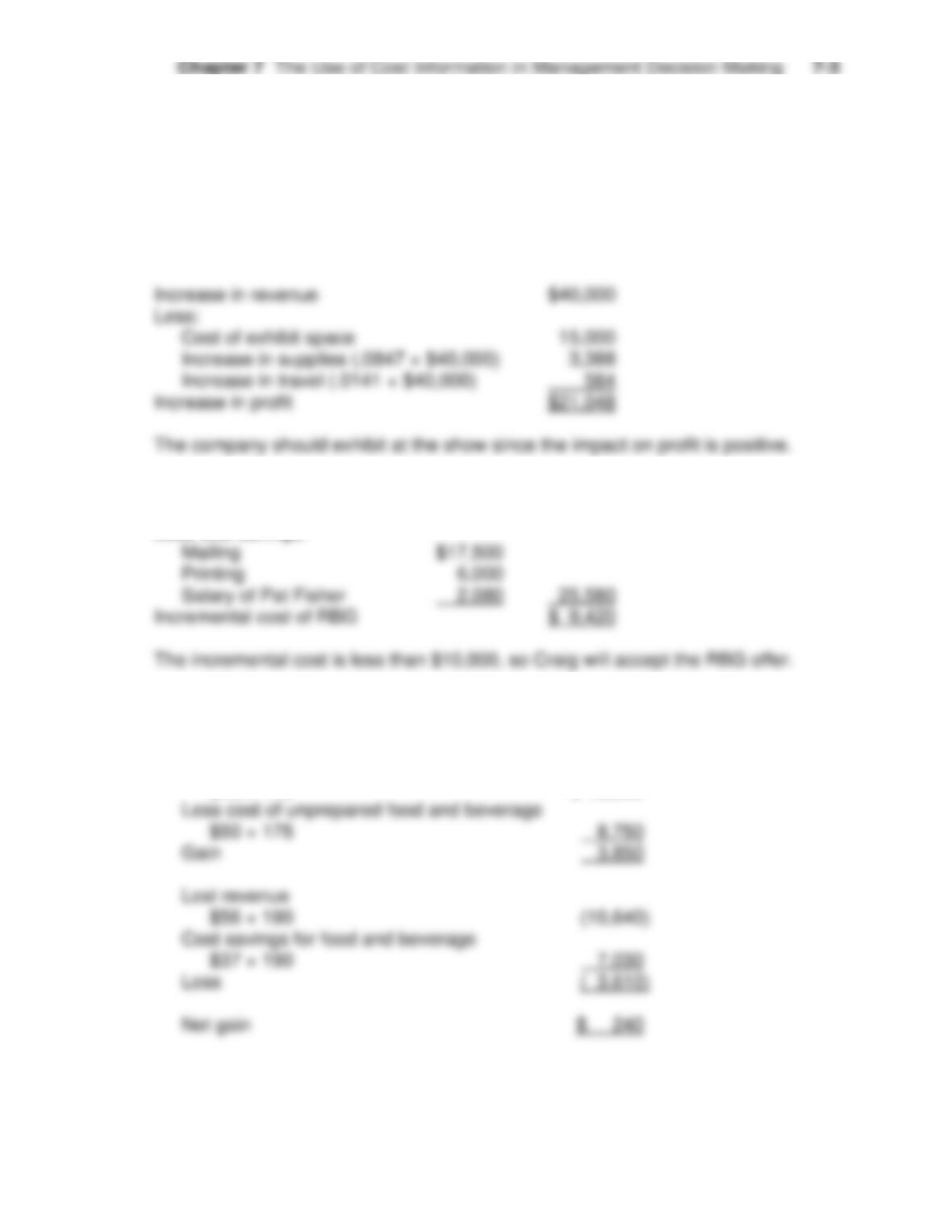
In this solution, supplies and travel are assumed to vary with revenue.
Supplies as a percent of revenue
$18,000 ÷ $212,500 0.0847
Travel as a percent of revenue
$3,000 ÷ $212,500 0.0141
E5. [LO 1]
Cost of RBG $35,000
Less cost savings:
E6. [LO 1, 2]
a. The incremental profit is $240 as follows:
Revenue
$72 × 175 $ 12,600
Jiambalvo Managerial Accounting
7-4
E7. [LO 1]
E8. [LO 1]
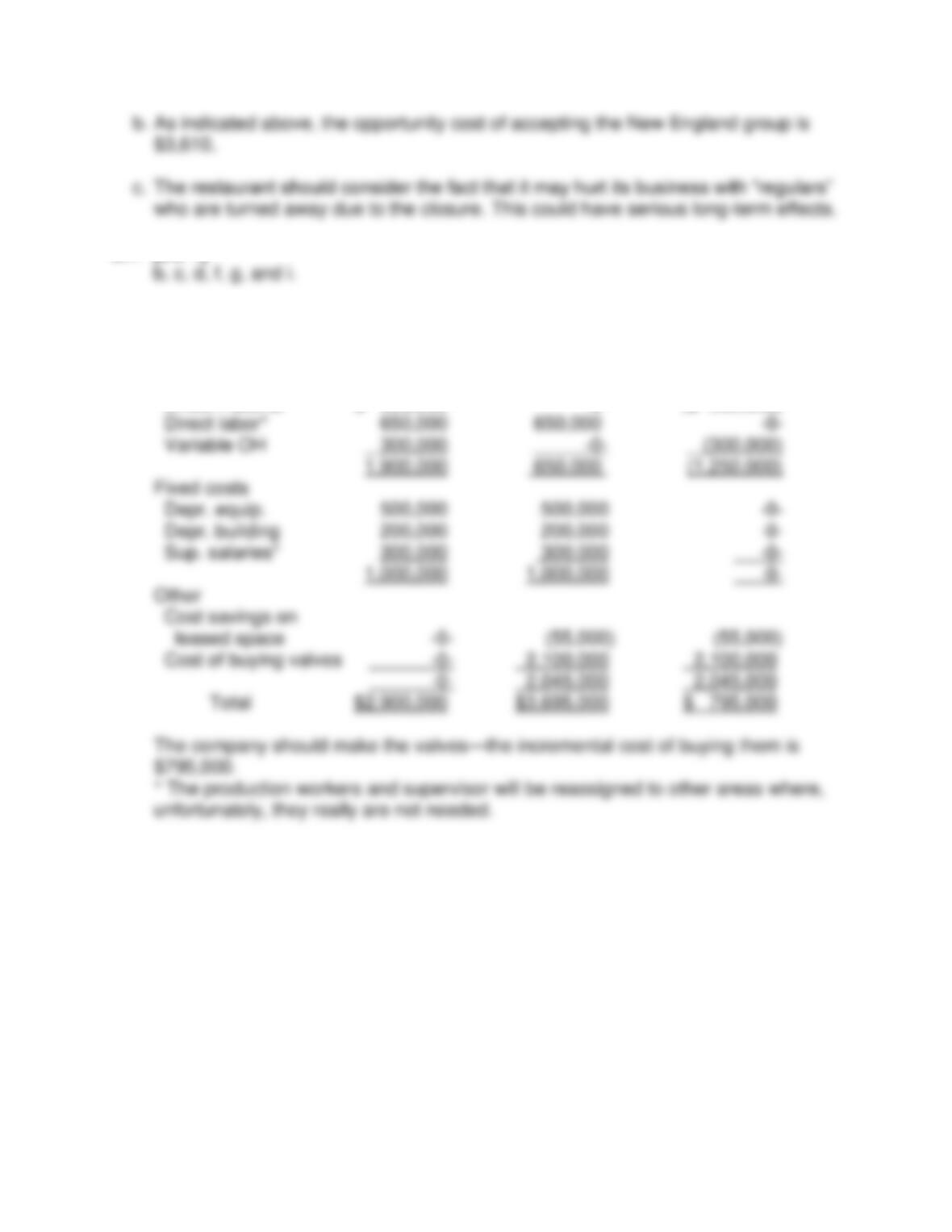
Cost of Making Cost of Buying Incremental
1,000 Valves 1,000 Valves Cost (Savings)
Variable costs
Direct material $ 950,000 -0- ($ 950,000)
E9. [LO 1]
a. False
E10. [LO 1]
E11. [LO 1]
Incremental benefit (cost) of completing the organizer:
Price $130
E12. [LO 1, 2]
Unit cost of manufacturing pumps $ 80
Less: Allocated fixed overhead (irrelevant) (18)
Add: Warranty cost ($20 .40)
Jiambalvo Managerial Accounting
7-6
E13. [LO 1]
Income Without
Home Office Furniture
Sales ($1,400,000 × 1.13) $1,582,000
E14. [LO 2]
a. What is the quality assurance program of the company that will do the
bottling? Problems with quality could ruin the brand.
E15. [LO 2]
a. Allocation based on physical output:
Product A 30 pounds (1/5)
Chapter 7 The Use of Cost Information in Management Decision Making
7-7
E16. [LO 2]
a. Allocation based on relative sales values:
Product A (30 pounds $100) $3,000 (.4167)
E17. [LO 2]
Allocation using physical quantity method:
E18. [LO 1]
Selling price per unit $ 14.00
Less variable costs per unit:
Chapter 7 The Use of Cost Information in Management Decision Making
7-9
PROBLEMS
P1. [LO 1], Ethics
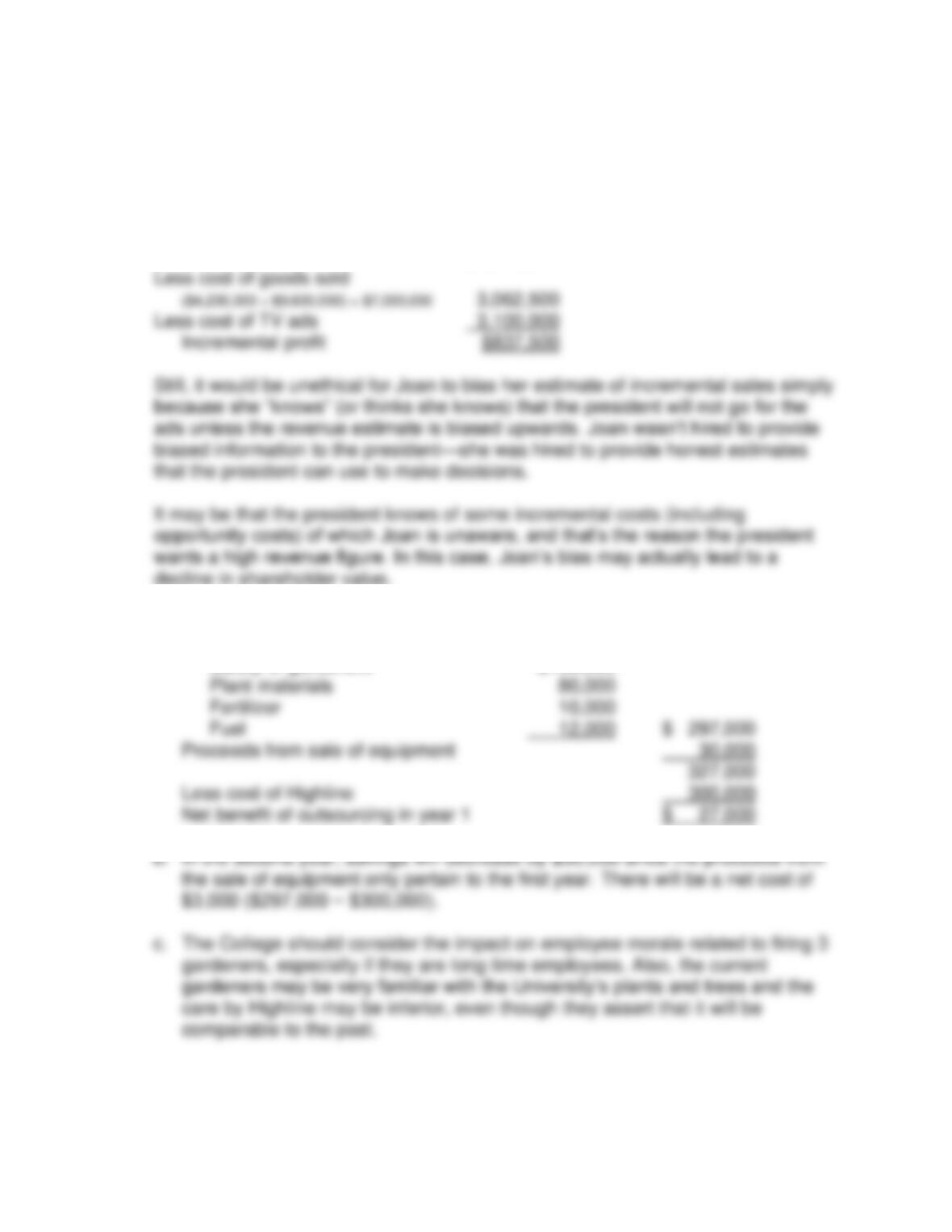
Extrapolating from the information provided, an $837,500 incremental profit will be
generated even if sales are only $7,000,000:
Incremental sales $7,000,000
P2. [LO 1, 2]
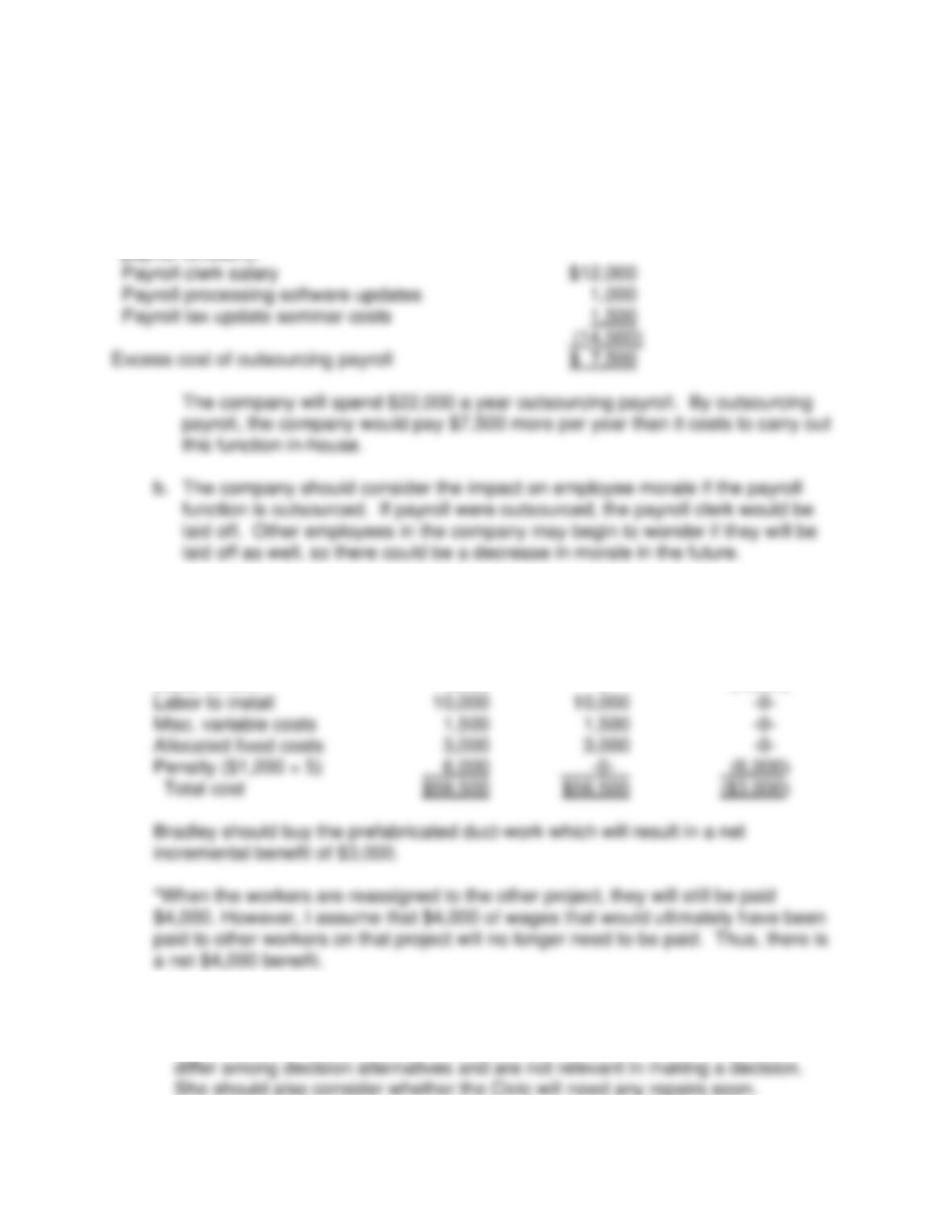
a. Cost savings
Salary of gardeners $195,000
Jiambalvo Managerial Accounting
7-10
P3. [LO 1, 2]
a.
Incremental Cost Analysis
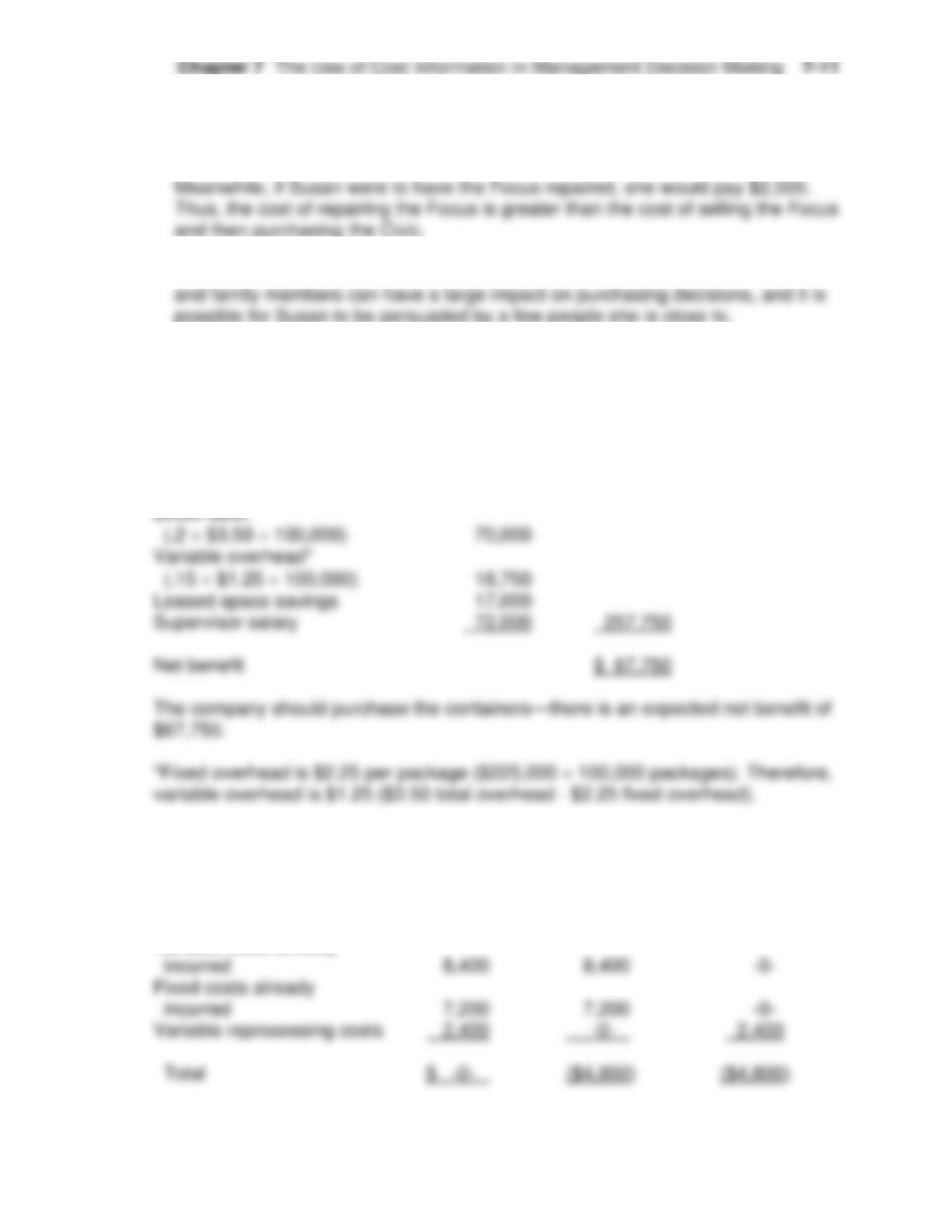
Cost of outsourcing payroll function $22,000
Cost savings (avoidable if outsource
payroll function):
P4. [LO 1]
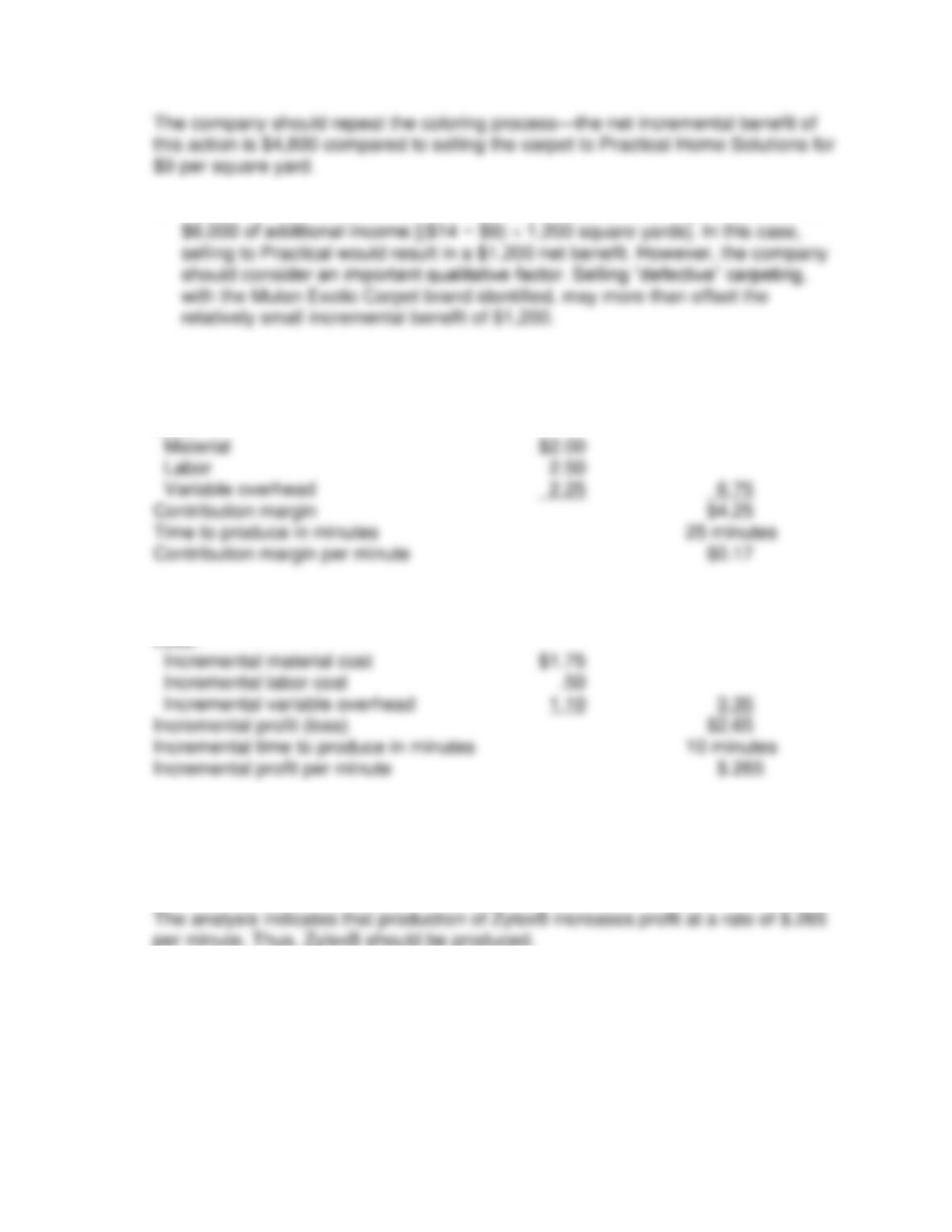
Do not buy Buy
Prefabricated Prefabricated Difference
Materials $35,000 $42,000 $7,000
Labor to form 4,000 -0-* (4,000)
P5. [LO 1, 2]
1. The $17,450 is a sunk cost and has no bearing on future decisions. These
costs have already been incurred and are not reversible. Thus, they do not
2. Susan should buy the Honda Civic. By doing so, she would sell the Ford Focus
for $8,500 and buy the Civic for $10,500. This makes her total costs $2,000.
3. Susan may be influenced by her friends or family in making a decision. Friends
P6. [LO 1]
Incremental cost of purchasing containers
(100,000 packages $1.90) $190,000
Cost savings:
Direct material
(.10 $8.00 100,000) $80,000
P7. [LO 1, 2]
a. Reprocess Sell
and Sell to Practical Difference
Sales $18,000 $10,800 ($7,200)
Less:
Variable costs already
Jiambalvo Managerial Accounting
7-12
b. A payment by Practical of $14 per square yard (rather than $9), would result in
P8. [LO 1]
ZylexA
Selling price $11.00
Less:
ZylexB
Incremental revenue ($17.00 − 11.00) $6.00
There is no question that ZylexA has to be produced, because the company
cannot make ZylexB without starting with ZylexA. The question is, “If you have a
unit of ZylexA, should you take up production time converting it into ZylexB or
should you just make more ZylexA?”