Exercise 7.20
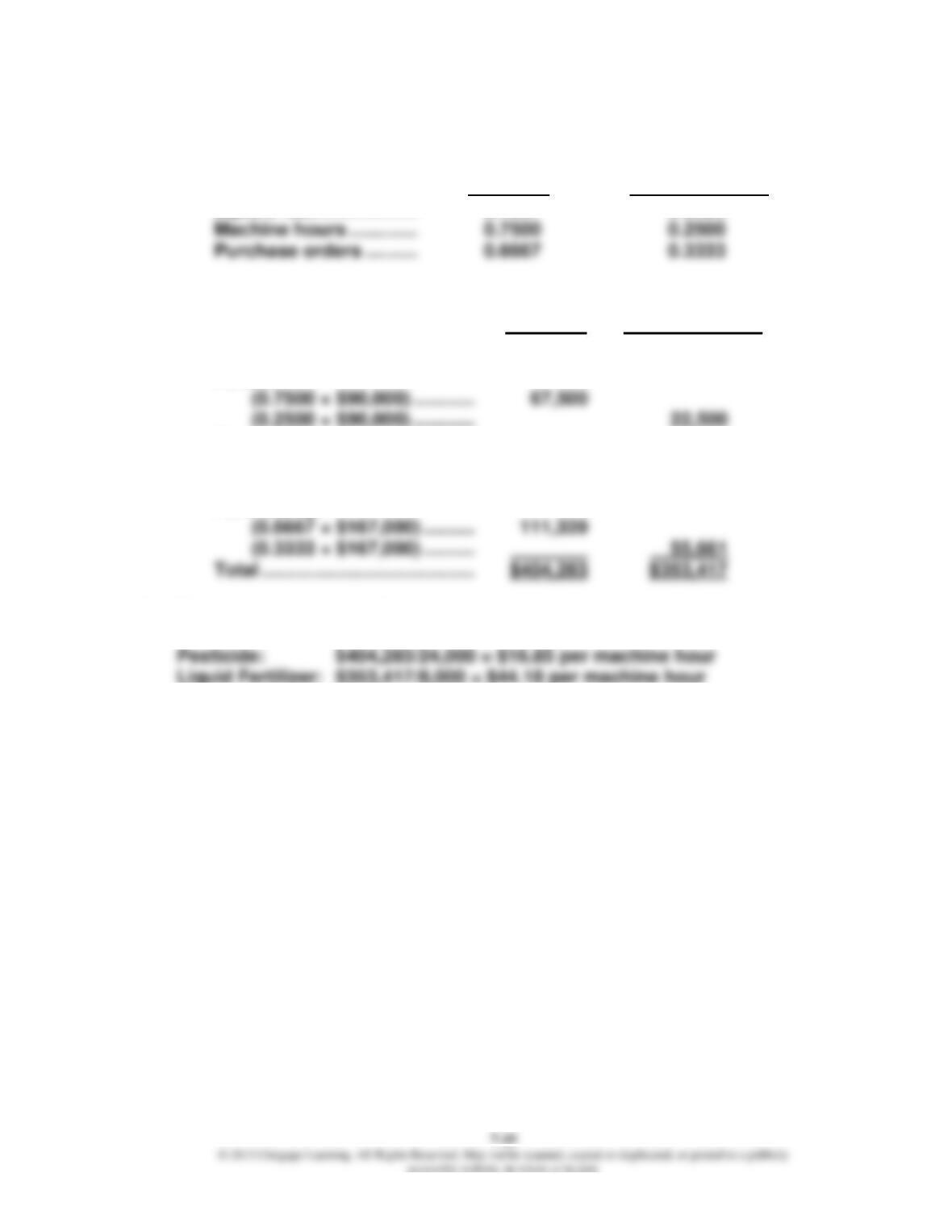
1. Allocation ratios:
Pesticide Liquid Fertilizer
Square feet ………………. 0.4667 0.5333
Cost assignment:
Pesticide Liquid Fertilizer
Direct costs $ 78,900 $107,800
Power:
General Factory:
(0.4667 × $314,000) ………. 146,544
(0.5333 × $314,000) ………. 167,456
Purchasing:
2. Departmental overhead rates:
Exercise 7.21
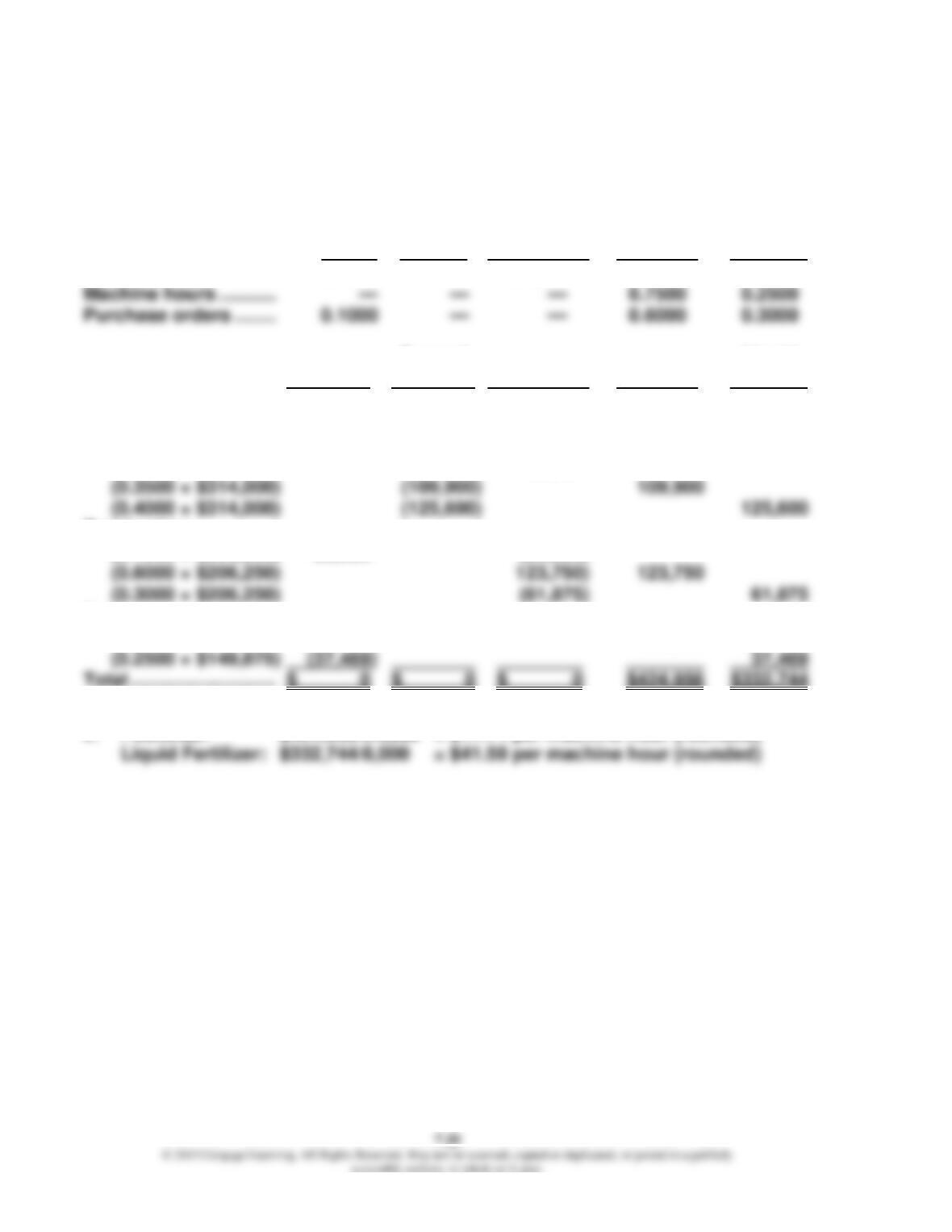
1. Assume the support department costs are allocated in order of highest to
lowest cost: General Factory, Purchasing, and Power.
General Liquid
Power Factory Purchasing Pesticide Fertilizer
Square feet …………….. 0.1250 — 0.1250 0.3500 0.4000
General Liquid
Power Factory Purchasing Pesticide Fertilizer
Direct costs ……………. $ 90,000 $ 314,000 $ 167,000 $ 78,900 $107,800
General Factory:
(0.1250 × $314,000) 39,250 (39,250)
(0.1250 × $314,000) (39,250) 39,250
Purchasing:
(0.1000 × $206,250) 20,625 (20,625)
Power:
(0.7500 × $149,875) (112,406) 112,406
2. Pesticide: $424,956/24,000 = $17.71 per machine hour (rounded)
7-21
Exercise 7.22
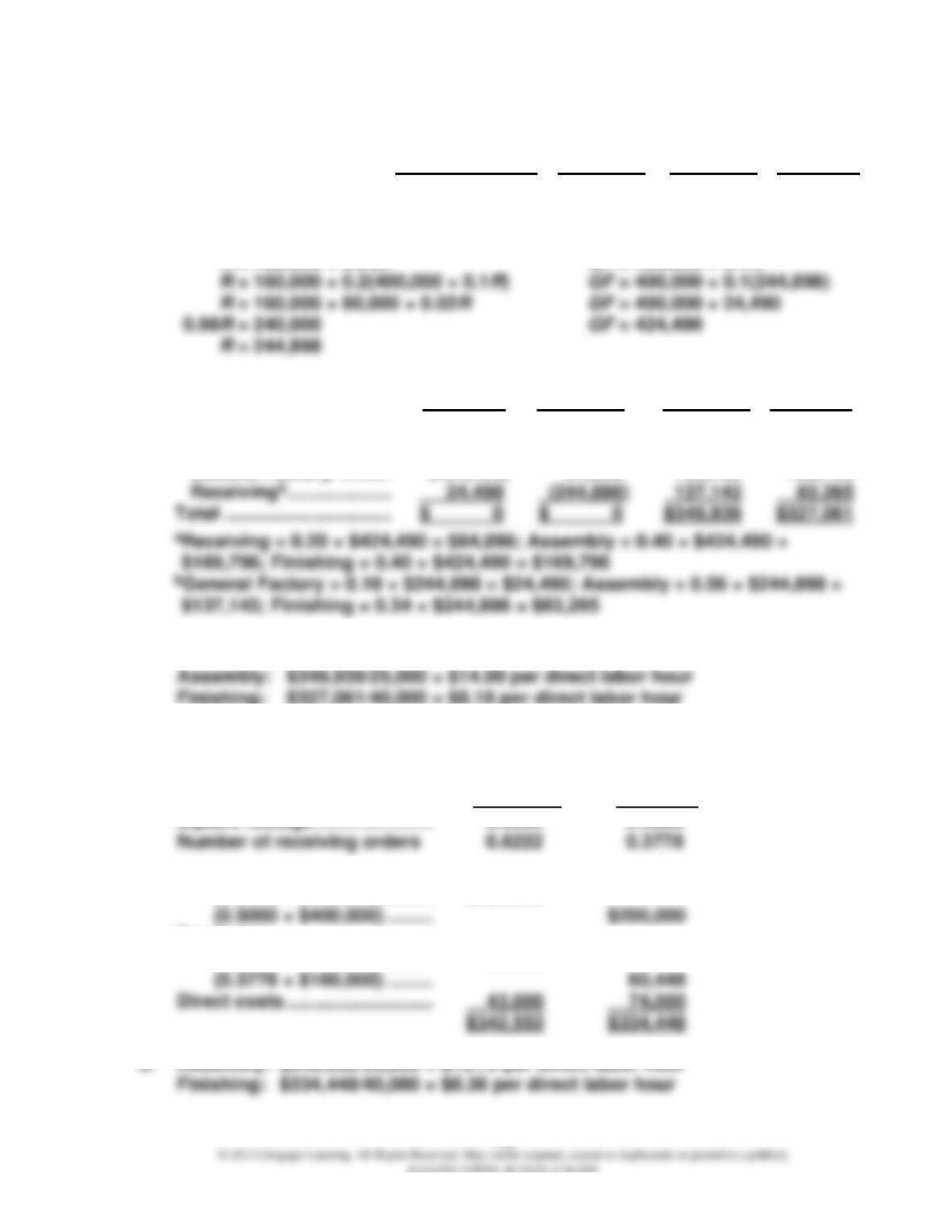
1. General Factory Receiving Assembly Finishing
Square footage …………… — 0.20 0.40 0.40
Number of receiving
orders …………………….. 0.10 — 0.56 0.34
R = 160,000 + 0.2GF GF = 400,000 + 0.1R
General
Factory Receiving Assembly Finishing
Direct overhead cost …… $ 400,000 $ 160,000 $ 43,000 $ 74,000
Allocate:
General Factorya………. (424,490) 84,898 169,796 169,796
2. Departmental rates:
Exercise 7–23
1. Assembly Finishing
Square footage ………………….. 0.5000 0.5000
General Factory:
(0.5000 × $400,000) ……… $200,000
Receiving:
(0.6222 × $160,000) ……… 99,552
7-22
Exercise 7.24
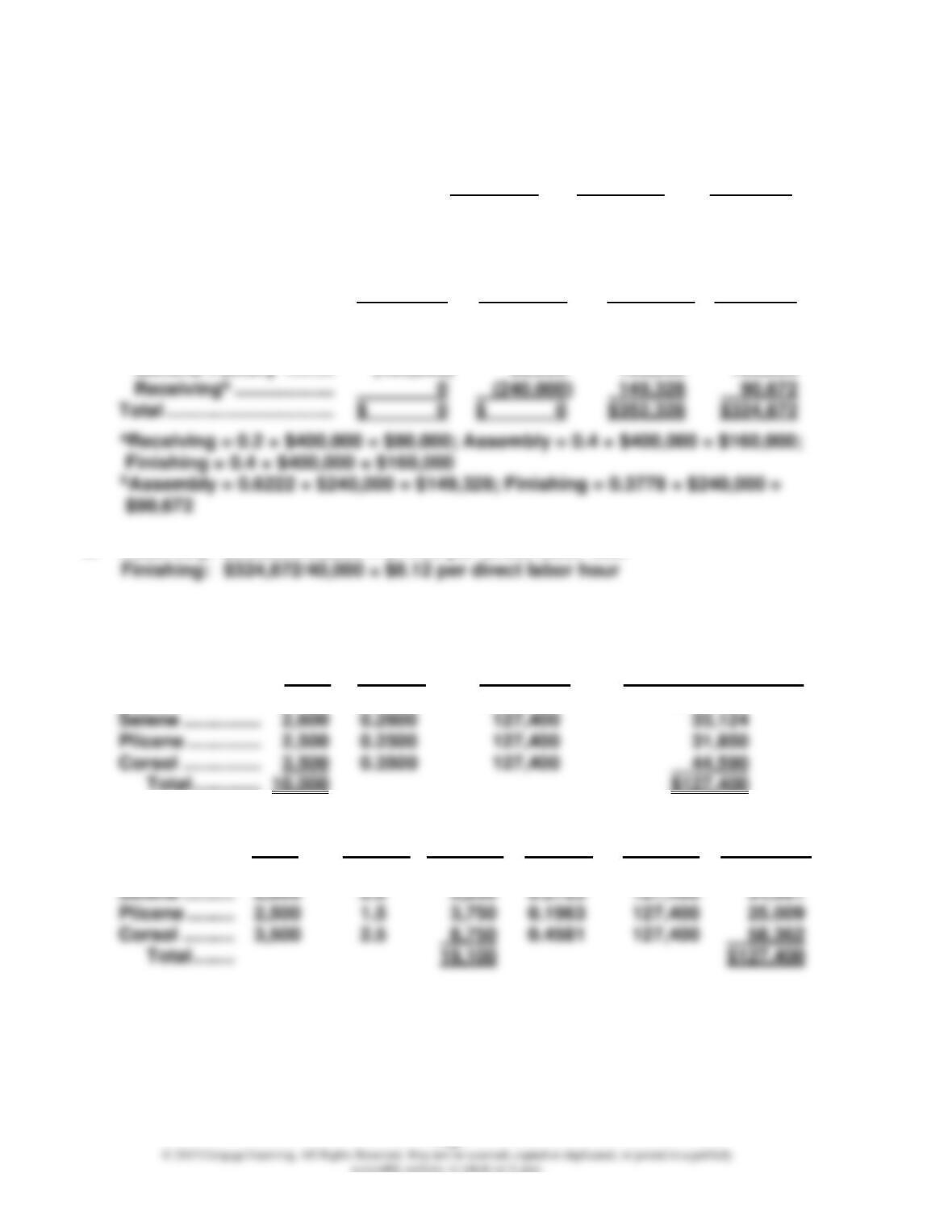
1.
Receiving Assembly Finishing
Square footage …………………………... 0.2000 0.4000 0.4000
Number of receiving orders …………. 0.6222 0.3778
General
Factory Receiving Assembly Finishing
Direct overhead cost ….. $ 400,000 $ 160,000 $ 43,000 $ 74,000
Allocate:
General Factorya ……… (400,000) 80,000 160,000 160,000
2. Assembly: $352,328/25,000 = $14.09 per direct labor hour
Exercise 7.25
1. Units Percent × Joint Cost = Allocated Joint Cost
Barlon …………… 1,400 0.1400 $127,400 $ 17,836
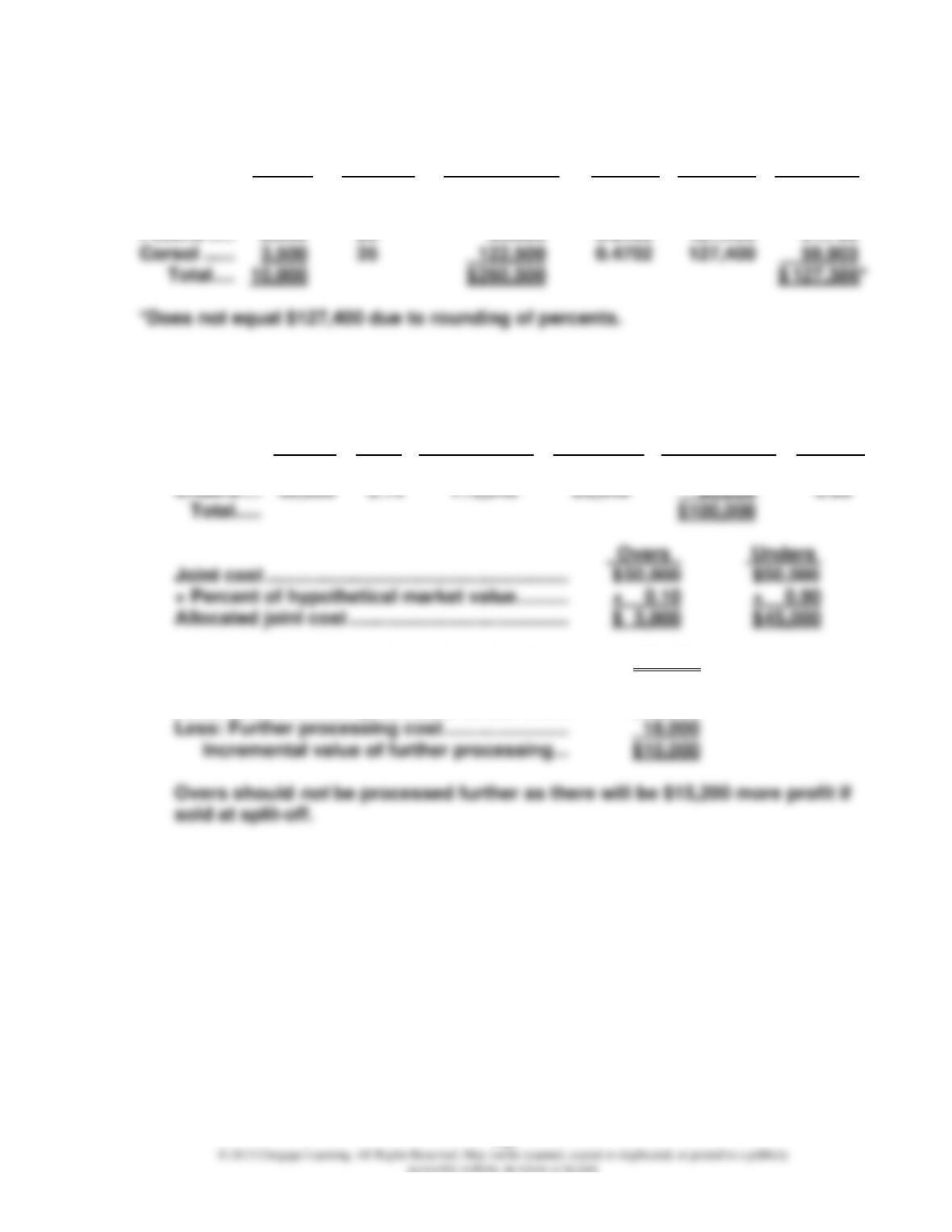
2. Weight Weighted Joint Allocated
Units × Factor = Units Percent × Cost = Joint Cost
Barlon ………. 1,400 1.0 1,400 0.0733 $127,400 $ 9,338
7-23
Exercise 7.26
Price at Market Value Joint Allocated
Units Split-Off at Split-Off Percent Cost Cost
Barlon …… 1,400 $15 $ 21,000 0.0806 $ 127,400 $ 10,268
Selene …… 2,600 20 52,000 0.1996 127,400 25,429
Plicene ….. 2,500 26 65,000 0.2495 127,400 31,786
Exercise 7.27
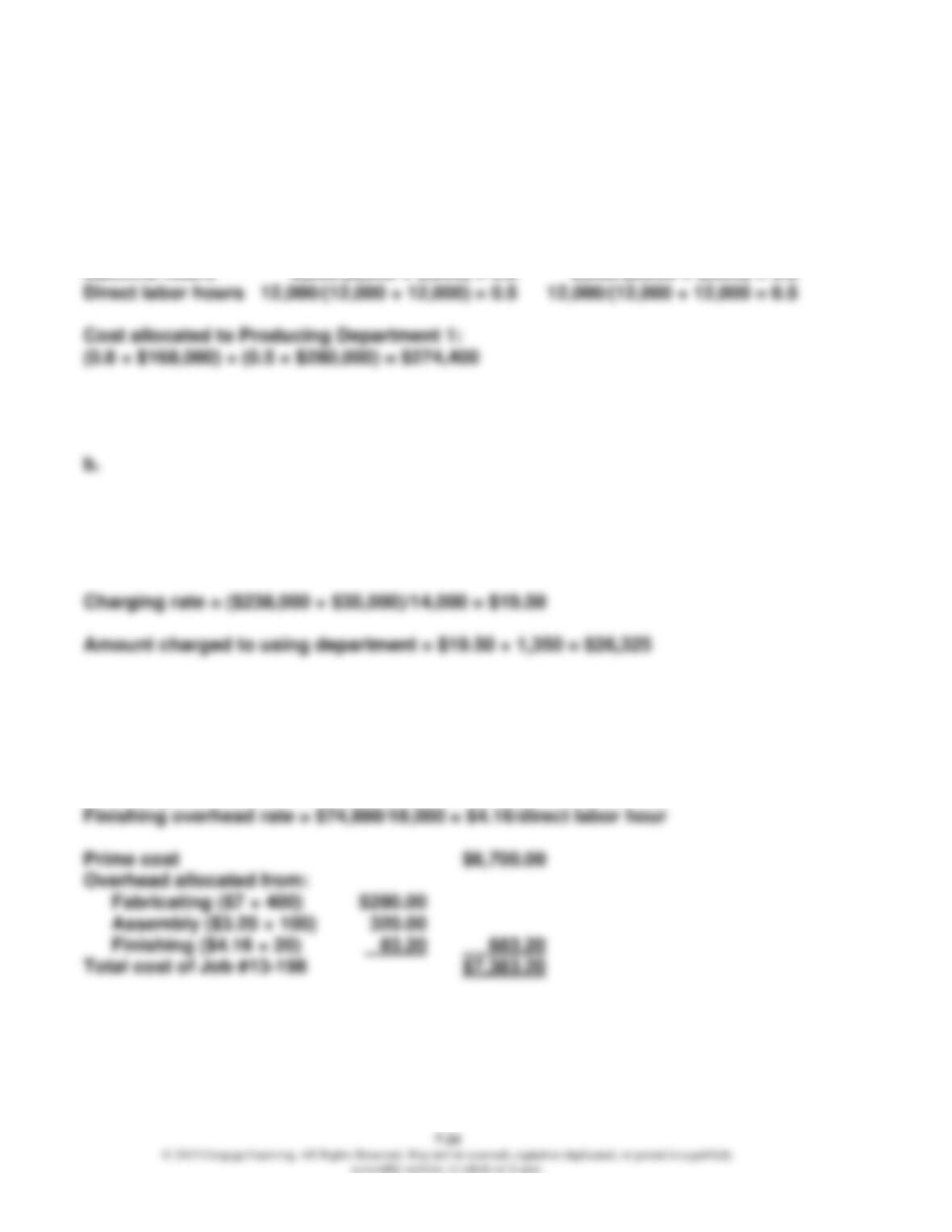
1. Eventual Separable Hypothetical
Units Price Market Value Costs Market Value Percent
Overs …… 14,000 $2.00 $ 28,000 $18,000 $ 10,000 0.10
2. Value of overs at split-off (14,000 × $1.80) ….. $25,200
Value of overs when processed further ……… $28,000
CPA-TYPE EXERCISES
Exercise 7.28
d.
Allocation ratios:
Producing Department 1 Producing Department 2
Machine hours 8,000/(8,000 + 2,000) = 0.8 2,000/(8,000 + 2,000) = 0.2
Exercise 7.29
Exercise 7.30
c.
Exercise 7.31
d.
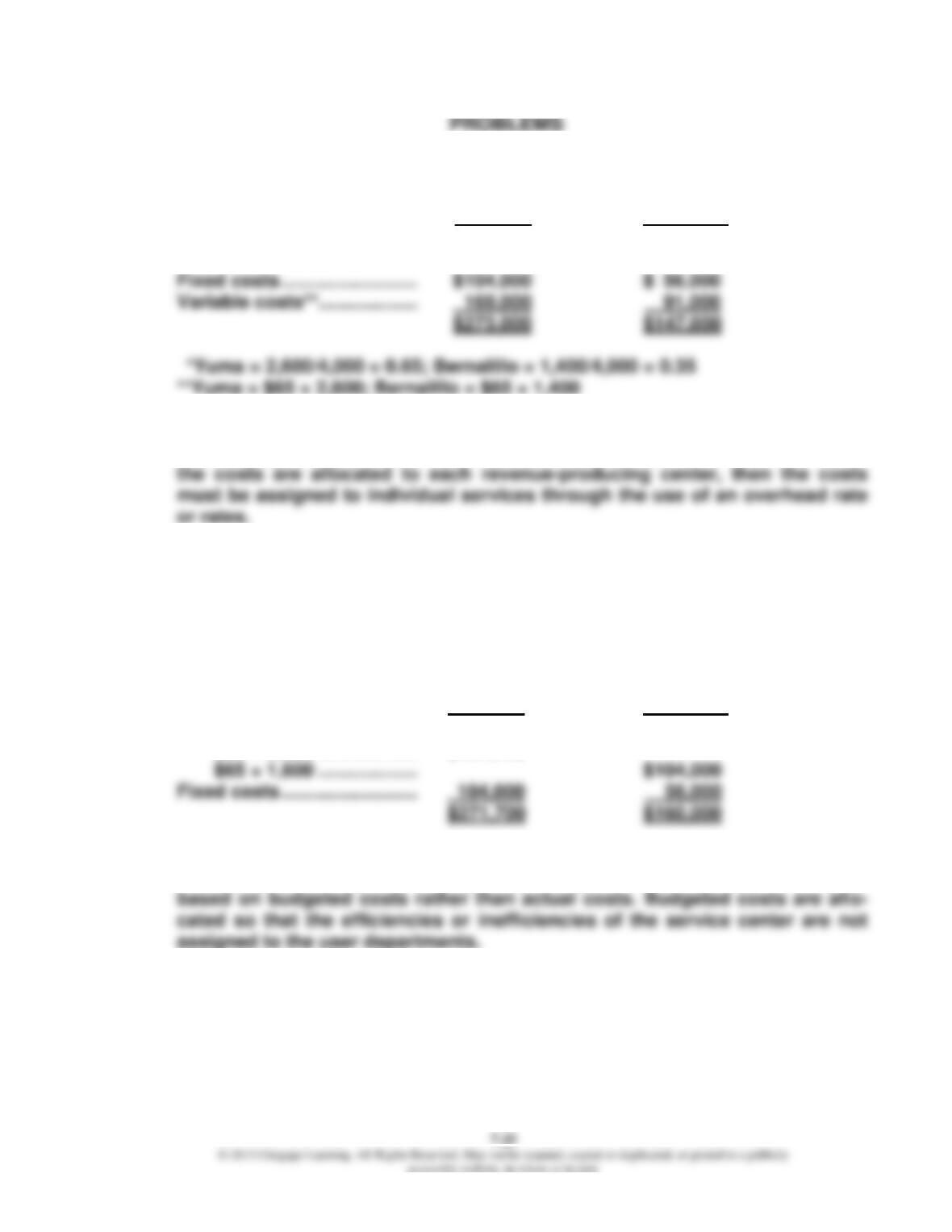
Fabricating overhead rate = $140,000/20,000 = $7/machine hour
Assembly overhead rate = $64,000/20,000 = $3.20/direct labor hour
Exercise 7.32
a.
Problem 7.33
1. Yuma Bernalillo
Ratio for fixed costs* ………. 0.65 0.35
2. Costing out services serves the same purposes as costing out tangible prod-
ucts (e.g., pricing, profitability analysis, and performance evaluation). Once
3. If the purpose is to cost out individual services, then the allocation is identi-
cal to that given in Requirement 1.
If the purpose is for performance evaluation, then variable costs equal the
predetermined rate multiplied by the actual usage. The fixed costs are allo-
cated the same way as before.
Yuma Bernalillo
Variable costs:
$65 × 2,580 ………………. $167,700
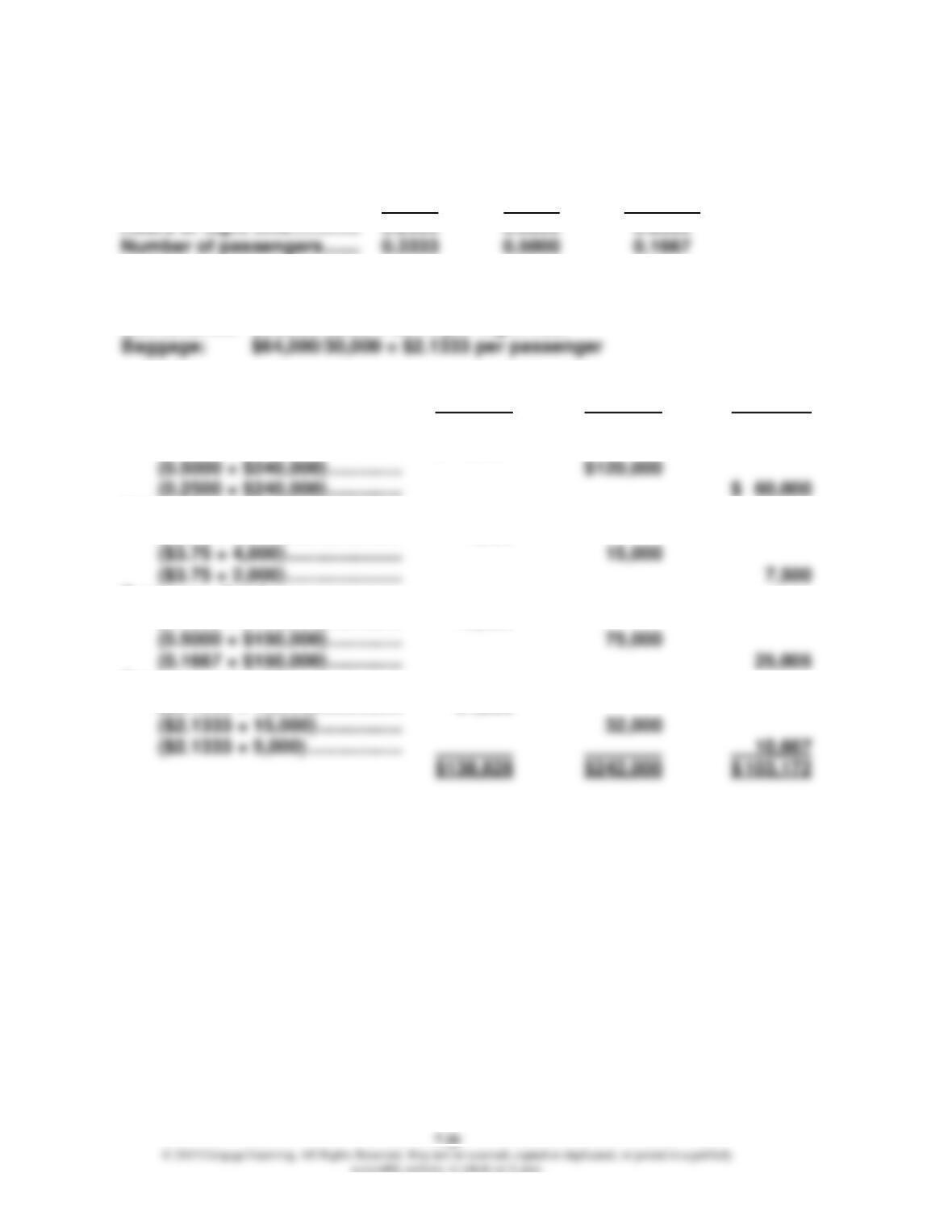
4. The allocated costs of $431,700 were $3,700 lower than the actual costs of
$435,400, because the producing departments are charged an allocation
Problem 7.34
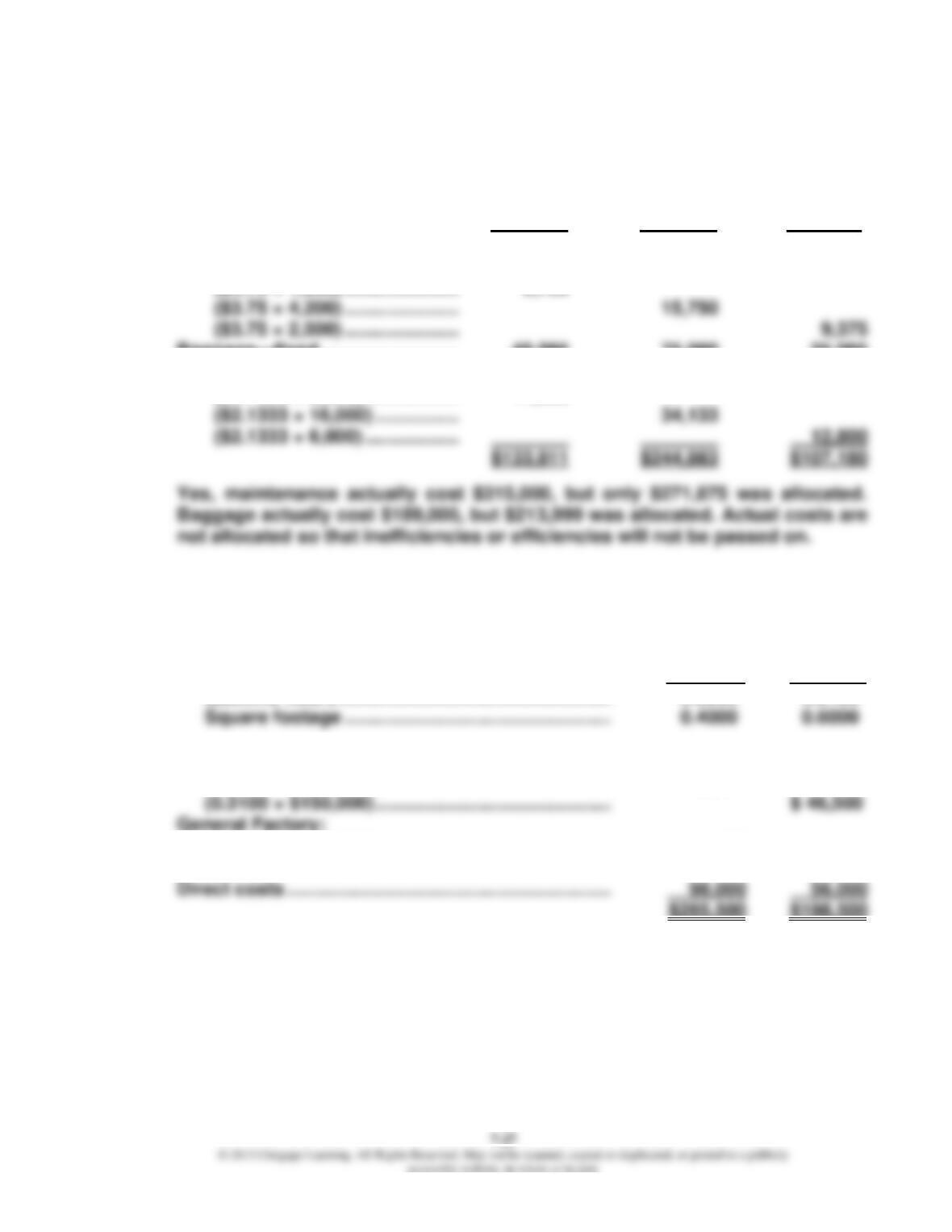
1. Allocation ratios for fixed costs (uses normal levels):
SLC Reno Portland
Hours of flight time …………. 0.2500 0.5000 0.2500
Variable rates:
Maintenance: $30,000/8,000 = $3.75 per flight hour
SLC Reno Portland
Maintenance—fixed:
(0.2500 × $240,000) ………….. $ 60,000
Maintenance—variable:
($3.75 × 2,000) …………………. 7,500
Baggage—fixed:
(0.3333 × $150,000) ………….. 49,995
Baggage—variable:
($2.1333 × 10,000) ……………. 21,333
Problem 7.34 (Concluded)
2. The allocations are the same as in Requirement 1, except variable costs are
assigned using actual instead of budgeted activity.
SLC Reno Portland
Maintenance—fixed ……………….. $ 60,000 $120,000 $ 60,000
Maintenance—variable:
($3.75 × 1,800) …………………. 6,750
Baggage—fixed ……………………… 49,995 75,000 25,005
Baggage—variable:
($2.1333 × 8,000) ……………… 17,066
Problem 7.35
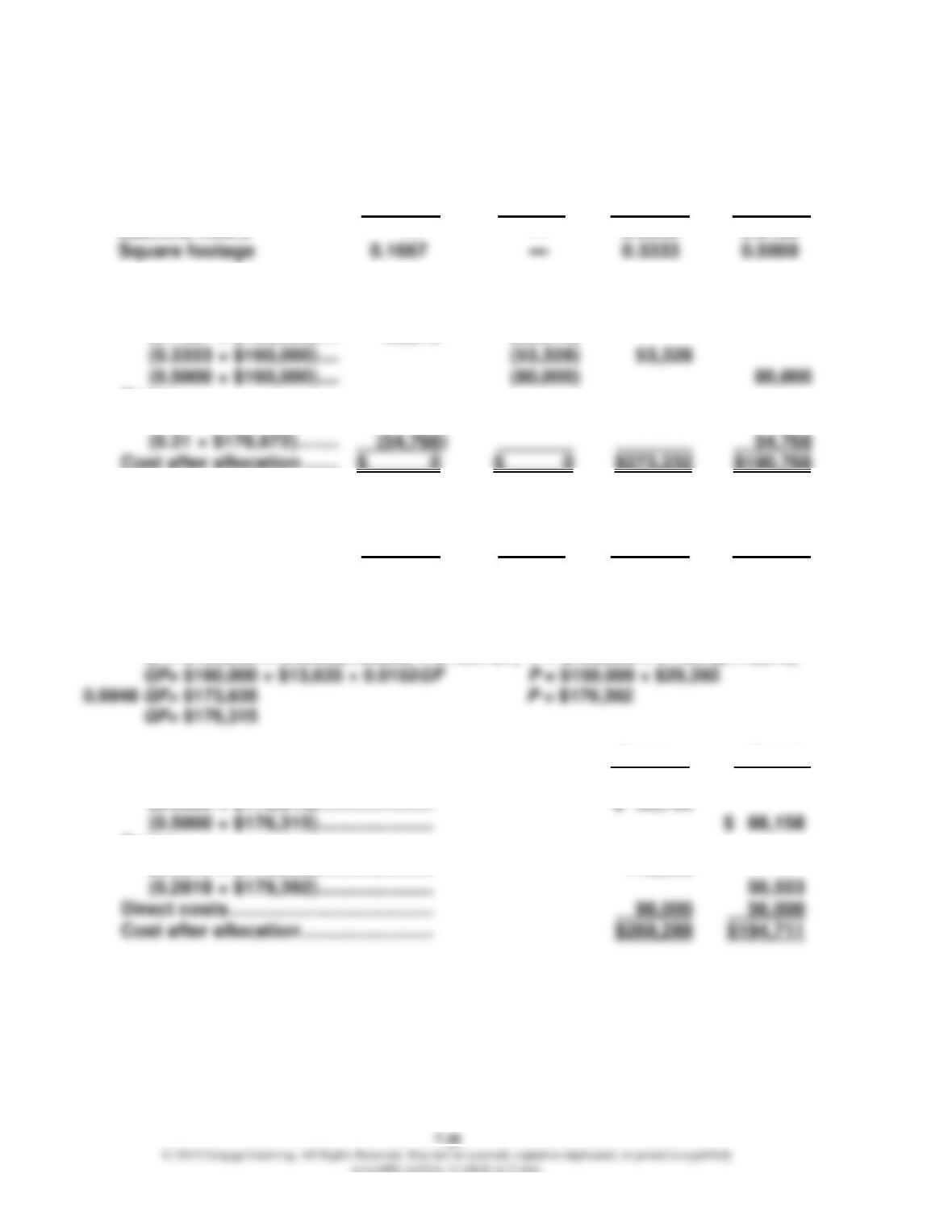
1.
Proportion of: Pottery Retail
Machine hours ……………………………………………. 0.6900 0.3100
Power:
(0.6900 × $150,000) ……………………………………… $ 103,500
(0.4000 × $160,000) ……………………………………… 64,000
(0.6000 × $160,000) ……………………………………… 96,000
Problem 7.35 (Concluded)
2.
General
Power Factory Pottery Retail
Machine hours — — 0.6900 0.3100
Direct costs ………………… $ 150,000 $160,000 $ 98,000 $ 56,000
General Factory:
(0.1667 × $160,000) …. 26,672 (26,672)
Power:
(0.69 × $176,672) …….. (121,904) 121,904
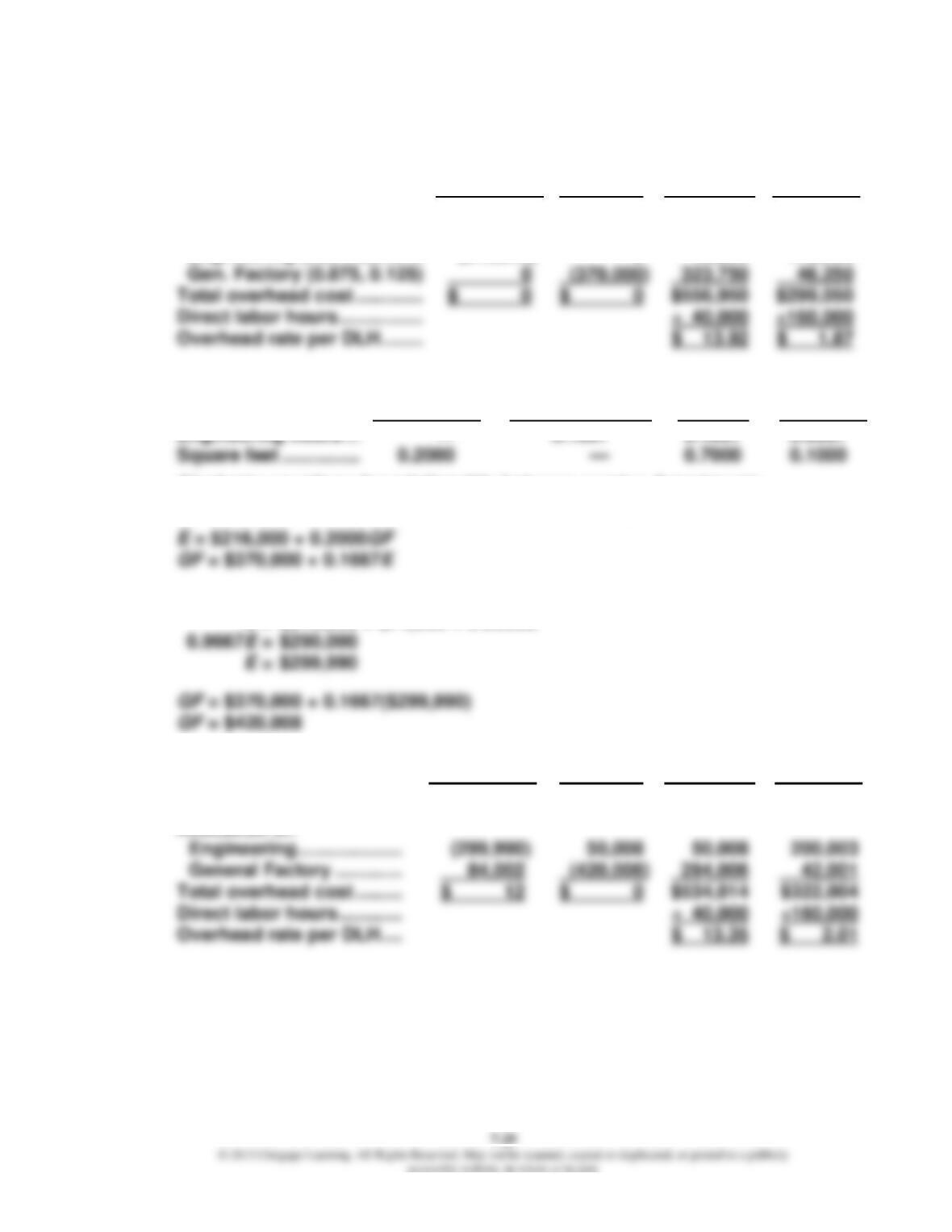
3.
General
Power Factory Pottery Retail
Machine hours ……………… — 0.0909 0.6273 0.2818
Square footage …………….. 0.1667 — 0.3333 0.5000
GF= $160,000 + 0.0909P P = $150,000 + 0.1667GF
GF= $160,000 + 0.0909($150,000 + 0.1667GF) P = $150,000 + 0.1667($176,315)
Pottery Retail
General Factory:
Power:
(0.6273 × $179,392) …………………. 112,533
Problem 7.36
1. General
Engineering Factory Molding Assembly
Department costs ……………. $ 216,000 $ 370,000 $190,000 $ 80,000
Allocation of:
Engineering (0.2, 0.8) ……… (216,000) 0 43,200 172,800
2.
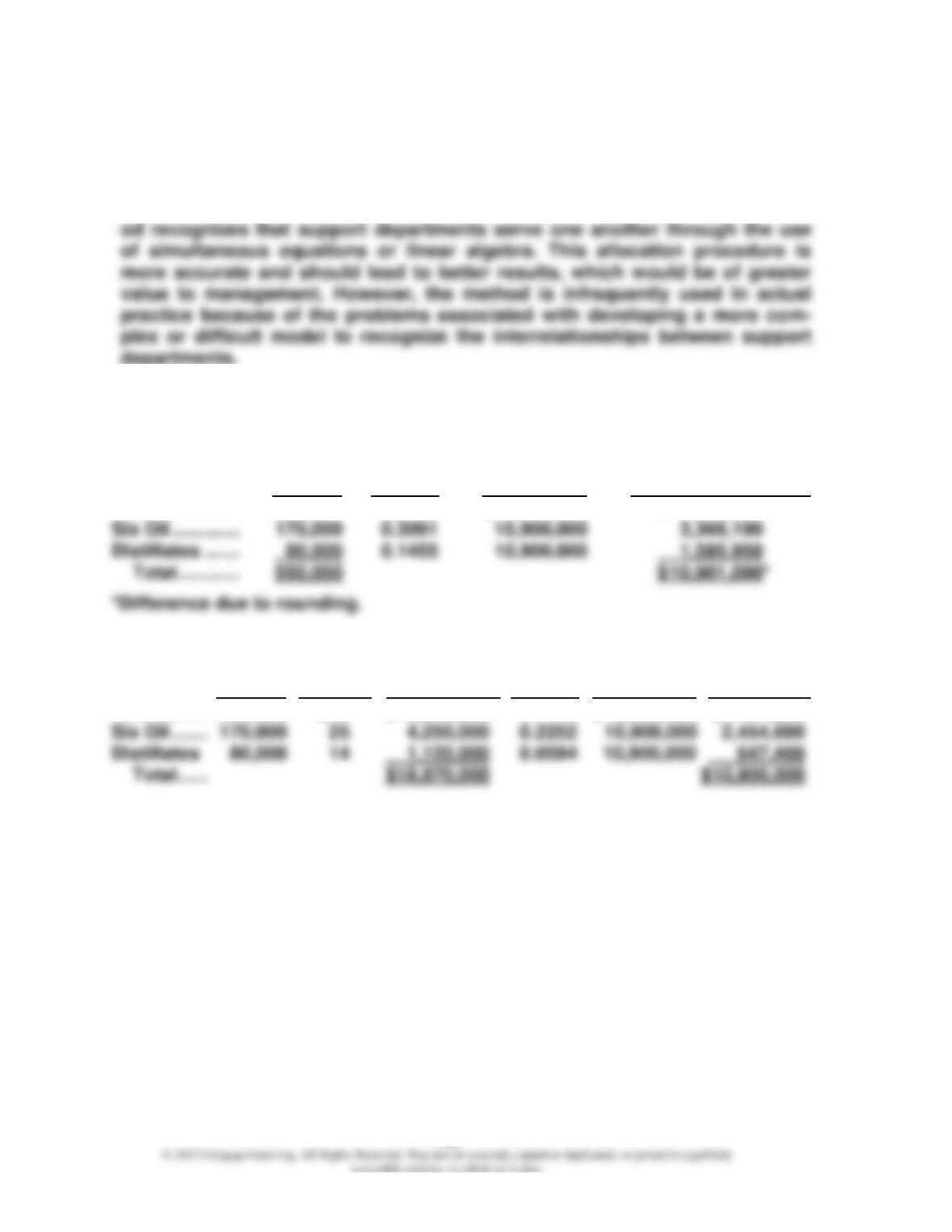
Engineering General Factory Molding Assembly
Algebraic equations for relationship between service departments
(E = Engineering Department; GF = General Factory Department):
E = $216,000 + 0.2000($370,000 + 0.1667E)
E = $216,000 + $74,000 + 0.0333E
General
Engineering Factory Molding Assembly
Direct overhead costs ….. $ 216,000 $ 370,000 $190,000 $ 80,000
Allocation of:
7-30
Problem 7.36 (Concluded)
3. The direct allocation method ignores any service rendered by one support
department to another. Allocation of each support department’s total cost is
made directly to the production departments. The reciprocal allocation meth-
Problem 7.37
1.
Barrels Percent × Joint Cost = Allocated Joint Cost
Two Oil ……….. 300,000 0.5455 $10,900,000 $ 5,945,950
2.
Price at Market Value Joint Allocated
Barrels Split-Off at Split-Off Percent Cost Cost
Two Oil ….. 300,000 $45 $ 13,500,000 0.7154 $10,900,000 $7,797,860
7-31
Problem 7.38
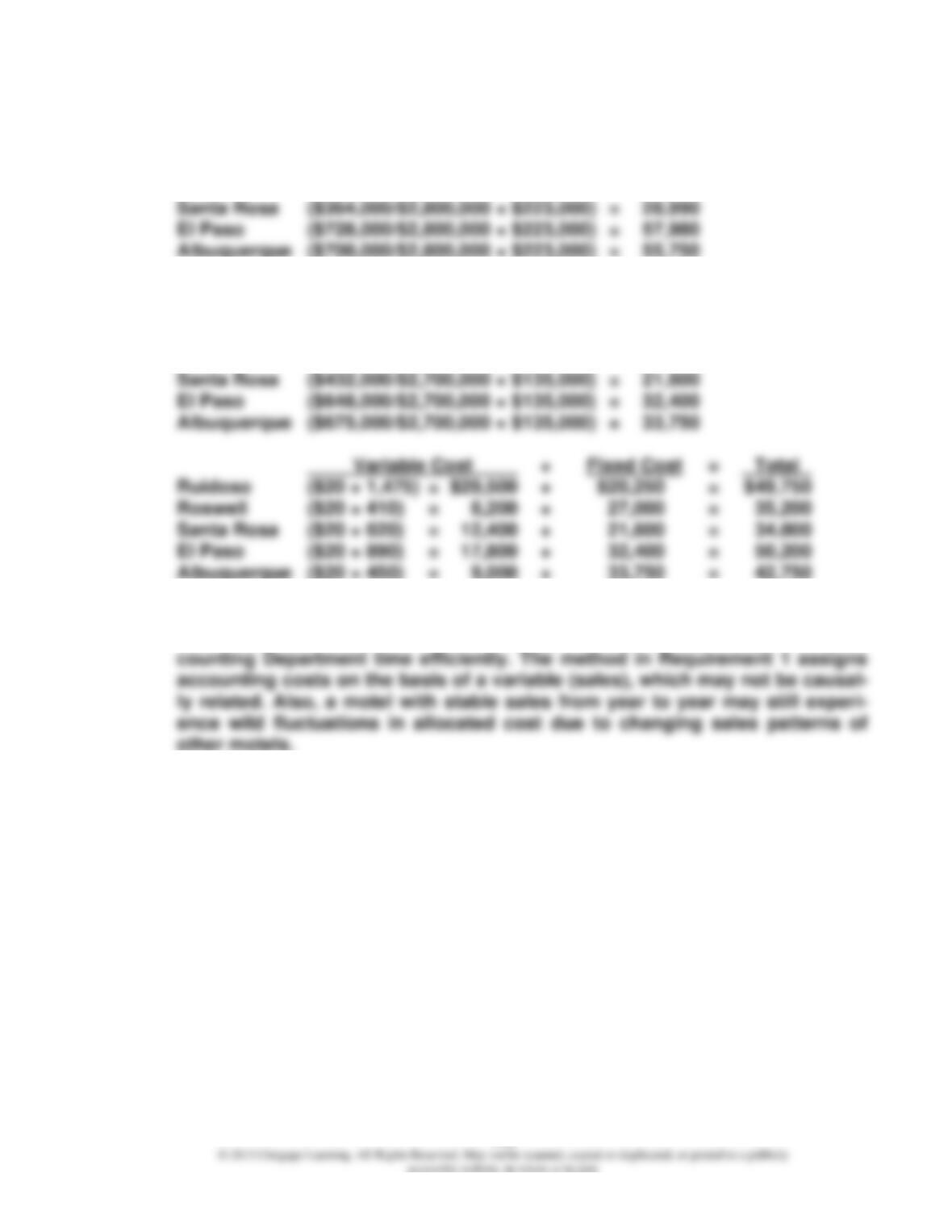
1. Ruidoso ($420,000/$2,800,000 × $223,000) = $33,450
Roswell ($588,000/$2,800,000 × $223,000) = 46,830
2. Share of Accounting Department fixed costs based on 2014 sales:
Ruidoso ($405,000/$2,700,000 × $135,000) = $20,250
Roswell ($540,000/$2,700,000 × $135,000) = 27,000
3. The method in Requirement 2 is better because it ties cost allocated to the
driver that causes the cost. Thus, managers would be more likely to use Ac-
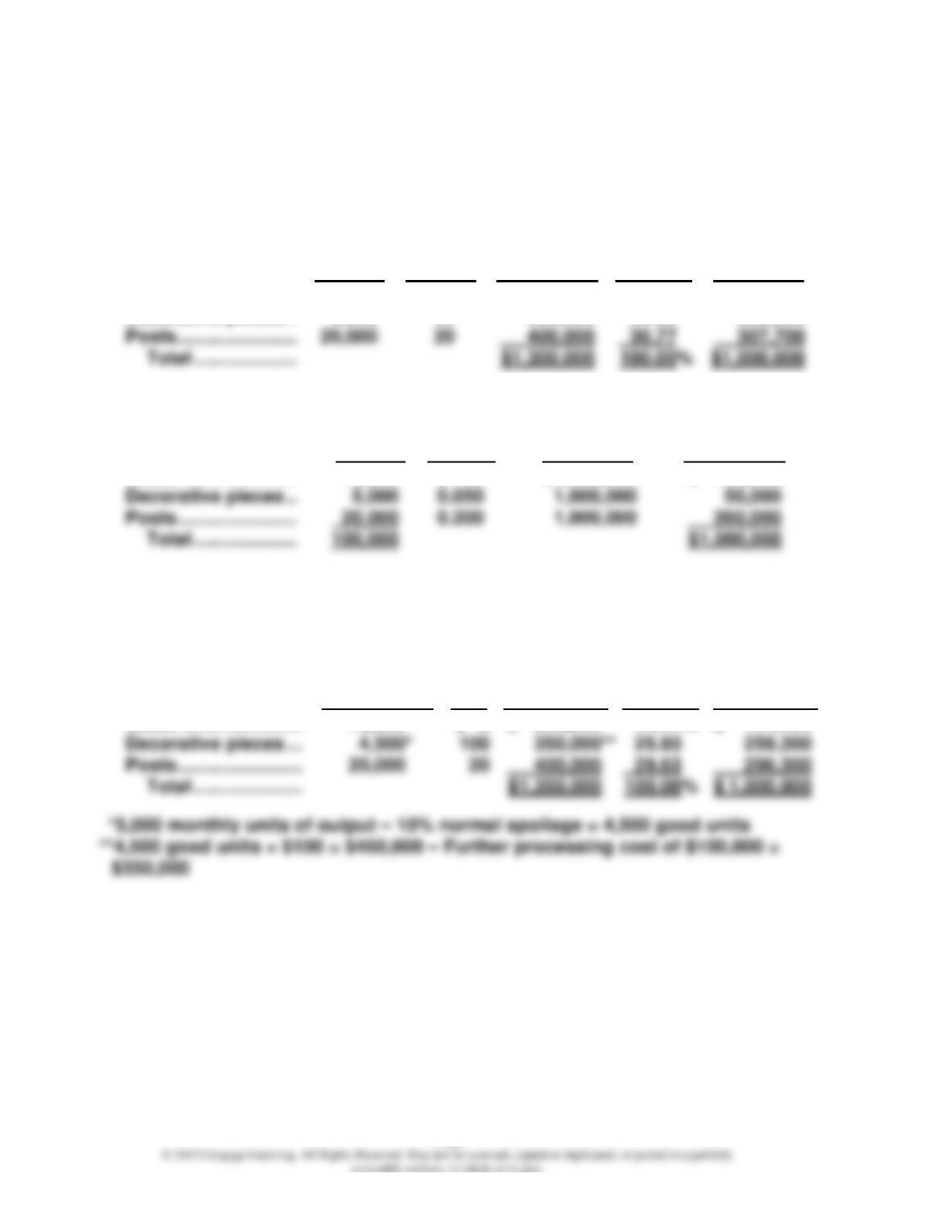
7-32
Problem 7.39
1.
a. Relative sales-value-at-split-off method:
Monthly Sales Relative Percent Allocated
Unit Price Sales Value of Joint
Output per Unit at Split-Off Sales Costs
Studs …………………. 75,000 $ 8 $ 600,000 46.15% $ 461,500
Decorative pieces .. 5,000 60 300,000 23.08 230,800
b. Physical units (volume) method at split-off:
Allocated
Units Percent × Joint Cost = Joint Costs
Studs …………………. 75,000 0.750 $1,000,000 $ 750,000
c. Estimated net realizable value method:
Fully
Processed Sales Estimated
Monthly Price Net Percent Allocated
Unit per Realizable of Joint
Output Unit Value Value Costs
Studs ………………….. 75,000 $ 8 $ 600,000 44.44% $ 444,400
7-33
Problem 7.39 (Concluded)
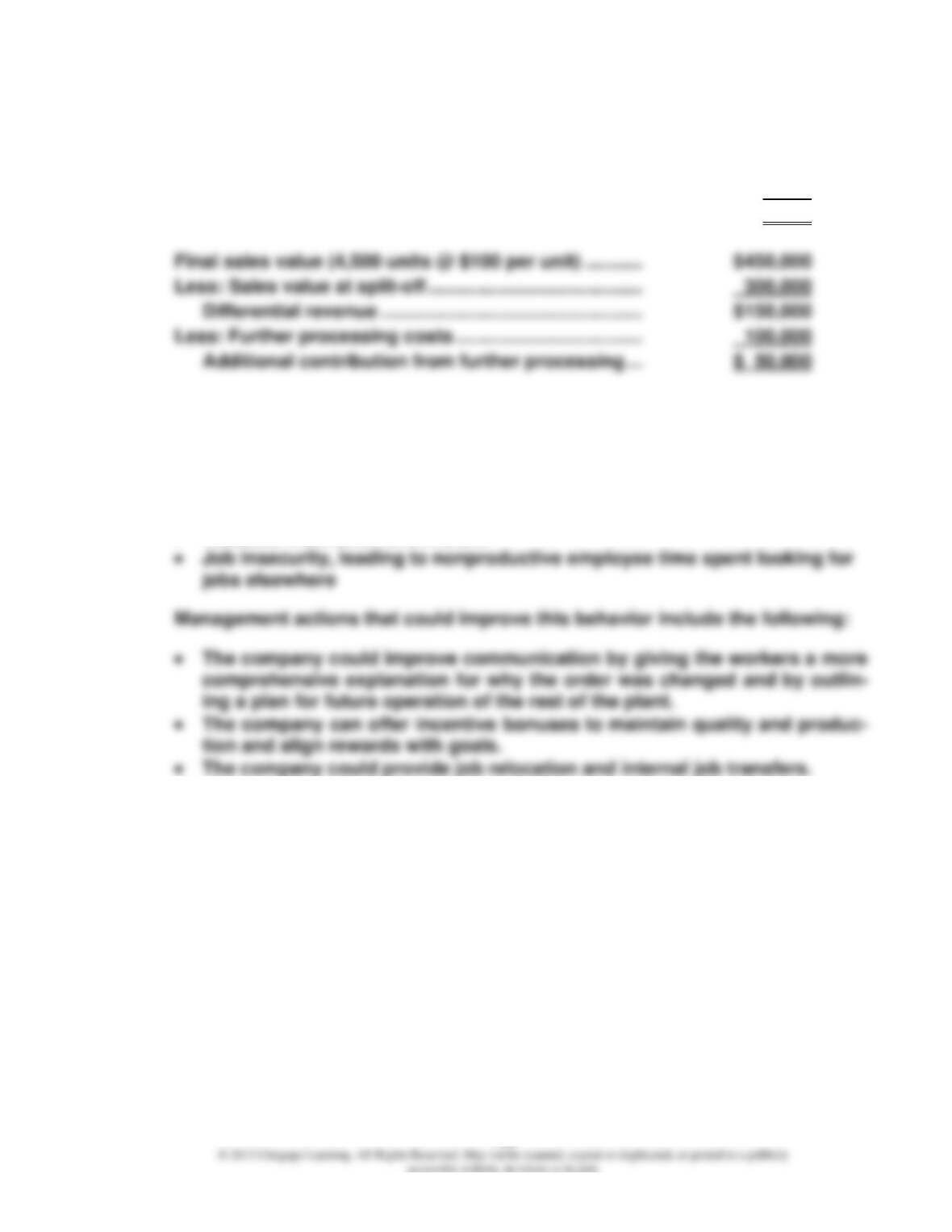
2. Monthly unit output ……………………………………………….. 5,000
Less: Normal further processing shrinkage ……………. 500
Units available for sale ……………………………………… 4,500
3. Assuming Sonimad Sawmill, Inc., announces that in six months it will sell the
rough-cut product at split-off, due to increasing competitive pressure, at least
three types of likely behavior that will be demonstrated by the skilled labor in
the planing and sizing process include the following:
• Poorer quality
• Reduced motivation and morale
7-34
Problem 7.40
1. Clearly, some expenses pertain to women living in the house, while others
pertain to all members. In-house members use the second floor, most of the
food, and most of the variable expenses. All members use the first floor facili-
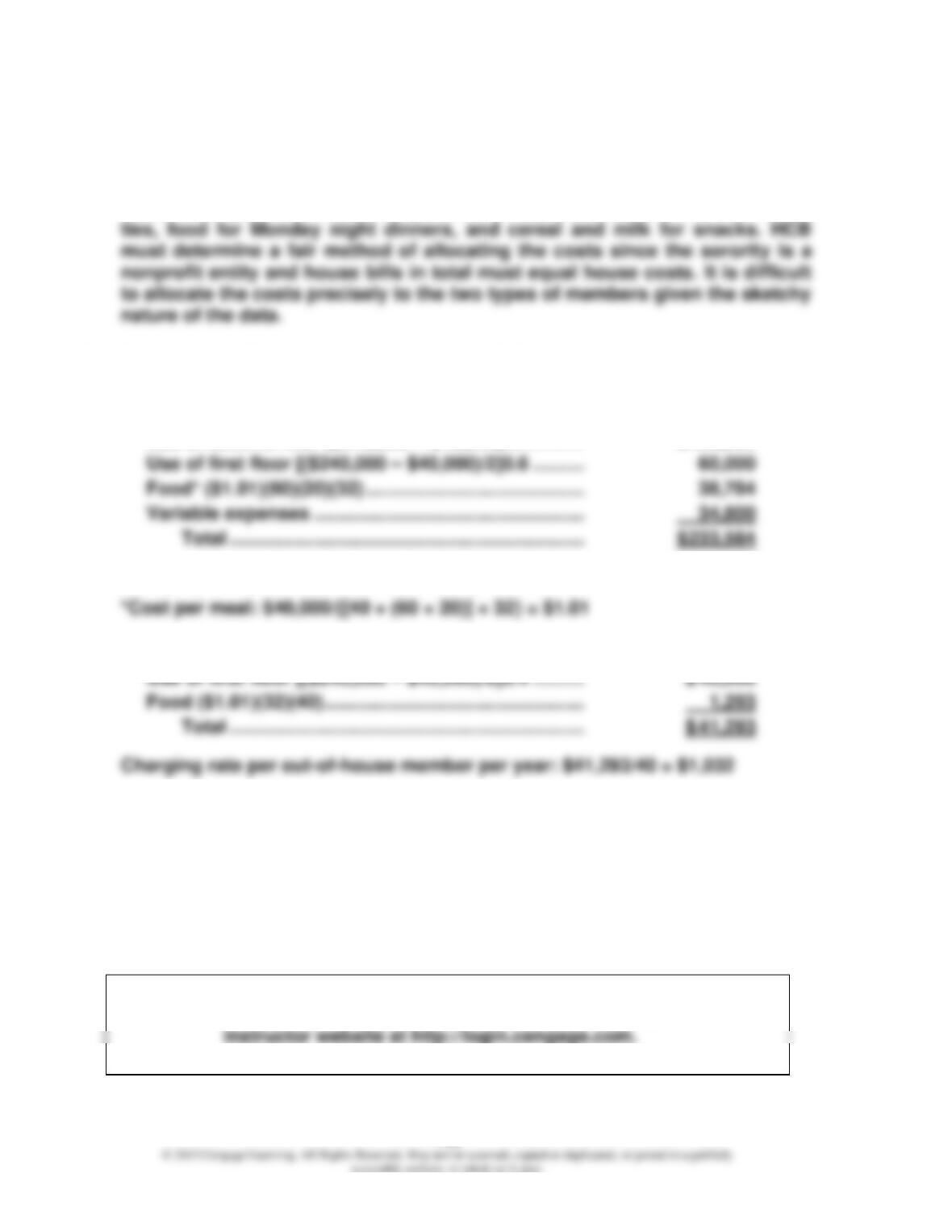
2. Using a benefits-received approach, the following charging rates might be
applied.
In-house members:
Use of second floor ($240,000 – $40,000)/2 ………… $ 100,000
Charging rate per in-house member per year: $233,584/60 = $3,893
Out-of-house members:
CYBER RESEARCH CASE
7.41
Answers will vary.
The Collaborative Learning Exercise Solutions can be found on the
7-35
The following problems can be assigned within CengageNOW and are auto-
graded. See the last page of each chapter for descriptions of these new assign-
ments.
• Integrative Problem—Job Order Costing, Support Department Allocation, Rele-
vant Costing (Covering chapters 5, 7, and 17)
• Integrative Problem—Job Costing, Joint Costs, Process Costing, Decentraliza-