P7–5
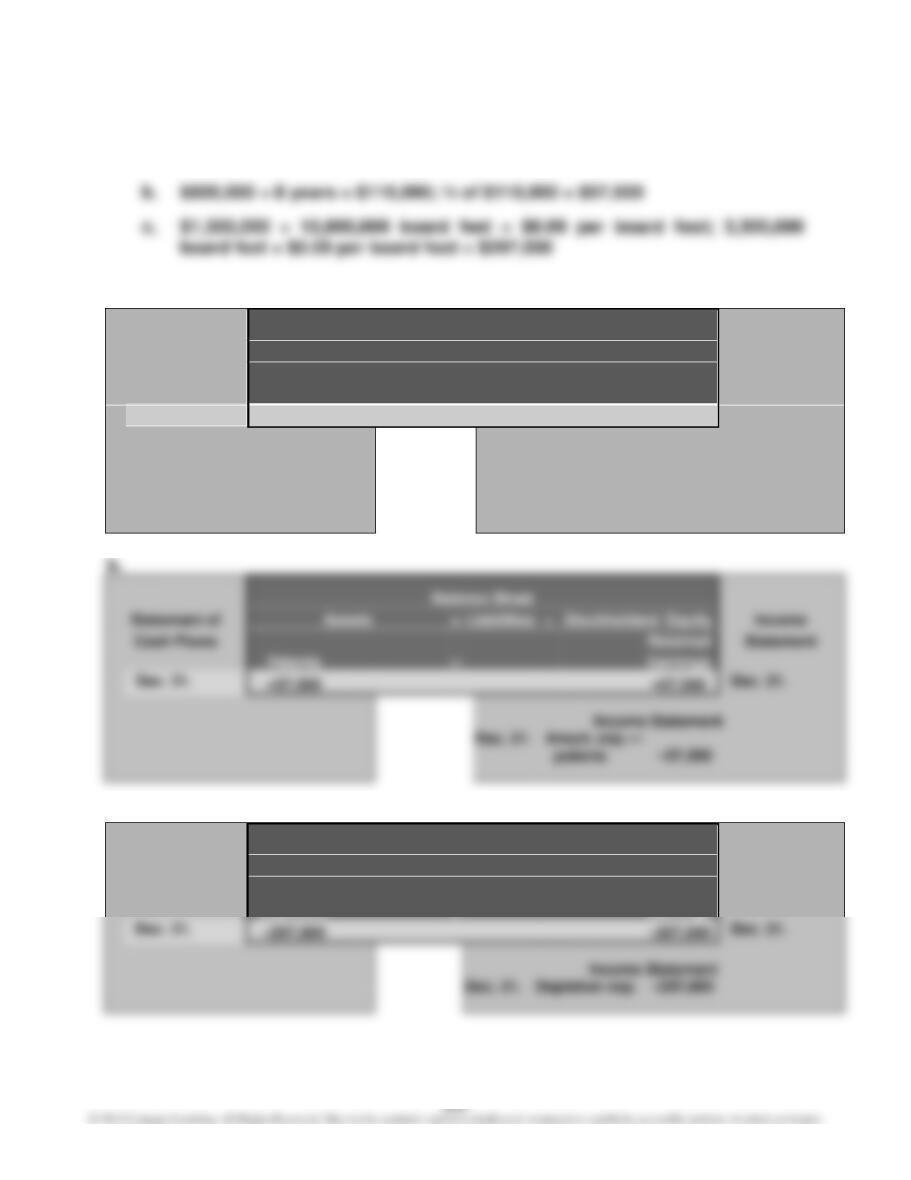
1. a. Loss on impairment of goodwill, $3,000,000
2. a.
Balance Sheet
Statement of
Assets
=
Liabilities
+
Stockholders’ Equity
Income
Cash Flows
Retained
Statement
Goodwill
=
Earnings
Dec. 31.
–3,000,000
–3,000,000
Dec. 31.
Income Statement
Dec. 31.
Loss from
impaired
goodwill
–3,000,000
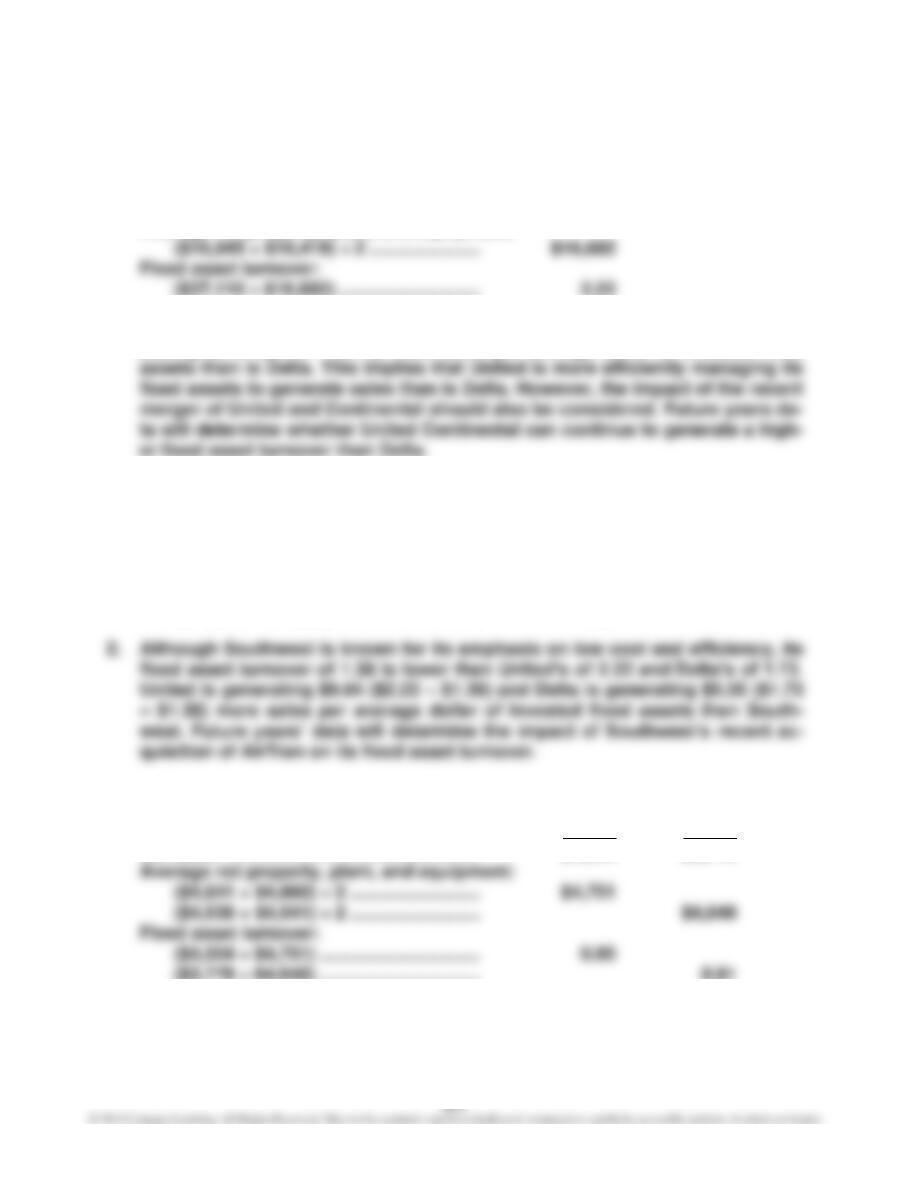
Balance Sheet
Statement of
Assets
=
Liabilities
+
Stockholders’ Equity
Income
Cash Flows
Retained
Statement
=
Earnings
–57,500
–57,500
c.
Balance Sheet
Statement of
Assets
=
Liabilities
+
Stockholders’ Equity
Income
Cash Flows
– Acc.
Retained
Statement
=
Earnings
Dec. 31.
Depletion exp.
–297,000
FINANCIAL ANALYSIS
FA7–1
1. Net sales …………………………………………… $37,110
Average net property, plant, and equipment:
2. United’s fixed asset turnover is 2.22 compared to Delta’s 1.73. United is gen-
erating $0.49 ($2.22 – $1.73) more sales per average dollar of invested fixed
FA7–2
1. Net sales …………………………………………… $15,658
Average net property, plant, and equipment:
($10,578 + $12,127) ÷ 2 …………………. $11,353
Fixed asset turnover:
($15,658 ÷ $11,353) ………………………. 1.38
FA7–3
1. Year 2 Year 1
Net sales …………………………………………… $4,504 $3,779
2. JetBlue increased its fixed asset turnover by 0.14 from 0.81 in Year 1 to 0.95
in Year 2. This is a favorable trend and implies that JetBlue is more efficiently
using its fixed asset to generate sales in Year 2.
FA7–4
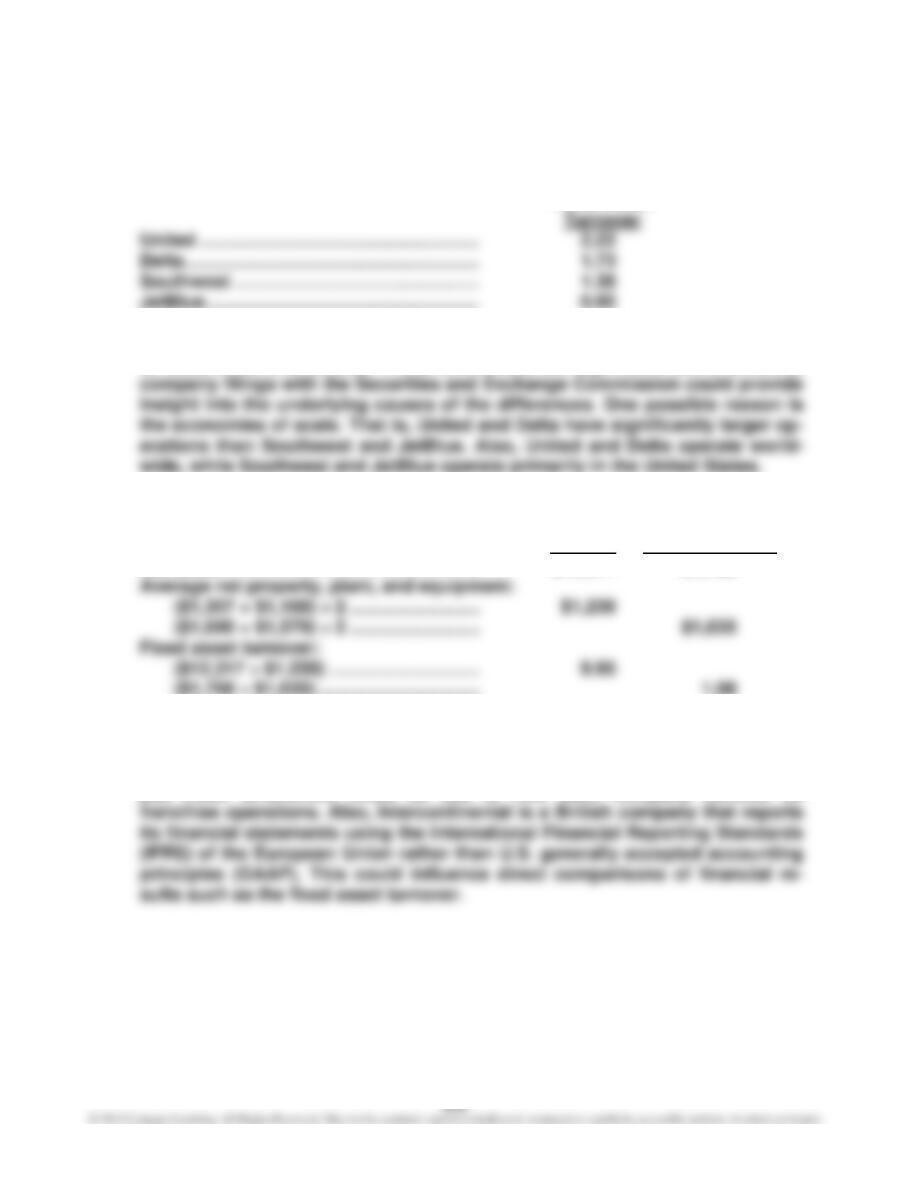
1. The fixed asset turnovers are summarized below from highest to lowest.
Fixed Asset
2. As shown above, United has the highest fixed asset turnover followed by Del-
ta, Southwest, and JetBlue. These differences are significant and a review of
FA7–5
1. Marriott Intercontinental
Net sales ……………………………………………. $12,317 $1,768
2. Marriott’s fixed asset turnover of 9.95 is significantly higher than Interconti-
nental’s fixed asset turnover of 1.08. The reasons for these significant differ-
ences could be due to how each company manages its properties. For exam-
ple, these differences could be due to how each company handles its
CASES
Case 7–1
It is considered unprofessional for employees to use company assets for
personal reasons, because such use reduces the useful life of the assets for
normal business purposes. Thus, it is unethical for Rowel Baylon to use Arches
Case 7–2
You should explain to Don and Rita that it is acceptable to maintain two sets
of records for tax and financial reporting purposes. This can happen when a
company uses one method for financial statement purposes, such as straight-line
depreciation, and another method for tax purposes, such as MACRS depreciation.

Case 7–3
1. a. Straight-line method:
20Y2: ($300,000 ÷ 5) × 1/2 ………………………………………………………….. $30,000
20Y3: ($300,000 ÷ 5) ………………………………………………………………….. 60,000
20Y4: ($300,000 ÷ 5) ………………………………………………………………….. 60,000
b. MACRS:
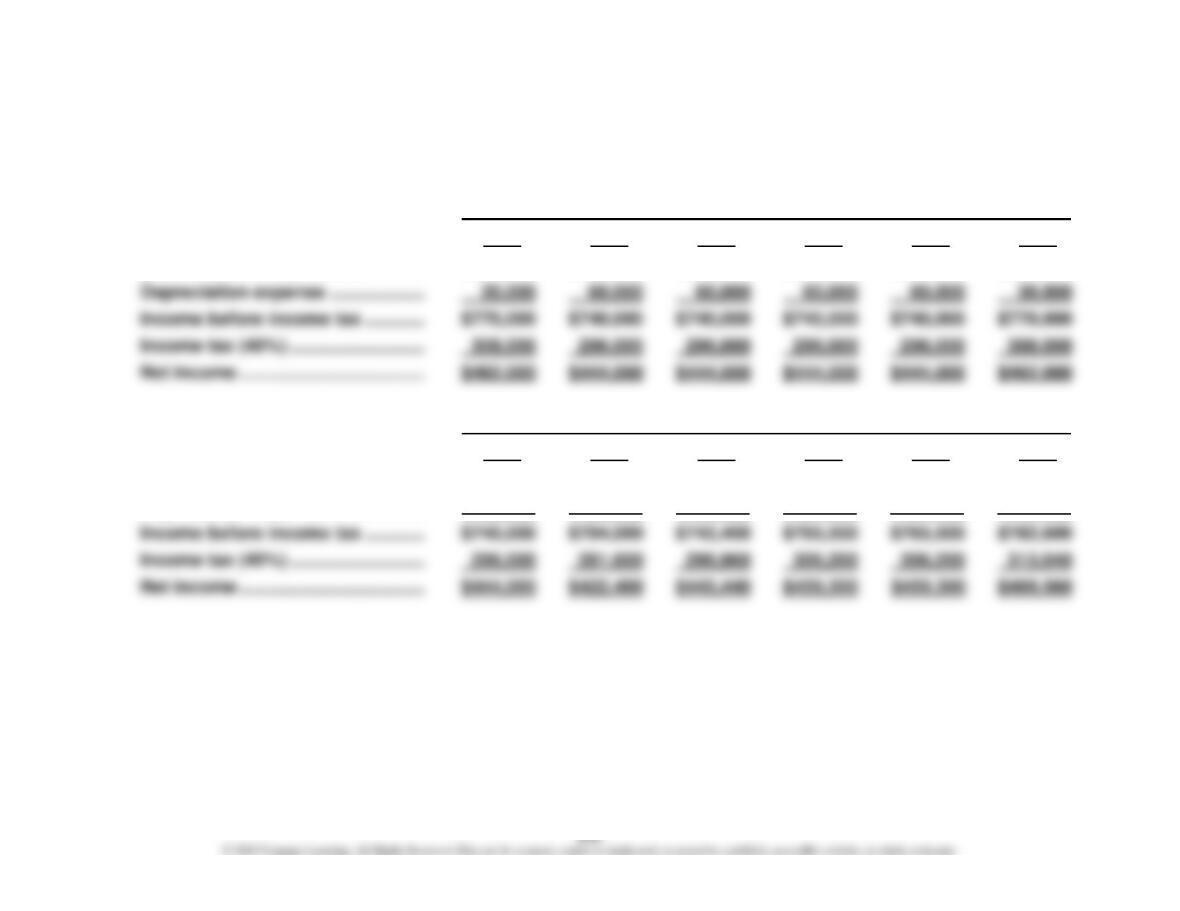
20Y2: ($300,000 × 20%) …………………………………………………………….. $60,000
Case 7–3, Continued
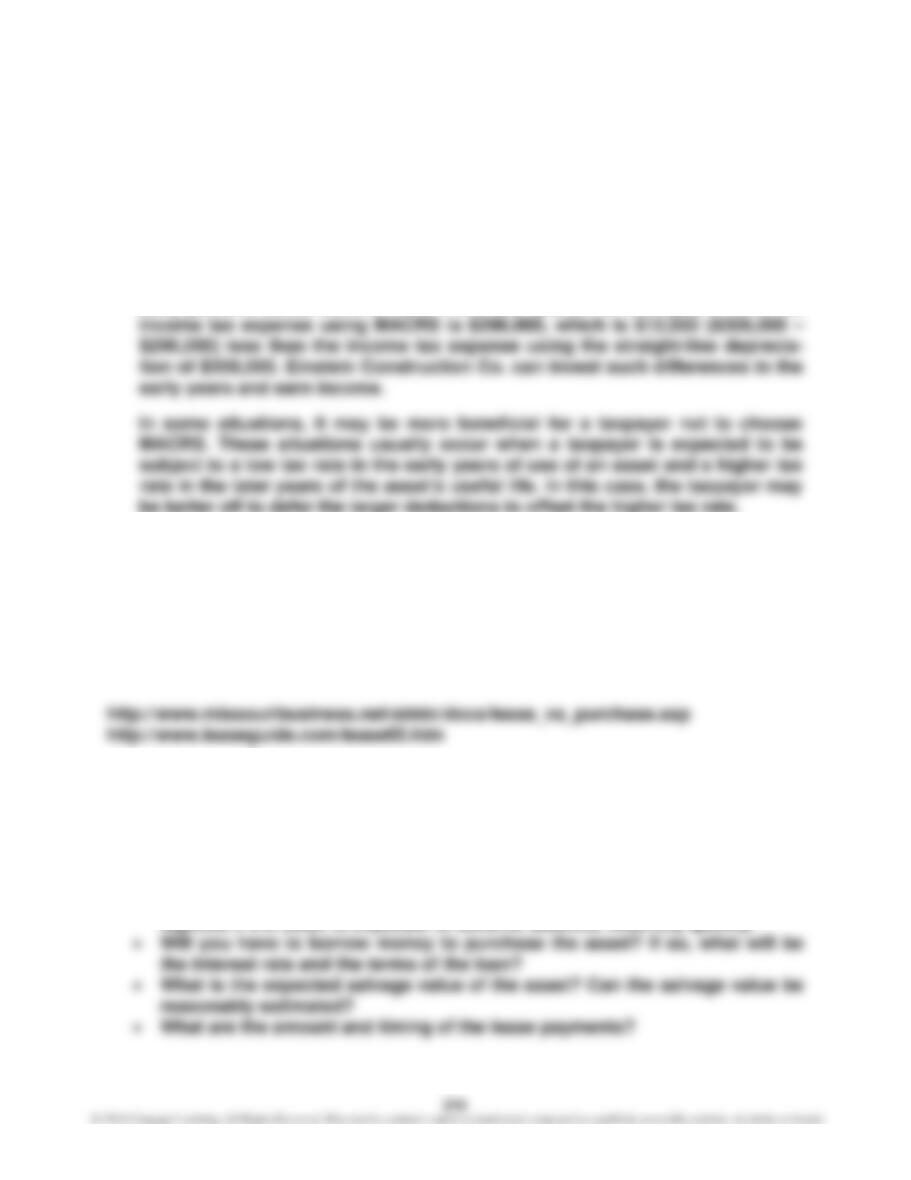
2.
a. Straight-line method Year
20Y2 20Y3 20Y4 20Y5 20Y6 20Y7
Income before depreciation ………. $800,000 $800,000 $800,000 $800,000 $800,000 $800,000
b. MACRS Year
20Y2 20Y3 20Y4 20Y5 20Y6 20Y7
Income before depreciation ………. $800,000 $800,000 $800,000 $800,000 $800,000 $800,000
Depreciation expense ………………. 60,000 96,000 57,600 34,500 34,500 17,400
Case 7–3, Concluded
3. For financial reporting purposes, Bree should select the method that provides
the net income figure that best represents the results of operations. (Note to
Instructors: The concept of matching revenues and expenses was discussed
in Chapter 3.) However, for income tax purposes, Bree should consider se-
lecting the method that will minimize current taxes. Based on the analyses in
(2), both methods of depreciation will yield the same total amount of taxes
over the useful life of the equipment. MACRS results in fewer taxes paid in the
early years of useful life and more in the later years. For example, in 20Y2 the
Case 7–4
Note to Instructors: The purpose of this activity is to familiarize students with the
considerations in leasing and buying a business asset. A couple of Internet sites
that your students might find useful in deciding whether to purchase or lease an
asset are:
Some considerations on deciding whether to purchase or lease an asset include
the following:
• The amount of time the business will be using the asset. If the business
needs the asset for a short time only, then leasing may be more advanta-
geous.
• How quickly will the asset become obsolete? Leasing may be more advan-
tageous if the asset is expected to become obsolete relatively quickly.
Case 7–4, Concluded
• Are there any limitations on use of the leased asset? For example, leased
automobiles often have a mileage limit per year. Miles driven beyond the
limit incur additional charges.
Students may want to experiment with different assumptions and assets (such as
an automobile) using the lease versus buy calculator at http://lease-vs-buy.com/.
Case 7–5
Note to Instructors: The purpose of this activity is to familiarize students with the
procedures involved in acquiring a patent, a copyright, and a trademark. You may
want to divide the class into three groups to report back on patents, copyrights,
and trademarks separately.
The following is some information on patents, copyrights, and trademarks that
you may find helpful in your discussions.
Patent
A patent is requested by filing a written application at the relevant patent office.
The person or company filing the application is referred to as “the applicant.” The
applicant may be the inventor or its assignee. The application contains a descrip-
tion of how to make and use the invention and provides sufficient detail for a per-
son skilled in the art (i.e., the relevant area of technology) to make and use the
Case 7–5, Concluded
Copyright
While copyright in the United States automatically attaches upon the creation of
an original work of authorship, registration with the Copyright Office puts a copy-
right holder in a better position if litigation arises over the copyright. A copyright
holder desiring to register his or her copyright should do the following:
1. Obtain and complete appropriate form.
2. Prepare clear rendition of material being submitted for copyright.
3. Send both documents to U.S. Copyright Office in Washington, D.C.
Trademark
The law considers a trademark to be a form of property. Proprietary rights in rela-
tion to a trademark may be established through actual use in the marketplace, or
through registration of the mark with the trademarks office (or “trademarks regis-
try”) of a particular jurisdiction. In some jurisdictions, trademark rights can be
Case 7–6
Both Kim Jenkins (CEO) and Steve Mueller (CFO) have a responsibility for fair
and accurate reporting of financial results. Steve should remind Kim of this fact.
