
Chapter 7
Job Costing
Learning Objectives
1. Explain what job and job shop mean.
2. Assign costs in a job cost system.
3. Account for overhead using predetermined rates.
4. Apply job costing methods in service organizations.
5. Understand the ethical issues in job costing.
6. Describe the difference between jobs and projects.
Chapter Overview
I. DEFINING A JOB
II. USING ACCOUNTING RECORDS IN A JOB SHOP
III. COMPUTING THE COST OF A JOB
• Production Process at Gupta Designs
• Records of Costs at Gupta Designs
• How Manufacturing Overhead Costs Are Recorded at Gupta Designs
o Predetermined Rate
o Application of Manufacturing Costs to Jobs
• The Job Cost Sheet
• Over- and Underapplied Overhead
• Multiple Allocation Bases: The Two-Stage Approach
• Summary of Steps in a Job Costing System
IV. USING JOB COSTING IN SERVICE ORGANIZATIONS
V. ETHICAL ISSUES AND JOB COSTING
VI. MANAGING PROJECTS
Chapter Outline
LO 7-1 Explain what job and job shop mean.
DEFINING A JOB
• A job is a unit of product that is easily distinguishable from other units; a job shop is a firm
that produces jobs.
o It is possible to distinguish among individual jobs because:
o These job cost records are important because:
USING ACCOUNTING RECORDS IN A JOB SHOP
• The cost accounting system records and keeps track of the costs incurred by the firm for the
job in the form of a job cost sheet, which is a record of the cost of the job kept in the
accounting system.
▪ The job cost sheet provides the detail for the Work-in-Process account, which is a
control account.
• A control account is an account in the general ledger that summarizes a set of
subsidiary ledger accounts.
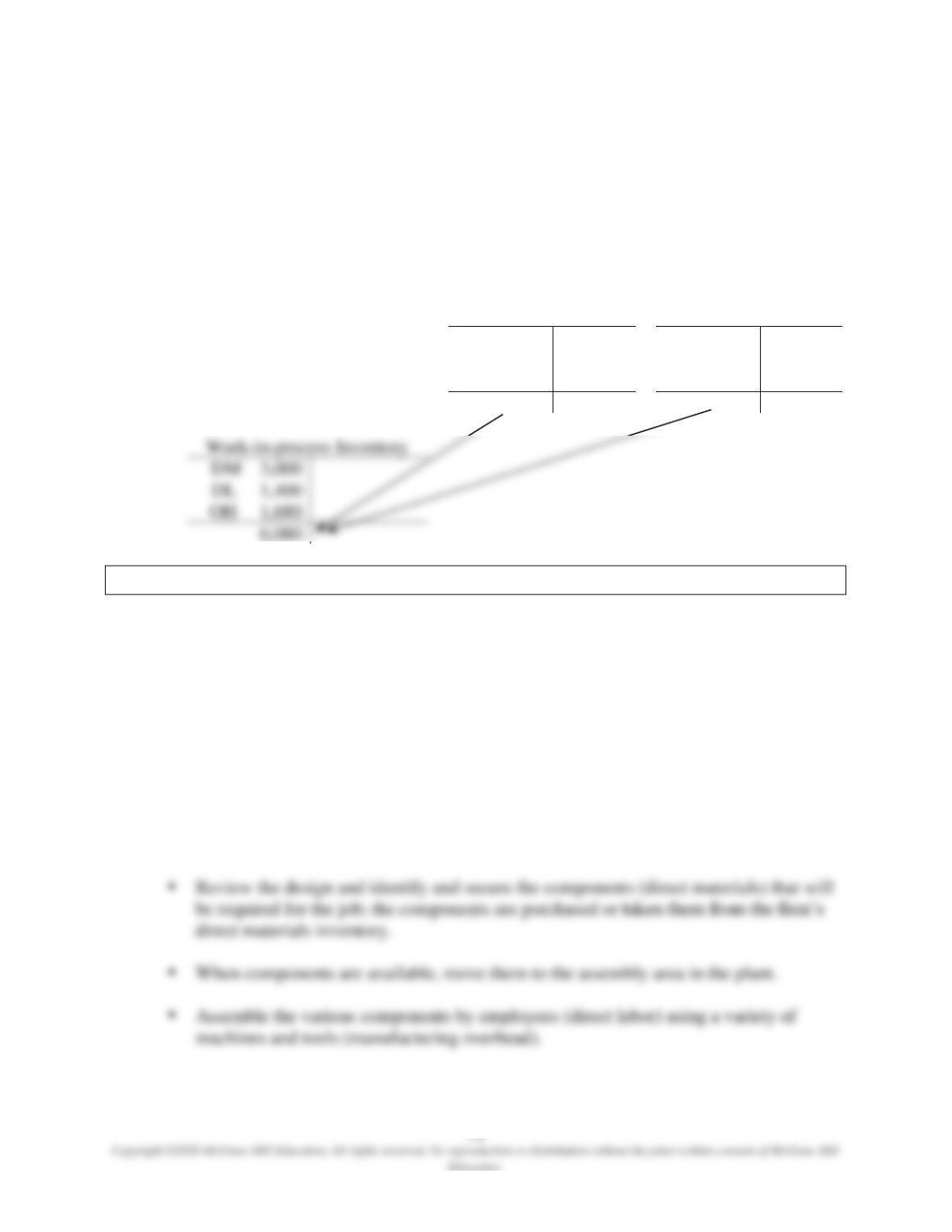
▪ Example 1: A job shop is working on two jobs from scratch: Job #101 and Job #102.
These are the only current jobs. Job #101 uses $1,000 of direct materials (DM), $800
of direct labor (DL), and $960 of overhead (OH); Job #102 uses $2,000 of DM, $600
of DL, and $720 of OH.
The following T-accounts show how the subsidiary ledger accounts (job cost sheets)
are related to the control account (work-in-process inventory). The control total
represents the sum from all the jobs together.
Job #101
Job #102
DM 1,000
DM 2,000
DL 800
DL 600
OH 960
OH 720
2,760
3,320
LO 7-2 Assign costs in a job cost system.
COMPUTING THE COST OF A JOB
• Production Process at Gupta Designs
o The basic idea of product costing in the cost accounting system is for the cost flows to
follow the physical flows of the resources that are combined to produce the final product
or service.
o The production process in job shops (such as Gupta Designs) involves several steps:
▪ Assign a job number to the job.
▪ Once completed, move the individual items for the order to the finished goods
inventory, where they are kept until the order is complete.
• Records of Costs at Gupta Designs
o The cost accounting system records the cost flows as the resources move through the firm.
o Inventory Accounts
o Direct Materials
▪ All direct materials used in assembling jobs are generally received at the materials
inventory, and recorded in the Material Inventory account, which also records
supplies and other materials that are not charged (debited) directly to jobs.
The purchase of various materials for use in jobs on account is recorded with the
following journal entry:
Materials Inventory xxx
Accounts Payable xxx
▪ The cost of each job is posted to the individual job cost sheets and summarized on the
work-in-process inventory account.
Exhibit 7.1 shows how the direct material cost flows through the T-accounts.
o Direct Labor
▪ Recording direct labor cost differs from that of direct materials in one important
respect.
There is no “store” for direct labor, so the cost is recorded in the Work–in-Process
account as it is incurred. The accounting document that records this cost is the
time card, which includes fields for the job number and the start and end times.
The time card can be a physical piece of paper the employee or supervisor fills in
or a virtual record updated as the employee checks in and out and enters the job
numbers worked.
▪ The cost of each job is posted to the individual job cost sheets and summarized on the
work-in-process inventory account.
Exhibit 7.2 shows how the direct labor cost flows through the T-accounts.
o Manufacturing Overhead
▪ Manufacturing overhead costs are typically pooled together into one account and then
allocated to individual jobs using a relatively arbitrary allocation base (for example,
number of machine hours or direct labor hours as discussed in Chapter 6).
Manufacturing overhead costs, including indirect materials indirect labor, are
usually accumulated in the Manufacturing Overhead Control account.
Actual manufacturing overhead for indirect labor are recorded with the following
journal entry:
Manufacturing Overhead Control xxx
Wages Payable xxx
Actual manufacturing overhead for utilities, prepaid taxes, depreciation and other
overhead costs are recorded with the following journal entry:
▪ The manufacturing overhead applied to each job is posted to the individual job cost
sheets and summarized on the work-in-process inventory account.
Exhibit 7.3 shows cost flows through T-account for manufacturing overhead.
LO 7-3 Account for overhead using predetermined rates.
• How Manufacturing Overhead Costs Are Recorded at Gupta Designs
o Manufacturing overhead is the third component of product cost, but because it is not
directly incurred in the assembly of the jobs, no “transaction” triggers a journal entry.
Instead, manufacturing overhead is recorded periodically on the job cost sheet. Two
common events that lead to manufacturing overhead being recorded are:
o Predetermined Rate
▪ Job shops use predetermined rates to assign manufacturing overhead to jobs.
When direct labor cost is adopted as the allocation base, the formula becomes:
Predetermined overhead rate =
Estimated manufacturing overhead
Estimated direct labor cost
o Application of Manufacturing Costs to Jobs
o Transferring jobs from Work-in-Process Inventory to Finished Goods Inventory
▪ The transfer of work-in-process inventory to finished goods inventory when jobs are
completed is recorded with the following journal entry:
Finished Goods Inventory xxx
Work-in-Process Inventory xxx
o Shipping Completed Jobs to Customers
o See Exhibit 7.6 for a summary of the cost flows for the month and the beginning and
ending inventory balances.
▪ The following summarizes the cost flows through the T-accounts.
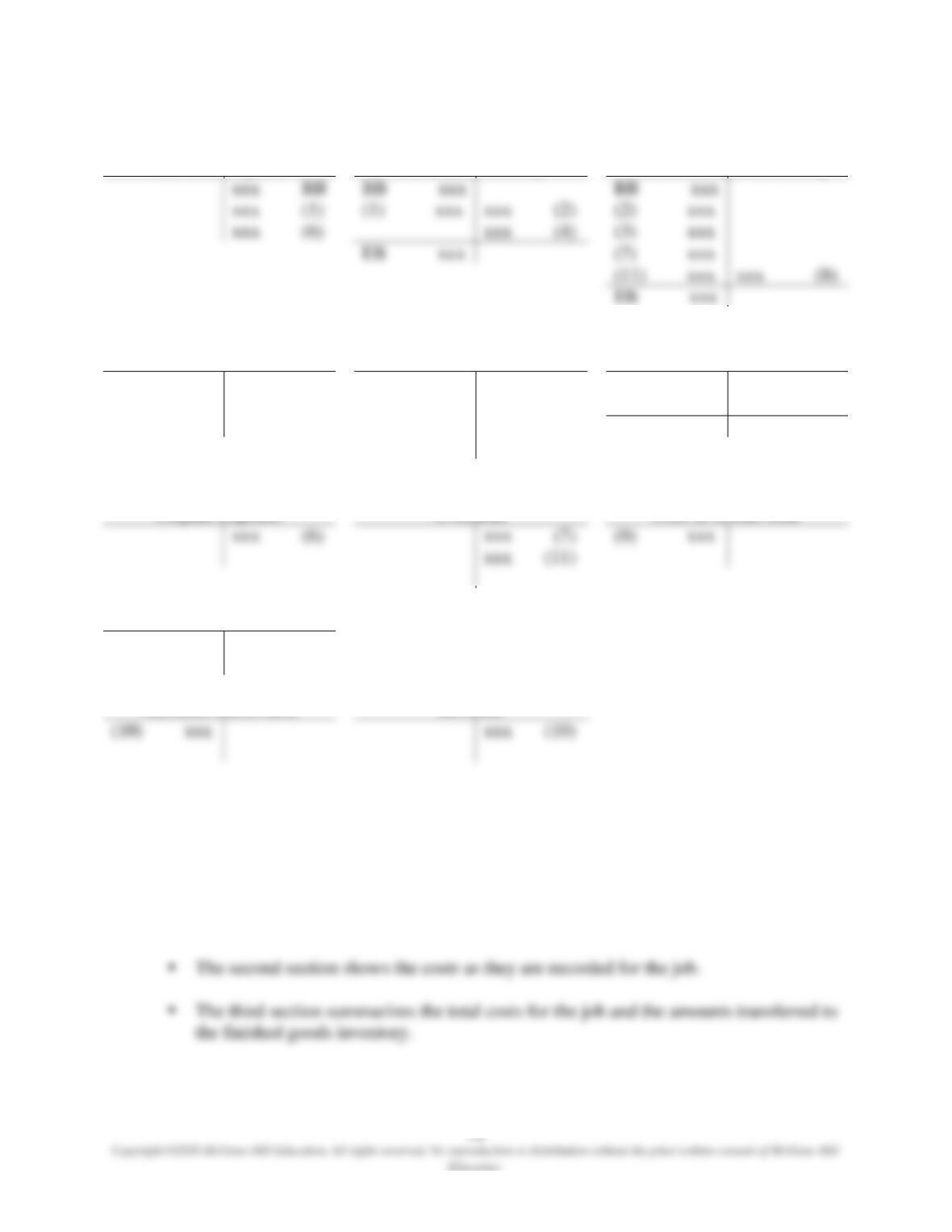
Note: BB = Beginning Balance; EB = Ending Balance
Accounts Payable
Materials Inventory
Work-in-Process Inventory
xxx BB
BB xxx
BB xxx
xxx (1)
(1) xxx
xxx (2)
(2) xxx
xxx (6)
xxx (4)
(3) xxx
EB xxx
(7) xxx
(11) xxx
xxx (8)
EB xxx
Wages Payable
Manufacturing Overhead
Control
Finished Goods Inventory
xxx (3)
(4) xxx
BB xxx
xxx (5)
(5) xxx
(8) xxx
xxx (9)
(6) xxx
EB xxx
xxx (6)
xxx (7)
(9) xxx
xxx (11)
Applied Manufacturing
Accumulated Depreciation
xxx (6)
(10) xxx
xxx (10)
• The Job Cost Sheet
o For each job, the accountant creates a job cost sheet that records the costs for the
individual jobs along with some additional information; Exhibit 7.7 shows a completed
job cost sheet, which has three sections:
▪ The top section provides information about the job.
• Over- and Underapplied Overhead
o As noted earlier, Manufacturing Overhead Control is a control account that summarizes
various overhead costs including indirect materials, indirect labor, and depreciation.
• An Alternative Method of Recording and Applying Manufacturing Overhead
o Gupta Designs uses a Manufacturing Overhead Control account to record manufacturing
overhead costs and an Applied Manufacturing Overhead account to apply manufacturing
overhead to work-in-process. At the end of the accounting period, the two account
balances may differ in amount (as discussed on the next page).
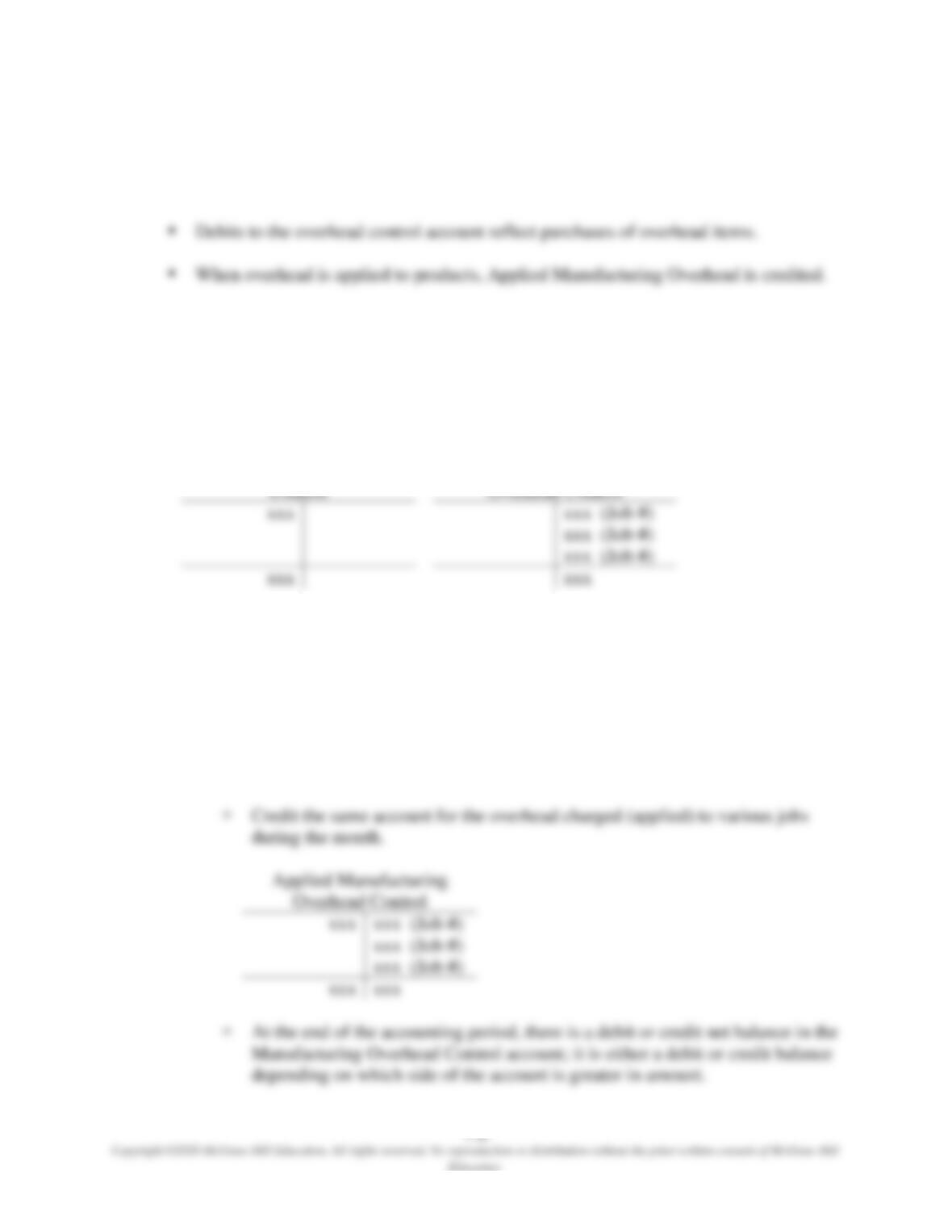
Manufacturing Overhead
Applied Manufacturing
o Some companies combine these two accounts into one account.
▪ Accountants in these companies record manufacturing overhead costs as debits and
manufacturing overhead costs applied as credits to this account.
• If Gupta Designs uses only one Manufacturing Overhead account, it would:
Debit Manufacturing Overhead for the various overhead resources incurred.
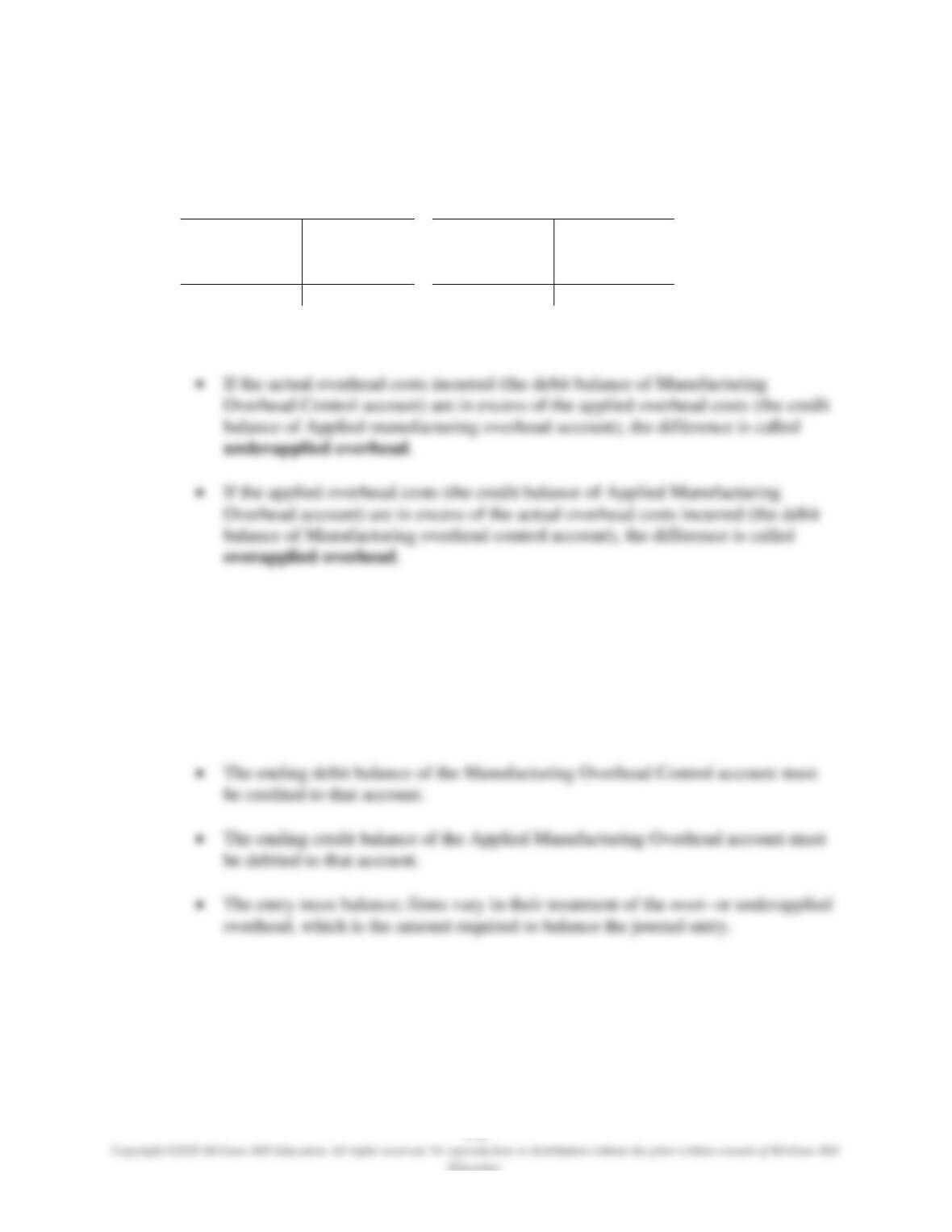
o We will assume Gupta Designs uses two accounts: a Manufacturing Overhead Control
account and an Applied Manufacturing Overhead account.
Manufacturing Overhead
Control
Applied Manufacturing
Overhead Control
xxx
xxx (Job #)
xxx (Job #)
xxx (Job #)
xxx
xxx
▪ At the end of the accounting period:
o Writing Off Over- or Underapplied Overhead
▪ Ultimately, the accounting system needs to account for the actual amount incurred.
No balances are kept for Manufacturing overhead control and Applied manufacturing
overhead because they are not balance sheet accounts.
▪ So that there is no balance in either account from month to month, an entry is made.
▪ Many firms charge cost of goods sold with the over- or underapplied overhead. Any
under- or overapplied overhead is simply written off to Cost of Goods Sold for the
month.
• Writing off overapplied overhead to cost of goods sold account is recorded with
the following journal entry:
Applied Manufacturing Overhead xxx
Cost of Goods Sold xxx
Manufacturing Overhead Control xxx
• Writing off underapplied overhead to cost of goods sold account is recorded with
the following journal entry:
Applied Manufacturing Overhead xxx
Cost of Goods Sold xxx
Manufacturing Overhead Control xxx
▪ Allocating Over- or Underapplied Overhead
• A second option for dealing with over- and underapplied overhead is to “allocate”
or “prorate” it in some way to the various accounts that contain the cost of the
products manufactured during the period.
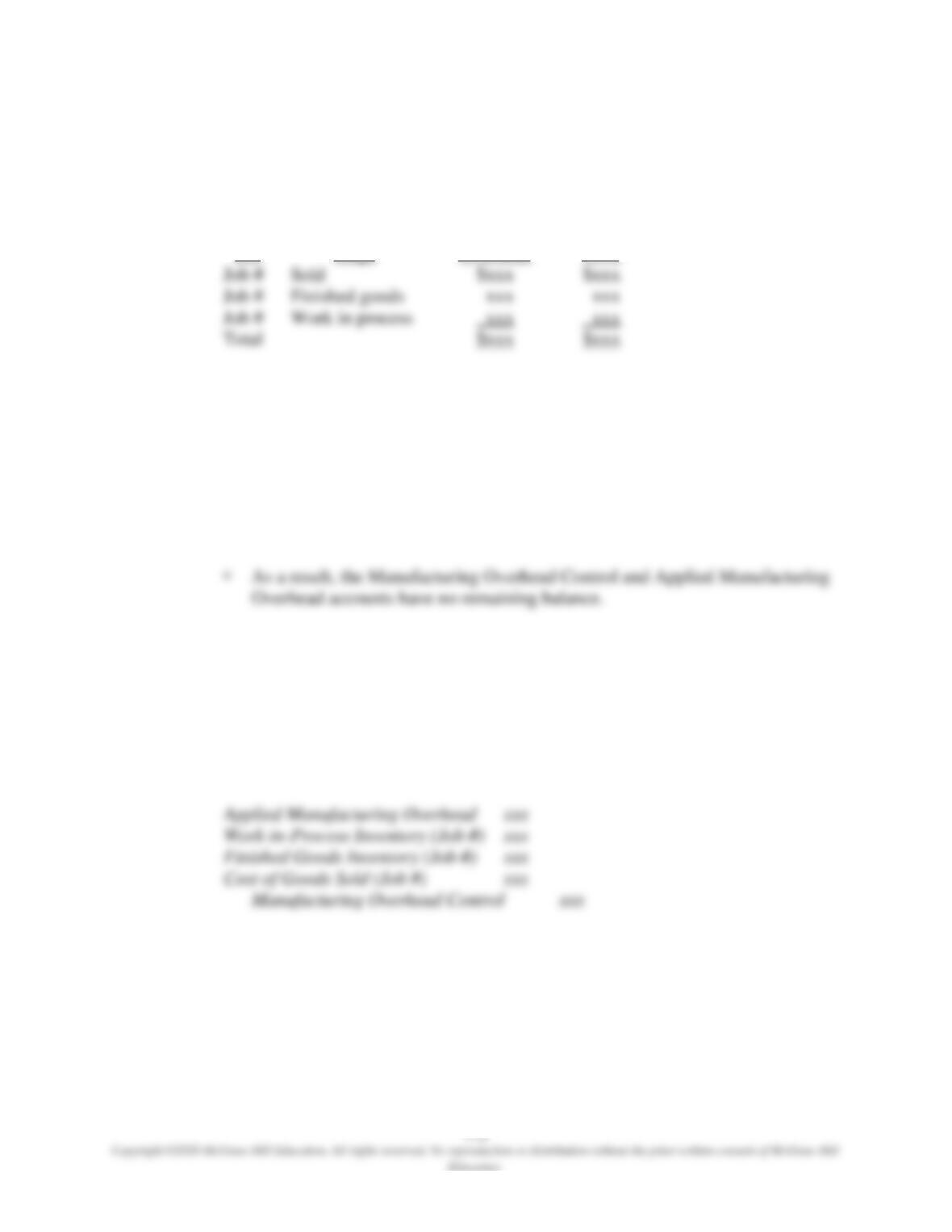
• The company may allocate the over- or underapplied overhead based on the
relative value of overhead in the individual inventory accounts.
Job #
Sold
Job #
Finished goods
Job #
Work in process
Total
Overapplied-
(or
Underapplied)
Charge
• Allocating overapplied overhead to the various accounts is recorded with the
following journal entry:
Applied Manufacturing Overhead xxx
Work-in-Process Inventory (Job #) xxx
Finished Goods Inventory (Job #) xxx
Cost of Goods Sold (Job #) xxx
Manufacturing Overhead Control xxx
If the firm has overapplied overhead, then “too much” overhead was applied
to each of these accounts during the period, so the inventory accounts and the
Cost of Goods Sold account have to be reduced (credited) to reflect this
overapplication of overhead.
• Allocating underapplied overhead to the various accounts is recorded with the
following journal entry:
Again, as a result, the Manufacturing Overhead Control and Applied
Manufacturing Overhead accounts have no remaining balance.
Similarly, if the firm has underapplied overhead, then “too little” overhead
was applied to each of these accounts during the period, so the inventory
accounts and the Cost of Goods Sold account have to be increased (debited) to
reflect this overapplication of overhead.