Chapter 7
Financial Reporting and Changing Prices
Discussion Questions
1. Historical-based financial statements may be misleading during periods of significant inflation.
Many resources may have been acquired in periods when the purchasing power of the monetary
unit was much higher. These expenses are then typically deducted from revenues that reflect
2. This exercise is a good way to test students’ understanding of the various approaches to
accounting for changing prices. Vestel’s earnings numbers are based on the general price
level model whereas Infosys is measuring its performance based on a current cost framework.
Modello goes a step further and adjusts its current cost statements for changes in the general
price level.
Some may feel that current cost data, which is based on the notion of replacement costs, is
too subjective a notion to be reliable. Because general price level data are based on general
price level indices, the numbers appearing in Vestel’s income statement are much more
objective and facilitate comparisons among companies using a similar methodology.
Moreover, Vestel’s statements do not violate the historical cost doctrine. Others will argue
3. This statement is partly true and shows the confusion that surrounds inflation accounting. In
accounting for changing prices, users must distinguish between general price changes and
4. The congressman is wrong. The object of inflation accounting is to clarify the distinction
between capital and income, not to minimize corporate taxes. Inflation accounting shows how
5. The International Accounting Standards Board sanctions use of the general price level model
or the current cost framework. Whichever method is employed, these inflation adjustments
must be expressed in terms of constant purchasing power as of the balance sheet date.
6. The historical cost-constant dollar model measures the impact of general price level changes on
a firm’s reported performance and financial position. The current cost model examines the
7. Restating foreign and domestic accounts to their current cost equivalents produces information
that is far more helpful to investor decisions than historical cost methods, whether or not adjusted
8. The gearing adjustment is an inflation adjustment that partially offsets the additional charges
to income associated with assets whose values are restated for inflation (e.g., higher
9. Accounting for foreign inflation differs from accounting for domestic inflation in two major
ways. First, foreign rates of inflation often are higher than domestic rates, which increases
10. Double-dipping refers to methods that count the effects of foreign inflation twice in reported
earnings. Earnings are reduced once when cost of sales is adjusted upwards for inflation, and
Exercise Solutions
1. a.
Income Statement Historical Price Level Historical Cost–
Cost Adjustment Constant Dollar
Revenue MXP 144,000,000 420/340 MXP 177,882,353
Operating expenses (86,400,000) 420/340 (106,729,412)
Balance Sheet
Cash MXP 157,600,000 420/420 MXP 157,600,000
Land 180,000,000 420/263 287,452,471
________________________________________________________________________
aMonetary loss:
Cash
Beginning balance 1,000,000,000 420/263 1,596,958,174
Purchase of
b Beginning equity x price level adjustment = adjusted amount
b.
Cost HC/Constant Dollar
2.
2010 2011
Cash MJR 2,500 MJR 5,100
3.
Nominal Restate for Constant
MJR’s Majikstan GPL MJR’s
Net monetary liab.’s MJR 1,500 x 36,000/30,000 = MJR1,645
4. Historical Current Cost Current
Income Statement Cost Adjustment Cost
Revenues MXP 144,000,000 – MXP 144,000,000
Balance Sheet
Cash MXP 157,600,000 – P 157,600,000
Acc. Depreciation (36,000,000) 1.8 (64,800,000)
5. As no new assets were acquired during the year, we must determine to what extent the
2010 2011
Current cost MJR 8,000 MJR11,000
Current cost, 12/31/10 MJR8,000,000
Increase in current cost of equipment, net of inflation (000’s):
Current cost, net
6. Restate-translate method:
Constant Translate $ Equivalents
renges of constant
renges
Increase in current
CC (MJR) Translate CC ($) Restate CC/ Constant $
U.S. GPL
CC, net MJR 6,400,000 x 1/4,800 = $1,333 x 292.5/281.5 = $1,385
7. 2010 2011
£m £m
Trade receivables 242 270
Nominal Restate for Constant
£ British PPI £
Gearing adjustment:
[(TL – CA)/(FA + I + MWC)] [CC Dep. Adj. + CC Sales Adj. + MWCA]
where TL = total liabilities other than trade payables
CA = current assets other than trade receivables
It is calculated as follows:
8. a.
Nominal Thai Historical Translation U.S.
baht inflation cost/constant rate dollar
adjustment baht equivalent
b.
Nominal Translation U.S. U.S. Historical
baht rate dollar inflation cost/constant
equivalent adjustment dollars
Inven–
tory BHT500,000 x .02 = 10,000 x 180/198 = $9,090
c. Most students will prefer the restate-translate method. This approach has merit if general and
of sales for inflation by simulating what it would have been on a LIFO basis. Two adjustments
are necessary because local inflation impacts exchange rates used to translate foreign currency
inventory balances to dollars. With FIFO inventories, a translation loss is recorded in “as
reported” earnings when it is originally translated to U.S. dollars by a current exchange rate that
changed (devalued) during the period. This translation loss is an indirect charge for local
inflation. The inflation adjustment (simulated LIFO charge) to increase “as reported” cost of
sales to a current cost basis is an additional charge for inflation. Absent some offsetting entry,
consolidated results would be charged twice for inflation. To avoid this double charge, the
translation loss embodied in reported earnings is deducted from the simulated LIFO charge to
arrive at a net U.S. dollar current cost of sales adjustment. Steps in the adjustment process are as
follows:
1. FIFO inventory subject to simulated LIFO charge KRW10,920,000
2. Restate line 1 to January 1 currency units
3. Difference between FIFO and LIFO inventory
4. Translate line 3 to dollars at the January 1
(line 1) that has already been reflected in “as
reported” results:
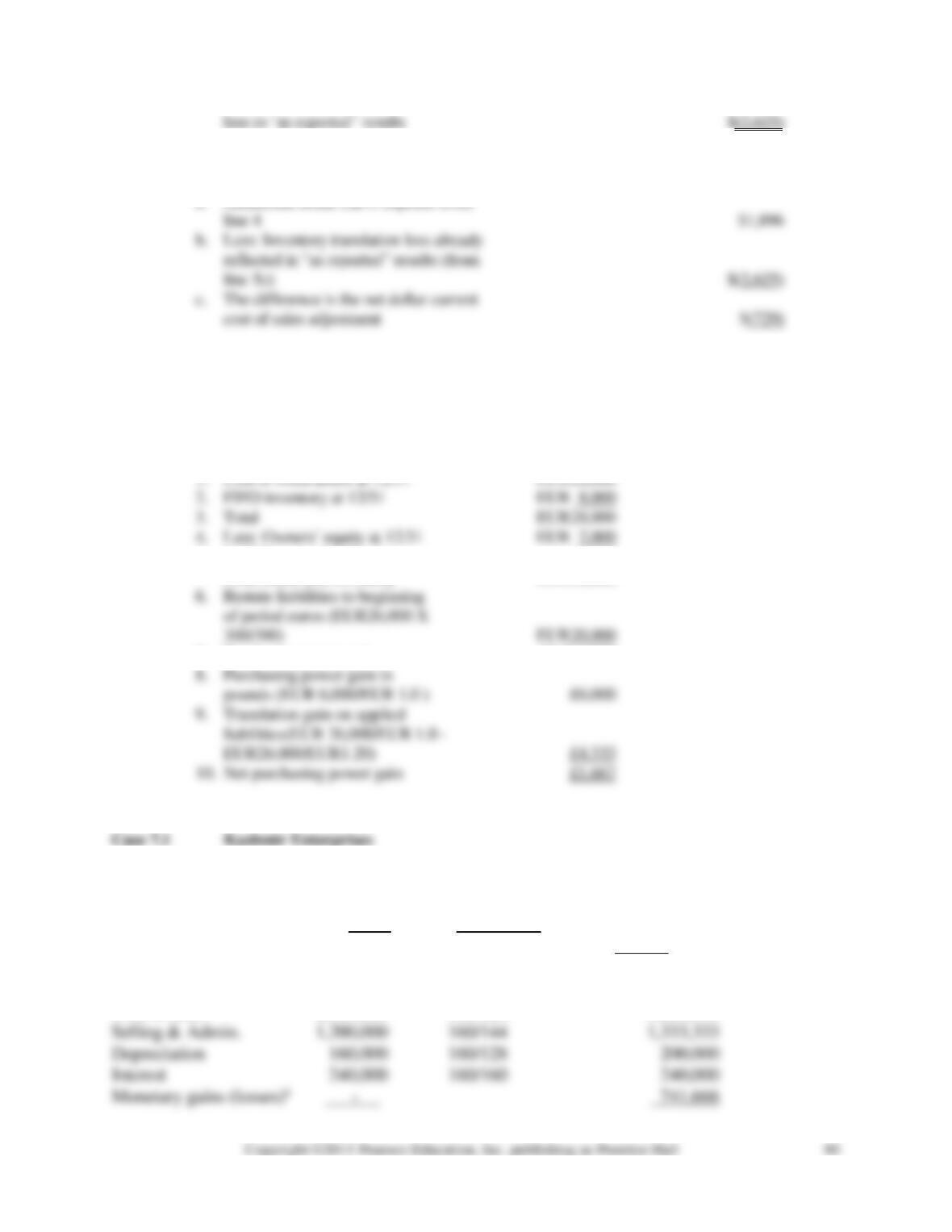
6. The difference between lines 4 and 5c is
the cost of sales adjustment in dollars:
a. Additional dollar LIFO expense from
Here, the current cost of sales adjustment is negative (i.e., reduces the dollar cost of sales adjustment). This is
because the won devalued by more than the differential inflation rate (assuming a U.S. inflation rate close to
zero). If the lira devalued by less than the differential inflation rate, the cost of sales adjustment would have
been positive.
10. 1. Cost of fixed assets at 12/31 EUR20,000
5. Liabilities used to finance
fixed assets and inventory EUR26,000
7. Purchasing power gain EUR 6,000
1. a through c
Historical Price Level Historical
Cost Adjustment Cost Constant
Income Statement Rupees
Revenues INR6,000,000 160/144 INR6,666,667
Cost of Sales 2,560,000 160/128 3,200,000
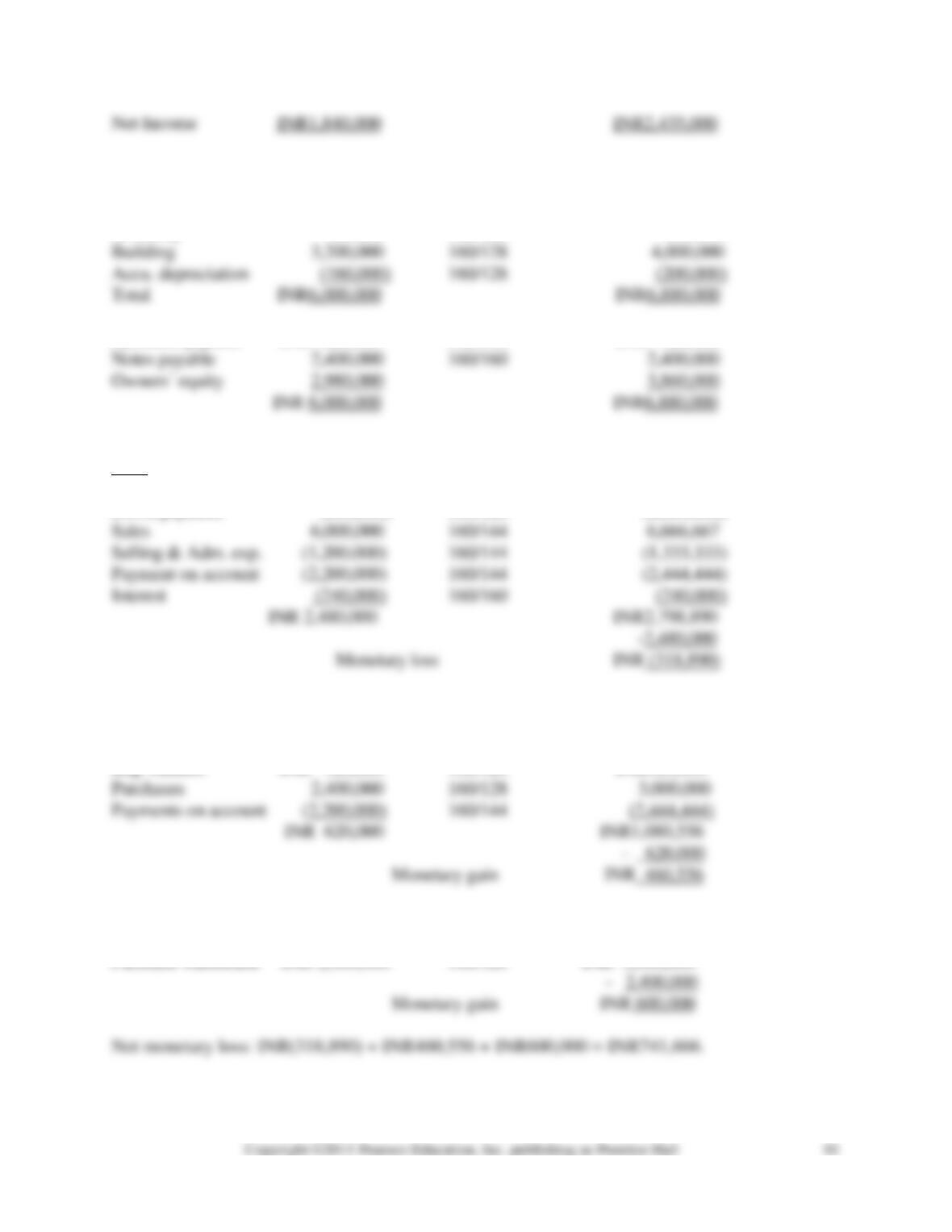
Balance Sheet
Cash INR2,480,000 160/160 INR2,480,000
Inventory 480,000 160/128 600,000
Accounts payable INR 620,000 160/160 INR 620,000
aMonetary gains/(losses):
Cash
Beg. balance INR 720,000 160/128 INR1,150,000
Down payment (800,000) 160/128 (1,000,000)
aMonetary gains and losses:
Accounts Payable
Beg. balance INR 420,000 160/128 INR525,000
aMonetary gains/(losses):
Notes Payable
Purchase warehouse INR 2,400,000 160/128 INR 3,000,000
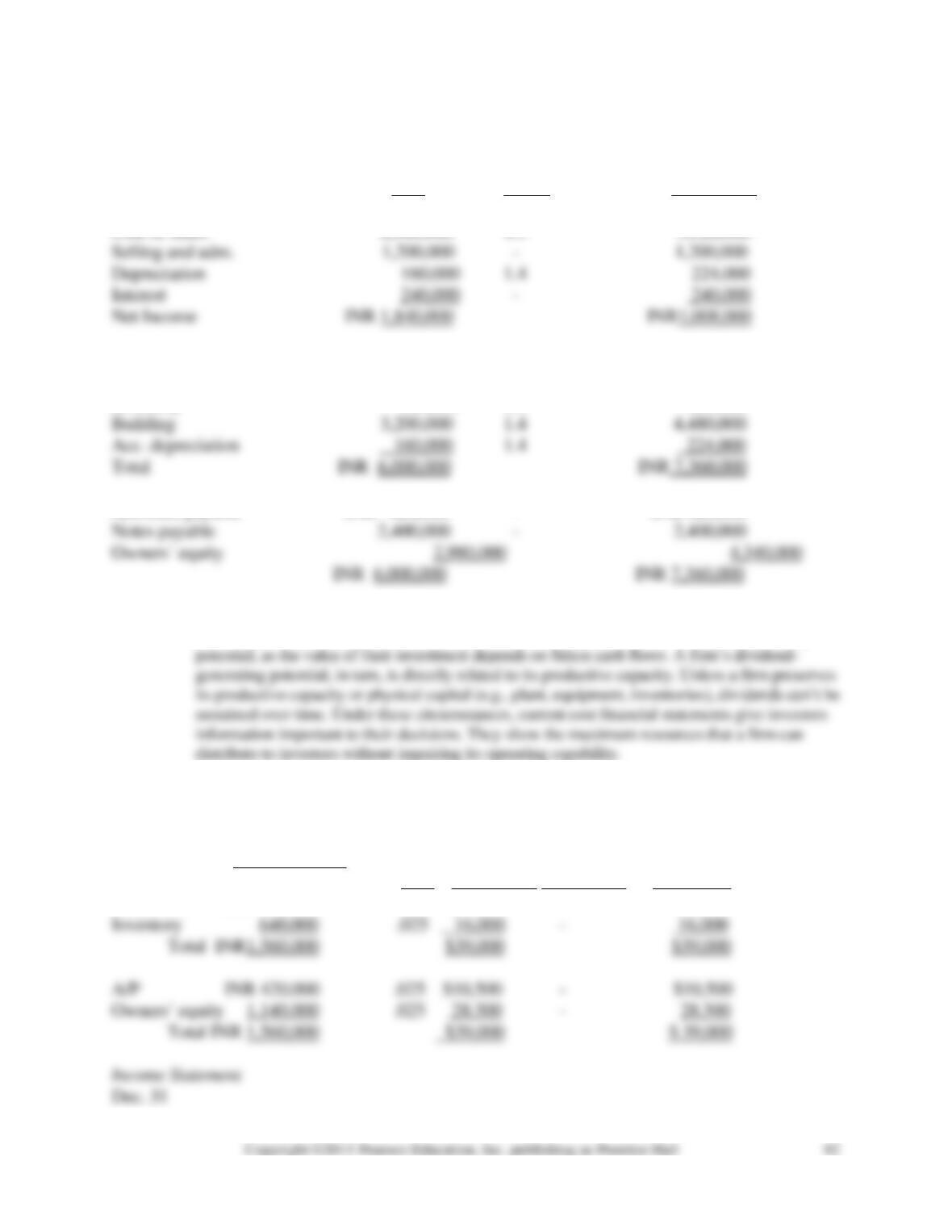
Current Cost Financial Statements
Historical Adjustment Current Cost
Income Statement Cost Factor Equivalents
Revenues INR6,000,000 – INR 6,000,000
Cost of Sales 2,560,000 1.3 3,328,000
Balance Sheet
Cash INR 2,480,000 – INR 2,480,000
Inventory 480,000 1.3 624,000
Accounts payable INR 620,000 – INR 620,000
2. Your authors favor current cost over historical or historical cost-constant dollar financial
statements. Finance theory states that investors are interested in a firm’s dividend-generating
3.
Translate-Restate Method
Balance Sheet, Jan. 1
Local Currency Trans. Dollar Inflation Historical cost
Rate Equivalents Adjustment Constant $
Cash INR 920,000 .025 $23,000 – $23,000
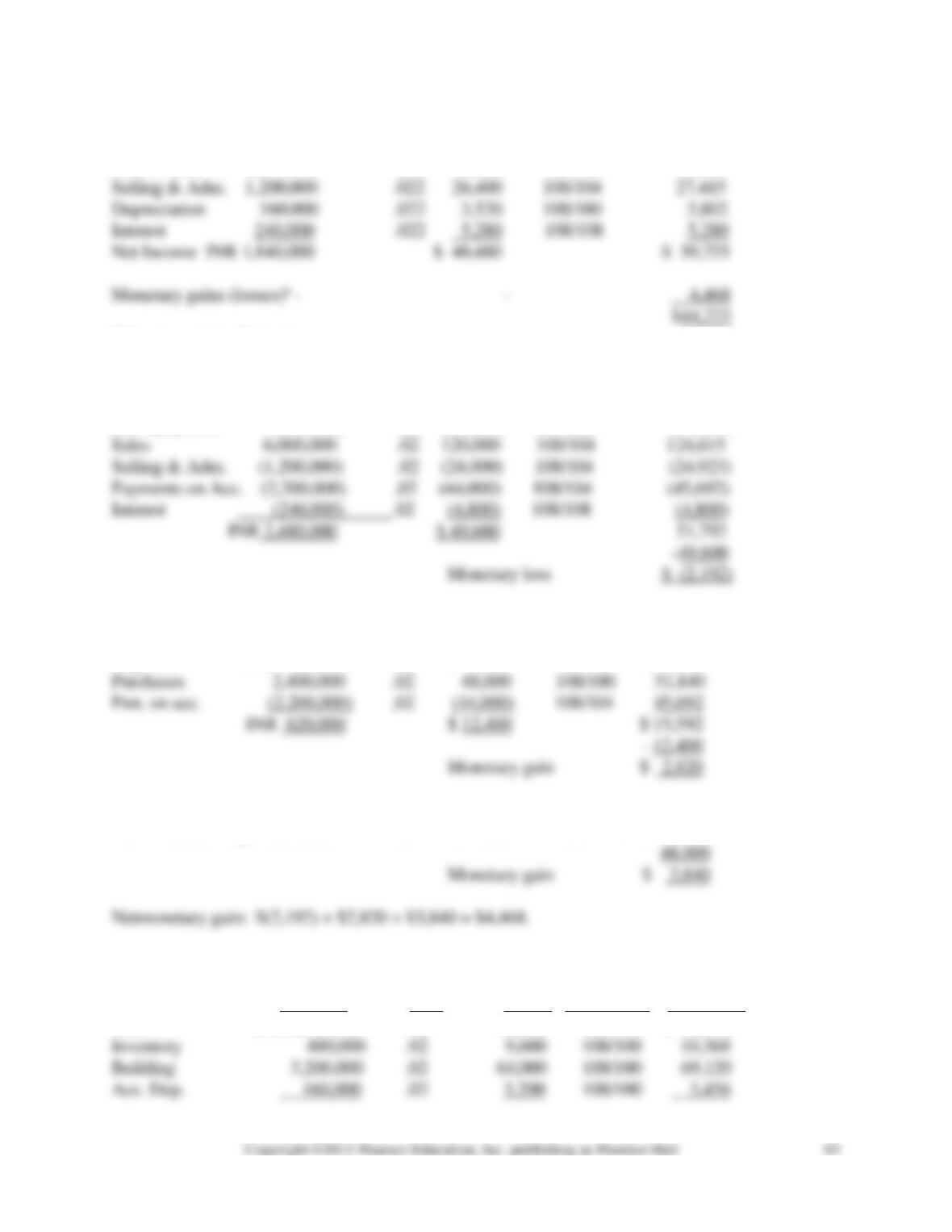
Revenues INR 6,000,000 .022 $ 132,000 108/104 $ 137,077
Cost of sales 2,560,000 .022 56,320 108/100 60,825
aMonetary gains/(losses):
Cash
Beg. Bal INR 920,000 .02 $ 18,400 108/100 $ 19,872
Downpayment (800,000) .02 (16,000) 108/100 (17,280)
Accounts Payable
Beg. Bal. INR 420,000 .02 $ 8,400 108/100 $ 9,072
Notes payable
Pur. W/house Rpe 2,400,000 .02 $ 48,000 108/100 $ 51,840
Balance Sheet Local Trans. Dollar Inflation Historical cost–
Dec. 31 Currency Rate Equiv. Adjustment Constant $
Cash INR 2,480,000 .02 48,600 108/108 $ 48,600
Total INR 6,000,000 $120,000 $ 124,632
Acc. payable 620,000 .02 12,400 108/108 $ 12,400
Notes payable 2,400,000 .02 48,000 108/108 48,000
cBalancing residual
Restate-Translate Method
Balance Sheet Local Inflation Historical Cost- Trans. Dollar
Jan 1. Currency Adjustment Constant rupee Rate equivalents
Cash INR 920,000 128/128 INR 920,000 .025 $ 23,000
dAssumes inventory acquired near year-end.
Income Statement
Year ended Dec. 31
Revenues INR 6,000,000 160/144 INR 6,666,666 .022 $ 146,667
Cost of Sales 2,560,000 160/128 3,200,000 .022 70,400
Balance Sheet
Cash INR 2,480,000 160/160 INR 2,480,000 .02 $ 49,600
Inventory 480,000 160/128 600,000 .02 12,000
________________________________________
b Beginning net assets INR1,140,000 (.02 – .025) = $ (5,700)
Restate (current cost)/Translate (current rate)
Cash INR 920,000 – INR 920,000 .025 $ 23,000
Income Statement
Dec. 31
Revenues INR6,000,000 – INR 6,000,000 .022 $ 132,000
Inventory 480,000 1.3 624,000 .02 12,480
Acct. payable INR 620,000 – INR 620,000 .02 $ 12,400
cTranslation adjustment:
Case 7-2 Icelandic Enterprises
1. Between the calendar years 2001 and 2002, Icelandic Enterprise’s annual sales volume rose from
Ikr 8.2 billion to Ikr 14.6 billion while earnings doubled. When translated to dollars at average
2. Management’s statement that currency translation “automatically approximates the impact of
inflation” is true only if exchange rates are perfectly negatively correlated with differences in
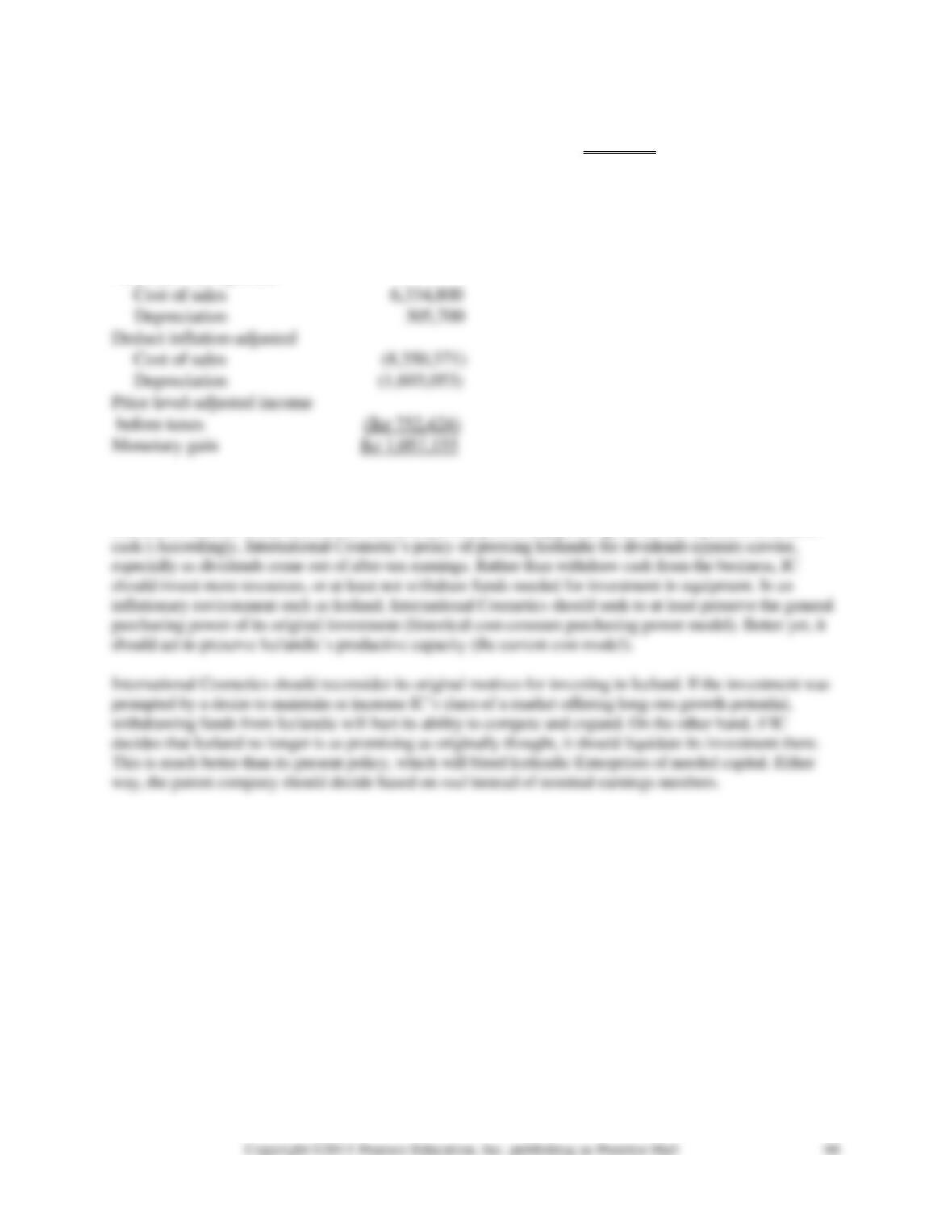
3. Restatement of Icelandic’s earnings to reflect the impact of local inflation is presented here.
Inflation-adjusted Depreciation (000’s):
Nominal Adjustment Factor Adjustment Amount
1998 125,000 X 547/63.1 = 1,083,597
1999 42,750 X 547/100.0 = 233,843
Inflation-adjusted Cost of Sales (000’s):
Nominal Adjustment Factor Adjusted Amount
Beg. inventories 2,949,017 X 547/418.2 = 3,857,275
a Production is derived from the cost of goods sold formula and is assumed to have taken place uniformly
during the year. Hence, it is adjusted using an average index for the year = 482.6 [(418.2 + 547)/2].
Monetary Gains and Losses (000’s):
2001 2002
Cash 221,176 368,414
Nominal AdjustmentFactor Adjusted Amount
2001 (3,221,334) X 547/418.2 = (4,213,462)
Monetary gain 1,057,155
Price Level-Adjusted Earnings:
“As reported” earnings Ikr 2,560,500
Add back “as reported”
Based on its adjusted kronur earnings, Icelandic Enterprises is not doing as well as it appears at first glance,
whether viewed in kronur or dollars. (Students should be asked whether they think monetary gains should be
included in income. They should then be reminded that purchasing power gains do not represent remittable