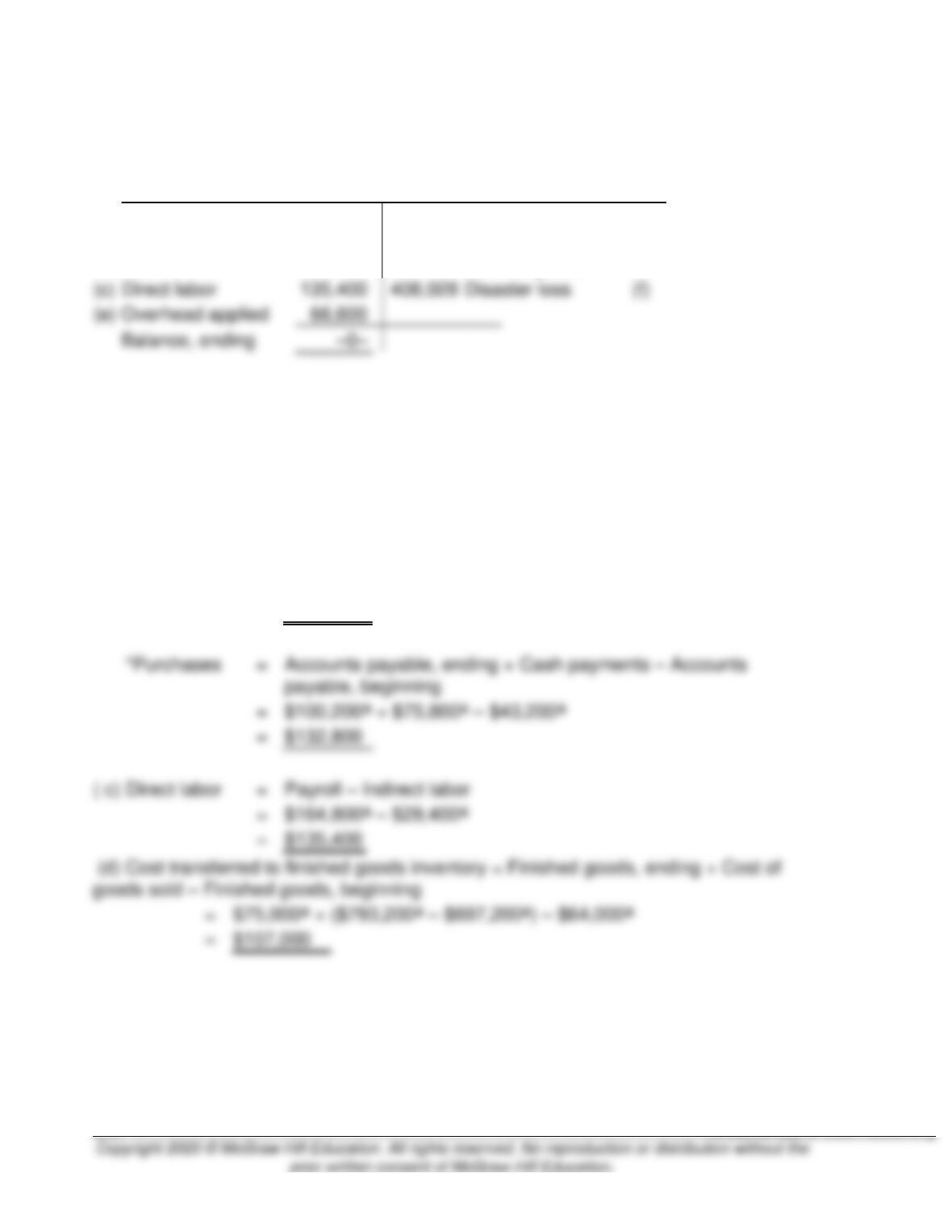
7-61. (70 min.) Reconstruct Missing Data: Toledo Farm Implements.
This is a challenging problem. We put the work in process account for May on the
board for the “big picture,” then solve for each item in the account as follows:
Work-in-Process
(a)
Balance, beginning
172,400
(b)
Direct materials
140,628
107,000
Transferred to
finished goods
(d)
(c)
Direct labor
135,400
Disaster loss
(f)
Balance, ending
The calculations are shown below. We usually present these using both T-accounts
and the following formulas.
(a) Given
(b)
Direct materials
=
Beginning inventory + Purchases – Ending inventory – Indirect
materials
=
$98,000a + $132,800* – $86,000a – $4,172 (from paper scrap)
=
$140,628
*Purchases
=
Accounts payable, ending + Cash payments – Accounts
payable, beginning
=
$132,800
=
=
$135,400
=
$75,000a + ($793,200a – $697,200a) – $64,000a
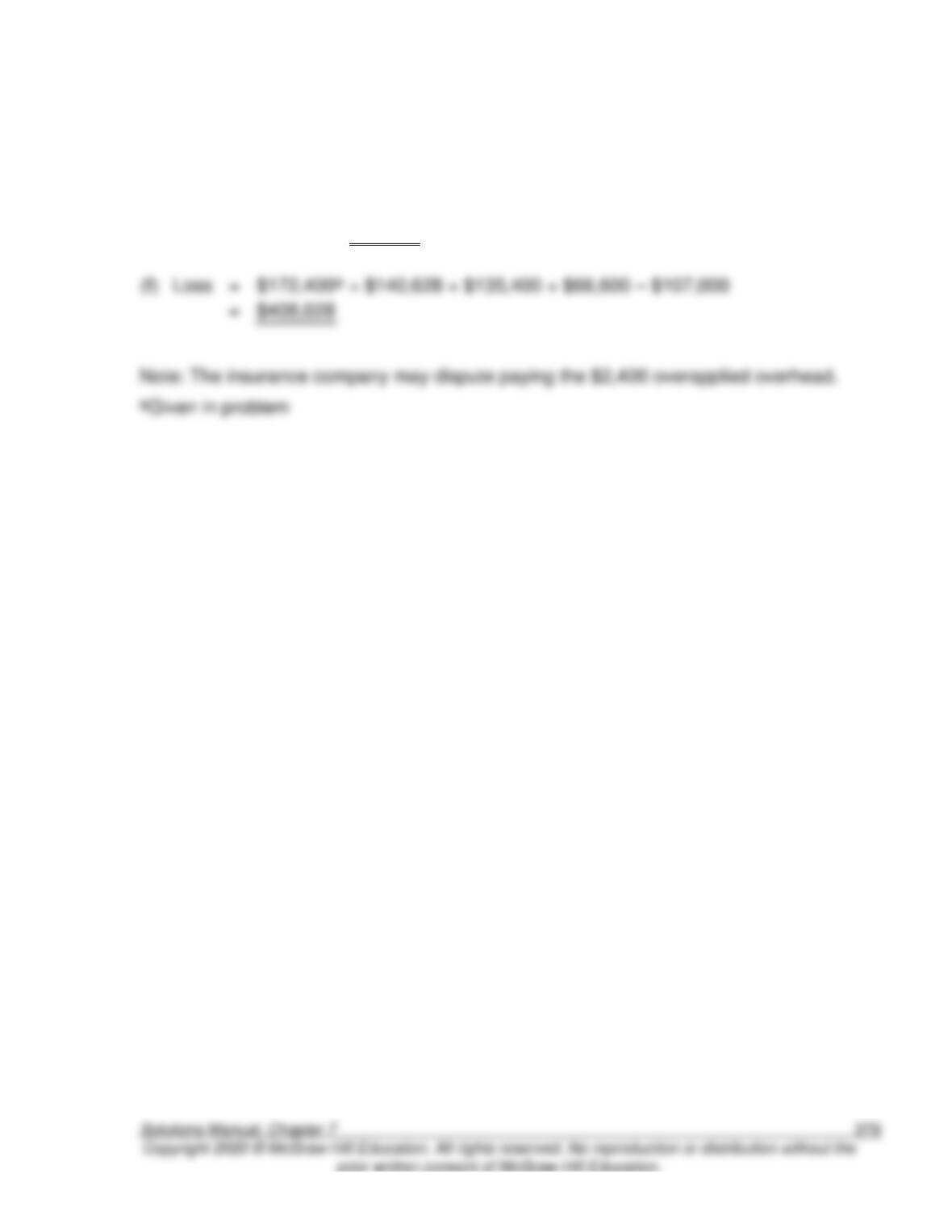
7-61. (continued)
(e)
Overhead applied
=
Ending manufacturing overhead – beginning
manufacturing overhead + overapplied overhead
=
$434,000a – $369,800a + $2,400a
=
$66,600
(f)
Loss
=
$172,400a + $140,628 + $135,400 + $66,600 – $107,000
=
$408,028
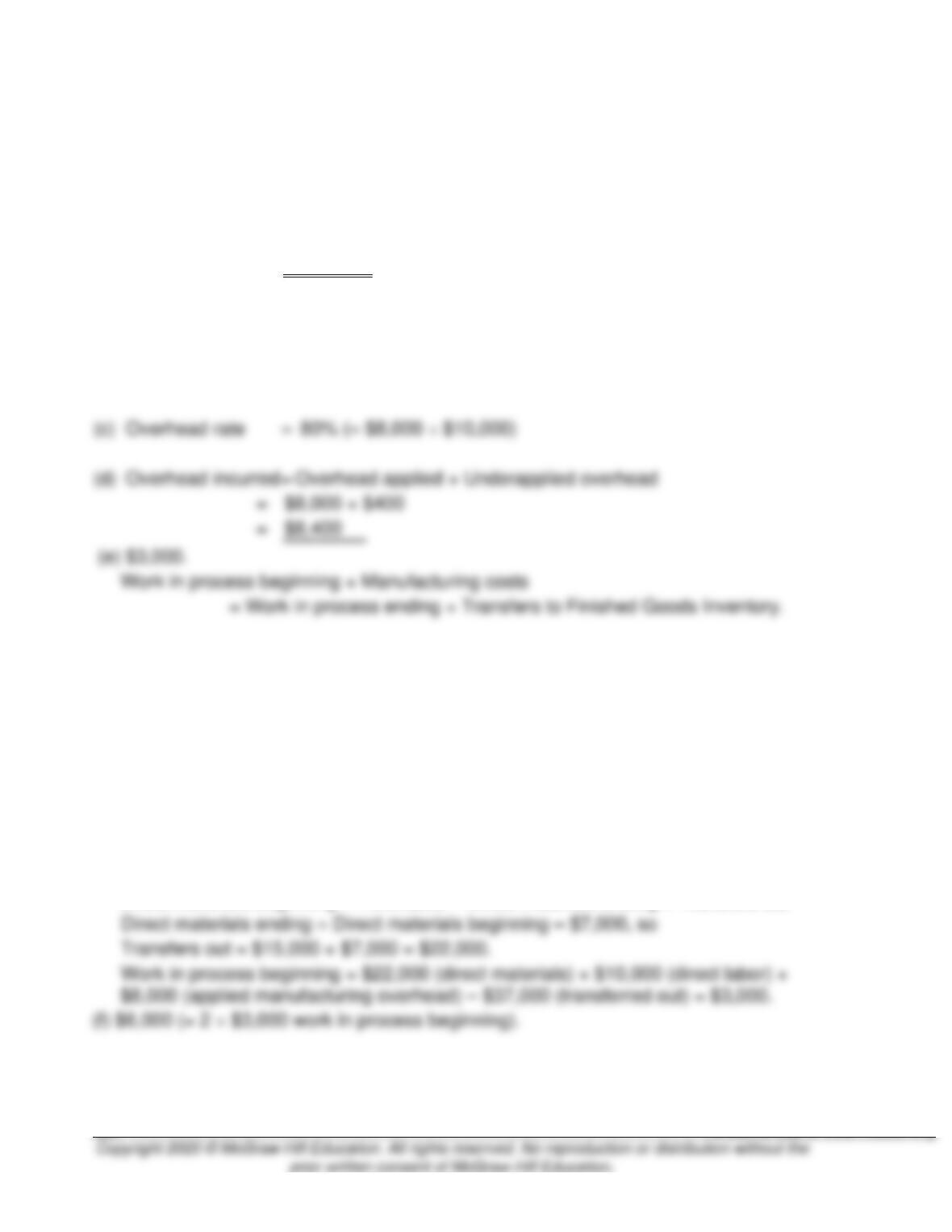
7-62. (70 min.) Find Missing Data: IYF Corporation.
The calculations are shown below. We usually present these using both T-accounts
and the following formulas.
(a)
Beginning inventory + Transfers in = Ending inventory + Transfers Out
Beginning inventory
=
Ending inventory + Transfers Out – Transfers in
=
$3,000 + $45,000 – $37,000
=
$11,000
(b) $8,000. Because any over- or underapplied is written off to Cost of Goods Sold, the
difference between the Cost of Goods Sold journal entry ($45,000) and the Cost of
Goods Sold amount on the income statement ($45,400) must be the amount of
underapplied overhead. Underapplied overhead is 5% of overhead applied for June, so
total overhead applied is $8,000 (= $400 ÷ 5%)
(c)
Overhead rate
=
80% (= $8,000 ÷ $10,000)
(d)
Overhead incurred
=
Overhead applied + Underapplied overhead
=
$8,000 + $400
=
$8,400
But, Work in process ending = 2 Work in process beginning.
Therefore, Work in process beginning + Manufacturing costs
= 2 Work in process beginning + Transfers to finished goods
and,
Work in process beginning = Manufacturing costs – Transfers to finished goods.
We know the amount of direct labor, but not the amount of direct materials
transferred into production. For this, we use the inventory equation for direct
materials.
Direct materials beginning + Purchases = Direct materials ending + Transfers out
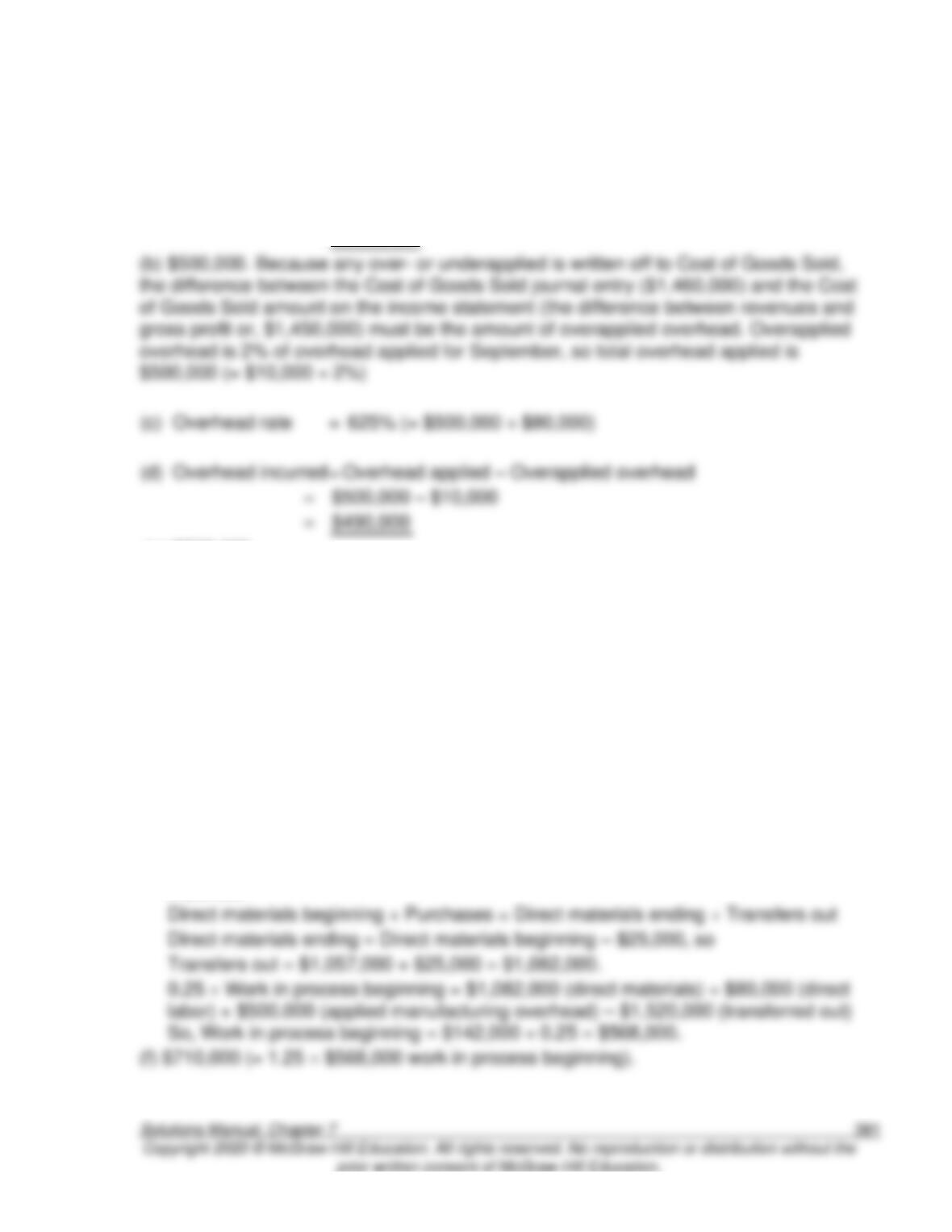
7-63. (70 min.) Find Missing Data: NIC Enterprises.
The calculations are shown below. We usually present these using both T-accounts
and the following formulas.
(a)
Beginning inventory + Transfers in = Ending inventory + Transfers Out
Ending inventory
=
Beginning inventory + Transfers in – Transfers Out
=
$148,000 + $1,520,000 – $1,460,000
=
$208,000
(c)
Overhead rate
=
(d)
Overhead incurred
=
Overhead applied – Overapplied overhead
=
=
$490,000
(e) $568,000.
Work in process beginning + Manufacturing costs
= Work in process ending + Transfers to Finished Goods Inventory.
But, Work in process ending = 1.25 Work in process beginning.
Therefore, Work in process beginning + Manufacturing costs
= 1.25 Work in process beginning + Transfers to finished
goods
and,
0.25 Work in process beginning
= Manufacturing costs – Transfers to finished goods.
We know the amount of direct labor, but not the amount of direct materials
transferred into production. For this, we use the inventory equation for direct
materials.
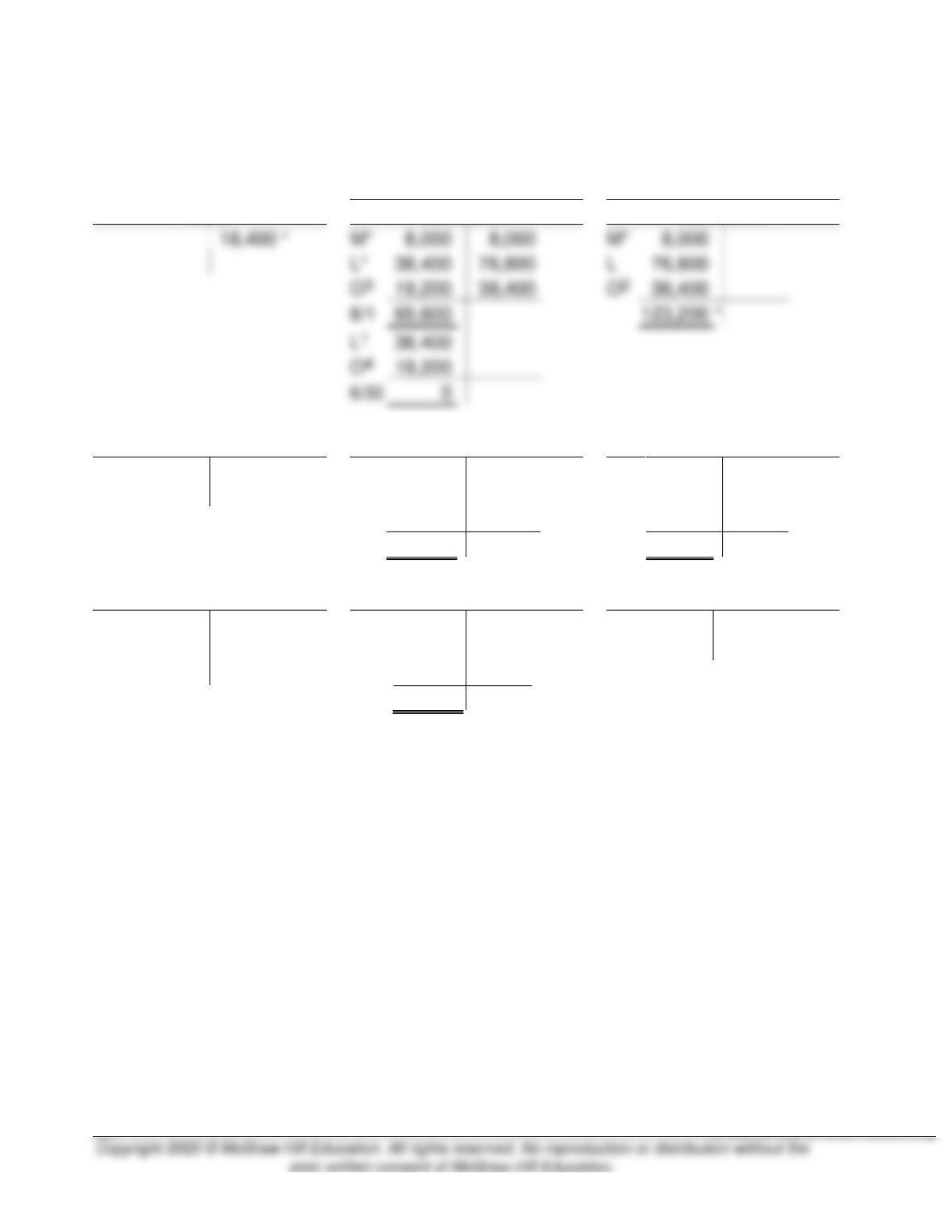
7-64. (45 min.) Incomplete Data—Job Costing: Chelsea Household
Renovations.
The following information should be included (in summary) in a report to management.
Work-in-Process
Cost of Goods Sold
Cash
Job No. 61
Job No. 61
18,400
*
38,400
L
O3
19,200
6/1
65,600
*
L1
38,400
O4
19,200
6/30
Wages Payable
Job No. 62
Job No. 62
128,000
*
M5
12,000
12,000
M
12,000
L6
48,000
48,000
L
48,000
O7
24,000
24,000
O
24,000
6/30
0
84,000
Overhead
Job No. 63
Underapplied Overhead
Actual
Applied
M*
6,400
16,00010
80,000
*
64,000
9
L*
41,600
O8
20,800
6/30
68,800
Note: See footnotes on next page.
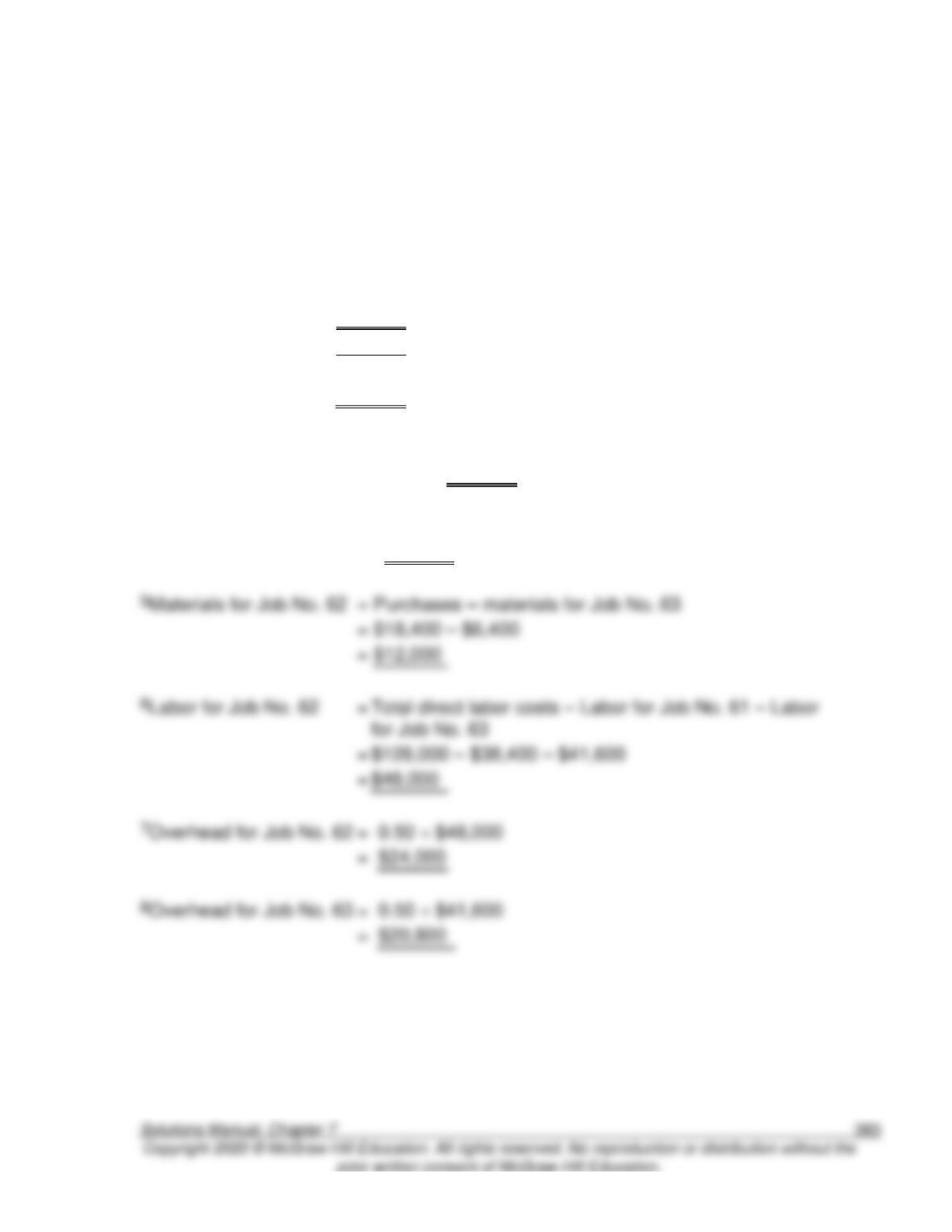
7-64. (continued)
M refers to direct materials
L refers to direct labor
O refers to manufacturing overhead
*Numbers given in the problem
1Labor to complete job is $38,400 since the beginning inventory was 50% complete
2Applied overhead
=
$123,200 – $8,000 – $76,800
=
$38,400
Applied overhead
=
$38,400
$76,800
=
50%
of direct labor dollars
3Overhead in beginning inventory
=
0.50 $38,400
=
$19,200
4Overhead applied in June
=
0.50 $38,400
=
$19,200
5Materials for Job No. 62
=
Purchases – materials for Job No. 63
=
$18,400 – $6,400
=
=
$128,000 – $38,400 – $41,600
=
7Overhead for Job No. 62
=
0.50 $48,000
=
8Overhead for Job No. 63
=
0.50 $41,600
=
$20,800
7-64. (continued)
9Applied Overhead
=
$19,200 + $24,000 + $20,800
=
$64,000
=
Actual – Applied
=
$80,000 – $64,000
$16,000
7-65. (25 min.) Job Costing and Ethics: Old Port Shipyards.
(This problem is based on actual experience.)
a.
Olde Town
Newton
Overhead cost ……………..
$20,000,000
$80,000,000
Direct labor-hours …………
200,000
200,000
Predetermined rate……….
$100 per hour
$400 per hour
(Overhead ÷ Hours) ………
(= $20,000,000 ÷
200,000)
(= $80,000,000 ÷
200,000)
7-66. (25 min.) Job Costing and Ethics: Price and Waters.
a. Chuck should refuse to charge the U.S. Department of Defense for work for
General Motors.
b. The fact that the consulting firm is being reimbursed for the government job and not
the General Motors job gives the manager an incentive to try and shift costs to the
government job. (If both jobs were fixed price, the total profits would remain the
same regardless of the assignment of the costs.)
7-67. (25 min.) Job Costing and Ethics: Global Partners.
a. Because the choice is between direct labor hours and direct labor cost, the
circumstance that would cause a difference is if different direct labor employees
were paid different amounts. If all are paid the same rate, the two bases will give
the same result.
Solutions to Integrative Case
7-68. (75 min.) Cost Estimation, Estimating Overhead Rates, Job Costing, and
Decision-Making: O’Leary Corporation.
This problem relates overhead allocation to cost estimation and decision making. It
uses some of the methods of Chapters 4 and 5.
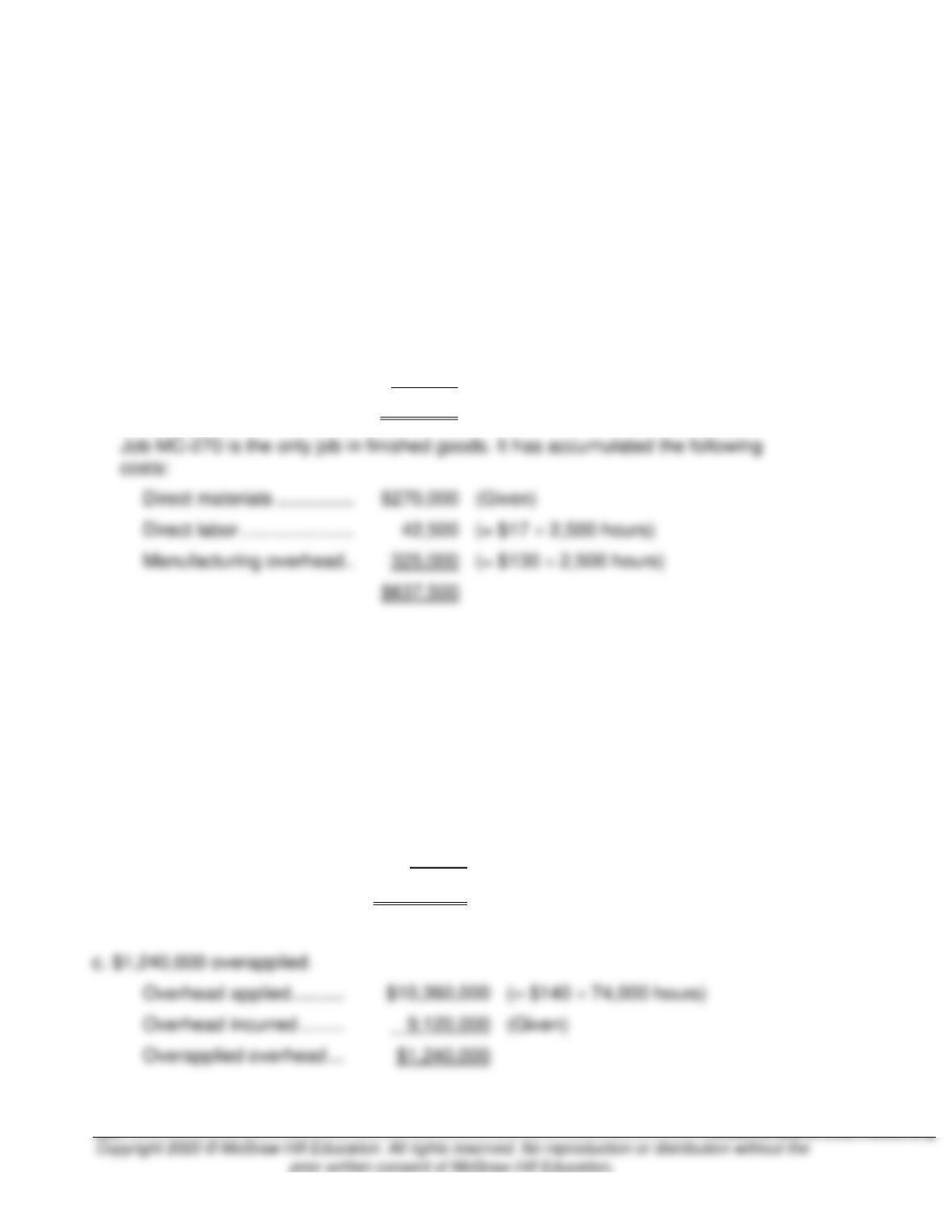
a. $965,400 (Work-in-Process Inventory) and $637,500 (Finished Goods Inventory).
Job MC-275 is the only job in process. It has accumulated the following costs:
Direct materials ……………
$495,000
(Given)
Direct labor ………………….
54,400
(= $17 3,200 hours)
Manufacturing overhead ..
416,000
(= $130 3,200 hours)
$965,400
Direct materials ……………
$270,000
(Given)
Direct labor ………………….
42,500
(= $17 2,500 hours)
Manufacturing overhead ..
(= $130 2,500 hours)
b. $1,069,500.
The predetermined overhead rate in year 3 is $140 per direct labor-hour. O’Leary
uses the actual rate from the previous year and $140 = $7,560,000 ÷ 54,000
hours).
Beginning costs …………..
$965,400
(From requirement (a))
Additional direct material .
57,000
(given)
Additional direct labor ……
5,100
(= $17 300 hours)
Manufacturing overhead ..
42,000
(= $140 300 hours)
$1,069,500
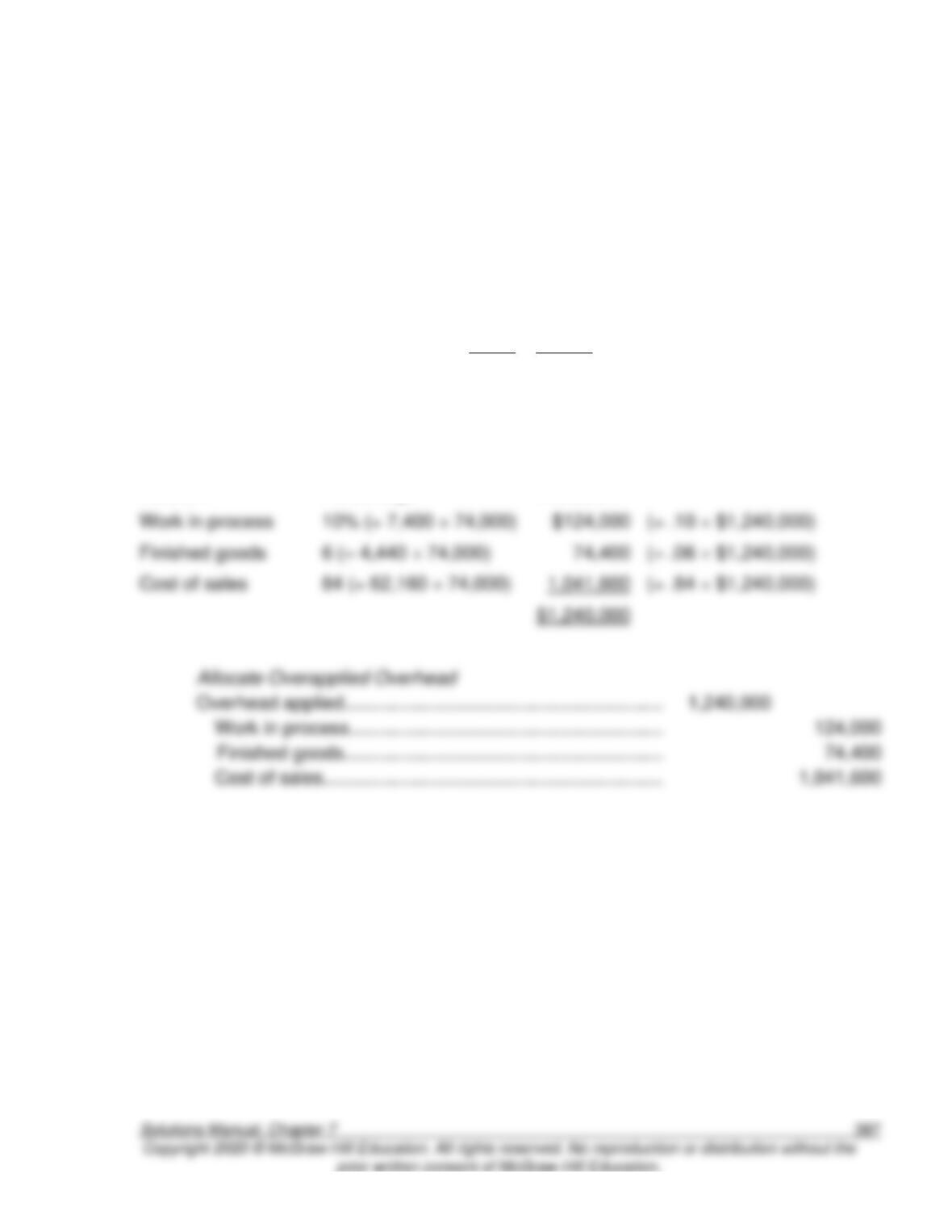
Overhead applied ……….
(= $140 74,000 hours)
Overhead incurred………
(Given)
7-68. (continued)
d. A variety of allocations can be used. Because we know how many direct labor hours
are in each account from year 3, we will use this basis. Direct labor hours are the
basis for applying overhead. If this were unknown, we could use total account
balances. First, determine the number of direct labor-hours used in year 3 in each
account.
Direct labor hours, year 3
74,000
(Given)
In work in process, end of year 3
7,400
(6,100 in MC-397 + 1,300 in
MC–399)
In finished goods, end of year 3
4,440
11,840
(1,740 in MC-389 + 2,700 in
MC–390)
In cost of goods, year 3
62,160
(74,000 – 11,840)
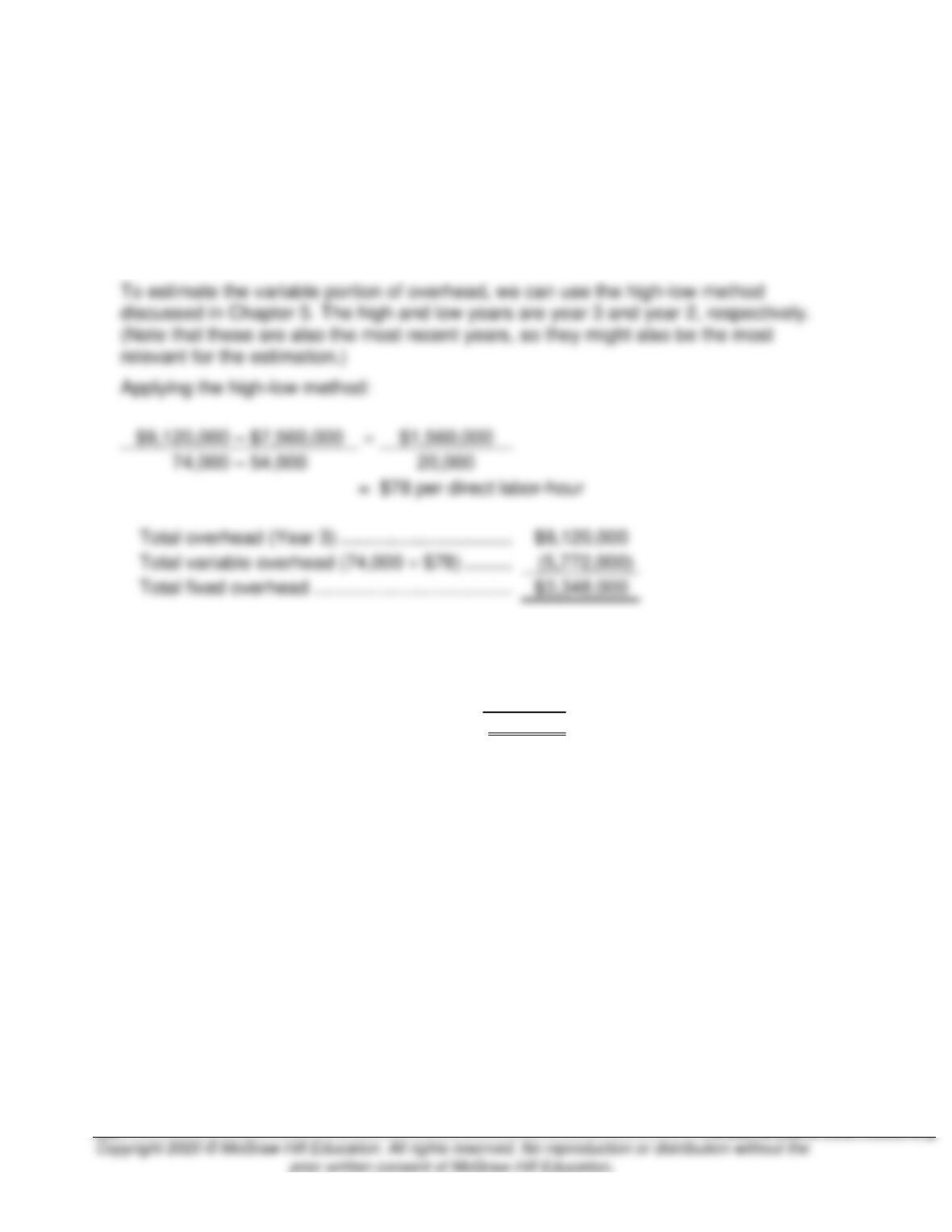
The allocation is then based on the relative amounts in each account:
Account
Percentage
Allocation
Work in process
10% (= 7,400 ÷ 74,000)
(= .10 $1,240,000)
Finished goods
6 (= 4,440 ÷ 74,000)
(= .06 $1,240,000)
Cost of sales
84 (= 62,160 ÷ 74,000)
(= .84 $1,240,000)
7-68. (continued)
e. $567,500.
This is a special-order problem similar to those discussed in Chapter 4. The
minimum bid would be the variable cost of the job, ignoring strategic or other
considerations. The variable cost of the job (ignoring sales and administrative costs
as instructed in the problem) consists of direct material, direct labor, and variable
manufacturing overhead.
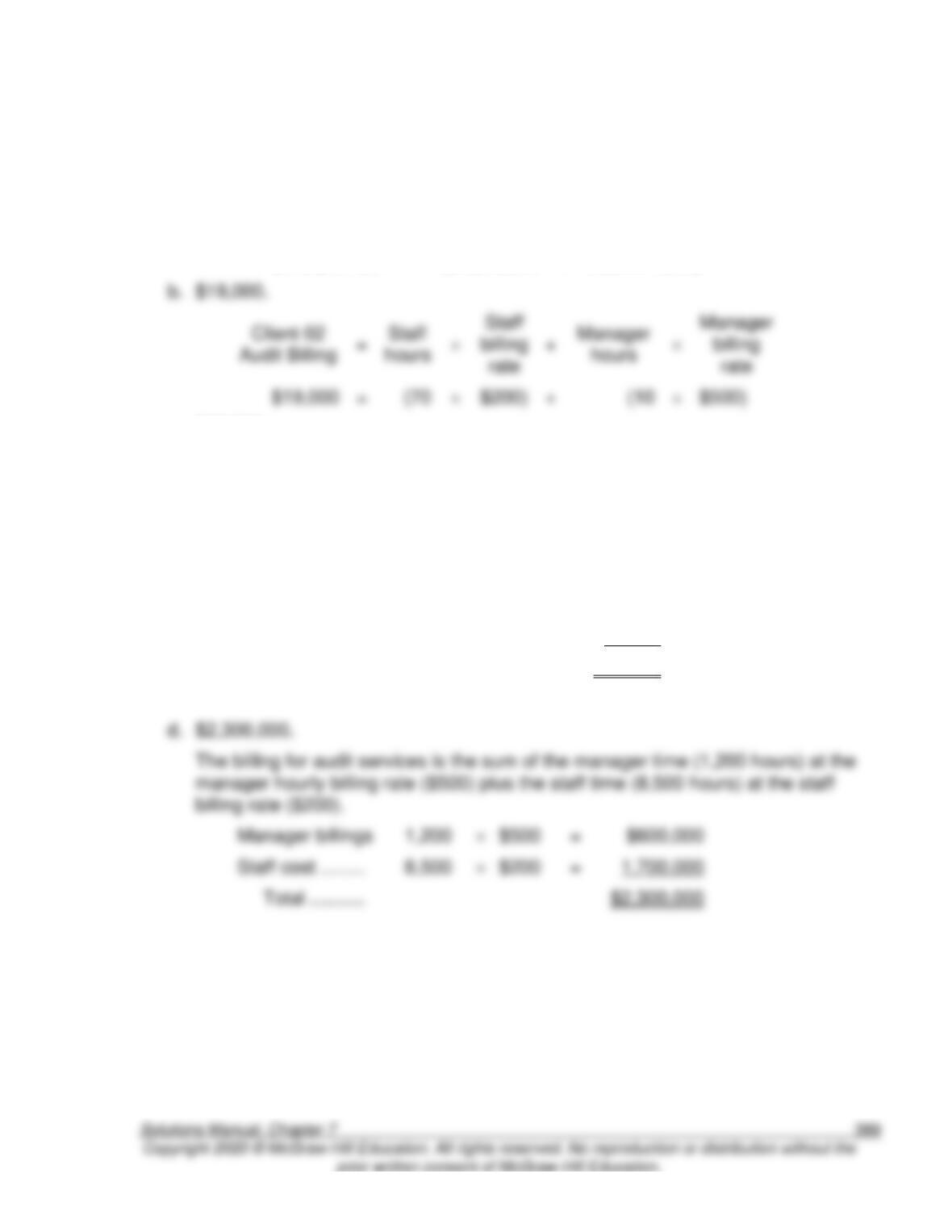
The variable cost of the special job can be estimated as follows:
Direct materials …………………………
$ 92,500
(Given)
Direct labor……………………………….
85,000
(= $17 5,000 hours)
Variable manufacturing overhead ..
390,000
(= $78 5,000 hours)
Total ……………………………………
$567,500
7-69. (60 min.) Predetermined Rates, Job Costing, Service Firms, Product-line
Profitability: A&R.
This problem relates overhead allocation to decision making. It uses some of the
methods of Chapter 4.
a. $225 per billable hour.
Predetermined rate
=
(Overhead
÷
Billable hours)
$225 per hour
=
($4,500,000
÷
20,000 hours)
=
$200)
+
$500)
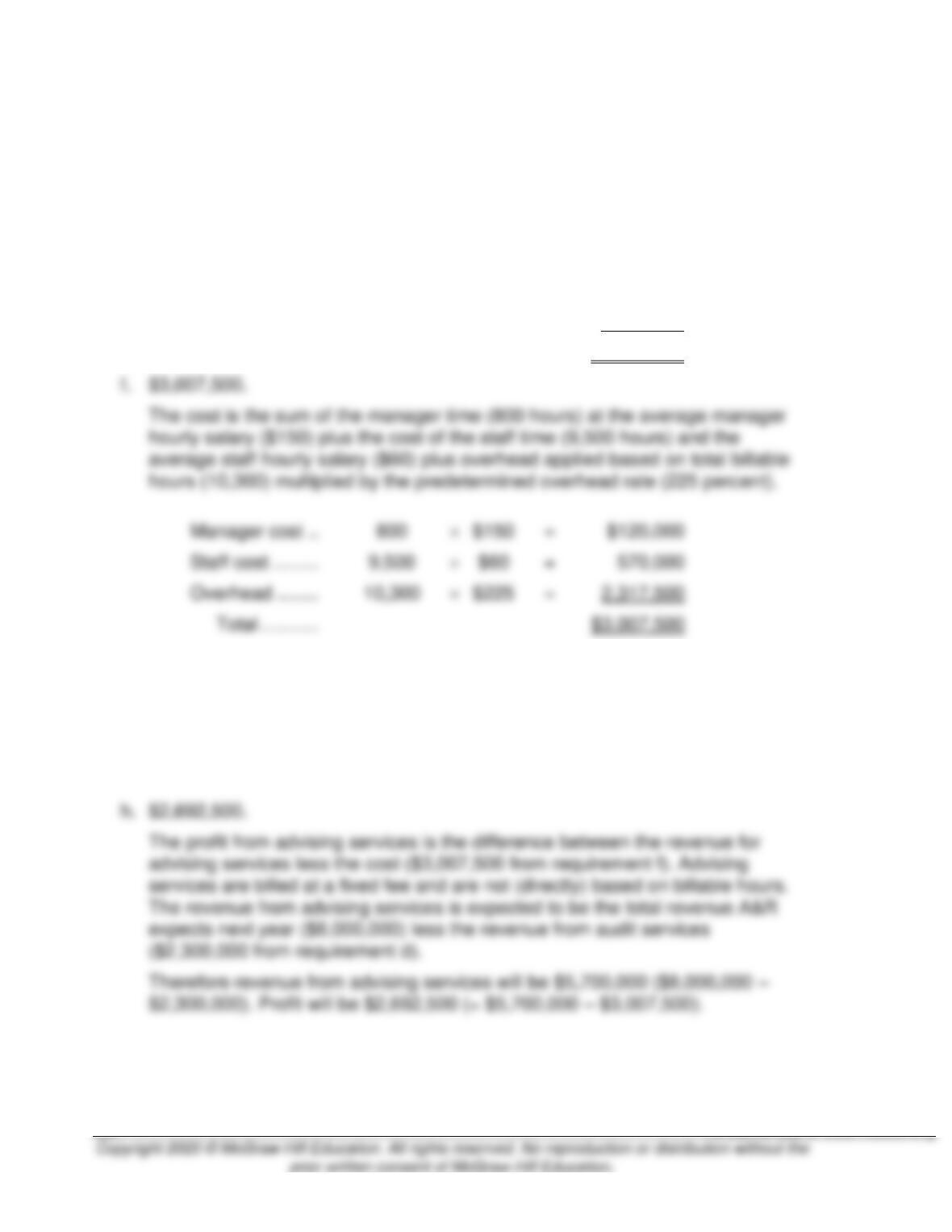
c. $23,700
The cost is the sum of the manager time (10 hours) at the average manager
hourly salary ($150) plus the cost of the staff time (70 hours) and the average
staff hourly salary ($60) plus overhead applied based on total billable hours (80)
multiplied by the predetermined overhead rate (225 percent).
Manager cost ..
10
$150
=
$1,500
Staff cost ………
70
$60
=
4,200
Overhead ……..
80
$225
=
18,000
Total ………..
$23,700
Manager billings
Staff cost ………
Total ………..
7-69. (continued)
e. $2,872,500.
The cost is the sum of the manager time (1,200 hours) at the average manager
hourly salary ($150) plus the cost of the staff time (8,500 hours) and the
average staff hourly salary ($60) plus overhead applied based on total billable
hours (9,700) multiplied by the predetermined overhead rate (225 percent).
Manager cost ..
1,200
$150
=
$180,000
Staff cost ………
8,500
$60
=
510,000
Overhead ……..
9,700
$225
=
2,182,500
Total ………..
$2,872,500
Manager cost ..
$150
=
Staff cost ………
9,500
$60
=
570,000
Overhead ……..
$225
=
Total ………..
g. $(572,500).
The profit from audit services is the difference between the amount billed
($2,300,000 from requirement d) and the cost ($2,872,500 from requirement e).
This is a loss of $572,500 (= $2,300,000 – $2,872,500).
7-69. (continued)
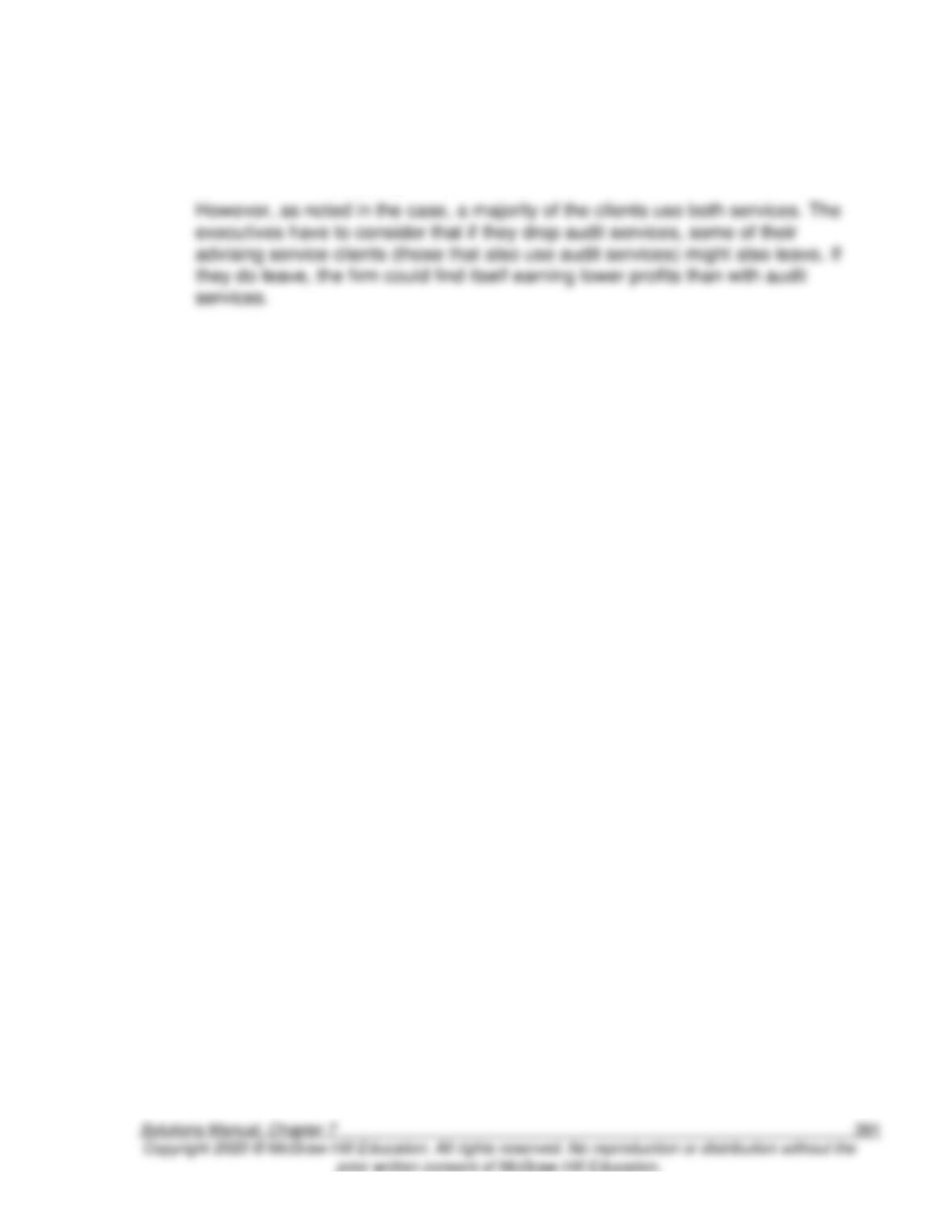
i. Answers will vary. There are two issues that a memo should address. The first
is the relative reported profits of the two service lines. If the executives believe
these represent the profits the firm actually earns from the two services, they
should consider dropping audit services.