CHAPTER 7
SOLUTIONS TO EXERCISES—SET B
EXERCISE 7-1B
(a)
Reject
Order
Accept
Order
Net Income Effect
Revenues
Materials ($0.50)
$ –0–
–0–
$20,000
(2,000)
$20,000
(2,000)
(b) As shown in the incremental analysis, Harrison should accept the special
(c) It is assumed that sales of the golf disc in other markets would not be
affected by this special order. If other sales were affected, Harrison would
EXERCISE 7-2B
(a)
Reject
Order
Accept
Order
Net Income
Increase
(Decrease)
Cost of goods sold
Operating expenses
(1)
(2)
Revenues (60,000 X $8.00)
$0
$ 480,000
$ 480,000
(1) Variable cost of goods sold = $2,800,000 X 75% = $2,100,000.
Fixed overhead
Sales commissions
(5,000)
EXERCISE 7-2B (Continued)
(2) Variable operating expenses = $900,000 X 70% = $630,000;
$630,000 ÷ 400,000 = $1.575 per unit;
(b) As shown in the incremental analysis, Penn Company should accept the
EXERCISE 7-3B
Reject
Order
Accept
Order
Net Income
Increase
(Decrease)
Revenues
$0
$945,000 (1)
$ 945,000
Variable costs:
Direct materials
0
420,000
(420,000)
Total variable costs
Net income
$0
$ 210,000
(1) [($2.00 + $0.50 + $1.00 + $1.00) X 210,000]
EXERCISE 7-4B
(a)
Make
Buy
Net Income
Increase
(Decrease)
$995,000
Direct materials (70,000 X $4.00)
$280,000
$ 0
$ 280,000
EXERCISE 7-4B (Continued)
(b) No, Ralph Inc. should not purchase the finials. As indicated by the
(c) Yes, by purchasing the finials shades, a total cost saving of $5,000 will
result as shown below.
Make
Buy
Net Income
Increase
(Decrease)
Total annual cost (above)
$960,000
$995,000
$(35,000)
EXERCISE 7-5B
(a) (1)
Make
Buy
Net Income
Increase
(Decrease)
Direct materials
$ 600,000
$ –0–
$ 600,000
Direct labor
500,000
–0–
500,000
Variable overhead
300,000
–0–
300,000
Fixed overhead
Purchase price
0
EXERCISE 7-5B (Continued)
(2)
Make
Buy
Net Income
Increase
(Decrease)
Direct materials
$ 600,000
$ 0
$ 600,000
Direct labor
500,000
0
500,000
Yes. The offer should be accepted as net income would be $100,000 more.
(b) Qualitative factors include the possibility of laying off those employees
EXERCISE 7-6B
(a) Net Income
Increase
Make Sails Buy Sails (Decrease)
Direct material $100 $ 0 $ 100
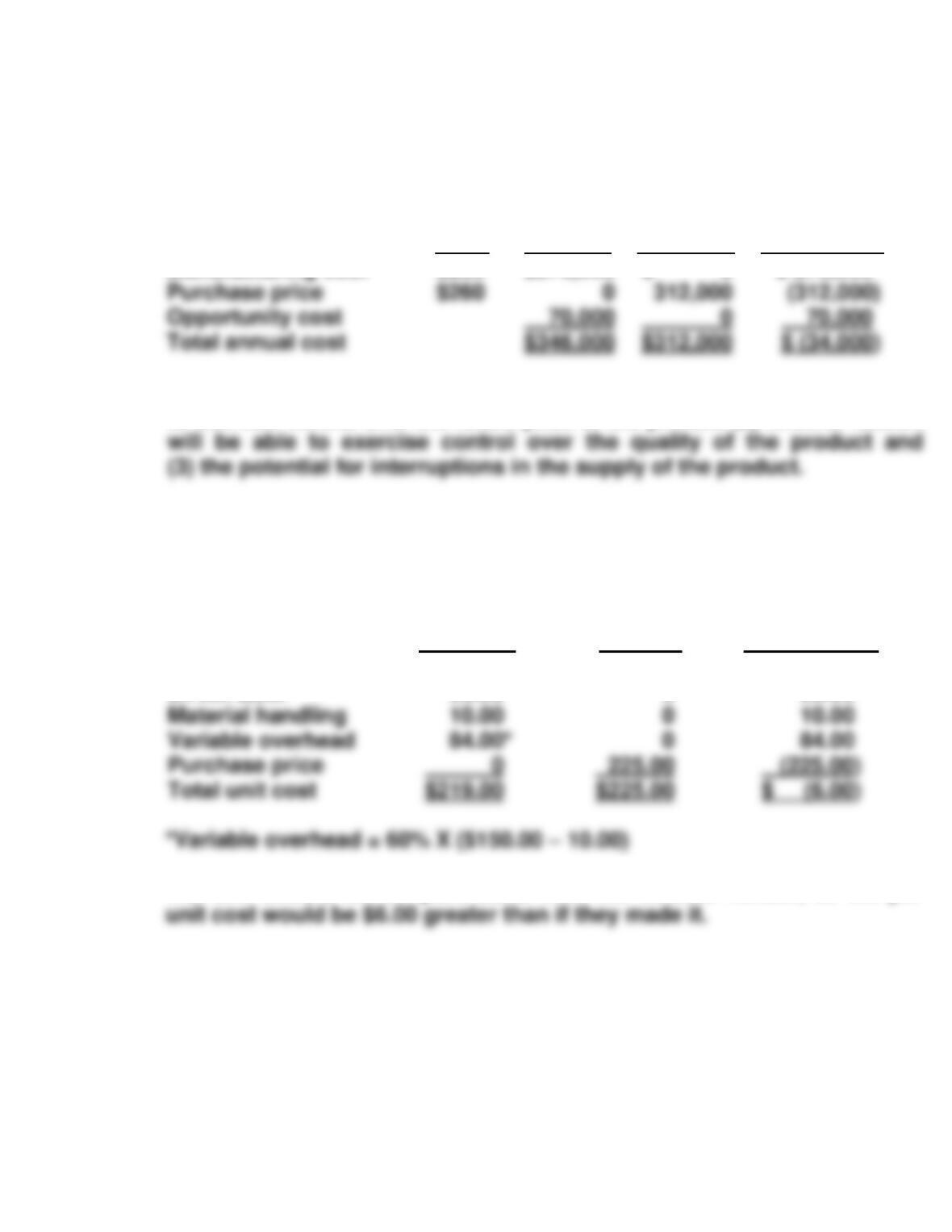
Macon should be making the sails, because they could save $30 per unit
or $36,000. The president was including the fixed overhead cost in the
Variable overhead
300,000
0
300,000
Fixed overhead
400,000
Opportunity cost
200,000
0
200,000
Purchase price
$1,900,000
$ 100,000
EXERCISE 7-6B (Continued)
(b) The best decision would be to rent out the space as shown below. The
differential savings would be $70,000 – $36,000 = $34,000.
Net Income
Per Make Increase
(Based on 1,200 units) Unit Sails Buy Sails (Decrease)
Manufacturing cost $230 $276,000 $ 0 $ 276,000
(c) Qualitative factors to consider would be (1) whether Macon will be able
to exercise control over the future price of the product (2) whether Macon
EXERCISE 7-7B
(a) Net Income
Increase
Make J36 Buy J36 (Decrease)
Direct material $ 75.00 $ 0 $ 75.00
Direct labor 50.00 0 50.00
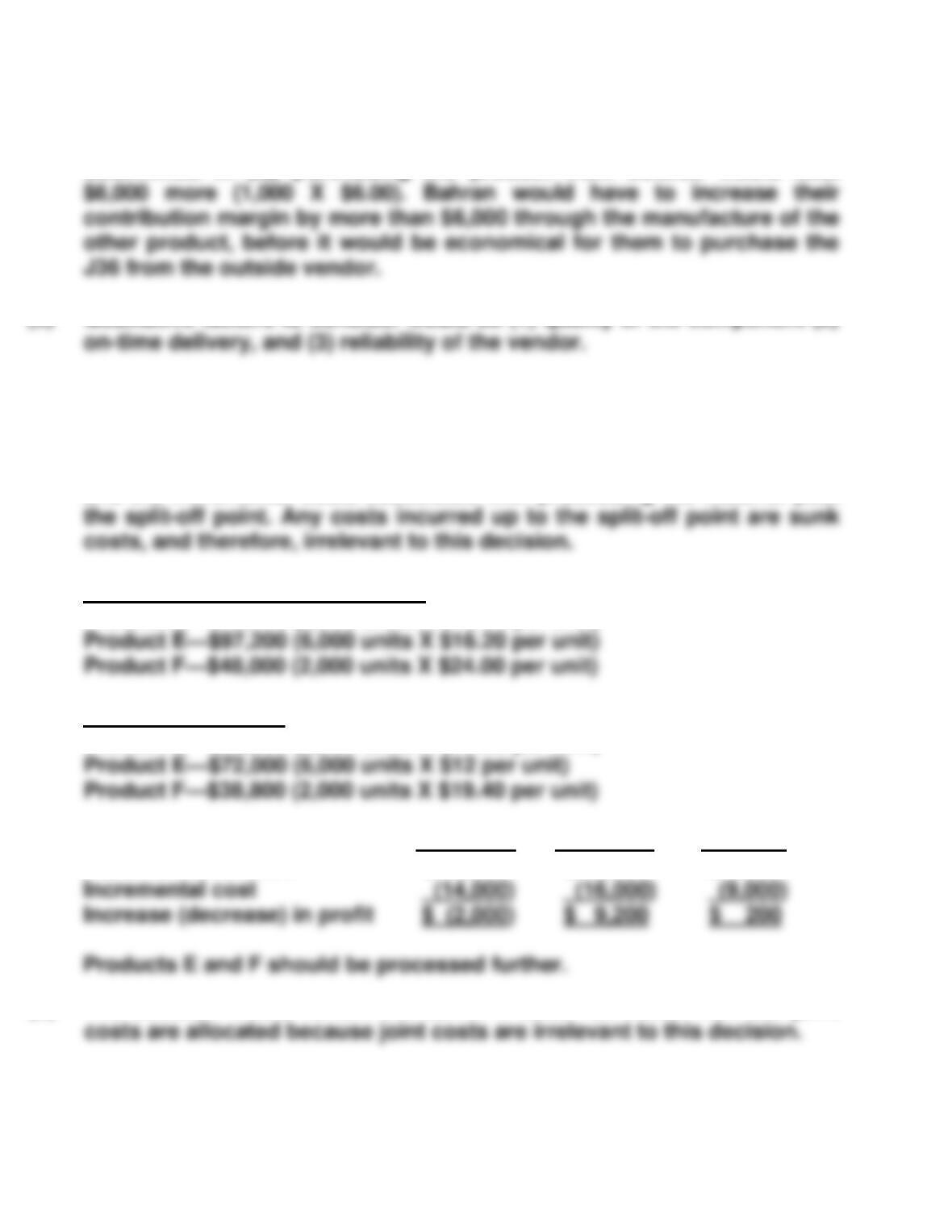
The unit should not be purchased from the outside vendor, as the per
EXERCISE 7-7B (Continued)
(b) In order for Bahran to make an accurate decision, they would have to
know the opportunity cost of manufacturing the other product. As
determined in (a), purchasing the product from outside would cost
(c) Qualitative factors to consider would be (1) quality of the component (2)
EXERCISE 7-8B
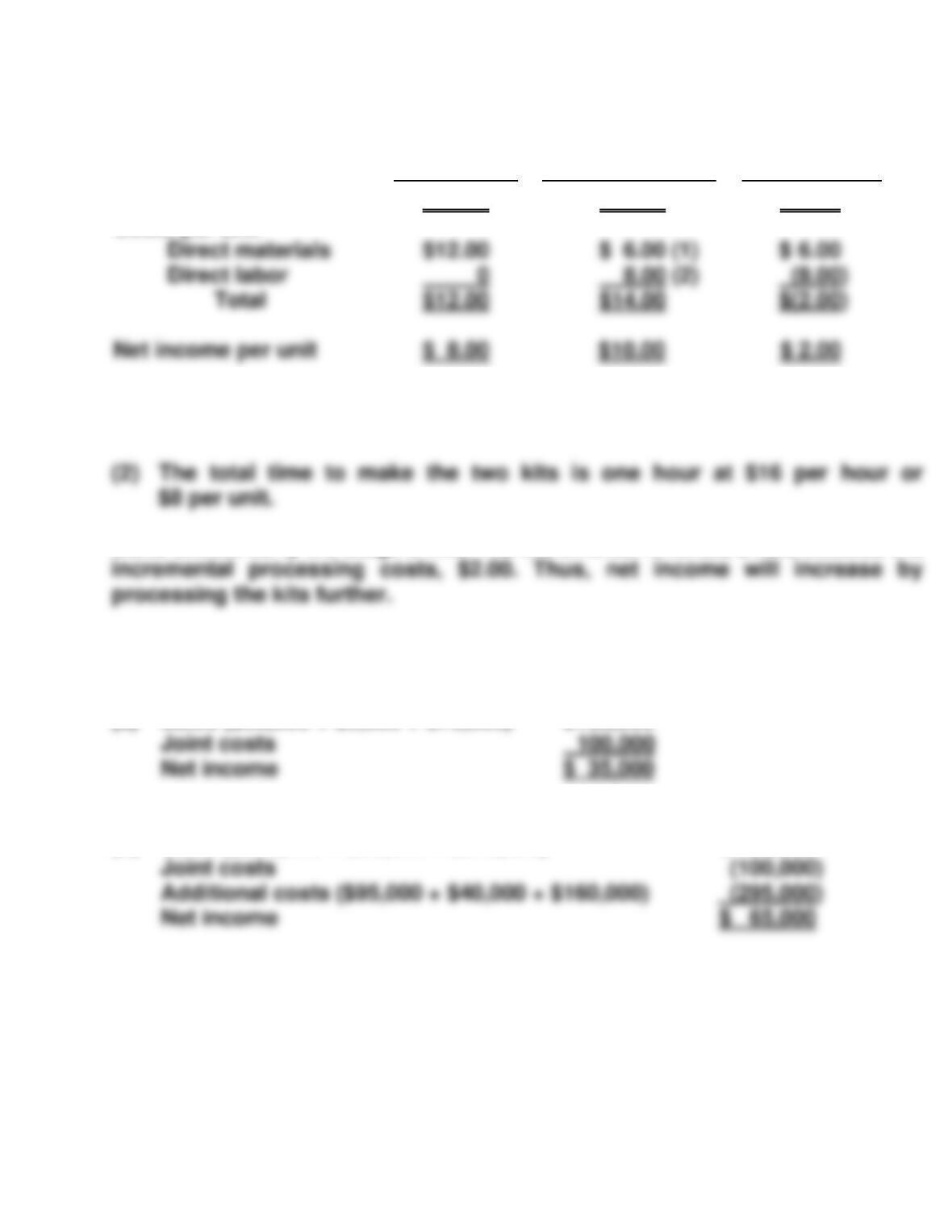
(a) The costs that are relevant in this decision are the incremental revenues
and the incremental costs associated with processing the material past
(b) Revenue after further processing:
Product D—$45,000 (3,000 units X $15.00 per unit)
Revenue at split-off:
Product D—$33,000 (3,000 units X $11.00 per unit)
D E F
Incremental revenue $ 12,000 $ 25,200 $ 9,200
(c) The decision would remain the same. It does not matter how the joint
EXERCISE 7-9B
Sell
(Basic Kit)
Process Further
(Stage 2 Kit)
Net Income
Increase
(Decrease)
Sales per unit
Costs per unit
$20.00
($24.00
$ 4.00)
(1) The cost of materials decreases because Stella can make two Stage 2 Kits
from the materials for a basic kit.
Stella should carry the Stage 2 Kits. The incremental revenue, $4.00, exceeds the
EXERCISE 7-10B
(a)
Sales ($60,000 + $5,000 + $70,000)
$135,000
Joint costs
Net income
$ 35,000
(b)
Sales ($200,000 + $50,000 + $210,000)
$ 460,000
Joint costs
Additional costs ($95,000 + $40,000 + $160,000)
Net income
$ 65,000
EXERCISE 7-10B (Continued)
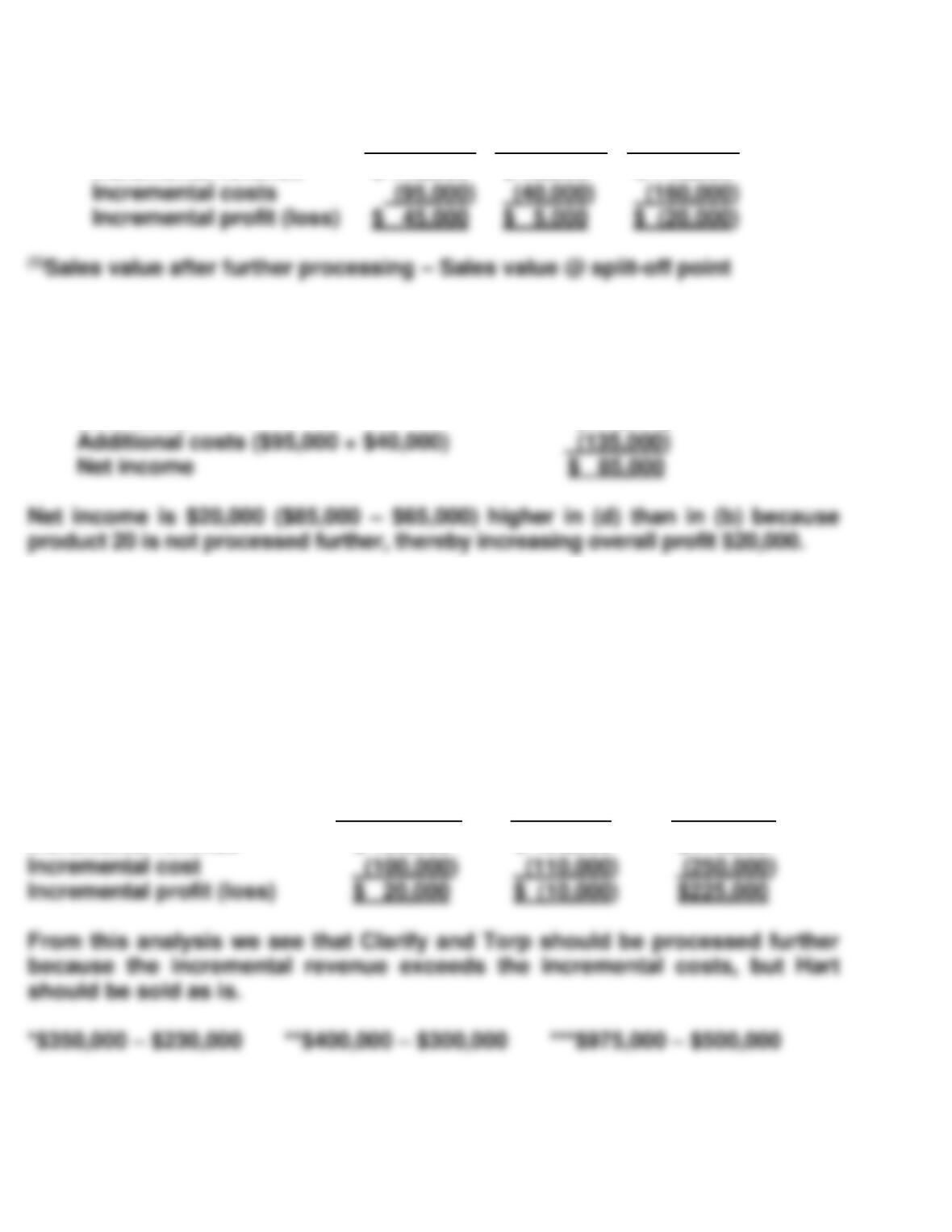
(c)
Product 10
Product 15
Product 20
Incremental revenue(1)
$ 140,000
$ 45,000
$ 140,000
Products 10 and 15 should be processed further and product 20 should be
sold at the split-off point.
(d)
Sales ($200,000 + $50,000 + $70,000)
$ 320,000
Joint costs
(100,000)
Additional costs ($95,000 + $40,000)
Net income
EXERCISE 7-11B
To determine whether each of the three joint products should be sold as is, or
processed further, we must determine the incremental profit or loss that
would be earned by each. The allocated joint costs are irrelevant to the
decision since these costs will not change whether or not the products are
sold as is or processed further.
Clarify
Hart
Torp
$ 20,000
Incremental revenue
$ 120,000*
$ 100,000
**
$475,000
***
(95,000)
EXERCISE 7-12B
(a)
Cost
$100,000
Accumulated depreciation
20,000*
Book value
80,000
(b)
Retain
Scanner
Replace
Scanner
Net Income
Increase
(Decrease)
Annual operating costs
$480,000*
$380,000**
$ 100,000
New scanner cost
115,000
(115,000)
Old scanner salvage
(30,000)
$480,000
$465,000
$ 15,000
(c) As shown in (a) above, replacing the old scanner will result in reporting a
loss of $50,000. Reluctance to report losses of this nature is the usual
reason for not recognizing that a poor decision was made in the past. The
Sales proceeds
30,000
Loss on sale
$ 50,000
EXERCISE 7-13B
Retain
Machine
Replace
Machine
Net Income
Increase
(Decrease)
Operating costs
$150,000
(1)
($120,000)
(2)
($ 30,000)
The current machine should be replaced. The incremental analysis shows that
EXERCISE 7-14B
The company should introduce Product E next year.
Calculation of contribution margin per unit:
C D E
Selling price per unit $100 $80 $150
Company profit with Products C and D:
C D Total
Units sold 4,000 10,000
Sales revenue $400,000 $800,000 $1,200,000
$150,000
EXERCISE 7-14B (Continued)
Company profit with Products C and E:
C E Total
Units sold 4,400* 5,500
Sales Revenue $440,000 $825,000 $1,265,000
EXERCISE 7-15B
Continue
Eliminate
Net Income
Increase
(Decrease)
Operating expenses
$(35,070)
Sales
Variable expenses
Cost of goods sold
Operating expenses
$ 96,200)
(70,000)
15,000)
$ 0
( 0
0
$(96,200)
(70,000
15,000
Jaime Martin is incorrect. The incremental analysis shows that net income will
EXERCISE 7-16B
(a) $80,000 + $115,000 – $30,000 = $165,000
(b)
Shocker
Stunner
Total
Sales
Variable expenses
$360,000
160,000
$540,000
200,000
$900,000
360,000
(c) As shown in the analysis above, Norton should not eliminate the
Paralyzer product line. Elimination of the line would cause net income to
SOLUTIONS TO PROBLEMS—SET C
PROBLEM 7-1C
(a)
Reject
Order
Accept
Order
Net Income
Increase
(Decrease)
Revenues (11,000 X $30)
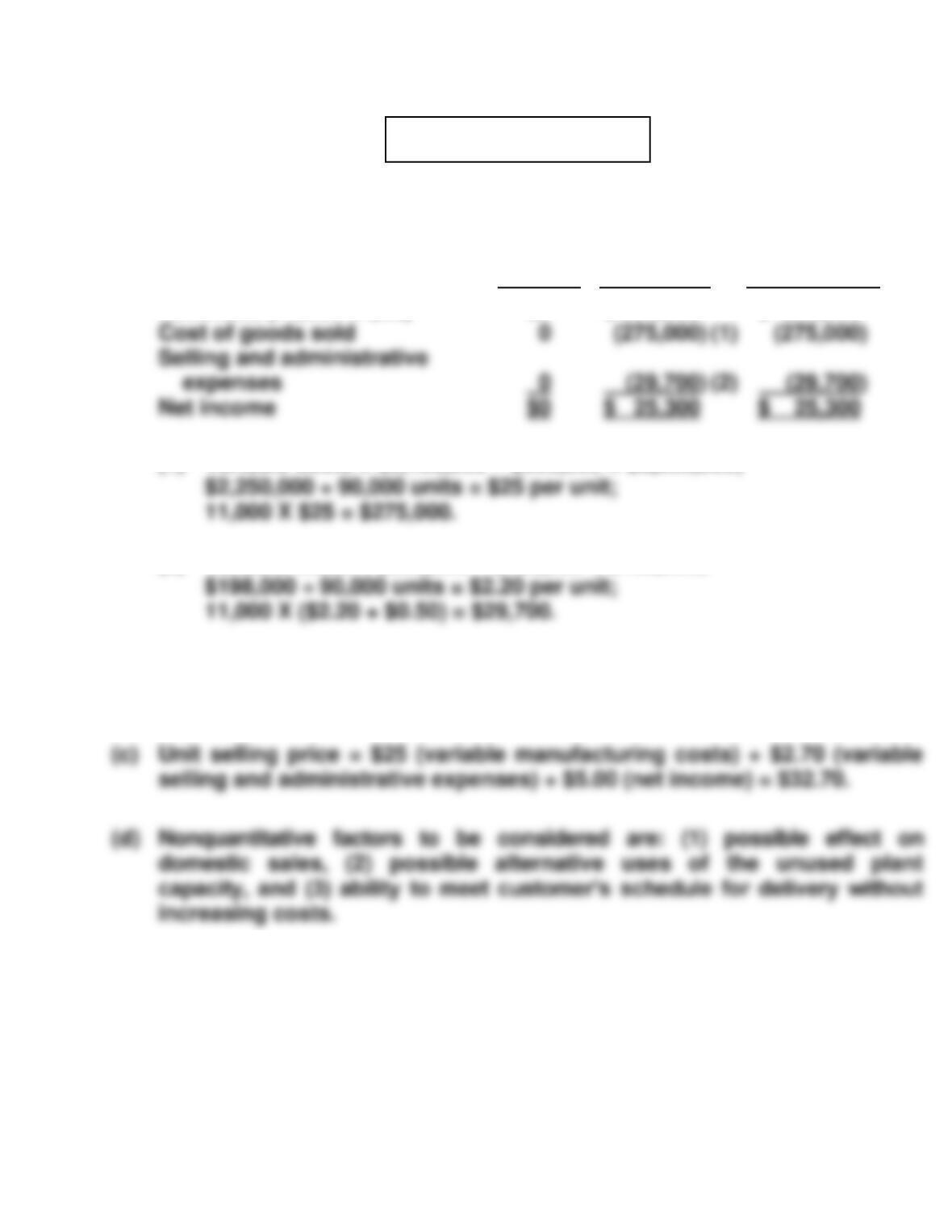
$0
$ 330,000
$ 330,000
(1) Variable costs = $3,150,000 – $900,000 = $2,250,000;
(2) Variable costs = $360,000 – $162,000 = $198,000;
(b) Yes, the special order should be accepted because net income will be
increased by $25,300.
PROBLEM 7-2C
(a)
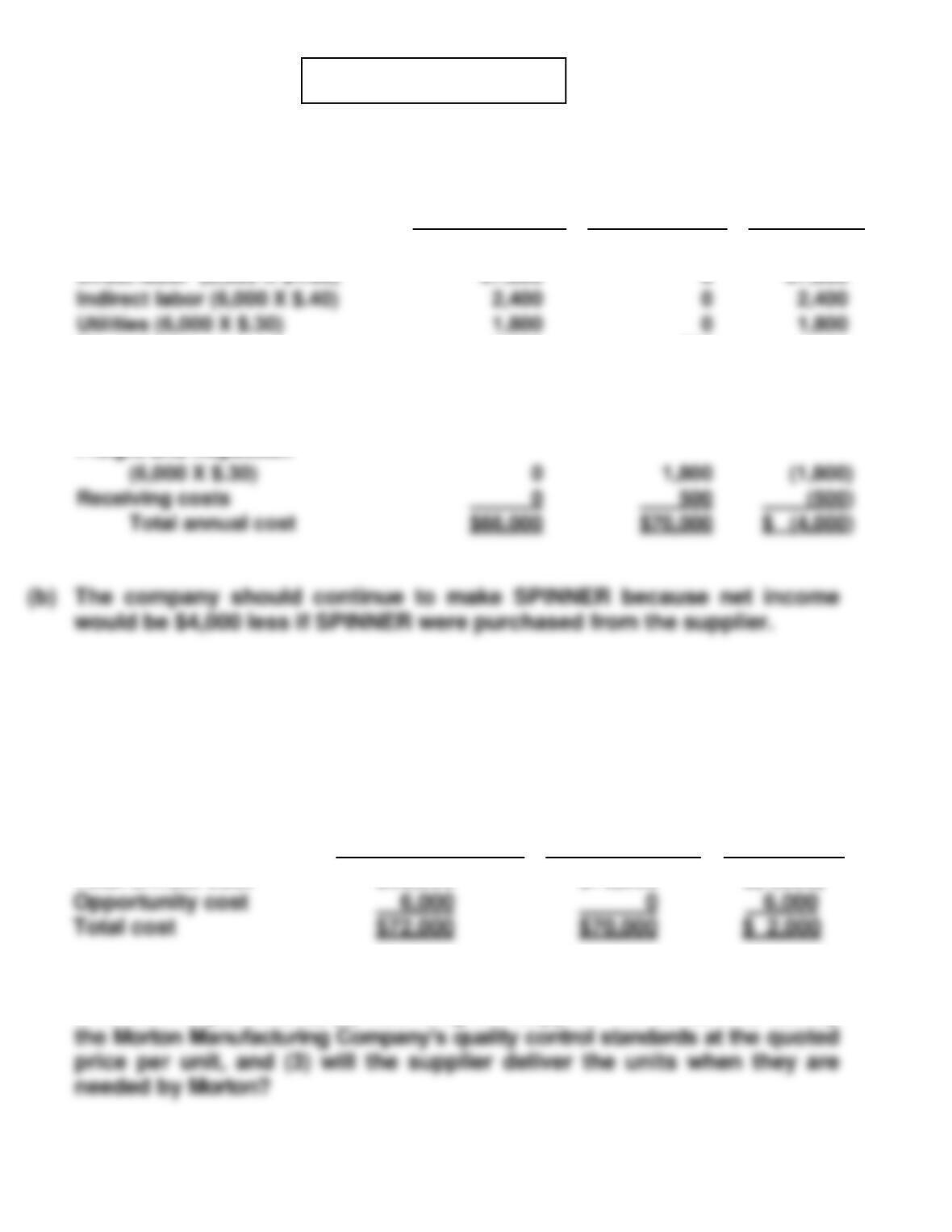
Make SPINNER
Buy SPINNER
Net Income
Increase
(Decrease)
Direct materials (6,000 X $5.00)
Depreciation
Property taxes
Insurance
Purchase price
Freight and inspection
$30,000
2,000
700
1,500
0
$ 0
900
200
600
66,000
($ 30,000
( 1,100
( 500
( 900
( (66,000)
(
(c) The decision would be different. Because of the opportunity cost of
$6,000, net income will be $2,000 higher if SPINNER is purchased as
shown below:
Make SPINNER
Buy SPINNER
Net Income
Increase
(Decrease)
Total annual cost
$66,000
$70,000
$(4,000)
(d) Nonquantitative factors include: (1) the adverse effect on employees if
SPINNER is purchased, (2) how long the supplier will be able to satisfy
PROBLEM 7-3C
(a) (1)
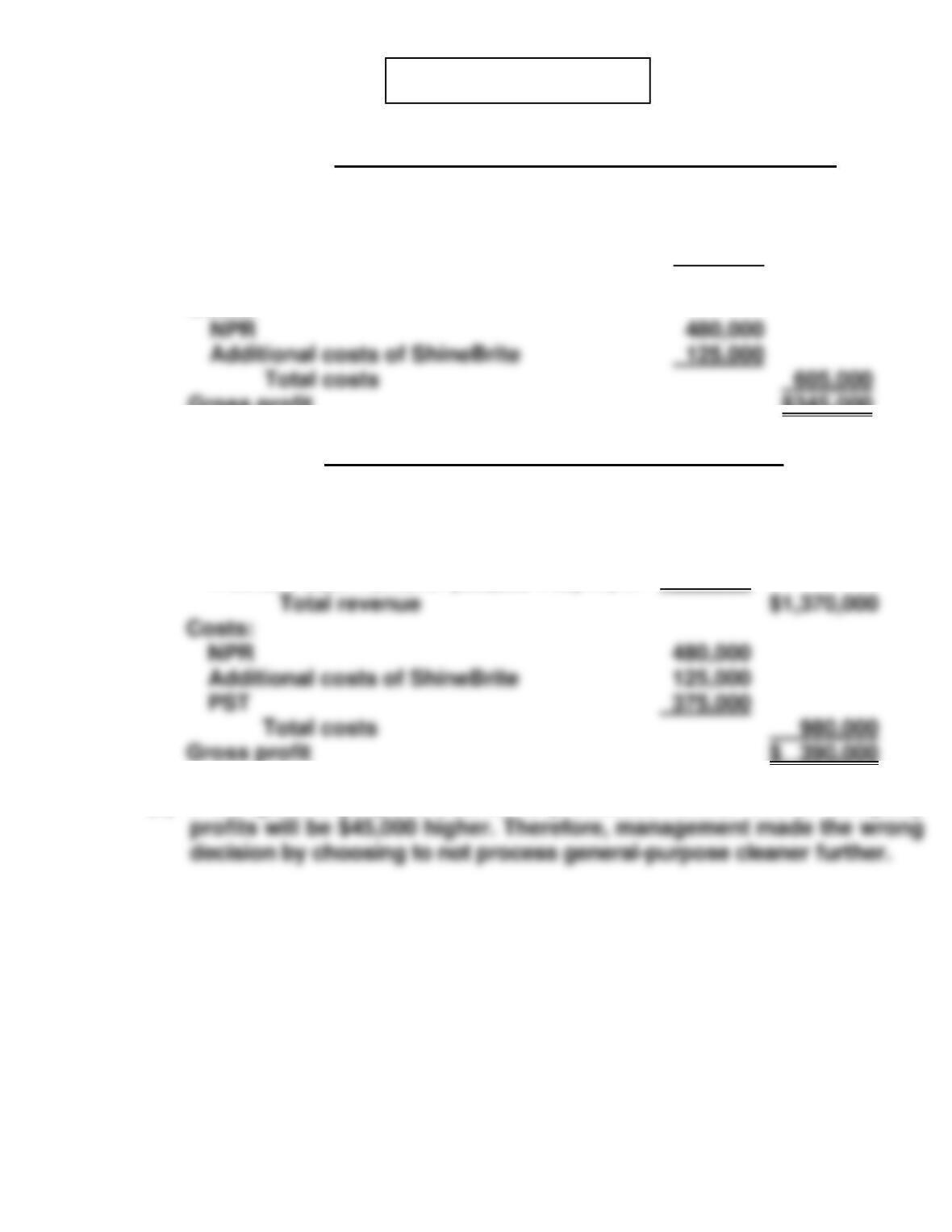
General-Purpose Cleaner Not Processed Further
Sales:
ShineBrite (1,000,000 ÷ 20) X $13
$650,000
General–Purpose Cleaner (600,000 ÷ 20) X $10
300,000
Total revenue
$950,000
Costs:
Gross profit
$345,000
(2)
General-Purpose Cleaner Processed Further
Sales:
ShineBrite
$650,000
Premium Cleaner (600,000 ÷ 20) X $12
360,000
Premium Stain Remover (600,000 ÷ 20) X $12
360,000
Total revenue
$1,370,000
Costs:
Additional costs of ShineBrite
125,000
Total costs
Gross profit
$ 390,000
(3) If the general-purpose cleaner is processed further overall company
NPR
Total costs
PROBLEM 7-3C (Continued)
(b)
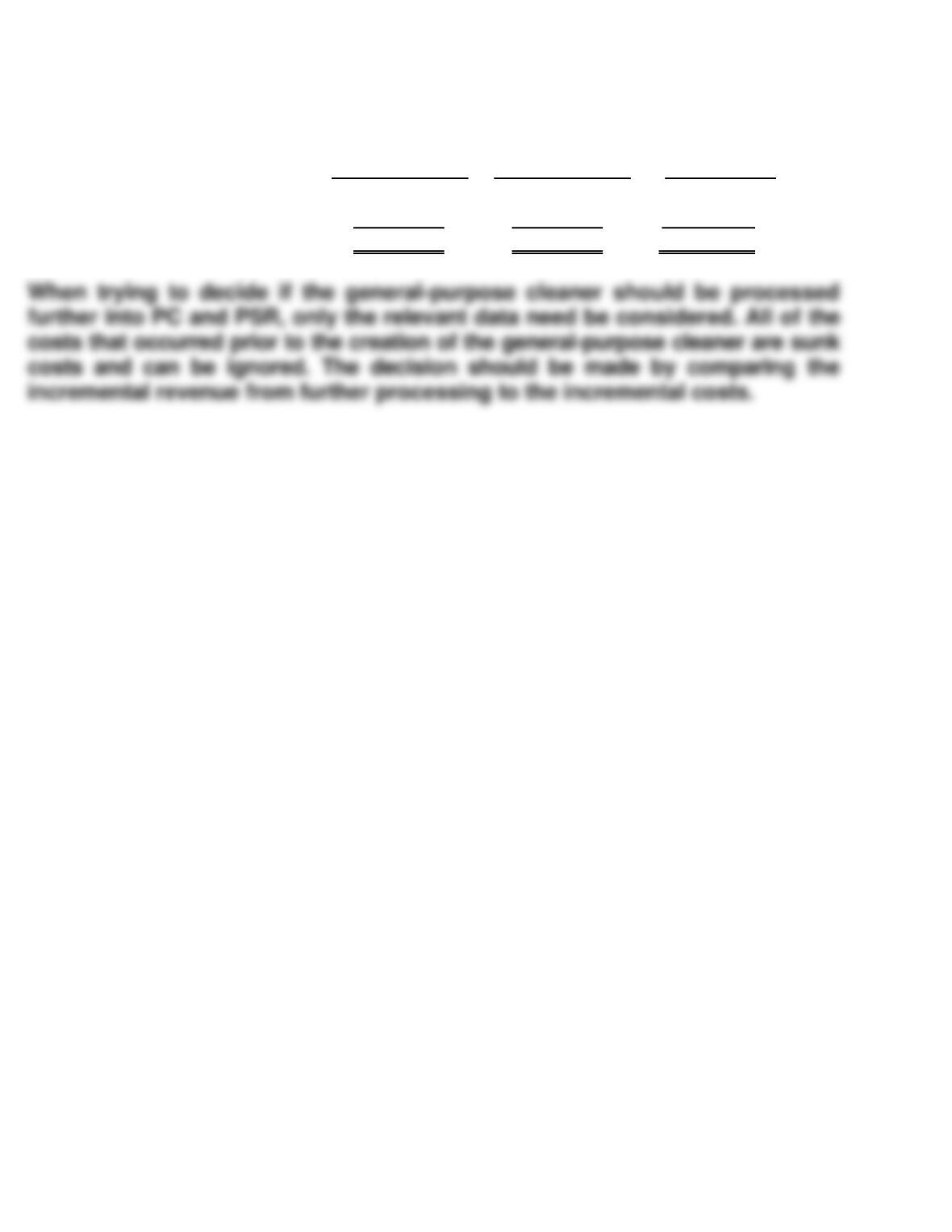
Don’t Process
G-P Cleaner
Further
Process
G-P Cleaner
Further
Net Income
Increase
(Decrease)
Incremental revenue
$300,000
$720,000
$ 420,000
Incremental costs
0
375,000
(375,000)
Totals
$300,000
$345,000
$ 45,000
PROBLEM 7-4C
(a)
Cost
$252,000
Accumulated depreciation
42,000*
Book value
210,000
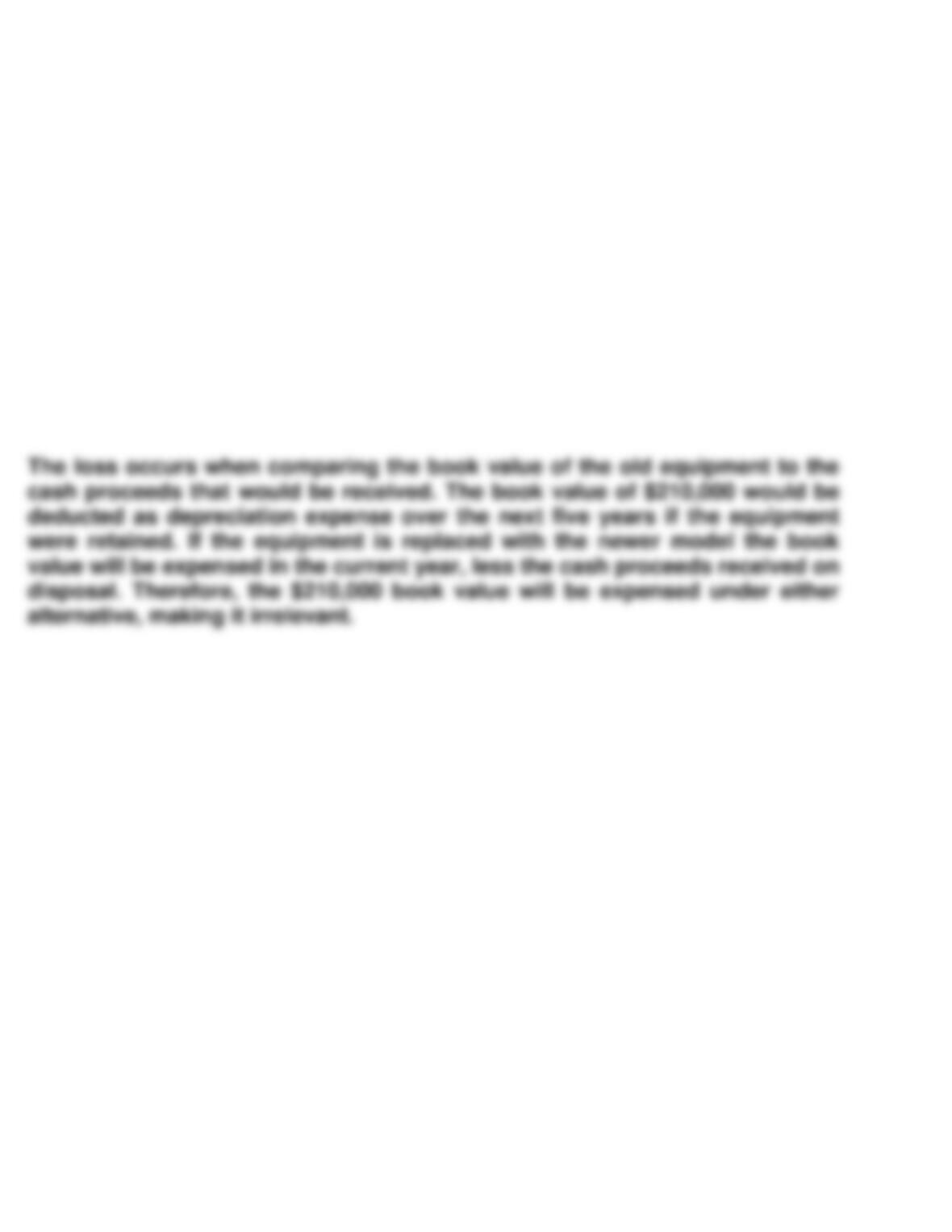
(b) (1)
Retain Old Equipment
Sales ($600,000 X 5 yrs.)
$3,000,000
Less costs:
Variable costs
$260,000
Fixed costs
Selling & administrative
Depreciation
Net income
(2)
Replace Old Equipment
Sales
$3,000,000
Less costs:
Variable costs
$75,000
Fixed costs
Selling and administrative
Depreciation
Operating income
Less: Loss on old equipment
160,000
Net income
(c)
Retain
Old Equipment
Replace
Old Equipment
Net Income
Increase
(Decrease)
Variable operating costs
$260,000
$75,000
$ 185,000
Fixed operating costs
New equipment cost
Salvage on old equipment
50,000
Totals
Sales proceeds
Loss on sale
PROBLEM 7-4C (Continued)
(d) MEMO
TO: Douglas Stephens
FROM: Student
SUBJECT: Relevant Data for Decision to Replace Old Equipment
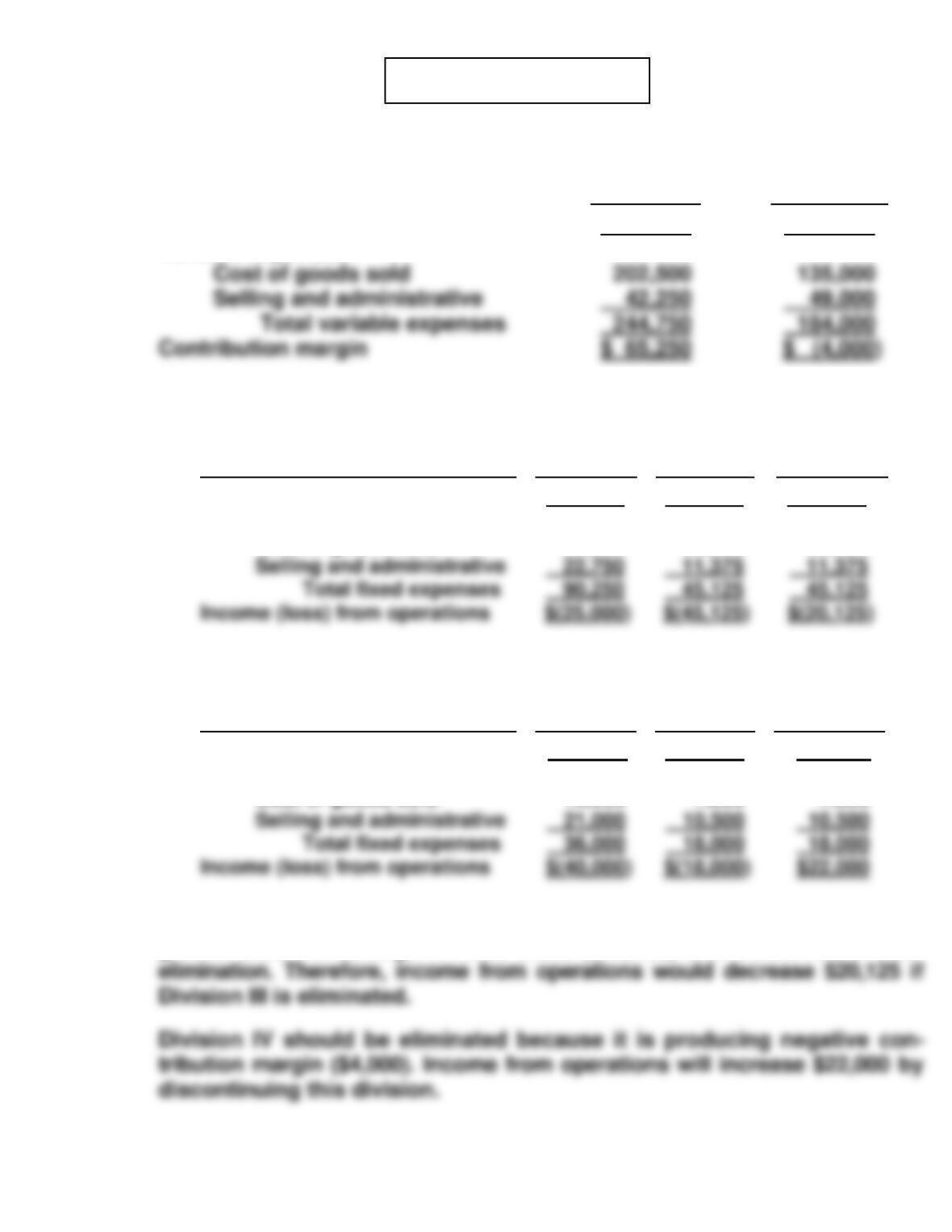
When deciding whether or not to replace any old equipment, the analysis
should only include cost data relevant to the replacement decision. The
$160,000 loss that would be experienced if we replace the old equipment with
the newer equipment is related to a sunk cost, namely the cost of the old
equipment. Sunk costs are irrelevant in decision making.
PROBLEM 7-5C
(a)
Division
III
Division
IV
Sales
Variable expenses
$310,000
$180,000
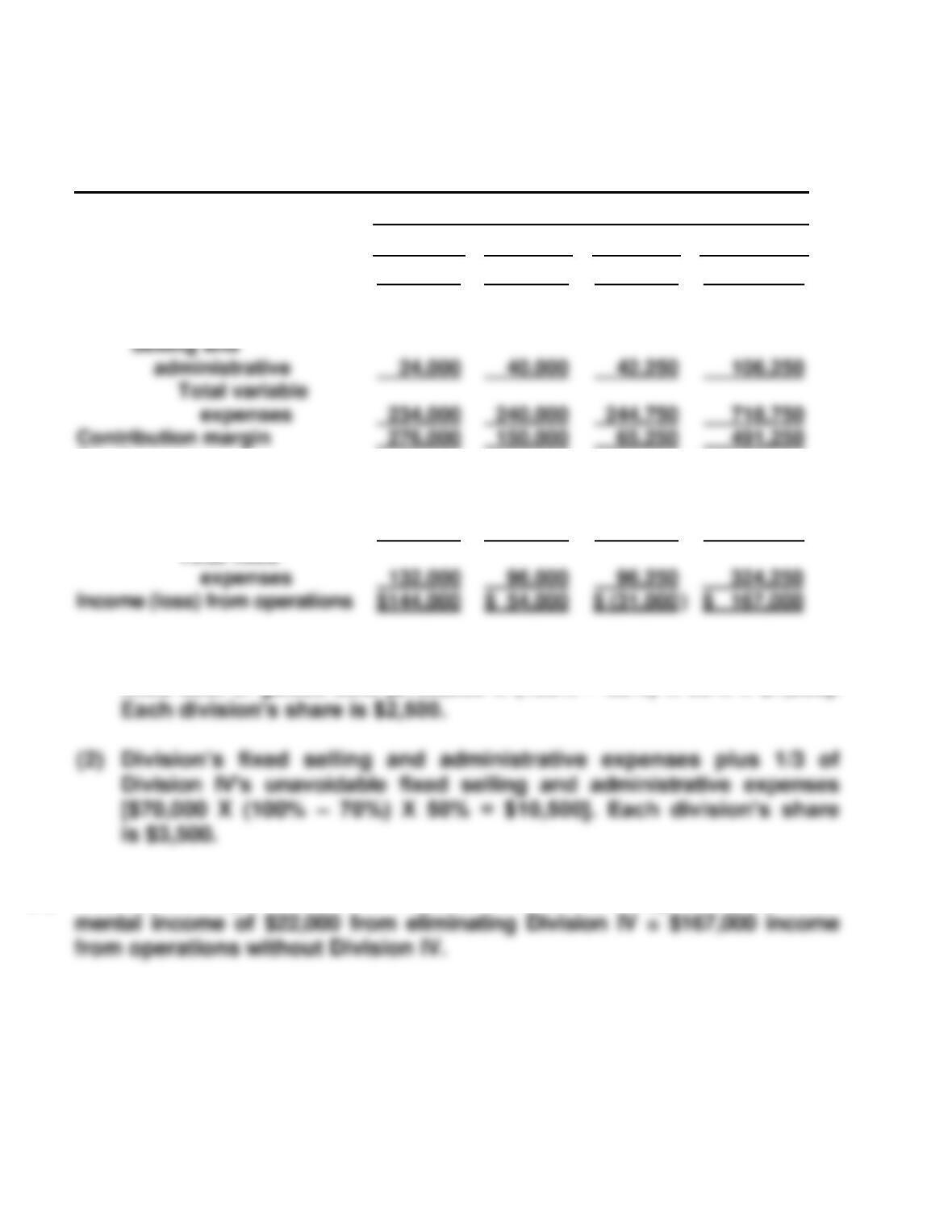
(b)
(1)
Division III
Continue
Eliminate
Net Income
Increase
(Decrease)
Contribution margin (above)
Fixed expenses
Cost of goods sold
$ 65,250
67,500
$ 0
(33,750
$(65,250)
33,750
(2)
Division IV
Continue
Eliminate
Net Income
Increase
(Decrease)
Contribution margin (above)
Fixed expenses
Cost of goods sold
$ (4,000)
(15,000)
$ 0
7,500
$ (4,000)
7,500
Division III should be continued as contribution margin ($65,250) is
greater than the savings in fixed costs ($45,125) that would result from
PROBLEM 7-5C (Continued)
(c) McKAY MANUFACTURING COMPANY
CVP Income Statement
For the Quarter Ended March 31, 2017
Divisions
I
II
III
Total
Sales
Variable expenses
Cost of goods sold
Fixed expenses
Cost of goods sold (1)
Selling and
administrative (2)
Total fixed
$510,000
210,000
92,500
39,500
$390,000
200,000
52,500
43,500
$310,000
202,500
70,000
26,250
$1,210,000
612,500
215,000
109,250
(1) Division’s fixed cost of goods sold plus 1/3 of Division IV’s unavoidable
fixed cost of goods sold [$150,000 X (100% – 90%) X 50% = $7,500].
(d) Income from operations with Division IV of $145,000 (given) plus incre-