John J. Wild, Financial Accounting: Information for Decisions, 8th Edition
7-1
CHAPTER 7
REPORTING AND ANALYZING RECEIVABLES
Related Assignment Materials
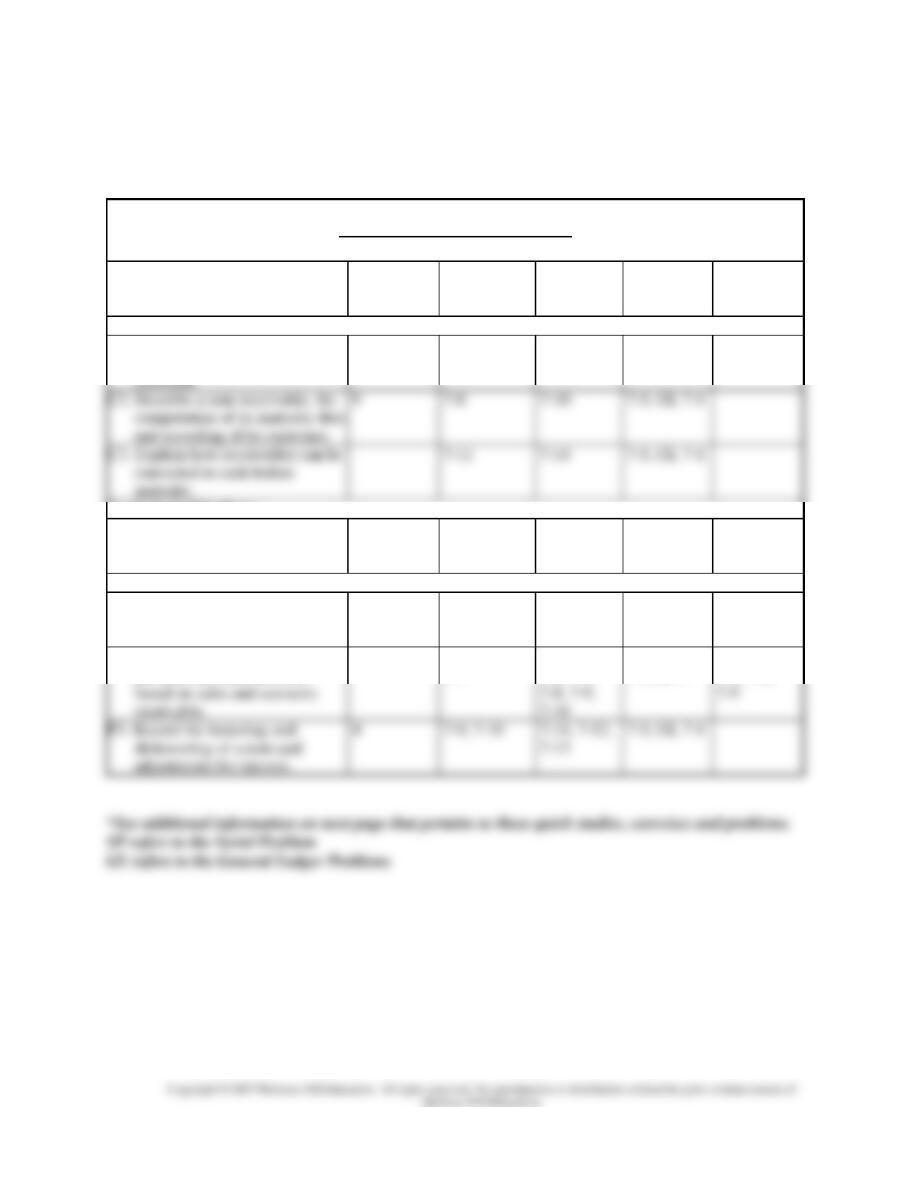
Student Learning Objectives
Questions
Quick
Studies*
Exercises*
Problems*
Beyond the
Numbers
Conceptual objectives:
recorded.
C3. Explain how receivables can be
converted to cash before
maturity.
7-11
7-14
7-5, GL 7-1
C1. Describe accounts receivable
and how they occur and are
1
7-1, 7-13
7-1, 7-2
7-1, 7-4
7-5, 7-7,
7-8, 7-9
Analytical objectives:
A1 Compute accounts receivable
turnover and use it to help
assess financial condition.
7-12
7-15
7-1, 7-2
Procedural objectives:
P1. Apply the direct write-off
method to account for accounts
receivable.
2, 3, 5, 6, 8
7-2, 7-3, 7-4
7-3
SP 7
based on sales and accounts
receivable.
dishonoring of a note and
adjustments for interest.
P2. Apply the allowance method
and estimate uncollectibles
7,10
7-4, 7-5, 7-6,
7-7
7-4, 7-5,
7-6, 7-7,
7-2, 7-3,
7-4, SP 7
7-2, 7-3,
7-4, 7-6,
John J. Wild, Financial Accounting: Information for Decisions, 8th Edition
7-2
Additional Information on Related Assignment Material
Connect
Available on the instructor’s course-specific website) repeats all numerical Quick Studies, all Exercises
and Problems Set A. Connect also provides algorithmic versions for Quick Study, Exercises and
Problems. It allows instructors to monitor, promote, and assess student learning. It can be used in
practice, homework, or exam mode.
Connect Insight
The first and only analytics tool of its kind, Connect Insight is a series of visual data displays that are each framed
The Serial Problem (SP) for Success Systems continues in this chapter.
General Ledger
Assignable within Connect, General Ledger (GL) problems offer students the ability to see how transactions post
from the general journal all the way through the financial statements. Critical thinking and analysis components are
added to each GL problem to ensure understanding of the entire process. GL problems are auto-graded and provide
instant feedback to the student.
Synopsis of Chapter Revisions
• NEW opener—GrubHub
• Updated data in Exhibit 7.1.
John J. Wild, Financial Accounting: Information for Decisions, 8th Edition
7-3
Chapter Outline
Notes
I. Accounts Receivable—Amounts due from customers for credit sales.
They occur when a customer uses credit cards issued by third parties
and when a company gives credit directly to customers.
A. Recognizing Accounts Receivable:
1. Sales on credit—Increase (debit) Accounts Receivable for the
2. Credit card sales (Examples: Visa, MasterCard, American
Express).
a. Advantages: (1) eliminates the company’s need to
B. Installment Sales and Receivables
Amounts owed by customers from credit sales where payment is
required in periodic amounts over an extended time period.
1. Customer is usually charged interest.
terms.
C. Valuing Accounts Receivable
Accounts of customers who do not pay are uncollectible accounts,
commonly called bad debts. Two methods are used to account for
uncollectible accounts:
John J. Wild, Financial Accounting: Information for Decisions, 8th Edition
7-4
Chapter Outline
Notes
1. Direct Write-off Method
Records the loss from an uncollectible account receivable
when it is determined to be uncollectible.
a. Recording and Writing Off Bad Debts: record loss when it
is determined to be uncollectible. Debit Bad Debt
Expense; credit Accounts Receivable.
b. Recovering a Bad Debt: if a written off account is later
2. Allowance Method
Matches the estimated loss from uncollectibles against the
sales they helped produce.
a. Recording Bad Debts Expense: at end of each accounting
period, bad debts expense is estimated and recorded with
an adjusting entry.
b. Advantages of method:
c. To record estimate of bad debt expense, Debit Bad Debt
Expense, credit a contra-asset account called Allowance
for Doubtful Accounts.
(see d above) and a normal collection of account entry.
John J. Wild, Financial Accounting: Information for Decisions, 8th Edition
7-5
Chapter Outline
Notes
D. Estimating Bad Debts Expense—two methods:
sales for the period. (% x sales = Bad Debt Expense)
1. Percent of Sales Method (uses income statement relations to
estimate)—bad debts expense is computed as a percentage of
2. Percent of Accounts Receivable Method (uses balance sheet
relations to estimate)—desired credit balance in Allowance for
Doubtful Accounts is computed: ( % x Acc/Rec = Desired
balance in Allowance for Doubtful Accounts)
II. Notes Receivable— Promissory note that is a written promise to pay a
specified amount of money (principal) either on demand or on a
definite future date. Most notes are interest bearing. Promissory notes
are notes payable to the maker (person promising to pay) and notes
receivable to the payee (person to be paid). Interest is the charge for
using money until the due date.
note interest fraction of year
A. Computations for Notes
1. Maturity date is the date the note must be repaid.
B. Recognizing Notes Receivable—debit Notes Receivable for
principal or face amount of note. Credit will vary; depends on
reason note is received. Interest is not recorded until earned.
C. Valuing and Settling Notes
1. Recording an honored note—debit Cash for maturity value
(face value and interest), credit Note Receivable for face value
and credit Interest Revenue for the interest amount.
John J. Wild, Financial Accounting: Information for Decisions, 8th Edition
7-6
Chapter Outline
Notes
2. Recording a dishonored note—debit Accounts Receivable for
maturity value (face value + Interest), credit Note Receivable
for face amount and credit Interest Revenue for the interest
amount. If account receivable remains uncollected, it will be
written-off.
III. Disposing of Receivables—Companies can convert receivables to
cash before they are due. Reasons for this include the need for cash or
a desire to not be involved in collection activities.
A. Selling Receivables
1. Buyer, called a factor, charges the seller a factoring fee and
B. Pledging Receivables
1. Company borrows money by pledging its receivables as
security.
John J. Wild, Financial Accounting: Information for Decisions, 8th Edition
7-7
Chapter Outline
Notes
V. Global View—Compares U.S. GAAP to IFRS
A. Recognition of Receivables: Both have similar asset criteria that
apply to recognition of receivables. Both refer to the realization
principle and earnings process. The criteria are broadly similar
but there are differences.
B. Valuation of Receivables: Both require that receivables be
IV. Decision Analysis—Accounts Receivable Turnover
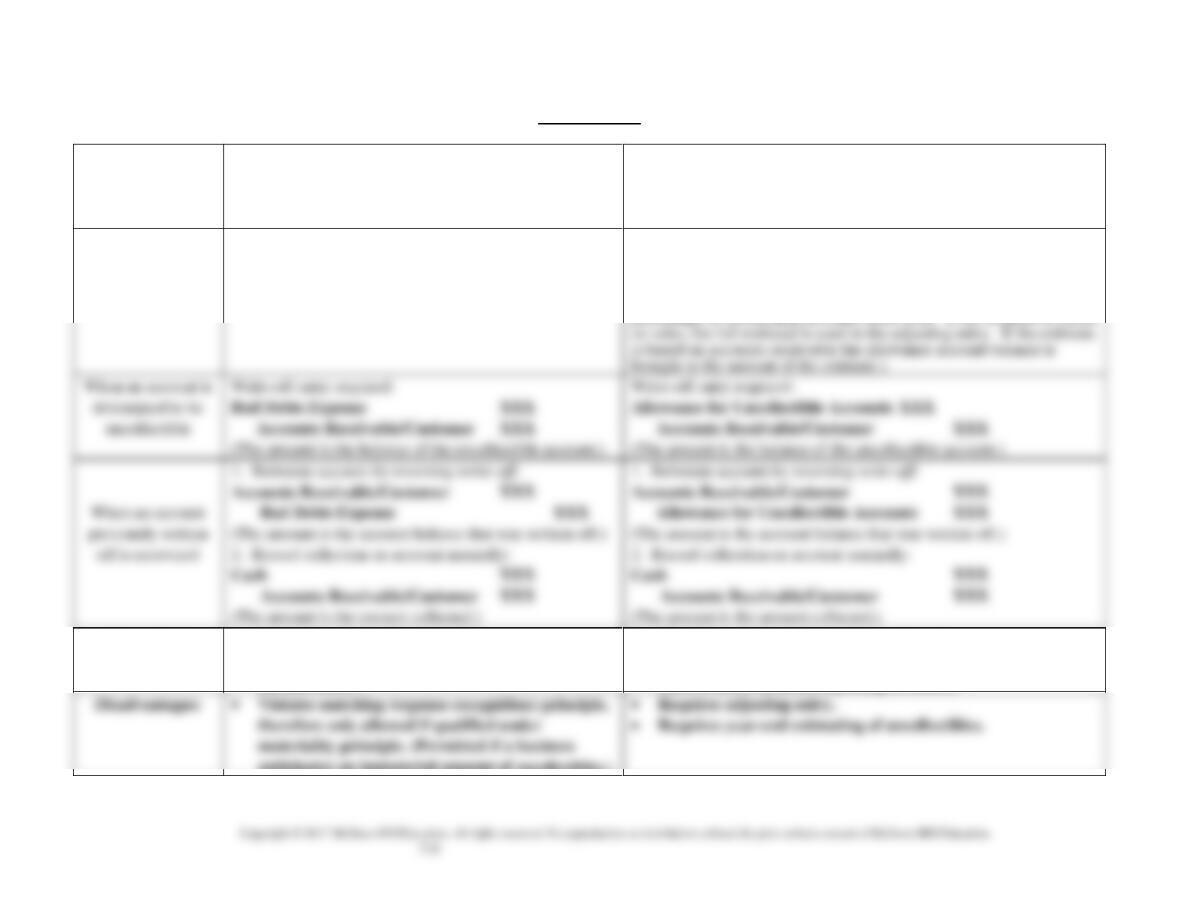
D. Measures both the quality (likeliness of collecting) and liquidity
John J. Wild, Financial Accounting: Information for Decisions, 8th Edition
VISUAL # 7-1
METHODS OF ACCOUNTING FOR BAD DEBTS
DIRECT WRITE-OFF METHOD
Accounts for bad debts from an uncollectible account
receivable at the time account is determined to be
uncollectible.
ALLOWANCE METHOD
At the end of each accounting period,
bad debts expense is
estimated and recorded.
Year-end
No adjusting entry
Adjusting entry required:
Bad Debt Expense XXX
Allowance for Uncollectible Accounts XXX
(The amount is an estimate based on a percentage of sales or a
percentage of outstanding accounts receivable. If the estimate is based
Advantages:
• Does not require adjusting entry.
• Does not require year-end estimating of
uncollectibles.
• Matches expense against related revenues.
• Reports the net realizable accounts receivable on the balance
sheet (a more accurate reporting of assets).
anticipates an immaterial amount of uncollectibles.)

John J. Wild, Financial Accounting: Information for Decisions, 8th Edition
7-9
John J. Wild, Financial Accounting: Information for Decisions, 8th Edition
7-10
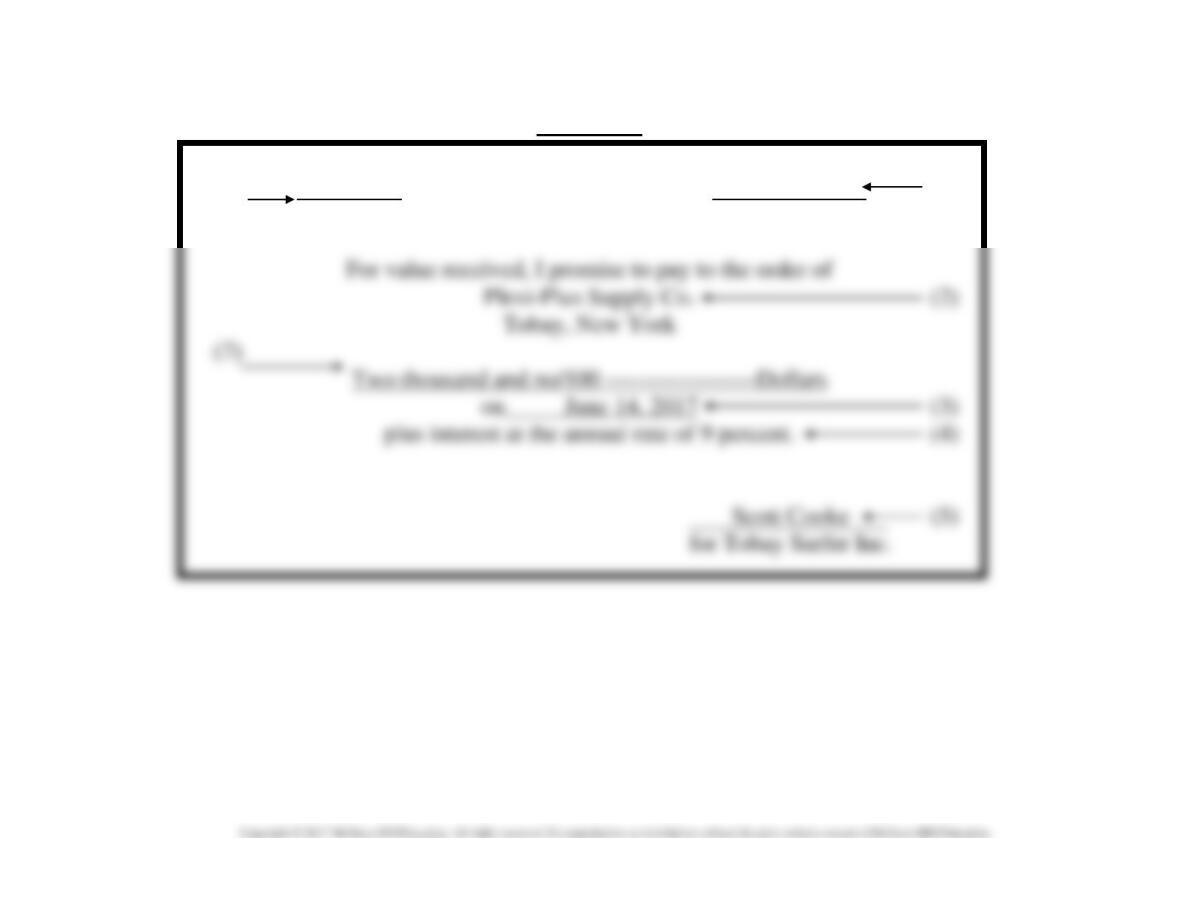
VISUAL #7-2
PROMISSORY NOTE
(6) $2,000.00 April 15, 2017 (1)
Amount Date

John J. Wild, Financial Accounting: Information for Decisions, 8th Edition
7-11
John J. Wild, Financial Accounting: Information for Decisions, 8th Edition
7-12
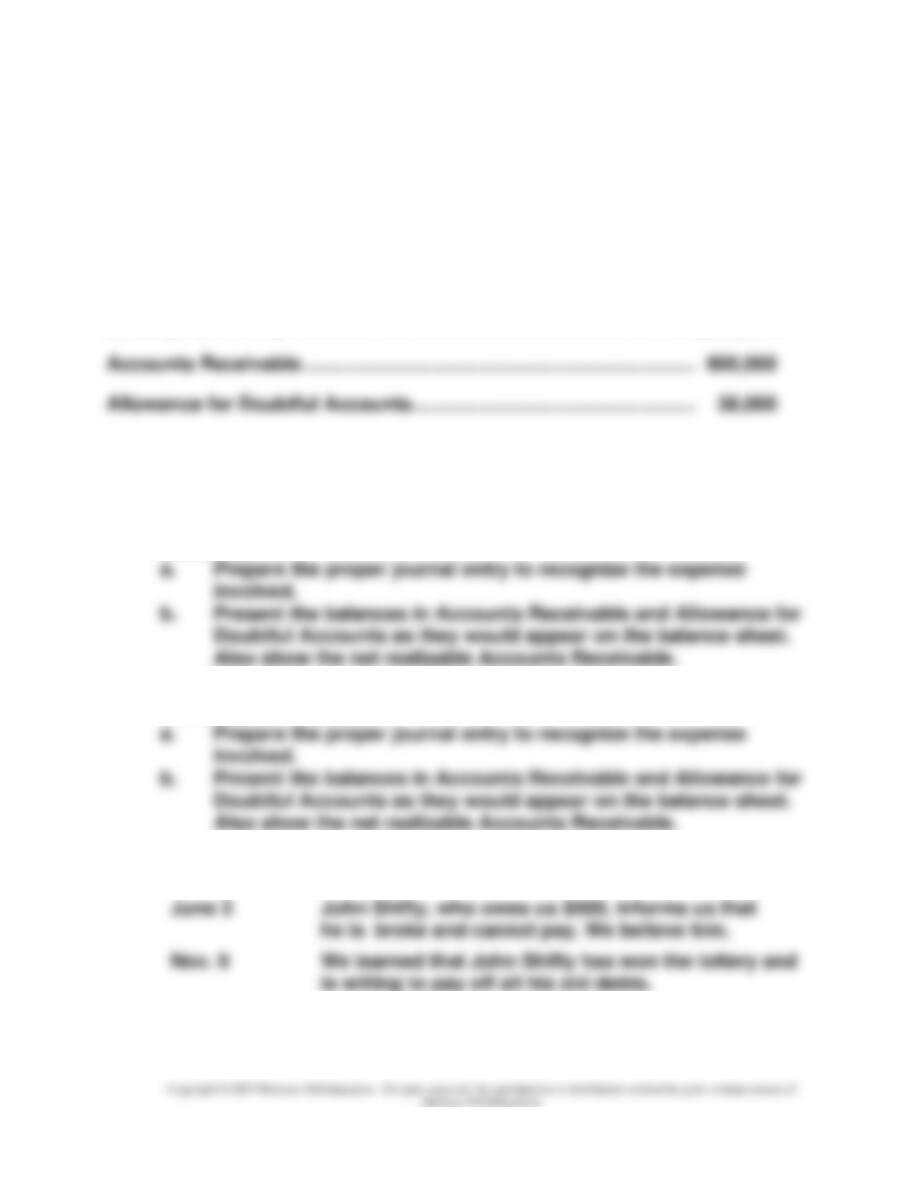
Alternate Demonstration Problem
Chapter 7
At the end of the year, the M. I. Wright Company showed the following
selected account balances:
Sales (all on credit) ………………………………………………………………….$300,000
Required:
1. Assume the company estimates that 1% of all credit sales will not be
collected.
2. Assume the company estimates that 5% of its accounts receivable
will never be collected.
3. Under assumptions 1 and 2 above, give the proper journal entries for
the following events.
John J. Wild, Financial Accounting: Information for Decisions, 8th Edition
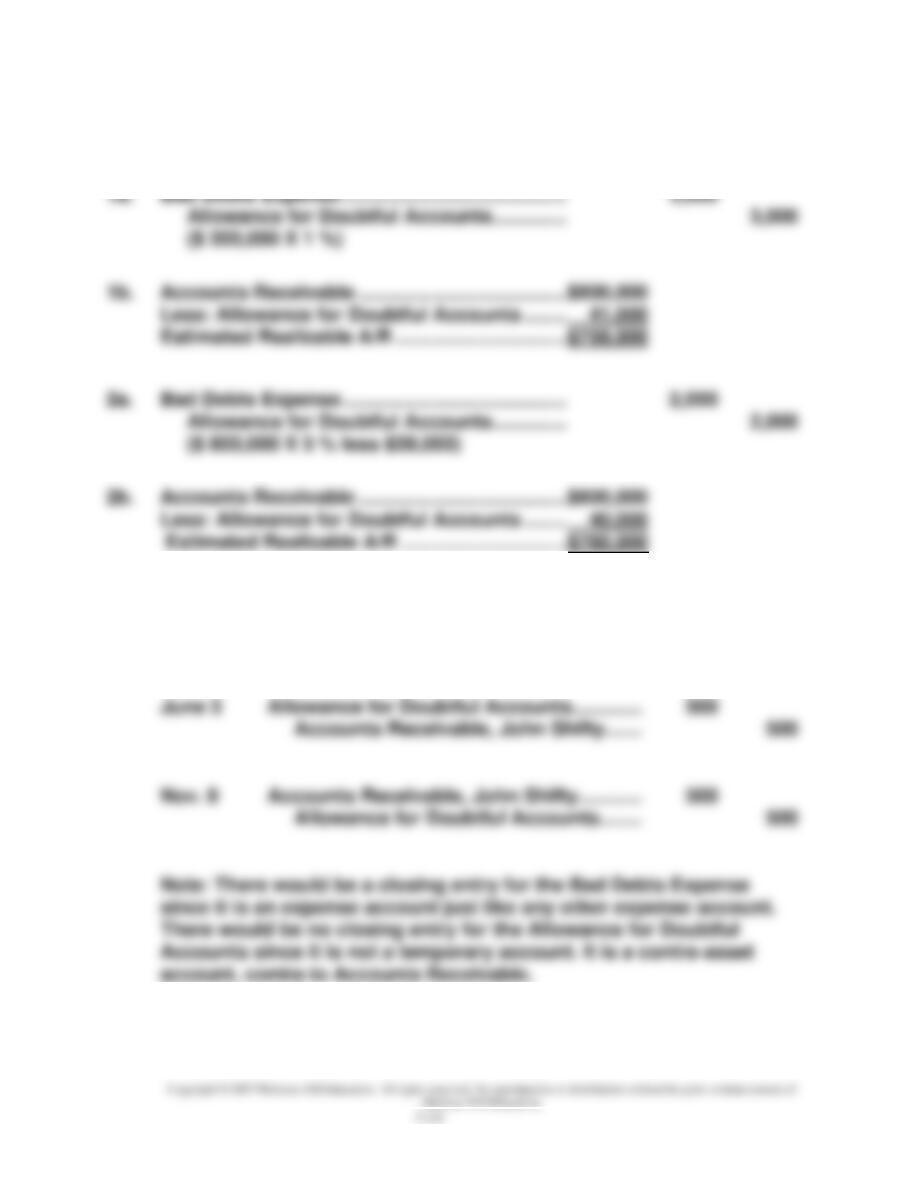
Solution: Alternate Demonstration Problem
Chapter 7
3. Both assumptions 1 and 2 above represent the allowance method of
accounting for uncollectibles. The only difference is in the approach
to estimating uncollectibles. Therefore the entries to write off and
show subsequent reinstatement would be the same in 1 and 2.