CHAPTER 7
Fraud, Internal Control, and Cash
Learning Objectives
1. Define fraud and internal control.
2. Identify the principles of internal control activities.
3. Explain the applications of internal control principles to cash receipts.
4. Explain the applications of internal control principles to cash disbursements.
5. Prepare a bank reconciliation.
6. Explain the reporting of cash.
7. Discuss the basic principles of cash management.
8. Identify the primary elements of a cash budget.
9. Explain the operation of a petty cash fund.
Summary of Questions by Learning Objectives and Bloom’s Taxonomy
Item LO BT Item LO BT Item LO BT Item LO BT Item LO BT
Questions
1. 1 C 7. 2 C 13. 2 C 19. 4 C 24. 7 C
Brief Exercises
1. 1 C 4. 3 C 7 4 C 10. 5 AP 13. 8 AP
Do It Review Exercises
Exercises
1. 2 C 5. 2, 4 E 8. 5 AP 11. 5 AP 14. 8 AP
Problems: Set A
1. 2, 3 C 3. 5 AP 5. 5 AP 7. 8 AP 8. 2, 3,
Problems: Set B
1. 2, 3 C 3. 5 AP 5. 5 AP 7. 8 AP 8. 2, 3,
ASSIGNMENT CHARACTERISTICS TABLE
Problem
Number
Description
Difficulty
Level
Time
Allotted (min.)
1A Identify internal control weaknesses for cash receipts. Simple 20–30
2A Identify internal control weaknesses in cash receipts and
cash disbursements.
Simple 20–30
3B Prepare a bank reconciliation and adjusting entries. Simple 20–30
4B Prepare a bank reconciliation and adjusting entries from
detailed data.
Moderate 40–50
ANSWERS TO QUESTIONS
1. Fraud is a dishonest act by an employee that results in personal benefit to the employee at a cost
to the employer. An example of fraud that might occur at a bank would be a computer operator
embezzling funds by transferring a customer’s deposits into another account.
2. The three main factors that contribute to employee fraud are opportunity, financial pressure, and
5. The Sarbanes-Oxley Act requires that a company develop sound principles of internal control over
financial reporting and continually verify that these controls are working. The act specifically requires
top management to attest that the company’s internal controls are reliable and effective.
8. The two applications of segregation of duties are:
(1) The responsibility for related activities should be assigned to different individuals.
(2) The responsibility for record keeping for an asset should be separate from the physical
custody of that asset.
9. Documentation procedures contribute to good internal control by providing evidence of the occur–
rence of transactions and events and, when signatures (or initials) are added, the documents
establish responsibility for the transactions. The prompt transmittal of documents to accounting
Questions Chapter 7 (Continued)
11. (a) Independent internal verification involves the review, comparison, and reconciliation of data
prepared by employees.
(b) Maximum benefit is obtained from independent internal verification when:
12. (a) The concept of reasonable assurance means that the costs of establishing control procedures
should not exceed their expected benefit. Ordinarily, a system of internal control provides
13. The human resources department plays an important role in internal control by
(a) bonding employees who handle cash,
(b) rotating employees’ duties and requiring employees to take vacations,
(c) conducting thorough background checks.
16. Cash registers are readily visible to the customer. Thus, they prevent the sales clerk from ringing
up a lower amount and pocketing the difference. In addition, the customer receives an itemized
17. Two mail clerks contribute to a more accurate listing of mail receipts and to the endorsement of
all checks “For Deposit Only.” In addition, two clerks reduce the likelihood of mail receipts being
diverted to personal use.
19. The procedure and related principle are:
Procedure Principle
(1) Treasurer signs checks. • Establishment of responsibility.
(2) Checks imprinted by a checkwriter. • Physical controls.
(3) Comparing check with approved • Independent internal verification.
invoice before signing.
Questions Chapter 7 (Continued)
20. (a) Physical controls apply to cash disbursements when blank checks are stored in a safe, and
access to the safe is restricted to authorized personnel, and a check-writing machine is used
to print amounts on checks with indelible ink.
22. True. A bank contributes significantly to internal control over cash because it: (1) safeguards cash
on deposit, (2) minimizes the amount of cash that must be kept on hand, and (3) provides a double
record of all bank transactions.
23. The lack of agreement between the balances may be due to either:
24. The basic principles of cash management are: (1) increase the speed of receivables collection,
(2) keep inventory low, (3) monitor payment of liabilities, (4) plan timing of major expenditures,
and (5) invest idle cash.
25. (a) An NSF check occurs when the checkwriter’s bank balance is less than the amount of the
check.
26. (a) Cash equivalents are short-term highly liquid investments that may be converted to a specific
27. At December 31, 2011, Tootsie Roll reported cash and cash equivalents of $78,612,000. It reported
no restricted cash. In Note 1 to its financial statements it defines cash equivalents as “temporary
cash investments with an original maturity of three months or less.”
*28. The activities in a petty cash system and the related principles are:
(a) (1) Establishing the fund. • Establishment of responsibility for custody of the
fund.
SOLUTIONS TO BRIEF EXERCISES
BRIEF EXERCISE 7-1
(a) Financial Pressure
BRIEF EXERCISE 7-2
The purposes of internal control are to:
1. Safeguard a company’s assets from employee theft, robbery, and unau-
thorized use. An application for Brighan Co. is the use of a cash register
to safeguard assets.
2. Enhance the accuracy and reliability of a company’s accounting records
BRIEF EXERCISE 7-3
(a) Segregation of duties.
BRIEF EXERCISE 7-4
(a) Physical controls.
BRIEF EXERCISE 7-5
BRIEF EXERCISE 7-6
(a) Documentation procedures.
BRIEF EXERCISE 7-7
(a) The use of a checking account minimizes the amount of currency that
must be kept on hand. Therefore, cash is safeguarded by using the bank
as a depository and clearinghouse for checks written and received.
BRIEF EXERCISE 7-8
(a) Outstanding checks—deducted from cash balance per bank.
BRIEF EXERCISE 7-9
(a) The reconciling items per the books, items (b) and (c) above, will
require adjustment on the books of the depositor.
BRIEF EXERCISE 7-10
Cash balance per bank statement …………………………………………. $7,291
BRIEF EXERCISE 7-11
Checks written in November …………………………………………………. $ 9,750
Less: Checks paid by bank in November …………………………….. 8,800
BRIEF EXERCISE 7-12
Span Company should report cash in bank and payroll bank account as
BRIEF EXERCISE 7-13
CONGER COMPANY
Cash Budget
For the Month of January
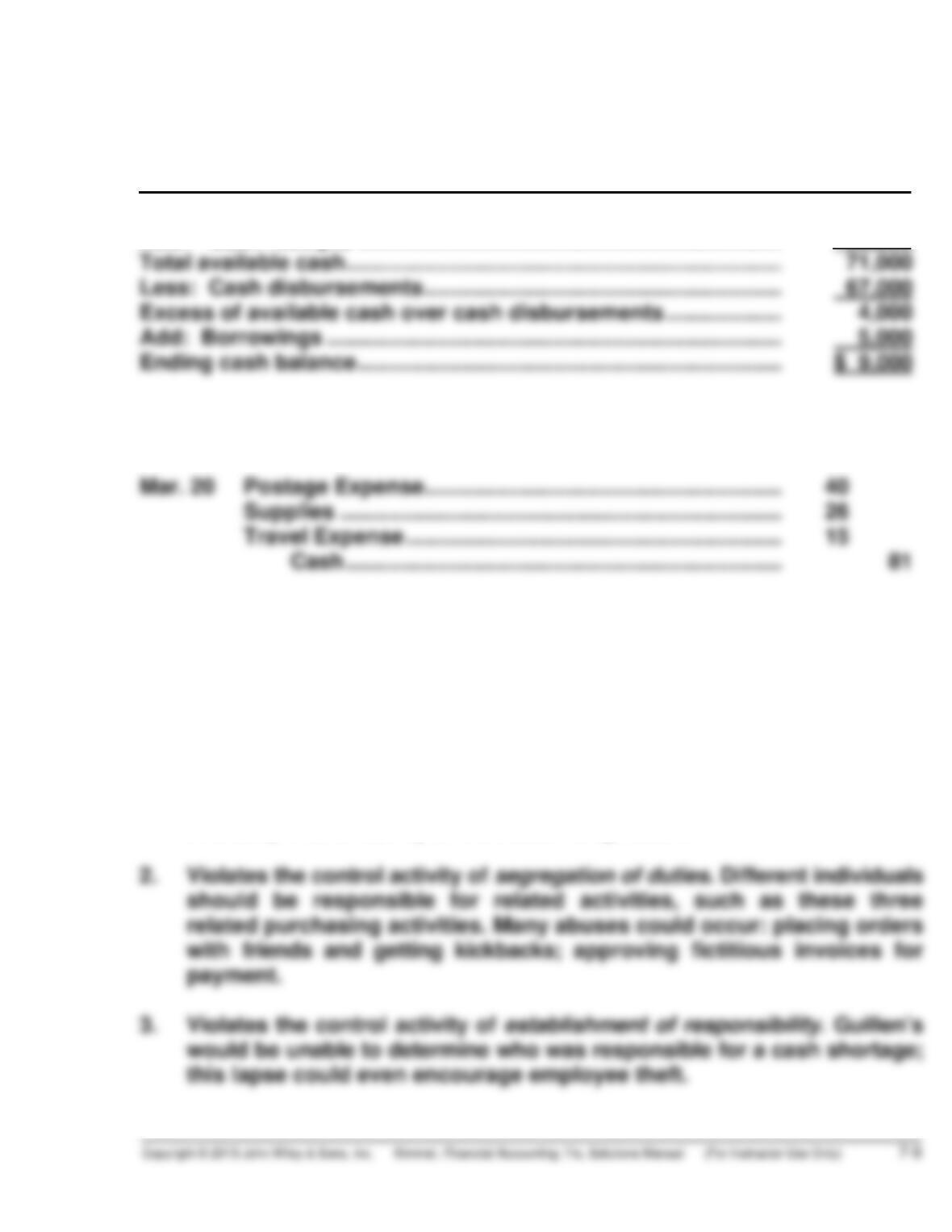
Beginning cash balance ………………………………………………………. $12,000
Add: Cash receipts ……………………………………………………………. 59,000
*BRIEF EXERCISE 7-14
SOLUTIONS TO DO IT! REVIEW EXERCISES
DO IT! 7-1
1. Violates the control activity of documentation procedures. Source docu-
ments should be promptly forwarded to the accounting department so
accounting entries can be made. This control activity helps to ensure
timely recording of sales transactions and contributes directly to the
accuracy and reliability of the accounting records.
DO IT! 7-2
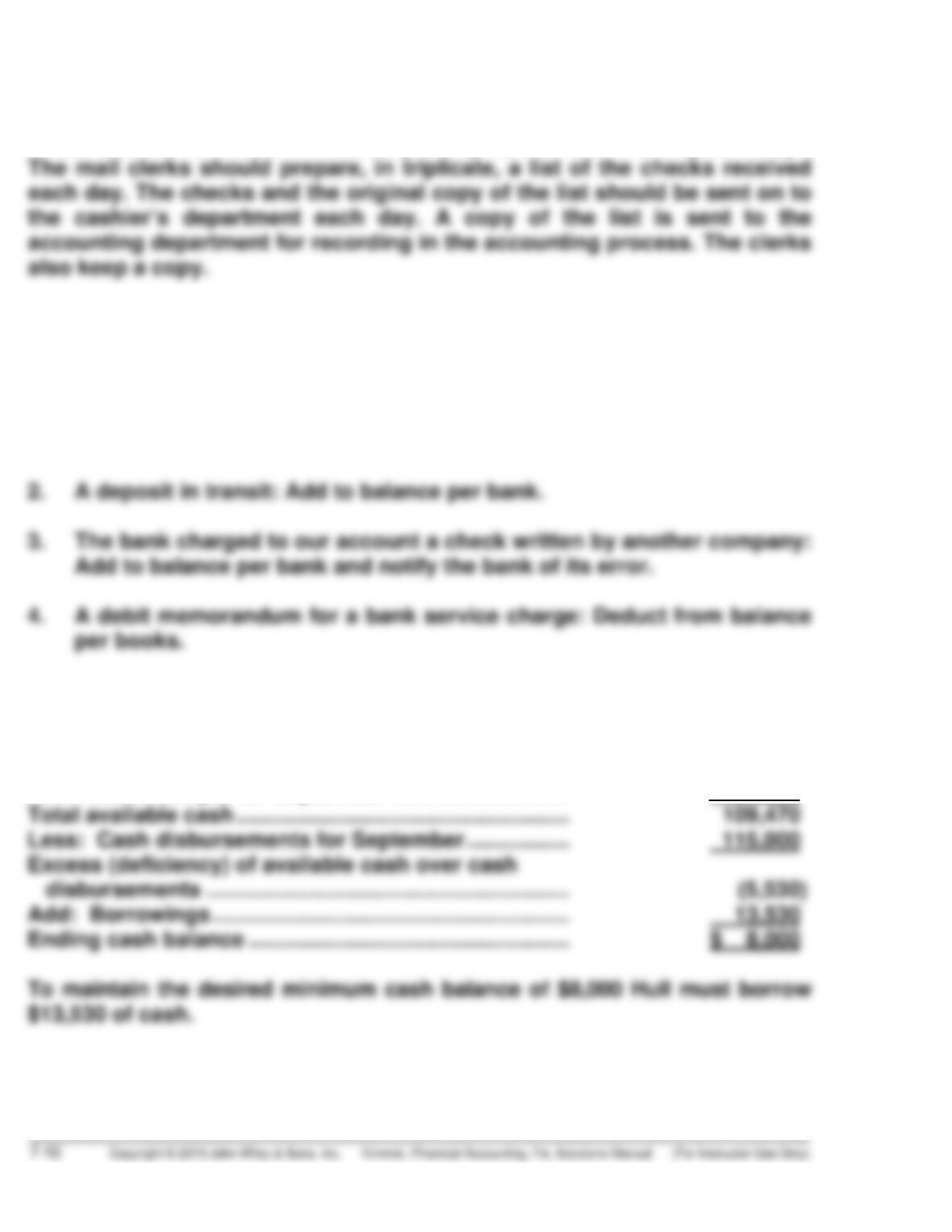
All mail receipts should be opened in the presence of two mail clerks.
Those mail clerks should immediately stamp each check “For Deposit Only.”
DO IT! 7-3
Doug should treat the reconciling items as follows:
1. Outstanding checks: Deduct from balance per bank.
DO IT! 7-4
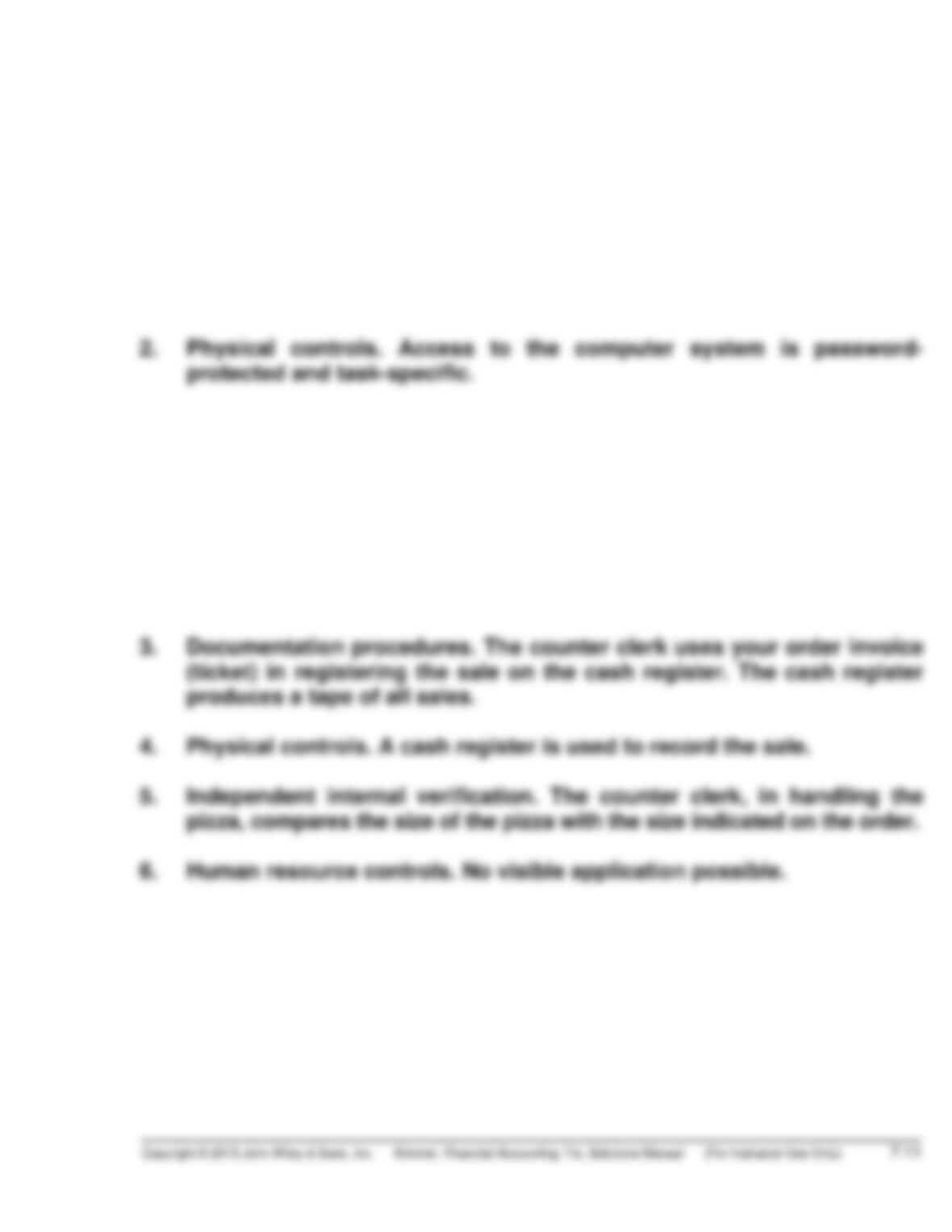
Beginning cash balance ………………………………………… $ 12,270
Add: Cash receipts for September ………………………… 97,200
SOLUTIONS TO EXERCISES
EXERCISE 7-1
The principles of internal control inherent in the “maker-checker” proce-
dure are:
1. Segregation of duties. The employee records the transactions. The
supervisor verifies and approves the transactions.
EXERCISE 7-2
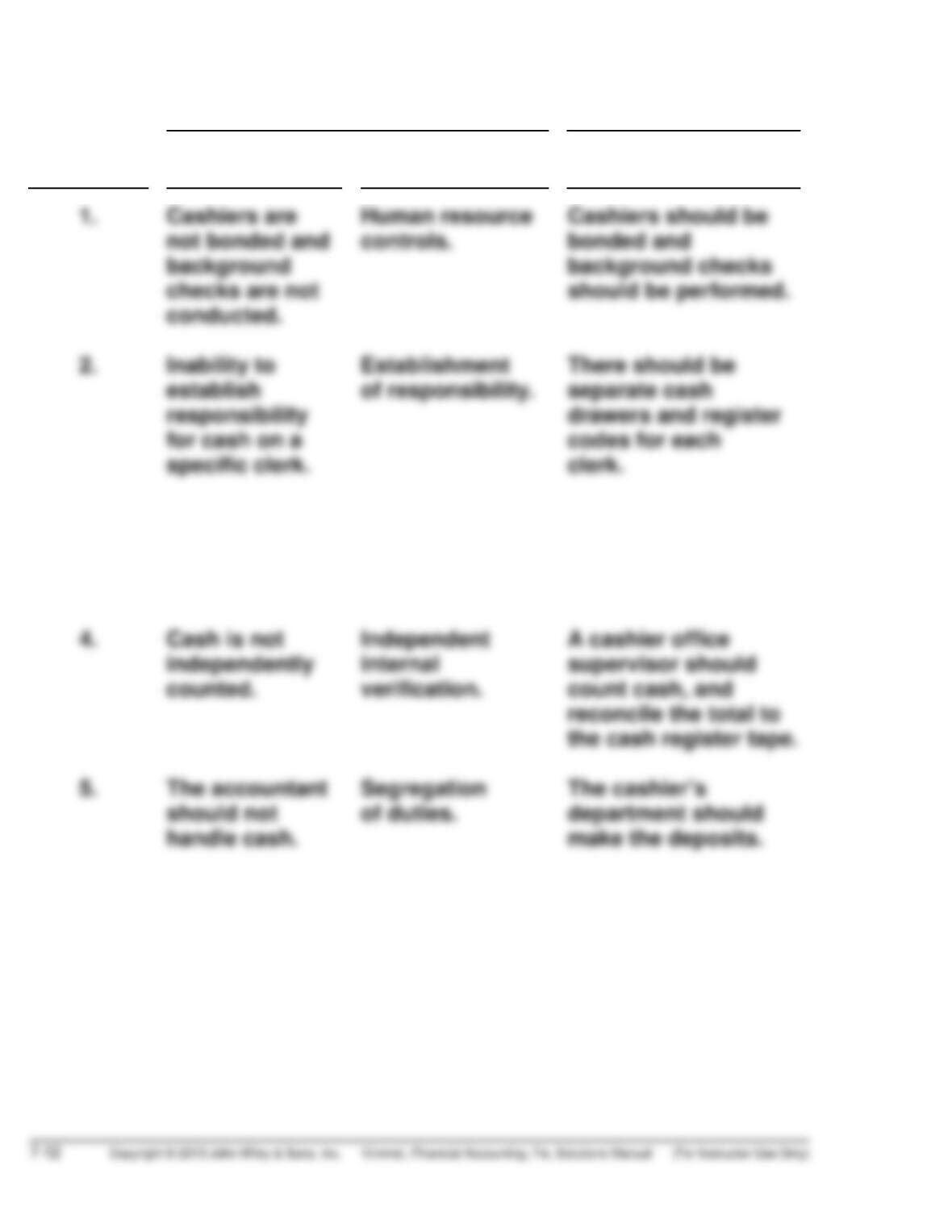
1. Establishment of responsibility. The counter clerk is responsible for
handling cash. Other employees are responsible for making the pizzas.
2. Segregation of duties. Employees who make the pizzas do not handle
cash.
EXERCISE 7-3
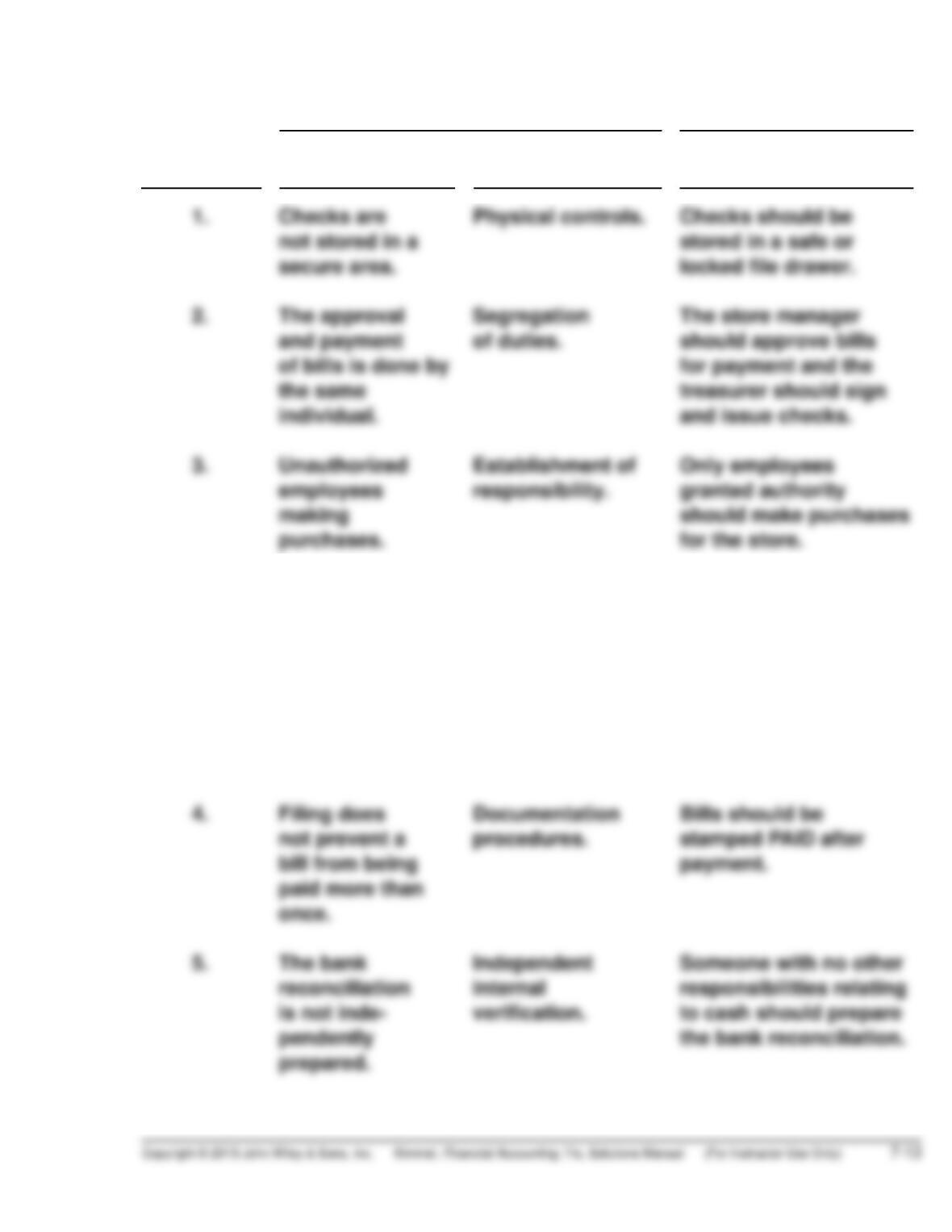
(a) (b)
Procedure
Weakness
Principle
Violated
Recommended
Change
3. Cash is not
adequately
protected from
theft.
Physical controls. Cash should be
stored in a safe until
it is deposited in
bank.
EXERCISE 7-4
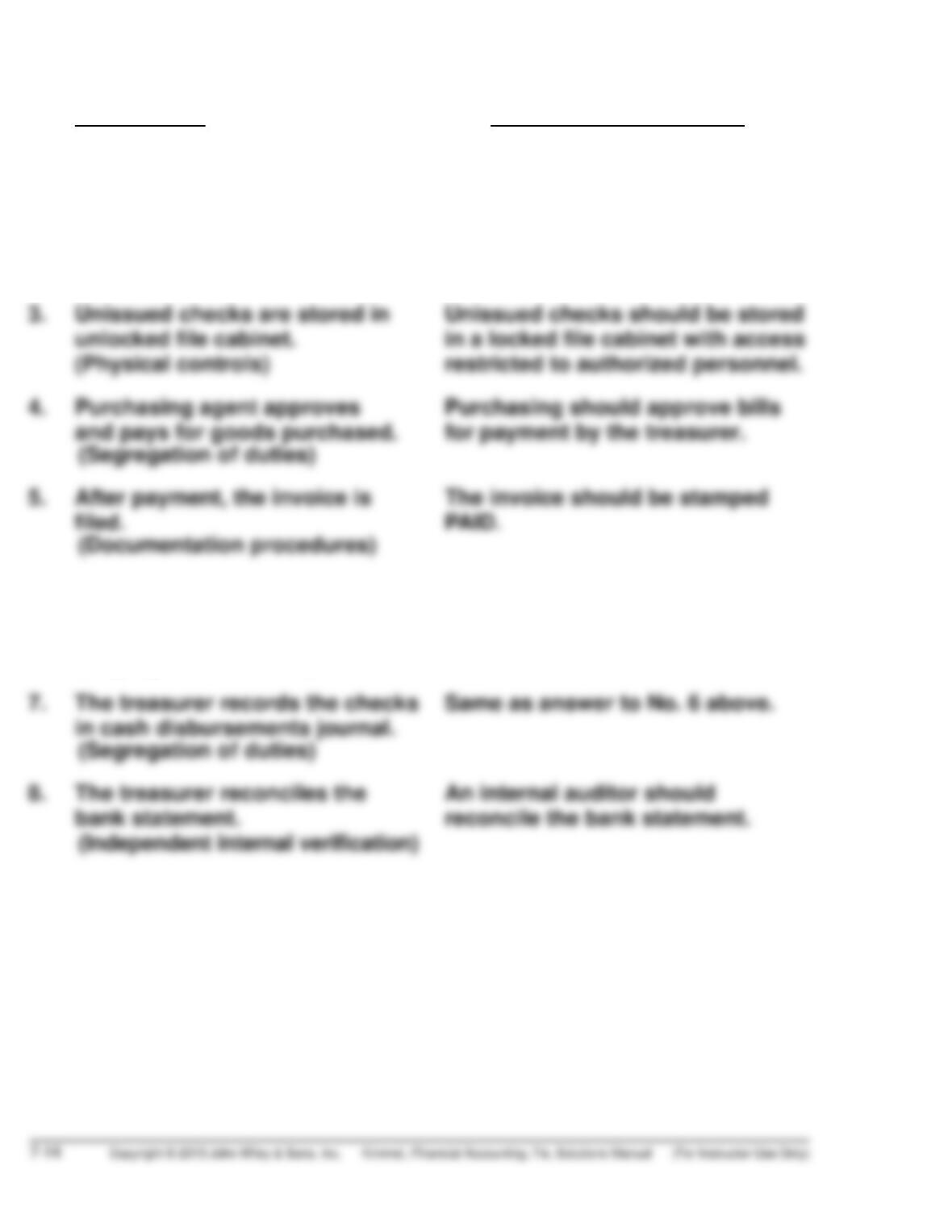
(a) (b)
Procedure
Weakness
Principle
Violated
Recommended
Change
Use of cash
instead of
checks; no
prenumbered
invoices.
Documentation
procedures.
Purchases should
be paid with
prenumbered checks
and the purchases
should be documented
by a prenumbered
invoice signed by the
seller.
EXERCISE 7-5
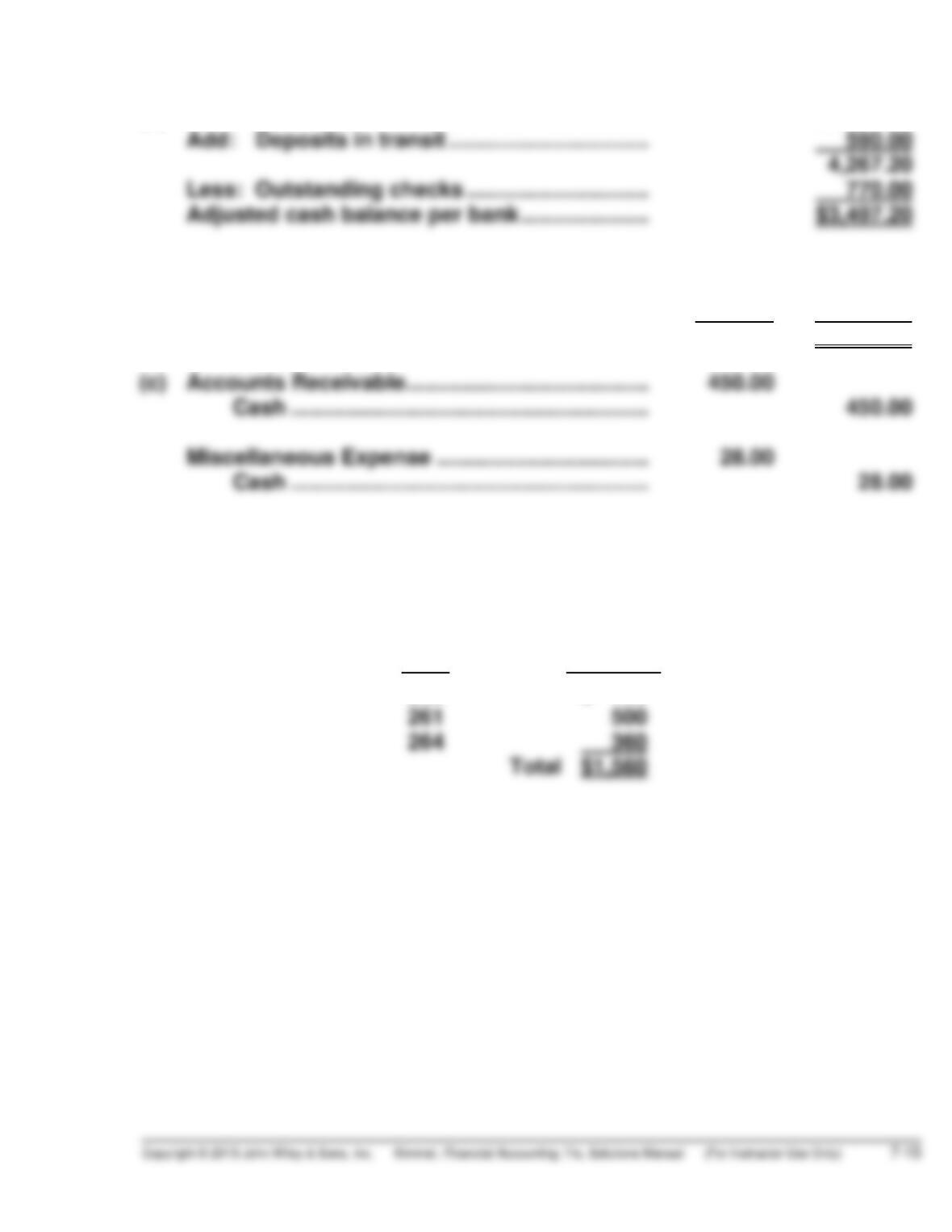
(a) Weaknesses (b) Suggested Improvement
1. Checks are not prenumbered. Use prenumbered checks.
(
Documentation procedures
)
2. The purchasing agent signs
checks.
Only the treasurer’s department
personnel should sign checks.
(
Establishment of responsibilit
y)
(
g
g
)
(
)
6. The purchasing agent records
payments in cash disbursements
journal.
Only accounting department
personnel should record cash
disbursements.
(
Se
g
re
g
ation of duties
)
(
EXERCISE 7-6
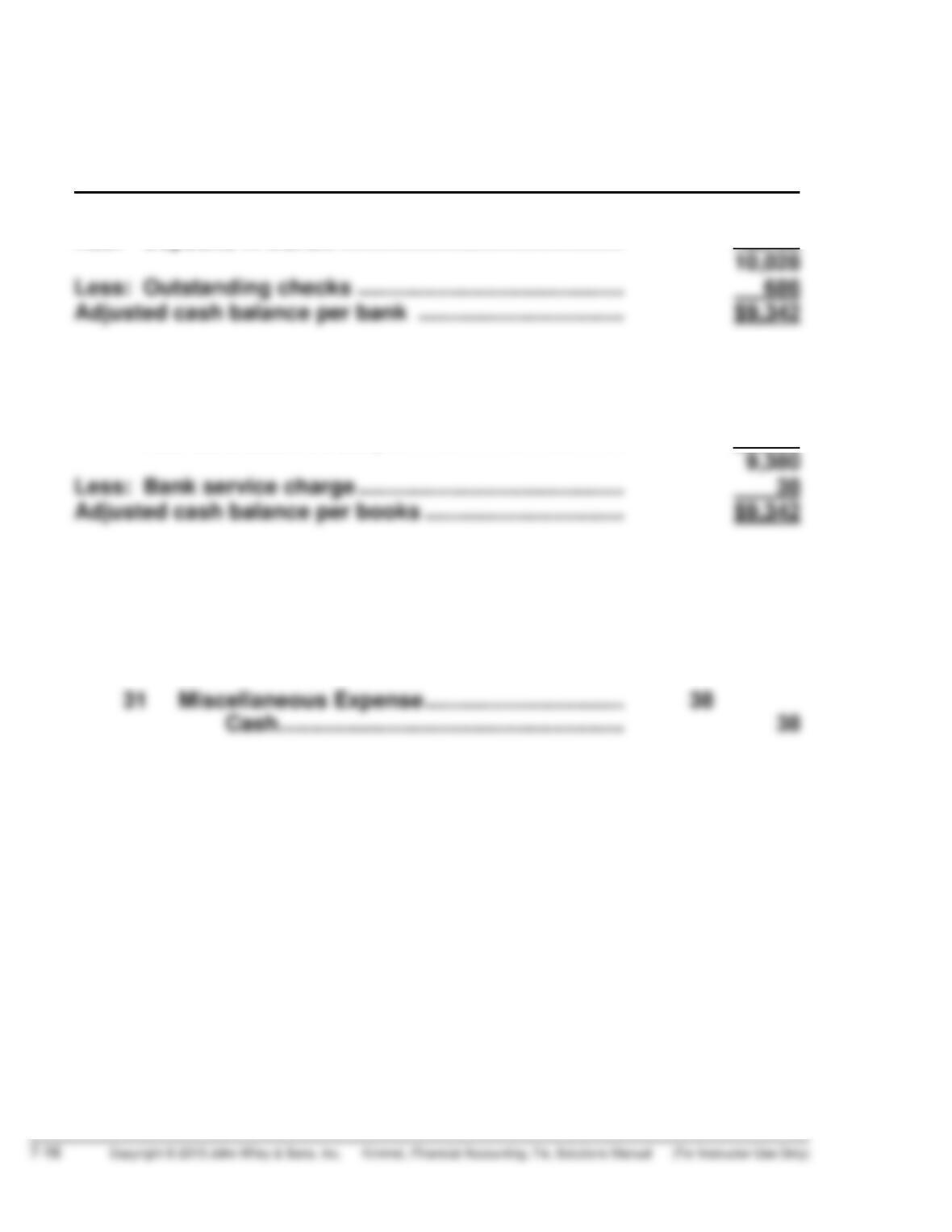
(a) Cash balance per bank statement ………………. $3,677.20
(b) Cash balance per books ……………………………. $3,975.20
Less: NSF check ………………………………………. $450.00
Bank service charge ……………………….. 28.00 478.00
Adjusted cash balance per books ………………. $3,497.20
EXERCISE 7-7
The outstanding checks are as follows:
No.
A
mount
255
$ 700
EXERCISE 7-8
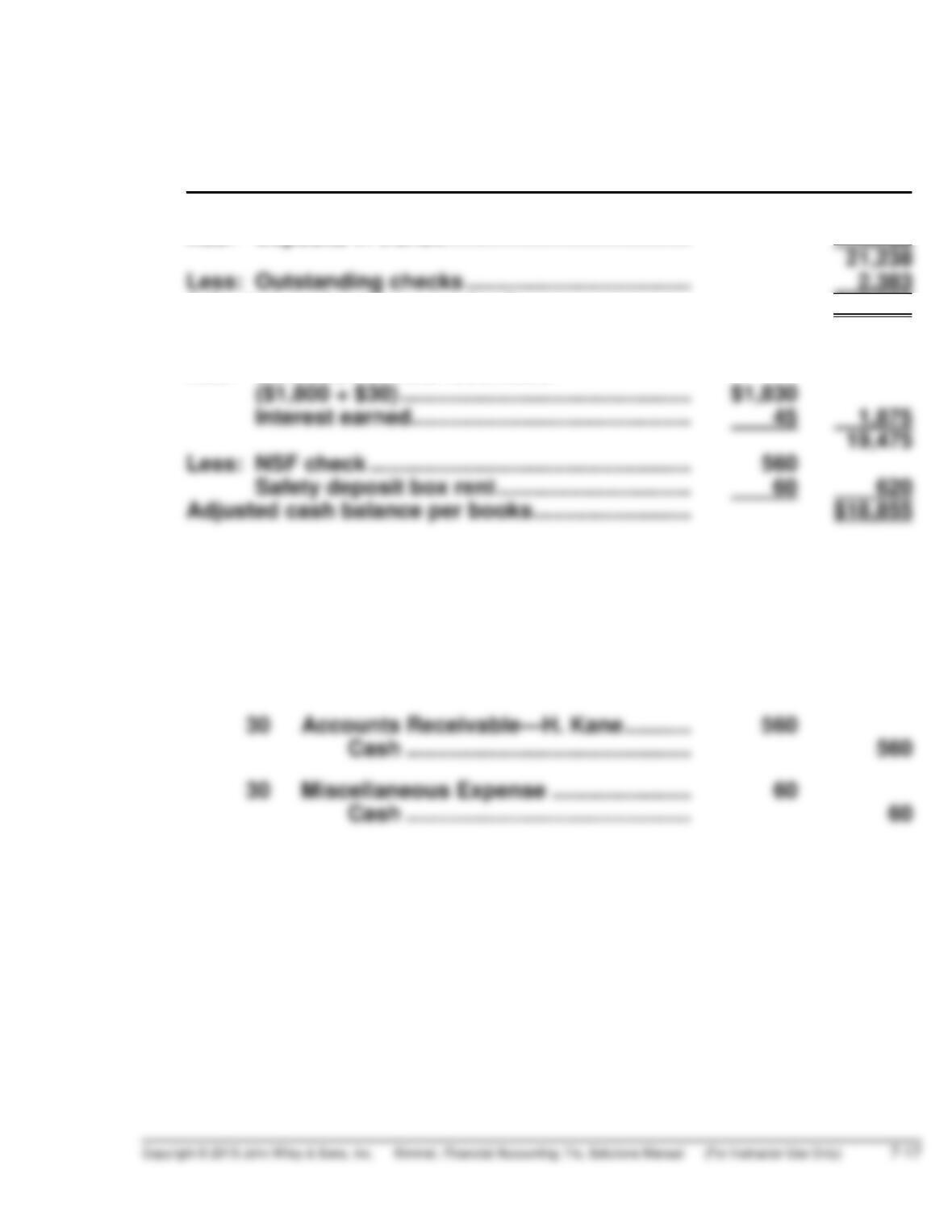
(a) JOYCE COMPANY
Bank Reconciliation
July 31, 2014
Cash balance per bank statement …………………………… $7,328
Add: Deposits in transit ……………………………………….. 2,700
Cash balance per books …………………………………………. $7,364
Add: Collection of note receivable
($2,000 plus accrued interest $36,
less collection fee $20) …………………………………. 2,016
(b) July 31 Cash ………………………………………………………. 2,016
Miscellaneous Expense …………………………… 20
Notes Receivable ……………………………… 2,000
Interest Revenue ……………………………… 36
EXERCISE 7-9
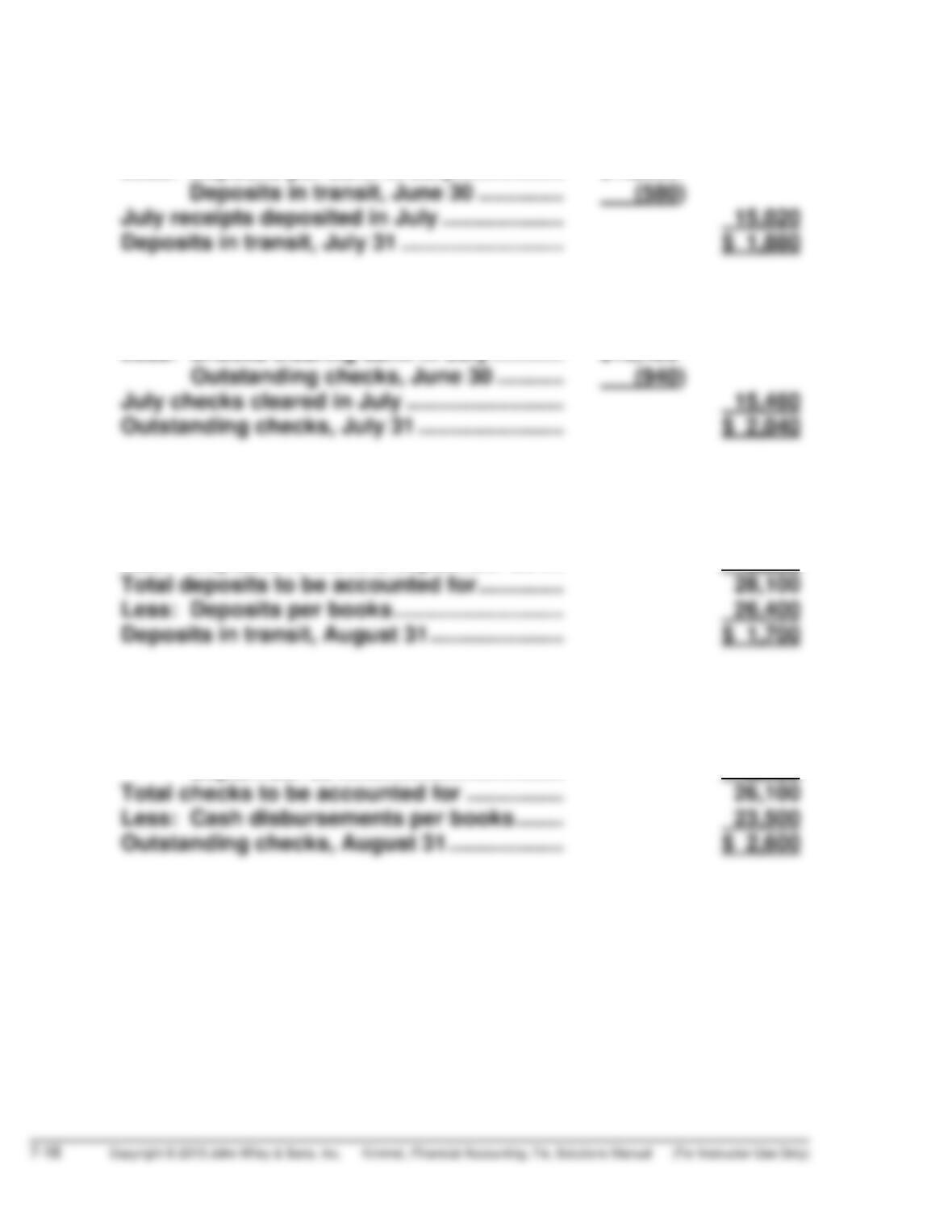
(a) TREANOR COMPANY
Bank Reconciliation
September 30, 2014
Cash balance per bank statement …………………….. $16,500
Add: Deposits in transit …………………………………. 4,738
Adjusted cash balance per bank ………………………. $18,855
Cash balance per books ………………………………….. $17,600
Add: Collection of note receivable
(b) Sept. 30 Cash ………………………………………………. 1,830
Notes Receivable …………………….. 1,800
Interest Revenue ……………………… 30
30 Cash ………………………………………………. 45
Interest Revenue ……………………… 45
EXERCISE 7-10
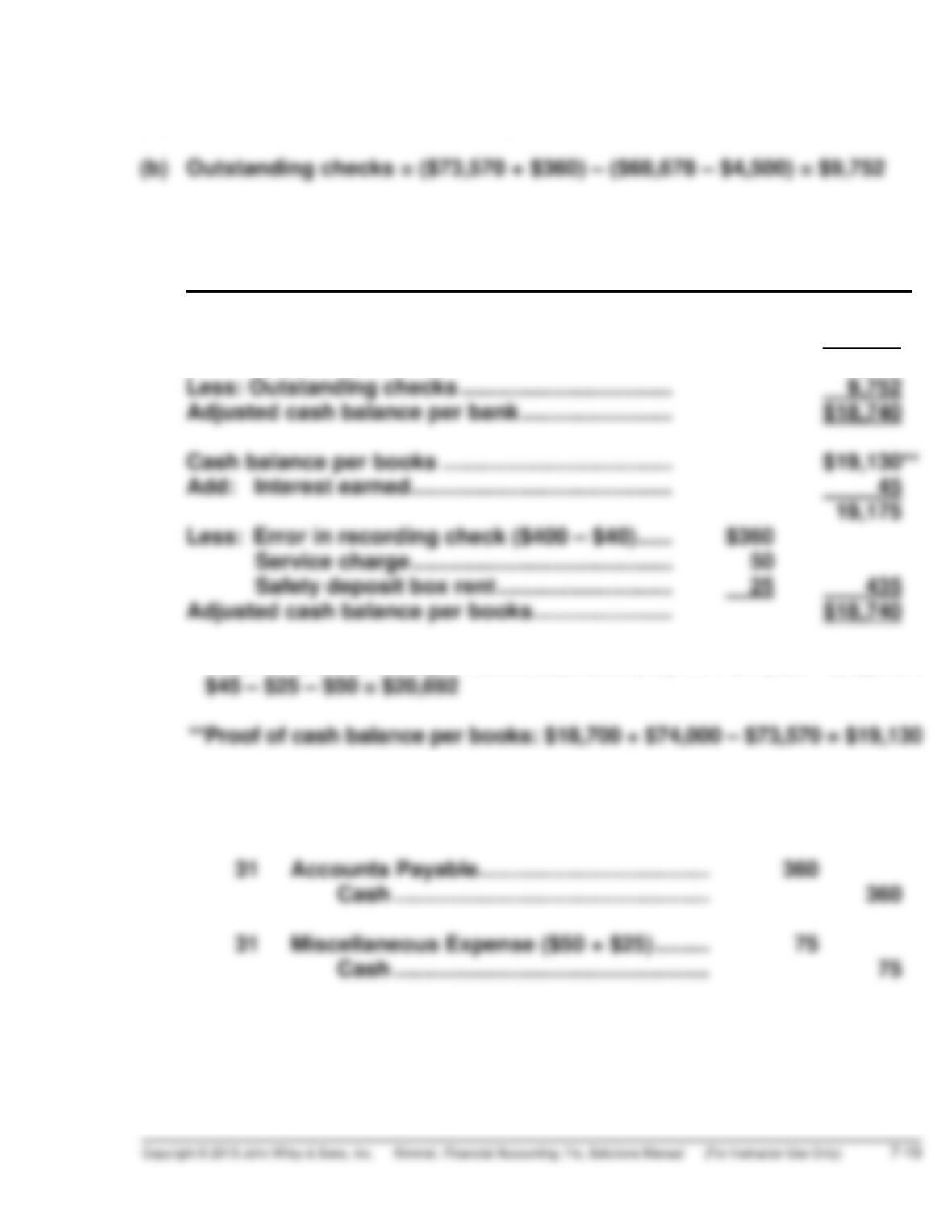
(a) Deposits in transit:
Deposits per books in July ……………………… $16,900
Less: Deposits per bank in July ……………… $15,600
(b) Outstanding checks:
Checks per books in July ……………………….. $17,500
Less: Checks clearing bank in July ………… $16,400
(c) Deposits in transit:
Deposits per bank statement in
September ………………………………………….. $25,900
Add: Deposits in transit, September 30 …. 2,200
(d) Outstanding checks:
Checks clearing bank in September ………… $24,000
Add: Outstanding checks,
September 30 ………………………………. 2,100
EXERCISE 7-11
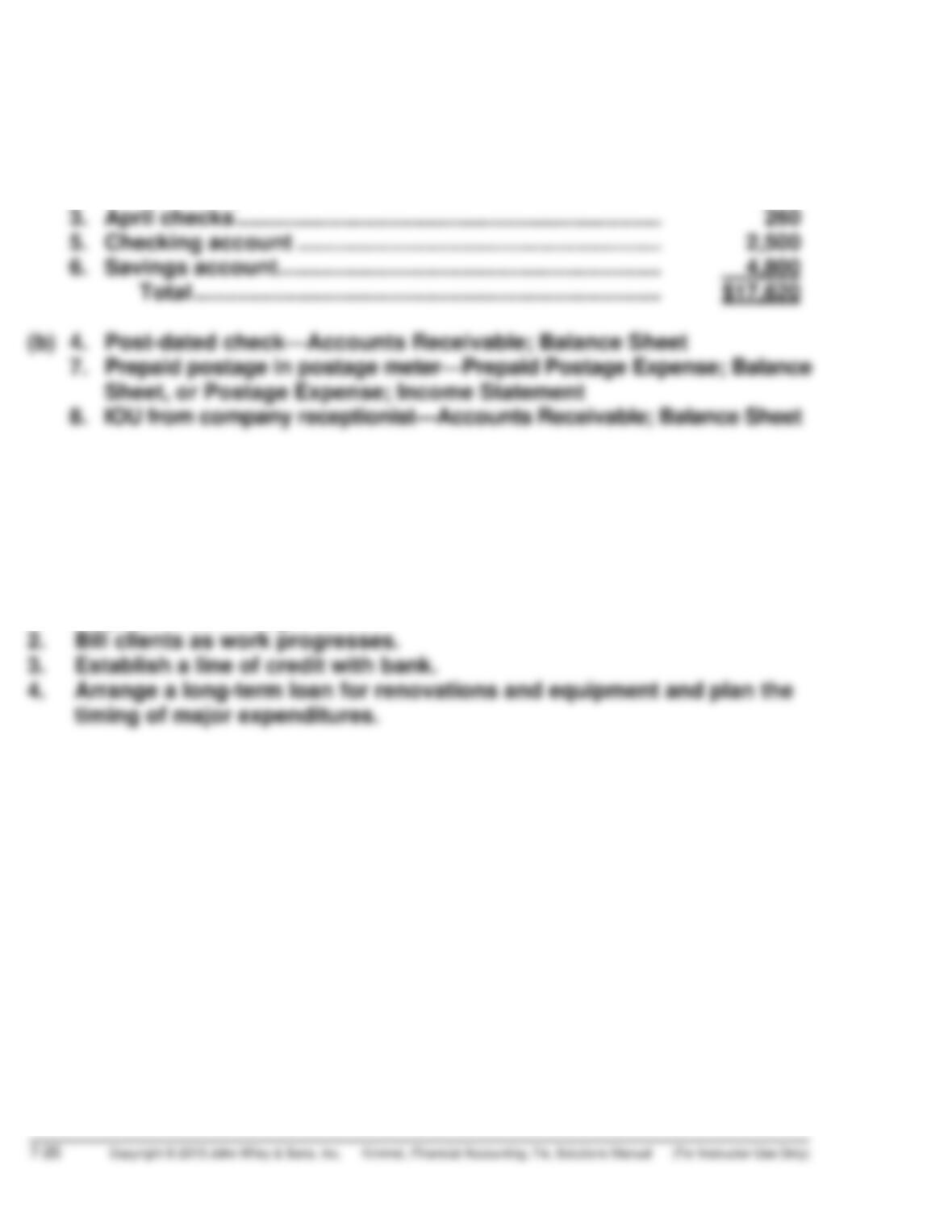
(a) Deposits in transit = $74,000 – ($71,000 – $4,800) = $7,800
(c) WERTH INC.
Bank Reconciliation
August 31, 2014
Cash balance per bank statement ………………….. $20,692*
Add: Deposits in transit ……………………………….. 7,800
28,492
*Proof of cash balance per bank statement: $18,400 + $71,000 – $68,678 +
(d) Aug. 31 Cash …………………………………………………… 45
Interest Revenue ………………………….. 45
EXERCISE 7-12
(a) Cash and Cash Equivalents
1. Currency ………………………………………………………………… $ 60
2. U.S. Treasury bill …………………………………………………….. 10,000
EXERCISE 7-13
Suggestions to improve cash management practices for Canzer, Morel and
Wang:
1. Prepare a cash budget.