
Chapter 7
Activity-Based Costing: A Tool to Aid
Decision Making
Solutions to Questions
7-1 Activity-based costing differs from
traditional costing systems in a number of ways.
In activity-based costing, nonmanufacturing as
7-2 When direct labor is used as an allocation
base for overhead, it is implicitly assumed that
overhead cost is directly proportional to direct
labor. When cost systems were originally
developed in the 1800s, this assumption may
have been reasonably accurate. However, direct
labor has declined in importance over the years
while overhead has been increasing. This
suggests that there is no longer a direct link
between the level of direct labor and overhead.
Indeed, when a company automates, direct labor
is replaced by machines; a decrease in direct
labor is accompanied by an increase in overhead.
This violates the assumption that overhead cost is
directly proportional to direct labor. Overhead
cost appears to be driven by factors such as
product diversity and complexity as well as by
volume, for which direct labor has served as a
convenient measure.
operations that is needed to design an effective
ABC system. Tapping the knowledge of cross–
functional employees also lessens their resistance
produced.
Customer-level
activities must be
carried out to support customers regardless of
what products or services they buy.
Organization–
sustaining
activities are carried out regardless of
the company’s precise product mix or mix of
customers.
7-5 Organization-sustaining costs, customer-
level costs, and the costs of idle capacity should
not be assigned to products. These costs
represent resources that are not consumed by the
products.
7-6 In activity-based costing, costs must first
be allocated to activity cost pools and then they
are allocated from the activity cost pools to
products, customers, and other cost objects.
7-7 Because people are often involved in
more than one activity, some way must be found
they are being observed may change how they
behave.
7-8 In traditional cost systems, product-level
costs are indiscriminately spread across all
products using direct labor–hours or some other
allocation base related to volume. As a
consequence, high-volume products are assigned
the bulk of such costs. If a product is responsible
7-9 Activity rates tell managers the average
cost of resources consumed to carry out a
particular activity such as processing purchase
orders. An activity whose average cost is high
may be a good candidate for process
improvements. Benchmarking can be used to
identify which activities have unusually large
costs. If some other organization is able to carry
out the activity at a significantly lower cost, it is
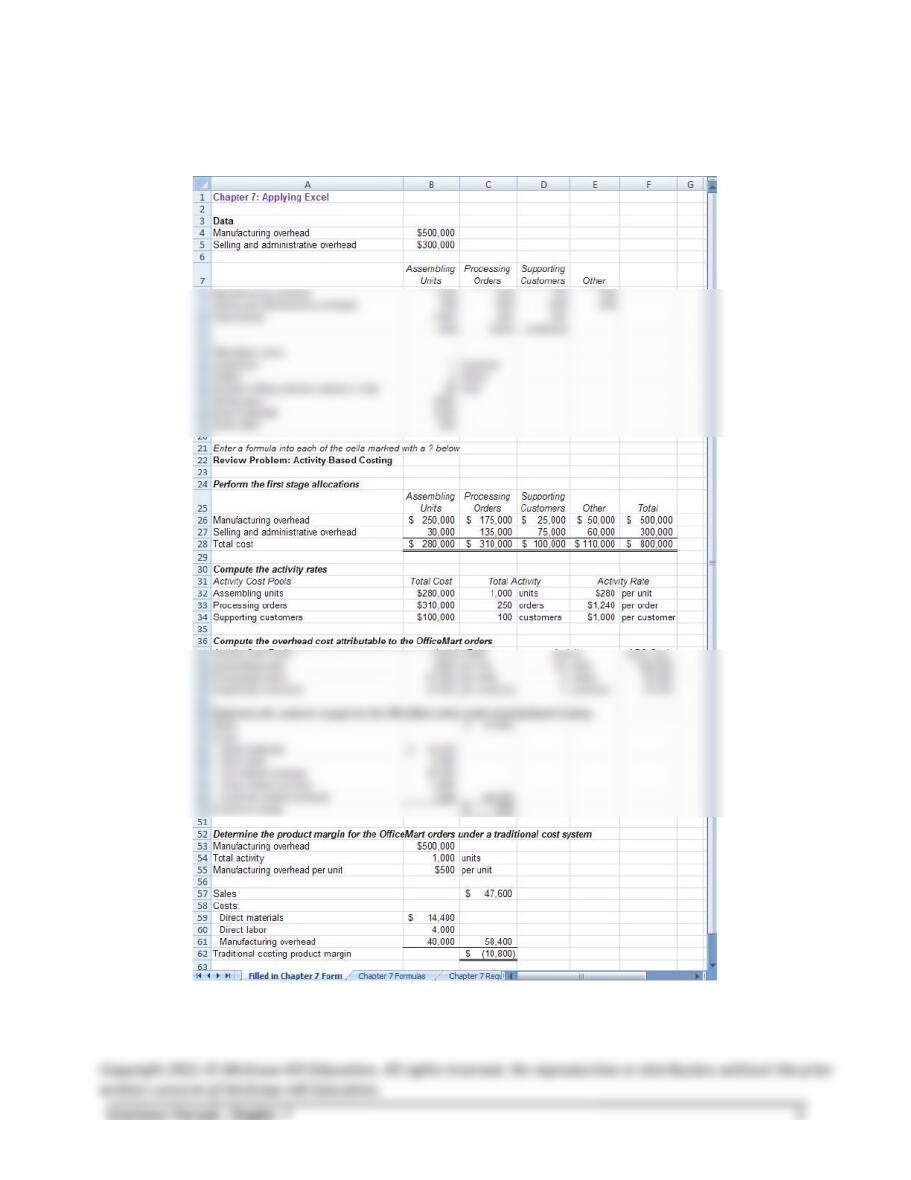
Chapter 7: Applying Excel
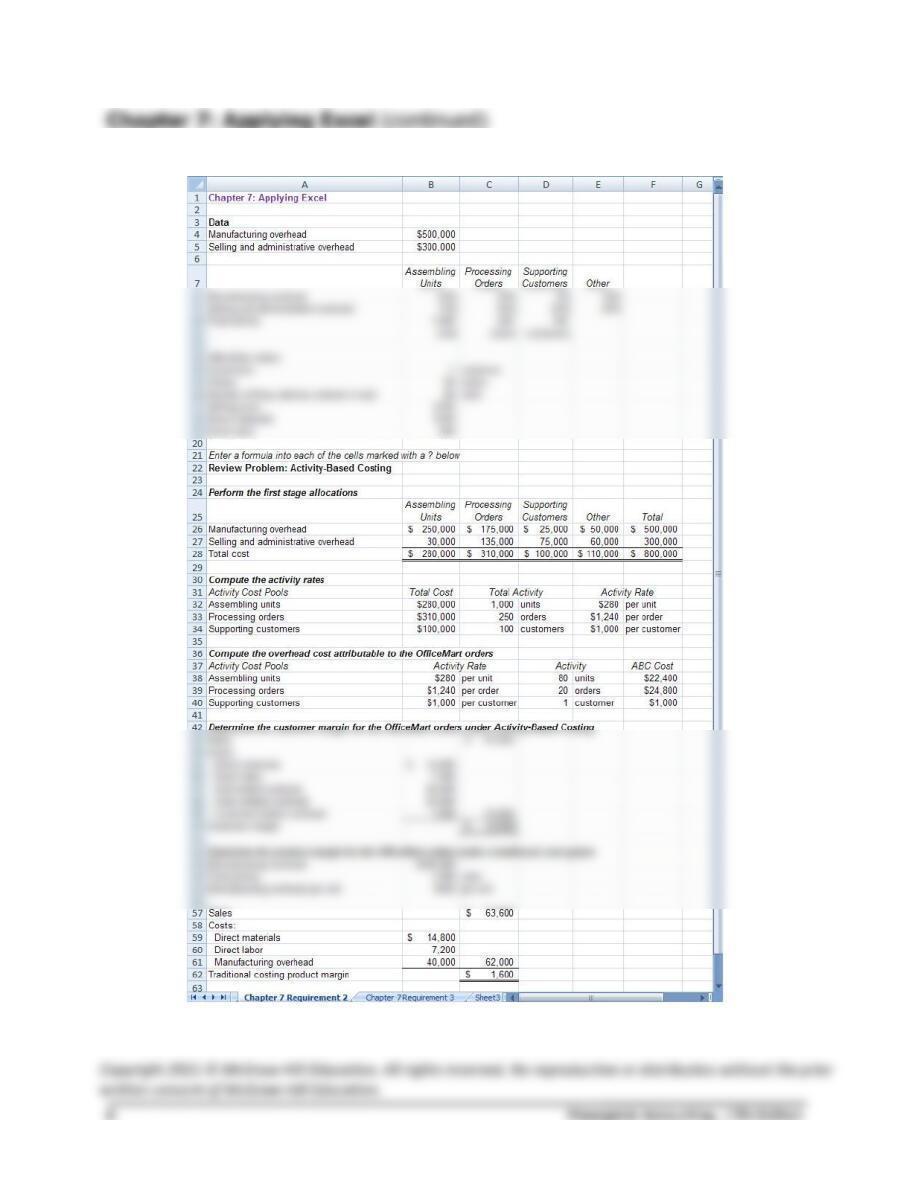
The completed worksheet is shown below.
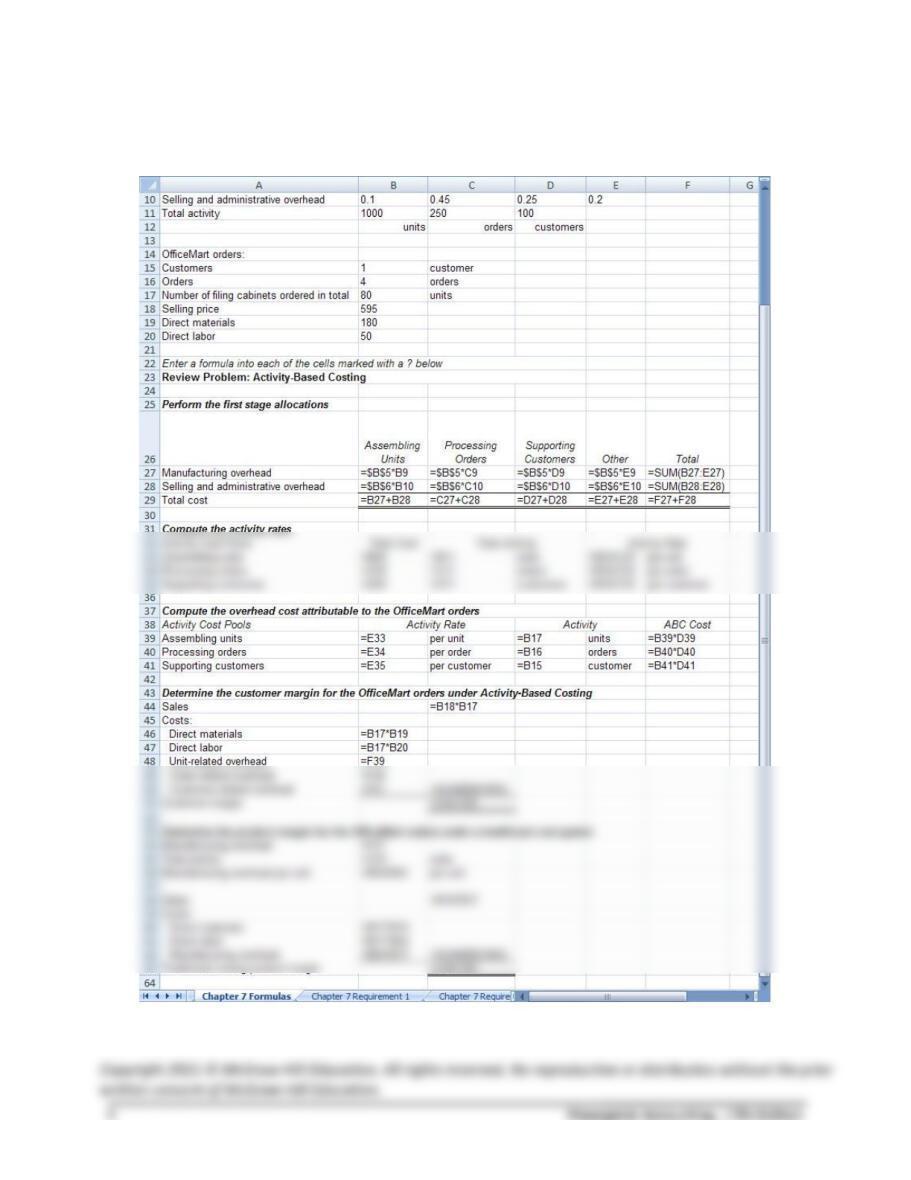
Chapter 7: Applying Excel (continued)
The completed worksheet, with formulas displayed, is shown below.
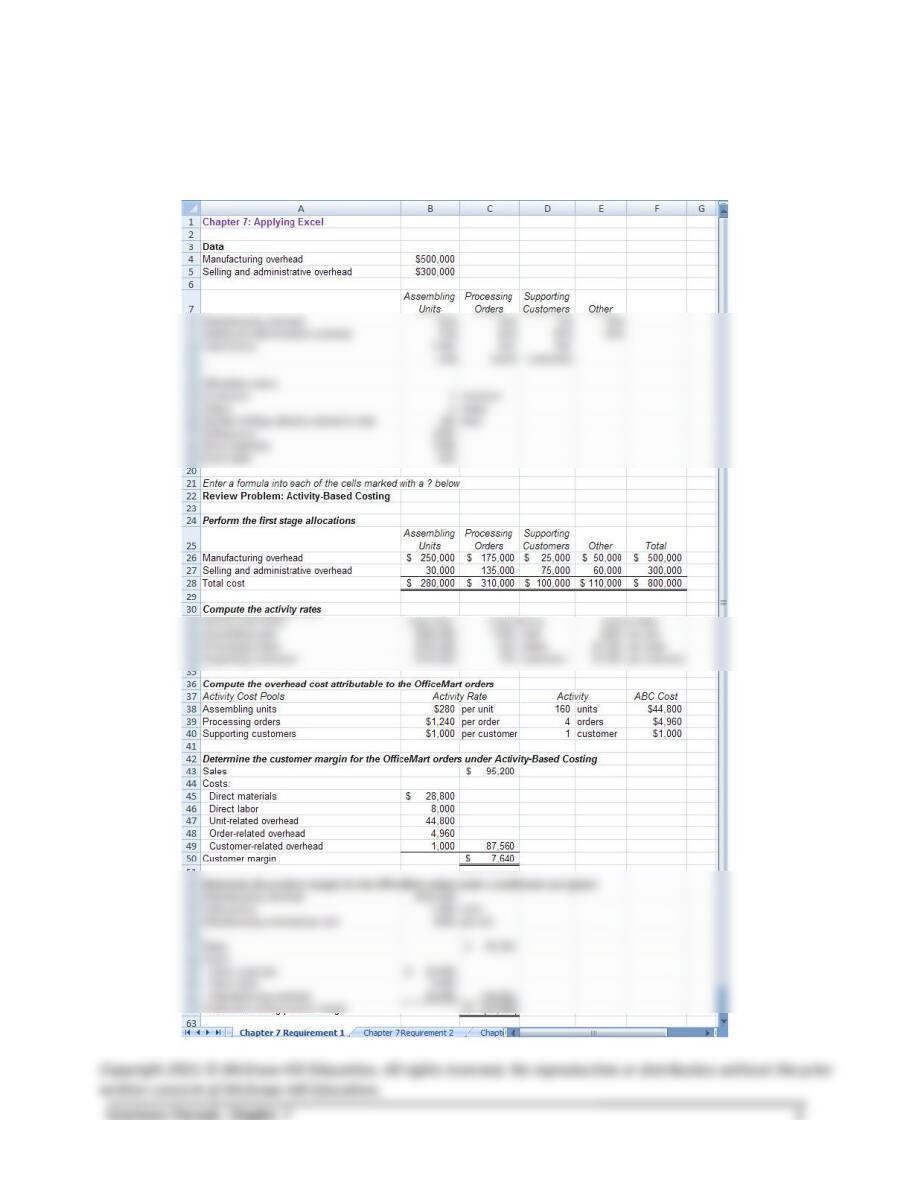
Chapter 7: Applying Excel (continued)
1. When the number of units ordered by OfficeMart is doubled to 160
units, the result is:

Chapter 7: Applying Excel (continued)
a. The customer margin under activity-based costing at 80 units was
b. The product margin under traditional costing has exactly doubled,
going from a loss of $10,800 to a loss of $21,600, because all of the
costs included in the product margin under traditional costing are
assumed to be strictly variable with respect to the number of units
ordered.
c. Assuming that the activity-based costing system was carefully
designed and implemented, it will provide a more accurate picture of
what happens to profits as the number of units ordered increases. If
some of the fixed manufacturing overhead costs are order-related
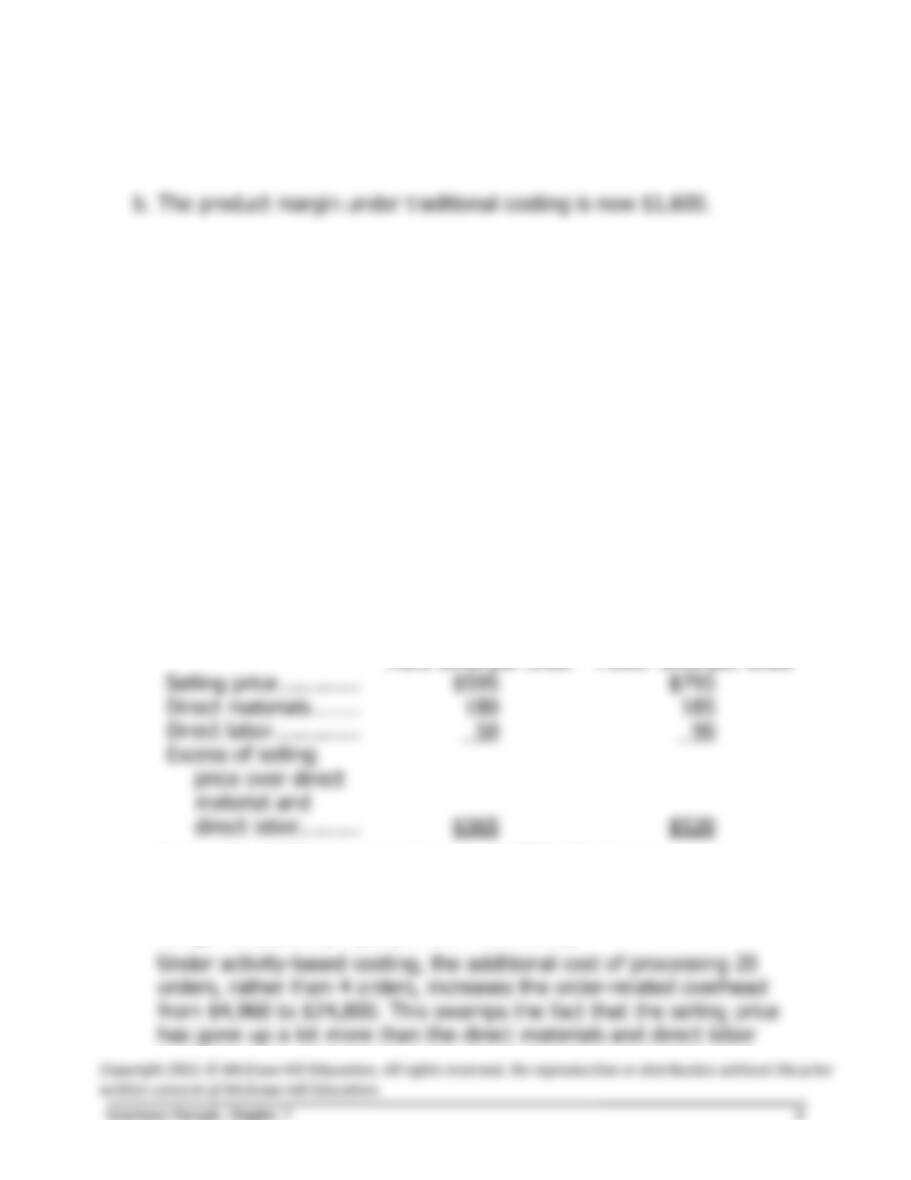
2. With the changes in the data, the worksheet should look like this:
Chapter 7: Applying Excel (continued)
a. The customer margin under activity-based costing is now $(6,600).
c. Even though the number of units ordered is exactly the same, the
profitability picture has shifted radically and is summarized below:
Lower-end,
Fewer orders,
More units per order
Higher-end,
More orders,
Fewer units per
order
Customer margin,
activity-based
costing ……………..
$840
$(6,600)
Product margin,
traditional costing .
$(10,800)
$1,600
The reasons for these changes are complex. One reason is that the
difference between the selling price and the direct materials and
direct labor costs has increased.
Lower-end,
Fewer orders,
Higher-end,
More orders,
Under the traditional costing method, $500 of manufacturing
overhead is allocated to each. Consequently, the product margin is
$20 per unit. When 80 units are ordered, the result is a total product
margin of $1,600 (= $20 per unit × 80 units).
costs.
Chapter 7: Applying Excel (continued)
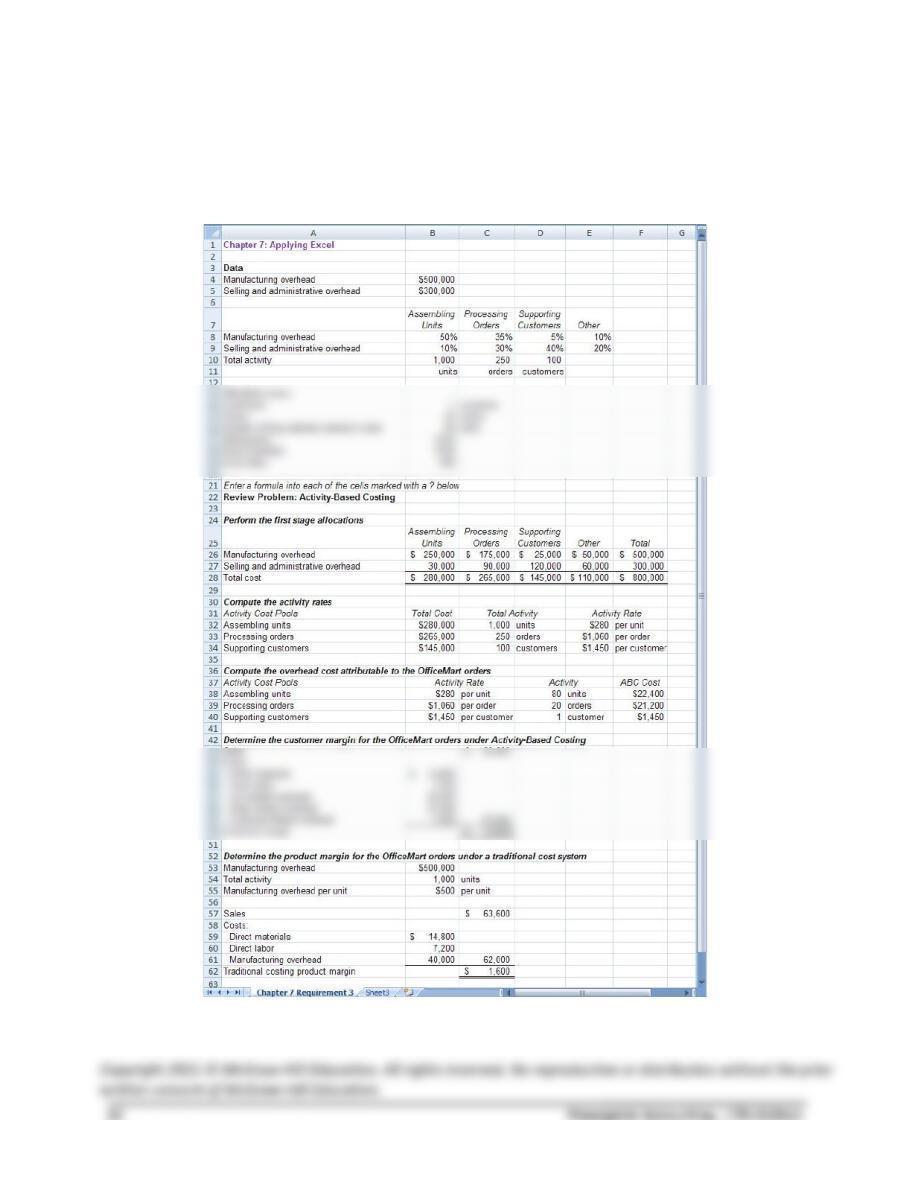
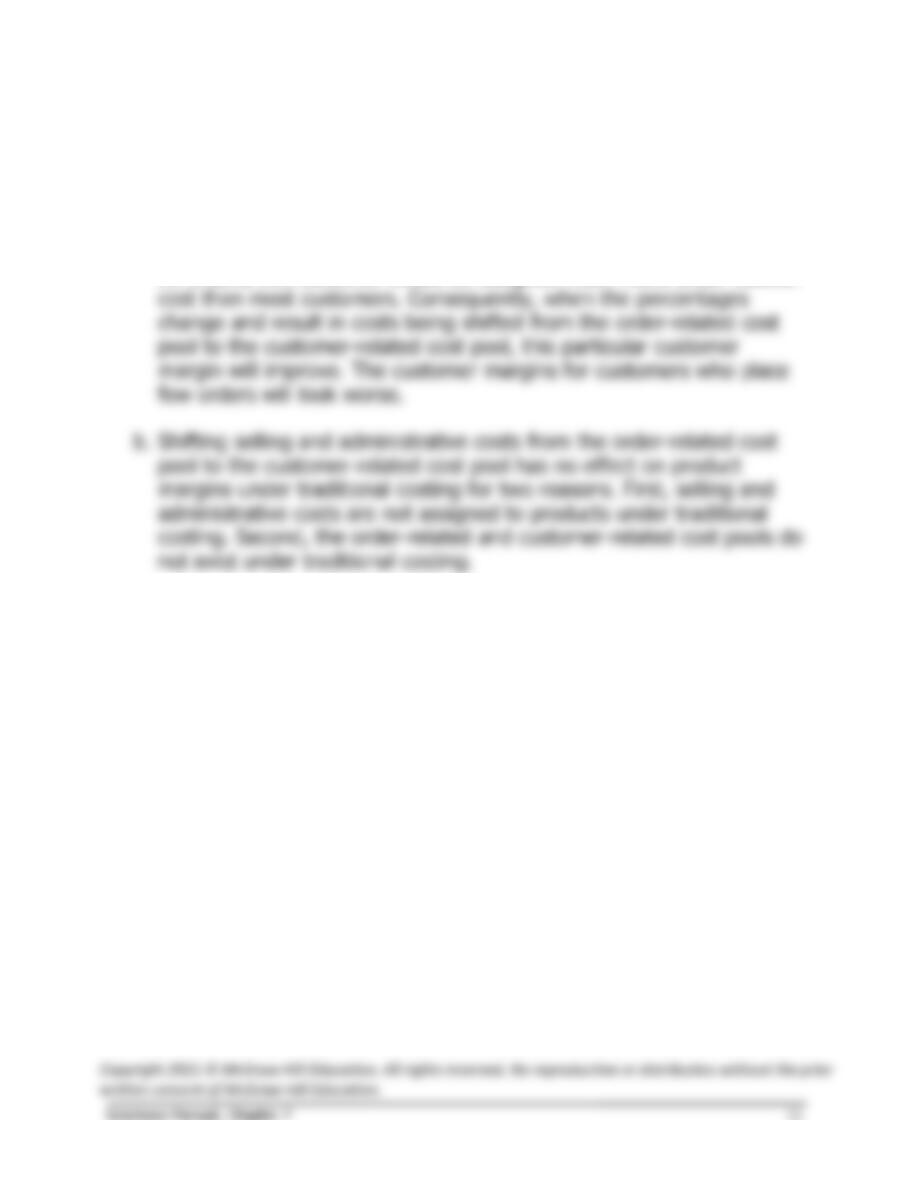
3. With the change in the selling and administrative percentages, the result
is:
Chapter 7: Applying Excel (continued)
a. The customer margin under activity-based costing has improved from
$(6,600) to $(3,450) because costs have shifted from the order-
related activity cost pool to the customer-related activity cost pool.
The average number of orders per customer is 2.5 (= 250 orders ÷
100 customers). Since in this part we assume that this customer had
The Foundational 15
1. The plantwide overhead rate is computed as follows:
Total estimated overhead cost (a) …………
$684,000
Total expected direct labor-hours (b) …….
12,000
DLHs
Plantwide overhead rate (a) ÷ (b) …………
$57.00
per DLH
2. The overhead cost assignments to Products Y and Z are as follows:
Product Y
Product Z
Total direct labor hours (a) ………………….
Manufacturing overhead assigned (a) × (b)
3-6.
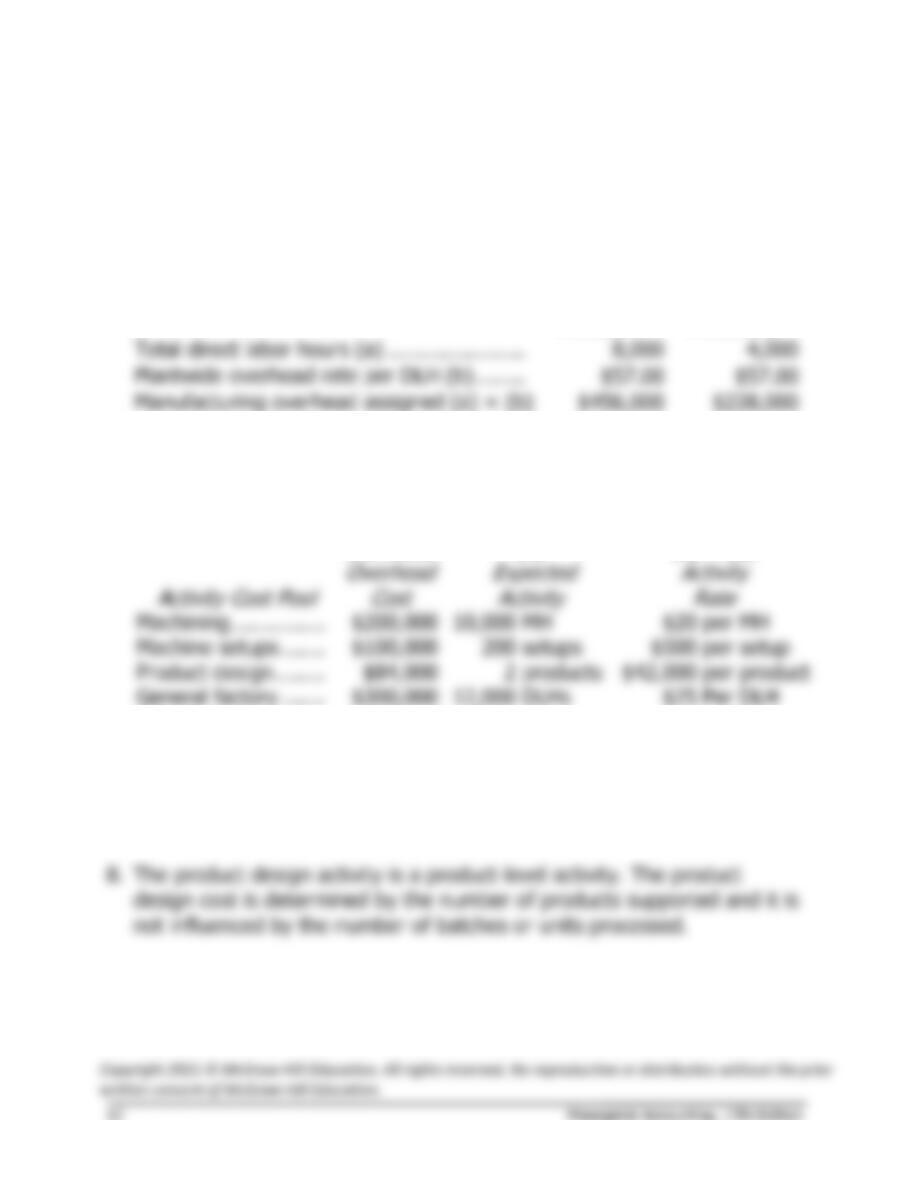
The activity rates are computed as follows:
Machining ……………
Machine setups …….
setups
(a)
Estimated
(b)
(a) ÷ (b)
7. Machine setups is a batch-level activity. A setup is performed to run a
batch of units. The cost of the setup is determined by the resources
consumed performing the setup and it is not influenced by the number
of units processed once the setup is complete.
The Foundational 15 (continued)
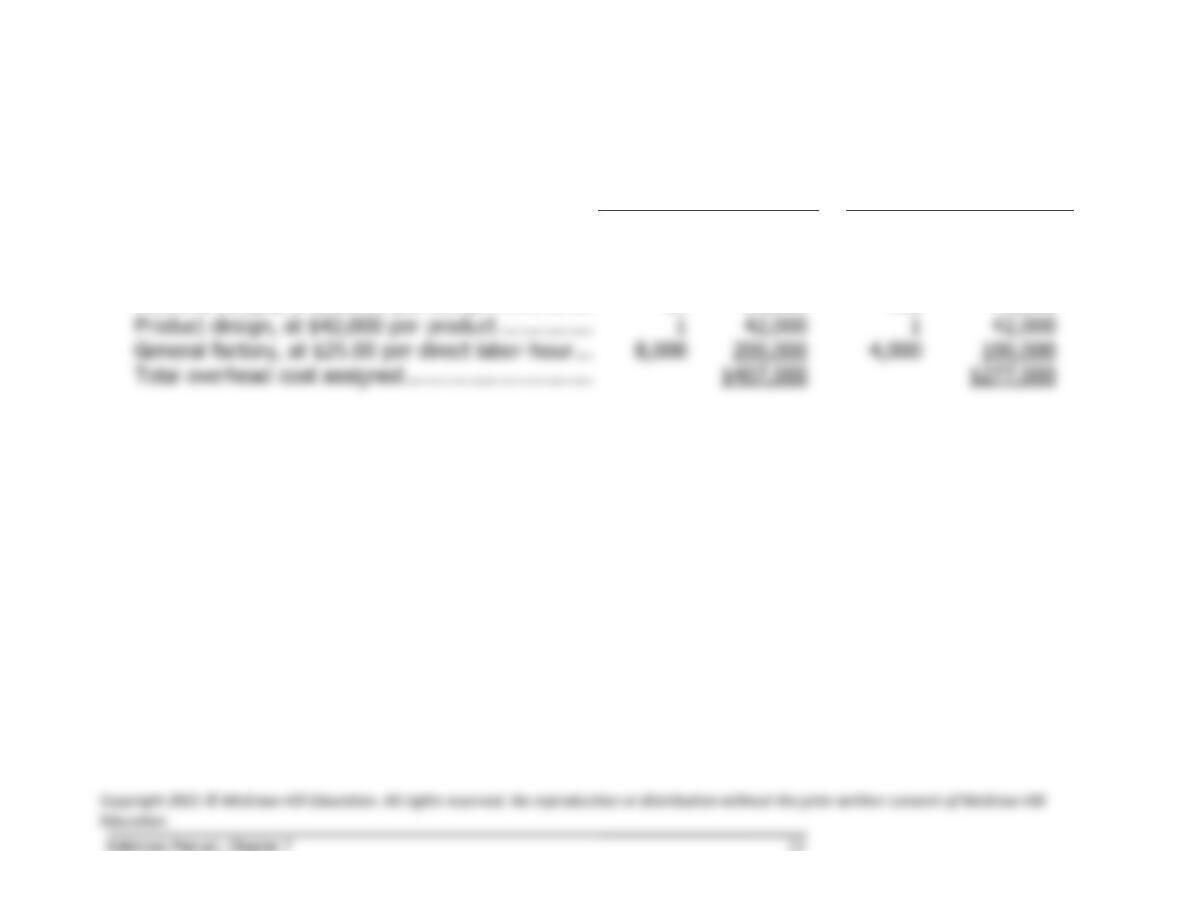
9-10. Using the ABC system, the total overhead assigned to Products Y and Z is computed as follows:
Product Y
Product Z
Expected
Activity
Amount
Expected
Activity
Amount
Machining, at $20.00 per machine-hour ……………
7,000
$140,000
3,000
$ 60,000
Machine setups, at $500.00 per setup ……………..
Product design, at $42,000 per product ……………
General factory, at $25.00 per direct labor-hour …
8,000
4,000
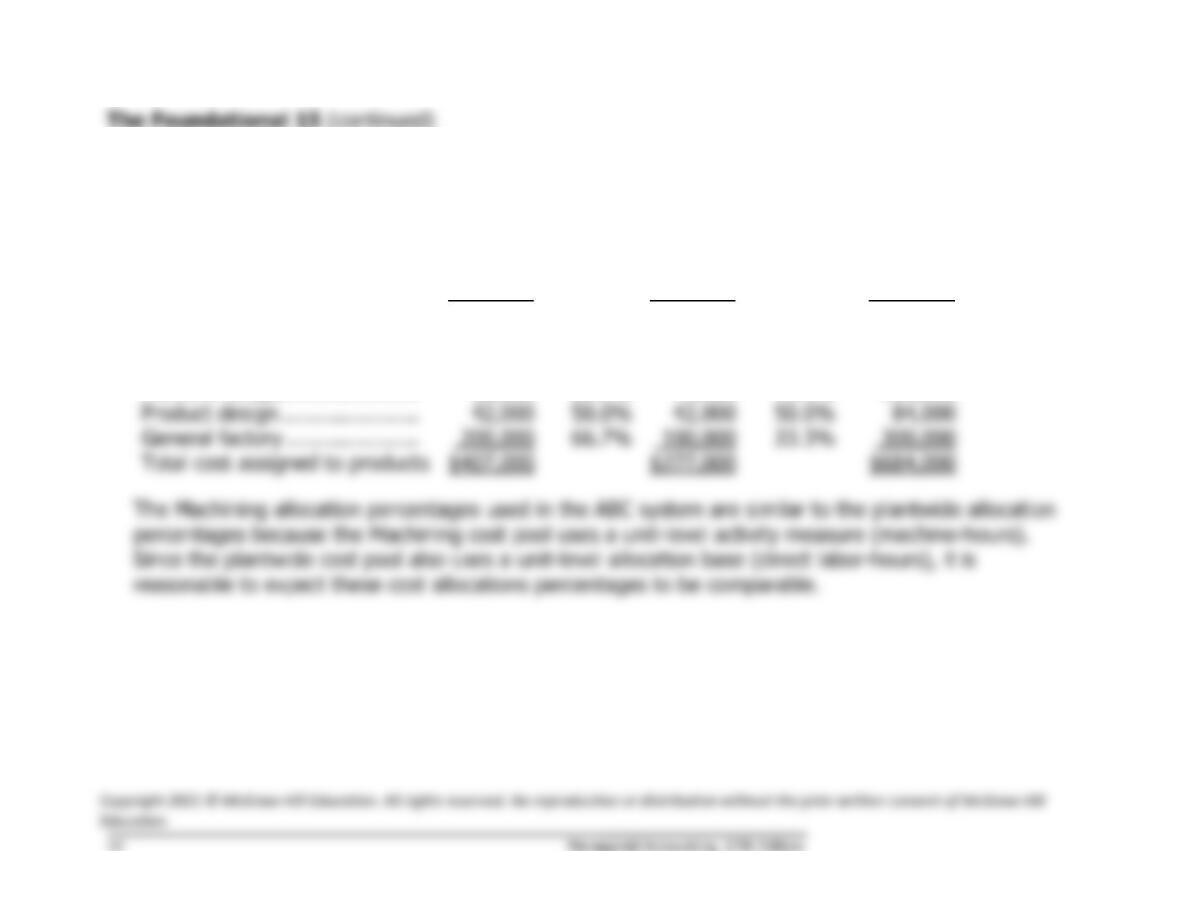
11–15. The percentages of overhead assigned using the plantwide and ABC approaches are computed
as follows:
Product Y
Product Z
Total
Plantwide Approach
(a)
Amount
(a) ÷ (c)
%
(b)
Amount
(b) ÷ (c)
%
(c)
Amount
Manufacturing overhead ……..
$456,000
66.7%
$228,000
33.3%
$684,000
Activity-Based Costing System
Machining ………………………..
$140,000
70.0%
$ 60,000
30.0%
$200,000
Machine setups …………………
25,000
25.0%
75,000
75.0%
100,000
Product design ………………….
42,000
42,000
General factory …………………
Total cost assigned to products
Under the ABC system, 25% and 75% of the Machine Setups cost is allocated to Products Y and Z,
respectively, whereas the plantwide approach allocates 67% and 33% of all overhead costs to the
two products. These allocation percentages are different because Machine Setups is a batch-level
cost pool. Although Product Y is the high-volume product (14,000 units) and Product Z is the low-
volume product (6,000 units), Product Y only consumes 25% of the total machine setups and Product
Z consumes 75% of the total machine setups. The conventional system is allocating too much of the
machine setup costs to Product Y and too little of these costs to Product Z.
The Foundational 15 (continued)
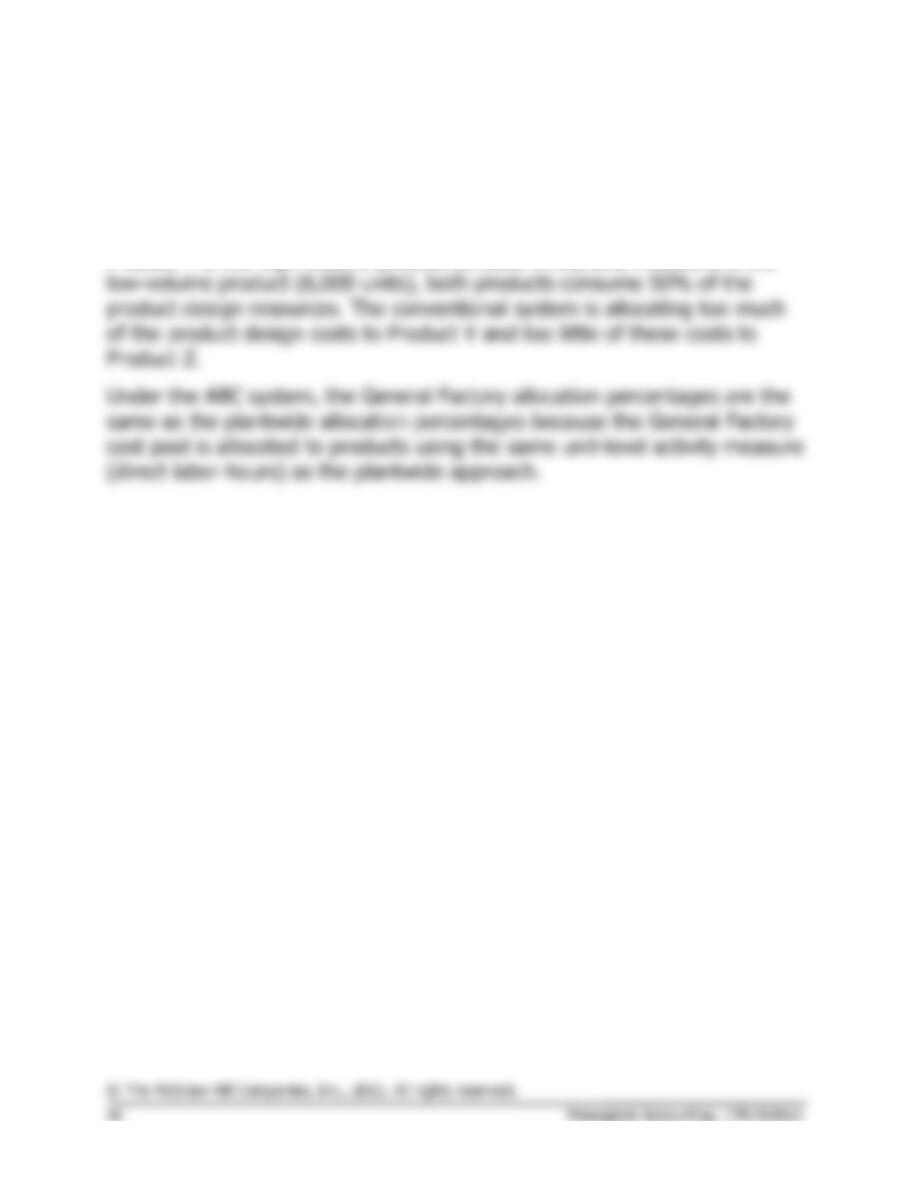
Under the ABC system, 50% of the Product Design cost is allocated to each
product, whereas the plantwide approach allocates 67% and 33% of all
overhead costs to Products Y and Z, respectively. These percentages are
different because Product Design is a product-level cost pool. Although
Exercise 7-1 (10 minutes)
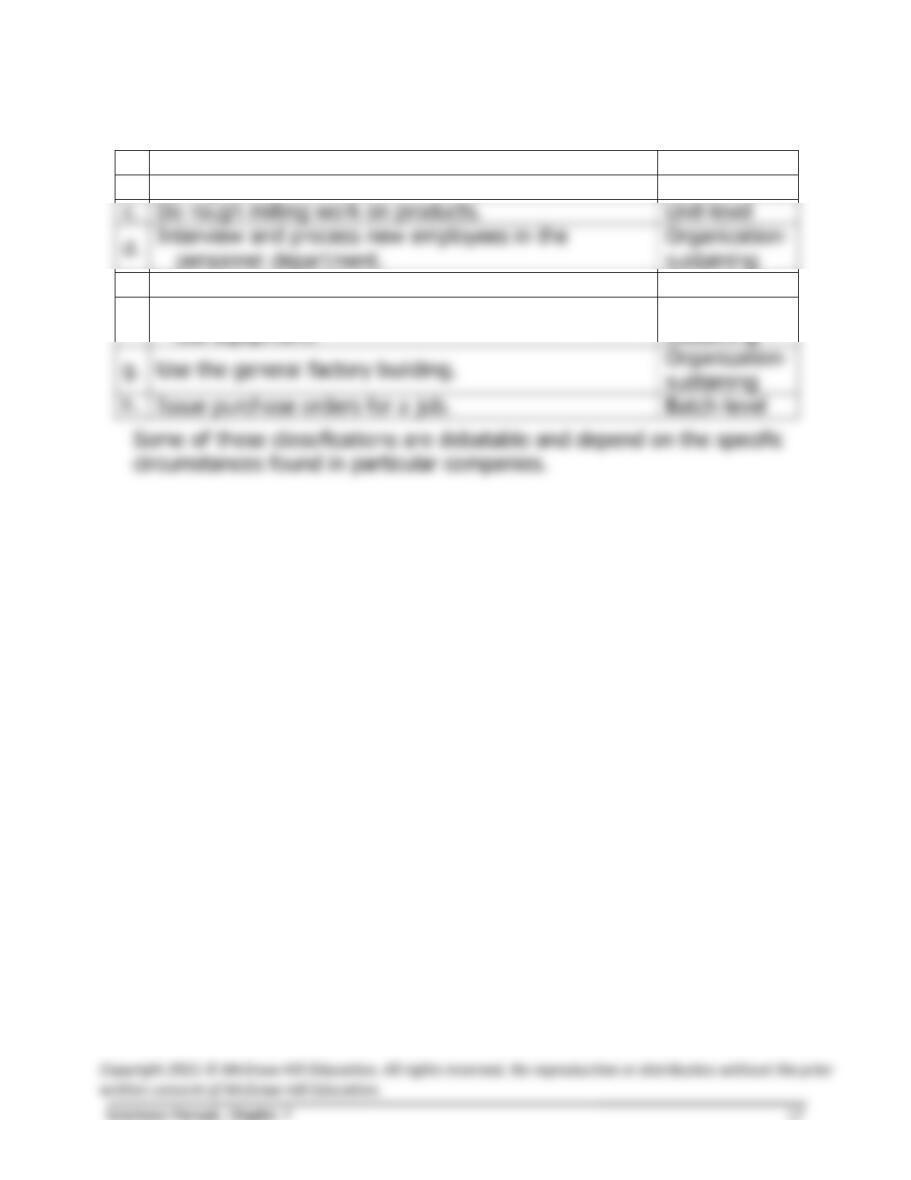
a.
Receive raw materials from suppliers.
Batch-level
b.
Manage parts inventories.
Product-level
Do rough milling work on products.
Unit-level
e.
Design new products.
Product-level
f.
Perform periodic preventive maintenance on general-
Issue purchase orders for a job.
Batch-level
Organization-
Exercise 7-2 (15 minutes)
Travel
Pickup
and
Delivery
Customer
Service
Other
Totals
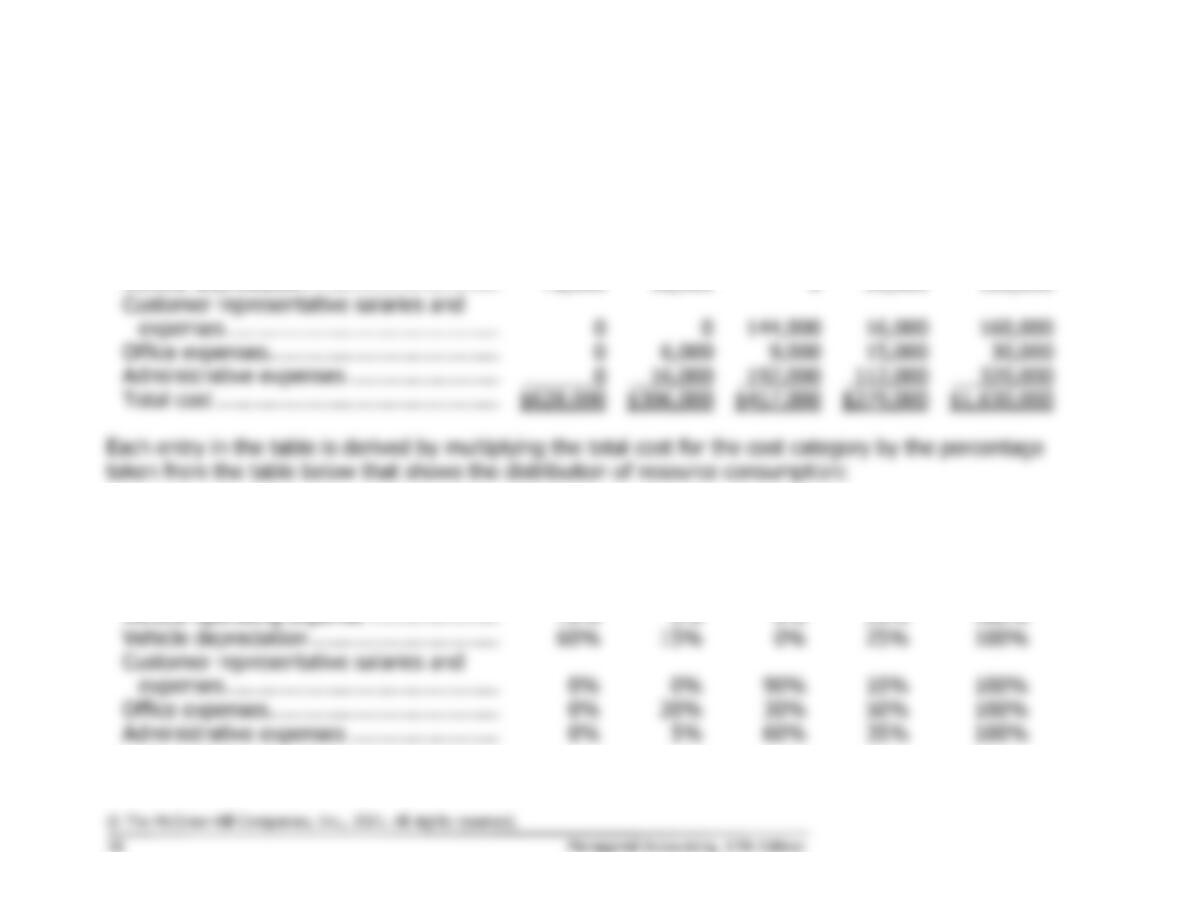
Driver and guard wages …………………….
$360,000
$252,000
$ 72,000
$ 36,000
$ 720,000
Vehicle operating expense …………………
196,000
14,000
0
70,000
280,000
0
0
144,000
16,000
160,000
Administrative expenses ……………………
192,000
112,000
Total cost ………………………………………
$628,000
$306,000
$417,000
$279,000
$1,630,000
Travel
Pickup
and
Delivery
Customer
Service
Other
Totals
Driver and guard wages …………………….
50%
35%
10%
5%
100%
Vehicle operating expense …………………
70%
5%
25%
100%
0%
0%
90%
10%
100%
Administrative expenses ……………………
0%
5%
60%
35%
100%
Exercise 7-3 (10 minutes)
Activity Cost Pool
Estimated
Overhead
Cost
Expected Activity
Activity Rate
Caring for lawn ………………..
$72,000
150,000
square ft. of lawn
$0.48
per square ft. of lawn
Caring for garden beds–
Customer billing and service .
customers
per customer
$26,400
20,000
square ft. of low
$1.32
per square ft. of low
Exercise 7-4 (10 minutes)
K425
Activity Cost Pool
Activity Rate
Activity
ABC Cost
Supporting direct labor ………
$6
per direct labor-hour
80
direct labor-hours
$ 480
Machine processing …………..
$4
per machine-hour
100
machine-hours
400
Machine setups ………………..
per setup
setups
Shipments ………………………
per shipment
shipment
Product sustaining …………….
per product
product
Total …………………………..…
M67
Activity Cost Pool
Activity Rate
Activity
ABC Cost
Supporting direct labor ………
$6
per direct labor-hour
500
direct labor-hours
$ 3,000
Machine processing …………..
$4
per machine-hour
1,500
machine-hours
6,000
Machine setups ………………..
per setup
setups
Production orders ……………..
per order
orders
360
Shipments ………………………
per shipment
shipments
140
Product sustaining …………….
per product
product
Total …………………………..…