
CHAPTER 7
Incremental Analysis
ASSIGNMENT CLASSIFICATION TABLE
Learning Objectives
Questions
Brief
Exercises
Do It!
Exercises
A
Problems
1. Describe management’s
decision-making process and
incremental analysis.
1, 2, 3, 4
1, 2
1
1, 18
2. Analyze the relevant costs in
accepting an order at a
special price.
5
3
2
2, 3, 4, 18
1A
3. Analyze the relevant costs in
a make-or-buy decision.
6, 7
4
3
5, 6, 7, 8, 18
2A
4. Analyze the relevant costs in
determining whether to sell or
process materials further.
8, 9, 10
5, 6
4
9, 10, 11,
12, 18
3A
5. Analyze the relevant costs to
be considered in repairing,
retaining or replacing
equipment.
11
7
5
13, 14, 18
4A
6. Analyze the relevant costs in
deciding whether to eliminate
an unprofitable segment.
12
8
6
15, 16, 17,
18
5A

ASSIGNMENT CHARACTERISTICS TABLE
Problem
Number
Description
Difficulty
Level
Time
Allotted (min.)
1A
Use incremental analysis for special order and identify
nonfinancial factors in the decision.
Simple
20–30
2A
Use incremental analysis related to make or buy,
consider opportunity cost, and identify nonfinancial
factors.
Moderate
30–40
3A
Determine if product should be sold or processed further.
Moderate
30–40
4A
Compute gain or loss, and determine if equipment should
be replaced.
Moderate
30–40
5A
Prepare incremental analysis concerning elimination of
divisions.
Moderate
30–40

BLOOM’ S TAXONOMY TABLE
Correlation Chart between Bloom’s Taxonomy, Learning Objectives and End–of-Chapter Exercises and Problems
Learning Objective
Knowledge
Comprehension
Application
Analysis
Synthesis
Evaluation
*1. Describe management’s decision–
making process and incremental
analysis.
Q7-1
Q7-2
Q7-3
Q7-4
E7-1
E7–18
BE7-1
BE7-2
DI7-1
*2. Analyze the relevant costs in
accepting an order at a special
price.
Q7-5
E7–18
BE7-3
DI7-2
E7-2
E7-3
E7-4
P7–1A
*3. Analyze the relevant costs in a
make–or-buy decision.
Q7-6
Q7-7
E7–18
BE7-4
DI7-3
E7-5
E7-6
E7-7
E7-8
P7–2A
*4. Analyze the relevant costs in
determining whether to sell or
process materials further.
Q7-8
Q7-9
Q7–10
E7–18
BE7-5
BE7-6
DI7-4
E7-9
E7–10
E7–11
P7–3A
E7–12
*5. Analyze the relevant costs to be
considered in repairing, retaining
or replacing equipment.
Q7–11
E7–18
BE7-7
DI7-5
E7–14
P7–4A
E7–13
*6. Analyze the relevant costs in
deciding whether to eliminate
an unprofitable segment.
Q7–12
E7–18
BE7-8
DI7-6
E7–15
E7–16
E7–17
P7–5A
Broadening Your Perspective
BYP7-1
BYP7-4
BYP7-5
BYP7-2
BYP7-8
BYP7-3
BYP7-6
BYP7-7
ANSWERS TO QUESTIONS
1. The following steps are frequently involved in management’s decision-making process:
(1) Identify the problem and assign responsibility.
(2) Determine and evaluate possible courses of action.
(3) Make a decision.
(4) Review results of the decision.
2. My roommate is incorrect. Accounting contributes to the decision-making process at Steps 2 and 4.
Prior to the decision, accounting provides relevant revenue and cost data for each course of action.
Following the decision, internal reports are prepared to show the actual impact of the decision.
3. Disagree. Incremental analysis involves the identification of financial data that change under
alternative courses of action.
4. In incremental analysis, the important point to consider is whether costs will differ (change)
between the two alternatives. As a result, sometimes (1) variable costs do not change under the
alternative courses of action and (2) fixed costs do change.
5. The relevant data in deciding whether to accept an order at a special price are the incremental
revenues to be obtained compared to the incremental costs of filling the special order.
6. The manufacturing costs that are relevant in the make-or-buy decision are those that will change
if the parts are purchased.
7. Opportunity cost may be defined as the potential benefit that may be obtained by following an
alternative course of action. Opportunity cost is relevant in a make-or-buy decision when the
facilities used to make the part can be used to generate additional income.
8. The decision rule in a decision to sell a product or to process it further is: Process further as
long as the incremental revenue from the additional processing exceeds the incremental
processing costs.
9. Joint products are products that are produced from a single raw material and a common
production process. An accounting issue related to joint products is how to allocate the joint costs
incurred during the production process that creates the joint products.
10. Joint costs are irrelevant to a sell-or-process-further decision because they are sunk costs and
will not change whether the decision is to sell the existing product or process it further. Therefore,
joint costs are ignored in this decision.
11. A sunk cost is a cost that cannot be changed by any present or future decision. Sunk costs, such
as the book value of an old piece of equipment, therefore, are not relevant in a decision to retain
or replace equipment.
12. Net income will be lower if an unprofitable product line is eliminated when the product line is
producing a positive contribution margin and its fixed costs cannot be avoided or reduced.
SOLUTIONS TO BRIEF EXERCISES
BRIEF EXERCISE 7-1
The correct order is:
1. Identify the problem and assign responsibility.
2. Determine and evaluate possible courses of action.
BRIEF EXERCISE 7-2
Alternative
A
Alternative
B
Net Income
Increase
(Decrease)
($ 5,000)
Revenues
$160,000
$180,000
($ 20,000)
BRIEF EXERCISE 7-3
Reject
Order
Accept
Order
Net Income
Increase
(Decrease)
$ 6,000
Revenues
Costs—Variable manufacturing
$0
0
$75,000
60,000
*
**
($ 75,000)
( (60,000)
BRIEF EXERCISE 7-4
Make
Buy
Net Income
Increase
(Decrease)
Variable manufacturing costs
$50,000
$ –0–
$ 50,000
BRIEF EXERCISE 7-5
Sell
Process
Further
Net Income
Increase (Decrease)
Sales price per unit
Cost per unit
Variable
$62.00
36.00
$70.00
42.00
$8.00
( (6.00)
BRIEF EXERCISE 7-6
The allocated joint costs are irrelevant to the sell or process further
decisions. If AB1 is processed further, the company will earn incremental
revenue of $50,000 ($150,000 – $100,000) and only incur incremental costs of
Fixed manufacturing costs
Purchase price
30,000
BRIEF EXERCISE 7-7
Retain
Equipment
Replace
Equipment
Net 5-Year
Income
Increase
(Decrease)
Variable manufacturing costs
for 5 years
$3,000,000
$2,500,000
($ 500,000
BRIEF EXERCISE 7-8
Continue
Eliminate
Net Income
Increase (Decrease)
Fixed costs
Net income
Sales
Variable costs
$200,000
180,000
$ –0–
–0–
$(200,000)
(180,000)
SOLUTIONS FOR DO IT! REVIEW EXERCISES
DO IT! 7-1
Alternative
1
Alternative
2
Net Income
Increase
(Decrease)
Sunk (s)
Revenues
$65,000
$60,000
$(5,000)
Maintenance expense
5,000
5,000
0
Operating expenses
26,000
22,000
Equipment upgrade
17,000
Opportunity cost
4,000
DO IT! 7-2
Sell old machine
Total
$3,000,000
Reject
Accept
Net Income
Increase (Decrease)
Revenues
$ –0–
$180,000
$180,000
DO IT! 7-3
(a)
Make
Buy
Net Income
Increase (Decrease)
Direct materials
$ 30,000
$ –0–
$ 30,000
Direct labor
42,000
–0–
42,000
costs
Purchase price
–0–
(162,000)
Total cost
*60,000 $2.70
(b)
Make
Buy
Net Income
Increase (Decrease)
Total cost
$177,000
$207,000
$(30,000)
Opportunity cost
34,000
Total cost
$211,000
Costs
$ –0–
Net income
$ –0–
$ 36,000
DO IT! 7-4
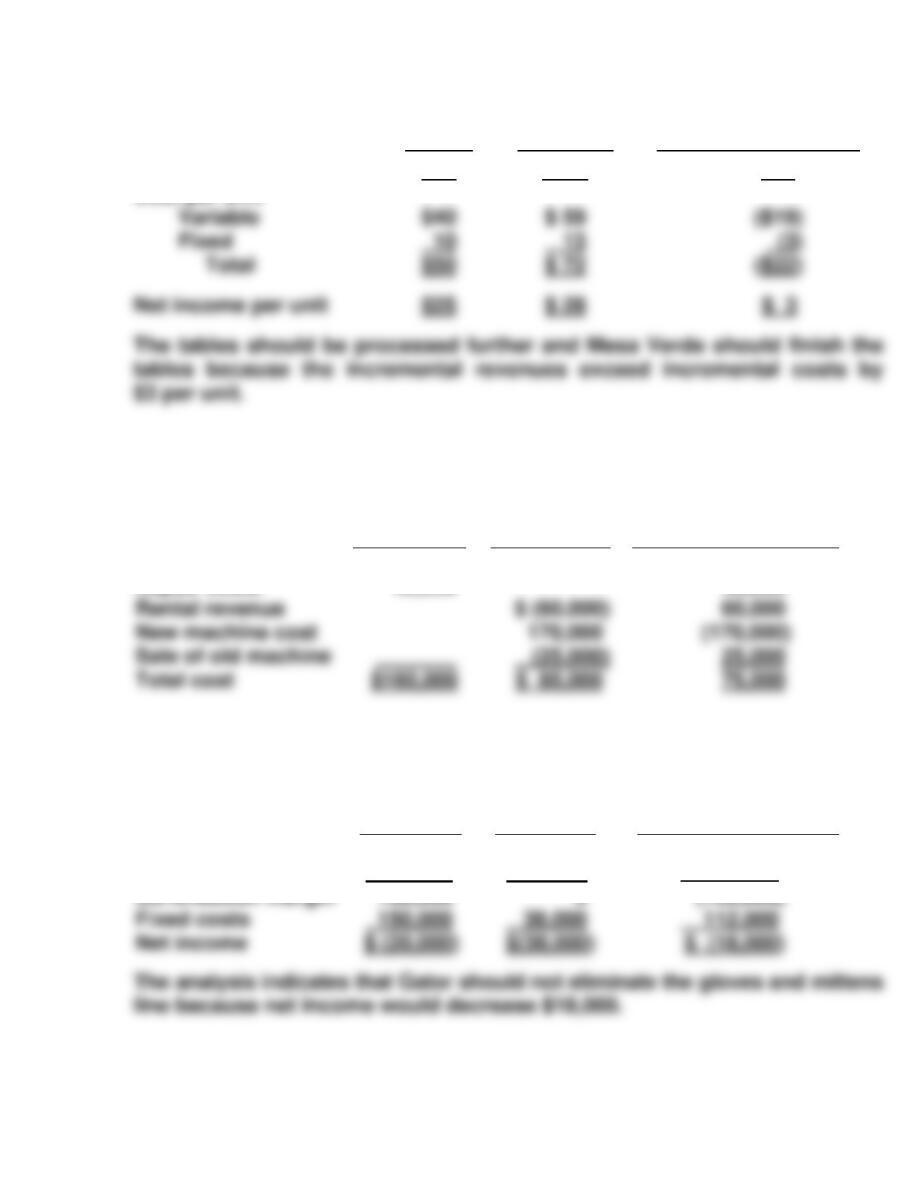
Sell
Process
Further
Net Income Increase
(Decrease)
Sales per unit
Cost per unit
$75
$100
$25
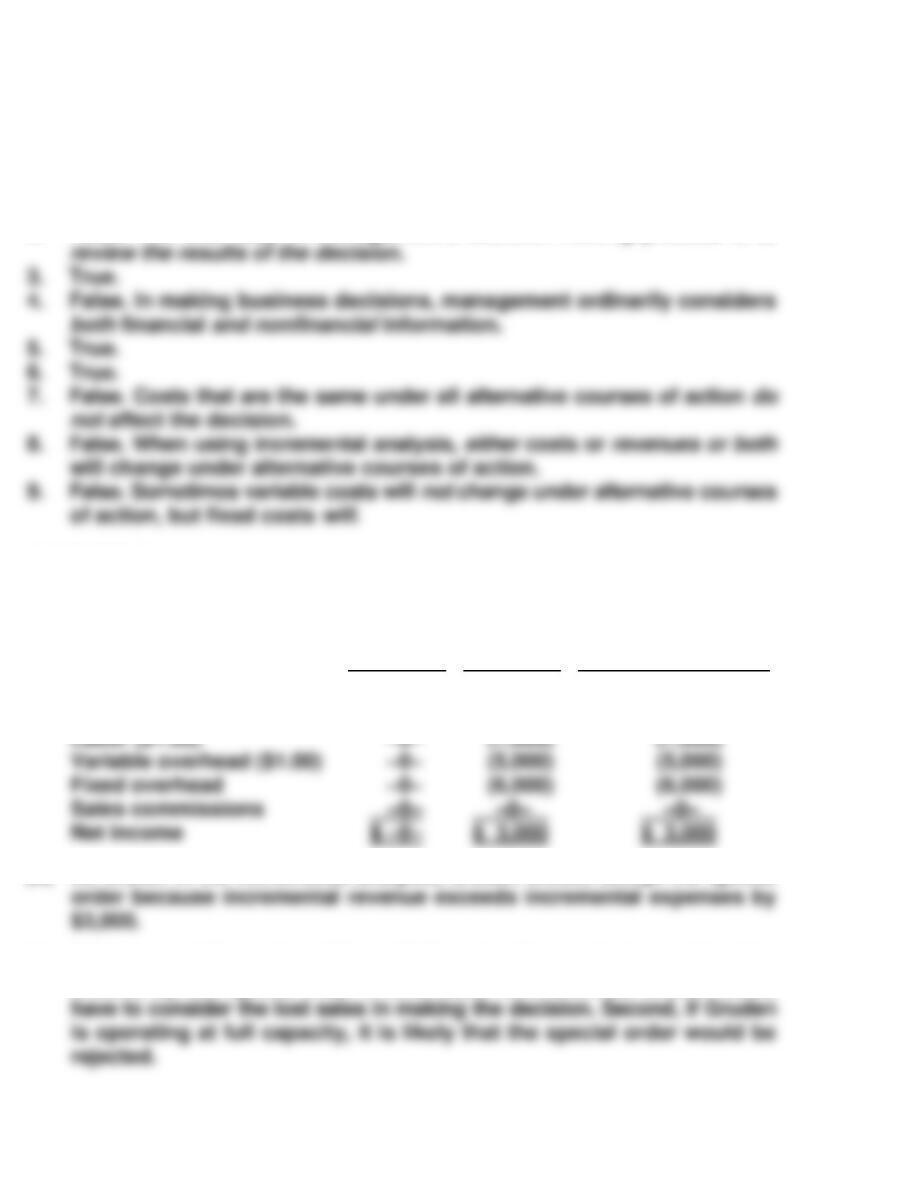
DO IT! 7-5
Retain
Equipment
Replace
Equipment
Net Income
Increase (Decrease)
Operating expenses
$120,000
$120,000
Repair costs
40,000
40,000
Rental revenue
New machine cost
Sale of old machine
25,000
Total cost
DO IT! 7-6
Continue
Eliminate
Net Income
Increase (Decrease)
Sales
$500,000
$ 0
$(500,000)
Variable costs
370,000
0
370,000
Contribution margin
Fixed costs
38,000
Net income
$(38,000)
Net income per unit
SOLUTIONS TO EXERCISES
EXERCISE 7-1
1. False. The first step in management’s decision–making process is “identify
the problem and assign responsibility”.
2. False. The final step in management’s decision-making process is to
EXERCISE 7-2
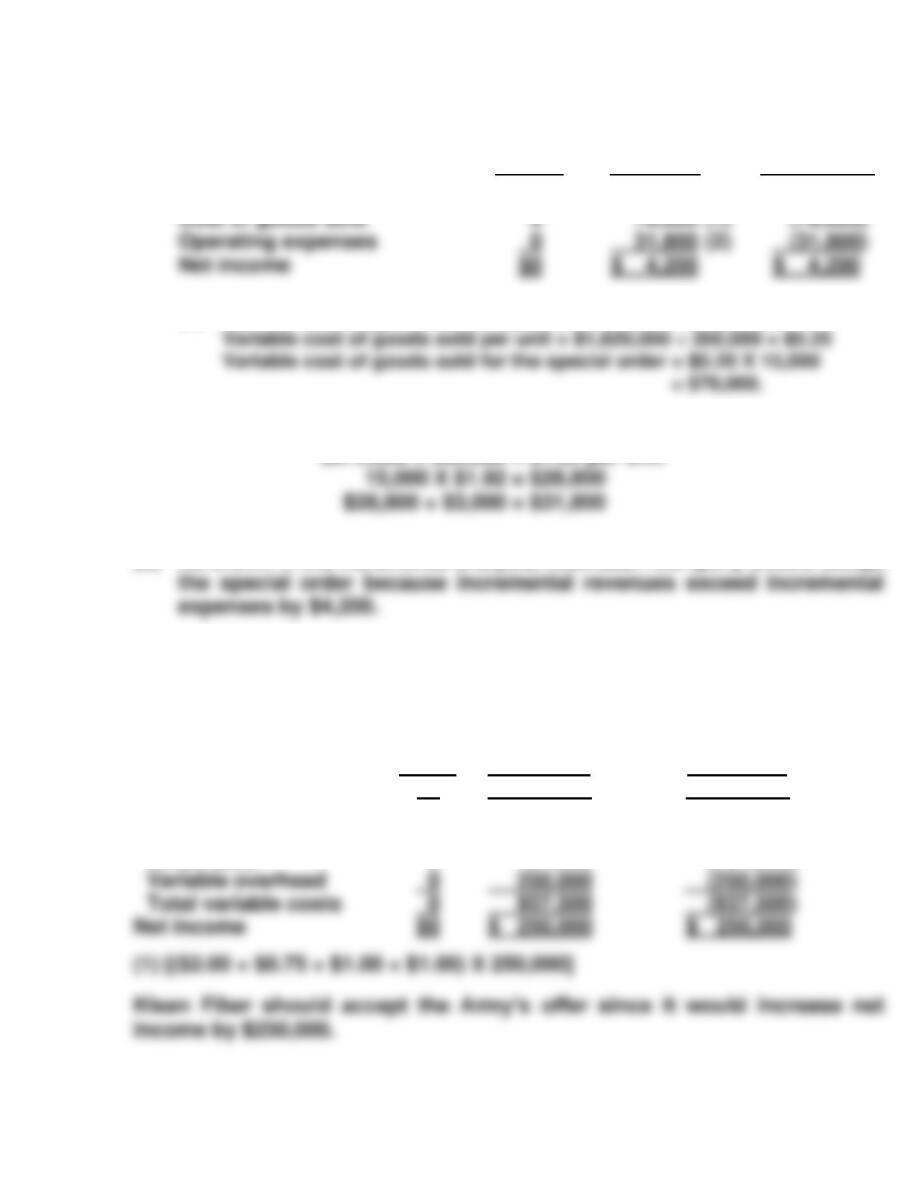
(a)
Reject
Order
Accept
Order
Net Income
Increase
(Decrease)
Revenues ($4.80)
Materials ($0.50)
$ –0–
–0–
$24,000
(2,500)
$24,000
(2,500)
(b) As shown in the incremental analysis, Gruden should accept the special
(c) It is assumed that sales of the golf discs in other markets would not be
affected by this special order. If other sales were affected, Gruden would
EXERCISE 7-3
(a)
Reject
Order
Accept
Order
Net Income
Increase
(Decrease)
Revenues (15,000 X $7.60)
$0
$114,000
($114,000)
(1) Variable cost of goods sold = $2,600,000 X 70% = $1,820,000.
(2) Variable operating expenses = $840,000 X 80% = $672,000
$672,000 ÷ 350,000 = $1.92 per unit
(b) As shown in the incremental analysis, Moonbean Company should accept
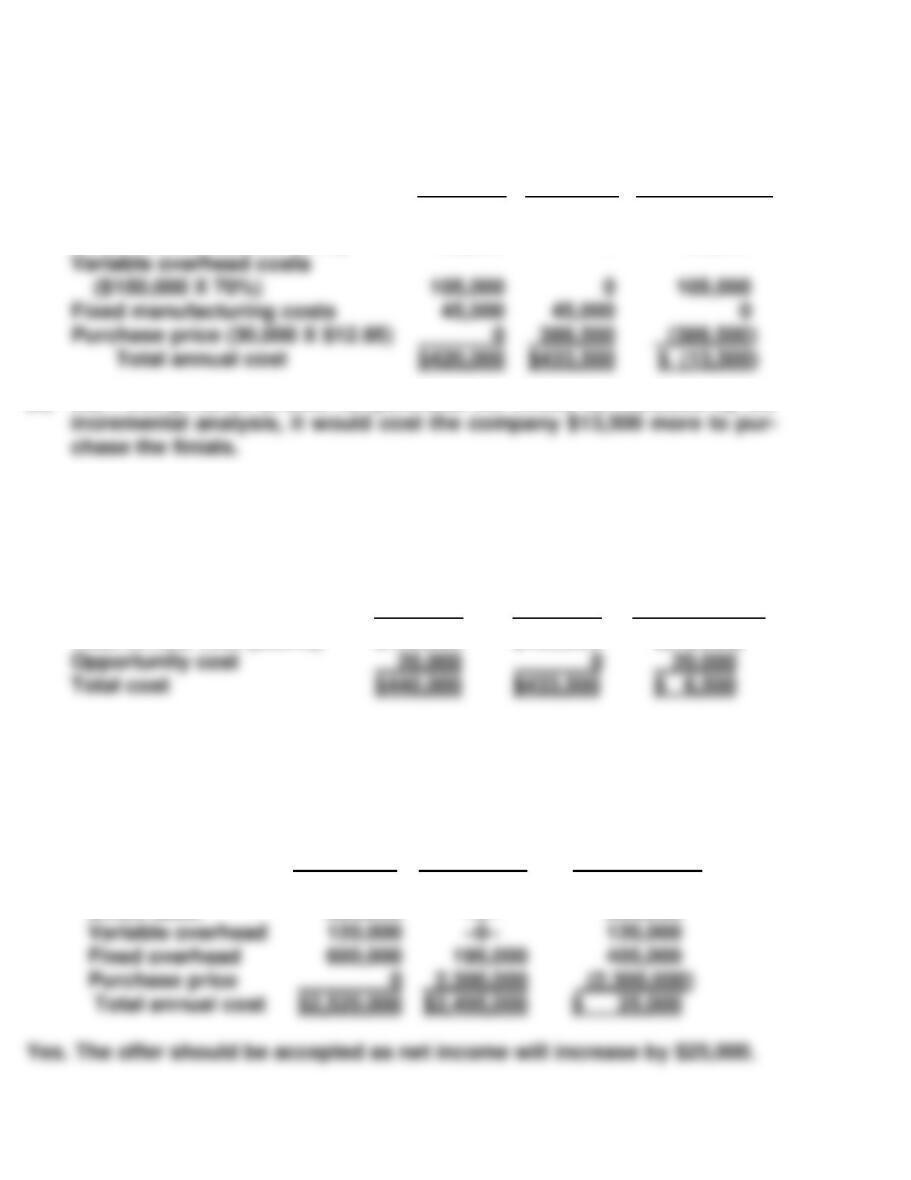
EXERCISE 7-4
Reject
Order
Accept
Order
Net Income
Increase
(Decrease)
Revenues
$0
$1,187,500 (1)
$1,187,500
Variable costs:
Direct materials
0
500,000
(500,000)
Direct labor
0
187,500
(187,500)
Variable overhead
250,000
(250,000)
Total variable costs
937,500
(937,500)
Net income
$0
$ 250,000
Operating expenses
EXERCISE 7-5
(a)
Make
Buy
Net Income
Increase
(Decrease)
Direct materials (30,000 X $4.00)
Direct labor (30,000 X $5.00)
$120,000
150,000
$ 0
0
$ 120,000
150,000
(b) No, Pottery Ranch should not purchase the finials. As indicated by the
(c) Yes, by purchasing the finials, a total cost saving of $6,500 will result
as shown below.
Make
Buy
Net Income
Increase
(Decrease)
Total annual cost (above)
$420,000
$433,500
$(13,500)
EXERCISE 7-6
(a) 1.
Make
Buy
Net Income
Increase
(Decrease)
Direct materials
$1,000,000
$ –0–
$ 1,000,000
Direct labor
800,000
–0–
800,000
Variable overhead
120,000
–0–
120,000
Fixed overhead
2,300,000
Fixed manufacturing costs
45,000
EXERCISE 7-6 (Continued)
2.
Make
Buy
Net Income
Increase
(Decrease)
Direct materials
$1,000,000
$ 0
$ 1,000,000
Direct labor
800,000
0
800,000
No. The offer should not be accepted as net income would be $5,000 less.
(b) Qualitative factors include the possibility of laying off those employees
EXERCISE 7-7
(a) Net Income
Increase
Make Sails Buy Sails (Decrease)
Direct materials $100 $ 0 $ 100
Direct labor 80 0 80
Riggs should be making the sails, because they could save $45 per
unit or $54,000. The president was including the fixed overhead cost
in the calculation. Variable overhead = Total overhead ($90) – Fixed
Variable overhead
120,000
0
120,000
Fixed overhead
Opportunity cost
0
$2,900,000
$ (5,000)
EXERCISE 7-7 (Continued)
(b) The best decision would be to rent out the space as shown below.
The differential savings would be $77,000 – $54,000 = $23,000.
Net Income
Per Make Increase
(Based on 1,200 units) Unit Sails Buy Sails (Decrease)
Manufacturing cost $205 $246,000 $ 0 $ 246,000
(c) Qualitative factors to consider would be (1) whether Riggs will be able
EXERCISE 7-8
(a) Net Income
Increase
Make IMC2 Buy IMC2 (Decrease)
Direct materials $ 65.00 $ 0 $ 65.00
Direct labor 45.00 0 45.00
EXERCISE 7-8 (Continued)
(b) In order for Innova to make an accurate decision, they would have to
know the opportunity cost of manufacturing the other product. As
determined in (a), purchasing the product from outside would cost
$11,500 more (1,000 X $11.50). Innova would have to increase their
contribution margin by more than $11,500 through the manufacture of
EXERCISE 7-9
Sell
(Basic Kit)
Process Further
(Stage 2 Kit)
Net Income
Increase
(Decrease)
Total
Sales per unit
Costs per unit
Direct materials
$30
$16
( )$36( )
( ) $ 8 (1)
$(6)
$(8)
(1) The cost of materials decreases because Anna can make two Stage
2 Kits from the materials for a basic kit.
EXERCISE 7-9 (Continued)
Anna should carry the Stage 2 Kits. The incremental revenue, $6, exceeds
the incremental processing costs, $1. Thus, net income will increase by
processing the kits further.
EXERCISE 7-10
(a)
Sales ($60,000 + $15,000 + $55,000)
$ 130,000
Joint costs
(100,000)
Net income
$ 30,000
(1)Sales value after further processing – Sales value @ split–off point
Products 10 and 14 should be processed further and product 12 should be
sold at the split-off point.
(d)
Sales ($190,000 + $15,000 + $215,000)
$ 420,000
Joint costs
(100,000)
Additional costs ($100,000 + $150,000)
Net income
$ 70,000
(b)
Sales ($190,000 + $35,000 + $215,000)
Joint costs
Additional costs ($100,000 + $30,000 + $150,000)
Net income
(c)
Product 10
Product 12
EXERCISE 7-11
To determine whether each of the three joint products should be sold as is,
or processed further, we must determine the incremental profit or loss that
would be earned by each. The allocated joint costs are irrelevant to the
decision since these costs will not change whether or not the products are
sold as is or processed further.
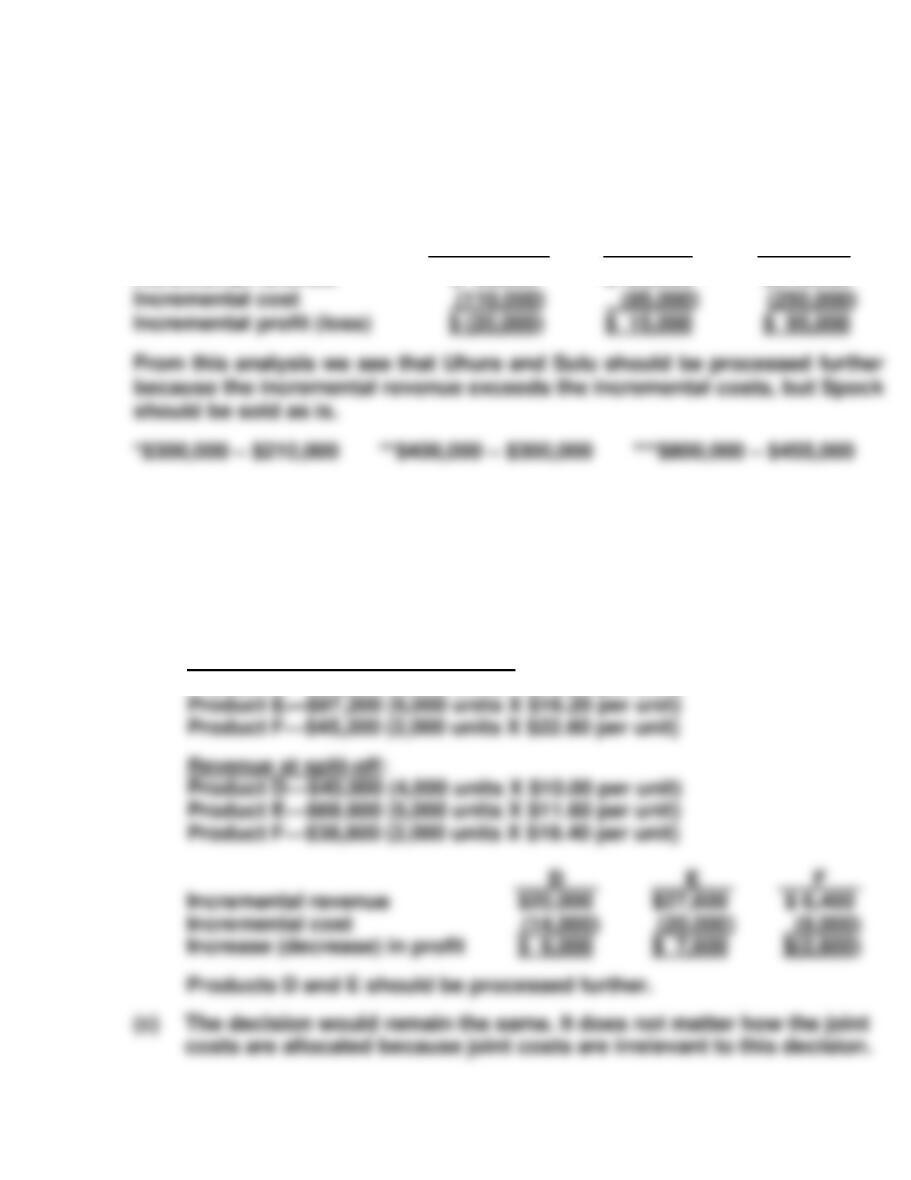
Spock
Uhura
Sulu
Incremental revenue
$ 90,000*
$100,000
**
$345,000
***
EXERCISE 7-12
(a) The costs that are relevant in this decision are the incremental revenues
and the incremental costs associated with processing the material
past the split-off point. Any costs incurred up to the split–off point are
sunk costs, and therefore, irrelevant to this decision.
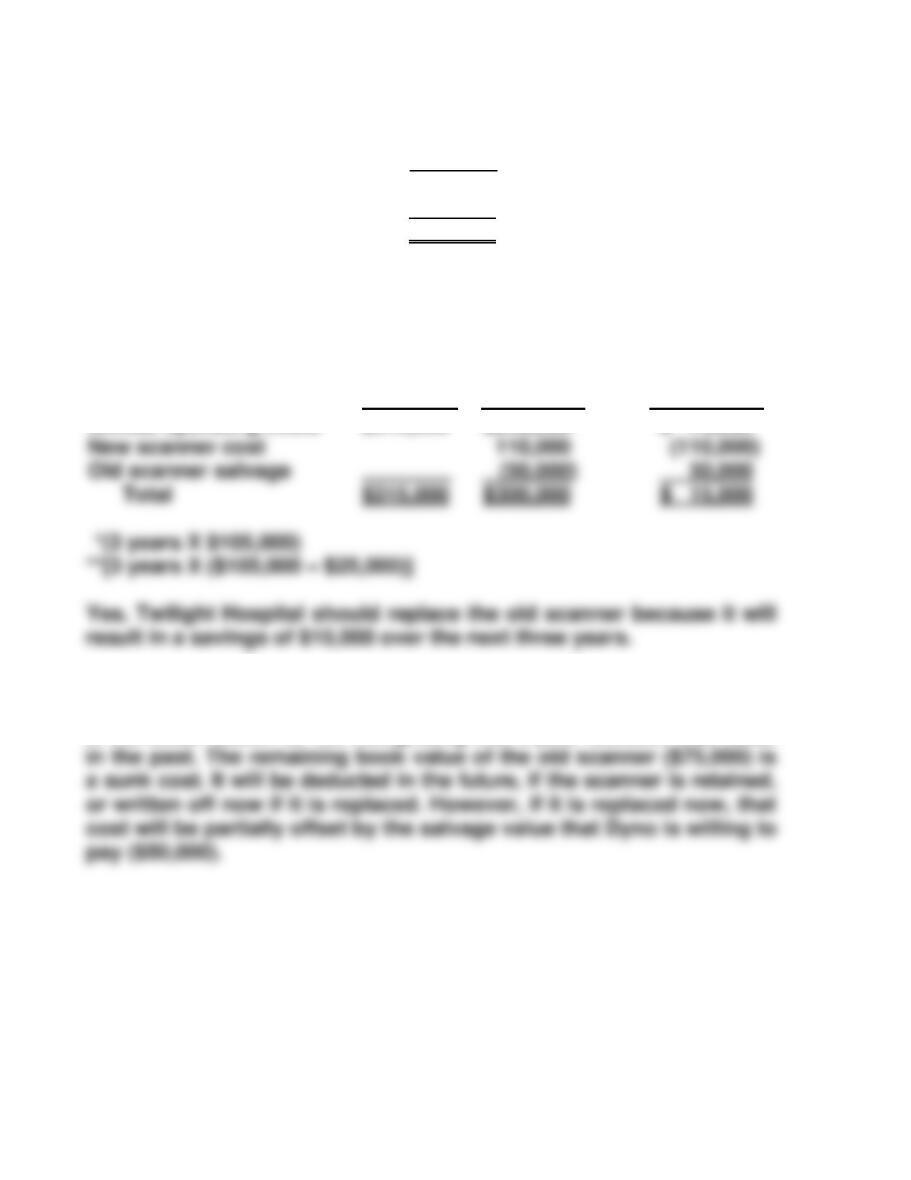
(b) Revenue after further processing:
Product D—$60,000 (4,000 units X $15.00 per unit)
Incremental profit (loss)
(
$ 15,000
EXERCISE 7-13
(a)
Cost
$100,000
Accumulated depreciation
(25,000*)
Book value
75,000
Sales proceeds
50,000
Loss on sale
$ 25,000
*One year’s depreciation: ($100,000 – $0) ÷ 4 years
(b)
Retain
Scanner
Replace
Scanner
Net Income
Increase
(Decrease)
Annual operating costs
$315,000*
$240,000**
$ 75,000
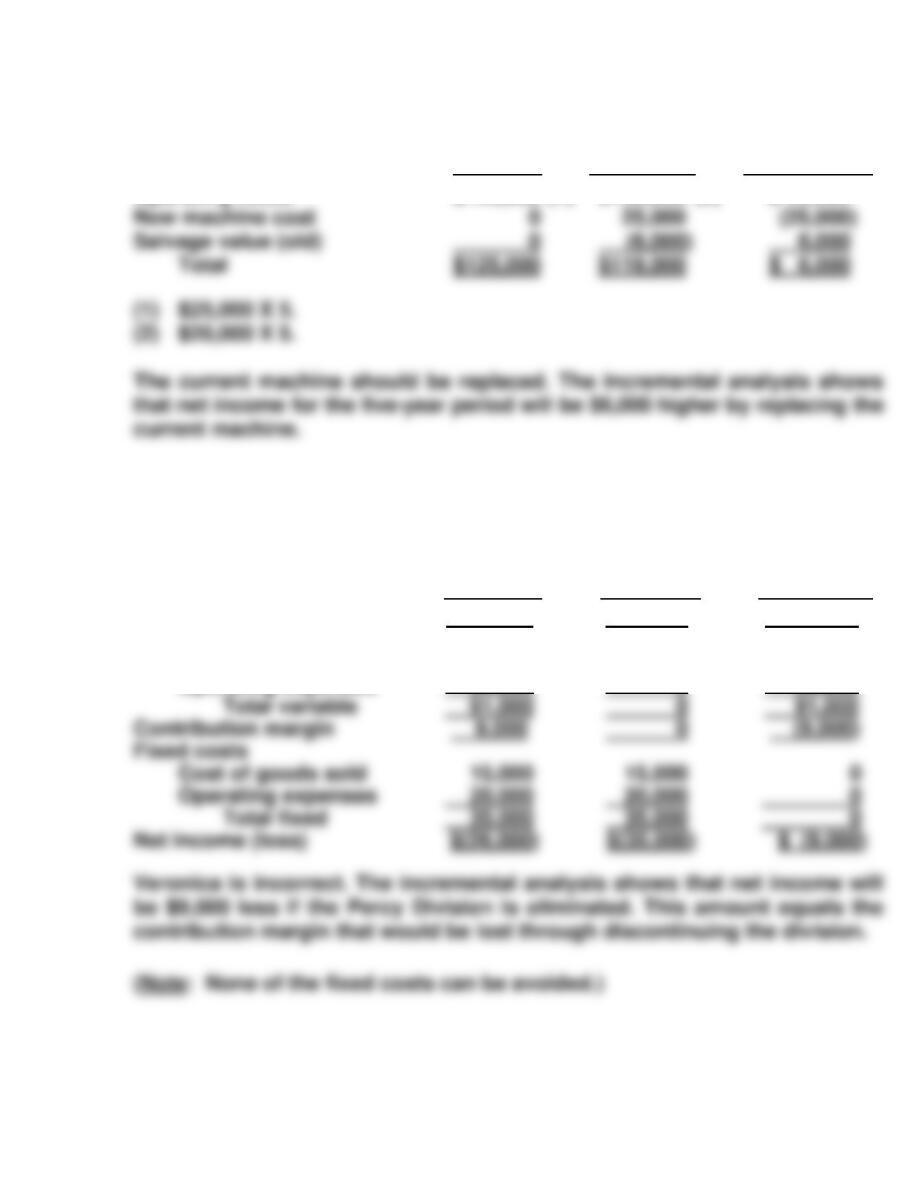
(c) As shown in (a) above, replacing the old scanner will result in
reporting a loss of $25,000. Reluctance to report losses of this nature
is the usual reason for not recognizing that a poor decision was made
Old scanner salvage
(50,000)
50,000
$315,000
$300,000
$ 15,000
EXERCISE 7-14
Retain
Machine
Replace
Machine
Net Income
Increase
(Decrease)
Operating costs
$125,000
(1)
($100,000)
(2)
($ 25,000
EXERCISE 7-15
Continue
Eliminate
Net Income
Increase
(Decrease)
Sales
Variable costs
Cost of goods sold
Operating expenses
$100,000)
( 61,000)
(30,000)
$( 0)
( 0)
( 0)
$(100,000)
(61,000)
(30,000)
New machine cost
Total
$125,000
EXERCISE 7-16
(a) $30,000 + $70,000 – $40,000 = $60,000
(b)
Tingler
Shocker
Total
Sales
Variable expenses
$300,000
150,000
$500,000
200,000
$800,000
350,000
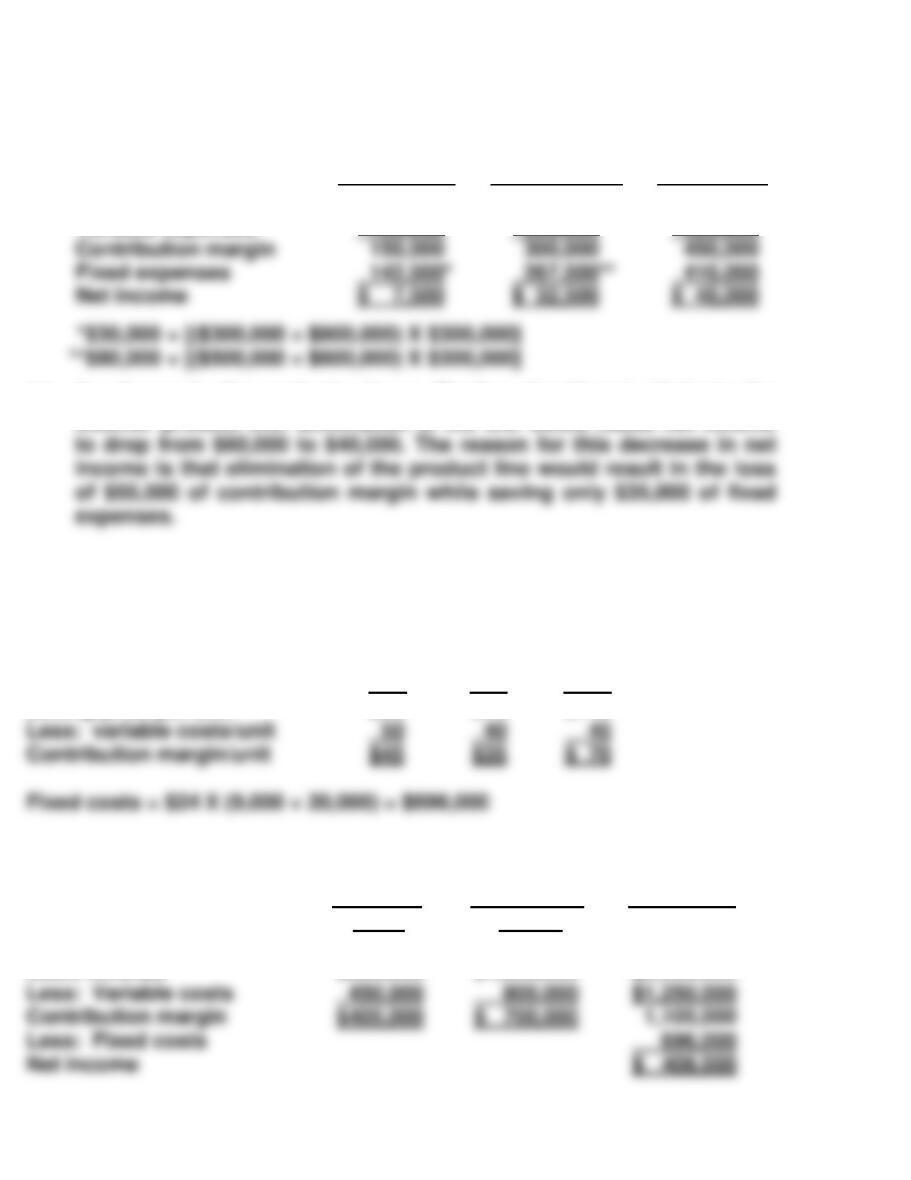
(c) As shown in the analysis above, Cawley should not eliminate the
Stunner product line. Elimination of the line would cause net income
EXERCISE 7-17
Calculation of contribution margin per unit:
C D E
Selling price per unit $95 $75 $115
Company profit with Products C and D:
C D Total
Units sold 9,000 20,000
Sales revenue $855,000 $1,500,000 $2,355,000
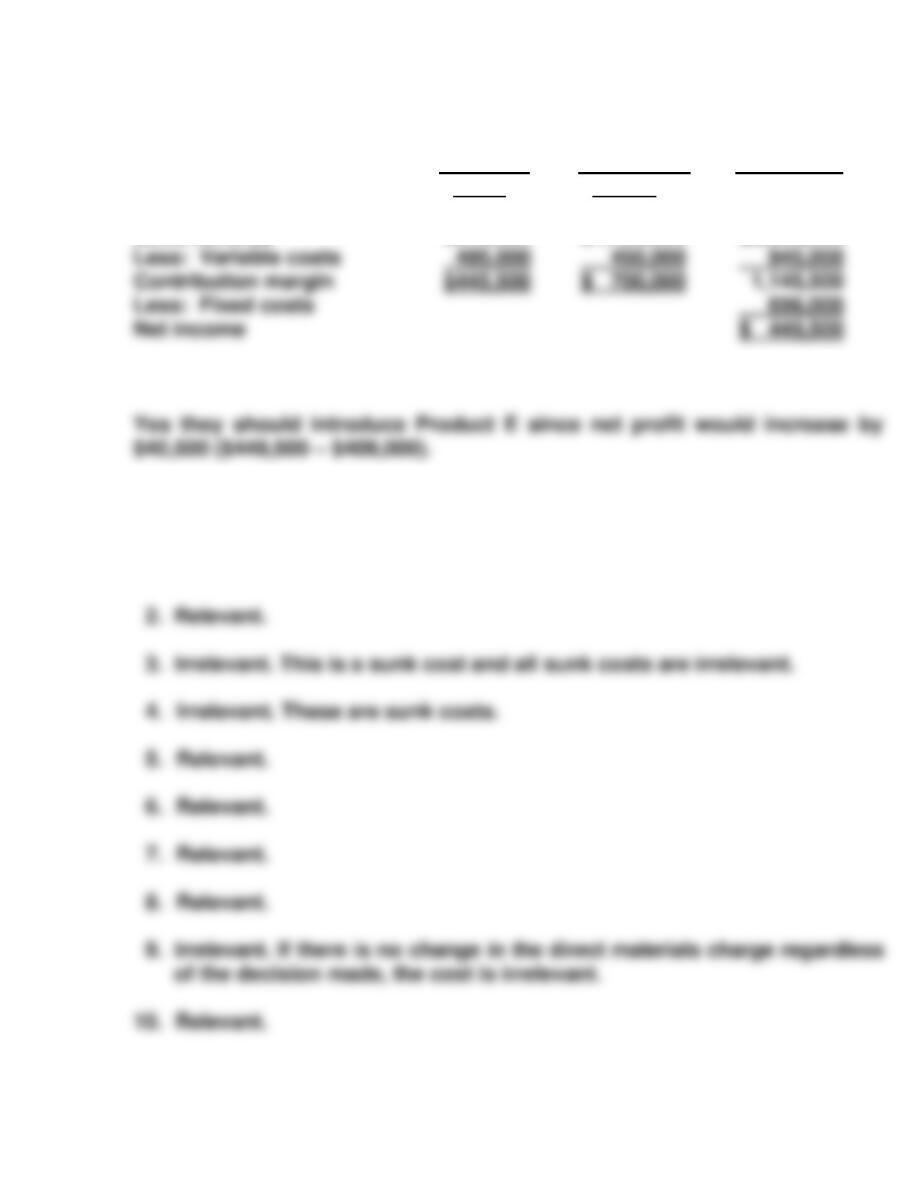
EXERCISE 7-17 (Continued)
Company profit with Products C and E:
C E Total
Units sold 9,900* 10,000
Sales revenue $940,500 $1,150,000 $2,090,500
*Product C sales increase by 10%, (9,000 X 110%)
EXERCISE 7-18
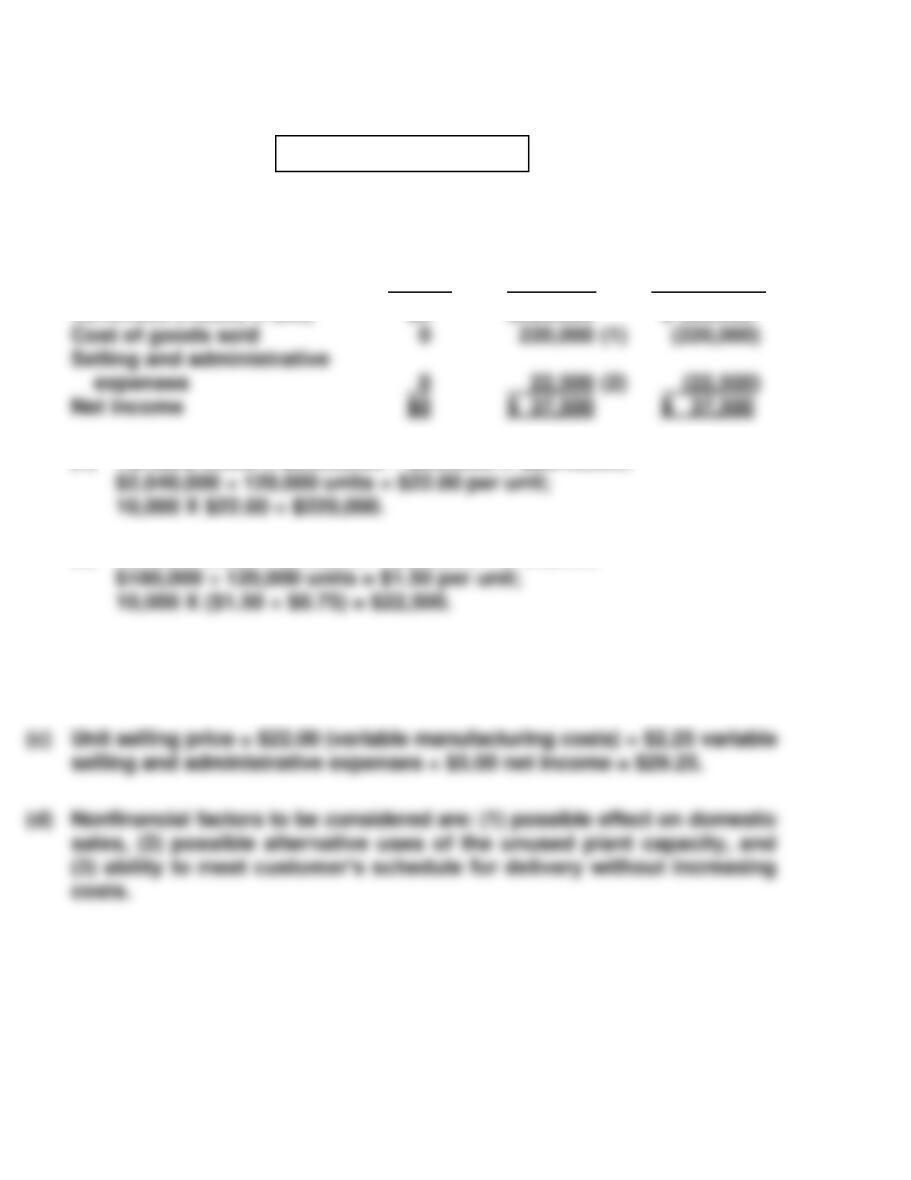
1. Irrelevant. Unavoidable costs will be incurred regardless of the
decision made.
SOLUTIONS TO PROBLEMS
PROBLEM 7-1A
(a)
Reject
Order
Accept
Order
Net Income
Increase
(Decrease)
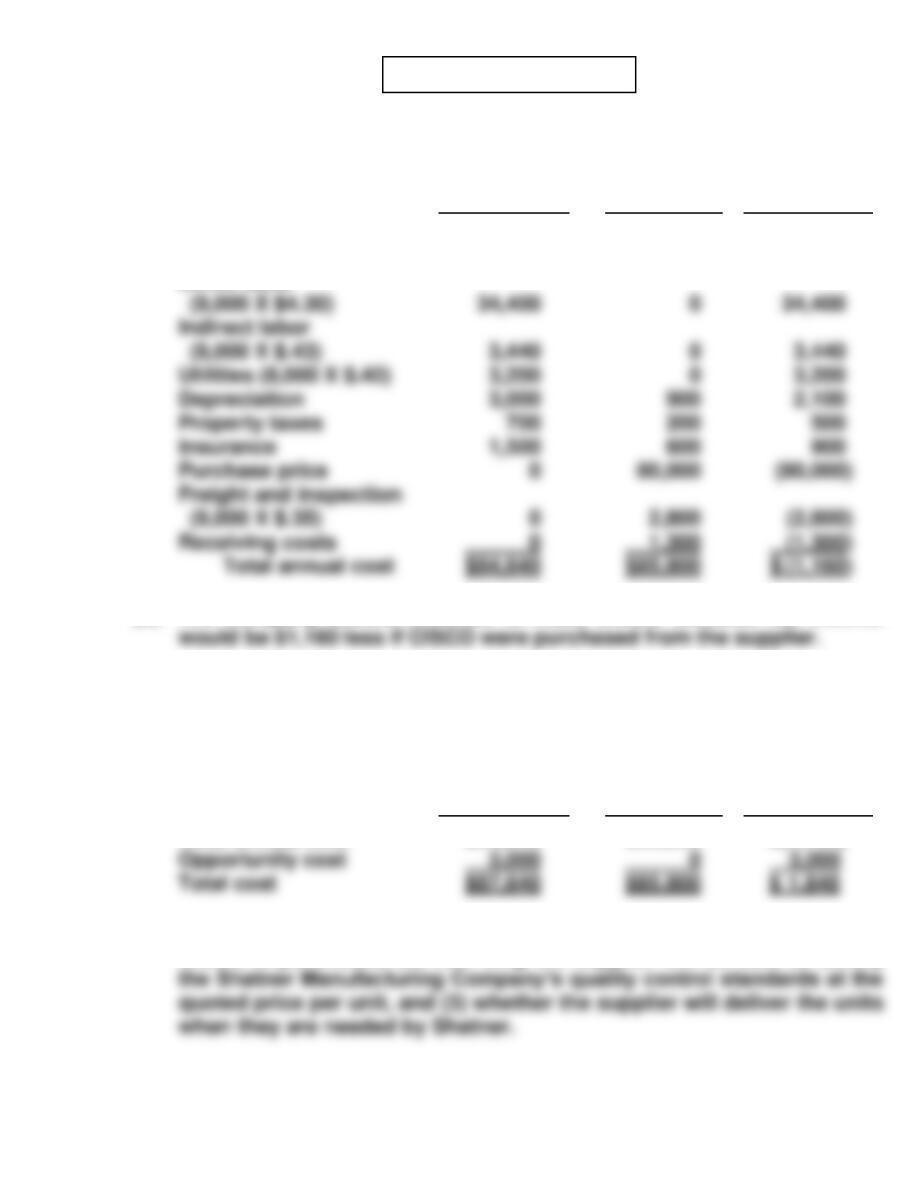
Revenues (10,000 X $28)
$0
$280,000
$ 280,000
(1) Variable costs = $3,600,000 – $960,000 = $2,640,000;
(2) Variable costs = $405,000 – $225,000 = $180,000;
(b) Yes, the special order should be accepted because net income will
increase by $37,500.
PROBLEM 7-2A
(a)
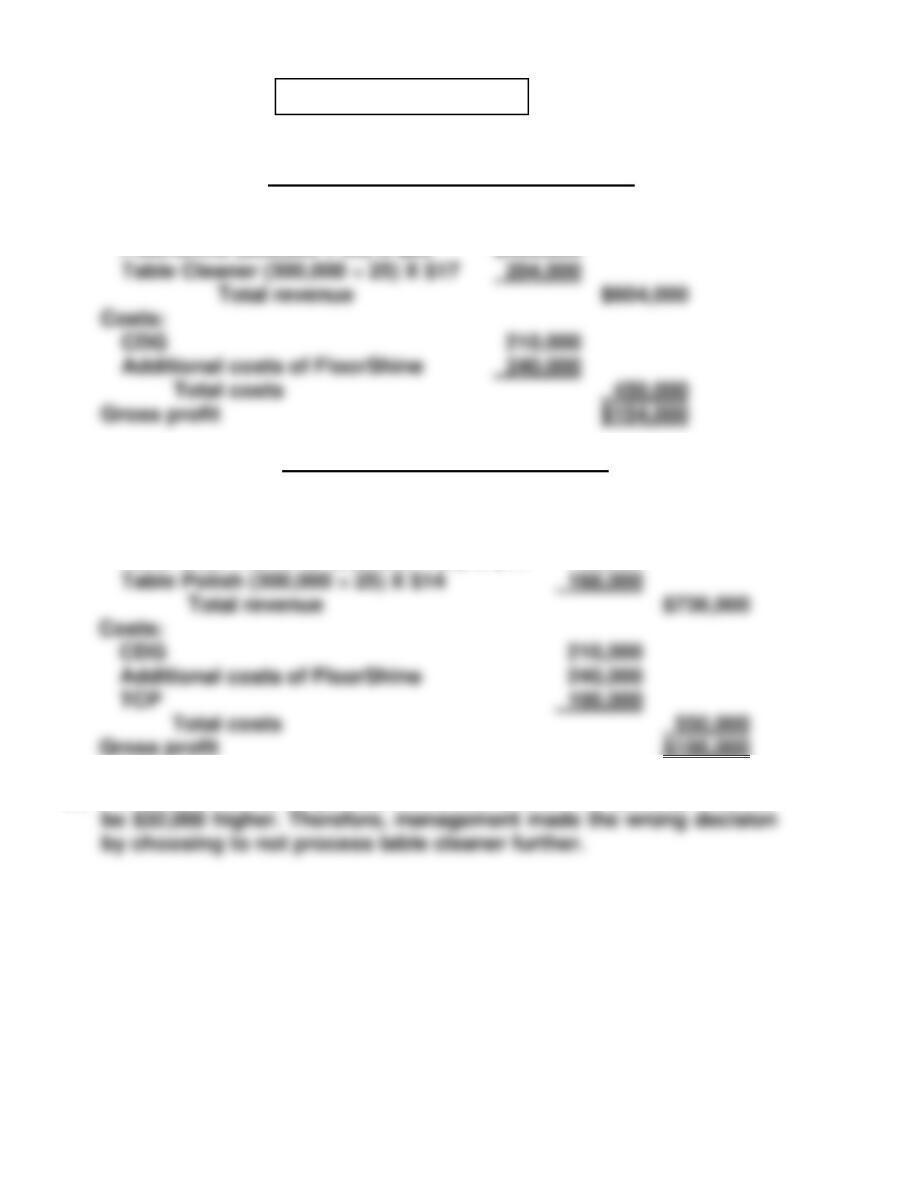
Make CISCO
Buy CISCO
Net Income
Increase
(Decrease)
Direct materials
(8,000 X $4.80)
Direct labor
$38,400
$ 0
($38,400)
(b) The company should continue to make CISCO because net income
(c) The decision would be different. Because of the opportunity cost of
$3,000, net income will be $1,840 higher if CISCO is purchased as
shown below:
Make CISCO
Buy CISCO
Net Income
Increase
(Decrease)
Total annual cost
$84,640
$85,800
$(1,160)
(d) Nonfinancial factors include: (1) the adverse effect on employees if
CISCO is purchased, (2) how long the supplier will be able to satisfy
PROBLEM 7-3A
(a) (1)
Table Cleaner Not Processed Further
Sales:
FloorShine (600,000 ÷ 30) X $20
$400,000
(2)
Table Cleaner Processed Further
Sales:
FloorShine
$400,000
Table Stain Remover (300,000 ÷ 25) X $14
168,000
Total revenue
$736,000
Costs:
Additional costs of FloorShine
240,000
TCP
Total costs
Gross profit
$186,000
(3) If the table cleaner is processed further overall company profits will
Table Cleaner (300,000 ÷ 25) X $17
Costs:
CDG
Total costs
Gross profit
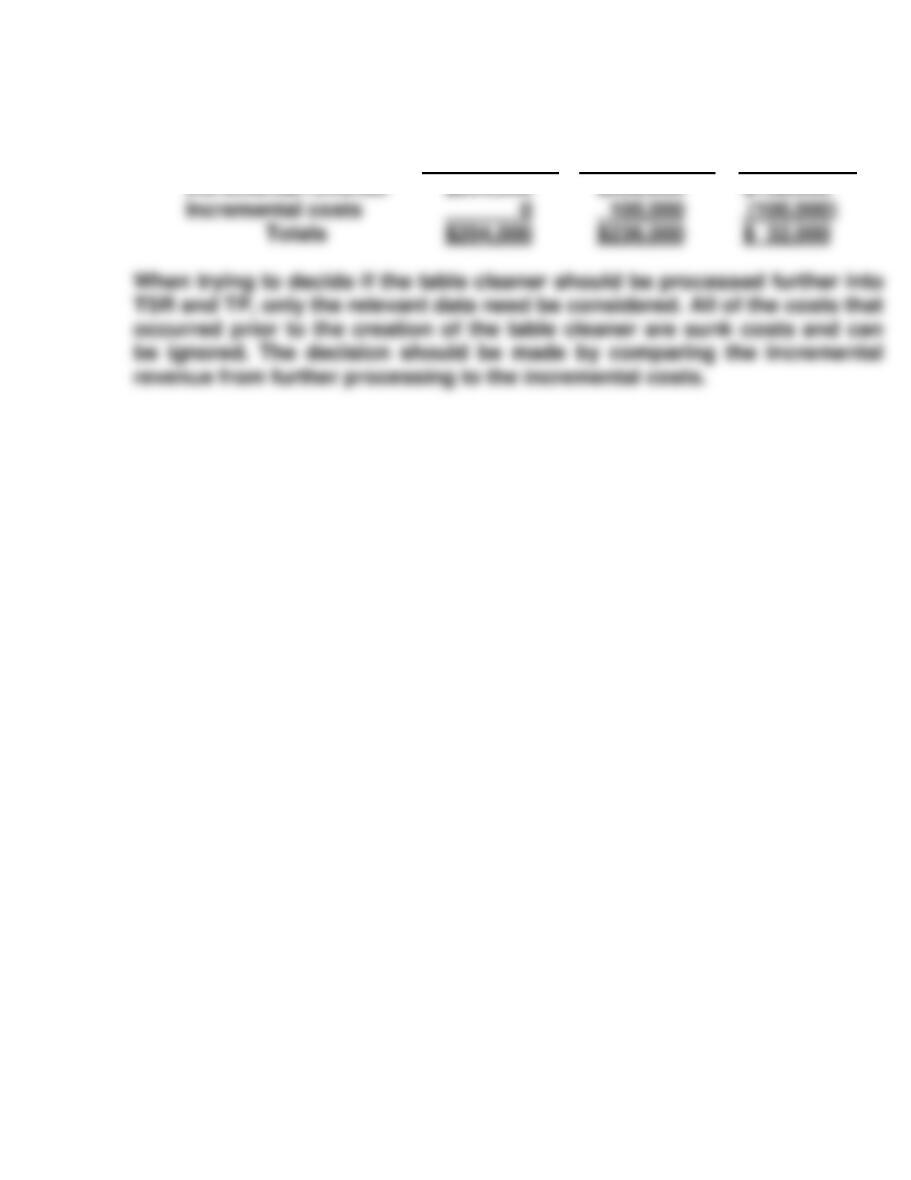
PROBLEM 7-3A (Continued)
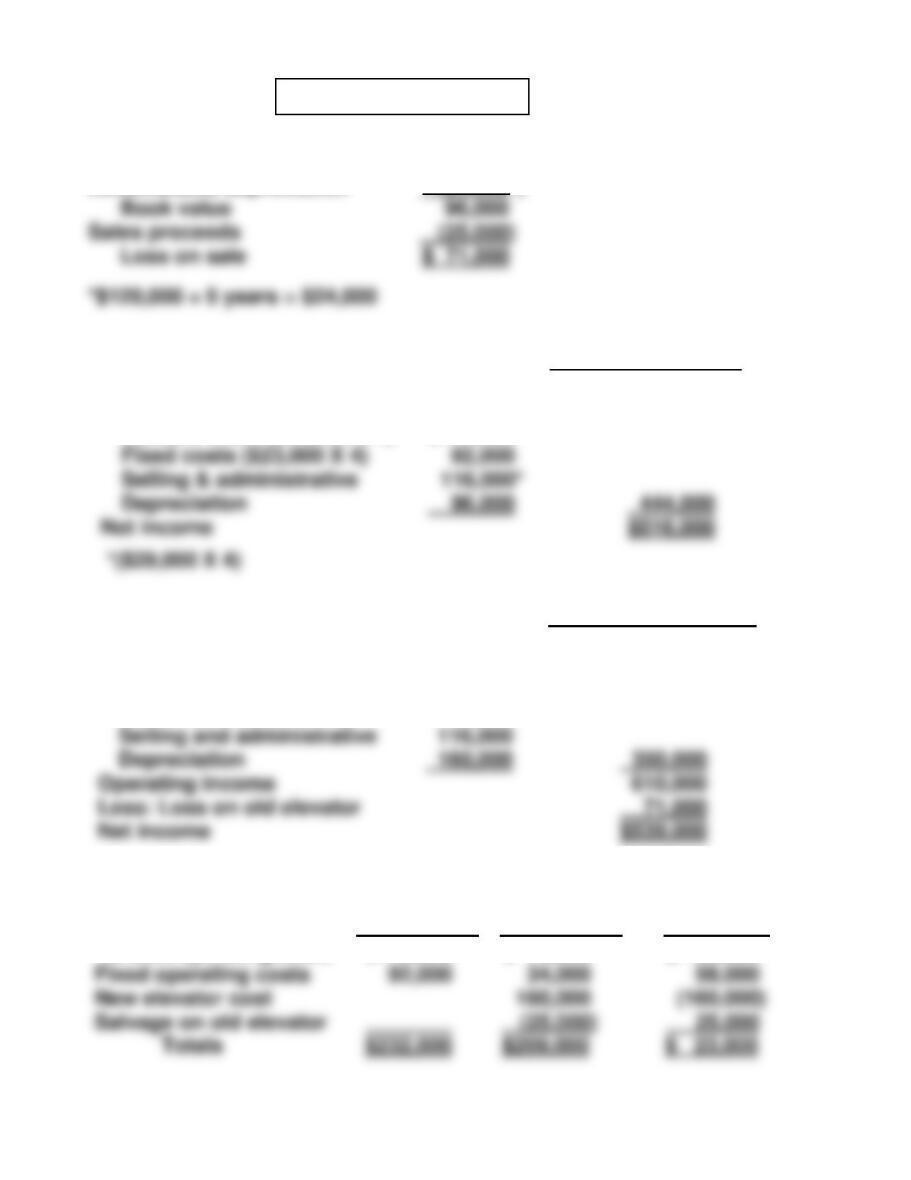
(b)
Don’t Process
Table Cleaner
Further
Process
Table Cleaner
Further
Net Income
Increase
(Decrease)
PROBLEM 7-4A
(a)
Cost
$120,000
Accumulated depreciation
(24,000*)
(b) (1)
Retain Old Elevator
Revenues ($240,000 X 4 yrs.)
$960,000
Less costs:
Variable costs ($35,000 X 4)
$140,000
Fixed costs ($23,000 X 4)
Selling & administrative
Depreciation
96,000
Net income
$516,000
(2)
Replace Old Elevator
Revenues
$960,000
Less costs:
Variable costs ($10,000 X 4)
$ 40,000
Fixed costs ($8,500 X 4)
34,000
Selling and administrative
Depreciation
Operating income
Less: Loss on old elevator
71,000
Net income
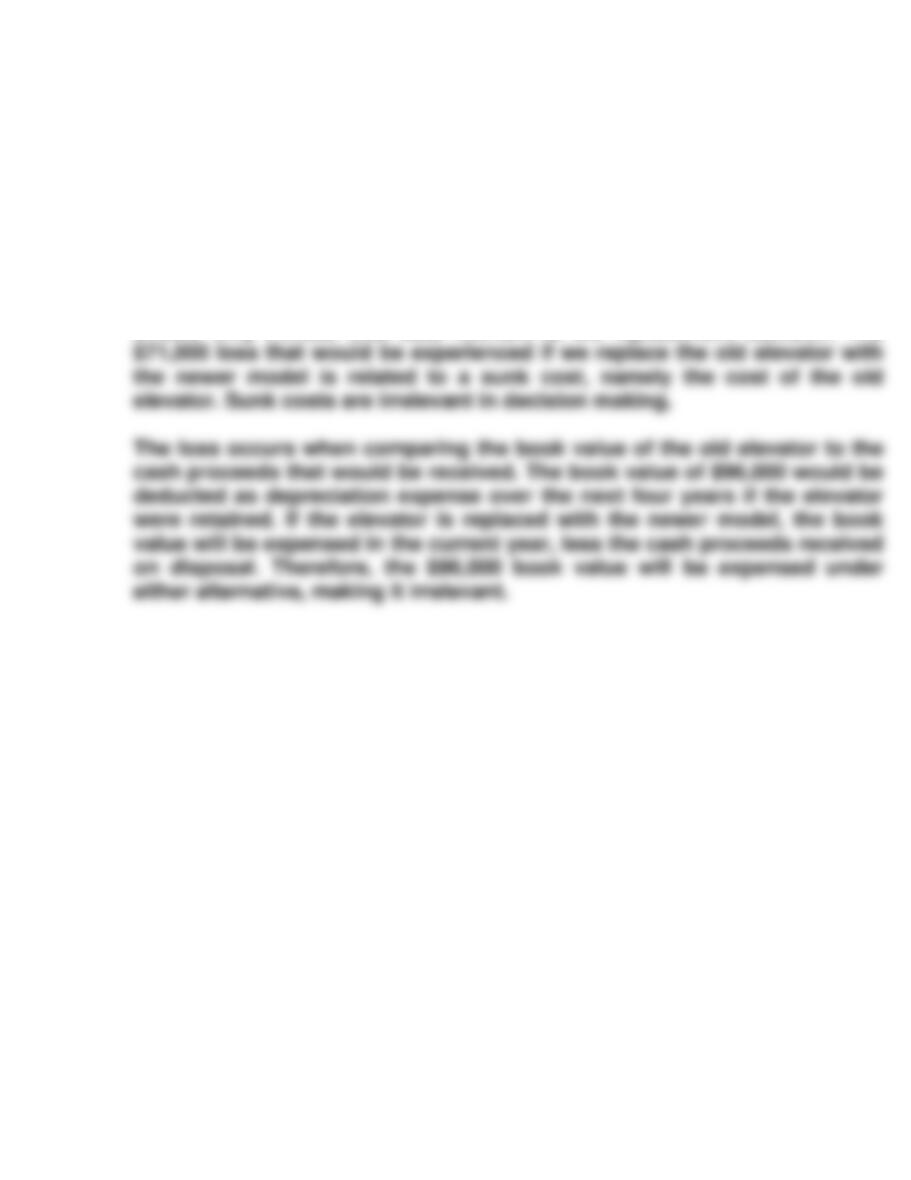
(c)
Retain
Old Elevator
Replace
Old Elevator
Net Income
Increase
(Decrease)
Variable operating costs
$140,000
$ 40,000
$ 100,000
New elevator cost
Book value
Sales proceeds
(25,000)
Loss on sale
PROBLEM 7-4A (Continued)
(d) MEMO
TO: Ron Richter
FROM: Student
SUBJECT: Relevant Data for Decision to Replace Old Elevator
When deciding whether or not to replace any old equipment, the analysis
should only include cost data relevant to the replacement decision. The
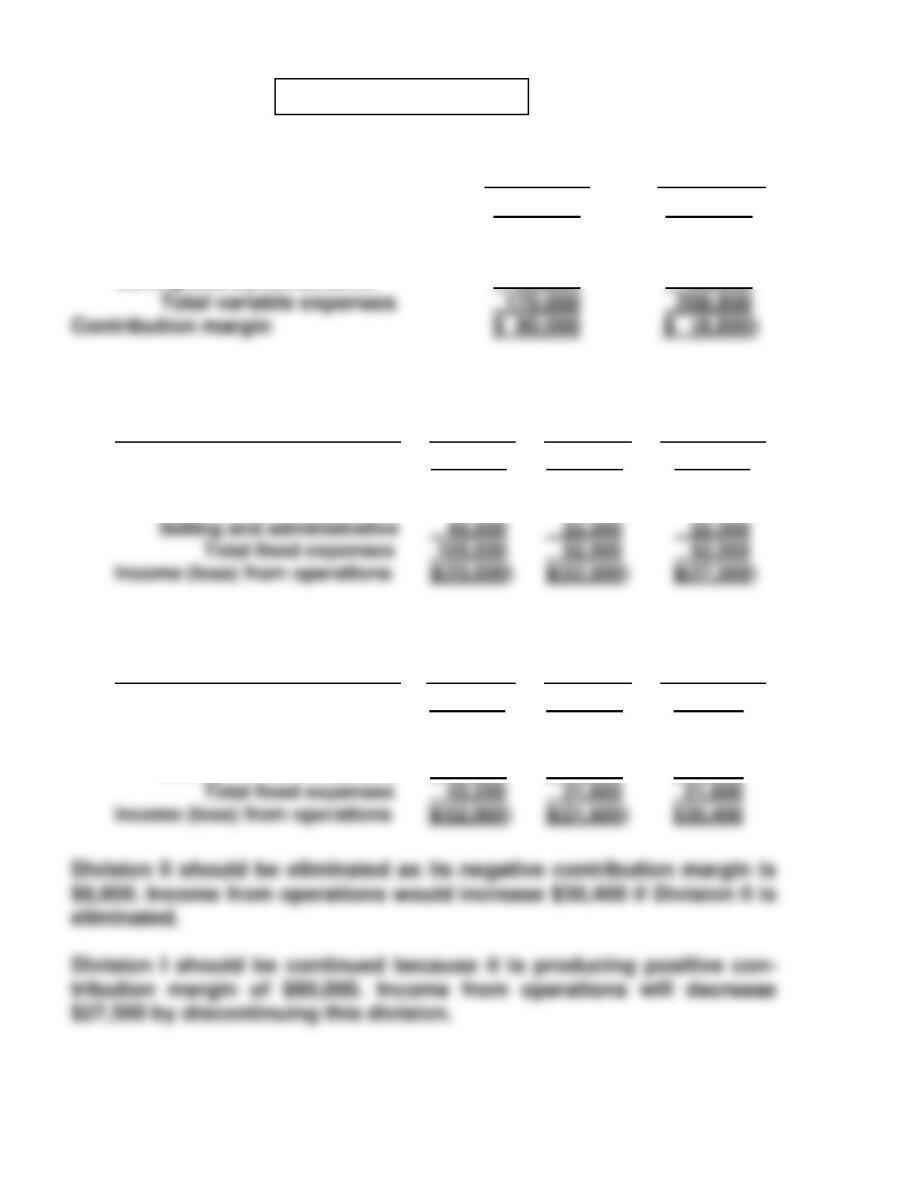
PROBLEM 7-5A
(a)
Division I
Division II
Sales
Variable costs
Cost of goods sold
Selling and administrative
$250,000
140,000
30,000
$200,000
172,800
36,000
(b)
(1)
Division I
Continue
Eliminate
Net Income
Increase
(Decrease)
Selling and administrative
(45,000)
(22,500)
Contribution margin (above)
Fixed costs
Cost of goods sold
$(80,000)
(60,000)
$( 0)
(30,000)
$(80,000)
30,000
(2)
Division II
Continue
Eliminate
Net Income
Increase
(Decrease)
Contribution margin (above)
Fixed costs
Cost of goods sold
Selling and administrative
$ (8,800)
(19,200
( 24,000
$( 0)
( 9,600)
(12,000)
$ 8,800
( 9,600
15,000
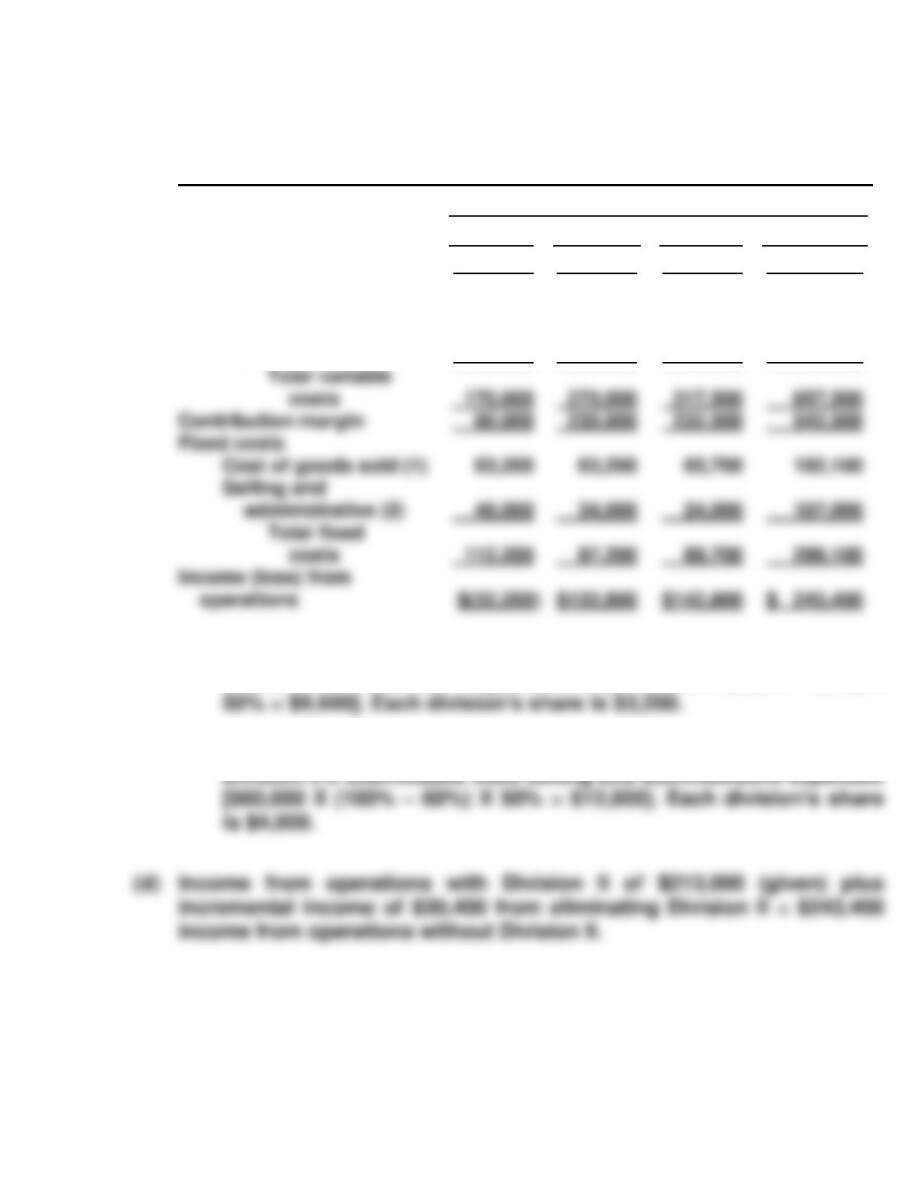
PROBLEM 7-5A (Continued)
(c) BRISLIN COMPANY
CVP Income Statement
For the Quarter Ended March 31, 2017
Divisions
I
III
IV
Total
Sales
Variable costs
Cost of goods sold
Selling and
administrative
$250,000
140,000
30,000
$500,000
240,000
30,000
$450,000
187,500
30,000
$1,200,000
567,500
90,000
(1) Division’s fixed cost of goods sold plus 1/3 of Division II’s
unavoidable fixed cost of goods sold [$192,000 X (100% – 90%) X
(2) Division’s fixed selling and administrative expense plus 1/3 of
operations
)
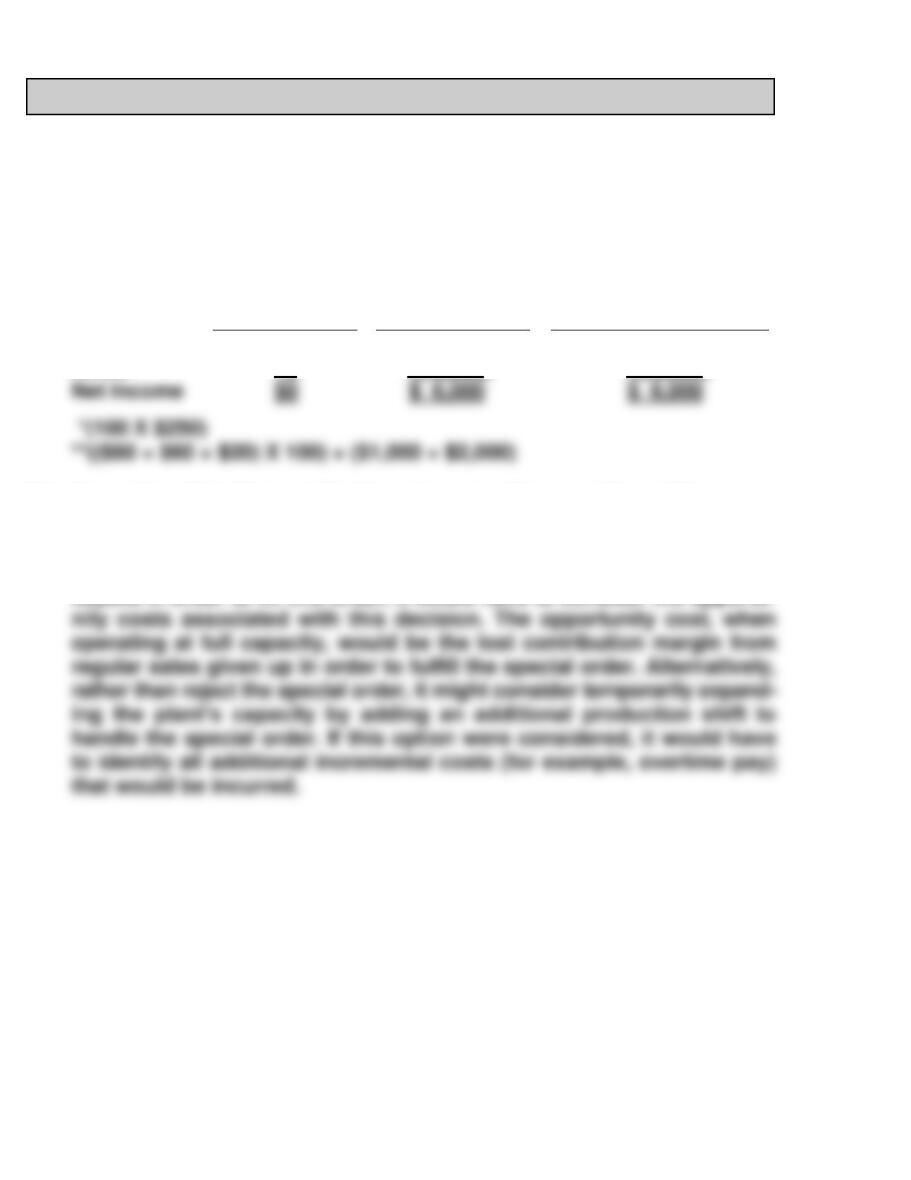
CD7 CURRENT DESIGNS
Situation #1
(a) Current Designs should accept the special order based on the following
calculations:
Reject Order
Accept Order
Net Income
Increase (Decrease)
Revenues
$0
$25,000*
$25,000
Costs
0
(19,000)**
(19,000)
(b) Assuming that Current Designs is currently operating with excess
capacity, it should accept the order based on the calculations shown
in part (a). If Current Designs is currently operating at full capacity, it
would have to weigh its options. If it displaced production of regular
kayaks in order to fill this order, it would have to consider the opportu–
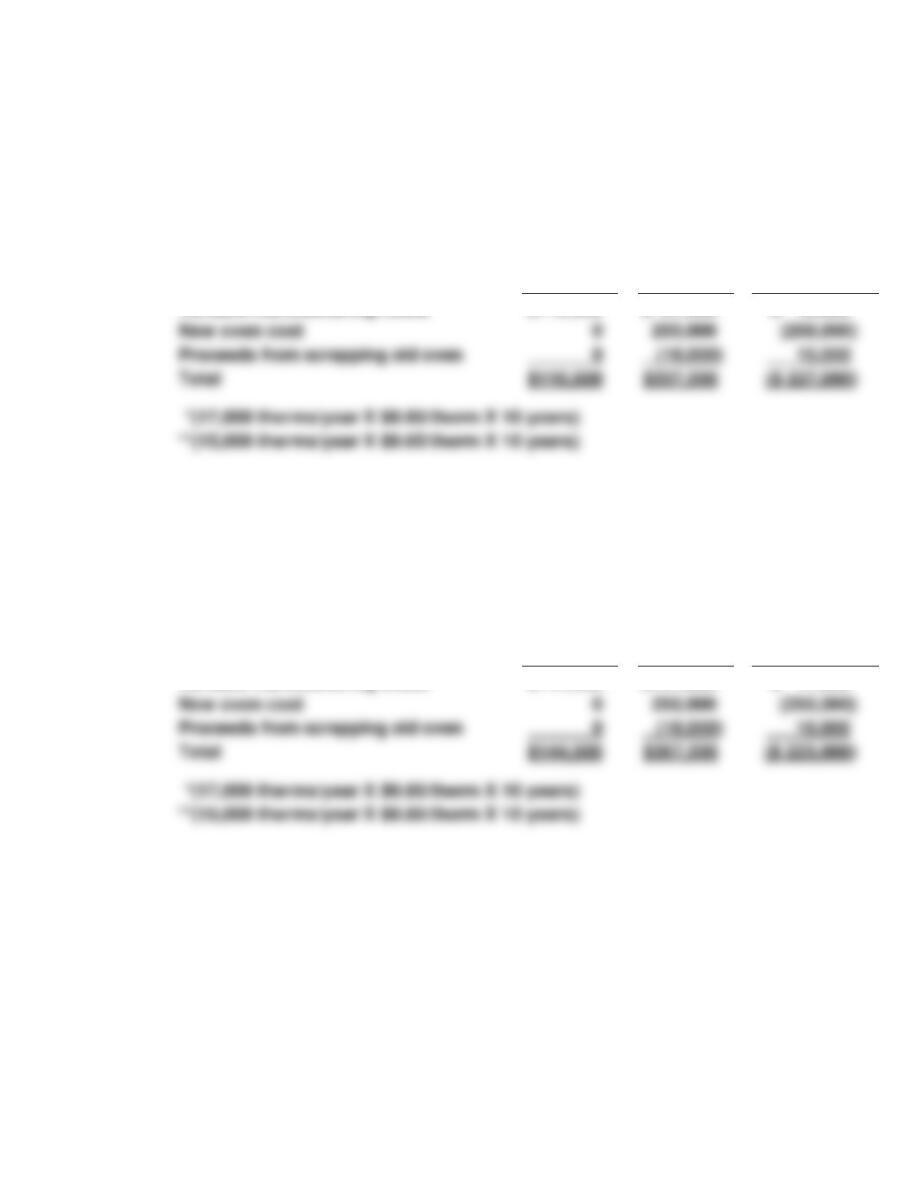
CD7 (Continued)
Situation #2
(a) Current designs should not replace the Rotomold oven based on the
following calculations:
Retain
Oven
Replace
Oven
Net Income
Increase
(Decrease)
Variable manufacturing costs
$110,500*
$ 97,500**
$ 13,000
(b) Even with the cost of natural gas increasing at a faster than expected
rate, Current Designs still should not replace the Rotomold oven as the
rate increase does not cover the cost of the new oven based on the
following calculations:
Retain
Oven
Replace
Oven
Net Income
Increase
(Decrease)
Variable manufacturing costs
$144,500*
$127,500**
$ 17,000
New oven cost
Proceeds from scrapping old oven
0
Total
$144,500
New oven cost
Proceeds from scrapping old oven
0
Total
$110,500
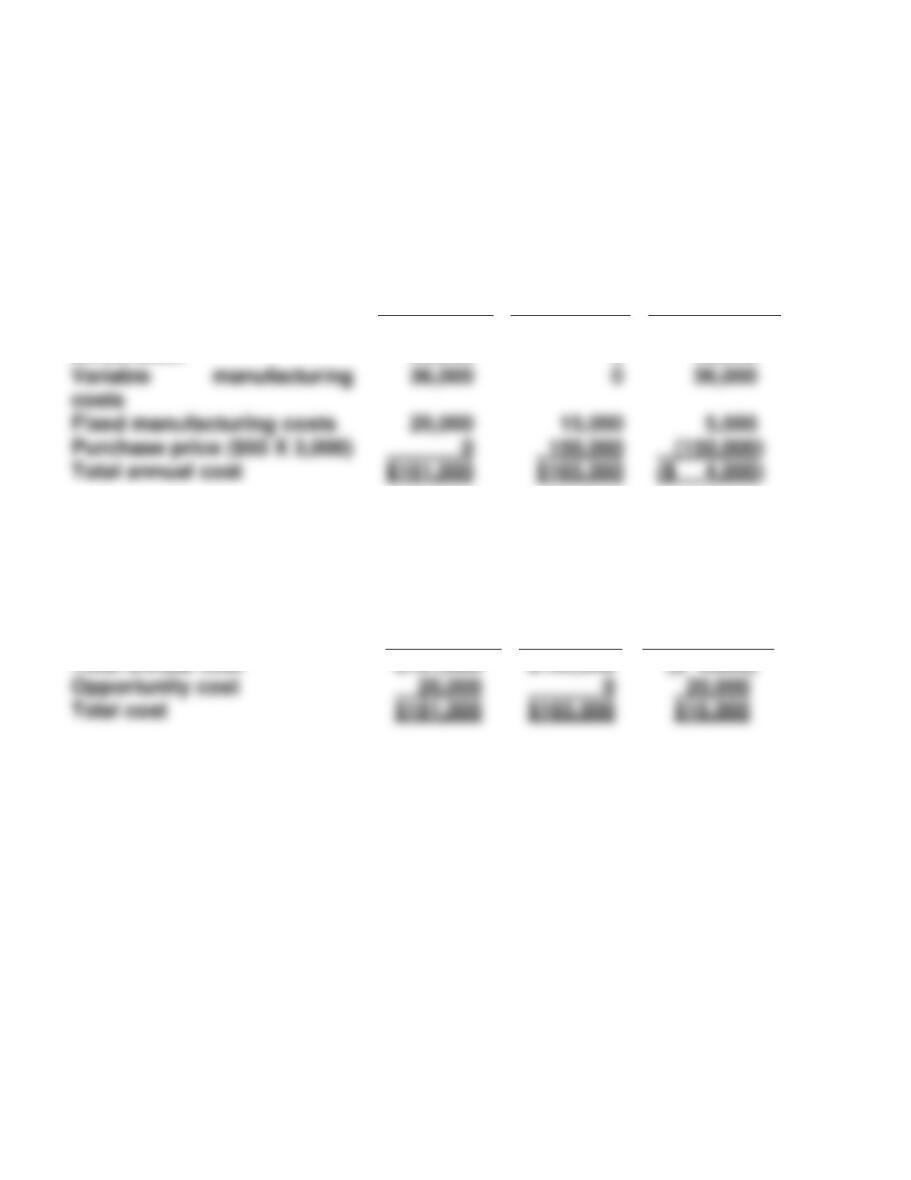
CD7 (Continued)
Situation #3
(a) Current Designs should make the seats based on the following calcu-
lations:
Make
Buy
Net Income
Increase
(Decrease)
Direct materials
$ 60,000
$ 0
$ 60,000
Direct labor
45,000
0
45,000
(b) When the opportunity cost of $20,000 is considered, Current Designs
should buy the seats based on the following calculations:
Make
Buy
Net Income
Increase
(Decrease)
Total annual cost
$161,000
$165,000
($ 4,000)
Opportunity cost
20,000
0
Total cost
$181,000
$165,000
$16,000
costs
Fixed manufacturing costs
20,000
Purchase price ($50 X 3,000)
0
(150,000)
Total annual cost
$161,000
$165,000
($ 4,000)
BYP 7-1 DECISION-MAKING ACROSS THE ORGANIZATION
Retain
Old Machine
Purchase
New Machine
Net Income
Increase
(Decrease)
Sales
Costs and expenses
Cost of goods sold
$6,000,000
4,500,000
(1)
(3)
$6,600,000
4,620,000
(2)
(4)
($ 600,000
( (120,000)
(1) 12,000 X $100 X 5 years = $6,000,000.
(2) $6,000,000 X 110% = $6,600,000.
The new machine should be purchased. The incremental analysis shows
BYP 7-2 MANAGERIAL ANALYSIS
(a)
Make
Buy—
Trans-
Tech
Buy—
Omega
Sales Revenue
Variable Manufacturing Cost:
Circuit Board
Plastic Case
Alarms (4 @ $.15 each)
$ 14.50
2.00
0.80
0.60
$ 14.50
0
0
0
$ 14.50
0
0
0
(b) There are several important nonfinancial factors described in the case.
Other factors might be identified as well. The factors described are:
The company is having serious difficulty manufacturing the clocks.
Therefore, it would probably be willing to have someone else manu–
facture the clocks, even if it cost more to do so. The most promising
Total Manufacturing Cost

BYP 7-2 (Continued)
(c) Many answers are possible, depending upon each student’s assessment
of the seriousness of the issues mentioned in (b). One answer would
be: The company should use Omega to manufacture the Kmart order.
BYP 7-3 REAL-WORLD FOCUS
(a) Before building the special-order new ceiling fans, company manage-
ment must consider the effect of the new lines on current production
capacity, existing and available channels of distribution, the effect on
BYP 7-4 REAL-WORLD FOCUS
(a) The types of outsourcing services that the company provides assis-
tance on are:
Information technology outsourcing, finance and accounting, human re–
(b) Insourcing means to take work that is currently being performed by an
outside service provider back in–house. For example, collections of
BYP 7-5 COMMUNICATION ACTIVITY
To: Preston Thiese—Plant Manager
From: Hank Jewel—Production Manager
I have spent considerable time thinking about the dilemma created by the
new PDD1130 machine. Clearly, it is far superior to our existing machine.
There is no question that it would save us tremendous amounts of money.
I hope I am not overstepping my bounds here, but I just reviewed a chapter
BYP 7-6 ETHICS CASE
(a) Many factors need to be considered when determining whether to
close a division. The loss of jobs can have a devastating impact on a
community and on the morale of remaining employees. From a
financial perspective, closing a division that is reporting losses will not
(b) It is not unusual to reevaluate fixed cost allocations periodically. However,
the allocation should be based on the underlying economics of the
situation rather than the motives of individuals.
BYP 7-7 ALL ABOUT YOU
(a) Chronic homelessness is defined as being on the streets for a year
or more.
(b) Homelessness costs cities money because the chronic homeless have
frequent jail time, shelter costs, emergency room visits and hospital stays.
Some costs per city per homeless person are: New York $40,000; Dallas
$50,000; San Diego $150,000.
(c) The first step is to try to identify the size of the problem by doing street
counts. From this count, benchmarks can be set, enabling a reward
BYP 7-8 CONSIDERING YOUR COSTS AND BENEFITS
Discussion guide: This is a very difficult decision. All of the evidence
suggests that your short-term and long-term prospects will be far greater
with some form of post–high-school degree. Because of this, we feel strongly