
Financial Accounting, 10/e 7-21
E7–11. (continued)
Req. 3
When prices are falling, the opposite effect occurs–LIFO produces higher net income and
less favorable cash flow than does FIFO. Thus LIFO is preferable in terms of net income,
and FIFO is preferable for income tax purposes.
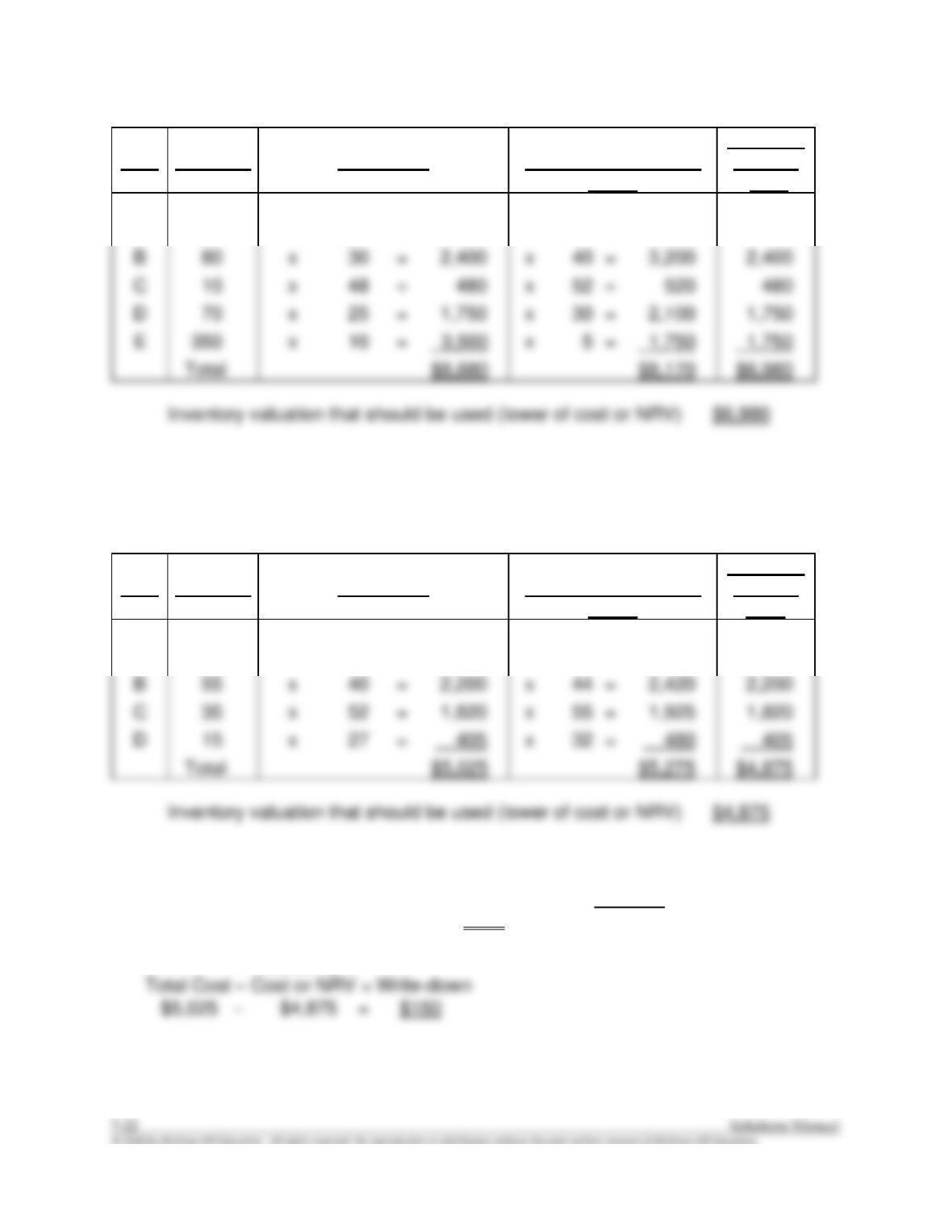
E7–12.
Item
Quantity
Total Cost
Total Net Realizable
Value
Lower of
Cost or
NRV
A
50
x
$15
=
$ 750
x
$12
=
$600
$ 600
B
80
x
=
2,400
x
=
C
10
x
=
x
=
520
D
70
x
=
x
=
2,100
E
x
=
x
=
$8,170
E7–13.
Req. 1
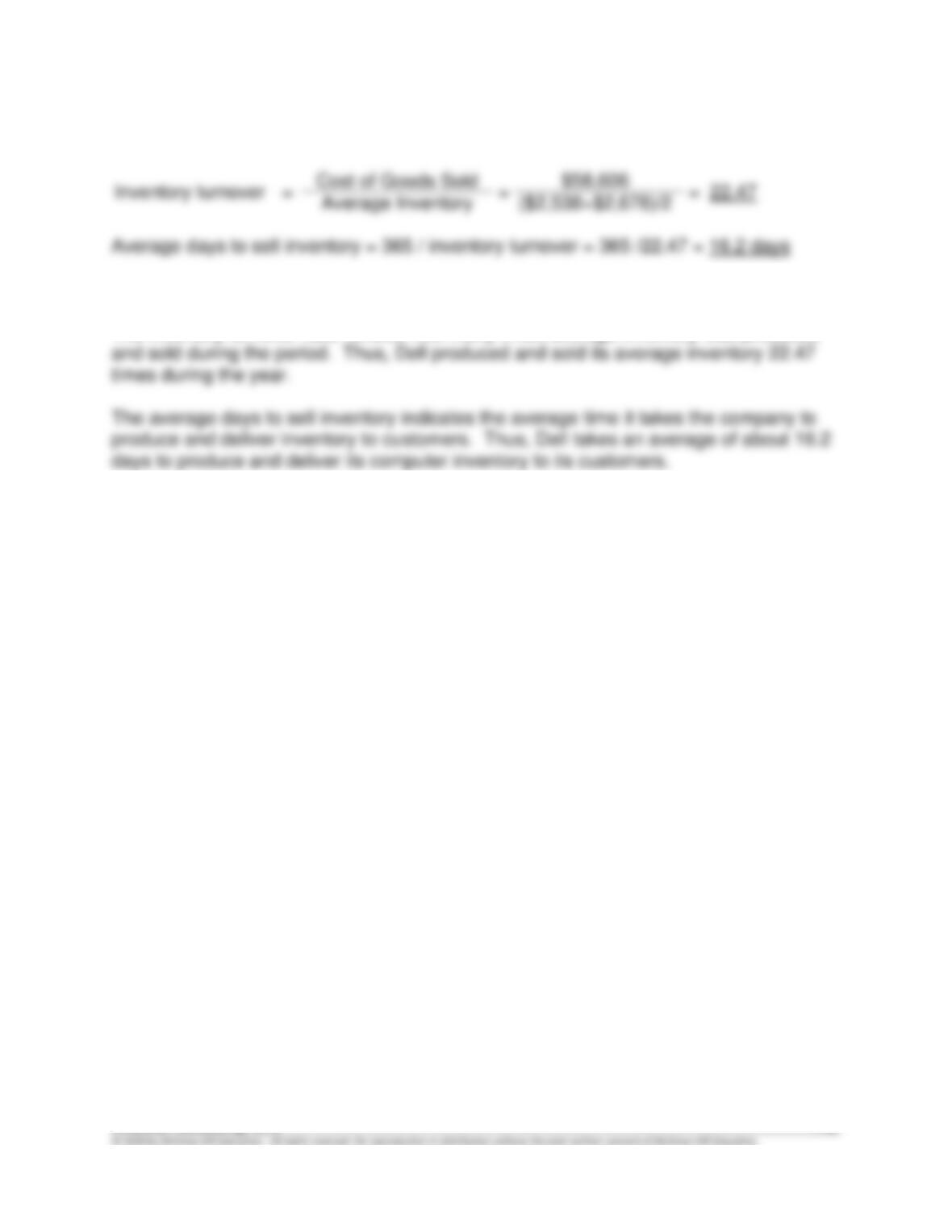
Item
Quantity
Total Cost
Total Net Realizable
Value
Lower of
Cost or
NRV
A
30
x
$20
=
$ 600
x
$15
=
$ 450
$ 450
B
55
x
=
x
=
2,420
C
35
x
=
x
55
=
D
x
=
x
32
=
$5,025
$5,275
Req. 2
The write-down to lower of cost or net realizable value will increase cost of goods sold
expense by the amount of the write-down, $150:
Lower of
Financial Accounting, 10/e 7-23
E7–14.
(dollar amounts in millions)
Req. 1
Req. 2
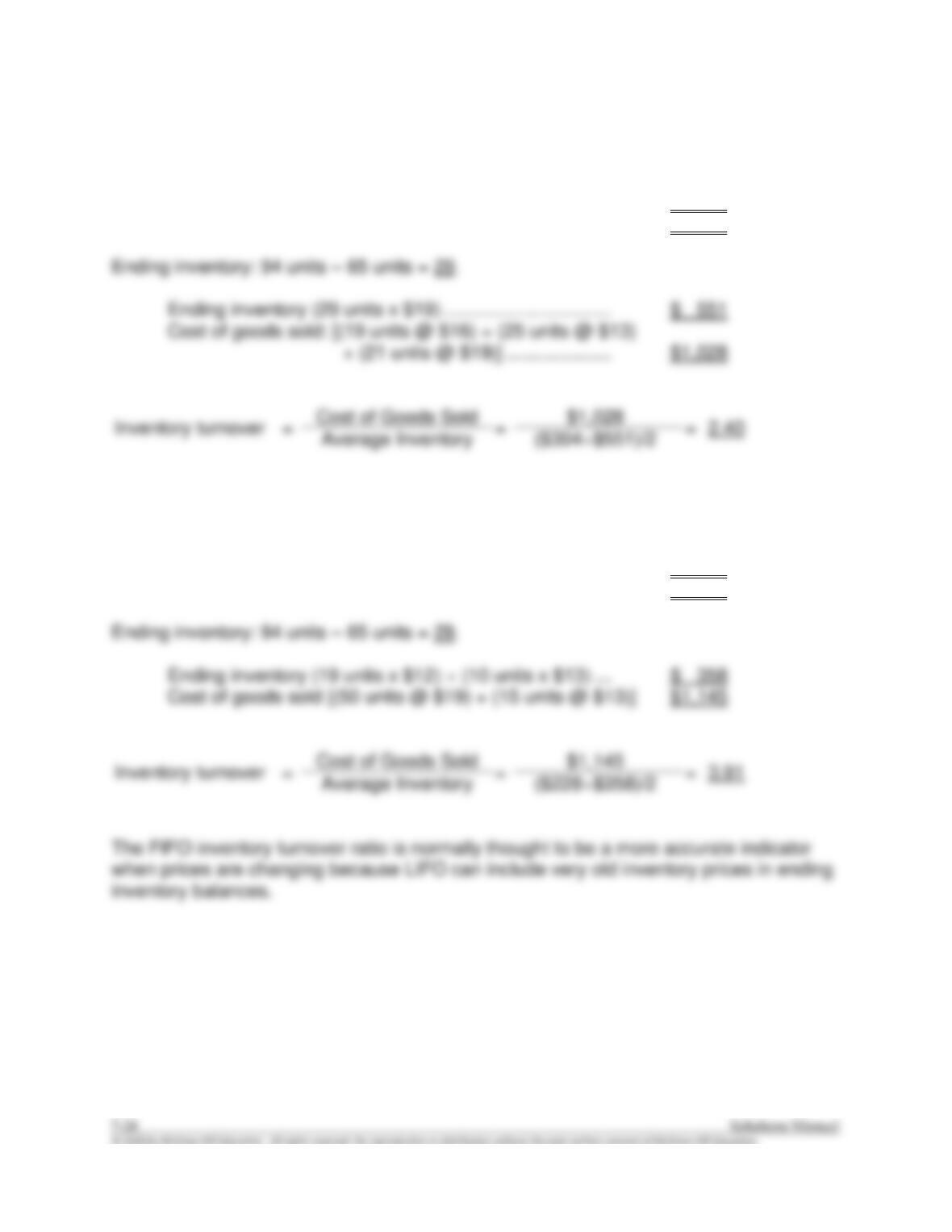
The inventory turnover ratio reflects how many times average inventory was produced
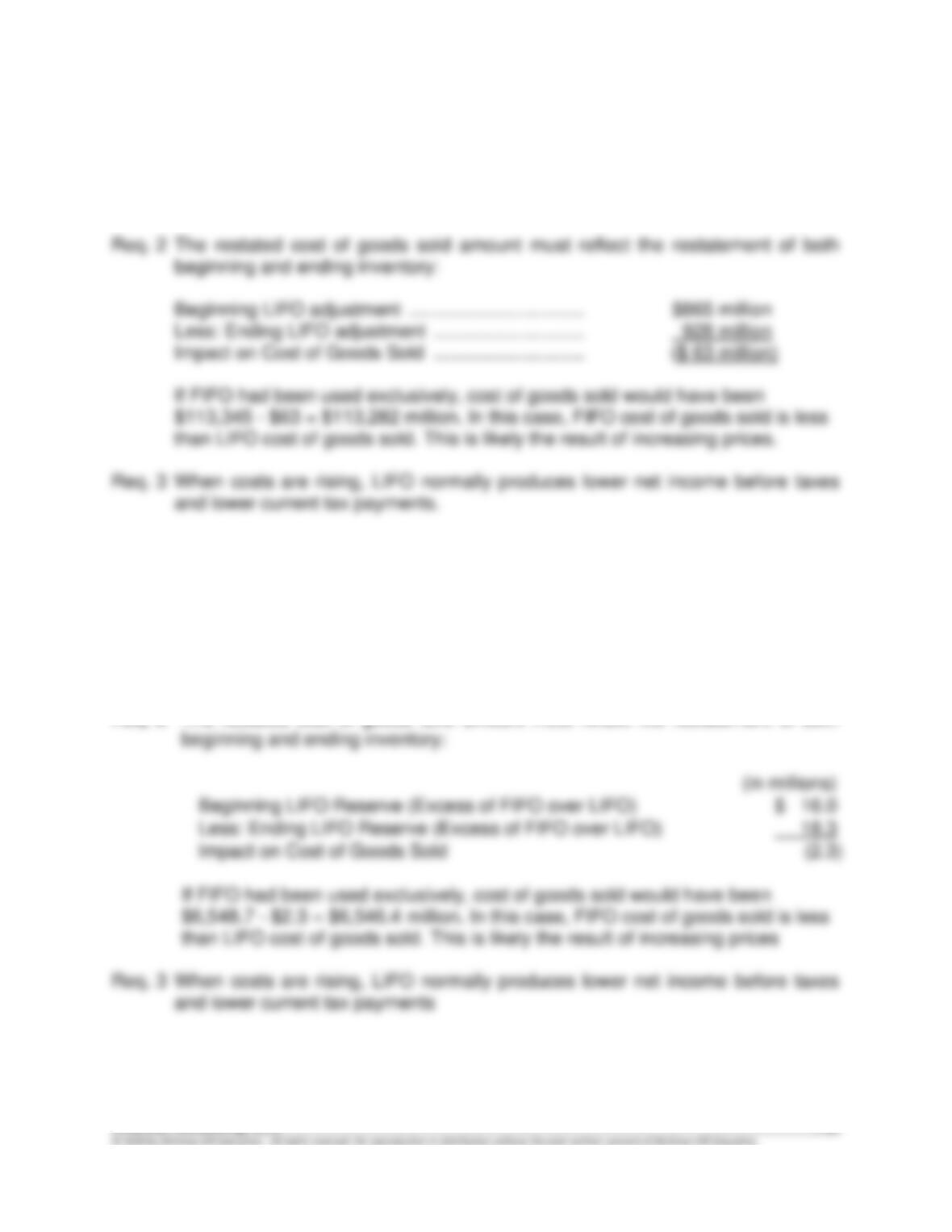
E7–15.
FIFO:
Goods available for sale for FIFO:
Units (19 + 25 + 50) …………………………………………….. 94
Amount ($304 + 325 + 950) ………………………………….. $1,579
LIFO:
Goods available for sale for LIFO:
Units (19 + 25 + 50) …………………………………………….. 94
Amount ($228 + 325 + 950) ………………………………….. $1,503
Financial Accounting, 10/e 7-25
E7–16.
(dollars in millions)
Req. 1 The reported ending inventory (using LIFO) for Ford was $5,901 million. If FIFO
were used exclusively, the ending inventory would have been $928 million higher
than reported, or $6,829 million.
E7–17.
(dollars in millions)
Req. 1 The reported ending inventory (using LIFO) was $505.7 million. If FIFO were
used exclusively, the ending inventory would have been $18.3 million higher than
reported, or $524.0 million.
Req. 2 The restated cost of goods sold amount must reflect the restatement of both
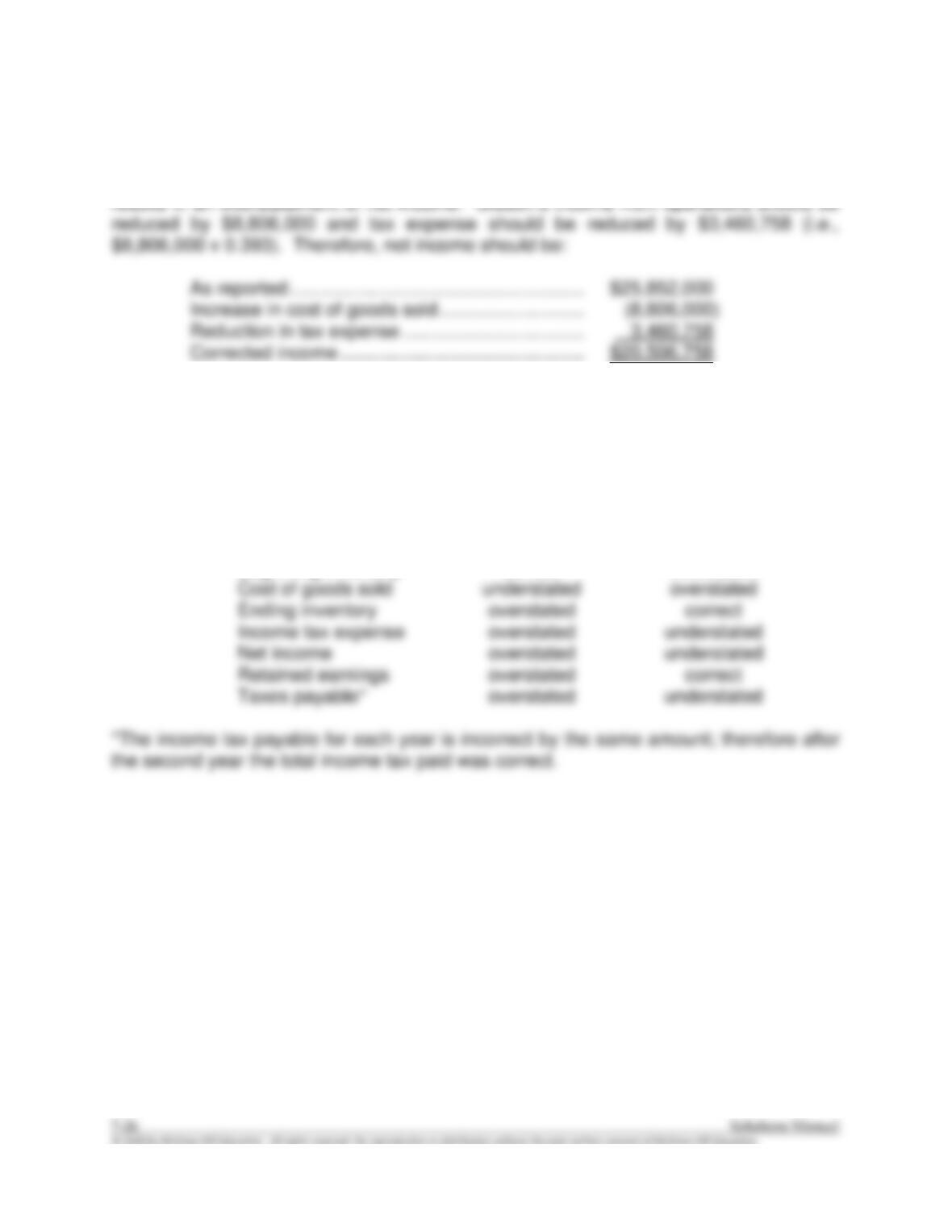
E7–18.
Req. 1
When the ending inventory is overstated, cost of goods sold is understated which in turn
Req. 2
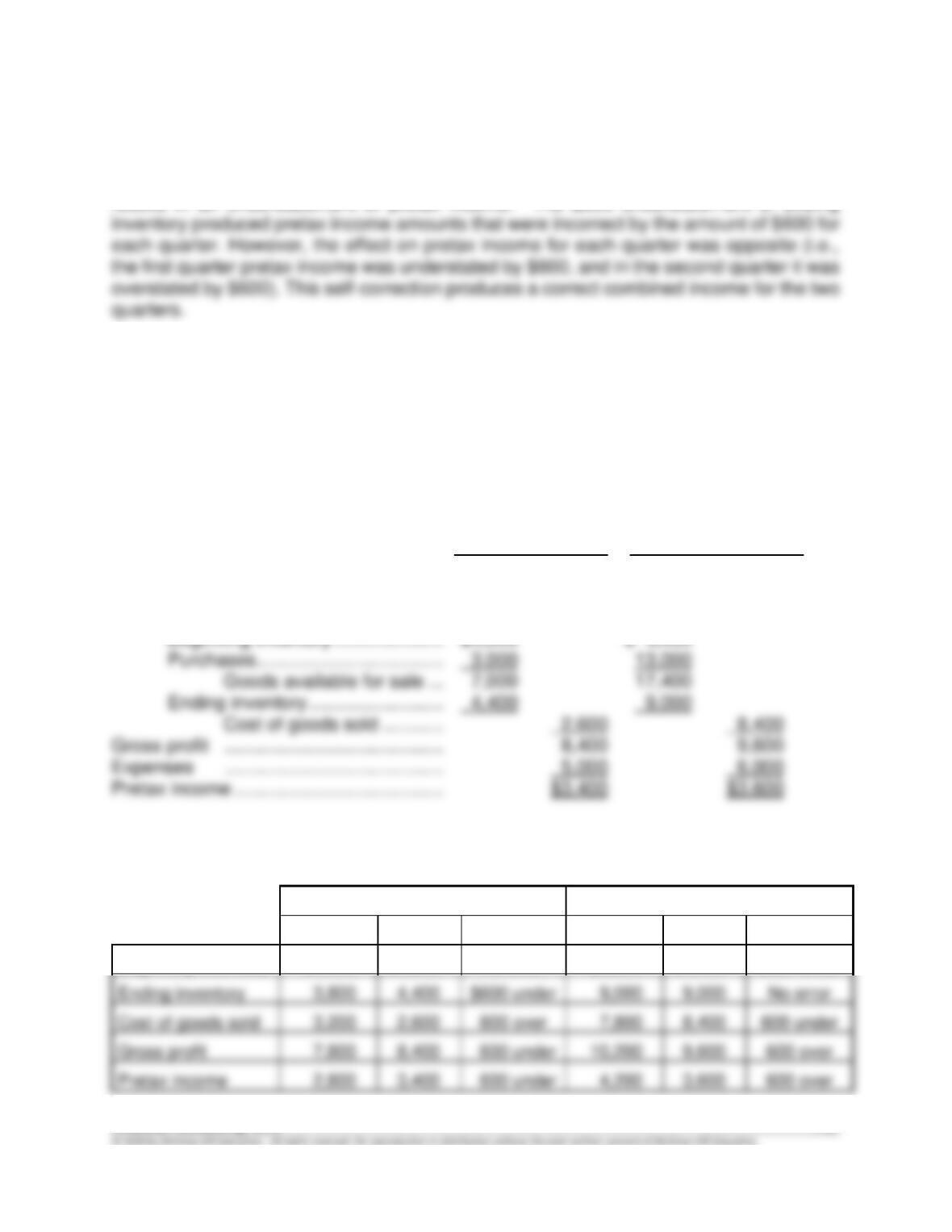
The incorrect accounts can be summarized as follows:
(a) Year of (b) Subsequent
Account Error Year
Beginning inventory correct overstated
Financial Accounting, 10/e 7-27
E7–19.
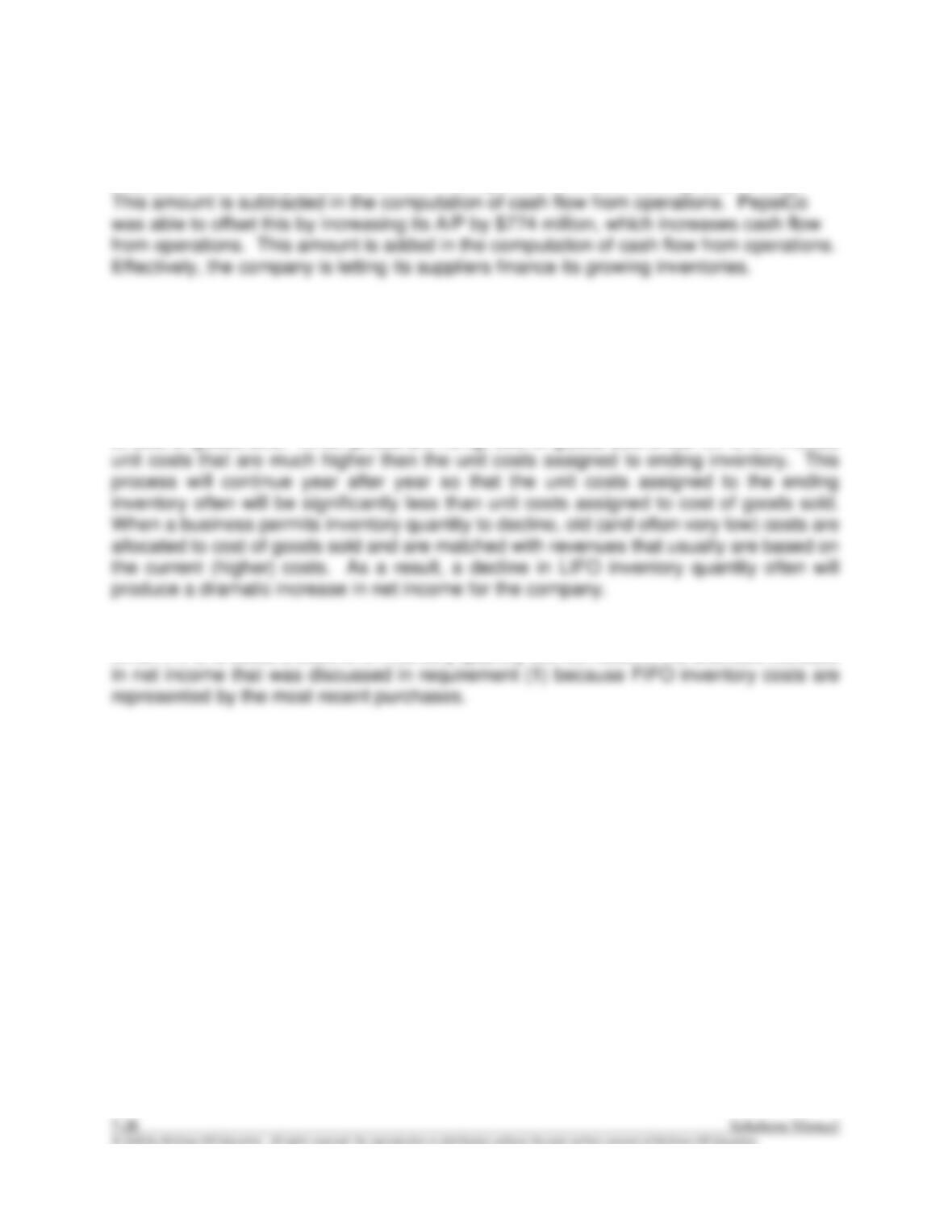
Req. 1
When the ending inventory is understated, cost of goods sold is overstated which in turn
results in an understatement of pretax income. The $600 understatement of ending
Req. 2
The error caused the pretax income for each quarter to be incorrect [see (1) above];
therefore, it produced incorrect EPS amounts for each quarter.
Req. 3
First Quarter Second Quarter
Sales revenue …………………………………. $11,000 $18,000
Cost of goods sold:
Req. 4
1st Quarter
2nd Quarter
Incorrect
Correct
Error
Incorrect
Correct
Error
Beginning inventory
$4,000
$4,000
No error
$3,800
$4,400
$600 under
Ending inventory
No error
Cost of goods sold
Gross profit
10,200
E7–20.
Current Year Previous Year Change
Increases in inventory cause cash flow from operations to decrease by $224 million.
E7–21. (Supplement A)
Req. 1
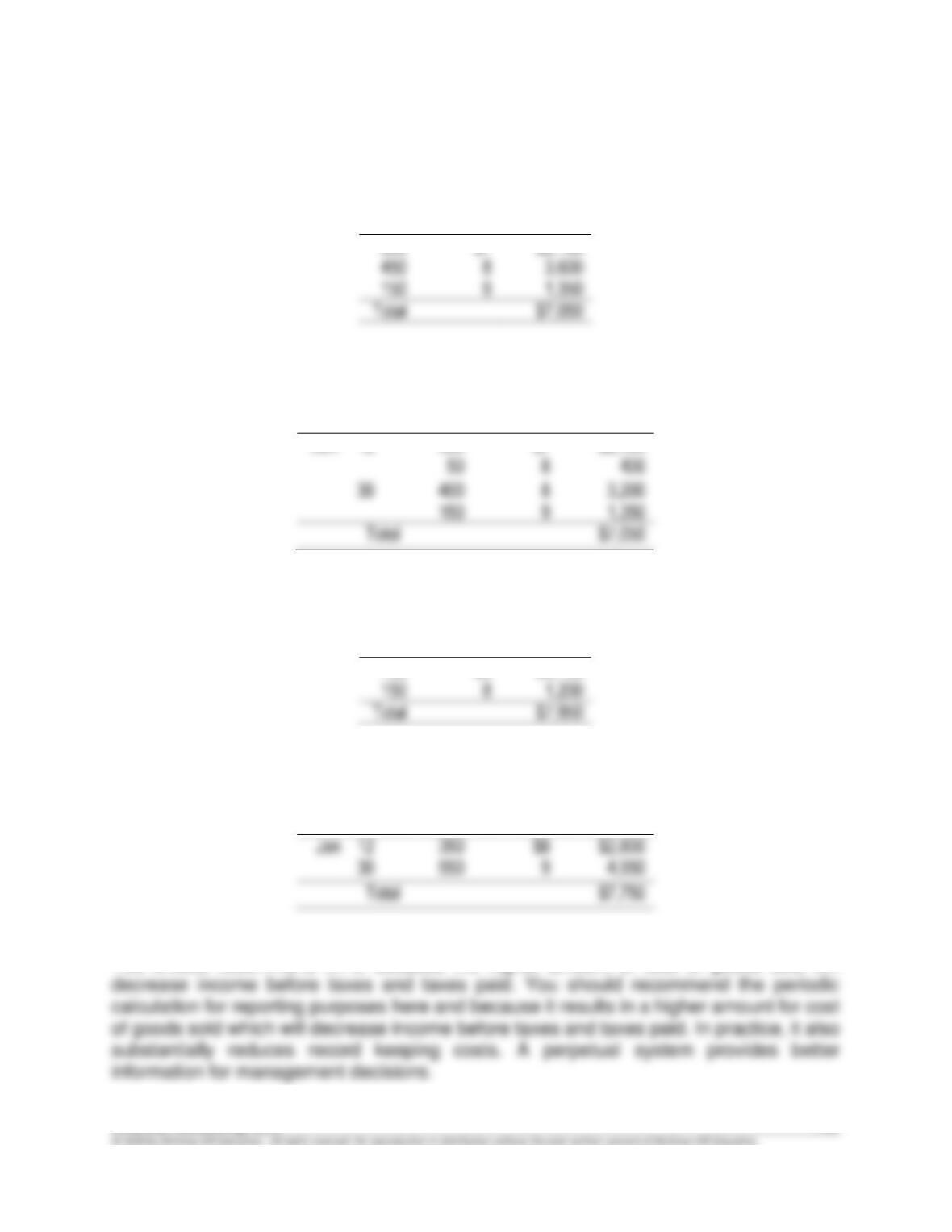
This actual footnote from ConocoPhillips illustrates the impact of “dipping into a LIFO
layer” or a LIFO liquidation. Under LIFO, the cost of recently purchased items is assigned
to cost of goods sold. When prices are rising, cost of goods sold under LIFO will include
Req. 2
When FIFO is used, a decline in inventory quantity will not result in the dramatic increase
Financial Accounting, 10/e 7-29
E7–22. (Supplement B)
Req. 1
a. First–In, First–Out (FIFO) Periodic Calculation:
Cost of Goods Sold
Units
Unit Cost
Total Cost
300
$7
$2,100
450
150
$7,050
b. First–In, First–Out (FIFO) Perpetual Calculation:
Cost of Goods Sold
Date
of Sale
Units
Unit Cost
Total Cost
Jan.
12
300
$7
$2,100
30
400
150
c. Last–In, First–Out (LIFO) Periodic Calculation:
Cost of Goods Sold
Units
Unit Cost
Total Cost
750
$9
$6,750
150
$7,950
d. Last–In, First–Out (LIFO) Perpetual Calculation:
Cost of Goods Sold
Date
of Sale
Units
Unit Cost
Total Cost
12
350
$8
$2,800
Req. 2
You should recommend LIFO because the higher amount of cost of goods sold will
E7–23. (Supplement C)
Req. 1
Accounts receivable (+A) ……………………………………………
1,500
Sales (+R, +SE) …………………………………………………….
1,500
Cost of goods sold (+E, −SE) ……………………………………….
975
Inventory (−A) ……………………………………………………….
975
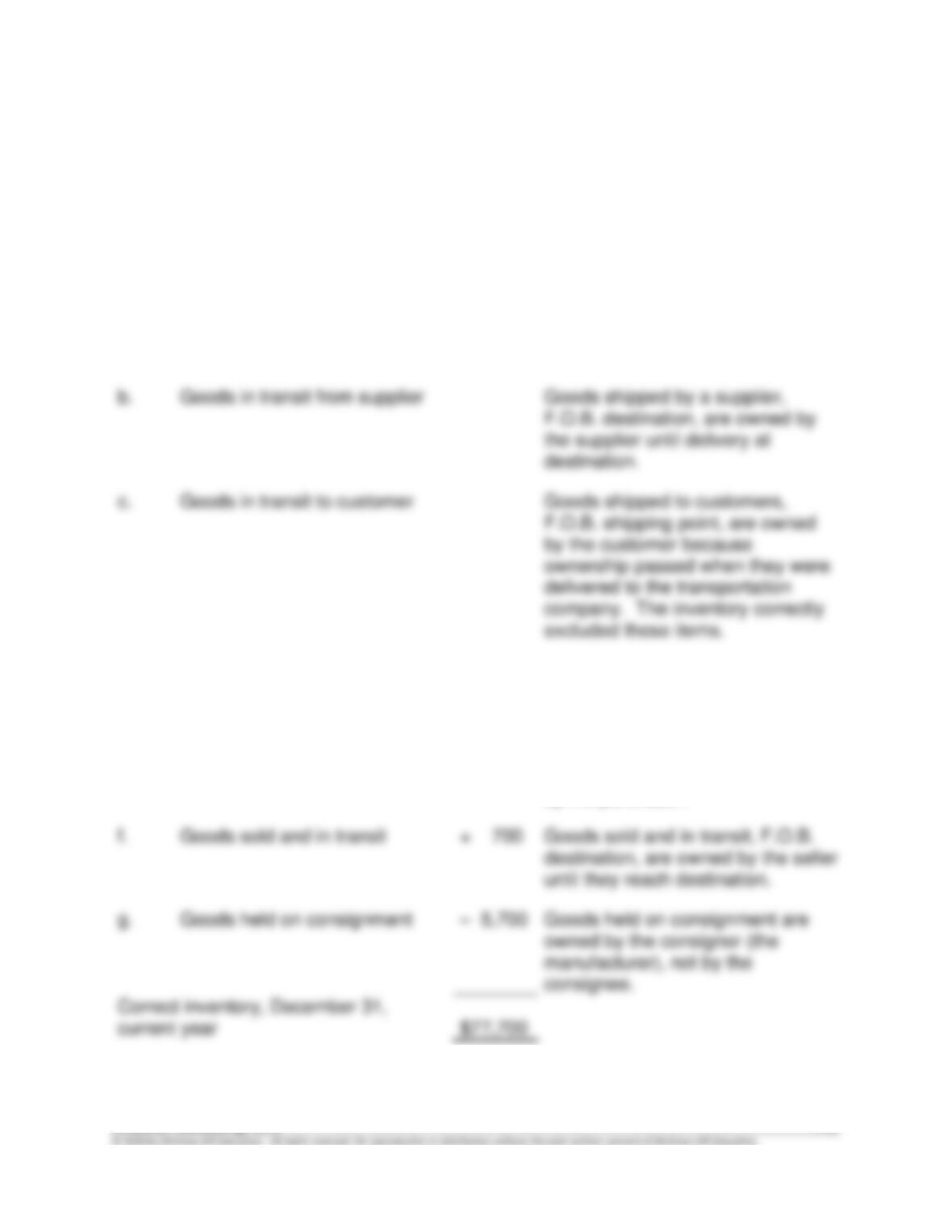
Req. 2
Cash (+A) ($1,500 x 0.98) ……………………………………………
1,470
Sales discounts (+XR, −R, −SE) ($1,500 x 0.02) ……………
Accounts receivable (−A) ………………………………………..
Req. 3
Cash (+A) ………………………………………………………………….
1,500
Accounts receivable (−A) ………………………………………..
Req. 4
Inventory (+A) ……………………………………………………………
Accounts payable (+L) ……………………………………………
Req. 5
Accounts payable (−L) ………………………………………………..
Req. 6
Accounts payable (−L) ………………………………………………..
Financial Accounting, 10/e 7-31
PROBLEMS
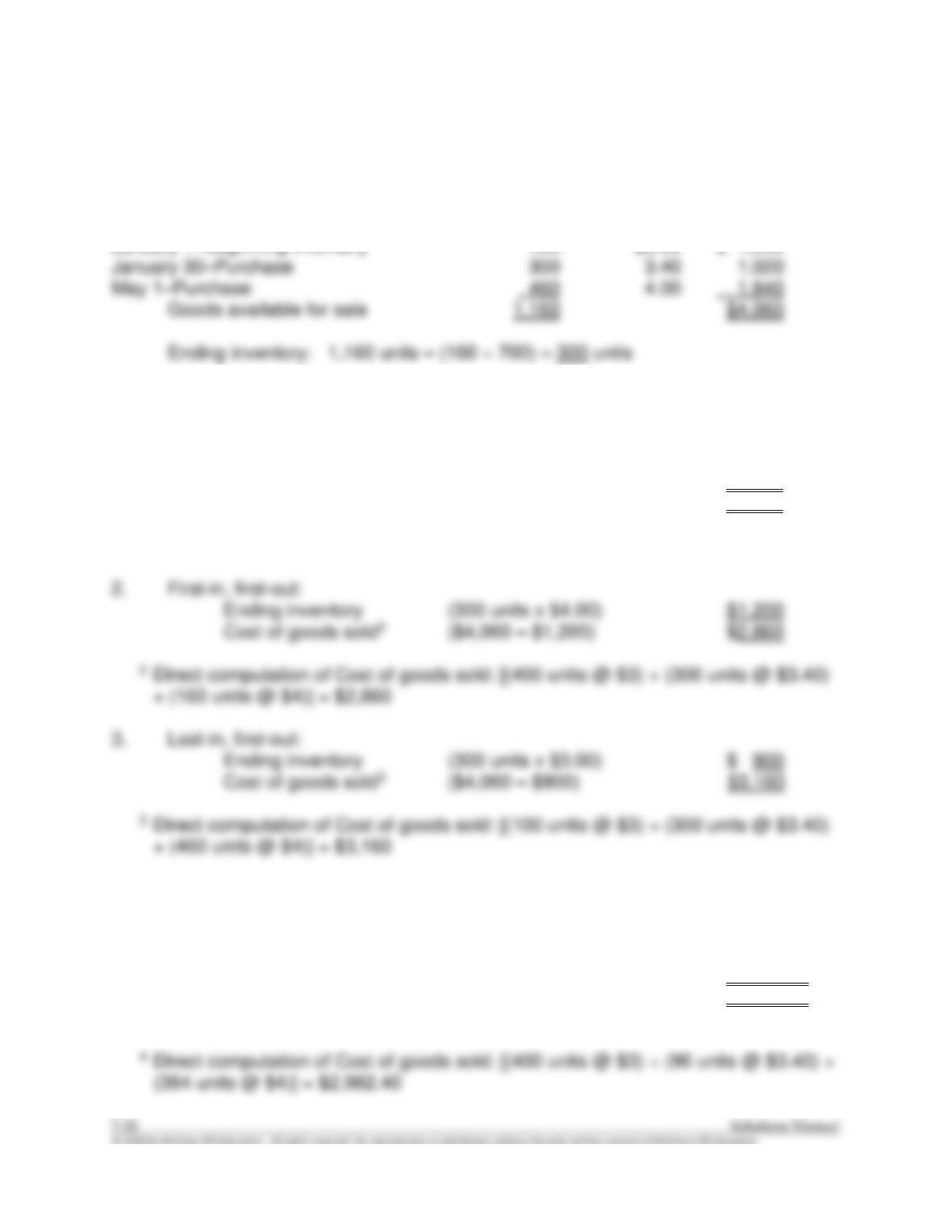
P7–1.
Item
Amount
Explanation
Ending inventory (physical count on
December 31, current year)
$80,000
Per physical inventory.
a.
Goods out on trial to customer
+ 900
Goods held by a customer on trial
are still owned by the vendor; no
sale or transfer of ownership has
occurred.
b.
Goods in transit from supplier
Goods shipped by a supplier,
F.O.B. destination, are owned by
the supplier until delivery at
destination.
d.
Goods held for customer pickup
– 1,750
The goods sold but held for
customer pickup are owned by the
customer. Ownership has passed.
e.
Goods purchased and in transit
+ 3,550
Goods purchased and in transit,
F.O.B. shipping point, are owned
by the purchaser.
Goods sold and in transit
+ 700
Goods sold and in transit, F.O.B.
destination, are owned by the seller
until they reach destination.
g.
Goods held on consignment
Goods held on consignment are
owned by the consignor (the
manufacturer), not by the
consignee.
Correct inventory, December 31,
current year
P7–2.
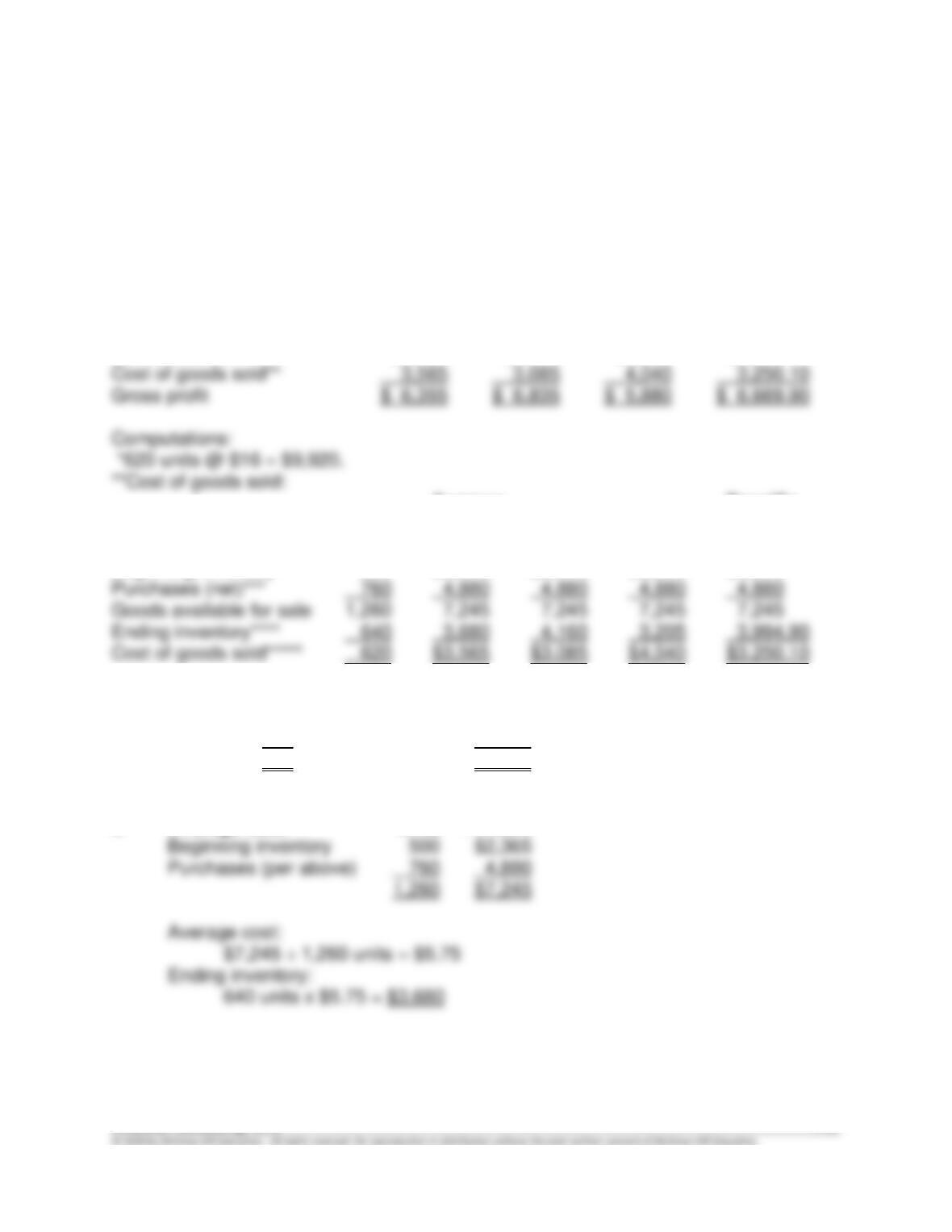
a) Goods available for sale for all methods:
Unit Total
Units Cost Cost
b) and c)
1. Average cost:
Average unit cost $4,060 ÷ 1,160 = $3.50
Ending inventory (300 units x $3.50) $1,050
Cost of goods sold1 ($4,060 – $1,050) $3,010
1 Direct computation of Cost of goods sold: (860 units x $3.50) = $3,010
4. Specific identification:
Ending inventory ( 0 units x $3.00) +
( 204 units x $3.40) +
( 96 units x $4.00) $1,077.60
Cost of goods sold4 ($4,060 – $1,077.60) $2,982.40
Financial Accounting, 10/e 7-33
P7–3.
Req. 1
DONNER COMPANY
Partial Income Statement
For the Month Ended January 31, current year
(a) (b) (c) (d)
Average Specific
Cost FIFO LIFO Identification
Sales revenue* $9,920 $9,920 $9,920 $9,920
Average Specific
Units Cost FIFO LIFO Identification
Beginning inventory 500 $2,365 $2,365 $2,365 $2,365
***Purchases:
January 12 600 units @ $6 = $3,600
January 26 160 units @ $8 = 1,280
Totals 760 $4,880
****Ending inventory:
a. Average cost: Units Amount
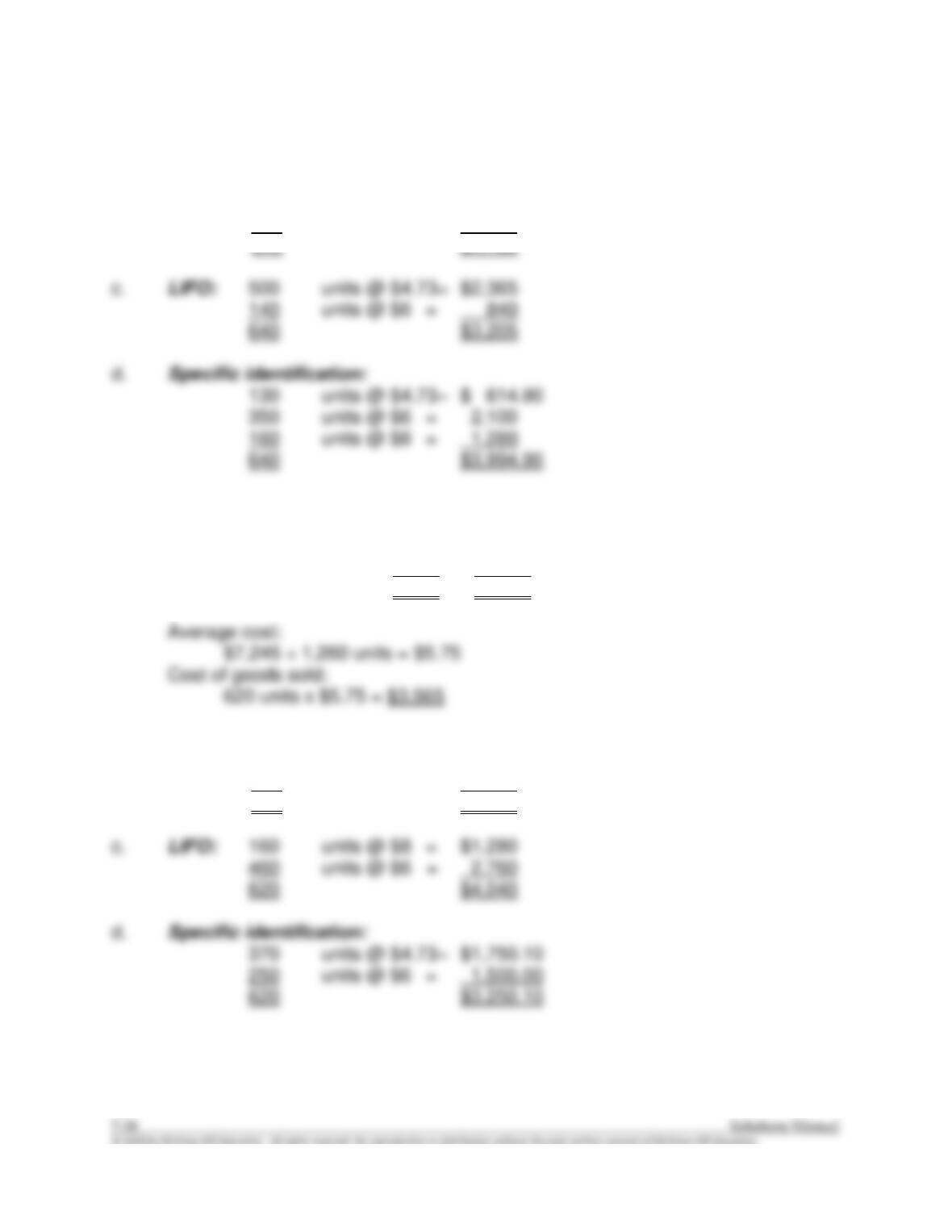
P7–3. (continued)
Req. 1 (continued)
****Ending inventory:
b. FIFO: 160 units @ $8 = $1,280
480 units @ $6 = 2,880
640 $4,160
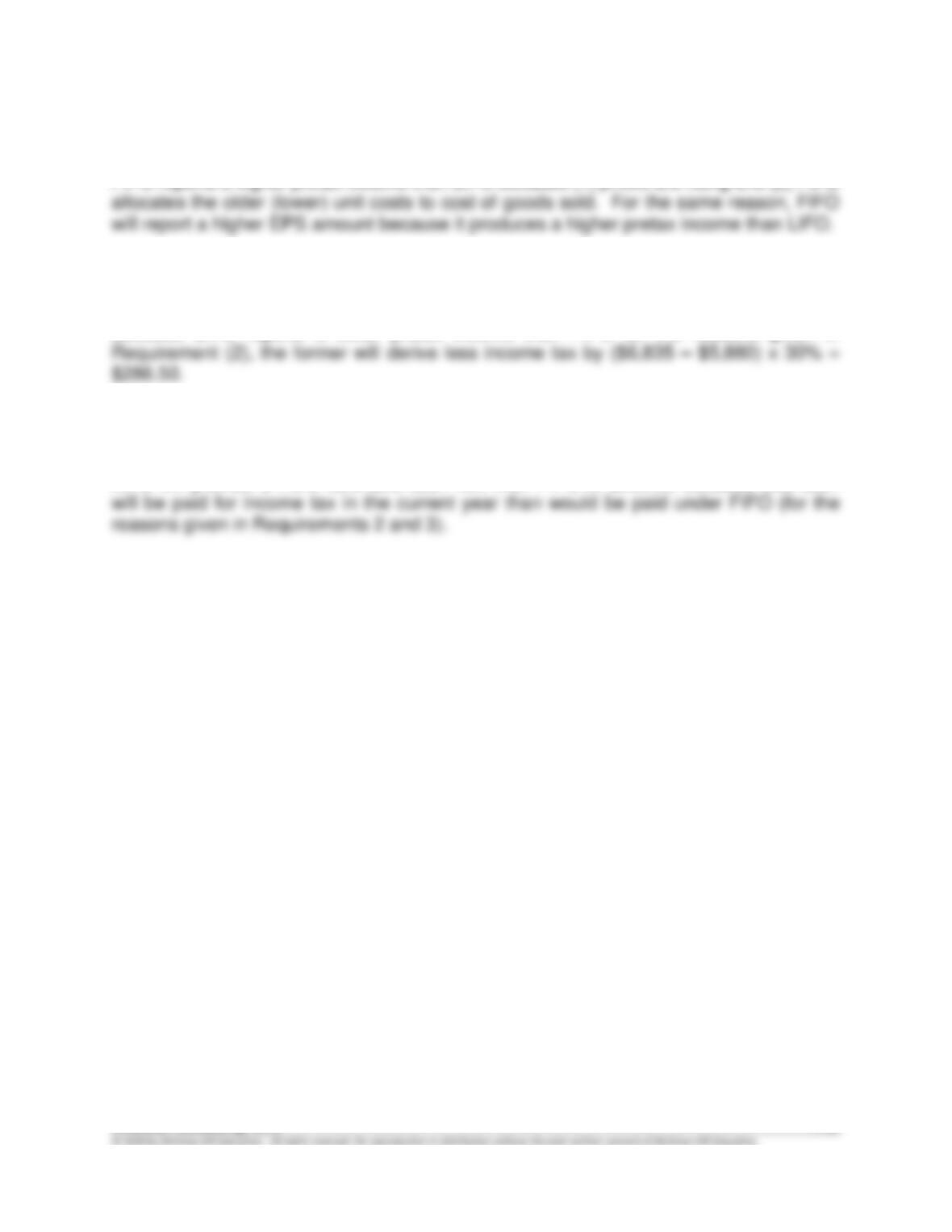
*****Cost of goods sold (direct computations):
a. Average cost: Units Amount
Beginning inventory 500 $2,365
Purchases (per above) 760 4,880
1,260 $7,245
b. FIFO: 500 units @ $4.73= $2,365
120 units @ $6 = 720
620 $3,085
Financial Accounting, 10/e 7-35
P7–3. (continued)
Req. 2
FIFO reports a higher pretax income than LIFO because (1) prices are rising and (2) FIFO
Req. 3
Because LIFO reports a lower pretax income than FIFO for the reasons given in
Req. 4
LIFO will provide a more favorable cash flow than FIFO of $286.50 because less cash
P7–4.
Req. 1
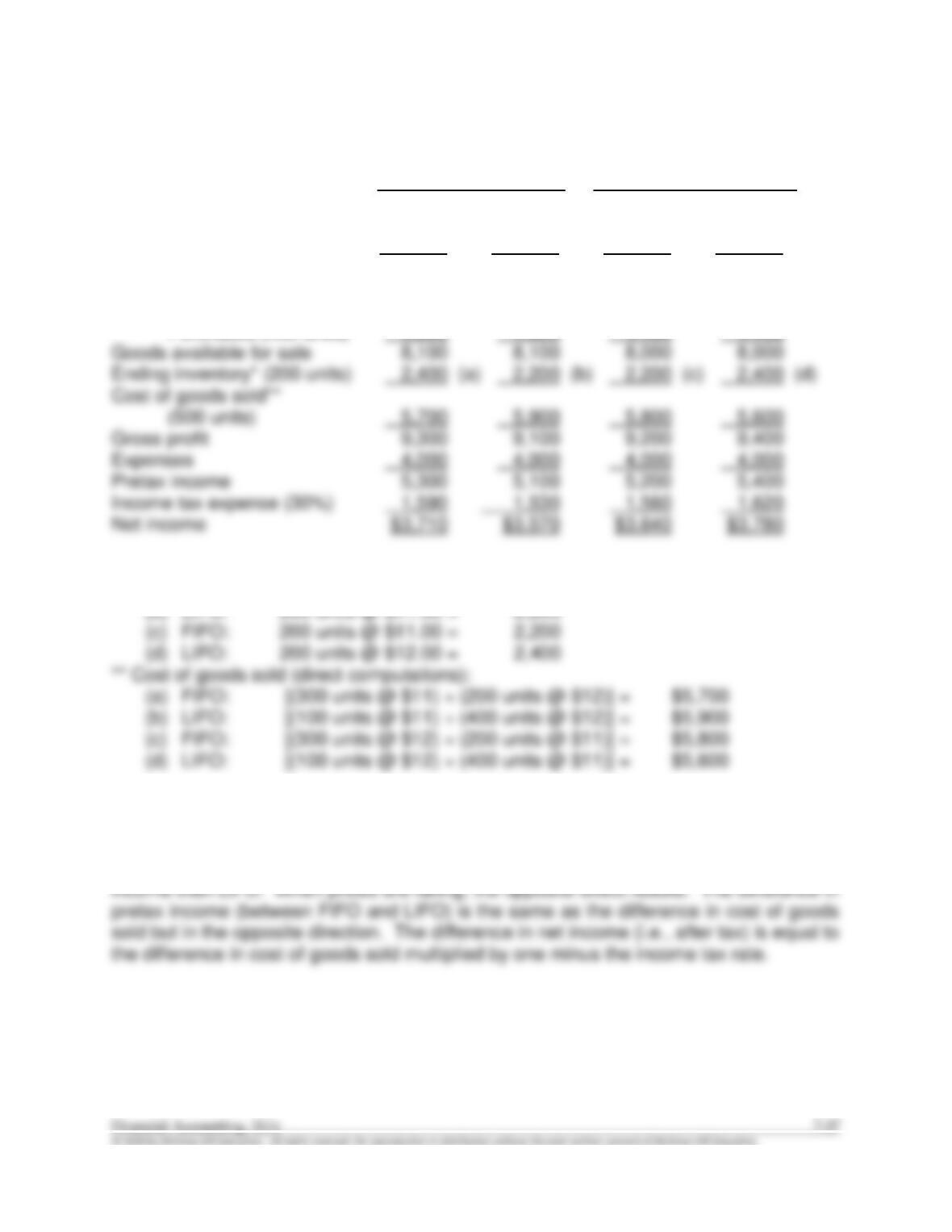
Sales revenue (47 @ $24,500) $1,151,500
Req. 2
Sales revenue (47 @ $24,500) $1,151,500
Ending inventory (20 @ $12,000) + (15 @ $10,000) $ 390,000
Req. 3
Pretax income increased by $30,000 because of the decision to purchase the additional
units at the end of the year. This decision provided lower cost units to allocate to cost of
goods sold, which increased pretax income.
P7–5.
Req. 1
Prices Rising Prices Falling
A B C D
FIFO LIFO FIFO LIFO
Sales revenue (500 units) $15,000 $15,000 $15,000 $15,000
Cost of goods sold:
Beginning inventory
(300 units) 3,300 3,300 3,600 3,600
Purchases (400 units) 4,800 4,800 4,400 4,400
*Ending inventory computations:
(a) FIFO: 200 units @ $12.00 = $2,400
Req. 2
The above tabulation demonstrates that when prices are rising, FIFO gives a higher net
P7–5. (continued)
Req. 3
When prices are rising, LIFO derives a more favorable cash position (than FIFO) equal
Req. 4
Either method can be defended reasonably. If one focuses on current income and EPS,
FIFO derives a more favorable result (higher than LIFO) when prices are rising.
Financial Accounting, 10/e 7-39
P7–6.
Req. 1
JAFFA COMPANY
Income Statement (Corrected)
For the Year Ended December 31, current year
Sales revenue $300,000
Cost of goods sold:
Beginning inventory $ 33,000
*Computation of ending inventory on lower of cost or net realizable value basis:
Net Realizable Lower of Cost
Item Quantity Original Cost Value (Market) of NRV
Req. 2
Lower of Amount of
FIFO Cost or Change
Item Changed Cost Basis NRV (Decrease)
Ending inventory $ 50,450 $ 37,850 ($12,600)
P7–6. (continued)
Req. 2 (continued)
Analysis
Ending inventory, cost of goods sold, gross profit, and pretax income each
changed by the change in the valuation of the ending inventory.
Req. 3
The inventory costing methods (average cost, FIFO, LIFO, and specific identification)
apply the cost and matching principles. Cost of goods sold, under these principles, is the
Req. 4
Lower of cost or net realizable value reduced pretax income and income tax expense.
There was a cash savings of $3,780 for the current year (assuming the lower of cost or