Financial and Managerial Accounting, 8e
7-1
CHAPTER 7
ACCOUNTING FOR RECEIVABLES
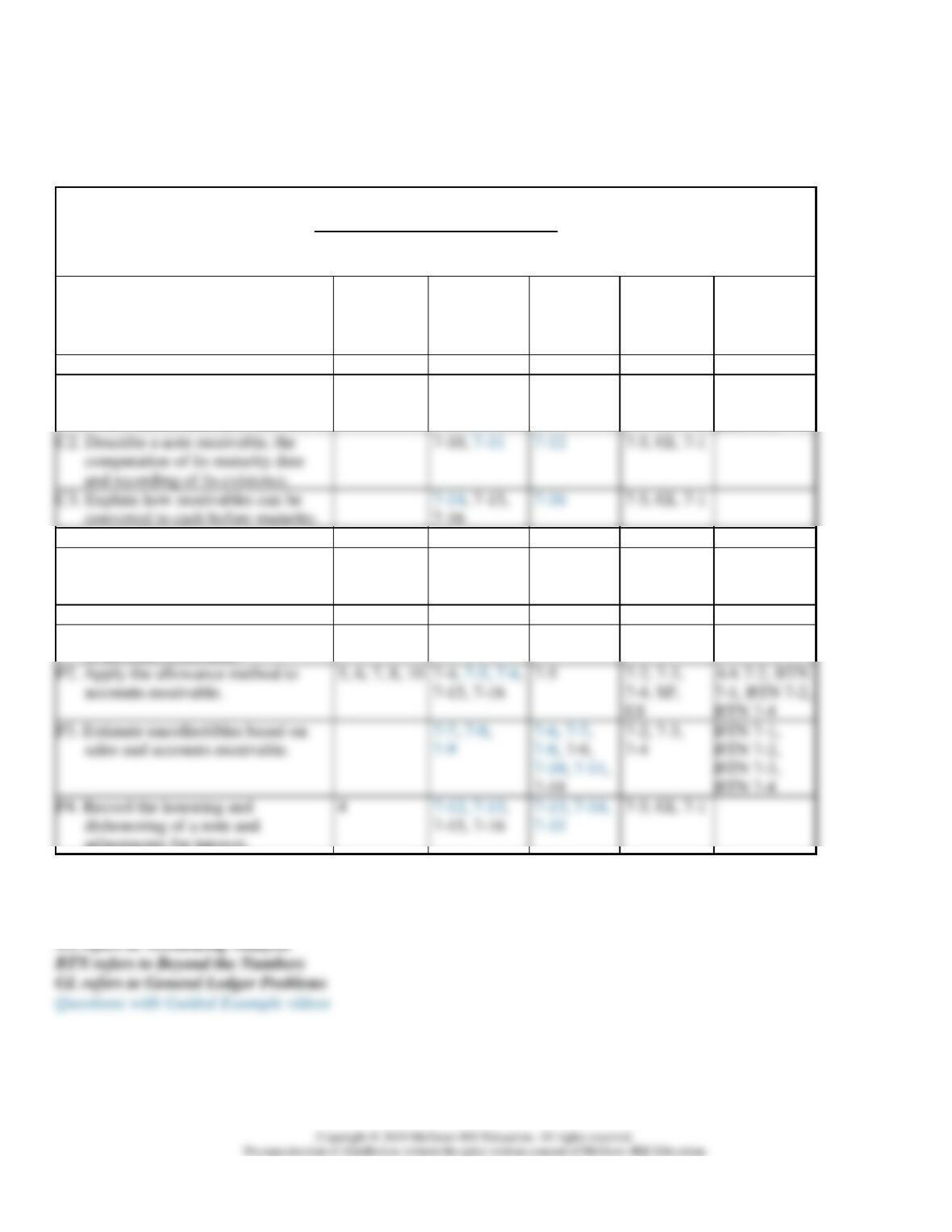
Related Assignment Materials
Student Learning Objectives
Questions
Quick
Studies*
Exercises*
Problems*
AA
and
BTN
Conceptual objectives:
C1. Describe accounts receivable and
how they occur and are recorded.
1, 9
7-1
7-1, 7-2, 7-3
7-1, 7-4
AA 7-3, BTN
7-3, BTN 7-5,
BTN 7-6
computation of its maturity date
and recording of its existence.
C3. Explain how receivables can be
converted to cash before maturity.
7-16
7-5, GL 7-1
Analytical objectives:
A1 Compute accounts receivable
turnover and use it to help assess
financial condition.
7-17
7-17
AA 7-1,
AA 7-2,
AA 7-3
Procedural objectives:
P1. Apply the direct write-off method
to accounts receivable.
2, 3, 8
7-2, 7-3, 7-4
7-4
SP
accounts receivable.
7-15, 7-16
7-4, SP,
ES
7-1, BTN 7-2,
BTN 7-4
7-18
BTN 7-3,
BTN 7-4
P4. Record the honoring and
dishonoring of a note and
4
7-12, 7-13,
7-15, 7-16
7-13, 7-14,
7-5, GL 7-1
adjustments for interest.
*See additional information on next page that pertains to these quick studies, exercises, and problems.
SP refers to the Serial Problem
Financial and Managerial Accounting, 8e
Additional Information on Related Assignment Material
See Chapter 1 of the Instructor’s Resource Manual for more information on materials for this text available in
Connect.
Connect
Available on the instructor’s course-specific website, Connect:
• All numerical Quick Studies, all Exercises and Problems Set A.
Hints/Guided Examples
Please note that the Guided Examples are labeled as “Hints” in Connect assignments. The animated PowerPoints without
Need-to-Know Videos
LO
Need–to-Know
Title
Time
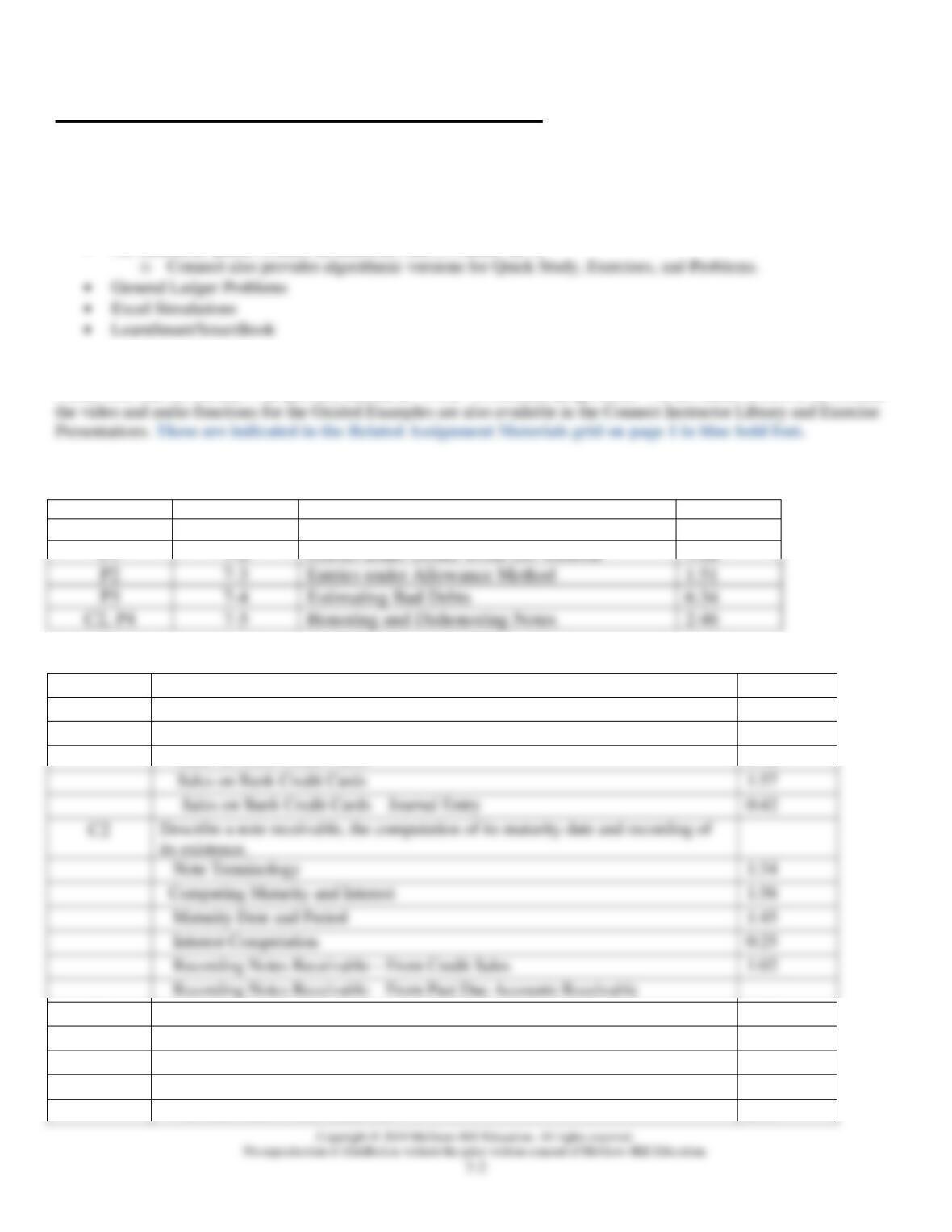
C1
7-1
Credit Card Sales
2:07
P1
7-2
Entries under Direct Write-Off Method
1:08
P2
7-3
Entries under Allowance Method
1:51
P3
7-4
Estimating Bad Debts
6:34
7-5
Honoring and Dishonoring Notes
2:46
Concept Overview Videos, (COV’s)
LO
Title
Time
C1
Describe accounts receivable and how they occur and are recorded.
Accounts Receivable Ledger
2:35
Sales on Store Credit Cards
1:02
Sales on Bank Credit Cards
1:57
Sales on Bank Credit Cards – Journal Entry
0:42
Note Terminology
1:34
Maturity Date and Period
1:45
Interest Computation
0:25
Recording Notes Receivable – From Credit Sales
1:02
Recording Notes Receivable – From Past Due Accounts Receivable
C3
Explain how receivables can be converted to cash before maturity.
1:04
Selling Receivables
1:02
Pledging Receivables
A1
Compute accounts receivable turnover and use it to help assess financial condition.
1:18
Accounts Receivable Turnover
2:35
Financial and Managerial Accounting, 8e
7-3
Accounts Receivable Turnover — Illustration
1:44
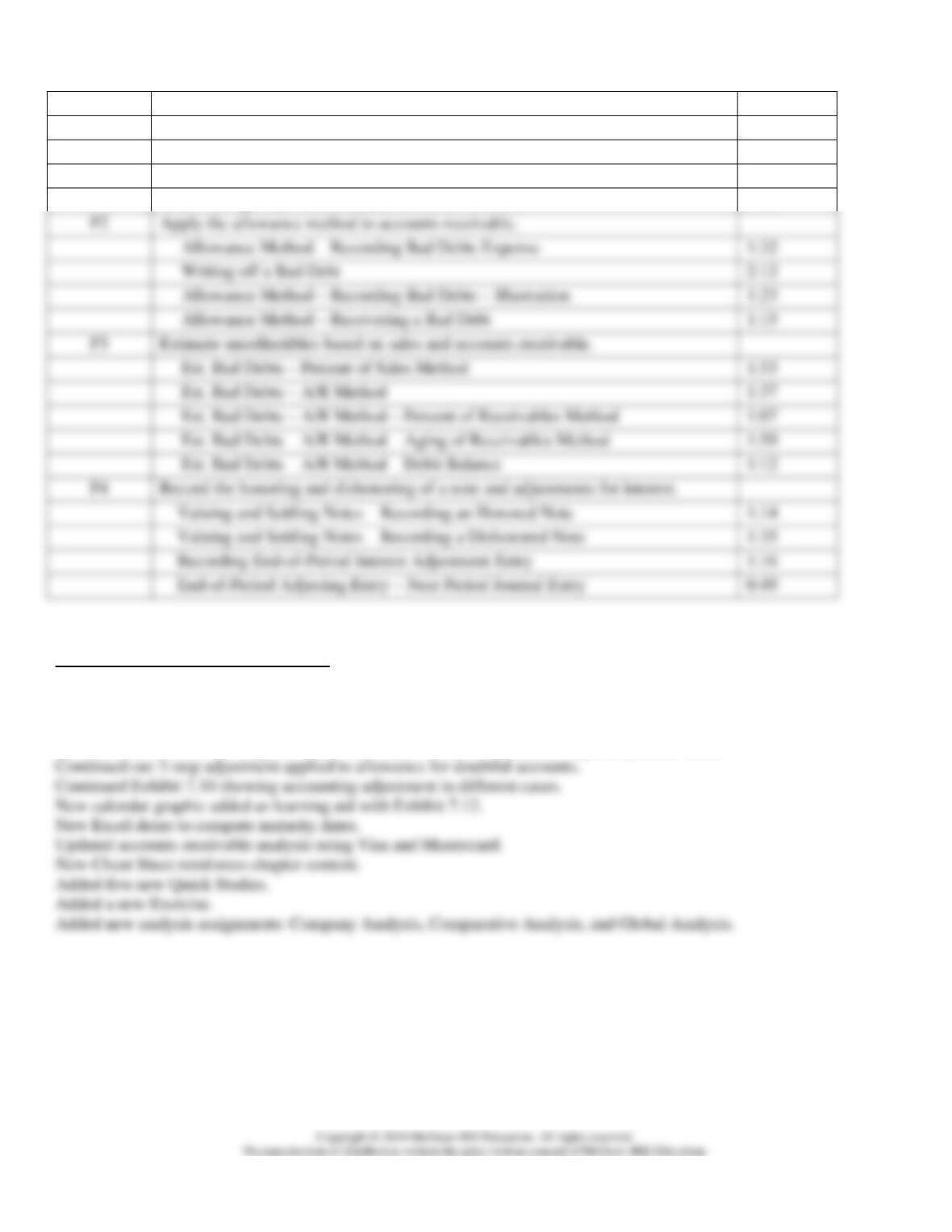
P1
Apply the direct write-off method to accounts receivable.
Direct Write-Off Method – Writing Off Bad Debts
1:38
Direct Write-Off Method Recovering a Bad Debt
1:17
Assessing the Direct Write-Off Method
0:52
P2
Apply the allowance method to accounts receivable.
Allowance Method – Recording Bad Debts Expense
1:32
Writing off a Bad Debt
2:12
Allowance Method – Recording Bad Debts – Illustration
1:23
Allowance Method – Recovering a Bad Debt
1:15
P3
Estimate uncollectibles based on sales and accounts receivable.
Est. Bad Debts – Percent of Sales Method
1:53
Est. Bad Debts – A/R Method
1:37
Est. Bad Debts – A/R Method – Percent of Receivables Method
1:07
Est. Bad Debts – A/R Method – Aging of Receivables Method
1:59
Est. Bad Debts – A/R Method – Debit Balance
1:12
P4
Record the honoring and dishonoring of a note and adjustments for interest.
Valuing and Settling Notes—Recording an Honored Note
1:14
Valuing and Settling Notes—Recording a Dishonored Note
1:35
Recording End-of-Period Interest Adjustment Entry
1:16
End-of-Period Adjusting Entry – Next Period Journal Entry
0:49
Synopsis of Chapter Revisions
NEW opener—Facebook and entrepreneurial assignment.
Updated company data in Exhibit 7.1.
Streamlined direct write-off method.
Enhanced Exhibit 7.6 showing allowances set aside for future bad debts along with journal entries.
Financial and Managerial Accounting, 8e
Chapter Outline
I. Valuing Accounts Receivable—Amounts due from customers for credit sales. They occur when a
customer uses credit cards and when a company gives credit directly to customers.
A. Sales on credit
1. Increase (debit) Accounts Receivable for the full amount of the sale and increase (credit) Sales.
a. The General Ledger continues to keep a single (total) Accounts Receivable Account. (control
B. Sales on Store Credit Card
1. Large retailers such as Home Depot sell on credit and maintain their own credit cards to grant
credit to approved customers and to earn interest on any balance past due.
C. Sales on Bank Credit Card
1. Credit card sales (Examples: Visa, Mastercard, or American Express).
a. Advantages: (1) eliminates the company’s need to evaluate each customer’s credit standing
(2) avoids seller’s risk (3) seller receives cash sooner than when they grant credit directly (4)
D. Sales on Installment
Amounts owed by customers from credit sales where payment is required in periodic amounts over
an extended time period.
1. Customer is usually charged interest.
2. Classified as current or noncurrent assets depending on length of repayment.
II. Direct Write-Off Method – accounts of customers who do not pay are uncollectible accounts,
commonly called bad debts. Two methods are used to account for uncollectible accounts:
1. direct write-off method
2. allowance method
Financial and Managerial Accounting, 8e
III. Allowance Method – matches the estimated loss from uncollectibles against the sales they helped
produce.
A. Recording Bad Debts Expense: at end of each accounting period, bad debts expense is estimated
and recorded with an adjusting entry.
B. Advantages of method:
1. Satisfies the matching principle because expense is charged in the period of the corresponding
2. Recovering a Bad Debt results of a reversal of the write off (see d above) and a normal
C. Writing off a Bad Debt: debit Allowance for Doubtful Accounts, credit Accounts Receivable.
1. Writing off an uncollectible does not change the estimated amount of cash to be collected
IV. Estimating Bad Debts Expense—two methods:
A. Percent of Sales Method (uses income statement relations to estimate)—bad debts expense is
computed as a percentage of sales for the period. (% x sales = Bad Debt Expense)
a. Sales figure chosen as base is usually credit sales but it can be total or net sales if cash sales
B. Percent of Receivable Method (uses balance sheet relations to estimate)—desired credit balance
in Allowance for Doubtful Accounts is computed: (% x AR = Desired balance in Allowance for
Doubtful Accounts). Estimated balance for allowance account obtained as:
uncollectibles.
1. As a percentage of outstanding receivables or
V. Notes Receivable— Promissory note that is a written promise to pay a specified amount (principal)
usually with interest, either on demand or on a stated future date. Promissory notes are notes payable to
the maker (person promising to pay) and notes receivable to the payee (person to be paid). Interest is the
charge for using money until the due date.
A. Computations for Notes
Chapter Outline
Financial and Managerial Accounting, 8e
7-6
4. Formula for computing annual interest:
Principal x Annual interest rate x time (fraction of year) = Interest
B. Recording Notes Receivable—debit Notes Receivable for principal or face amount of note. Credit
will vary; depends on reason note is received. Interest is not recorded until earned.
C. Valuing and Settling Notes
1. Recording an honored note—debit Cash for maturity value (face value and interest), credit Note
VI. Disposal of Receivables—Companies can convert receivables to cash before they are due. Reasons for
this include the need for cash or do not want to be involved in collection activities.
A. Selling Receivables
1. Buyer, called a factor, charges the seller a factoring fee and then collects the receivables as they
come due.
2. Entry: debit Cash (amount received), and Factoring Fee Expense (amount charged) and credit
Accounts Receivable (amount sold).
B. Pledging Receivables
1. Company borrows money by pledging its receivables as security.
VII. Decision Analysis—Accounts Receivable Turnover
A. Measures both the quality (likeliness of collecting) and liquidity (speed of collection) of accounts
receivable,
Financial and Managerial Accounting, 8e
7-7
Chapter 7 Alternate Demonstration Problem
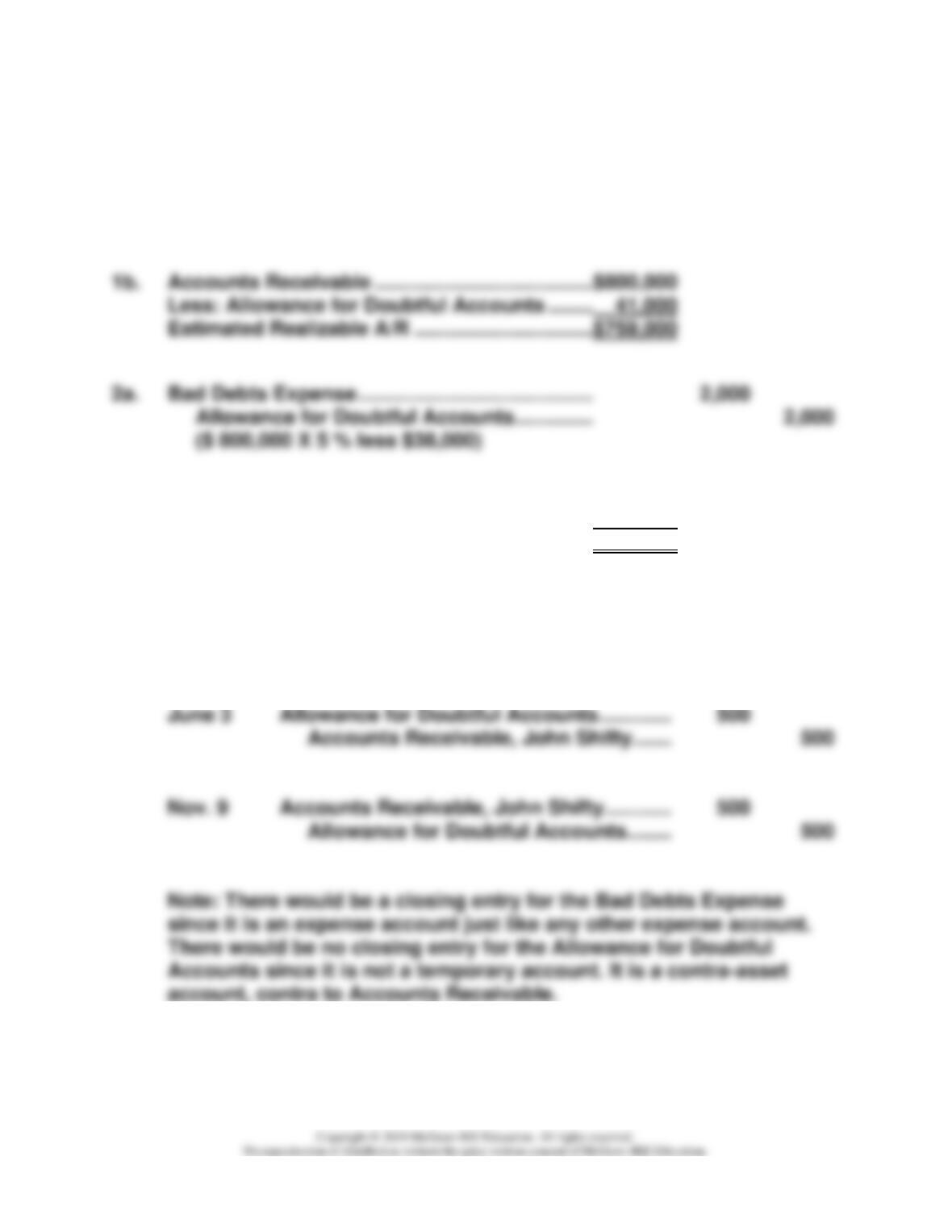
At the end of the year, the M. I. Wright Company showed the following
selected account balances:
Sales (all on credit) ………………………………………………………………….$300,000
Required:
1. Assume the company estimates that 1% of all credit sales will not be
collected.
2. Assume the company estimates that 5% of its accounts receivable
will never be collected.
3. Under assumptions 1 and 2 above, give the proper journal entries for
the following events.
Financial and Managerial Accounting, 8e
7-8
Chapter 7 Solution: Alternate Demonstration Problem
1a. Bad Debts Expense …………………………………… 3,000
Allowance for Doubtful Accounts ………….. 3,000
($ 300,000 X 1 %)
2b. Accounts Receivable …………………………………$800,000
Less: Allowance for Doubtful Accounts …….. 40,000
Estimated Realizable A/R ………………………….$760,000
3. Both assumptions 1 and 2 above represent the allowance method of
accounting for uncollectibles. The only difference is in the approach
to estimating uncollectibles. Therefore the entries to write off and
show subsequent reinstatement would be the same in 1 and 2.