Chapter 7
Reporting and Interpreting Cost of Goods Sold
and Inventory
ANSWERS TO QUESTIONS
1. Inventory often is one of the largest amounts listed under assets on the balance
sheet which means that it represents a significant amount of the resources
available to the business. The inventory may be excessive in amount, which is a
2. Fundamentally, inventory should include those items, and only those items, legally
3. The cost principle governs the measurement of the ending inventory amount. The
4. Goods available for sale is the sum of the beginning inventory and the amount of
5. Beginning inventory is the stock of goods on hand (in inventory) at the start of the
6. (a) Average cost–This inventory costing method in a periodic inventory system
is based on a weighted-average cost for the entire period. At the end of the
accounting period the average cost is computed by dividing the goods
available for sale in units into the cost of goods available for sale in dollars.
The computed unit cost then is used to determine the cost of goods sold for
7. The specific identification method of inventory costing is subject to manipulation.
Manipulation is possible because one can, at the time of each sale, select (pick
and choose) from the shelf the item that has the highest or the lowest (or some
other) unit cost with no particular rationale for the choice. The rationale may be
that it is desired to influence, by arbitrary choice, both the amount of income and
8. LIFO and FIFO have opposite effects on the inventory amount reported under
assets on the balance sheet. The ending inventory is based upon either the oldest
Financial Accounting, 10/e 7-3
9. LIFO versus FIFO will affect the income statement in two ways: (1) the amount of
cost of goods sold and (2) net income. When the prices are rising, FIFO will give
10. When prices are rising, LIFO causes a lower taxable income than does FIFO.
Therefore, when prices are rising, income tax is less under LIFO than FIFO. A
11. When net realizable value is lower than the cost of units on hand, applying lower
of cost or net realizable value (NRV) (a) increases cost of goods sold which
12. When a perpetual inventory system is used, the unit cost must be known for each
item sold at the date of each sale because at that time two things happen: (a) the
units sold and their costs are removed from the perpetual inventory record and the
new inventory balance is determined; and (b) the cost of goods sold is determined
from the perpetual inventory record and an entry in the accounts is made as a debit
ANSWERS TO MULTIPLE CHOICE
Authors’ Recommended Solution Time
(Time in minutes)
Mini-exercises
Exercises
Problems
Alternate
Problems
Cases and
Projects
No.
Time
No.
Time
No.
Time
No.
Time
No.
Time
1
5
1
15
1
30
1
30
1
20
2
5
2
20
2
30
2
40
2
20
3
5
3
20
3
40
3
35
3
20
4
10
4
10
4
40
4
40
4
5
5
5
15
5
45
5
40
6
5
6
15
6
50
6
20
7
5
7
30
7
40
7
30
8
5
8
30
8
40
8
9
10
9
30
9
35
30
20
30
15
20
1
30
15
20
20
20
1
40
20
20
20
25
25
* Due to the nature of these cases and projects, it is very difficult to estimate the amount
of time students will need to complete the assignment. As with any open-ended project,
it is possible for students to devote a large amount of time to these assignments. While
MINI-EXERCISES
M7–1.
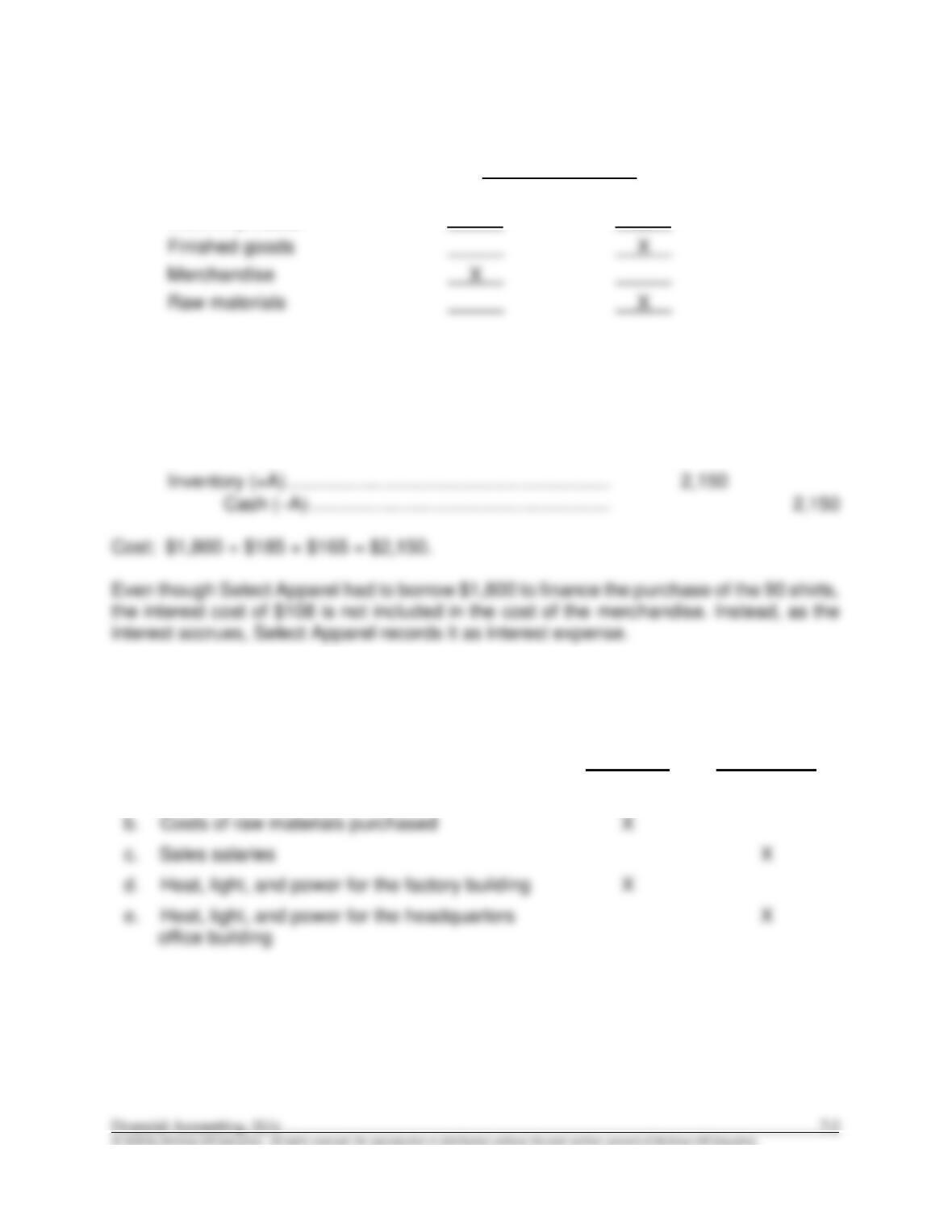
Type of Business
Type of Inventory Merchandising Manufacturing
Work in process X
M7–2.
To record the purchase of 90 new shirts in accordance with the cost principle (perpetual
inventory system):
M7–3.
(1) Part of
inventory
(2) Expense
as incurred
a. Wages of factory workers
X
X
d. Heat, light, and power for the factory building
X
M7–4.
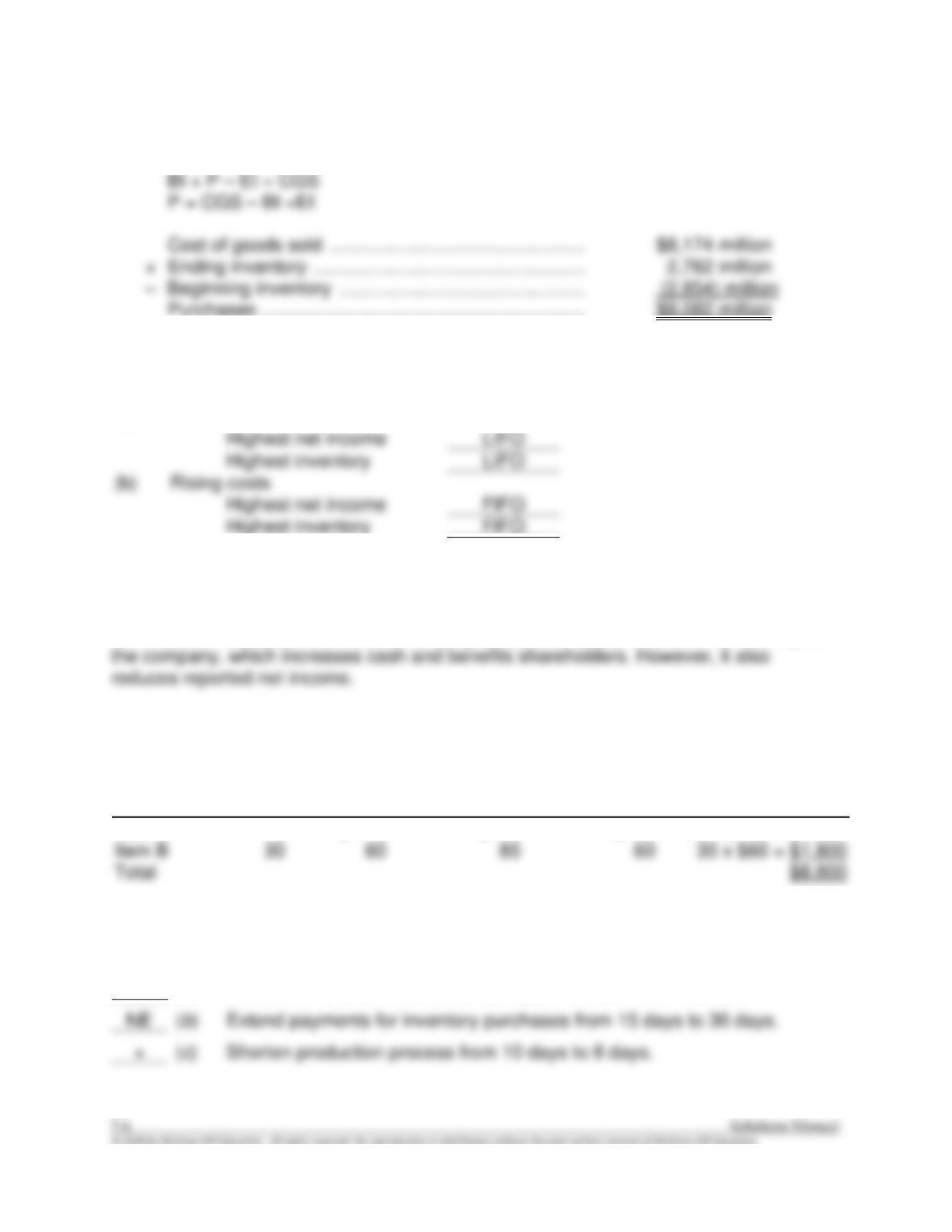
Purchases can be estimated by simply rearranging the cost of goods sold equation:
M7–5.
(a)
Declining costs
(b)
Rising costs
M7–6.
LIFO is often selected when costs are rising because it results in a lower tax liability for
M7–7.
Quantity
Cost per
Item
Net Realizable
Value per Item
Lower of Cost
or NRV
Reported on
Balance Sheet
Item A
70
$ 110
$100
$100
70 x $100 = $7,000
Item B
Total
M7–8.
+
(a)
Parts inventory delivered daily by suppliers instead of weekly.
Extend payments for inventory purchases from 15 days to 30 days.
+
(c)
Shorten production process from 10 days to 8 days.

M7–9.
Understatement of the prior year ending inventory by $50,000 caused prior year cost of
goods sold to be overstated and pretax income to be understated. Thus, current year
EXERCISES
E7–1.
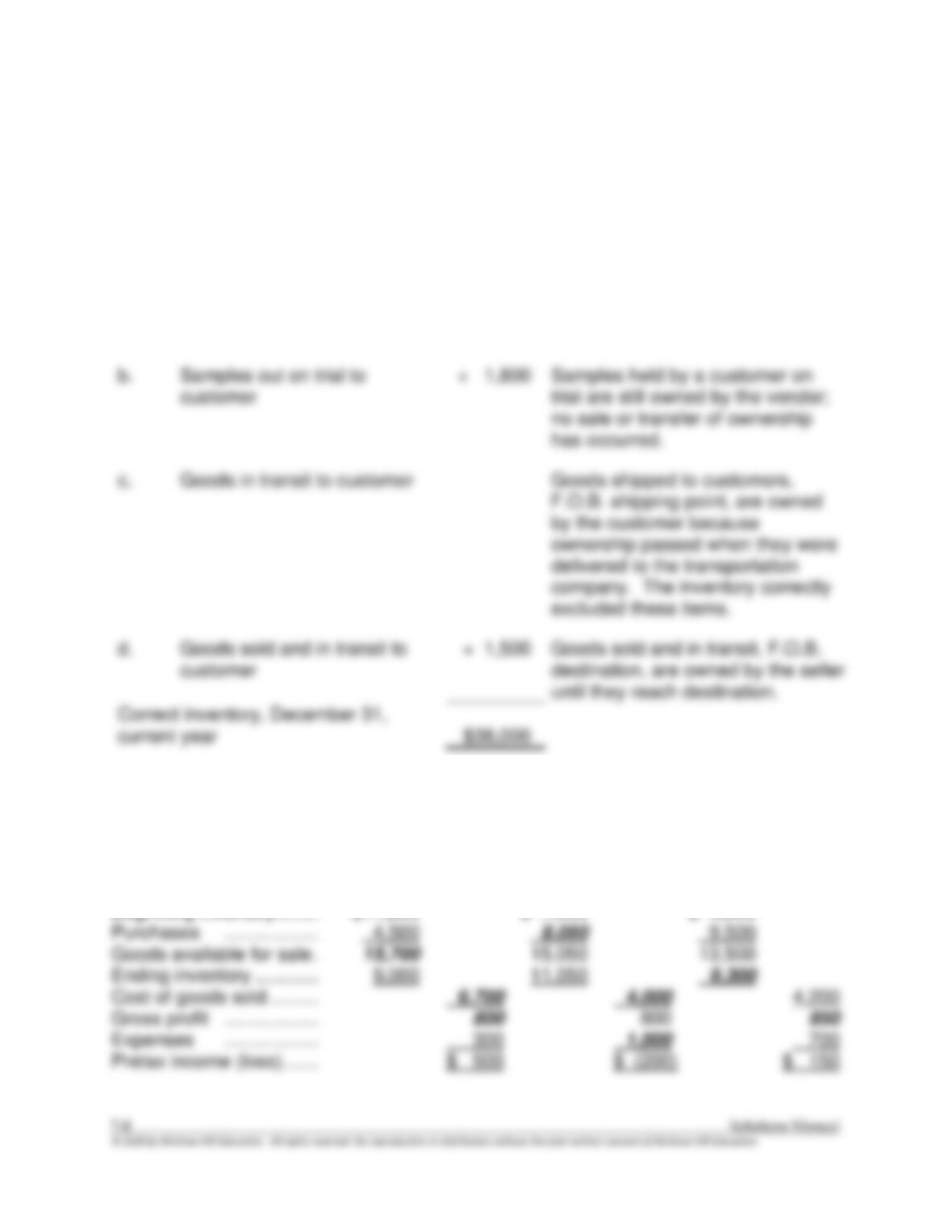
Item
Amount
Explanation
Ending inventory (physical count on
December 31 of the current year)
$34,000
Per physical inventory.
a.
Goods purchased and in transit
+ 700
Goods purchased and in transit,
F.O.B. shipping point, are owned
by the purchaser.
d.
Goods sold and in transit to
customer
+ 1,500
Goods sold and in transit, F.O.B.
destination, are owned by the seller
until they reach destination.
Correct inventory, December 31,
current year
E7–2.
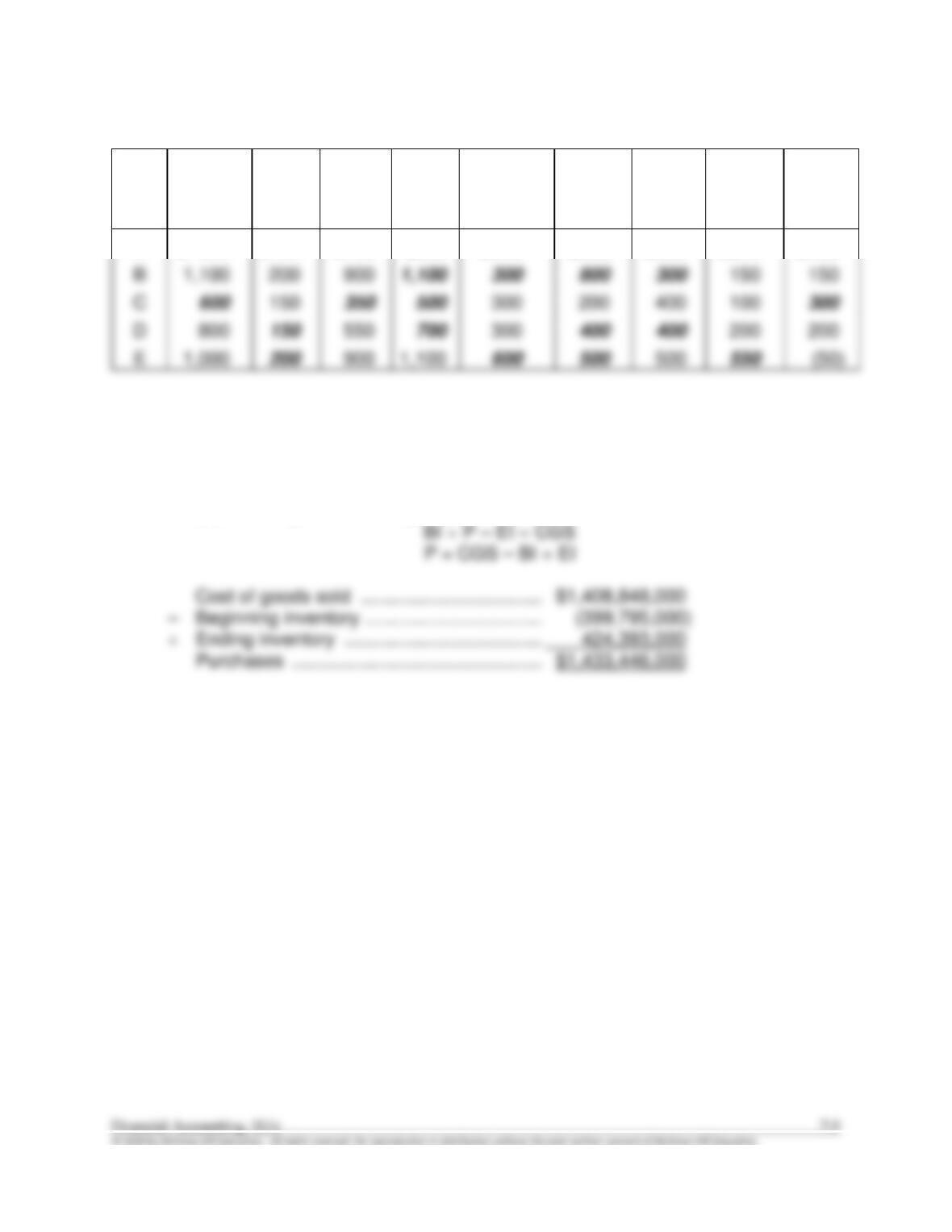
(Italics for missing amounts only.)
Case A Case B Case C
Net sales revenue ………. $7,500 $4,800 $5,050
Beginning inventory …….. $11,200 $ 7,000 $ 4,000
E7–3.
(Italics and bold for missing amounts only.)
Case
Sales
Revenue
Beg.
Inven-
tory
Pur-
chases
Total
Avail-
able
Ending
Inventory
Cost of
Goods
Sold
Gross
Profit
Ex–
penses
Pretax
Income
or
(Loss)
A
$ 650
$100
$700
$800
$500
$300
$350
$200
$150
B
C
D
E
(50)
E7–4.
Computations:
Simply rearrange the cost of goods sold equation
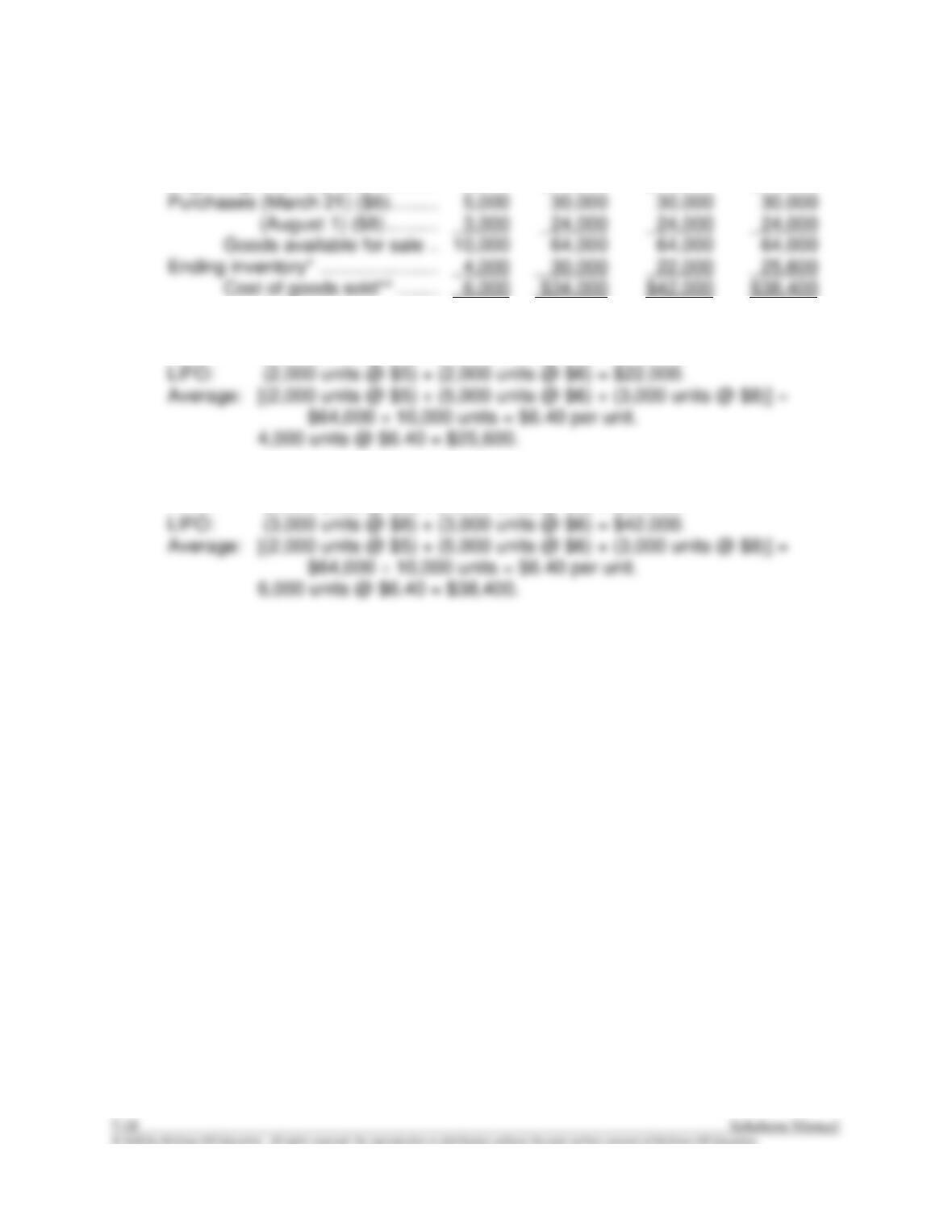
E7-5.
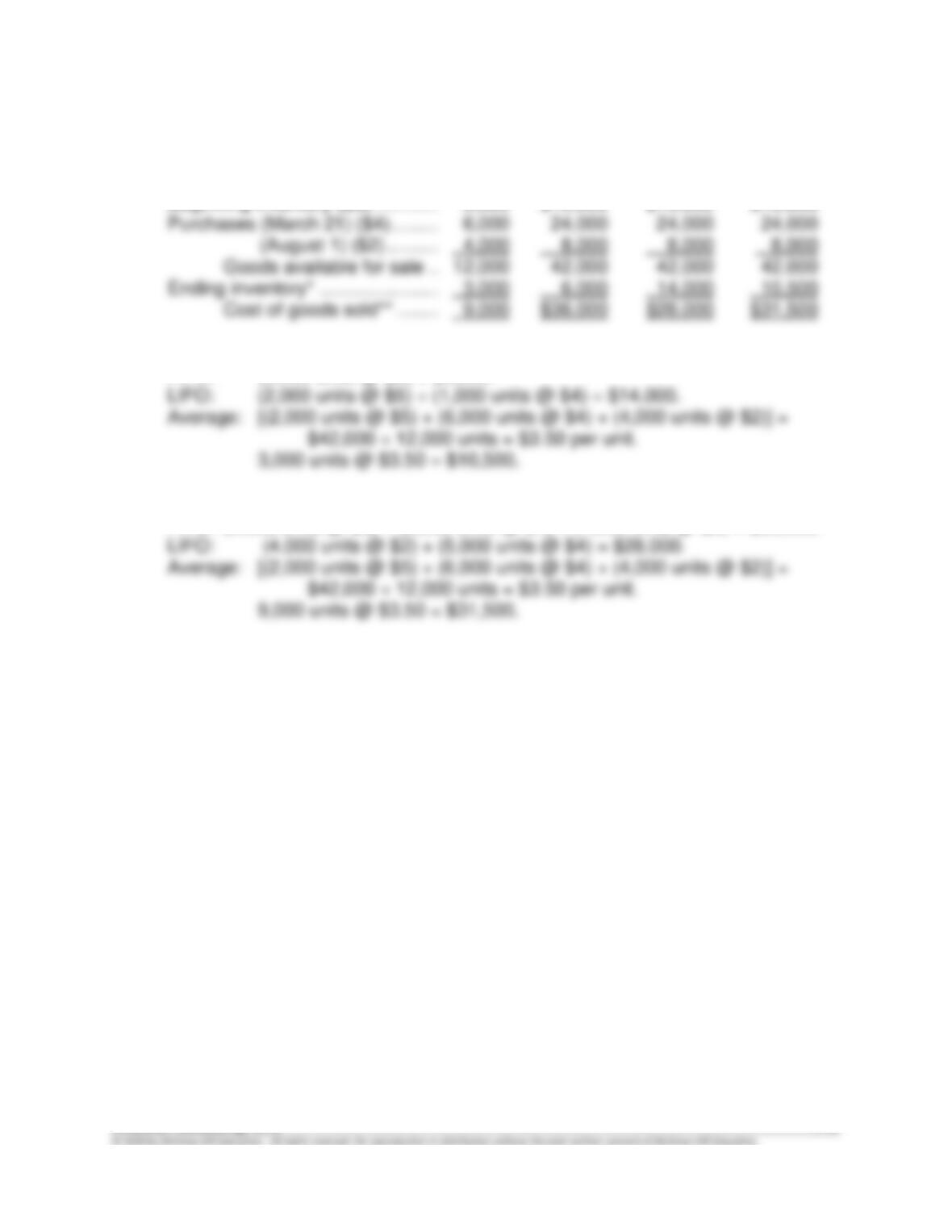
Average
Units FIFO LIFO Cost
Cost of goods sold:
Beginning inventory ($5) …………. 2,000 $10,000 $10,000 $10,000
*Ending inventory computations:
FIFO: (3,000 units @ $8) + (1,000 units @ $6) = $30,000.
**Cost of goods sold computations:
FIFO: (2,000 units @ $5) + (4,000 units @ $6) = $34,000.
Financial Accounting, 10/e 7-11
E7–6.
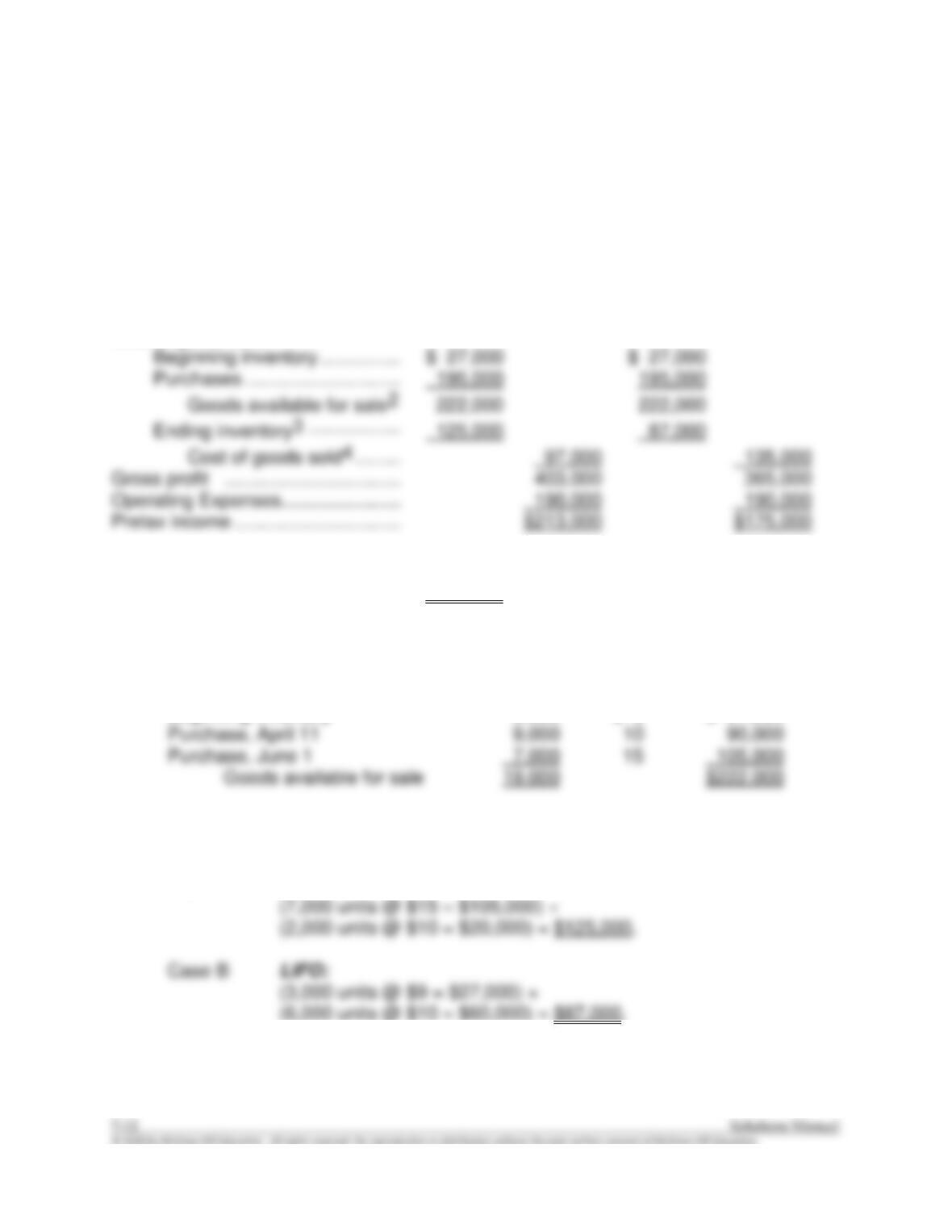
Average
Units FIFO LIFO Cost
Cost of goods sold:
Beginning inventory ($5) …………. 2,000 $10,000 $10,000 $10,000
*Ending inventory computations:
FIFO: (3,000 units @ $2) = $6,000.
**Cost of goods sold computations:
FIFO: (2,000 units @ $5) + (6,000 units @ $4) + (1,000 units @ $2) = $36,000.
E7–7.
Req. 1
EMILY COMPANY
Income Statement
For the Year Ended December 31, Current Year
Case A Case B
FIFO LIFO
Sales revenue1 ………………………… $500,000 $500,000
Cost of goods sold:
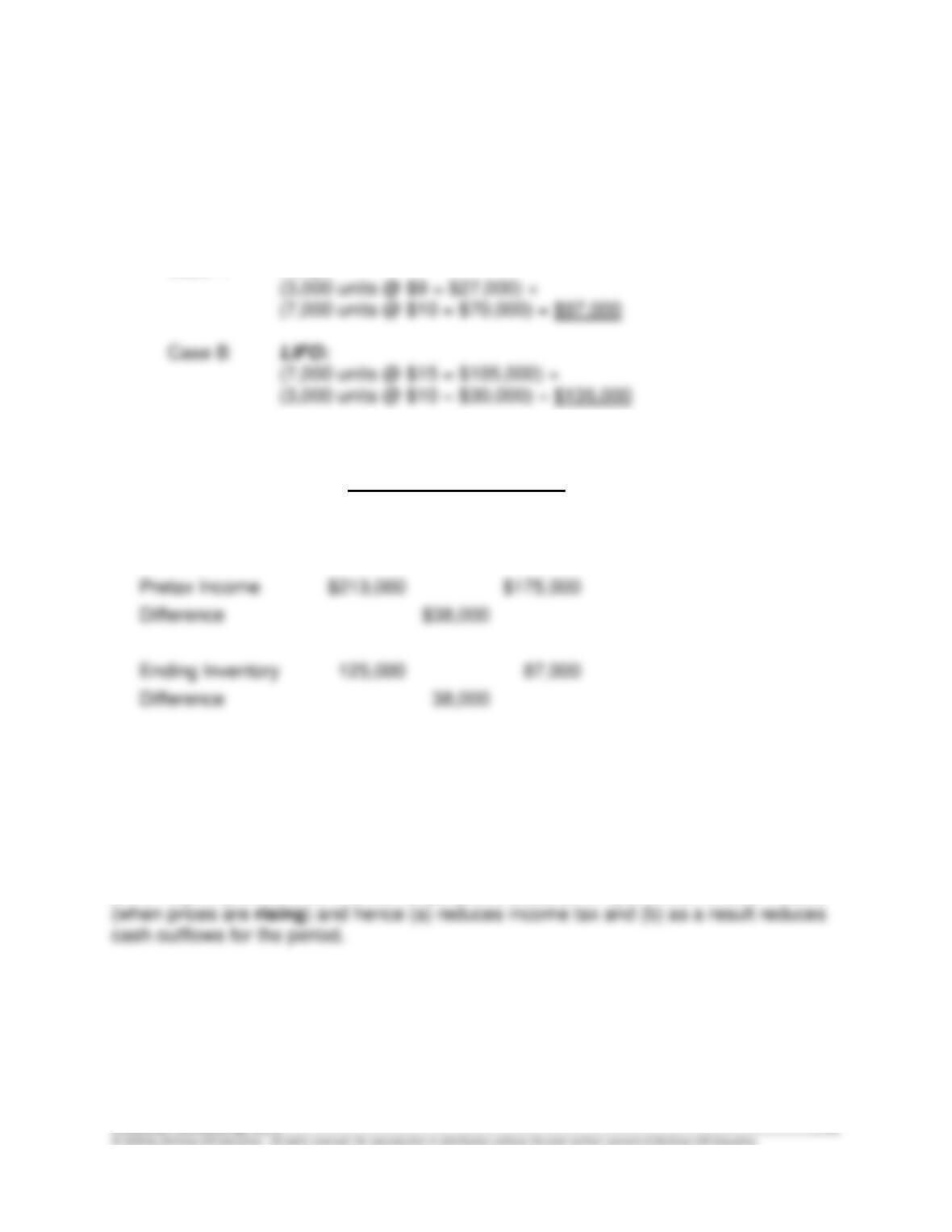
Computations:
(1) Sales: (10,000 units @ $50) = $500,000
(2) Goods available for sale (for both cases):
Units Unit Cost Total Cost
Beginning inventory 3,000 $ 9 $ 27,000
(3) Ending inventory (19,000 available – 10,000 units sold = 9,000 units):
Case A FIFO:
Financial Accounting, 10/e 7-13
E7–7. (continued)
Req. 1 (continued)
(4) Cost of goods sold (10,000 units sold):
Case A FIFO:
Req. 2
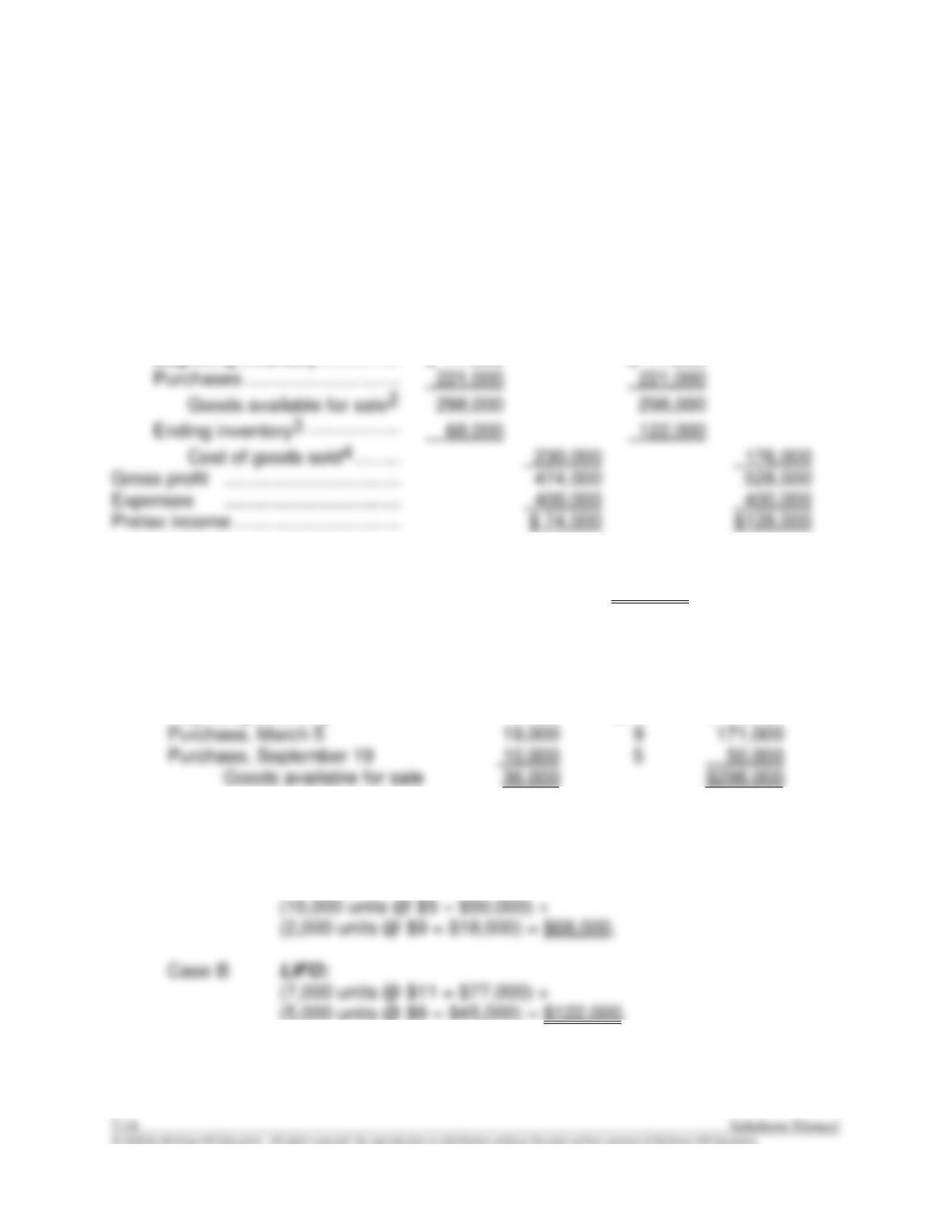
Comparison of Amounts
Case A Case B
FIFO LIFO
The above tabulation demonstrates that the pretax income difference between the two
cases is exactly the same as the inventory difference. Differences in inventory have a
dollar-for-dollar effect on pretax income.
Req. 3
LIFO may be preferred for income tax purposes because it reports less taxable income
E7–8.
Req. 1
GIVOLY INC.
Income Statement
For the Year Ended December 31, Current Year
Case A Case B
FIFO LIFO
Sales revenue1 ………………………… $704,000 $704,000
Cost of goods sold:
Beginning inventory ……………. $ 77,000 $ 77,000
Computations:
(1) Sales: (8,000 units @ $28) + (16,000 units @ $30) = $704,000
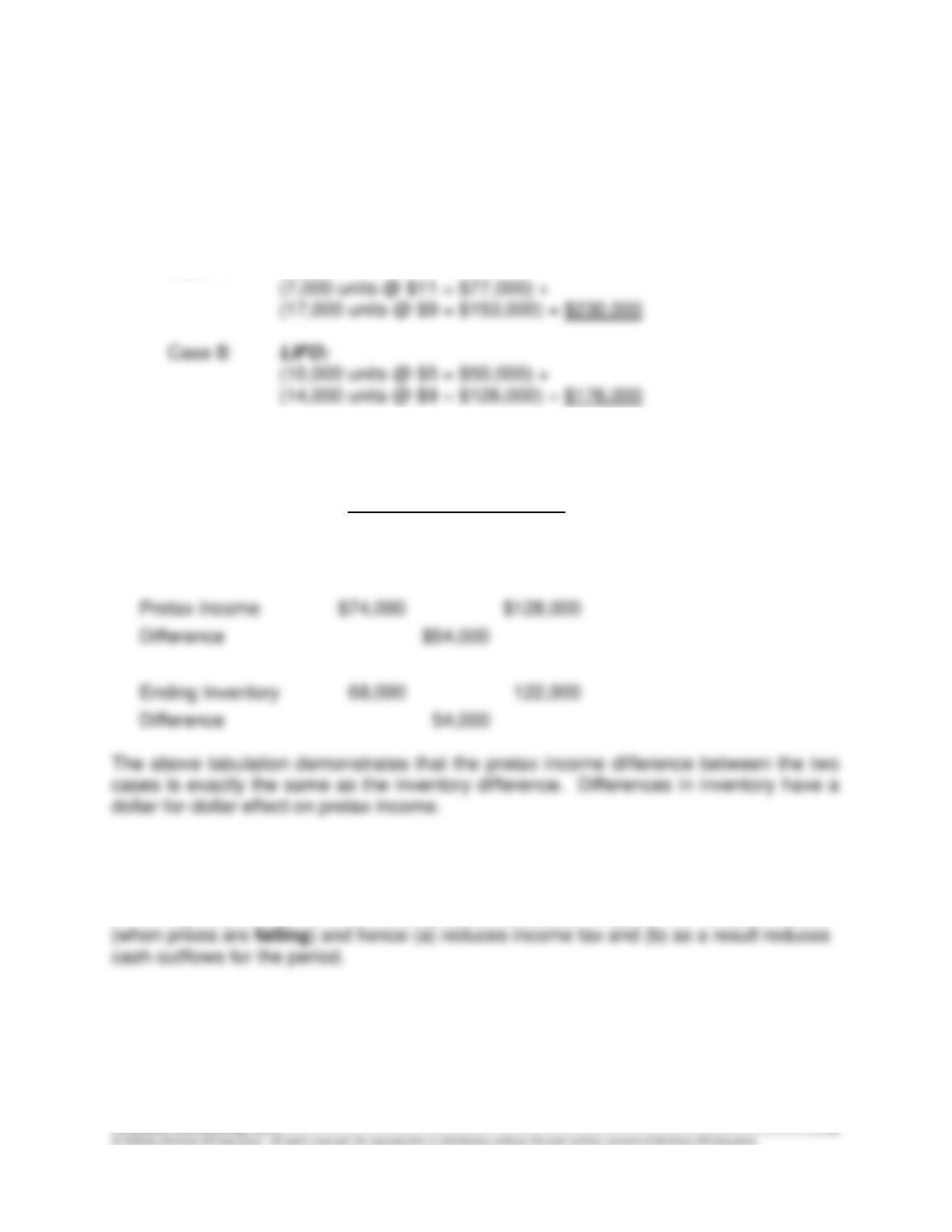
(2) Goods available for sale (for both cases):
Units Unit Cost Total Cost
Beginning inventory 7,000 $11 $ 77,000
(3) Ending inventory (36,000 available – 24,000 units sold = 12,000 units):
Case A FIFO:
Financial Accounting, 10/e 7-15
E7–8. (continued)
Req. 1 (continued)
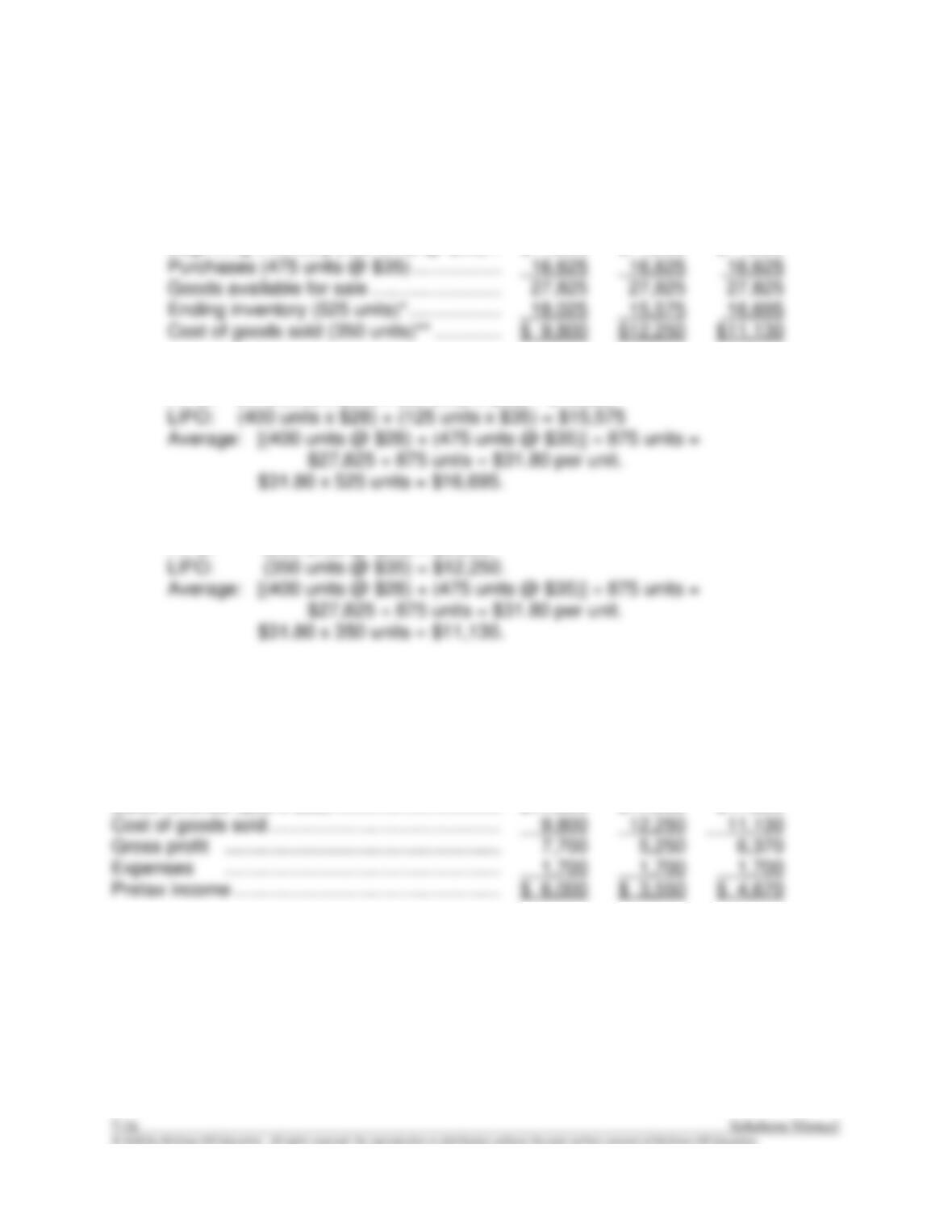
(4) Cost of goods sold (24,000 units sold):
Case A FIFO:
Req. 2
Comparison of Amounts
Case A Case B
FIFO LIFO
Req. 3
FIFO may be preferred for income tax purposes because it reports less taxable income
E7–9.
Req. 1
Average
FIFO LIFO Cost
Cost of goods sold:
Beginning inventory (400 units @ $28) … $11,200 $11,200 $11,200
*Computation of ending inventory:
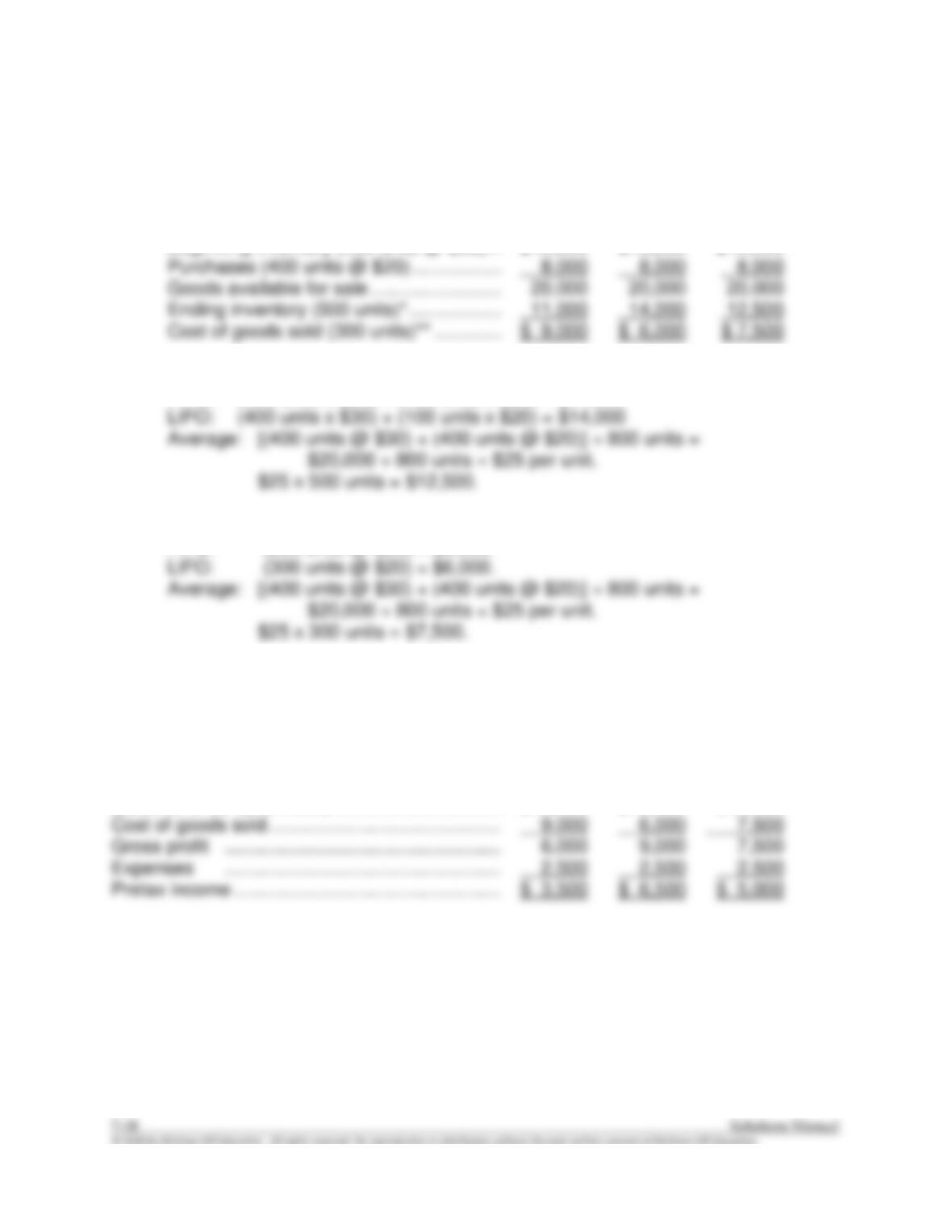
FIFO: (475 units x $35) + (50 units x $28) = $18,025
**Cost of goods sold computations:
FIFO: (350 units @ $28) = $9,800.
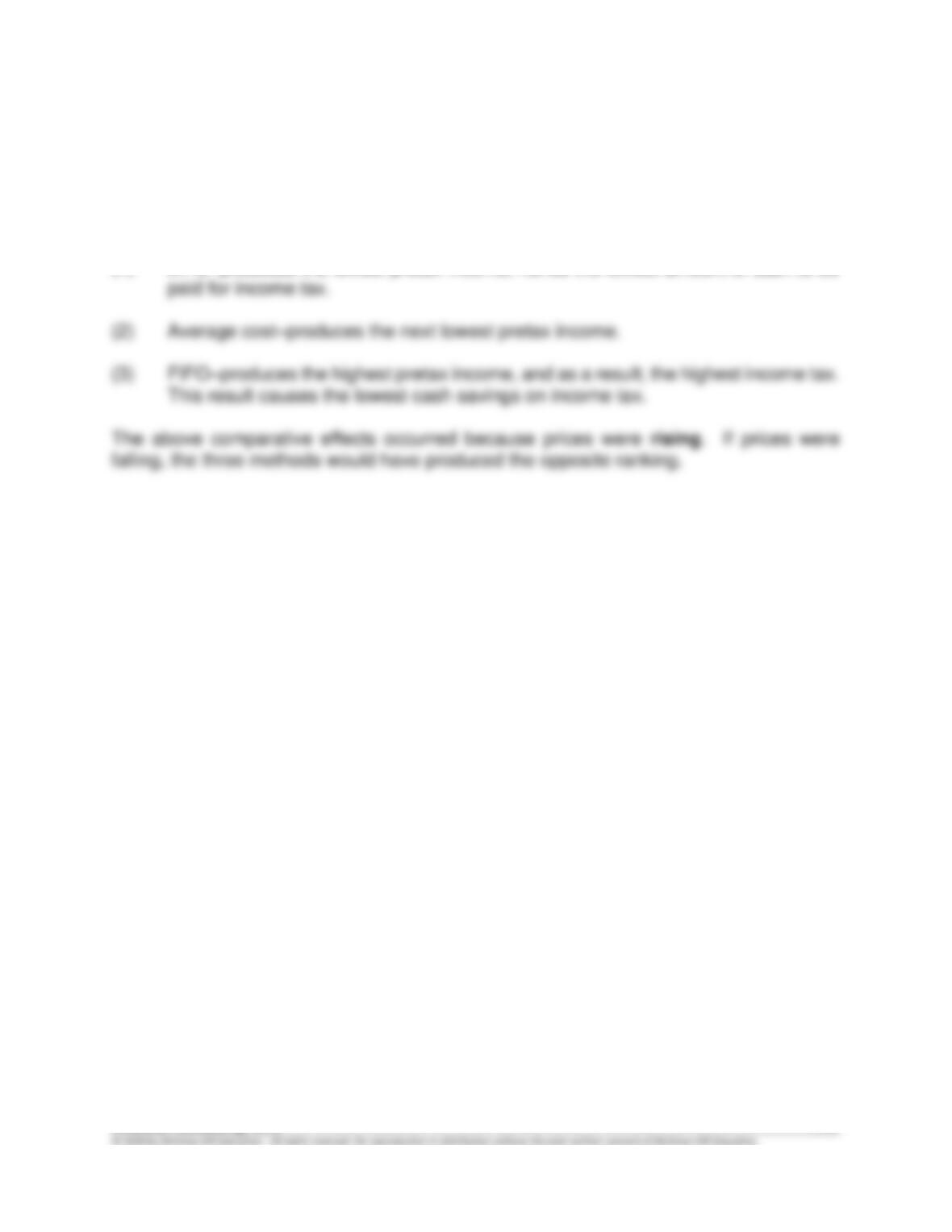
Req. 2
Average
FIFO LIFO Cost
Sales revenue ($50 x 350) ………………………….. $17,500 $17,500 $17,500
Financial Accounting, 10/e 7-17
E7–9. (continued)
Req. 3
Ranking in order of favorable cash flow: The higher rankings are given to the methods
that produce the lower income tax expense because the lower the income tax expense
the higher the cash savings.
(1) LIFO–produces the lowest pretax income, hence the lowest amount of cash to be
E7–10.
Req. 1
Average
FIFO LIFO Cost
Cost of goods sold:
Beginning inventory (400 units @ $30) … $12,000 $12,000 $12,000
*Computation of ending inventory:
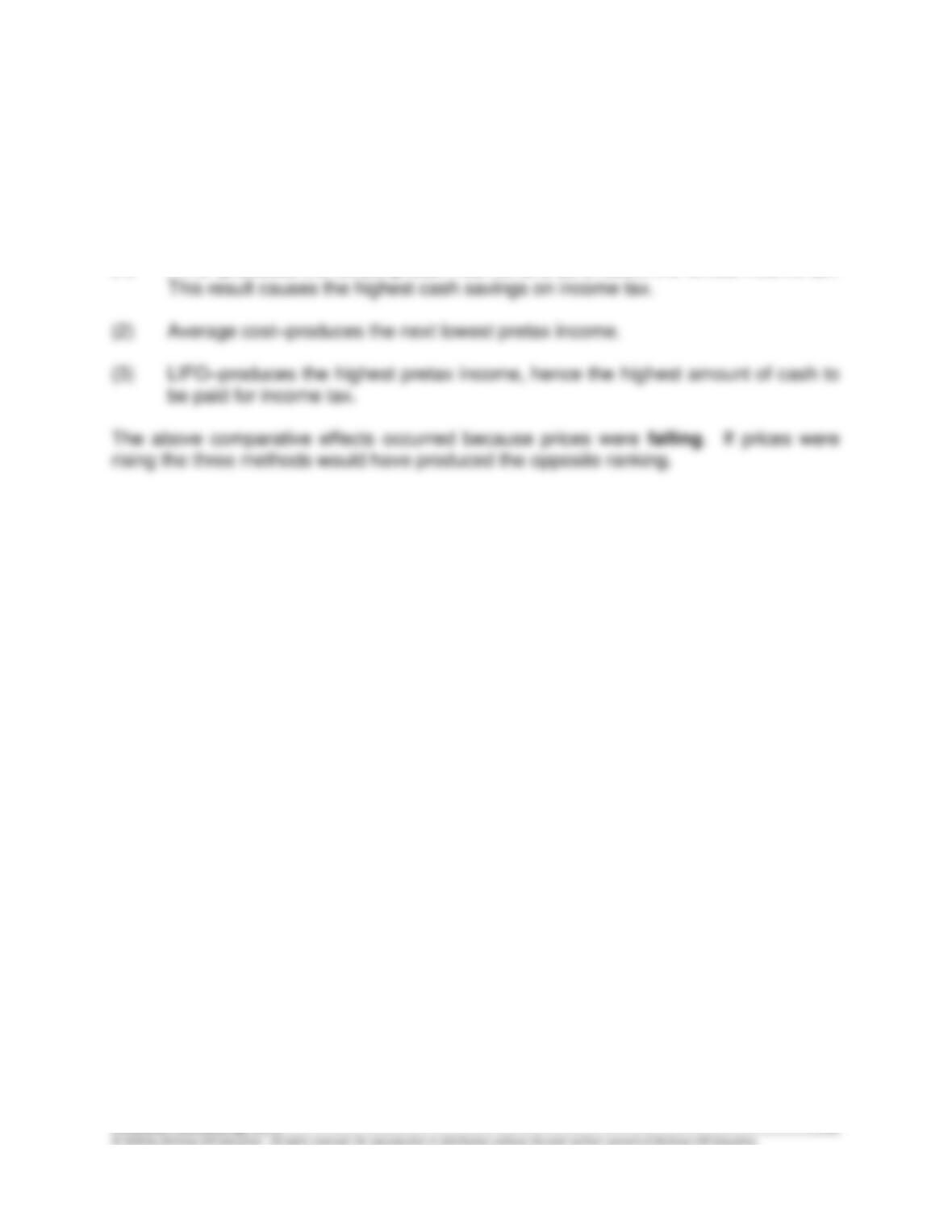
FIFO: (400 units x $20) + (100 units x $30) = $11,000
**Cost of goods sold computations:
FIFO: (300 units @ $30) = $9,000.
Req. 2
Average
FIFO LIFO Cost
Sales revenue ($50 x 300) ………………………….. $15,000 $15,000 $15,000
Financial Accounting, 10/e 7-19
E7–10. (continued)
Req. 3
Ranking in order of favorable cash flow: The higher rankings are given to the methods
that produce the lower income tax expense because the lower the income tax expense
the higher the cash savings.
(1) FIFO–produces the lowest pretax income, and as a result, the lowest income tax.
E7–11.
Req. 1
Average
Units FIFO LIFO Cost
Cost of goods sold:
Beginning inventory ……………….. 2,000 $ 76,000 $ 76,000 $ 76,000
Average
Income statement FIFO LIFO Cost
Sales revenue ………………………………… $615,000 $615,000 $615,000
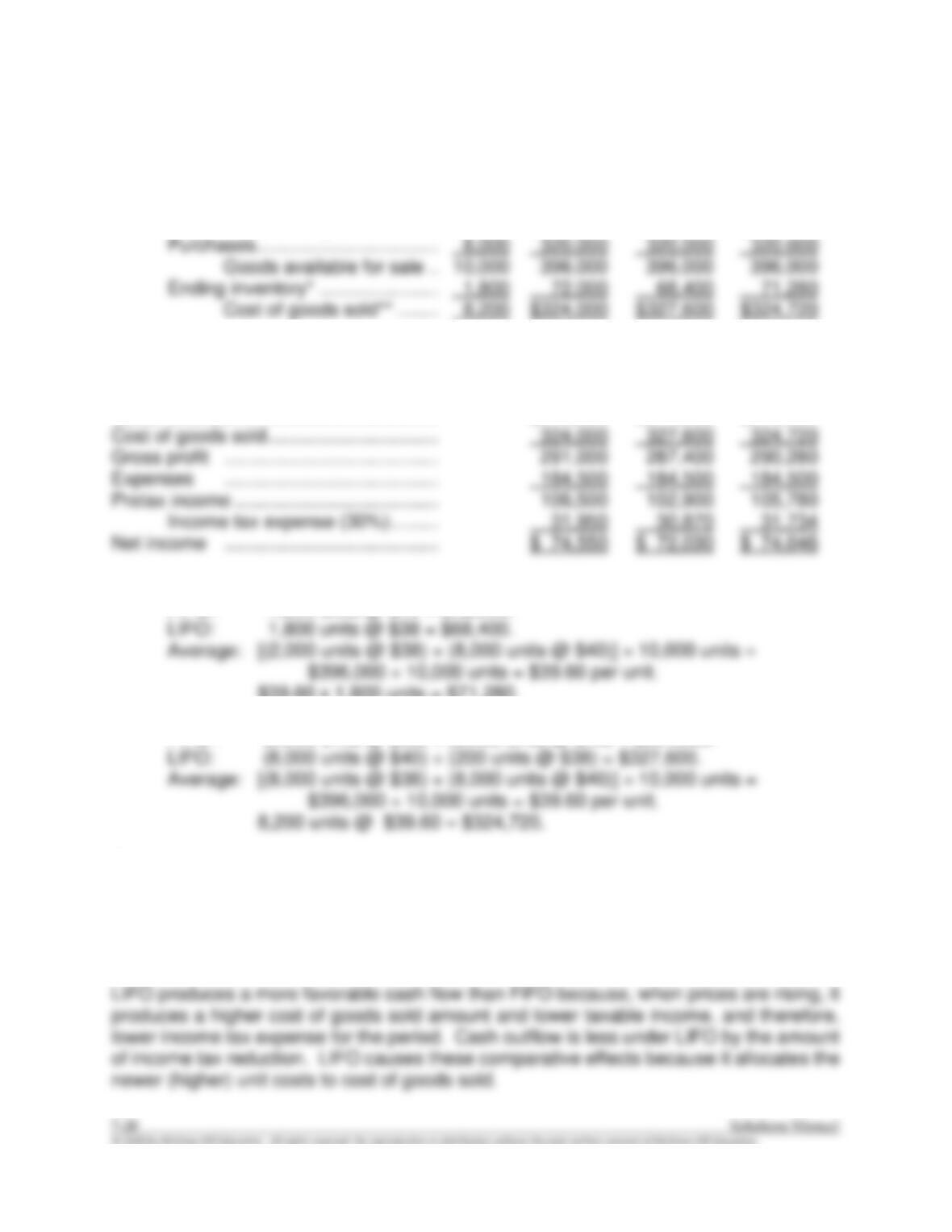
*Ending inventory computations:
FIFO: 1,800 units @ $40 = $72,000.
$39.60 x 1,800 units = $71,280.
**Cost of goods sold computations:
FIFO: (2,000 units @ $38) + (6,200 units @ $40) = $324,000.
Req. 2
FIFO produces a more favorable (higher) net income because when prices are rising it
gives a lower cost of goods sold amount. FIFO allocates the older (lower) unit costs to
cost of goods sold.