Exercise 6-11 (20 minutes)
1.
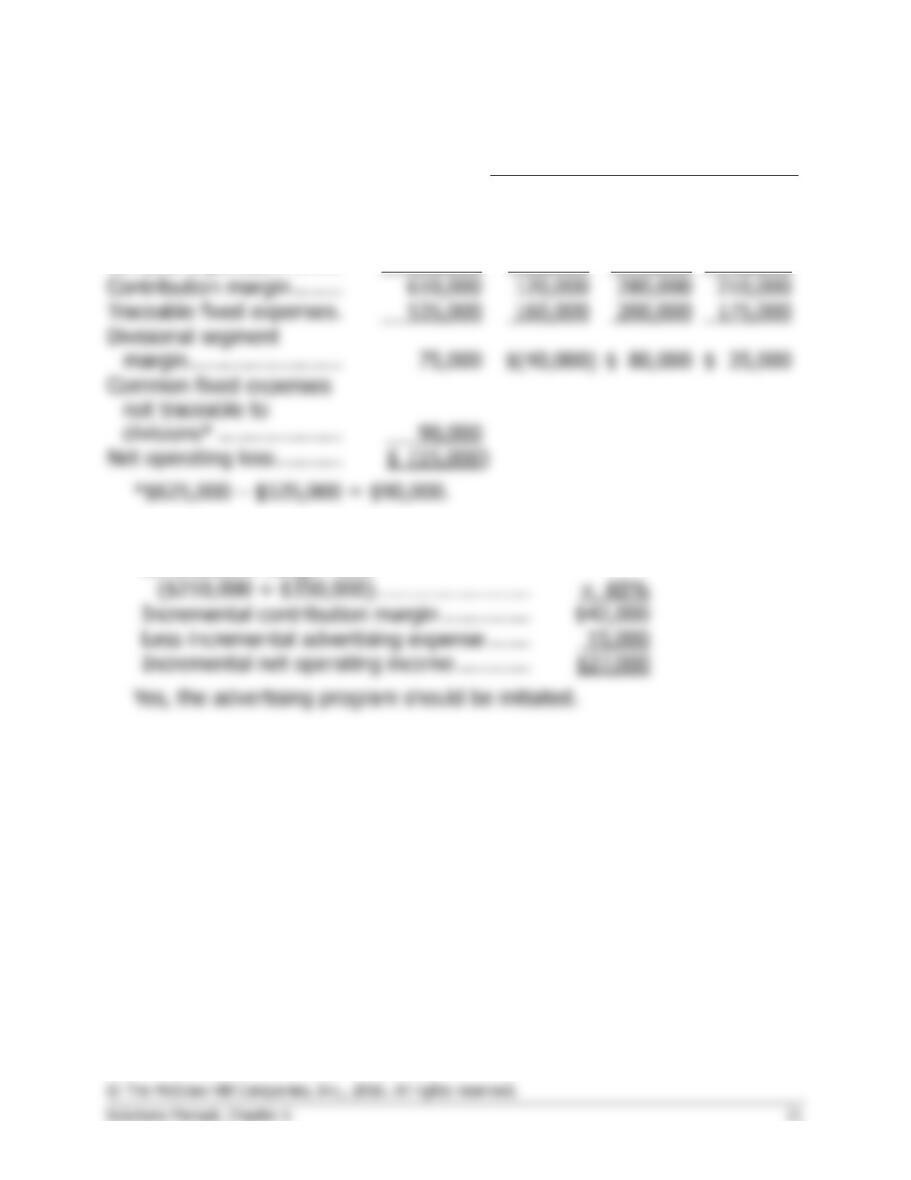
Division
Total
Company
East
Central
West
Sales …………………………
$1,000,000
$250,000
$400,000
$350,000
Variable expenses ………..
390,000
130,000
120,000
140,000
Contribution margin ……..
120,000
Traceable fixed expenses .
535,000
160,000
200,000
175,000
$ 80,000
Net operating loss ………..
2.
Incremental sales ($350,000 × 20%) …….
$70,000
Incremental contribution margin …………..
$42,000
Less incremental advertising expense …….
Incremental net operating income …………
Contribution margin ratio
Exercise 6-12 (20 minutes)
1.
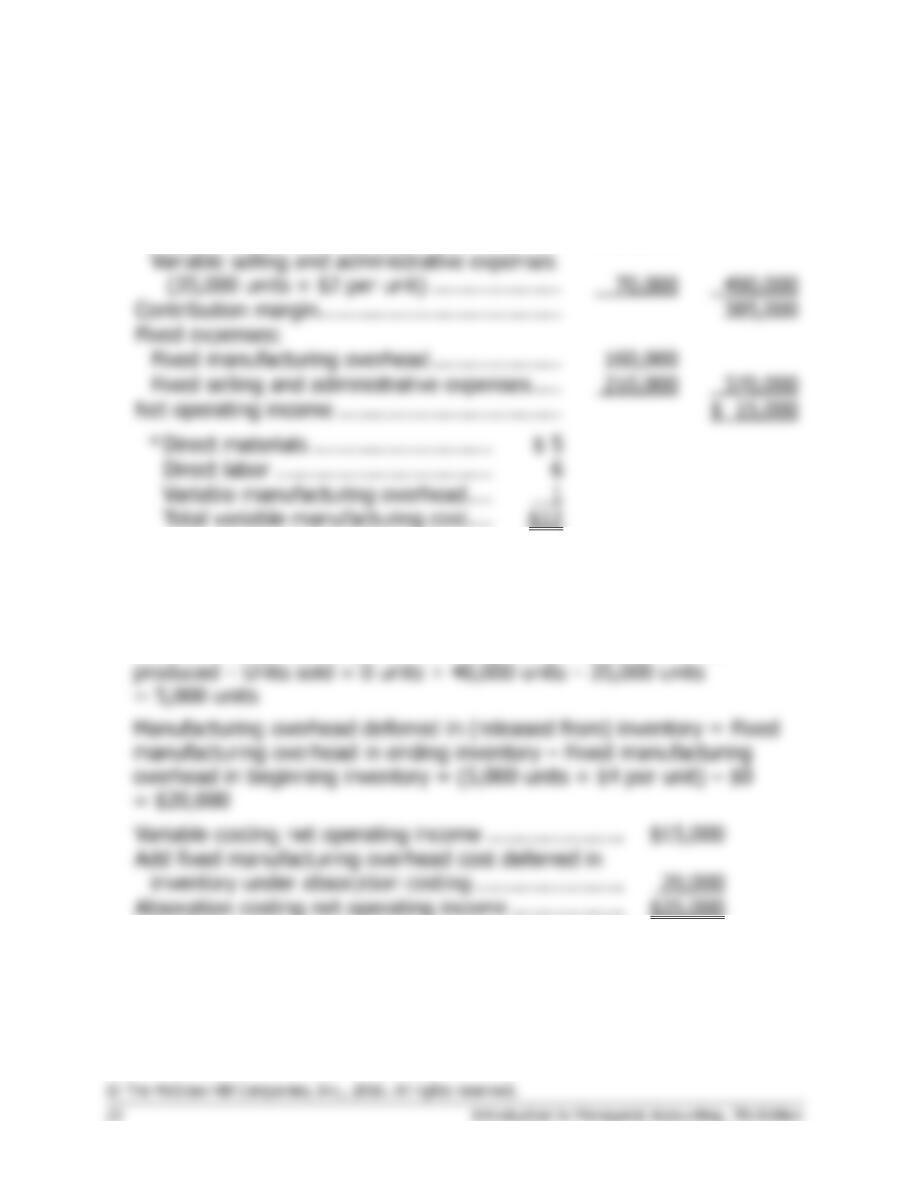
Sales (35,000 units × $25 per unit) …………….
$875,000
Variable expenses:
Variable cost of goods sold
(35,000 units × $12 per unit*) ………………
$420,000
Variable selling and administrative expenses
Contribution margin …………………………………
Fixed expenses:
Net operating income …………………………..….
*
Direct materials ………………………..
Direct labor ……………………………..
Variable manufacturing overhead ….
Total variable manufacturing cost ….
2. The difference in net operating income can be explained by the $20,000
in fixed manufacturing overhead deferred in inventory under the
absorption costing method:
Units in ending inventory = Units in beginning inventory + Units
Variable costing net operating income ………………….
$15,000
Absorption costing net operating income ………………
$35,000
Exercise 6-13 (20 minutes)
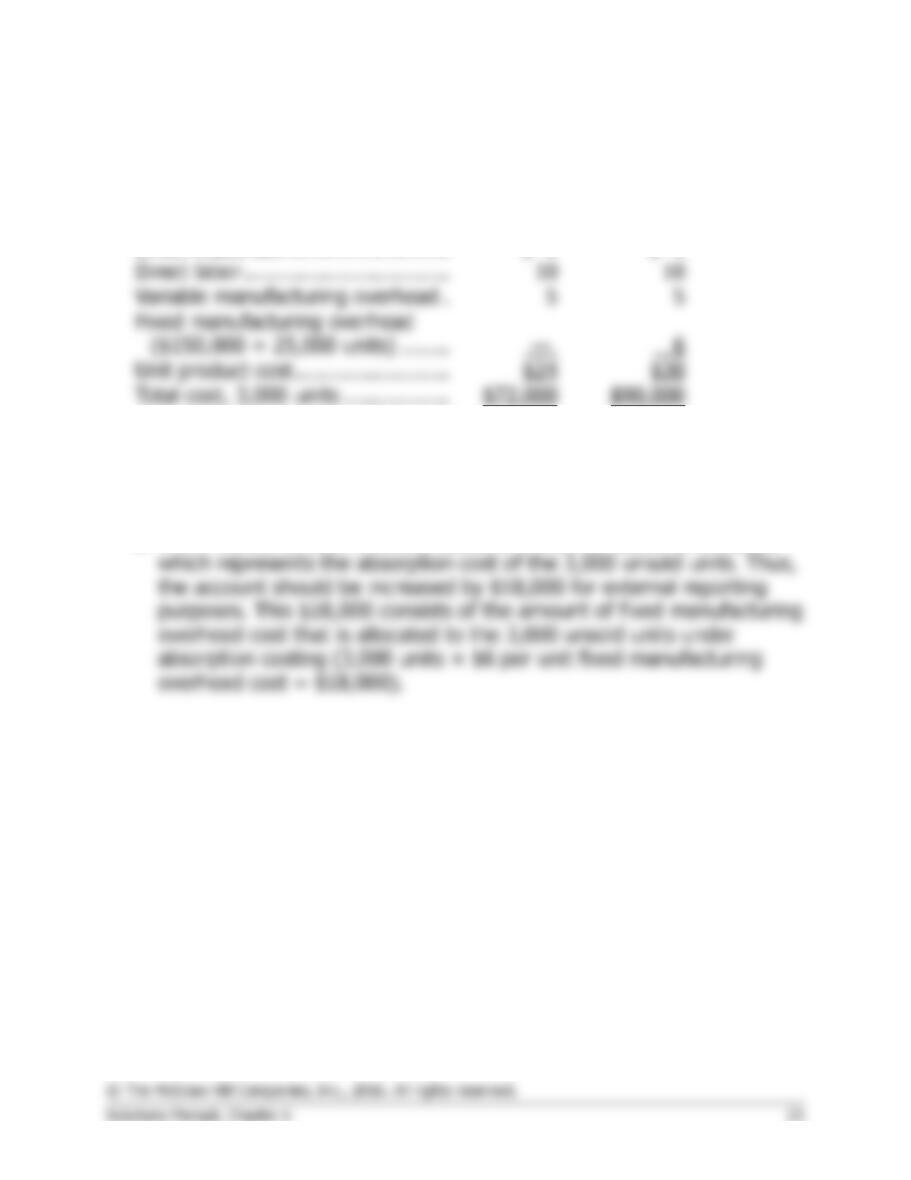
1. The company is using variable costing. The computations are:
Variable
Costing
Absorption
Costing
Direct materials ………………………
$ 9
$ 9
Unit product cost …………………….
2. a. No, $72,000 is not the correct figure to use because variable costing
is not generally accepted for external reporting purposes or for tax
purposes.
b. The Finished Goods inventory account should be stated at $90,000,
Exercise 6-14 (30 minutes)
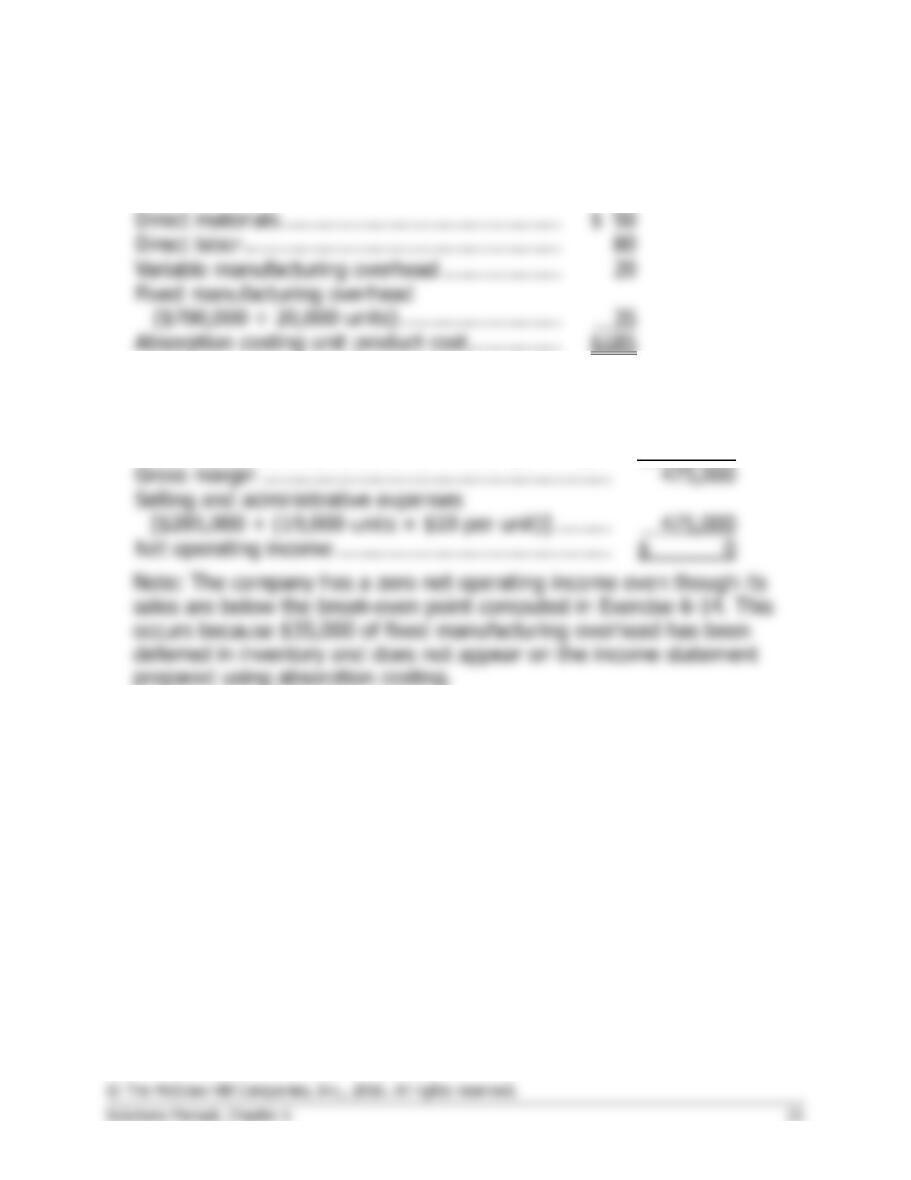
1. Under variable costing, only the variable manufacturing costs are
included in product costs.
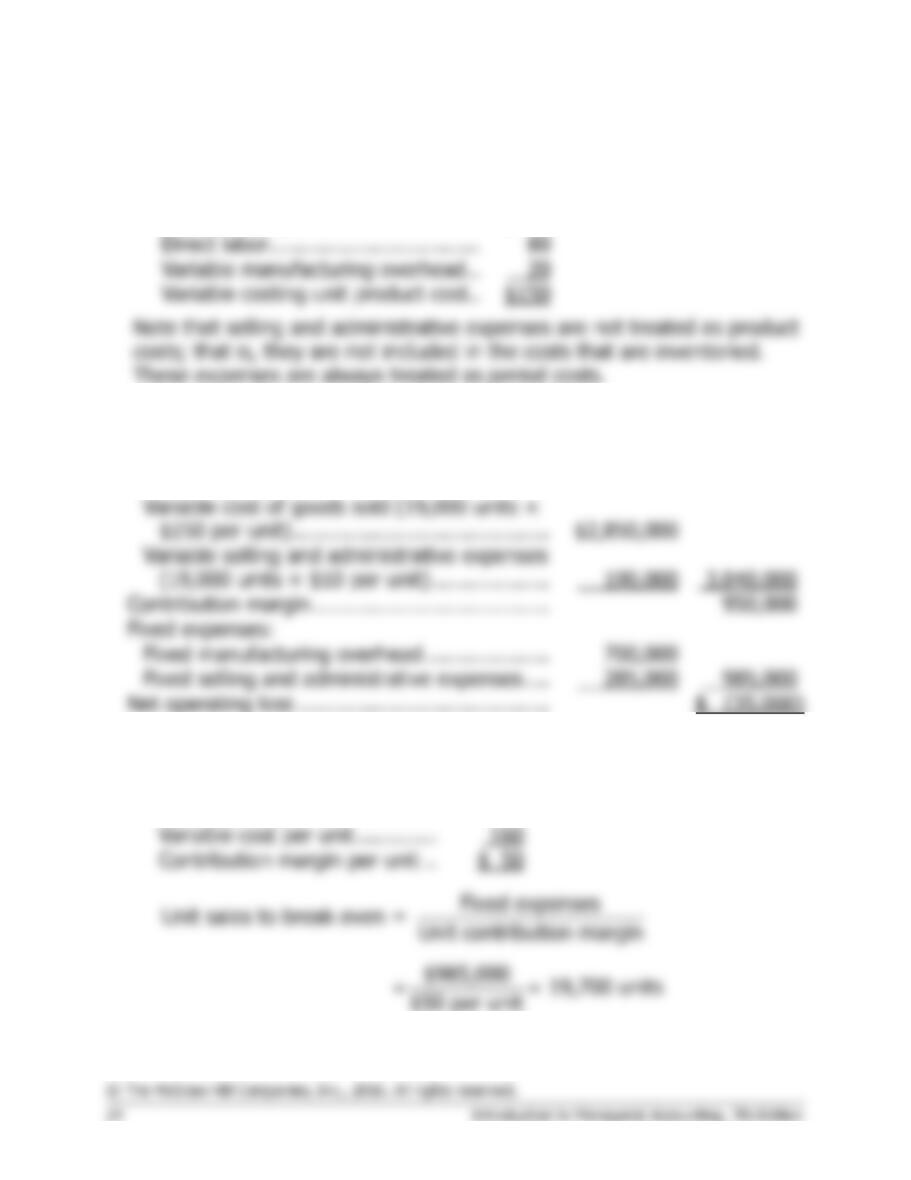
Direct materials……………………….
$ 50
Direct labor…………………………….
Variable manufacturing overhead ..
Variable costing unit product cost ..
2. The variable costing income statement appears below:
Sales …………………………………………………..
$3,990,000
Variable expenses:
Fixed expenses:
Net operating loss ………………………………….
3. The break-even point in units sold can be computed using the
contribution margin per unit as follows:
Selling price per unit …………..
$210
Variable cost per unit ………….
Contribution margin per unit ..
Exercise 6-15 (20 minutes)
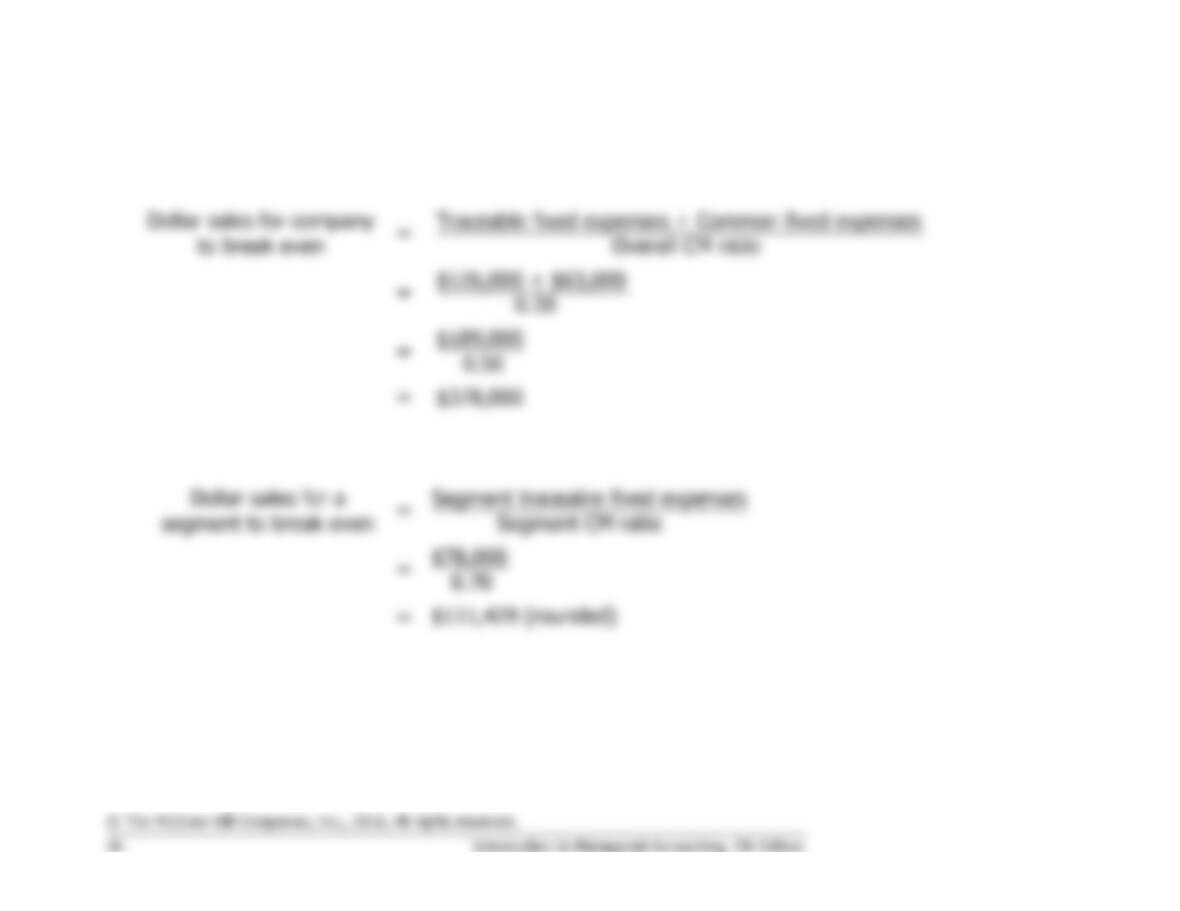
1. Under absorption costing, all manufacturing costs (variable and fixed)
are included in product costs.
Variable manufacturing overhead ……………….
2. The absorption costing income statement appears below:
Sales (19,000 units × $210 per unit) ………………….
$3,990,000
Cost of goods sold (19,000 units × $185 per unit) …
3,515,000
Net operating income …………………………..…………
Exercise 6-16 (20 minutes)
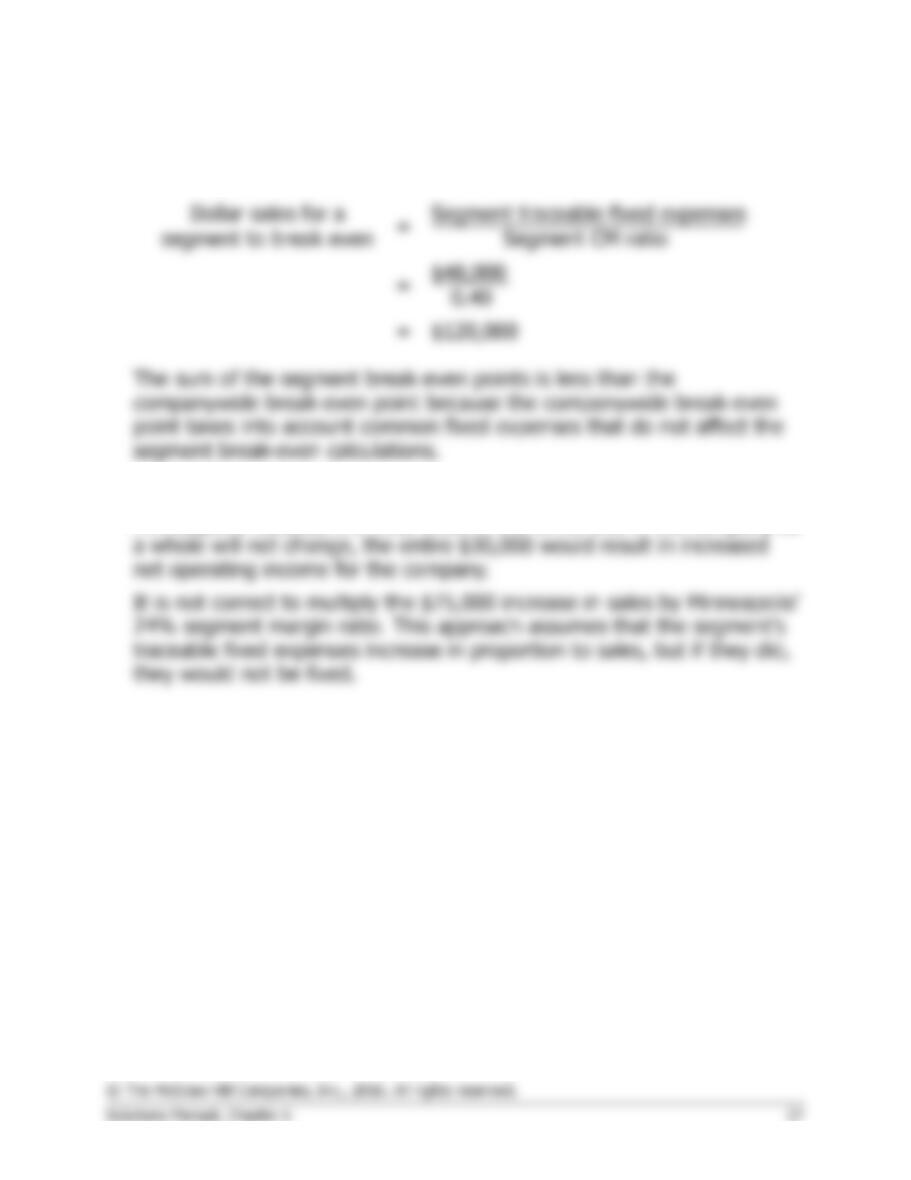
1. The companywide break-even point is computed as follows:
The break-even point for the Chicago office is computed as follows:
Exercise 6-16 (continued)
The break-even point for the Minneapolis office is computed as follows:
2. $75,000 × 40% CM ratio = $30,000 increased contribution margin in
Minneapolis. Because the fixed costs in the office and in the company as
Exercise 6-16 (continued)
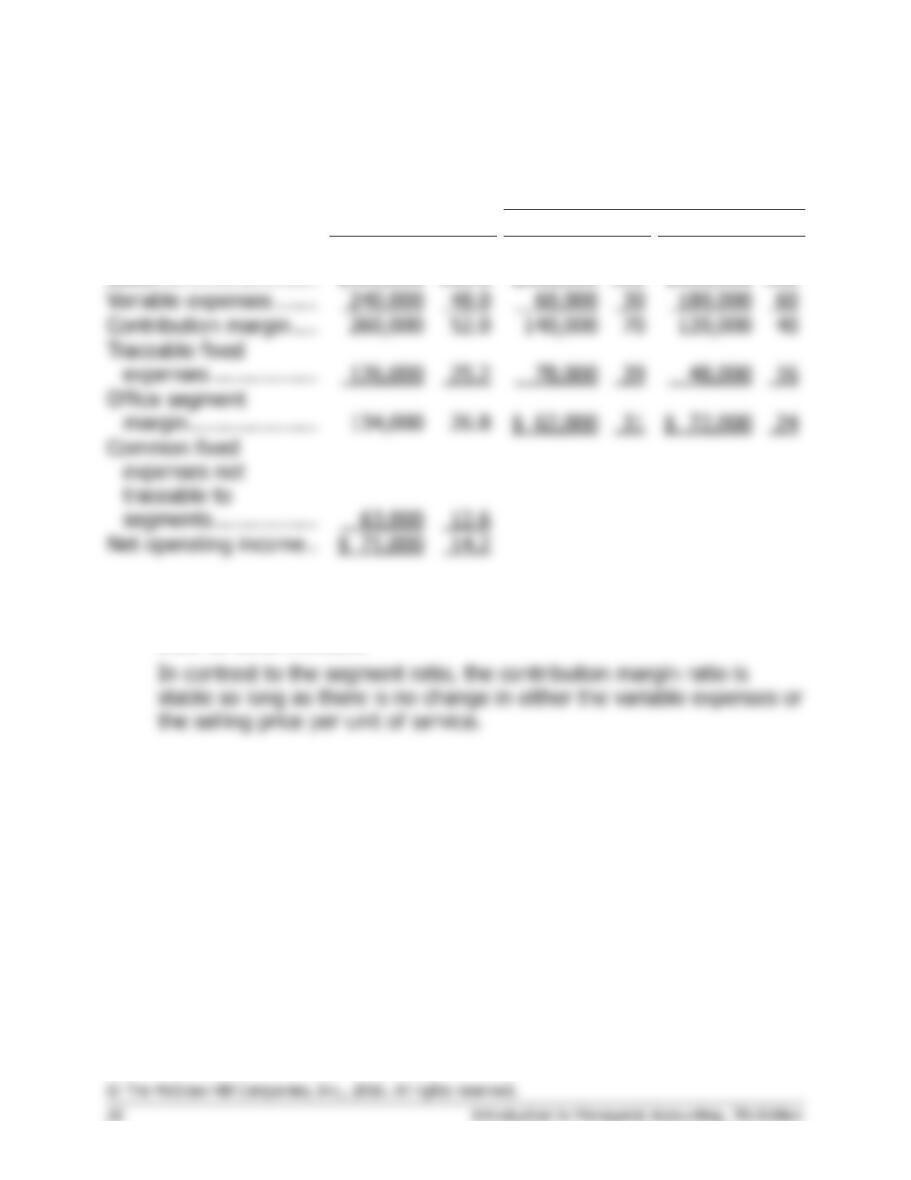
3. a. The segmented income statement follows:
Segments
Total Company
Chicago
Minneapolis
Amount
%
Amount
%
Amount
%
Sales ……………………..
$500,000
100.0
$200,000
100
$300,000
100
Variable expenses …….
b. The segment margin ratio rises and falls as sales rise and fall due to
the presence of fixed costs. The fixed costs are spread over a larger
base as sales increase.
Exercise 6-17 (15 minutes)
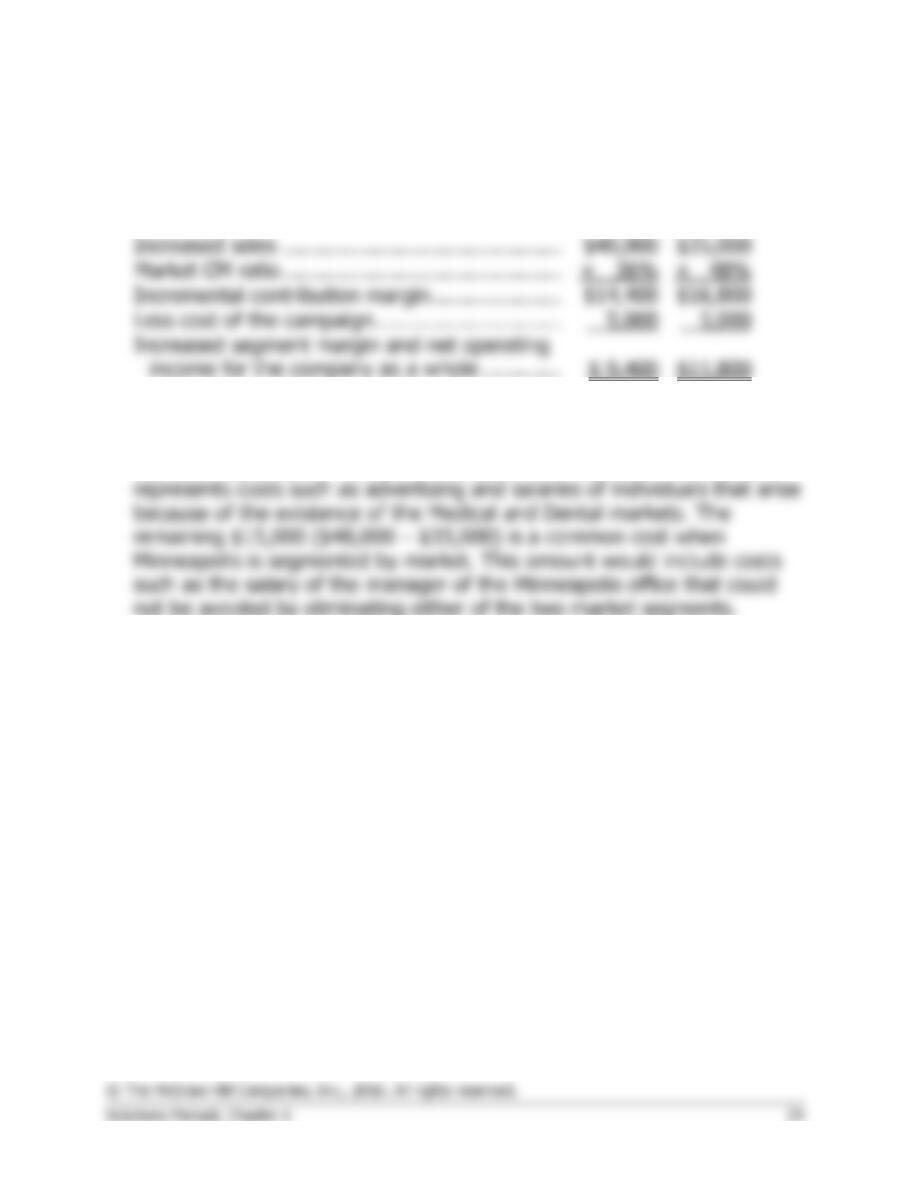
1. The company should focus its campaign on the Dental market. The
computations are:
Medical
Dental
Increased sales ………………………………………
Market CM ratio ………………………………………
2. The $48,000 in traceable fixed expenses in the previous exercise is now
partly traceable and partly common. When we segment Minneapolis by
market, only $33,000 remains a traceable fixed expense. This amount
Problem 6-18A (45 minutes)
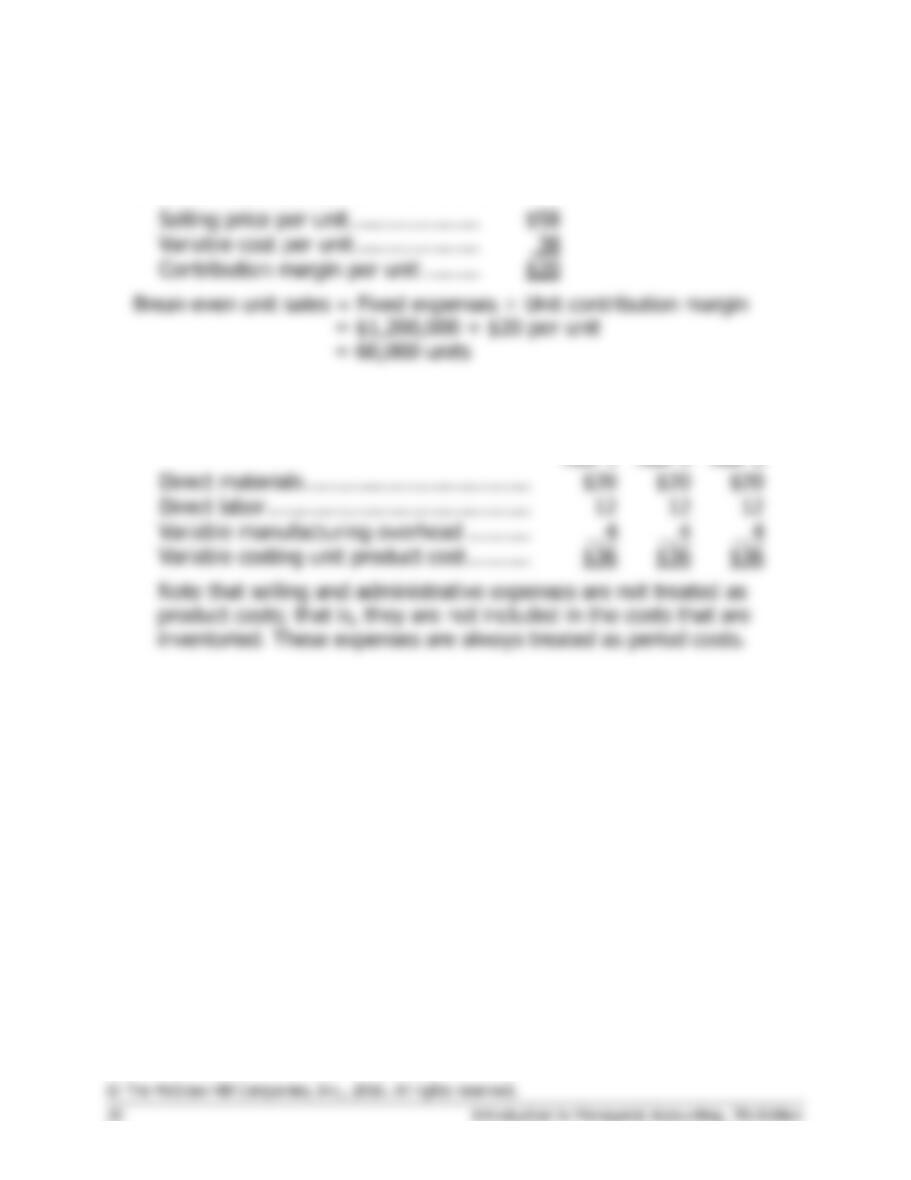
1. The break-even point in units sold can be computed using the
contribution margin per unit as follows:
2 a. Under variable costing, only the variable manufacturing costs are
included in product costs.
Problem 6-18A (continued)
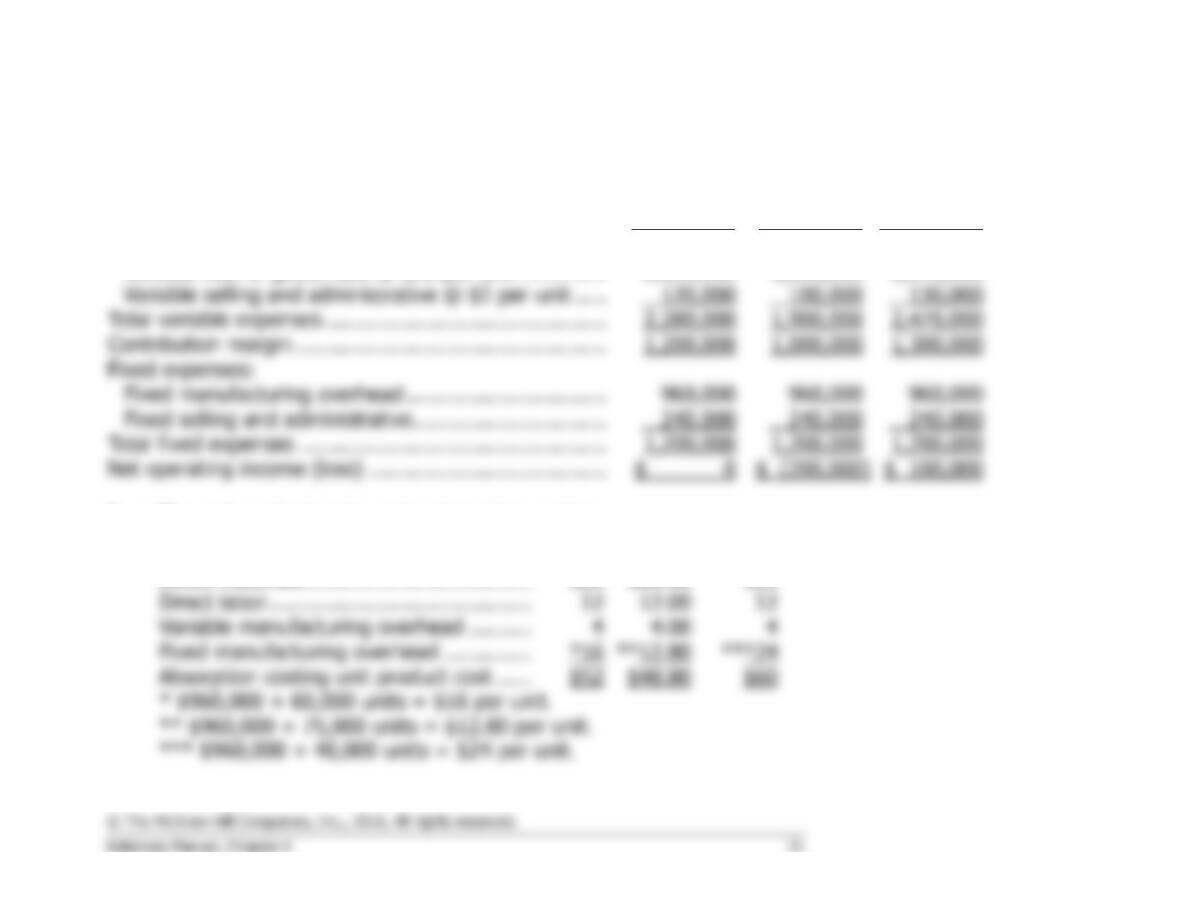
2 b. The variable costing income statements appear below:
Year 1
Year 2
Year 3
Sales ………………………………………………………………
$3,480,000
$2,900,000
$3,770,000
Variable expenses:
Variable cost of goods sold @ $36 per unit …………..
2,160,000
1,800,000
2,340,000
Total variable expenses ………………………………………
2,280,000
Contribution margin …………………………………………..
Fixed expenses:
Fixed manufacturing overhead …………………………..
Total fixed expenses ………………………………………….
Net operating income (loss) ………………………………..
3 a. The unit product costs under absorption costing:
Year 1
Year 2
Year 3
Direct materials ………………………………
$20
$20.00
$20
Direct labor ……………………………………
Variable manufacturing overhead ……….
Fixed manufacturing overhead …………..
Absorption costing unit product cost ……
* $960,000 ÷ 60,000 units = $16 per unit.
Problem 6-18A (continued)
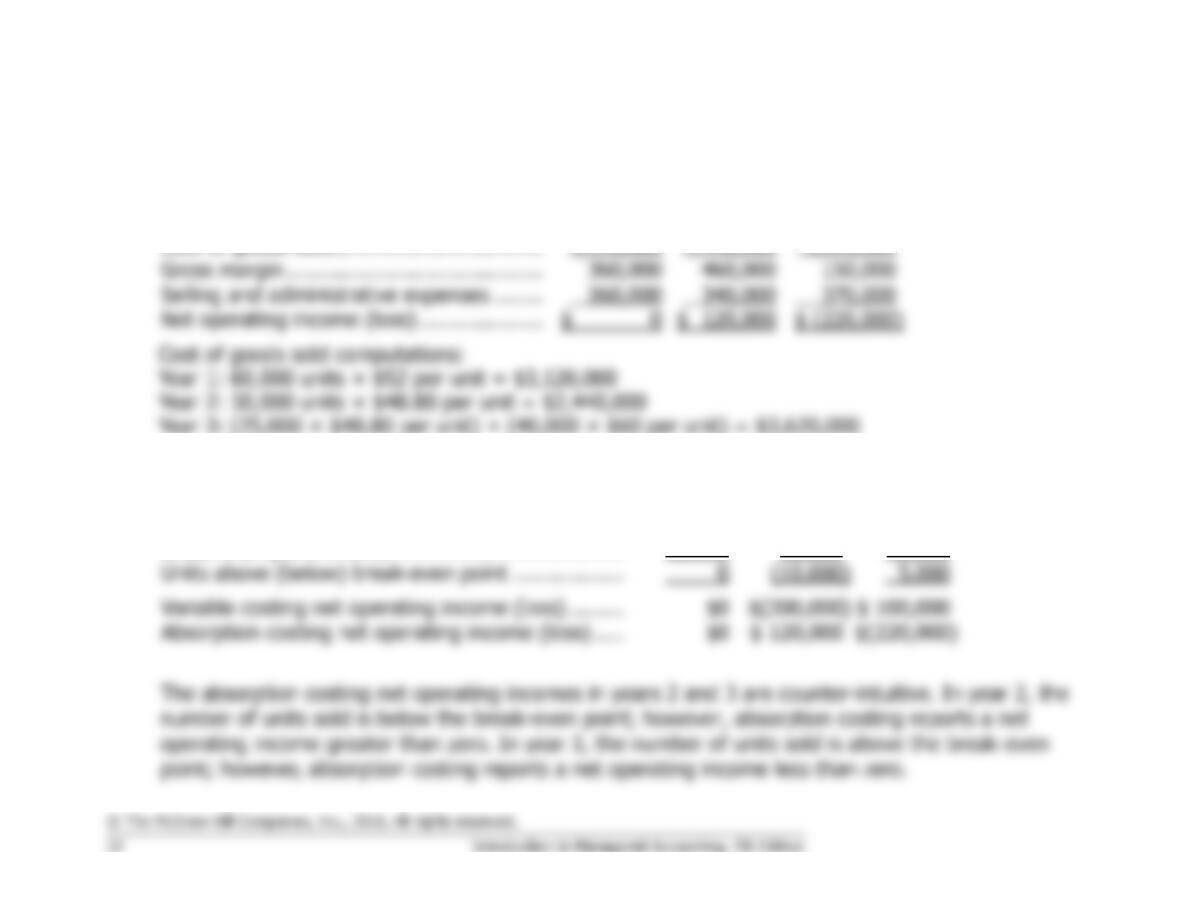
3 b. The absorption costing income statements appears below:
Year 1
Year 2
Year 3
Sales ……………………………………………..
$3,480,000
$2,900,000
$3,770,000
Cost of goods sold…………………………….
3,120,000
2,440,000
3,620,000
Gross margin …………………………………..
Selling and administrative expenses ……..
Net operating income (loss) ………………..
4.
Year 1
Year 2
Year 3
Units sold …………………………………………………..
60,000
50,000
65,000
Break-even point in units ……………………………….
60,000
60,000
60,000
Units above (below) break-even point ………………
Variable costing net operating income (loss) ………
Absorption costing net operating income (loss) …..
$ 120,000
Problem 6-19A (30 minutes)
1. The unit product cost under variable costing is computed as follows:
Direct materials ……………………..
$ 4
Direct labor …………………………..
With this figure, the variable costing income statements can be
prepared:
Year 1
Year 2
Unit sales ……………………………………………
40,000 units
50,000 units
Sales …………………………………………………
$1,000,000
$1,250,000
Variable expenses:
80,000
Total variable expenses ………………………….
560,000
130,000
Total fixed expenses ……………………………..
400,000
Net operating income …………………………...
$ 40,000
$ 150,000
Problem 6-19A (continued)
2. The reconciliation of absorption and variable costing follows:
Year 1
Year 2
Units in beginning inventory ……………………
0
5,000
+ Units produced …………………………..…….
45,000
45,000
40,000
50,000
Year 1
Year 2
$30,000
Year 1
Year 2
Variable costing net operating income (loss)
$40,000
$150,000
30,000
Absorption costing net operating income …..
$70,000
$120,000
Problem 6-20A (45 minutes)
1. a. The unit product cost under absorption costing is:
Direct materials …………………………..…
$20
Direct labor …………………………………..
Variable manufacturing overhead ……….
Absorption costing unit product cost …..
$40
b. The absorption costing income statement is:
Sales (8,000 units × $75 per unit)……………………..
$600,000
Cost of goods sold (8,000 units × $40 per unit) ……
320,000
Gross margin ………………………………………………..
Net operating income ……………………………………..
$ 32,000
2. a. The unit product cost under variable costing is:
Direct materials ……………………….
$20
Direct labor …………………………....
8
Variable manufacturing overhead …
2
Variable costing unit product cost…
$30
b. The variable costing income statement is:
Sales (8,000 units × $75 per unit) ………………
$600,000
Variable expenses:
Contribution margin …………………………………
Fixed expenses:
Net operating income ……………………………….
Problem 6-20A (continued)
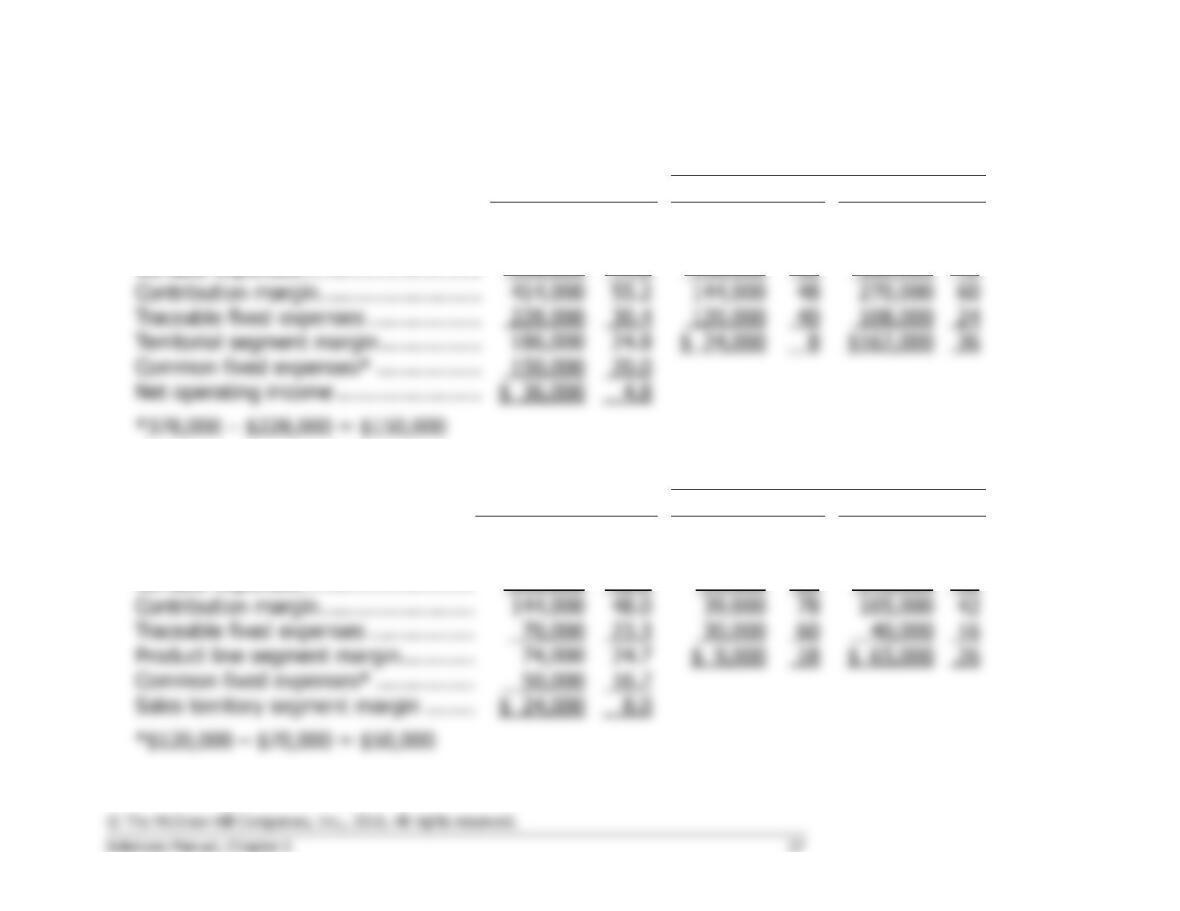
3. The difference in the ending inventory relates to a difference in the
handling of fixed manufacturing overhead costs. Under variable costing,
these costs have been expensed in full as period costs. Under
absorption costing, these costs have been added to units of product at
the rate of $10 per unit ($100,000 ÷ 10,000 units produced = $10 per
Problem 6-21A (30 minutes)
1.
Sales Territory
Total Company
Northern
Southern
Amount
%
Amount
%
Amount
%
Sales ………………………………………..
$750,000
100.0
$300,000
100
$450,000
100
Variable expenses ………………………..
336,000
44.8
156,000
52
180,000
40
Territorial segment margin …………….
186,000
24.8
$ 24,000
$162,000
Common fixed expenses* ……………..
150,000
20.0
Net operating income …………………..
$ 36,000
4.8
*378,000 – $228,000 = $150,000
Product Line
Northern Territory
Paks
Tibs
Amount
%
Amount
%
Amount
%
Sales ……………………………………….
$300,000
100.0
$50,000
100
$250,000
100
Variable expenses ……………………….
156,000
52.0
11,000
22
145,000
58
Contribution margin …………………….
48.0
Traceable fixed expenses ……………..
70,000
23.3
60
Sales territory segment margin ……..
$ 24,000
8.0
*$120,000 – $70,000 = $50,000
Problem 6-21A (continued)
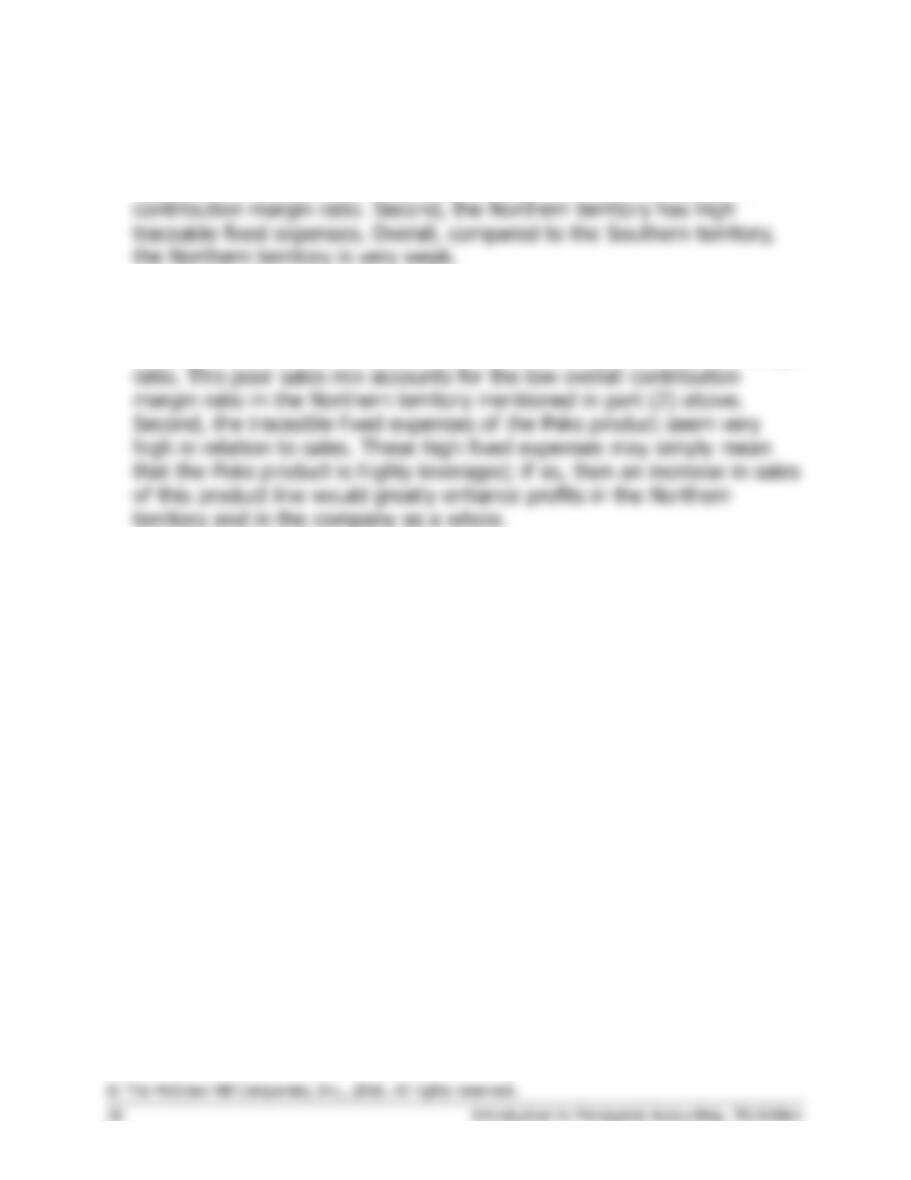
2. Two insights should be brought to the attention of management. First,
compared to the Southern territory, the Northern territory has a low
3. Again, two insights should be brought to the attention of management.
First, the Northern territory has a poor sales mix. Note that the territory
sells very little of the Paks product, which has a high contribution margin
Problem 6-22A (45 minutes)
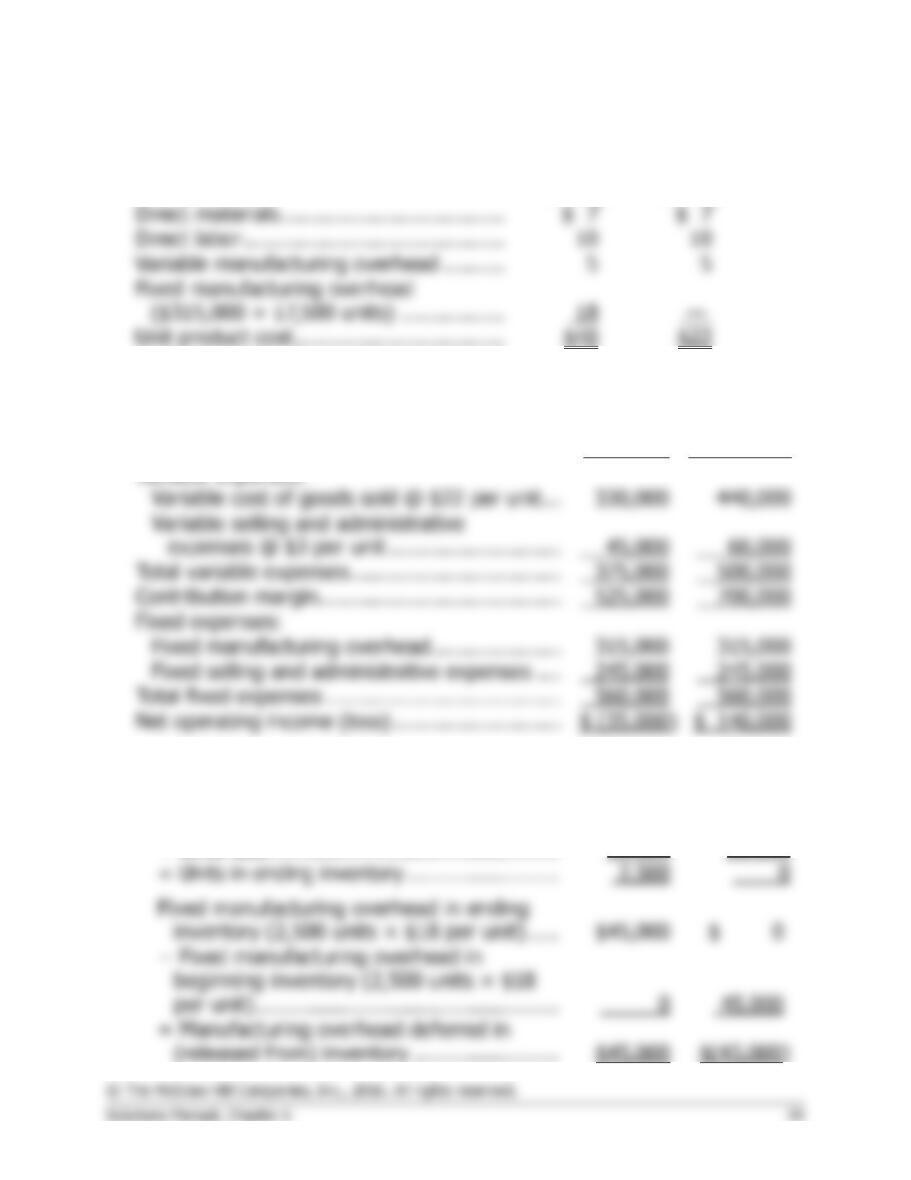
1.
a. and b.
Absorption
Costing
Variable
Costing
Direct materials ………………………………
Direct labor ……………………………………
Variable manufacturing overhead ……….
Unit product cost …………………………….
2.
July
August
Unit sales ………………………………………………
15,000
20,000
Sales ……………………………………………………
$900,000
$1,200,000
Variable expenses:
Total variable expenses …………………………….
500,000
Contribution margin…………………………………
Fixed expenses:
Fixed manufacturing overhead …………………
Fixed selling and administrative expenses ….
245,000
Total fixed expenses ………………………………..
560,000
Net operating income (loss) ………………………
$ 140,000
3.
July
August
Units in beginning inventory ……………………
0
2,500
+ Units produced ………………………………….
17,500
17,500
− Units sold…………………………………………
15,000
20,000
Problem 6-22A (continued)
July
August
Variable costing net operating income
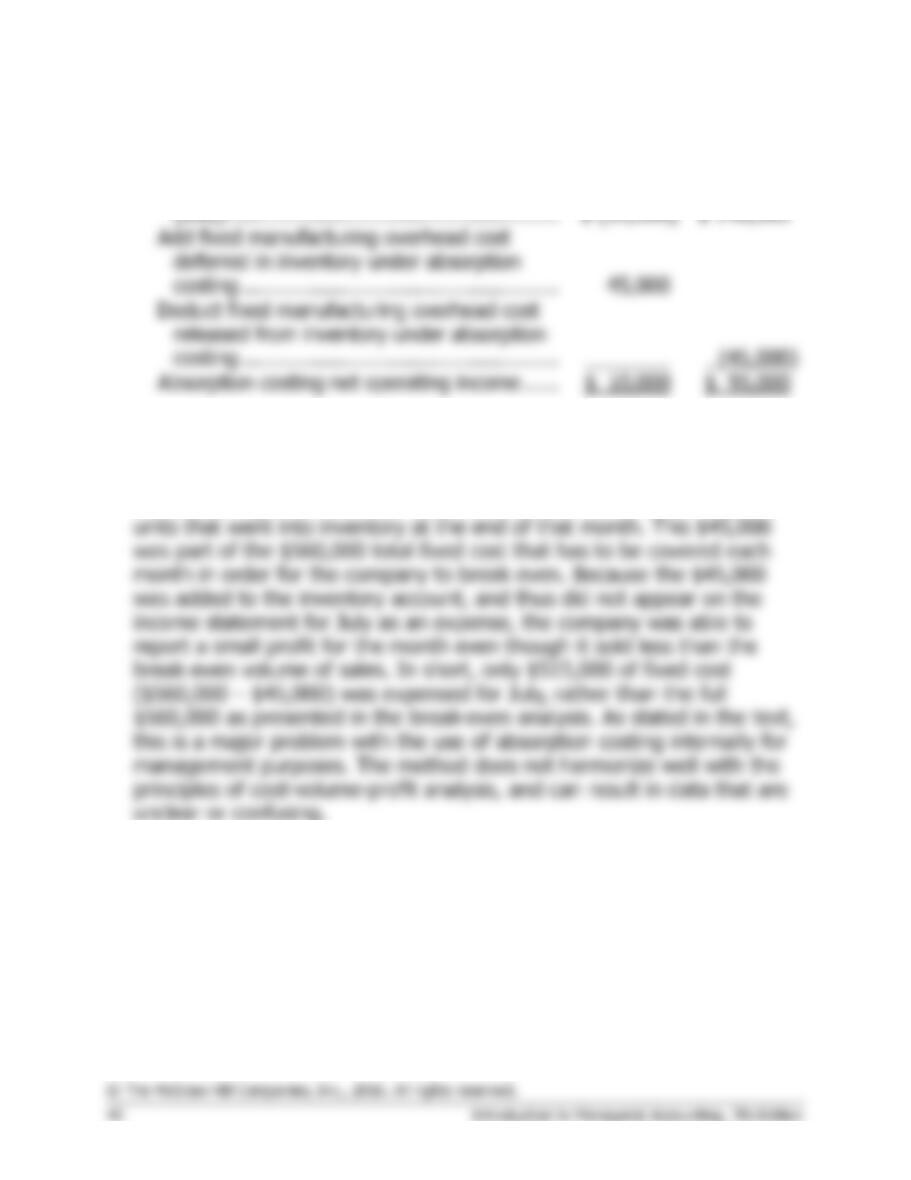
4. As shown in the reconciliation in part (3) above, $45,000 of fixed
manufacturing overhead cost was deferred in inventory under
absorption costing at the end of July because $18 of fixed
manufacturing overhead cost “attached” to each of the 2,500 unsold