Analytical Thinking (continued)
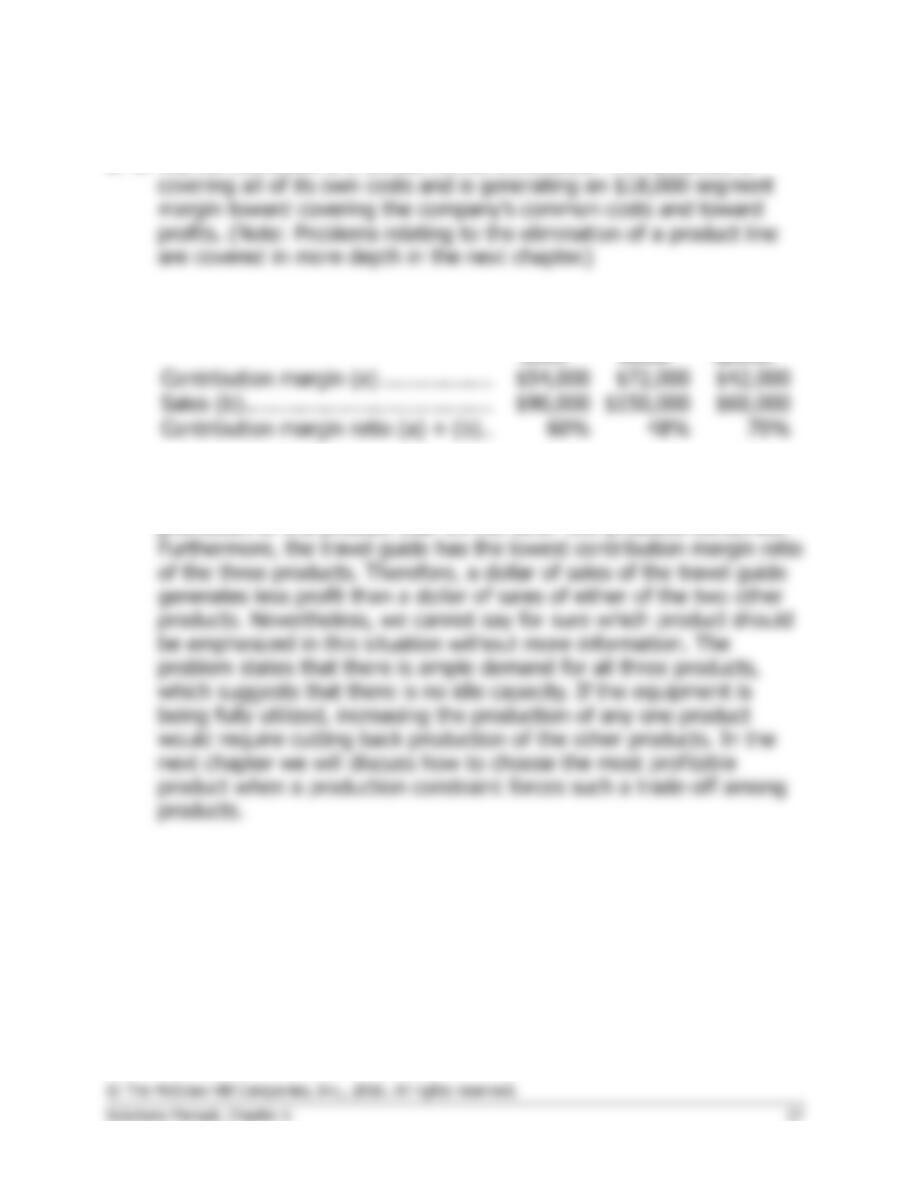
2. a. No, the cookbook line should not be eliminated. The cookbook is
b.
Cook–
Travel
Handy
It is probably unwise to focus all available resources on promoting the
travel guide. The company is already spending more on the
promotion of this product than on the other two products combined.
Case (75 minutes)
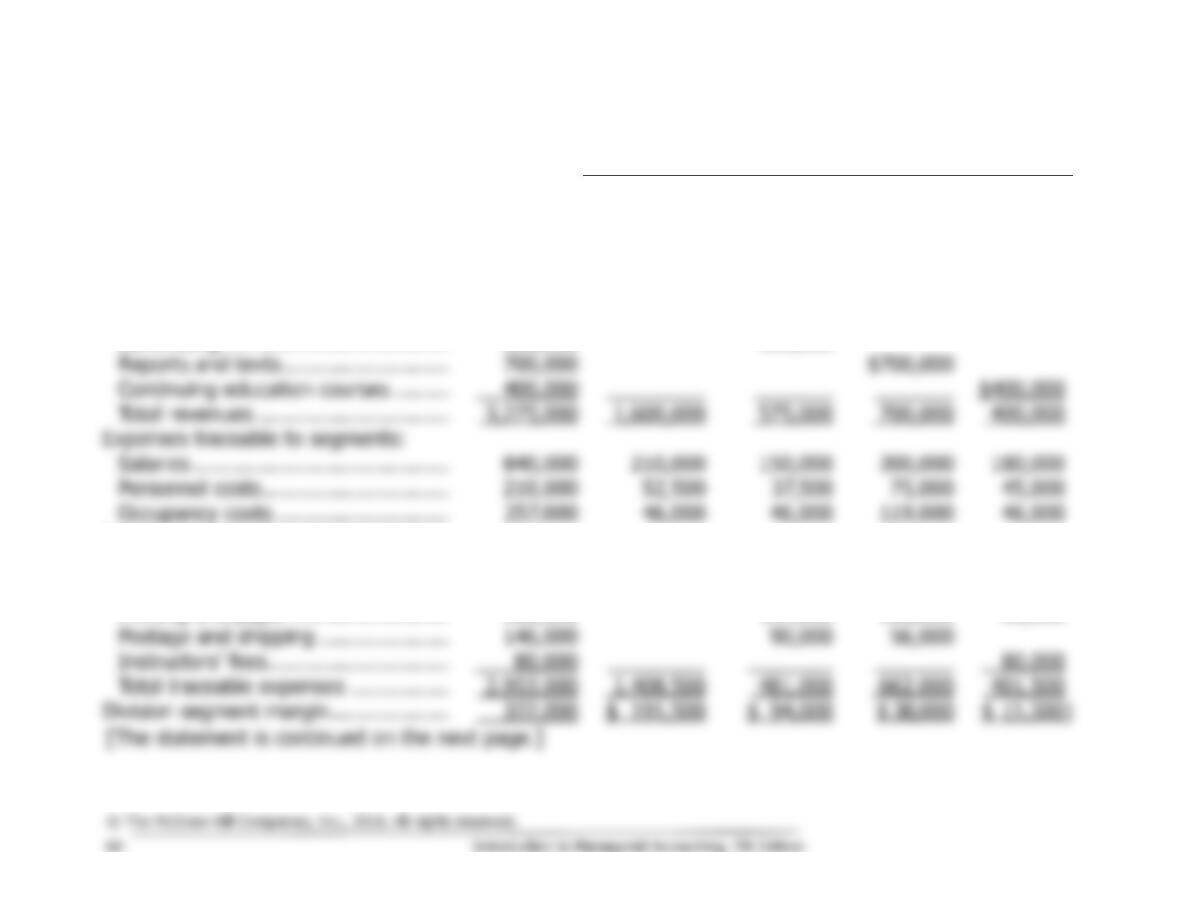
1. See the segmented statement on the second following page.
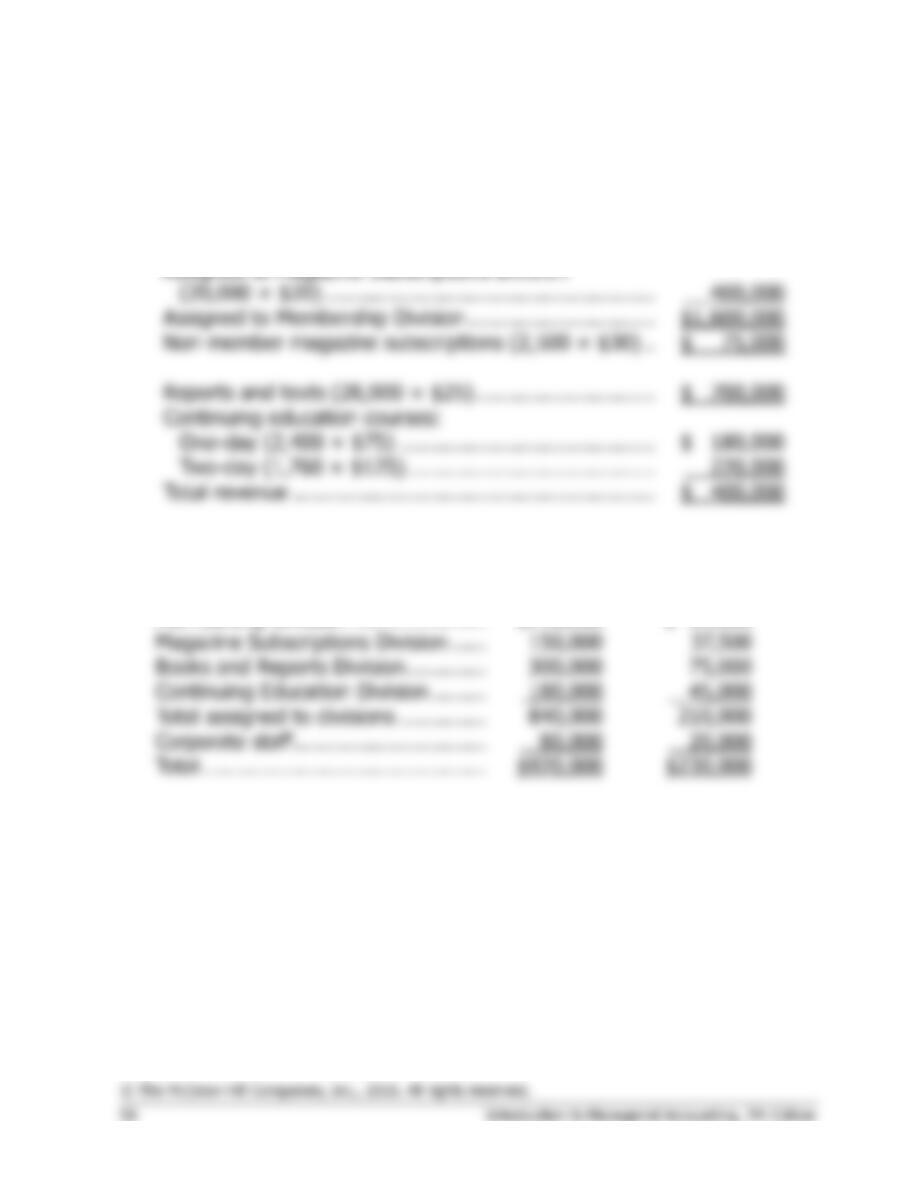
Supporting computations for the statement are given below:
Sales:
Membership dues (20,000 × $100) ………………………
$2,000,000
Non-member magazine subscriptions (2,500 × $30) ..
$ 75,000
Total revenue ………………………………………………….
$ 400,000
Assigned to Magazine Subscriptions Division
Salary and personnel costs:
Salaries
Personnel Costs
(25% of Salaries)
Membership Division ………………….
$210,000
$ 52,500
Corporate staff ………………………….
$920,000
Case (continued)
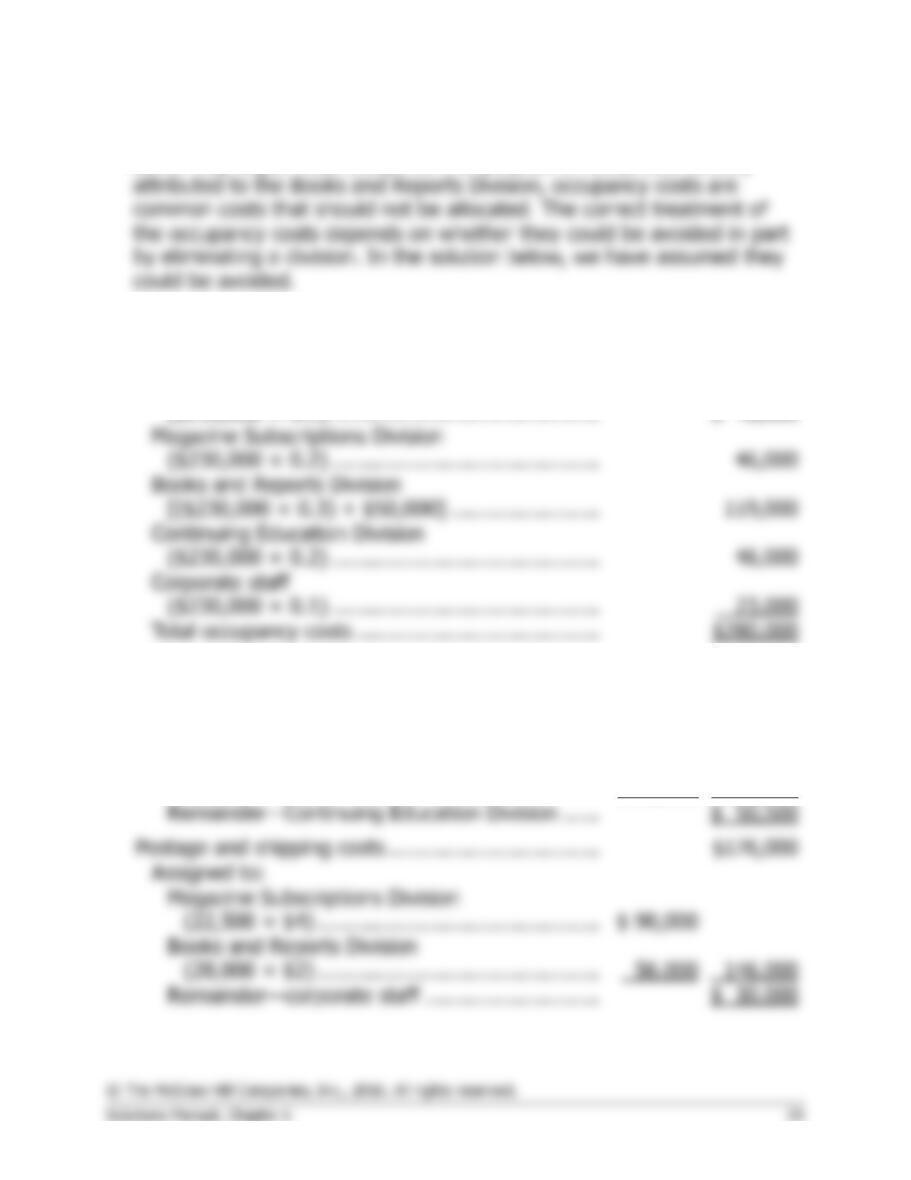
Some may argue that, except for the $50,000 in rental cost directly
Occupancy costs ($230,000 allocated + $50,000 direct to the Books
and Reports Division = $280,000):
Allocated to:
Membership Division
($230,000 × 0.2) …………………………………….
$ 46,000
Magazine Subscriptions Division
Books and Reports Division
Continuing Education Division
$280,000
Printing and paper costs ………………………………..
$320,000
Assigned to:
Magazine Subscriptions Division
(22,500 × $7) ………………………………………
$157,500
Books and Reports Division
(28,000 × $4) ………………………………………
112,000
269,500
Postage and shipping costs …………………………….
Books and Reports Division
(28,000 × $2) ………………………………………
$ 30,000
Case (continued)
Division
Association
Total
Membership
Magazine
Subscriptions
Books &
Reports
Continuing
Education
Sales:
Membership dues ………………………
$2,000,000
$1,600,000
$400,000
Non-member magazine
subscriptions ………………………….
75,000
75,000
Advertising ………………………………
100,000
100,000
Reports and texts ………………………
700,000
Continuing education courses ………
$400,000
575,000
Personnel costs …………………………
210,000
52,500
45,000
Occupancy costs ……………………….
257,000
46,000
46,000
119,000
46,000
Reimbursement of member costs to
local chapters …………………………..
600,000
600,000
Other membership services …………
500,000
500,000
Printing and paper …………………….
320,000
157,500
112,000
50,500
Postage and shipping …………………
146,000
90,000
481,000
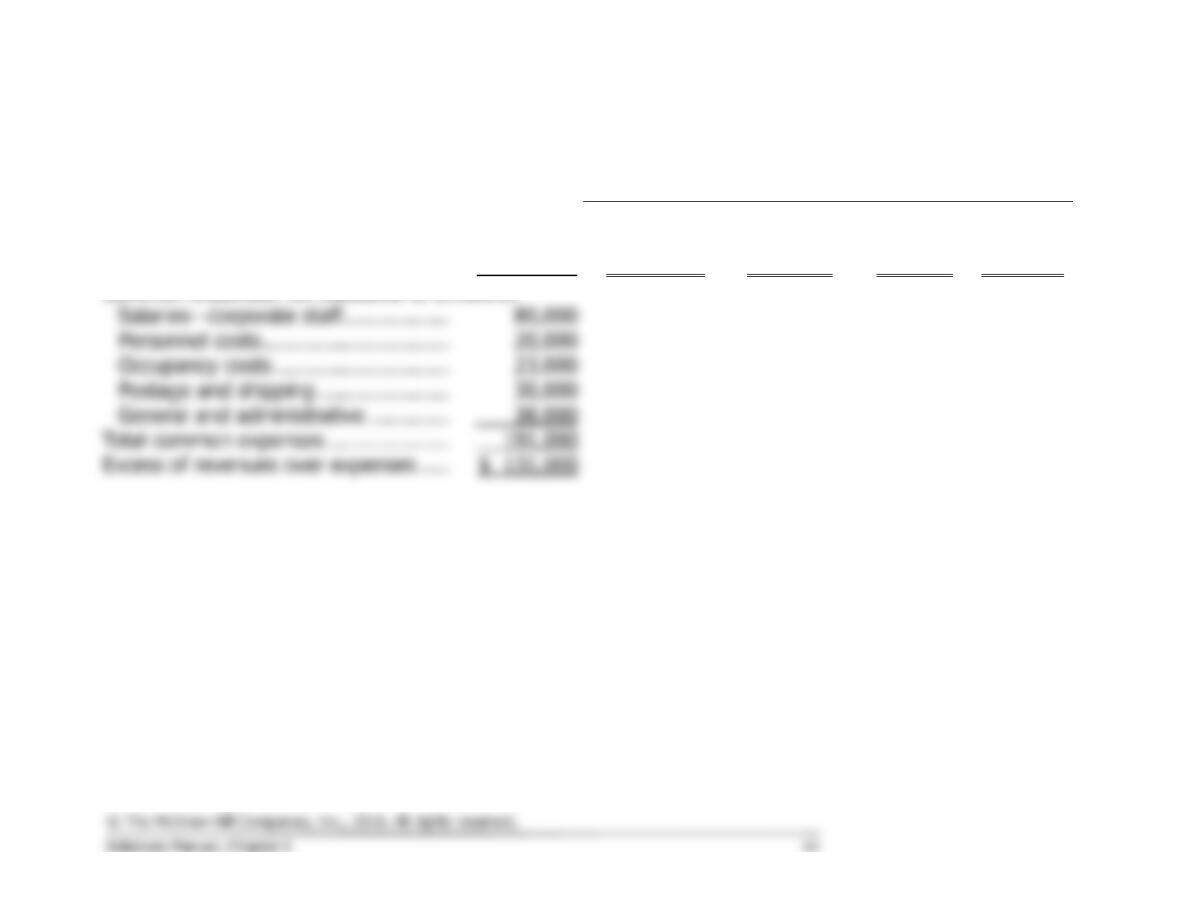
Case (continued)
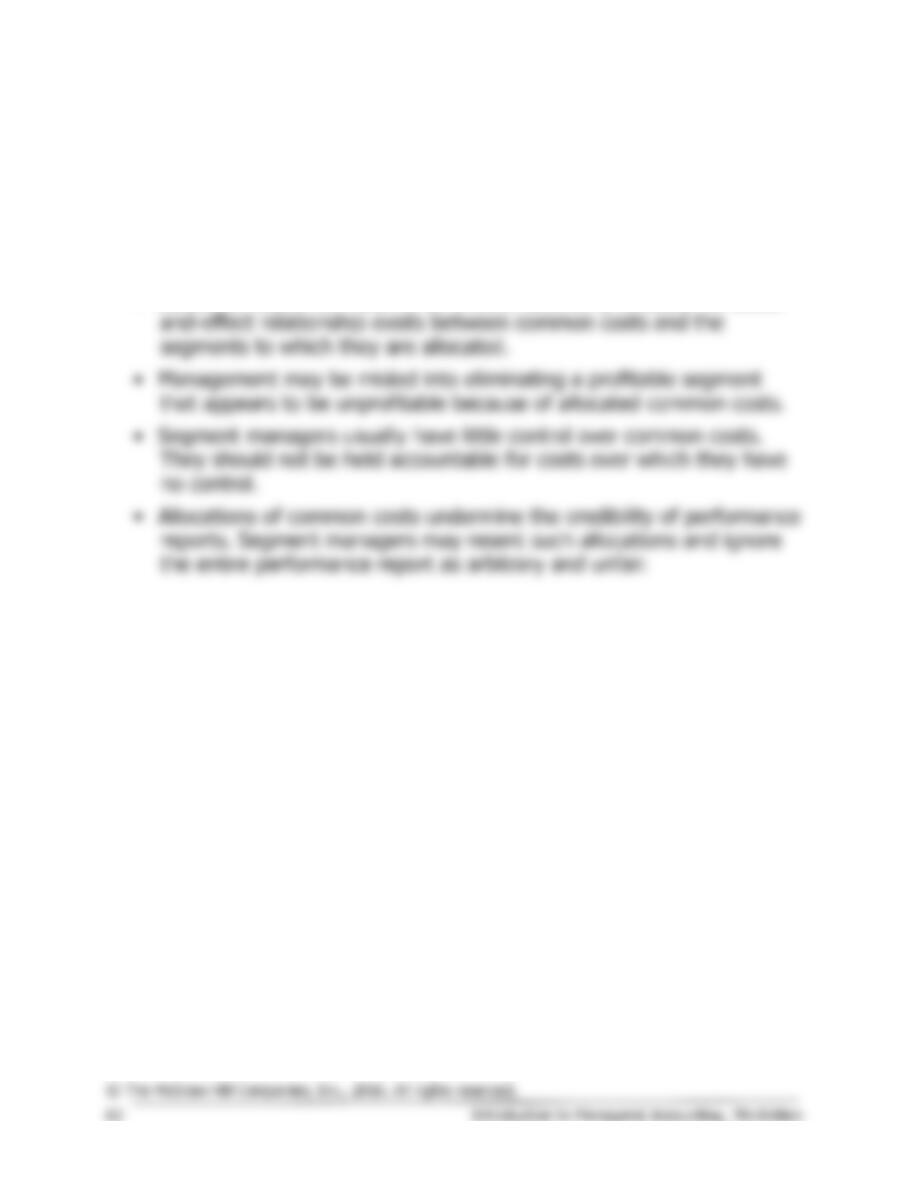
[Continuation of the segmented income statement.]
Division
Association
Total
Membership
Magazine
Subscriptions
Books &
Reports
Continuing
Education
Division segment margin ……………….
322,000
$ 191,500
$ 94,000
$ 38,000
$ (1,500)
Common expenses not traceable to divisions:
38,000
Total common expenses ………………..
191,000
Case (continued)
2. While we do not favor the allocation of common costs to segments, the
most common reason given for this practice is that segment managers
need to be aware of the fact that common costs do exist and that they
must be covered.
Arguments against allocation of all costs:
• Allocation bases will need to be chosen arbitrarily because no cause-
Chapter 6
Take Two Solutions
Exercise 6-1 (15 minutes)
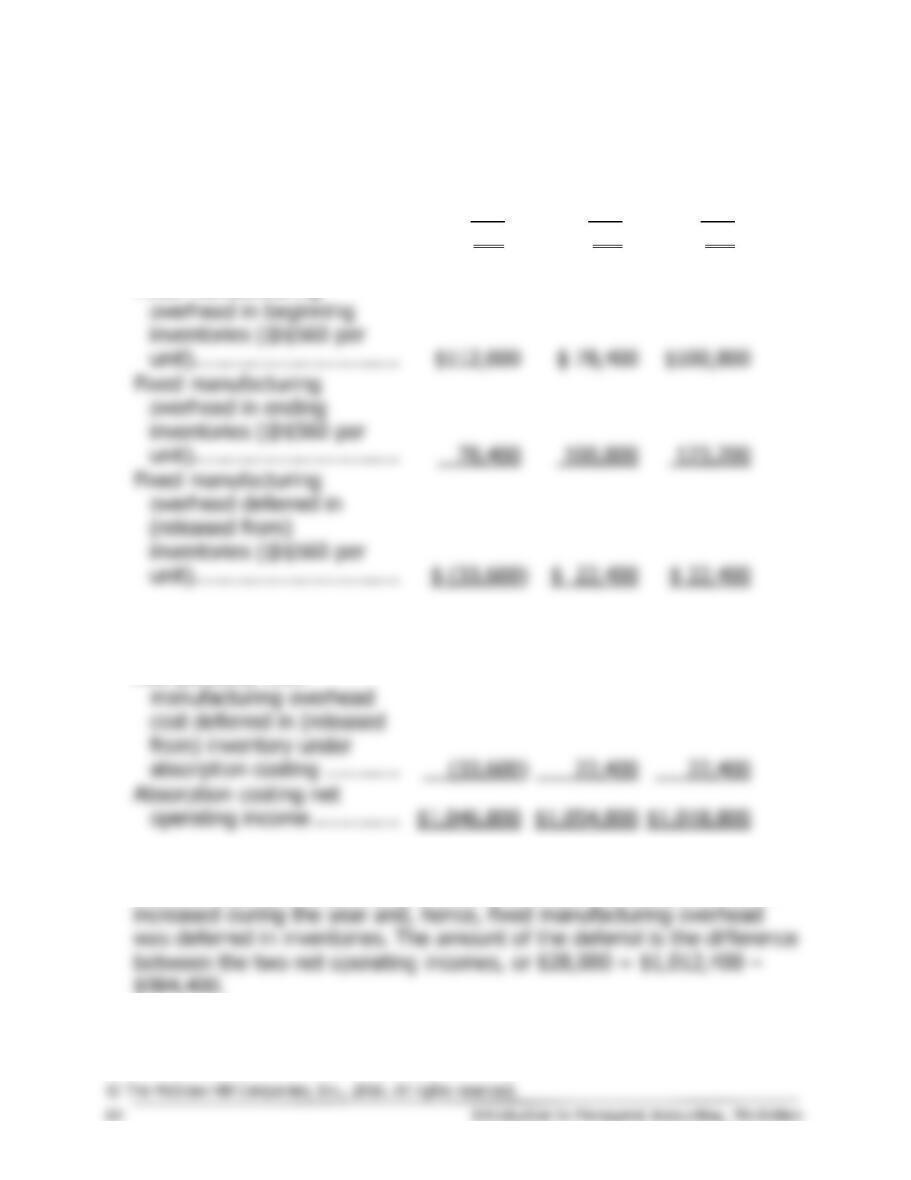
1. Under absorption costing, all manufacturing costs (variable and fixed)
are included in product costs.
Direct labor …………………………………………………………
Variable manufacturing overhead …………………………….
Fixed manufacturing overhead ($60,000 ÷ 250 units) …..
Absorption costing unit product cost …………………………
$700
2. Under variable costing, only the variable manufacturing costs are
included in product costs.
Direct materials ……………………………………………………
$100
Variable costing unit product cost …………………………….
$460
Exercise 6-3 (20 minutes)
1.
Year 1
Year 2
Year 3
Beginning inventories ……….
200
140
180
Ending inventories ……………
140
180
220
Change in inventories ……….
(60)
40
40
Fixed manufacturing
Variable costing net
operating income …………..
$1,080,400
$1,032,400
$ 996,400
Absorption costing net
operating income …………..
$1,018,800
Add (deduct) fixed
2. Because absorption costing net operating income was greater than
variable costing net operating income in Year 4, inventories must have
Exercise 6-4 (10 minutes)
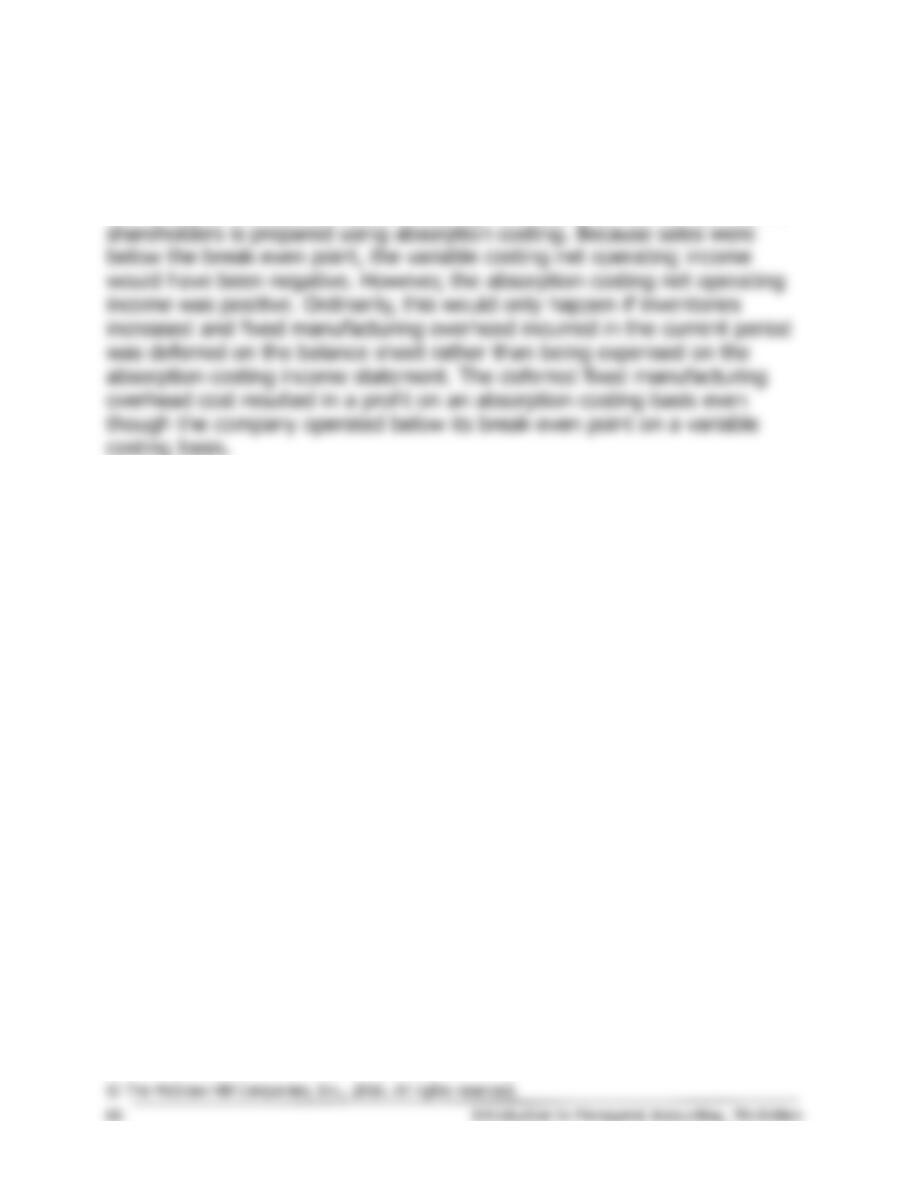
Total
Company
Weedban
Greengrow
Sales* ……………………………..
$321,000
$96,000
$225,000
Variable expenses** …………..
195,900
38,400
157,500
Contribution margin ……………
125,100
57,600
67,500
Traceable fixed expenses ……..
Product line segment margin ..
Net operating income ………….
Exercise 6-8 (10 minutes)
Sales were below the company’s break–even sales and yet the company
earned a profit. The apparent contradiction is explained by the fact that the
CVP analysis is based on variable costing, whereas the income reported to
Exercise 6-9 (30 minutes)
1 a. Under variable costing, only the variable manufacturing costs are
included in product costs.
Year 1
Year 2
Direct materials ………………………………
$25
$25
Direct labor ……………………………………
Variable manufacturing overhead ……….
Variable costing unit product cost ……….
1 b.
Year 1
Year 2
Sales …………………………………………………
$2,400,000
$3,000,000
Variable expenses:
Variable cost of goods sold @ $45 per unit
1,800,000
2,250,000
Total variable expenses ………………………….
Contribution margin ………………………………
Fixed expenses:
Total fixed expenses ……………………………..
Net operating income (loss) ……………………
2 a. The unit product costs under absorption costing:
Year 1
Year 2
Direct materials ………………………………
$25
$25
Direct labor ……………………………………
Variable manufacturing overhead ……….
Fixed manufacturing overhead …………..
Absorption costing unit product cost ……
$53
$55
* $400,000 ÷ 50,000 units = $8 per unit.
Exercise 6-9 (continued)
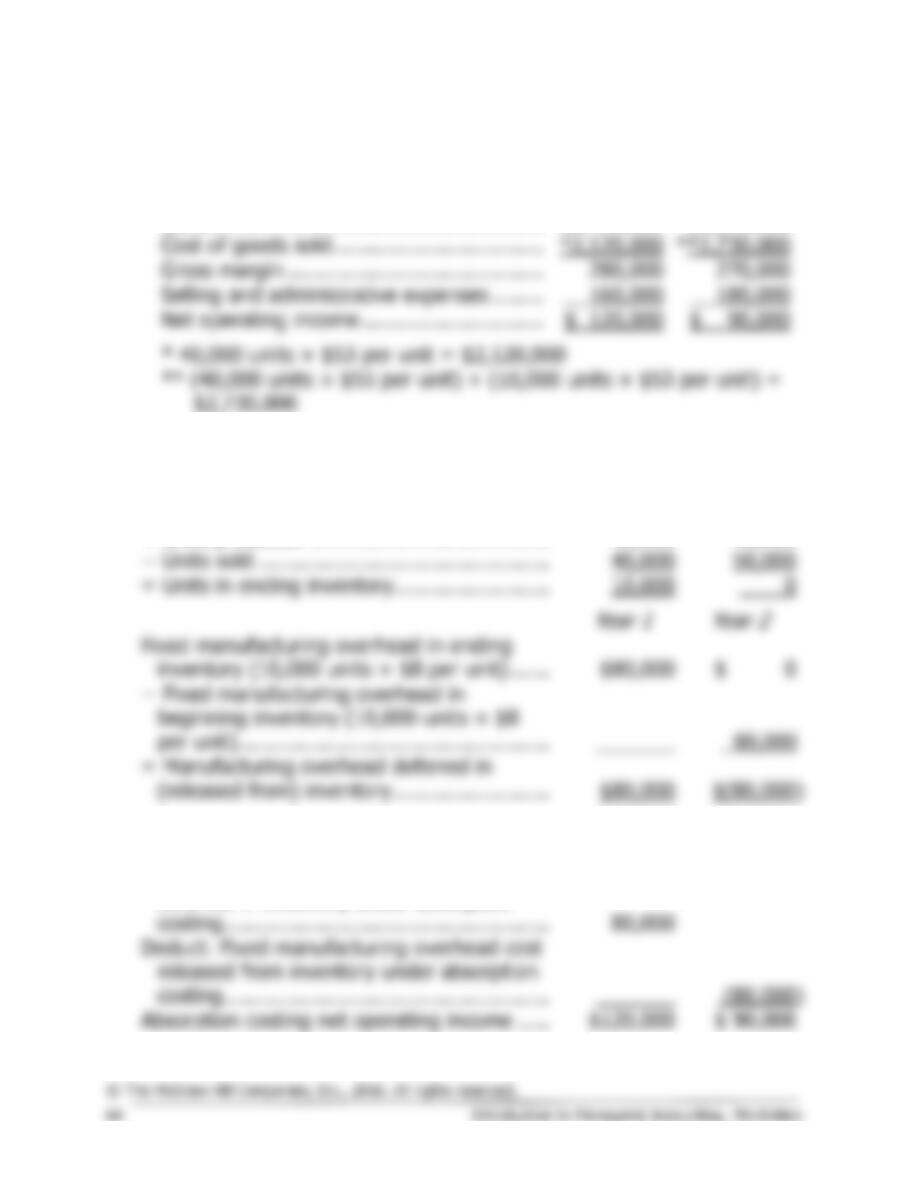
2 b. The absorption costing income statements appears below:
Year 1
Year 2
Sales ……………………………………………..
$2,400,000
$3,000,000
Cost of goods sold…………………………….
Gross margin …………………………………..
Selling and administrative expenses ……..
Net operating income ………………………..
3. The net operating incomes are reconciled as follows:
Year 1
Year 2
Units in beginning inventory ……………………
0
10,000
+ Units produced …………………………………
50,000
40,000
= Units in ending inventory …………………….
Year 1
Year 2
Year 1
Year 2
Variable costing net operating income ……..
$ 40,000
$170,000
Deduct: Fixed manufacturing overhead cost
released from inventory under absorption
Add: Fixed manufacturing overhead cost
deferred in inventory under absorption
Exercise 6-11 (20 minutes)
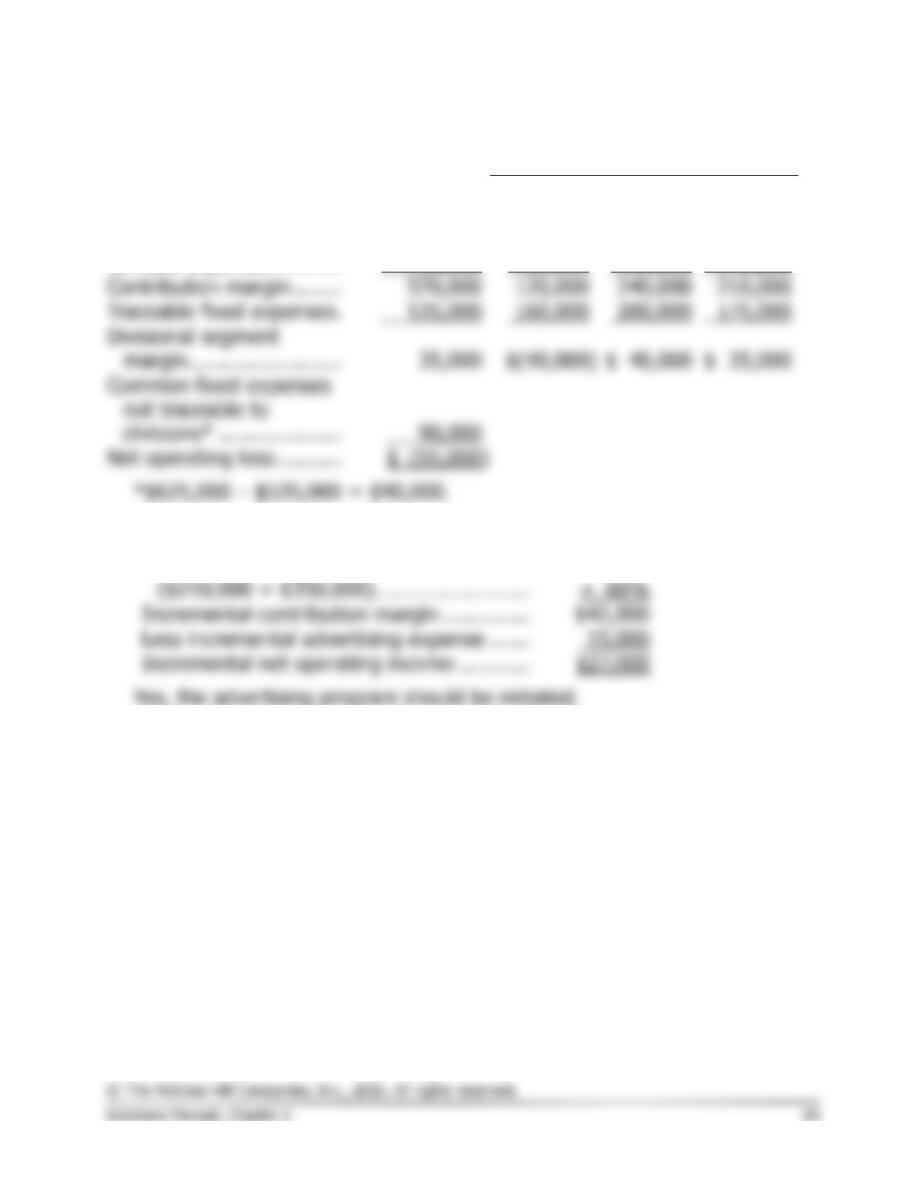
1.
Division
Total
Company
East
Central
West
Sales …………………………
$1,000,000
$250,000
$400,000
$350,000
Variable expenses ………..
430,000
130,000
160,000
140,000
Contribution margin ……..
Traceable fixed expenses .
535,000
160,000
200,000
175,000
$ 40,000
Net operating loss ………..
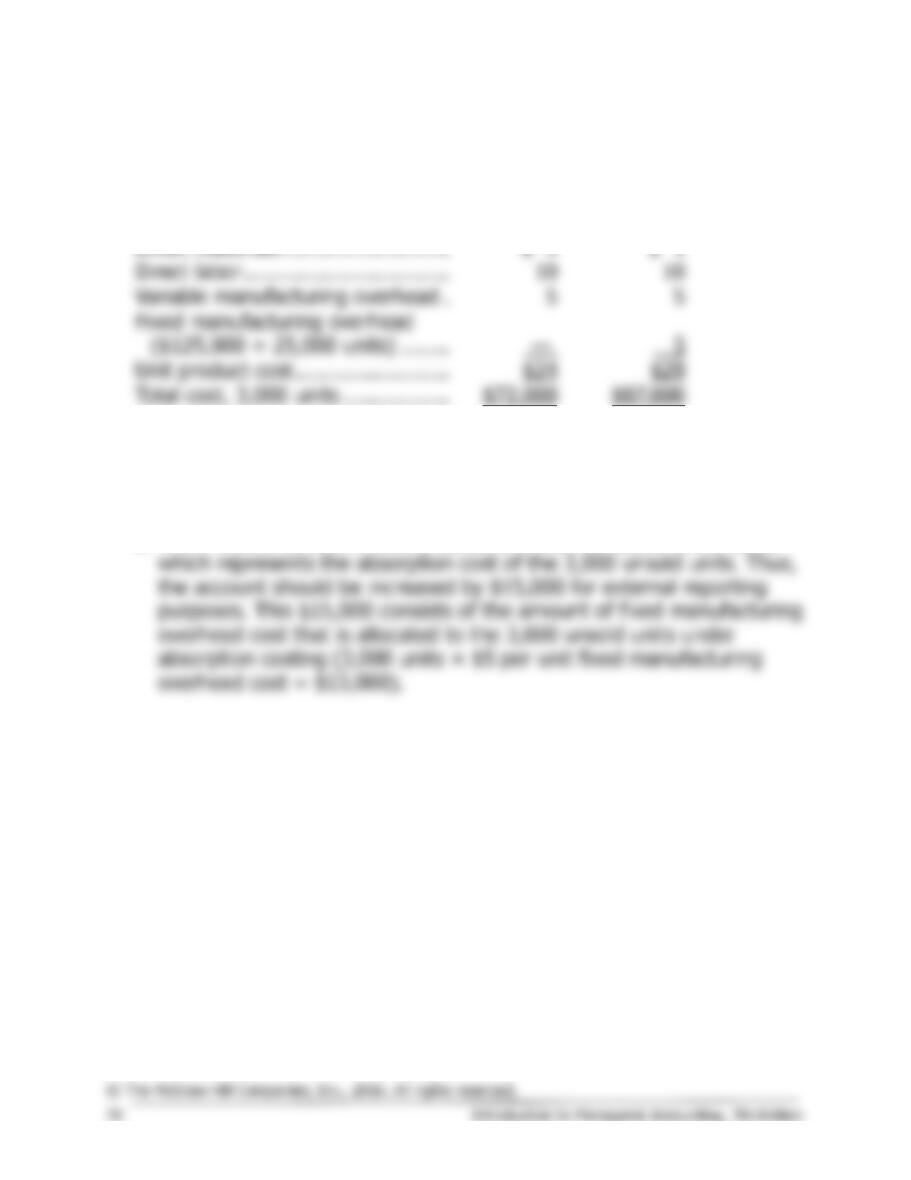
2.
Incremental sales ($350,000 × 20%) …….
$70,000
Incremental contribution margin …………..
$42,000
Less incremental advertising expense …….
Incremental net operating income …………
Contribution margin ratio
Exercise 6-13 (20 minutes)
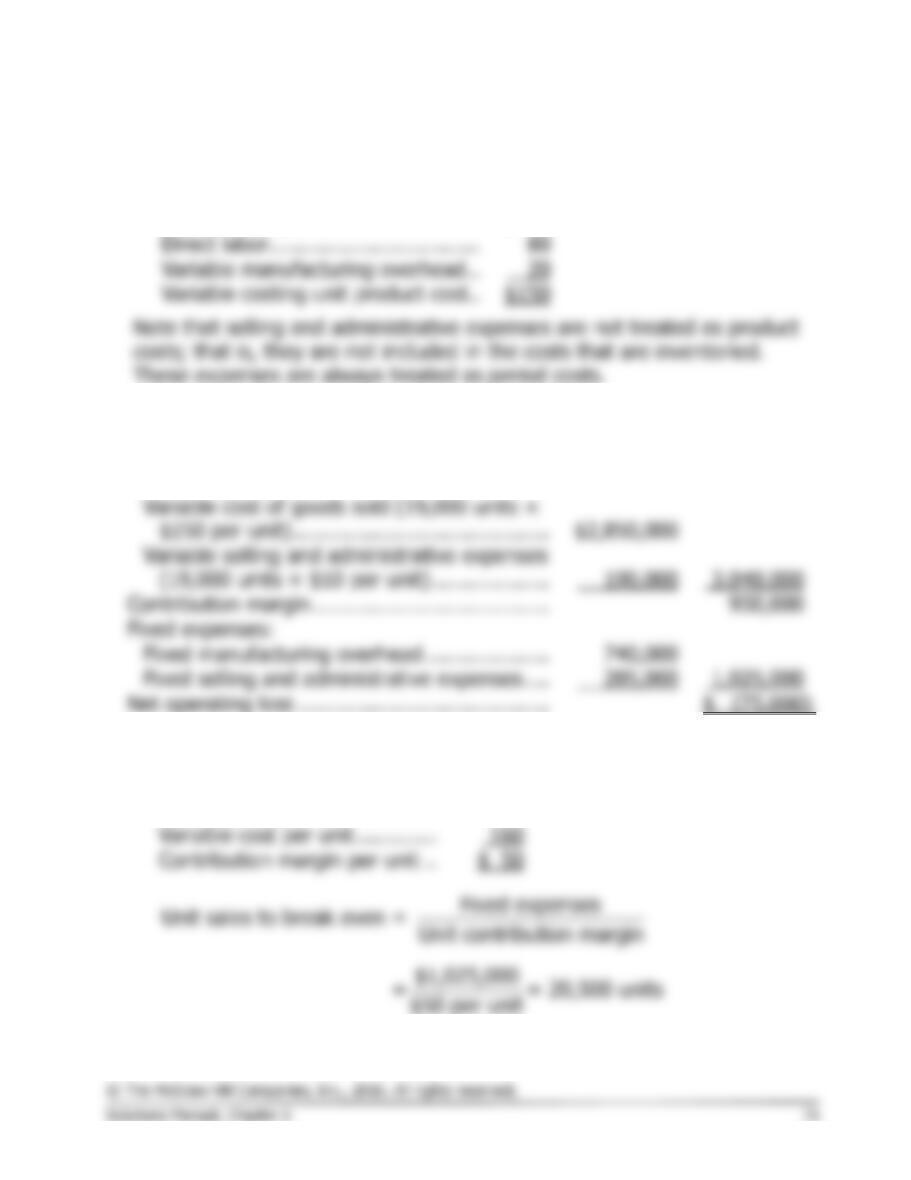
1. The company is using variable costing. The computations are:
Variable
Costing
Absorption
Costing
Direct materials ………………………
Unit product cost …………………….
2. a. No, $72,000 is not the correct figure to use because variable costing
is not generally accepted for external reporting purposes or for tax
purposes.
b. The Finished Goods inventory account should be stated at $87,000,
Exercise 6-14 (30 minutes)
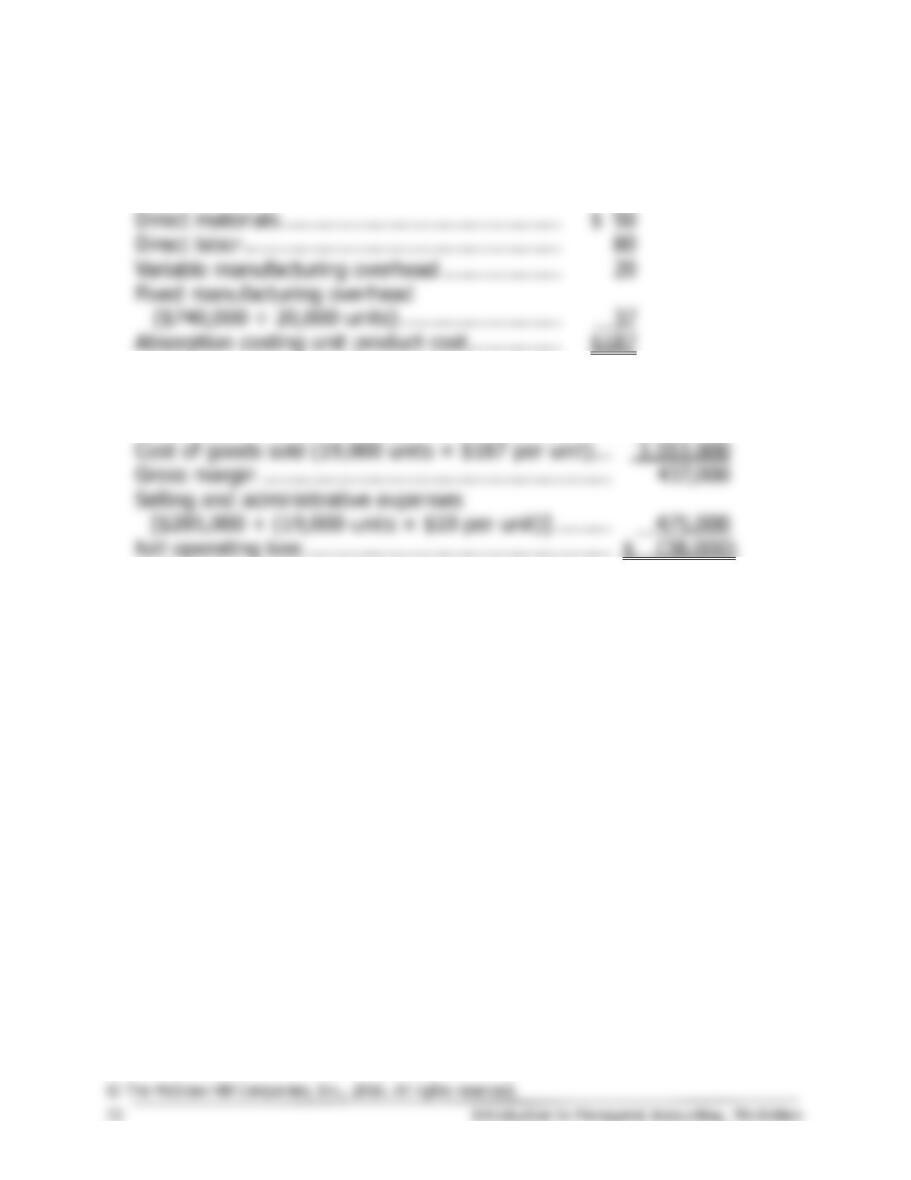
1. Under variable costing, only the variable manufacturing costs are
included in product costs.
Direct materials……………………….
$ 50
Direct labor…………………………….
Variable manufacturing overhead ..
Variable costing unit product cost ..
2. The variable costing income statement appears below:
Sales …………………………………………………..
$3,990,000
Variable expenses:
Fixed expenses:
Fixed manufacturing overhead ………………..
Fixed selling and administrative expenses ….
Net operating loss …………………………..……..
3. The break-even point in units sold can be computed using the
contribution margin per unit as follows:
Selling price per unit …………..
$210
Variable cost per unit ………….
Contribution margin per unit ..
Exercise 6-15 (20 minutes)
1. Under absorption costing, all manufacturing costs (variable and fixed)
are included in product costs.
Variable manufacturing overhead ……………….
2. The absorption costing income statement appears below:
Sales (19,000 units × $210 per unit) ………………….
$3,990,000
Cost of goods sold (19,000 units × $187 per unit) …
Net operating loss ………………………………………….