CHAPTER 6
Accounting and the Time Value of Money
ASSIGNMENT CLASSIFICATION TABLE (BY TOPIC)
Topics
Questions
Brief
Exercises
Exercises
Problems
1.
Present value concepts.
1, 2, 3, 4,
5, 9, 17
2.
Use of tables.
13, 14
8
1
3.
Present and future value
problems:
a. Unknown future amount.
7, 19
1, 5, 13
2, 3, 4, 7
b. Unknown payments.
10, 11, 12
6, 12,
15, 17
8, 16, 17
2, 6
c. Unknown number of
periods.
4, 9
10, 15
2
d. Unknown interest rate.
15, 18
3, 11, 16
9, 10, 11, 14
2, 7
e. Unknown present value.
8, 19
2, 7, 8,
10, 14
3, 4, 5, 6,
8, 12, 17,
18, 19
1, 4, 7, 9,
13, 14
4.
Value of a series of irregular
deposits; changing interest
rates.
3, 5, 8
5.
pensions, bonds; choice
between projects.
14, 15
10, 11, 12,
13, 14, 15
6.
Deferred annuity.
7.
Expected Cash Flows.
20, 21, 22
13, 14, 15
Valuation of leases,
6
15
7, 12, 13,
3, 5, 6, 8, 9,
ASSIGNMENT CLASSIFICATION TABLE (BY LEARNING OBJECTIVE)
Learning Objectives
Questions
Brief
Exercises
Exercises
Problems
1. Describe the accounting concepts
and fundamental concepts related to
the time value of money.
1, 3, 4, 5,
6, 7, 10,
11, 12, 13,
14, 17, 18
1, 2
2, 7, 8, 10,
11, 12
1, 2, 3,
4, 7, 8
8, 9, 10,
11, 13
5, 6, 9, 13
annuity due problems.
12, 14
10, 11, 12,
14, 16, 17
to deferred annuities, bonds, and
2, 12, 15,
ASSIGNMENT CHARACTERISTICS TABLE
Item
Description
Level of
Difficulty
Time
(minutes)
E6.1
Using interest tables.
Simple
5–10
E6.2
Simple and compound interest computations.
Simple
5–10
E6.3
Computation of future values and present values.
Simple
10–15
E6.4
Computation of future values and present values.
Moderate
15–20
E6.5
Computation of present value.
Simple
10–15
E6.6
Future value and present value problems.
Moderate
15–20
E6.7
Computation of bond prices.
Moderate
12–17
E6.8
Computations for a retirement fund.
Simple
10–15
E6.9
Unknown rate.
Moderate
5–10
E6.10
Unknown periods and unknown interest rate.
Simple
10–15
E6.11
Evaluation of purchase options.
Moderate
10–15
E6.12
Analysis of alternatives.
Simple
10–15
E6.13
Computation of bond liability.
15–20
E6.14
Computation of pension liability.
Moderate
15–20
E6.15
Investment decision.
Moderate
15–20
E6.16
Retirement of debt.
Simple
10–15
E6.17
Computation of amount of rentals.
Simple
10–15
E6.18
Least costly payoff.
Simple
10–15
E6.19
Least costly payoff.
Simple
10–15
E6.20
Expected cash flows.
Simple
5–10
E6.21
Expected cash flows and present value.
Moderate
15–20
E6.22
Fair value estimate.
Moderate
15–20
P6.1
Various time value situations.
Moderate
15–20
P6.2
Various time value situations.
Moderate
15–20
P6.3
Analysis of alternatives.
Moderate
20–30
P6.4
Evaluating payment alternatives.
Moderate
20–30
P6.5
Analysis of alternatives.
Moderate
20–25
P6.6
Purchase price of a business.
Moderate
25–30
P6.7
Time value concepts applied to solve business problems.
Complex
30–35
P6.8
Analysis of alternatives.
Moderate
20–30
P6.9
Analysis of business problems.
Complex
30–35
P6.10
Analysis of lease vs. purchase.
Complex
30–35
P6.11
Pension funding.
Complex
25–30
P6.12
Pension funding.
Moderate
20–25
P6.13
Expected cash flows and present value.
Moderate
20–25
P6.14
Expected cash flows and present value.
Moderate
20–25
P6.15
Fair value estimate.
Complex
20–25
ANSWERS TO QUESTIONS
1. Money has value because with it one can acquire assets and services and discharge obligations.
The holding, borrowing or lending of money can result in costs or earnings. And the longer the
time period involved, the greater the costs or the earnings. The cost or earning of money as a
2. Some situations in which present value measures are used in accounting include:
(a) Notes receivable and payable—these involve single sums (the face amounts) and may
involve annuities if there are periodic interest payments.
(b) Leases—involve measurement of assets and obligations based on the present value of
3. Interest is the payment for the use of money. It may represent a cost or earnings depending upon
whether the money is being borrowed or loaned. The earning or incurring of interest is a function
4. The interest rate generally has three components:
(a) Pure rate of interest—This is the amount a lender would charge if there were no possibilities
of default and no expectation of inflation.
(b) Expected inflation rate of interest—Lenders recognize that in an inflationary economy, they
Questions Chapter 6 (Continued)
5. (a) Present value of an ordinary annuity at 8% for 10 periods (Table 6-4).
(b) Future value of 1 at 8% for 10 periods (Table 6-1).
6. He should choose quarterly compounding, because the balance in the account on which interest
will be earned will be increased more frequently, thereby resulting in more interest earned on the
investment. This is shown in the following calculation:
Semiannual compounding, assuming the amount is invested for 2 years:
7. $26,898 = $20,000 X 1.34489 (future value factor of 1 at 21/2% for 12 periods).Table 6-1
LO: 2, Bloom: AP, Difficulty: Simple, Time: 3-5, AACSB: Analytic, AICPA BB: None, AICPA FC: Reporting, AICPA PC: None
8. $44,671 = $80,000 X .55839 (present value factor of 1 at 6% for 10 periods). Table 6-2
LO: 2, Bloom: AP, Difficulty: Simple, Time: 3-5, AACSB: Analyti , AICPA BB: None, AICPA FC: Reporting, AICPA PC: None
11.
Amount deposited each year =
$200,000
(**future value factor of an ordinary annuity at 10% for
4 years). Table 6-4
**4.64100
Amount deposited each year = $43,094.16.
Questions Chapter 6 (Continued)
13. The process for converting the future value of an annuity due using the future value of an ordinary
annuity interest table is to multiply the corresponding future value of the ordinary annuity by one
14. The basis for converting the present value of an ordinary annuity table to the present value of an
15. Present value = present value of an ordinary annuity of $25,000 for 20 periods at ? percent.
$245,000 = present value of an ordinary annuity of $25,000 for 20 periods at ? percent.
16. 4.96764 Present value of ordinary annuity at 12% for eight periods. (Table 6-4)
(2.40183) Present value of ordinary annuity at 12% for three periods. (Table 6-4)
17. (a) Present value of an annuity due.
(b) Present value of 1.
18. $27,600 = PV of an ordinary annuity of $6,900 for five periods at ? percent.
19. The IRS argues that the future reserves should be discounted to present value. The result would
be smaller reserves and therefore less of a charge to income. As a result, income would be higher
SOLUTIONS TO BRIEF EXERCISES
BRIEF EXERCISE 6.1
8% annual interest
i = 8%
PV = $15,000 FV = ?
8% annual interest, compounded semiannually
i = 4% (8% ÷ 2)
PV = $15,000 FV = ?
BRIEF EXERCISE 6.2
12% annual interest
i = 12%
PV = ? FV = $25,000
0
1
2
3 4
12% annual interest, compounded quarterly
i = 3% (12% ÷ 4)
PV = ? FV = $25,000
0
1
2
14
15 16
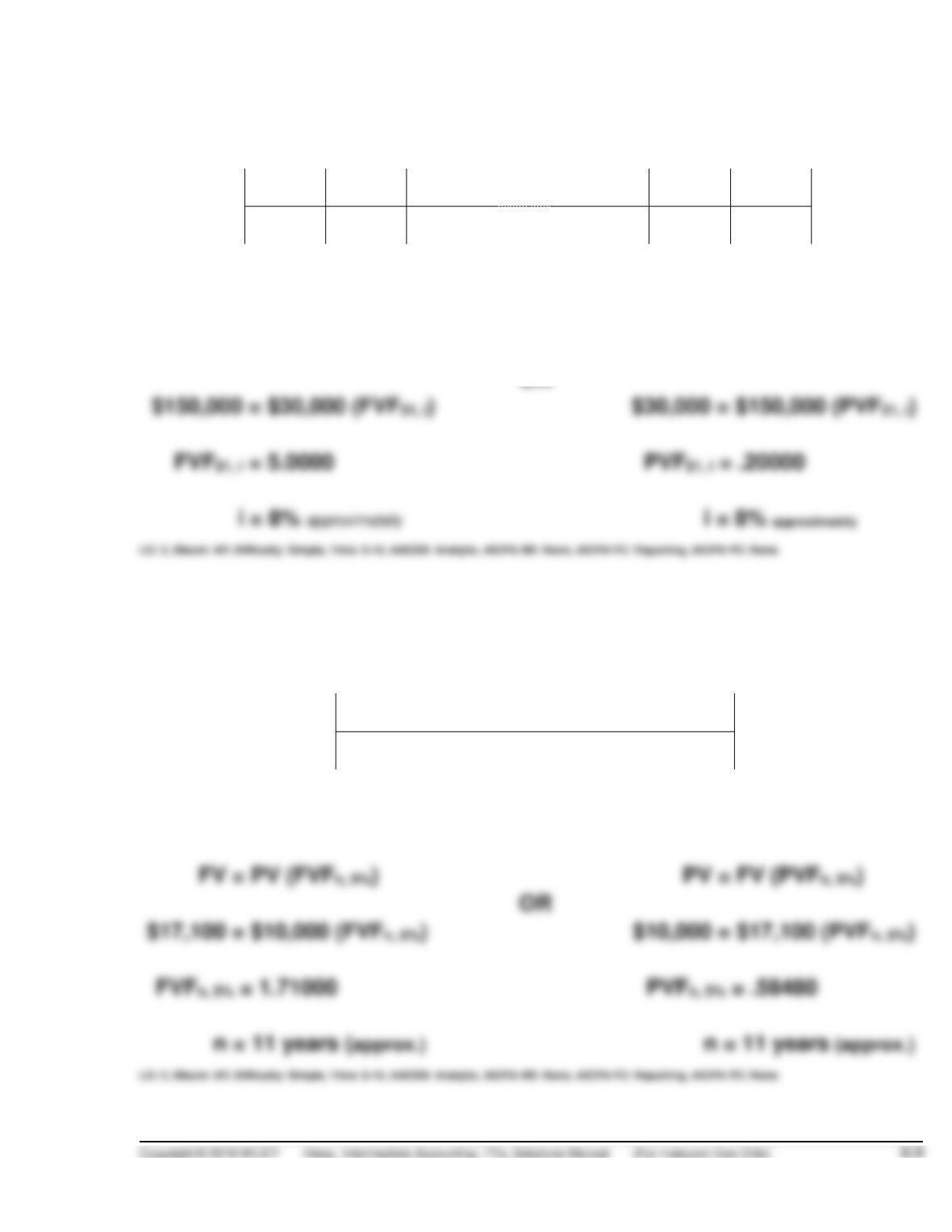
BRIEF EXERCISE 6.3
i = ?
PV = $30,000 FV = $150,000
0
1
2
19
20 21
n = 21
FV = PV (FVF21, i)
PV = FV (PVF21, i)
OR
$30,000 = $150,000 (PVF21, i)
FVF21, i = 5.0000
PVF21, i = .20000
i = 8% approximately
i = 8% approximately
BRIEF EXERCISE 6.4
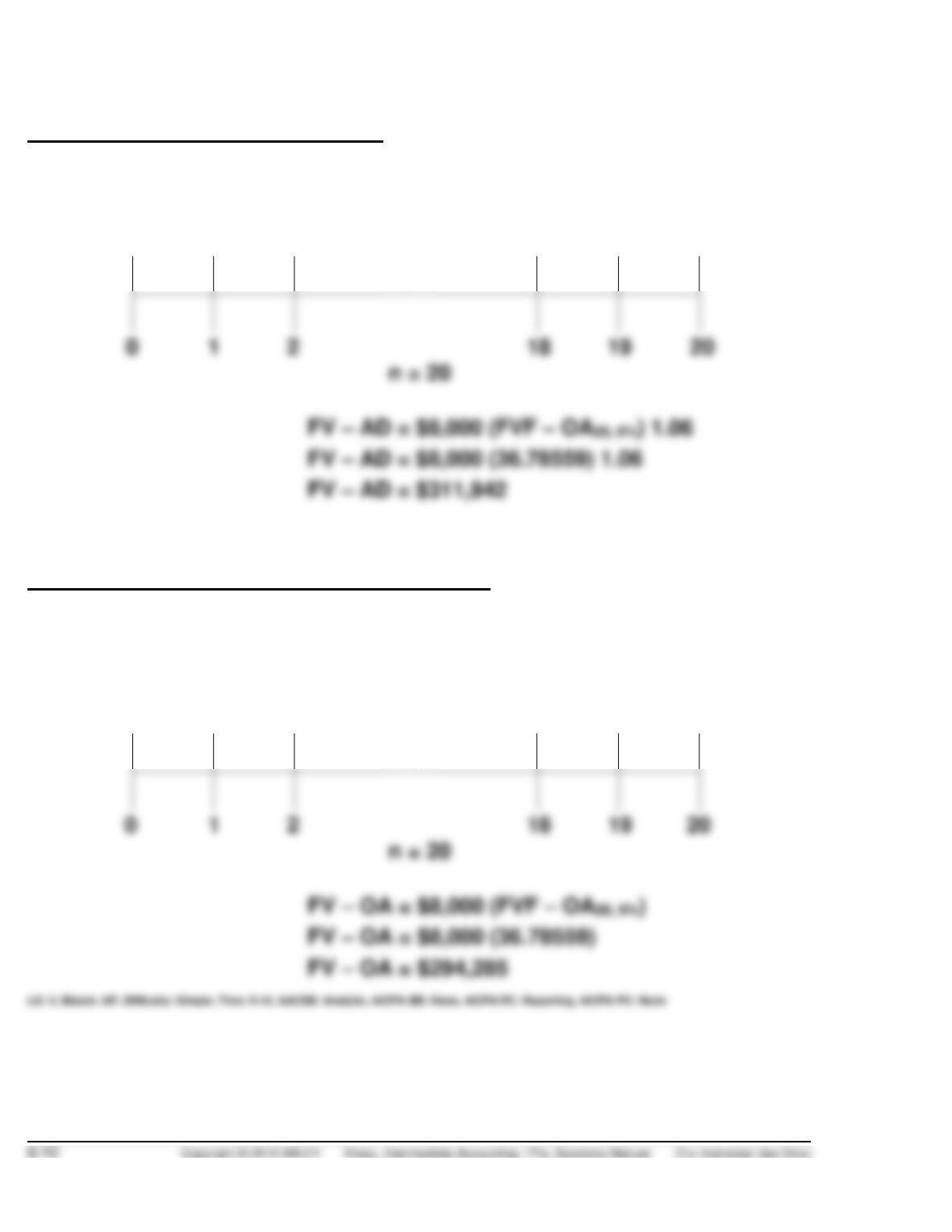
i = 5%
PV = $10,000 FV = $17,100
0
?
n = ?
PV = FV (PVFn, 5%)
OR
$17,100 = $10,000 (FVFn, 5%)
n = 11 years (approx.)
n = 11 years (approx.)
BRIEF EXERCISE 6.5
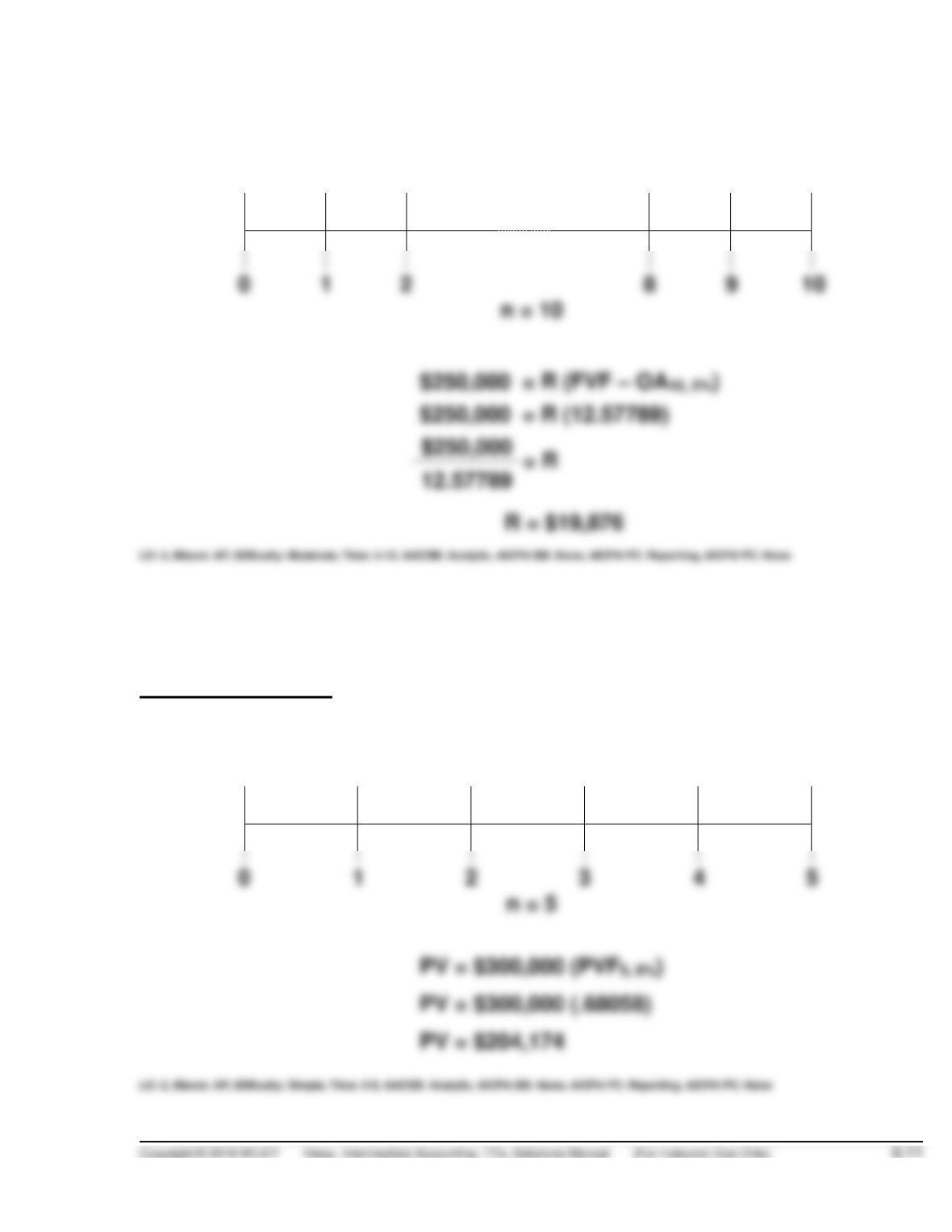
First payment today (Annuity Due)
i = 6%
R = FV – AD =
$8,000 $8,000 $8,000 $8,000 $8,000 ?
First payment at year-end (Ordinary Annuity)
i = 6%
FV – OA =
?
$8,000 $8,000 $8,000 $8,000 $8,000
BRIEF EXERCISE 6.6
i = 5%
FV – OA =
R = ? ? ? ? $250,000
BRIEF EXERCISE 6.7
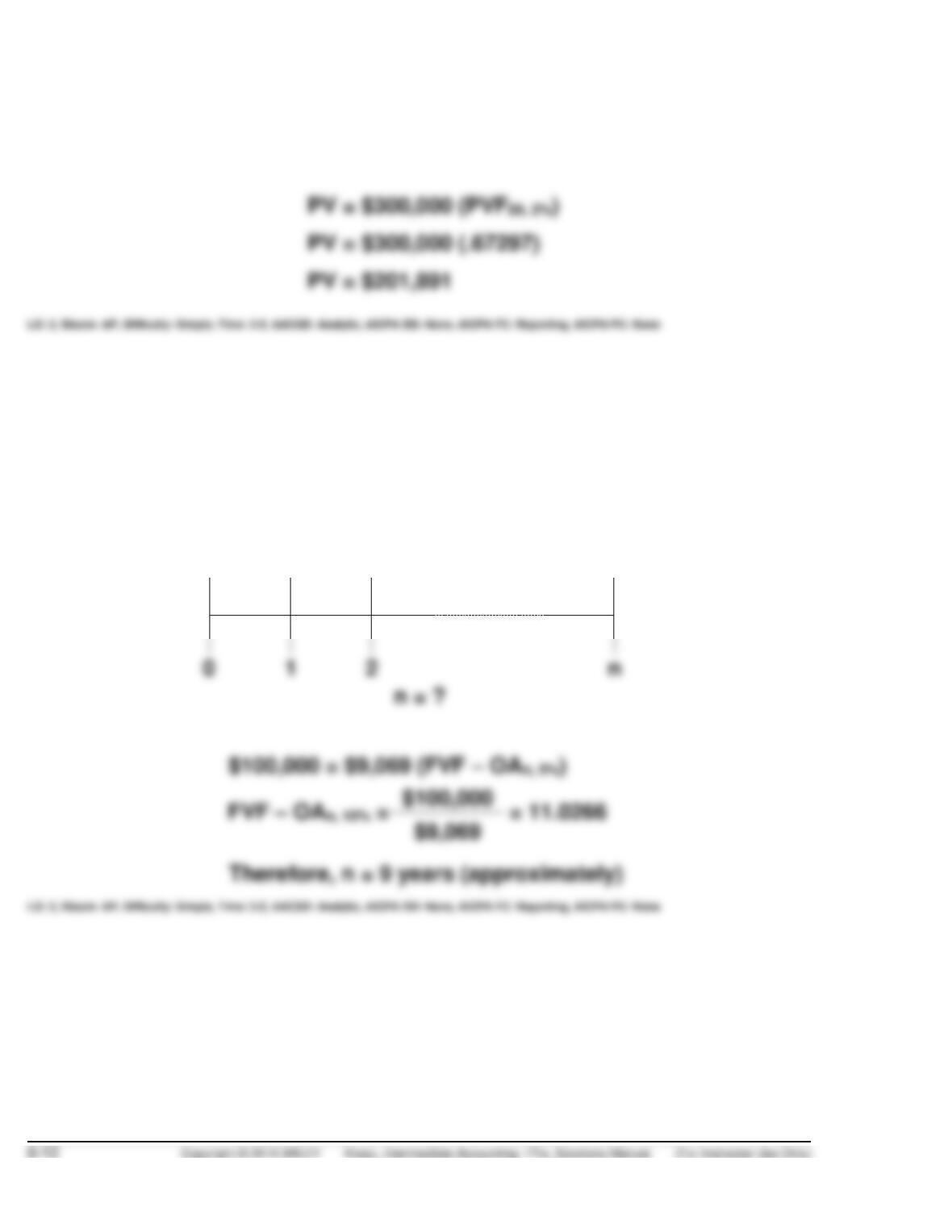
8% annual interest
i = 8%
PV = ? FV = $300,000
BRIEF EXERCISE 6.8
With quarterly compounding, there will be 20 (5 x 4) quarterly compounding
periods, at 1/4 the interest rate (8% ÷ 4 = 2%):
BRIEF EXERCISE 6.9
i = 5%
FV – OA =
R = $100,000
$9,069 $9,069 $9,069
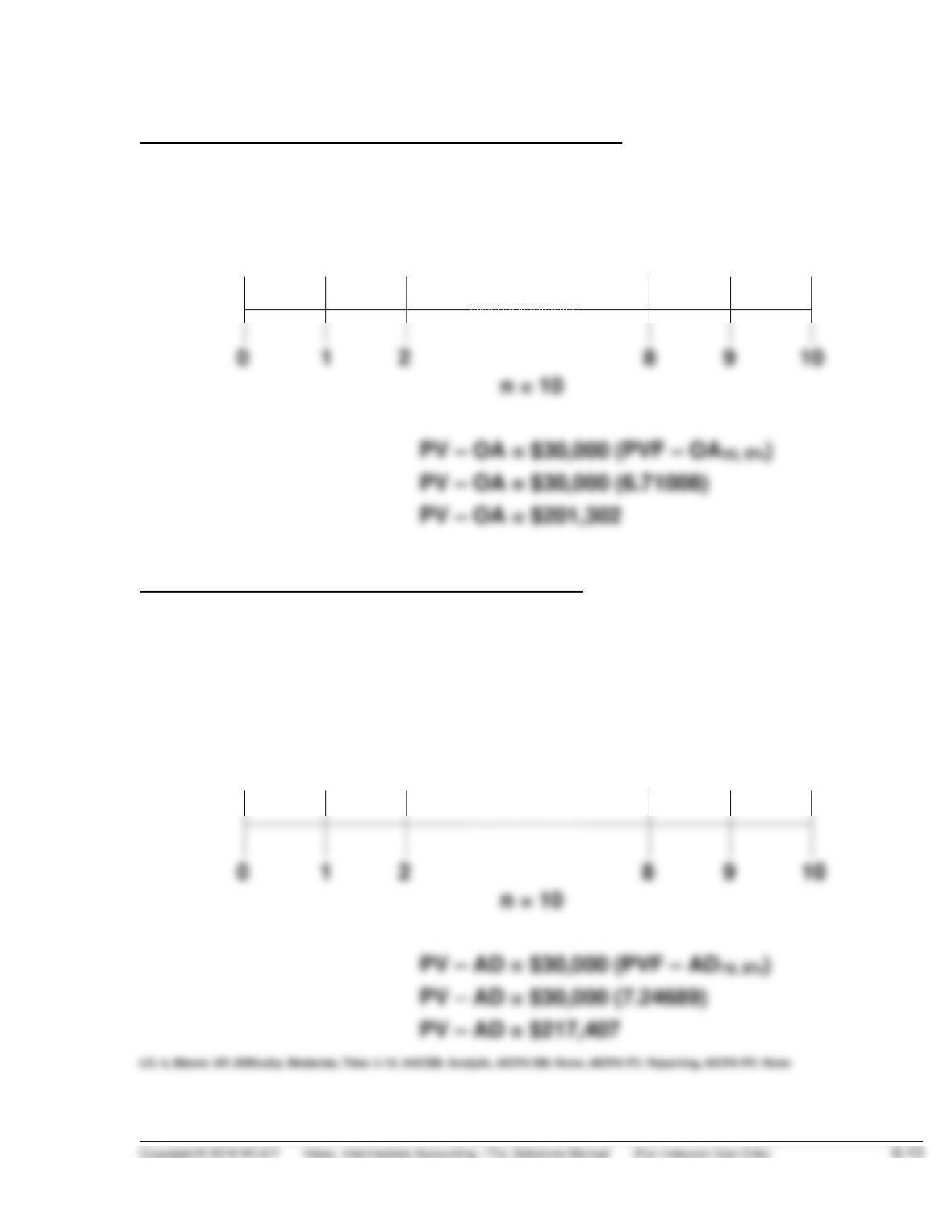
BRIEF EXERCISE 6.10
First withdrawal at year-end – ordinary annuity
i = 8%
PV – OA = R =
? $30,000 $30,000 $30,000 $30,000 $30,000
First withdrawal immediately – annuity due
i = 8%
PV – AD =
?
R =
$30,000 $30,000 $30,000 $30,000 $30,000
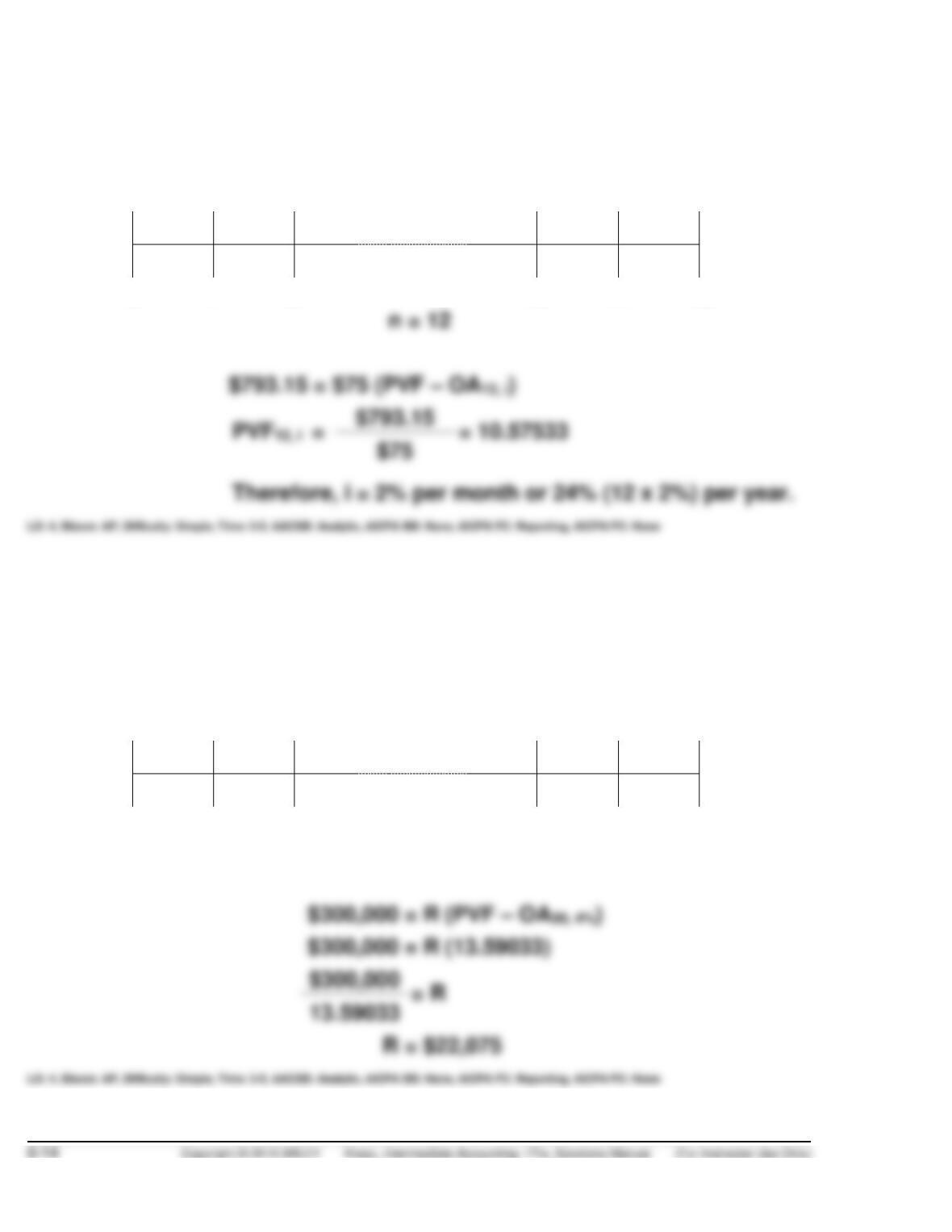
BRIEF EXERCISE 6.11
i = ?
PV = R =
$793.15 $75 $75 $75 $75 $75
0
1
2
10
11 12
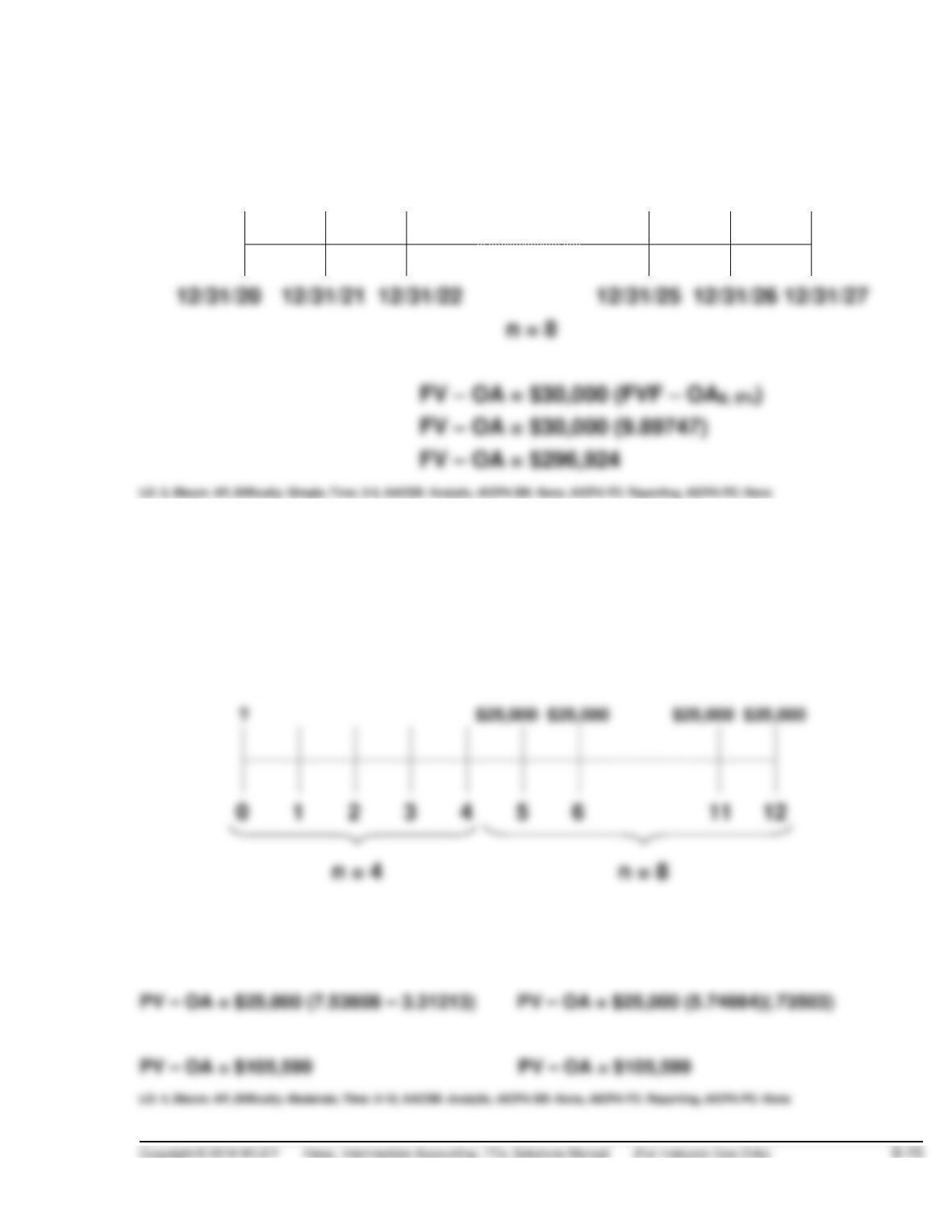
BRIEF EXERCISE 6.12
i = 4%
PV =
$300,000 R = ? ? ? ? ?
0
1
2
18
19 20
n = 20
$300,000
13.59033
BRIEF EXERCISE 6.13
i = 6%
R =
$30,000 $30,000 $30,000 $30,000 $30,000
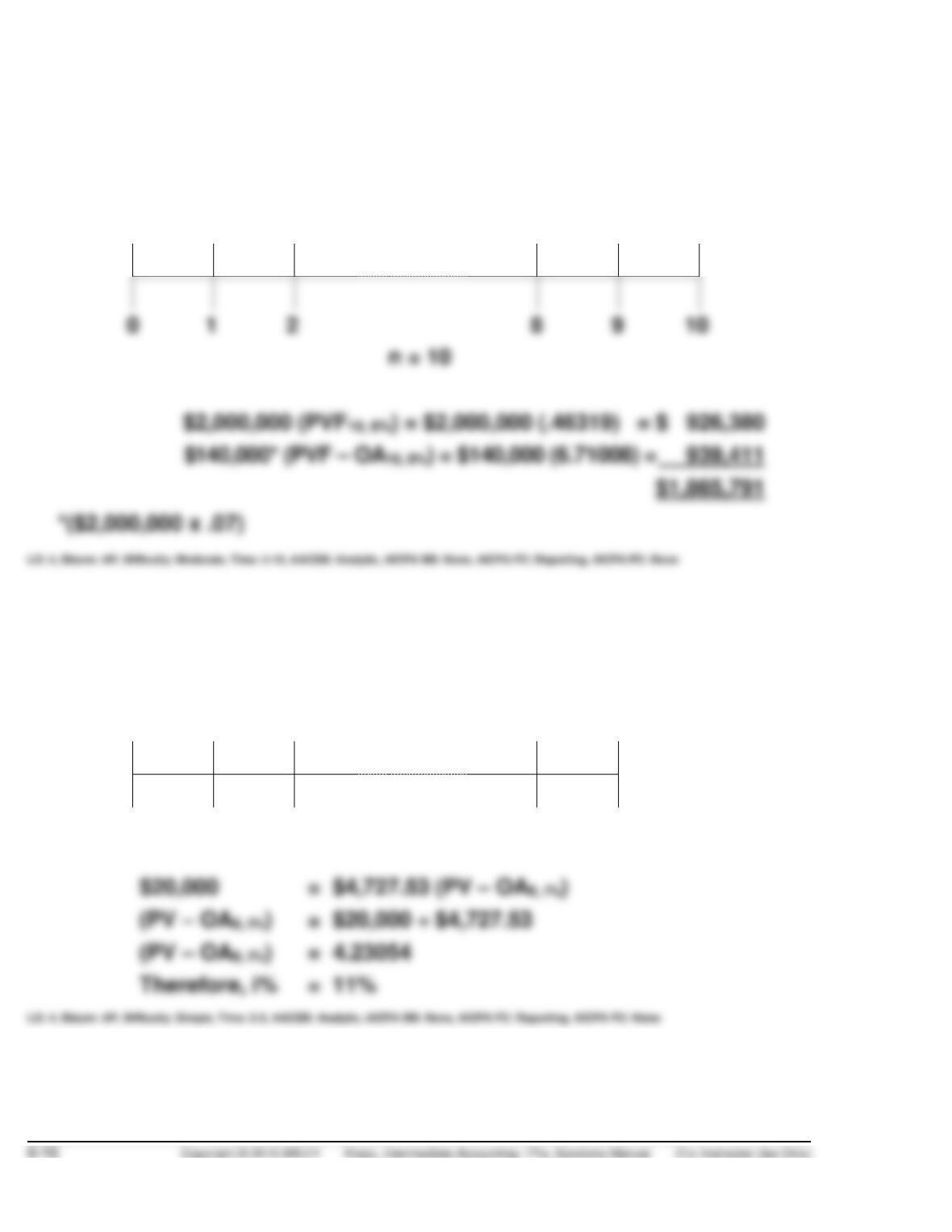
BRIEF EXERCISE 6.14
i = 8%
PV – OA = R =
0
1
2
3
4
5
6
PV – OA = $25,000 (PVF – OA12–4, 8%) PV – OA = $25,000 (PVF – OA8, 8%)(PVF4, 8%)
OR
BRIEF EXERCISE 6.15
i = 8%
PV = ?
PV – OA = R = $2,000,000
? $140,000 $140,000 $140,000 $140,000 $140,000*
0
1
2
8
9 10
BRIEF EXERCISE 6.16
PV – OA = $20,000
$4,727.53 $4,727.53 $4,727.53 $4,727.53
0
1
2
5 6
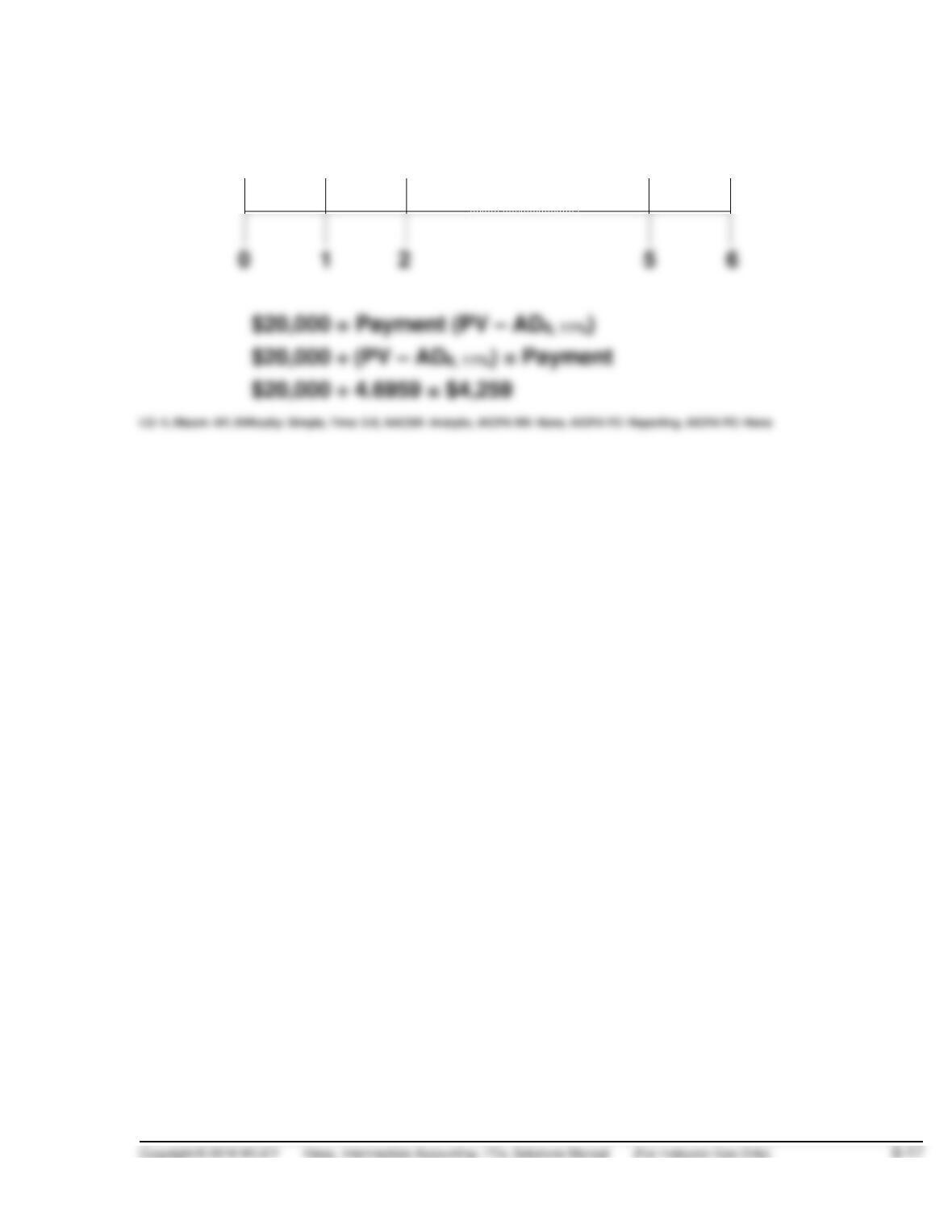
BRIEF EXERCISE 6.17
PV – AD = $20,000
$? $? $? $?
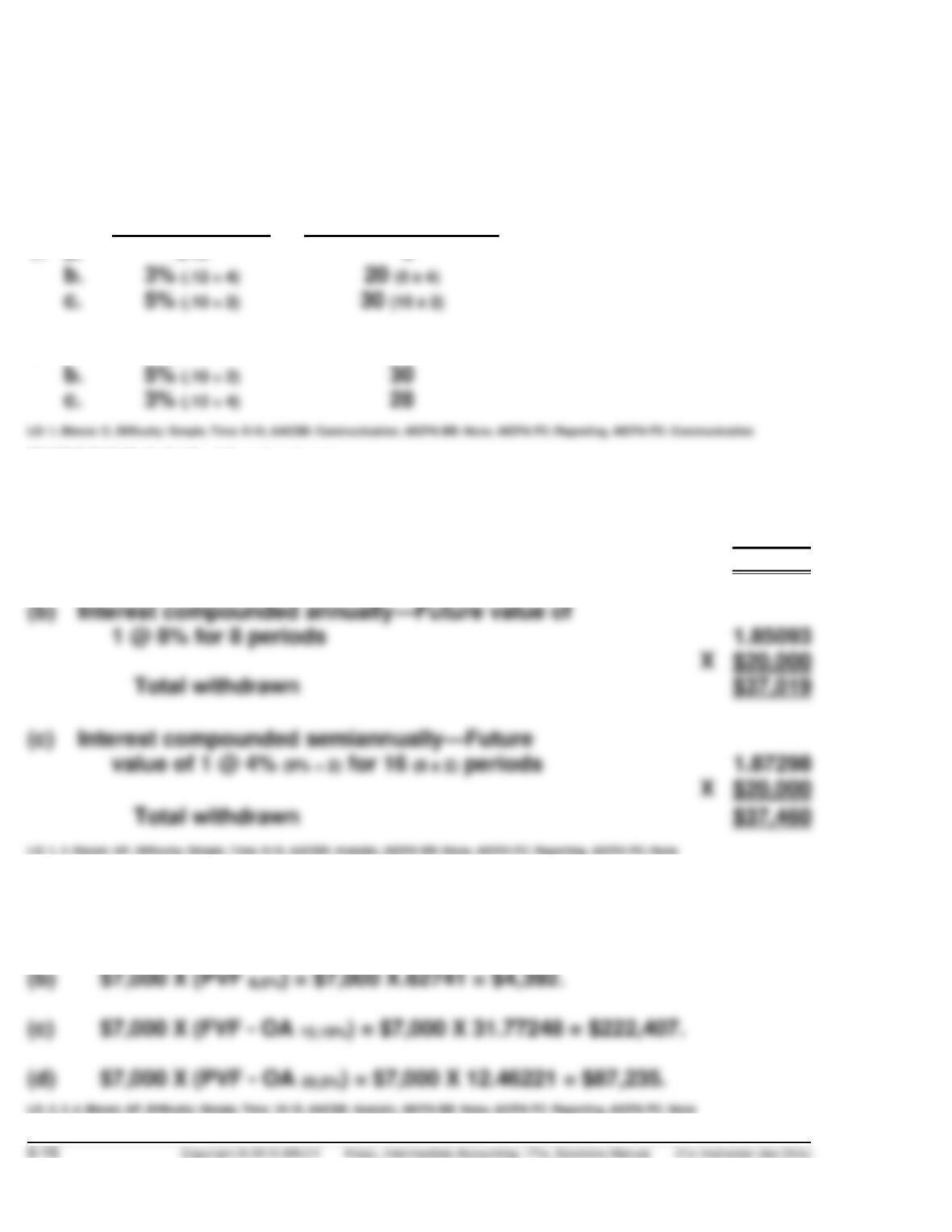
SOLUTIONS TO EXERCISES
EXERCISE 6.1 (5–10 minutes)
(a)
(b)
Rate of Interest
Number of Periods
1.
a.
9%
9
c.
2.
a.
9%
25
c.
EXERCISE 6.2 (5–10 minutes)
(a)
Simple interest of $1,600 ($20,000 x 8%)per year X 8
$12,800
Principal
20,000
Total withdrawn
$32,800
EXERCISE 6.3 (10–15 minutes)
(a)
$7,000 X (FVF 5,8%) = $7,000 X 1.46933 = $10,285.
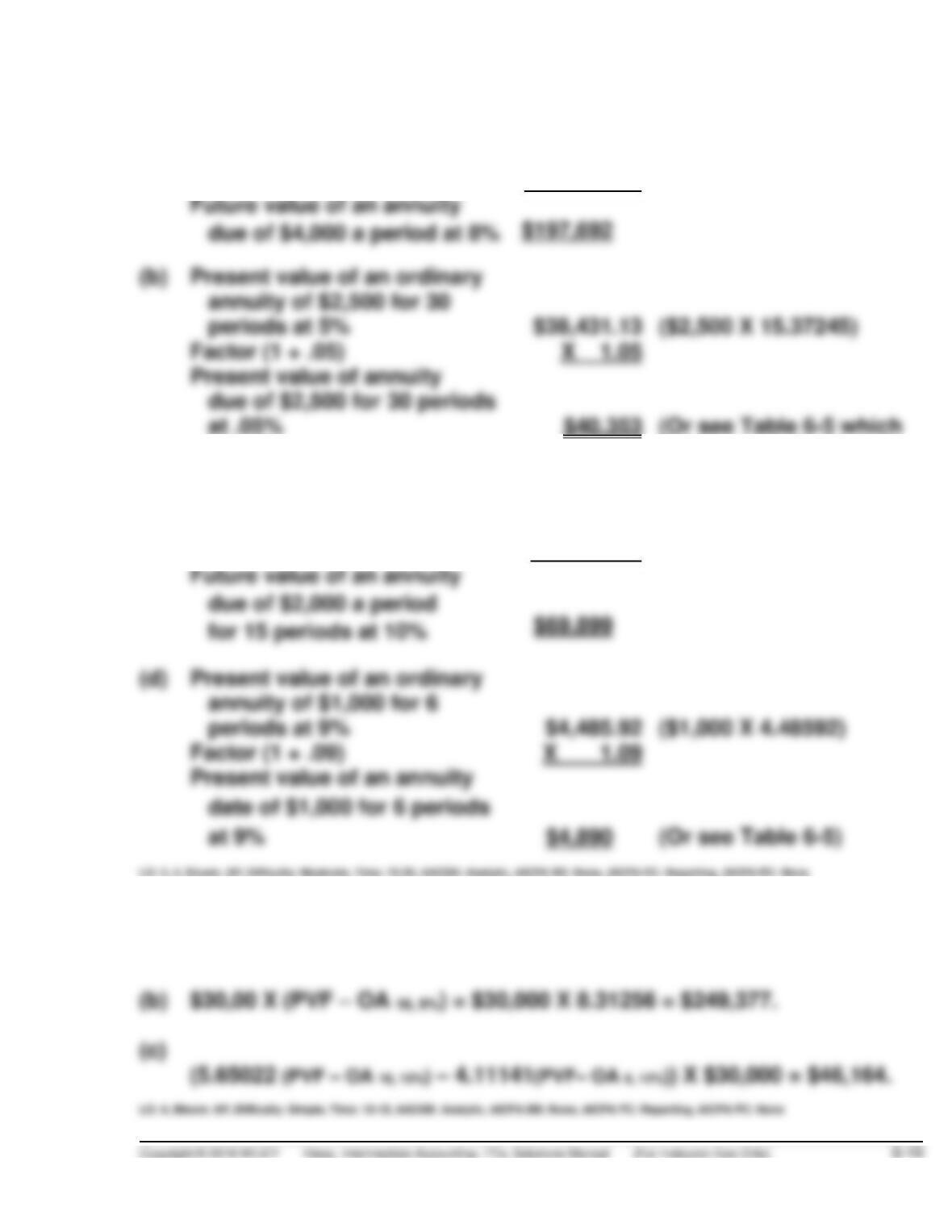
EXERCISE 6.4 (15–20 minutes)
(a)
Future value of an ordinary
annuity of $4,000 a period
for 20 periods at 8%
$183,047.84
($4,000 X 45.76196)
Factor (1 + .08)
X 1.08
(b)
Present value of an ordinary
Factor (1 + .05)
gives $40,356.68)
(c)
Future value of an ordinary
annuity of $2,000 a period
for 15 periods at 10%
$63,544.96
($2,000 X 31.77248)
Factor (1 + 10)
X 1.10
(d)
Present value of an ordinary
Factor (1 + .09)
EXERCISE 6.5 (10–15 minutes)
(a)
$30,000 (PVF – OA 8, 12%) = $30,000 X 4.96764 = $149,029.
(b)
$30,00 X (PVF – OA 16, 9%) = $30,000 X 8.31256 = $249,377.
(c)
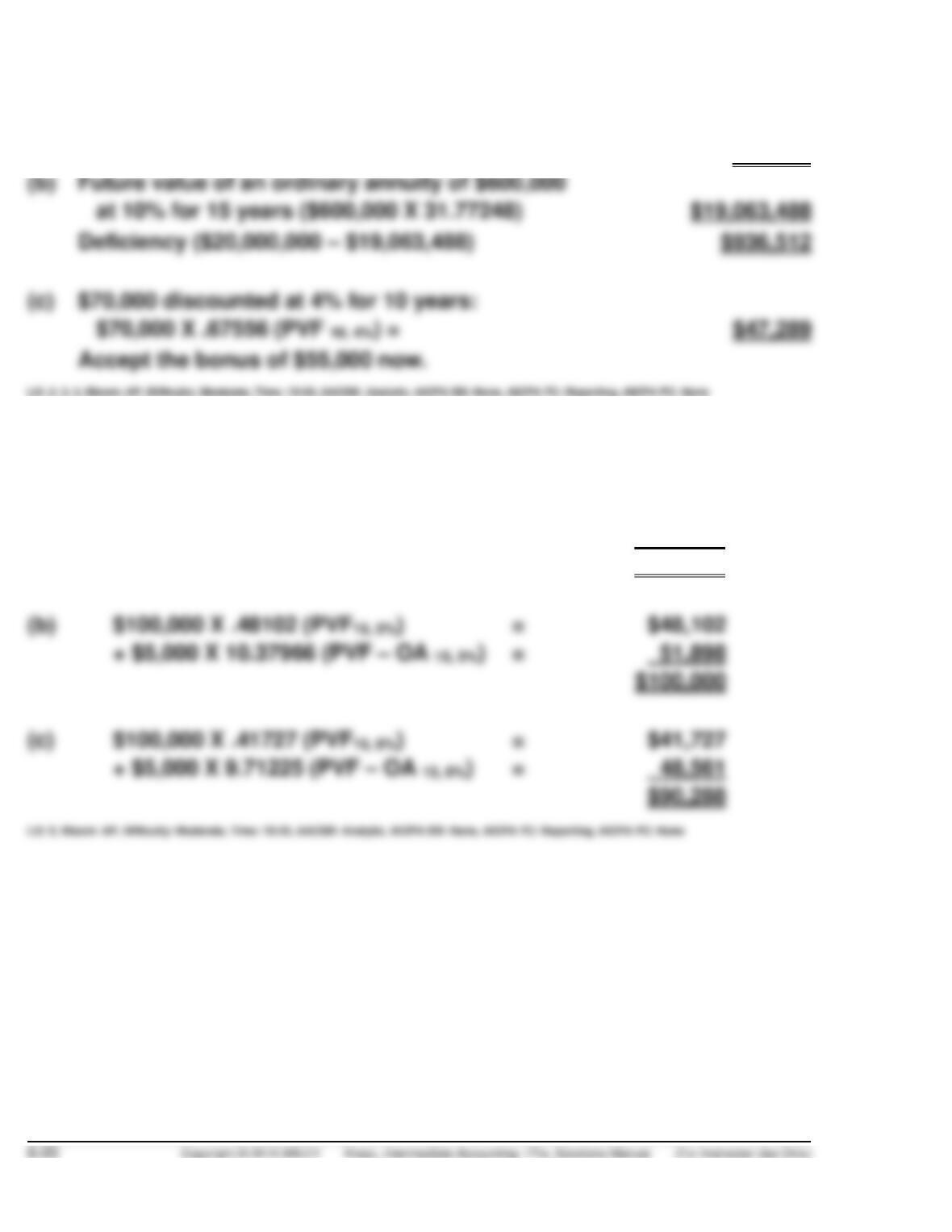
EXERCISE 6.6 (15–20 minutes)
(a)
Future value of $12,000 @ 5% for 10 years
($12,000 X 1.62889) =
$19,547
(b)
Future value of an ordinary annuity of $600,000
at 10% for 15 years ($600,000 X 31.77248)
(c)
$70,000 discounted at 4% for 10 years:
$70,000 X .67556 (PVF 10, 4%) =
Accept the bonus of $55,000 now.
EXERCISE 6.7 (12–17 minutes)
(a)
$100,000 X .55526 (PVF15, 4%)
=
$55,526
+ $5,000 X 11.11839 (PVF – OA 15, 4%)
=
55,592
$111,118
(b)
$100,000 X .48102 (PVF15, 5%)
=
$48,102
+ $5,000 X 10.37966 (PVF – OA 15, 5%)
=
$100,000
(c)
$100,000 X .41727 (PVF15, 6%)
=
$41,727
+ $5,000 X 9.71225 (PVF – OA 15, 6%)
=