Wild and Shaw, Financial & Managerial Accounting, 8e Solutions Manual: Chapter 6
399
Chapter 6
Cash, Fraud, and Internal Control
QUESTIONS
1. The seven broad principles are: Establish responsibilities; Maintain adequate records;
2. Internal control procedures become especially critical when the manager of a business
can no longer control the business through personal supervision and direct
participation.
3. Responsibility for related transactions should be divided so that the work of one
department or individual acts as a check on that of another.
4. Separation of custody from recordkeeping of an asset encourages the asset custodian to
5. If individual departments were permitted to deal directly with suppliers, the amount of
6. The limitations of internal control arise from two sources: the human element (human
error or human fraud) and the cost-benefit principle.
7. Cash is most liquid; and least liquid is a building. The four assets ordered from most to
9. Depositing all receipts on the day of receipt (1) creates an independent record of the
amount of cash received and (2) helps prevent an employee from having personal use of
the money for a period of time before depositing it.
Wild and Shaw, Financial & Managerial Accounting, 8e Solutions Manual: Chapter 6
400
11. Google’s net income was $12,662 million. Further, it reported a net decrease in cash
(and equivalents) of $2,203 million. These two figures are different because (1) net
12. Samsung’s cash and cash equivalents at December 31, 2017, equals ₩30,545,130 (all in
KRW millions). It is the second largest current asset and makes up about 20.8% of its
13. Samsung’s cash and equivalents decreased by ₩1,566,312 million; specifically, from
₩32,111,442 to ₩30,545,130 (all in KRW millions). Its statement of cash flows identifies
Wild and Shaw, Financial & Managerial Accounting, 8e Solutions Manual: Chapter 6
401
QUICK STUDIES
Quick Study 6-1 (10 minutes)
1. True Separation of recordkeeping for assets from the custody over assets helps reduce
fraud.
Quick Study 6-2 (5 minutes)
a. Monitoring
Quick Study 6-3 (10 minutes)
1. a (cash) The ____ category includes currency, coins, and deposits in bank
accounts.
Quick Study 6-4 (10 minutes)
a. False A guideline for safeguarding cash is that all cash receipts be deposited monthly or yearly.
Wild and Shaw, Financial & Managerial Accounting, 8e Solutions Manual: Chapter 6
Quick Study 6-5 (10 minutes)
(a) Cash ………………………………………………………….. 430
Cash Over and Short ……………………………. 10
Quick Study 6-6 (10 minutes)
1. (a) Petty Cash …………………………………………………. 150
Cash ……………………………………………………. 150
2. Answers: a and c. The Petty Cash account is credited when:
Quick Study 6-7 (15 minutes)
Bank or Book Side Add or Subtract Adjusting Entry or Not
a. (1) Book (2) Add (3) Adjusting entry required
Wild and Shaw, Financial & Managerial Accounting, 8e Solutions Manual: Chapter 6
403
Quick Study 6-8 (25 minutes)
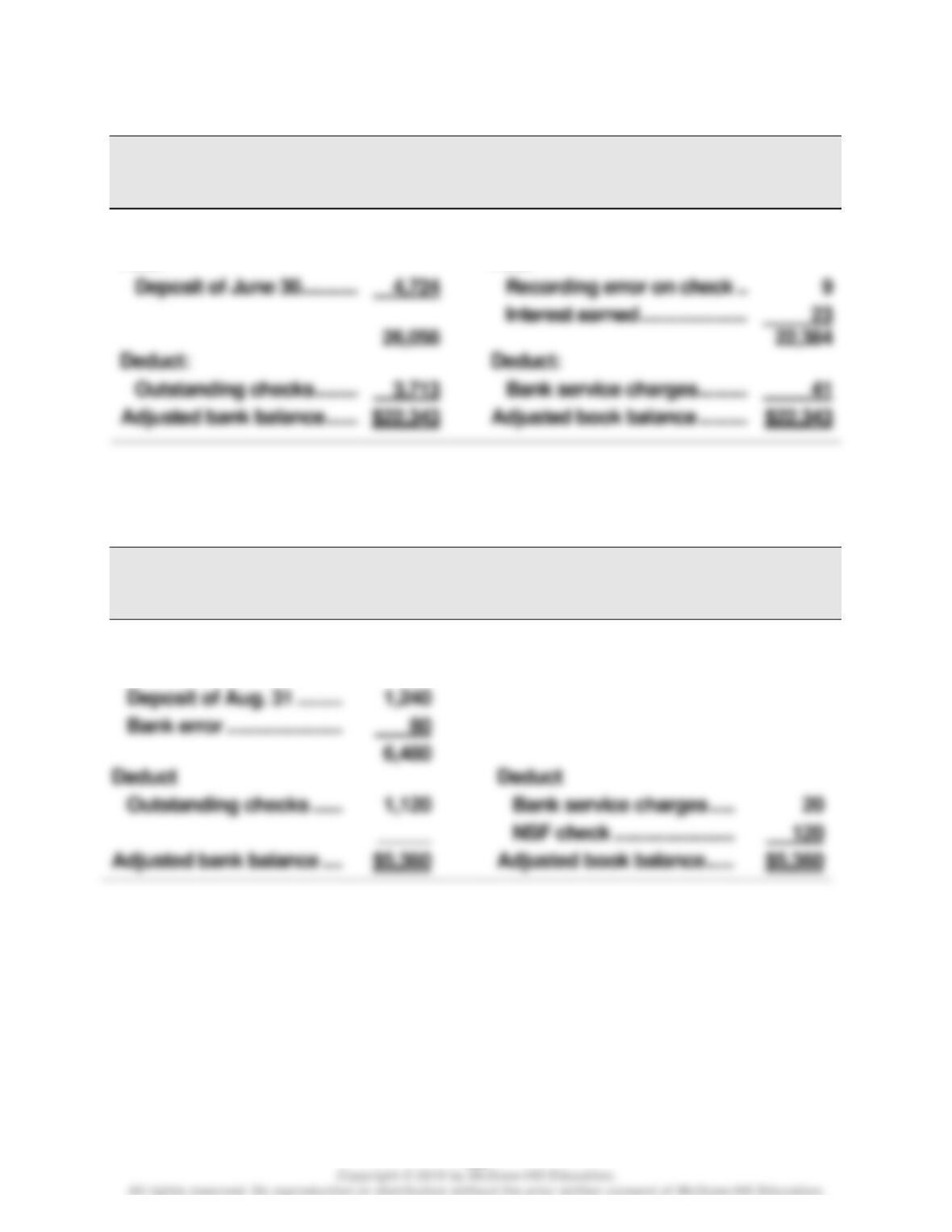
NOLAN COMPANY
Bank Reconciliation
June 30
Bank statement balance…..
$21,332
Book balance …………………………..
$22,352
Add:
Add:
Deduct:
Deduct:
Quick Study 6-9 (20 minutes)
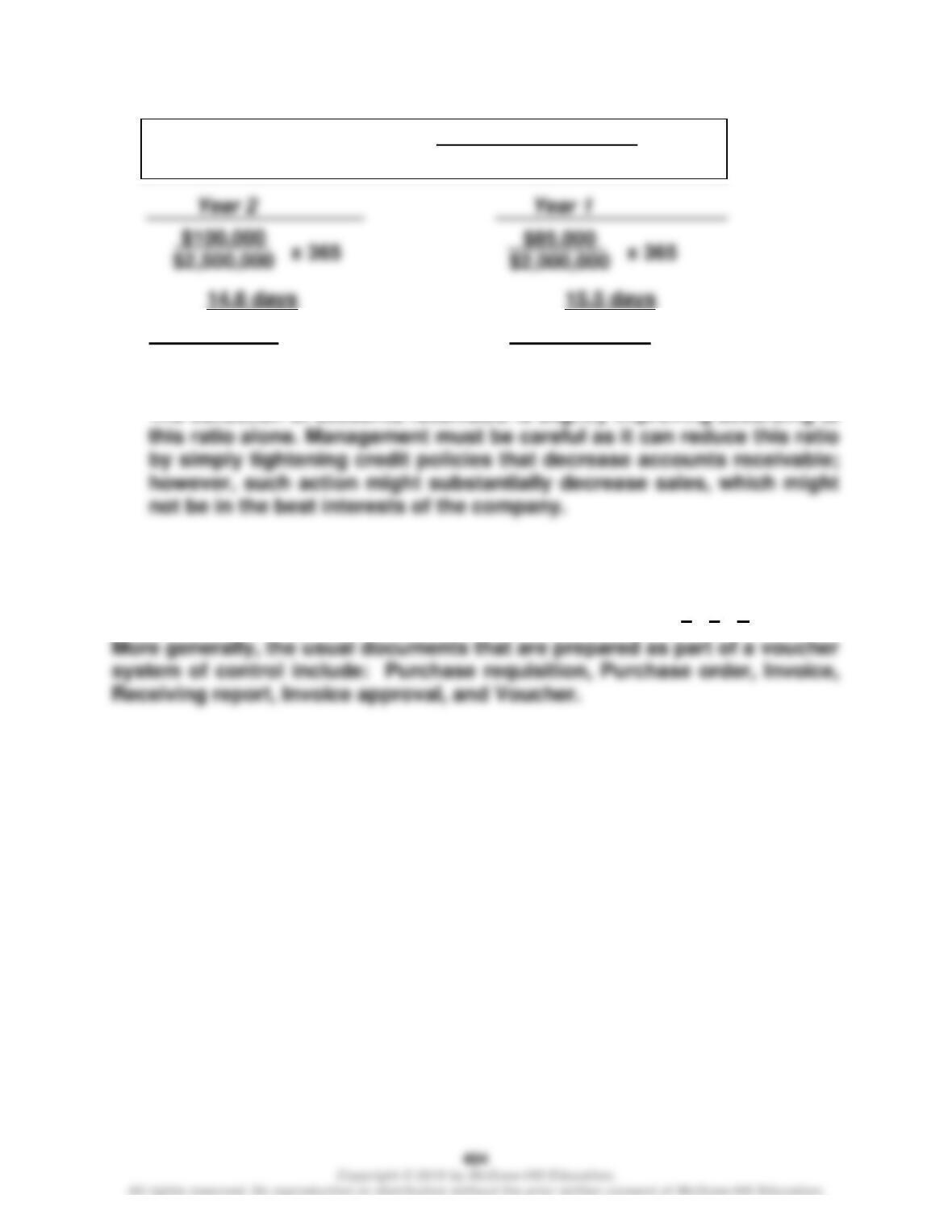
ORGANIC FOOD CO.
Bank Reconciliation
August 31
Bank statement balance ..
$5,160
Book balance …………………………..
$5,500
Add
Deduct
Deduct
Wild and Shaw, Financial & Managerial Accounting, 8e Solutions Manual: Chapter 6
Quick Study 6-10 (15 minutes)
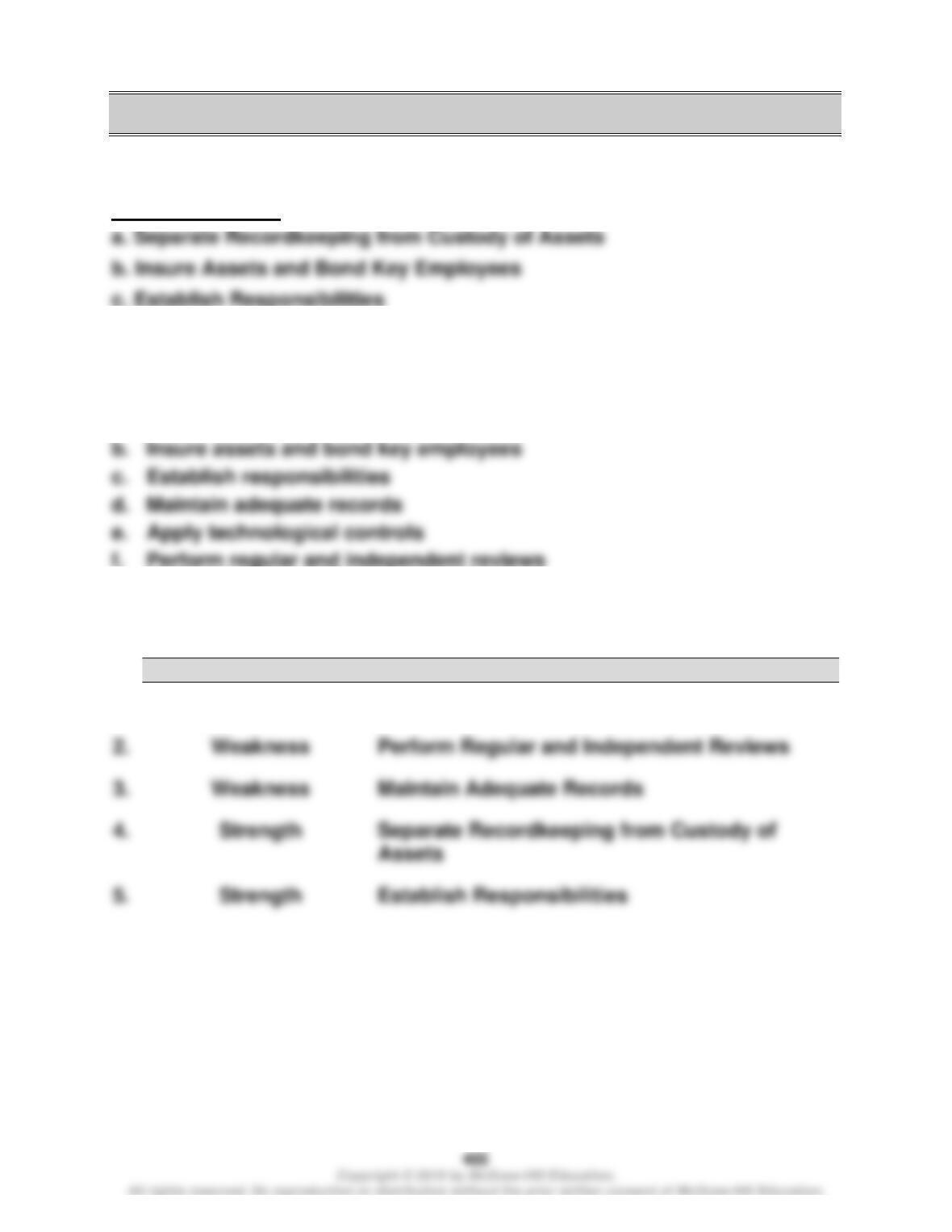
a. Days’ sales uncollected = x 365
b. Interpretation: The company took 0.9 days less to collect on its
accounts receivable in Year 2 (14.6 days) compared with Year 1 (15.5
days).
The collection of accounts receivable is slightly improving according to
Quick Study 6-11A (10 minutes)
Documents prepared as part of a voucher system include: a, c, d.
Accounts receivable
Net sales
Wild and Shaw, Financial & Managerial Accounting, 8e Solutions Manual: Chapter 6
EXERCISES
Exercise 6-1 (10 minutes)
Principle Violated
Exercise 6-2 (15 minutes)
a. Separate recordkeeping from custody of assets
Exercise 6-3 (15 minutes)
Weakness or Strength
Internal Control Principle
1.
Weakness
Divide Responsibility for Related Transactions
3.
Weakness
Wild and Shaw, Financial & Managerial Accounting, 8e Solutions Manual: Chapter 6
Exercise 6-4 (15 minutes)
Good or Bad
Cash Management Strategy
1.
Bad
Delay payment of liabilities
2.
Plan expenditures
3.
Bad
4.
Bad
Encourage collection of receivables
5.
Exercise 6-5 (15 minutes)
Currency and coins …………………………..……………….. $1,000
Exercise 6-6 (15 minutes)
Strength or Weakness
1.
Weakness
2.
Strength
3.
Strength
4.
Weakness
5.
Weakness
6.
Weakness
Exercise 6-7 (15 minutes)
Strength or Weakness
1.
Strength
2.
Strength
3.
Weakness
4.
Weakness
5.
Strength
6.
Weakness
Wild and Shaw, Financial & Managerial Accounting, 8e Solutions Manual: Chapter 6
Exercise 6-8 (20 minutes)
1.
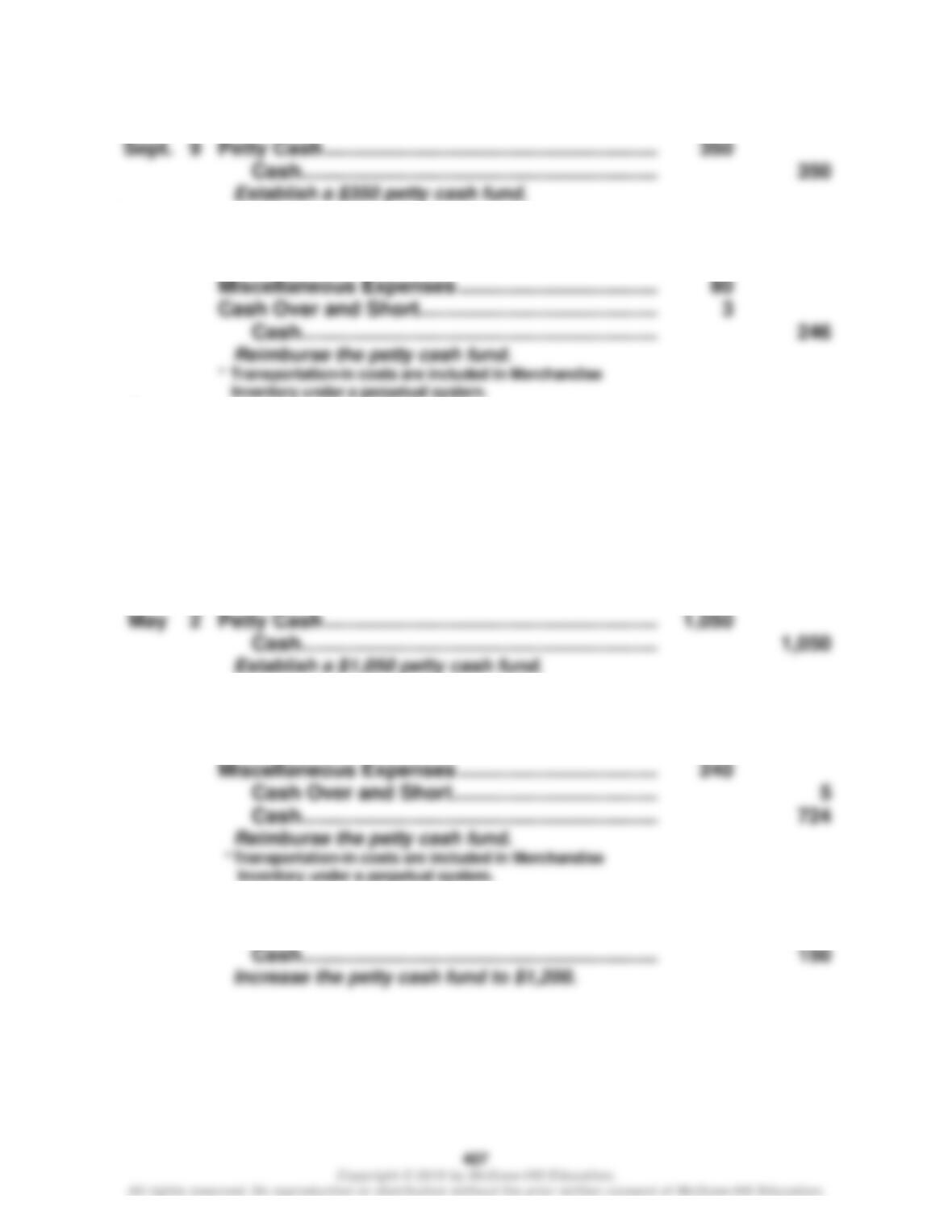
Sept. 9
Petty Cash ………………………………………………………
350
Cash ……………………………………………………….
Establish a $350 petty cash fund.
2.
Sept. 30
Merchandise Inventory* …………………………………..
40
Postage Expenses …………………………………………..
123
Miscellaneous Expenses …………………………..…….
80
Cash Over and Short ……………………………………….
Cash ……………………………………………………….
Reimburse the petty cash fund.
3.
Oct. 1
Petty Cash ………………………………………………………
50
Cash ……………………………………………………….
50
Increase the petty cash fund to $400.
Exercise 6-9 (20 minutes)
1.
May 2
Petty Cash ………………………………………………………
Cash ……………………………………………………….
Establish a $1,050 petty cash fund.
2.
May 30
Merchandise Inventory* …………………………………..
120
Postage Expenses …………………………………………..
369
Miscellaneous Expenses …………………………..…….
240
Cash Over and Short ………………………………….
Cash ……………………………………………………….
Reimburse the petty cash fund.
3.
June 1
Petty Cash ………………………………………………………
150
Cash ……………………………………………………….
Increase the petty cash fund to $1,200.
Wild and Shaw, Financial & Managerial Accounting, 8e Solutions Manual: Chapter 6
Exercise 6-10 (20 minutes)
1.
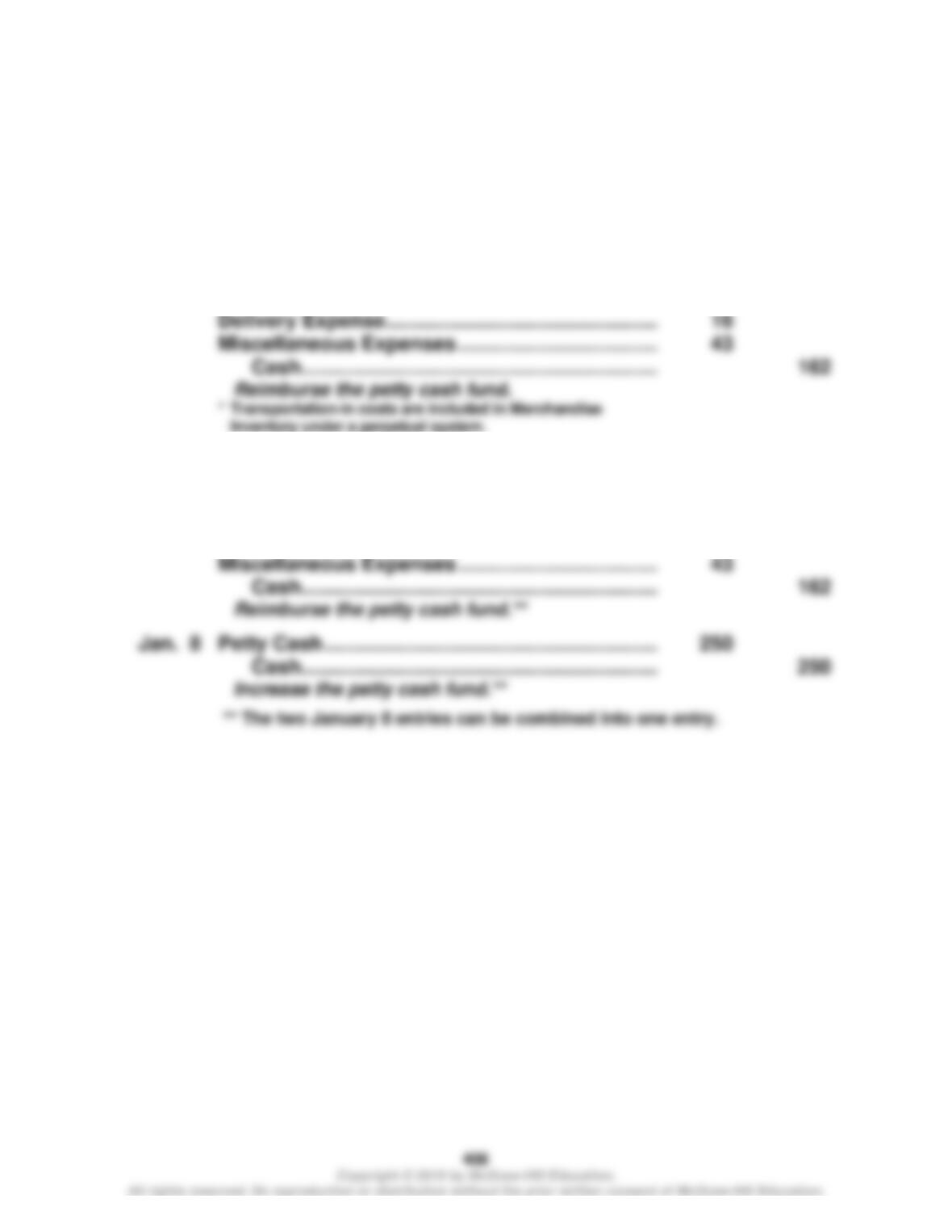
Jan. 1
Petty Cash ………………………………………………………
200
Cash ……………………………………………………….
200
Establish a petty cash fund.
2.
Jan. 8
Postage Expense …………………………………………….
74
Merchandise Inventory* …………………………………..
29
Delivery Expense …………………………………………….
16
Miscellaneous Expenses …………………………..…….
43
Cash ……………………………………………………….
162
Reimburse the petty cash fund.
3.
Jan. 8
Postage Expense …………………………………………….
74
Merchandise Inventory ……………………………………
29
Delivery Expense …………………………………………….
16
Miscellaneous Expenses …………………………..…….
43
Cash ……………………………………………………….
162
Reimburse the petty cash fund.**
Jan. 8
Petty Cash ………………………………………………………
250
Cash ……………………………………………………….
250
Increase the petty cash fund.**
Wild and Shaw, Financial & Managerial Accounting, 8e Solutions Manual: Chapter 6
409
Exercise 6-11 (20 minutes)
Bank Balance
Book Balance
Shown or Not
Shown on
Add or Subtract
Add or Subtract
Adjust
Reconciliation
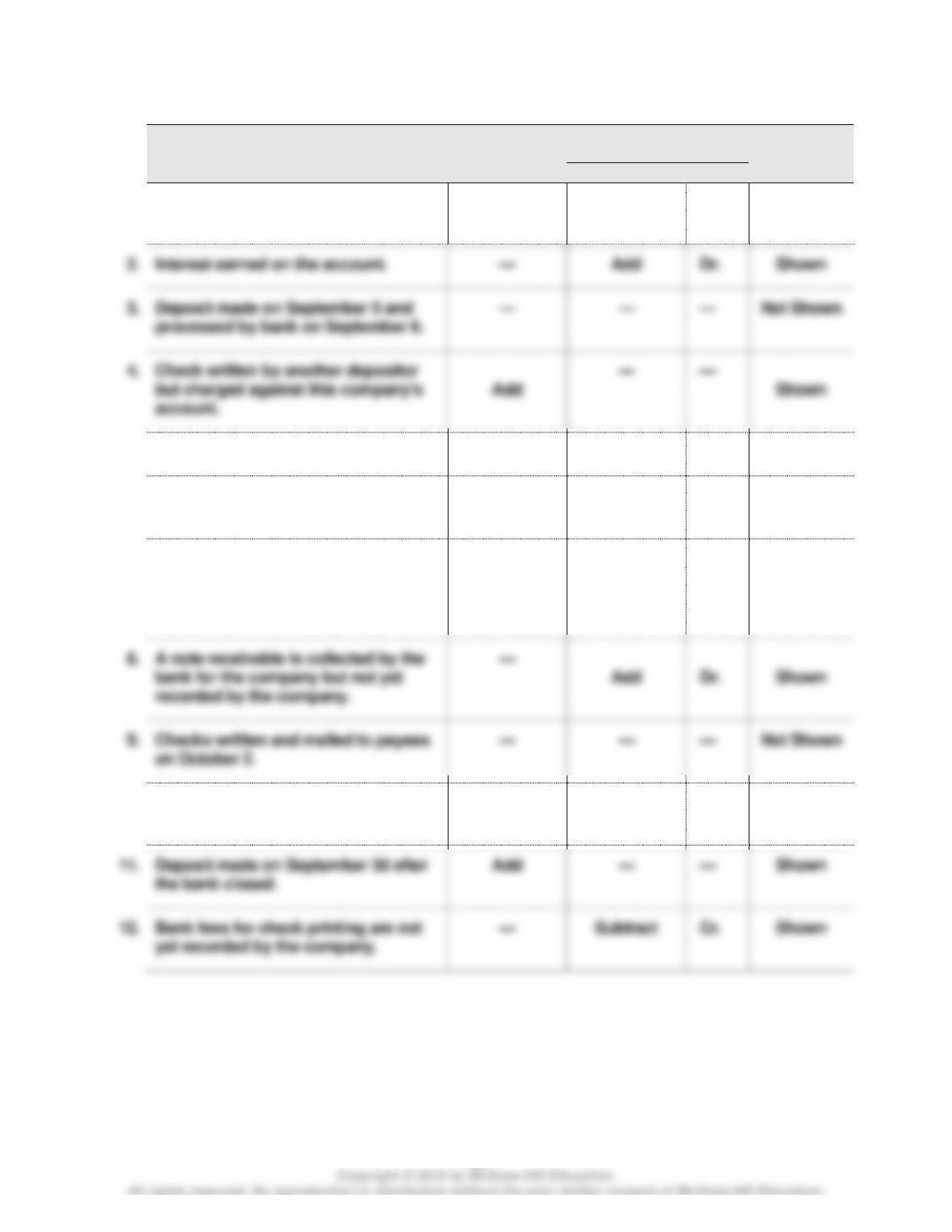
1.
NSF check shown on bank statement
but not yet recorded by company.
—
Subtract
Cr.
Shown
2.
Interest earned on the account.
—
Dr.
Shown
Deposit made on September 5 and
processed by bank on September 6.
but charged against this company’s
5.
Bank service charge.
—
Subtract
Cr.
Shown
6.
Checks outstanding on August 31
that cleared the bank in September.
—
—
—
Not Shown
7.
Check written against the company
account and cleared by the bank;
erroneously not recorded by the
company recordkeeper.
—
Subtract
Cr.
Shown
A note receivable is collected by the
bank for the company but not yet
recorded by the company.
Shown
9.
Checks written and mailed to payees
on October 2.
—
—
—
Not Shown
10.
Checks written by the company and
mailed to payees on September 30.
Deduct
—
—
Shown
12.
Bank fees for check printing are not
yet recorded by the company.
—
Cr.
Shown
Wild and Shaw, Financial & Managerial Accounting, 8e Solutions Manual: Chapter 6
Exercise 6-12 (25 minutes)
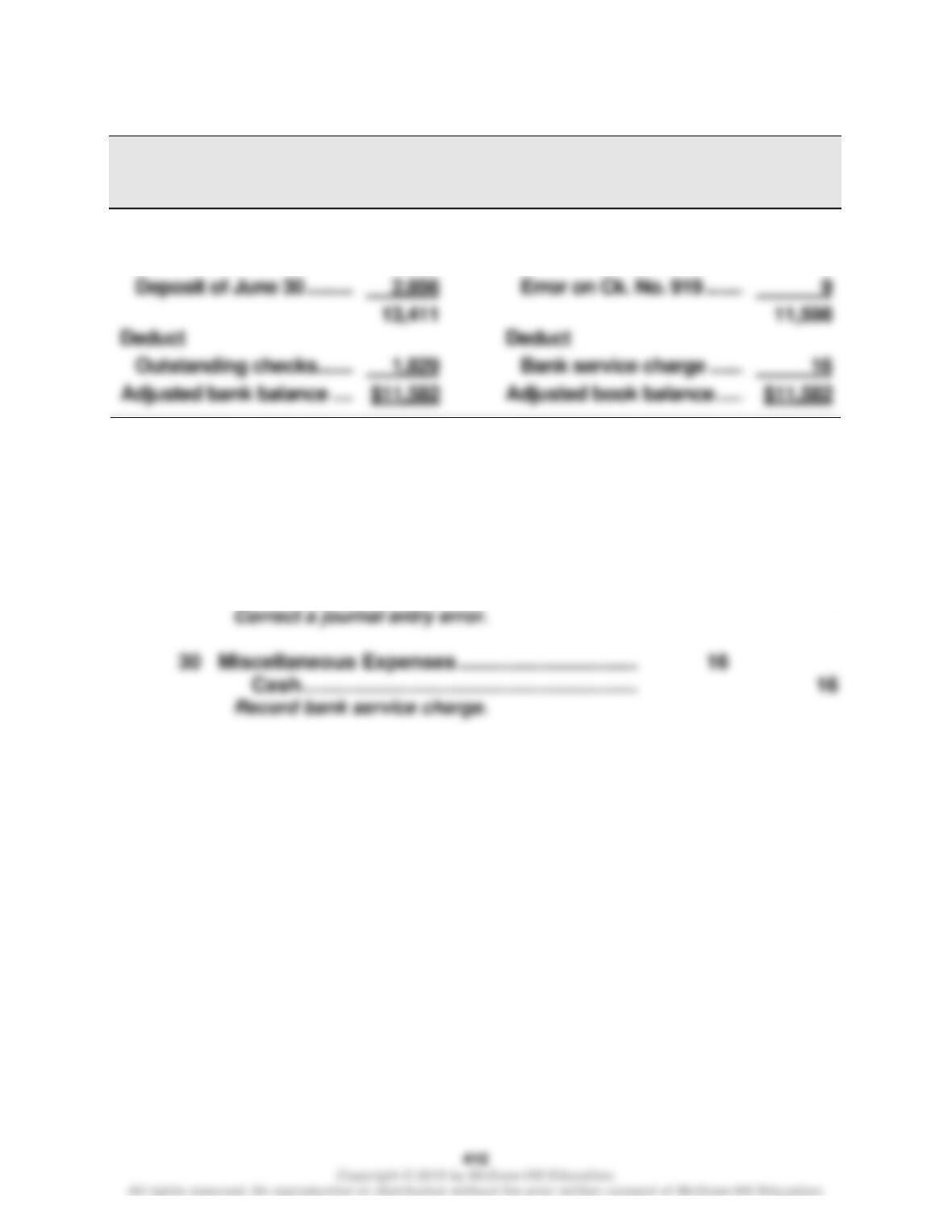
DEL GATO CLINIC
Bank Reconciliation
June 30
Bank statement balance ..
$10,555
Book balance …………………………..
$11,589
Add
Add
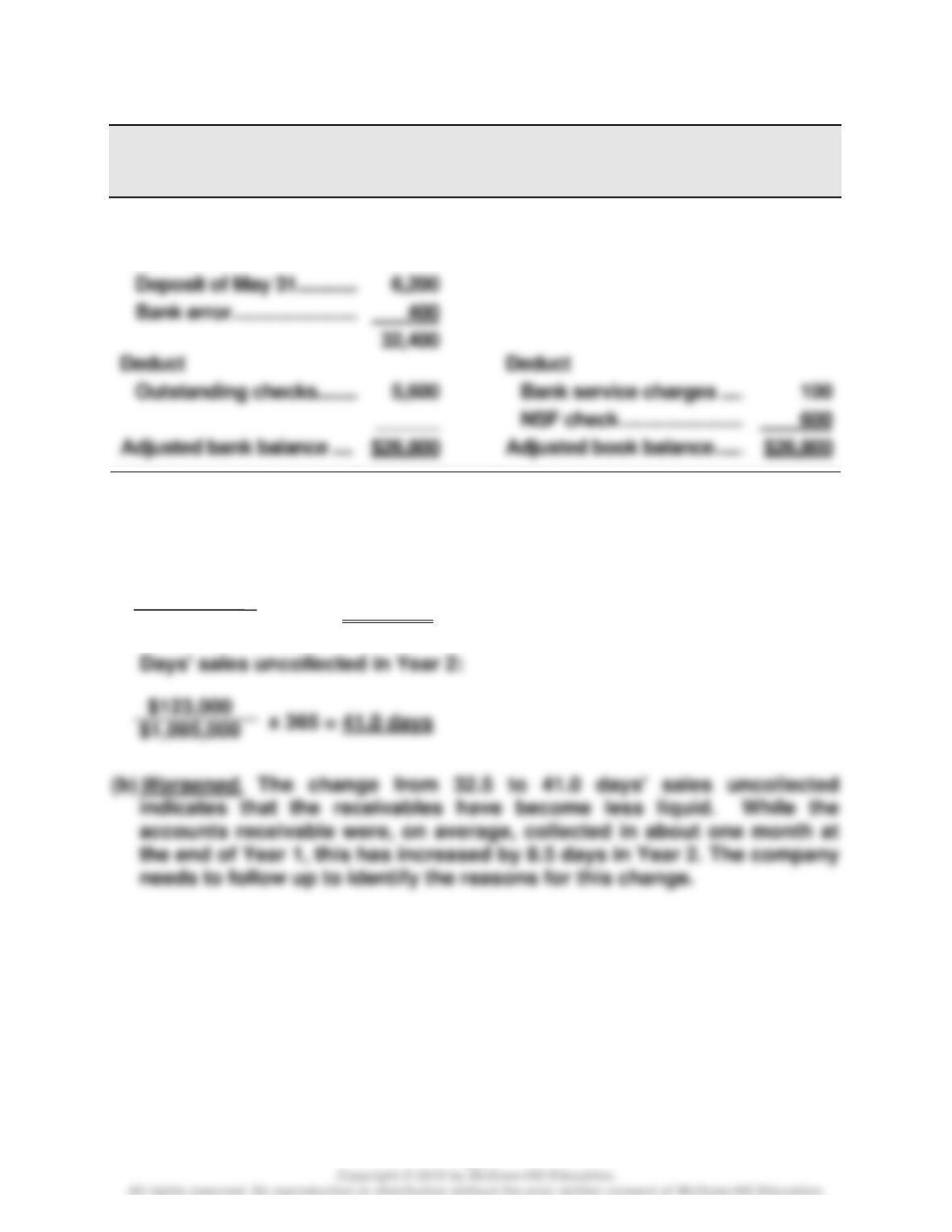
Exercise 6-13 (10 minutes)
June 30
Cash …………………………………………………………..
9
Utilities Expense ……………………………………
9
Cash ……………………………………………………..
Wild and Shaw, Financial & Managerial Accounting, 8e Solutions Manual: Chapter 6
411
Exercise 6-14 (25 minutes)
WRIGHT COMPANY
Bank Reconciliation
May 31
Bank statement balance …
$25,800
Book balance …………………………..
$27,500
Add
Deduct
Deduct
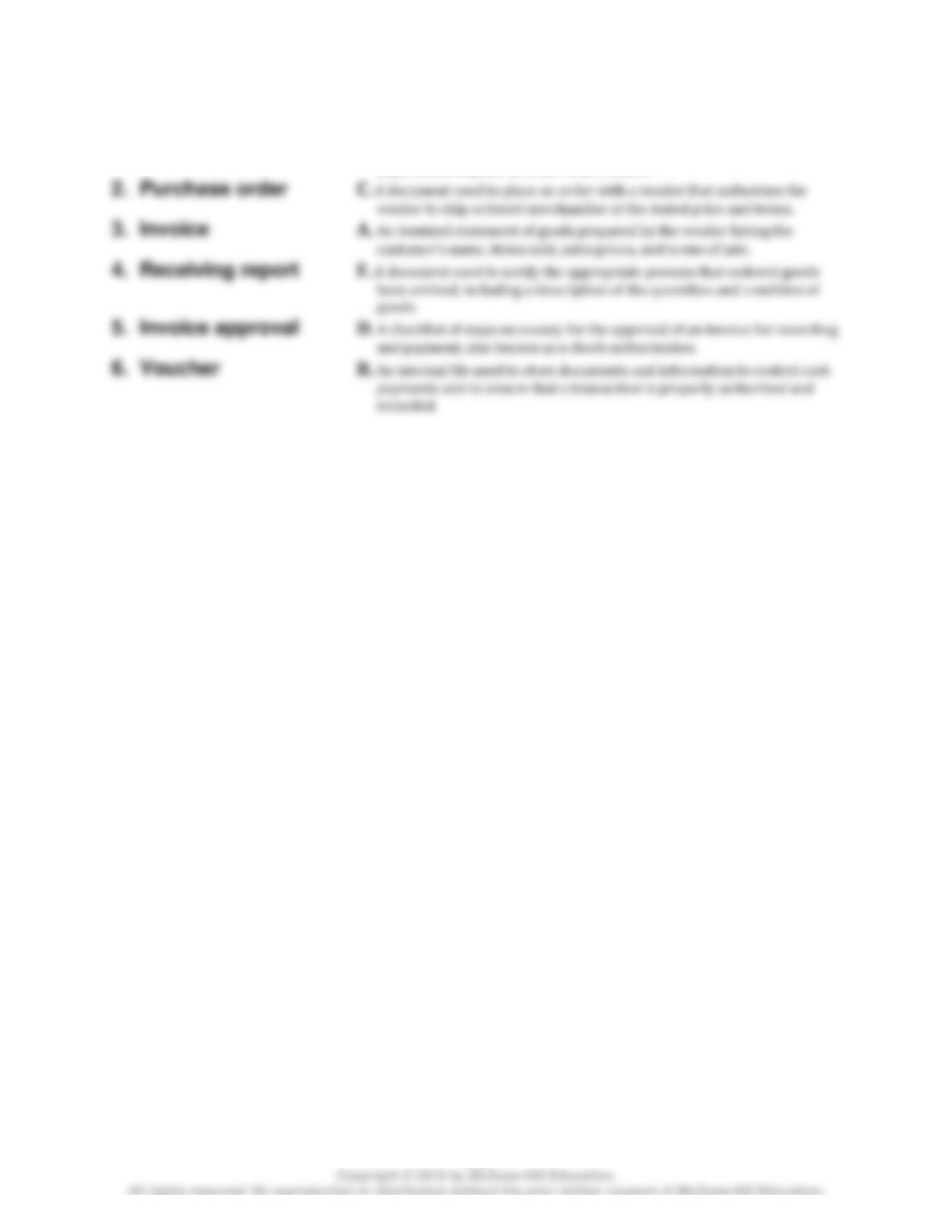
Exercise 6-15 (15 minutes)
(a) Days’ sales uncollected in Year 1:
x 365 = 32.5 days
$65,000
$730,000
Wild and Shaw, Financial & Managerial Accounting, 8e Solutions Manual: Chapter 6
412
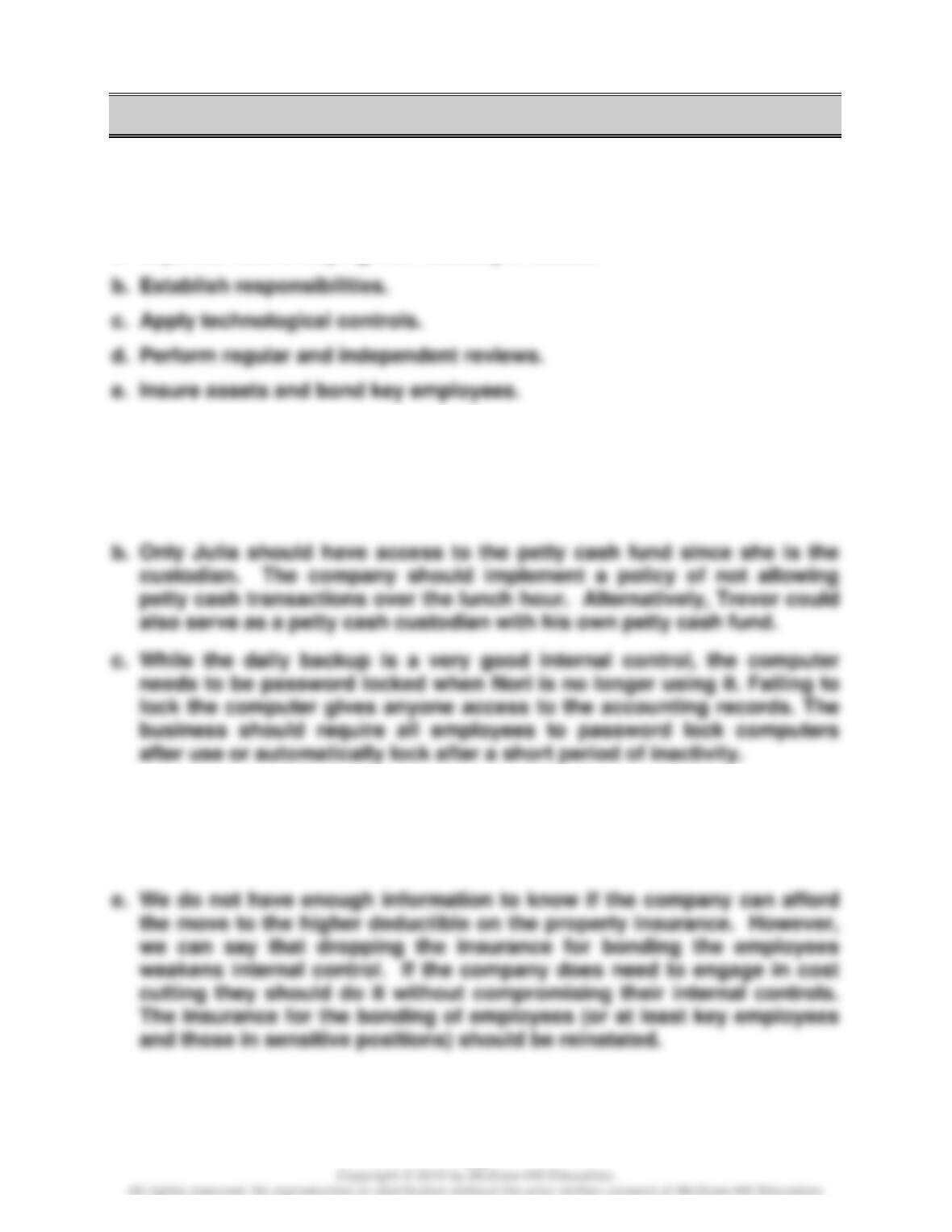
Exercise 6-16A (10 minutes)
1. Purchase requisition E. A document used by department managers to inform the purchasing
department to place an order with a vendor.
Wild and Shaw, Financial & Managerial Accounting, 8e Solutions Manual: Chapter 6
413
PROBLEM SET A
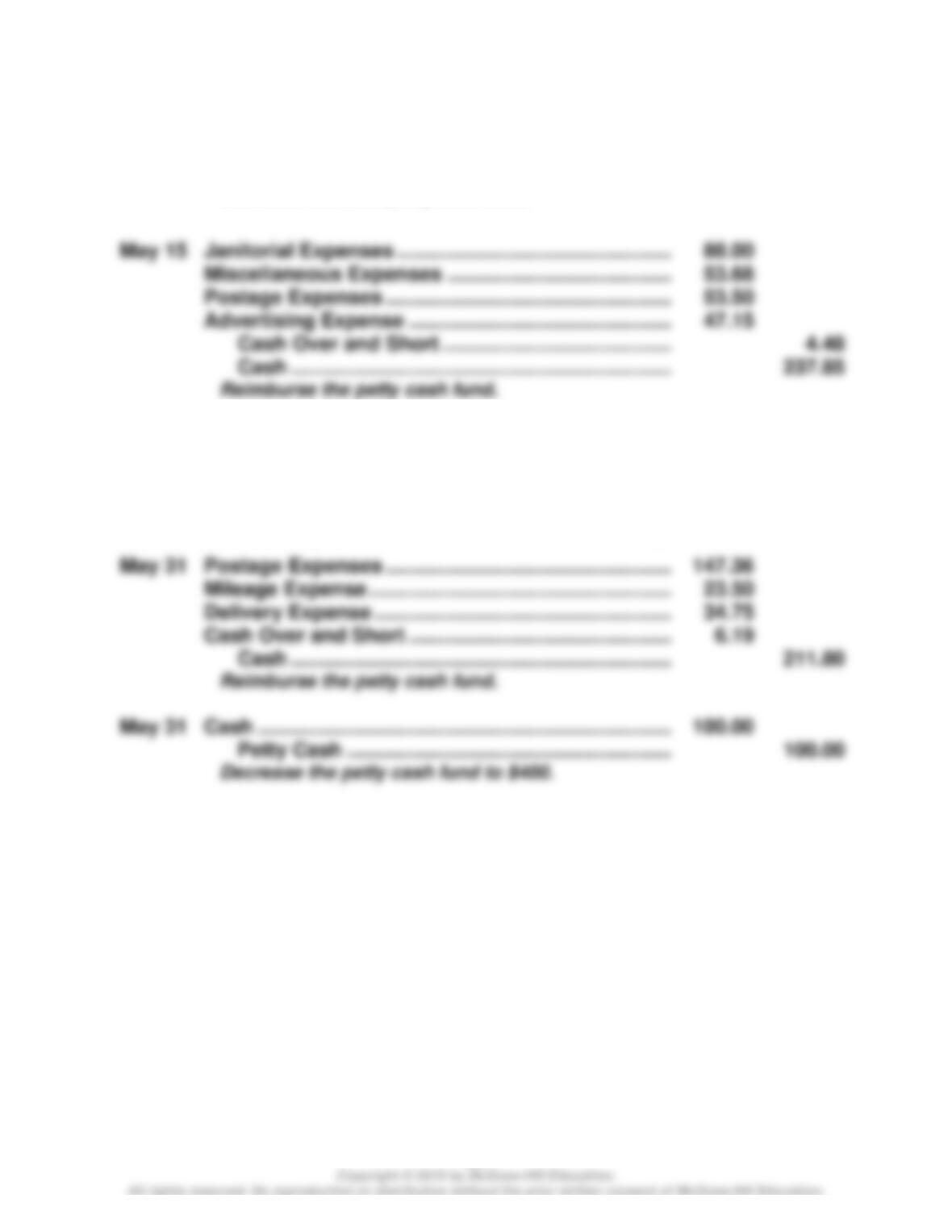
Problem 6-1A (20 minutes)
Part 1
a. Separate recordkeeping from custody of assets.
Part 2
a. The company should implement a policy whereby the person receiving
incoming cash receipts is not responsible for posting the payments to
the customer accounts.
d. Ben Shales needs to implement a way to regularly and independently
review his employees. Hiring of internal auditors or an outside
consultant to objectively review the internal controls and the employees’
work needs to be implemented.
Wild and Shaw, Financial & Managerial Accounting, 8e Solutions Manual: Chapter 6
414
Problem 6-2A (20 minutes)
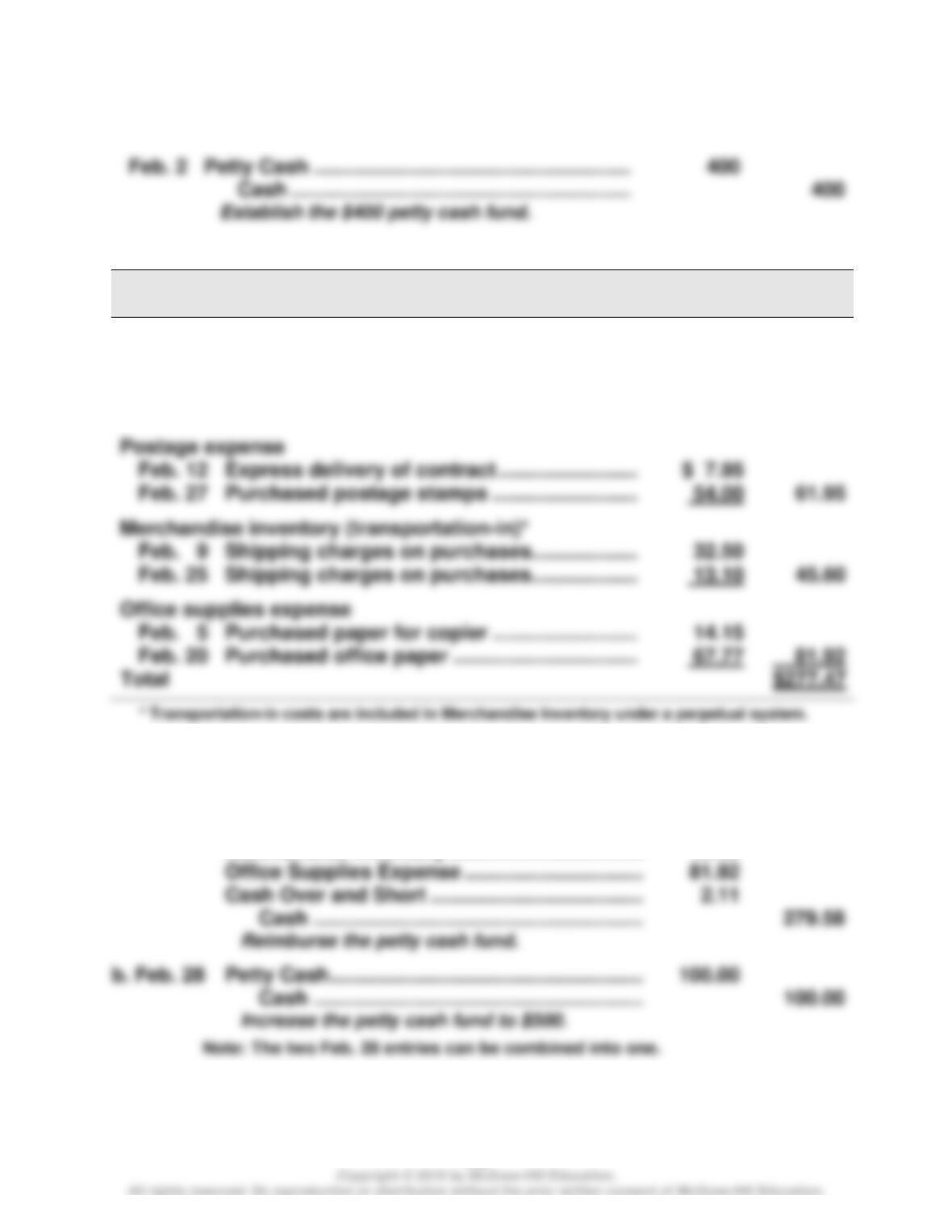
May 1
Petty Cash ……………………………………………………….
300.00
Cash ………………………………………………………………
300.00
Establish the $300 petty cash fund.
May 15
Janitorial Expenses …………………………..…………………
Miscellaneous Expenses ……………………………………..
Postage Expenses ……………………………………………….
Advertising Expense ……………………………………………
Cash Over and Short ………………………………………
Cash ………………………………………………………………
237.85
Reimburse the petty cash fund.
May 16
Petty Cash ……………………………………………………….
200.00
Cash ………………………………………………………………
200.00
Increase the petty cash fund to $500.
Note: The May 31 entries can be combined into one entry.
May 31
Postage Expenses ……………………………………………….
147.36
Mileage Expense ………………………………………………….
Delivery Expense …………………………..…………………….
Cash ………………………………………………………………
211.80
Reimburse the petty cash fund.
May 31
100.00
Petty Cash ……………………………………………………..
100.00
Decrease the petty cash fund to $400.
Wild and Shaw, Financial & Managerial Accounting, 8e Solutions Manual: Chapter 6
415
Problem 6-3A (30 minutes)
Part 1
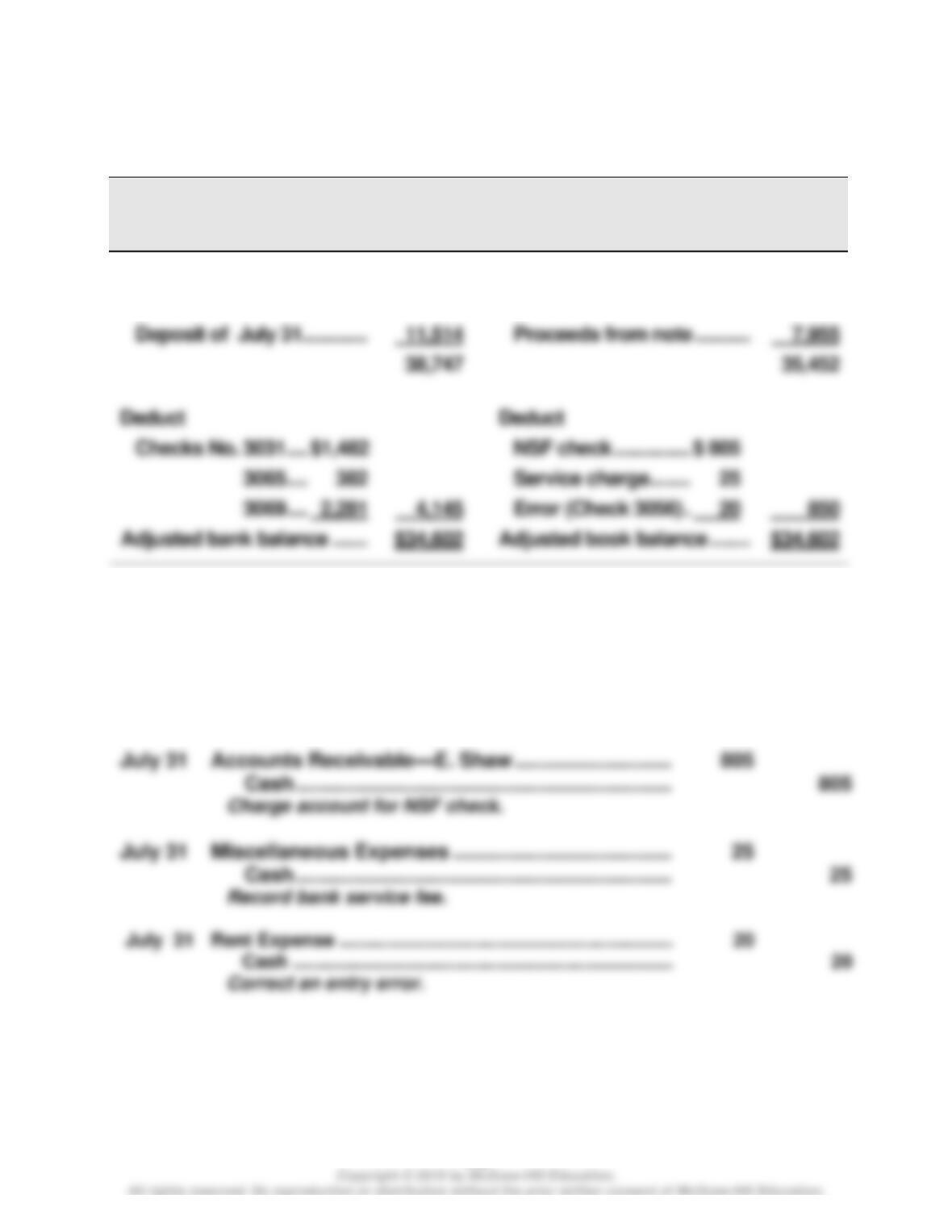
Petty Cash ……………………………………………………….
Part 2
Nakashima Gallery
Petty Cash Payments Report (for February)
Delivery expense
Feb. 23
Delivery of customer’s merchandise …………………….
$ 20.00
Mileage expense
Feb. 14
Reimbursement for mileage …………………………..
68.00
Postage expense
Feb. 12
Express delivery of contract …………………………..
Feb. 27
Purchased postage stamps …………………………..
61.95
Merchandise inventory (transportation-in)*
Feb. 9
Feb. 25
45.60
Feb. 20
Purchased office paper ………………………………………..
Part 3
a. Feb. 28
Delivery Expense …………………………………………………
20.00
Mileage Expense ………………………………………………….
68.00
Postage Expense …………………………………………………
61.95
Merchandise Inventory …………………………………………
45.60
81.92
Petty Cash ……………………………………………………….
Wild and Shaw, Financial & Managerial Accounting, 8e Solutions Manual: Chapter 6
416
Problem 6-4A (30 minutes)
Part 1
BRANCH COMPANY
Bank Reconciliation
July 31
Bank statement balance …..
$27,233
Book balance …………………………..
$27,497
Add
Add
Deduct
Deduct
Part 2
July 31
Cash ……………………………………………………………………
7,955
Notes Receivable ……………………………………………
7,955
Record note collection.
July 31
Accounts Receivable—E. Shaw …………………………..
Cash ………………………………………………………………
Charge account for NSF check.
July 31
Miscellaneous Expenses ……………………………………..
Cash ………………………………………………………………
Record bank service fee.
Correct an entry error.