P a g e | 81
Choice of Ethical Decision Framework
Provided the list of stakeholders is accurately identified, and their interests are also clearly
understood, I would be comfortable with any of the three approaches listed in Chapter 4. I
would perhaps lean to the use of the five question framework or the Velasquez model
4. What should Jane do if Webster & Co. looks like the choice the Audit Committee will make and
recommend to the board of directors?
John, the chief financial officer, would have to consider in this case whether the interests of the
directors and owners of the company would be adequately protected by Webster and Co.
becoming the auditors. If he had serious concerns about the previous relationship between the
25. Lowballing a Fee Quotation (Chapter 6, page 484)
What this case has to offer
Note: Lowballing can occur when the fee quoted does not cover the costs of the engagement and
provide a reasonable return, within a reasonable time frame.
The Lowballing Case offers the opportunity to explore:
• The problem of agreeing to a fee which is too low to support usual or reasonable profit margins
for the audit firm, thus usually leading to the skimping on audit procedures, the erosion of audit
Teaching suggestions
I would begin discussion of this case by eliciting the chain of reasoning set out in point 1 above, so that
the class understands the problem (low bid ➔ cost cutting ➔ skimping on audit work ➔ erosion of
audit quality ➔ audit errors ➔ failure to discharge duty to shareholders).
P a g e | 83
framework should be based on which addresses the problems most directly and efficiently. In this case,
the issues of legality and sustainable development do not apply, but profitability does. As well, it would
be useful to canvas the organizational culture to see if lowballing was a common practice in the firm,
and that effective control practices had been developed. Consequently, I would probably use a hybrid
approach, as follows:
Well-offness
• For the audit firm (profit)
Rights
• Of the shareholders (to expected levels of service by their agent)
Fairness
• To the audit staff (expectations to work too hard)
Discussion of important issues
Within the framework suggested above, the important issues to be addressed and their sub-
components are:
Balancing personal self-interest against the interests of others
In the long run, personal self-interest will be affected by the interests of others. If the profitability
P a g e | 84
Profitability is too narrowly defined
The analysis of profitability of the firm should take into account the opportunity cost of using your
best staff on this job to maximize efficiency, but lose on other jobs which might have led to more
Are there occasions when lowballing is appropriate?
On the assumption that each assignment must make a reasonable return within a reasonable time
frame or unfortunate consequences will result, lowballing is not appropriate. However, there are
occasions when lowballing may be acceptable, such as:
What control strategies may be advisable?
In order to protect the integrity of the audit, procedures must be in place which ensure that audit
P a g e | 85
Fundamental Accounting & Auditing Issues
26. Societal Concerns (Chapter 6, page 484)
What this case has to offer
This case is intended to allow students to explore the role of the accountant. As a professional, the
accountant has a responsibility to the public and not just to whomever they think is their immediate
Teaching suggestions
This case is very transparent as to the basic issue involved, but it allows the students to develop their
understanding of the issues as the discussion progresses. I would begin the discussion of the case by
Discussion of ethical issues
Responsibility to the public
This issue is argued in Chapters 2 and 6, where for a variety of reasons it is shown that the
accounting professional, particularly the auditor, is ultimately responsible to the public. This issue is
Credibility
Care must be taken—and this should be realized by the student–that a professional should not
comment definitively on something beyond his or her expertise, nor should anything be promised
P a g e | 86
Information Inductance
The students should be made aware of the principal of information inductance which, commonly
stated, suggests that management will be induced to better the scorecard that they are being
Basic and relative expertise of accountants
Accountants are trained and educated to develop an understanding and skills in the area of
evaluation and measurement of economic activities. Traditionally, these measurements are made in
dollars, but there is no reason why the awareness of such principles as objectivity and consistency
cannot be transferred to measurements made in terms of units or percentages and other factors
The Societal Concerns Case is intended to develop an awareness of the proper professional perspective
which is necessary to serve the public and to maintain the rights accorded the professional accountants
in society by properly discharging duties to the public. To the extent that accountants are reluctant to
The points that Joan and Miguel have raised are worthy of comment by accountants.
P a g e | 87
27. Economic Realities or GAAP (Chapter 6, page 485)
What this case has to offer
This case is based on the Four Seasons Hotel’s use of the cost base basis for carrying an investment
which attracted negative press in the Wall Street Journal during the winter and spring of 1994. The
principal issues which the students should address are:
• The probable response by the investing public when the rationale for a generally accepted
accounting principle/practice is not intuitively obvious.
Teaching suggestions
I would start the class thinking about this case by asking about the logic of the accounting profession in
creating accounting standards which are generally accepted as accounting principles. From this base I
would ask the class what their understanding is of the cost basis for carrying investment, rather than
a poor one to apply, if for example, there were no other owners of the subsidiary Far East Hotels whose
interest approached the 19.9% owned by Fine Line Hotels. If they had control of the Board of Directors
and management, and intended to continue to operate the chain, Fine Line would therefore be the
Discussion of issues
General acceptance of accounting principles
The concept of fair presentation of economic transactions relies upon the use of accounting rules
and conventions that may apply to transactions in a consistent way that preparers and readers can
P a g e | 88
understand. Since there is usually no single, right way to disclose the economic impact of a
transaction, accountants have traditionally sorted out which rules are best applied in certain
Fairness in presentation
The ethical principle of fairness is one which is used an interesting way to control the disclosure of
accounting transactions according to the financial statements of a corporation. If a transaction is
unfairly presented, it is thought to convey an economic advantage or disadvantage to one
Economic realities
In this case, the point being made by Stan Jones is that the presentation using a cost basis for
carrying the investment in the subsidiary Far East Hotels did not reflect the losses which have been
made, because the company’s interests of 19.9% were just a hair underneath the 20% trigger for
disclosure. He felt very disadvantaged due to a technicality. He felt the economic reality was that
P a g e | 89
Credibility and trust in auditors
The case implies that the auditors of Fine Line Hotels decided not to qualify their audit report and,
therefore, either found the losses in the subsidiary not to be material, or believed that the rationale
Useful Articles, Links, and Videos
American Institute of Certified Public Accountants (AICPA) (2016). AICPA Code of Professional Conduct.
P a g e | 90
28. Multidisciplinary Practices – Ethical Challenges (Chapter 6, pages 485-486)
What this case has to offer
Multidisciplinary practices (MDPs) are now the norm for assurance service-oriented firms, the result of a
transformation from the narrower auditing, tax and consulting orientation that prevailed for decades,
except for a short time after the introduction of the Sarbanes-Oxley Act of 2002. The case calls for the
Teaching suggestions
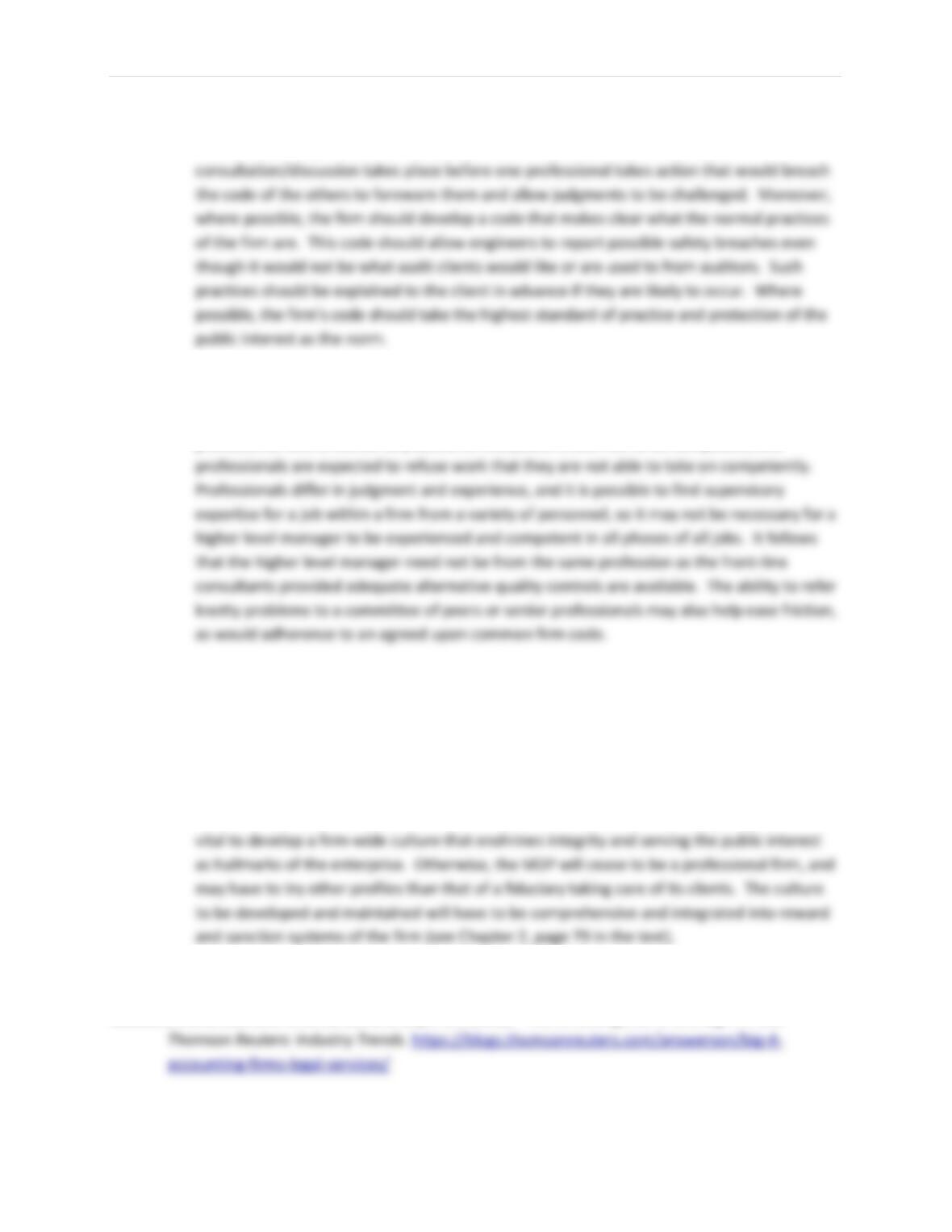
This case offers an opportunity to discuss the emerging MDPs, and I would encourage the students to
visit the websites of the Big 4 accounting firms and of the Esteban and Wilkins (2016) article (see Useful
ASPECT OF CODE/CULTURE
ACCOUNTANTS
LAWYERS
ENGINEERS
Focus
Primarily on…
Public interest
Rule of law
Public interest
Other
Client interest
Client interest
Client interest
Confidentiality
Strict
Strictest
Strict
Principles
Principles
Principles
GAAP & GAAS
Courts
Statutes
Discussion of ethical issues
1. What are your answers to the questions raised in the case?
Whose codes will predominate: lawyers, engineers or accountants?
P a g e | 91
The codes of an individual professional cannot be obviated, so each will have to be followed.
However, it is important that each professional understand the others, and that
Do professionals report to one of their own or to a member from a different profession?
The type of professional reported to is not as important as one might imagine. Each
professional with a license to practice on the public is deemed to be competent, and
Who would be sued?
The professional who erred could be sued, but it is more likely that the firm and other deep-
pocket partners would be sued, unless a limited partnership form was used.
Won’t focus be on profit rather than serving the public interest?
This is a real problem as the proportion of non-professionals in MDPs also grows. It will be
Useful Articles, Links, and Videos
Esteban, Maria José and Wilkins, David B. (April 27, 2016). “The re-emergence of the Big 4 in law.”
P a g e | 92
Tax & Regulatory Cases
29. Multinationals and Tax Planning (Chapter 6, pages 486-487)
What this case has to offer
This is a good case to debate a number of interesting questions concerning the nature of taxation and
Teaching suggestions
Have the students debate the following questions.
1. What is the purpose and nature of taxation?
Discussion of ethical issues
1. Do you consider transfer pricing to be an ethical means of reducing a business’s tax liability? Why,
and why not?
Transfer pricing is an attempt to assign a value to a non-arm’s length transaction. Because the
transaction is non-arm’s length there is usually no objective market value that can be used;
2. At what level would a transfer price cease to become reasonable, and become unethical and
probably illegal?
As mentioned above, a transfer price that approximates its ‘true’ price is reasonable. As the
3. Does transfer pricing impose an ethically unfair tax burden on non-multinationals that cannot
engage in such a scheme because they do not have international operations?
Justice as fairness says that equals should be treated equally, and unequals should be treated
unequally in proportion to their inequalities. The default position is that all are equal. Therefore,
4. Do governments have an ethical responsibility to harmonize tax rates around the world?
Some students may argue that governments have responsibilities to set tax policies and
regulations that provide for the social welfare of their citizens. Tax planning then becomes a
Useful Articles, Links, and Videos
Income Research Team (June 16, 2014). “Apple’s Tax Avoidance Draws Scrutiny ”. WALL ST Daily

P a g e | 94
The transcript (and video) of the closing speech of the G20 meeting on another step in
“eliminating the risk that any firm is too big to fail” and business tax reforms, including
inversions (see references, below).
Gray, Jeff (September 20, 2014). “Global watchdogs take on the corporate tax dodgers,” Globe and Mail,
This article reports on the meeting in September 2014 of the “finance ministers and central bank
governors from the world’s 20 largest economies” and their “… proposals, called “revolutionary”
and “historic,” [that] aim to plug the gaping loopholes in the international tax system that allow
multinationals to slide substantial profits into tax havens or low-tax countries, depriving
governments of badly-needed revenue.”
Associated Press (September 23, 2014). “Tim Hortons, Burger King merger fallout: U.S. cracks down on
The article reports on the Obama administration’s reforms affecting “tax inversions” resulting
from “…certain overseas corporate mergers and acquisitions, aiming to curb American
companies from shifting their ownership abroad to shirk paying U.S. taxes.”
Hickey, Walter (May 21, 2013). “Apple Avoids Paying $17 Million In Taxes Every Day Through A Ballsy
P a g e | 95
30. KPMG’s Questionable Tax Shelters (Chapter 6, pages 487-488)
What this case has to offer
This case raises questions on whether tax accountants serve or endanger the public interest in what
they do and whether they should change their practices before public opinion seriously erodes the
Teaching Suggestions
Other cases also look at tax issues, for example, Case 34 Providing Tax Advice in this chapter (Chapter 6,
pages 493-495 in the text), and can be used in conjunction with this case to allow students to ask
fundamental questions, such as:
• What is the public interest?
Discussion of ethical issues
1. Are offshore tax havens that are technically legal but socially unacceptable in the public interest?
The wealthy, who are better able to pay a proportion of their income than the poor or middle
class, are the usual beneficiaries of offshore tax havens. By reducing the amount of tax they pay,
2. Are tax accountants promoting the public interest when they design, promote, and sell tax shelters
that reduce or eliminate paying taxes by the wealthiest members of society?
It depends. Professional accountants have an obligation to serve the public interest. This
means that the activities of the accountant should promote the general welfare, or at least do
3. Is there a difference between tax planning strategies that use legally sanctioned shelters, such as
retirement savings accounts, different from tax planning strategies that use questionable offshore
tax havens?
Yes. Tax planning strategies that use legally sanctioned shelters, such as retirement savings
accounts, have been approved as being in the public interest, and are available to all taxpayers
4. Do you think that government tax enforcement officers should or should not socialize with tax policy
committees of the accounting profession and/ or directly with practitioners?
While government tax enforcement officers might learn of ways in which tax money can be
sheltered and so be more vigilant in investigating shelters that are not in the public interest, the