
6-1
CHAPTER 6
Reporting and Analyzing Inventory
Learning Objectives
1. Determine how to classify inventory and inventory quantities.
2. Explain the basis of accounting for inventories and apply the inventory cost flow
methods under a periodic inventory system.
3. Explain the financial statement and tax effects of each of the inventory cost flow
assumptions.
4. Explain the lower-of-cost-or-market basis of accounting for inventories.
5. Compute and interpret the inventory turnover ratio.
6. Describe the LIFO reserve and explain its importance for comparing results of
different companies.
*7. Apply the inventory cost flow methods to perpetual inventory records.
*8. Indicate the effects of inventory errors on the financial statements.
6-2
Chapter Outline
Learning Objective 1 – Determine how to classify inventory and inventory
Quantities
CLASSIFYING AND DETERMINING INVENTORY—Two important steps in
the reporting of inventory at the end of the accounting period are the
classification of inventory based on its degree of completeness and the
determination of inventory amounts.
▪ Classifying Inventory—depends on whether the firm is a merchandiser
of a manufacturer.
o In a merchandising company, inventory consists of many different
items.
▪ By observing the levels and changes in the levels of these three inventory
types, financial statement users can gain insight into management’s
production plans.
Determining Inventory Quantities—No matter whether they are using a
periodic or perpetual inventory system, all companies need to determine
inventory quantities at the end of the accounting period.
▪ If using a perpetual system, companies take a physical inventory at year–
end for two purposes: (1) to check the accuracy of their perpetual
inventory records and (2) to determine the amount of inventory lost due to
6-3
o To arrive at an accurate count, ownership of goods in transit (on
board a truck, train, ship, or plane) must be determined.
o Goods in transit should be included in the inventory of the company
that has legal title to the goods. Legal title is determined by the terms
of the sale.
Learning Objective 2 – Explain the Basis of Accounting for Inventories and
Apply the Inventory Cost Flow Methods under a
Periodic Inventory System
INVENTORY COSTING—After a company has determined the quantity of units
of ending inventory, it applies unit costs to the quantities to determine the total
cost of the ending inventory and the cost of goods sold. There are different
inventory costing methods available:
TEACHING TIP
Even though computers have made it possible to specifically match goods to the actual sale,
specific identification is not a popular method. Refer students to Illustration 6-11 and ask
them why specific identification is seldom used.
▪ Cost Flow Assumptions—other cost flow methods differ from the
specific identification method in that they assume flows of costs may be
unrelated to the actual physical flow of goods. There are three assumed
6-4
o Average-cost
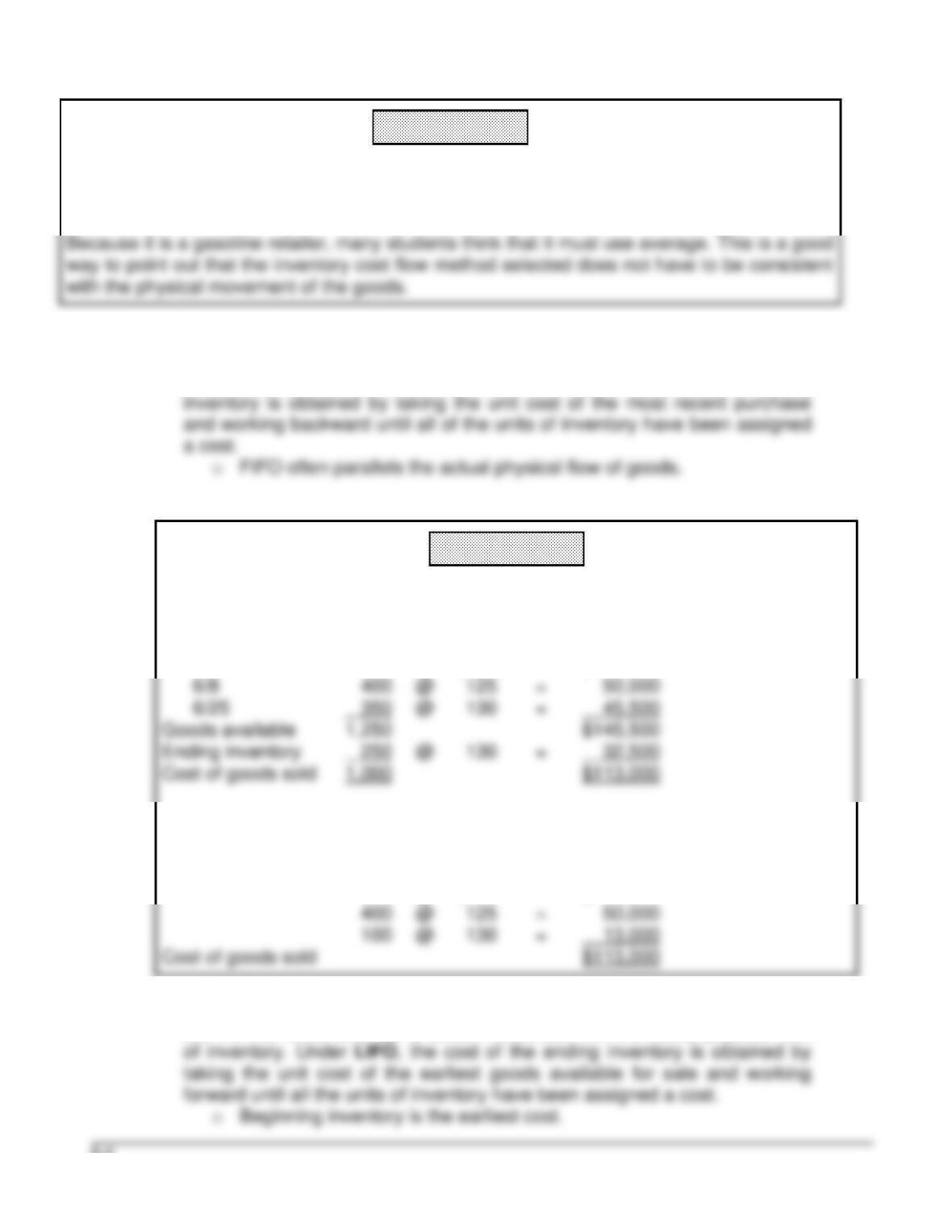
TEACHING TIP
Ask students to answer this multiple choice question: Which inventory method should a
gasoline retailer use? (a) LIFO, (b) FIFO, (c) Average, or (d) any method that its management
chooses.
▪ First-in, First-out (FIFO) method assumes that the earliest goods
purchased are the first to be sold. Under FIFO, the cost of the ending
TEACHING TIP
Use the example of a bicycle shop to illustrate FIFO.
Beginning inventory -0- -0-
Purchases:
6/2 500 @ $100 = $ 50,000
When using FIFO, one assumes the first units in are the first units sold. Which of
the above units were sold?
500 @ $100 = $ 50,000
▪ Last-in, First-out (LIFO) method assumes that the last goods purchased
are the first to be sold. LIFO seldom coincides with the actual physical flow
6-5
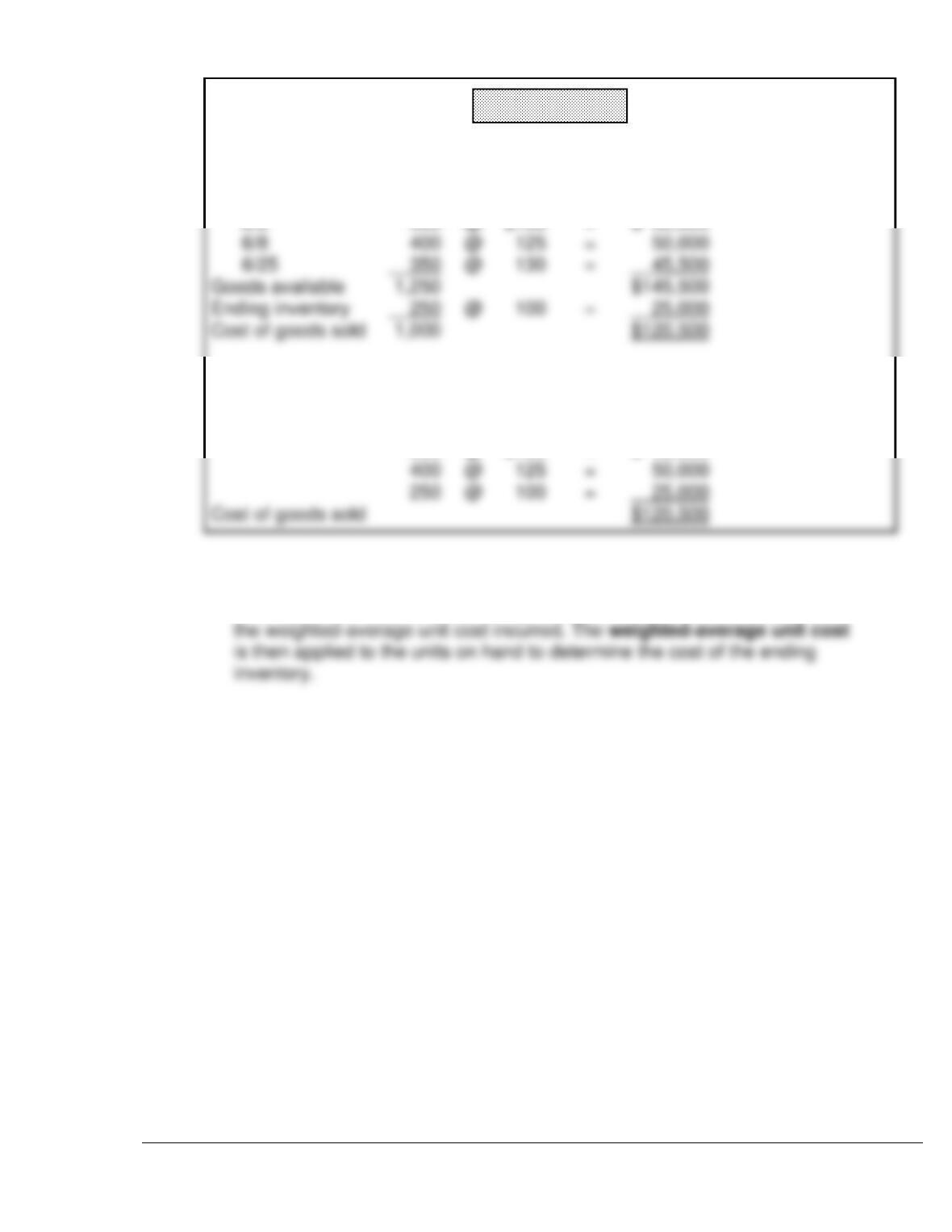
TEACHING TIP
Use the example of a bicycle shop to illustrate LIFO.
Beginning inventory -0- -0-
Purchases:
6/2 500 @ $100 = $ 50,000
When using LIFO, one assumes the last units in are the first units sold. Which of
the above units were sold?
350 @ $130 = $ 45,500
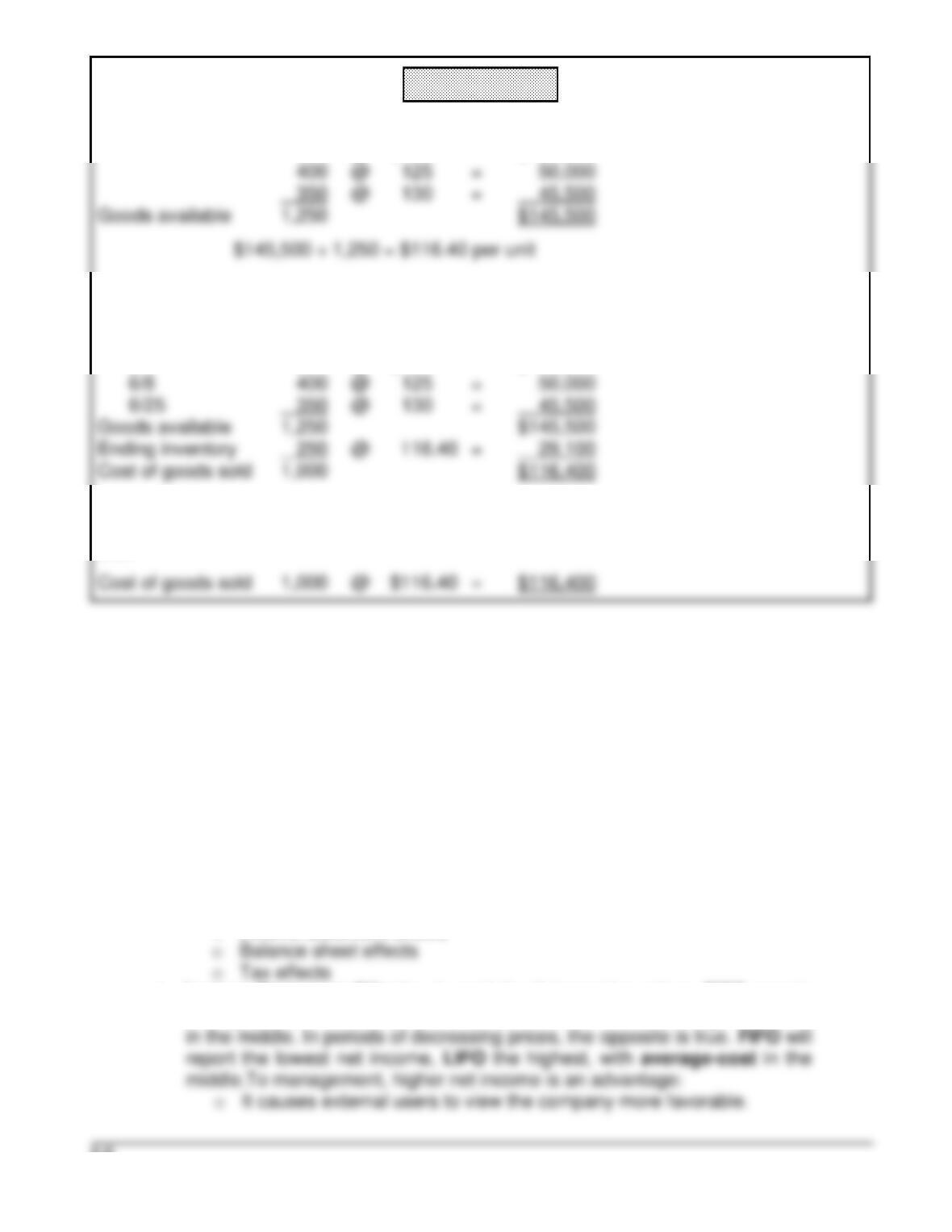
▪ Average-cost method assumes that the goods available for sale are similar
in nature and allocates the cost of goods available for sale on the basis of
6-6
TEACHING TIP
Use the example of a bicycle shop to illustrate the average-cost method.
500 @ $100 = $ 50,000
Beginning inventory -0- -0-
Purchases:
6/2 500 @ $100 = $ 50,000
When using the average-cost method, one assumes the units were similar in nature. Another
way to find the cost of the units sold is to multiply the number of units sold by the average
cost.
Learning Objective 3 – Explain the Financial Statement and Tax Effects of
Each of
the Inventory Cost Flow Assumptions
FINANCIAL STATEMENT AND TAX EFFECT OF COST FLOW
METHODS—Each of the three assumed cost flow methods is acceptable
for use under GAAP.
▪ The reasons companies adopt different inventory cost flow methods are
varied, but
they usually involve one of the following three factors:
o Income statement effects
▪ Income Statement Effects—In periods of increasing prices, FIFO reports
the highest net income, LIFO the lowest net income and average-cost falls
o Management bonuses, if based on net income, will be higher.
o Thus, when prices are rising, companies tend to prefer FIFO.
In a period of increasing prices, the use of LIFO enables the company to avoid
reporting paper or phantom profit.
▪ Balance Sheet Effects—In a period of inflation, the costs allocated to
▪ Tax Effects—Both inventory on the balance sheet and net income on the
income statement are higher when FIFO is used in a period of inflation.
Many companies have switched to LIFO because it yields the lowest net
income and therefore, the lowest income tax liability in a period of
increasing prices.
Using Inventory Cost Flow Methods Consistently—company should use
the method chosen from one accounting period to another. When a company
adopts a different method, it should disclose in the financial statements and its
effects on net income.
TEACHING TIP
Ask students which method of inventory they would choose to use if they were: CEO of a
company just going public or CEO or a company short on cash.
Learning Objective 4 – Explain the Lower-of-Cost-or-Market Basis of
Accounting
for Inventories
LOWER-OF-COST-OR-MARKET—When the value of inventory is lower than its
cost, the inventory is written down to its market value by valuing the inventory at
the lower-of-cost-or-market (LCM) in the period in which the price decline
6-8
selling price.
o For a merchandising company, market is the cost of purchasing
the same goods at the present time from the usual suppliers in the
usual quantities.
TEACHING TIP
Ask students to think about instances where lower of cost or market may be needed. Why
would a company want to use lower of cost or market in valuing the inventory?
Learning Objective 5 – Compute and Interpret the Inventory Turnover Ratio
ANALYSIS of INVENTORY—For merchandising companies, managing
inventory levels is critical. Too much inventory on hand costs money, and too
little inventory results in lost sales.
▪ Inventory turnover ratio is computed by dividing cost of goods sold by
average inventory. The ratio indicates how many times the inventory “turns
over” (is sold) during the year.
TEACHING TIP
Provide examples of merchandise which may have a relatively long shelf life as well as
examples of merchandise with extremely short lives. Would a retailer or wholesaler want to
turn merchandise over rapidly? Why?
TEACHING TIP
6-9
Learning Objective 6 – Describe the LIFO Reserve and Explain its
Importance for Comparing Results of Different
Companies
ANALYSTS’ ADJUSTMENTS FOR LIFO RESERVE—The difference
between inventory reported using LIFO and inventory using FIFO is
referred to as the LIFO reserve.
▪ Accounting standards require firms using LIFO to report the amount by which
inventory would be increased (or on occasion decreased) if the firm had
TEACHING TIP
Explain to students that the LIFO reserve adjustment is important in that it allows financial
statements to be more comparable.
Learning Objective 7- (Appendix 6A) Apply the Inventory Cost Flow
Methods to
Perpetual Inventory Records
INVENTORY COST FLOW METHODS IN PERPETUAL INVENTORY
SYSTEMS—Each of the inventory cost flow methods for a periodic
inventory system may be used in a perpetual inventory system.
▪ First-In, First-Out (FIFO)—Under FIFO, the cost of the earliest goods on
6-10
Learning Objective 8 – (Appendix 6B) Indicate the Effects of Inventory
Errors on the Financial Statements
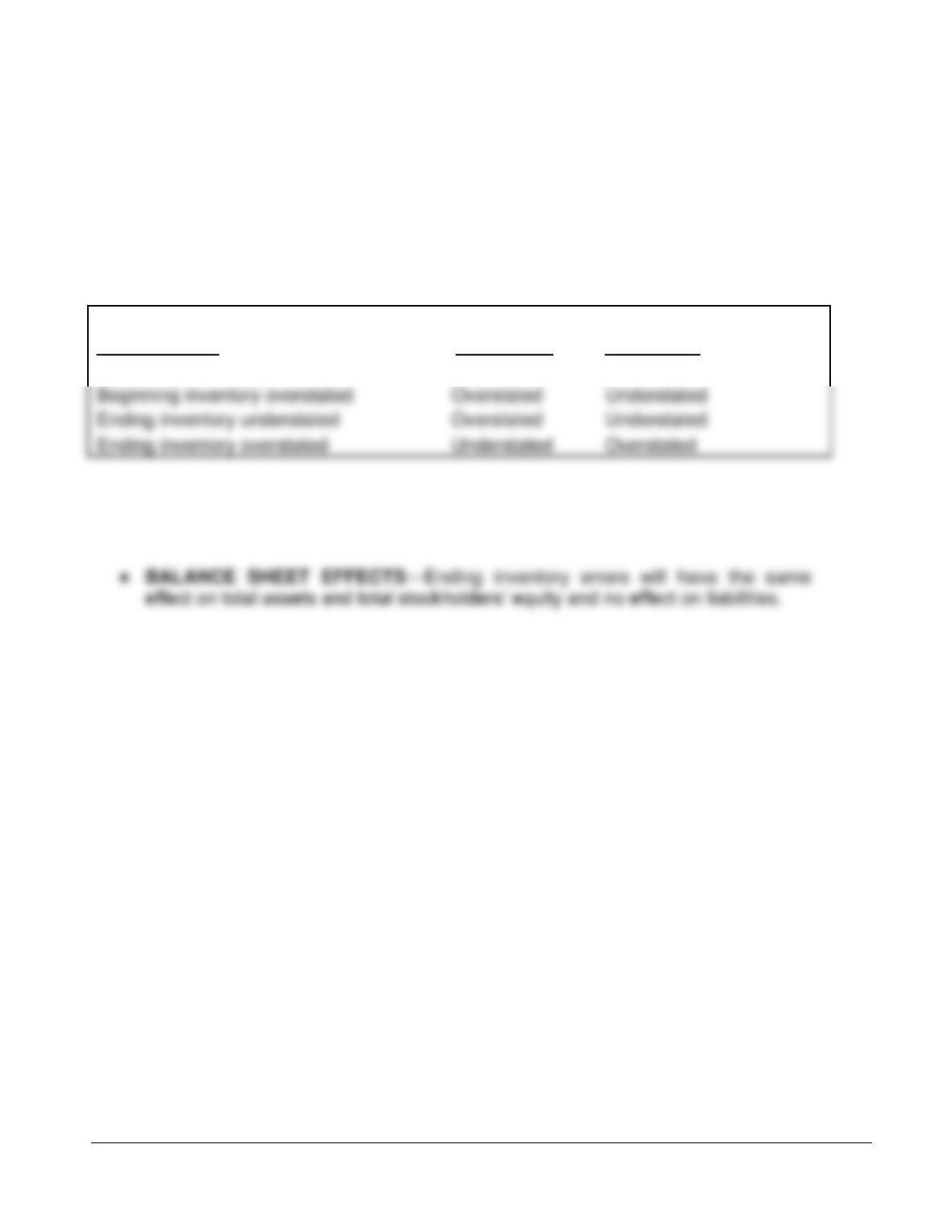
INCOME STATEMENT EFFECTS—Under a periodic system, both the
beginning and ending inventories appear in the income statement.
▪ Inventory errors affect the computation of cost of goods sold and net income
in two periods.
▪ Effects of inventory errors on current year’s income statement
Cost of
Inventory Error
Goods Sold
Net Income
Beginning inventory understated
Understated
Overstated
Beginning inventory overstated
Overstated
Understated
Ending inventory understated
Overstated
Understated
Ending inventory overstated
Understated
Overstated
▪ If ending inventory errors are not corrected, in the following period their effect
on net income for that period is reversed, and total net income for the two
year period will be correct.
6-11
Learning Objective 9 – Compare the accounting procedures under GAAP
and IFRS.
A Look at IFRS—The major IFRS requirements related to
accounting and reporting for inventories are the same as GAAP. The
major differences are that IFRS prohibits the use of the LIFO cost
flow assumption and determines market in the lower–of-cost-or–
market inventory valuation differently.
KEY POINTS
▪ The requirements for accounting for and reporting inventories are more
principles-based under IFRS. That is, GAAP provides more detailed
guidelines in inventory accounting.
▪ Under GAAP, if inventory is written down under the lower–of-cost-or–
market valuation, the new value becomes its cost basis. As a result, the
inventory may not be written back up to its original cost in a subsequent
period. Under IFRS, the write-down may be reversed in a subsequent
period up to the amount of the previous write-down. Both the write-down
6-12
and any subsequent reversal should be reported on the income statement
as an expense. An item–by-item approach is generally followed under
IFRS.
▪ An example of the use of lower–of-cost-or-net realizable value under IFRS
follows.
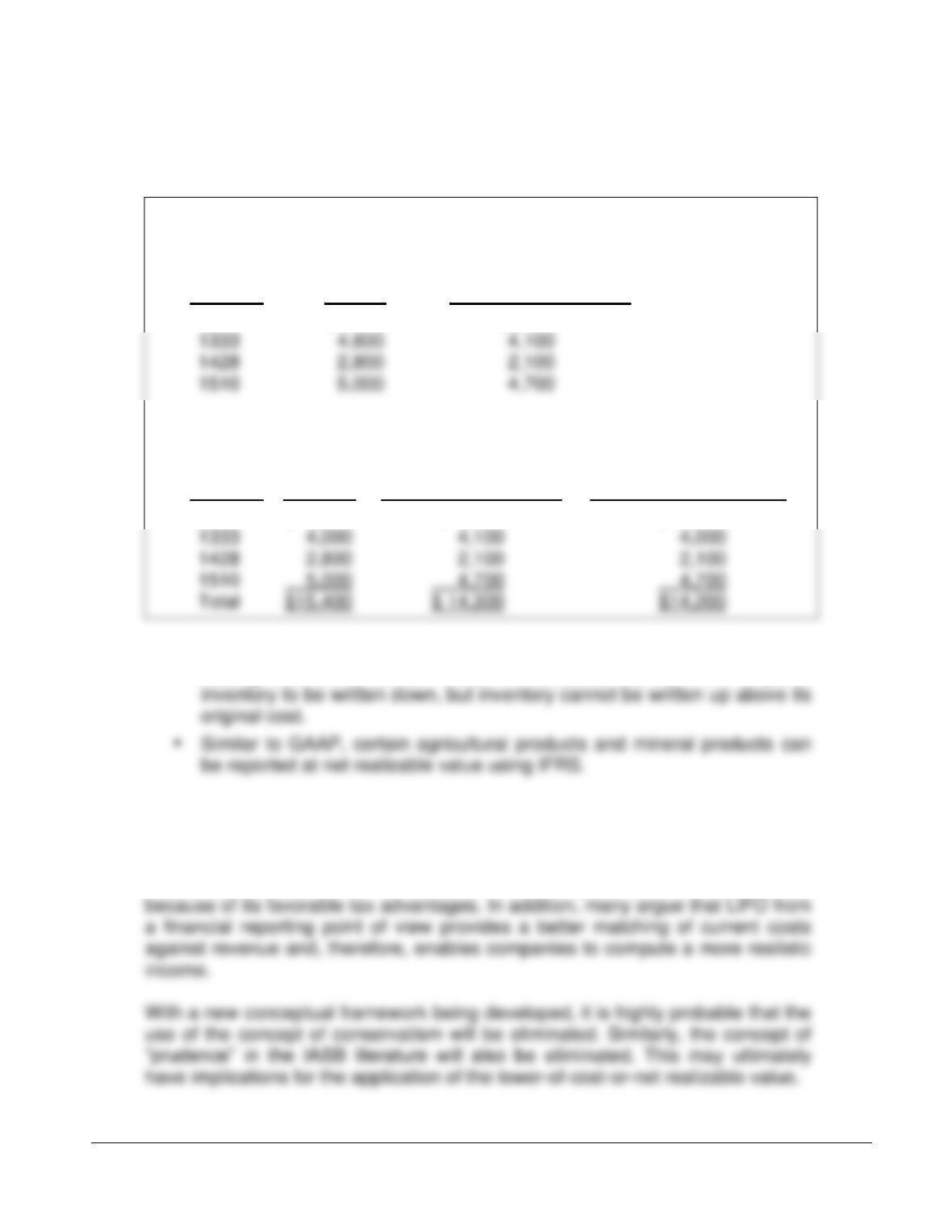
Mendel Company has the following four items in its ending inventory as of
December 31, 2012. The company uses the lower–of-cost-or-net realizable
value approach for inventory valuation following IFRS.
Item No. Cost Net Realizable Value
1320 $3,600 $3,400
The computation of the ending inventory value to be reported in the financial
statements at December 31, 2012, is as follows.
Item No. Cost Net Realizable Value Lower-of-Cost-or NRV
1320 $ 3,600 $ 3,400 $ 3,400
▪ Unlike property, plant, and equipment, IFRS does not permit the option of
valuing inventories at fair value. As indicated above, IFRS requires
LOOKING TO THE FUTURE
One convergence issue that will be difficult to resolve relates to the use of the
LIFO cost flow assumption. As indicated, IFRS specifically prohibits its use.
Conversely, the LIFO cost flow assumption is widely used in the United States
6-13
Chapter 6 Review
✓ Why do companies need to determine inventory quantities at the end of the
accounting period? Explain the steps in determining inventory quantities. Discuss
issues involved in determining the ownership of goods. How do the shipping terms
(FOB shipping point and FOB destination) affect ownership of goods? Define
consigned goods and discuss related ownership issues.
✓ Explain the basis of accounting for inventories and apply the inventory cost flow
methods— FIFO, LIFO, and average–cost—under a periodic inventory system.
Discuss the differences between the physical movement of goods and cost flow
assumptions.
✓ Discuss the effects on the income statement and balance sheet and tax effects of
each of the inventory cost flow assumptions—FIFO, LIFO, and average-cost.
✓ What is the lower-of-cost-or-market (LCM) basis of accounting for inventories?
Describe the application of LCM.