6-59
Hazlett uses a FIFO cost flow assumption for finished goods inventory.
Combs are manufactured in batches of 200, and brushes are manufactured in batches of 100.
It takes 20 minutes to set up for a batch of combs and 1 hour to set up for a batch of brushes.
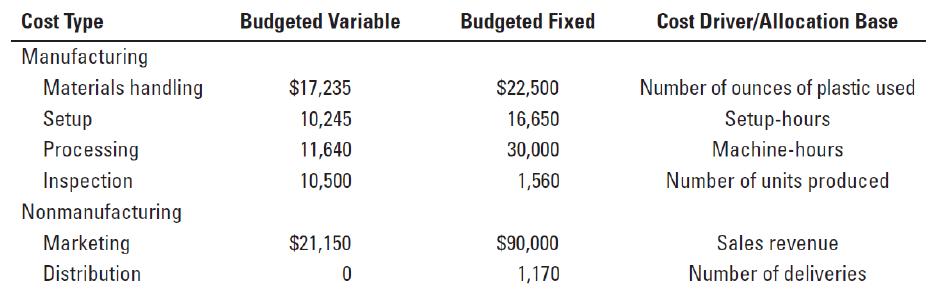
Hazlett uses activity-based costing and has classified all overhead costs as shown in the
following table. Budgeted fixed overhead costs vary with capacity. Hazlett operates at capacity
so budgeted fixed overhead cost per unit equals the budgeted fixed overhead costs divided by the
budgeted quantities of the cost allocation base.
Delivery trucks transport units sold in delivery sizes of 1,000 combs or 1,000 brushes.
Required:
Do the following for the year 2015:
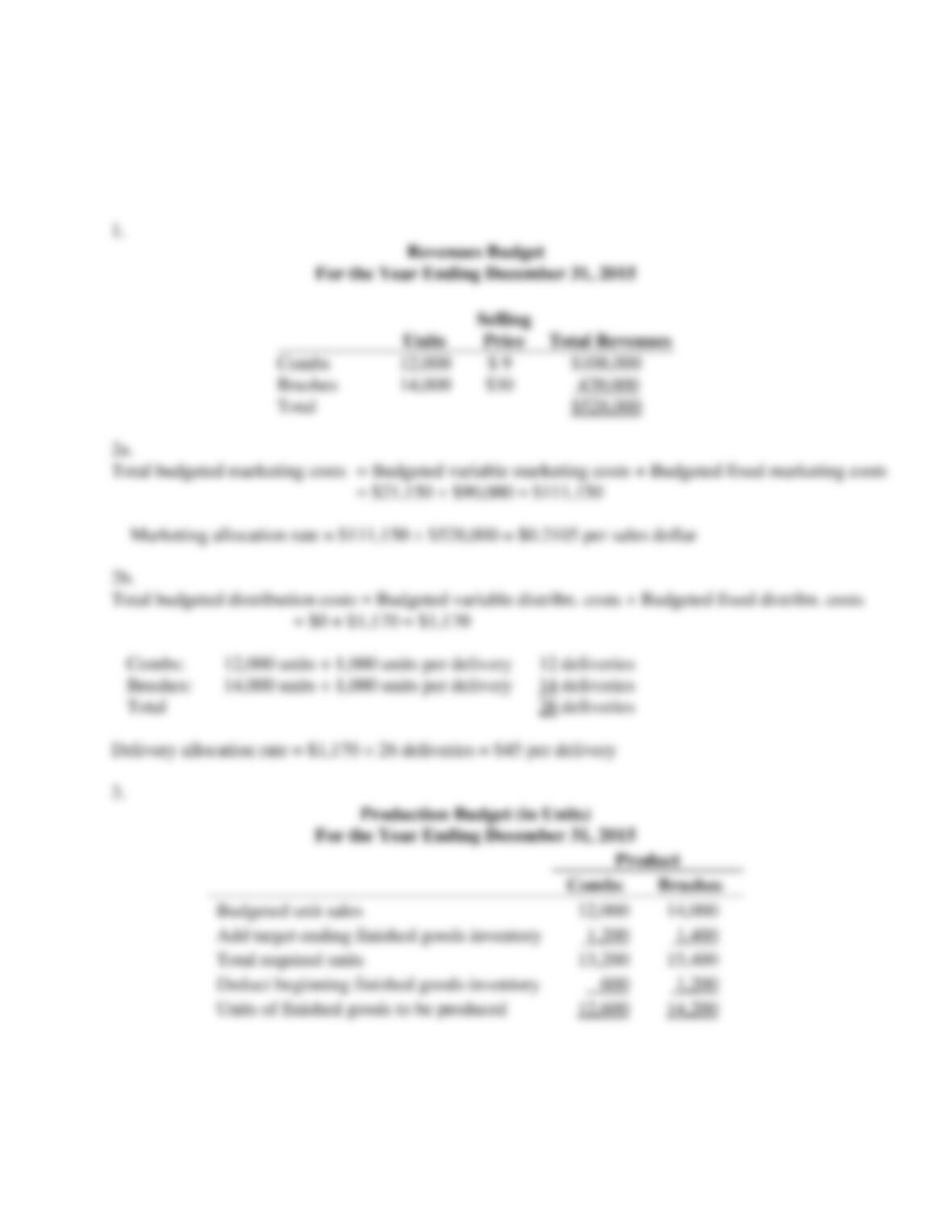
1. Prepare the revenues budget.
2. Use the revenues budget to:
a. Find the budgeted allocation rate for marketing costs.
b. Find the budgeted number of deliveries and allocation rate for distribution costs.
3. Prepare the production budget in units.
4. Use the production budget to:
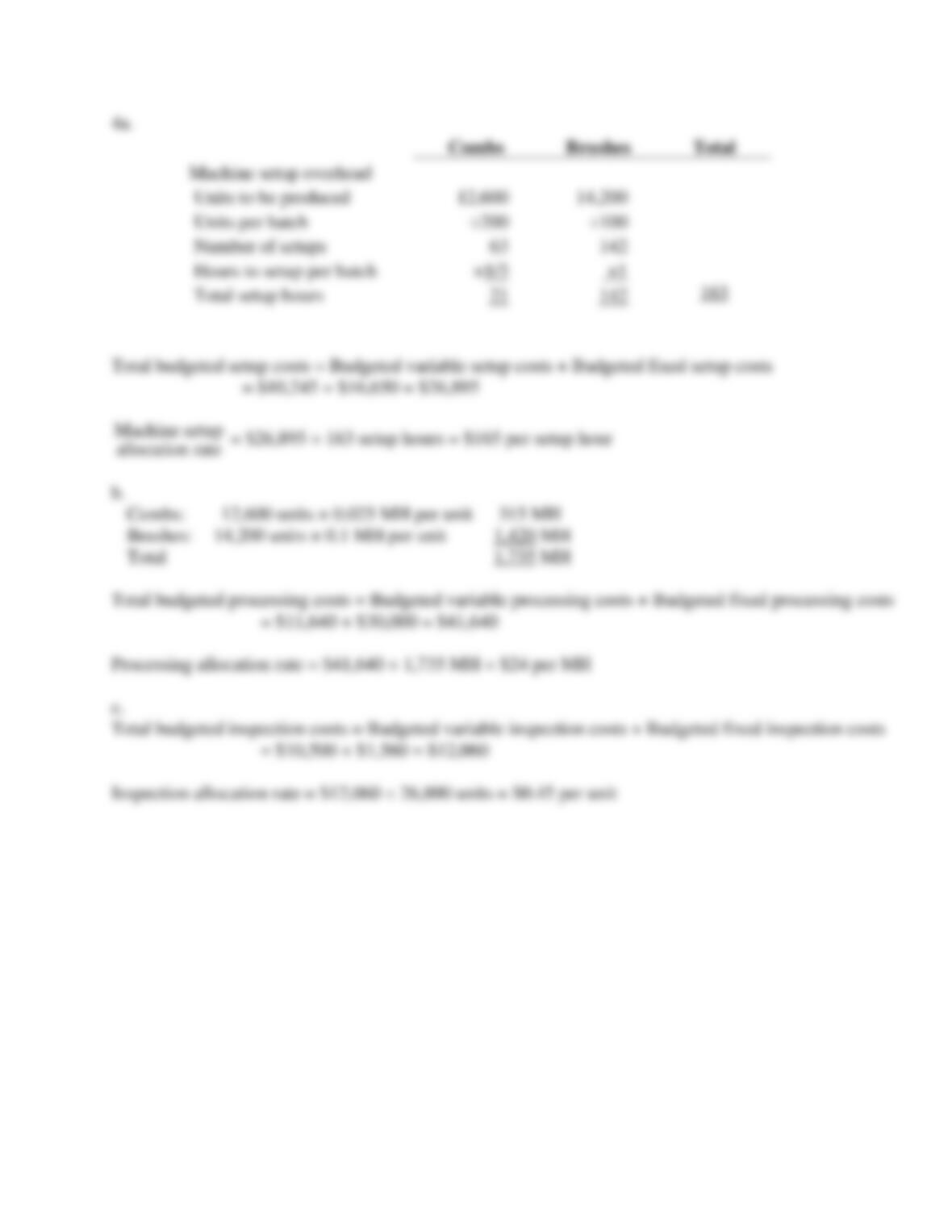
a. Find the budgeted number of setups and setup-hours and the allocation rate for setup
costs.
b. Find the budgeted total machine-hours and the allocation rate for processing costs.
c. Find the budgeted total units produced and the allocation rate for inspection costs.
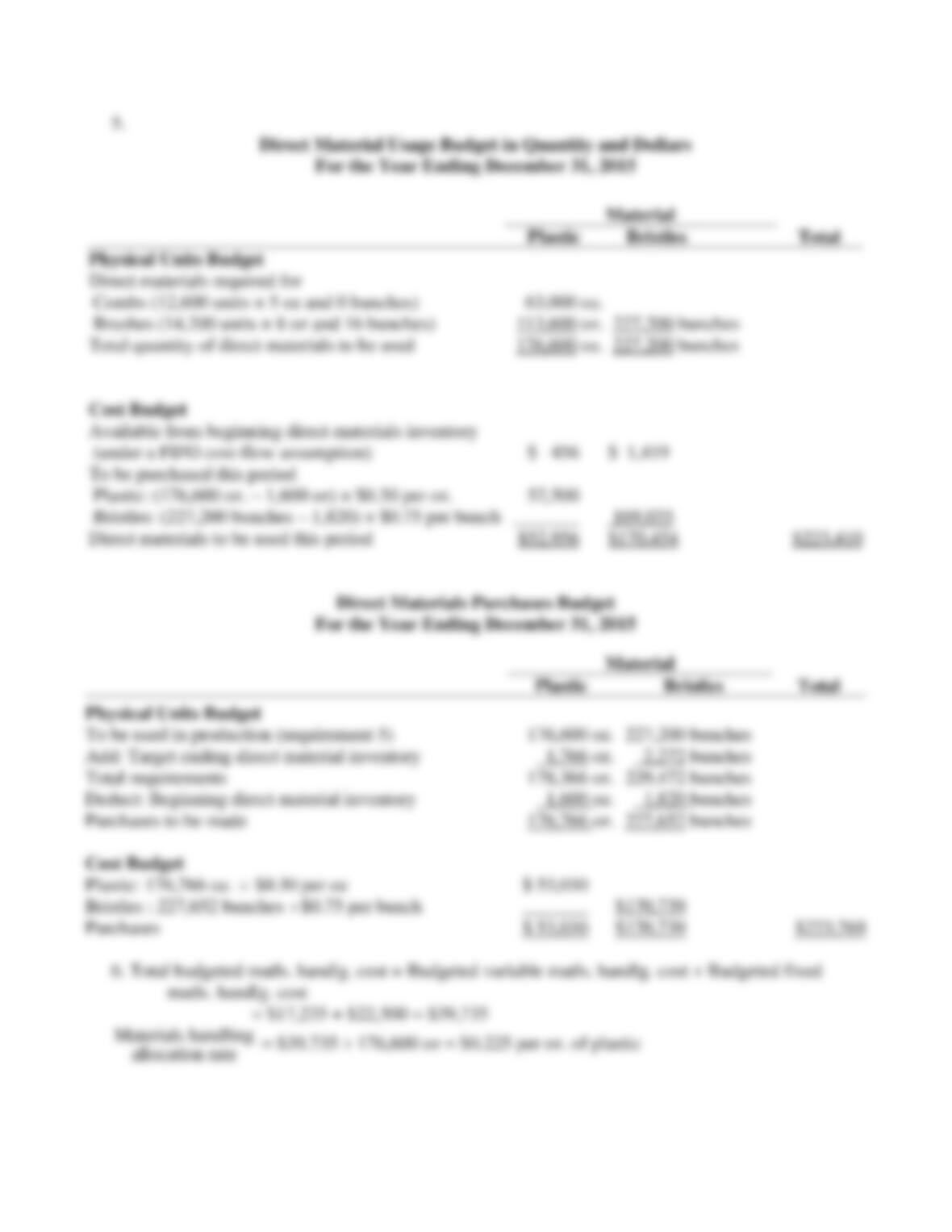
5. Prepare the direct material usage budget and the direct material purchases budgets in both
units and dollars; round to whole dollars.
6. Use the direct material usage budget to find the budgeted allocation rate for materials-
handling costs.
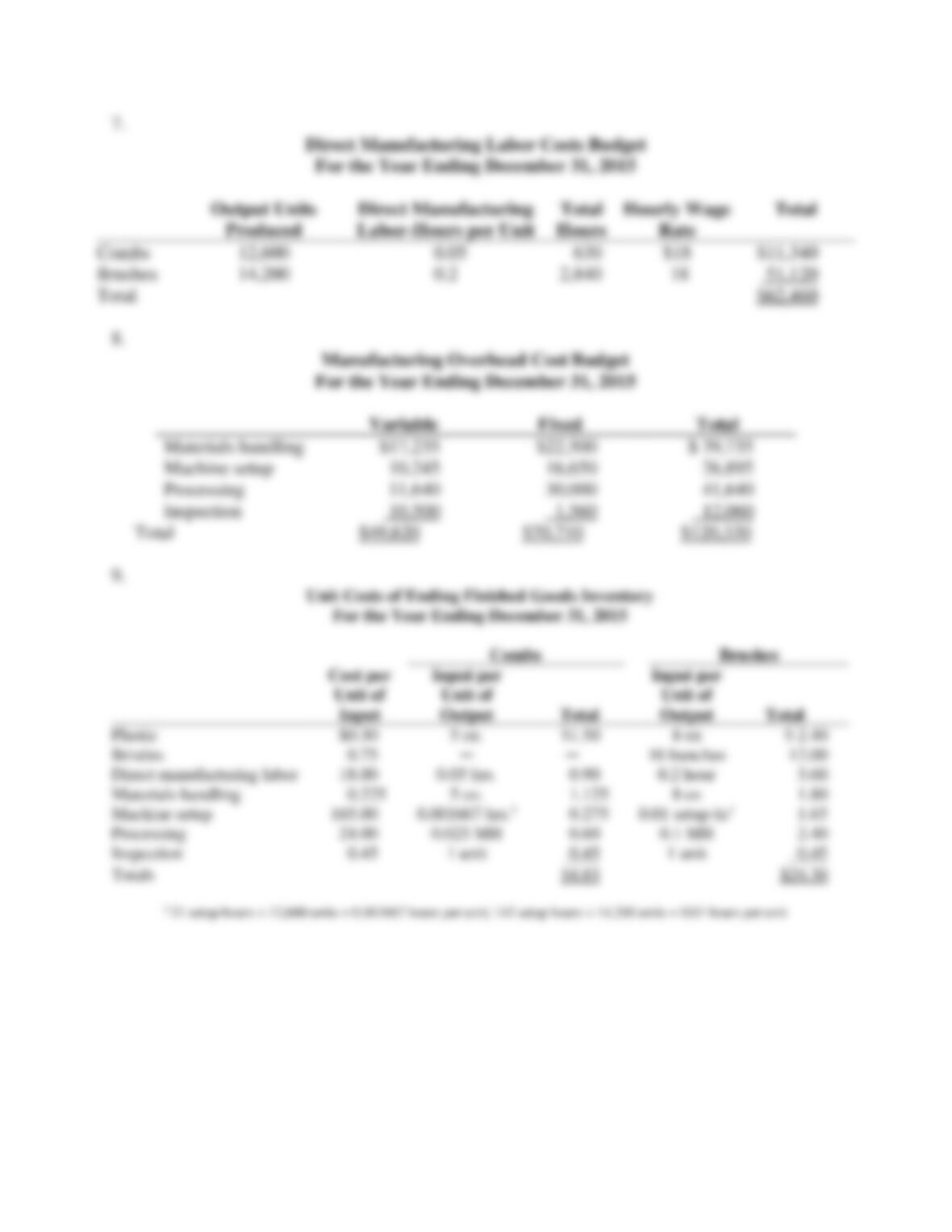
7. Prepare the direct manufacturing labor cost budget.
8. Prepare the manufacturing overhead cost budget for materials handling, setup, processing,
and inspection costs.
9. Prepare the budgeted unit cost of ending finished goods inventory and ending inventories
budget.
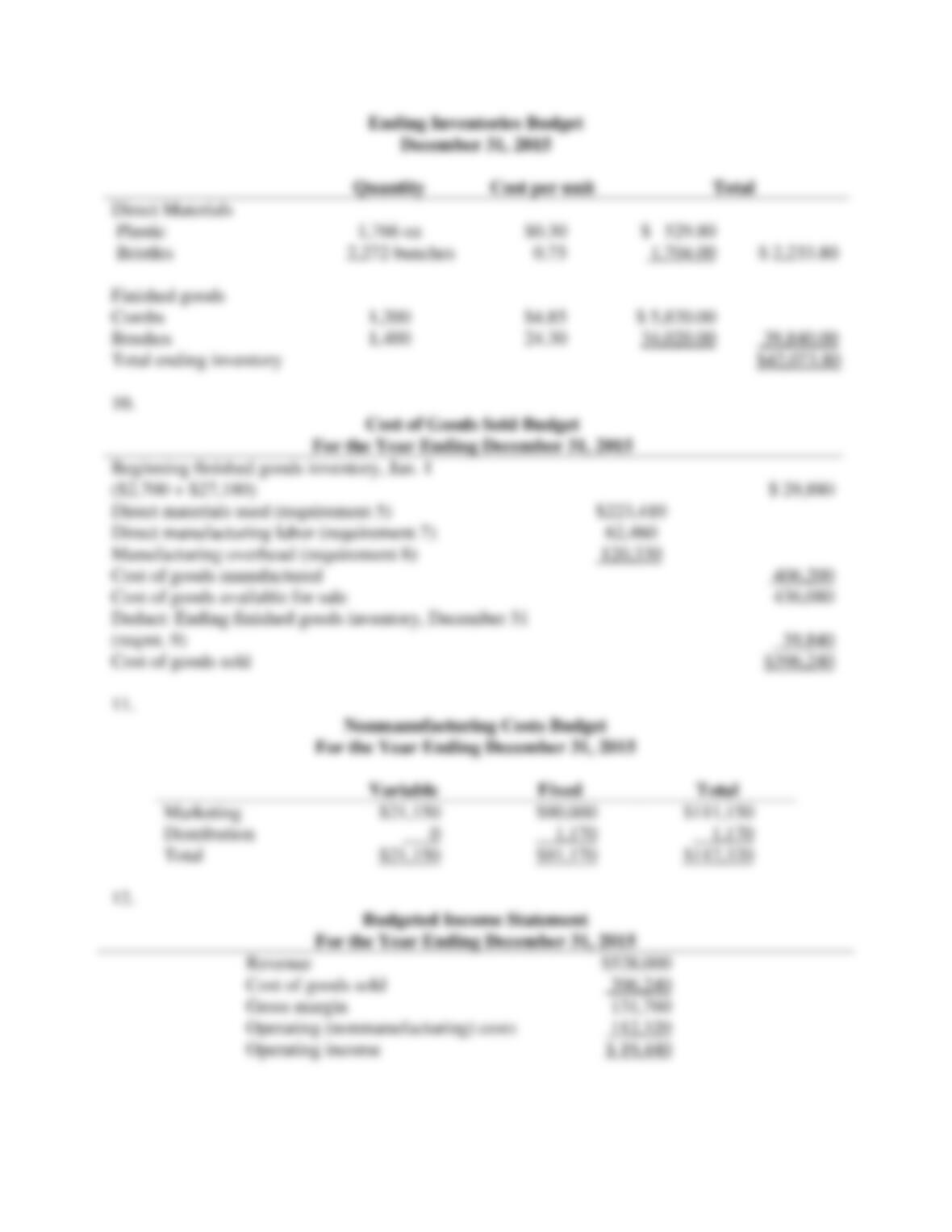
10. Prepare the cost of goods sold budget.
11. Prepare the nonmanufacturing overhead costs budget for marketing and distribution.
12. Prepare a budgeted income statement (ignore income taxes).
6-60
13. How does preparing the budget help Hazlett’s management team better manage the
company?
SOLUTION
6-61
6-62
6-63
6-64
6-65
6-41 (15 min.) Budgeting and ethics.
Jayzee Company manufactures a variety of products in a variety of departments and evaluates
departments and departmental managers by comparing actual cost and output relative to the
budget. Departmental managers help create the budgets and usually provide information about
input quantities for materials, labor, and overhead costs.
Kurt Jackson is the manager of the department that produces product Z. Kurt has estimated
these inputs for product Z:
The department produces about 100 units of product Z each day. Kurt’s department always gets
excel- lent evaluations, sometimes exceeding budgeted production quantities. For each 100 units
of product Z produced, the company uses, on average, about 48 hours of direct manufacturing
labor (eight people working 6 hours each), 790 pounds of material, and 39.5 machine-hours.
Top management of Jayzee Company has decided to implement budget standards that will
challenge the workers in each department, and it has asked Kurt to design more challenging input
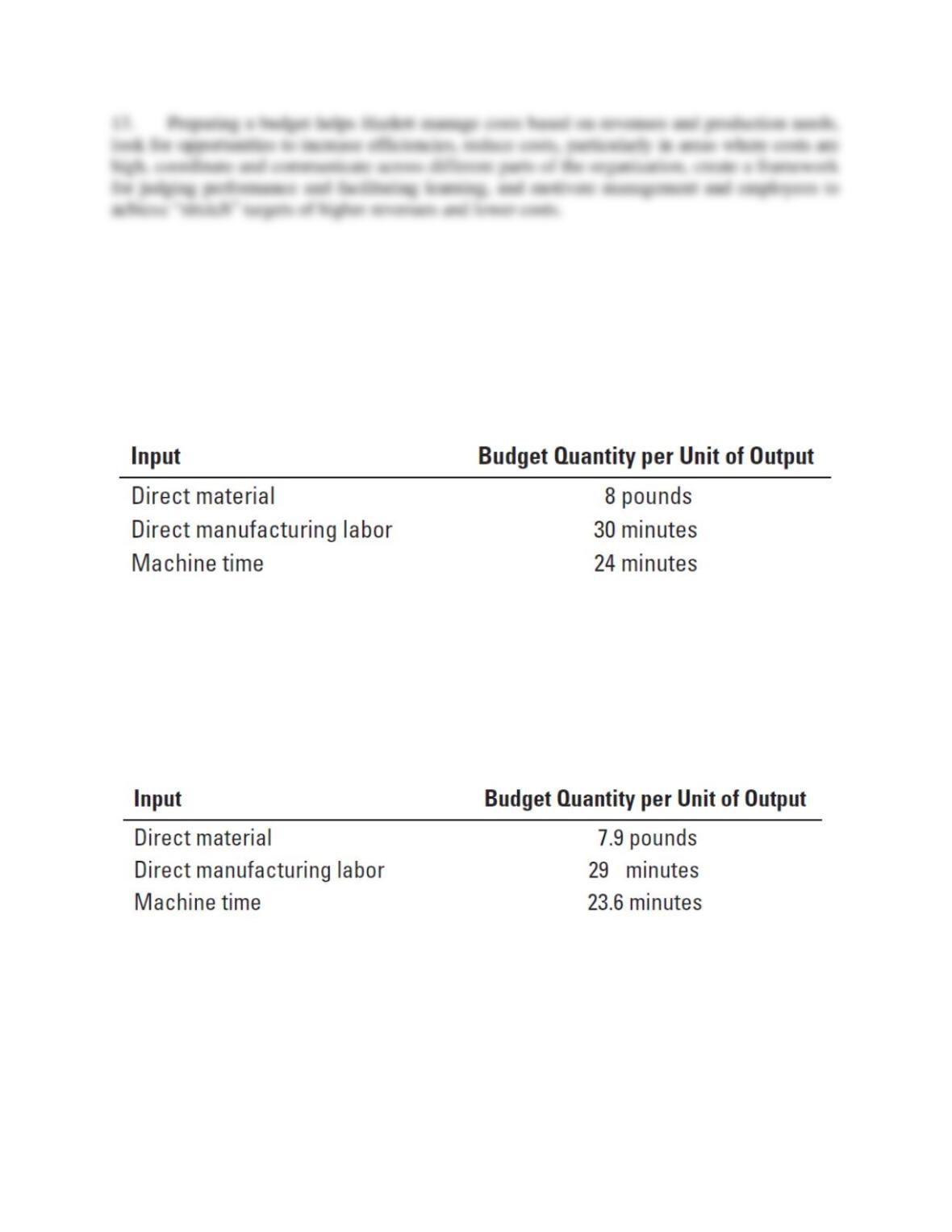
standards for product Z. Kurt provides top management with the following input quantities:
Discuss the following:
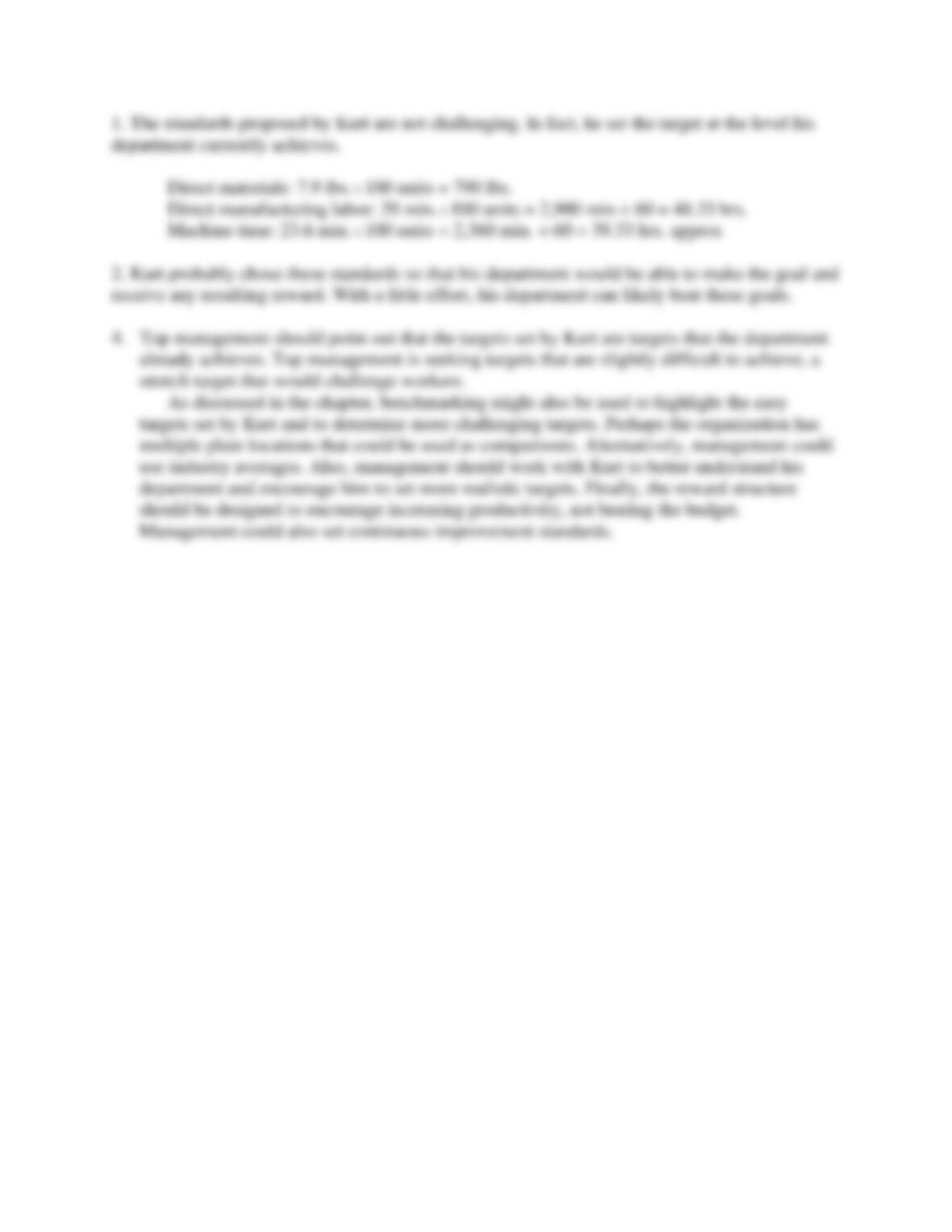
1. Are these budget standards challenging for the department that produces product Z?
2. Why do you suppose Kurt picked these particular standards?
3. What steps can Jayzee Company’s top management take to make sure Kurt’s standards
really meet the goals of the firm?
SOLUTION
6-66
6-42 (30 min.) Human Aspects of Budgeting in a Service Firm
Vidal Sanson owns three upscale hair salons: Bristles I, II, and III. Each of the salons has a
manager and 10 stylists who rent space in the salons as independent contractors and who pay a
fee of 10% of each week’s revenue to the salon as rent. In exchange they get to use the facility
and utilities, but must bring their own equipment.
The manager of each salon schedules each customer appointment to last an hour and then
allows the stylist 10 minutes between appointments to clean up, rest, and prepare for the next
appointment. The salons are open from 10:00 a.m. to 6:00 p.m., so each stylist can serve seven
customers per day. Stylists each work 5 days a week on a staggered schedule, so the salon is
open 7 days a week. Everyone works on Saturdays, but some stylists have Sunday and Monday
off, some have Tuesday and Wednesday off, and some have Thursday and Friday off.
Vidal Sanson knows that utility costs are rising. Vidal wants to increase revenues to cover at
least some part of rising utility costs, so Vidal tells each of the managers to find a way to
increase productivity in the salons so that the stylists will pay more to the salons. Vidal does not
want to increase the rental fee above 10% of revenue for fear the stylists will leave. And each
salon has only 10 stations, so Vidal feels each salon cannot hire more than 10 full-time stylists.
The manager of Bristles I attacks the problem by simply telling the stylists that, from now on,
customers will be scheduled for 40-minute appointments and breaks will be 5 minutes. This will
allow each stylist to add one more customer per day.
The manager of Bristles II asks the stylists on a voluntary basis to work one extra hour per
day, from 10:00 a.m. to 7:00 p.m., to add an additional customer per stylist per day.
The manager of Bristles III sits down with the stylists and discusses the issue. After
considering shortening the appointment and break times or lengthening the hours of operation,
one of the stylists says, “I know we rent stations in your store, but I am willing to share my
station. You could hire another stylist who will simply work at whatever station is vacant during
our days off. Since we use our own equipment, this will not be a problem for me as long as there
6-67
is a secure place I can leave my equipment on my days off.” Most of the other stylists agree that
this is a good solution.
Required:
1. Which manager’s style do you think is most effective? Why?
2. How do you think the stylists will react to the managers of salons I and II? If the stylists are
displeased, how can they indicate their displeasure?
3. In Bristles III, if the stylists did not want to share their stations with another party, how else
could they find a way to increase revenues?
SOLUTION
6-68
6-43 (60 min.) Comprehensive budgeting problem; activity-based costing, operating and
financial budgets.
Tyva makes a very popular undyed cloth sandal in one style, but in Regular and Deluxe. The
Regular sandals have cloth soles and the Deluxe sandals have cloth-covered wooden soles. Tyva
is preparing its budget for June 2015 and has estimated sales based on past experience.
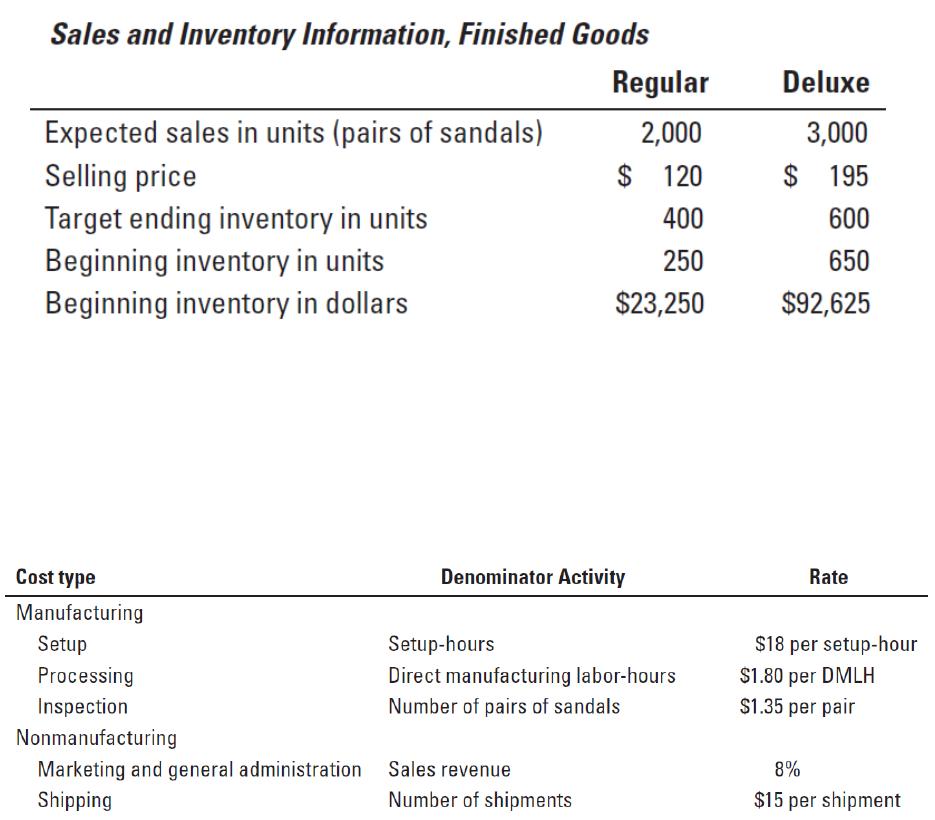
Other information for the month of June follows:
6-69
Tyva accounts for direct materials using a FIFO cost flow assumption.
Tyva uses a FIFO cost flow assumption for finished goods inventory.
All the sandals are made in batches of 50 pairs of sandals. Tyva incurs manufacturing
overhead costs, marketing and general administration, and shipping costs. Besides materials and
labor, manufacturing costs include setup, processing, and inspection costs. Tyva ships 40 pairs of
sandals per shipment. Tyva uses activity-based costing and has classified all overhead costs for
the month of June as shown in the following chart:
Required:
1. Prepare each of the following for June:
a. Revenues budget
b. Production budget in units
c. Direct material usage budget and direct material purchases budget in both units and
dollars; round to dollars
d. Direct manufacturing labor cost budget
e. Manufacturing overhead cost budgets for setup, processing, and inspection activities
f. Budgeted unit cost of ending finished goods inventory and ending inventories budget
g. Cost of goods sold budget
h. Marketing and general administration and shipping costs budget
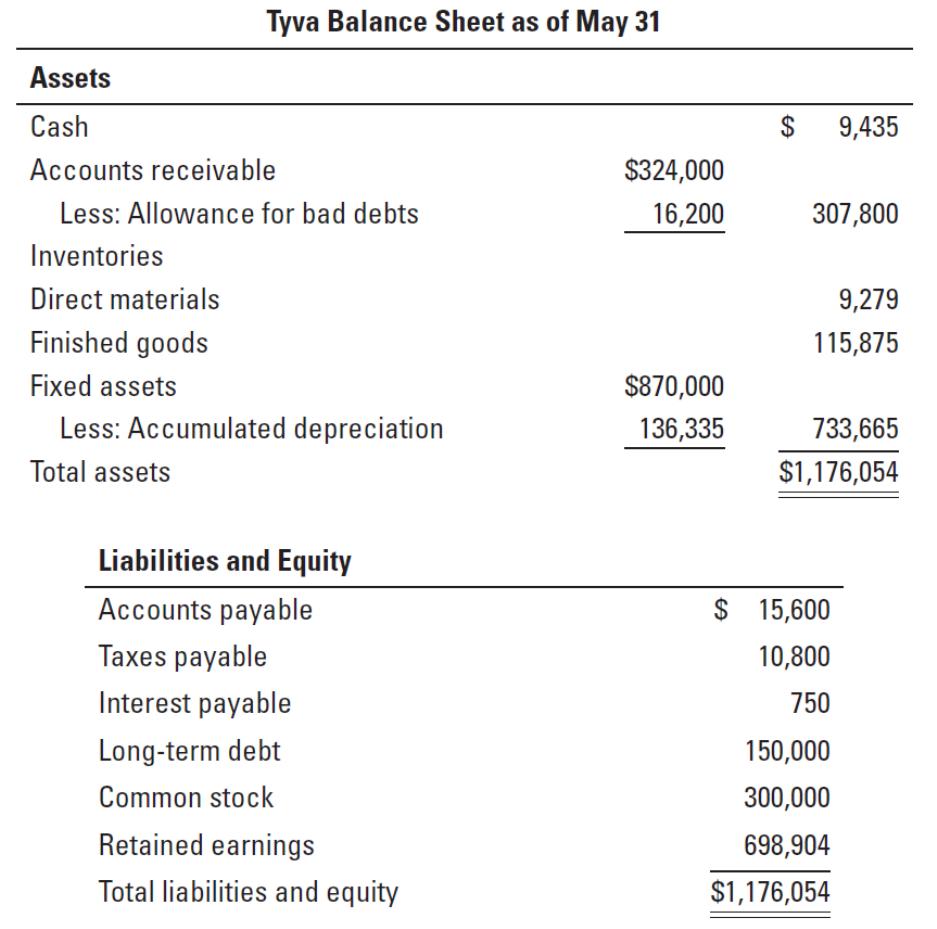
2. Tyva’s balance sheet for May 31 follows.
6-70
Use the balance sheet and the following information to prepare a cash budget for Tyva for June.
Round to dollars.
▪ All sales are on account; 60% are collected in the month of the sale, 38% are collected
the following month, and 2% are never collected and written off as bad debts.
▪ All purchases of materials are on account. Tyva pays for 80% of purchases in the month
of purchase and 20% in the following month.
▪ All other costs are paid in the month incurred, including the declaration and payment of a
$15,000 cash dividend in June.
▪ Tyva is making monthly interest payments of 0.5% (6% per year) on a $150,000 long-
term loan.
▪ Tyva plans to pay the $10,800 of taxes owed as of May 31 in the month of June. Income
tax expense for June is zero.
6-71
▪ 30% of processing, setup, and inspection costs and 10% of marketing and general
administration and shipping costs are depreciation.
3. Prepare a budgeted income statement for June and a budgeted balance sheet for Tyva as of
June 30, 2015.
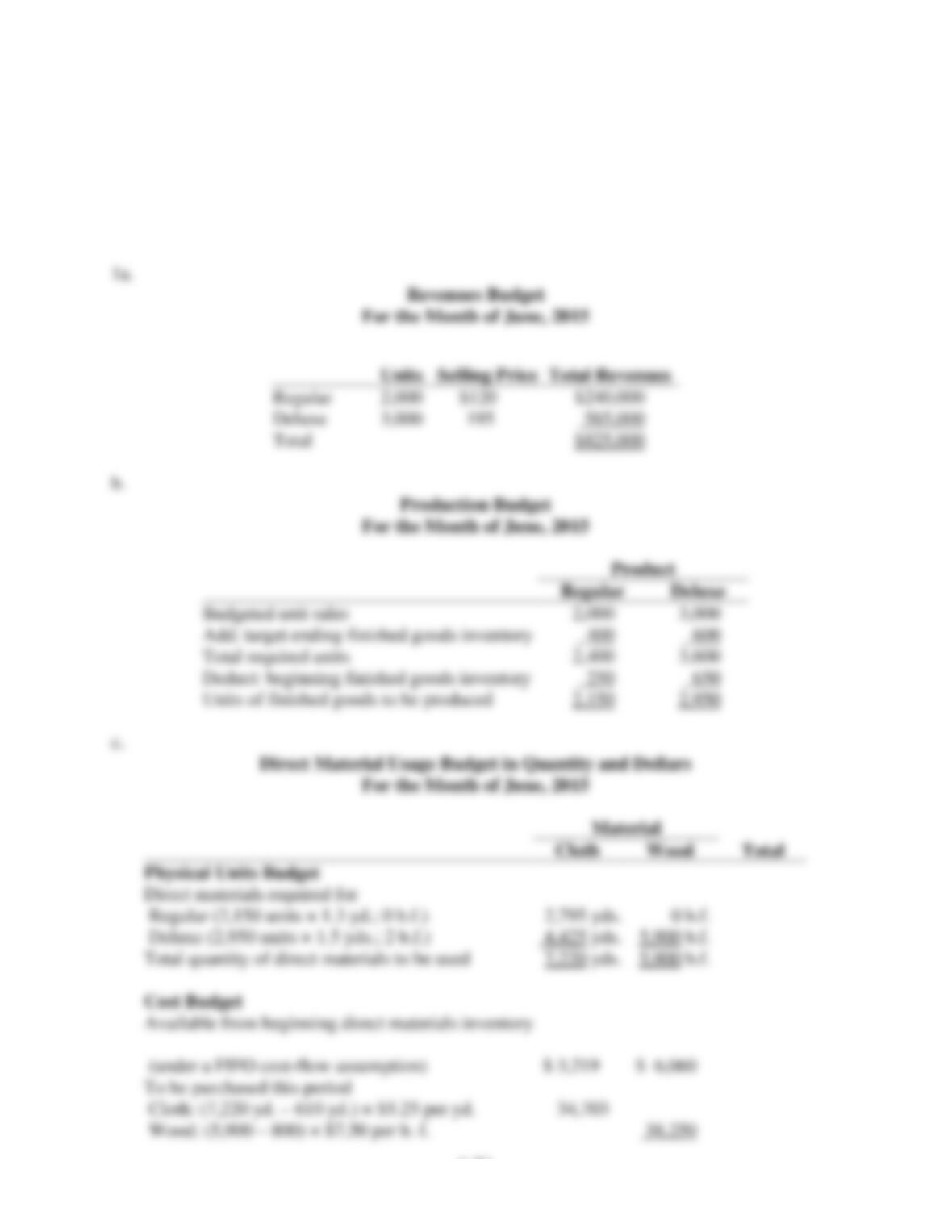
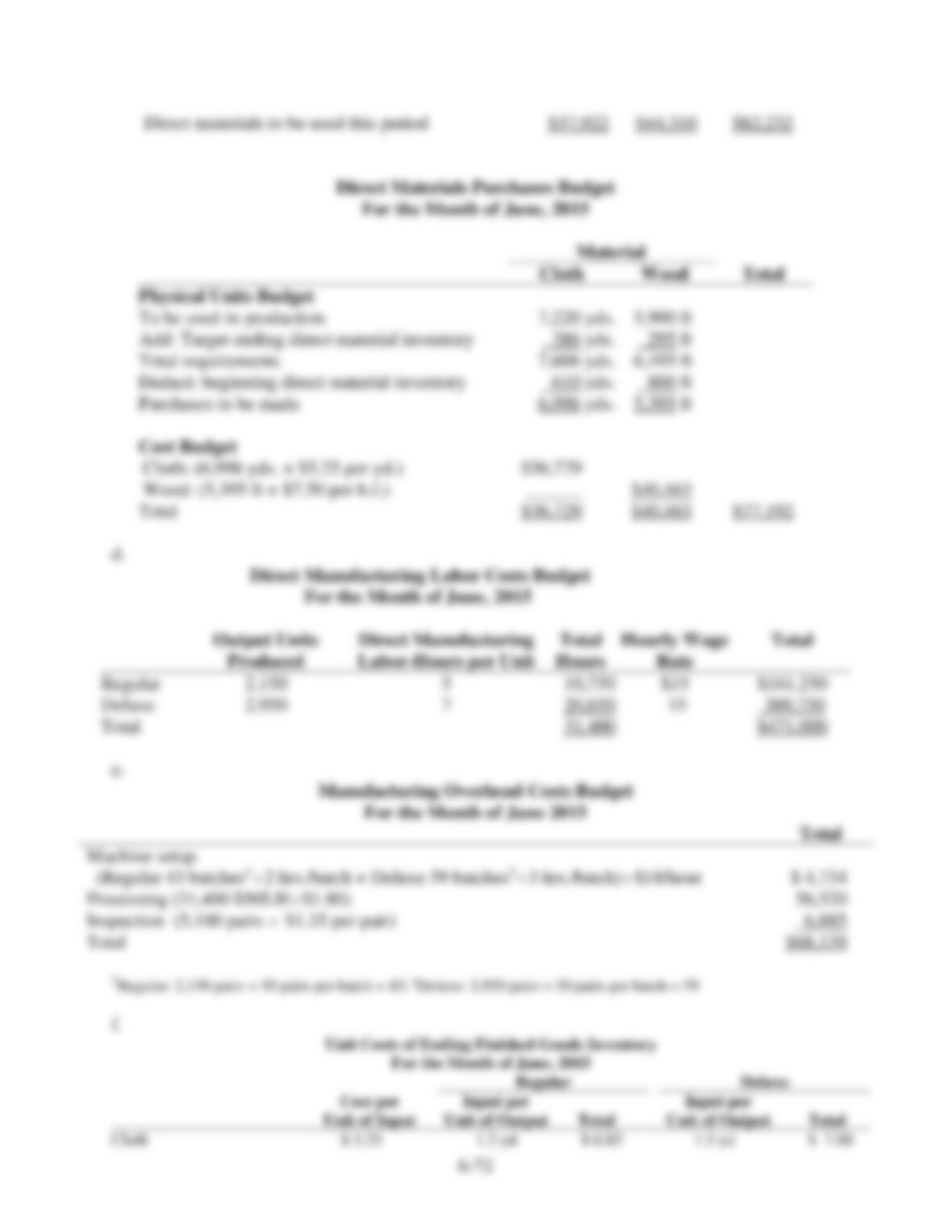
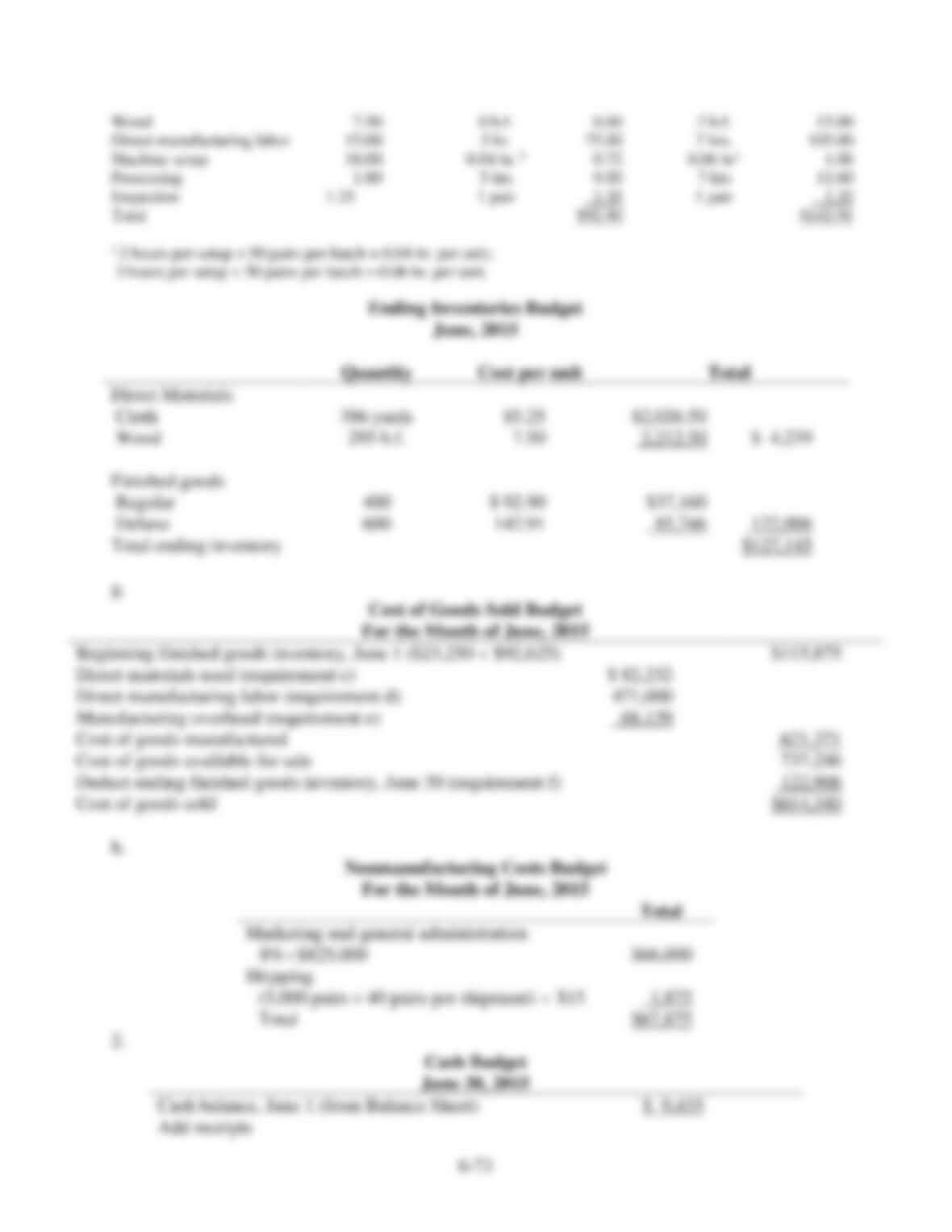
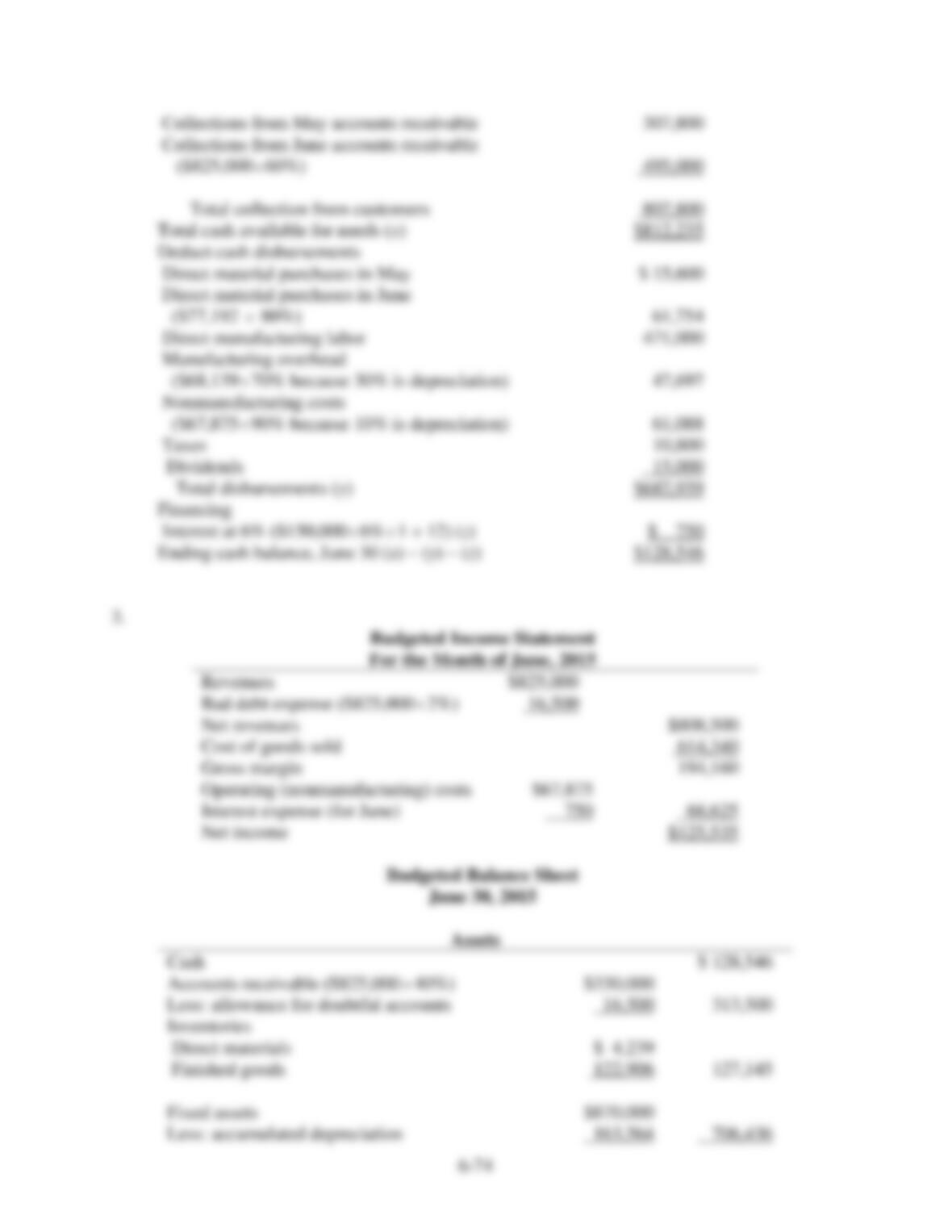
SOLUTION
6-75