CHAPTER 6
LEARNING OBJECTIVES
1. APPLY BASIC CVP CONCEPTS.
2. EXPLAIN THE TERM SALES MIX AND ITS EFFECTS
ON BREAK-EVEN SALES.
3. DETERMINE SALES MIX WHEN A COMPANY HAS
LIMITED RESOURCES.
4. INDICATE HOW OPERATING LEVERAGE AFFECTS
PROFITABILITY.
*5. EXPLAIN THE DIFFERENCE BETWEEN ABSORPTION
COSTING AND VARIABLE COSTING.
CHAPTER REVIEW
Cost-Volume-Profit Income Statement
1. (L.O. 1) The Cost-Volume-Profit (CVP) income statement classifies costs as variable or fixed
and computes a contribution margin. Contribution margin is the amount of revenue remaining
after deducting variable costs. It is often stated both as a total amount and on a per unit basis.
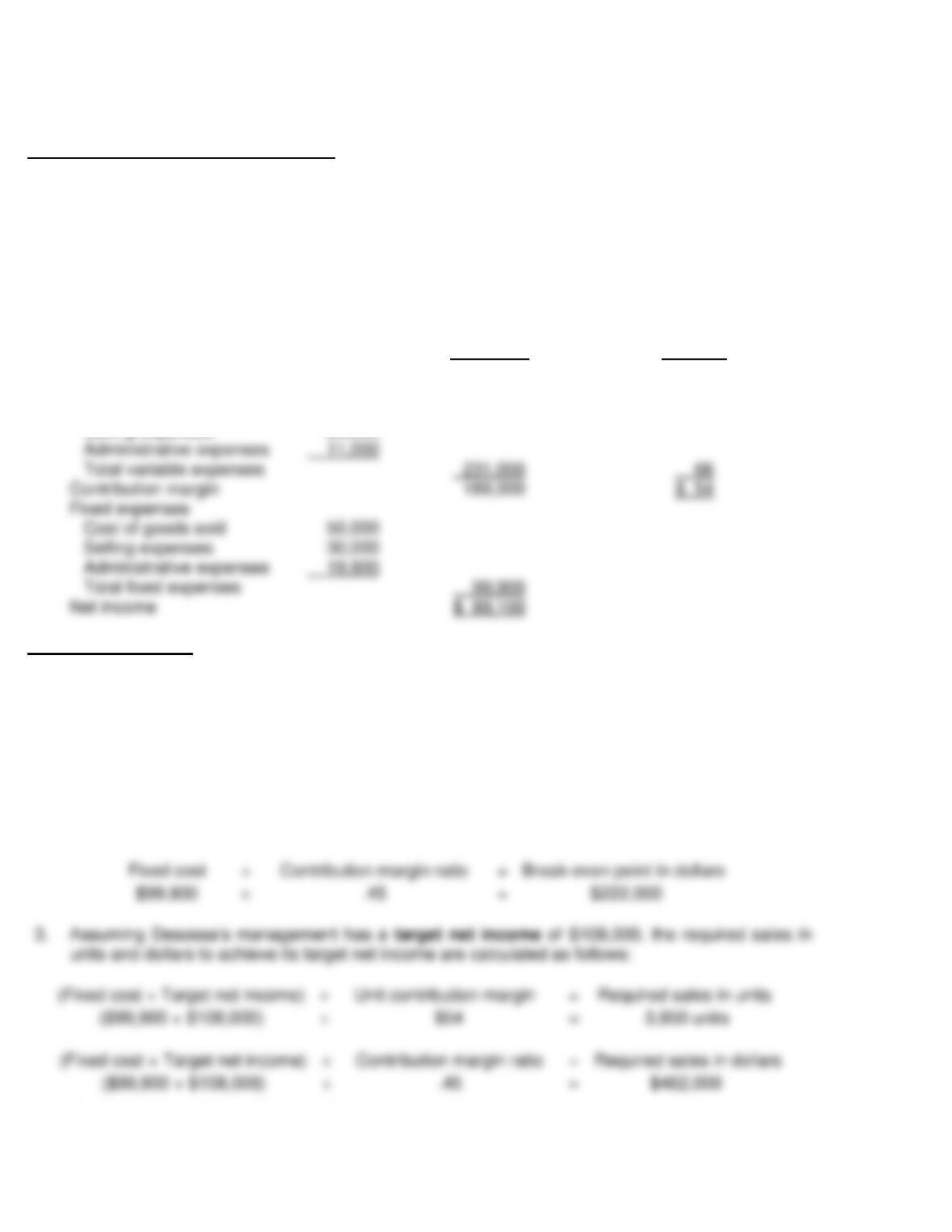
Desossa Music Player Company
CVP Income Statement
For the Month Ended June 30, 2017
Total Per Unit
Sales $420,000 $120
Variable expenses
Cost of goods sold $200,000
Selling expenses 20,000
Basic Computations
2. Desossa Music Player’s CVP income statement shows that total contribution margin (sales minus
variable expenses) is $175,000, and the company’s contribution margin per unit is $50. The
contribution margin ratio (contribution margin divided by sales) is 45% ($54 ÷ $120). Desossa’s
break-even point in units (using unit contribution margin) or in dollars (using contribution margin
ratio) are calculated as follows:
Fixed cost
÷
Unit contribution margin
=
Break-even point in units
$99,900
÷
$54
=
1,850 units
Fixed cost
÷
=
÷
=
÷
=
÷
=
÷
=
4. Desossa’s margin of safety in dollars or as a ratio is calculated as follows:
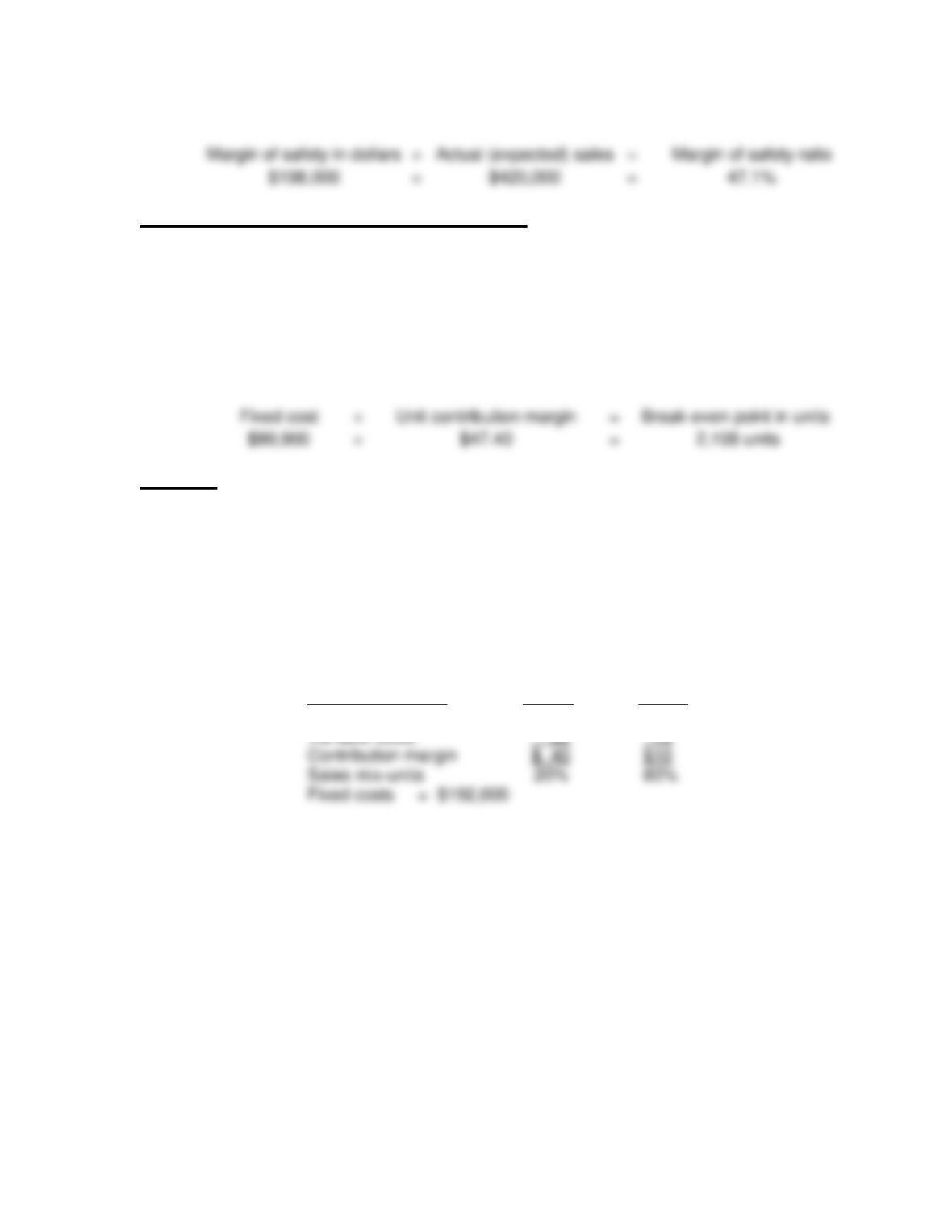
Actual (expected) sales
–
Break-even sales
=
Margin of safety in dollars
$420,000
–
$222,000
=
$198,000
=
=
CVP and Changes in the Business Environment
5. To better understand how CVP analysis works, let’s assume that shipping costs have increased
significantly causing the unit variable cost to increase by 10%, what effect will this have on
Desossa’s break-even point?
Answer: A 10% increase in variable costs increases the per unit variable cost to $72.60 [$66 +
($66 X 10%)]. The new unit contribution margin is therefore $47.40 ($120 – $72.60). Thus the new
break-even point in units is calculated as follows:
Sales Mix
6. (L.O. 2) Sales mix is the relative percentage in which a company sells its multiple products. For
example, if 80% of Company A’s unit sales are shoes and the other 20% are jeans, its sales mix
is 80% shoes to 20% jeans.
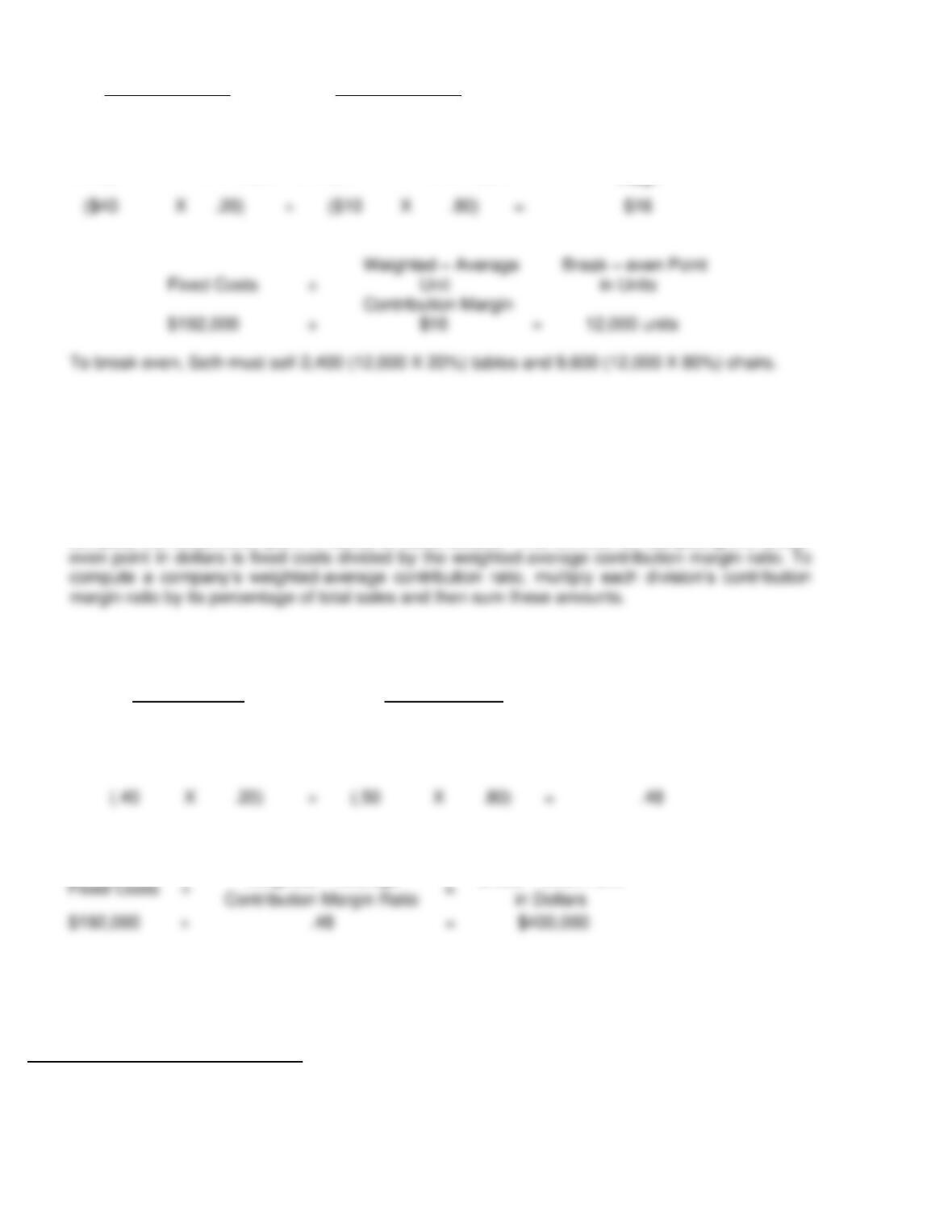
7. Break-even sales can be computed for a mix of two or more products by determining the
weighted-average unit contribution margin of all the products. Assume that Seth Inc. sells
tables and chairs in a ratio of four chairs for every one table. The sales mix in percentages is 20%
(1/5) for tables and 80% (4/5) for chairs. The following is the per unit data for Seth Inc.:
Unit Data Tables Chairs
Selling price $100 $20
Variable costs 60 10
To compute break-even for Seth Inc., we use the weighted-average unit contribution margin as
follows:
Actual (expected) sales
Tables Chairs
Unit Sales
Contribution X Mix
Margin Percentage
+
Unit Sales
Contribution X Mix
Margin Percentage
=
Weighted –Average
Unit Contribution
Margin
8. At any level of units sold, net income will be greater if more high contribution margin units are sold
than low contribution margin units. An analysis of these relationships generally shows that a shift
from low-margin sales to high-margin sales may increase net income, even though there is a
decline in total units sold.
9. The calculation of the break-even point computed in units works well if a company has only a
small number of products. When a company has a large number of products, it’s more useful to
compute the break-even point in terms of sales dollars. The formula for computing the break–
Seth Inc’s contribution margin ratio for sales of tables is .40 ($40/$100) and for chairs is .50
($10/$20). The weighted-average contribution margin ratio is calculated as follows:
Tables Chairs
Contribution XSalesMix
MarginRatio Percentage
+
Contribution XSalesMix
Margin Ratio Percentage
=
Weighted – Average
ContributionMarginRatio
The break-even point in dollars is calculated as follows:
Weighted – Average
Break – even Point
Sales Mix with Limited Resources
10. (L.O. 3) When a company has limited resources (e.g., floor space, raw materials, direct labor
hours), management must decide which products to make and sell in order to maximize net
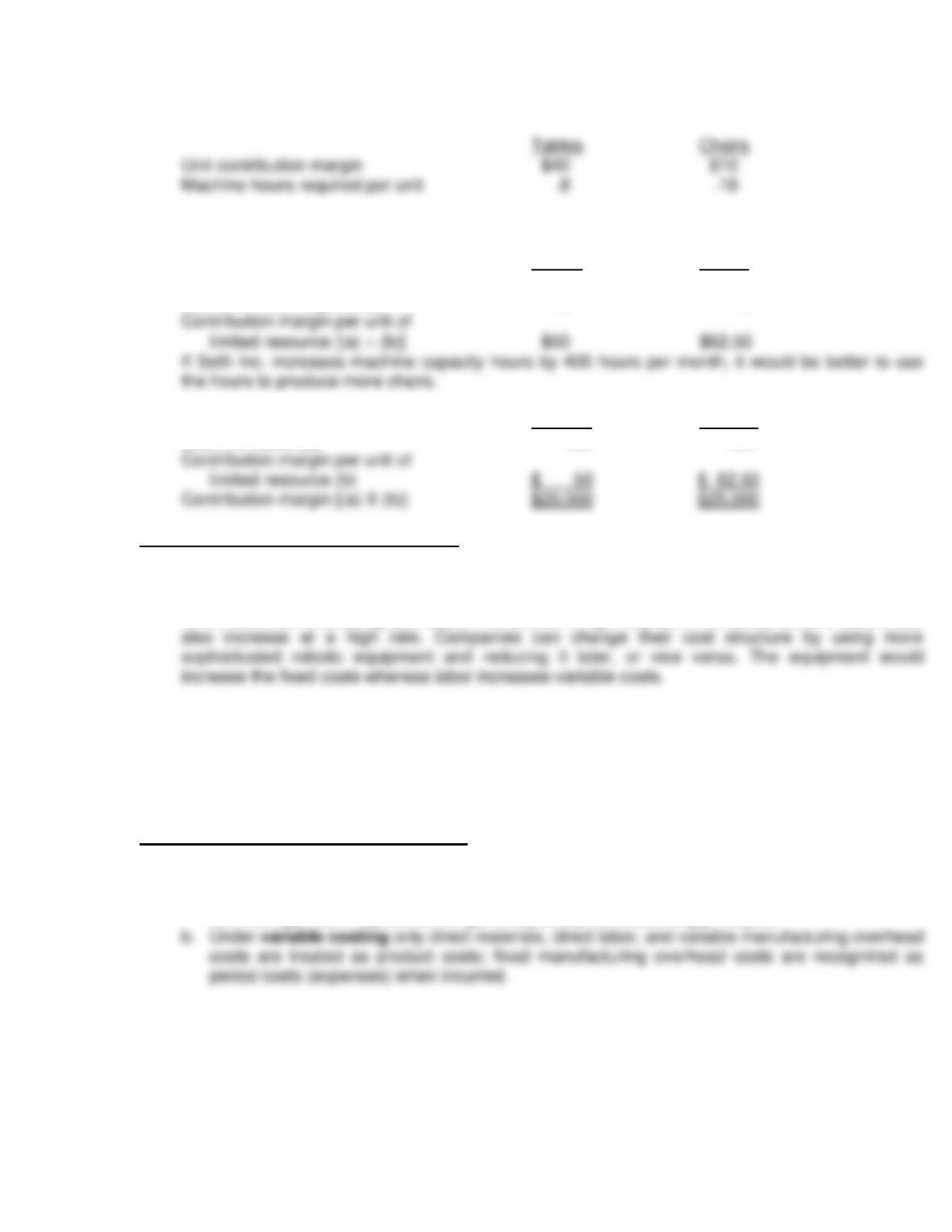
income. Assume that Seth Inc. has limited machine capacity which is 2,600 hours per month.
Relevant data consist of the following:
The contribution margin per unit of limited resource is calculated as follows:
Tables Chairs
Unit contribution margin (a) $40 $10
Machine hours required (b) .8 .16
Tables Chairs
Machine hours (a) 400 400
Cost Structure and Operating Leverage
11. (L.O. 4) Cost structure refers to the relative proportion of fixed versus variable costs that a
company incurs. In most cases, increased reliance on fixed costs increases a company’s risk.
When sales are increasing, profits can increase at a high rate, but when sales decline, losses can
12. Operating leverage refers to the extent to which a company’s net income reacts to a given
change in sales. The degree of operating leverage provides a measure of a company’s earnings
volatility and can be used to compare companies. The formula is:
Contribution Margin
÷
Net Income
=
Degree of Operating Leverage
Variable Costing vs. Absorption Costing
*13. (L.O. 5) There are two approaches to product costing.
a. Under full or absorption costing all manufacturing costs are charged to the product. This is
also the approach required under generally accepted accounting principles.
*14. The primary difference between variable and absorption costing is that under variable costing the
fixed manufacturing overhead is charged as an expense in the current period. The result is that
absorption costing will show a higher net income number than variable costing whenever units
produced exceed units sold. The reason: the cost of the ending inventory is higher under
absorption costing than under variable costing.
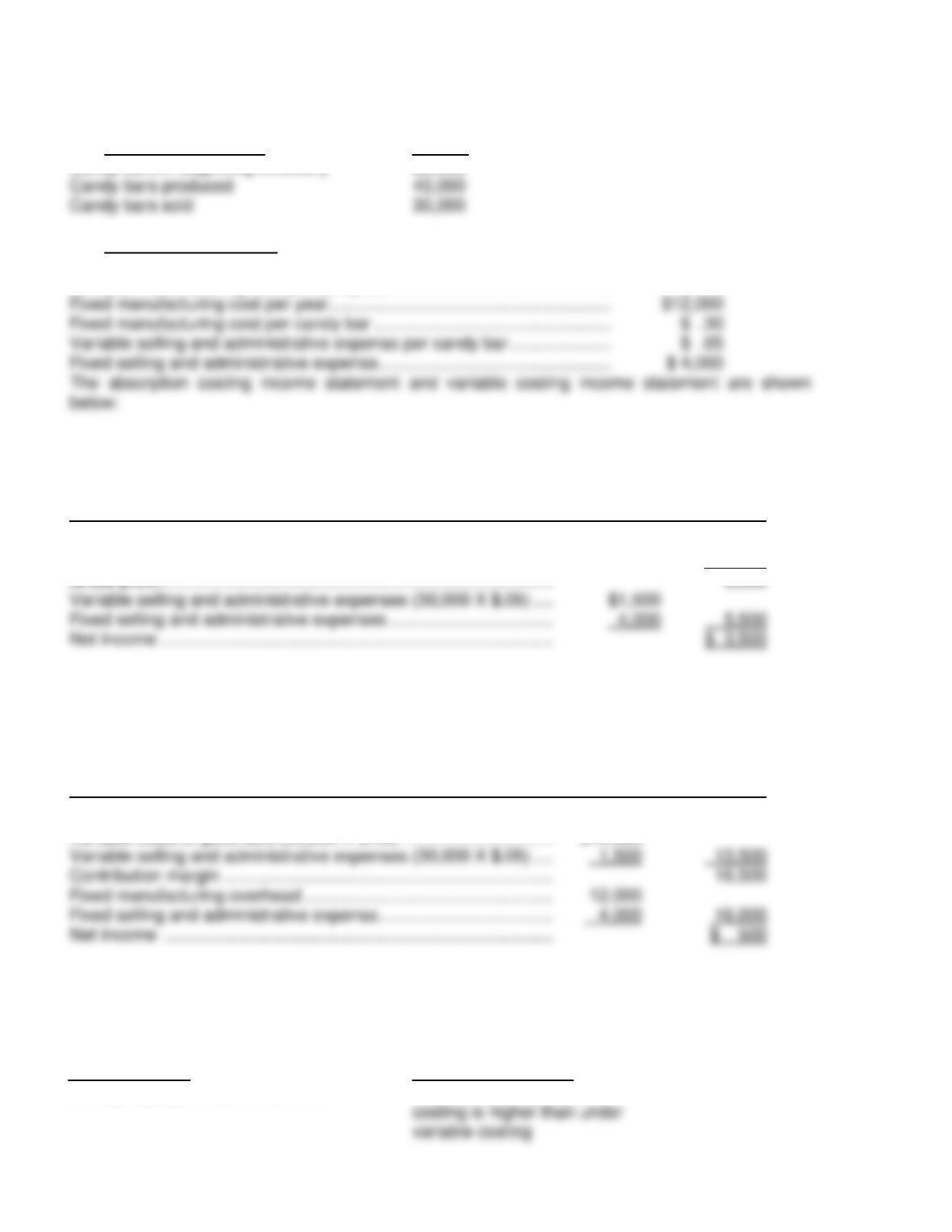
*15. Assume Thibodeau Company manufactures candy bars and has the following information:
Volume Information 2017
Candy bars in beginning inventory 20,000
Financial Information
Selling price per candy bar …………………………………………………………… $1.00
Variable manufacturing cost per candy bar ……………………………………… $ .40
THIBODEAU COMPANY
Income Statement
For the Year Ended 2017
Absorption Costing
Sales (30,000 X $1.00) ……………………………………………………… $30,000
Cost of goods sold [30,000 X ($.40 + $.30)] ………………………….. 21,000
THIBODEAU COMPANY
Income Statement
For the Year Ended 2017
Variable Costing
Sales (30,000 X $1.00) ……………………………………………………… $30,000
Variable costs of good sold (30,000 X $.40) …………………………. $12,000
*16. The effects of the alternative costing methods on income from operations are:
Effects on Income
Circumstance From Operations
Units produced exceed units sold Income under absorption
Units produced are less than units sold Income under absorption costing
Is lower than under variable costing
Units produced equal units sold Income will be equal under both approaches
*17. One of the problems with absorption costing is that management may be tempted to overproduce
in a given period in order to increase net income. Therefore, to avoid this overproduction, variable
costing is often used internally to evaluate management decision-making.
*18. The following are potential advantages of variable costing:
a. Net income computed under variable costing is unaffected by changes in production levels.
b. The use of variable costing is consistent with cost-volume-profit analysis.
LECTURE OUTLINE
A. Cost-Volume-Profit (CVP) Review.
1. Because CVP analysis is important for decision making, management
often wants this information reported in a CVP income statement format
for internal use.
MANAGEMENT INSIGHT
Analysts closely watch the “conversion rate” when analyzing an Internet business.
This rate is computed by dividing the number of people who buy something at an
Internet site by the number of people who visit the site. Conversion rates have an
obvious effect on the break-even point. Studies show that conversion rates increase
if the site has an easy–to-use interface, fast-performing screens, a convenient
ordering process, and advertising that is clear.
Besides increasing their conversion rates, what steps can online merchants use
to lower their break-even points?
Answer: In theory, one of the principal advantages of online retailers is that
they can minimize their investment in “bricks and mortar” and thus
minimize their fixed costs. Some online merchants never even handle
However, some online merchants who originally planned on employing
this model have since found it necessary to build their own warehouses
and distribution centers to ensure timely and dependable product
delivery. This increases their fixed costs, and consequently increases
their break-even point.
B. Sales Mix
1. When a company sells many products, it is important that managers
understand the company’s sales mix.
2. Sales mix is the relative proportion in which each product is sold when
a company sells more than one product. It is important to managers
because different products often have substantially different contribution
margins and break-even points.
3. Break-even sales in units can be computed for a mix of two or more
products by determining the weighted-average unit contribution margin
of all the products.
a. The break-even point in units is computed by dividing fixed costs by
the weighted-average unit contribution margin.
c. At any level of units sold, net income will be greater if higher
contribution margin units are sold than lower contribution margin
units.
4. The calculation of the break-even point in units works well if a company
has only a small number of products. In a company with many products,
break-even sales in dollars is calculated using the weighted-average
contribution margin ratio.
a. The break-even point in dollars is computed by dividing fixed costs
by the weighted-average contribution margin ratio.
SERVICE COMPANY INSIGHT
Zoom kitchen, a chain of four restaurants in the Chicago area, is known for
serving sizable portions of meat and potatoes. During the past four years salad
sales have increased from 18% of its sales mix to 40%. This has pleased
company management because the contribution margin on salads is much
higher than on meat.
Why do you suppose restaurants are so eager to sell beverages and desserts?
Answer: There is a reason why servers at restaurants keep your beverage
glass full, and why they wave the dessert tray in your face at the
C. Limited Resources.
1. When a company has limited resources (i.e., machine hours), it is
necessary to find the contribution margin per unit of limited resource.
2. Contribution margin per unit of limited resource is computed by dividing
the contribution margin/unit of each product by the number of units of
limited resource required for each product.
3. The contribution margin per unit of limited resource is then multiplied by
the units of limited resource to determine total contribution margin and
which product maximizes net income.
MANAGEMENT INSIGHT
When fragrance sales recently went flat, retailers turned up the heat on fragrance
manufacturers. They reduced the amount of floor space devoted to fragrances,
and chose the fragrance with the highest contribution margin per square foot for
a given period of time.
What is the limited resource for a retailer, and what implication does this have for
sales mix?
Answer: For retailers, the limited resource is not just shelf space, but shelf
space per day. At first you might think that a product that is small and
D. Cost Structure and Operating Leverage.
1. Cost structure is the relative proportion of fixed versus variable costs
that a company incurs.
2. Cost structure can have a significant effect on profitability.
3. Operating leverage is the degree to which a company’s net income
reacts to a change in sales.
4. Operating leverage is determined by a company’s relative use of fixed
versus variable costs.
a. Companies with high fixed costs relative to variable costs have high
operating leverage.
5. The degree of operating leverage provides a measure of a company’s
earnings volatility and can be used to compare companies. Degree of
operating leverage is computed by dividing total contribution margin by
net income.
6. A cost structure that relies on higher fixed costs, and consequently has
higher operating leverage, is not necessarily bad. Operating leverage
can add considerably to a company’s profitability when used carefully.
SERVICE COMPANY INSIGHT
Warren Buffet recently purchased Burlington Northern Railroad for 31% above its
market value. The company has fixed costs of approximately 50 – 60%, and
therefore huge operating leverage. Railroads have barriers to entry, are an
energy-efficient method of transportation, and there are a limited number of
railroads operating.
Why did Warren Buffett think that this was good time to invest in railroad stocks?
Answer: Railroads have extremely high fixed costs. Mr. Buffett bought
Burlington Northern Railroad at the bottom of a recession. He is
*E. Absorption Costing Versus Variable Costing.
1. Under absorption costing, all manufacturing costs are charged to, or
absorbed by, the product. This approach is used for external reporting
under generally accepted accounting principles.
2. Under variable costing, only variable manufacturing costs (direct mate–
rials, direct labor, and variable manufacturing overhead costs) are
considered product costs.
6. The one primary difference between variable and absorption costing is
that under variable costing companies charge fixed manufacturing
overhead as an expense in the current period, instead of being deferred
to a future period through the ending inventory as under absorption
costing.
8. When units produced and sold are the same, net income will be equal
under the two costing approaches because there is no increase in
ending inventory, and therefore no deferral of fixed overhead costs to
future periods through the ending inventory.
*F. Decision-Making Concerns.
1. For external reporting purposes, companies must report financial infor–
mation using GAAP, which requires that absorption costing be used for
the costing of inventory.
2. Some companies have recognized that net income calculated using
GAAP does not highlight differences between variable and fixed costs
and may lead to poor business decisions. Therefore, some companies
use variable costing for internal reporting purposes.
4. Management may be tempted to overproduce in a given period in order
to increase net income, but this decision may not be in the company’s
best interest since the buildup of inventories will lead to additional costs
to the company in the long run.
5. Variable costing avoids the temptation to overproduce because net
income under this approach is not affected by changes in production
levels.
*G. Potential Advantages of Variable Costing.
1. Variable costing has several potential advantages relative to absorption
costing:
a. Net income computed under variable costing is unaffected by
changes in production levels.
b. The use of variable costing is consistent with cost-volume-profit
analysis.
20 MINUTE QUIZ
Circle the correct answer.
True/False
1. The CVP income statement classifies costs as variable or fixed and computes a contribution
margin.
True False
2. The margin of safety indicates how much sales must increase before a company will be
operating at a profit.
True False
3. Sales mix is the relative percentage in which each product is sold when a company sells more
than one product.
True False
4. When multiple products exist, the break-even point in dollars is computed by dividing fixed costs
by the weighted-average contribution margin.
True False
5. When a company has limited resources, management must decide which product to make and
sell in order to maximize contribution margin ratio.
True False
6. Contribution margin per unit of limited resource is obtained by dividing the contribution margin
per unit of each product by the number of units of the limited resource required for each product.
True False
7. Operating leverage refers to the extent to which a company’s net income reacts to a given
change in production.
True False
8. Companies that have higher fixed costs relative to variable costs have higher operating leverage.
True False
*9. Under variable costing, all variable costs are considered product costs.
True False
*10. Fixed manufacturing costs are a product cost under absorption costing but are a period cost
under variable costing.
True False
Multiple Choice
1. For a company selling multiple products, the break-even point in dollars is computed by
dividing fixed costs by the
a. contribution margin per unit.
b. contribution margin ratio.
c. weighted-average contribution margin per unit.
d. weighted-average contribution margin ratio.
2. In order to maximize net income a company should produce and sell the product with the
highest.
a. contribution margin ratio.
b. contribution margin per unit.
c. contribution margin per unit of limited resource.
d. weighted-average unit contribution margin.
3. Operating leverage refers to the extent to which a company’s net income reacts to a
given change in
a. fixed costs.
b. production.
c. sales.
d. variable costs
*4. Under variable costing, all of the following are considered product costs except
a. direct materials.
b. direct labor.
c. variable manufacturing overhead.
d. variable selling and administrative expenses.
*5. All of the following are potential advantages of variable costing except that
a. its use is consistent with cost-volume-profit and incremental analysis.
b. variable costing net income is affected by changes in production levels.
c. variable costing net income is closely tied to changes in sales levels.
d. the presentation of fixed and variable cost components makes it easier
to identify these costs.

ANSWERS TO QUIZ
True/False
1. True 6. True
Multiple Choice
1. d.