FINANCIAL ACCOUNTING – Eleventh Edition Solutions Manual
S6-1
(10-15 min.)
Solution:
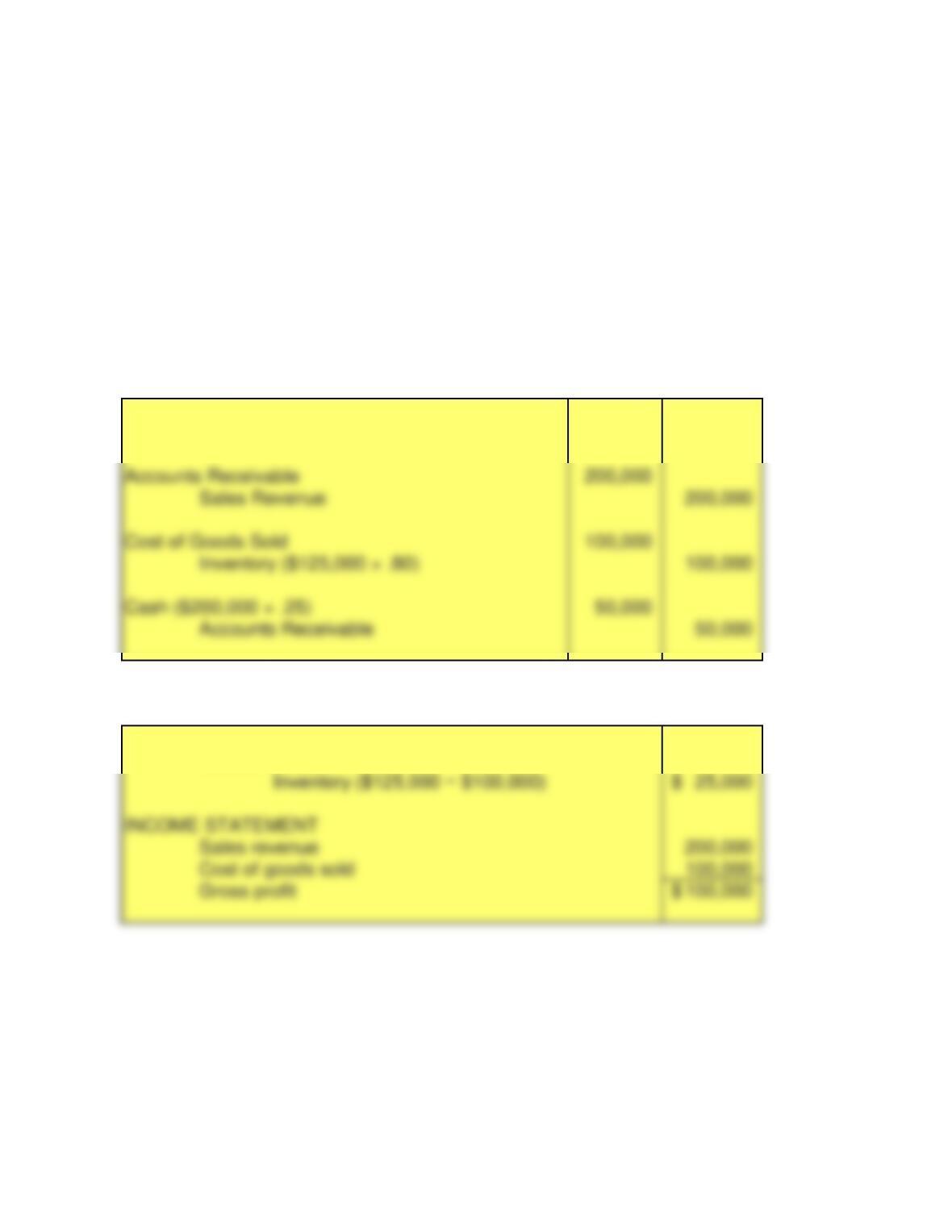
1. (Journal entries)
Inventory 125,000
Accounts Payable 125,000
2. (Financial statements)
BALANCE SHEET
Current assets:
INCOME STATEMENT
Sales revenue 200,000
Cost of goods sold 100,000
Gross profit 100,000$
1. Journalize these transactions for Cozelle, which uses the perpetual
inventory system.
2. For these transactions, show what Cozelle will report for inventory,
revenues, and expenses on its financial statements at the end of the month.
Report gross profit on the appropriate statement.
Chapter 6: Inventory and Cost of Goods Sold Page 1 of 96
Accounts Receivable 200,000
Sales Revenue 200,000
Cost of Goods Sold 100,000
Inventory ($125,000 × .80) 100,000
Cash ($200,000 × .25) 50,000
Accounts Receivable 50,000
FINANCIAL ACCOUNTING – Eleventh Edition Solutions Manual
S6-2
(5 min.)
Solution:
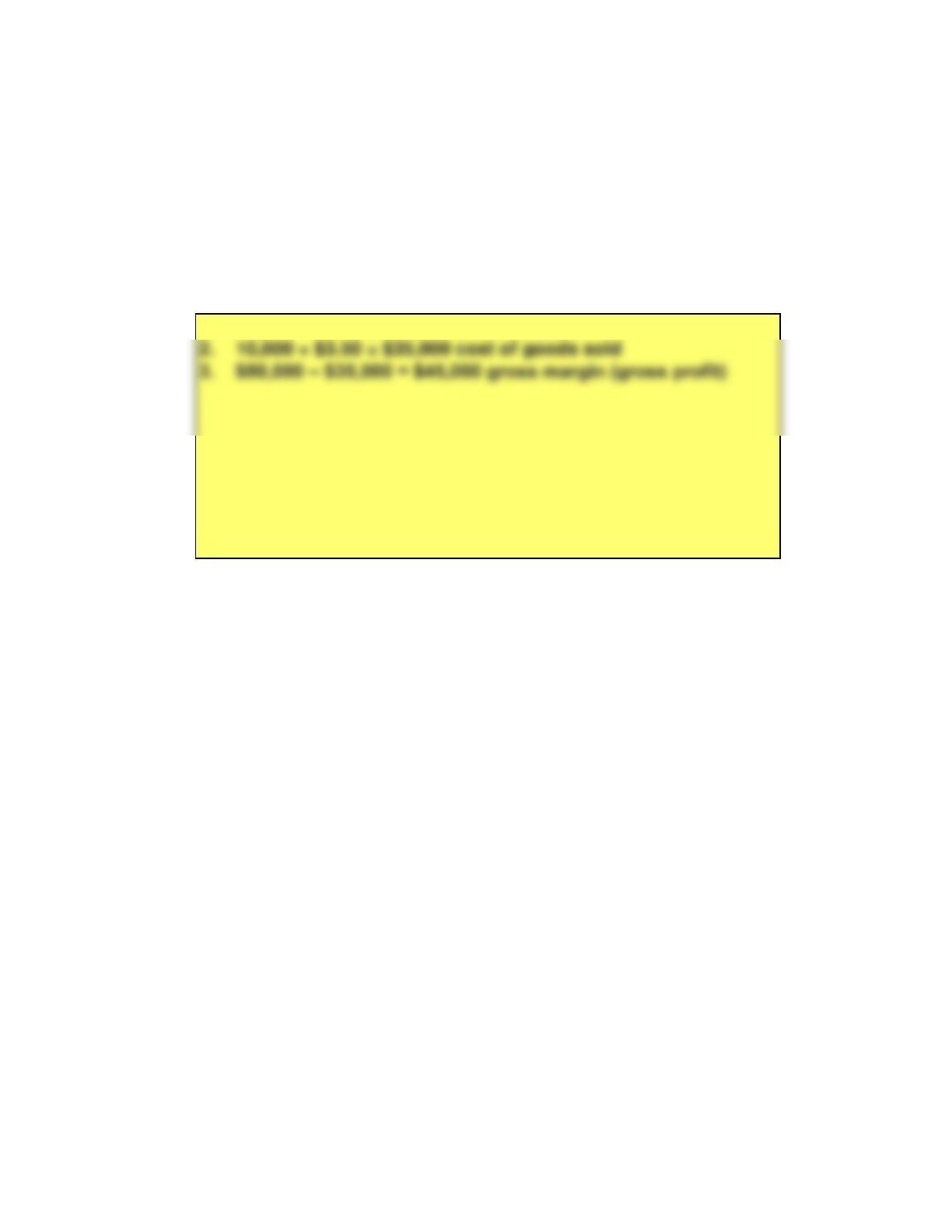
1. 10,000 × $8.00 = $80,000 sales revenue
Calculate the following:
1. Sales revenue
2. Cost of goods sold
3. Gross margin
Chapter 6: Inventory and Cost of Goods Sold Page 2 of 96
2. 10,000 × $3.50 = $35,000 cost of goods sold
FINANCIAL ACCOUNTING – Eleventh Edition Solutions Manual
S6-3
(5 min.)
Solution:
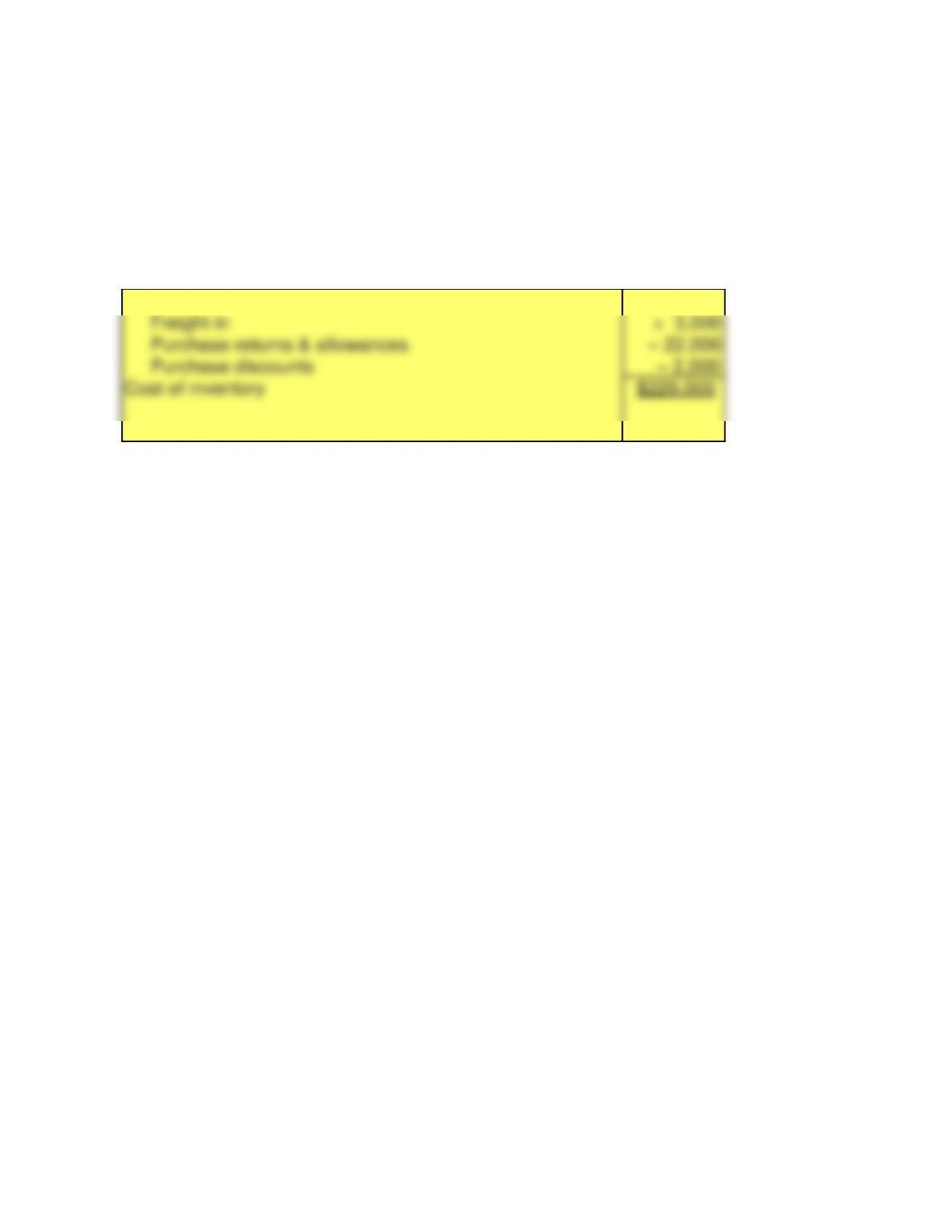
Purchases $250,000
What was Trinkets Unlimited’s cost of inventory?
Chapter 6: Inventory and Cost of Goods Sold Page 3 of 96
FINANCIAL ACCOUNTING – Eleventh Edition Solutions Manual
S6-4
(10-15 min.)
Solution:
Average FIFO LIFO
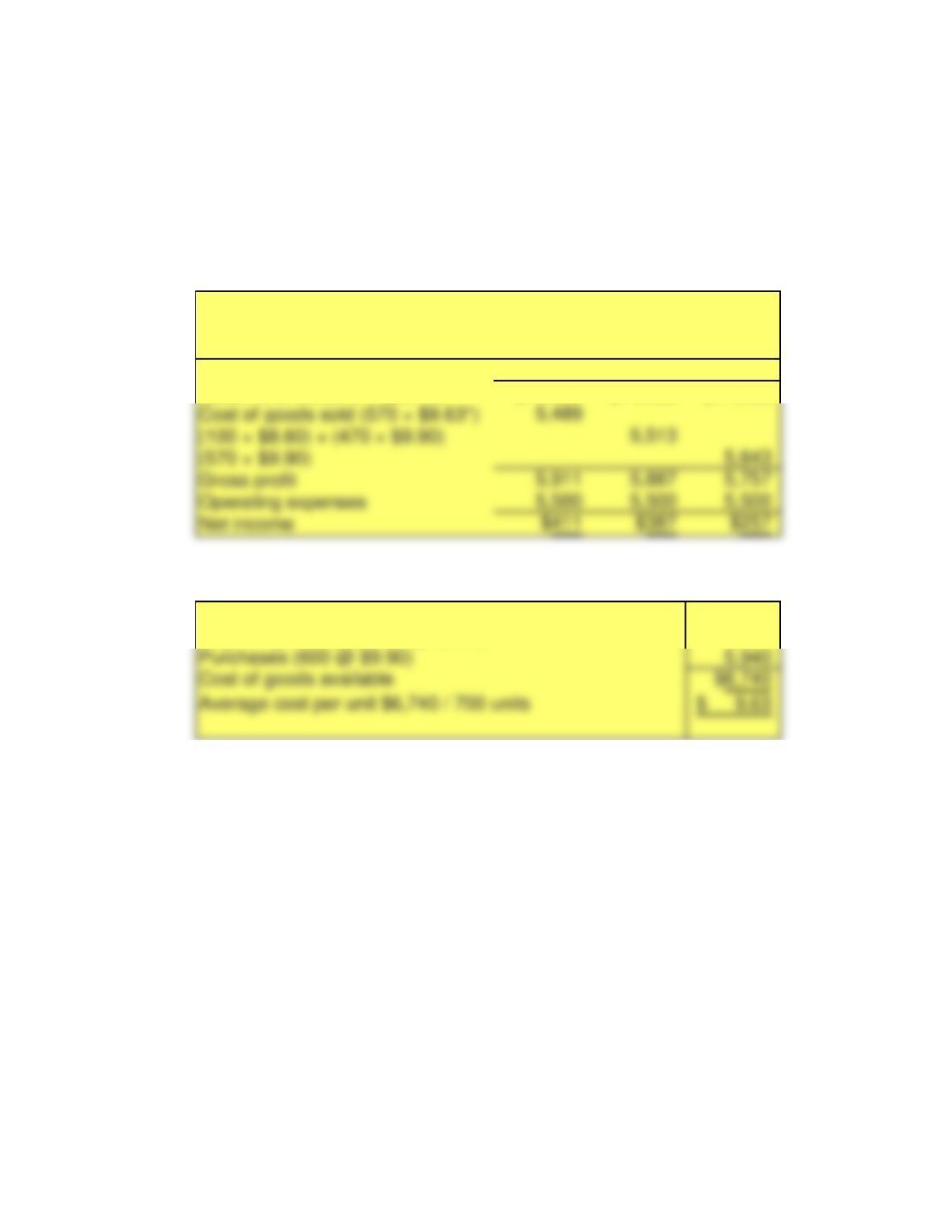
Sales revenue (570 × $20.00) $11,400 $11,400 $11,400
*Average cost per unit:
Beginning inventory (100 @ $8.00) $800
Prepare McDonough Copy Center’s income statement for the current year
ended December 31 under the average, FIFO, and LIFO inventory costing
methods. Include a complete statement heading.
McDonough Copy Center
Income Statement
Year Ended December 31, Current Year
Chapter 6: Inventory and Cost of Goods Sold Page 4 of 96
FINANCIAL ACCOUNTING – Eleventh Edition Solutions Manual
S6-5
(10-15 min.)
Solution:
Average FIFO LIFO
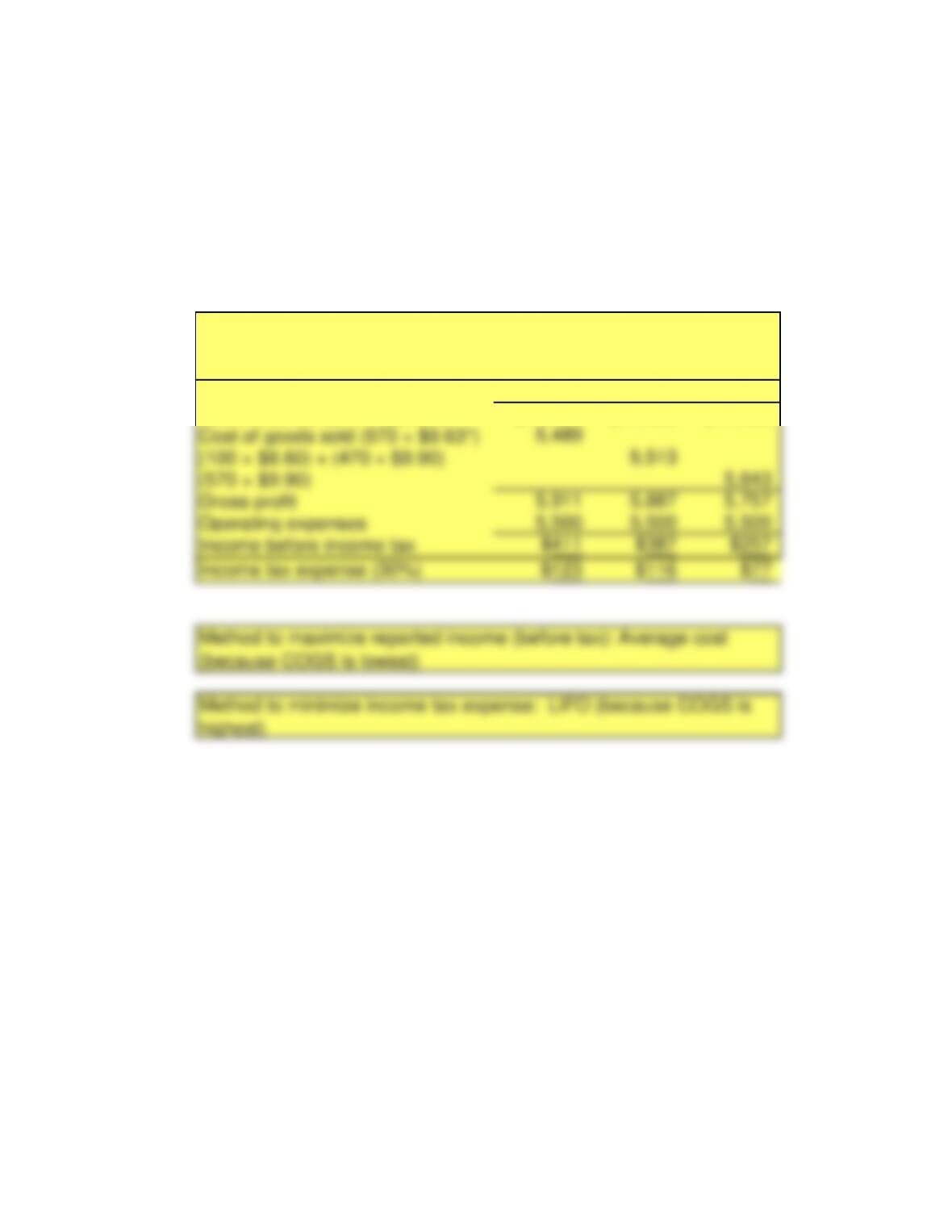
Sales revenue (570 × $20.00) $11,400 $11,400 $11,400
McDonough Copy Center
Income Statement
Year Ended December 31, Current Year
Compute McDonough Copy Center’s income tax expense under the average,
FIFO, and LIFO inventory costing methods. Which method would you select to
(a) maximize income before tax and (b) minimize income tax expense?
Chapter 6: Inventory and Cost of Goods Sold Page 5 of 96
FINANCIAL ACCOUNTING – Eleventh Edition Solutions Manual
S6-6
(5 min.)
Solution:
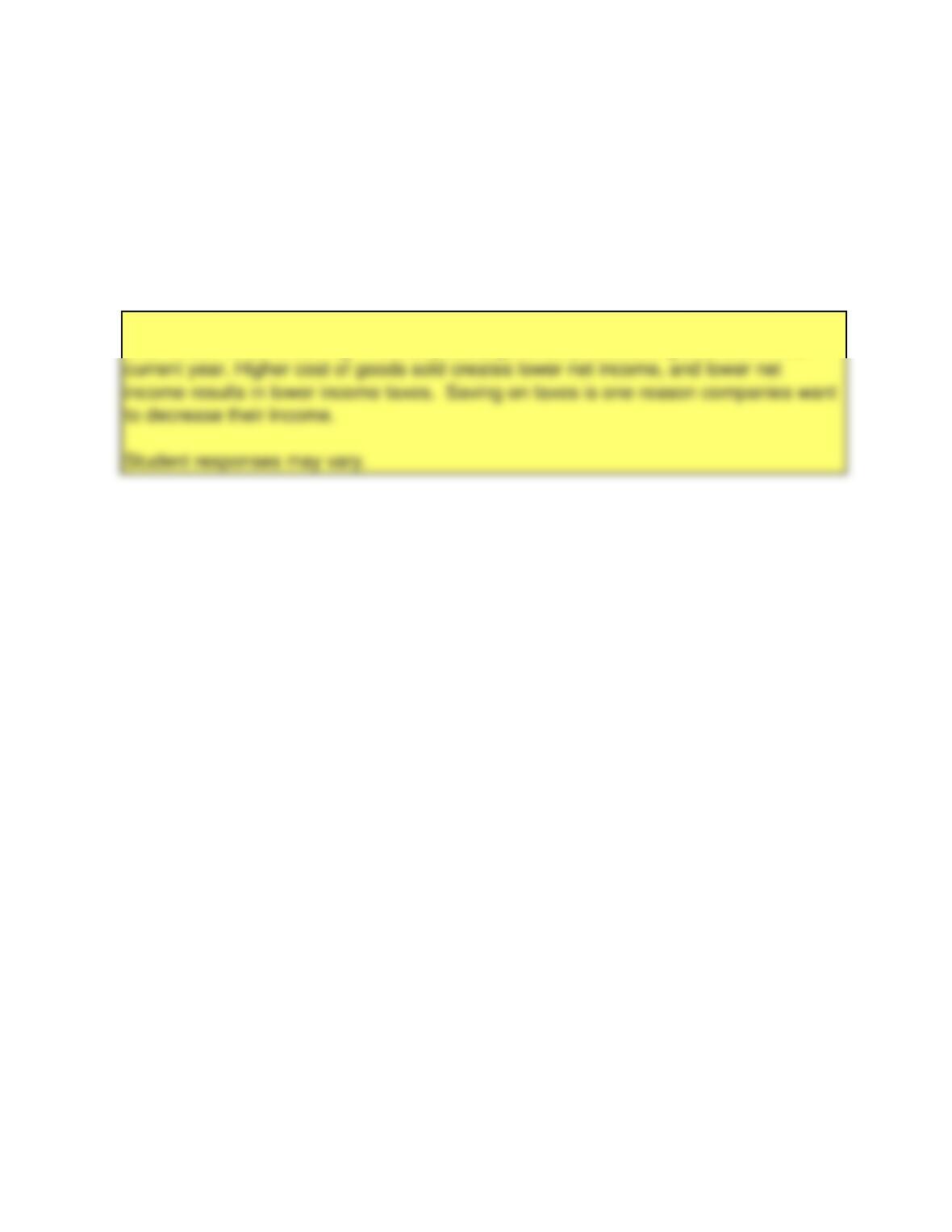
What can Marley do immediately before the end of the year to decrease net income?
Explain how this action decreases reported income, and tell why Marley might want to
decrease its net income.
Marley Corporation managers can purchase a large amount of inventory before year
end. Under LIFO, these high inventory costs go directly to cost of goods sold in the
Chapter 6: Inventory and Cost of Goods Sold Page 6 of 96
FINANCIAL ACCOUNTING – Eleventh Edition Solutions Manual
S6-7
(5-10 min.)
Solution:
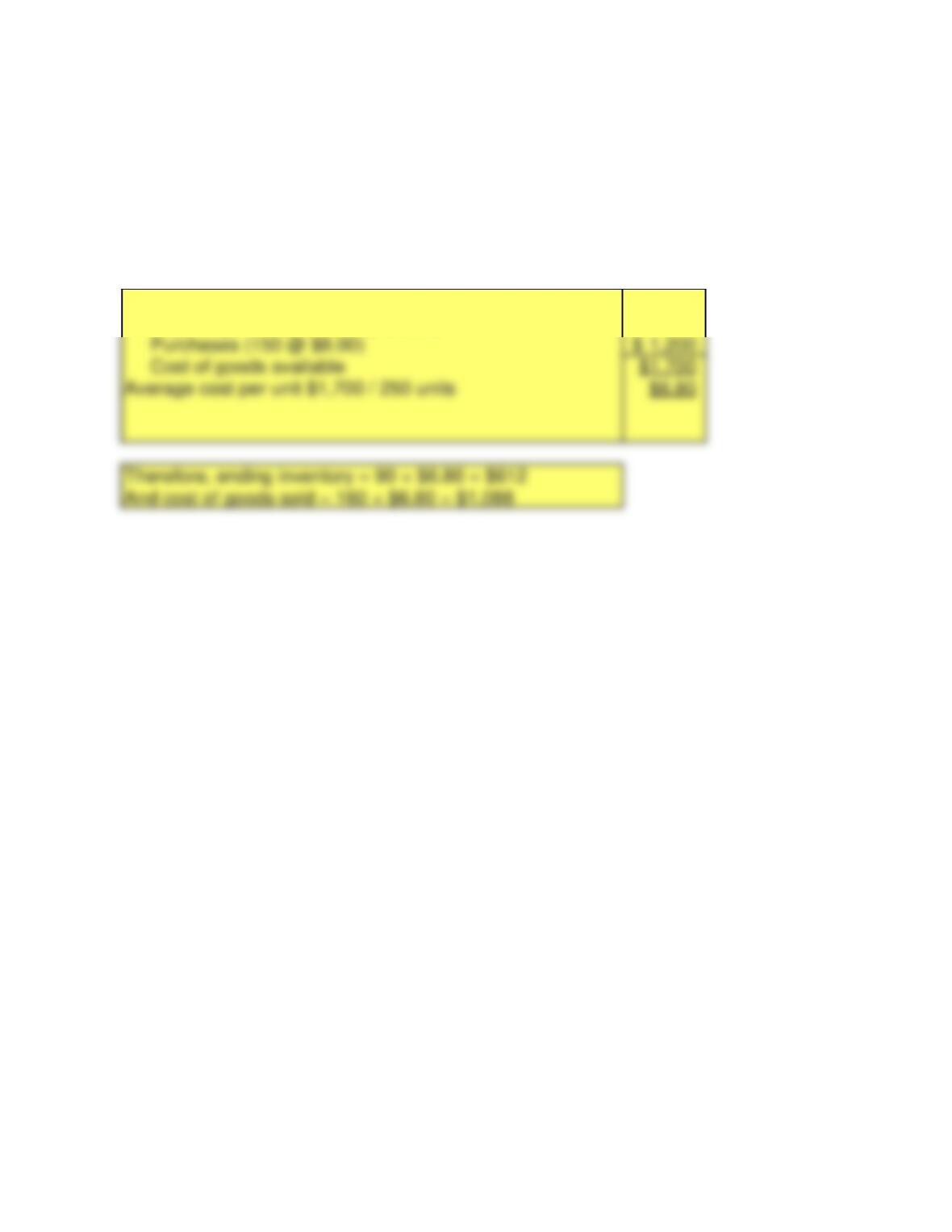
Average cost per unit:
Beginning inventory (100 @ $5.00)
500$
Using the average-cost method,
calculate the cost of ending inventory and cost of goods sold for Cowell Corporation.
Chapter 6: Inventory and Cost of Goods Sold Page 7 of 96
Therefore, ending inventory = 90 × $6.80 = $612
And cost of goods sold = 160 × $6.80 = $1,088

FINANCIAL ACCOUNTING – Eleventh Edition Solutions Manual
S6-8
(5 min.)
Solution:
Using the FIFO method, calculate the cost of ending inventory and cost of goods sold
for Cowell Corporation.
Ending inventory = 90 × $8.00 = $720
Chapter 6: Inventory and Cost of Goods Sold Page 8 of 96

FINANCIAL ACCOUNTING – Eleventh Edition Solutions Manual
S6-9
(5 min.)
Solution:
Using the LIFO method, calculate the cost of ending inventory and cost of goods sold
for Cowell Corporation.
Ending inventory = 90 × $5.00 = $450
Chapter 6: Inventory and Cost of Goods Sold Page 9 of 96
FINANCIAL ACCOUNTING – Eleventh Edition Solutions Manual
S6-10
(10-15 min.)
Solution:
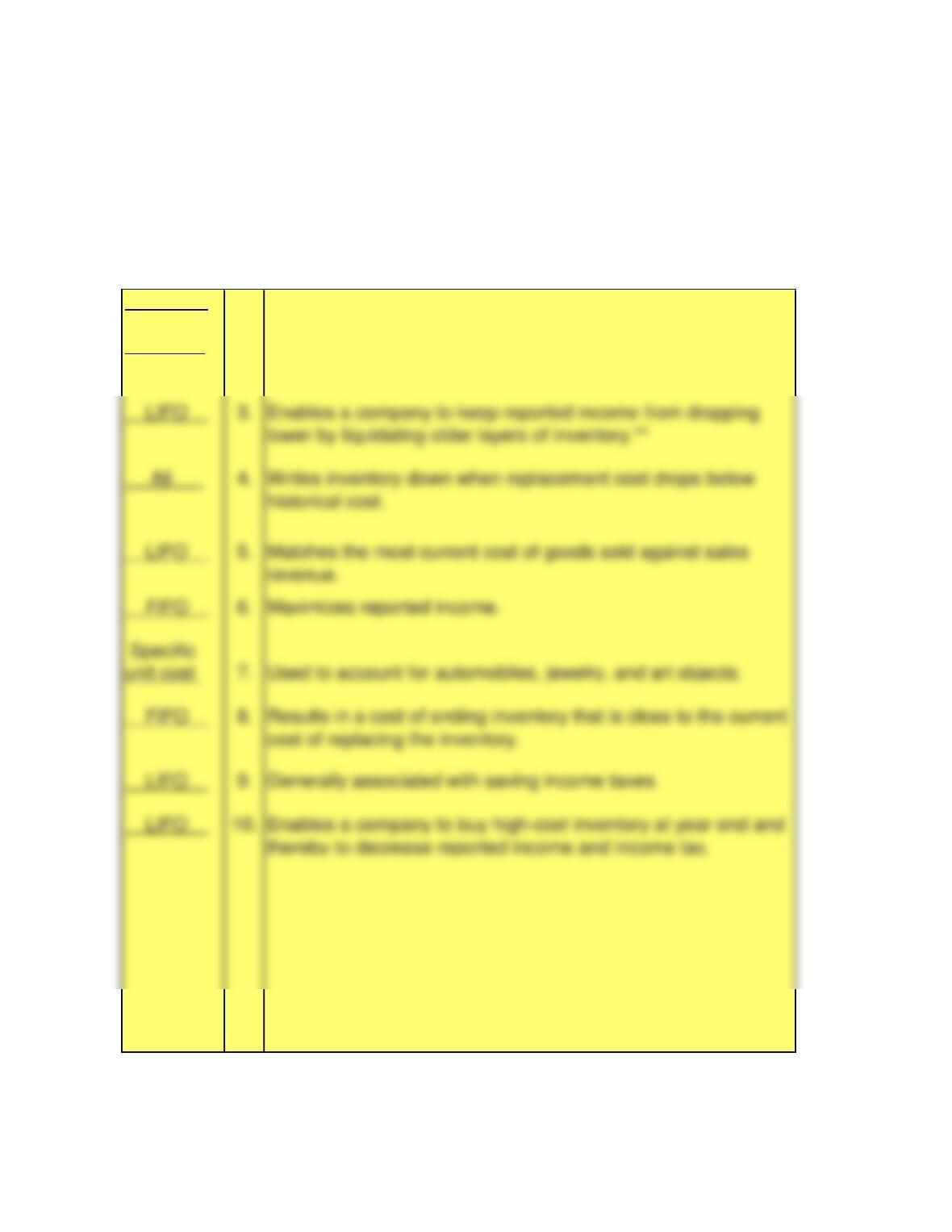
LIFO 1. Results in an old measure of the cost of ending inventory.
Average 2.
List the name of the inventory method that best fits the description. Assume that
the cost of inventory is rising.
Provides a middle-ground measure of ending inventory and
cost of goods sold.
Chapter 6: Inventory and Cost of Goods Sold Page 10 of 96
LIFO 5.
FIFO 6. Maximizes reported income.
Specific
unit cost 7. Used to account for automobiles, jewelry, and art objects.
FIFO 8.
LIFO 9. Generally associated with saving income taxes.
LIFO 10.
Enables a company to buy high-cost inventory at year end and
FINANCIAL ACCOUNTING – Eleventh Edition Solutions Manual
S6-11
(5-10 min.)
Solution:
BALANCE SHEET
Current assets:
Show what Saxton should report for ending inventory and for cost of
goods sold. Identify the financial statement where each item appears.
Chapter 6: Inventory and Cost of Goods Sold Page 11 of 96
FINANCIAL ACCOUNTING – Eleventh Edition Solutions Manual
S6-12
(5-10 min.)
Solution:
Dollars in Millions
Compute Spritzer’s gross profit percentage and rate of
inventory turnover for 2016.
Chapter 6: Inventory and Cost of Goods Sold Page 12 of 96
FINANCIAL ACCOUNTING – Eleventh Edition Solutions Manual
S6-13
(5-10 min.)
Solution:
Beginning inventory $299,000
+ Purchases 1,820,000
Compute Metro Technology’s estimated cost of ending inventory by using
the gross profit method.
Chapter 6: Inventory and Cost of Goods Sold Page 13 of 96
FINANCIAL ACCOUNTING – Eleventh Edition Solutions Manual
S6-14
(10-15 min.)
Solution:
1. Unethical. The company falsified its purchases, cost of goods sold,
and net income in order to evade taxes.
1. In applying the lower-of-cost-or-market rule to inventories, Blue Mountain Coffee
Company recorded an excessively low value for its ending inventory (below both cost and
market). This action allowed the company to pay less income tax for the year.
2. Rosalind Sales, Inc., delayed the purchase of inventory until after December 31, 2016, to
keep 2016’s cost of goods sold from growing too large. The delay in purchasing inventory
helped net income of 2016 to reach the level of profit demanded by the company’s investors.
3. Carlson Pharmaceuticals purchased a large amount of inventory shortly before year-end to
increase the LIFO cost of goods sold and decrease reported income for the year.
4. Glacier Corporation deliberately overstated purchases to produce a high figure for cost of
goods sold (low amount of net income). The real reason was to decrease the company’s
income tax payments to the government.
5. Farley Sales Company deliberately overstated ending inventory in order to report higher
profits (net income).
Chapter 6: Inventory and Cost of Goods Sold Page 14 of 96
2. Ethical. As long as an appropriate amount of inventory is available, delaying the
purchase until early the next year is acceptable. There is nothing wrong with buying
inventory when the company wishes.
3. Ethical. As long as an appropriate amount of inventory is available, delaying the
purchase until early the next year is acceptable. There is nothing wrong with buying
inventory when the company wishes.
4. Unethical. The company falsified its purchases, cost of goods sold, and net income
in order to evade taxes.
5. Unethical. Deliberately overstating ending inventory and therefore net income
is not ethical.
FINANCIAL ACCOUNTING – Eleventh Edition Solutions Manual
S6-15
(5 min.)
Solution:
1. Last year’s reported gross profit was understated.
Correct gross profit last year was $4.1 million ($2.9 + $1.2).
1. Was last year’s reported gross profit of $2.9 million overstated, understated, or
correct? What was the correct amount of gross profit last year?
2. Is this year’s gross profit of $3.6 million overstated, understated, or correct? What is
the correct amount of gross profit for the current year?
3. Was last year’s reported cost of goods sold of $5.4 million overstated, understated,
or correct? What was the correct amount of cost of goods sold last year?
4. Is this year’s cost of goods sold of $5.7 million overstated, understated, or correct?
What is the correct amount of cost of goods sold for this year?
Chapter 6: Inventory and Cost of Goods Sold Page 15 of 96
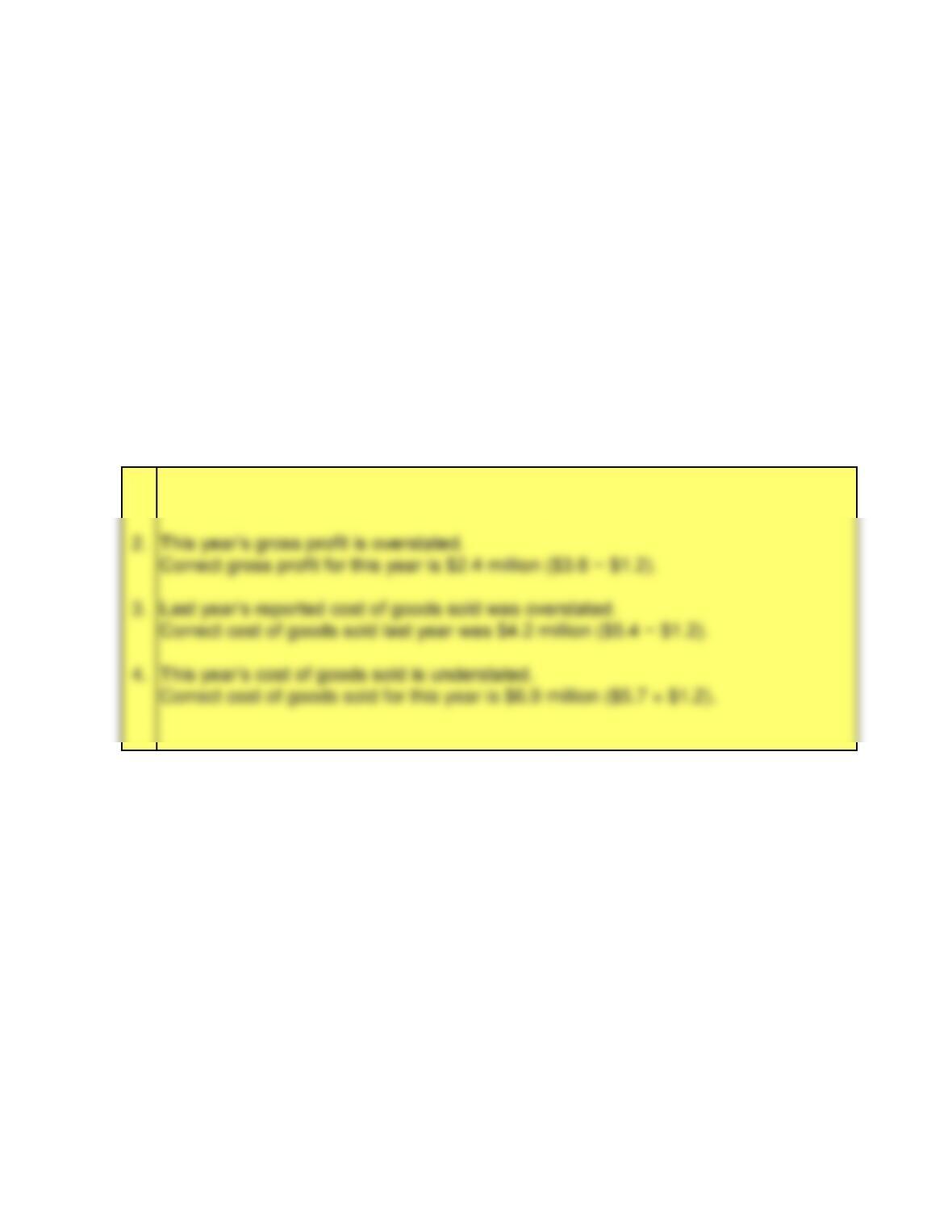
2. This year’s gross profit is overstated.
3. Last year’s reported cost of goods sold was overstated.
4. This year’s cost of goods sold is understated.
Correct cost of goods sold for this year is $6.9 million ($5.7 + $1.2).
FINANCIAL ACCOUNTING – Eleventh Edition Solutions Manual
S6-16
(10-15 min.)
Solution:
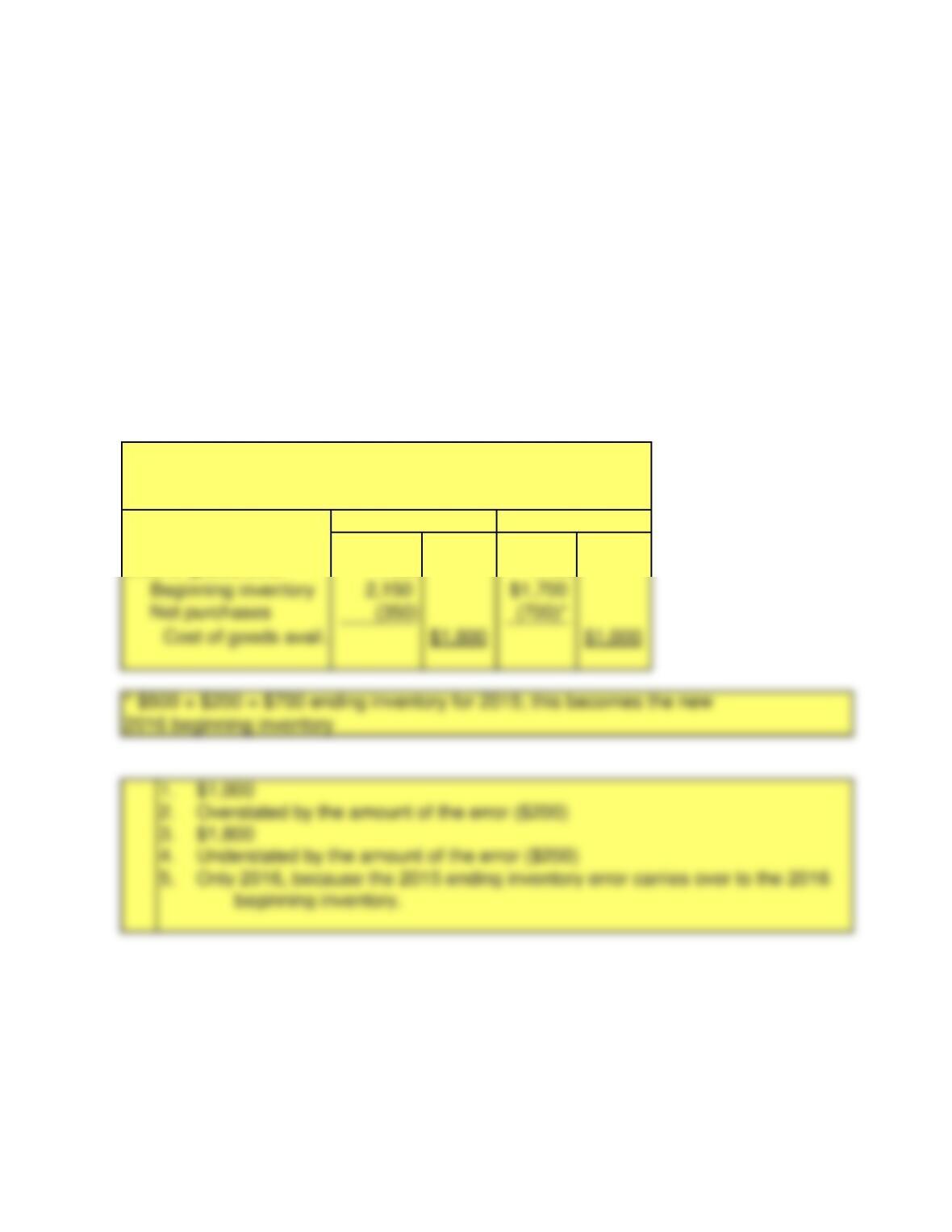
Sales revenue $ 700* $600
Cost of goods sold: 1,450 1,100
1. What is the corrected cost of goods sold for 2015?
2. Did the understatement of ending inventory in 2015 cause the 2015 cost of goods
sold to be overstated or understated?
3. What is the corrected cost of goods sold for 2016?
4. Did the understatement of ending inventory in 2015 cause the 2016 cost of goods
sold to be overstated or understated?
5. Were any other years impacted by the 2015 $200 understatement of ending
inventory? Why or why not?
Truman Company
Schedule of Cost of Goods Sold (Corrected)
Years 2015 and 2016
2016
2015
Chapter 6: Inventory and Cost of Goods Sold Page 16 of 96
FINANCIAL ACCOUNTING – Eleventh Edition Solutions Manual
E6-17A
(15-20 min.)
Requirements
Solution:
Req. 1
Perpetual System
1. Purchases:
Inventory 66,000
Accounts Payable 66,000
1. Journalize Ontario’s inventory transactions for the year under the perpetual
system.
2. Report ending inventory, sales, cost of goods sold, and gross profit on the
appropriate financial statement.
Chapter 6: Inventory and Cost of Goods Sold Page 17 of 96
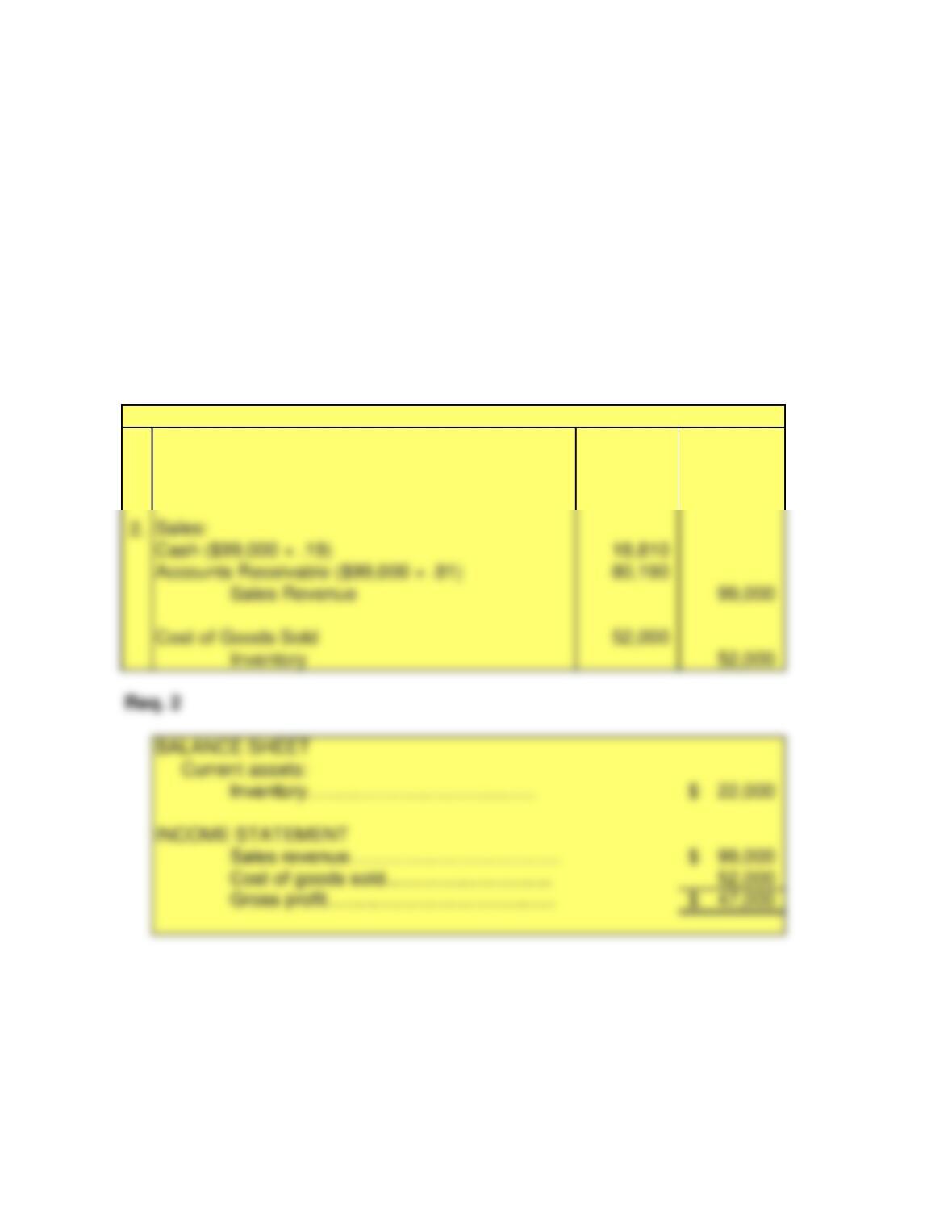
Cash ($99,000 × .19) 18,810
Accounts Receivable ($99,000 × .81) 80,190
Sales Revenue 99,000
Cost of Goods Sold 52,000
BALANCE SHEET
INCOME STATEMENT
FINANCIAL ACCOUNTING – Eleventh Edition Solutions Manual
E6-18A
(15-25 min.)
Solution:
Req. 1, 2, and 3
DATE DEBIT CREDIT
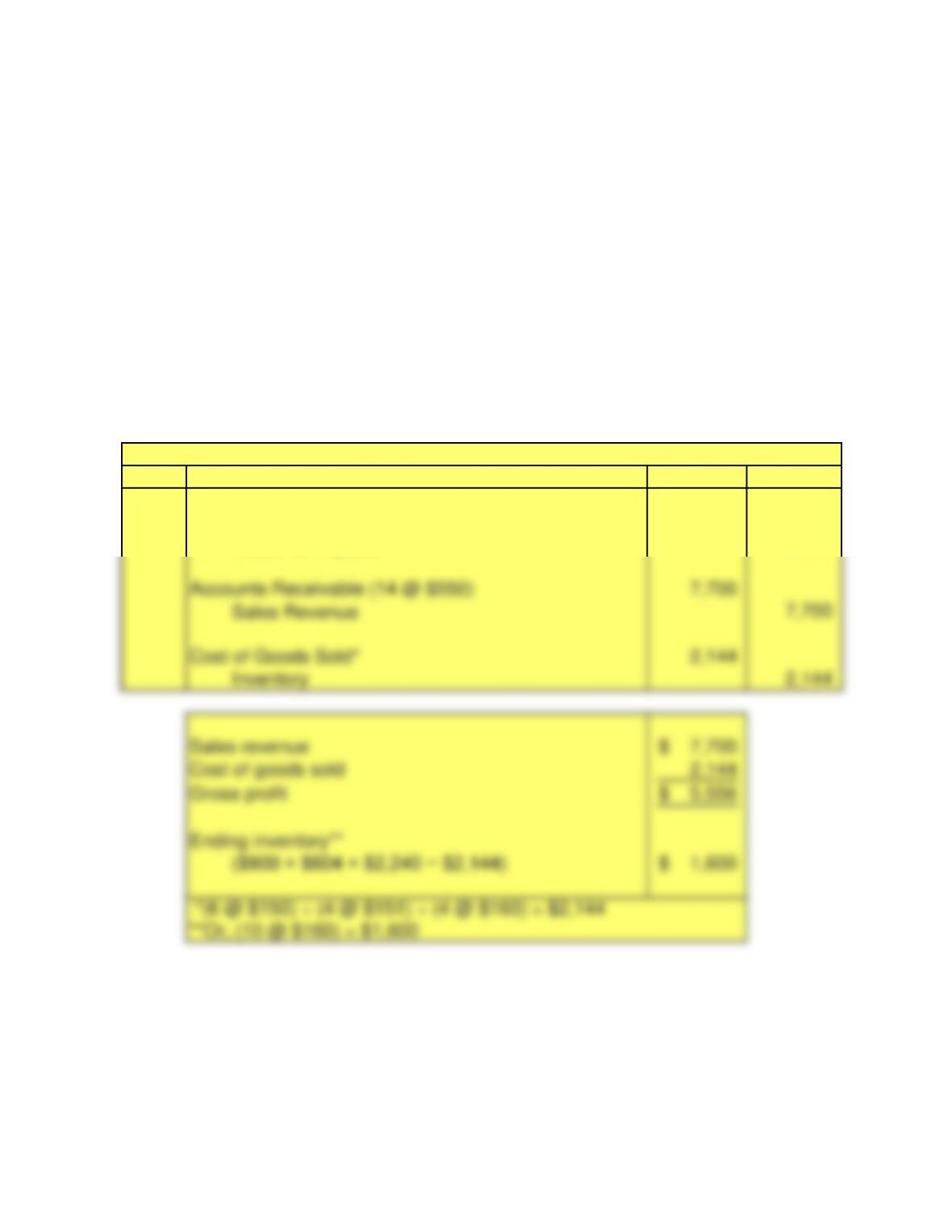
Inventory ($604 + $2,240) 2,844
Accounts Payable 2,844
Journal
ACCOUNT TITLES AND EXPLANATION
Journalize the following for Cranwell Company under the perpetual system:
1. Total May purchases in one summary entry. All purchases were on credit.
2. Total May sales and cost of goods sold in two summary entries. The selling price
was $550 per unit, and all sales were on credit. Assume that Cranwell uses the FIFO
inventory method.
3. Under FIFO, how much gross profit would Cranwell earn on these transactions?
What is the FIFO cost of Cranwell Company’s ending inventory?
Chapter 6: Inventory and Cost of Goods Sold Page 18 of 96
Sales Revenue 7,700
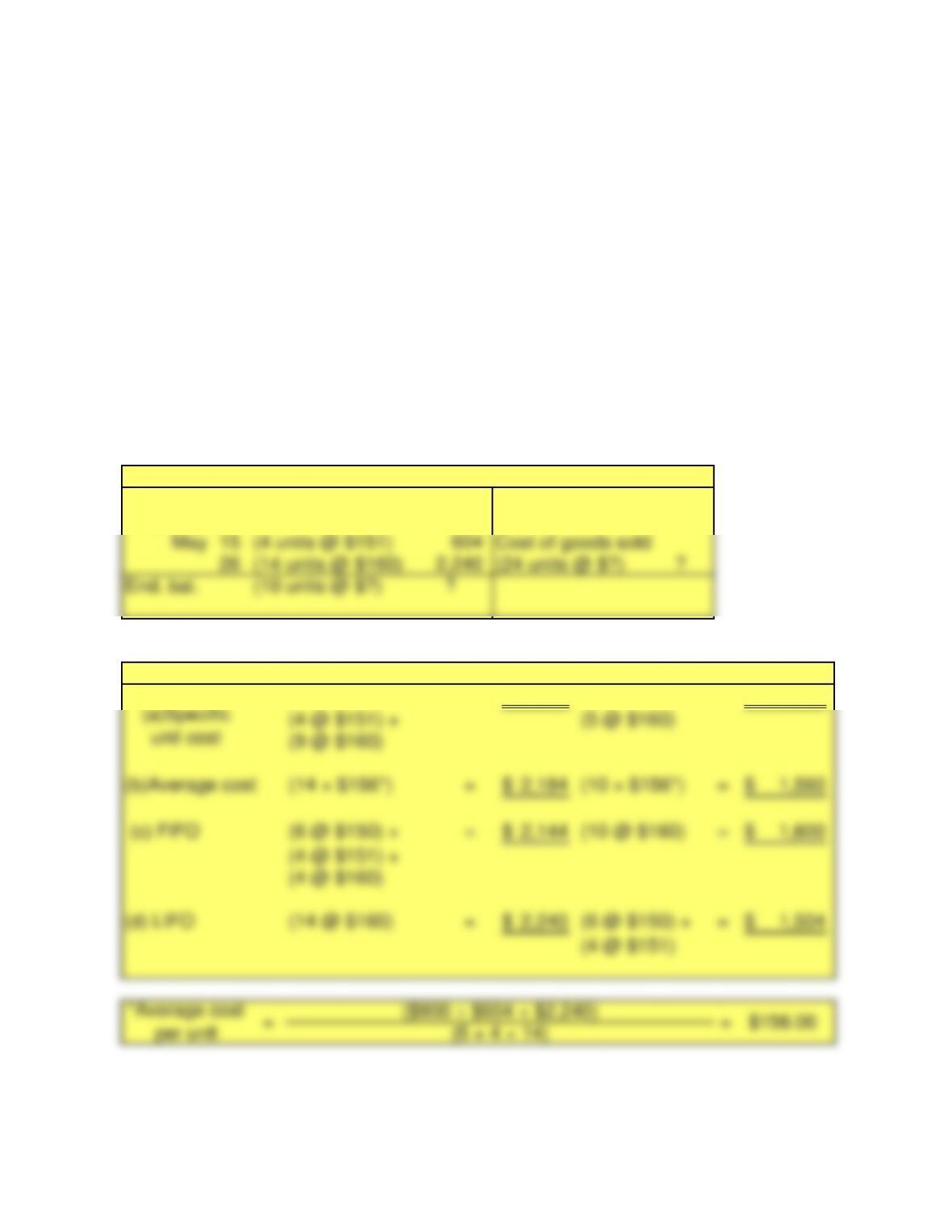
*(6 @ $150) + (4 @ $151) + (4 @ $160) = $2,144
**Or, (10 @ $160) = $1,600
FINANCIAL ACCOUNTING – Eleventh Edition Solutions Manual
E6-19A
(10-15 min.)
Requirements
Solution:
Req. 1
Beg. bal. (6 units @ $150)
Purchases
Cost of Goods Sold Ending Inventory
(1 @ $150) + = 2,194$ (5 @ $150) + = 1,550$
900
Inventory
1. Compute cost of goods sold and ending inventory, using each of the following
methods:
a. Specific unit cost, with five $150 units and five $160 units still on hand at the end
b. Average cost
c. FIFO
d. LIFO
2. Which method produces the highest cost of goods sold? Which method produces
the lowest cost of goods sold? What causes the difference in cost of goods sold?
Chapter 6: Inventory and Cost of Goods Sold Page 19 of 96

FINANCIAL ACCOUNTING – Eleventh Edition Solutions Manual
Req. 2
LIFO produces the highest cost of goods sold, $2,240.
Chapter 6: Inventory and Cost of Goods Sold Page 20 of 96