
chapter
6
Accounting for
Merchandising Businesses
_____________________________________________
OPENING COMMENTS
Chapter 6 introduces the merchandising form of business. It opens by contrasting the income statements
of service and merchandising businesses. The majority of the chapter is focused on the presentation of
inventory, purchase of inventory and sale of inventory including returns, discounting, and freight charges.
The 25th edition of Accounting focuses on the perpetual inventory method, since computerized
accounting and inventory systems have made it feasible for even small merchandisers to track each
purchase and sale of inventory. The text illustrates how to record transactions related to the purchase and
sale of merchandise under the perpetual inventory system. It also presents a chart of accounts and an
overview of the accounting cycle for a merchandiser using a perpetual inventory system. The chapter then
presents the financial statements for a merchandising business and summarizes the essential differences
between the periodic and perpetual inventory systems.
A summary of the closing process as it differs in a merchandising environment is provided to assist
students in identifying additional income statement accounts to include in the closing process.
A presentation of the ratio of net sales to assets that illustrates how effectively a business is using its
assets to generate sales follows and explains its relevance to a company from year to year or as a
comparison to its industry average.
The appendix explains and illustrates the use of the periodic inventory system. It also contains a table that
displays how the same business transaction would be journalized differently between a perpetual and a
periodic inventory system.
After studying the chapter, your students should be able to:
1. Distinguish between the activities and financial statements of service and merchandising businesses.

88 Chapter 6 Accounting for Merchandising Businesses
3. Describe and illustrate the financial statements of a merchandising business.
5. Describe and illustrate the use of the ratio of net sales to assets in evaluating a company’s operating
performance.
STUDENT FAQS
• How do you handle a business that is primarily a service business but has some merchandising
aspects?
• In a merchandising (retail) type businesses, how can you use the periodic inventory method and still
use a computer to monitor with inventory?
• Which method is more current or is more correct so that what is in inventory can be determined at any
given time?
• If you are viewing a chart of accounts, how do you tell if it is for a periodic or perpetual inventory
system?
• What accounts are in the chart of accounts of a periodic inventory system?
• What accounts are in the chart of accounts of a perpetual inventory system?
• Which inventory method will yield the most net income?
• Which inventory method will yield the least net income?
• How can a business have gross profit but end up with a net loss for the year?
• Why bother with the sales contra accounts (sales discounts and sales returns and allowances)? Aren’t
you overstating sales doing it this way?
• Why not debit the sales account directly for any adjustments?
• Why do you add transportation in and do not deduct delivery expense when determining the cost of
merchandise purchased?
• Why does it matter that we identify other revenues and expenses on the income statement? It doesn’t
impact the overall net income or net loss.
• Why can’t we deduct credit card expense from sales? After all, it reduces the cash we receive from
the sale.
• Why don’t discount terms apply to the total amount we may owe a supplier when the supplier prepays
the freight for us?
• Why do we record the sales tax separately from the sales amount? Wouldn’t it be easier to credit sales
for the total amount (sales and tax) and then debit sales when we remit the sales tax?
• Why don’t we record trade discounts like sales discounts? Aren’t we understating the transaction?
• When computing ratio of net sales to assets, why is there a choice about which value of assets to use?
Does it matter?
Chapter 6 Accounting for Merchandising Businesses 89
OBJECTIVE 1
Distinguish between the activities and financial statements of service and merchandising
businesses.
KEY TERMS
Cost of Merchandise Sold Merchandise Inventory
Gross Profit
SUGGESTED APPROACH
The goal of Objective 1 is to introduce the student to the basic skeleton of the income statement for the
merchandiser.
90 Chapter 6 Accounting for Merchandising Businesses
OBJECTIVE 2
Describe and illustrate the accounting for merchandise transactions..
KEY TERMS
Credit Memorandum (Credit Memo) Physical Inventory
SUGGESTED APPROACH
This objective demonstrates to the student that merchandising businesses engage in purchasing and
selling of merchandise inventory. First the purchase of inventory is demonstrated using the perpetual
method of accounting for inventory. Note the periodic method is demonstrated in the appendix to the
chapter.
DEMONSTRATION PROBLEM—Entries for Merchandise Purchases
Purchases of merchandise for resale to a customer are recorded in the merchandise inventory account.
Point out that this account is an asset. Therefore, it is debited whenever inventory is increased and
credited whenever inventory is decreased.
TM 6-18 lists purchase-related transactions for S & V Office Supply Company. Read the first transaction
to your students and ask them to journalize it in their notes. After giving them a minute to work, show
them the correct journal entry. Proceed with the other transactions listed on the TM. The correct journal
Chapter 6 Accounting for Merchandising Businesses 91
DEMONSTRATION PROBLEM—Entries to Record Merchandise Sales
TMs 6-11 and 6-12 present a matrix that explains the new accounts related to sales. Review these
transparencies with your class.
TMs 6-13 and 6-14 list several sales-related transactions for S & V Office Supply Company. One method
to present this material is to give the students examples of the entries to record the sale of inventory items
in lecture format. Another is to allow students to decipher the entries on their own. Try reading the first
WRITING EXERCISE—Recording Merchandise Sales
To emphasize some of the operational considerations in recording sales, ask your students to write
answers to one or more of the following questions (TM 6-17).
1. Why would a retailer offer customers sales discounts?
2. How is using a separate account for sales returns and allowances useful to management?
3. If you owned a merchandising business, how would you decide which credit cards, if any, to accept?
4. Which of the following credit terms would be more generous to your customers: n/30 or n/eom?
Possible responses: 1) Retailers offer discounts to customers to encourage them to pay early to improve
LECTURE AID—Discounts
For many students, a 2 percent discount doesn’t sound very impressive. They may need a little help
understanding the true financial impact of taking discounts on purchases. The following questions will
stress the savings of taking discounts:
1. What is the net savings from borrowing at a 12 percent interest rate in order to take the discount on a
$10,000 purchase, terms 1/10, n/30? Answer: $34 ($100 – [$9,900 20/360 12%]).
92 Chapter 6 Accounting for Merchandising Businesses
LECTURE AID—Transportation Costs on Sales
If merchandise is sold FOB destination, the seller is responsible for paying the shipping cost. The cost is
debited to Freight Out or Delivery Expense. For example, assume goods costing $100 are sold to a
customer on account for $250, terms FOB destination. The freight cost paid to have these goods delivered
is $25. The following entries are needed to record this sale and the transportation costs:
Accounts Receivable………… 250
Sales…………………. 250
Cost of Merchandise Sold…… 100
Merchandise Inventory 100
Delivery Expense………….. 25
Cash…………………. 25
FOB (free on board) terms identify (1) when legal title to goods passes from seller to buyer and (2) who is
responsible for paying transportation costs. TM 6-20 lists the operational implications of FOB terms.
Notice that TM 6-20 points out that the buyer bears the risk of loss during transportation when
merchandise is shipped FOB shipping point. Therefore, the buyer should make sure that the merchandise
is insured against loss during shipment.
A couple of points related to shipping terms usually need special emphasis. First, when merchandise is
shipped FOB shipping point, the seller frequently prepays the transportation costs and adds this amount to
DEMONSTRATION PROBLEM—Transportation Costs on Purchases
Ask your students to record the transactions related to the purchase of merchandise and transportation
costs on TM 6-22. The correct entries are listed on TM 6-23.
Chapter 6 Accounting for Merchandising Businesses 93
TEACHING SUGGESTION—Chart of Accounts, Trade Discounts, and Sales
Tax
Chart of Accounts: After explaining the text’s system, it is interesting to point out the variety in charts of
accounts and their numbering systems by providing some real-world examples. Ask students to bring in
copies of charts of accounts for merchandising businesses. Students may have access to charts of accounts
through their job or the job of a relative. There are also several Web sites that provide sample charts of
accounts to various industries. These can be found by searching for “chart of accounts” using an Internet
search engine. Many industry trade organizations will provide these samples on their Web site. As an
alternative, you may want to describe the chart of accounts for a local company with which you are
familiar.
In discussing the chart of accounts for a merchandising firm, the text uses a three-digit account number.
This reflects the growing number of accounts required by the increased complexity of a merchandiser’s
accounting transactions.
Under the three-digit chart of accounts, the first digit represents the account classification (1 for assets, 2
for liabilities, etc.). The second digit represents the sub classification (11 for current assets and 21 for
current liabilities). The third digit identifies the specific account.
Trade Discounts: To introduce trade discounts to your students, you need only to define the term and
give a quick example. A trade discount is a discount off the normal (or list) price of merchandise given to
Sales Tax: Unless your students have lived exclusively in a state that does not charge sales tax, they will
already be familiar with this concept. Remind students that when sales tax is collected by a merchandiser
at the time of a sale, it is recorded in a liability account (sales tax payable); the merchandiser is obligated
to remit the sales tax collected to the appropriate government authority. You may want to refer to the
journal entries related to sales tax in the text.
OBJECTIVE 3
Describe and illustrate the financial statements of a merchandising business.
KEY TERMS
Account Form
Other Expense
Administrative Expenses (General Expenses)
Other Income
Income from Operations (Operating Income)
Report Form
Multiple-Step Income Statement
Selling Expenses
Net Sales
Single-Step Income Statement
94 Chapter 6 Accounting for Merchandising Businesses
SUGGESTED APPROACH
This objective introduces the multiple-step income statement. This income statement format contains
various sections, subsections, and subtotals, which increase the length and complexity of the income
statement. Point out that the benefit of this more detailed format is greater flexibility in analyzing a
company’s performance. For example, the gross profit percentage (gross profit divided by net sales) is
used to analyze the mark-up above cost charged by retailers.
The trap that many students fall into is blindly attempting to memorize the multiple-step income
statement line by line. Instead, they need to approach it as a series of pieces (sections) that must be fit
together to provide a total picture of a company—similar to fitting together pieces of a jigsaw puzzle.
Note: The format of the multiple-step income statement is significantly different in the area of Cost of
Merchandise Sold when periodic inventory is used than when perpetual inventory is used.
GROUP LEARNING ACTIVITY—Multiple-Step Income Statement
Before digging into the multiple-step income statement, you will need to define the new terms for your
students.
Sales: The total amount charged customers for merchandise sold. (This is a revenue account.)
Sales Returns: The amount refunded to customers who return merchandise.
Sales Allowances: A reduction in price given to a customer to compensate for a problem, such as
damaged merchandise.
Sales Discount: A reduction in price given to a customer for paying early, such as giving a 2 percent
discount on the price of merchandise if the customer pays in 10 days.
Net Sales: Sales less sales returns and allowances and less sales discounts.
Cost of Merchandise Sold: The cost to purchase the inventory being sold.
Gross Profit: Proceeds available for selling and administrative expenses.
TM 6-2 lists an adjusted trial balance for Gem City Music. Divide students into small groups and ask
them to prepare an income statement for this retailer. A completed income statement is shown on TM 6-3.
GROUP LEARNING ACTIVITY—Statement of Owner’s Equity and Balance
Sheet
This learning objective contrasts the account form of balance sheet (assets on the left-hand side and
sheet from the adjusted trial balance for Gem City Music on TM 6-2. See TMs 6-4 and 6-5 for the
completed financial statements.
OBJECTIVE 4
Describe the adjusting and closing process for a merchandising business.
KEY TERMS
Inventory Shrinkage (Inventory Shortage)
SUGGESTED APPROACH
96 Chapter 6 Accounting for Merchandising Businesses
This objective introduces the adjusting entry for inventory shrinkage. Remind students that merchandisers
also record any of the adjusting entries introduced in Chapter 3 that are applicable (for example, supplies
used, insurance expired, wages owed to employees, fees earned, etc.). It also discusses closing entries;
point out to students that closing entries for a merchandising business are similar to those for a service
business. Discuss the new merchandising accounts that are added as part of the closing process. Sales
LECTURE AID—Adjusting Entry for Inventory Shrinkage
Unfortunately, inventory shrinkage is considered a normal cost of operations for a retailer. Theft of
inventory (shoplifting), damaged inventory, and mistakes in recording inventory can never be totally
eliminated. Therefore, the inventory account must be adjusted prior to preparing financial statements. Any
shrinkage is recorded as an expense.
For example, assume a company’s perpetual inventory records show that there should be $89,500 of
inventory on hand. (Emphasize that the perpetual records show what should be in inventory based on
merchandise purchased and sold during the year.) However, a physical inventory count reveals that only
$87,000 is actually on hand at year end. Ask your students to determine the amount of shrinkage.
(Answer: $2,500)
This shrinkage is recorded as follows:
LECTURE AID—Closing Process for Merchandising Business
Chapter 6 Accounting for Merchandising Businesses 97
GROUP LEARNING ACTIVITY—Closing Entries for a Merchandiser
TM 6-25 reviews the basics of the closing process. Remind students that closing entries can be taken
OBJECTIVE 5
Describe and illustrate the use of the ratio of net sales to assets in evaluating a company’s
operating performance.
KEY TERMS
Ratio of Net Sales to Assets
SUGGESTED APPROACH
Explain to students that the assets of a company are “used up” as a normal part of conducting business.
How efficiently a company uses those assets to generate sales is another good indicator of the company’s
operating performance. As the text indicates, the value of the assets used to compute the ratio may be the
total assets at the end of the year, the average between the beginning and the end of the year, or the
average of the monthly assets.
APPENDIX—THE PERIODIC INVENTORY
SYSTEM
98 Chapter 6 Accounting for Merchandising Businesses
SUGGESTED APPROACH
Chapter 6 assumes the merchandising business uses a perpetual inventory system. Some business may
still use a periodic inventory system, and this appendix points out the differences in the two systems.
LECTURE AID—Calculating Cost of Merchandise Sold Using the Periodic
Inventory System
This objective presents a brief comparison of the perpetual and periodic inventory systems. TMs 6-6
through 6-8 contrast the two inventory systems, show the costs and benefits of a perpetual inventory
system, and offer insight on how businesses choose an inventory system. To illustrate the essence of a
perpetual inventory system, relate it to a checkbook. Maintaining a checkbook register for a bank account
is a type of perpetual inventory system. By tracking increases (deposits) and decreases (withdrawals or
checks written) in the checkbook register, you can keep a running balance of your cash.
A merchandiser who uses the periodic inventory system must compute the Cost of Merchandise Sold
when preparing an income statement. This calculation is based on the amount of inventory purchased and
the amount in inventory at the beginning and the end of the period. The following story will illustrate this
calculation.
Chapter 6 Accounting for Merchandising Businesses 99
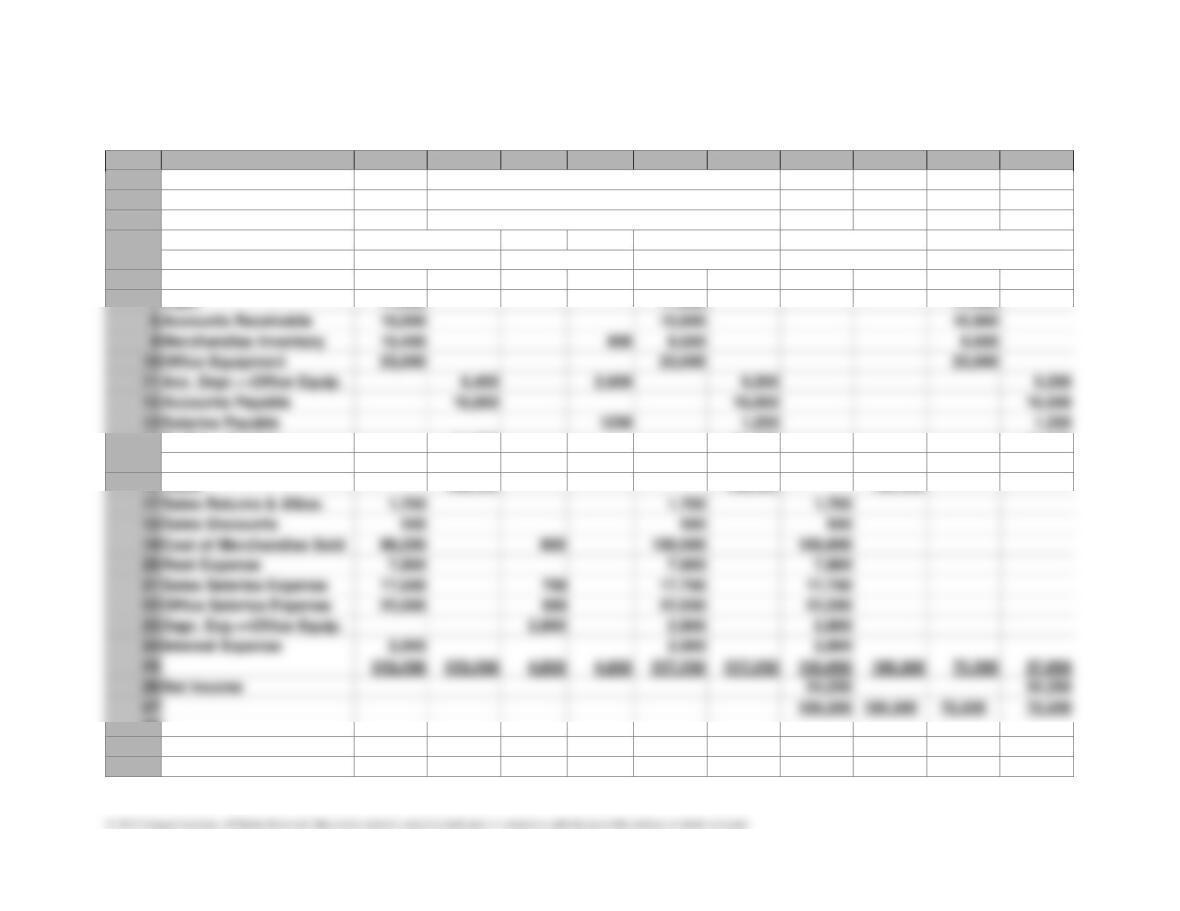
Handout 6-1
A
B
C
D
E
F
G
H
I
J
K
1
Gem City Music
2
End-of-Period Spreadsheet (Work Sheet)
3
For the Year Ended December 31, 20—
4
Unadjusted
Adjusted
Income
Balance
5
Trial Balance
Adjustments
Trial Balance
Statement
Sheet
6
Account Title
Dr.
Cr.
Dr.
Cr.
Dr.
Cr.
Dr.
Cr.
Dr.
Cr.
7
Cash
11,000
11,000
11,000
8
Accounts Receivable
15,800
15,800
15,800
9
Merchandise Inventory
10,400
10
Office Equipment
23,000
23,000
23,000
11
Acc. Depr.—Office Equip.
12
Accounts Payable
16,000
16,000
16,000
13
Salaries Payable
14
M. Marx, Capital
11,500
11,500
11,500
15
M. Marx, Drawing
12,800
12,800
12,800
16
Sales
189,300
189,300
189,300
17
Sales Returns & Allow.
18
Sales Discounts
19
Cost of Merchandise Sold
99,200
100,000
20
Rent Expense
21
Sales Salaries Expense
17,000
17,700
22
Office Salaries Expense
22,000
22,550
23
Depr. Exp.—Office Equip.
24
Interest Expense
25
223,200
223,200
227,250
227,250
155,050
189,300
72,200
37,950
26
Net Income
34,250
34,250
27
189,300
72,200
28
29
30
DIFFICULTY
BUSPROG
AICPA AICPA ACBSP ACBSP ACBSP ACBSP BLOOM’S TIME
Problem
Learning
Objective
Description Primary
Broad
Business
Functional Primary Secondary Teritary Quaternary
Spread-
sheet
GL
DQ6-1 6-1 Easy Analytic Measurement Purpose Knowledge 5 min.
DQ6-2 6-1 Easy Analytic Measurement
Knowledge 5 min.
DQ6-8 6-2 Easy Analytic Measurement Purpose Knowledge 5 min.
DQ6-5 6-3 Easy Analytic Measurement
Receivables
Reporting
Knowledge 5 min.
DQ6-3 6-3 Easy Analytic Measurement
Receivables
Reporting
Knowledge 5 min.
Receivables
Reporting
Knowledge 5 min.
Inventories
DQ6-6 6-3 Easy Analytic Measurement
Reporting
Knowledge 5 min.
DQ6-7 6-2 Easy Analytic Measurement
Inventories
Reporting
Knowledge 5 min.
DQ6-9 6-2 Easy Analytic Measurement
Inventories
Reporting
Application 5 min.
Inventories
Reporting
Application 5 min.
Inventories
PE6-1A 6-1 Gross profit Easy Analytic Measurement
Reporting
Application 5 min.
PE6-1B 6-1 Gross profit Easy Analytic Measurement
Inventories
Reporting
Application 5 min.
Inventories
Receivables
PE6-3A 6-2 Sales transactions Easy Analytic Measurement
Reporting
Reporting
Application 5 min.
PE6-3B 6-2 Sales transactions Easy Analytic Measurement
Inventories
Reporting
Receivables
Reporting
Application 5 min.
PE6-2A 6-2 Purchase transactions Easy Analytic Measurement
Inventories
Reporting
Application 5 min.
PE6-2B 6-2 Purchase transactions Easy Analytic Measurement
Inventories
Reporting
Application 5 min.
Inventories
PE6-4A 6-2 Freight terms Easy Analytic Measurement
Reporting
Application 5 min.
PE6-4B 6-2 Freight terms Easy Analytic Measurement
Inventories
Reporting
Application 5 min.
Inventories
PE6-5A 6-2 Transactions for buyer and seller Easy Analytic Measurement
Reporting
Application 5 min.
PE6-5B 6-2 Transactions for buyer and seller Easy Analytic Measurement
Inventories
Reporting
Application 5 min.
PE6-6A 6-4 Inventory shrinkage Easy Analytic Measurement
Inventories
Reporting
Application 5 min.
PE6-6B 6-4 Inventory shrinkage Easy Analytic Measurement
Reporting
Application 5 min.
Financial
Statement
Inventories
PE6-7A 6-5 Ratio of net sales to assets Moderate Analytic Measurement
Analysis
Application 10 min.
PE6-7B 6-5 Ratio of net sales to assets Moderate Analytic Measurement
Financial
Statement
Analysis
Application 10 min.
HOMEWORK CHART WITH LEARNING OUTCOMES TAGGING
DIFFICULTY
BUSPROG
AICPA AICPA ACBSP ACBSP ACBSP ACBSP BLOOM’S TIME
Problem
Learning
Objective
Description Primary
Broad
Business
Functional Primary Secondary Teritary Quaternary
Spread-
sheet
GL
Ex6-2 6-1
Determining cost of merchandise
sold
Easy Analytic Measurement
Inventories
Reporting
Application 5 min.
Ex6-20 6-3 Income statement for merchandiser Easy Analytic Measurement
Inventories
Reporting
Financial
Application 5 min.
Inventories
Financial
Ex6-21 6-3 Income statement for merchandiser Easy Analytic Measurement
Reporting
Statements
Knowledge 5 min.
Ex6-25 6-3 Single-step income statement Easy Analytic Measurement
Financial
Statements
Application 10 min.
Ex6-24 6-3 Multiple-step income statement Moderate Analytic Measurement
Financial
Statements
Application 15 min.
Ex6-22 6-3
omitted from income statement
Moderate Analytic Measurement
Financial
Statements
Application 15 min.
Financial
Ex6-23 6-3 Multiple-step income statement Moderate Analytic Measurement
Statements
Application 30 min. X
Ex6-16 6-2 Chart of accounts Easy Analytic Measurement Purpose Knowledge 20 min.
Ex6-8 6-2
Sales-related transactions, including
the use of credit cards
Easy Analytic Measurement
Inventories
Reporting
Application 20 min.
Ex6-9 6-2 Sales returns and allowances Easy Analytic Measurement
Inventories
Reporting
Application 10 min.
Inventories
Ex6-10 6-2 Sales-related transactions Easy Analytic Measurement
Reporting
Application 10 min.
Ex6-11 6-2 Sales-related transactions Easy Analytic Measurement
Inventories
Reporting
Application 10 min.
Ex6-12 6-2 Sales-related transactions Easy Analytic Measurement
Inventories
Reporting
Application 10 min.
Ex6-3 6-2 Purchase-related transaction Easy Analytic Measurement
Inventories
Reporting
Application 10 min.
Inventories
Ex6-4 6-2 Purchase-related transactions Easy Analytic Measurement
Reporting
Application 5 min.
Ex6-5 6-2 Purchase-related transactions Easy Analytic Measurement
Inventories
Reporting
Application 10 min.
Ex6-6 6-2 Purchase-related transactions Easy Analytic Measurement
Inventories
Reporting
Application 10 min.
Ex6-7 6-2 Purchase-related transactions Moderate Analytic Measurement
Inventories
Reporting
Application 15 min.
Inventories
Ex6-13 6-2
invoices
Moderate Analytic Measurement
Reporting
Application 15 min.
Ex6-17 6-2 Sales tax Easy Analytic Measurement
Inventories
Reporting
Application 10 min.
Ex6-18 6-2 Sales tax transactions Easy Analytic Measurement
Inventories
Reporting
Application 10 min.
Ex6-14 6-2 Sales-related transactions Easy Analytic Measurement
Inventories
Reporting
Application 10 min.
Inventories
Ex6-15 6-2 Purchase-related transactions Easy Analytic Measurement
Reporting
Application 10 min.
Ex6-19 6-2
Normal balances of merchandise
accounts
Easy Analytic Measurement
Inventories
Reporting
Application 5 min.
Ex6-26 6-4
inventory shrinkage
Easy Analytic Measurement
Inventories
Reporting
DIFFICULTY
BUSPROG
AICPA AICPA ACBSP ACBSP ACBSP ACBSP BLOOM’S TIME
Problem
Learning
Objective
Description Primary
Broad
Business
Functional Primary Secondary Teritary Quaternary
Spread-
sheet
GL
Ex6-28 6-4 Closing entries; net income Easy Analytic Measurement
Inventories
Reporting
Closing Entries Application 10 min.
Financial
Statement
Ex6-30 6-5 Ratio of net sales to assets Moderate Analytic Measurement
Analysis
Application 15 min.
Ex6-31 6-5 Ratio of net sales to assets Moderate Analytic Measurement
Analysis
Application 15 min.
determining cost of merchandise
Financial
Financial
Statement
Ex6-32 Appendix
sold
Moderate Analytic Measurement
Statements
Knowledge 10 min.
Ex6-33 Appendix
Cost of merchandise sold and
related items
Moderate Analytic Measurement
Financial
Statements
Inventories
Reporting
Application 10 min.
Ex6-34 Appendix Cost of merchandise sold Moderate Analytic Measurement
Financial
Statements
Inventories
Reporting
Application 15 min.
Financial
Inventories
Financial
Inventories
Ex6-36 Appendix Cost of merchandise sold Moderate Analytic Measurement
Statements
Reporting
Application 15 min.
Ex6-37 Appendix
Rules of debit and credit for periodic
inventory accounts
Easy Analytic Measurement
Financial
Statements
Inventories
Reporting
Application 5 min.
Ex6-38 Appendix
Journal entries using the periodic
inventory system
Moderate Analytic Measurement
Inventories
Reporting
Application 15 min.
Ex6-39 Appendix
Journal entries using perpetual
inventory system
Moderate Analytic Measurement
Inventories
Reporting
Application 15 min.
Closing entries using periodic
Inventories
Ex6-40 Appendix
inventory system
Moderate Analytic Measurement
Reporting
Application 15 min.
Pr6-5A 6-3
Multiple-step income statement and
report form of balance sheet
Moderate Analytic Measurement
Financial
Statements
Application
1.5
hours
X X
Pr6-6A 6-3
Single-step income statement and
account form of balance sheet
Moderate Analytic Measurement
Financial
Statements
Application 1 hour X
Pr6-2A 6-2 Sales-related transactions Moderate Analytic Measurement
Recording
Transactions
Application 45 min. X X
Recording
Pr6-1A 6-2 Purchase-related transactions Moderate Analytic Measurement
Transactions
Application 45 min. X
Pr6-3A 6-2
Sales-related and purchase-related
transactions
Challenging Analytic Measurement
Recording
Transactions
Application
1.5
hours
X
Pr6-4A 6-2
Sales-related and purchase-related
transactions for buyer and seller
Challenging Analytic Measurement
Recording
Transactions
Application 2 hours
periodic inventory system
Reporting
Application 45 min.
transactions using periodic inventory
Recording
Inventories
Purchase-related transactions using
Recording
Inventories
Pr6-8A Appendix
system
Challenging Analytic Measurement
Transactions
Reporting
Application
hours
Pr6-9A Appendix
using periodic inventory system
Challenging Analytic Measurement
Transactions
Reporting
Application 2 hours
Sales-related and purchase-related
transactions for buyer and seller
Recording
Inventories
Pr6-10A Appendix
closing entries
Challenging Analytic Measurement
Reporting
Statements
Entries
Application 2 hours X
DIFFICULTY
BUSPROG
AICPA AICPA ACBSP ACBSP ACBSP ACBSP BLOOM’S TIME
Problem
Learning
Objective
Description Primary
Broad
Business
Functional Primary Secondary Teritary Quaternary
Spread–
sheet
GL
Pr6-5B 6-3
Multiple-step income statement and
report form of balance sheet
Moderate Analytic Measurement
Financial
Statements
Application
1.5
hours
X X
Pr6-6B 6-3
Single-step income statement and
account form of balance sheet
Moderate Analytic Measurement
Financial
Statements
Application 1 hour X
Pr6-2B 6-2 Sales-related transactions Moderate Analytic Measurement
Recording
Transactions
Application 45 min. X X
Recording
Pr6-1B 6-2 Purchase-related transactions Moderate Analytic Measurement
Transactions
Application 45 min. X
Pr6-3B 6-2
Sales-related and purchase-related
transactions
Challenging Analytic Measurement
Recording
Transactions
Application
hours
Sales-related and purchase-related
Recording
Pr6-4B 6-2
transactions for seller and buyer
Challenging Analytic Measurement
Transactions
Application 2 hours
Pr6-7B Appendix
periodic inventory method
Moderate Analytic Measurement
Transactions
Application 45 min.
Sales-related and purchase-related
transactions using periodic inventory
Recording
1.5
Purchase-related transactions using
Recording
Pr6-8B Appendix
system
Challenging Analytic Measurement
Transactions
Application
hours
Pr6-9B Appendix
using periodic inventory system
Challenging Analytic Measurement
Transactions
Application 2 hours
Periodic inventory accounts,
multiple-step income statement,
Inventories
Sales-related and purchase-related
transactions for buyer and seller
Recording
Pr6-10B Appendix
closing entries
Challenging Analytic Measurement
Reporting
Application 2 hours X
Comp
Problem
2
6-2, 6-3, 6-
4
Journalize entries, adjusted trial
balance, financial statements,
closing entries, post-closing trial
balance
Challenging Analytic Measurement
Recording
Transactions
Adjusting Entries
Financial
Statements
Closing
Entries
Application 3 hours X
business
Transactions
Statement
Ethics and professional conduct in
Recording
CP6-2 6-2
payable
Easy Analytic Measurement
Analysis
Analysis 10 min.
CP6-3 6-2 Determining cost of purchase Moderate Analytic Measurement
Inventories
Reporting
Application 15 min.
CP6-4 6-2 Sales discounts Challenging Analytic Measurement
Inventories
Reporting
Application 30 min.
CP6-5 6-2 Shopping for a television Moderate Analytic Measurement
Reporting
Analysis 30 min.