6-21
6-28 (15 min.) Responsibility, controllability, and stretch targets.
Consider each of the following independent situations for Happy Tours, a company owned by
Jason Haslett that sells motor coach tours to schools and other groups. Happy Tours owns a fleet
of 10 motor coaches and employs 12 drivers, 1 maintenance technician, 3 sales representatives,
and an office manager. Happy Tours pays for all fuel and maintenance on the coaches. Drivers
are paid $0.50 per mile while in transit, plus $15 per hour while idle (time spent waiting while
tour groups are visiting their destinations). The maintenance technician and office manager are
both full-time salaried employees. The sales representatives work on straight commission.
1. When the office manager receives calls from potential customers, she is instructed to handle
the contracts herself. Recently, however, the number of contracts written up by the office
manager has declined. At the same time, one of the sales representatives has experienced a
significant increase in contracts. The other two representatives believe that the office
manager has been colluding with the third representative to send him the prospective
customers.
2. One of the motor coach drivers seems to be reaching his destinations more quickly than any
of the other drivers and is reporting longer idle time.
3. Fuel costs have increased significantly in recent months. Driving the motor coaches at 60
miles per hour on the highway consumes significantly less fuel than driving them at 65 miles
per hour.
4. Regular preventive maintenance of the motor coaches has been proven to improve fuel
efficiency and reduce overall operating costs by averting costly repairs. During busy months,
however, it is difficult for the maintenance technician to complete all of the maintenance
tasks within his 40-hour workweek.
5. Jason Haslett has read about stretch targets, and he believes that a change in the
compensation structure of the sales representatives may improve sales. Rather than a straight
commission of 10% of sales, he is considering a system where each representative is given a
monthly goal of 50 contracts. If the goal is met, the representative is paid a 12% commission.
If the goal is not met, the commission falls to 8%. Currently, each sales representative
averages 45 contracts per month.
Required:
For situations 1–4, discuss which employee has responsibility for the related costs and the extent
to which costs are controllable and by whom. What are the risks or costs to the company? What
can be done to solve the problem or improve the situation? For situation 5, describe the potential
benefits and costs of establishing stretch targets.
SOLUTION
6-22
6-29 (30 min.) Cash flow analysis, sensitivity analysis.
Game Depot is a retail store selling video games. Sales are uniform for most of the year but pick
up in June and December both because new releases come out and because consumers purchase
games in anticipation of summer or winter holidays. Game Depot also sells and repairs game
systems. The forecast of sales and service revenue for the March–June 2014 is as follows:
6-23
Almost all the service revenue is paid for by bank credit card, so Game Depot budgets this as
100% bank card revenue. The bank cards charge an average fee of 3% of the total. Half of the
sales revenue is also paid for by bank credit card, for which the fee is also 3% on average. About
10% of the sales are paid in cash, and the rest (the remaining 40%) are carried on a store account.
Although the store tries to give store credit only to the best customers, it still averages about 2%
for uncollectible accounts; 90% of store accounts are paid in the month following the purchase,
and 8% are paid 2 months after purchase.
Required:
1. Calculate the cash that Game Depot expects to collect in May and in June 2014. Show
calculations for each month.
2. Game Depot has budgeted expenditures for May of $8,700 for the purchase of games and
game systems, $2,800 for rent and utilities and other costs, and $2,000 in wages for the two
part-time employees.
a. Given your answer to requirement 1, will Game Depot be able to cover its payments for
May?
b. The projections for May are a budget. Assume (independently for each situation) that
May revenues might also be 5% less and 10% less and that costs might be 8% higher.
Under each of those three scenarios, show the total net cash for May and the amount
Game Depot would have to borrow if cash receipts are less than cash payments. Assume
the beginning cash balance for May is $200.
3. Why do Game Depot’s managers prepare a cash budget in addition to the revenue, expenses,
and operating income budget? Has preparing the cash budget been helpful? Explain briefly.
4. Suppose the costs for May are as described in requirement 2, but the expected cash receipts
for May are $12,400 and beginning cash balance is $200. Game Depot has the opportunity to
purchase the games and game systems on account in May, but the supplier offers the
company credit terms of 2/10 net 30, which means if Game Depot pays within 10 days (in
May) it will get a 2% discount on the price of the merchandise. Game Depot can borrow
money at a rate of 24%. Should Game Depot take the purchase discount?
SOLUTION
6-24
6-25
6-30 (40 min.) Budget schedules for a manufacturer.
Lame Specialties manufactures, among other things, woolen blankets for the athletic teams of the
two local high schools. The company sews the blankets from fabric and sews on a logo patch
purchased from the licensed logo store site. The teams are as follows:
▪ Knights, with red blankets and the Knights logo
▪ Raiders, with black blankets and the Raider logo
Also, the black blankets are slightly larger than the red blankets.
6-26
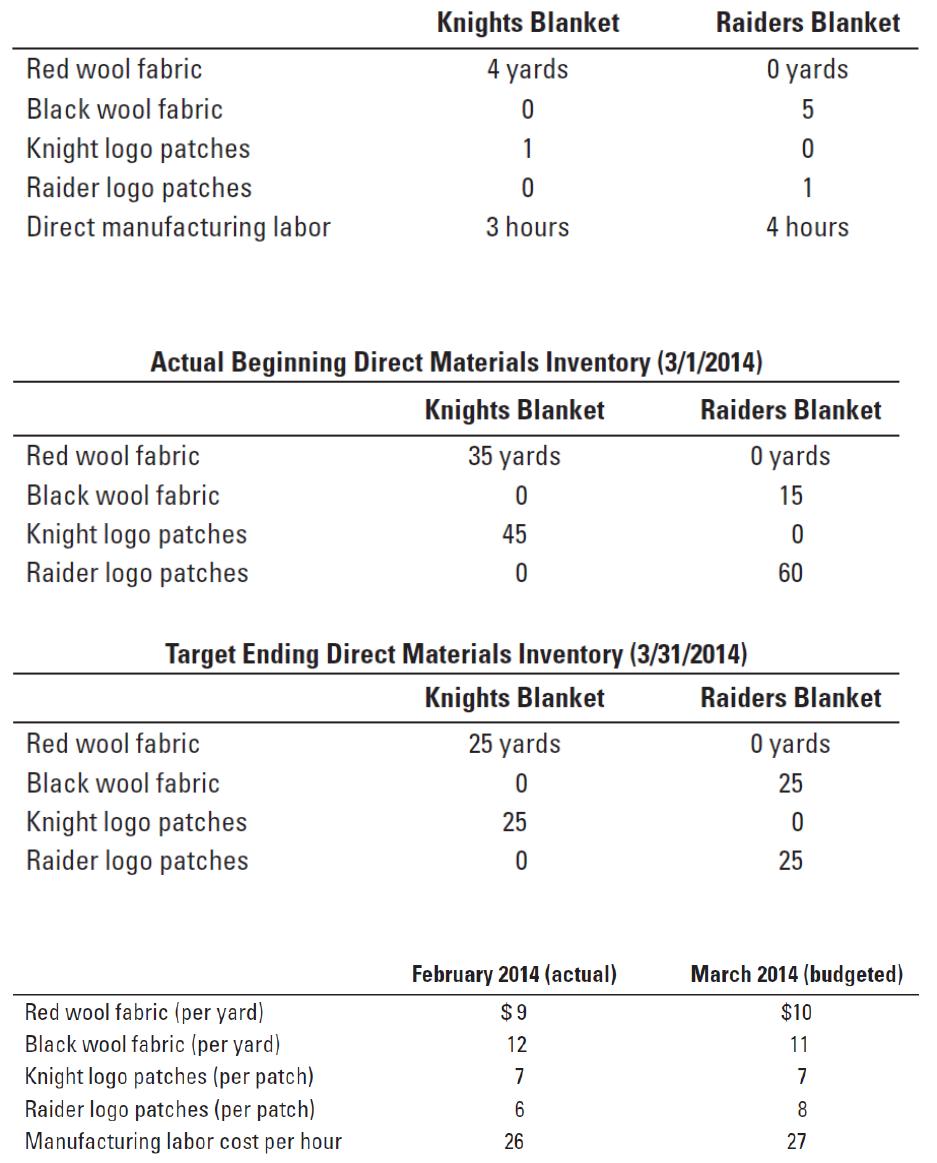
The budgeted direct-cost inputs for each product in 2014 are as follows:
Unit data pertaining to the direct materials for March 2014 are as follows:
Unit cost data for direct-cost inputs pertaining to February 2014 and March 2014 are as follows:

6-27
Manufacturing overhead (both variable and fixed) is allocated to each blanket on the basis of
budgeted direct manufacturing labor-hours per blanket. The budgeted variable manufacturing
overhead rate for March 2014 is $16 per direct manufacturing labor-hour. The budgeted fixed
manufacturing overhead for March 2014 is $14,640. Both variable and fixed manufacturing
overhead costs are allocated to each unit of finished goods.
Data relating to finished goods inventory for March 2014 are as follows:
Budgeted sales for March 2014 are 130 units of the Knights blankets and 190 units of the
Raiders blankets. The budgeted selling prices per unit in March 2014 are $229 for the Knights
blankets and $296 for the Raiders blankets. Assume the following in your answer:
▪ Work-in-process inventories are negligible and ignored.
▪ Direct materials inventory and finished goods inventory are costed using the FIFO method.
▪ Unit costs of direct materials purchased and finished goods are constant in March 2014.
Required:
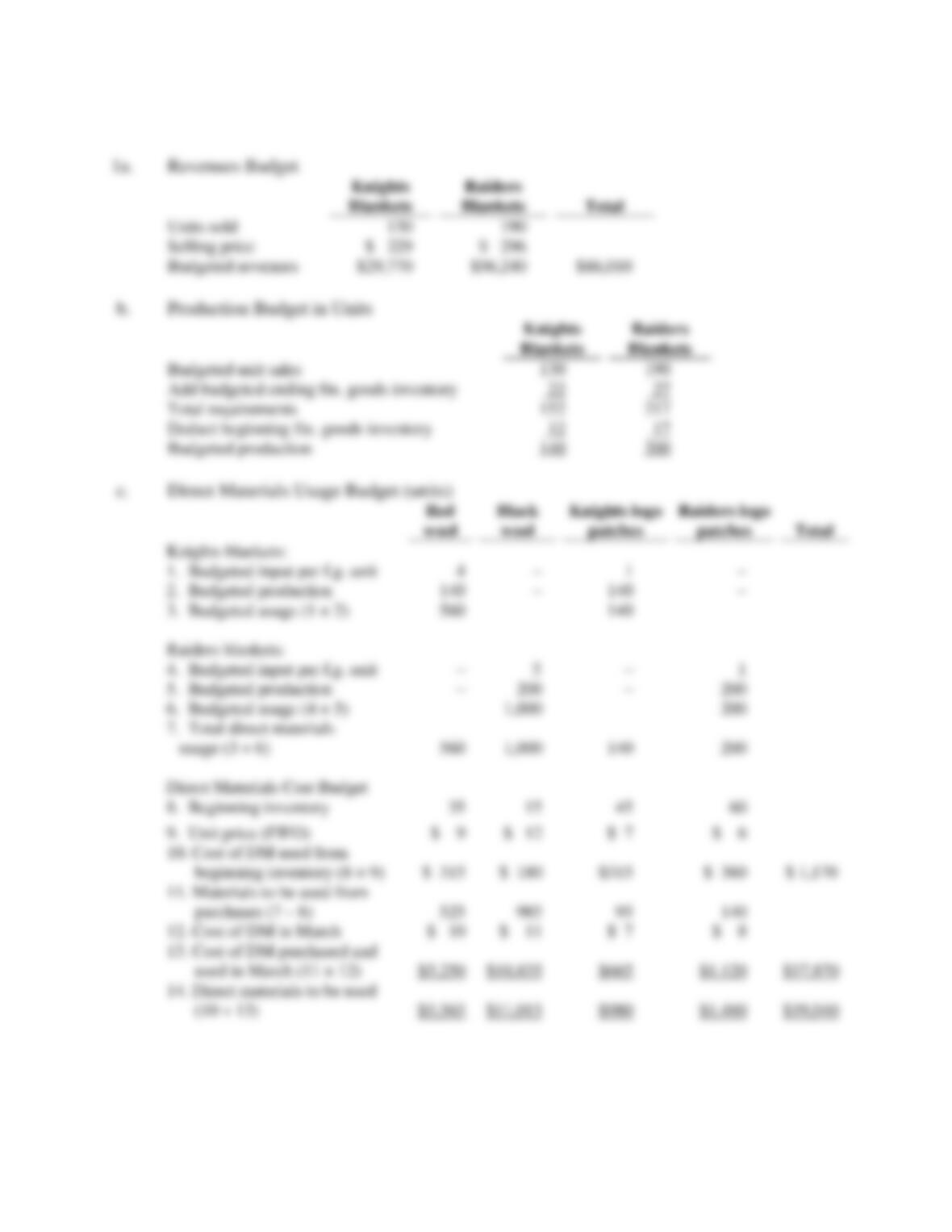
1. Prepare the following budgets for March 2014:
a. Revenues budget
b. Production budget in units
c. Direct material usage budget and direct material purchases budget
d. Direct manufacturing labor budget
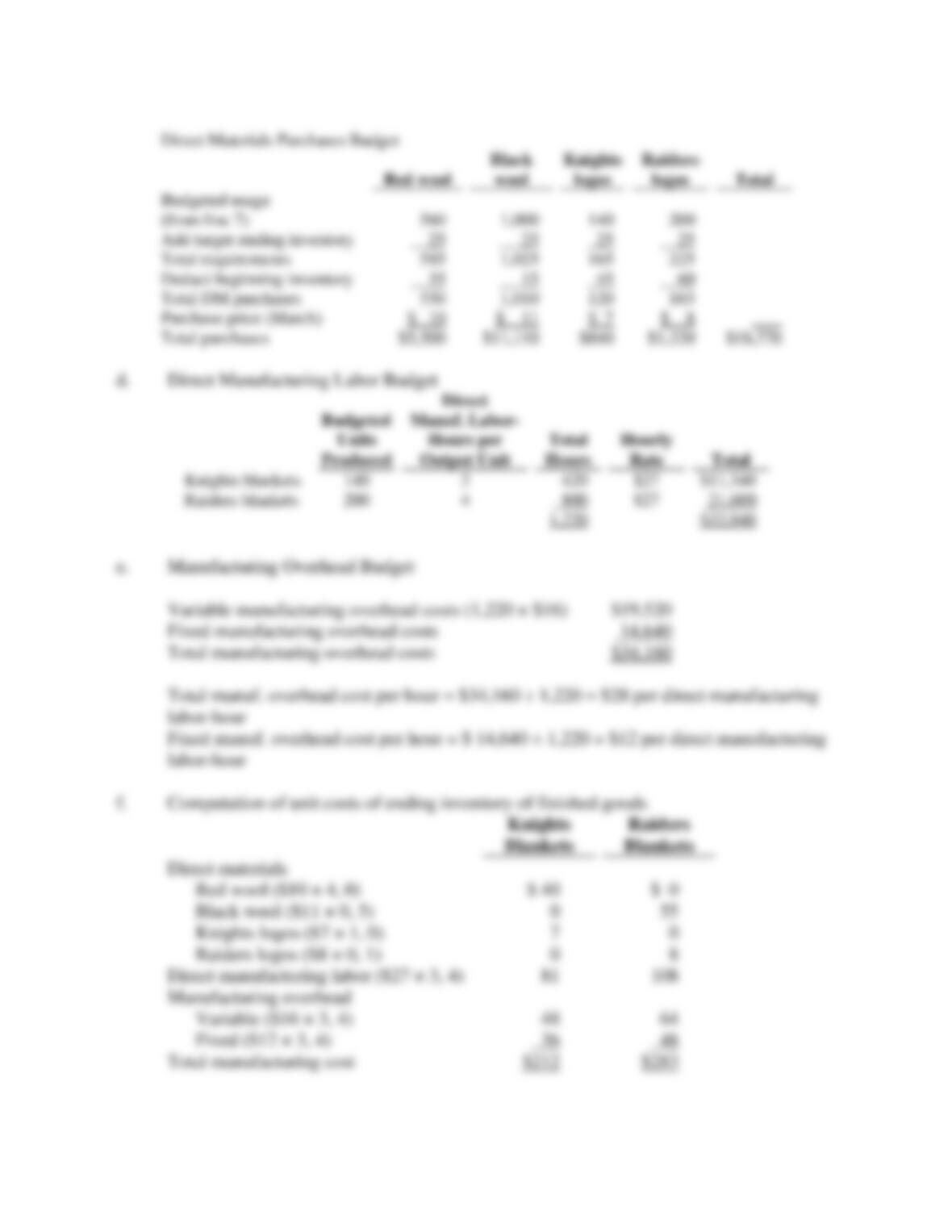
e. Manufacturing overhead budget
f. Ending inventories budget (direct materials and finished goods)
g. Cost of goods sold budget
2. Suppose Lame Specialties decides to incorporate continuous improvement into its budgeting
process. Describe two areas where it could incorporate continuous improvement into the
budget schedules in requirement 1.
6-28
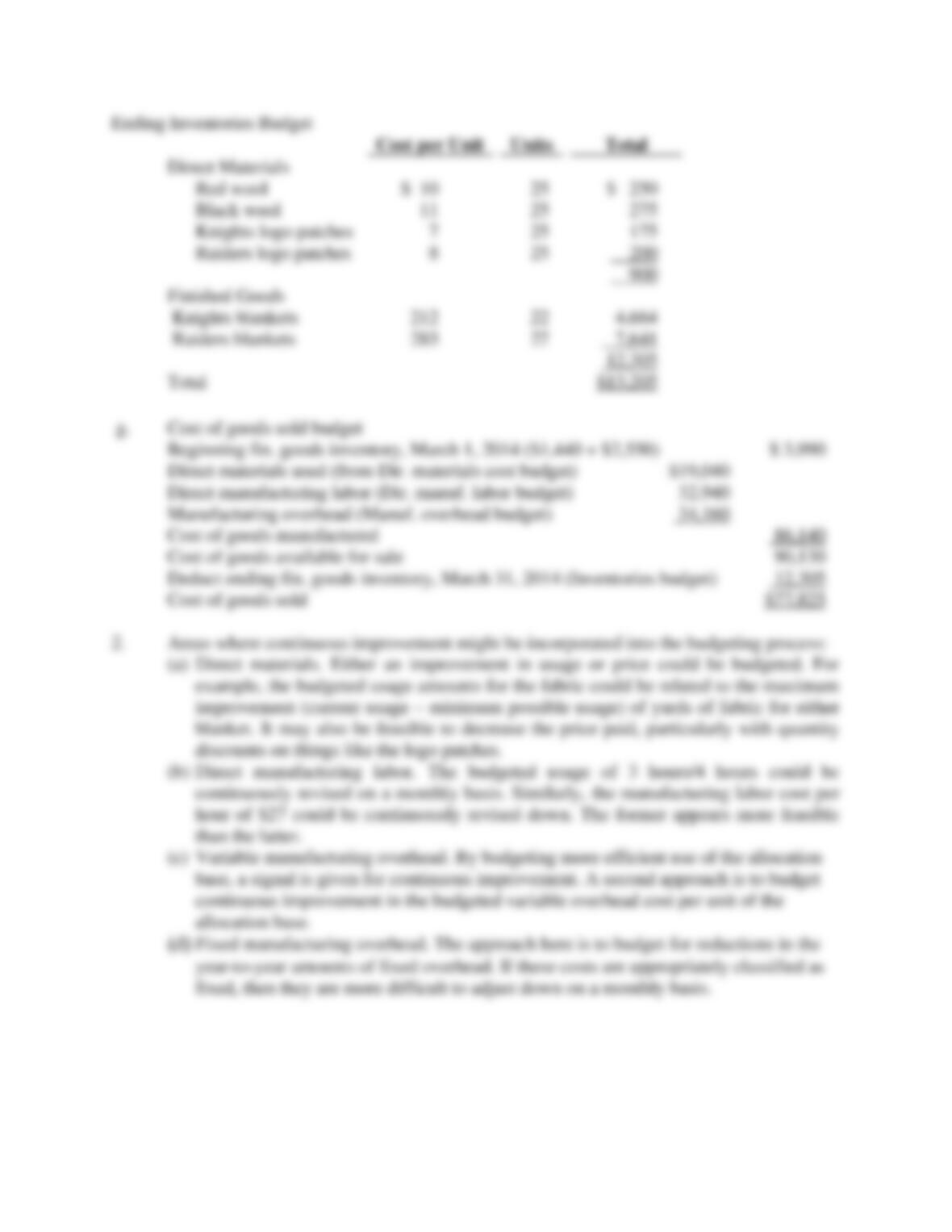
SOLUTION
6-29
6-30
6-31
6-31 (45 min.) Budgeted costs, Kaizen improvements.
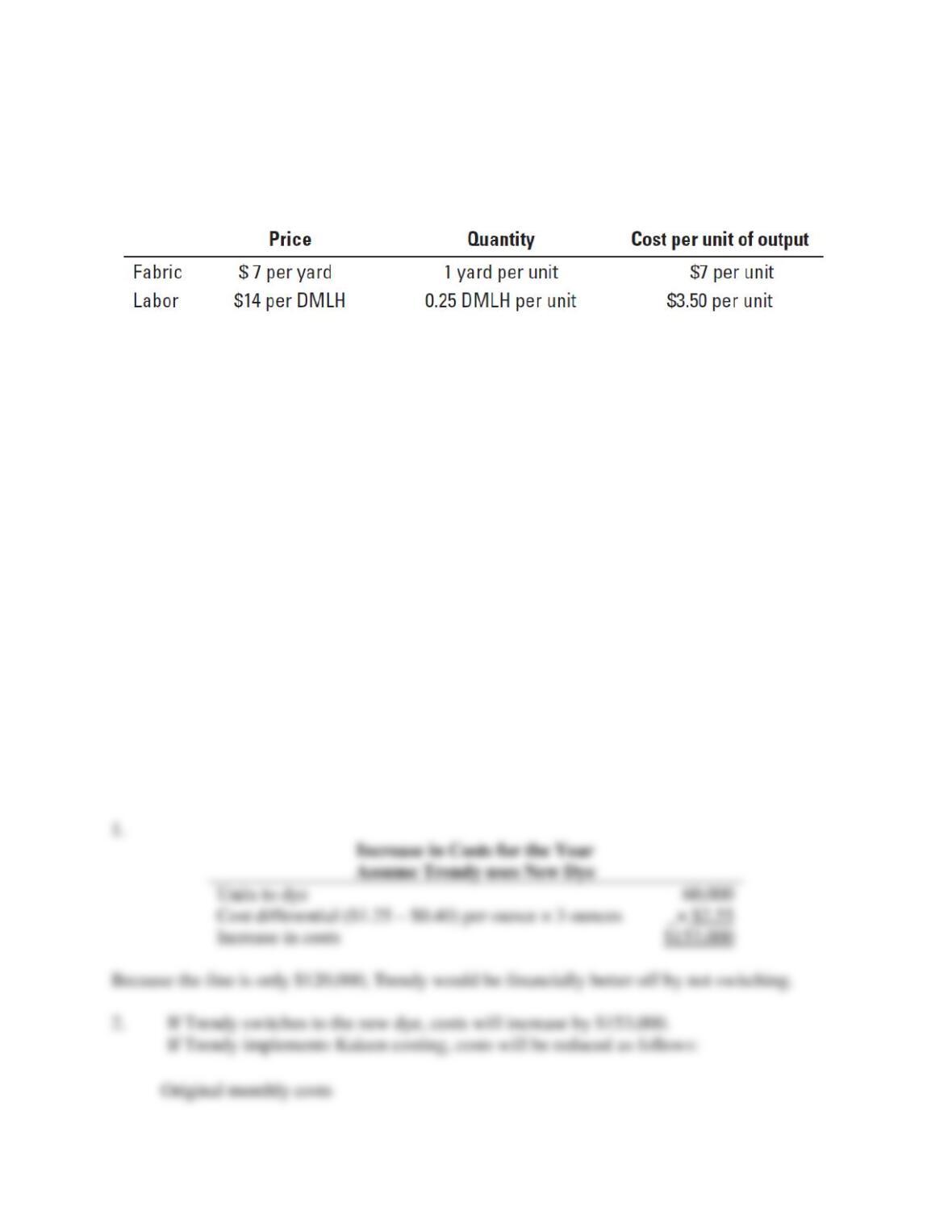
Trendy T-Shirt Factory manufactures plain white and solid– colored T-shirts. Inputs include the
following:
Additionally, the colored T-shirts require 3 ounces of dye per shirt at a cost of $0.40 per ounce.
The shirts sell for $14 each for white and $18 each for colors. The company expects to sell
12,000 white T-shirts and 60,000 colored T-shirts uniformly over the year.
Trendy has the opportunity to switch from using the dye it currently uses to using an
environmentally friendly dye that costs $1.25 per ounce. The company would still need 3 ounces
of dye per shirt. Trendy is reluctant to change because of the increase in costs (and decrease in
profit), but the Environmental Protection Agency has threatened to fine the company $120,000 if
it continues to use the harmful but less expensive dye.
Required:
1. Given the preceding information, would Trendy be better off financially by switching to the
environmentally friendly dye? (Assume all other costs would remain the same.)
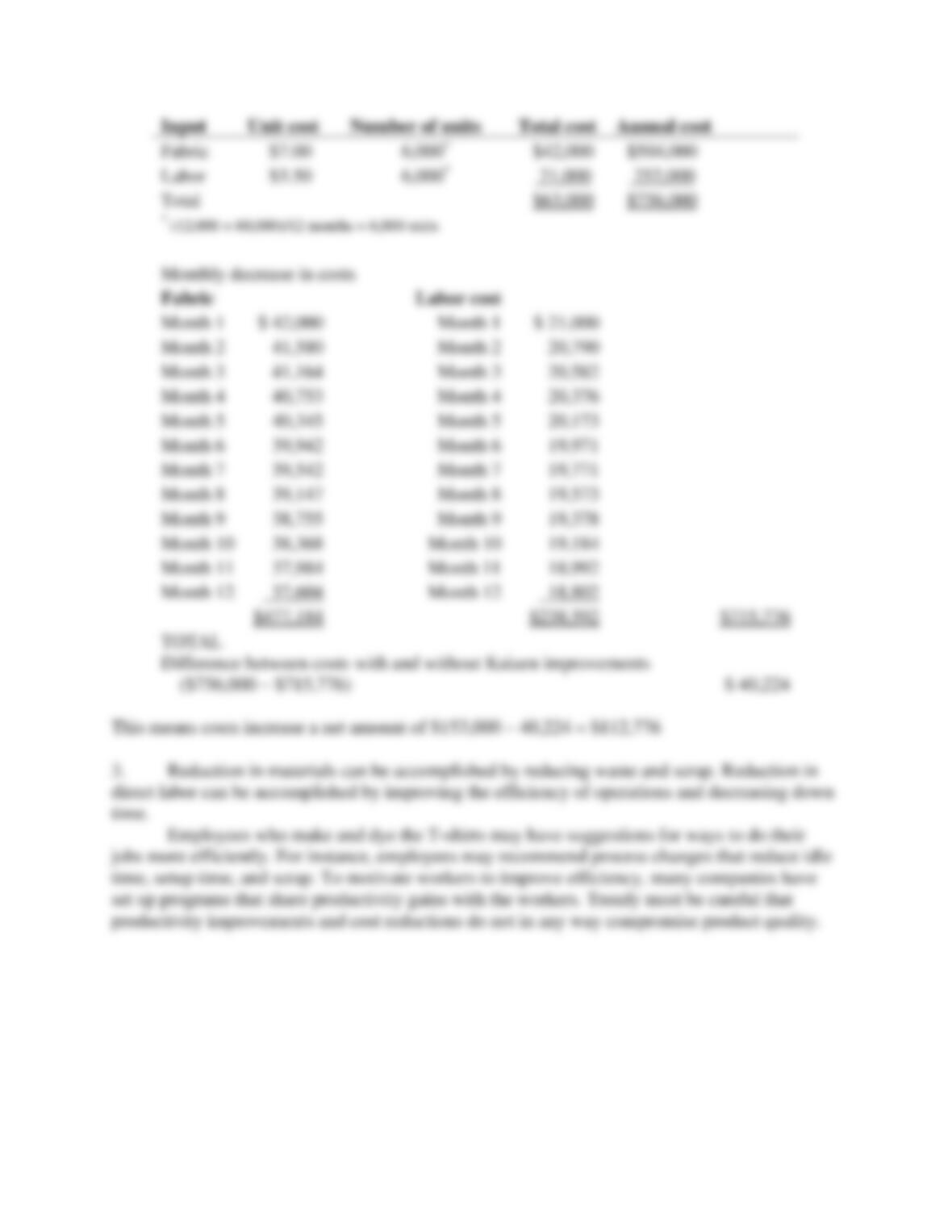
2. Assume Trendy chooses to be environmentally responsible regardless of cost, and it switches
to the new dye. The production manager suggests trying Kaizen costing. If Trendy can
reduce fabric and labor costs each by 1% per month, how close will it be at the end of 12
months to the profit it would have earned before switching to the more expensive dye?
(Round to the nearest dollar for calculating cost reductions.)
3. Refer to requirement 2. How could the reduction in material and labor costs be
accomplished? Are there any problems with this plan?
SOLUTION
6-32
6-32 (30–40 min.) Revenue and production budgets.
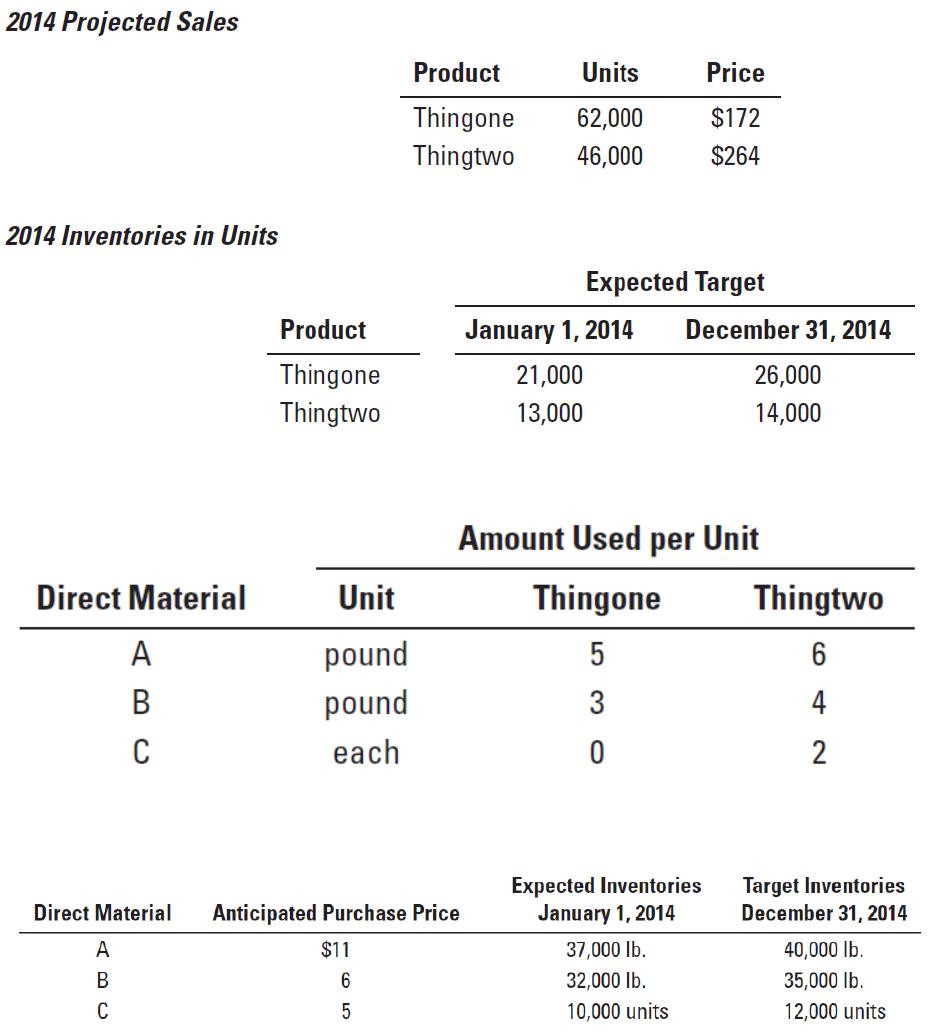
(CPA, adapted) The Sabat Corporation manufactures and sells two products: Thingone and
Thingtwo. In July 2013, Sabat’s budget department gathered the following data to prepare
budgets for 2014:
6-33
The following direct materials are used in the two products:
Projected data for 2014 for direct materials are:
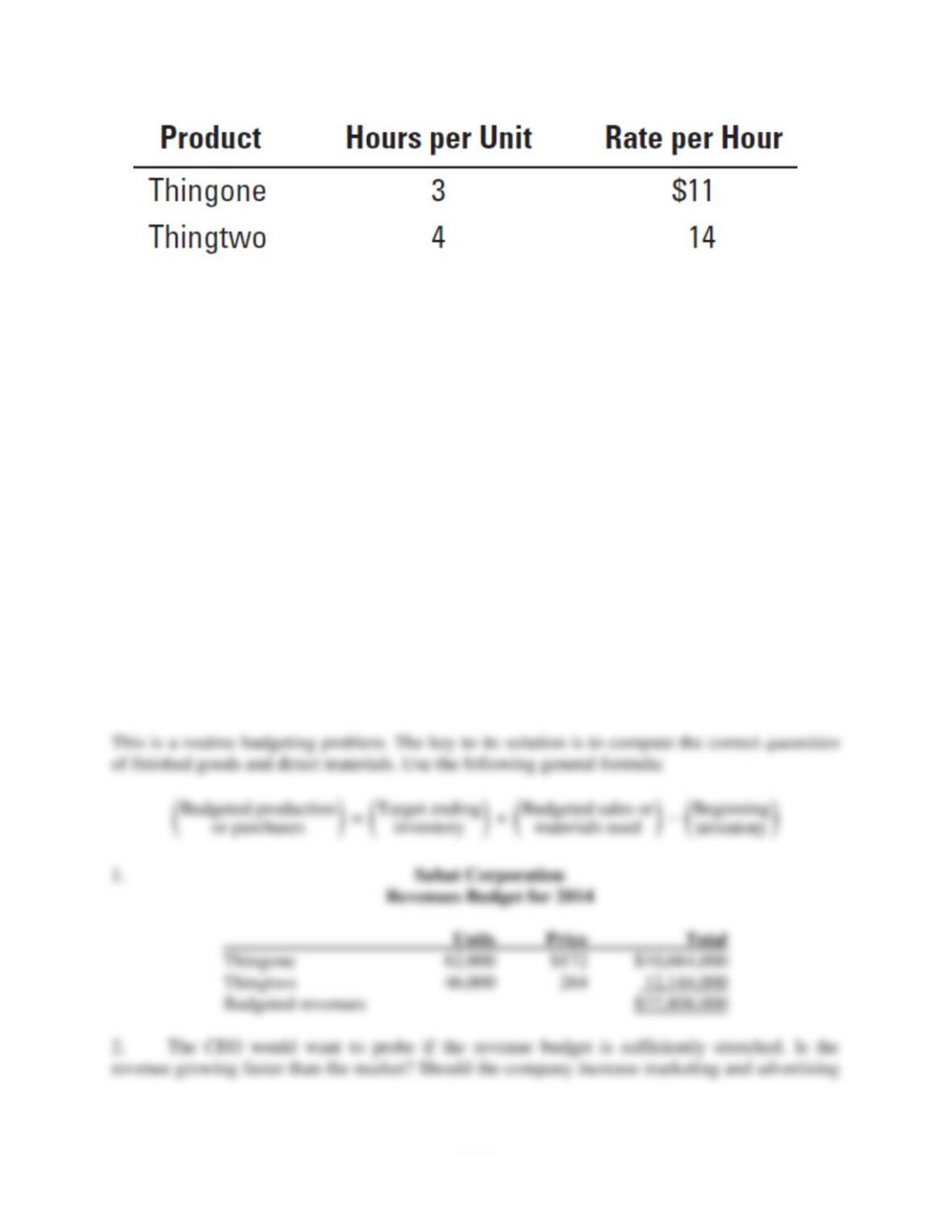
Projected direct manufacturing labor requirements and rates for 2014 are:
6-34
Manufacturing overhead is allocated at the rate of $19 per direct manufacturing labor-hour.
Based on the preceding projections and budget requirements for Thingone and Thingtwo,
prepare the following budgets for 2014:
Required:
1. Revenues budget (in dollars)
2. What questions might the CEO ask the marketing manager when reviewing the revenues
budget? Explain briefly.
3. Production budget (in units)
4. Direct material purchases budget (in quantities)
5. Direct material purchases budget (in dollars)
6. Direct manufacturing labor budget (in dollars)
7. Budgeted finished goods inventory at December 31, 2014 (in dollars)
8. What questions might the CEO ask the production manager when reviewing the production,
direct materials, and direct manufacturing labor budgets?
9. How does preparing a budget help Sabat Corporation’s top management better manage the
company?
SOLUTION
6-35
6-36
6-37
6-33 (30 min.) Budgeted income statement.
(CMA, adapted) Smart Video Company is a manufacturer of videoconferencing products.
Maintaining the videoconferencing equipment is an important area of customer satisfaction. A
recent downturn in the computer industry has caused the videoconferencing equipment segment
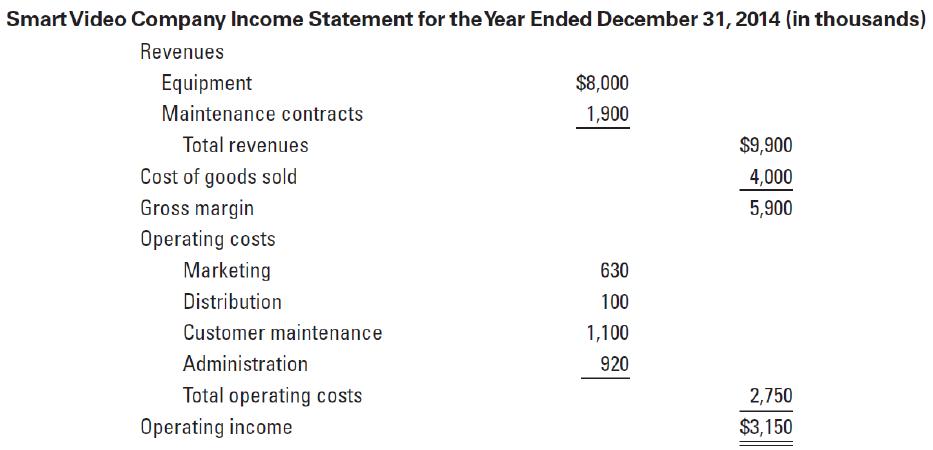
to suffer, leading to a decline in Smart Video’s financial performance. The following income
statement shows results for 2014:
Smart Video’s management team is preparing the 2015 budget and is studying the following
information:
1. Selling prices of equipment are expected to increase by 10% as the economic recovery
begins. The selling price of each maintenance contract is expected to remain unchanged from
2014.
2. Equipment sales in units are expected to increase by 6%, with a corresponding 6% growth in
units of maintenance contracts.
3. Cost of each unit sold is expected to increase by 5% to pay for the necessary technology and
quality improvements.
4. Marketing costs are expected to increase by $290,000, but administration costs are expected
to remain at 2014 levels.
5. Distribution costs vary in proportion to the number of units of equipment sold.
6. Two maintenance technicians are to be hired at a total cost of $160,000, which covers wages
and related travel costs. The objective is to improve customer service and shorten response
time.
7. There is no beginning or ending inventory of equipment.
Required:
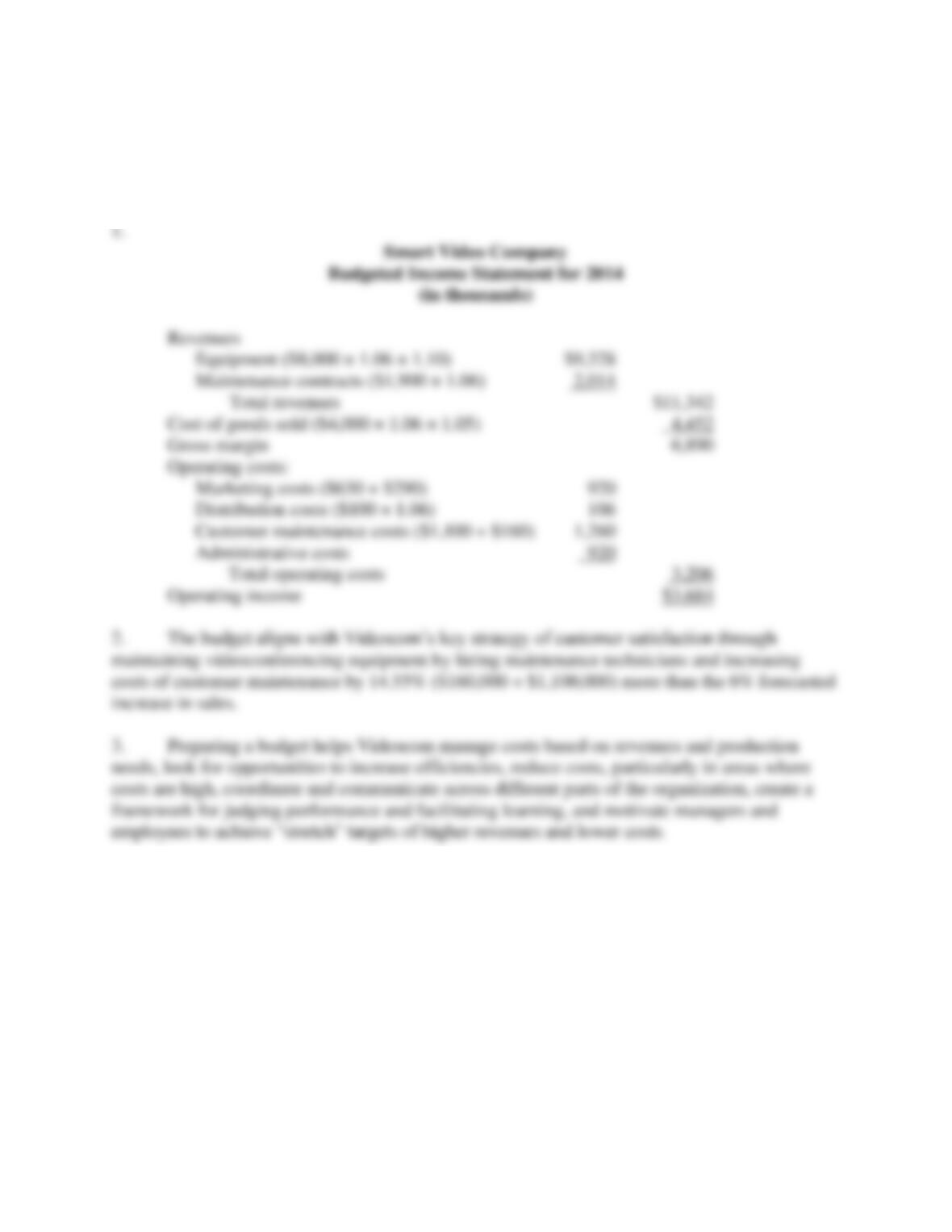
1. Prepare a budgeted income statement for the year ending December 31, 2015.
2. How well does the budget align with Smart Video’s strategy?
6-38
3. How does preparing the budget help Smart Video’s management team better manage the
company?
SOLUTION
6-34 (15 min.) Responsibility of purchasing agent.
Paula Beane owns a restaurant franchise that is part of a chain of “southern homestyle”
restaurants. One of the chain’s popular breakfast items is biscuits and gravy. Central Warehouse
makes and freezes the biscuit dough, which it then sells to the franchise stores where it is thawed
and baked in the individual stores by the cook. Each franchise also has a purchasing agent who
orders the biscuits (and other items) based on expected demand. In March 2015, one of the
freezers in Central Warehouse breaks down and biscuit production is reduced by 25% for 3 days.
During those 3 days, Paula’s franchise runs out of biscuits but demand does not slow down.
Paula’s franchise cook, Betty Baker, sends one of the kitchen helpers to the local grocery store to
buy refrigerated ready-to-bake biscuits. Although the customers are kept happy, the refrigerated
6-39
biscuits cost Paula’s franchise three times the cost of the Central Warehouse frozen biscuits, and
the franchise loses money on this item for those 3 days. Paula is angry with the purchasing agent
for not ordering enough biscuits to avoid running out of stock and with Betty for spending too
much money on the replacement biscuits.
Required:
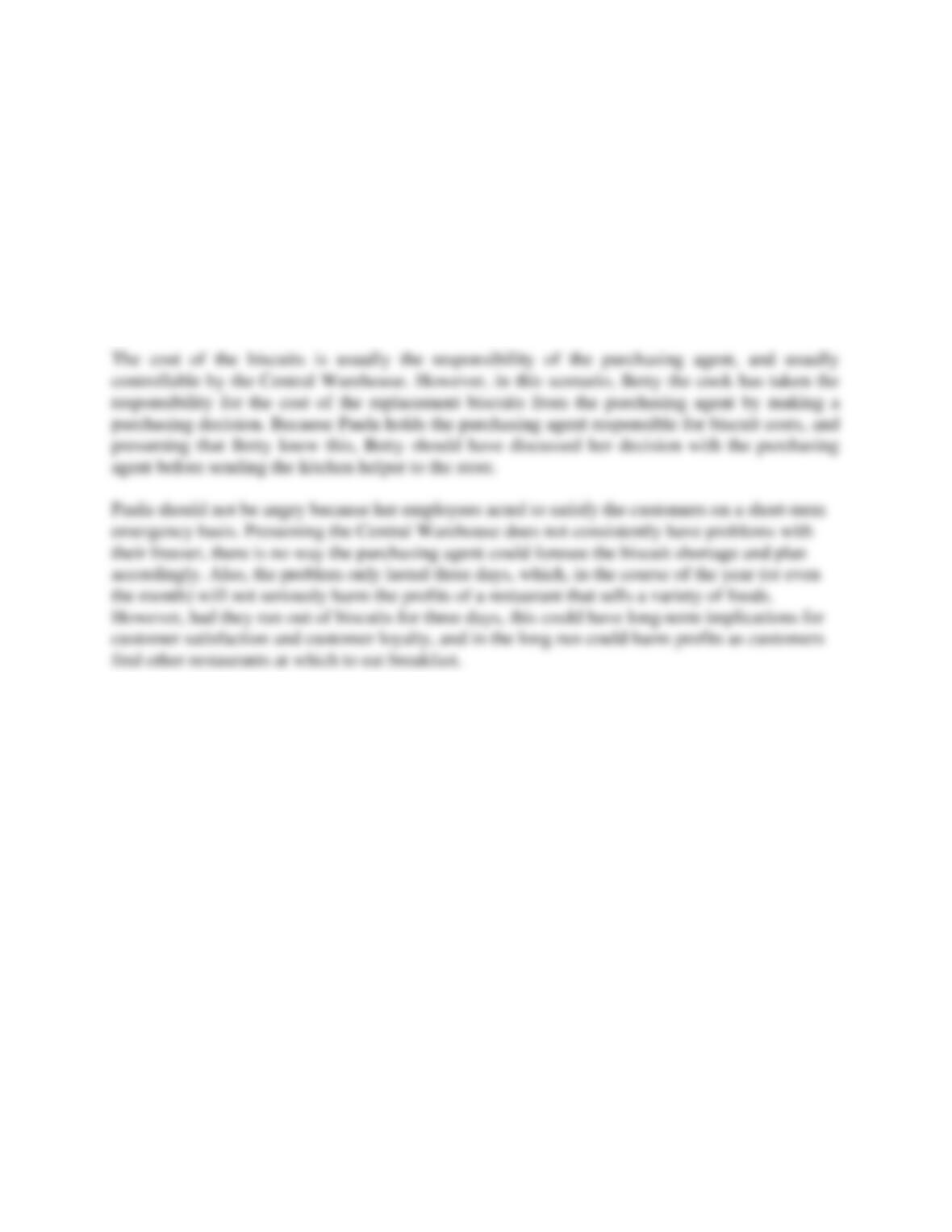
Who is responsible for the cost of the biscuits? At what level is the cost controllable? Do you
agree that Paula should be angry with the purchasing agent? With Betty? Why or why not?
SOLUTION
6-35 (60 min.) Comprehensive problem with ABC costing
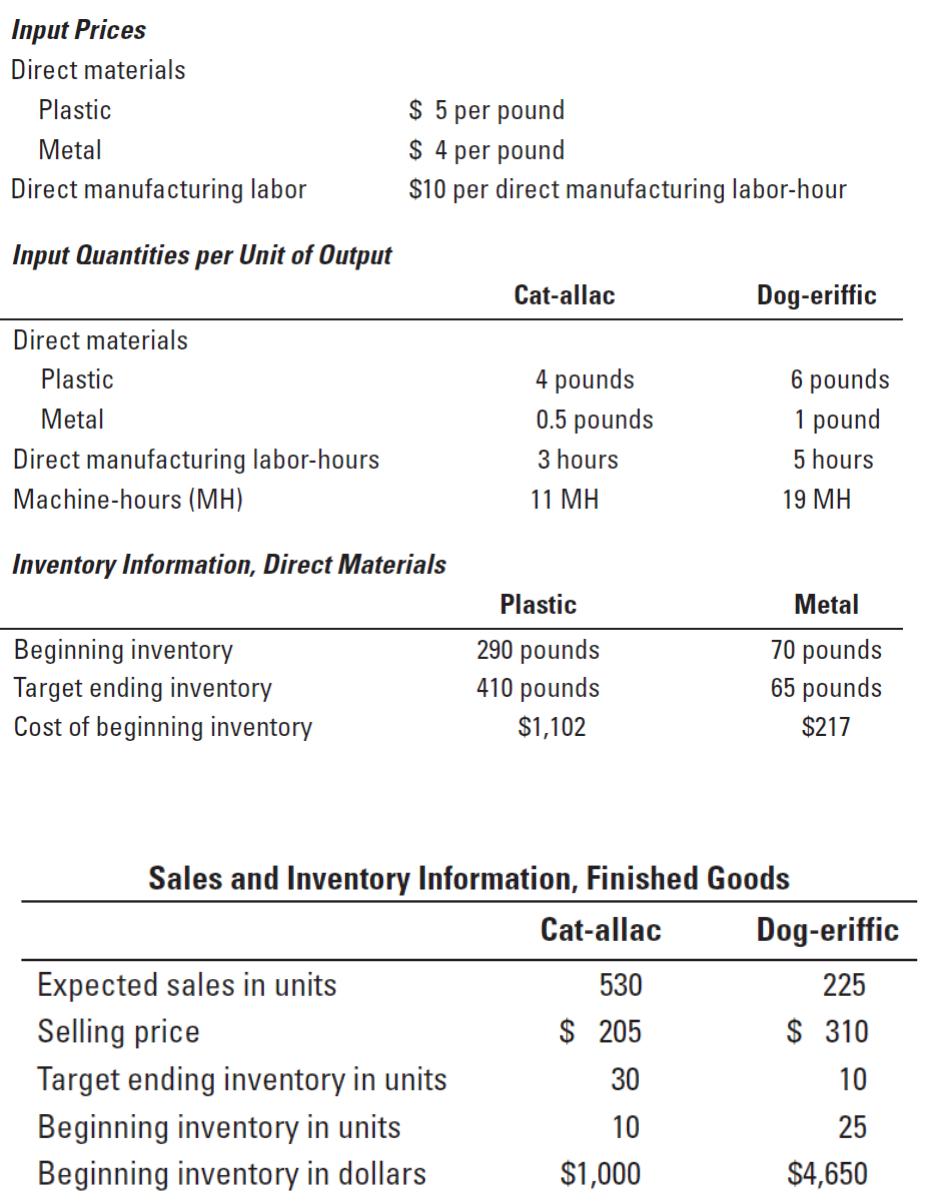
Animal Gear Company makes two pet carriers, the Cat-allac and the Dog-eriffic. They are both
made of plastic with metal doors, but the Cat-allac is smaller. Information for the two products
for the month of April is given in the following tables:
6-40
Animal Gear accounts for direct materials using a FIFO cost flow assumption.
Animal Gear uses a FIFO cost flow assumption for finished goods inventory.