Problem 6-18 (continued)
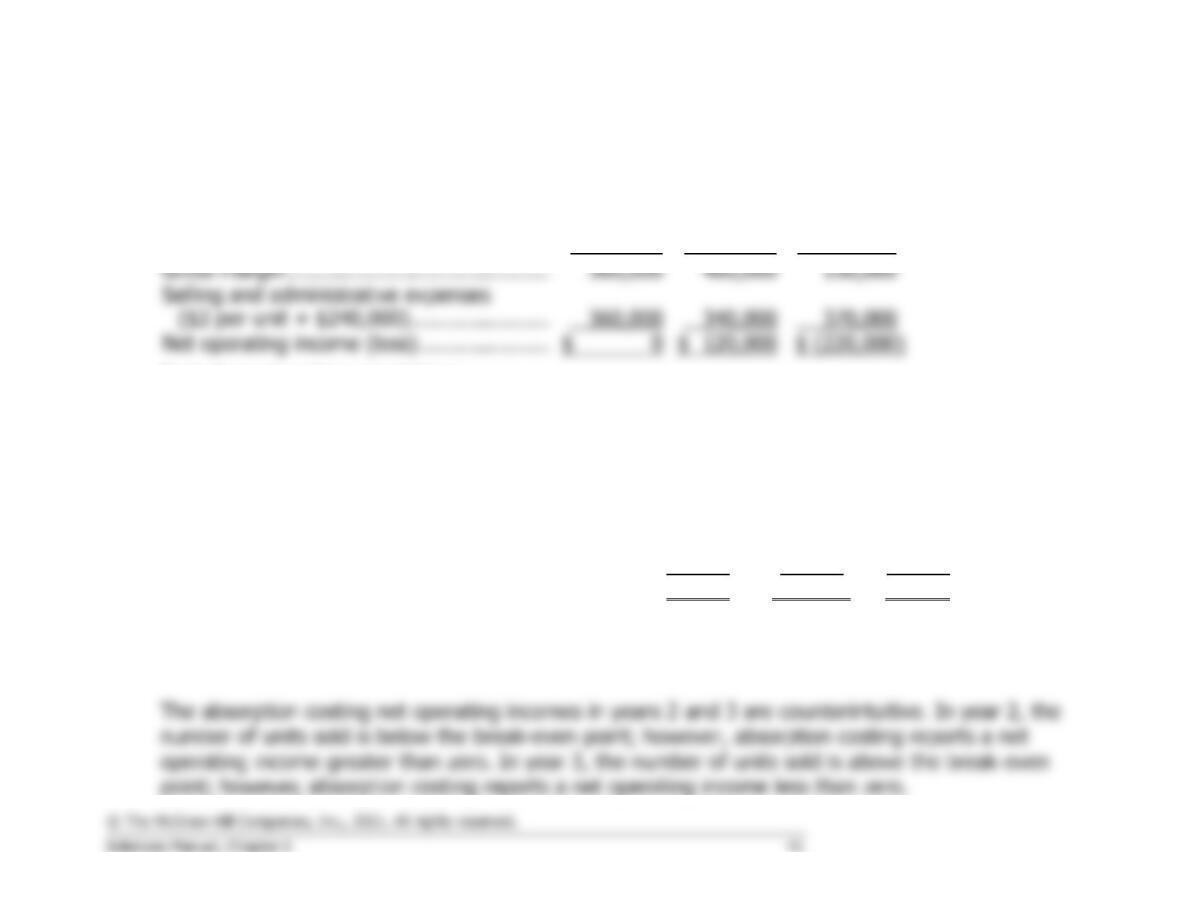
3. b. The absorption costing income statements appear below:
Year 1
Year 2
Year 3
Sales ………………………………………………
$3,480,000
$2,900,000
$3,770,000
Cost of goods sold …………………………….
3,120,000
2,440,000
3,620,000
Gross margin ……………………………………
Net operating income (loss) …………………
Cost of goods sold computations:
Year 1: 60,000 units × $52 per unit = $3,120,000
Year 2: 50,000 units × $48.80 per unit = $2,440,000
Year 3: (25,000 × $48.80 per unit) + (40,000 × $60 per unit) = $3,620,000
4.
Year 1
Year 2
Year 3
Units sold …………………………………………………..
60,000
50,000
65,000
Break-even point in units ……………………………….
60,000
60,000
60,000
Units above (below) break-even point ………………
0
(10,000)
5,000
Variable costing net operating income (loss) ………
$0
$(200,000)
$ 100,000
Absorption costing net operating income (loss) …..
$0
$ 120,000
$(220,000)
Problem 6-19 (30 minutes)
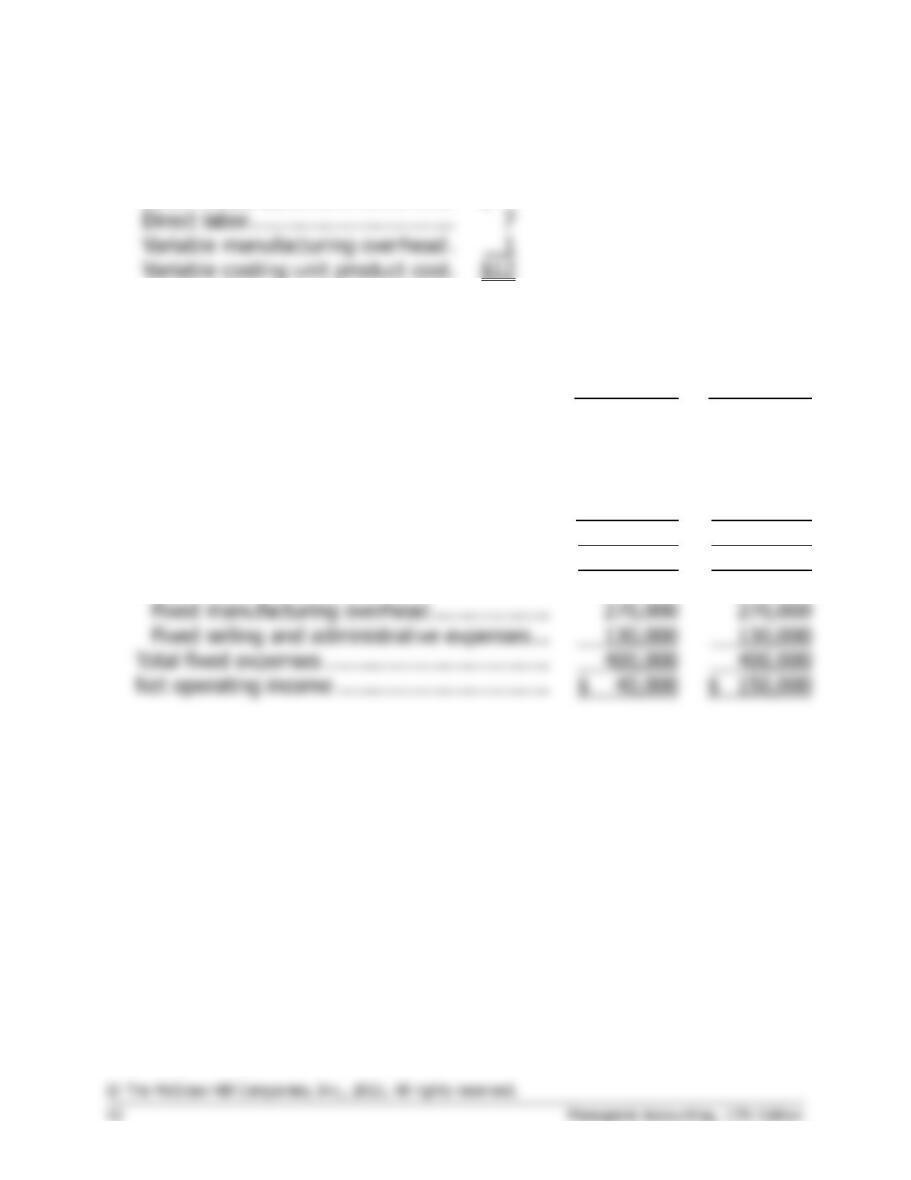
1. The unit product cost under variable costing is computed as follows:
Direct materials ………………………
$ 4
Direct labor …………………………...
Variable manufacturing overhead .
Variable costing unit product cost .
2. With this figure, the variable costing income statements can be
prepared:
Year 1
Year 2
Sales (@ $25 per unit) …………………………...
$1,000,000
$1,250,000
Variable expenses:
Variable cost of goods sold
(@ $12 per unit) ………………………………
480,000
600,000
Variable selling and administrative
expenses (@ $2 per unit) …………………..
80,000
100,000
Total variable expenses …………………………..
560,000
700,000
Contribution margin ……………………………….
440,000
550,000
Fixed expenses:
270,000
270,000
130,000
130,000
Total fixed expenses ………………………………
400,000
400,000
Net operating income …………………………….
$ 40,000
$ 150,000
Problem 6-19 (continued)
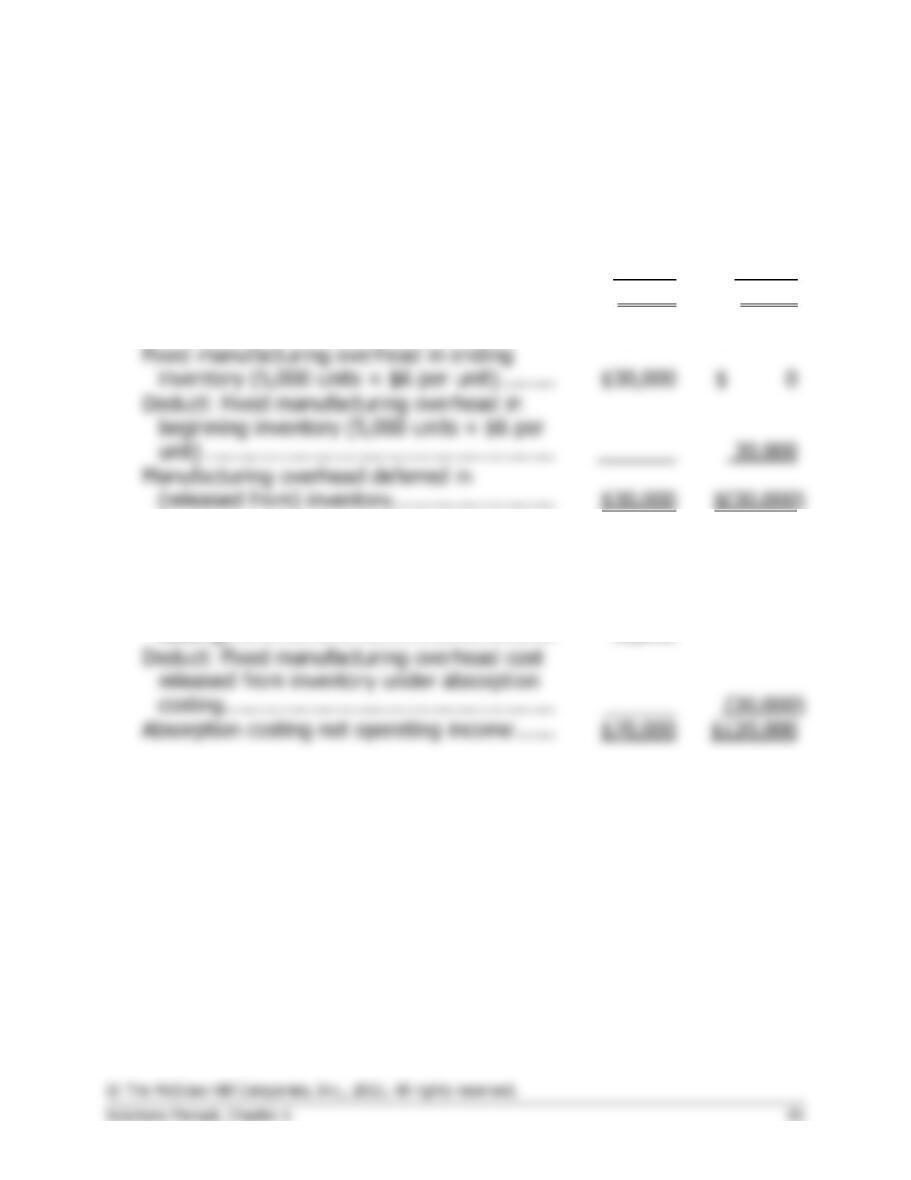
3. The reconciliation of absorption and variable costing follows:
Year 1
Year 2
Units in beginning inventory ……………………
0
5,000
+ Units produced ………………………………….
45,000
45,000
− Units sold …………………………………………
40,000
50,000
= Units in ending inventory …………………….
5,000
0
Year 1
Year 2
$30,000
Year 1
Year 2
Variable costing net operating income (loss) .
$40,000
$150,000
Add: Fixed manufacturing overhead cost
deferred in inventory under absorption
30,000
Absorption costing net operating income ……
$70,000
$120,000
Problem 6-20 (45 minutes)
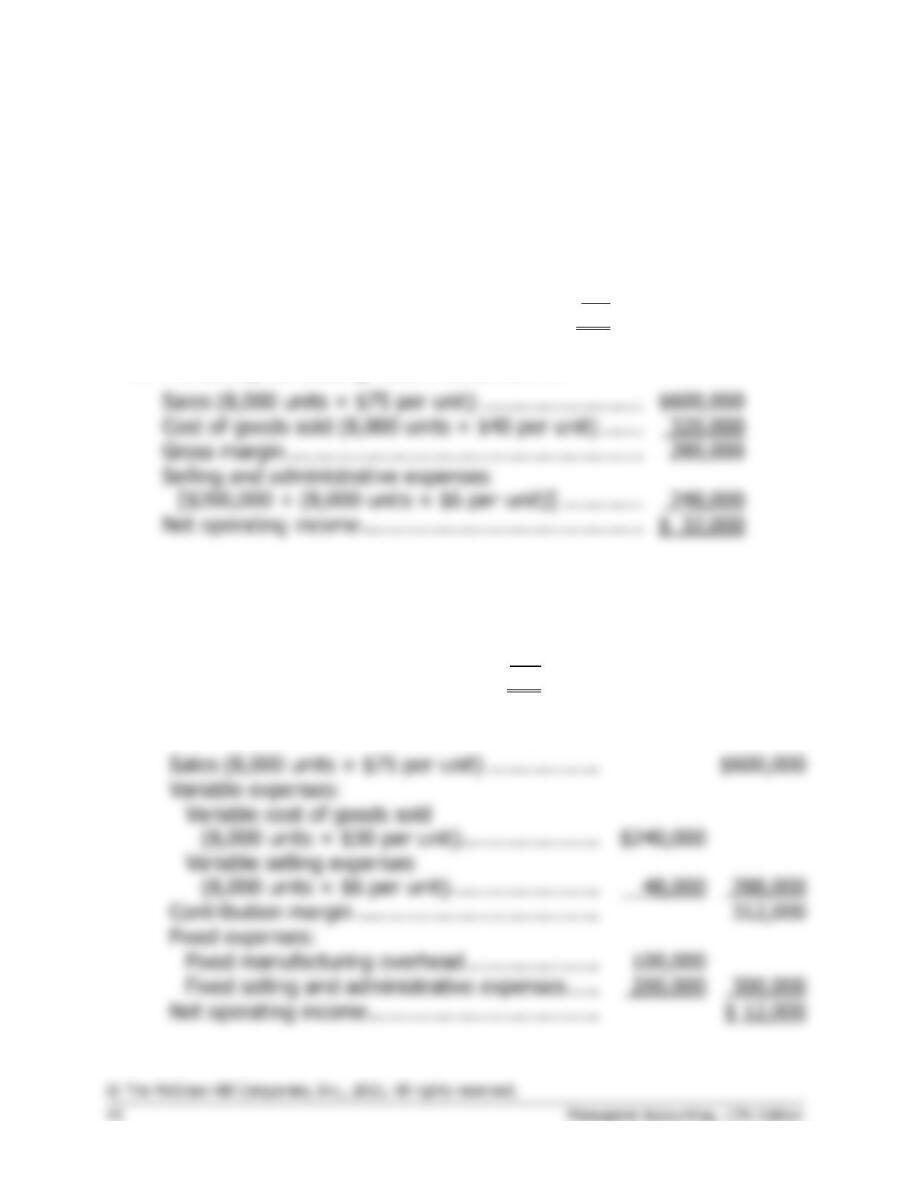
1. a. The unit product cost under absorption costing is:
Direct materials …………………………...
$20
Direct labor …………………………………
8
Variable manufacturing overhead ……..
2
Fixed manufacturing overhead
($100,000 ÷ 10,000 units) …………..
10
Absorption costing unit product cost …
$40
b. The absorption costing income statement is:
Sales (8,000 units × $75 per unit) ……………………..
$600,000
Cost of goods sold (8,000 units × $40 per unit) …….
320,000
Gross margin …………………………..…………………….
Selling and administrative expenses
Net operating income ………………………………………
$ 32,000
2. a. The unit product cost under variable costing is:
Direct materials ……………………….
$20
Direct labor …………………………….
8
Variable manufacturing overhead …
2
Variable costing unit product cost ..
$30
b. The variable costing income statement is:
Sales (8,000 units × $75 per unit) ………………
Variable expenses:
Contribution margin …………………………………
Fixed expenses:
Net operating income ……………………………….
Problem 6-20 (continued)
3. The difference in the ending inventory relates to a difference in the
handling of fixed manufacturing overhead costs. Under variable costing,
these costs have been expensed in full as period costs. Under
absorption costing, these costs have been added to units of product at
the rate of $10 per unit ($100,000 ÷ 10,000 units produced = $10 per
unit). Thus, under absorption costing a portion of the $100,000 fixed
manufacturing overhead cost for the month has been added to the
1.
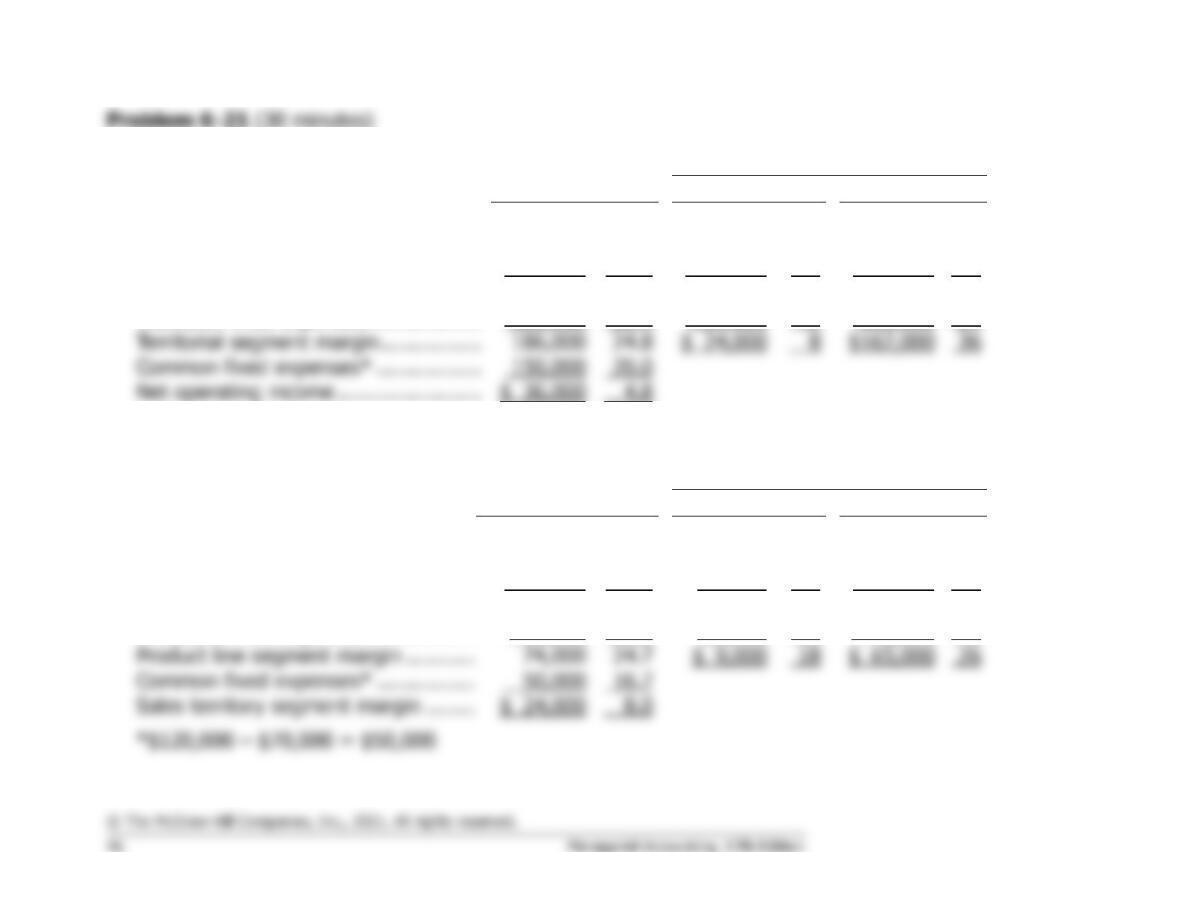
Sales Territory
Total Company
Northern
Southern
Amount
%
Amount
%
Amount
%
Sales ………………………………………..
$750,000
100.0
$300,000
100
$450,000
100
Variable expenses ……………………….
336,000
44.8
156,000
52
180,000
40
Contribution margin …………………….
414,000
55.2
144,000
48
270,000
60
Traceable fixed expenses ………………
Territorial segment margin …………….
186,000
24.8
$ 24,000
$162,000
36
Common fixed expenses* ……………..
150,000
20.0
Net operating income …………………..
$ 36,000
4.8
*378,000 – $228,000 = $150,000
Product Line
Northern Territory
Paks
Tibs
Amount
%
Amount
%
Amount
%
Sales ……………………………………..
$300,000
100.0
$50,000
100
$250,000
100
Variable expenses ………………………
156,000
52.0
11,000
22
145,000
58
Contribution margin ……………………
144,000
48.0
39,000
78
105,000
42
Traceable fixed expenses ……………..
70,000
23.3
30,000
60
40,000
16
Product line segment margin ………..
$ 9,000
Common fixed expenses* …………….
Sales territory segment margin ……..
$ 24,000
8.0
*$120,000 – $70,000 = $50,000
Problem 6-21 (continued)
2. Two insights should be brought to the attention of management. First,
compared to the Southern territory, the Northern territory has a low
contribution margin ratio. Second, the Northern territory has high
traceable fixed expenses. Overall, compared to the Southern territory,
the Northern territory is very weak.
3. Again, two insights should be brought to the attention of management.
First, the Northern territory has a poor sales mix. Note that the territory
Problem 6-22 (45 minutes)
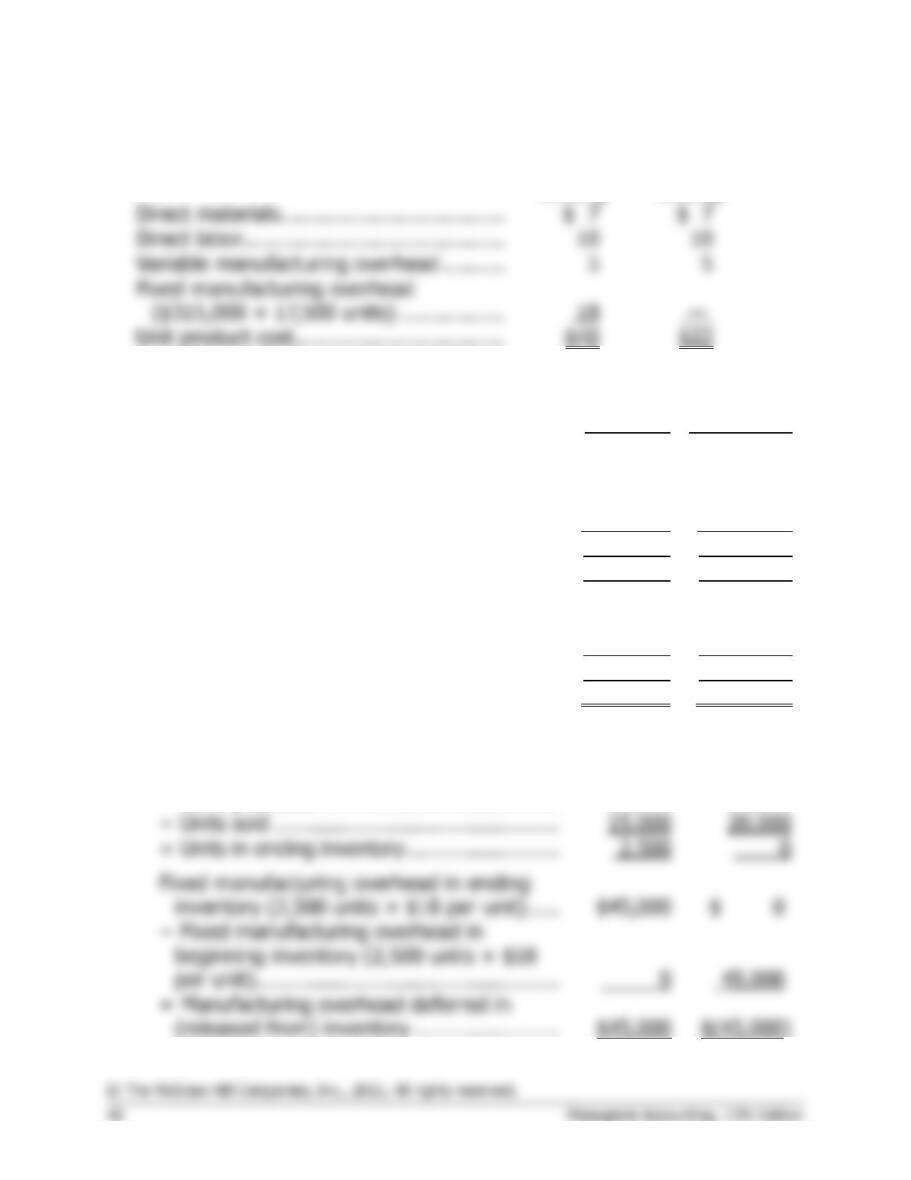
1.
a. and b.
Absorption
Direct materials ………………………………
Direct labor ……………………………………
Variable manufacturing overhead ……….
Unit product cost…………………………….
Variable
2.
July
August
Sales ………………………………………………….
$900,000
$1,200,000
Variable expenses:
Variable cost of goods sold @ $22 per unit .
330,000
440,000
Variable selling and administrative
expenses @ $3 per unit ……………………..
45,000
60,000
Total variable expenses ………………………….
375,000
500,000
Contribution margin ………………………………
525,000
700,000
Fixed expenses:
Fixed manufacturing overhead ………………
315,000
315,000
Fixed selling and administrative expenses ..
245,000
245,000
Total fixed expenses ………………………………
560,000
560,000
Net operating income (loss) …………………….
$ (35,000)
$ 140,000
3.
July
August
Units in beginning inventory ……………………
0
2,500
+ Units produced …………………………………
17,500
17,500
Fixed manufacturing overhead in ending
$45,000
Problem 6-22 (continued)
July
August
Variable costing net operating income
(loss) ………………………………………………
$ (35,000)
$ 140,000
Add fixed manufacturing overhead cost
deferred in inventory under absorption
costing …………………………..………………..
45,000
Deduct fixed manufacturing overhead cost
released from inventory under absorption
costing …………………………..………………..
(45,000)
Absorption costing net operating income……
$ 10,000
$ 95,000
4. As shown in the reconciliation in part (3) above, $45,000 of fixed
manufacturing overhead cost was deferred in inventory under
absorption costing at the end of July because $18 of fixed
manufacturing overhead cost “attached” to each of the 2,500 unsold
units that went into inventory at the end of that month. This $45,000
was part of the $560,000 total fixed cost that has to be covered each
month in order for the company to break even. Because the $45,000
Problem 6-23 (60 minutes)
1. a. Absorption costing unit product cost is:
Direct materials …………………………...
$ 3.50
Direct labor …………………………………
12.00
Variable manufacturing overhead ……..
1.00
Fixed manufacturing overhead
($300,000 ÷ 30,000 units) ……………
10.00
Absorption costing unit product cost …
$26.50
Sales (28,000 units × $40 per unit) …………………….
$1,120,000
Cost of goods sold (28,000 units × $26.50 per unit)
Gross margin …………………………..…………………….
Selling and administrative expenses
Net operating income ………………………………………
c. The reconciliation is as follows:
Units in ending inventory = Units in beginning inventory + Units
produced – Units sold = 0 units + 30,000 units – 28,000 units
= 2,000 units
Manufacturing overhead deferred in (released from) inventory = Fixed
manufacturing overhead in ending inventory – Fixed manufacturing
overhead in beginning inventory = (2,000 units × $10 per unit) – $0
= $20,000
Variable costing net loss …………………………………..
$(10,000)
Add fixed manufacturing overhead cost deferred in
inventory under absorption costing …………………..
20,000
Absorption costing net operating income ……………..
$ 10,000
2. Under absorption costing, the company did earn a profit for the quarter.
However, before the question can really be answered, one must first
define what is meant by a “profit.” The central issue here relates to the
timing
of release of fixed manufacturing overhead costs to expense.
Advocates of variable costing argue that all such costs should be
expensed immediately, and that no profit is earned unless the revenues
of a period are sufficient to cover the fixed manufacturing overhead
costs in full. From this point of view, no profit was earned during the
quarter because the fixed costs were not fully covered.
3. a. The variable costing income statement is:
Sales (32,000 units × $40 per unit) …………
$1,280,000
Variable expenses:
Variable cost of goods sold
[32,000 units × ($3.50 + $12.00 +
$1.00) per unit] ……………………………..
$528,000
Variable selling and administrative
expenses (32,000 units × $6 per unit) ..
192,000
720,000
200,000
500,000
Net operating income …………………………..
Problem 6-23 (continued)
b. The absorption costing income statement would be constructed as
follows:
The absorption costing unit product cost will remain at $26.50, the
Sales (32,000 units × $40 per unit) ………………………
Cost of goods sold (32,000 units × $26.50 per unit) ..
848,000
Gross margin …………………………..………………………
432,000
Selling and administrative expenses
($200,000 + 32,000 units × $6.00 per unit) …………
392,000
Net operating income ………………………………………..
$ 40,000
c. The reconciliation of variable costing and absorption costing income
is:
Units in ending inventory = Units in beginning inventory + Units
produced – Units sold = 2,000 units + 30,000 units – 32,000 units
= 0 units
Variable costing net operating income …………………
Absorption costing net operating income ……………..
Problem 6-24 (45 minutes)
1. The intern’s decision to use the absorption format for her segmented
income statements is a bad idea because it does not focus on cost
behavior. To make decisions and perform break-even analysis, the
contribution format is superior to the absorption format because it
separates costs into variable cost and fixed cost categories.
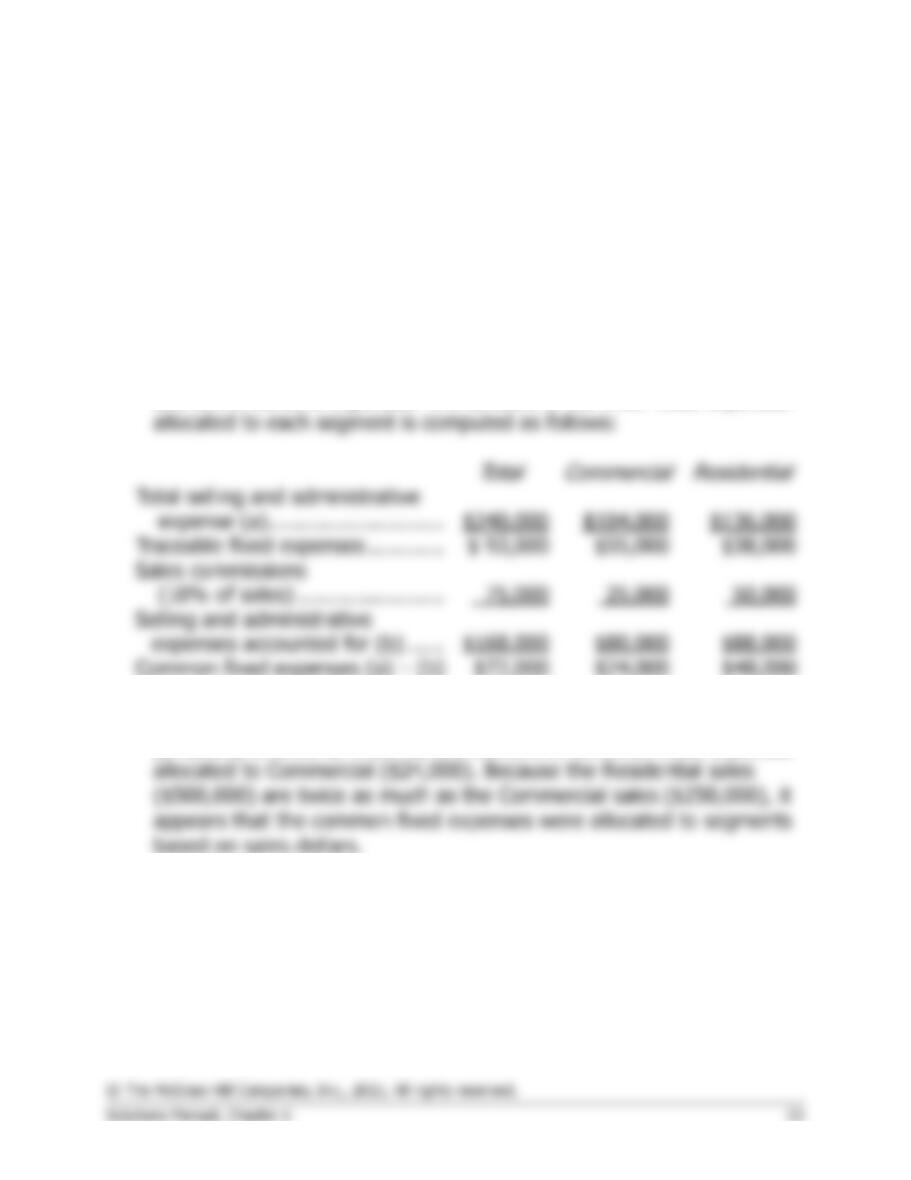
2.a. To answer this question, students must understand that cost of goods
sold for a merchandiser is a variable cost. Thus, all of the company’s
fixed costs plus its sales commissions are reported as part of selling
and administrative expenses. The amount of common fixed expenses
2.b. The amount of common fixed expenses allocated to Residential
($48,000) is twice as much as the amount of common fixed expenses
3. No. Allocating common fixed expenses is a bad idea because these
costs are not traceable to segments and they are not affected by
segment-level decisions.
Problem 6-24 (continued)
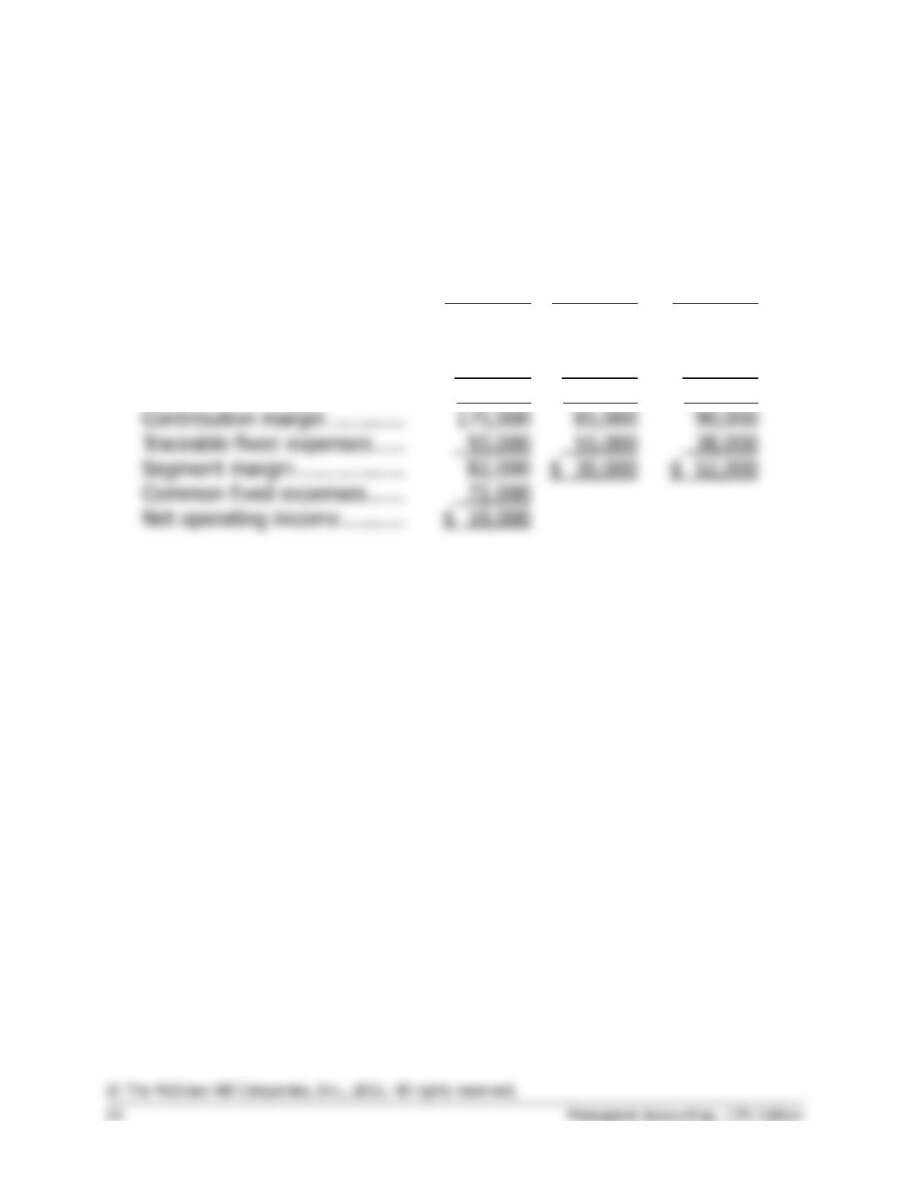
4. The contribution format segmented income statements would appear as
follows:
Total
Company
Commercial
Residential
Sales …………………………….
$750,000
$250,000
$500,000
Variable expenses:
Cost of goods sold ………..
500,000
140,000
360,000
Sales commissions (10%) .
75,000
25,000
50,000
Total variable expenses ……..
575,000
165,000
410,000
Contribution margin …………
Traceable fixed expenses …..
Segment margin ……………..
Common fixed expenses ……
72,000
Net operating income ……….
Problem 6-24 (continued)
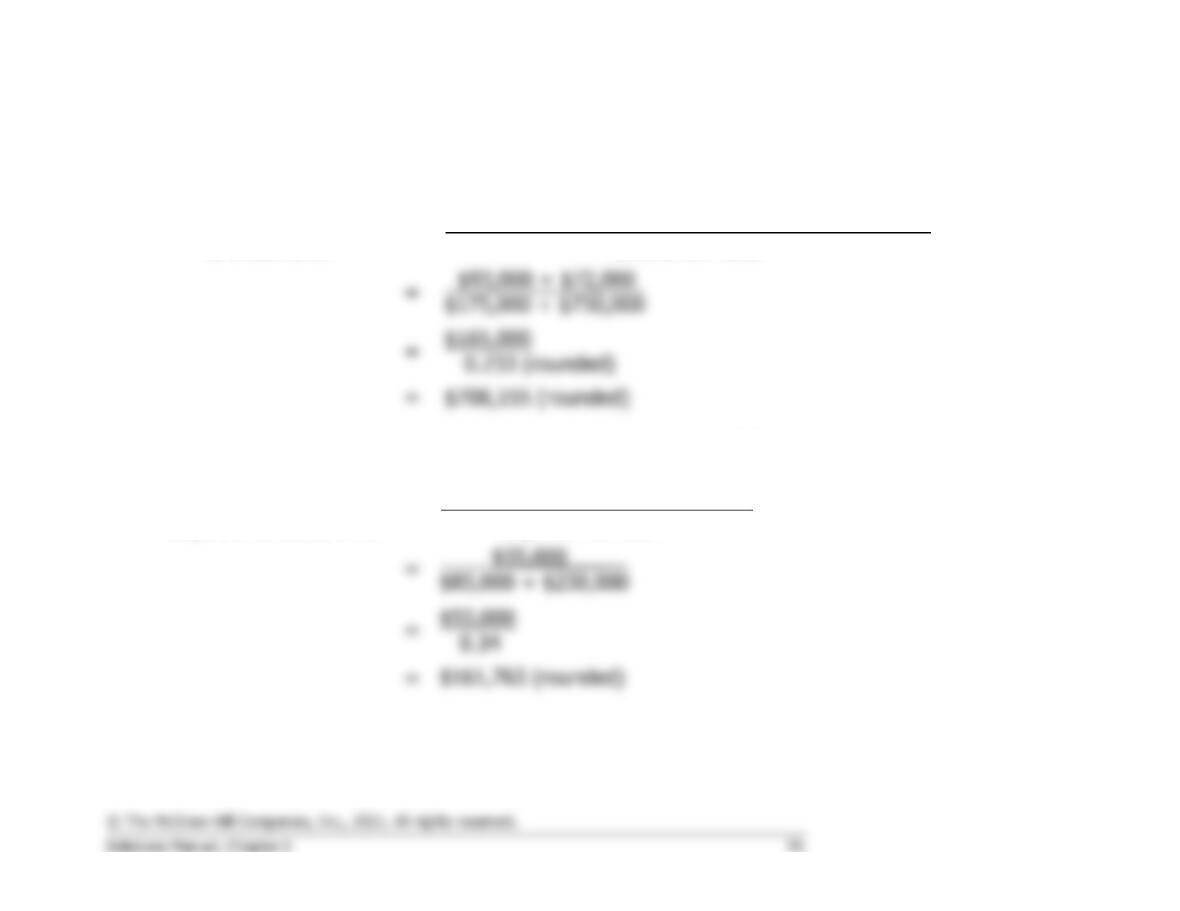
5. The companywide break-even point is computed as follows:
Dollar sales for company
to break even
=
Traceable fixed expenses + Common fixed expenses
Overall CM ratio
=
=
0.233 (rounded)
6. The break-even point for the Commercial Division is computed as follows:
Dollar sales for a
segment to break even
=
Segment traceable fixed expenses
Segment CM ratio
=
=
$55,000
0.34
Problem 6-24 (continued)
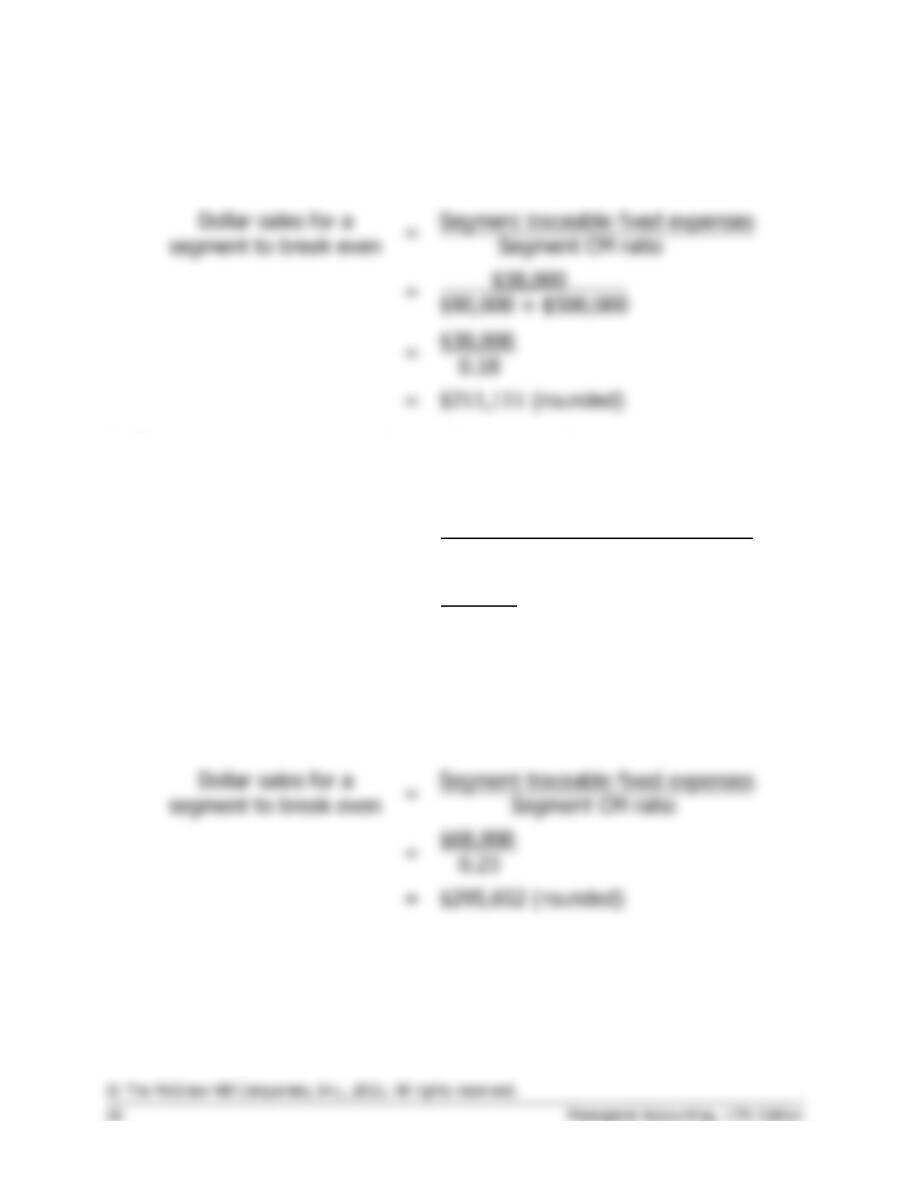
The break-even point for the Residential Division is computed as follows:
Dollar sales for a
segment to break even
Segment traceable fixed expenses
Segment CM ratio
$90,000 ÷ $500,000
=
$211,111 (rounded)
7. The new break-even point for the Commercial Division is computed as
follows:
Dollar sales for a
segment to break even
=
Segment traceable fixed expenses
Segment CM ratio
=
$70,000
0.39
=
$179,487 (rounded)
The new break-even point for the Residential Division is computed as
follows:
Dollar sales for a
segment to break even
Segment traceable fixed expenses
Segment CM ratio
=
Problem 6-25 (75 minutes)
1.
Year 1
Year 2
Year 3
Sales …………………………………….
$800,000
$ 640,000
$800,000
Variable expenses:
Variable cost of goods sold
@ $2 per unit …………………….
100,000
80,000
100,000
Variable selling and
administrative expenses
@ $1 per unit …………………….
50,000
40,000
50,000
Total variable expenses……………..
150,000
120,000
150,000
Contribution margin …………………
650,000
520,000
650,000
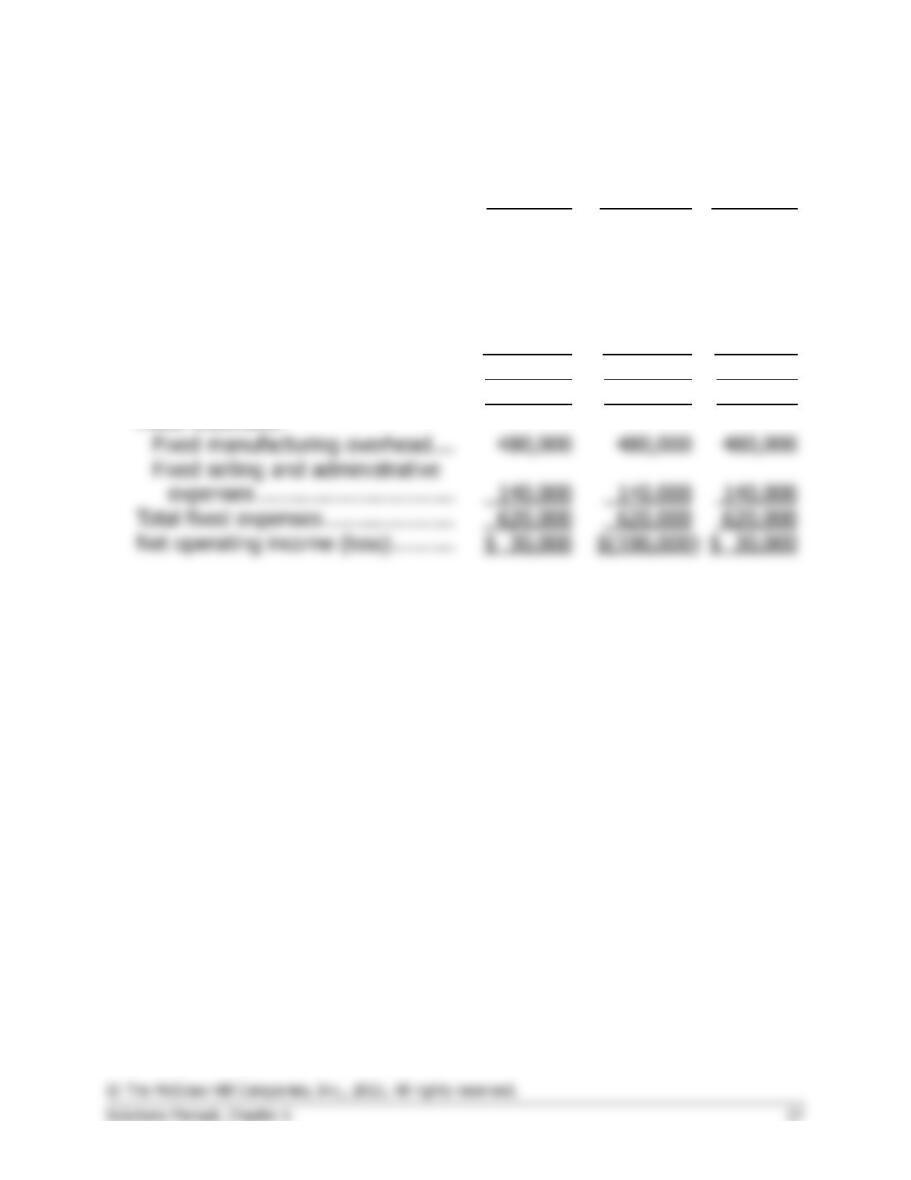
Fixed expenses:
Fixed selling and administrative
expenses …………………………..
140,000
140,000
140,000
Total fixed expenses …………………
620,000
620,000
620,000
Net operating income (loss) ……….
Problem 6-25 (continued)
2.
a.
Year 1
Year 2
Year 3
Variable manufacturing cost …………….
$ 2.00
$ 2.00
$ 2.00
Fixed manufacturing cost:
$480,000 ÷ 50,000 units ………………
9.60
$480,000 ÷ 60,000 units ………………
8.00
$480,000 ÷ 40,000 units ………………
12.00
Absorption costing unit product cost ….
$11.60
$10.00
$14.00
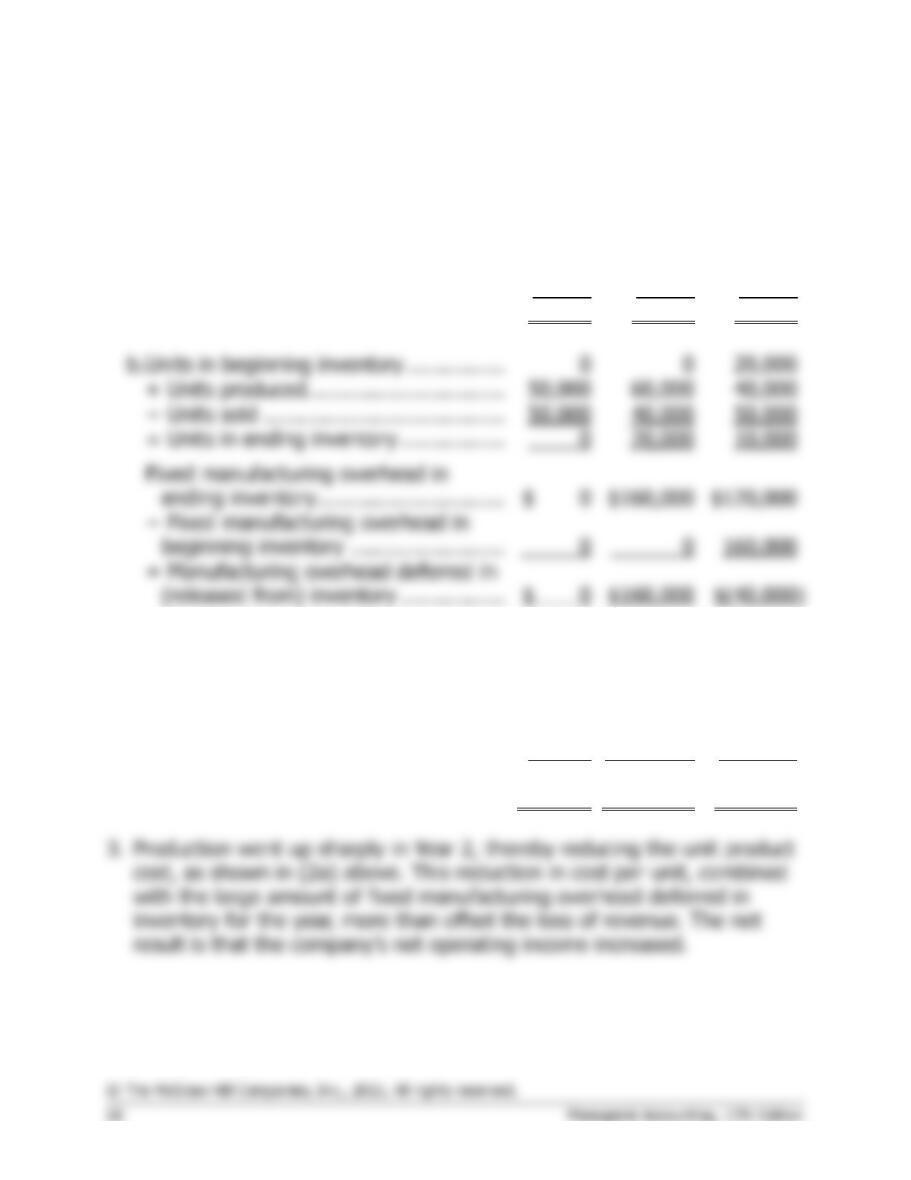
+ Units produced…………………………..
50,000
60,000
40,000
50,000
40,000
50,000
= Units in ending inventory ……………..
0
20,000
10,000
Fixed manufacturing overhead in
ending inventory …………………………
0
(released from) inventory ……………..
$(40,000)
Variable costing net operating income
(loss) ……………………………………….
$30,000
$(100,000)
$ 30,000
Add fixed manufacturing overhead
deferred in inventory ……………………
0
160,000
0
Deduct fixed manufacturing overhead
cost released from inventory ………….
0
0
(40,000)
Absorption costing net operating
income (loss) ……………………………..
$30,000
$ 60,000
$(10,000)
4. The fixed manufacturing overhead deferred in inventory from Year 2
was charged against Year 3 operations. This added charge against Year
3 operations was offset somewhat by the fact that part of Year 3’s fixed
Problem 6-25 (continued)
manufacturing overhead costs were deferred in inventory to future
years. Overall, the added costs charged against Year 3 were greater
than the costs deferred to future years, so the company reported less
income for the year even though the same number of units was sold as
in Year 1.
5. a. With lean production, production would have been tied to sales in
each year so that little or no inventory of finished goods would have
been built up in either Year 2 or Year 3.
1. The weaknesses of the company’s version of a segmented income
statement are as follows:
a. The company should include a column showing the combined results
of the three regions taken together.
2. Corporate advertising expenses have been allocated on the basis of
sales dollars; the general administrative expenses have been allocated
evenly among the three regions. Such allocations can be misleading to
management because they seem to imply that these expenses are