AP6–3.
Req. 1
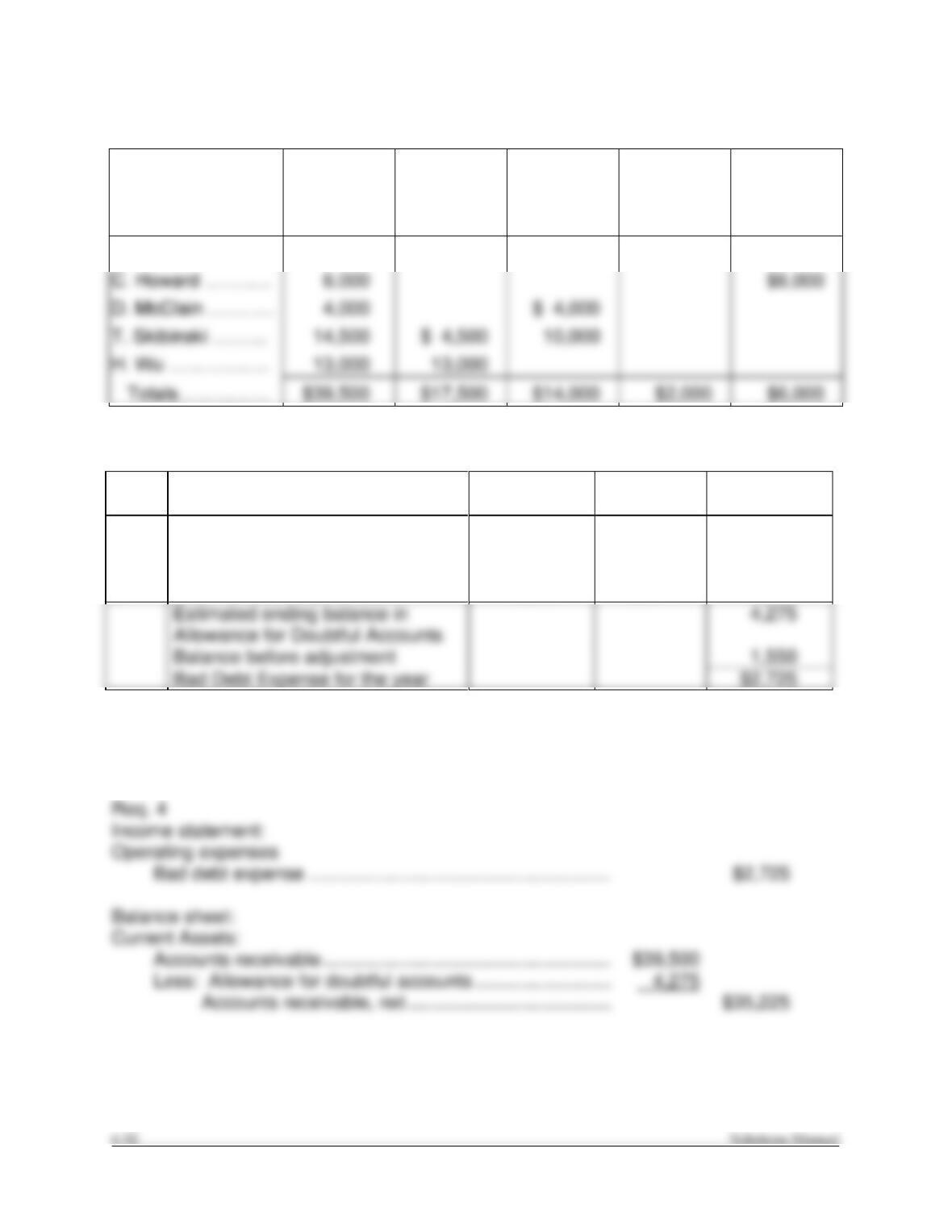
Aging Analysis of Accounts Receivable
Customer
Total
Receivable
(a)
Not Yet
Due
(b)
Up to
6 Mo.
Past Due
(c)
6 to
12 Mo.
Past Due
(d)
More Than
12 Mo.
Past Due
R. Devens ………..
$ 2,000
$2,000
C. Howard ………..
$6,000
D. McClain .……….
10,000
H. Wu ………..……
13,000
$2,000
$6,000
Req. 2
Estimated Amounts Uncollectible
Age
Amount of
Receivable
Estimated
Loss Rate
Estimated
Uncollectible
a.
Not yet due……………………
$17,500
1%
$ 175
b.
Up to 6 months past due…….
14,000
5%
700
c.
6 to 12 months past due.….
2,000
20%
400
d.
Over 12 months past due……
6,000
50%
3,000
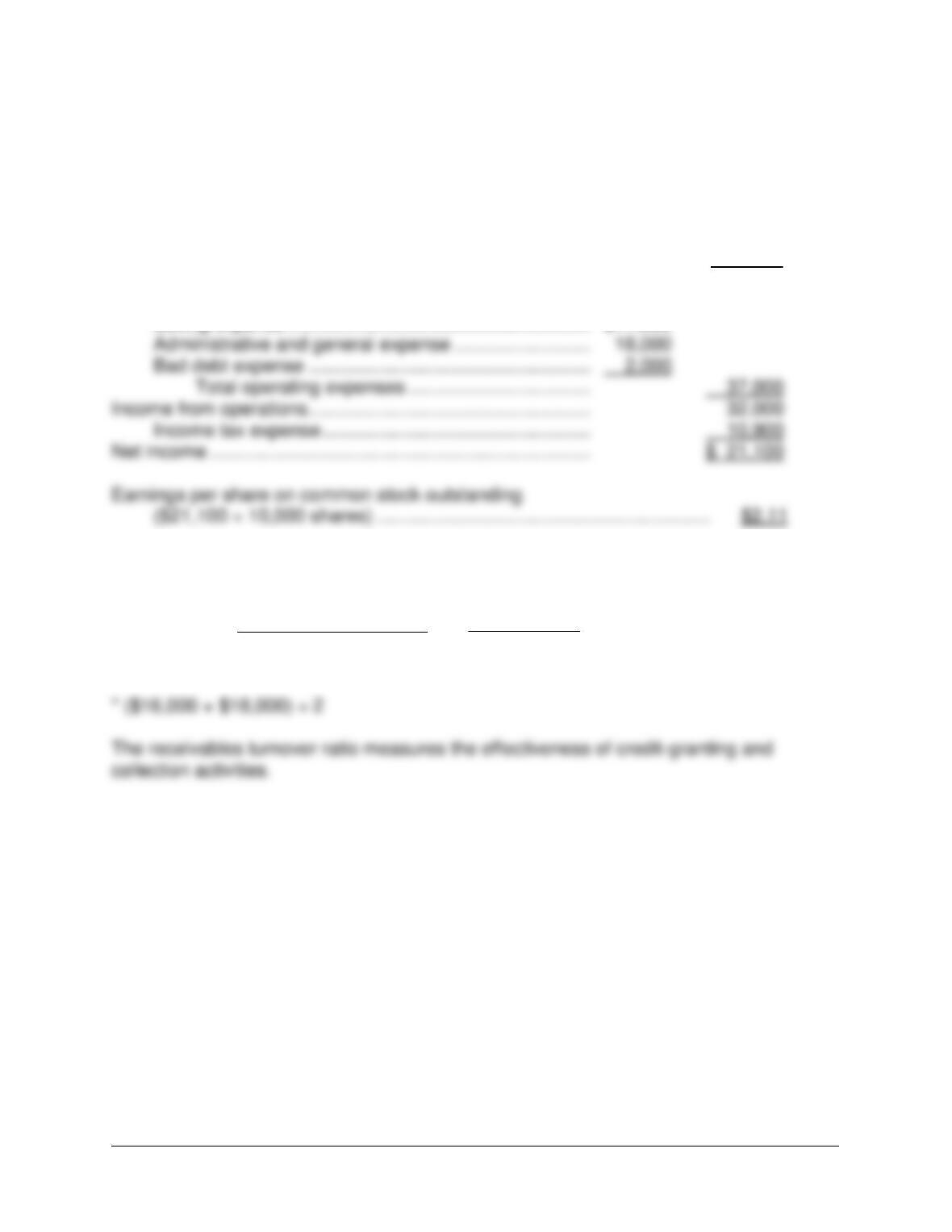
Estimated ending balance in
Allowance for Doubtful Accounts
Balance before adjustment
Bad Debt Expense for the year
$2,725
Req. 3
Bad debt expense (+E, –SE) ………………………………….. 2,725
Allowance for doubtful accounts (+XA, –A) ………. 2,725
Financial Accounting, 9/e 6-33
AP6–4.
Req. 1
PERRY CORPORATION
Income Statement
For the Year Ended December 31, Current Year
Net sales revenue ($184,000 – $9,000- $8,000) …………….. $167,000
Cost of goods sold…………………………………………………….. 98,000
Gross profit ………………………………………………………………. 69,000
Operating expenses:
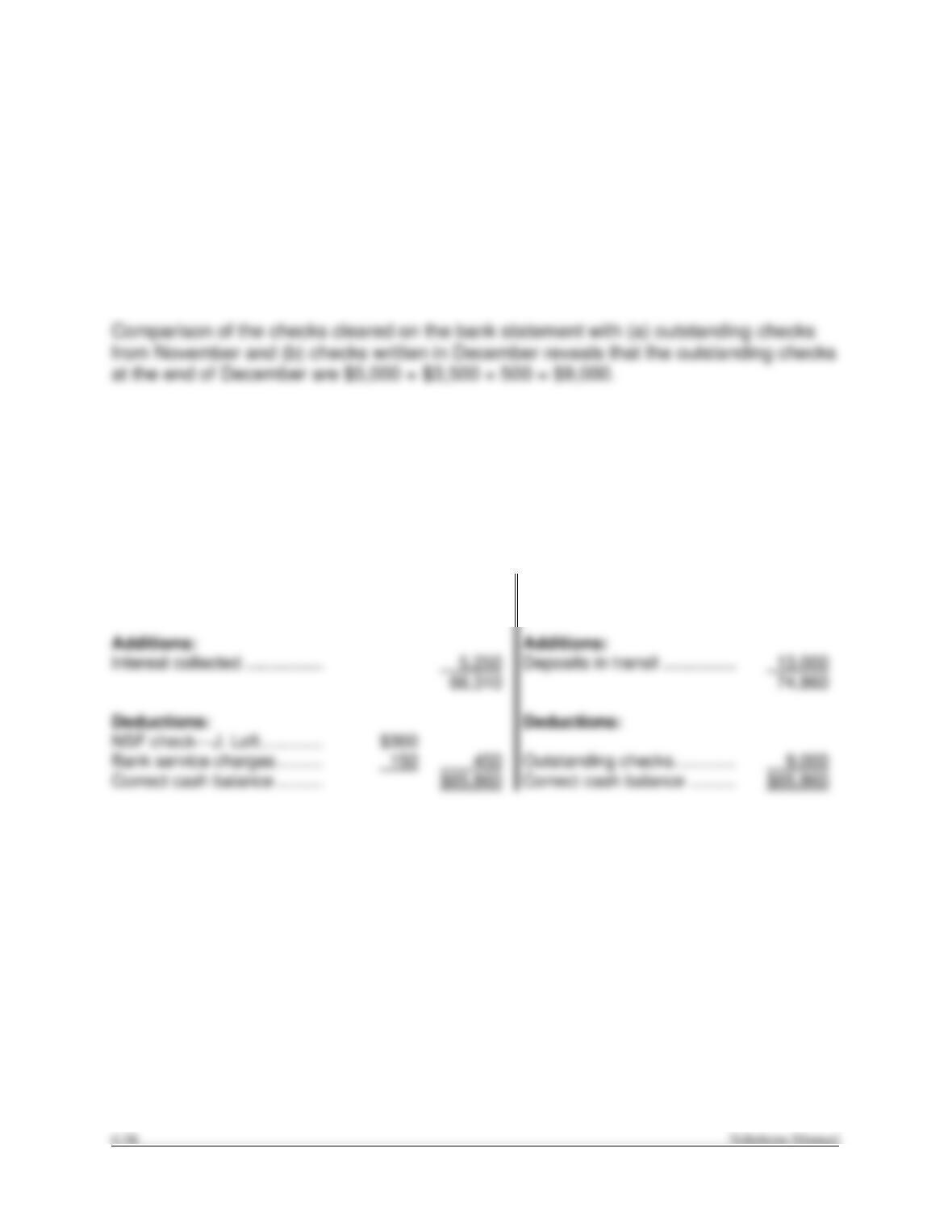
Selling expense …………………………………………………. $17,000
Req. 2
Receivables
=
Net Sales
=
$167,000
=
9.82
Turnover
Average Net Trade
Accounts Receivable
$17,000*
AP6–5.
Req. 1
Comparison of (a) the unrecorded deposit carried over from November and (b) the
deposits listed on the bank statement reveals that the $13,000 deposit for December 31
is in transit.
Req. 2
Req. 3
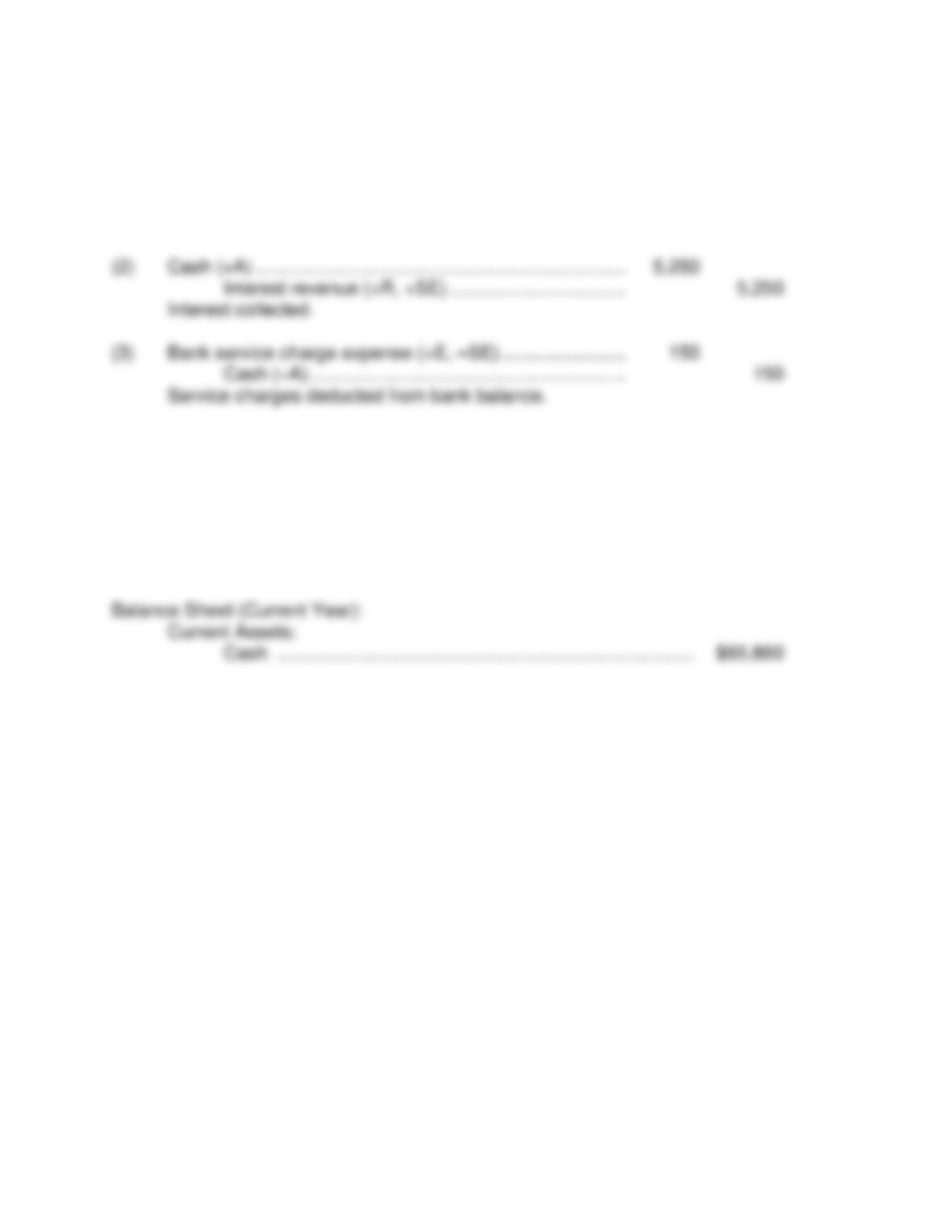
RIVAS COMPANY
Bank Reconciliation, December 31, Current Year
Company’s Books
Bank Statement
Ending balance per Cash
account …………………….
$61,060
Ending balance per bank
statement …………………
$61,860
NSF check—J. Left …………
Correct cash balance ………
$65,860
Correct cash balance ………
$65,860
Financial Accounting, 9/e 6-35
AP6–5. (continued)
Req. 4
(1) Accounts receivable (J. Left) (+A) ……………………………. 300
Cash (–A) ……………………………………………………. 300
To record NSF check.
These entries are necessary because of the changes in the regular Cash account that
have not yet been recorded by the company. The bank already has recorded them in its
accounts. The Cash account (and the other accounts in the entries) must be brought up
to date for financial statement purposes.
Req. 5
CONTINUING PROBLEM
CON6–1.
Req. 1
Bad debt expense (+E, –SE) ……………………………… 2,958
Allowance for doubtful accounts (+XA, –A) ……. 2,958
To record estimated bad debt expense.
Req. 2
Sales revenue …………………………………………………………………. $137,256
Less: Sales returns and allowances ………………………………….. 856
Financial Accounting, 9/e 6-37
CASES AND PROJECTS
ANNUAL REPORT CASES
CP6–1.
1. The company includes liquid financial instruments with remaining maturity of three
months or less to be cash and cash equivalents. This information is from Note 2 of
2. In addition to Cost of Goods Sold, American Eagle Outfitters subtracts buying,
occupancy and warehousing costs from Net Sales in its computation of Gross Profit.
3.
Receivables turnover
=
Net Sales
=
$3,282,867
=
46.3 times
Average Net Trade
Accounts Receivable
$70,888*
* ($67,894 + 73,882) ÷ 2
CP6–2.
1. The company held $154,558 thousand of cash and cash equivalents at the end of
the current year. This is disclosed on the balance sheet and the statement of cash
flows.
3. The accounts receivable are primarily due from wholesale customers and vendors.
Bad debt expense increased between 2013 and 2014 from $4,400 to $4,666. These
amounts are disclosed in Note 2 of the annual report.
4. It discloses its revenue recognition policies in Note 2 which summarizes significant
CP6–3.
1.
Current year
American Eagle
Outfitters
Urban Outfitters
Receivables
=
=
=
* ($67,894 + 73,882) ÷ 2
*($70,458 + 55,161) ÷ 2
2. American Eagle Outfitters has a lower ratio than Urban Outfitters because American
Eagle and Urban Outfitters sell to different classes of customers. American Eagle
sells its products almost exclusively to retail and online customers, who are likely to
3.
Industry
Average
American Eagle
Outfitters
Urban Outfitters
Receivables Turnover =
78.2
46.3
52.9
CRITICAL THINKING CASES
CP6–4.
1. Recording sales for goods or services that had not been delivered as of year-end
2. It should establish a sales returns and allowances account (a contra revenue) for
3. Profiting from sales of stock they owned at an inflated stock price and perhaps
4. The other investors who paid inflated amounts for the stock, customers who were
5. Sales transactions booked near the end of the quarter and sales with special
terms, e.g. right of return or cancellation, should receive special attention from
Financial Accounting, 9/e 6-41
CP6–5.
Req. 1
(a) $50 x 12 months = $ 600
(b) $12 x (52 weeks x 5 days per week) = 3,120
(c,d) Accounts receivable collections ($300 + $800) = 1,100
Total approximate amount stolen $4,820
Req. 2
Basic recommendations:
(1) Install a tight system of internal control, including the following:
a. Separate cash handling from recordkeeping.
(2) a. Arrange for an annual independent audit on a continuing basis.
b. Carefully plan and assign definite responsibilities for all employees. Focus on
FINANCIAL REPORTING AND ANALYSIS PROJECTS
CP6–6.
The solutions to this case will depend on the company and/or accounting period
selected for analysis.