6-1
CHAPTER 6
MASTER BUDGET AND RESPONSIBILITY ACCOUNTING
6-1 The budgeting cycle includes the following elements:
a. Planning the performance of the company as a whole as well as planning the performance
of its subunits. Management agrees on what is expected.
6-2 The master budget expresses management’s operating and financial plans for a specified
period (usually a fiscal year) and includes a set of budgeted financial statements. It is the initial
plan of what the company intends to accomplish in the period.
6-3 Strategy, plans, and budgets are interrelated and affect one another. Strategy specifies
how an organization matches its own capabilities with the opportunities in the marketplace to
accomplish its objectives. Strategic analysis underlies both long-run and short-run planning. In
turn, these plans lead to the formulation of budgets. Budgets provide feedback to managers about
the likely effects of their strategic plans. Managers use this feedback to revise their strategic
plans.
6-5 Production and marketing traditionally have operated as relatively independent business
functions. Budgets can assist in reducing conflicts between these two functions in two ways.
Consider a beverage company such as Coca-Cola or Pepsi-Cola:
• Communication. Marketing could share information about seasonal demand with
production.
• Coordination. Production could ensure that output is sufficient to meet, for example,
high seasonal demand in the summer.
6-2
6-8 The steps in preparing an operating budget are as follows:
1. Prepare the revenues budget.
2. Prepare the production budget (in units).
3. Prepare the direct material usage budget and direct material purchases budget.
6-9 The sales forecast is typically the cornerstone for budgeting because production (and,
hence, costs) and inventory levels generally depend on the forecasted level of sales.
6-10 Sensitivity analysis adds an extra dimension to budgeting. It enables managers to
examine how budgeted amounts change with a change in the underlying assumptions. This
assists managers in monitoring those assumptions that are most critical to a company in attaining
its budget and allows them to make timely adjustments to plans when appropriate.
6-13 The choice of the type of responsibility center determines what the manager is
accountable for and thereby affects the manager’s behavior. For example, if a revenue center is
chosen, the manager will focus on revenues, not on costs or investments. The choice of a
responsibility center type guides the variables to be included in the budgeting exercise.
6-14 Budgeting in multinational companies may involve budgeting in several different foreign
currencies. Further, management accountants must translate operating performance into a single
currency for reporting to shareholders by budgeting for exchange rates. Managers and
accountants must understand the factors that impact exchange rates and, where possible, plan
6-3
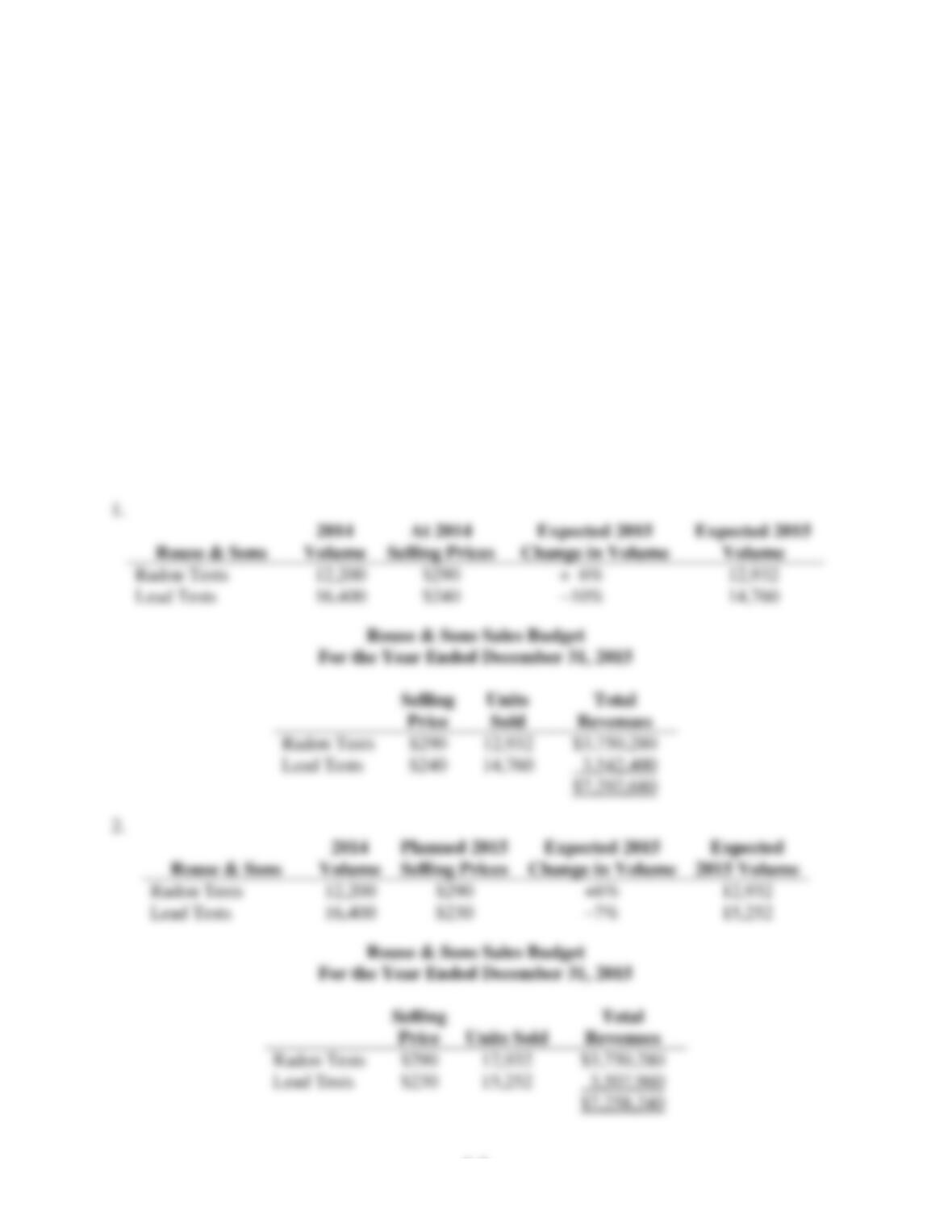
6-16 (15 min.) Sales budget, service setting.
In 2014, Rouse & Sons, a small environmental-testing firm, performed 12,200 radon tests for
$290 each and 16,400 lead tests for $240 each. Because newer homes are being built with lead–
free pipes, lead-testing volume is expected to decrease by 10% next year. However, awareness of
radon-related health hazards is expected to result in a 6% increase in radon–test volume each year
in the near future. Jim Rouse feels that if he lowers his price for lead testing to $230 per test, he
will have to face only a 7% decline in lead-test sales in 2015.
Required:
1. Prepare a 2015 sales budget for Rouse & Sons assuming that Rouse holds prices at 2014
levels.
2. Prepare a 2015 sales budget for Rouse & Sons assuming that Rouse lowers the price of a lead
test to $230. Should Rouse lower the price of a lead test in 2015 if the company’s goal is to
maximize sales revenue?
SOLUTION
6-4
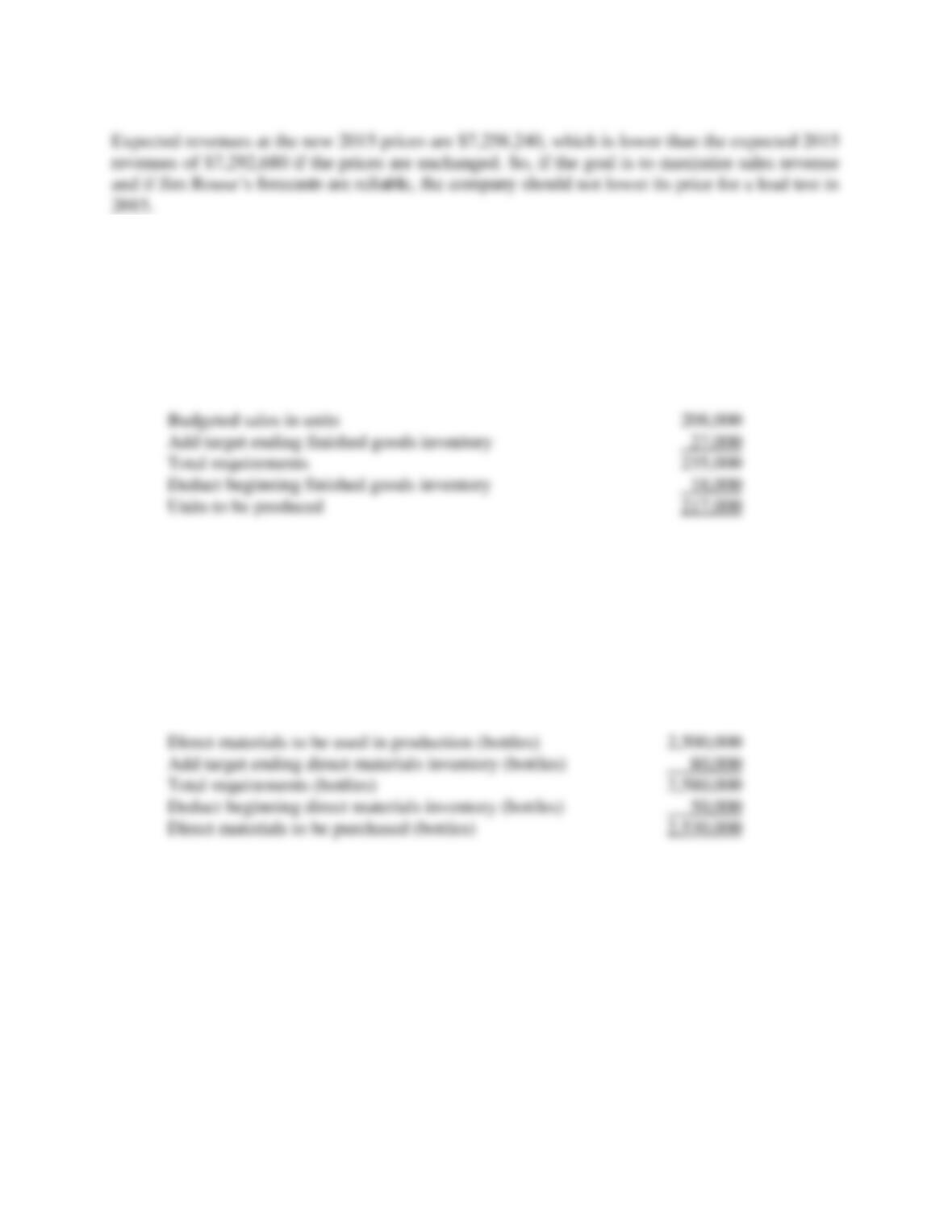
6-17 (5 min.) Sales and production budget.
The McKnight Company expects sales in 2015 of 208,000 units of serving trays. McKnight’s
beginning inventory for 2015 is 18,000 trays, and its target ending inventory is 27,000 trays.
Compute the number of trays budgeted for production in 2015.
SOLUTION
6-18 (5 min.) Direct materials purchases budget.
Inglenook Co. produces wine. The company expects to produce 2,500,000 two-liter bottles of
Chablis in 2015. Inglenook purchases empty glass bottles from an outside vendor. Its target
ending inventory of such bottles is 80,000; its beginning inventory is 50,000. For simplicity,
ignore breakage. Compute the number of bottles to be purchased in 2015.
SOLUTION
6-19 (10 min.) Budgeting material purchases.
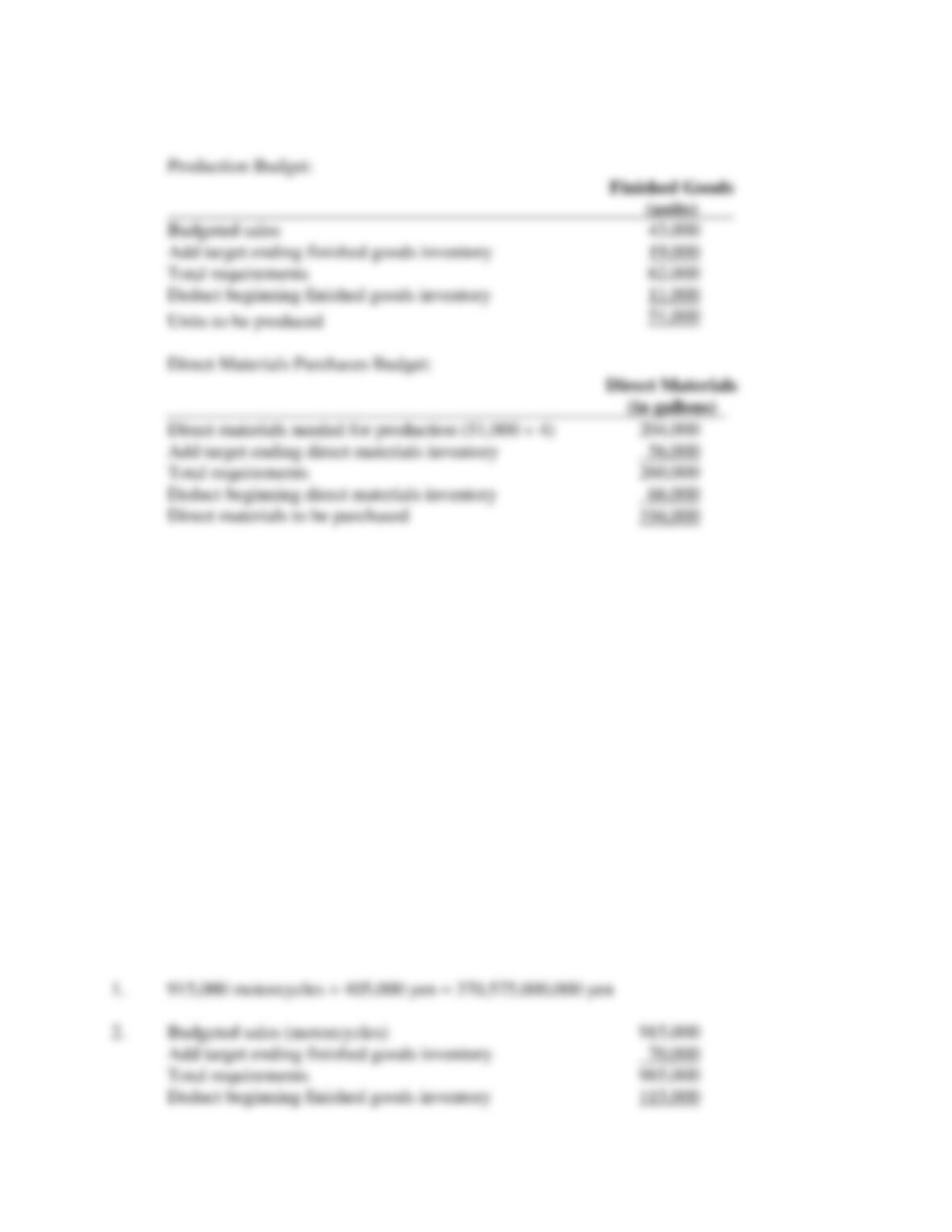
The Howell Company has prepared a sales budget of 43,000 finished units for a 3-month period.
The company has an inventory of 11,000 units of finished goods on hand at December 31 and
has a target finished goods inventory of 19,000 units at the end of the succeeding quarter.
It takes 4 gallons of direct materials to make one unit of finished product. The company has
an inventory of 66,000 gallons of direct materials at December 31 and has a target ending
inventory of 56,000 gallons at the end of the succeeding quarter. How many gallons of direct
materials should Howell Company purchase during the 3 months ending March 31?
6-5
SOLUTION
6-20 (15–20 min.) Revenues, production, and purchases budget.
The Mochizuki Co. in Japan has a division that manufactures two-wheel motorcycles. Its
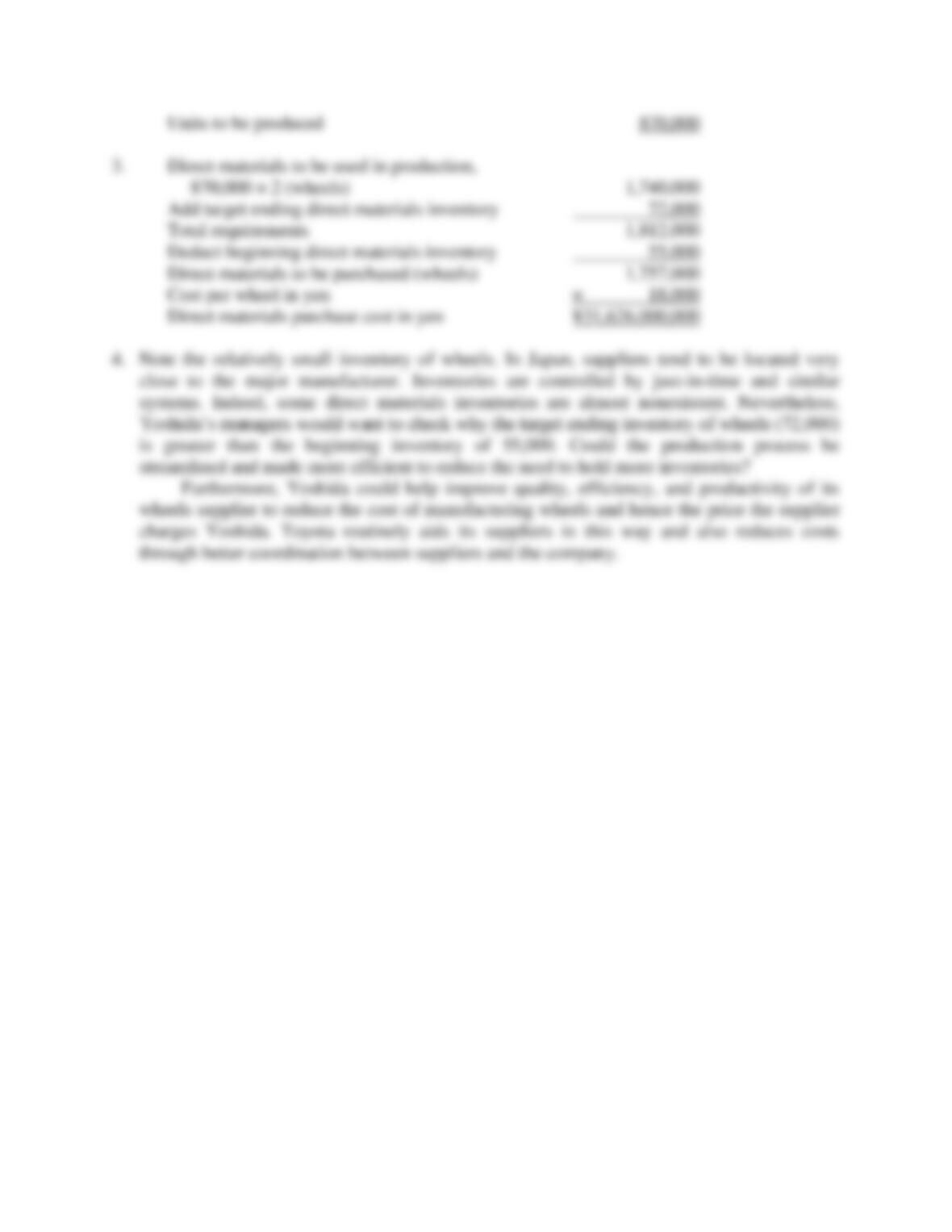
budgeted sales for Model G in 2015 is 915,000 units. Mochizuki’s target ending inventory is
70,000 units, and its beginning inventory is 115,000 units. The company’s budgeted selling price
to its distributors and dealers is 405,000 yen (¥) per motorcycle.
Mochizuki buys all its wheels from an outside supplier. No defective wheels are accepted.
(Mochizuki’s needs for extra wheels for replacement parts are ordered by a separate division of
the company.) The company’s target ending inventory is 72,000 wheels, and its beginning
inventory is 55,000 wheels. The budgeted purchase price is 18,000 yen (¥) per wheel.
Required:
1. Compute the budgeted revenues in yen.
2. Compute the number of motorcycles that Mochizuki should produce.
3. Compute the budgeted purchases of wheels in units and in yen.
4. What actions can Mochizuki’s managers take to reduce budgeted purchasing costs of wheels
assuming the same budgeted sales for Model G?
SOLUTION
6-6
6-21 (30 min.) Revenues and production budget.
Price, Inc., bottles and distributes mineral water from the company’s natural springs in northern
Oregon. Price markets two products: 12-ounce disposable plastic bottles and 1-gallon reusable
plastic containers.
Required:
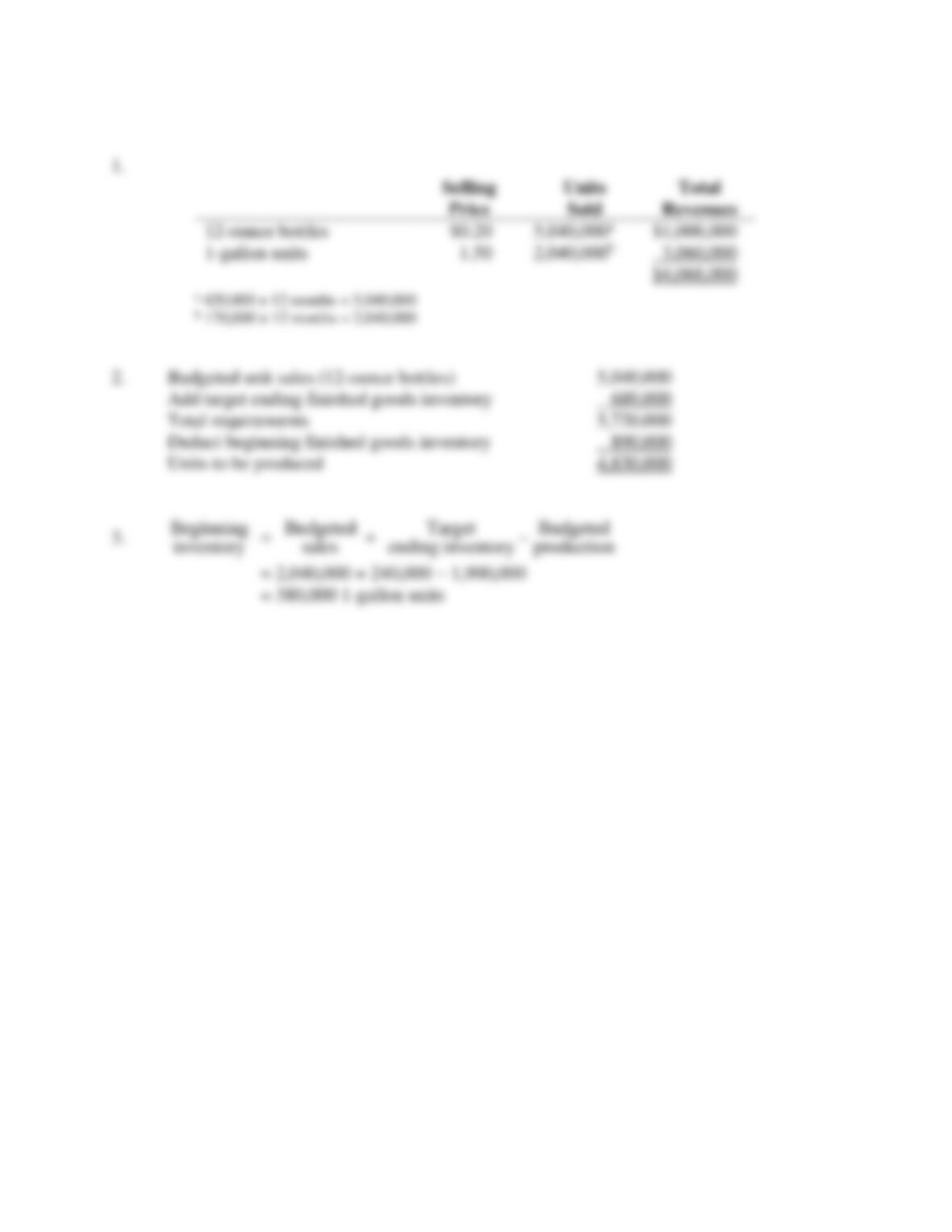
1. For 2015, Price marketing managers project monthly sales of 420,000 12-ounce bottles and
170,000 1-gallon containers. Average selling prices are estimated at $0.20 per 12-ounce
bottle and $1.50 per 1-gallon container. Prepare a revenues budget for Price, Inc., for the year
ending December 31, 2015.
2. Price begins 2015 with 890,000 12-ounce bottles in inventory. The vice president of
operations requests that 12-ounce bottles ending inventory on December 31, 2015, be no less
than 680,000 bottles. Based on sales projections as budgeted previously, what is the
minimum number of 12-ounce bottles Price must produce during 2015?
3. The VP of operations requests that ending inventory of 1-gallon containers on December 31,
2015, be 240,000 units. If the production budget calls for Price to produce 1,900,000 1-gallon
containers during 2015, what is the beginning inventory of 1-gallon containers on January 1,
2015?
6-7
SOLUTION
6-22 (30 min.) Budgeting: direct material usage, manufacturing cost, and gross margin.
Xander Manufacturing Company manufactures blue rugs, using wool and dye as direct materials.
One rug is budgeted to use 36 skeins of wool at a cost of $2 per skein and 0.8 gallons of dye at a
cost of $6 per gallon. All other materials are indirect. At the beginning of the year Xander has an
inventory of 458,000 skeins of wool at a cost of $961,800 and 4,000 gallons of dye at a cost of
$23,680. Target ending inventory of wool and dye is zero. Xander uses the FIFO inventory cost
flow method.
Xander blue rugs are very popular and demand is high, but because of capacity constraints the
firm will produce only 200,000 blue rugs per year. The budgeted selling price is $2,000 each.
There are no rugs in beginning inventory. Target ending inventory of rugs is also zero.
Xander makes rugs by hand, but uses a machine to dye the wool. Thus, overhead costs are
accumulated in two cost pools—one for weaving and the other for dyeing. Weaving overhead is
allocated to products based on direct manufacturing labor-hours (DMLH). Dyeing overhead is
allocated to products based on machine-hours (MH).
There is no direct manufacturing labor cost for dyeing. Xander budgets 62 direct
manufacturing labor-hours to weave a rug at a budgeted rate of $13 per hour. It budgets 0.2
machine-hours to dye each skein in the dyeing process.
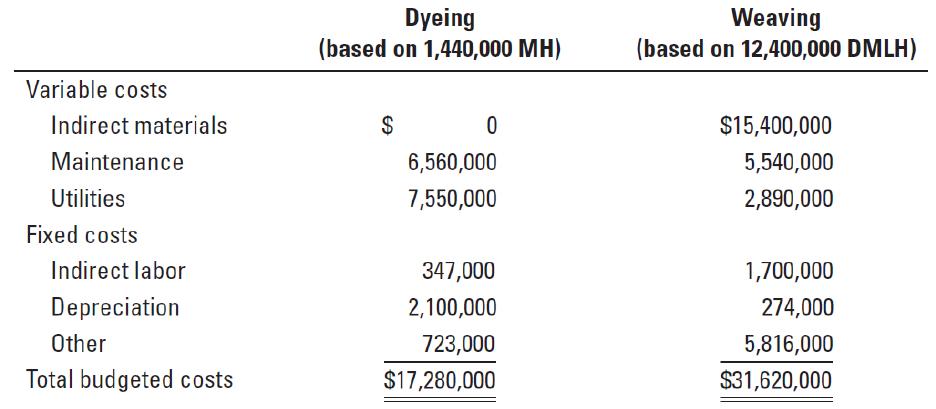
The following table presents the budgeted overhead costs for the dyeing and weaving
cost pools:
6-8
Required:
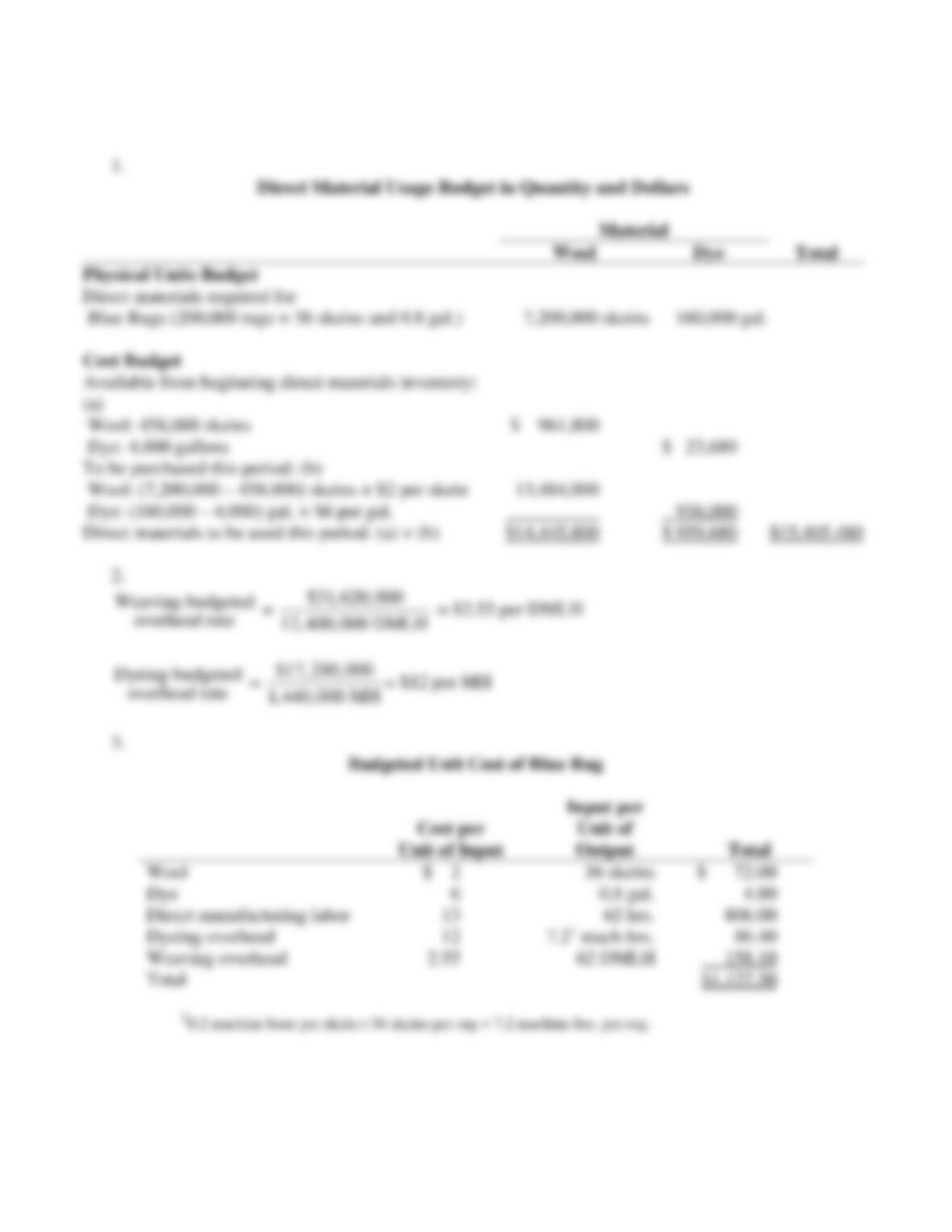
1. Prepare a direct material usage budget in both units and dollars.
2. Calculate the budgeted overhead allocation rates for weaving and dyeing.
3. Calculate the budgeted unit cost of a blue rug for the year.
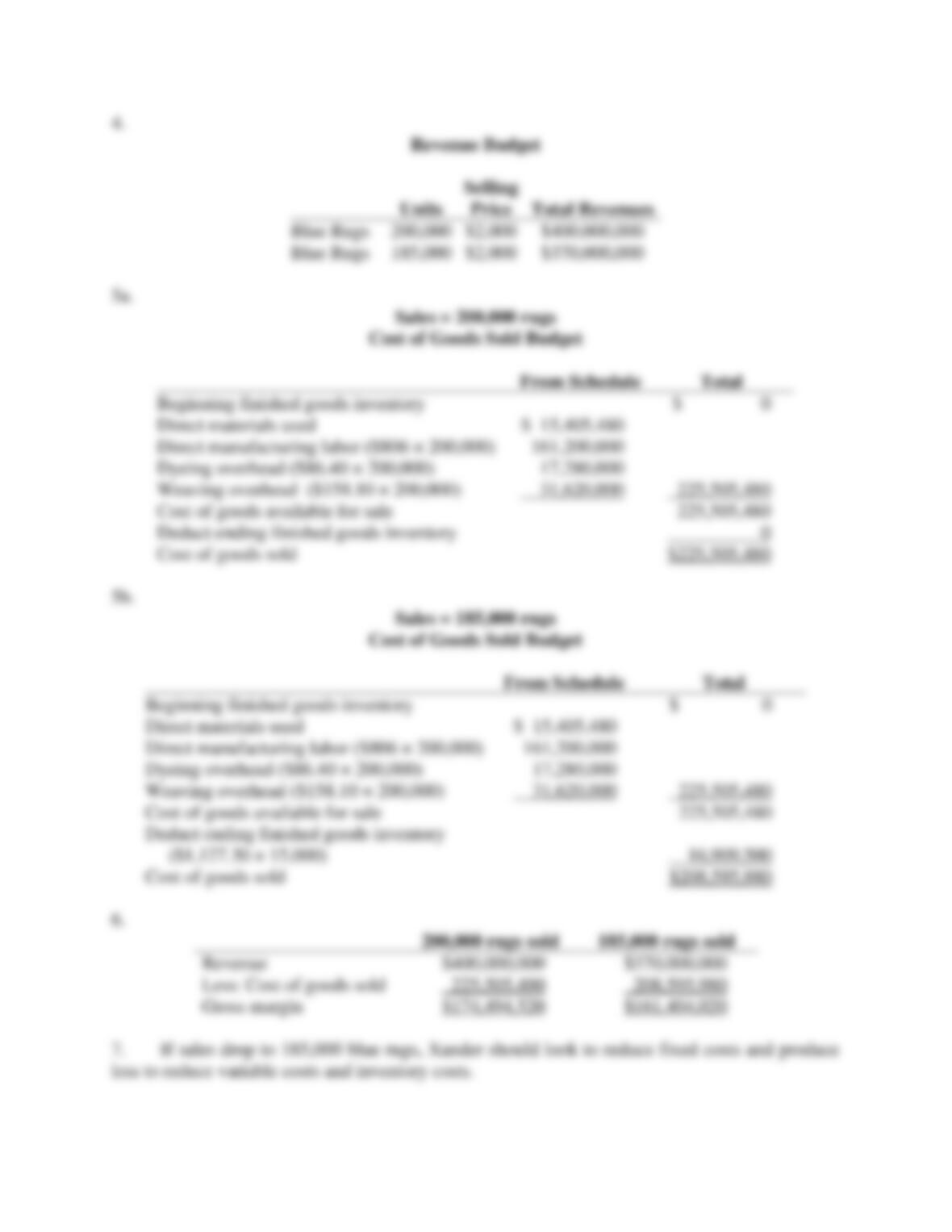
4. Prepare a revenues budget for blue rugs for the year, assuming Xander sells (a) 200,000 or
(b) 185,000 blue rugs (that is, at two different sales levels).
5. Calculate the budgeted cost of goods sold for blue rugs under each sales assumption.
6. Find the budgeted gross margin for blue rugs under each sales assumption.
7. What actions might you take as a manager to improve profitability if sales drop to 185,000
blue rugs?
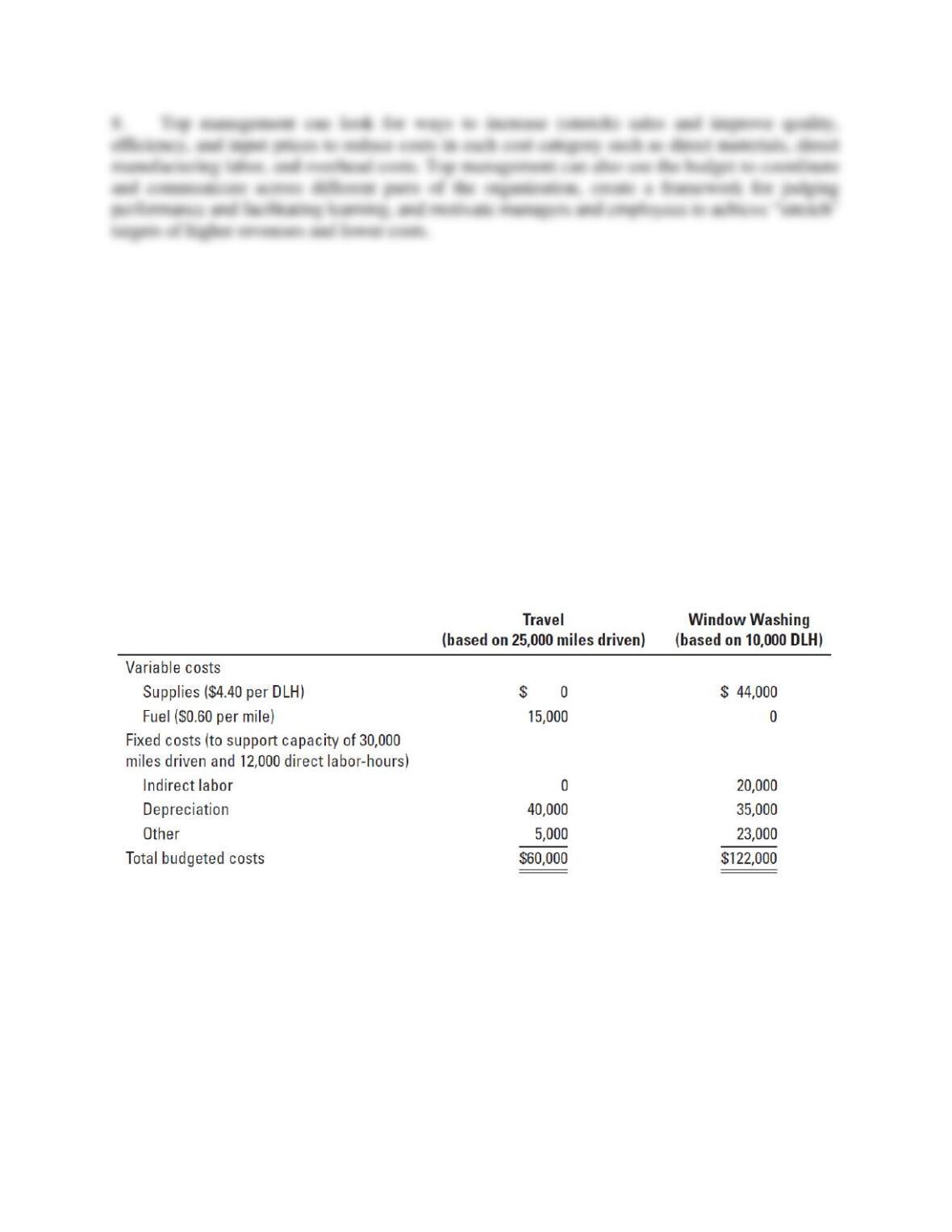
8. How might top management at Xander use the budget developed in requirements 1–6 to
better manage the company?
6-9
SOLUTION
6-10
6-11
6-23 (45 min.) Budgeting: service company.
Sunshine Window Washers (SWW) provides window-washing services to commercial clients.
The company has enjoyed considerable growth in recent years due to a successful marketing
campaign and favorable reviews on service-rating Web sites. Sunshine owner Sam Davis makes
sales calls himself and quotes on jobs based on square footage of window surface. Sunshine hires
college students to drive the company vans to jobs and wash the windows. A part-time
bookkeeper takes care of billing customers and other office tasks. Overhead is accumulated in
two cost pools, one for travel to jobs, allocated based on miles driven, and one for window
washing, allocated based on direct labor-hours (DLH).
Sam Davis estimates that his window washers will work a total of 2,000 jobs during the year
Each job averages 2,000 square feet of window surface and requires 5 direct labor-hours and
12.5 miles of travel. Davis pays his window washers $12 per hour. Taxes and benefits equal 20%
of wages. Wages, taxes, and benefits are considered direct labor costs. The following table
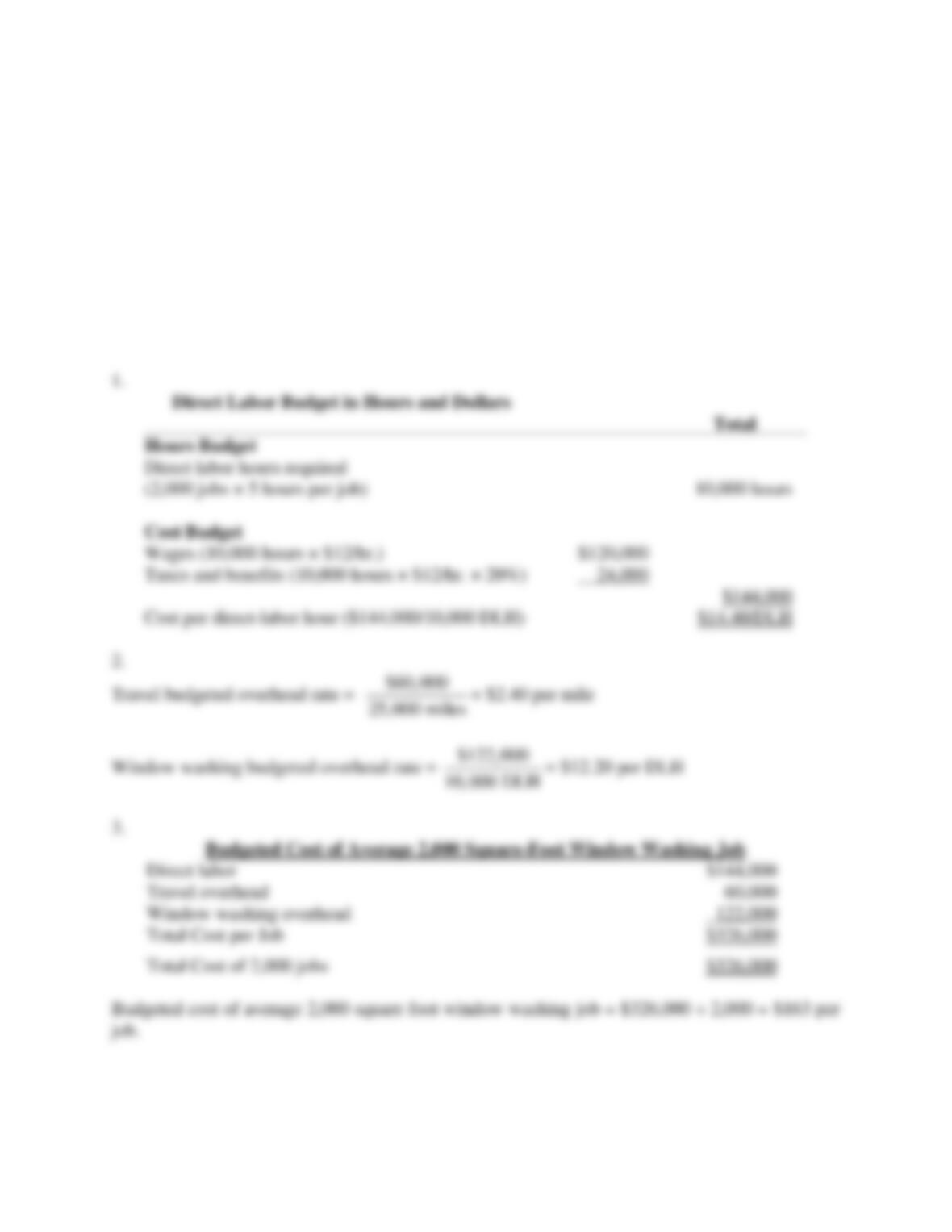
presents the budgeted overhead costs for the Travel and Window Washing cost pools:
Required:
1. Prepare a direct labor budget in both hours and dollars. Calculate the direct labor rate.
2. Calculate the budgeted overhead allocation rates for travel and window washing based on the
budgeted quantity of the cost drivers.
3. Calculate the budgeted total cost of all jobs for the year and the budgeted cost of an average
2,000-square-foot window-washing job.
4. Prepare a revenues budget for the year, assuming that Sunshine charges customers $0.10 per
square foot.
5. Calculate the budgeted operating income.
6-12
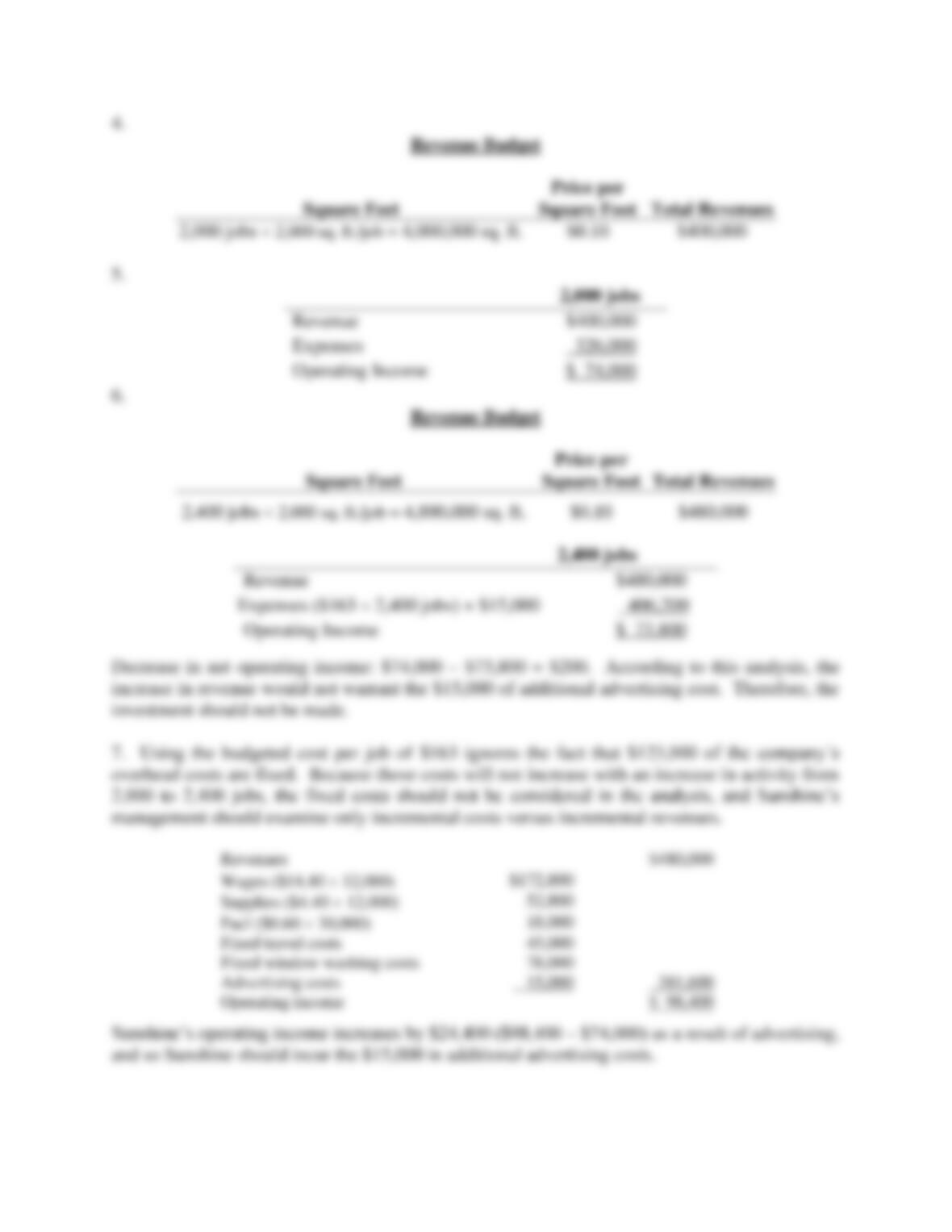
6. Davis believes that spending $15,000 in additional advertising will lead to a 20% increase in
the number of jobs. Recalculate the budgeted revenue and operating income assuming this
change is made. Calculate expenses by multiplying the existing budgeted cost per job
calculated in requirement 3 by the number of jobs and adding the $15,000 advertising cost.
Based on the change in budgeted operating income, would you recommend the investment?
7. Do you see any flaw in this analysis? How could the analysis be improved? Should SWW
spend $15,000 in additional advertising?
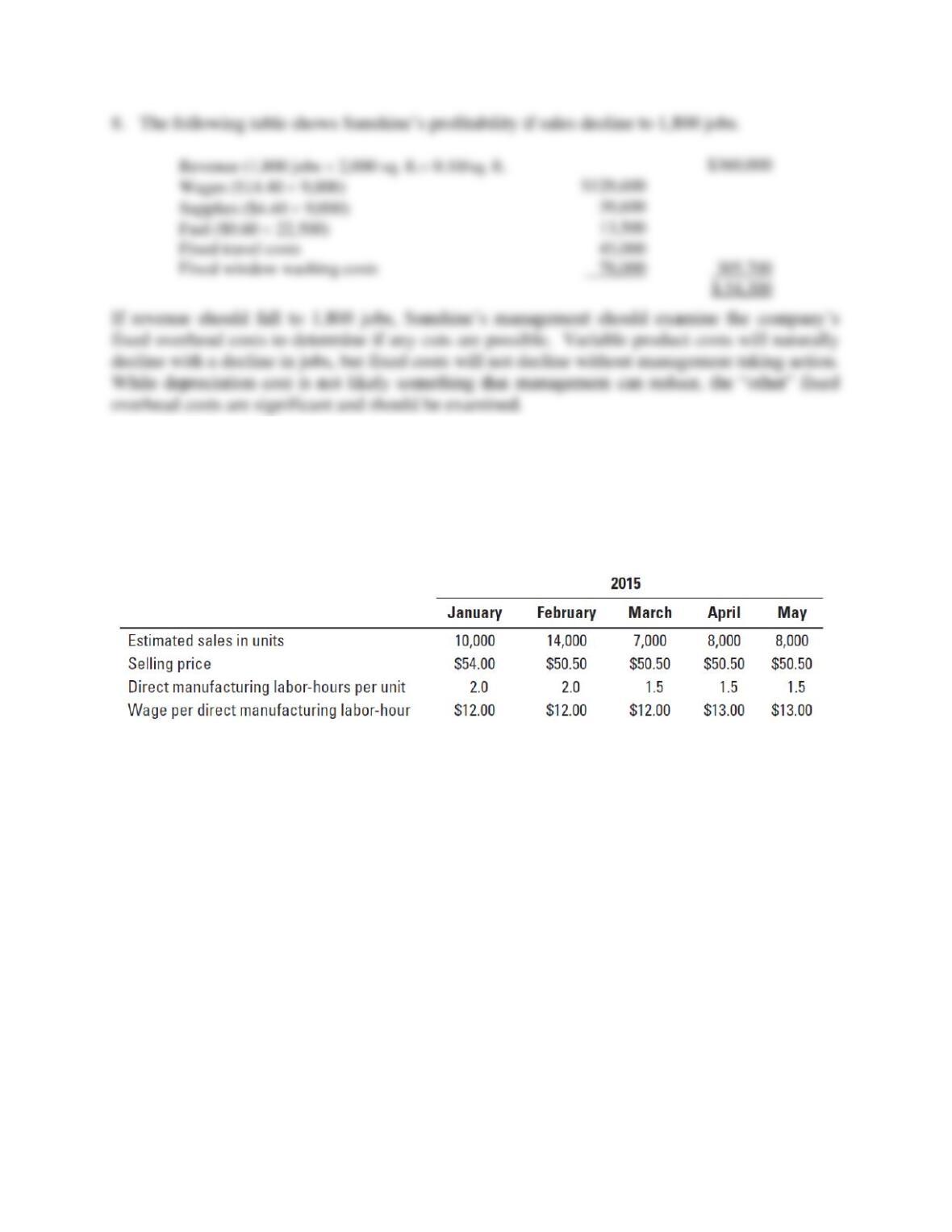
8. What is SWW’s profitability if sales should decline to 1,800 jobs annually? What actions can
Davis take to improve profitability?
SOLUTION
6-13
6-14
6-24 (15-25 min.) Budgets for production and direct manufacturing labor.
(CMA, adapted) Roletter Company makes and sells artistic frames for pictures of weddings,
graduations, and other special events. Bob Anderson, the controller, is responsible for preparing
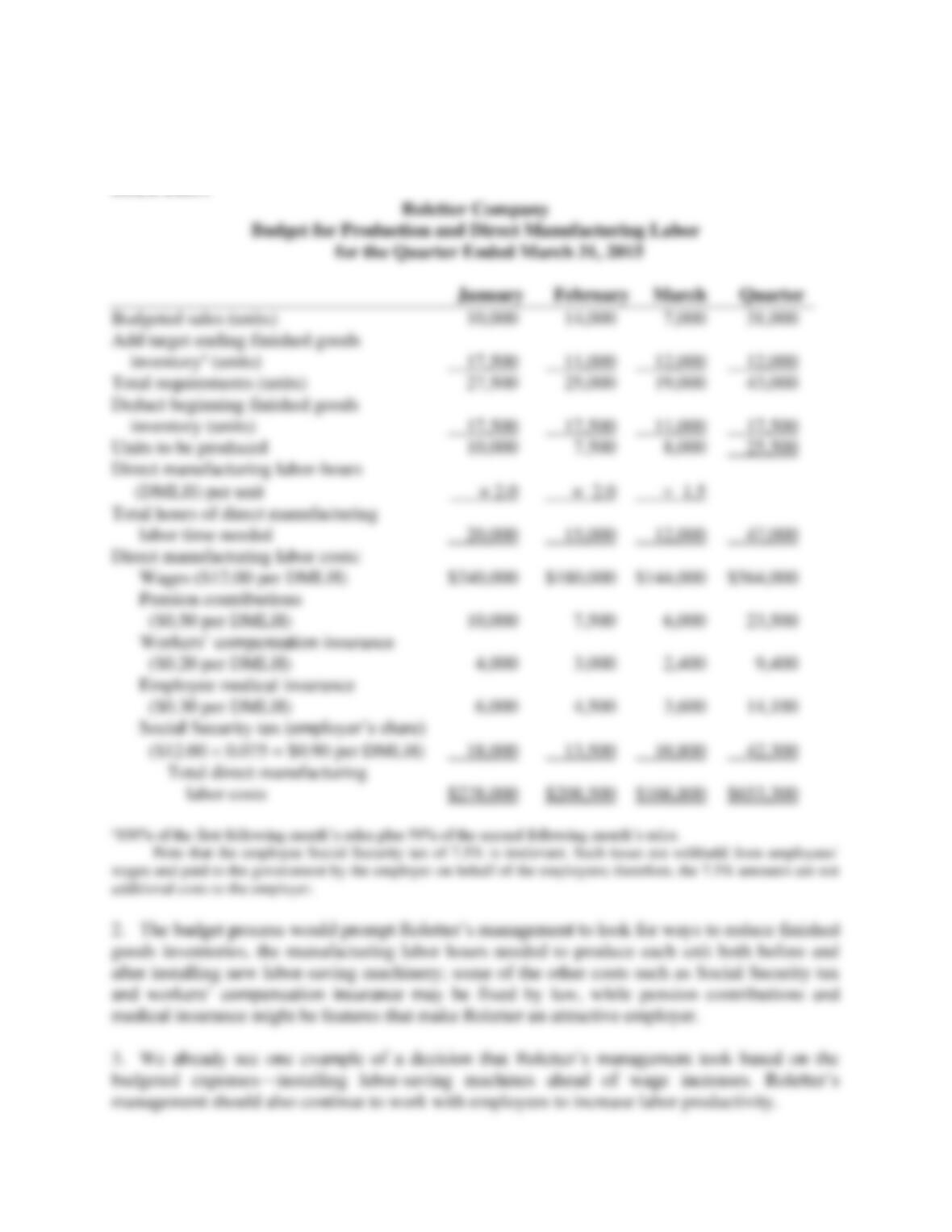
Roletter’s master budget and has accumulated the following information for 2015:
In addition to wages, direct manufacturing labor-related costs include pension contributions of
$0.50 per hour, worker’s compensation insurance of $0.20 per hour, employee medical insurance
of $0.30 per hour, and Social Security taxes. Assume that as of January 1, 2015, the Social
Security tax rates are 7.5% for employers and 7.5% for employees. The cost of employee
benefits paid by Roletter on its employees is treated as a direct manufacturing labor cost.
Roletter has a labor contract that calls for a wage increase to $13 per hour on April 1, 2015.
New labor- saving machinery has been installed and will be fully operational by March 1, 2015.
Roletter expects to have 17,500 frames on hand at December 31, 2014, and it has a policy of
carrying an end-of-month inventory of 100% of the following month’s sales plus 50% of the
second following month’s sales.
Required:
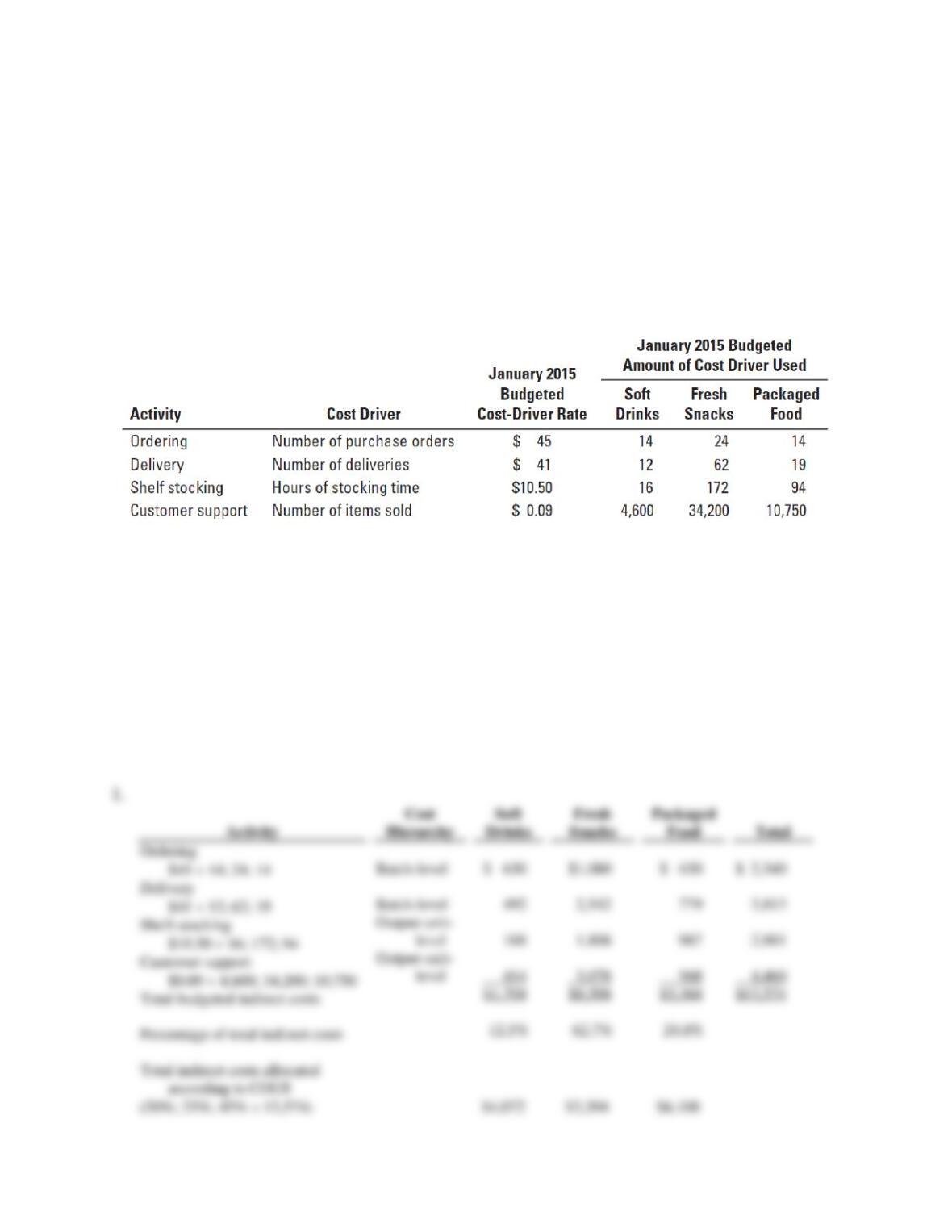
1. Prepare a production budget and a direct manufacturing labor budget for Roletter Company
by month and for the first quarter of 2015. You may combine both budgets in one schedule.
The direct manufacturing labor budget should include labor-hours and show the details for
each labor cost category.
2. What actions has the budget process prompted Roletter’s management to take?
6-15
3. How might Roletter’s managers use the budget developed in requirement 1 to better manage
the company?
SOLUTION
6-16
6-25 (20–30 min.) Activity-based budgeting.
The Jerico store of Jiffy Mart, a chain of small neighborhood convenience stores, is preparing its
activity-based budget for January 2015. Jiffy Mart has three product categories: soft drinks (35%
of cost of goods sold [COGS]), fresh produce (25% of COGS), and packaged food (40% of
COGS). The following table shows the four activities that consume indirect resources at the
Jerico store, the cost drivers and their rates, and the cost-driver amount budgeted to be consumed
by each activity in January 2015.
Required:
1. What is the total budgeted indirect cost at the Jerico store in January 2015? What is the total
budgeted cost of each activity at the Jerico store for January 2015? What is the budgeted
indirect cost of each product category for January 2015?
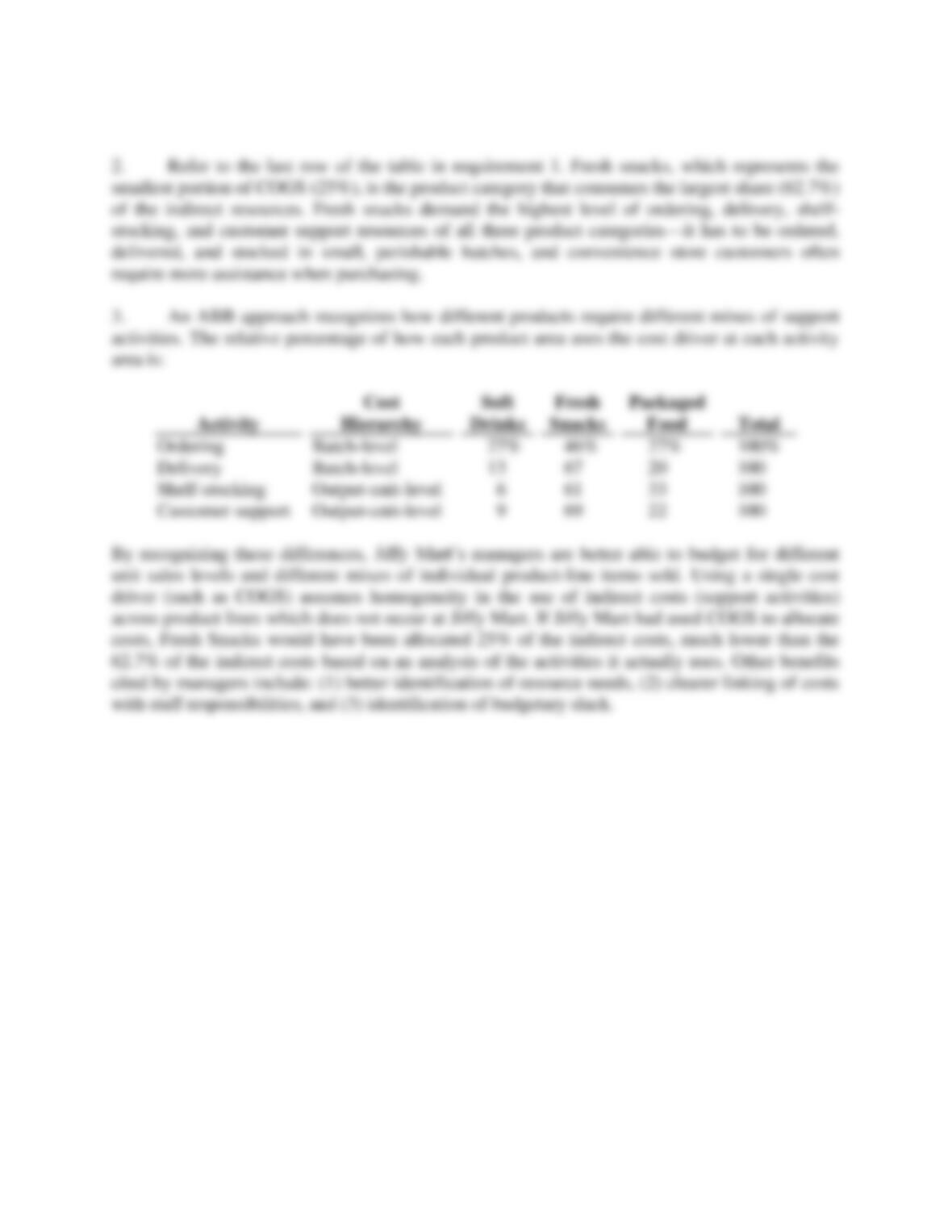
2. Which product category has the largest fraction of total budgeted indirect costs?
3. Given your answer in requirement 2, what advantage does Jiffy Mart gain by using an
activity-based approach to budgeting over, say, allocating indirect costs to products based on
cost of goods sold?
SOLUTION
6-17
6-26 (20–30 min.) Kaizen approach to activity-based budgeting (continuation of 6-25).
Jiffy Mart has a Kaizen (continuous improvement) approach to budgeting monthly activity costs
for each month of 2015. Each successive month, the budgeted cost-driver rate decreases by 0.4%
relative to the preceding month. So, for example, February’s budgeted cost-driver rate is 0.996
times January’s budgeted cost–driver rate, and March’s budgeted cost-driver rate is 0.996 times
the budgeted February rate. Jiffy Mart assumes that the budgeted amount of cost-driver usage
remains the same each month.
Required:
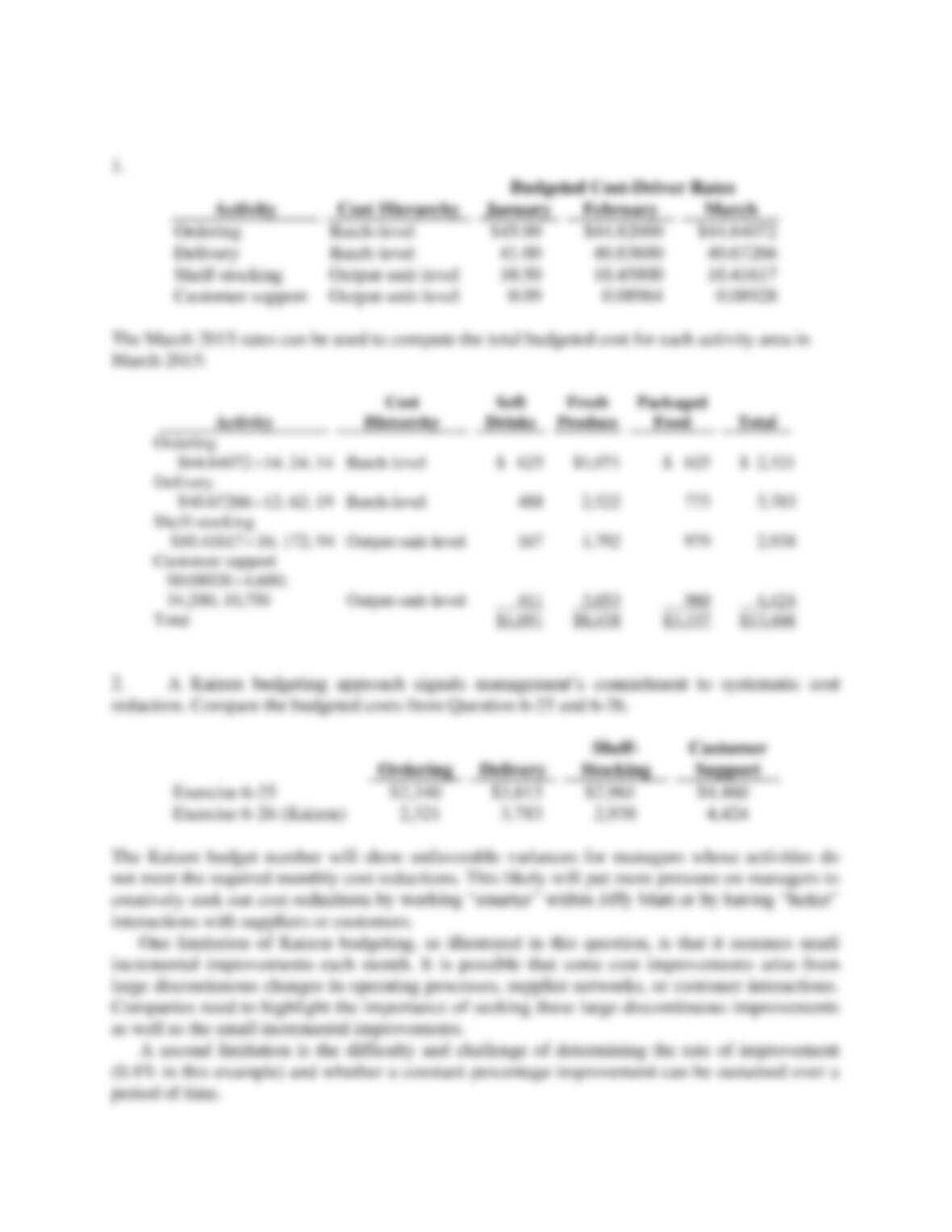
1. What are the total budgeted cost for each activity and the total budgeted indirect cost for
March 2015?
2. What are the benefits of using a Kaizen approach to budgeting? What are the limitations of
this approach, and how might Jiffy Mart management overcome them?
6-18
SOLUTION
6-19
6-27 (15 min.) Responsibility and controllability.
Consider each of the following independent situations for Tropical Hot Tubs. Tropical
manufactures and sells hot tubs. The company also contracts to service both its own and other
brands of hot tubs. Tropical has a manufacturing plant, a supply warehouse that supplies both the
manufacturing plant and the service technicians (who often need parts to repair hot tubs), and 10
service vans. The service technicians drive to customer sites to service the hot tubs. Tropical
owns the vans, pays for the gas, and supplies hot tub parts, but the technicians own their own
tools.
1. In the manufacturing plant, the production manager is not happy with the motors that the
purchasing manager has been purchasing. In May, the production manager stops requesting
motors from the supply warehouse and starts purchasing them directly from a different motor
manufacturer. Actual materials costs in May are higher than budgeted.
2. Overhead costs in the manufacturing plant for June are much higher than budgeted.
Investigation reveals a utility rate hike in effect that was not figured into the budget.
3. Gasoline costs for each van are budgeted based on the service area of the van and the amount
of driving expected for the month. The driver of van 3 routinely has monthly gasoline costs
exceeding the budget for van 3. After investigating, the service manager finds that the driver
has been driving the van for personal use.
4. Cascades Resort and Spa, one of Tropical’s hot tub service customers, calls the service
people only for emergencies and not for routine maintenance. Thus, the materials and labor
costs for these service calls exceeds the monthly budgeted costs for a contract customer.
5. Tropical’s service technicians are paid an hourly wage, with overtime pay if they exceed 40
hours per week, excluding driving time. Fred Friendly, one of the technicians, frequently
exceeds 40 hours per week. Service customers are happy with Fred’s work, but the service
manager talks to him constantly about working more quickly. Fred’s overtime causes the
actual costs of service to exceed the budget almost every month.
6. The cost of gasoline has increased by 50% this year, which caused the actual gasoline costs
to greatly exceed the budgeted costs for the service vans.
Required:
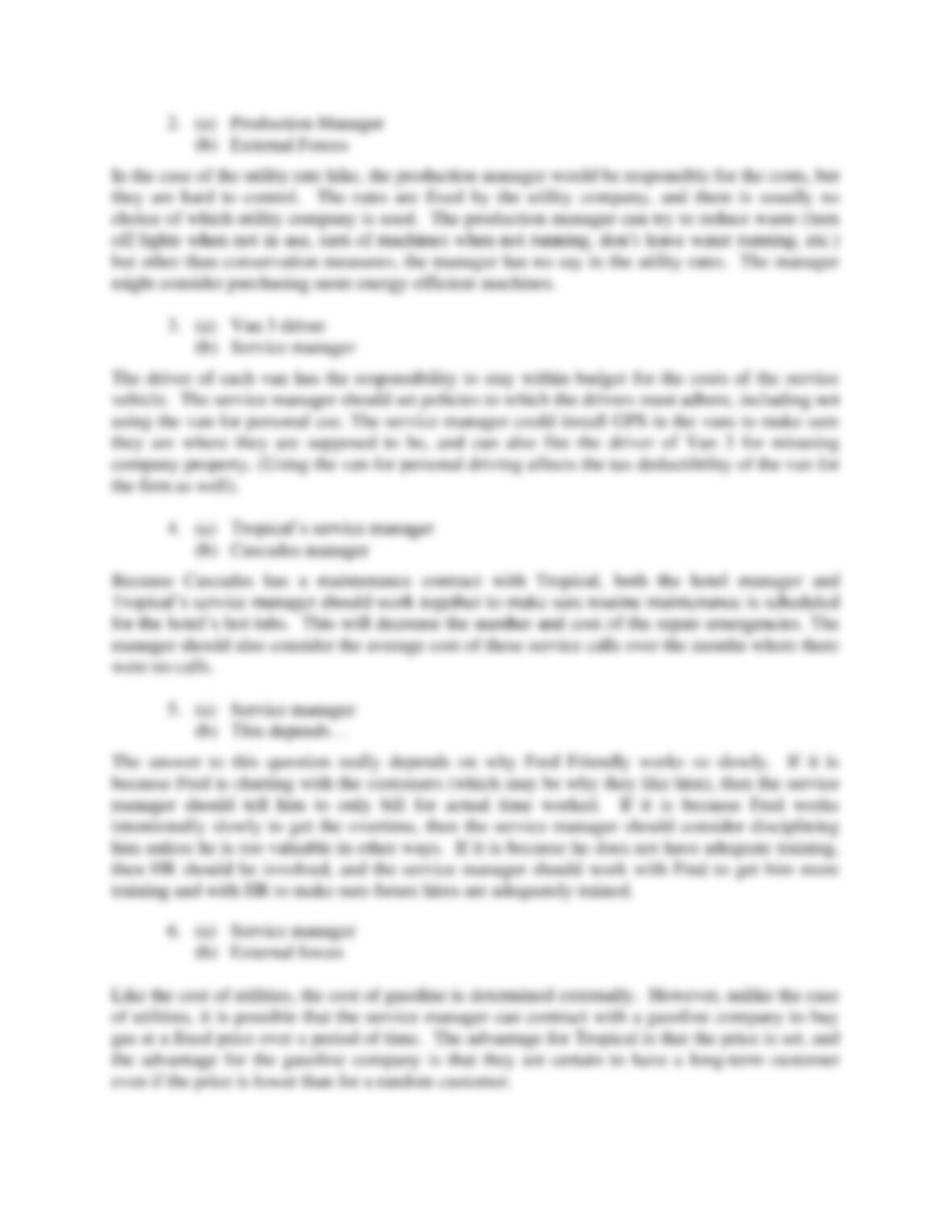
For each situation described, determine where (that is, with whom) (a) responsibility and (b)
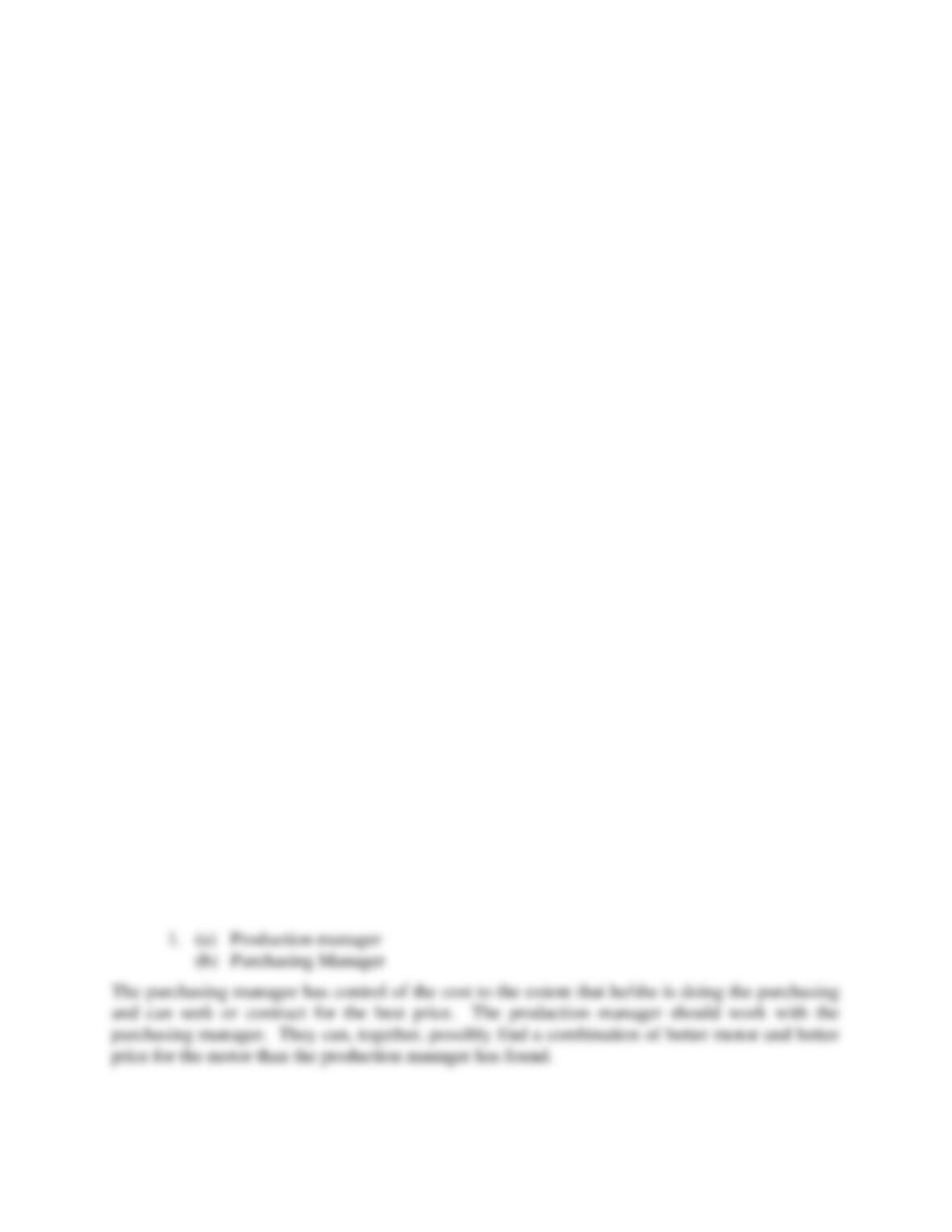
controllability lie. Suggest ways to solve the problem or to improve the situation.
SOLUTION
6-20