
Chapter 6
Foreign Currency Translation
Discussion Questions
1. In the foreign exchange spot market, currencies bought and sold must be delivered immediately,
normally within two business days. Thus a Singaporean tourist buying U.S. dollars at the airport
before boarding a plane for New York would hand over Singapore dollars and immediately receive
the equivalent amount in U.S. dollars. The forward market handles agreements to exchange a fixed
amount of one currency for another on an agreed date in the future. For example, a French
manufacturer exporting goods invoiced in euros to a Japanese importer on 60-day credit terms would
buy a forward contract to sell yen for euros two months in the future.
Transactions in the swap market involve the simultaneous purchase (or sale) of one currency in the
2. The question refers to alternative exchange rates that are used to translate foreign financial
statements. The current rate is the exchange rate at the financial statement date. It is sometimes called
the year-end or closing rate. The historical rate is the exchange rate at the time of the underlying
3. In this example, the Mexican Affiliate’s Canadian dollar loan is denominated in Canadian dollars.
However, because the Mexican affiliate’s functional currency is U.S. dollars, the peso equivalent of
4. A transaction gain or loss occurs when a foreign currency transaction, e.g., a foreign currency
borrowing, is settled at a different exchange rate than that which prevailed when the transaction was
5. It is not possible to combine, add, or subtract accounting measurements expressed in different
currencies; thus, it is necessary to translate those accounts that are measured or denominated in a
foreign currency into a single reporting currency. Foreign currency translation can involve

6. Major advantages and limitations of each of the major translation methods follow.
Current Rate Method
Advantages:
a. Retains the initial relationships in the foreign currency statements.
b. Simple to apply.
Limitations:
a. Violates the basic purpose of consolidation, which is to present the results of a parent and its
subsidiaries as if they were a single entity.
Current-noncurrent Method
Advantages:
a. Distortions in translated gross margins are reduced as inventories and translated at the current
rate.
b. Reported earnings are shielded from the distorting effects of currency fluctuations as excess
translation gains are deferred and used to offset future translation losses.
Limitations:
a. Uses balance sheet classification as basis for translation.
b. Assumes all current assets are exposed to exchange risk regardless of their form.
c. Assumes long-term debt is sheltered from exchange rate risk.
Monetary-nonmonetary Method
Advantages:
a. Reflects changes in domestic currency equivalent of long-term debt on a timely basis.
Limitations:
a. Assumes that only monetary assets and liabilities are subject to exchange rate risk.
Temporal Method
Advantages:
a. Theoretically valid: compatible with any accounting measurement method.
b. Has the effect of translating foreign subsidiaries operations as if they were originally transacted in

7. The current rate method is appropriate when the foreign entity being consolidated is largely
independent of the parent company. Conditions which would justify this methodology are when the
foreign affiliate tends to generate and expend cash flows in the local currency, sells a product locally
8. The history of foreign currency translation in the United States suggests that the development of
accounting principles does not depend on theoretical considerations so much as on political,
institutional, and economic influences that affect accounting standard setting. It may be more realistic
to recognize that theoretically sound solutions are impossible as long as policy prescriptions are
Foreign inflation, in particular, the differential rate of inflation between the country in which a subsidiary
is located and the country of its parent, determines foreign exchange rates. These rates, in turn, are
used to translate foreign currency balances to parent currency.
10 Under FAS No. 52, the parent currency is designated as the functional currency for an affiliate, whose
operations are considered to be an integral part of the parent company’s operations. Accordingly,
Exercises Solutions
1. ¥250,000,000 X .0106809 = $2,670,225.
2. Single Transaction Perspective:
4/1 Purchases (¥32,500,000/¥93.6250) $347,130
Cash 31,713
A/P(¥32,500,000 – ¥3,250,000)/¥93.6250 312,417
(Credit purchase)
Two Transactions Perspective:
4/1 Purchases $347,130
Cash $34,713
A/P 312,417
b. The Canadian dollar equivalent of the Mexican inventory account would not change if the
functional currency was the Canadian dollar as the temporal method translates inventory, a
4. Baht is the functional currency:
B 2,500,000/20 years = B 125,000
B 125,000/B35 = $3,571
5. If the euro is the German subsidiary’s functional currency, its accounts would be translated into
Australian dollars using the current rate method. In this case the translation gain of AUD4,545,455
would appear in consolidated equity. Thus, the only item affecting current income would be the
6.
U.S. Dollar U.S. Dollar U.S. Dollar
Before CNY After CNY After CNY
Appreciation Appreciation Depreciation
CNY Balance Sheet ($.15=CNY1) ($.1875 = CNY1) ($0.1125 = CNY1)
Assets Amount Current Monetary Current Monetary
Noncurrent Nonmonetary Noncurrent Nonmonetary
Cash CNY5,000 $750 $ 938 $ 938 $ 563 $ 563
7.
U.S. Dollar U.S. Dollar U.S. Dollar
Before CNY After CNY After CNY
Appreciation Appreciation Depreciation
CNY Balance Sheet ($.15=CNY1) ($.1875 = CNY1) ($.1125 = CNY1)
Assets Amount Temporal Current Temporal Current
Cash CNY5,000 $ 750 $ 938 $ 938 $ 563 $ 563
Accts. Receivable 14,000 2,100 2,625 2,625 1,575 1,575
Inventories
c. Students will quickly discover that each translation method has its advantages and disadvantages.
After some discussion, the question of translation objectives will arise. Currency translation
objectives are based on how foreign operations are viewed. If foreign operations are considered
Company A (Country A)
(Reporting Currency = Apeso)
Beginning of Year End of Year
Assets: Exchange Rate Translated Exchange Rate Translated
Apeso 100 Apeso 100 Apeso 100
translation results when the current rate method is used. Both companies are in seemingly
identical situations, yet one reports a translation loss whereas the other reports a
9.
Translation Rate
Local Currency is Dollar is
Functional Currency Functional Currency
Cash Current Current
Marketable securities (cost) Current Historicala
Bonds payable Current Current
Income taxes payable Current Current
Deferred income taxes Current Current
Common stock Historical Historical
Premium on common stock Historical Historical
Retained Earnings Balancing Residual Balancing Residual
aFixed income securities intended to be held to maturity.
10. a. Before riyal depreciation:
Cash SAR 60,000,000 ÷ SAR3.75 = $ 16,000,000
After riyal depreciation:
Cash SAR 60,000,000 ÷ SAR4.125 = $ 14,545,455
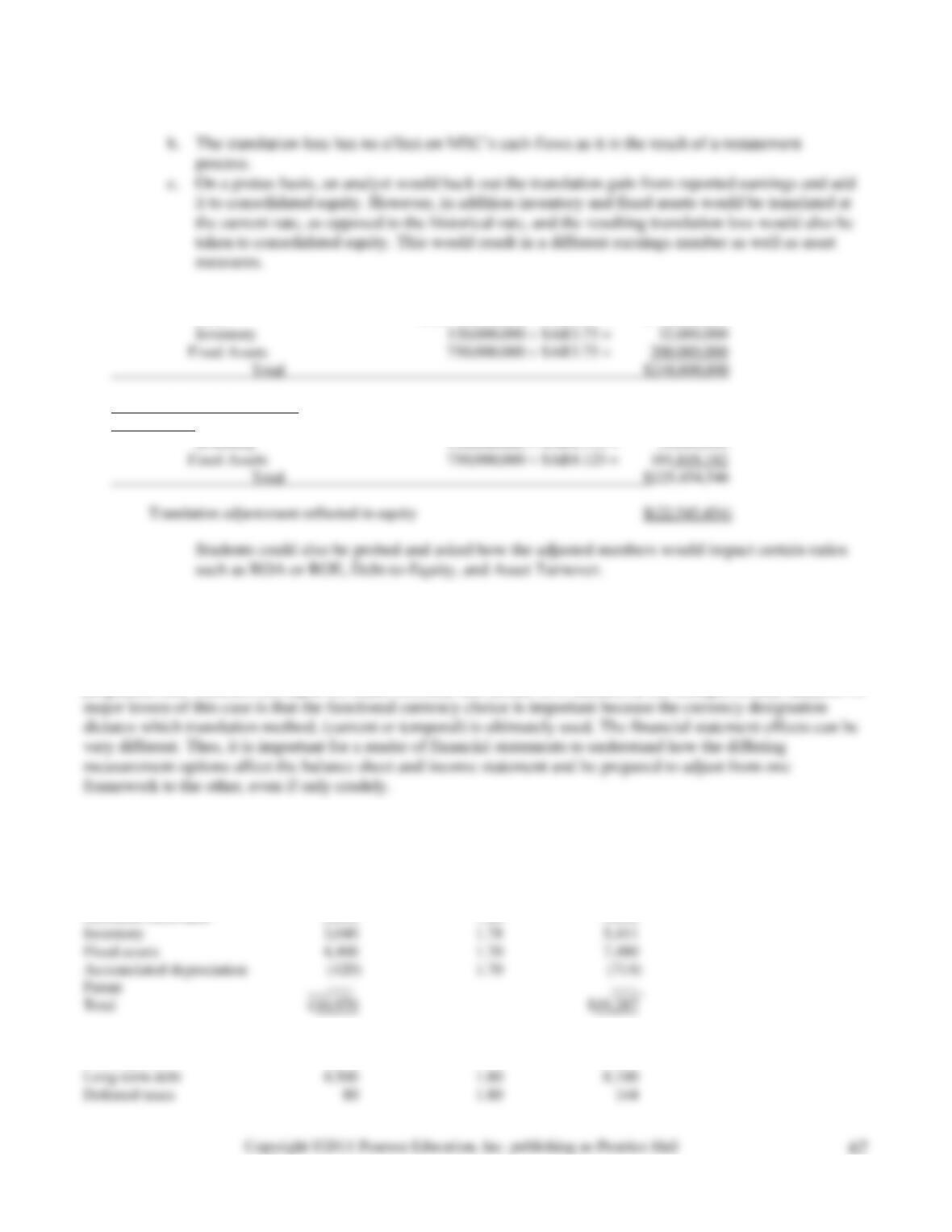
b. The translation loss has no effect on MSC’s cash flows as it is the result of a restatement
Before riyal depreciation:
Cash SAR 60,000,000 ÷ SAR3.75 = $ 16,000,000
After riyal depreciation:
Cash SAR 60,000,000 ÷ SAR4.125 = $ 14,545,455
Case 6-1 Regents Corporation
The nature of Regents’s operation is such that choice of an appropriate functional currency is ultimately a
judgement call. Students can argue for either currency and should be evaluated on the strength of their analysis. A
TEMPORAL METHOD
(U.S. DOLLAR IS THE FUNCTIONAL CURRENCY)
Balance Sheet Accounts, 12/31/10 Foreign Currency Exchange Rate Dollar Equivalent
Cash £ 1,060 1.80 $ 1,908
Accounts receivable 2,890 1.80 5,202
Accounts payable £ 1,610 1.80 $ 2,898
Due to parent 1,800 1. 80 3,240
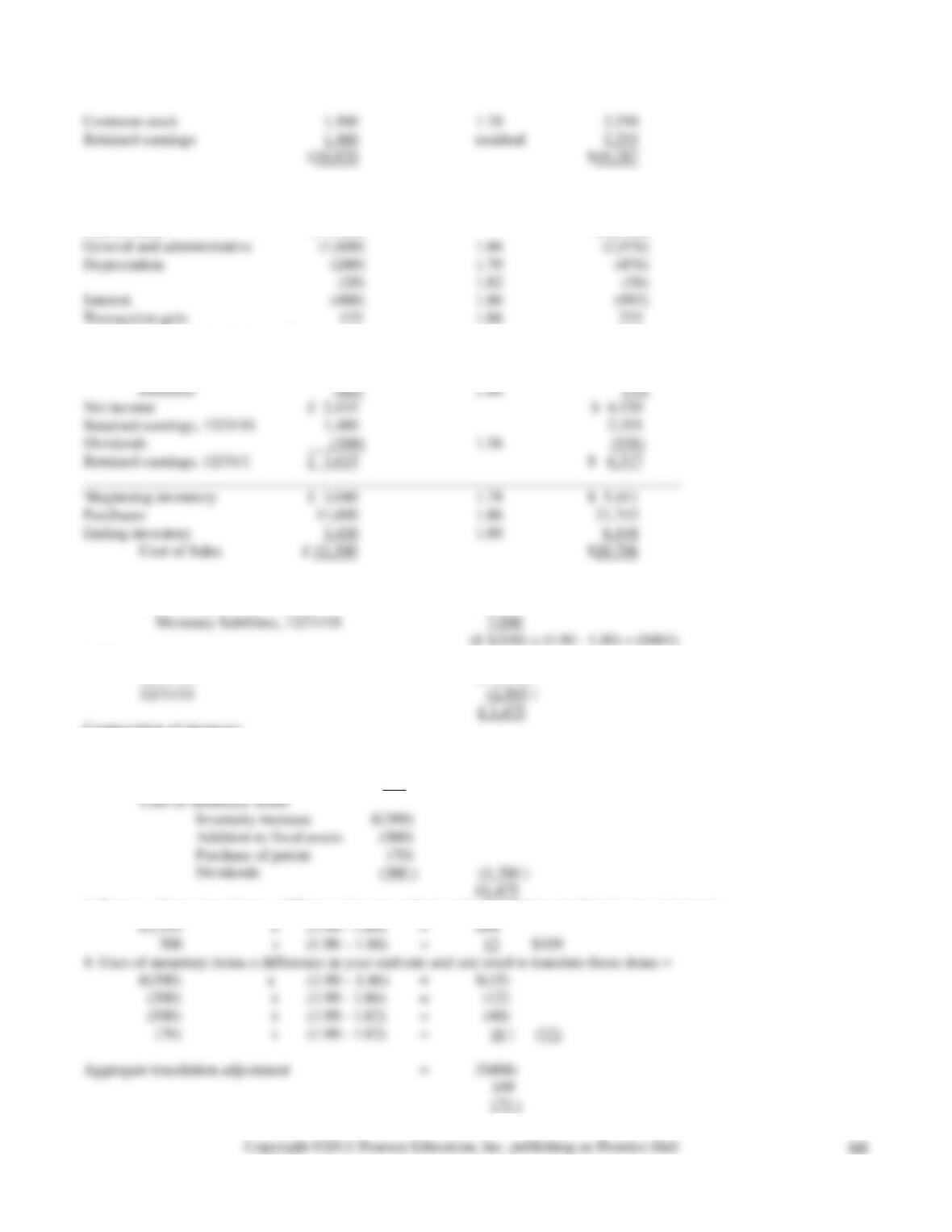
Income Statement, 12/31/11 Foreign Currency Exchange Rate Dollar Equivalent
Sales £ 16,700 1.86 $ 31,062
Cost of salesa (11,300) (20,706)
Aggregate translation adjustmentb (368)
Taxes:
Current (670) 1.86 (1,246 )
bAggregate translation adjustment:
1. Monetary assets, 12/31/10 £ 3,950
2. Change in negative exposure:
12/31/10 (£ 4,040)
Composition of decrease:
Sources of monetary items:
Net income £2,435
Depreciation 300 £2,735
3. Sources of monetary items x difference in year-end rate and rate used to translate income statement =
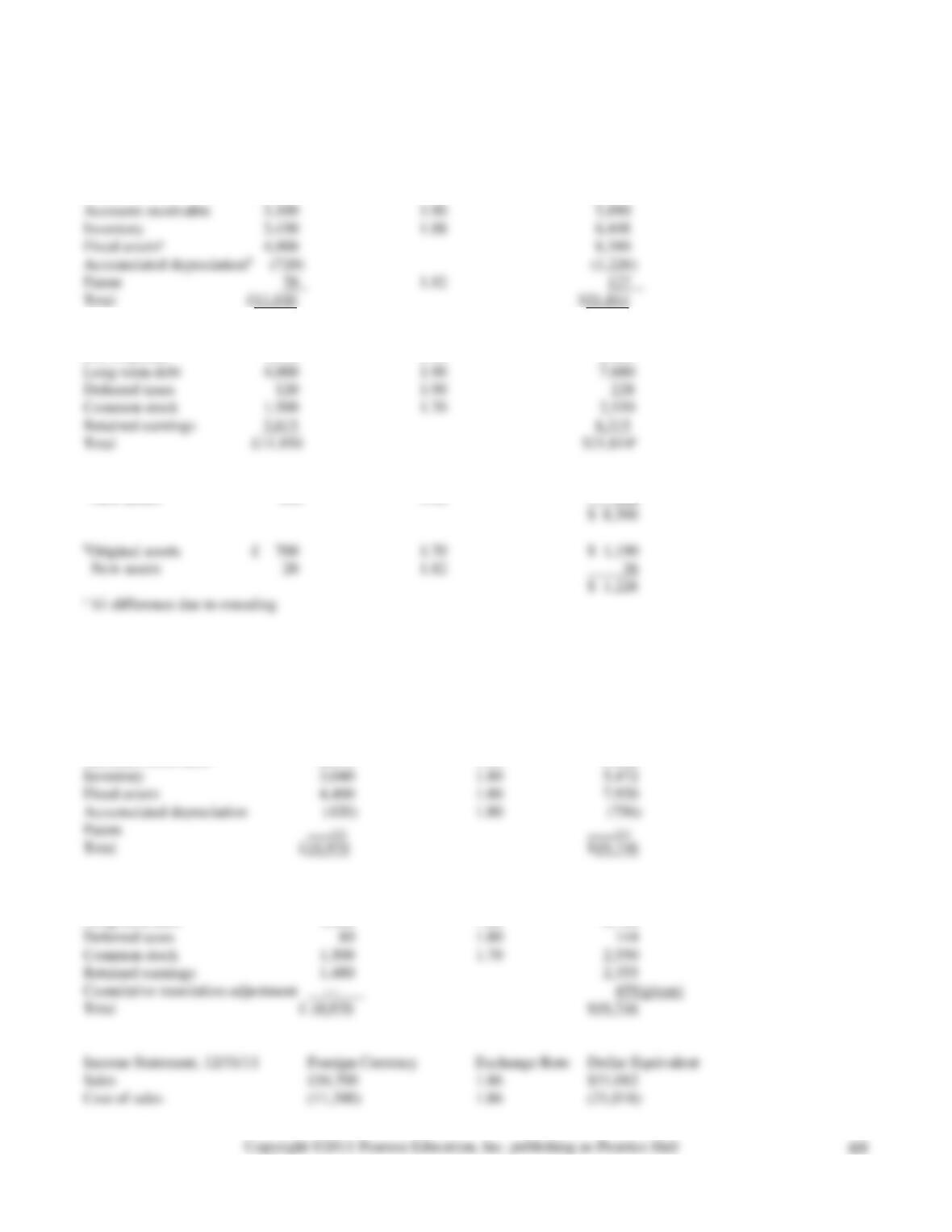
($368)
Balance Sheet, 12/31/11 Foreign Currency Exchange Rate Dollar Equivalent
Cash £ 1,150 1.90 $2,185
Accounts payable £ 1,385 1.90 $ 2,632
Due to parent 1,310 1.90 2,489
___________________________________________________________________________
a Original assets £ 4,400 1.70 $ 7,480
New assets 500 1.82 910
CURRENT RATE METHOD
(LOCAL CURRENCY IS THE FUNCTIONAL CURRENCY)
Balance Sheet Accounts, 12/31/10 Foreign Currency Exchange Rate Dollar Equivalent
Cash £ 1,060 1.80 $ 1,908
Accounts receivable 2,890 1.80 5,202
Accounts payable £ 1,610 1.80 $ 2,898
Due to parent 1,800 1.80 3,240
Long-term debt 4,500 1.80 8,100
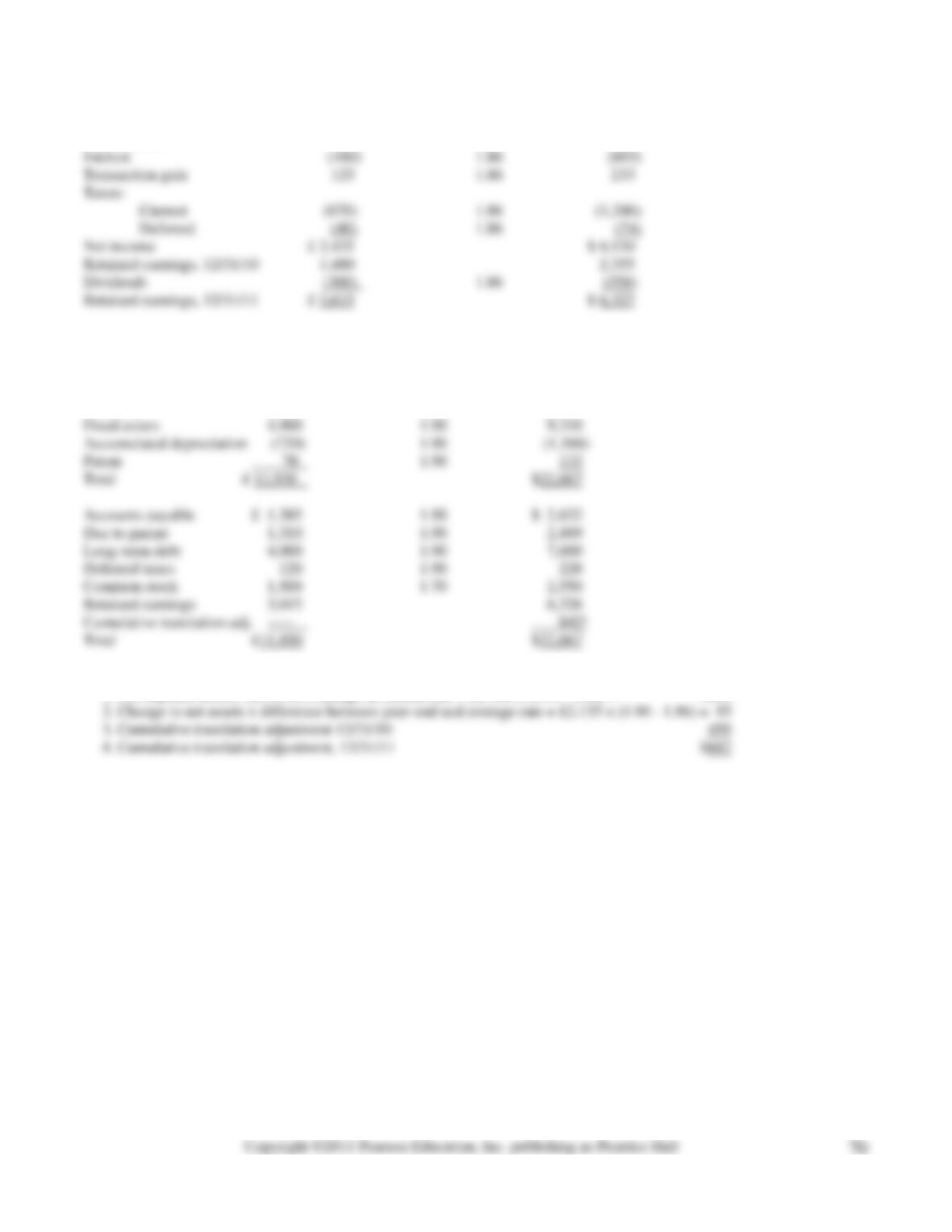
General and administrative (1,600) 1.86 (2,976)
Depreciation (300) 1.86 (558)
Balance Sheet, 12/31/11 Foreign Currency Exchange Rate Dollar Equivalent
Cash £ 1,150 1.90 $ 2,185
Accounts receivable 3,100 1.90 5,890
Inventory 3,430 1.90 6,517
___________________________________________________________________________
aCumulative translation adjustment:
1. Net exposed assets, 12/31/10, x change in current rate = £2.980 x (1.90 – 1.80) = $298
Selected policy issues raised by the Regents Corporation case:
1. Are the FASB’s criteria for selecting a functional currency designation adequate? Are there criteria
that are more definitive than those identified in this chapter?
2. Will statement readers understand the nature of the aggregate exchange adjustment appearing in the
consolidated income statement under the temporal method of translation that includes both
transaction and translation gains and losses?
3. Will statement readers understand the nature of the cumulative translation adjustment appearing in
consolidated equity under the current rate method?
4. Although the current rate method preserves the financial relationships that exist in the local currency
statements, does applying a current exchange rate to a historical cost measure (e.g., local currency
fixed assets) result in a reporting currency equivalent that can be interpreted?
Case 6-2 Managing Offshore Investments: Whose Currency?
This case is likely to generate a lot of discussion in class as one can argue it either way. Most arguments in favor
of one currency designation over the other will probably repeat points already made in the case. After much

discussion, students should begin to realize that one way out of the dilemma is to define the purpose of currency
translation. Some will argue that the purpose is to provide meaningful information to investors; others will argue