6-20
6-70
a. This excerpt identifies problems that the audit firm was having with obtaining evidence
from confirmations sent to the client’s banks. The auditors had not received replies from
the confirmations they sent to Longtop’s banks. So, they decided to visit the banks to
obtain the information. Those visits yielded some very troubling findings as outlined in
b. Assumptions that underlie confirmations include whether:
• The confirmations will receive a conscientious review and response from the
individual from whom the confirmation is requested.
• The respondent is knowledgeable and has a sufficient basis on which to respond to
c. A professionally skeptical auditor will understand the various sources of bias that may
enter into the equation when it comes to the reliability of confirmations. As such, a
6-71
a. The proper valuation of the allowance for doubtful accounts is management’s best
estimate of the amount of the accounts receivable that will not be collected. This is
b. The company should utilize the following information:
• Aging of the receivables
• Past collection experience
• Changes in credit policies
• Changes in the economy as it affects the customers
6-21
c. The auditor should:
• Understand the process management uses to make its estimates.
• Inquire as to the credit policies and approach management takes to make its estimate
and determine if it is a reasonable approach.
• Analyze the relationship between the provision for doubtful accounts and actual
write-offs over the last few years.
• Review an aging of the accounts receivable and:
• Compare with the prior year aging for any significant changes
• Review subsequent collections
d. Sales to less credit-worthy customers will normally lead to larger write-offs and a larger
allowance.
e. A change in the economic climate will impact the estimate; historical experience will be
6-72
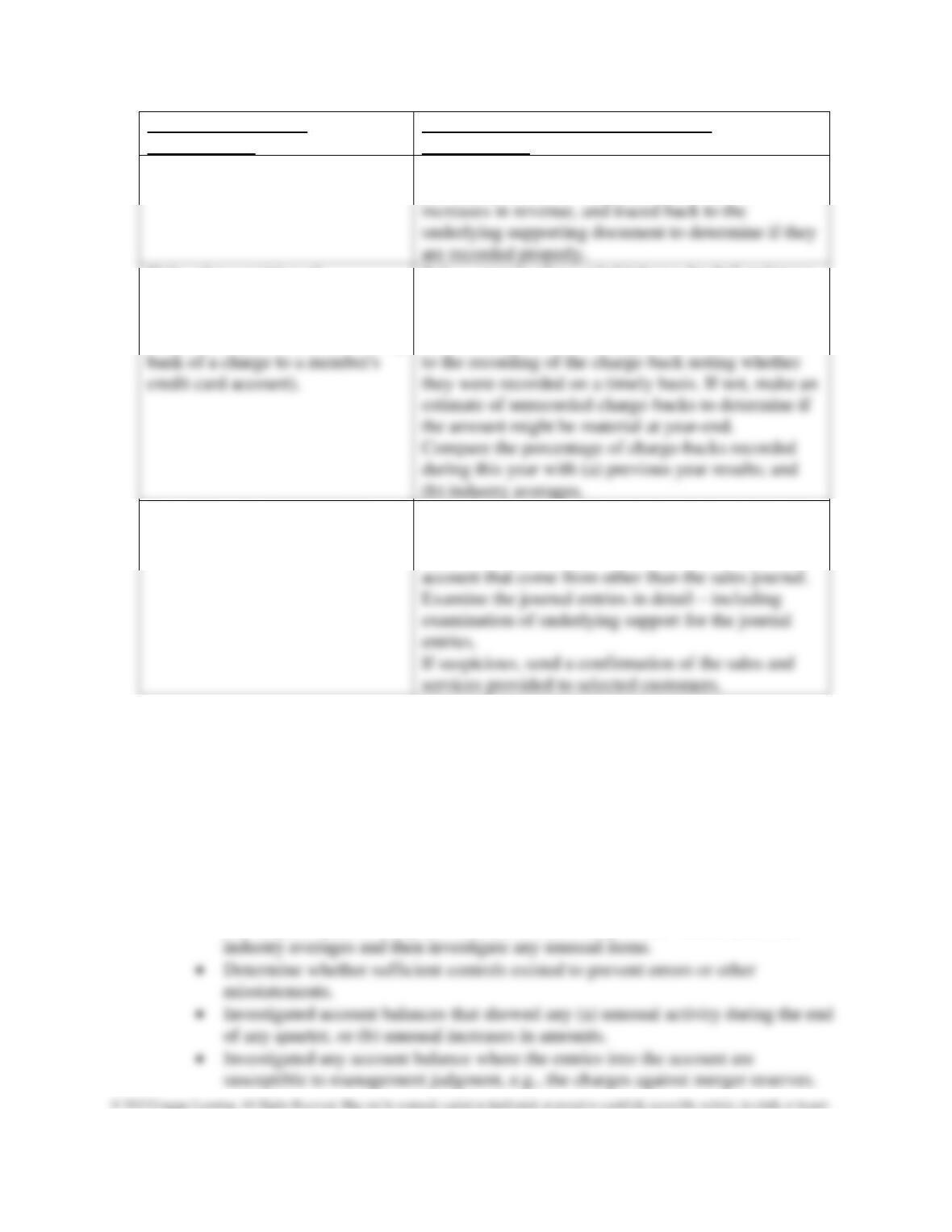
a.
Financial Statement
Misstatement
Audit Procedures to Detect Error or
Misstatement
Irregular Charges Against Merger
Reserves
Reserves should be set up at the time of a merger in
anticipation of future expenses directly associated
with the merger. The client should have an
information system in place to track all changes
reversed.
False Coding of Services sold to
Customers
First, analytical review procedures should be used to
identify unusual increases in revenue, or increases in
revenue that would be higher than expected given (a)
the number of members; and (b) industry trends.
6-22
Financial Statement
Misstatement
Audit Procedures to Detect Error or
Misstatement
Second, a sample of revenue recorded should be
taken, particularly during periods of unusual
Delayed recognition of
cancellation of memberships and
“charge-backs” (a charge-back is
a rejection by a credit card-issuing
Take a sample of recorded “charge–backs” and trace
back initial notice from the bank to see if the items
are recorded on a timely basis.
Take a sample of bank charge back notices and trace
Quarterly recording of fictitious
revenues
Examine the journal entries in detail – including
examination of underlying support for the journal
Examine all unusually large increases in revenue at
the end of a quarter.
Take a sample of all journal entries into the revenue
b. The auditor’s assessment of management integrity and management motivation should
affect all audits, and a professionally skeptical auditor will recognize and respond to this
fact. In the above situation, the auditor had a great deal of reason to question
management’s motivation due to a merger and management’s reputation to use
accounting as a tool to increase reported earnings. Given the suspicions by the auditor, a
professionally skeptical auditor should have:
• Assessed risk of potential misstatement as higher than usual.
• Identified the accounts that are most susceptible to management manipulation.
• Developed a plan to compare recorded results with previous results and with
6-23
6-73
An extra shipment of $9 million of disks. The primary evidence is found by reviewing
receipts for merchandise returned after year-end. The auditor examines records of goods
returned after year-end to determine whether the returns were material and the previous
sale should be reversed. The auditor also discovers evidence on the extra shipment
because the $9 million sale would result in a $9 million receivable. If the auditor attempts
to confirm the receivable with the customer, it is likely that the customer would indicate
that the sale was not appropriate.
Application Activities
6-74
a. Audit documentation is the record that forms the basis for the auditor’s representations and
conclusions. Audit documentation is important in that it facilitates the planning, performance,
and supervision of the audit and forms the basis of the review of the quality of the work
b. PCAOB inspectors are concerned with audit deficiencies—regardless of whether they result
in misstated financial statements or audit opinions. Earlier in the text we described a quality
c.
• Identify the ethical issue(s). The issue involves whether to comply with a superior request
to alter an audit workpaper after the fact.
• Determine who are the affected parties and identify their rights. The parties that would
be affected by your actions include:
(1) The audit firm as a whole. The firm has a right to demand and expect high
quality performance.
• Determine the most important rights. The most important rights are those held by the
client and its stakeholders. They are paying for high quality service, and if you do not
complete a quality audit (which includes adhering professional auditing standards) the
client and the stakeholders will not have received services they are expecting.
• Determine the likely consequences of each proposed course of action. : (1) Comply with
the request. There are many possibilities here. The action may never come to light.
Alternatively, the action may come to light through some review process (internal
inspection, PCAOB inspection, etc.). If that does occur you might get fired, be
reprimanded, be required to take additional training, have your worked more thoroughly
reviewed, have to start a new job with a tarnished reputation, etc.
6-25
6-75
a. The auditor is required by professional auditing standards to not only consider
information outside of the client’s records, but to actively solicit such information to
evaluate for consistency with the client’s record-keeping, and to provide additional input
on critical evaluation decisions the auditor must address.
b. Inventory: There is a significant downturn in the industry. Presumably that downturn
affects the ability to sell the inventory and therefore the valuation of the inventory. Recall
that inventory always should be valued at the lower of cost or market, thus the auditor
must consider current market conditions.
Reliance on Management Inquiry related to the Joint Venture. The auditor should have:
• Read and understood the contract related to the joint venture
• Determined the client’s obligations
• Evaluate the success of the JV to date in order to determine whether a liability
might exist
6-26
e. The deficiencies identified by the PCAOB are evidence of a lack of professional
skepticism by the auditor. While it is not always easy to state that there is one cause for
the decrease in skepticism, the need to control audit costs could certainly have been a
6-76
Answers will vary, but some potential situations that might be identified are listed below. For all
analytical procedures it is important that the student recognize the need for the auditor to first
develop an independent expectation with an appropriate level of precision. If this question is
covered in class, the instructor might want to probe the students as to what information would be
used in developing an expectation for their identified accounts.
6-77
a. and b.
The appropriate standard is AS 15. The relevant information can be found in paragraphs 22- 28
of that standard. These paragraphs are excerpted below.
22. Designing substantive tests of details and tests of controls includes determining the
means of selecting items for testing from among the items included in an account or the
occurrences of a control. The auditor should determine the means of selecting items for
testing to obtain evidence that, in combination with other relevant evidence, is sufficient to
meet the objective of the audit procedure. The alternative means of selecting items for testing
are:
23. The particular means or combination of means of selecting items for testing that is
appropriate depends on the nature of the audit procedure, the characteristics of the control or
Selecting All Items
24. Selecting all items (100 percent examination) refers to testing the entire population of
items in an account or the entire population of occurrences of a control (or an entire stratum
within one of those populations). The following are examples of situations in which 100
percent examination might be applied:
• The population constitutes a small number of large value items;
Selecting Specific Items
25. Selecting specific items refers to testing all of the items in a population that have a
specified characteristic, such as:
• Key items. The auditor may decide to select specific items within a population because
6-28
26. The auditor also might select specific items to obtain an understanding about matters
such as the nature of the company or the nature of transactions.
Audit Sampling
28. Audit sampling is the application of an audit procedure to less than 100 percent of the
6-78
The auditor should refer to the AICPA standards, as these are relevant to audits of non-public US
clients. The relevant standard is AU-C 500. Paragraph .10 of that standard indicates:
Inconsistency in, or Doubts Over Reliability of, Audit Evidence
.10 If
a. audit evidence obtained from one source is inconsistent with that obtained from
another or
b. the auditor has doubts about the reliability of information to be used as audit
evidence,
.A53 Obtaining audit evidence from different sources or of a different nature may
indicate that an individual item of audit evidence is not reliable, such as when audit
evidence obtained from one source is inconsistent with that obtained from another. This
may be the case when, for example, responses to inquiries of management, internal audit,
6-79
A purpose of this assignment is to give the students an opportunity to read an actual AAER. This
selected AAER is brief, yet provides some very interesting points for discussion.
6-29
a. Selected excerpts from the release are provided here to indicate the extent of evidence-
related deficiencies identified in the release.
Respondent failed to adequately plan the audits, obtain an understanding of
internal controls, and develop audit procedures responsive to identified risks. See
PCAOB Standards and Related Rules, AU §§ 311 and 319. Among other things,
Respondent did not understand AMG’s system of internal controls or competently
identify audit risks. For instance, with respect to her audit of AMG’s November
Respondent also failed to exercise professional skepticism or obtain sufficient
competent evidential matter with respect to the company’s large, unusual quarter
end sales. See PCAOB Standards and Related Rules, AU §§ 230.07 and 326. She
In addition, Respondent failed to perform confirmation procedures in accordance
with PCAOB Standards and Rules AU § 330. Among other things, she improperly
allowed AMG management to control her confirmation of accounts receivable.
See PCAOB Standards and Rules AU § 330.28. Respondent gave the former chief
Respondent also failed to evaluate exceptions noted on confirmation responses in
connection with her audit of the November 30, 2008 financial statements. For
instance, Respondent accepted the former accounting manager’s verbal
explanation of a $323,000 exception noted on a returned confirmation without
6-30
Respondent did not otherwise competently test sales or receivables. For example,
although Respondent examined certain invoices to determine if the year-end sales
cutoff was accurate, she relied on the former accounting manager to select the
invoices. She did not examine AMG’s sales journal to select her own sample of
b. The one instance in the release that refers to professional skepticism states:
Respondent also failed to exercise professional skepticism or obtain sufficient
competent evidential matter with respect to the company’s large, unusual quarter
end sales. See PCAOB Standards and Related Rules, AU §§ 230.07 and 326. She
c. The release states:
Accordingly, it is hereby ORDERED, effective immediately, that Respondent is
denied the privilege of appearing or practicing before the Commission as an
accountant.
6-80
This Disciplinary Order describes audit failures related to audit evidence, as well as failures
related to other audit activities. Relevant excerpts focusing on audit evidence failures for one of
the firm’s issuers, Universal Travel Group, include:
During the Universal Travel audit, ACSB failed to exercise due professional care and
failed to obtain sufficient competent evidential matter to support its opinion on Universal
Travel’s 2009 financial statements. Specifically, ACSB failed to obtain sufficient audit
evidence to test the existence and valuation of Universal Travel’s reported accounts
In its 2009 Form 10-K, Universal Travel reported that it generated revenue from four
lines of business, namely, air-ticketing, hotel reservations, packaged-tours, and air cargo
agency services. Universal Travel’s financial statements disclosed that the issuer
recognized packaged-tour revenue at the time that the tour was completed and that total
revenues from its packaged-tour operations represented approximately 69% of Universal
Travel’s reported revenue in 2009. ACSB failed to perform sufficient procedures to
determine whether Universal Travel recognized its revenue in accordance with its
disclosed policy.
Universal Travel’s 2009 financial statements reported goodwill totaling $9.9 million or
11.5% of its total reported assets at December 31, 2009. ACSB failed to appropriately
test Universal Travel’s goodwill for impairment. The working papers contained an
6-32
Academic Research Cases
6-81
a. The issue being addressed is the effect that information provided by management
regarding the effectiveness of internal controls has on the auditor’s judgment.
Management has knowledge about the company’s risks, strategies and accounting
transactions, as well as the associated internal controls that could be beneficial to the
b. When the information (about internal control effectiveness) provided by management is
not compatible with management’s self-interest, auditors consider the management-
provided information (in the context of evaluating the effectiveness of internal controls) t
and the auditor’s experience is not a factor in the extent to which management provided
information is considered. However, when the information provided by management is
c. Practicing auditors need to be aware that they could be at risk of being susceptible to the
persuasions of management information that is self-serving. The source of the evidence is
an important consideration when the auditor determines how to use that information in
her own assessments. Once the risk has been identified, the auditor can better prepare to
mitigate the risk within the audit. The audit firms can use the issue of persuasion
6-33
d. The authors examine the relationship between the nature of management-provided
information (e.g., whether the information is congruent or incongruent with management
self-interest) and auditor experience with data from two laboratory experiments.
In one experiment, audit seniors were asked to rate the overall reliability of internal
controls for an e-commerce sales system based on: (1) management’s reliability self–
assessment and (2) reliability ratings based on tests performed by other members of the
e. Experimental research typically includes several limitations including the fact that the
results are based on a hypothetical case setting which differs from an actual setting on
6-82
a. This paper investigates the market’s perception of related-party transactions. The authors
note that SOX banned related-party loans in 2002; however, Congress did not appear to
rely on any systematic evidence related to related-party loans in passing this provision of
SOX. The authors note that they are attempting to provide systematic evidence on the
market’s perception of firms that engaged in related-party transactions before this ban.
b. Overall, the results suggest that the market assigns lower valuations to the stocks of
6-34
companies that engage in certain types of related-party transactions. These lower
valuations are followed by lower subsequent returns. Specifically, these results relate to
c. This study is important to auditors because they are responsible for ensuring their clients
comply with the disclosure requirements for related-party transactions in FAS 57 and
SEC Regulation S-X. Specifically, this study shows that disclosures of related-party
transactions are relevant to investors. Although SOX banned related-party loans,
companies are still able to engage in the other simple related-party transactions with
d. The authors examine the stock price valuation implications of related-party disclosures in
2001 and the subsequent stock price return implications of these related-party disclosures
in 2002. The authors choose this sample period because SOX enacted a ban on related-
party loans in 2002. The authors choose to examine firms in the S&P 1500, but exclude
306 firms because of data availability limitations. The authors then develop two models
to test the impact of related-party transactions on market valuations based on: 1) Tobin’s
The authors then develop a model to analyze the stock returns for their sample companies
in 2002. This allows the authors to provide evidence on the nature of the low stock price
valuation implications of related-party transactions identified in the first two models. For
6-35
two models, the authors test the impact of the following on future stock returns:
• Impact of the presence of related-party transactions
• Impact of simple related-party transactions
e. The authors note the following limitations with their study:
• The sample includes all companies that disclose related-party transactions; however,
there could be other companies that enter into but do not disclose related-party
transactions. Therefore, the results are best interpreted as documenting a negative
effect of disclosure of related-party transactions on stock price valuations.
Ford and Toyota
6-83
Note to instructor: The solutions based upon the FYE 2012 annual reports for Ford and Toyota
ACL
6-84
ACL icons, commands, and equations in bold, data files in italics.
In this project, ACL can be used to identify potential fraud in the Pell grant program. It can be
used to identify:
2. More than one student using the same social security number.
4. Any students receiving grants that should not be receiving grants.
6-36
It could also be used to recalculate the correct amount of grants for each term, but this is a lot of
work and the results indicate that, except for rounding, nothing new is detected.
Condition
Number
Approach
To Begin
Create a new project by clicking on the New Project icon or choose File, New,
Project from the menu and give it the name Pella. Be sure to save the project on the
medium that contains the data files.
1
Objective: To check for a student getting more than $3,125 during one year.
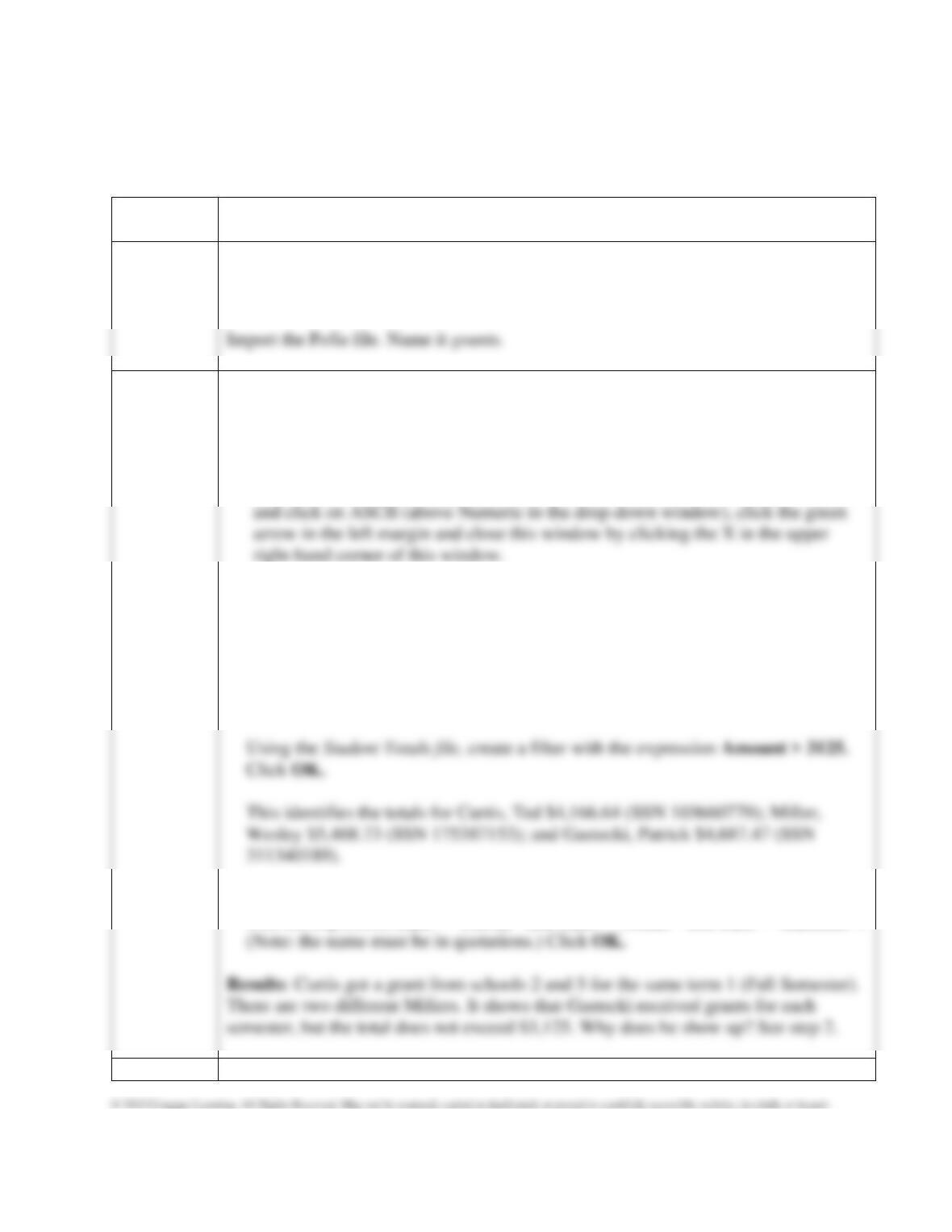
Using the grants file (table):
1. The SSN field must be changed from Numeric to ASCII format. Choose Edit,
Table Layout. Double click on SSN, click the down arrow next to Numeric, find
2. Choose Analyze, Summarize from the menu. Then choose the following:
Summarize on – SSN,
Subtotal fields – Amount
Other Fields –LAST, FIRST
Click on the output tab and file. Give the new file the name Student Totals.
3. Double click on the grants file in the left window to make it active. Create a filter
with the expression Last = “Curtis” OR Last = “Miller” OR Last =“Gastecki”.
2
Objective: See if more than one person uses the same SSN.
6-37
Condition
Number
Approach
Remove the filter to get the complete grant file:
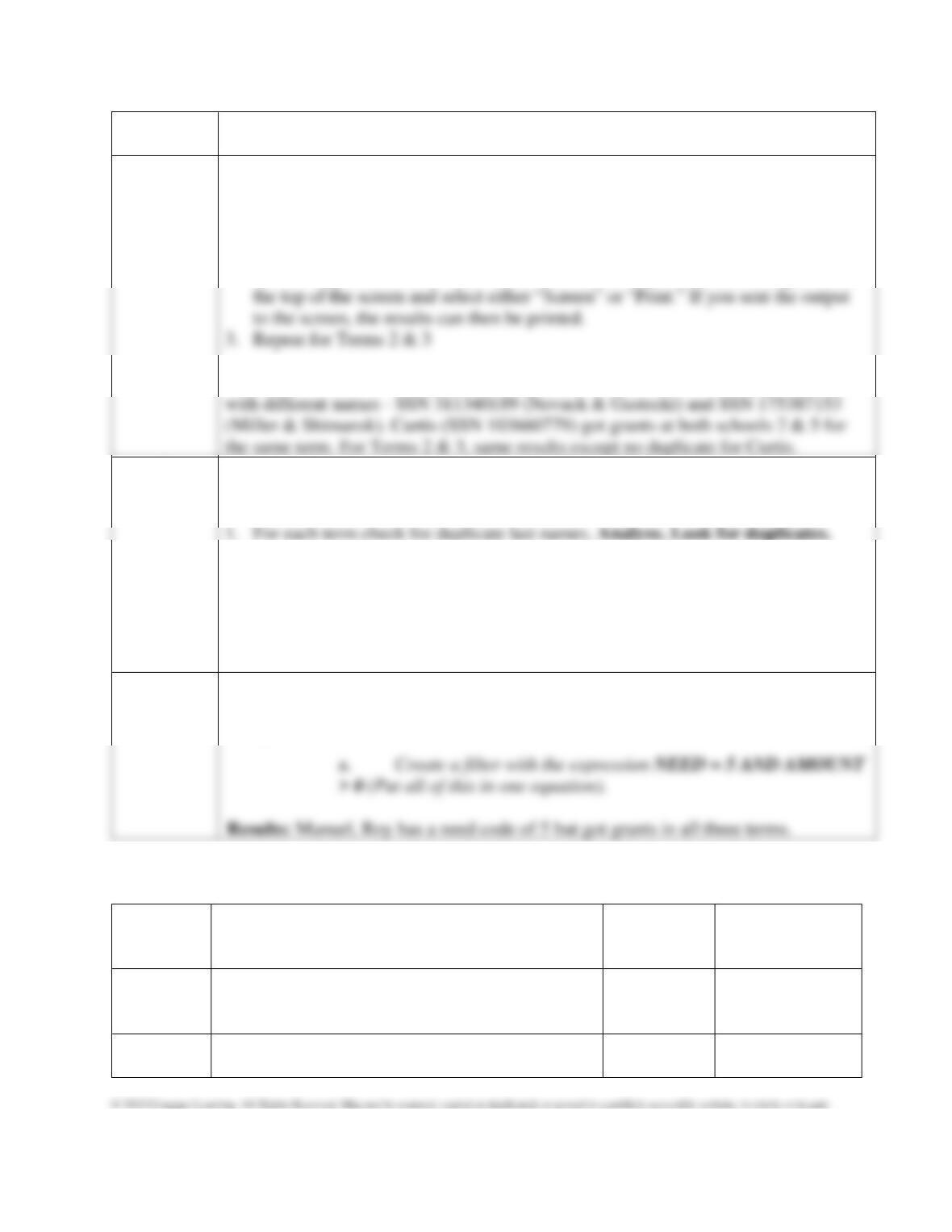
1. Choose Data, Extract Data, If using the equation Term = 1. Name the file Term
1 in the window next to the To button. Click OK.
2. Using the Term 1 file, choose Analyze, Look for Duplicates on SSN. Hold down
the Ctrl key and click all fields to list them in the output. Click the Output tab at
Results: There are three pairs of SSN duplicates for Term 1. Two have the same SSN
3
Objective: See if the same person is using different SSNs.
Using the Extracted Files for Terms 1, 2, & 3 from Condition Number 2 above –
2. Sequence on Last and include all fields in the output to screen.
3. Scan each list of duplicate last names for duplicate first names.
Results: In Term 3, Garnett, Colin used two SSNs – 751523222 at school 3 and
623933491 at school 6. This will also identify Curtis, Ted in Term 1 (see Condition
Number 1 and 2 above).
4
Objective: See if anyone with a need code 5 got a grant.
Using the grants file:
The items of potential fraud are:
Condition
Number
b. Condition
Social
Security
Number
Name
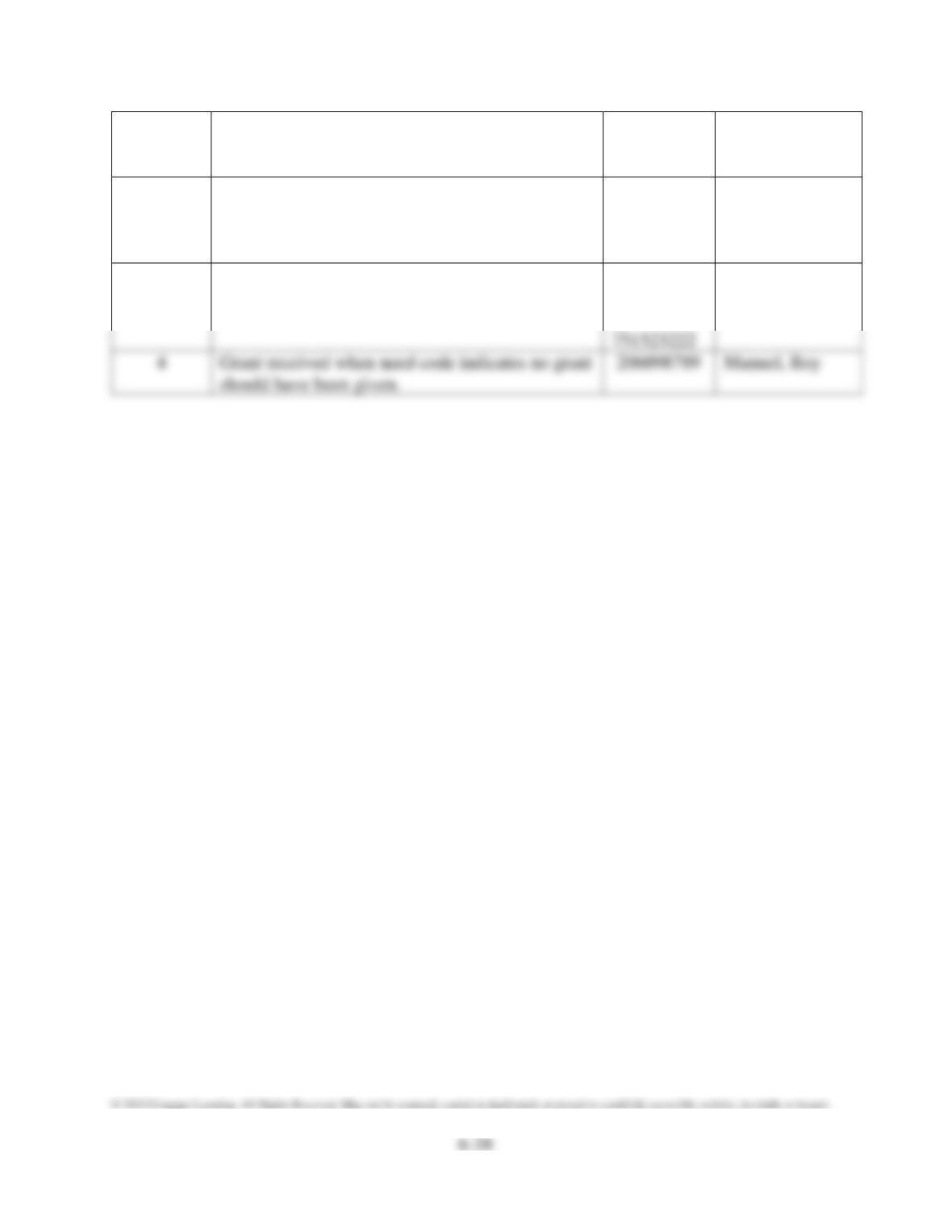
1
Student got a grant from both school 2 & 5 for
Fall Semester. Annual total exceeds the $3,125
annual limit.
103660779
Curtis, Ted
2
Same SS# with different names.
311340189
Novak, Kristy &
Gastecki, Patrick
Condition
Number
b. Condition
Social
Security
Number
Name
175387153
103660779
Miller, &
Shimansk
Curtis, Ted
shows up again.
3
Same name with different SS#.
Grant received when need code indicates no grant
206098789
Manuel, Roy
623933491
&
Garnett, Colin