Appendix
Capital Investment Decisions: An Overview
Solutions to Review Questions
A-1.
The timing is important because cash received earlier has a greater economic value
than cash received later. There is an opportunity cost and risk involved by having funds
tied up in capital investment projects. Determining the amount is important in estimating
the future cash flows. The timing and amount together are used to determine the
economic value of the project.
A-2.
A-3.
A-4.
A-5.
Depreciation is an accounting measure of the use of a capital asset and is not a cash
flow. The tax shield on depreciation is the savings in taxes associated with the
depreciation expense recorded for tax purposes and is a cash flow.
Solutions to Critical Analysis and Discussion Questions
A-6.
To determine which, if either, project should be approved, the net present value of each
project should be determined. Once the timing and amount of cash flows has been
determined, they should be discounted to the present by determining and applying
appropriate discount rates. Any project with a positive net present value could be
justified and the project with the greater net present value should be approved under
normal circumstances.
(1) investment cash flows,
(3) depreciation tax shield, and
(4) disinvestment flows.
A-8.
A-9.
The total amount depreciated over the life of the machine (and, therefore, often the tax
savings associated with that depreciation) is the same regardless of the depreciation
method used. However, for capital investment decisions, the timing of the savings is
important because it affects the net present value of the depreciation tax shield.
A-10.
Although the working capital might be assumed to be returned to the firm at the end of
the project, the firm does not have the use of those funds during that time. Therefore,
the present value of the working capital returned is less than the present value of the
working capital contributed.
A-11.
The net present value analysis for a new plant considered in this appendix considers
the cash flows from the entire life of the plant and compares the present value of those
Solutions to Exercises
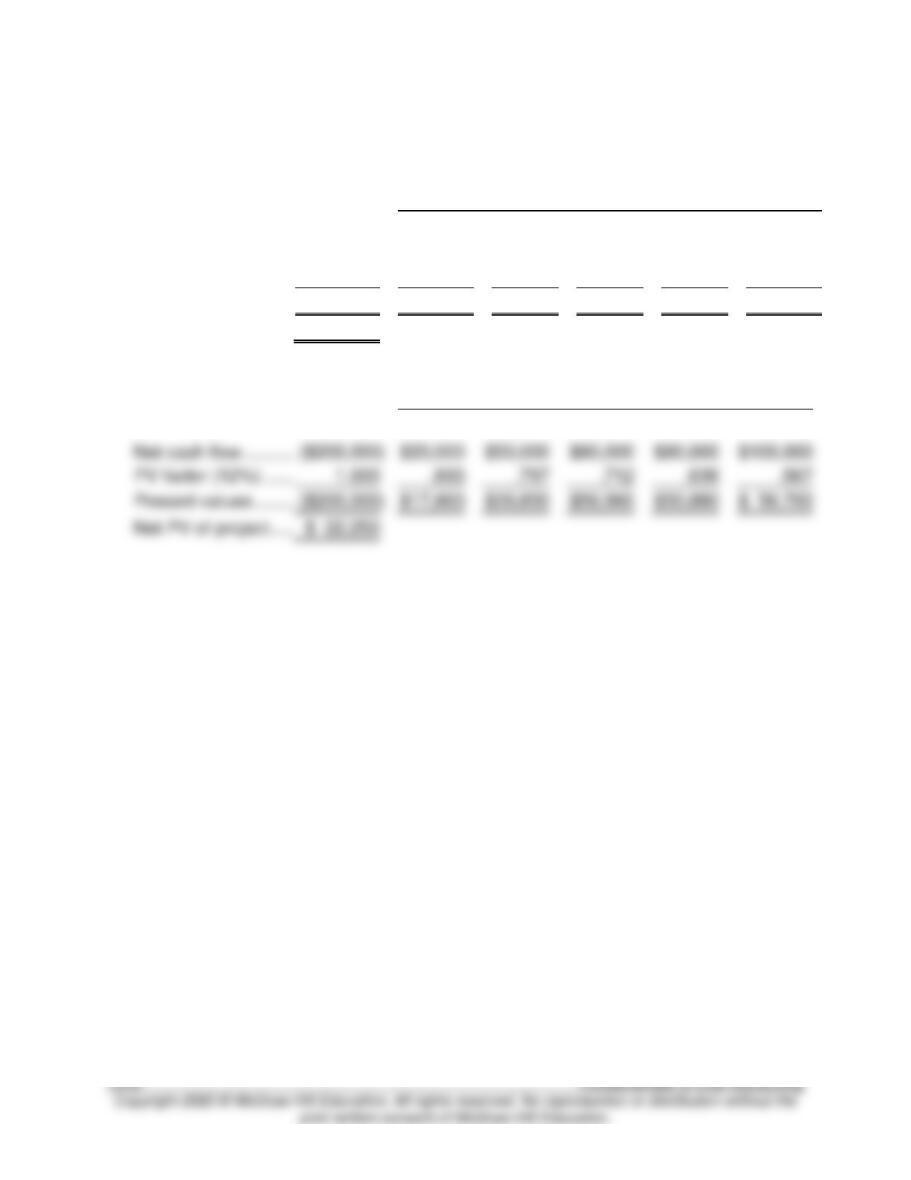
A-12. (20 min.) Present Value of Cash Flows: Star City.
a. At 20%
Time
Year
0
1
2
3
4
5
Net cash flow ……….
($200,000
)
$20,000
$50,000
$80,000
$80,000
$100,000
PV factor (20%) ……
1.000
.833
.694
.579
.482
.402
Present values ……..
($200,000
)
$16,660
$34,700
$46,320
$38,560
$ 40,200
Net PV of project …..
($ 23,560
)
b. At 12%
Time
Year
0
1
2
3
4
5
Net cash flow ……….
($200,000
)
$20,000
$50,000
$80,000
$80,000
$100,000
Present values ……..
($200,000
)
$17,860
$39,850
$56,960
$50,880
$ 56,700
Net PV of project …..
A-13. (25 min.) Present Value of Cash Flows: Rush Corporation.
a.
Year
Depreciation
Tax Shield
at 25%
PV Factor
(8%)
Present
Value
1
$120,000
$ 30,000
.926
$ 27,780
2
210,000
52,500
.857
44,993
3
90,000
22,500
.794
17,865
4
90,000
.735
16,538
5
90,000
22,500
.681
15,323
The present value of the tax shield is $122,498.
b.
Year
Depreciation
Tax Shield
at 25%
PV Factor
(8%)
Present
Value
1
$120,000
$ 30,000
.926
$ 27,780
2
120,000
30,000
.857
25,710
3
120,000
30,000
.794
23,820
4
120,000
30,000
.735
22,050
5
120,000
30,000
.681
20,430
$600,000
$150,000
A-14. (30 min.) Present Value Analysis in Nonprofit Organizations: Johnson Research Organization.
Year
0
1
2
3
4
5
6
7
Investment flows ……………..
$(6,000,000
)
Periodic operating flows:
Annual cash savings …….
$1,400,000
$1,400,000
$1,400,000
$1,400,000
$1,400,000
$1,400,000
$1,400,000
Additional cash outflow …
(200,000)
(200,000)
(200,000)
(200,000)
(200,000)
(200,000)
(200,000)
Disinvestment flows ……..
Net annual cash flow ……
$(6,000,000
)
PV factor 10% …………….
Present value ……………..
)
$1,090,800
$ 991,200
$ 901,200
$ 819,600
$ 745,200
$ 676,800
$ 820,800
Net present value ………..
A-15. (25 min.) Present Value of Cash Flows: Cervantes Company.
5 years is the minimum economic life.
Because the cash flows are uniform, we can use the annuity table (Exhibit A.9) to
evaluate the net present value. We do not know the economic life. We do know that if
A(n) is the annuity factor for n annual cash flows discounted at 10 percent, the net
present value of a series of cash flows of $300,000 with an initial investment of
$1,000,000 would be:
NPV = $300,000 × A(n) – $1,000,000.
The investment is worth taking if the NPV is positive, so we can solve this equation
(like a breakeven problem) for the value of A(n) such that NPV is zero:
Solutions to Problems
A-16. (35 min.) Compute Net Present Value; Expense Investment for Taxes: Mezzo
Diner.
a. $13,855.
In this case, the “depreciation” is recorded entirely in year 1, so there is no depreciation in
years 2-5. The following spreadsheet, similar to Exhibit A.2 in the text, shows the
calculations:
b. In this case, the managers at Mezzo Diner are likely to invest in the equipment as the
net present value is positive. The comparison of the situation in this problem (immediate
expensing for tax purposes of the investment expenditure) with the one in the text
(depreciation over the life of the investment) illustrates how tax policy can change
investment decisions.
A-17. (35 min.) Compute Net Present Value; Compare to Accounting Income:
Lucas Company.
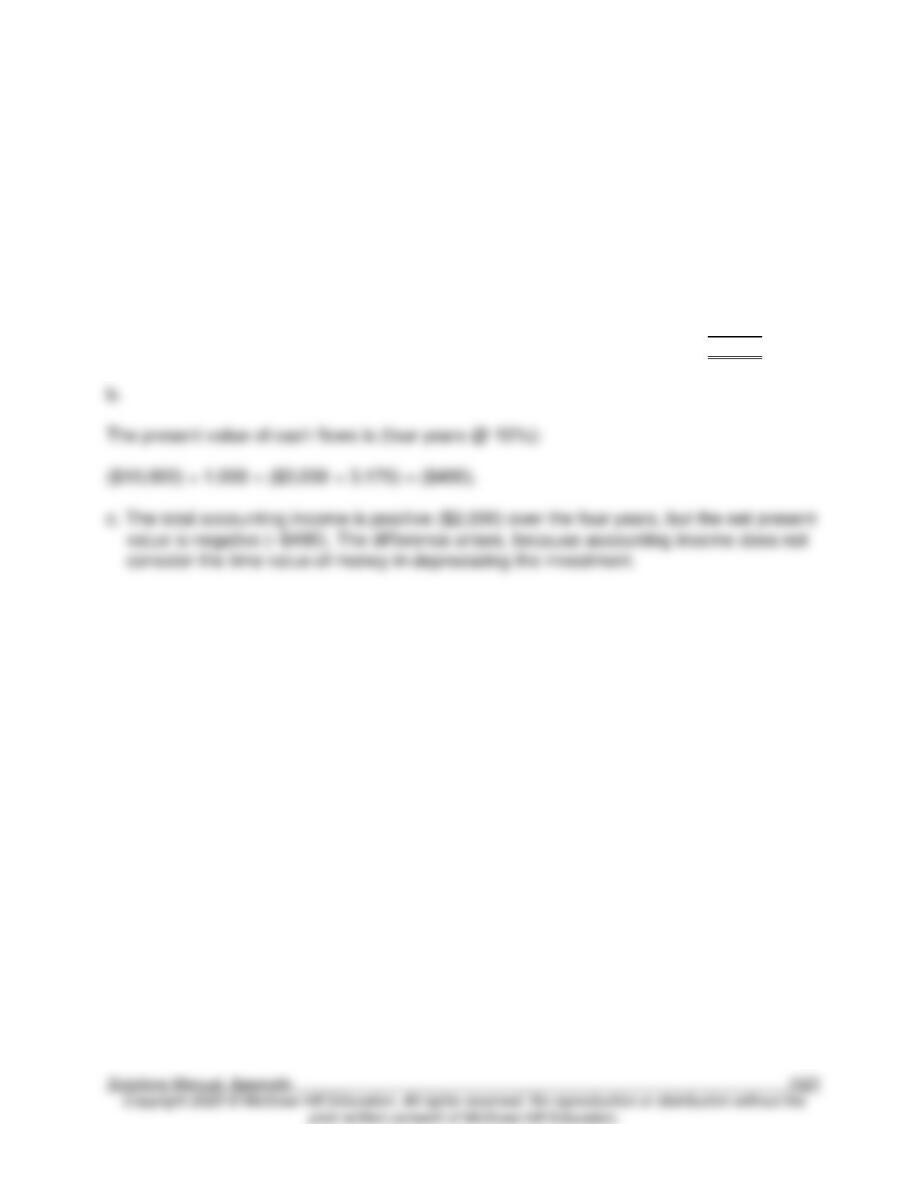
a. Accounting income each year will be $500. The total over four years is $2,000.
For each year, accounting income is calculated as follows:
Cash flows ………………..
(Cash revenues – cash expenses)
$3,000
Depreciation ……………..
($10,000 ÷ 4 years)
2,500
Accounting income …….
$ 500
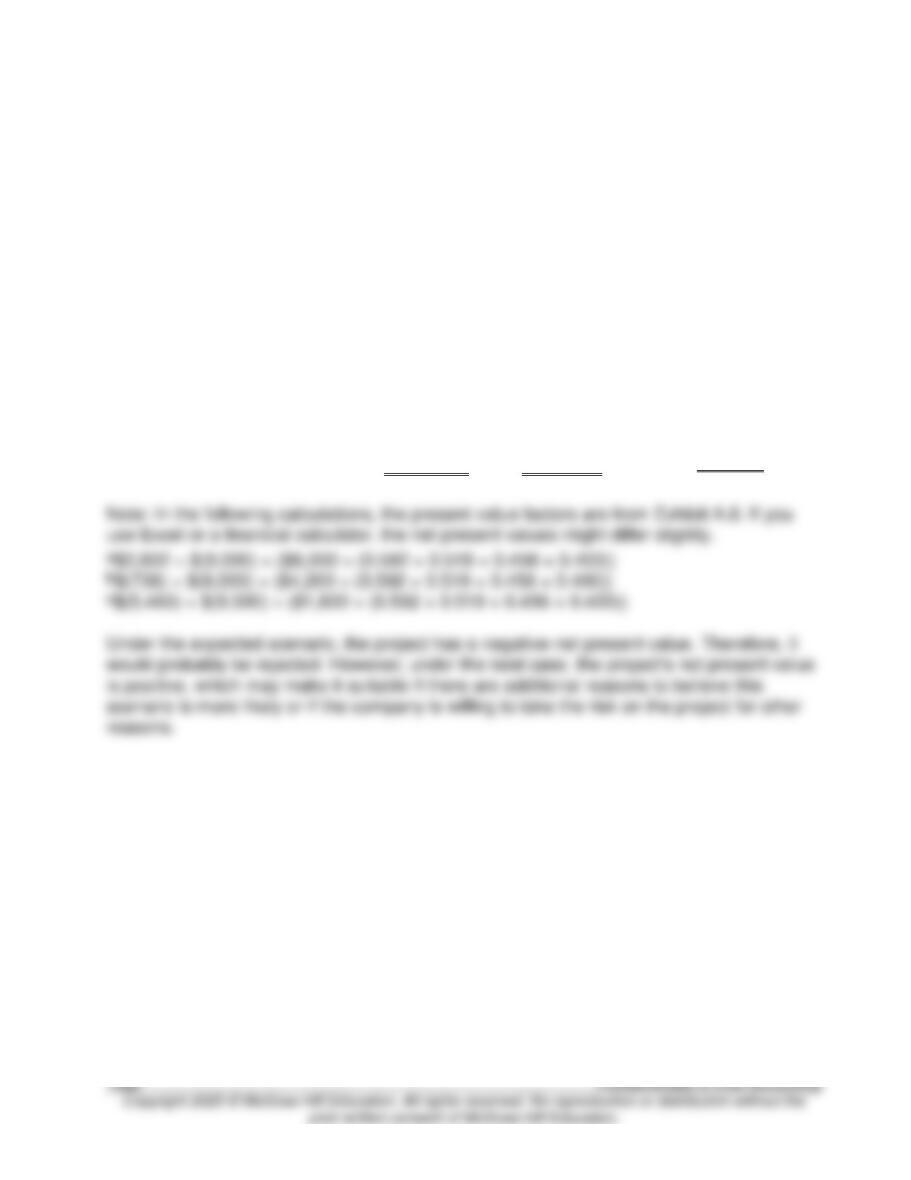
A-18. (35 min.) Sensitivity Analysis in Capital Investment Decisions: Square
Manufacturing.
The schedule of cash flows is ($000 omitted):
Year
Best Case
Expected
Worst
Case
0
($9,000
)
($9,000
)
($9,000
)
1
0
0
0
2
0
0
0
3
0
0
0
4
6,000
4,200
1,800
5
6,000
4,200
1,800
6
6,000
4,200
1,800
7
6,000
4,200
1,800
Net Present Value @ 14%
$ 2,802
a
($ 738
)b
($5,460
)c

A-19. (40 min.) Compute Net Present Value: Dungan Corporation.
a. Equipment removal net of tax effects = $3,750 = $5,000 × (1 – 25%).
b. Depreciation schedule:
Year
Depreciation
Tax Shield
at 25%
Present Value
Factor (16%)
Present
Value
1
$ 40,000
$10,000
.862
$8,620
2
70,000
17,500
.743
13,003
3
30,000
7,500
.641
4,808
4
30,000
7,500
.552
4,140
5
30,000
7.500
.476
3,570
Totals
$200,000
$50,000
$34,141
c. Forgone tax benefits: $2,500 = ($100,000 ÷ 10 years) × 25%
A-19. (continued)
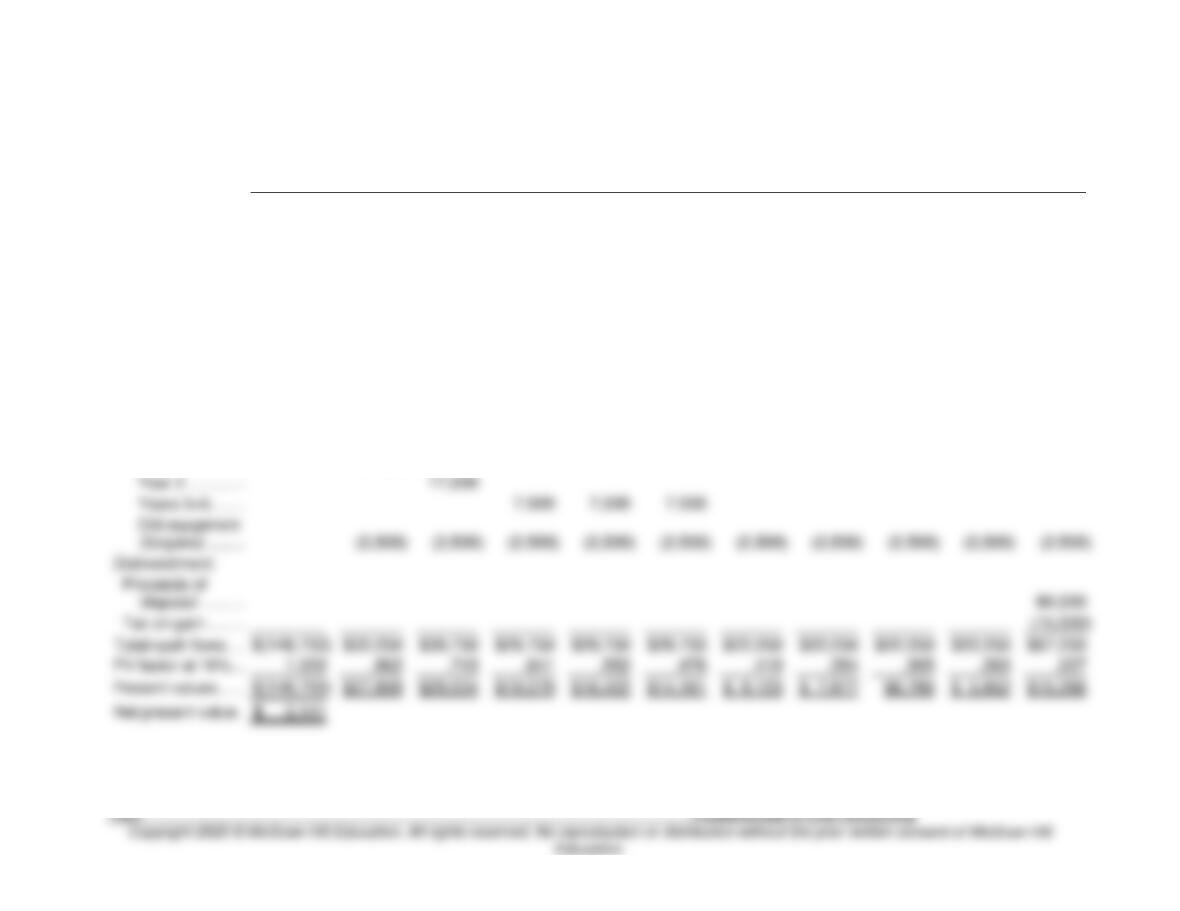
g.
Year
0
1
2
3
4
5
6
7
8
9
10
Investment flows:
Equipment cost …
$(200,000
)
Removal ………….
(3,750
)
Salvage of old
equipment …….
40,000
Tax benefit—sale
of old equip …..
15,000
Periodic operating
cash flows …….
$24,750
$24,750
$24,750
$24,750
$24,750
$24,750
$24,750
$24,750
$24,750
$24,750
Tax shield from
depreciation:
New equipment:
Year 1 ………….
10,000
Year 2 ………….
Years 3–5 ……..
Old equipment
(forgone) ……..
)
)
)
)
)
)
)
)
)
)
Proceeds of
disposal ……….
Tax on gain ………
)
Total cash flows ….
)
$39,750
$22,250
$22,250
$22,250
$22,250
$67,250
Present values ……
)
$29,534
$ 9,123
$ 7,877
$ 5,852