
6e Specific Accounts Page 199 Chapter 6
Q11 May a company choose one depreciation method for reporting to shareholders and a different
6e Specific Accounts Page 200 Chapter 6
ACTIVITY 70 PPE: GAINS AND LOSSES
Purpose: • Compute gains and losses on the sale of PPE.
• Understand that the effect on net income equals the cost of using the asset over the
useful life of the asset.
Gain (Loss) = Selling Price – Book Value
Revenues are earned when engaging in the primary business activity and reported at their gross amount.
Gains (Losses) are reported when a peripheral asset is sold and the selling price is reported net of book
value as of the date of sale.
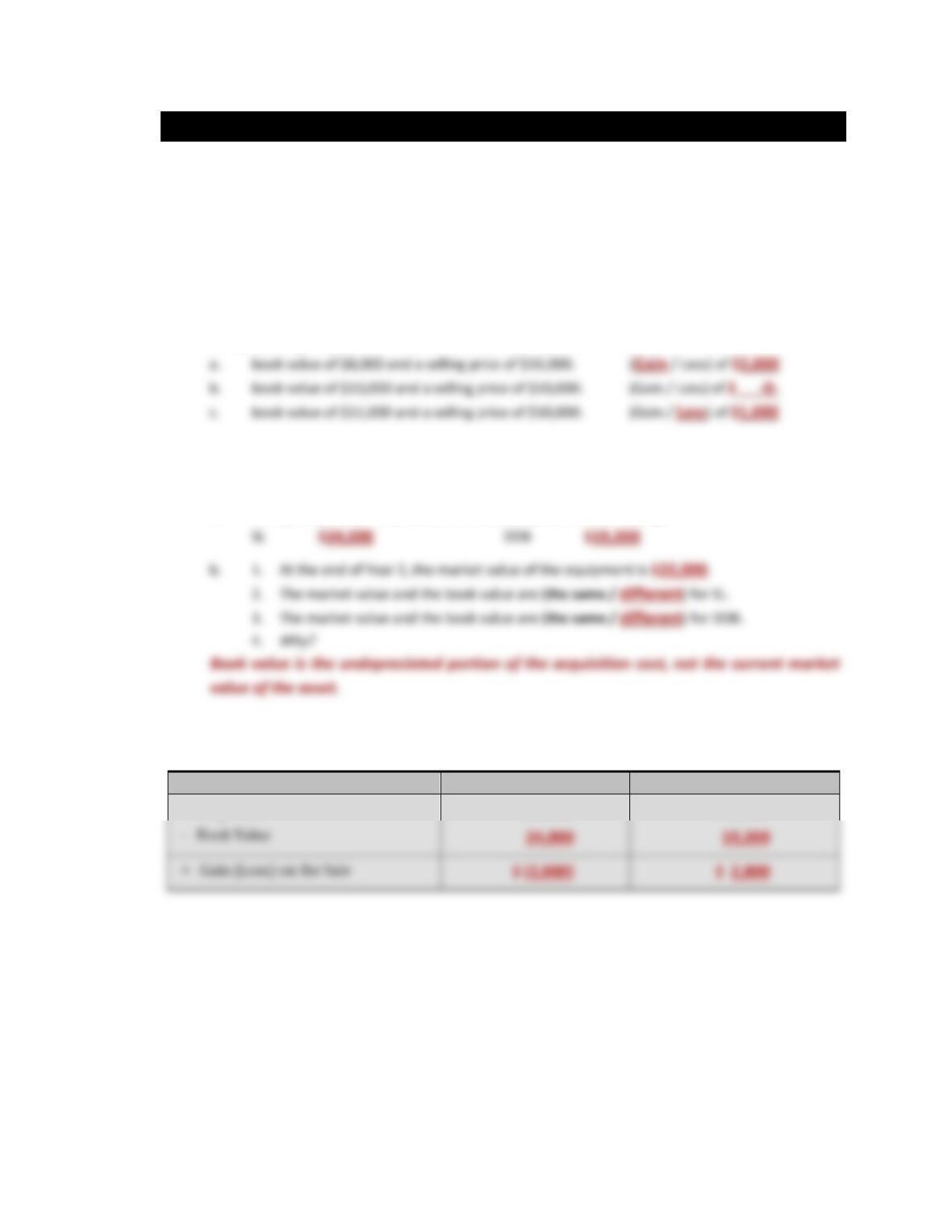
Q1 Compute the gain (loss) for Fancy Florist on the sale of a van with a:
Q2 Equipment purchased for $30,000 with a 10-year estimated useful life and no estimated residual
value is sold at the end of Year 2 for $22,000.
a. Compute the book value at the time of sale (at the end of Year 2).
Q3 Compute the gain (loss) on the sale for the SL and DDB depreciation methods.
Straight-line
Double-declining-balance
Selling Price
$ 22,000
$ 22,000
6e Specific Accounts Page 201 Chapter 6
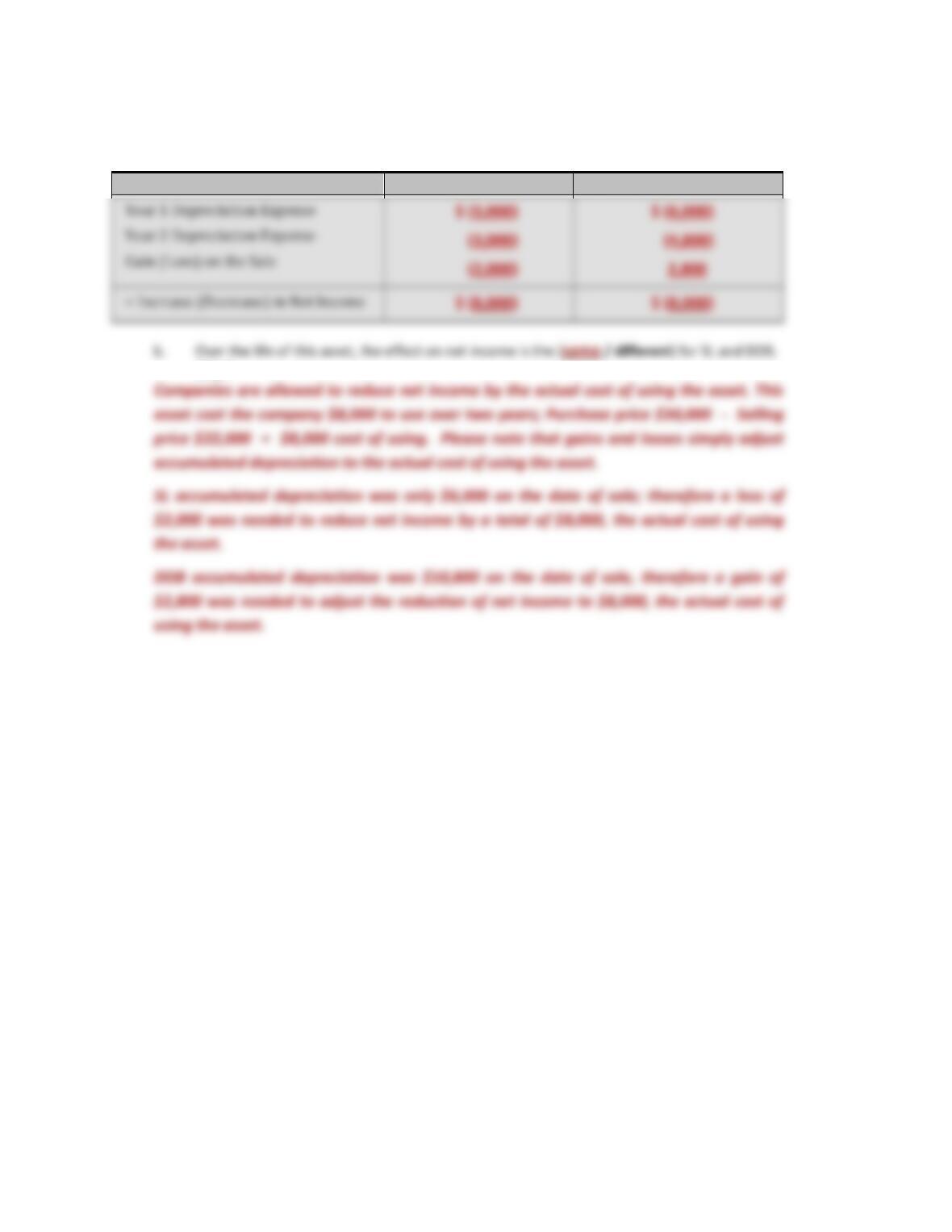
Q4 a. Compute the effect on net income for SL and DDB from purchase to sale of the asset.
Record in the chart below.
Straight-line
Double-declining-balance
Why?
6e Specific Accounts Page 202 Chapter 6
ACTIVITY 71 ETHICS AFFECTING FINANCIAL STATEMENT AMOUNTS
Purpose: • Understand the effect ethical decisions have on amounts reported for property,
plant, and equipment.
Financial analysts have predicted that net income will increase by 5% for a major corporation. Corporate
management has suggested that the controller do what is necessary to meet these predictions. The
controller decides to examine depreciation expense because the amount is based on estimates of useful
life and residual value and GAAP allows choices with regard to depreciation methods.
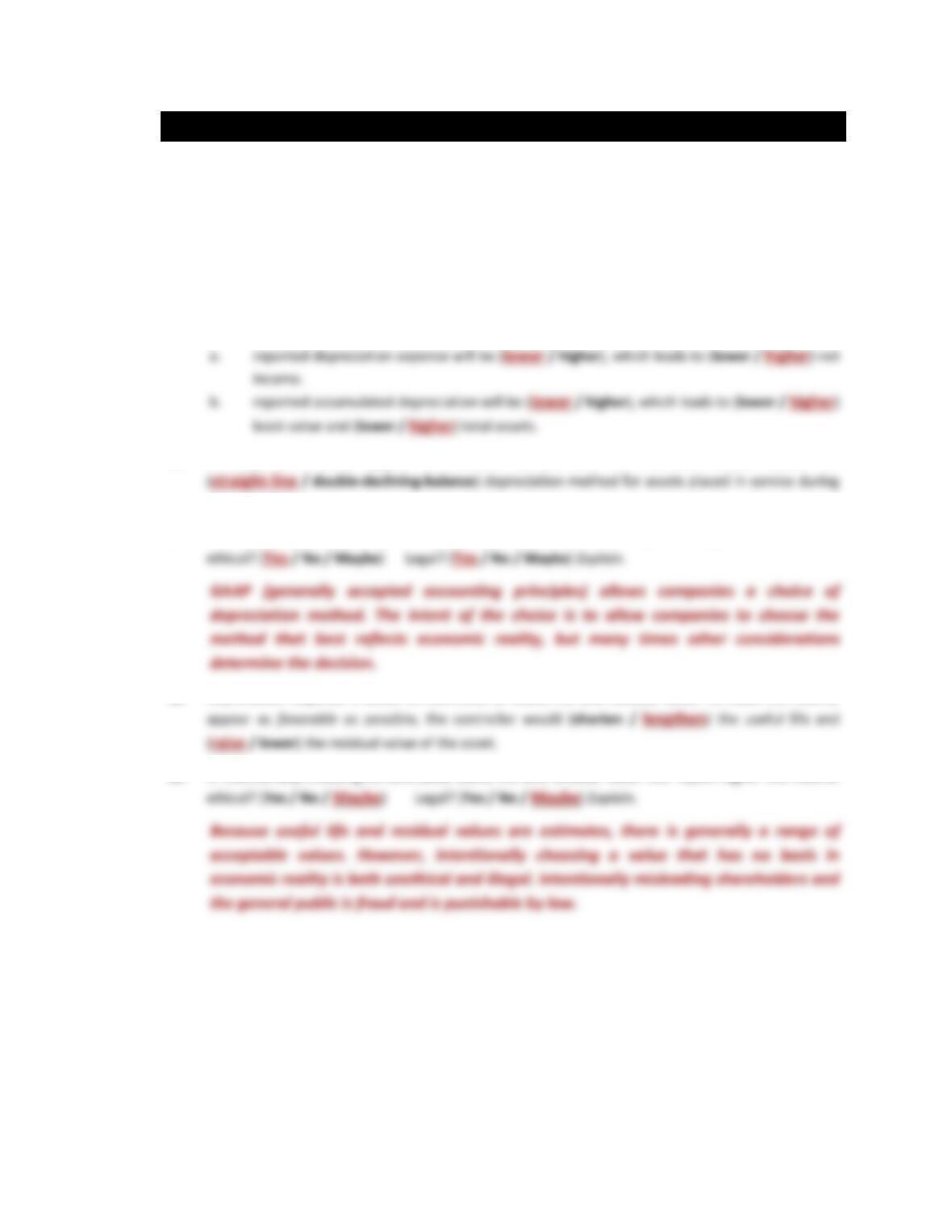
Q1 GAAP allows choices with regard to depreciation methods. In the first year of an asset’s useful life, if
the straight-line rather than the double-declining-balance depreciation method is used then:
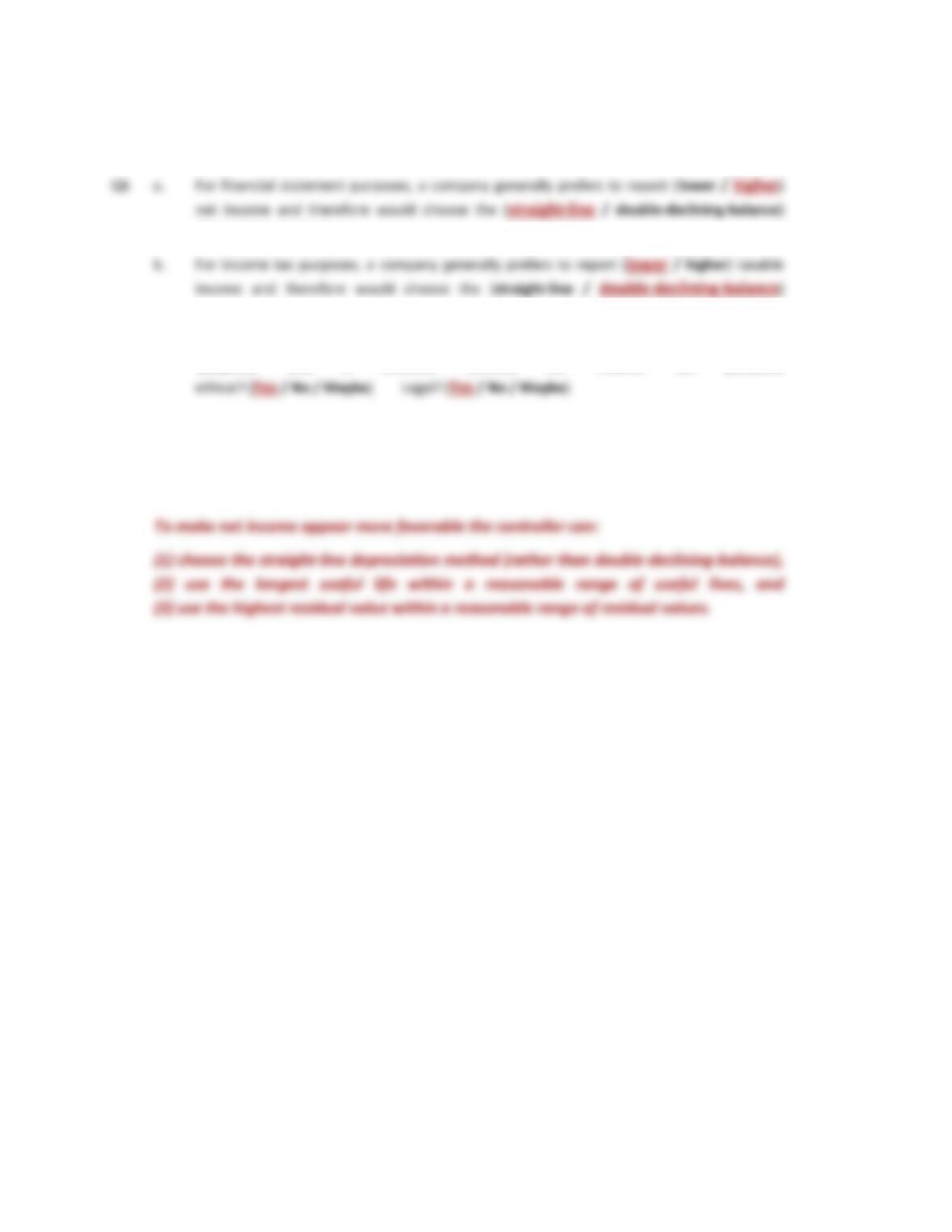
Q2 To make net income appear as favorable as possible, the controller would choose the
the current year.
Q3 Is intentionally choosing a depreciation method that reports higher net income
Q4 Depreciation expense is based on estimates of useful life and residual value. To make net income
Q5 Is intentionally choosing an estimated useful life and residual value that report higher net income
6e Specific Accounts Page 203 Chapter 6
depreciation method.
depreciation method.
c. Is intentionally choosing one depreciation method for financial statement
purposes and a different method for income tax purposes
Q7 Identify at least three items that the controller could use to make net income appear more
favorable with regard to the depreciation of assets placed in service during the current year that are
both ethical and legal.
6e Specific Accounts Page 204 Chapter 6
ACTIVITY 72 LONG–TERM INVESTMENTS
Purpose: • Reinforce understanding of investments classified as available-for-sale securities
Q1 Assume Winfield Corporation purchased 100 shares of Coca-Cola stock and 100 shares of IBM stock
on January 2, Year 1. These equity securities are classified as available-for-sale because the intent is
to hold them for several years. Refer to the related financial information below to answer the
following questions.
Fair Market Value
Cost
Dec 31, Year 3
Dec 31, Year 2
Dec 31, Year 1
Jan 2, Year 1
COCA-COLA (100 shares)
$ 7,400
$ 5,300
$ 4,500
$ 4,600
IBM (100 shares)
11,400
7,600
6,000
10,000
Total
$ 18,800
$ 12,900
$ 10,500
$ 14,600
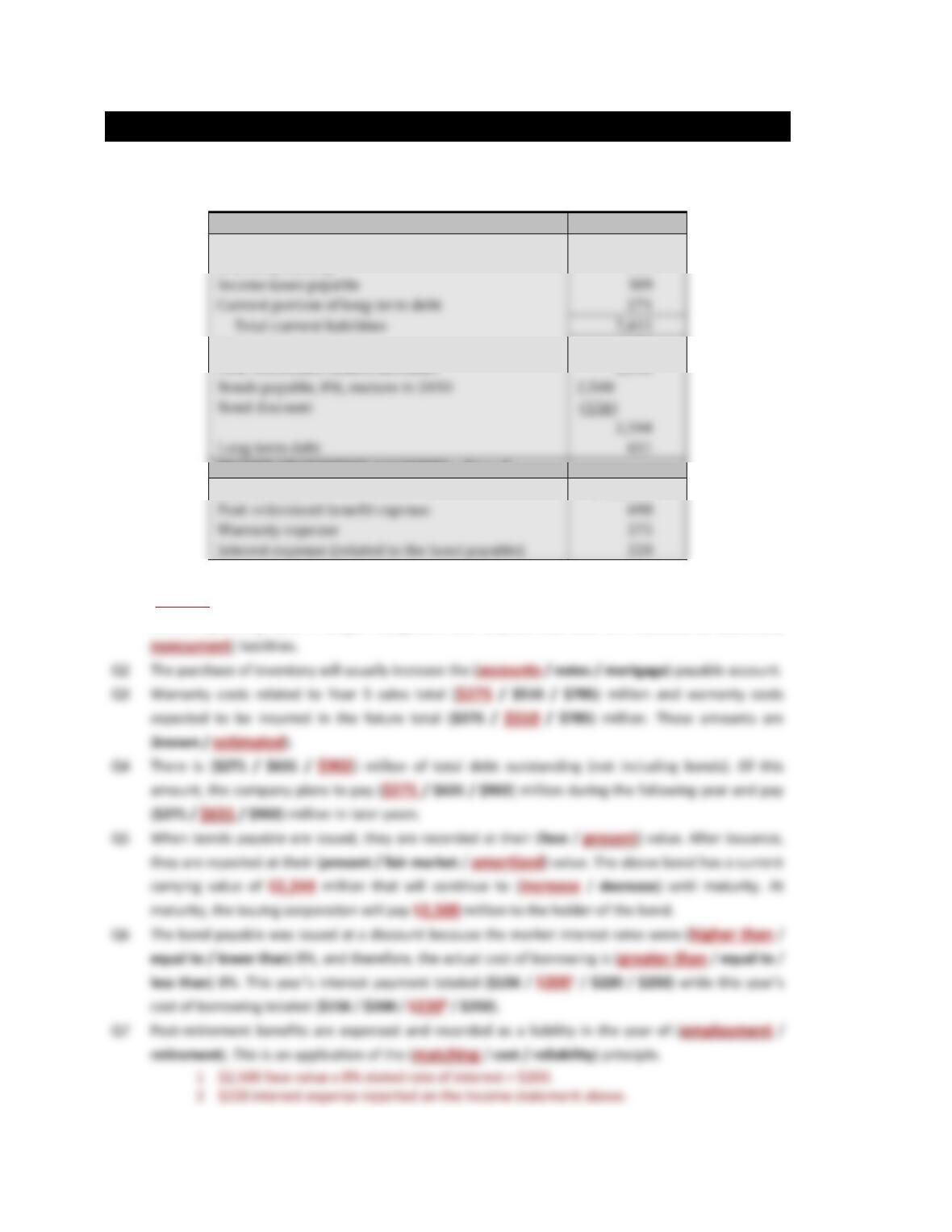
Q2 Complete the chart below to reflect how the above information would be reported on the financial
statements.
BALANCE SHEET
Dec 31, Year 3
Dec 31, Year 2
Dec 31, Year 1
Q3 When available-for-sale securities increase in value, this event will:
Q4 Assume the 100 shares of Coca-Cola stock were sold for $76 per share during Year 4. As a result,
6e Specific Accounts Page 205 Chapter 6
ACTIVITY 73 CURRENT AND NONCURRENT LIABILITIES
Purpose: • Reinforce understanding of amounts reported on the financial statements for current
and noncurrent liabilities.
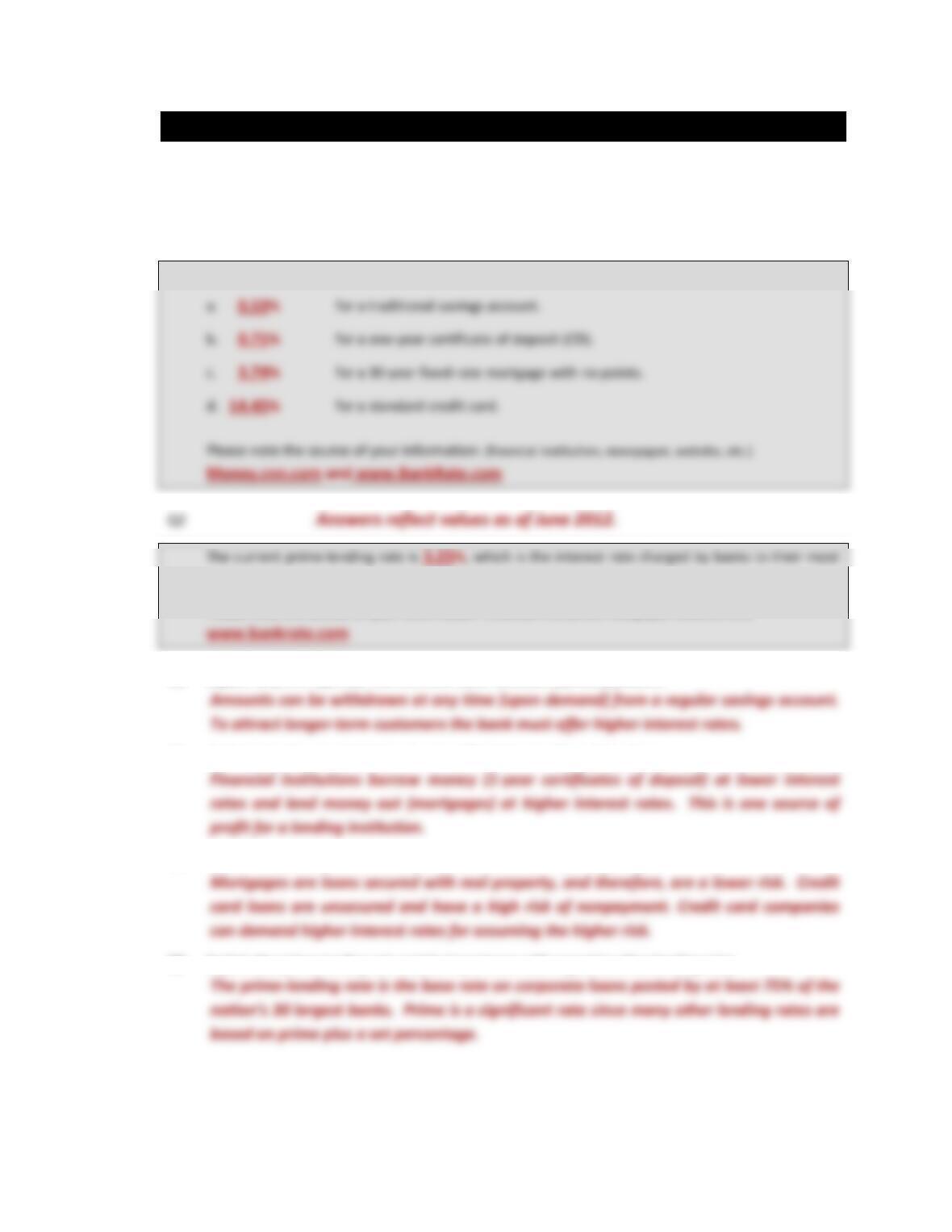
BALANCE SHEET ACCOUNTS—Dec 31, Year 5
($ in millions)
Accounts payable
$ 6,245
Warranty liability
510
Deferred income taxes
51
Post-retirement benefit liabilities
Bonds payable, 8%, mature in 2030
Bond discount
(156)
Long-term debt
631
INCOME STATEMENT ACCOUNTS—Year 5
Sales revenue
$ 50,000
Post-retirement benefit expense
698
Warranty expense
275
Interest expense (related to the bond payable)
220
Refer to the information presented above to answer the following questions.
Q1 (Current / Noncurrent) liabilities are obligations due within one year or within the company’s
normal operating cycle if longer. Obligations due beyond that time are classified as (current /
Income taxes payable
389
Current portion of long-term debt
6e Specific Accounts Page 206 Chapter 6
ACTIVITY 74 CURRENT MARKET INTEREST RATES
Purpose: • Benchmark current market rates and understand why they differ among various
financial instruments.
Q1 Research the following current interest rates. These rates are available on the Internet and at a
local bank or credit union.
The current rates banks/credit unions are offering/asking are
credit-worthy customers (usually the most prominent and stable business customers).
Please note the source of your information: (financial institution, newspaper, website, etc.)
Q3 Explain why the reported interest rates differ between (a) and (b) above.
Q4 Explain why the reported interest rates differ between (b) and (c) above.
Q5 Explain why the reported interest rates differ between (c) and (d) above.
Q6 Explain the prime lending rate and its importance with regard to other lending rates.
6e Specific Accounts Page 207 Chapter 6
ACTIVITY 75 BONDS PAYABLE
Purpose: • Reinforce understanding of bonds payable amounts reported on the financial
statements.
• Compute interest payments on a bond payable.
• Understand why a bond sells at a premium, par, or a discount.
Q1 Bond Prices
For example, if a $100,000 bond is issued at 102 the bond will sell for 102% of the face value or for
$102,000.
A Bond Issuance raises large amounts of capital ($$$) by issuing many bonds of small denominations
(e.g. $1,000).
Principal = Maturity Value = Face Value = the amount the issuing corporation pays to the holder of the
bond at maturity
Stated Rate = Coupon Rate = the rate of the required annual interest payment
Principal x Stated Rate = Annual Interest Payment
Use the information on the bond payable below to answer the following question.
Bond Payable
Principal $10,000
Stated rate 10%
Matures in 10 years
6e Specific Accounts Page 208 Chapter 6
Q3 Assume the bond was originally issued for $10,000 and held to maturity.
a. The corporation paid out $10,000 in total interest payments + paid out $10,000 of principal
Q4 Assume the bond was originally issued for $8,000 and held to maturity.
Q5 Assume the bond was originally issued for $12,000 and held to maturity.
Q7 When will a bond be issued at a premium? Par? A discount?
Q8 A corporation would prefer to issue bonds at a (premium / par / discount). Why?
6e Specific Accounts Page 209 Chapter 6
ACTIVITY 76 EXAMINING BOND YIELDS
Purpose: • Understand why bond yields differ.
YIELD COMPARISONS
CORPORATE BONDS
NEW TAX-EXEMPT BONDS
Maturity
Rating
Yield
Maturity
Rating
Yield
1–10 years
High quality (AAA–AA)
2.95%
7–12 years
G.O. (AA)
3.30%
1–10 years
Medium quality
(A-BBB/Baa)
3.92%
2–22 years
G.O. (AA)
4.19%
10+ years
High quality (AAA–AA)
5.34%
22+years
G.O. (AA)
4.70%
10+ years
Medium quality
(A-BBB/Baa)
5.95%
All years
High yield (BB/Ba–C)
9.23%
Refer to the information in the table above to answer the following questions.
Q1 Yield is the cost to the issuing entity for borrowing and the return to the investor/creditor for
lending the money. Yield is also referred to as the market rate and the effective rate of borrowing.
Q2 Ratings are a measure of risk. Standard & Poor’s and Moody’s are two companies that assess the
amount of risk. A rating of AAA indicates very low risk and a rating of C indicates very high risk.
Q3 Bonds have different lengths of time to maturity.
Q4 Bonds issued by corporations are usually not tax-exempt, whereas bonds issued by municipalities
usually are tax-exempt.
d. Explain why one yield is higher than the other for these two types of bonds.