E6-1 Compute break-even point and margin of safety
The Soma Inn is trying to determine its break-even point. The inn has 75 rooms that are rented at $60
a night. Operating costs are as follows.
Salaries $10,600 per month
Utilities 2,400 per month
Depreciation 1,500 per month
Maintenance 800 per month
Maid service 8 per room
Other costs 34 per room
Instructions
(a) Determine the inn’s break-even point in (1) number of rented rooms per month and
(2) dollars.
(b) If the inn plans on renting an average of 50 rooms per day (assuming a 30-day month),
what is (1) the monthly margin of safety in dollars and (2) the margin of safety ratio?
NOTE: Enter a number in cells requesting a value; enter either a number or a formula in cells with a “?” .
(a) Determine the inn’s break-even point in (1) number of rented rooms per month and
(2) dollars.
(a)(1) Break-even point in rooms
Rental per room Value
Variable cost per room Value
Contribution margin per room ?
Fixed costs Value
Contribution margin per room Value
Break-even point in rooms ?
(a)(2) Break-even point in dollars
Contribution margin per room Value
Rental per room Value
Contribution margin ratio ?
Break-even point in rooms Value
Rental per room Value
Break-even point in dollars ?
OR
Fixed cost Value
contribution margin ratio Value
Break-even point in dollars ?
(b) If the inn plans on renting an average of 50 rooms per day (assuming a 30-day month),
what is (1) the monthly margin of safety in dollars and (2) the margin of safety ratio?
(b)(1) Margin of safety in dollars
Actual sales Value
Break-even Sales
Value
Margin of safety in dollars ?
(b)(2) Margin of safety ratio
Margin of safety in dollars Value
Actual sales Value
Margin of safety ratio ?

After you have completed E6-1, consider the following additional questions.
1. Assume that the rental rate per room changed to $65 per night. Recalculate break-even point
in units and dollars. Round CM ratio to one decimal point.
2. If the inn plans to rent 60 rooms average per day at the new rate of $65 per night, recalculate the margin
of safety in dollars and the margin of safety ratio.
E6-1 Solution
(a) Determine the inn’s break-even point in (1) number of rented rooms per month and (2) dollars.
(a)(1) Breakeven point in rooms
Rental per room $60
(a)(2) Break-even point in dollars
Contribution margin per room $18
Rental per room $60
(b) If the inn plans on renting an average of 50 rooms per day (assuming a 30-day month),
what is (1) the monthly margin of safety in dollars and (2) the margin of safety ratio?
(b)(1) Margin of safety in dollars
Expected rental revenues $90,000
Break-even Sales $51,000
E6-1 Solution to additional question
1. Assume that the rental rate per room changed to $65 per night. Recalculate break-even point
in units and dollars. Round CM ratio to one decimal point.
(a)(1) Break-even point in rooms
Rental per room $65
Variable cost per room $42
(a)(2) Break-even point in dollars
Contribution margin per room $23
Rental per room $65
2. If the inn plans to rent 60 rooms average per day at the new rate of $65 a night,
recalculate the margin of safety in dollars and the margin of safety ratio.
(a) Margin of safety in dollars
Expected rental revenues $117,000
(b) Margin of safety ratio
Margin of safety in dollars $73,761
E6-3 Compute net income under different alternatives
Barnes Company reports the following operating results for the month of August: sales $325,000
(units 5,000); variable costs $210,000; and fixed costs $75,000. Management is considering the following
independent courses of action to increase net income.
1. Increase selling price by 10% with no change in total variable costs or sales volume.
2. Reduce variable costs to 58% of sales.
3. Reduce fixed costs by $15,000.
Instructions
Compute the net income to be earned under each alternative. Which course of action will produce the
highest net income?
NOTE: Enter a number in cells requesting a value; enter either a number or a formula in cells with a “?” .
1. Increase selling price by 10% with no change in total variable costs or sales volume.
Current selling price ?
New selling price ?
(Round to nearest cent)
Total sales ?
Less: variable costs ?
Contribution margin ?
Less: fixed costs Value
Net income ?
2. Reduce variable costs to 58% of sales.
Total Sales Value
Less: variable costs Value
Contribution margin ?
Less: fixed costs Value
Net income ?
3. Reduce fixed costs by $15,000.
Total Sales Value
Less: variable costs Value
Contribution margin ?
Less: fixed costs Value
Net income ?
After you have completed E6-3, consider the following additional questions.
1. Assume that unit selling price increased 5% with no change in total variable costs or sales volume.
2.
Assume variable costs decreased to 53% of sales.
3. Assume that fixed costs increased by $20,000.
Which course of action will produce the highest net income?
E3 – Solution
1. Increase selling price by 10% with no change in total variable costs or sales volume.
Current selling price $65
New selling price $71.50
2. Reduce variable costs to 58% of sales.
Total Sales $325,000
Less: variable costs 188,500
3. Reduce fixed costs by $15,000
Total Sales $325,000
Less: variable costs 210,000
E3 – Solution to additional question
1. Assume that unit selling price increased 5% with no change in total variable costs or sales volume.
Current selling price $65
New selling price $68.25
2. Assume variable cost decreased to 53% of sales.
Total Sales $325,000
Less: variable costs 172,250
3. Assume that fixed increased by $20,000.
Total Sales $325,000
Less: variable costs 210,000
E6-17 Compute product cost and prepare an income statement under variable and absorption costing
Siren Company builds custom fishing lures for sporting goods stores. In its first year of operations, 2017,
the company incurred the following costs.
Variable Costs per Unit
Direct materials $7.50
Direct labor $3.45
Variable manufacturing overhead $5.80
Variable selling and administrative expenses $3.90
Fixed Costs per Year
Fixed manufacturing overhead $225,000
Fixed selling and administrative expenses $210,100
Siren Company sells the fishing lures for $25. During 2017, the company sold 80,000
lures and produced 90,000 lures.
Instructions
(a) Assuming the company uses variable costing, calculate Siren’s manufacturing cost
per unit for 2017.
(b)
Prepare a variable costing income statement for 2017.
(c ) Assuming the company uses absorption costing, calculate Siren’s manufacturing cost
per unit for 2017.
(d) Prepare an absorption costing income statement for 2017.
NOTE: Enter a number in cells requesting a value; enter either a number or a formula in cells with a “?” .
(a) Assuming the company uses variable costing, calculate Siren’s manufacturing cost per unit for 2017.
Unit Cost (Variable costing)
Direct materials Value
Direct labor Value
Variable manufacturing overhead Value
Manufacturing cost per unit ?
(b)
Prepare a variable costing income statement for 2017.
Sales Value
Variable expenses
Variable cost of goods sold Value
Variable selling and administrative expenses Value ?
Contribution margin ?
Fixed expenses
Fixed manufacturing overhead Value
Fixed selling and administrative expenses Value ?
Net income ?
(c ) Assuming the company uses absorption costing, calculate Siren’s manufacturing cost per unit for 2017.
Unit Cost (Absorption costing)
Direct materials Value
Direct labor Value
Variable manufacturing overhead Value
SIREN COMPANY
Income Statement
For the Year Ended December 31, 2017
Variable Costing
Fixed manufacturing overhead Value
Manufacturing cost per unit ?
(d) Prepare an absorption costing income statement for 2017.
Sales Value
Cost of goods sold Value
Gross profit Value
Variable selling and administrative expenses Value
Fixed selling and administrative expenses Value Value
Net income Value
After you have completed E6-17, consider the following additional question.
1. Assume that variable overhead costs changed to $6.10 per unit and total fixed manufacturing overhead
increased to $275,000. What is the impact of these changes on the unit product costs and net income
under variable and absorption costing.
Absorption Costing
SIREN COMPANY
Income Statement
For the Year Ended December 31, 2017
E6-17 Solution
(a) Assuming the company uses variable costing, calculate Siren’s manufacturing cost per unit for 2017.
Unit Cost (Variable costing)
Direct materials $7.50
Direct labor 3.45
Variable manufacturing overhead 5.80
Manufacturing cost per unit $16.75
(b) Prepare a variable costing income statement for 2017.
Sales (80,000 lures x $25) $2,000,000
Variable expenses
(c) Assuming the company uses absorption costing, calculate Siren’s manufacturing cost per unit for 2017.
Unit Cost (Absorption costing)
Direct materials $7.50
Direct labor 3.45
(d) Prepare an absorption costing income statement for 2017.
Sales (80,000 lures x $25) $2,000,000
Cost of goods sold (80,000 lures x $19.25) 1,540,000
Absorption Costing
SIREN COMPANY
Income Statement
For the Year Ended December 31, 2017
SIREN COMPANY
Income Statement
For the Year Ended December 31, 2017
Variable Costing
E6-17 Solution to additional question
1. Assume that variable overhead costs changed to $6.10 per unit and total fixed manufacturing overhead
increased to $275,000. What is the impact of these changes on the unit product costs and net income
under variable and absorption costing.
(a) Assuming the company uses variable costing, calculate Siren’s manufacturing cost per unit for 2017.
Unit Cost (Variable costing)
Direct materials $7.50
(b) Prepare a variable costing income statement for 2017.
Sales (80,000 lures x $25) $2,000,000
Variable expenses
(c ) Assuming the company uses absorption costing, calculate Siren’s manufacturing cost per unit for 2017.
Unit Cost (Absorption costing)
Direct materials $7.50
Direct labor 3.45
(d) Prepare an absorption costing income statement for 2017.
Sales (80,000 lures x $25) $2,000,000
Cost of goods sold (80,000 lures x $20.11) 1,608,444
Income Statement
For the Year Ended December 31, 2017
Absorption Costing
SIREN COMPANY
Income Statement
For the Year Ended December 31, 2017
Variable Costing
SIREN COMPANY
CD6 EXCEL Tutorial
CURRENT DESIGNS
Current Designs manufactures two different types of kayak, rotomolded kayaks and composite kayaks.
The following information is available for each product line.
Rotomolded Composite
Sales price/unit $950 $2,000
Variable costs/unit $570 $1,340
The company‘s fixed costs are $820,000. An analysis of the sales mix identifies that rotomolded kayaks
make up 80% of the total units sold.
Instructions
(a) Determine the weighted-average unit contribution margin for Current Designs.
(b) Determine the break-even points in units for Current Designs and identify how many units of each
type of kayak will be sold at the break-even point. (Round to the nearest whole number.)
(c ) Assume that the sales mix changes, and rotomolded kayaks now make up 70% of total units sold.
Calculate the total number of units that would need to be sold to earn a net income of $2,000,000
and identify how many units of each type of kayak will be sold at this level of income. (Round to the
nearest whole number.)
(d) Assume that Current Designs will have sales of $3,000,000 with two-thirds of the sales dollars in
rotomolded kayaks and one-third of the sales dollars in composite kayaks. Assuming $660,000 of fixed
costs are allocated to the rotomolded kayaks and $160,000 to the composite kayaks, prepare a CVP
income statement for each product line.
(e ) Using the information in part (d), calculate the degree of operating leverage for each product line and
interpret your findings. (Round to two decimal places.)
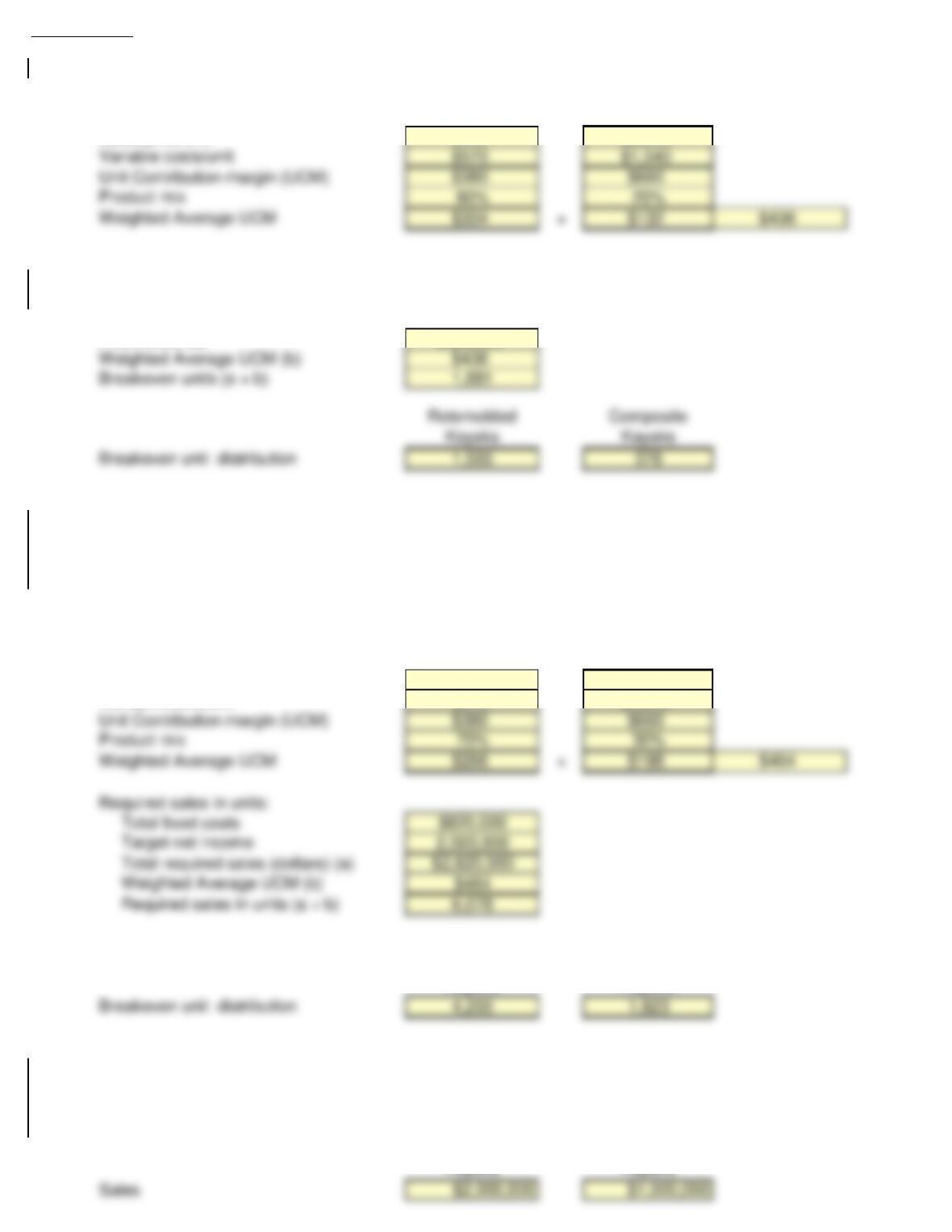
(a) Determine the weighted-average unit contribution margin for Current Designs.
Rotomolded
Kayaks
Composite
Kayaks
Sales price/unit Value Value
Variable costs/unit Value Value
Unit Contribution margin (UCM) ? ?
Product mix Value Value
Weighted Average UCM ? + ? ?
(b) Determine the break-even points in units for Current Designs and identify how many units of each
type of kayak will be sold at the break-even point. (Round to the nearest whole number.)
Fixed costs Value
Weighted Average UCM Value
Breakeven units ?
Rotomolded
Kayaks
Composite
Kayaks
Breakeven unit distribution ? ?
(c ) Assume that the sales mix changes, and rotomolded kayaks now make up 70% of total units sold.
Calculate the total number of units that would need to be sold to earn a net income of $2,000,000
and identify how many units of each type of kayak will be sold at this level of income. (Round to the
nearest whole number.)
Target net income in units:
Rotomolded
Kayaks
Composite
Kayaks
Sales price/unit Value Value
Variable costs/unit Value Value
Unit Contribution margin (UCM) ? ?
Product mix Value Value
Weighted Average UCM ? + ? ?
Required sales in units:
Total fixed costs Value Value
Target net income Value Value
Total required sales (dollars) ? ?
Weighted Average UCM ? ?
Required sales in units ? ?
(d) Assume that Current Designs will have sales of $3,000,000 with two-thirds of the sales dollars in
rotomolded kayaks and one-third of the sales dollars in composite kayaks. Assuming $660,000 of fixed
costs are allocated to the rotomolded kayaks and $160,000 to the composite kayaks, prepare a CVP
income statement for each product line.
Rotomolded
Kayaks
Composite
Kayaks
Sales Value Value
Variable Costs Value Value
Contribution Margin ? ?
Fixed Costs Value Value
Net Income ? ?
(e ) Using the information in part (d), calculate the degree of operating leverage for each product line and
interpret your findings. (Round to two decimal places.)
Rotomolded
Kayaks
Composite
Kayaks
Contribution Margin (a) Value Value
Net Income (b) Value Value
Degree of Operating Leverage (a ÷ b)
? ?
After you have completed CD6, consider the following additional question.
1. Assume that variable cost per unit for the rotomolded kayak and composite kayak changed to $610 and
$1,400 respectively. Show impact of these changes on each of the scenarios provided.
Interpretation of findings:
CD6 Solution
(a) Determine the weighted-average unit contribution margin for Current Designs.
Rotomolded
Kayaks
Composite
Kayaks
Rotomolded
Kayaks
Composite
Kayaks
Sales price/unit $950 $2,000
(b) Determine the break-even points in units for Current Designs and identify how many units of each
type of kayak will be sold at the break-even point. (Round to the nearest whole number.)
Fixed costs (a) $820,000
(c ) Assume that the sales mix changes, and rotomolded kayaks now make up 70% of total units sold.
Calculate the total number of units that would need to be sold to earn a net income of $2,000,000
and identify how many units of each type of kayak will be sold at this level of income. (Round to the
nearest whole number.)
Target net income in units:
Rotomolded
Kayaks
Composite
Kayaks
Sales price/unit $950 $2,000
Variable costs/unit $570 $1,340
Rotomolded
Kayaks
Composite
Kayaks
(d) Assume that Current Designs will have sales of $3,000,000 with two-thirds of the sales dollars in
rotomolded kayaks and one-third of the sales dollars in composite kayaks. Assuming $660,000 of fixed
costs are allocated to the rotomolded kayaks and $160,000 to the composite kayaks, prepare a CVP
income statement for each product line.
Rotomolded
Composite
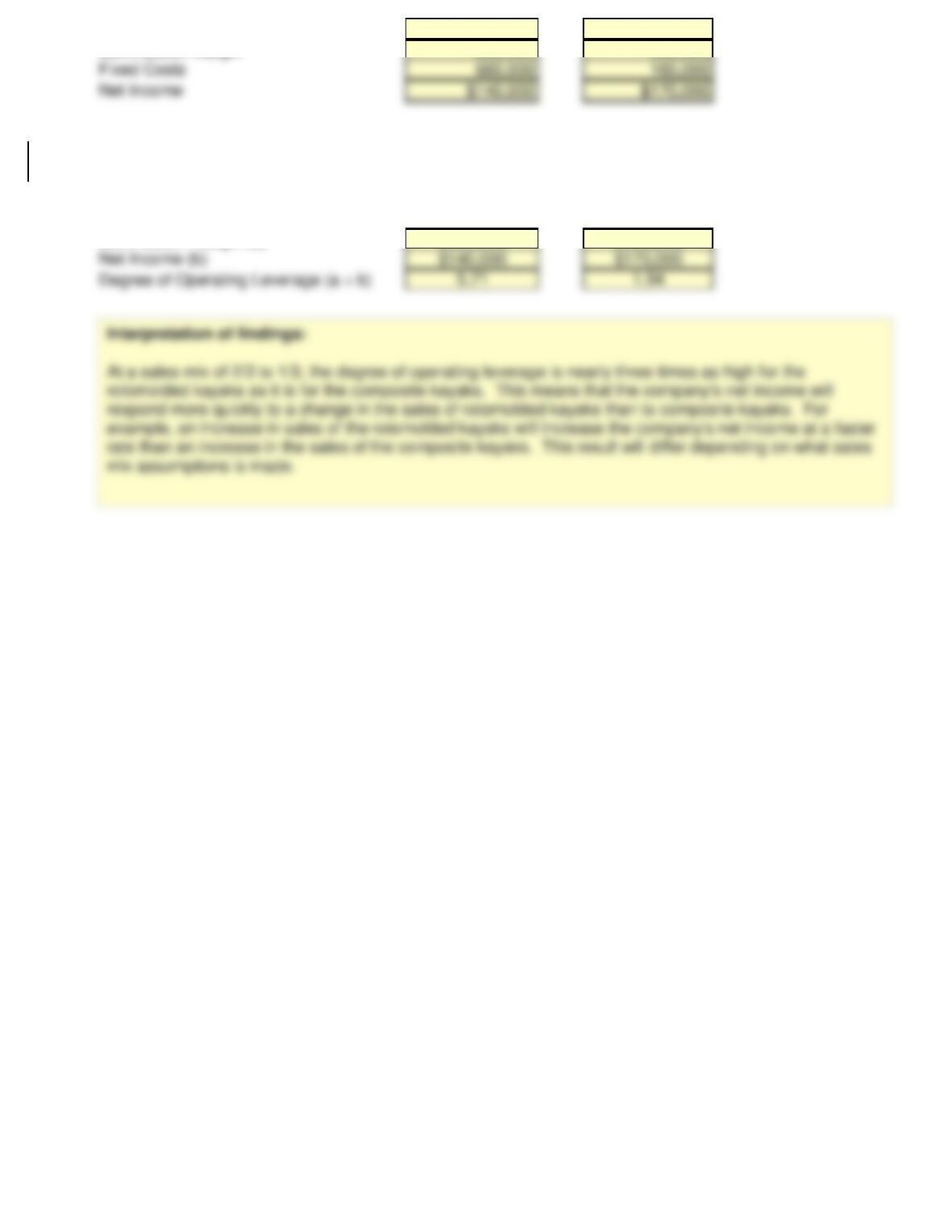
Variable Costs 1,200,000 670,000
Contribution Margin 800,000 330,000
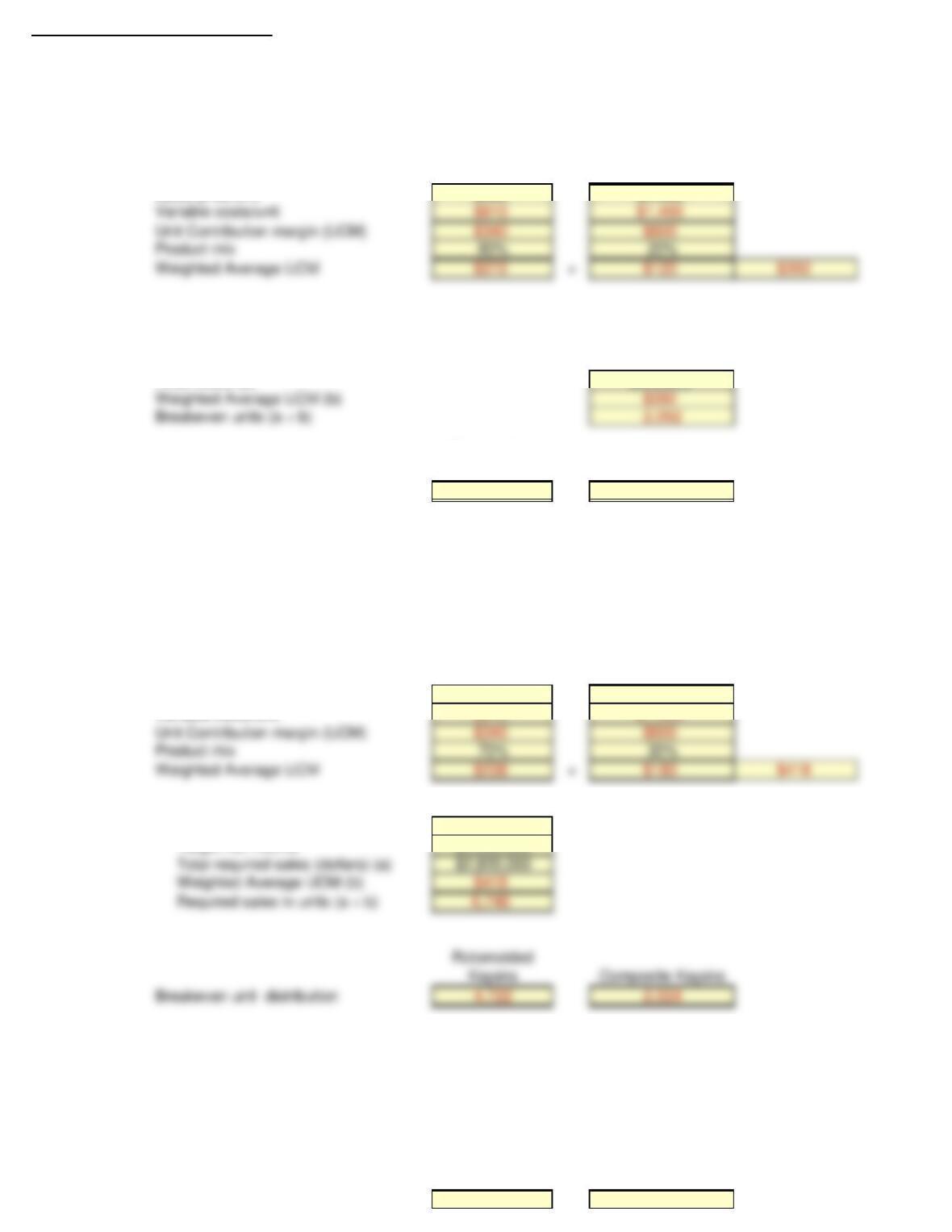
(e ) Using the information in part (d), calculate the degree of operating leverage for each product line and
interpret your findings. (Round to two decimal places.)
Rotomolded
Kayaks
Composite
Kayaks
Contribution Margin (a) $800,000 $330,000
CD6 Solution to additional question
1. Assume that variable cost per unit for the rotomolded kayak and composite kayak changed to $610 and
$1,400 respectively. Show impact of these changes on each of the scenarios provided.
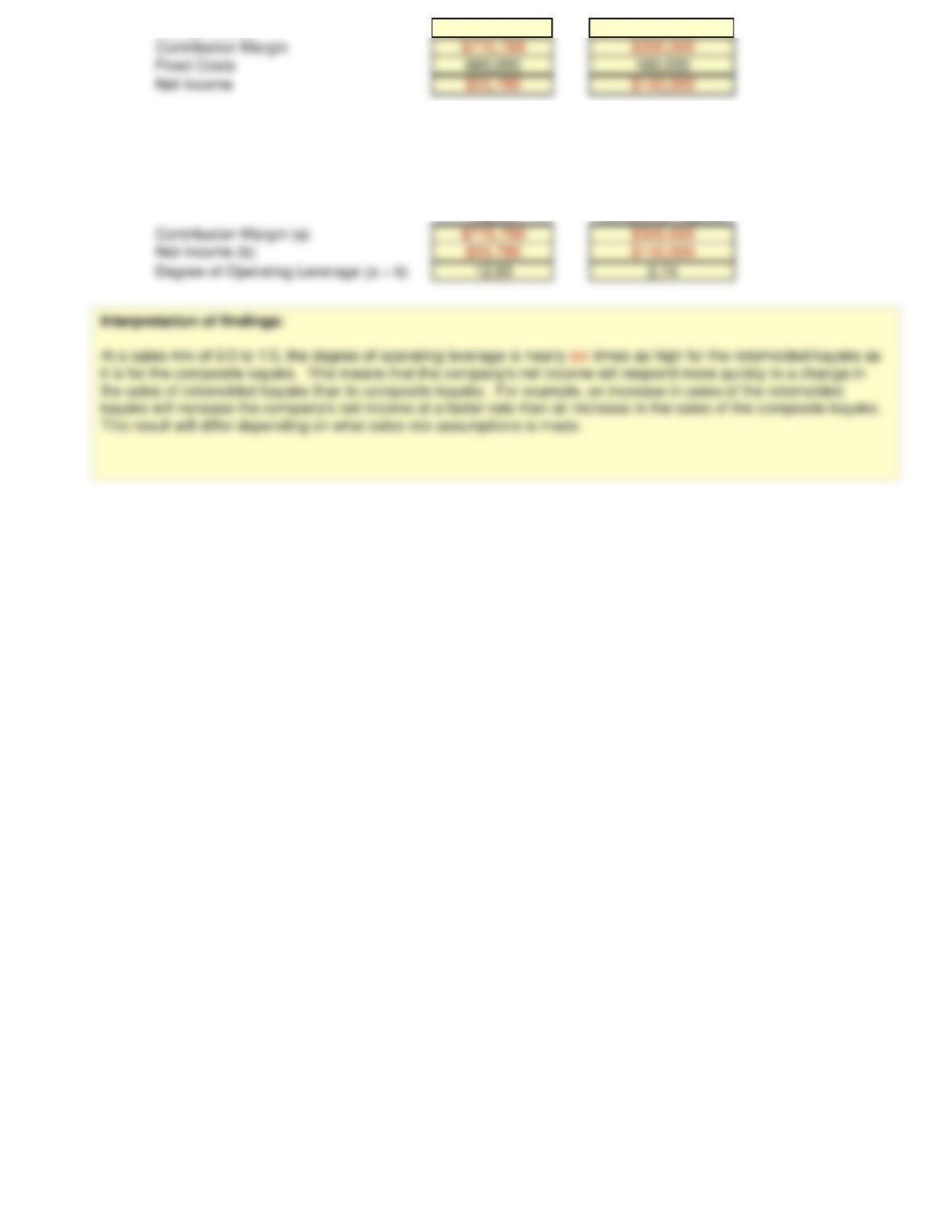
(a) Determine the weighted-average unit contribution margin for Current Designs.
Rotomolded
Kayaks
Composite Kayaks
Sales price/unit $950 $2,000
(b) Determine the break-even points in units for Current Designs and identify how many units of each
type of kayak will be sold at the break-even point. (Round to the nearest whole number.)
Fixed costs (a) $820,000
Rotomolded
Kayaks
Composite Kayaks
Breakeven unit distribution 1,673 418
(c ) Assume that the sales mix changes, and rotomolded kayaks now make up 70% of total units sold.
Calculate the total number of units that would need to be sold to earn a net income of $2,000,000
and identify how many units of each type of kayak will be sold at this level of income. (Round to the
nearest whole number.)
Target net income in units:
Rotomolded
Kayaks
Composite Kayaks
Rotomolded
Kayaks
Composite Kayaks
Sales price/unit $950 $2,000
Variable costs/unit $610 $1,400
Required sales in units:
Total fixed costs $820,000
Target net income $2,000,000
(d) Assume that Current Designs will have sales of $3,000,000 with two-thirds of the sales dollars in
rotomolded kayaks and one-third of the sales dollars in composite kayaks. Assuming $660,000 of fixed
costs are allocated to the rotomolded kayaks and $160,000 to the composite kayaks, prepare a CVP
income statement for each product line.
Rotomolded
Kayaks
Composite Kayaks
Sales $2,000,000 $1,000,000
Variable Costs $1,284,211 $700,000
(e ) Using the information in part (d), calculate the degree of operating leverage for each product line and
interpret your findings. (Round to two decimal places.)
Rotomolded
Kayaks
Composite Kayaks