FINANCIAL ACCOUNTING – Eleventh Edition Solutions Manual
Ethical Issues
Requirements
Solution:
Req. 1
Req. 2
Req. 3
1. What would you think of a company’s ethics if it changed accounting
methods every year?
2. What accounting principle would changing methods every year
violate?
3. Who can be harmed when a company changes its accounting
methods too often? How?
Changing accounting methods year after year hurts a company’s
credibility, which makes it hard for the company to borrow or raise
Creditors and outside investors could be harmed by accounting
changes year after year. It becomes difficult to tell which changes in the
Chapter 6: Inventory and Cost of Goods Sold Page 79 of 96
FINANCIAL ACCOUNTING – Eleventh Edition Solutions Manual
Apple, Inc.
(30 min.)
Requirement 1
Solution:
September 27, September 28,
2014 2013
Requirement 2
Solution:
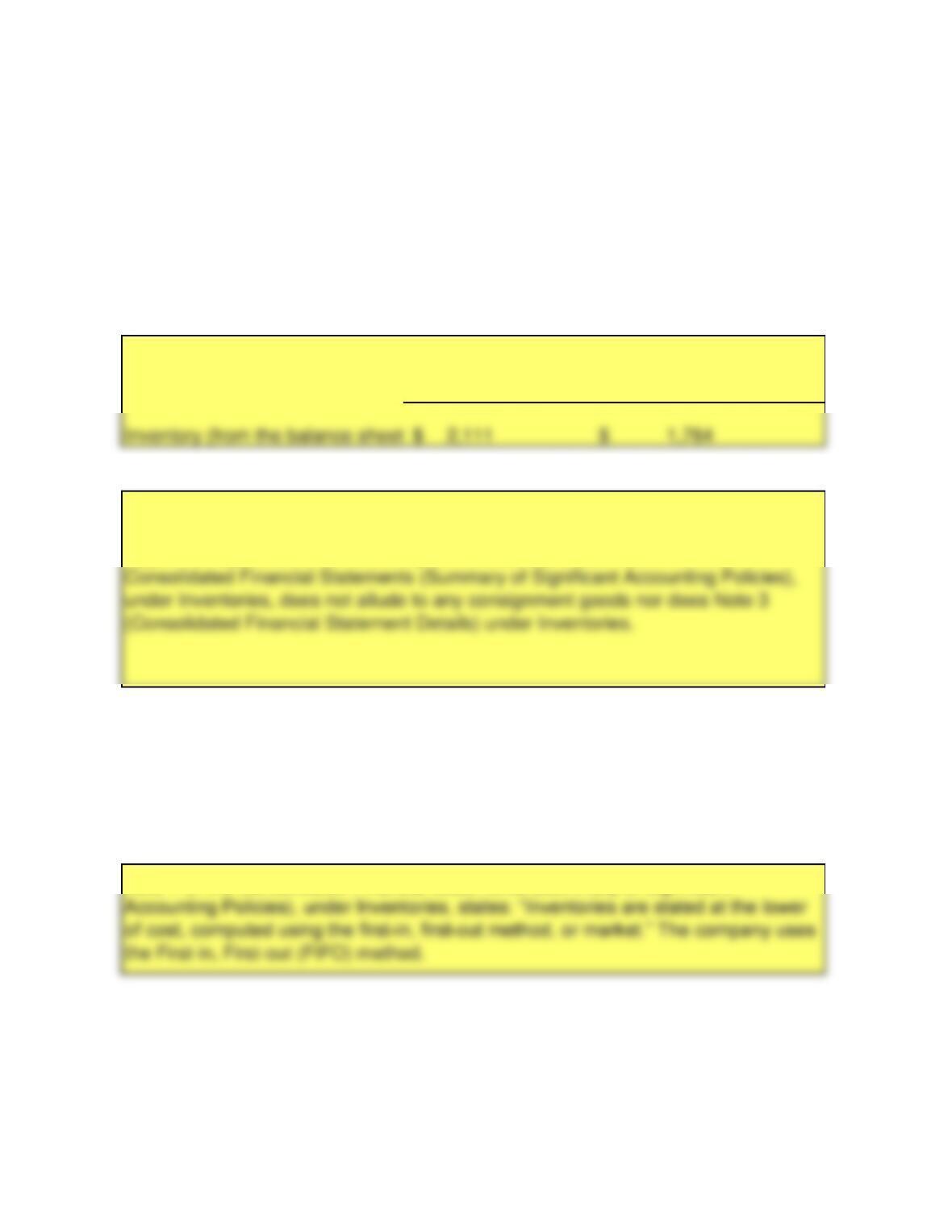
Note 1 of the Consolidated Financial Statements (Summary of Significant
Millions
How does Apple, Inc., value its inventories? Which cost method does
the company use?
Apple Inc. reports all of its’ inventory on the balance sheet. Note 1 of the
How much was Apple, Inc.’s merchandise inventory at September 27, 2014? At
September 28, 2013? Does Apple, Inc., include all inventory that it handles in the
inventory account on its balance sheet?
Chapter 6: Inventory and Cost of Goods Sold Page 80 of 96
FINANCIAL ACCOUNTING – Eleventh Edition Solutions Manual
Requirement 3
Solution:
Rearranging, Millions
Beginning Inventory Cost of sales
Requirement 4
Solution:
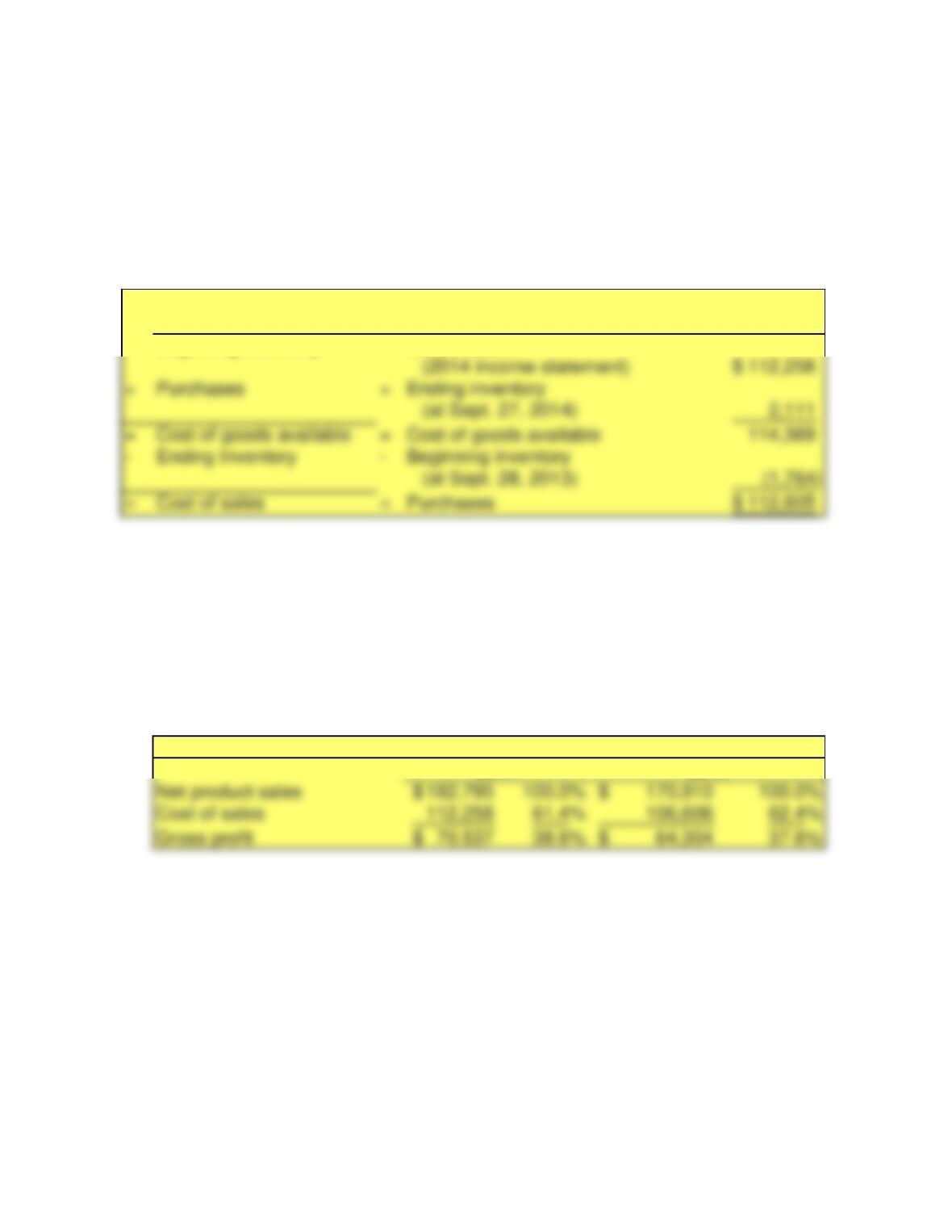
Net product sales 182,795$ 100.0% 170,910$ 100.0%
Gross profit 70,537$ 38.6% 64,304$ 37.6%
2013
2014
Using the cost-of-goods-sold model, compute Apple, Inc.’s purchases
of inventory during the year ended September 27, 2014.
Did Apple, Inc.’s gross profit percentage on company sales improve or deteriorate in
the year ended September 27, 2014, compared to the previous year?
The gross profit percentage increased slightly during 2014:
Chapter 6: Inventory and Cost of Goods Sold Page 81 of 96
FINANCIAL ACCOUNTING – Eleventh Edition Solutions Manual
Requirement 5
Solution:
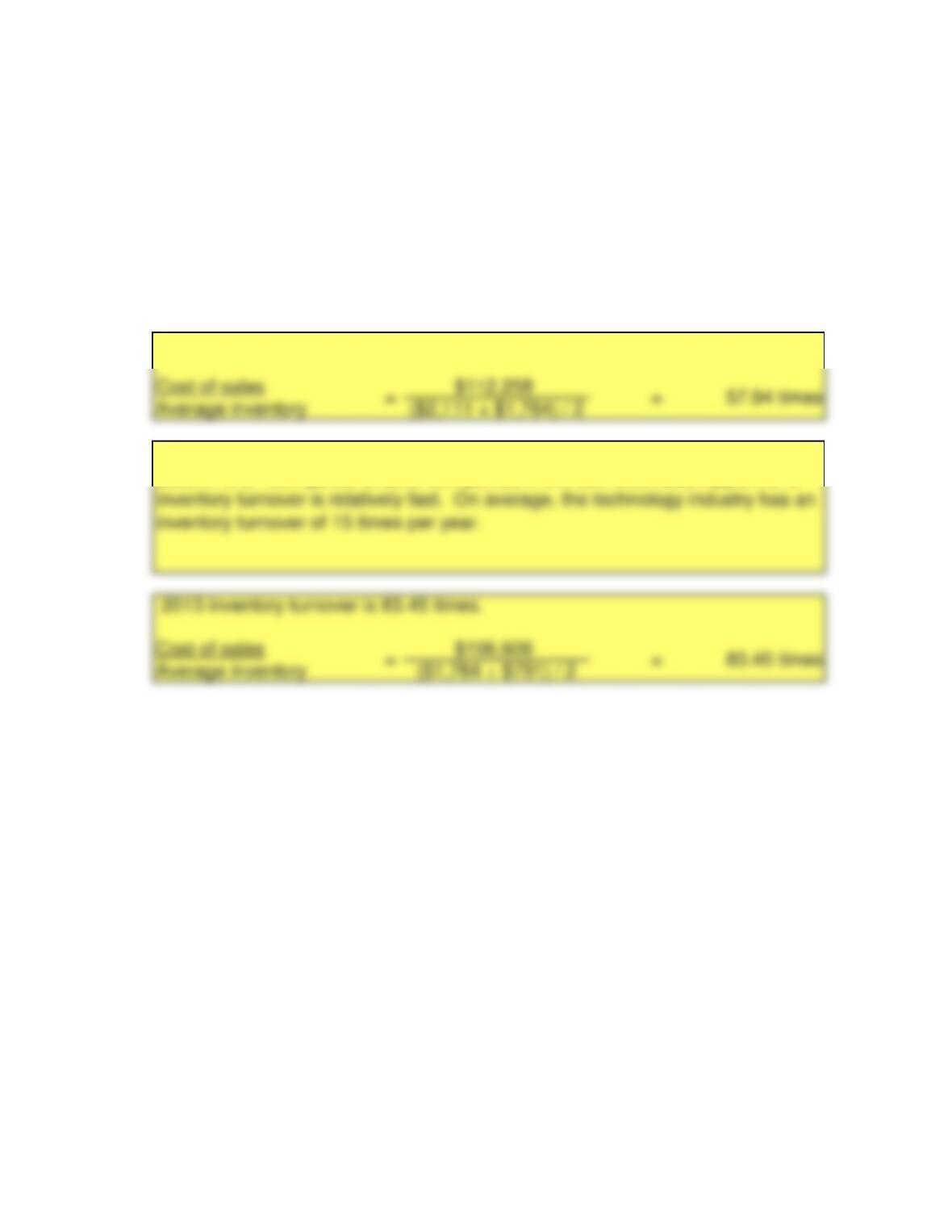
Apple Inc.’s rate of inventory turnover for 2014 is 57.94 times.
Requirement 6
Solution:
For this part, assume that beginning inventory on September 30, 2012 was $791
million. Compute inventory turnover for 2014 and 2013. Would you rate Apple, Inc.’s
rate of inventory turnover for the years ended September 27, 2014, and September
28, 2013, as fast or slow in comparison to most other companies in its industry?
Explain your answer.
Go to the SEC’s website (www.sec.gov). Find Apple, Inc.’s most recent
consolidated balance sheet and consolidated statement of operations. What has
happened to the company’s inventory turnover and gross profit percentages since
September 27, 2014? Can you explain the reasons? Where would you find the
company’s explanations for these changes? (Challenge)
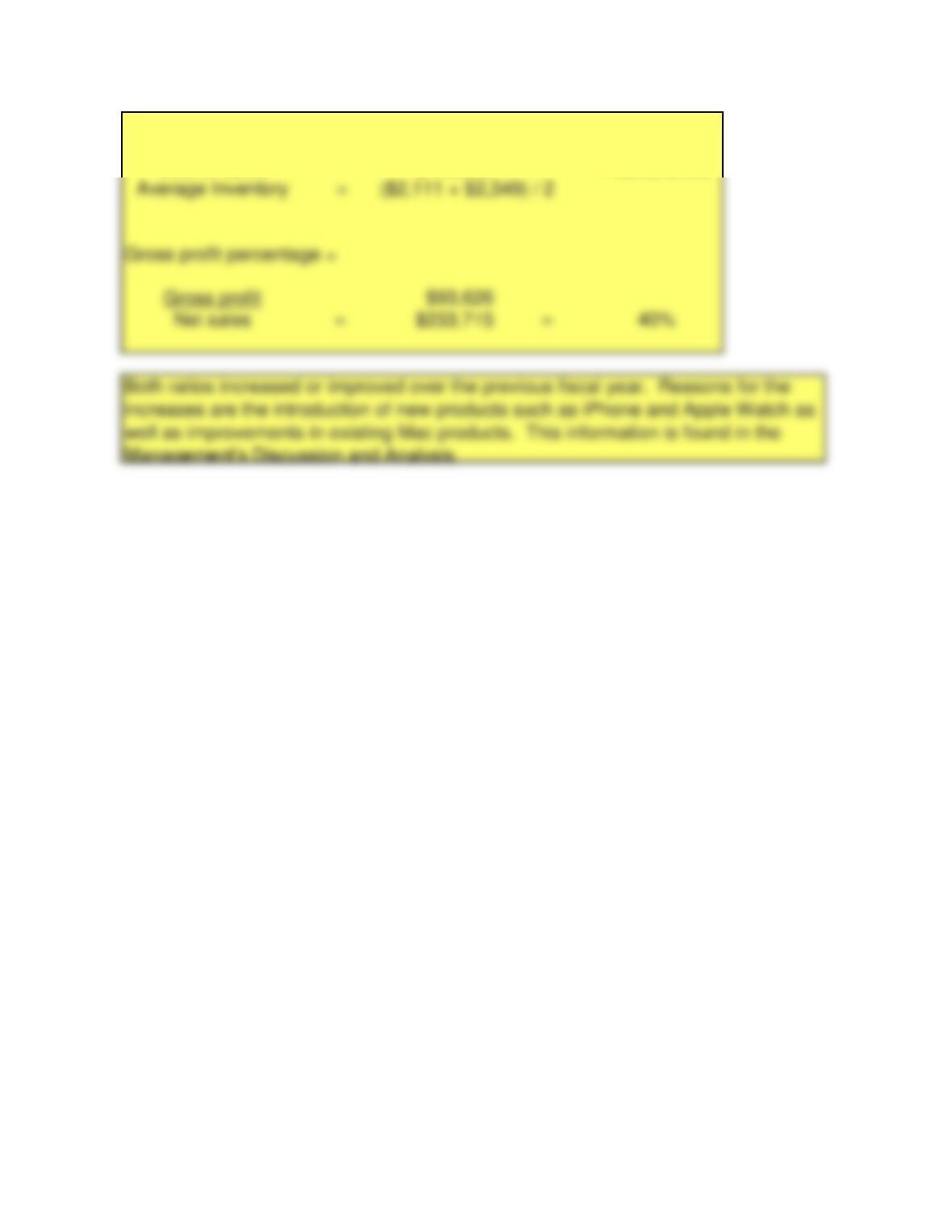
On a number-of-days basis, this works out to once about every 6.3 days
(365/57.94). Compared to other companies in the tech business, Apple Inc.’s
Chapter 6: Inventory and Cost of Goods Sold Page 82 of 96
FINANCIAL ACCOUNTING – Eleventh Edition Solutions Manual
Inventory turnover =
$140,089 = 62.82 times
Cost of sales
Chapter 6: Inventory and Cost of Goods Sold Page 83 of 96
FINANCIAL ACCOUNTING – Eleventh Edition Solutions Manual
Under Armour, Inc.
(30-40 min.)
Solution:
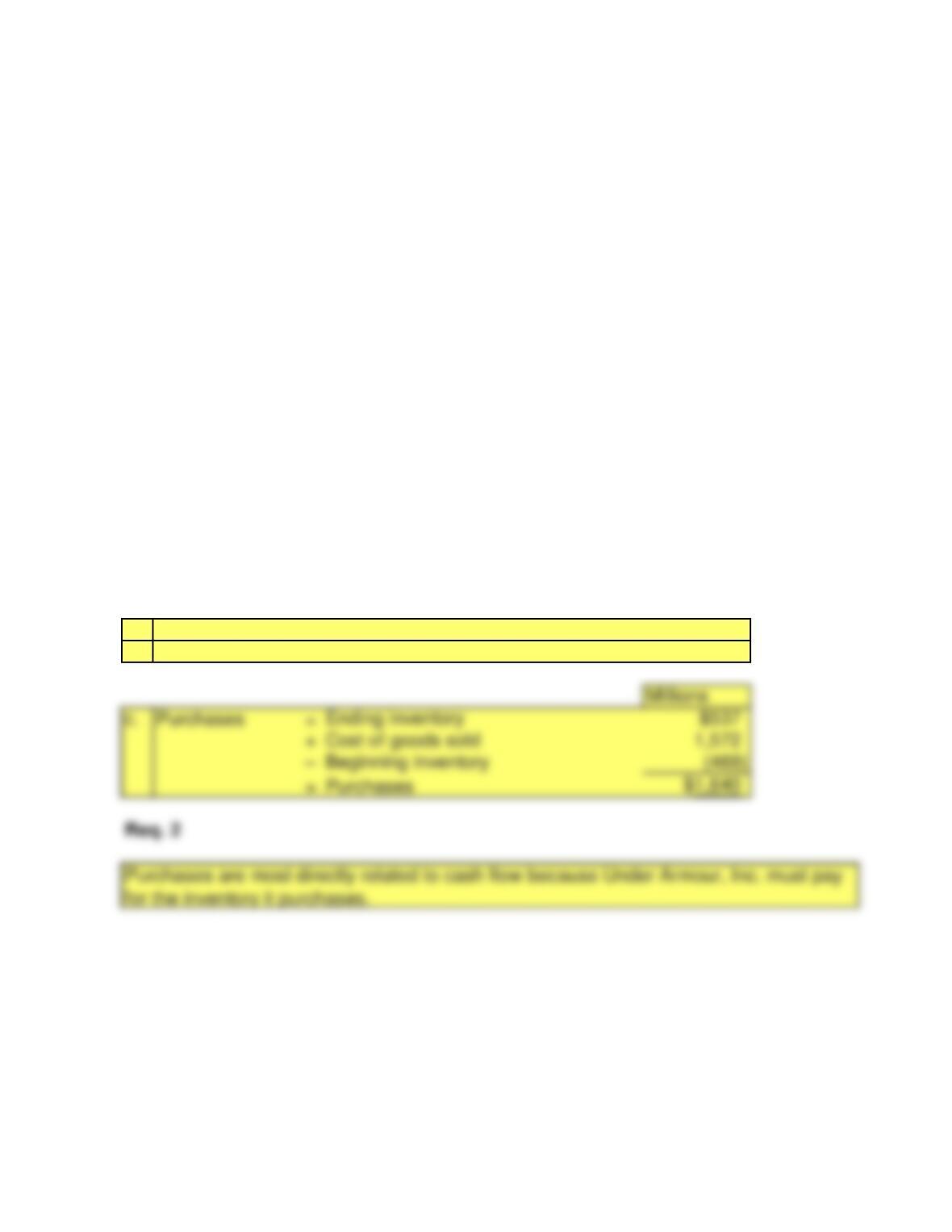
Req. 1
a. Inventory on hand at fiscal 2014 year end, $537 million.
b. Cost of sales, $1,572 million.
1. Three important pieces of inventory information are (a) the cost of inventory on hand,
(b) the cost of sales, and (c) the cost of inventory purchases. Identify or compute each
of these items for Under Armour, Inc., at December 31, 2014. Assume “food and paper”
are cost of goods sold.
2. Which item in requirement 1 is most directly related to cash flow? Why? (Challenge)
3. Assume that all inventory purchases were made on account and that only inventory
purchases increased Accounts Payable and Other Current Liabilities. Compute Under
Armour, Inc.’s cash payments for inventory during 2014.
4. How does Under Armour, Inc., value its inventories? Which costing method does
Under Armour use?
5. Did Under Armour, Inc.’s gross profit percentage and rate of inventory turnover
improve or deteriorate in 2014 (versus 2013)? Consider the overall effect of these two
ratios. Did Under Armour, Inc., improve during 2014? How did these factors affect the
net income for 2014? Under Armour, Inc.’s inventories totaled $319 million at the end of
fiscal 2012. Round decimals to three places.
Chapter 6: Inventory and Cost of Goods Sold Page 84 of 96
FINANCIAL ACCOUNTING – Eleventh Edition Solutions Manual
Req. 3
Millions
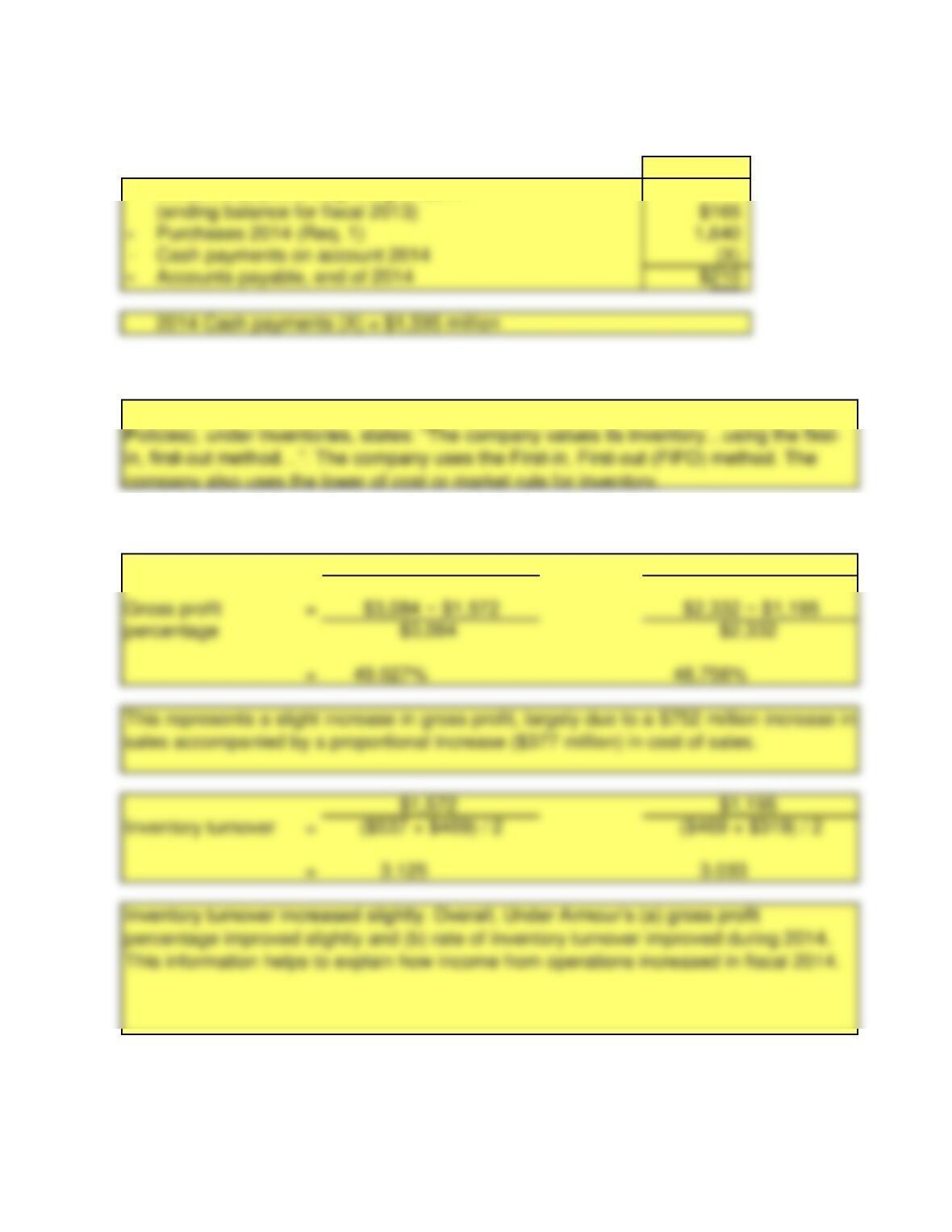
Accounts payable, beginning of 2014
Req. 4
Req. 5
(Dollars in millions) 2013
Gross profit =
Inventory turnover =
Note 2 of the Consolidated Financial Statements (Summary of Significant Accounting
2014
Chapter 6: Inventory and Cost of Goods Sold Page 85 of 96
(ending balance for fiscal 2013) $165
+ Purchases 2014 (Req. 1) 1,640
2014 Cash payments (X) = $1,595 million

FINANCIAL ACCOUNTING – Eleventh Edition Solutions Manual
Group Project
Solution:
Req. 1
Student responses will vary.
Req. 2
1. Compute each company’s gross profit percentage and rate of inventory turnover for
the most recent two years. If annual reports are unavailable or do not provide enough
data for multiple-year computations, you can gather financial statement data from
Moody’s Industrial Manual.
2. For the industries of the companies you are analyzing, obtain the industry averages
for gross profit percentage and inventory turnover from Robert Morris Associates,
Annual Statement Studies; Dun and Bradstreet, Industry Norms and Key Business
Ratios; or Leo Troy, Almanac of Business and Industrial Financial Ratios.
3. How well does each of your companies compare to the other company in its
industry? How well do your companies compare to the average for their industry? What
insight about your companies can you glean from these ratios?
4. Write a memo to summarize your findings, stating whether your group would invest in
each of the companies it has analyzed.
Chapter 6: Inventory and Cost of Goods Sold Page 86 of 96

FINANCIAL ACCOUNTING – Eleventh Edition Solutions Manual
Req. 3
Req. 4
Chapter 6: Inventory and Cost of Goods Sold Page 87 of 96
FINANCIAL ACCOUNTING – Eleventh Edition Solutions Manual
S6A-1
(10-15 min.)
Solution:
(Journal entries)
General Journal
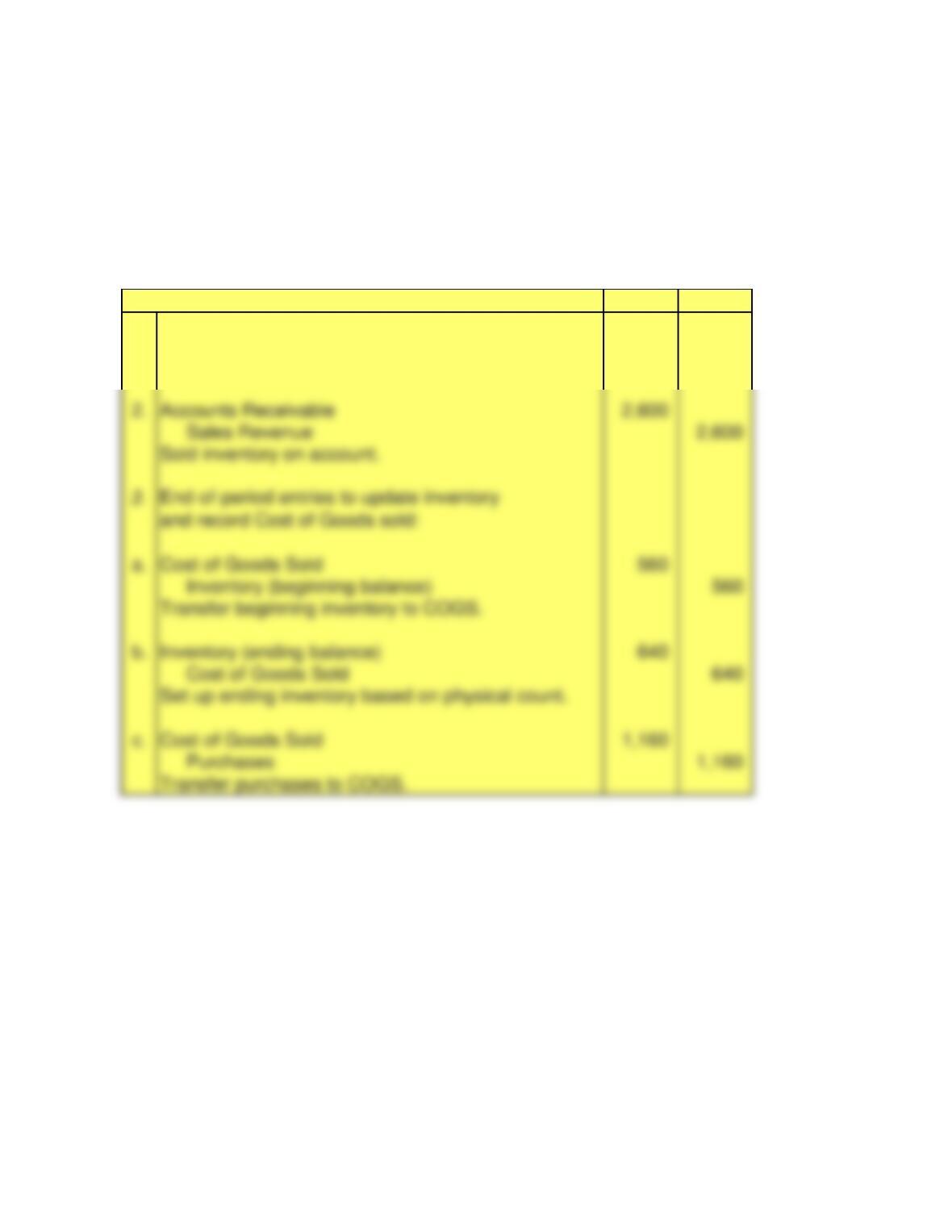
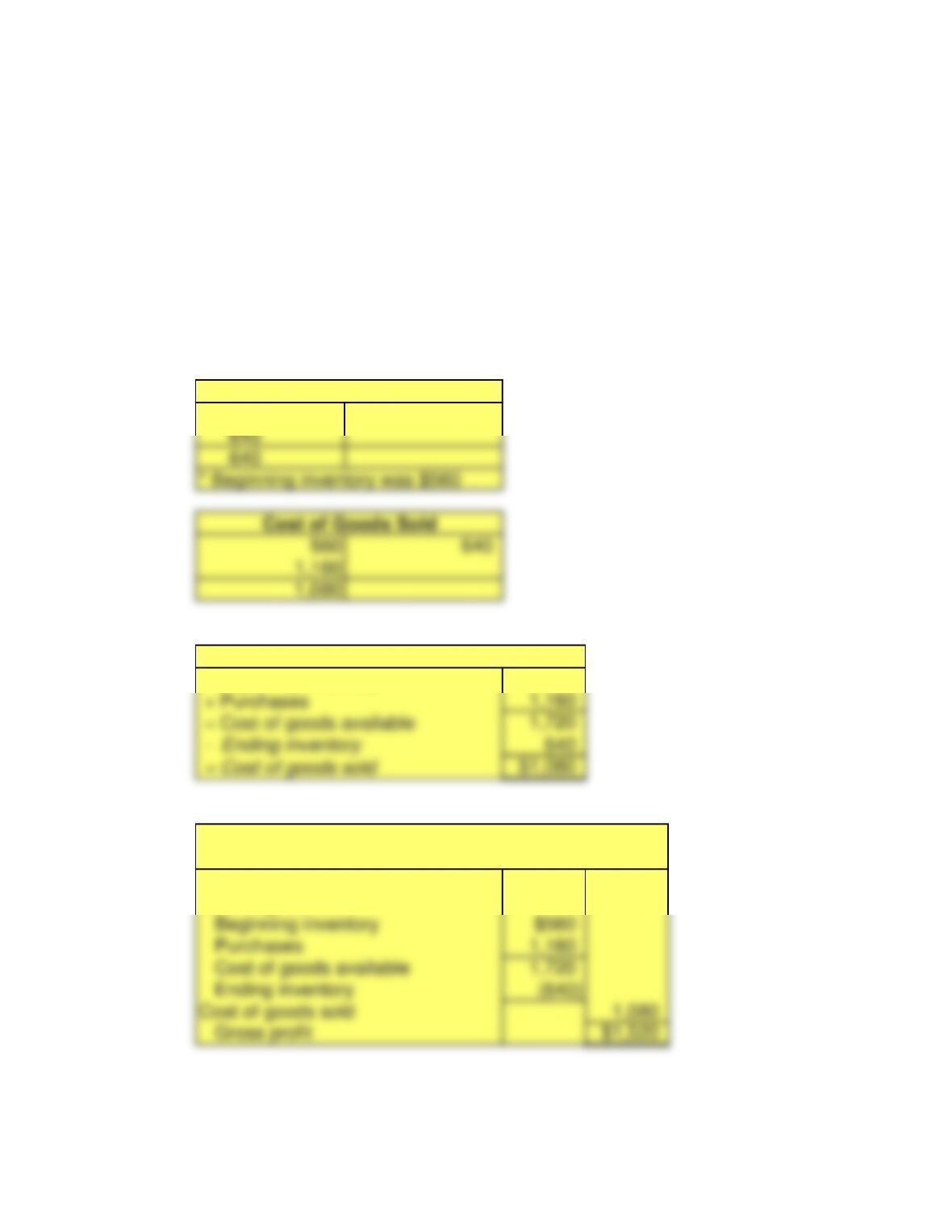
1. Purchases 1,160
Accounts Payable 1,160
Purchased inventory on account.
Journalize all the necessary transactions under the periodic inventory system
Chapter 6: Inventory and Cost of Goods Sold Page 88 of 96
2. Accounts Receivable 2,600
Sales Revenue 2,600
Sold inventory on account.
a. Cost of Goods Sold 560
Inventory (beginning balance) 560
Transfer beginning inventory to COGS.
b. Inventory (ending balance) 640
Cost of Goods Sold 640
Purchases 1,160
Transfer purchases to COGS.
FINANCIAL ACCOUNTING – Eleventh Edition Solutions Manual
S6A-2
(10-15 min.)
Requirements
Solution:
Req. 1
Posting general journal entries
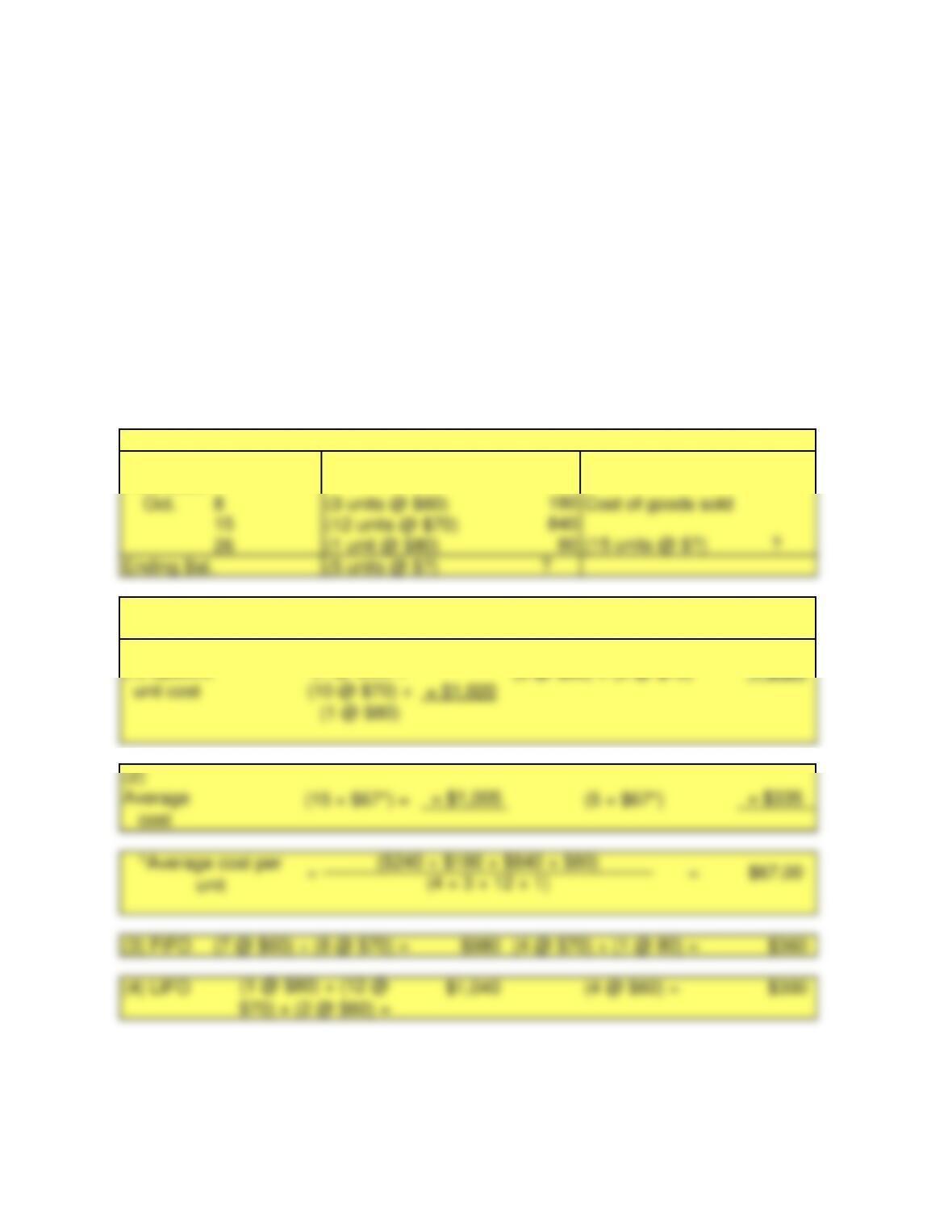
560* 560
Req. 2
Beginning inventory $560
+ Purchases 1,160
= Cost of goods available 1,720
Req. 3
Sales revenue $2,600
Cost of goods sold:
Beginning inventory $560
Purchases 1,160
Cost of goods available 1,720
Ending inventory (640)
Cost of goods sold 1,080
1. Post to the Inventory and Cost of Goods Sold accounts.
2. Compute cost of goods sold by the cost-of-goods-sold model.
3. Prepare the income statement of Wexton Technologies through gross profit.
Income Statement (Partial)
Inventory
Wexton Technologies
Cost-of-Goods-Sold Model
Chapter 6: Inventory and Cost of Goods Sold Page 89 of 96
FINANCIAL ACCOUNTING – Eleventh Edition Solutions Manual
E6A-3A
(10-15 min.)
Requirements
Solution:
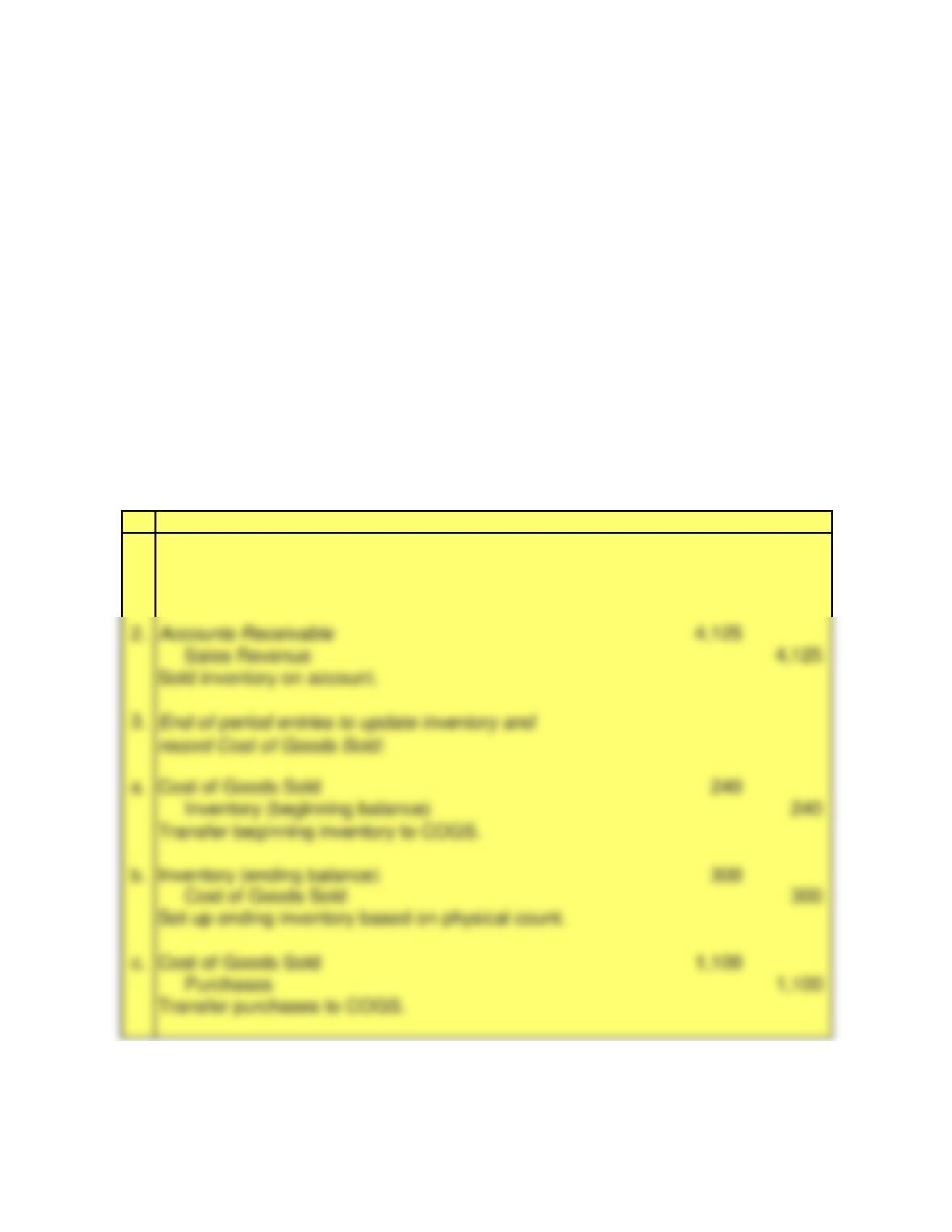
Begin. Bal. (4 units @ $60) 240
Purchases
Ending Inventory
(1) Specific = $320
unit cost = $1,020
(3) FIFO $980 $360
(4) LIFO $1,040 (4 @ $60) = $300
Inventory
(4 @ $60) +
Compute ending inventory and cost of goods sold, using each of the
following methods:
1. Specific unit cost, assuming three $60 units and four $70 units are on
hand
2. Average cost (round average unit cost to the nearest cent)
3. First-in, first-out
4 Last-in first-out
Cost of
Goods Sold
Chapter 6: Inventory and Cost of Goods Sold Page 90 of 96
Oct. 8 (3 units @ $60) 180
Ending Bal. (5 units @ $?) ?
FINANCIAL ACCOUNTING – Eleventh Edition Solutions Manual
E6A-4A
(10-15 min.)
Requirements
Solution:
Reqs. 1, 2, & 3
(Journal entries)
1. Purchases 1,100
Accounts Payable 1,100
Purchased inventory on account.
Journalize the following for the periodic system:
1. Total October purchases in one summary entry. All purchases were on credit.
2. Total October sales in a summary entry. Assume that the selling price was $275
per unit and that all sales were on credit.
3. October 31 entries for inventory. Synthetix uses LIFO. Post to the Cost of Goods
Sold T-account to show how this amount is determined. Label each item in the
account.
4 Show the computation of cost of goods sold by the cost-of-goods-sold model.
General Journal
Chapter 6: Inventory and Cost of Goods Sold Page 91 of 96
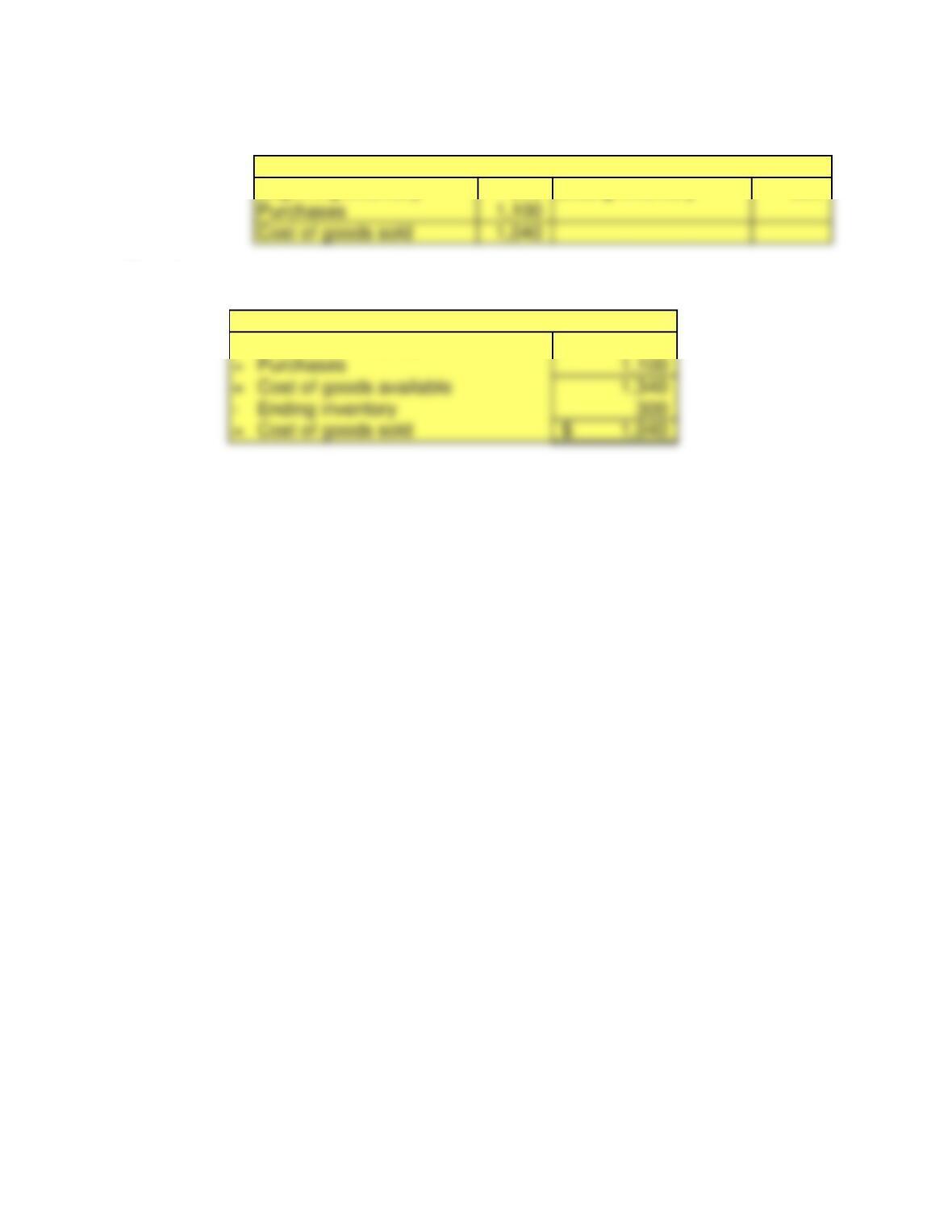
Sales Revenue 4,125
Sold inventory on account.
Transfer beginning inventory to COGS.
Purchases 1,100
Transfer purchases to COGS.
FINANCIAL ACCOUNTING – Eleventh Edition Solutions Manual
Posting general journal entries
Beginning inventory 240 Ending Inventory 300
Req. 4
Beginning inventory 240$
Cost-of-Goods-Sold Model
Cost of Goods Sold
Chapter 6: Inventory and Cost of Goods Sold Page 92 of 96
Purchases 1,100
Cost of goods sold 1,040
FINANCIAL ACCOUNTING – Eleventh Edition Solutions Manual
P6A-5A
(20-25 min.)
Requirements
Solution:
Req. 1
Begin. Bal.
(52 units @ $18) 936
Purchases
Req. 2
July 3 18 75$ 1,350$
Selling
Price
Total
Revenue
1. Determine the store’s cost of goods sold for July under the periodic
inventory system. Assume the FIFO method.
2. Compute gross profit for July.
Inventory
Units Sold
Date
Chapter 6: Inventory and Cost of Goods Sold Page 93 of 96
(86 units @ $19) 1,634
(22 units @ $20) 440
Ending Bal. (70 units @ $?) ?
FINANCIAL ACCOUNTING – Eleventh Edition Solutions Manual
Sales revenue 6,826$
Cost of goods sold:
Championship Outlet
Income Statement (Partial)
Chapter 6: Inventory and Cost of Goods Sold Page 94 of 96
Beginning inventory 936$
Cost of goods available 3,010
Cost of goods sold 1,658
FINANCIAL ACCOUNTING – Eleventh Edition Solutions Manual
P6A-6A
(20-30 min.)
Requirements
Solution:
Req. 1
(Journal entries)
1. Purchases 1,180
Accounts Payable 1,180
Purchased inventory on account
1. Journalize Just Desserts’ inventory transactions for the year under the
periodic system. Show all amounts in thousands.
2. Report ending inventory, sales, cost of goods sold, and gross profit on the
appropriate financial statement (amounts in thousands). Show the computation
of cost of goods sold.
(thousands)
General Journal
Chapter 6: Inventory and Cost of Goods Sold Page 95 of 96
2. Accounts Receivable 2,720
Sales Revenue 3,400
Sold inventory for cash and on account
a. Cost of Goods Sold 510
Inventory (beginning balance) 510
Transfer beginning inventory to COGS
Purchases 1,180
FINANCIAL ACCOUNTING – Eleventh Edition Solutions Manual
Req. 2
Sales revenue 3,400$
Cost of goods sold:
Just Desserts, Inc.
Income Statement (Partial)
Chapter 6: Inventory and Cost of Goods Sold Page 96 of 96