1. Merchandising businesses acquire merchandise for resale to customers. It is the selling of
merchandise, instead of providing a service, that makes the activities of a merchandising
b
usiness different from the activities of a service business.
4. a. 1% discount allowed if paid within 15 days of date of invoice; entire amount of invoice
due within 60 days of date of invoice.
b. Payment due within 30 days of date of invoice with no discount.
c. Payment due by the end of the month in which the sale was made with no discount.
5. Sales to customers who use MasterCard or VISA cards are recorded as cash sales.
b
p
8. Sales, Cost of Merchandise Sold, Merchandise Inventory
9. Cost of Merchandise Sold would be debited; Merchandise Inventory would be credited.
10. Loss from Merchandise Inventory Shrinkage would be debited.
CHAPTER 6
ACCOUNTING FOR MERCHANDISING BUSINESSES
DISCUSSION QUESTIONS
CHAPTER 6 Accounting for Merchandising Businesses
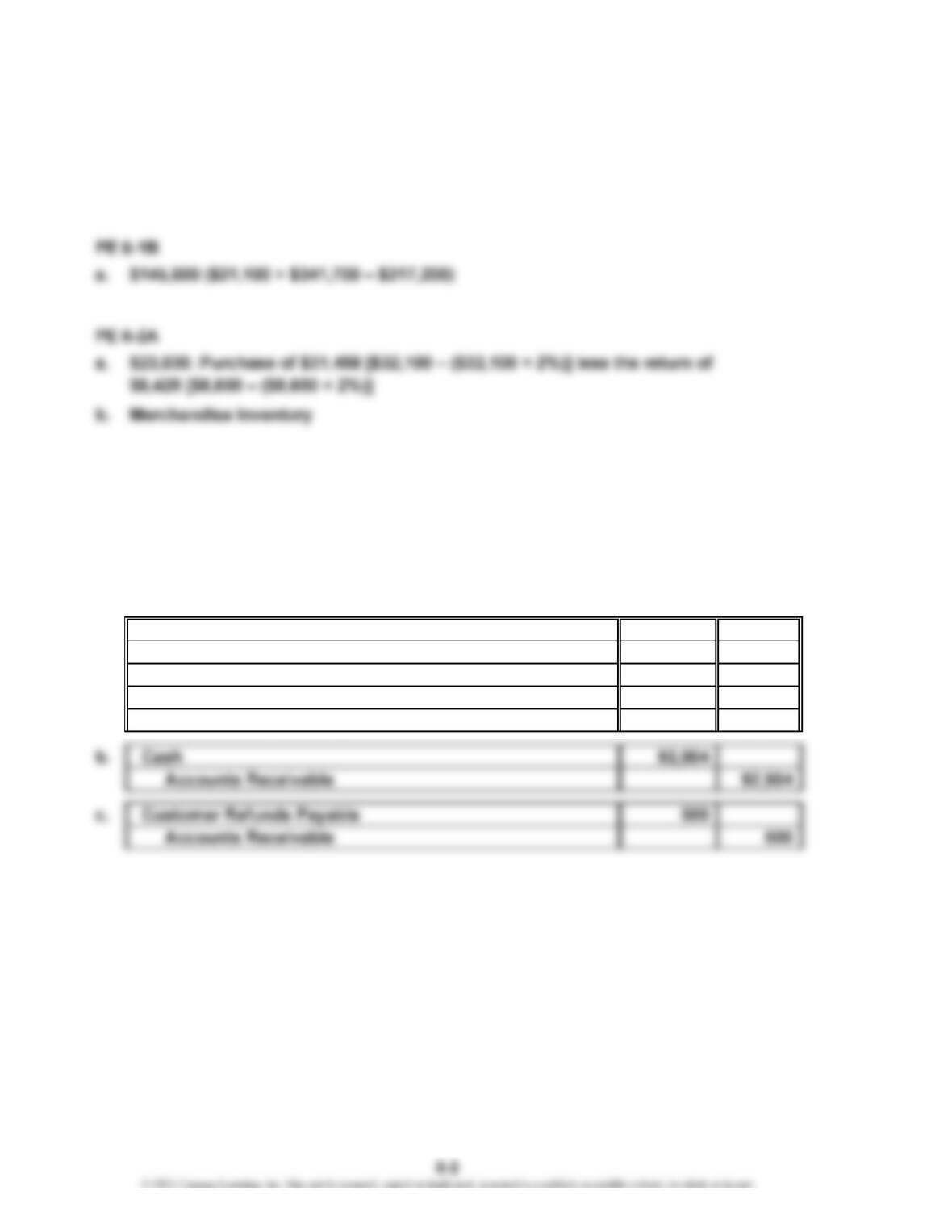
PE 6-1A
a. $771,800 ($366,100 + $1,420,000 – $1,014,300)
PE 6-2B
a. $74,448. Purchase of $84,150 [$85,000 – ($85,000 × 1%)] less the return of
$9,702 [$9,800 – ($9,800 × 1%)]
b. Accounts Payable
PE 6-3A
a. Accounts Receivable [$94,800 – ($94,800 × 2%)] 92,904
Sales 92,904
Cost of Merchandise Sold 56,900
Merchandise Inventory 56,900
PRACTICE EXERCISES
CHAPTER 6 Accounting for Merchandising Businesses
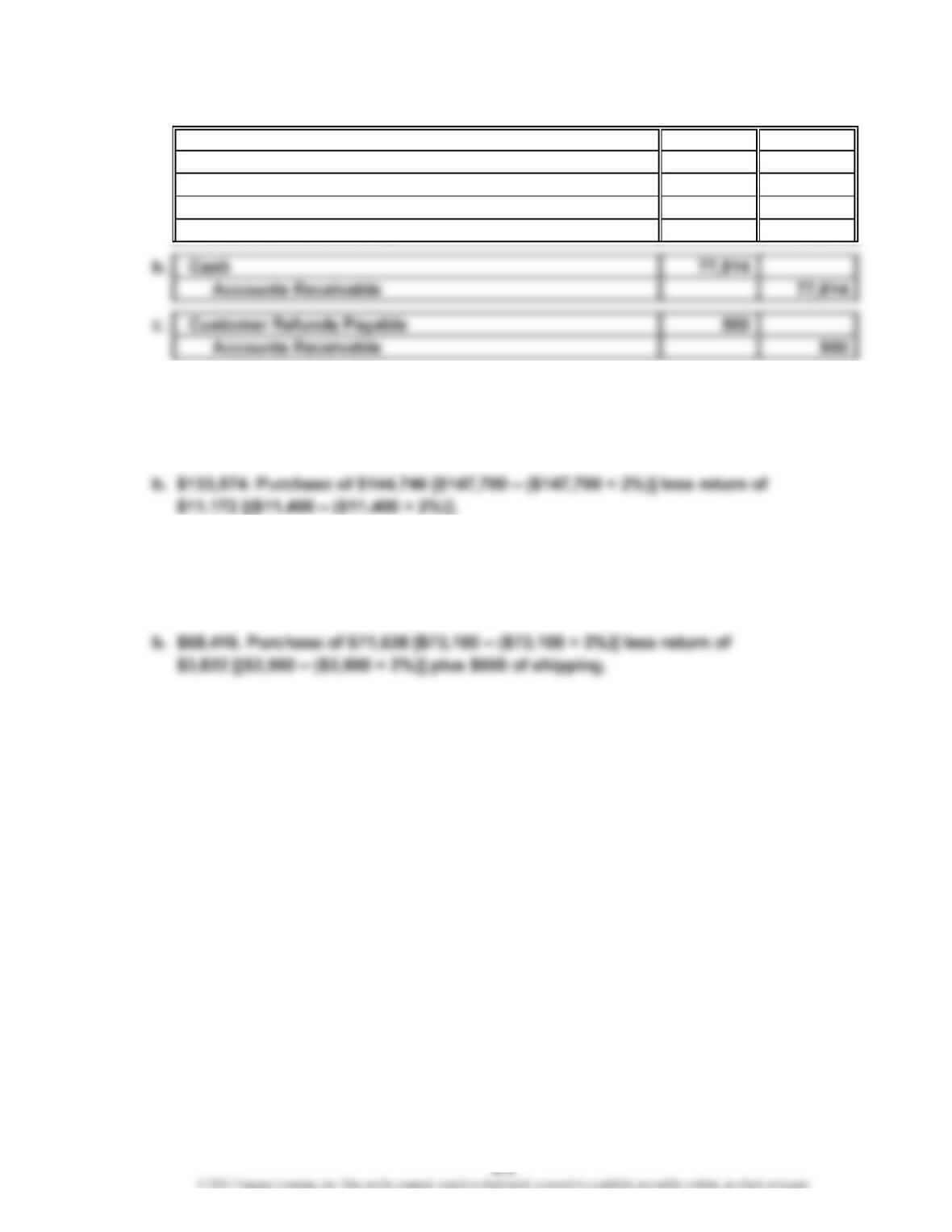
PE 6-3B
a. Accounts Receivable [$78,600 – ($78,600 × 1%)] 77,814
Sales 77,814
Cost of Merchandise Sold 47,200
Merchandise Inventory 47,200
PE 6-4A
a. $100,993. Purchase of $119,592 [$120,800 – ($120,800 × 1%)] less return of
$19,899 [($20,100 – ($20,100 × 1%)] plus $1,300 of shipping.
PE 6-4B
a. $51,579. Purchase of $58,014 [$58,600 – ($58,600 × 1%)] less return of
$6,435 [($6,500 – ($6,500 × 1%)].
CHAPTER 6 Accounting for Merchandising Businesses
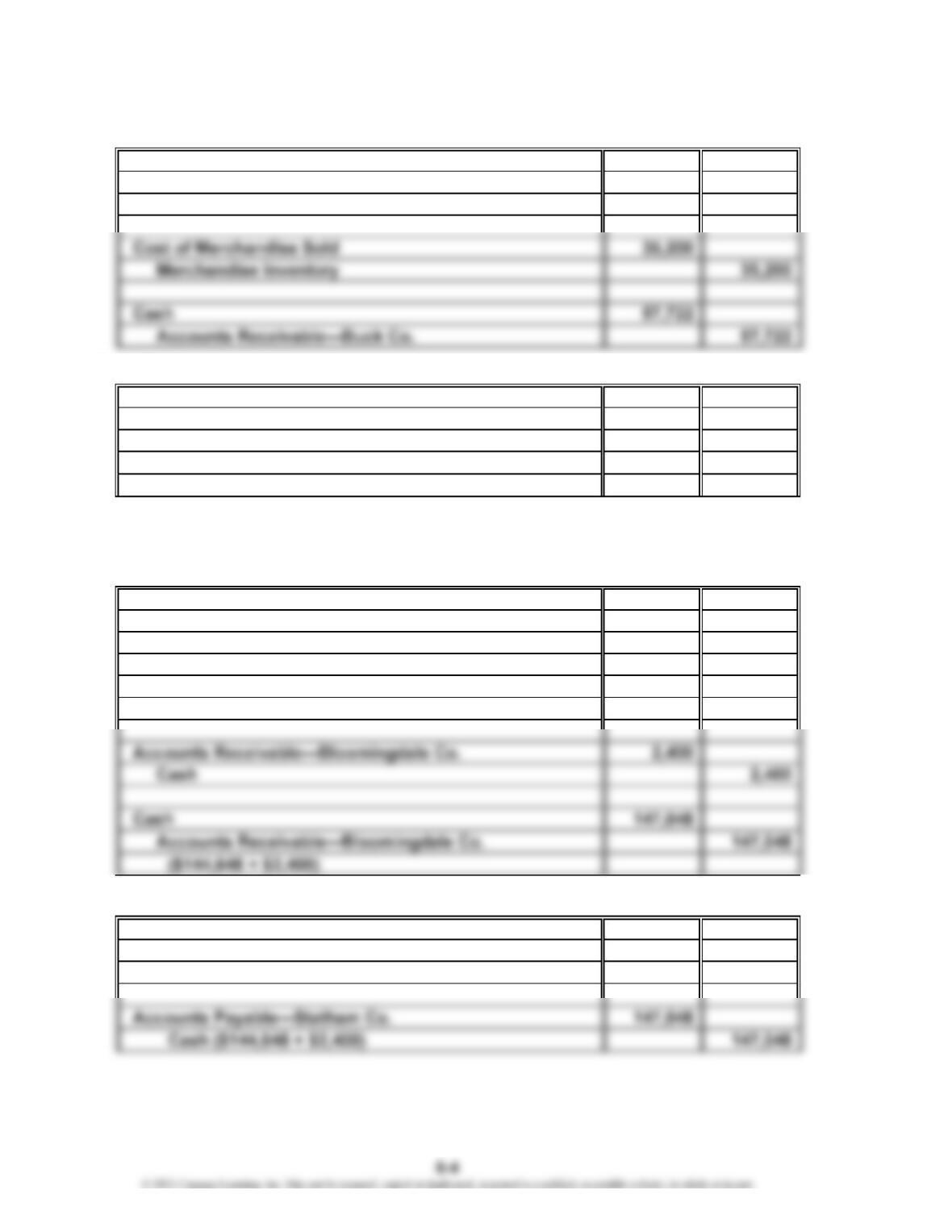
PE 6-5A
Sally Co. journal entries:
Accounts Receivable—Buck Co. 57,722
Sales 57,722
[$58,900 – ($58,900 × 2%)]
Buck Co. journal entries:
Merchandise Inventory [$58,900 – ($58,900 × 2%)] 57,722
Accounts Payable—Sally Co. 57,722
Accounts Payable—Sally Co. 57,722
Cash 57,722
PE 6-5B
Statham Co. journal entries:
Accounts Receivable—Bloomingdale Co. 144,648
Sales 144,648
[$147,600 – ($147,600 × 2%)]
Cost of Merchandise Sold 88,600
Merchandise Inventory 88,600
Bloomingdale Co. journal entries:
Merchandise Inventory 147,048
Accounts Payable—Statham Co. 147,048
[$147,600 – ($147,600 × 2%)] + $2,400
CHAPTER 6 Accounting for Merchandising Businesses
PE 6-6A
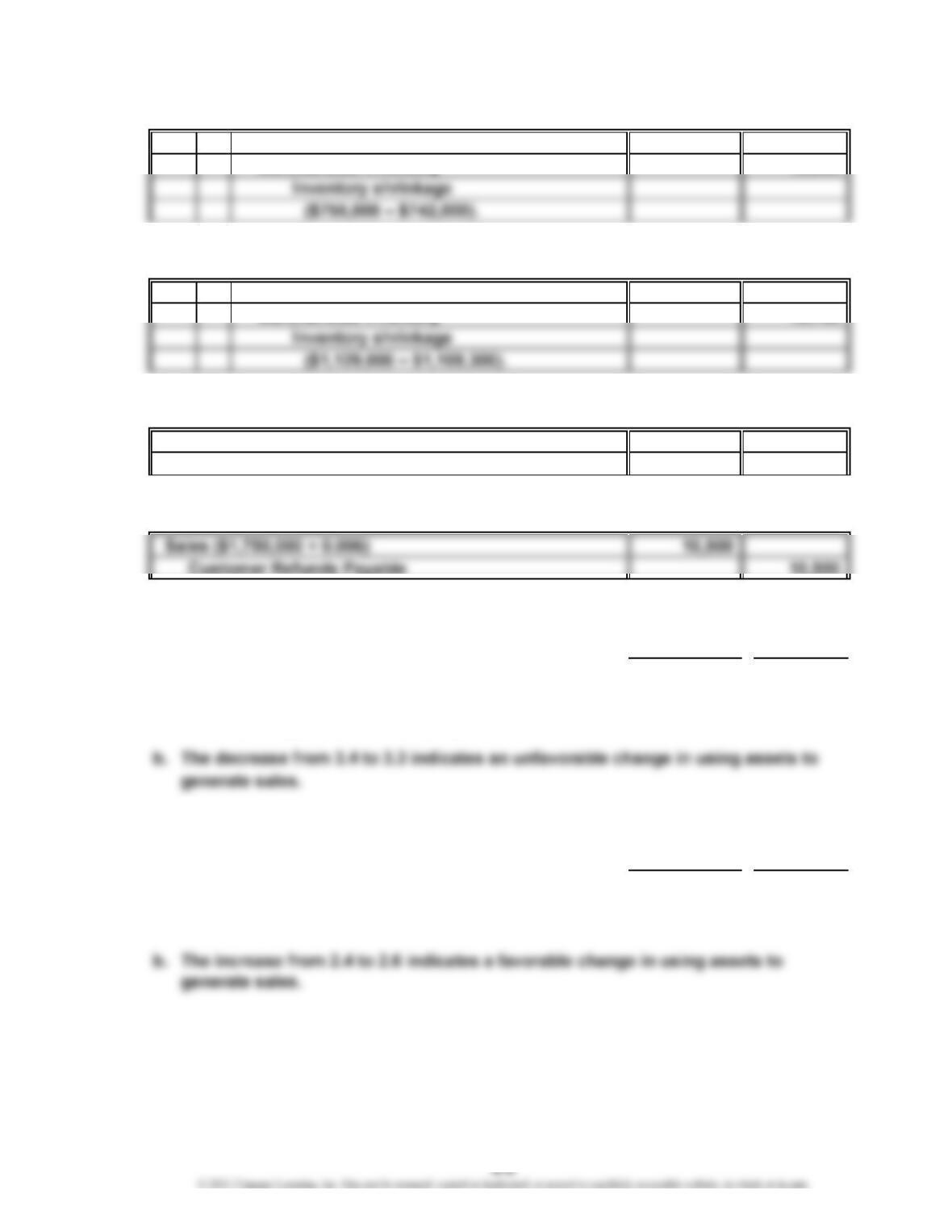
Nov. 30 Cost of Merchandise Sold 13,000
PE 6-6B
Dec. 31 Cost of Merchandise Sold 19,700
PE 6-7A
Sales ($3,600,000 × 0.008) 28,800
Customer Refunds Payable 28,800
PE 6-7B
PE 6-8A
a. 20Y3 20Y2
Asset turnover 3.3 3.4
*
$2,310,000 ÷ [($680,000 + $720,000) ÷ 2]
**
$2,278,000 ÷ [($660,000 + $680,000) ÷ 2]
PE 6-8B
a. 20Y3 20Y2
Asset turnove
r
2.6 2.4
*
$663,000 ÷ [($240,000 + $270,000) ÷ 2]
**
$516,000 ÷ [($190,000 + $240,000) ÷ 2]
***
***
CHAPTER 6 Accounting for Merchandising Businesses
Ex. 6-1
a. $12,843,600 ($45,870,000 – $33,026,400)
Ex. 6-2
$32,918 million ($42,879 million – $9,961 million)
Ex. 6-3
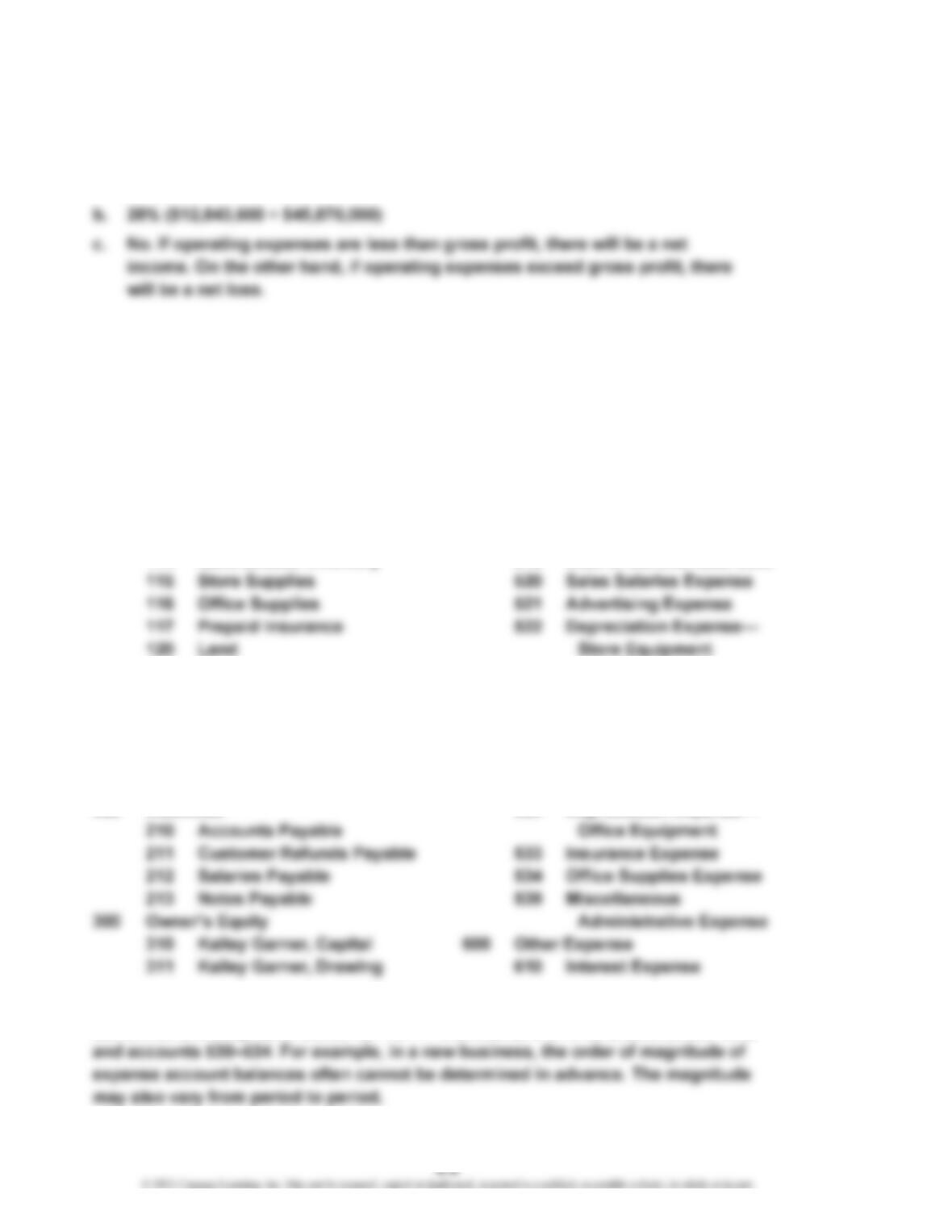
Balance Sheet Accounts Income Statement Accounts
100 Assets 400 Revenues
110 Cash 410 Sales
112 Accounts Receivable 500 Expenses
114 Merchandise Inventory 510 Cost of Merchandise Sold
123 Store Equipment 523 Store Supplies Expense
124 Accumulated Depreciation— 524 Delivery Expense
Store Equipment 529 Miscellaneous Selling
125 Office Equipment Expense
126 Accumulated Depreciation— 530 Office Salaries Expense
Office Equipment 531 Rent Expense
Note: The order and number of some of the accounts within subclassifications is
somewhat arbitrary, as in accounts 115–117, accounts 210–213, accounts 520–524,
EXERCISES
CHAPTER 6 Accounting for Merchandising Businesses
Ex. 6-4
a. $67,320. Purchase of $83,160 [$84,000 – ($84,000 × 1%)], less return of $15,840
[$16,000 – ($16,000 × 1%)]
b. Merchandise Inventory
Ex. 6-5
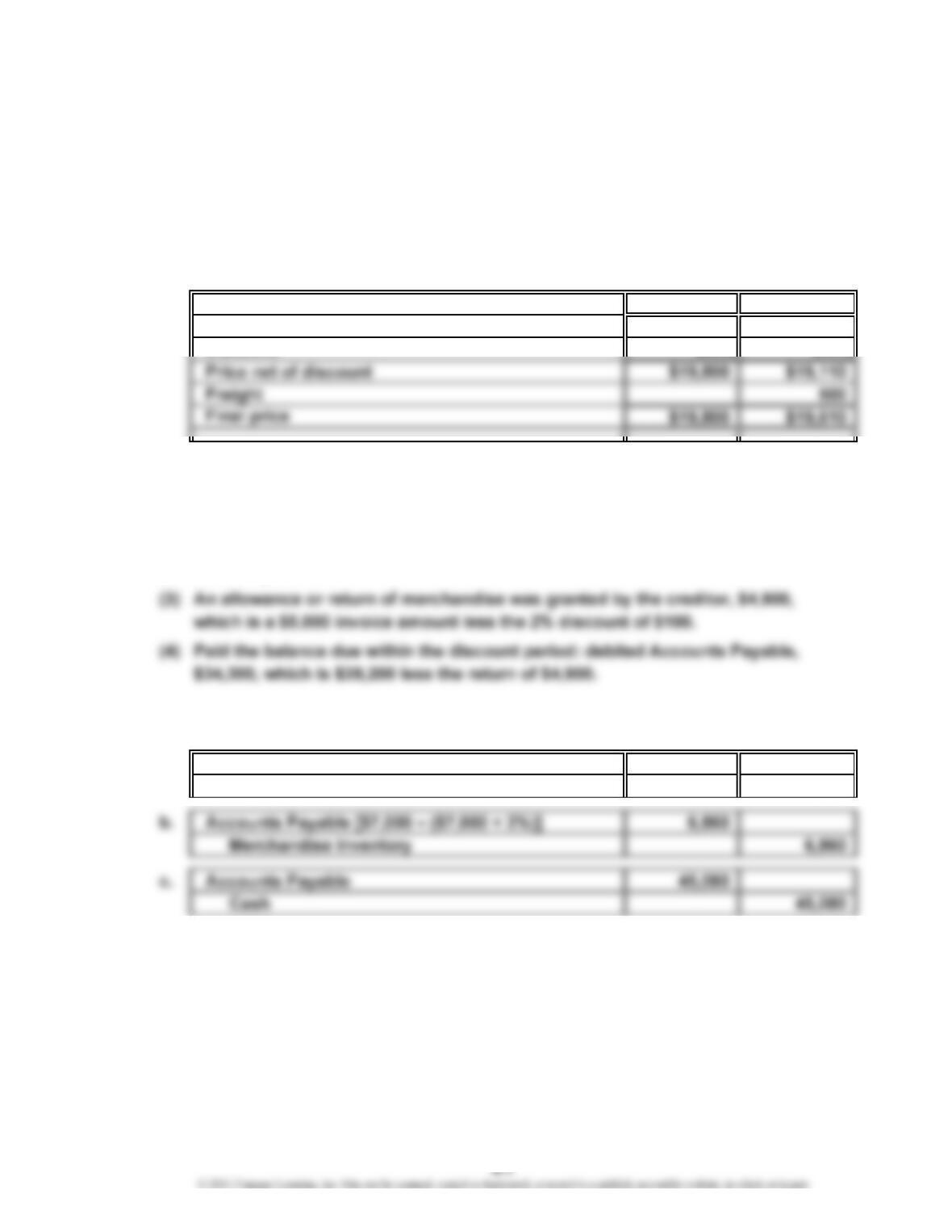
The offer of Supplier Two is lower than the offer of Supplier One. Details are as follows:
Supplier One Supplier Two
List price $20,000 $19,500
Ex. 6-6
(1) Purchased merchandise on account at a cost of $39,200, which is $40,000 less
the 2% discount of $800.
(2) Paid freight, $450.
Ex. 6-7
a. Merchandise Inventory [$53,000 – ($53,000 × 2%)] 51,940
Accounts Payable 51,940
CHAPTER 6 Accounting for Merchandising Businesses
Ex. 6-8
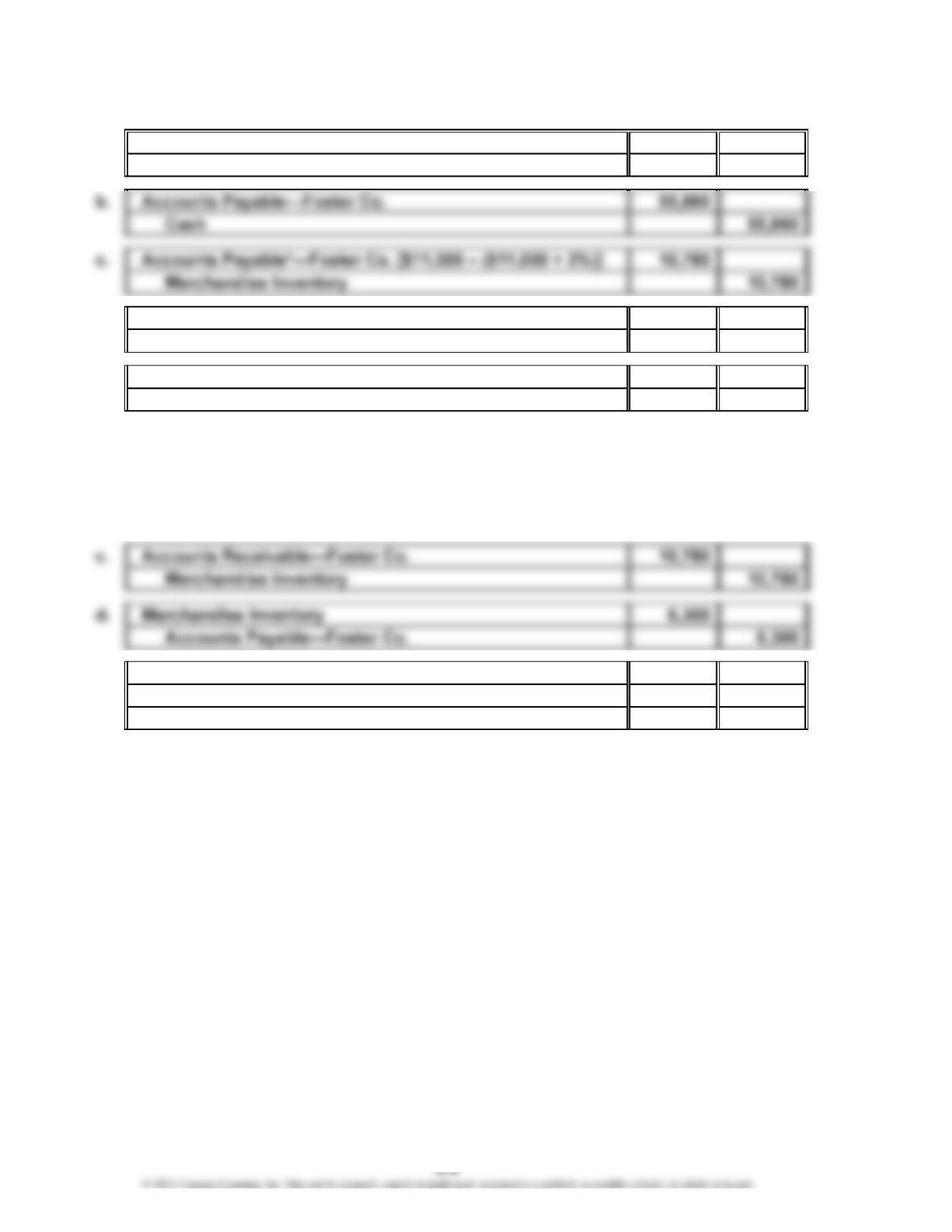
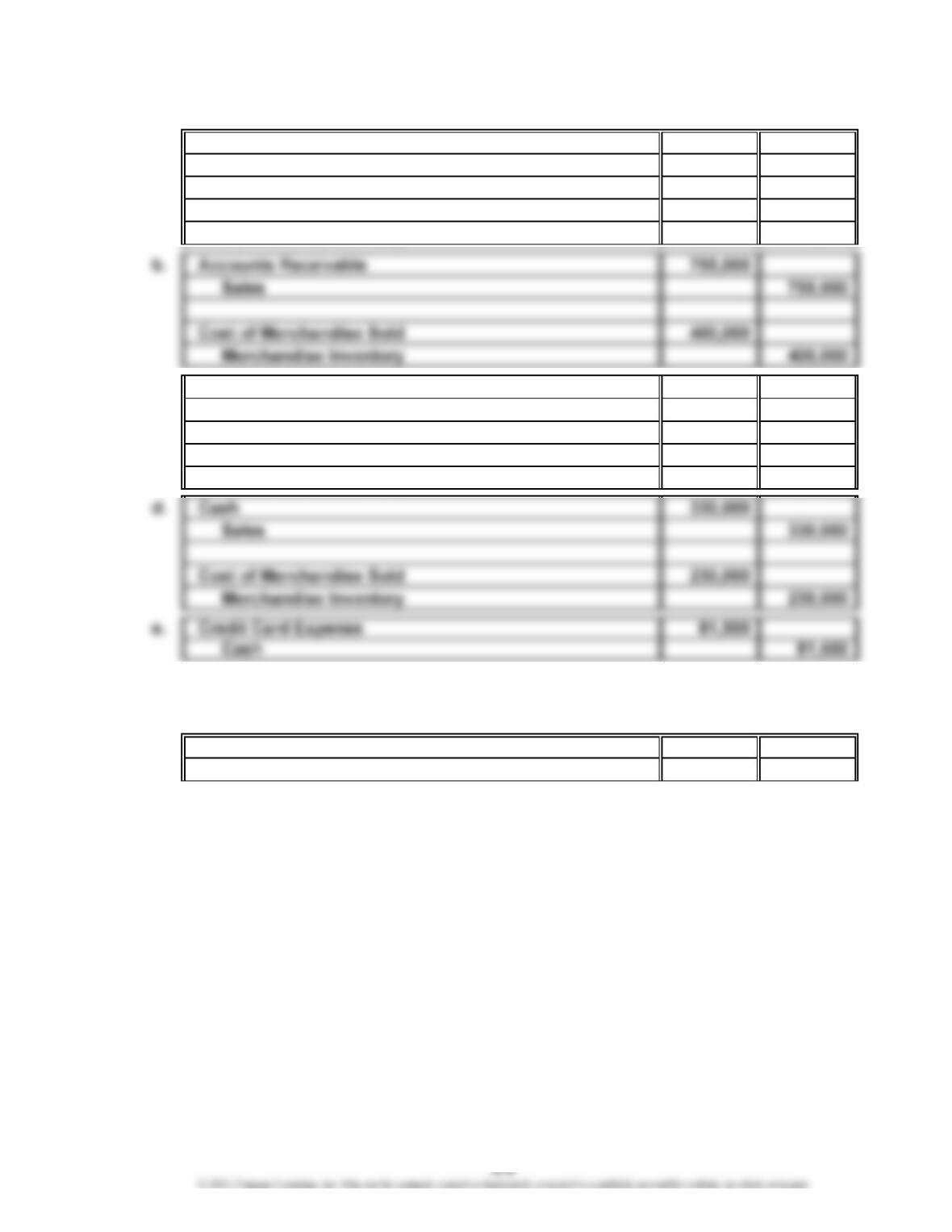
a. Merchandise Inventory [$57,000 – ($57,000 × 2%)] 55,860
Accounts Payable—Foster Co. 55,860
d. Merchandise Inventory 6,300
Accounts Payable—Foster Co. 6,300
e. Cash 4,480
Accounts Payable—Foster Co. 4,480
*Note: The debit of $10,780 to Accounts Payable in entry (c) is the amount of refund due from
Foster Co. It is computed as the amount that was paid for the returned merchandise, $11,000,
less the purchase discount of $220 ($11,000 × 2%). The credit to Accounts Payable of $6,300
in entry (d) reduces the debit balance in the account payable to $4,480, which is the amount of
the cash refund in entry (e). The alternative entries below yield the same final results.
e. Cash 4,480
Accounts Payable—Foster Co. 6,300
Accounts Receivable—Foster Co. 10,780
CHAPTER 6 Accounting for Merchandising Businesses
Ex. 6-9
a. Cash 116,300
Sales 116,300
Cost of Merchandise Sold 72,000
Merchandise Inventory 72,000
c. Cash 1,950,000
Sales 1,950,000
Cost of Merchandise Sold 1,250,000
Merchandise Inventory 1,250,000
Ex. 6-10
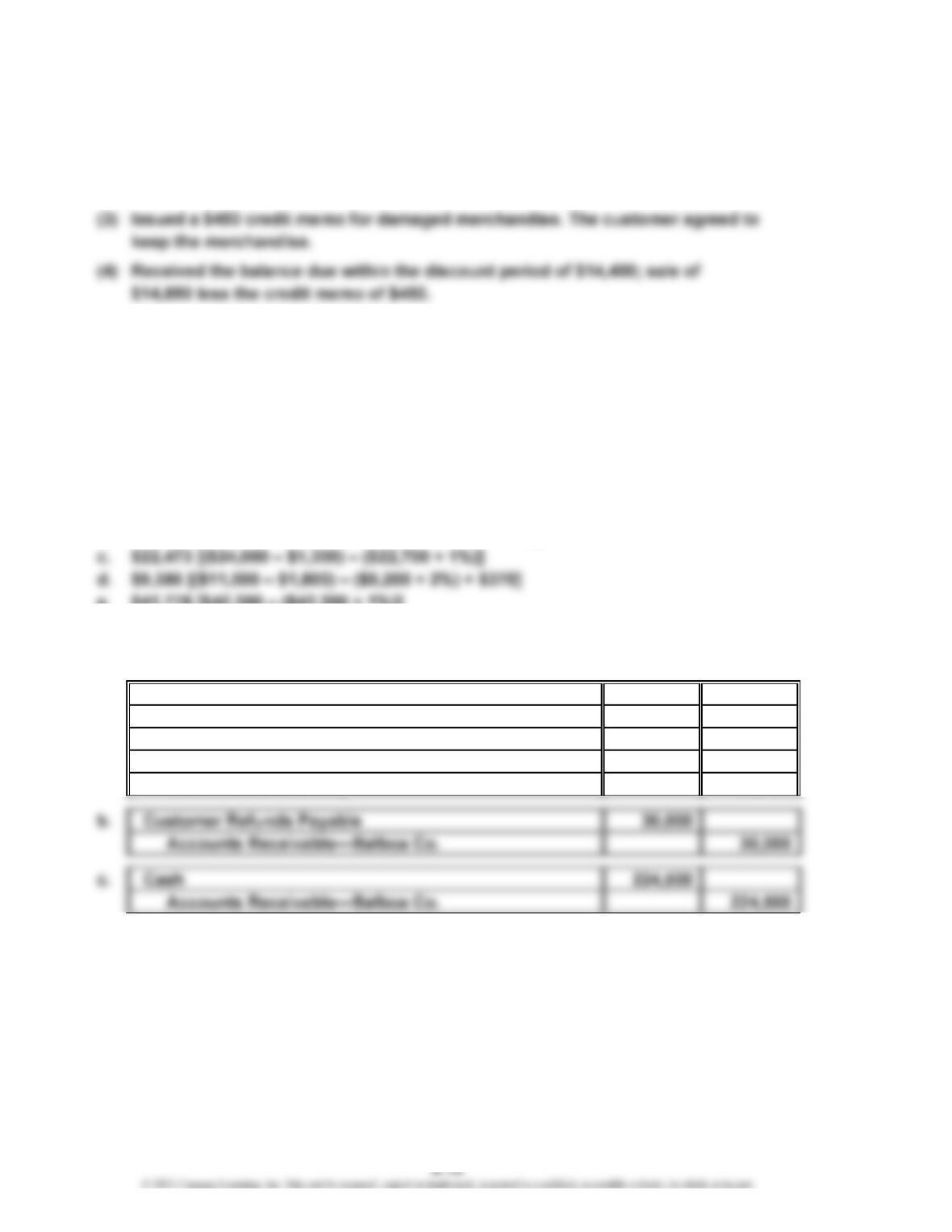
Customer Refunds Payable 3,000
Cash 3,000
CHAPTER 6 Accounting for Merchandising Businesses
Ex. 6-11
(1) Sold merchandise on account for $14,850, $15,000 less discount of 1%.
(2) Recorded the cost of the merchandise sold and reduced the merchandise
inventory account, $8,800.
Ex. 6-12
a. $55,370 [$56,500 – ($56,500 × 2%)]
b. $57,470 ($55,370 + $2,100)
c.
Ex. 6-13
a. $15,700 ($20,500 – $4,800)
b. $25,256 [($31,100 – $5,900) – ($25,200 × 2%) + $560]
e. $41,778 [$42,200 – ($42,200 × 1%)]
Ex. 6-14
a. Accounts Receivable—Balboa Co. 254,500
Sales 254,500
Cost of Merchandise Sold 152,700
Merchandise Inventory 152,700
$57,470
CHAPTER 6 Accounting for Merchandising Businesses
Ex. 6-15
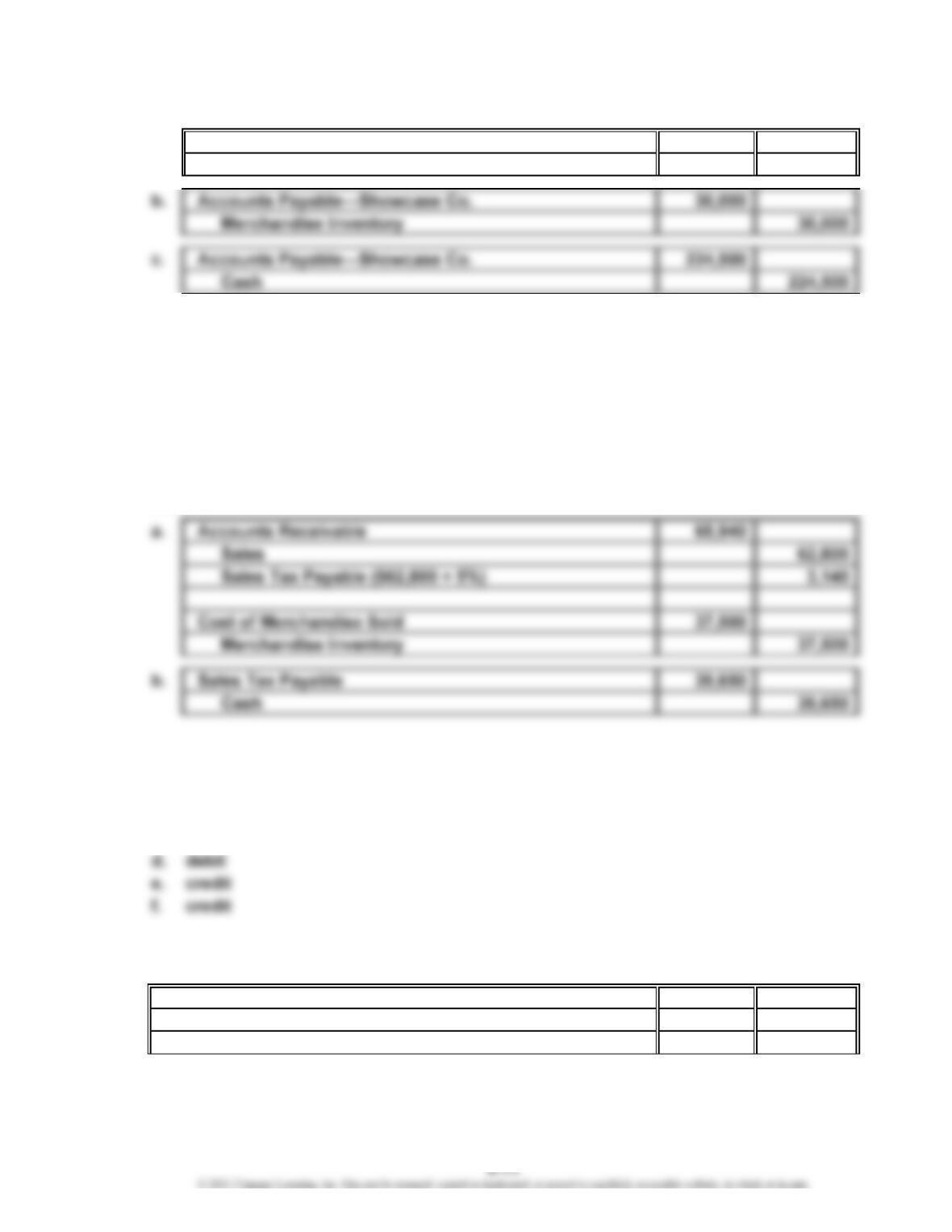
a. Merchandise Inventory 254,500
Accounts Payable—Showcase Co. 254,500
Ex. 6-16
a. At the time of sale
b. $36,000
c. $38,880 [$36,000 + ($36,000 × 8%)]
d. Sales Tax Payable
Ex. 6-17
Ex. 6-18
a. debit
b. credit
c. debit
Ex. 6-19
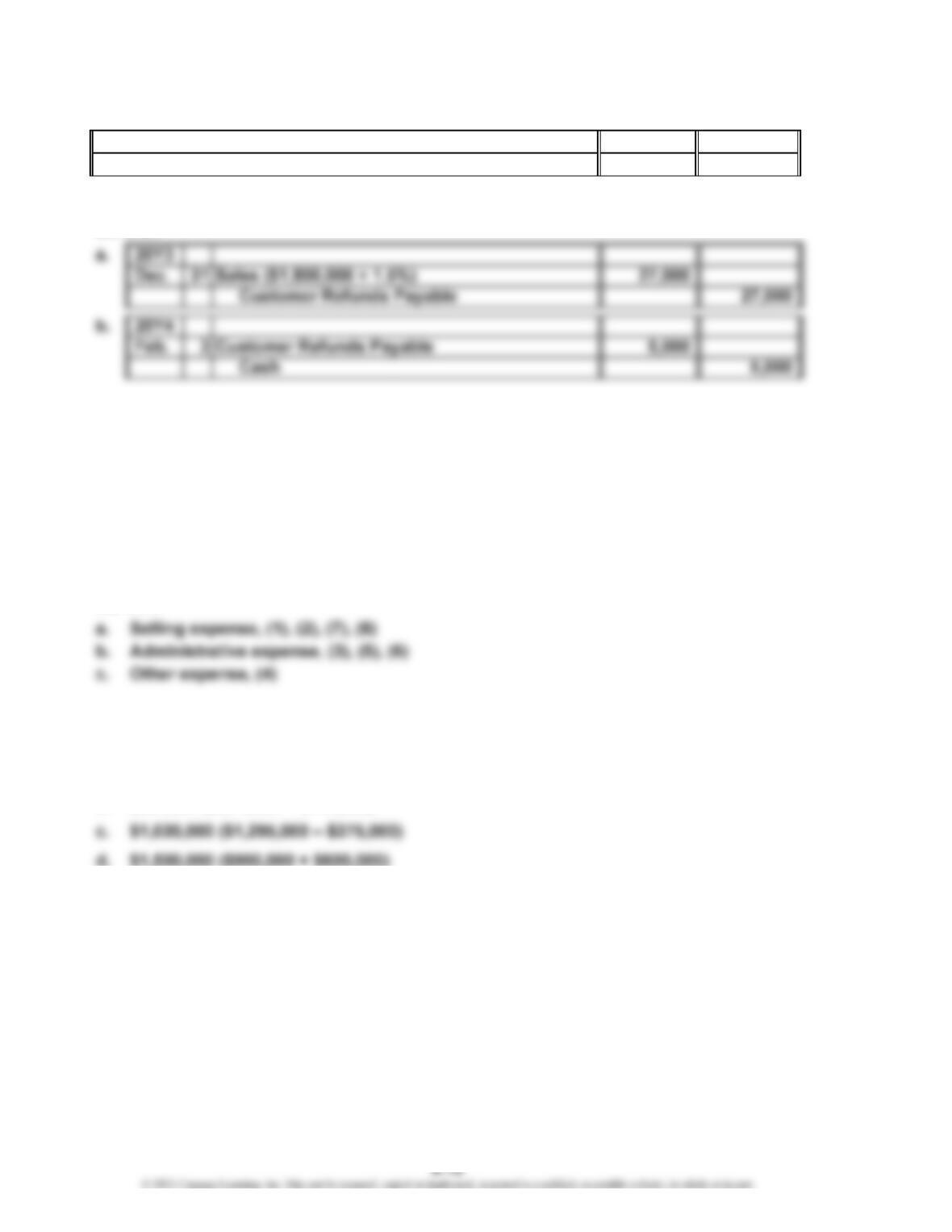
Cost of Merchandise Sold 45,200
Merchandise Inventory 45,200
Inventory shrinkage ($2,780,000 – $2,734,800).
CHAPTER 6 Accounting for Merchandising Businesses
Ex. 6-20
Sales ($51,600,000 × 1.2%) 619,200
Customer Refunds Payable 619,200
Ex. 6-21
Ex. 6-22
a. Gross profit: $76,550,000 ($191,350,000 – $114,800,000)
b. No. There could be other revenue and expense items that affect the amount
of net income.
c. Customer Refunds Payable is a liability account with a normal credit balance.
Ex. 6-23
Ex. 6-24
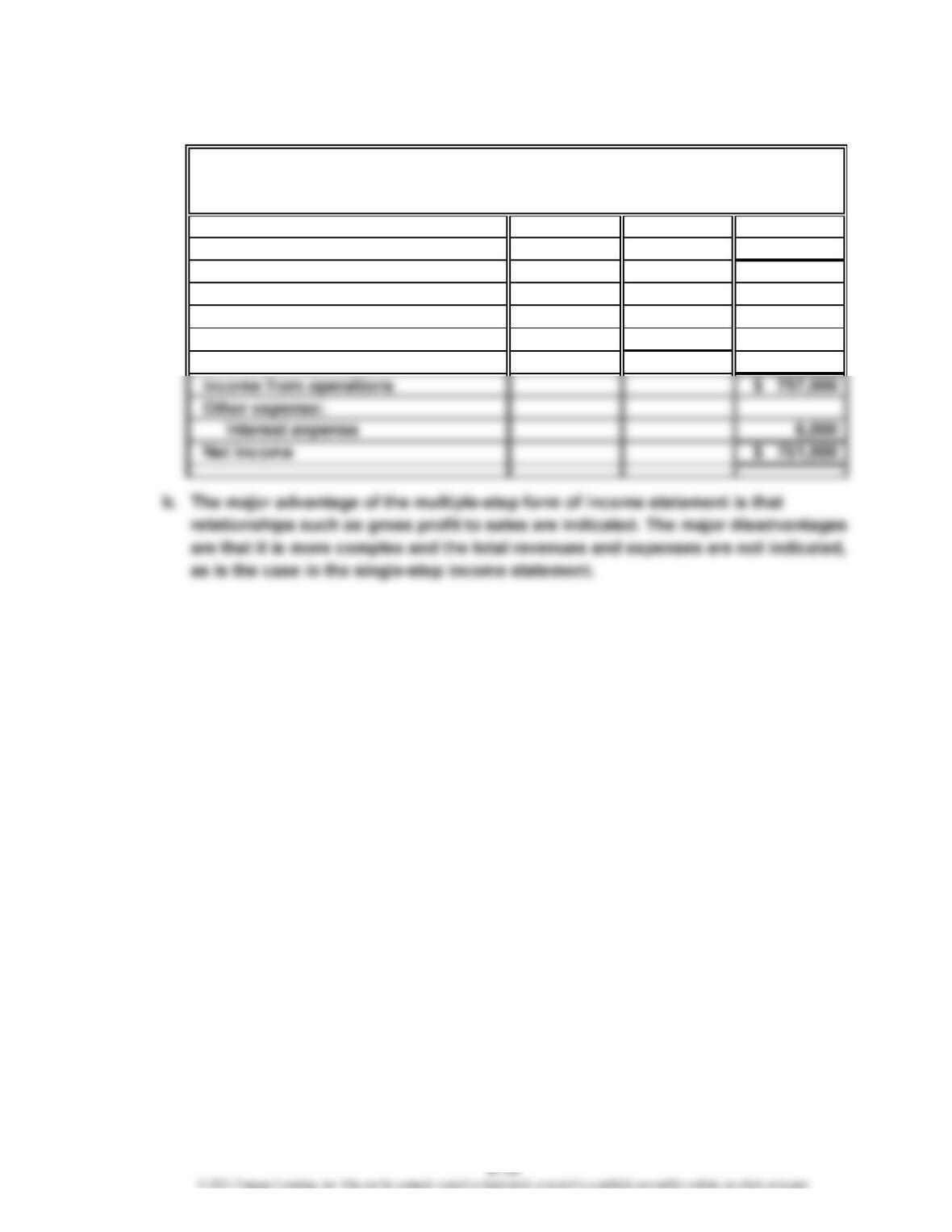
a. $379,900 ($463,400 – $83,500)
b. $687,500 ($277,500 + $410,000)
d. $1,500,000 ($900,000 + $600,000)
CHAPTER 6 Accounting for Merchandising Businesses
Ex. 6-25
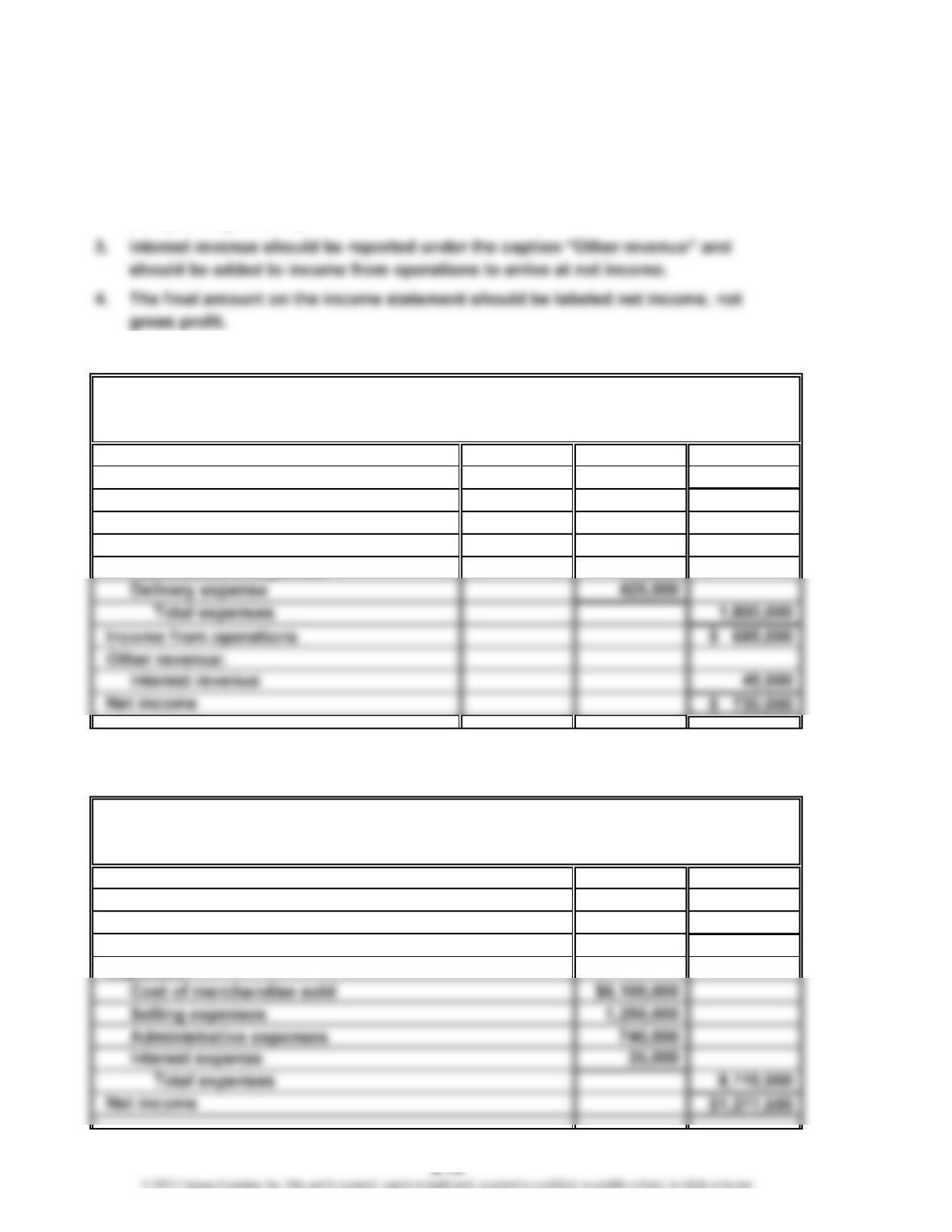
a.
Sales $3,582,000
Cost of merchandise sold 2,123,000
Gross profit $1,459,000
Expenses:
Selling expenses $400,000
Administrative expenses 302,000
Total expenses 702,000
Danns Furnishings Company
Income Statement
For the Year Ended March 31, 20Y4
CHAPTER 6 Accounting for Merchandising Businesses
Ex. 6-26
1. Deducting the cost of merchandise sold from sales yields gross profit (not income
from operations).
2. Deducting the total expenses from gross profit yields income from operations
(or operating income).
A corrected income statement is as follows:
Sales $8,595,000
Cost of merchandise sold 6,110,000
Gross profit $2,485,000
Expenses:
Selling expenses $800,000
Administrative expenses 575,000
Ex. 6-27
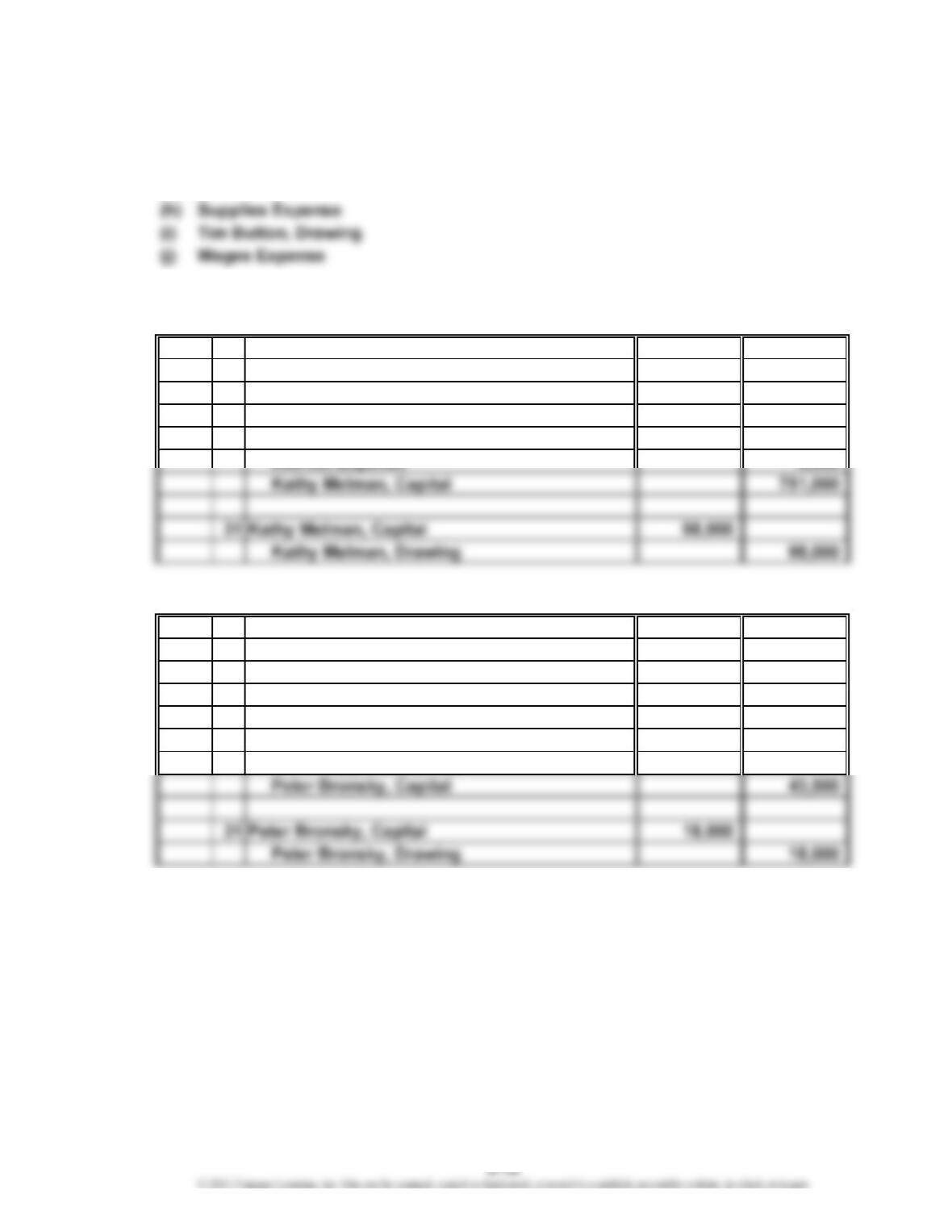
Revenues:
Sales $9,332,500
Rent revenue 60,000
Total revenues $9,392,500
Custom Wire & Tubing Company
Income Statement
For the Year Ended April 30, 20Y6
Curbstone Company
Income Statement
For the Year Ended August 31, 20Y5
CHAPTER 6 Accounting for Merchandising Businesses
Ex. 6-28
(b) Cost of Merchandise Sold
(d) Delivery Expense
(f) Sales
Ex. 6-29
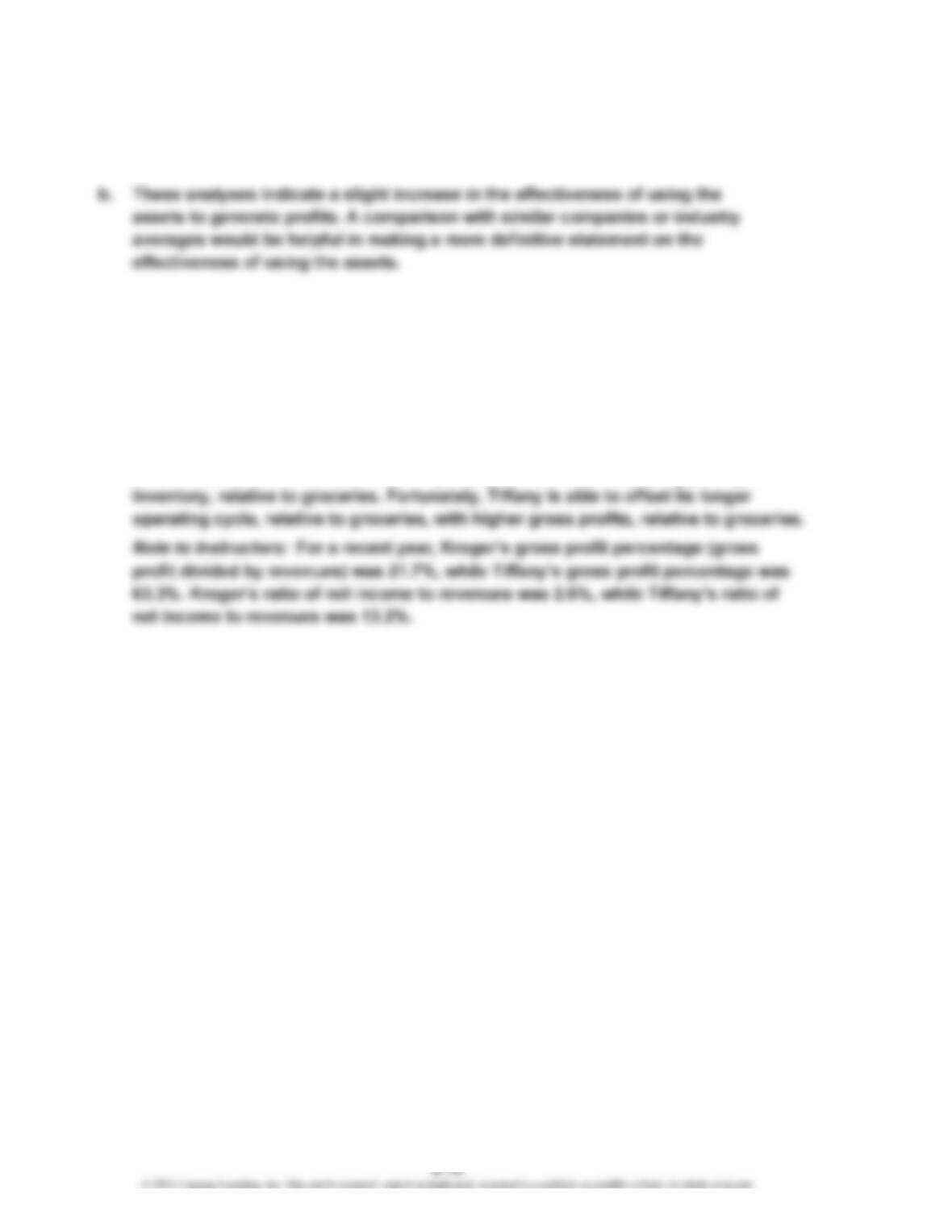
20Y4
Mar. 31 Sales 3,582,000
Cost of Merchandise Sold 2,123,000
Selling Expenses 400,000
Administrative Expenses 302,000
Ex. 6-30
20Y7
July 31 Sales 1,745,000
Administrative Expenses 534,000
Cost of Merchandise Sold 941,000
Interest Expense 7,000
Selling Expenses 194,000
Store Supplies Expense 25,500
Closing Entries
Closing Entries
CHAPTER 6 Accounting for Merchandising Businesses
Ex. 6-31
a. Year 2: 2.44 {$108,203 ÷ [($44,003 + $44,529) ÷ 2]}
Year 1: 2.31 {$100,904 ÷ [($44,529 + $42,966) ÷ 2]}
Ex. 6-32
a. 3.22 {$121,162 ÷ [($38,118 + $37,197) ÷ 2]}
b. Although Kroger and Tiffany are both retail stores, Tiffany sells jewelry using a
much longer operating cycle than Kroger uses selling groceries. Thus, Kroger is
able to generate $3.22 of sales for every dollar of assets. Tiffany, however, is only
able to generate $0.82 in sales per dollar of assets. This difference is reasonable
when one considers the sales rate for jewelry and the cost of holding jewelry
CHAPTER 6 Accounting for Merchandising Businesses
Appendix 1 Ex. 6-33
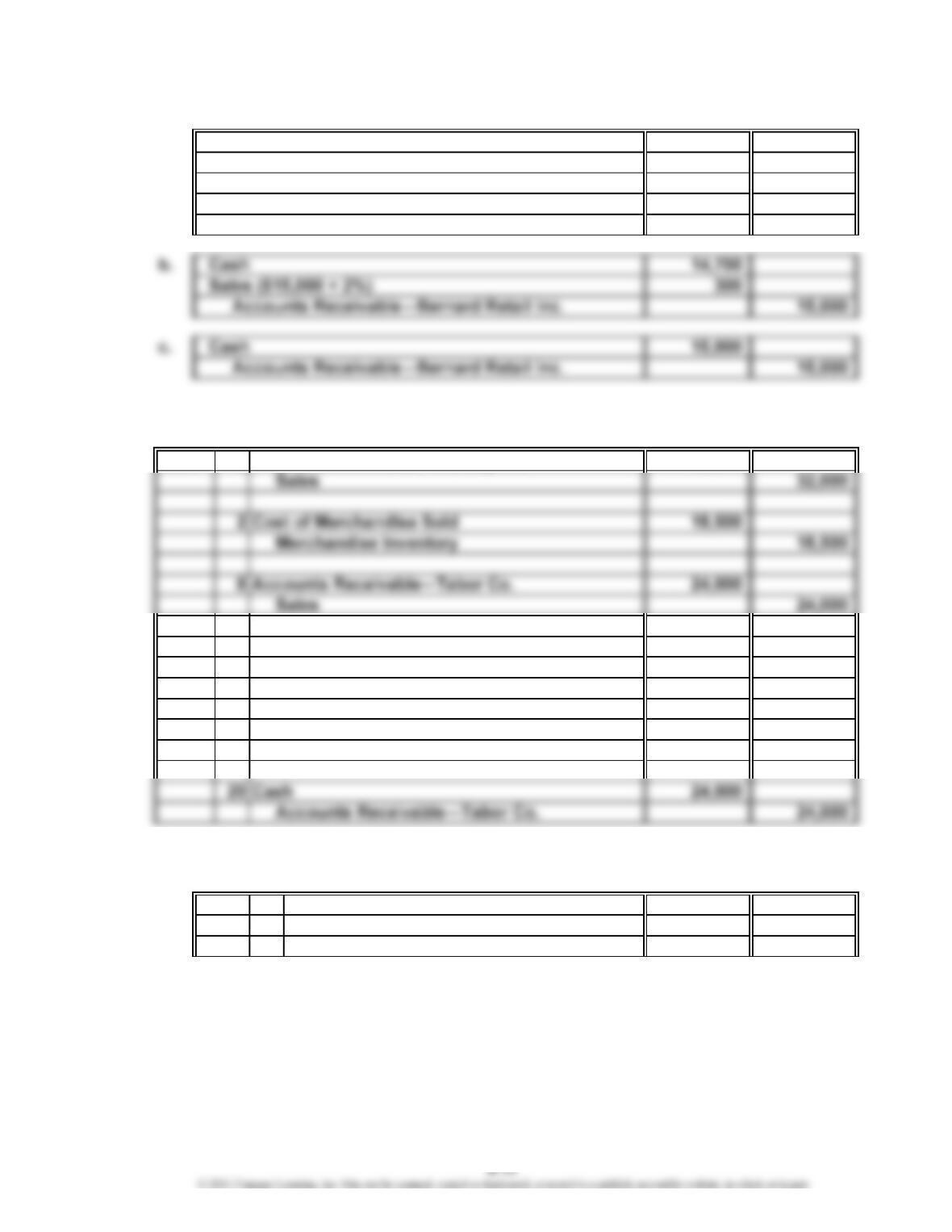
a. Accounts Receivable—Bernard Retail Inc. 15,000
Sales 15,000
Cost of Merchandise Sold 8,000
Merchandise Inventory 8,000
Appendix 1 Ex. 6-34
Mar. 2 Accounts Receivable—Parsley Co. 32,000
8 Cost of Merchandise Sold 14,400
Merchandise Inventory 14,400
11 Cash 31,680
Sales ($32,000 × 1%) 320
Accounts Receivable—Parsley Co. 32,000
Appendix 1 Ex. 6-35
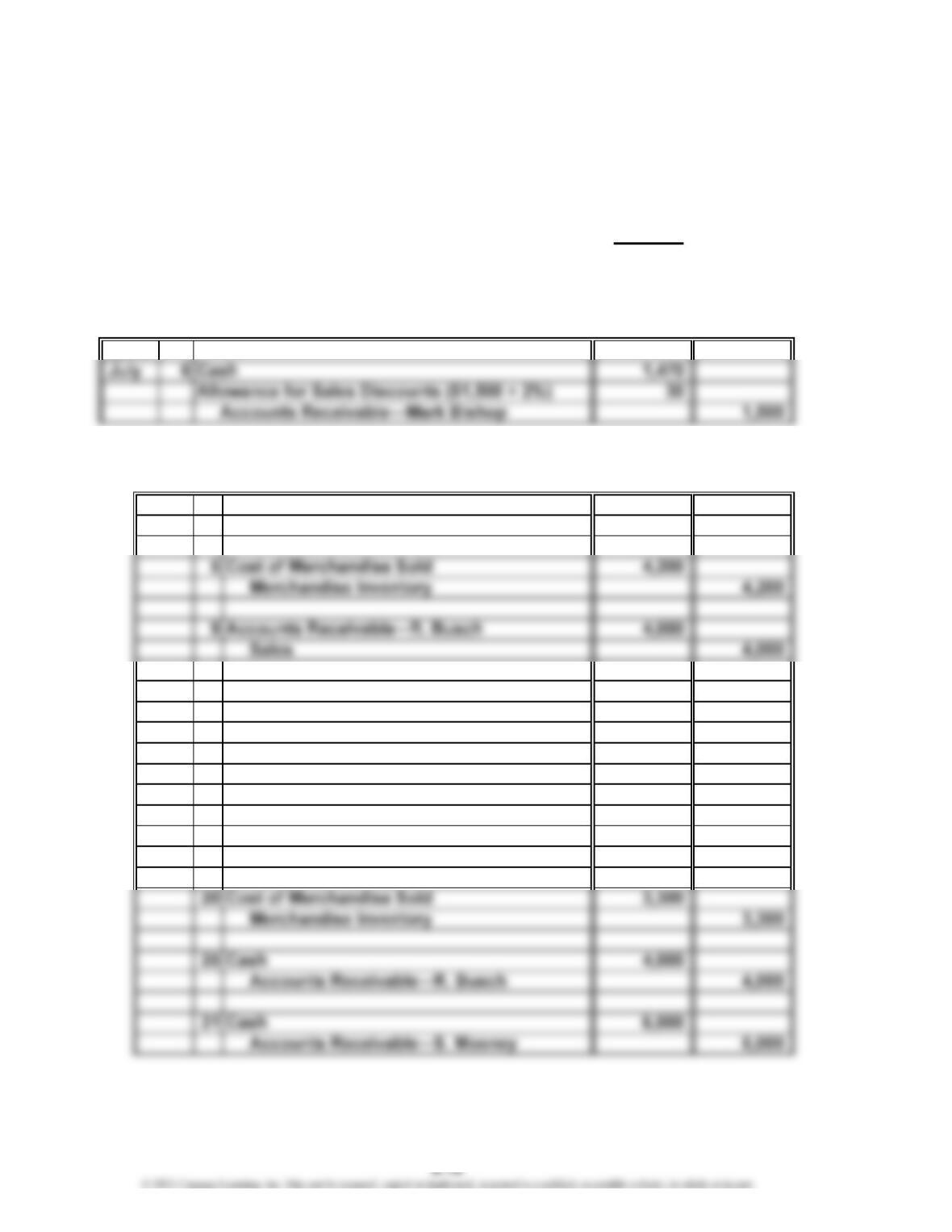
a. 20Y4
June 30 Sales 7,000
Allowance for Sales Discounts 7,000
CHAPTER 6 Accounting for Merchandising Businesses
Appendix 1 Ex. 6-35 (Concluded)
b. Sales would be reported as $9,993,000 ($10,000,000 − $7,000) on the income
statement. Accounts receivable would be reported as a current asset on the
balance sheet as follows:
Accounts receivable $850,000
Less allowance for sales discounts 7,400
Net accounts receivable $842,600
Appendix 1 Ex. 6-36
20Y4
Appendix 1 Ex. 6-37
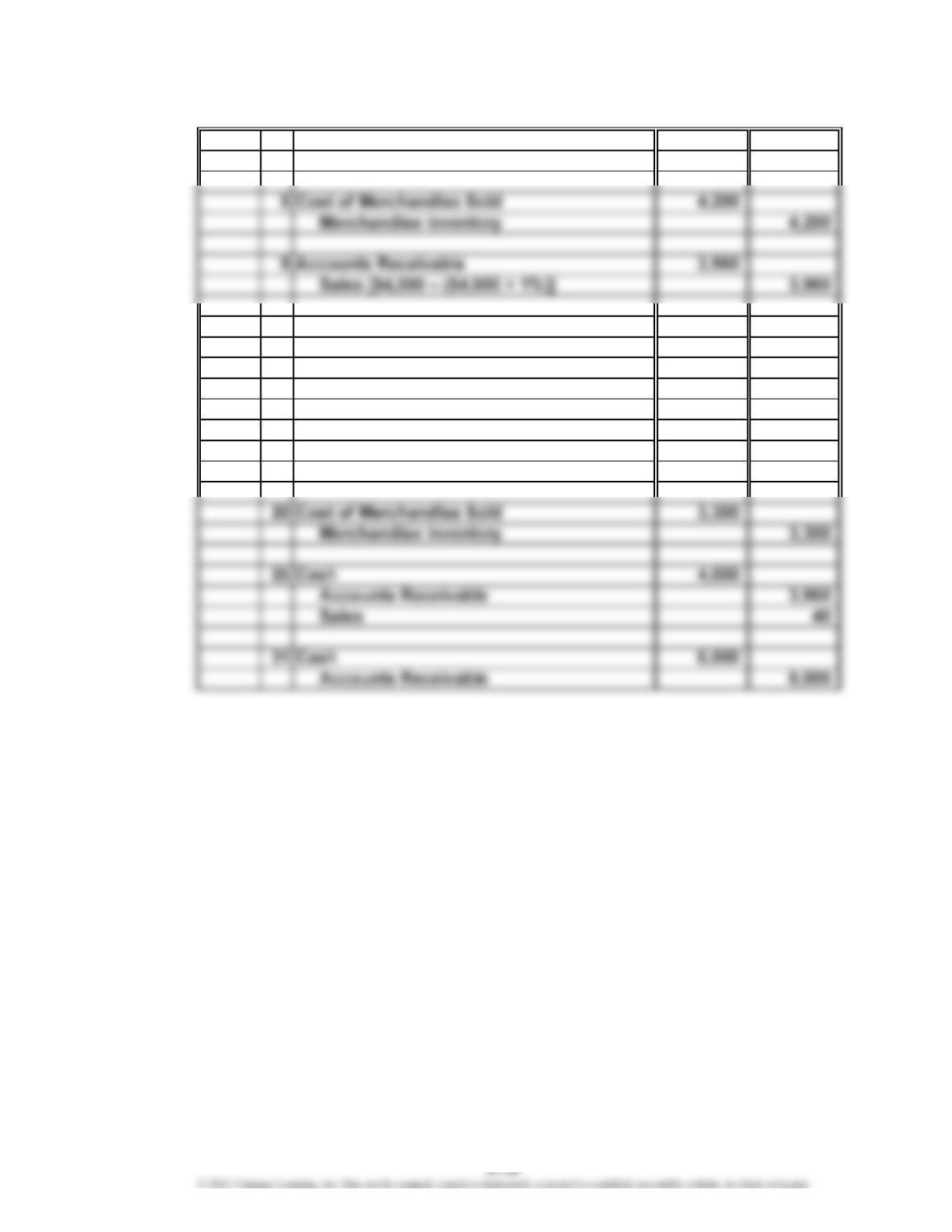
a. Aug. 5 Accounts Receivable—M. Quinn 7,500
Sales 7,500
9 Cost of Merchandise Sold 2,100
Merchandise Inventory 2,100
15 Cash 7,350
Sales ($7,500 × 2%) 150
Accounts Receivable—M. Quinn 7,500
20 Accounts Receivable—S. Mooney 6,000
Sales 6,000
CHAPTER 6 Accounting for Merchandising Businesses
Appendix 1 Ex. 6-37 (Concluded)
b. Aug. 5 Accounts Receivable 7,350
Sales [$7,500 – ($7,500 × 2%)] 7,350
9 Cost of Merchandise Sold 2,100
Merchandise Inventory 2,100
15 Cash 7,350
Accounts Receivable 7,350
20 Accounts Receivable 6,000
Sales 6,000
c. Gross method: $17,350 ($7,500 + $4,000 − $150 + $6,000)
Net method: $17,350 ($7,350 + $3,960 + $6,000 + $40)
d. The gross method requires an end-of-period adjusting entry.
CHAPTER 6 Accounting for Merchandising Businesses
Appendix 2 Ex. 6-38
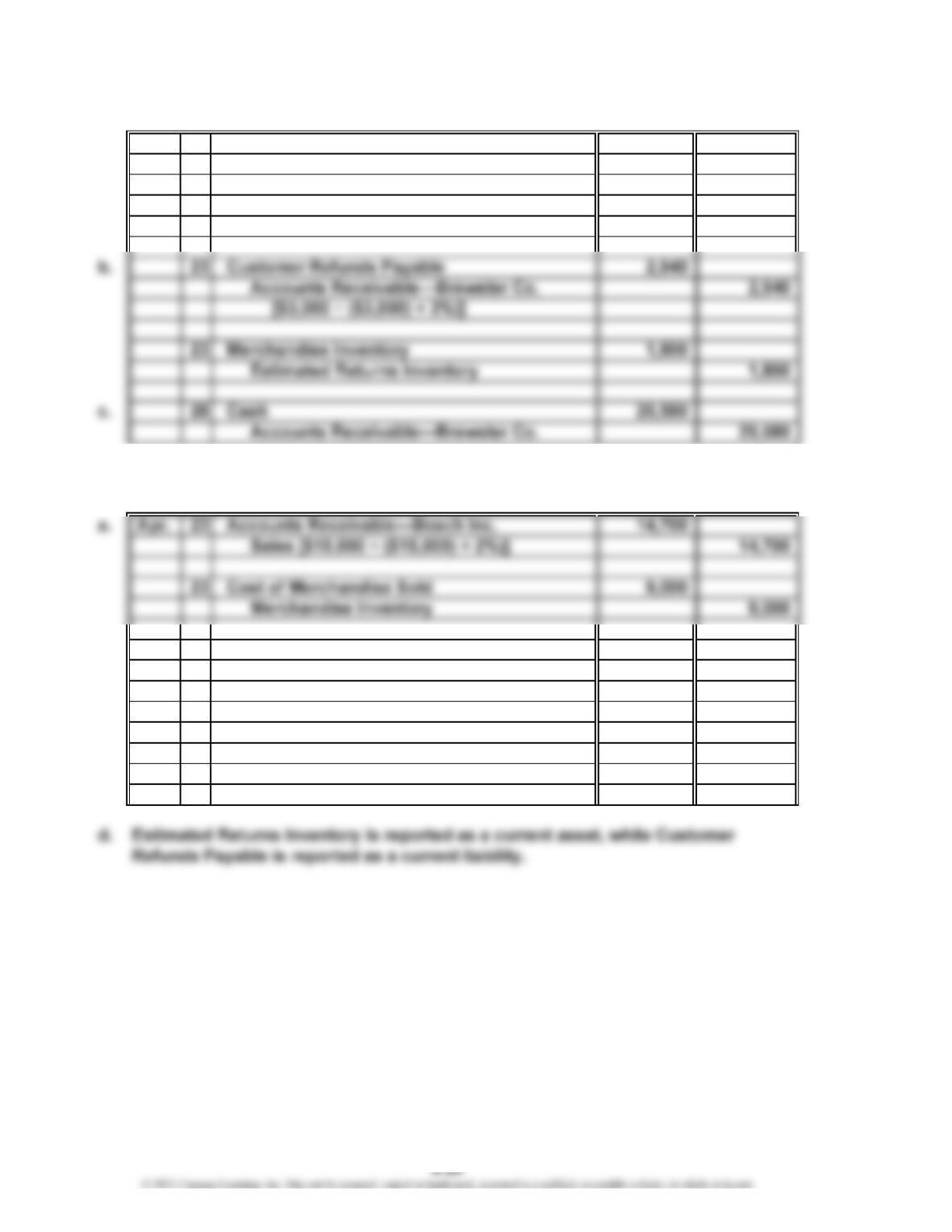
a. Feb. 18 Accounts Receivable—Brewster Co. 23,520
Sales [$24,000 − ($24,000) × 2%)] 23,520
18 Cost of Merchandise Sold 12,200
Merchandise Inventory 12,200
Appendix 2 Ex. 6-39
b. May 2 Cash 14,700
Accounts Receivable—Bosch Inc. 14,700
c. 11 Customer Refunds Payable 2,450
Cash 2,450
11 Merchandise Inventory 1,300
Estimated Returns Inventory 1,300