6-41
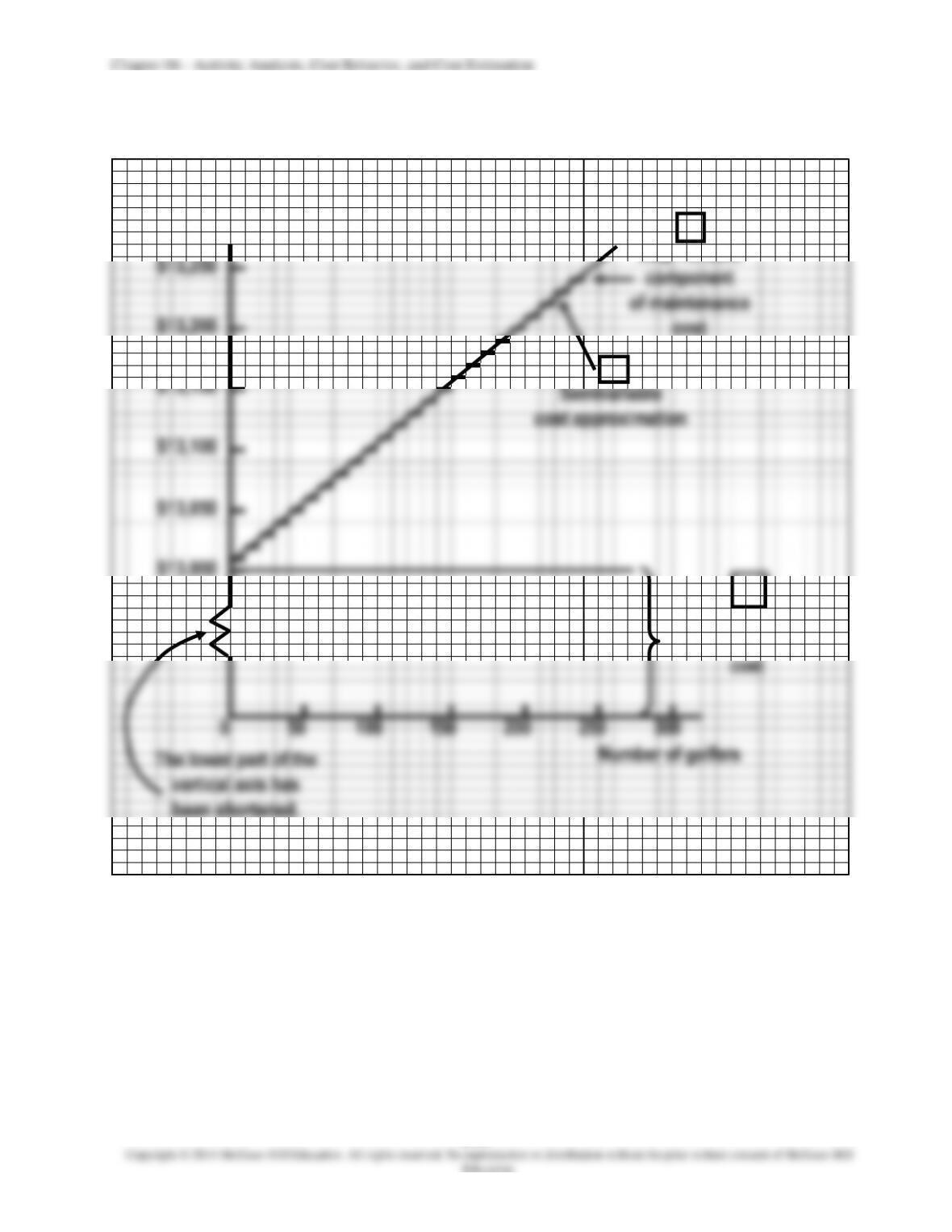
PROBLEM 6-42 (40 MINUTES)
Total course maintenance cost
1.
Fixed component
of maintenance
2.
1.
Step-variable
6-42
PROBLEM 6-42 (CONTINUED)
3.
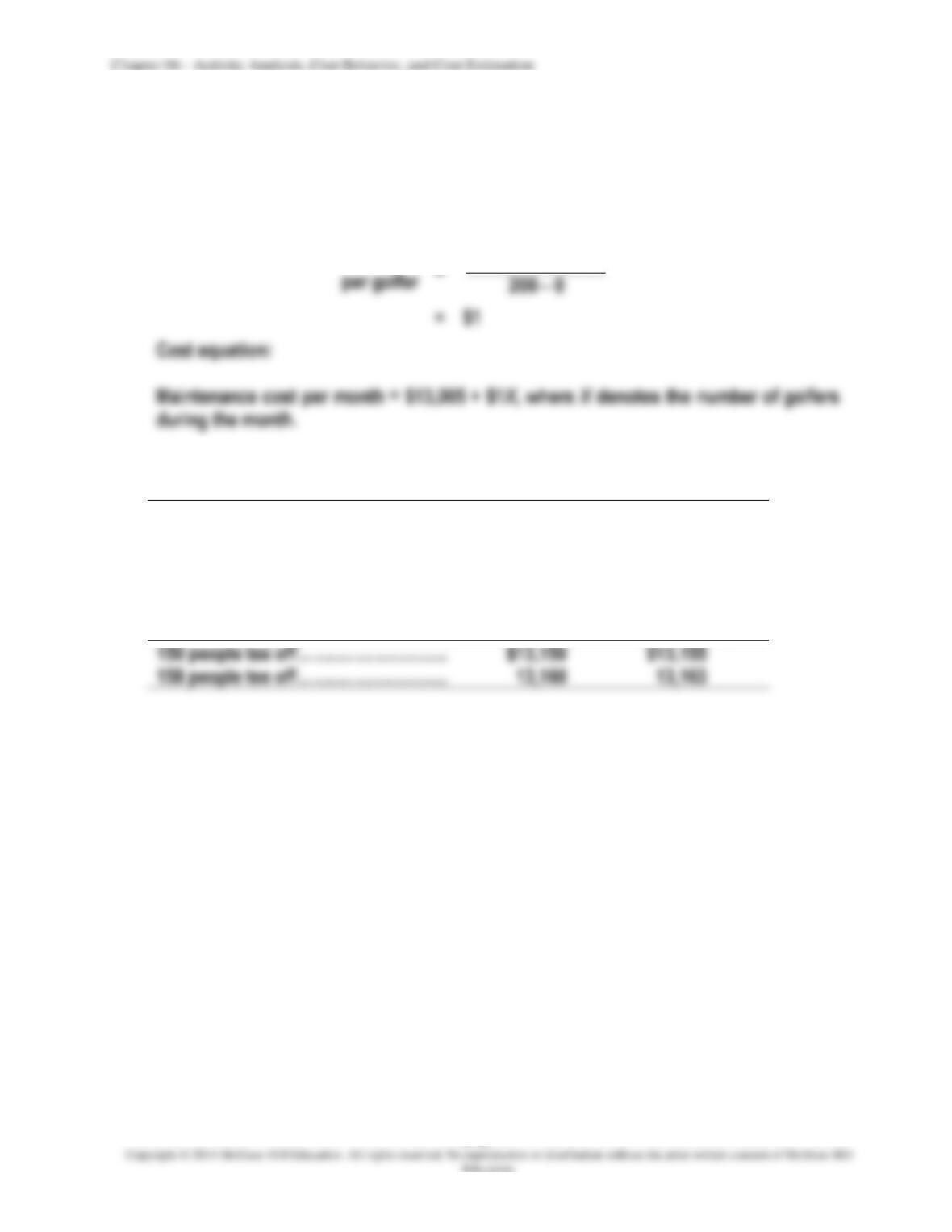
Fixed-cost component = $13,005
Variable-cost component:
=
$1
Cost equation:
Variable cost
$13,005 $13,205
−
4.
Predicted Course Maintenance Costs
Using Fixed
Cost Coupled
with Step-
Variable Cost
Behavior
Pattern
Using
Semivariable Cost
Approximation
150 people tee off …………………………..
158 people tee off …………………………..
6-43
PROBLEM 6-43 (35 MINUTES)
1.
incurred.
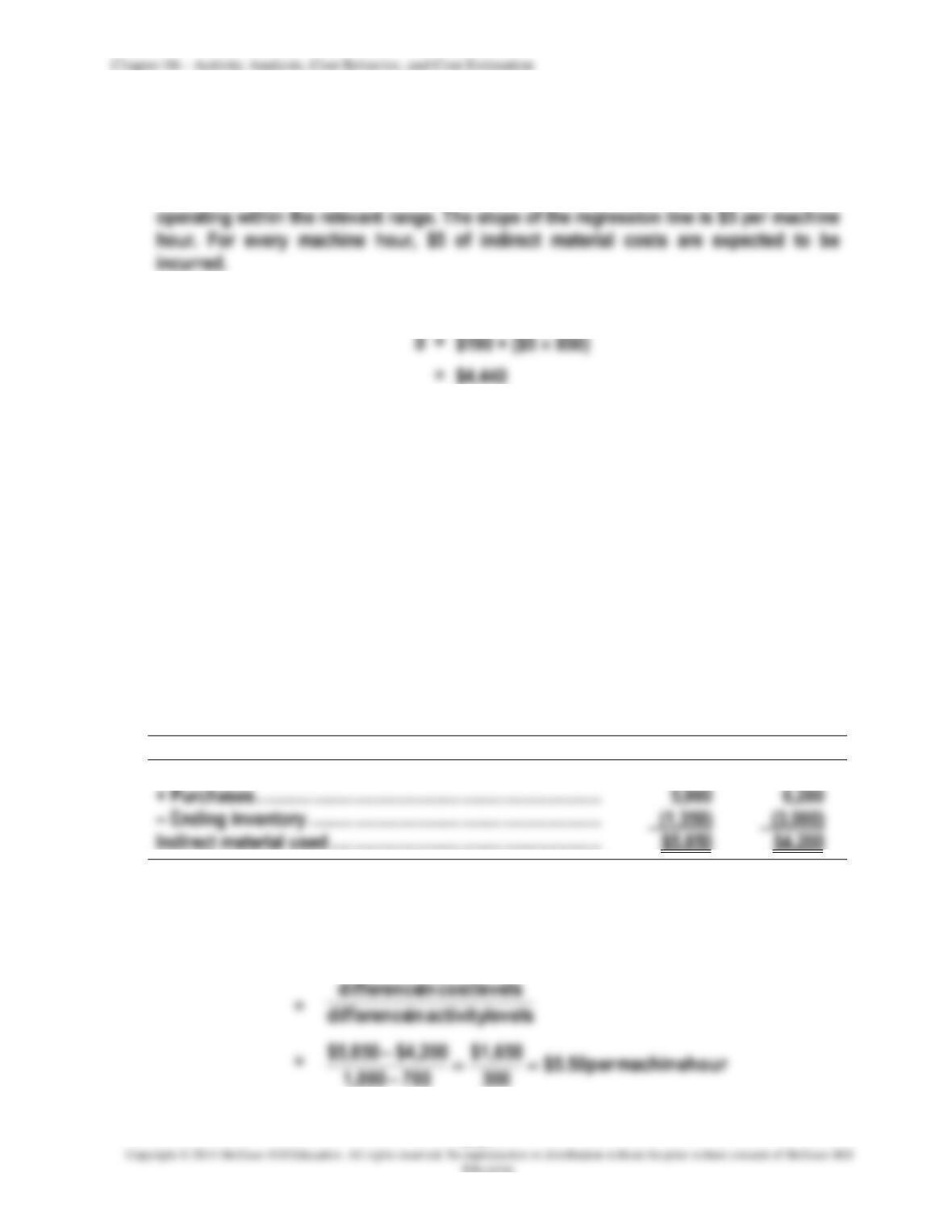
The regression equation’s intercept on the vertical axis is $190. It represents the
portion of indirect material cost that does not vary with machine hours when
2.
Estimated cost of indirect material at 850 machine hours of activity:
=
$4,440
3.
Several questions should be asked:
(a)
Do the observations contain any outliers, or are they all representative of normal
operations?
(b)
Are there any mismatched time periods in the data? Are all of the indirect
material cost observations matched properly with the machine hour
observations?
(c)
Are there any allocated costs included in the indirect material cost data?
(d)
Are the cost data affected by inflation?
4.
April
August
Beginning inventory …………………………………………………….
$1,300
$1,000
+ Purchases ………………………………………………………………..
5.
High-low method:
Variable cost per machine hour
6-44
PROBLEM 6-43 (CONTINUED)
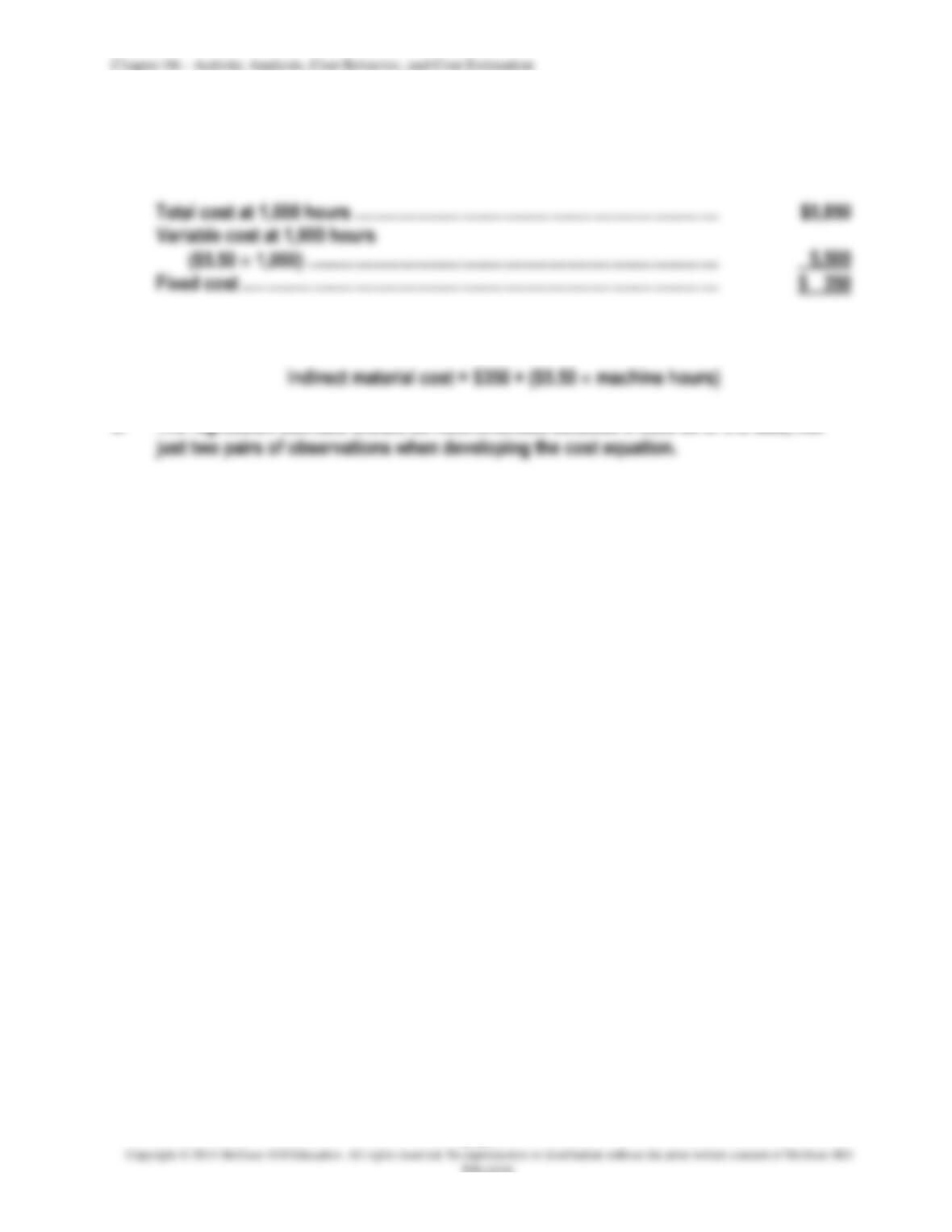
Total cost at 1,000 hours ……………………………………………………………………
Variable cost at 1,000 hours
Fixed cost …………………………………………………………………………………………
Fixed cost per month:
Equation form:
6.
The regression estimate should be recommended because it uses all of the data, not
6-45
PROBLEM 6-44 (25 MINUTES)
1. Scatter diagrams:
• Present, in graphic form, the relationship between costs and cost drivers via a plot of
Least-squares regression:
High-low method:
• Relies on only two data points (for the highest and lowest activity levels) in drawing
2. Yes. The three methods produce equations by different means. Scatter diagrams
PROBLEM 6-44 (CONTINUED)
3. These amounts represent the fixed and variable costs associated with the ticketing
5. Yes, she did err by including November data. November is not representative
6. Currently, most of the airline’s tickets are written through reservations personnel,
PROBLEM 6-45 (40 MINUTES)
1. The original method was simply the average overhead per hour for the last 12
months and did not distinguish between fixed and variable costs. Dana divided total
2. a. Based on the regression analysis, the variable cost per person for a cocktail
party is $23, calculated as follows:
b. Based on the regression analysis, the full absorption cost per person for a
cocktail party is $29, calculated as follows:
3. The minimum bid for a 250-person cocktail party would be $5,750. The amount is
6-48
PROBLEM 6-45 (CONTINUED)
4. Other factors that Dana should consider in developing a bid include the following:
6-49
PROBLEM 6-46 (45 MINUTES)
1.
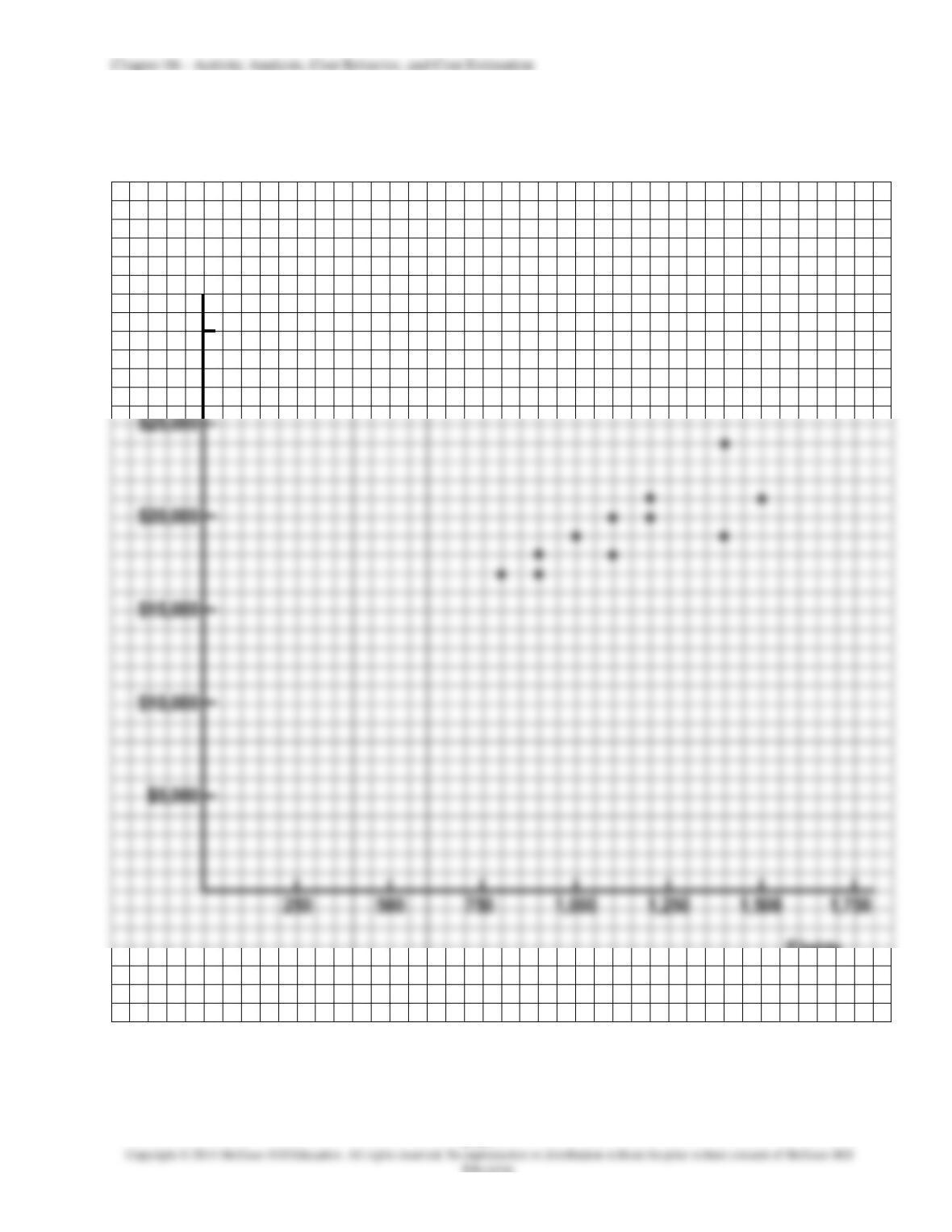
Scatter diagram:
Note: Only 11 data points appear, because two monthly observations were identical
(February and October).
Airport costs
$30,000
$25,000
$20,000
$15,000
$10,000
1,000
1,250
1,500
1,750
Flights
6-50
PROBLEM 6-46 (CONTINUED)
2. Estimation of variable- and fixed-cost components of cost behavior using least-
squares regression:
3.
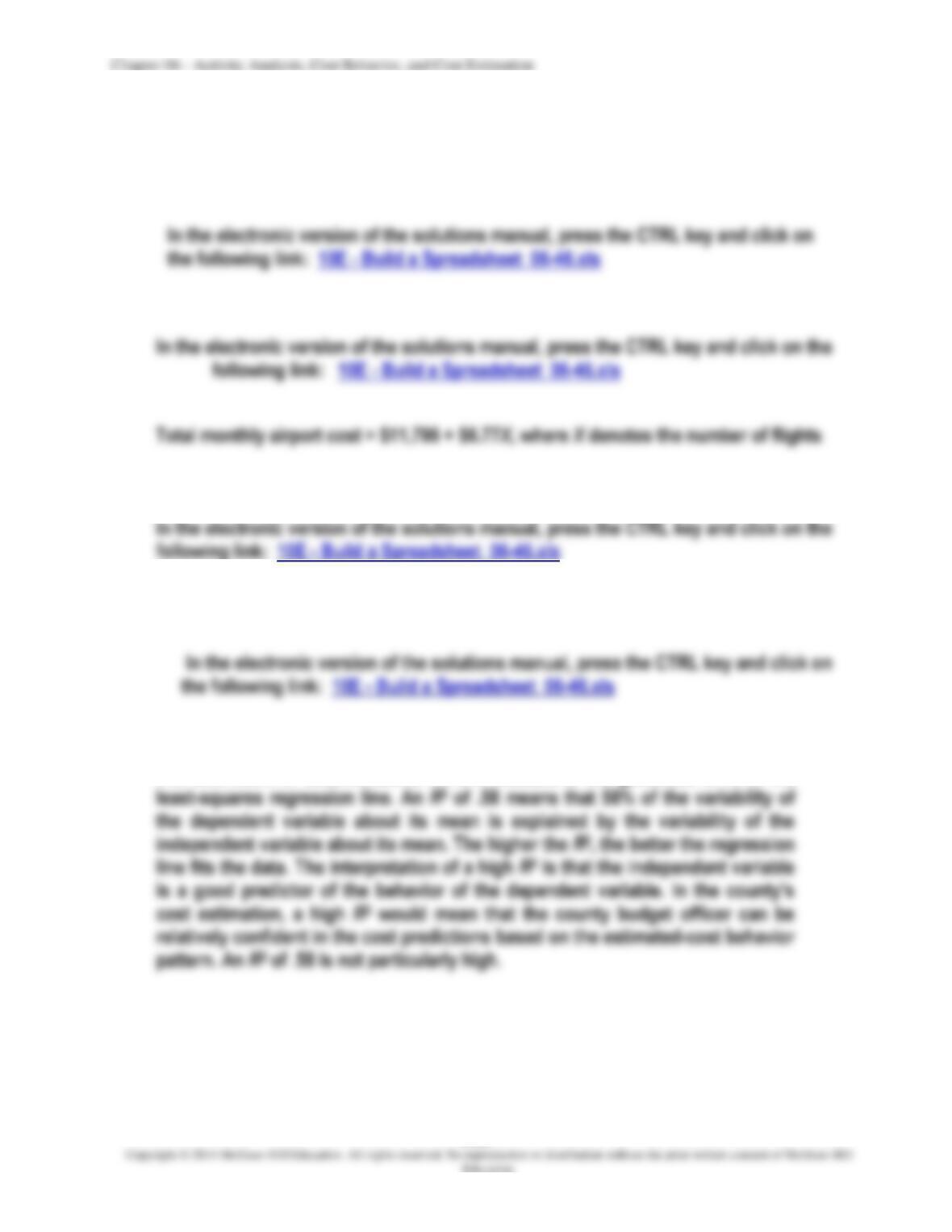
Total monthly airport cost = $11,796 + $6.77X, where X denotes the number of flights
Cost equation:
4.
Cost prediction for 1,500 flights:
5. Calculation of R2;
Interpretation of R2:
The coefficient of determination, R2, is a measure of the goodness of fit of the
6-51
PROBLEM 6-46 (CONTINUED)
The following alternative approach to calculating the regression parameters and R2 is not a
requirement in the problem.
Least-squares regression using manual calculations:
(a)
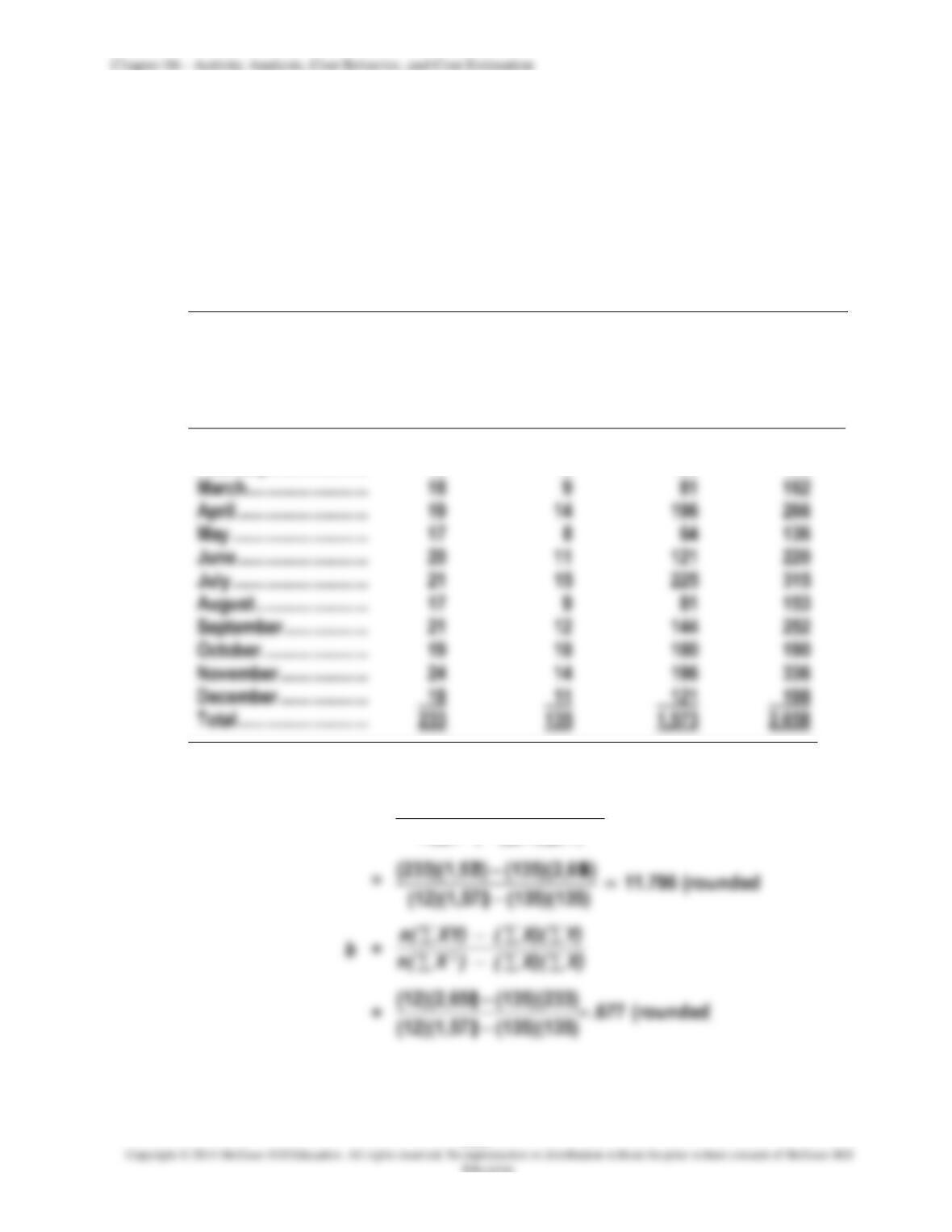
Tabulation of data:
Month
Dependent
Variable
(cost in
thousands)
Y
Independent
Variable
(flights in
hundreds)
X
X2
XY
January …………………..
20
12
144
240
February …………………
19
10
100
190
March ……………………..
18
81
162
April ……………………….
19
14
196
266
May ………………………..
17
64
136
June ……………………….
20
11
121
220
July ………………………..
August ……………………
17
81
153
September ………………
21
12
144
252
October …………………..
19
10
100
190
November ……………….
24
14
196
336
December ……………….
(b)
Calculation of parameters:
a
=
))(( )(
))(( ))((
2
2
XXXn
XYXXY
−
−