Matching
A.
Continuous flow processing
F.
Operations costing
B.
Cost management system
G.
Predetermined overhead rate
C.
Job
H.
Process costing
D.
Job costing
I.
Two-stage cost allocation
E.
Operation
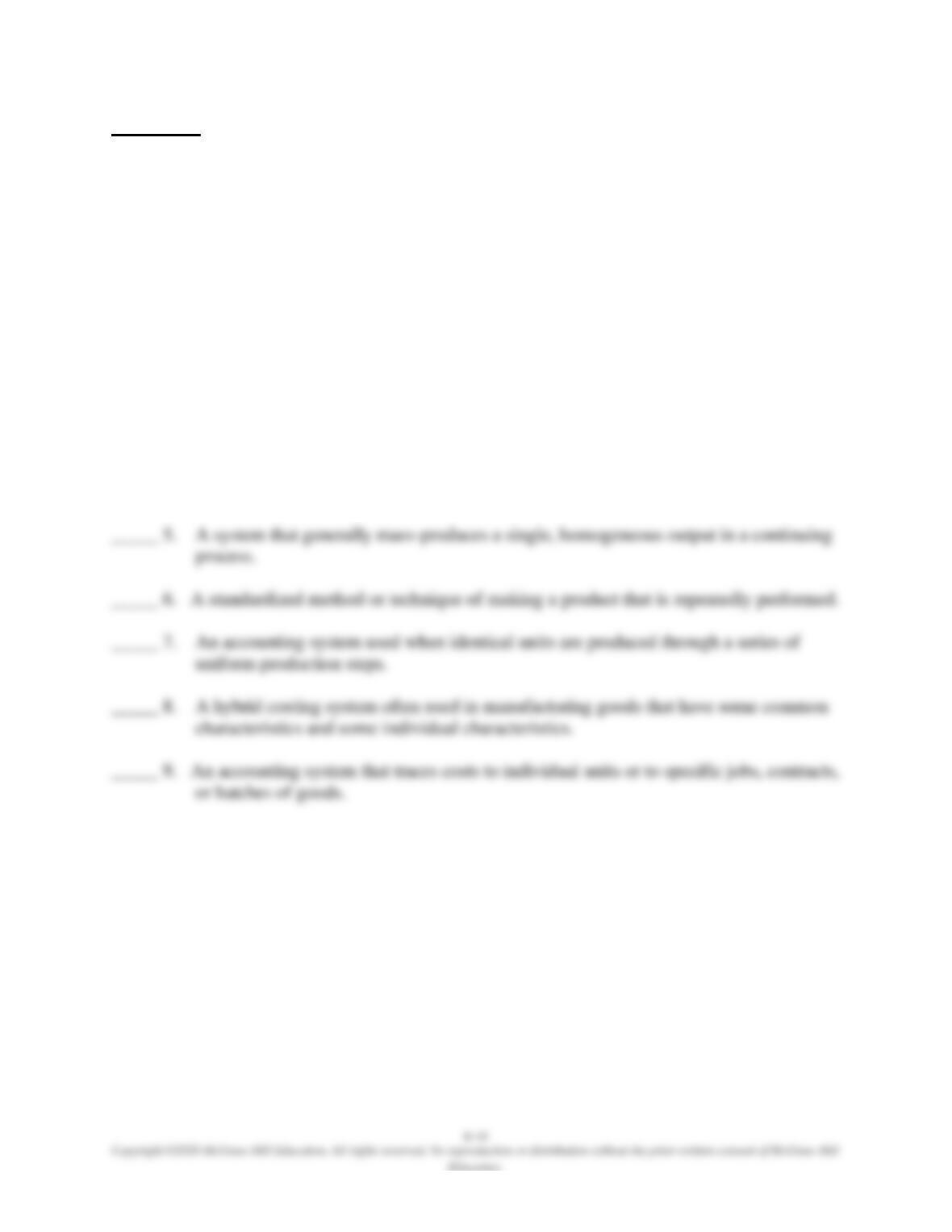
_____ 1. A system that provides information about the costs of processes, products, and
services used and produced by an organization.
_____ 2. Represents the cost per unit of the allocation base used to charge manufacturing
overhead to products and is calculated from the budgeted data.
_____ 3. The process of first allocating costs to intermediate cost pools and then to the
individual cost objects using different allocation bases.
_____ 4. Units of a product that are easily distinguishable from other units.
Matching Answers
1. B
3. I
5. A
7. H
9. D
Multiple Choice
1. Which of the following statements is correct?
2. Which of the following statements about the design of the cost systems is correct?
a. Cost systems should have a decision focus.
b. Different cost information is used for different purposes.
c. Cost information for managerial purposes must meet the cost-benefit test.
d. All of the above.
3. In June, 30,000 bushels of corn are 70% completed in the ending work-in-process inventory.
What are the equivalent units of production?
4. If the accountant decides to allocate overhead based on machine hours, what is P2’s share of
the total overhead costs?
a. $180,000
b. $200,000
c. $220,000
d. $240,000
5. If the accountant decides to allocate overhead based on labor hours, what is P1’s share of the
total overhead costs?
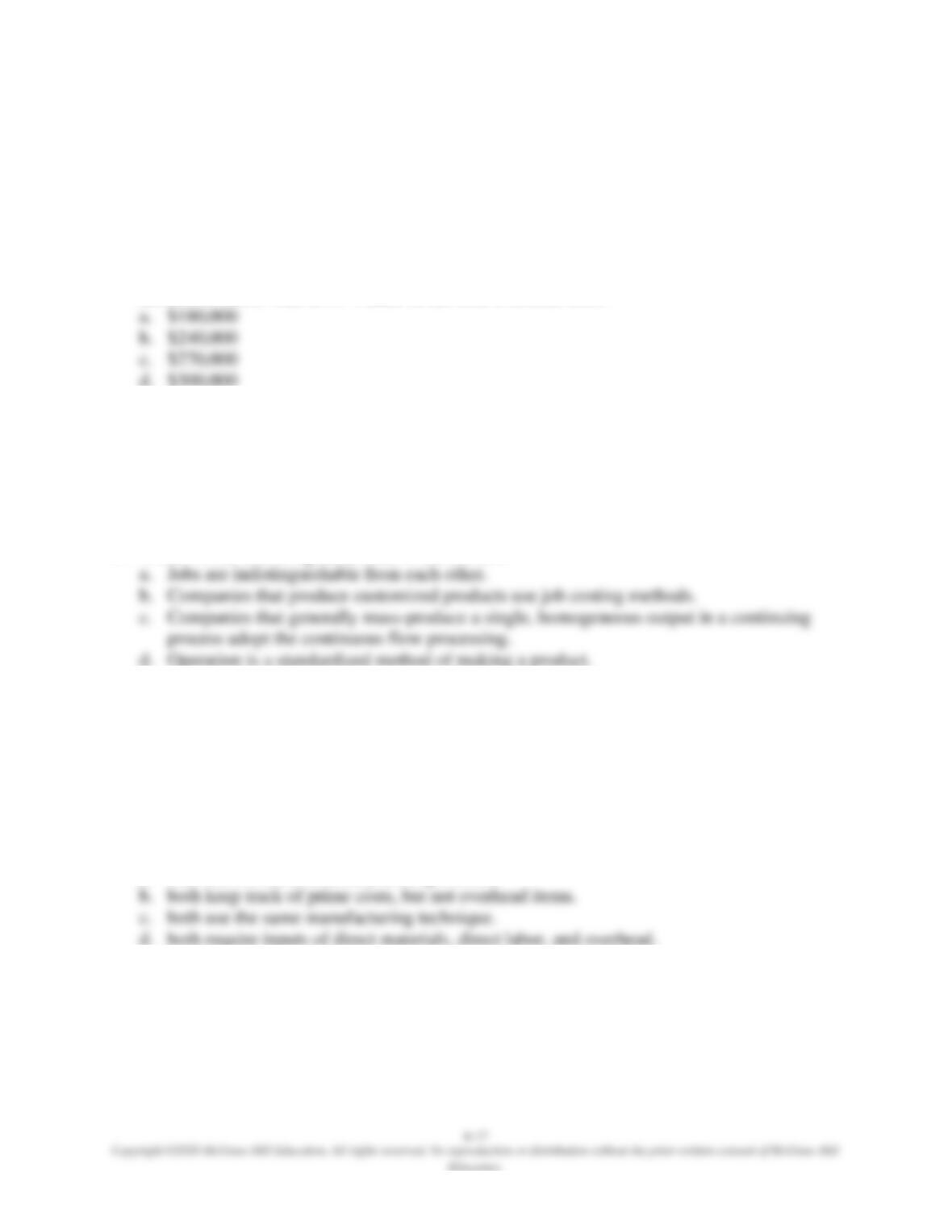
6. If the accountant chooses machine hours for Machining and labor hours for Assembly as
allocation bases, what is the overhead rate at Machining?
a. $100 per labor hour
b. $140 per labor hour
c. $120 per machine hour
d. $150 per machine hour
7. If the accountant chooses machine hours for Machining and labor hours for Assembly as
allocation bases, what is P1’s share of the total overhead costs?
8. For a two-stage allocation system:
a. the first stage is the most difficult to accomplish.
b. cost pools ideally consist of homogeneous cost items.
c. exactly two overhead rates are required.
d. the allocation bases bear no relationship with the overhead costs.
9. Which of the following statements is not correct?
10. Operations costing:
a. is a hybrid costing system.
b. is suitable when different products use the same production process and different
materials for input.
c. combines features from both job and process costing.
d. All of the above.
11. Job order system and process system are similar in the sense that:
a. both use the same inventory costing method.
12. The basic inventory equation can be represented by:
a. BB + TI = TO + EB.
b. BB – TI = TO + EB.
c. BB + EB = TI + TO.
d. BB + TO – TI = EB.
Multiple Choice Answers
1. a (LO1, LO2)
3. c (LO3)
30,000 bushels × 70% = 21,000 equivalent bushels.
4. a (LO4)
5. a (LO4)
$450,000 ÷ 1,500 labor hours = $300 per labor hour.
$300 per labor hour × 600 labor hours = $180,000.
7. b (LO4)
$150,000 ÷ 1,500 labor hours = $100 per labor hour.
$150 per machine hour × 1,200 machine hours + $100 per labor hour × 600 labor hours =
$240,000.
8. b (LO5)
10. d (LO6)
12. a (LO3)

Demonstration Problem 1
Required:
1. Determine the amount of Compound X started in the first quarter.
2. Compute the cost of Compound X transferred to finished goods and the amount of work-in–
process inventory as of the end of the first quarter.
Demonstration Problem 1 – Solution
Part 1
Compound X (barrels)
0
?
50,000
20,000
(55% complete)
Since 0 + ? – 50,000 = 20,000, the amount of Compound X started in the first quarter was 70,000
barrels.
Part 2
For the 20,000 barrels of Compound X in process at the end of the first quarter, they were on
average 55 percent complete and equivalent to 11,000 barrels of finished product (= 20,000
barrels × 55%). Total quantity of output for the first quarter became 61,000 barrels (= 50,000
barrels completed and transferred out + 11,000 equivalent barrels).
Compound X ($)
0
231,800
190,000
41,800
Demonstration Problem 2
Capable Golf Cart, Inc. (CGC) manufactures two models of golf cart: LX and EX. The budget
data for next month is available.
LX
EX
Total
Units produced
50
30
80
Direct labor hours
2,000
3,000
5,000
Machine hours
1,500
1,200
2,700
Direct materials
$90,000
Direct labor
150,000
Manufacturing overhead
202,500
Total
Required:
1. Compute the reported unit cost for each product if direct labor hours are used as the
allocation base.
2. Compute the reported unit cost for each product if direct labor costs are used as the allocation
base.
Demonstration Problem 2 – Solution
Part 1
Predetermined overhead rate =
$202,500
5,000 direct labor hours
= $40.50 per direct labor hour.
LX
EX
Total
Units produced (a)
50
30
80
Direct labor hours
2,000
3,000
5,000
Direct materials
$125,000
$90,000
$215,000
Direct labor
90,000
60,000
150,000
Manufacturing overhead
(@$40.50 per direct labor hour)
81,000
121,500
202,500
Total costs (b)
$296,000
$271,500
$567,500
Unit cost (b) ÷ (a)
$ 5,920
$ 9,050
Part 2
LX
EX
Total
Units produced (a)
50
30
80
Direct materials
$125,000
$ 90,000
$215,000
Direct labor
90,000
60,000
150,000
Manufacturing overhead
(@135% of direct labor cost)
121,500
81,000
202,500
Total costs (b)
$336,500
$231,000
$567,500
Unit cost (b) ÷ (a)
$ 6,730
$ 7,700
Demonstration Problem 2 – Solution, continued
Part 3
Predetermined overhead rate =
$202,500
2,700 machine hours
= $75 per machine hour.
LX
EX
Total
Units produced (a)
50
30
80
Machine hours
1,500
1,200
2,700
Direct materials
$125,000
$90,000
$215,000
Direct labor
150,000
Total costs (b)
$327,500
$240,000
$567,500
Unit cost (b) ÷ (a)
$ 6,550
$ 8,000
Demonstration Problem 3
Jim is a florist who runs Bountiful Flower Shop as a sole owner. During the third week of June,
he received two orders for flower bouquets that required same operations but different
flower/basket combinations. Orders 471 and 472 were for a wedding hall and a business
conference, respectively. The following information was available.
Order 471
Order 472
Total
Number of bouquets
120
90
210
Flowers
$1,800
$1,080
$2,880
Baskets
600
360
960
Supplies
240
90
330
Total costs of materials
$2,640
$1,530
$4,170
Direct labor in operation
$ 630
Overhead in operation
Total costs in operation
$1,785
Demonstration Problem 3 – Solution
The costs of materials can be assigned directly to the two orders. Because the time and the effort
required to put together each bouquet is essentially the same, Jim could allocate the operation
costs based on the number of units (bouquets) assembled. That is,
Operation cost per bouquet =
$1,785
210 bouquets
= $8.50 per bouquet
Order 471’s share of the operation costs was $1,020 (= $8.50 per bouquet × 120 bouquets)
Order 472’s share was $765 (= $8.50 per bouquet × 90 bouquets)
Order 471
Order 472
Number of bouquets (a)
120
90
Flowers
Baskets
600
360
Supplies
240
90
Total costs of materials
Operation costs
Total order costs (b)
Unit cost (b) ÷ (a)