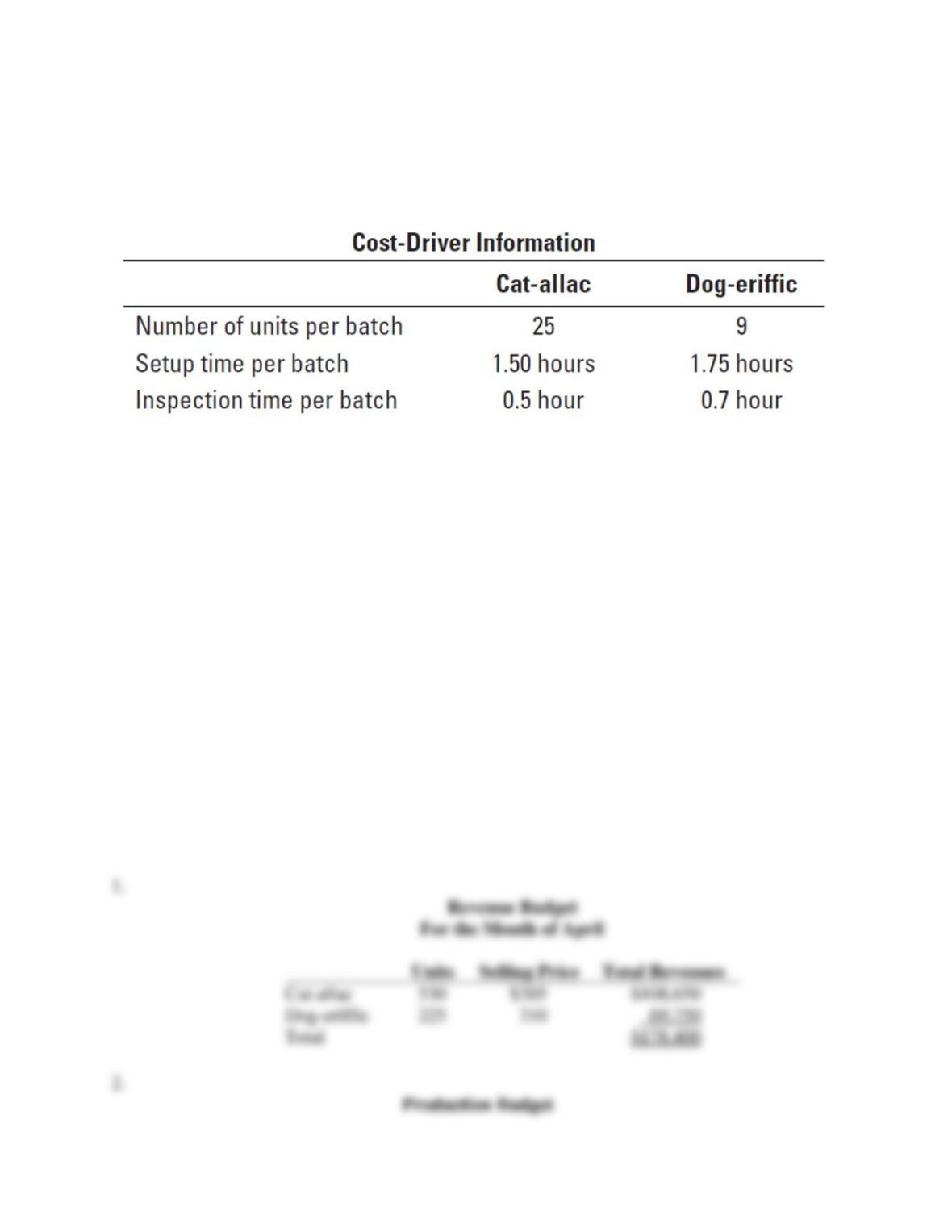
6-41
Animal Gear uses an activity-based costing system and classifies overhead into three activity
pools: Setup, Processing, and Inspection. Activity rates for these activities are $105 per setup–
hour, $10 per machine-hour, and $15 per inspection-hour, respectively. Other information
follows:
Nonmanufacturing fixed costs for March equal $32,000, half of which are salaries. Salaries are
expected to increase 5% in April. The only variable nonmanufacturing cost is sales commission,
equal to 1% of sales revenue.
Prepare the following for April:
Required:
1. Revenues budget
2. Production budget in units
3. Direct material usage budget and direct material purchases budget
4. Direct manufacturing labor cost budget
5. Manufacturing overhead cost budgets for each of the three activities
6. Budgeted unit cost of ending finished goods inventory and ending inventories budget
7. Cost of goods sold budget
8. Nonmanufacturing costs budget
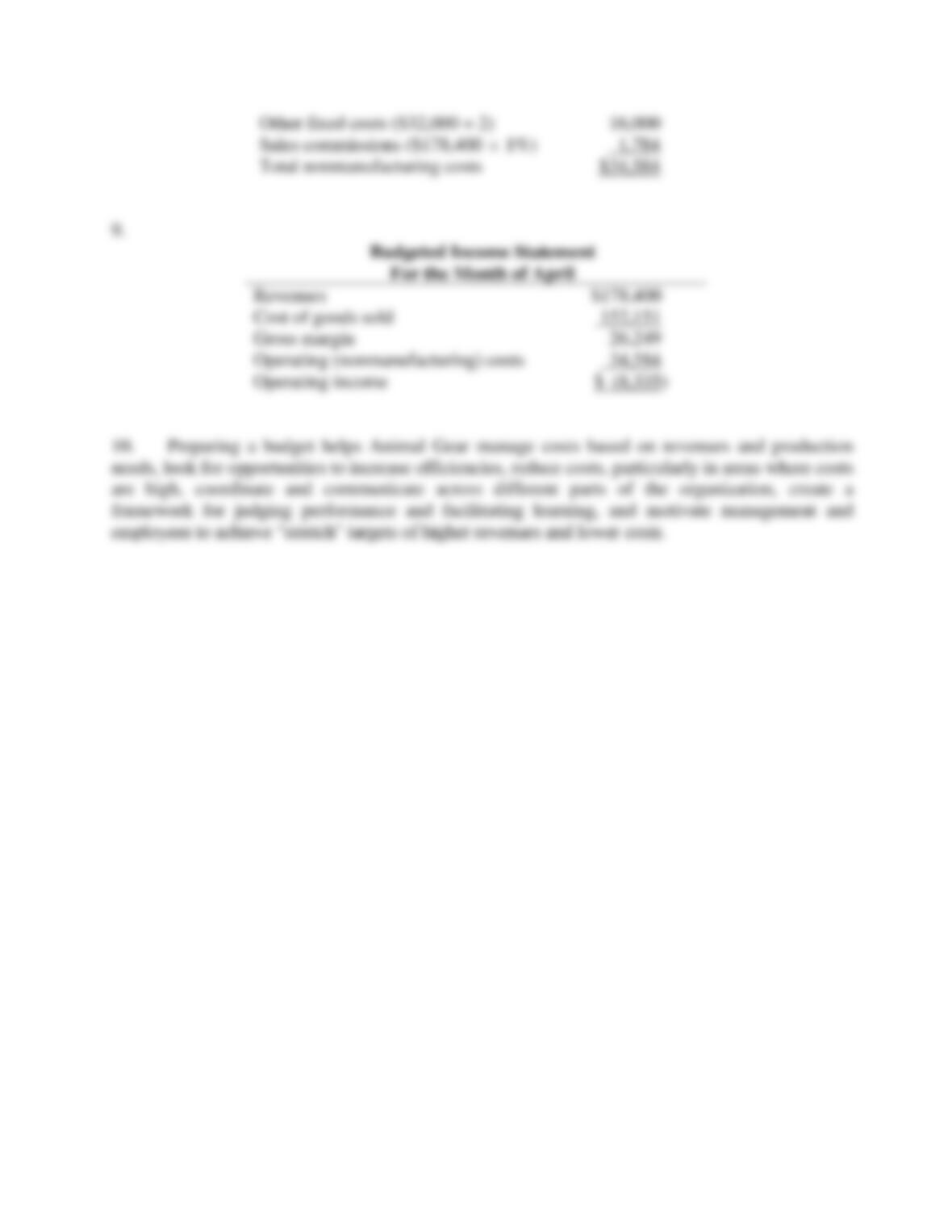
9. Budgeted income statement (ignore income taxes)
10. How does preparing the budget help Animal Gear’s management team better manage the
company?
SOLUTION
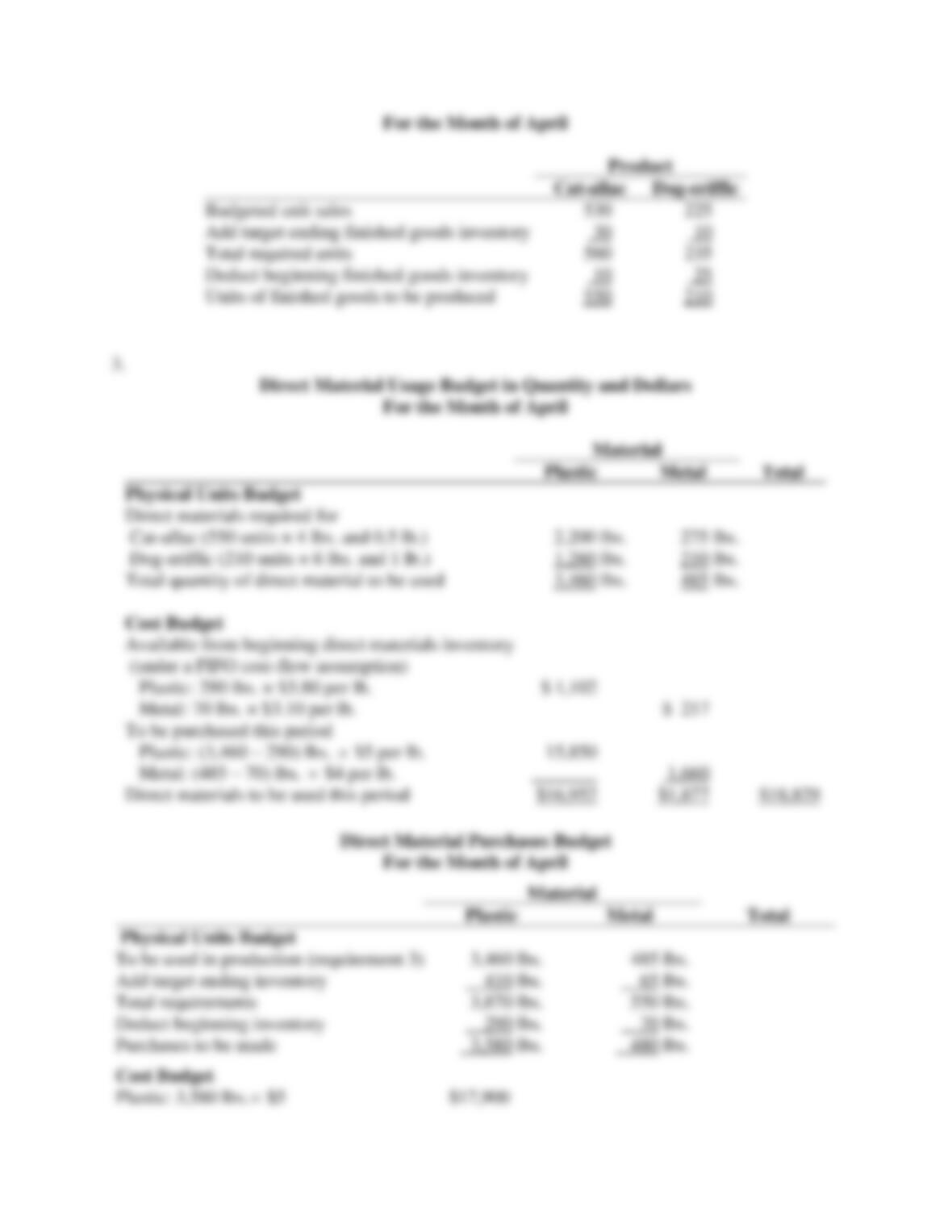
6-42
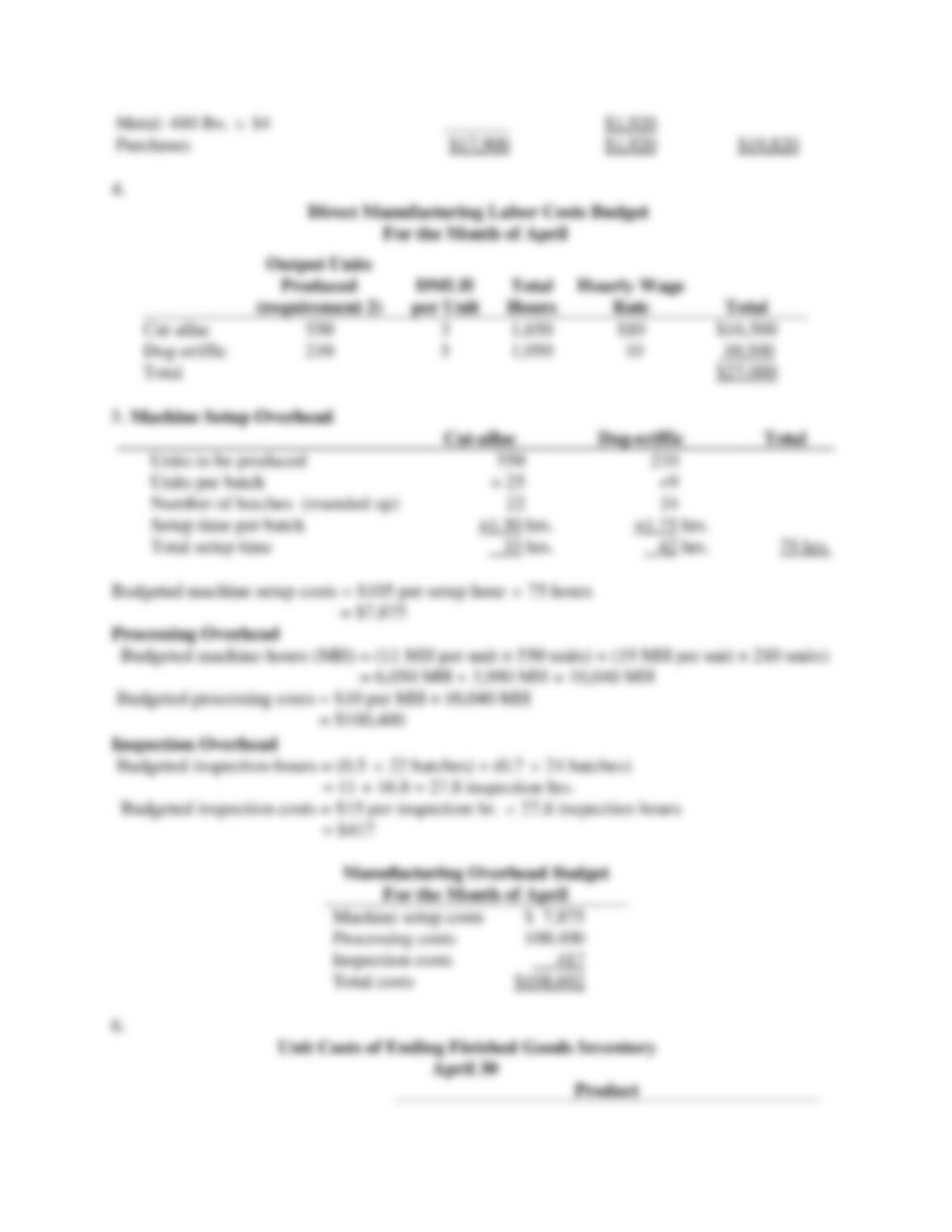
6-43
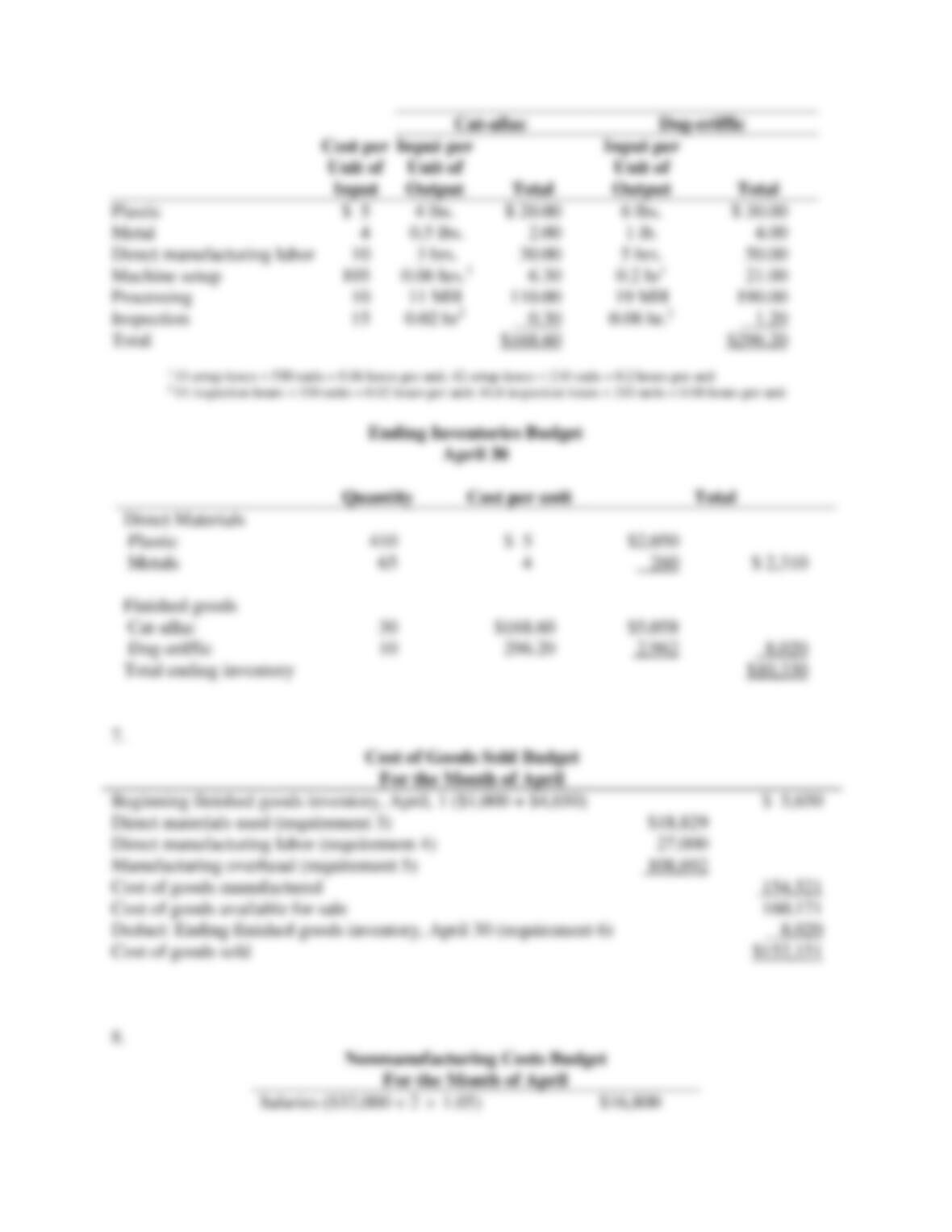
6-44
6-45
6-36 (25 min.) Cash budget (Continuation of 6-35) (Appendix)
Refer to the information in Problem 6-35.
Assume the following: Animal Gear (AG) does not make any sales on credit. AG sells only to
the public and accepts cash and credit cards; 90% of its sales are to customers using credit cards,
for which AG gets the cash right away, less a 2% transaction fee.
Purchases of materials are on account. AG pays for half the purchases in the period of the
purchase and the other half in the following period. At the end of March, AG owes suppliers
$8,000.
AG plans to replace a machine in April at a net cash cost of $13,000.
Labor, other manufacturing costs, and nonmanufacturing costs are paid in cash in the month
incurred except of course depreciation, which is not a cash flow. Depreciation is $25,000 of the
manufacturing cost and $10,000 of the nonmanufacturing cost for April.
AG currently has a $2,000 loan at an annual interest rate of 24%. The interest is paid at the
end of each month. If AG has more than $10,000 cash at the end of April it will pay back the
loan. AG owes $5,000 in income taxes that need to be remitted in April. AG has cash of $5,900
on hand at the end of March.
Required:
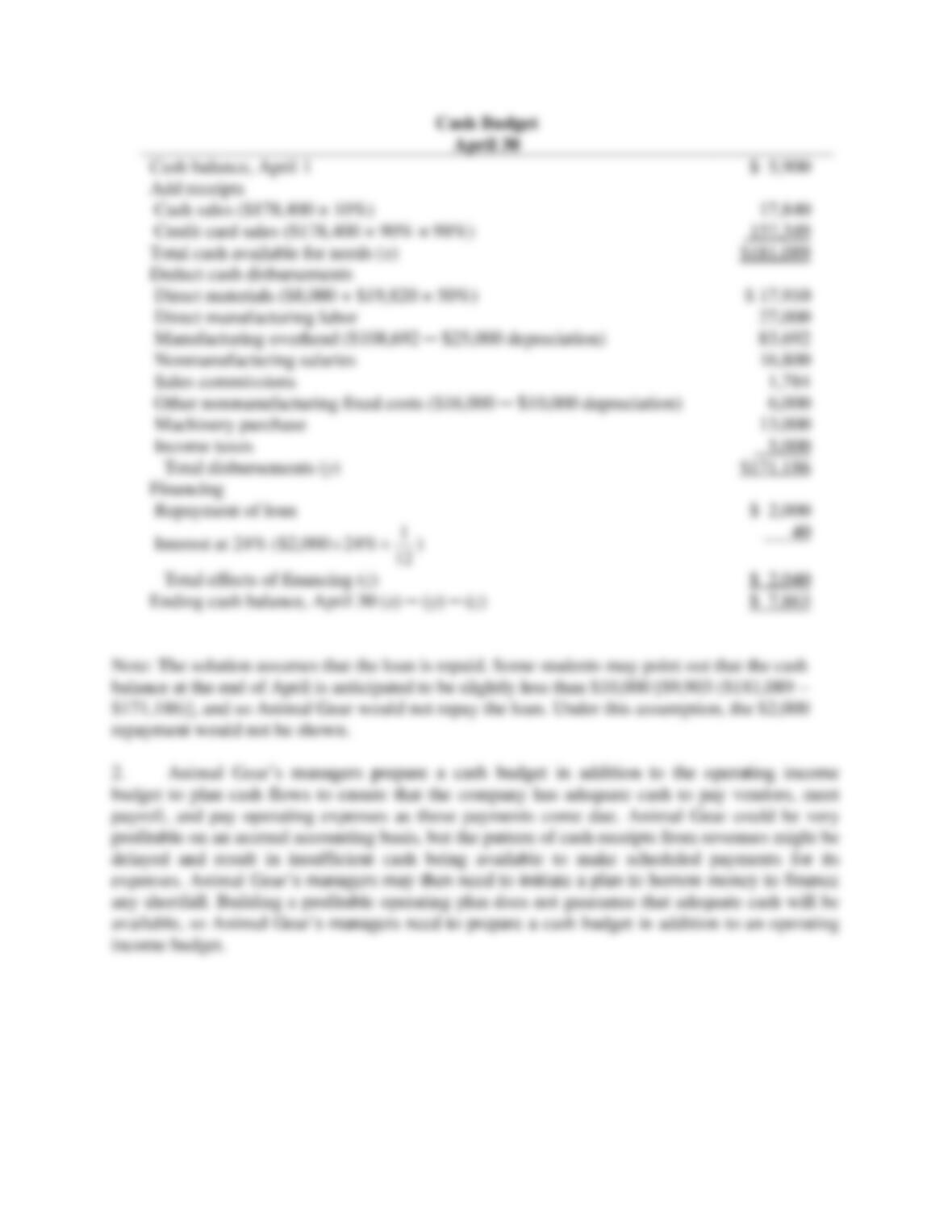
1. Prepare a cash budget for April for Animal Gear.
2. Why do Animal Gear’s managers prepare a cash budget in addition to the revenue, expenses,
and operating income budget?
SOLUTION
6-46
6-37 (60 min.) Comprehensive operating budget, budgeted balance sheet.
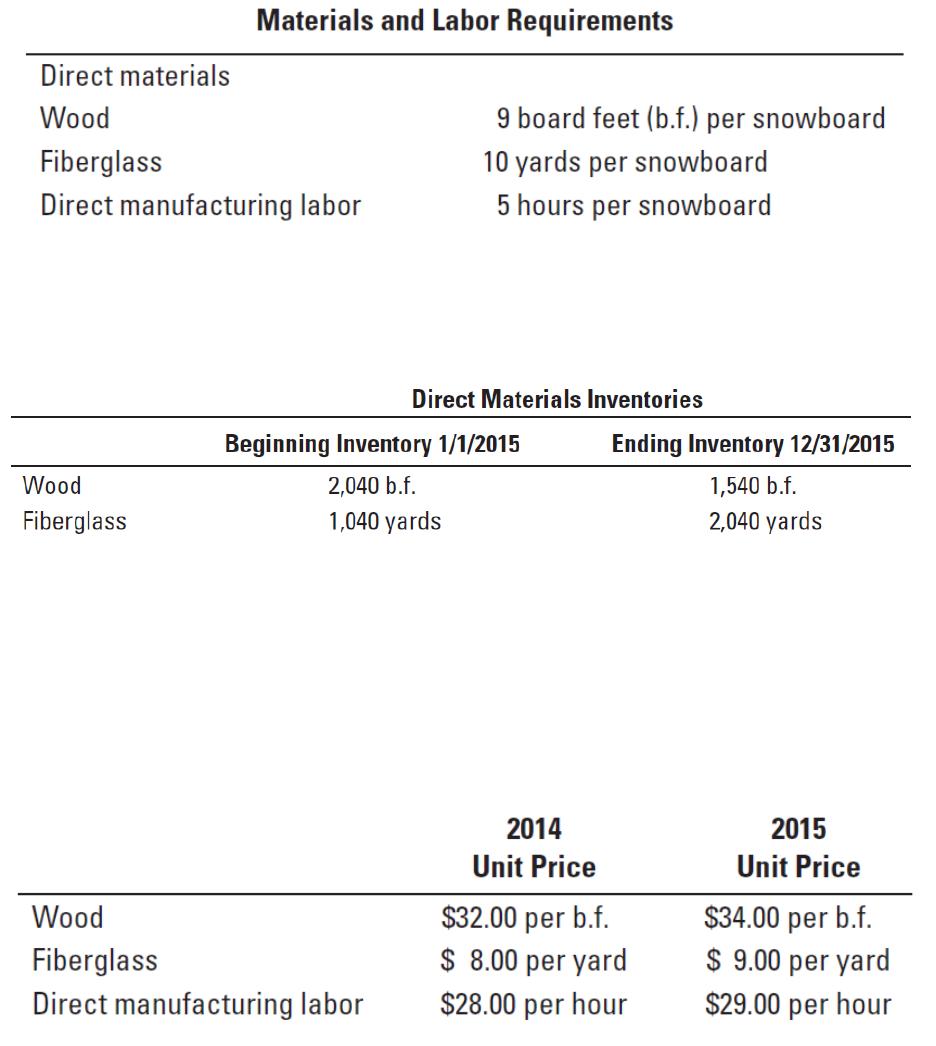
Skulas, Inc., manufactures and sells snowboards. Skulas manufactures a single model, the Pipex.
In the summer of 2014, Skulas’ management accountant gathered the following data to prepare
budgets for 2015:
6-47
Skulas’ CEO expects to sell 2,900 snowboards during 2015 at an estimated retail price of $650
per board. Further, the CEO expects 2015 beginning inventory of 500 snowboards and would
like to end 2015 with 200 snowboards in stock.
Variable manufacturing overhead is $7 per direct manufacturing labor-hour. There are also
$81,000 in fixed manufacturing overhead costs budgeted for 2015. Skulas combines both
variable and fixed manufacturing overhead into a single rate based on direct manufacturing
labor-hours. Variable marketing costs are allocated at the rate of $250 per sales visit. The
marketing plan calls for 38 sales visits during 2015. Finally, there are $35,000 in fixed
nonmanufacturing costs budgeted for 2015.
Other data include:
The inventoriable unit cost for ending finished goods inventory on December 31, 2014, is
$374.80. Assume Skulas uses a FIFO inventory method for both direct materials and finished
goods. Ignore work in process in your calculations.
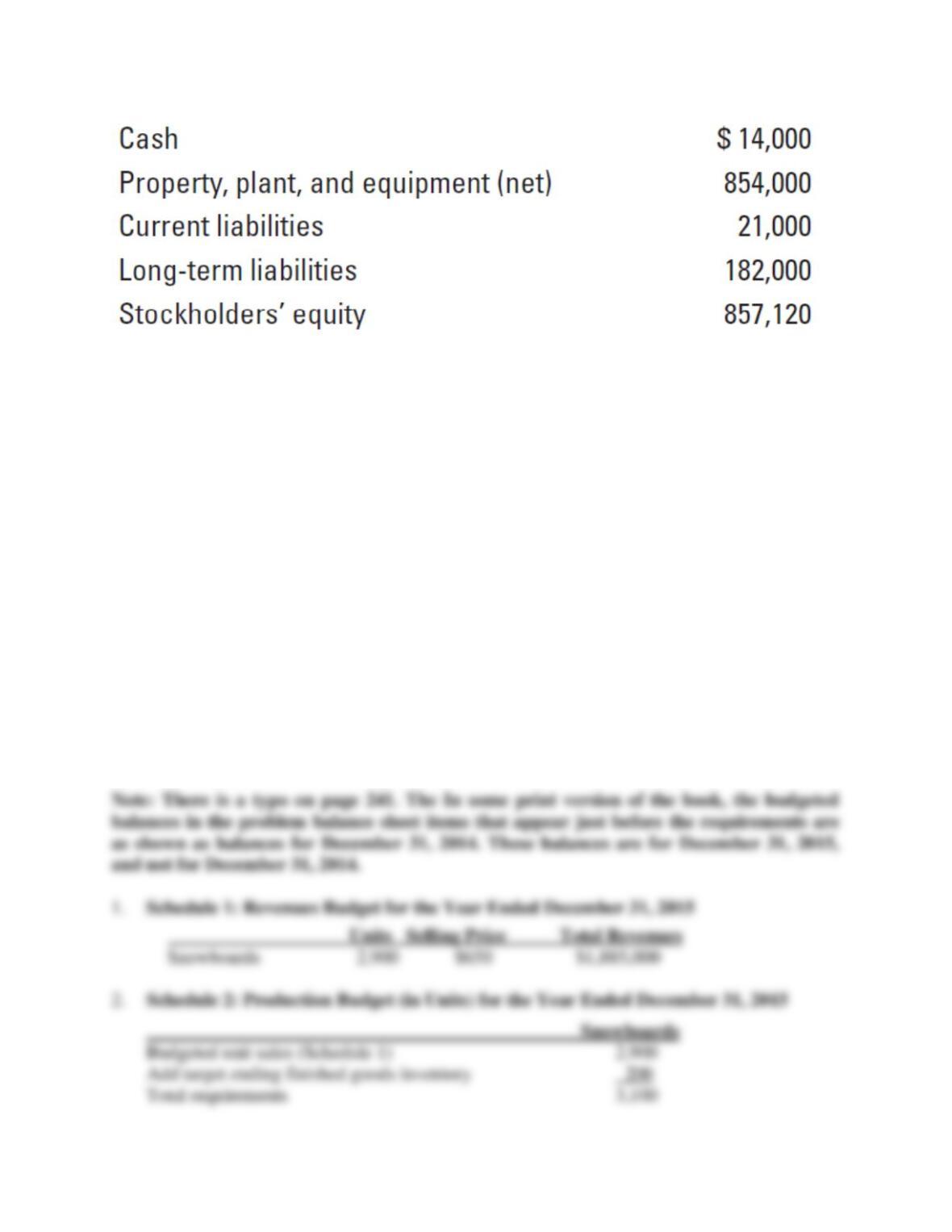
Budgeted balances at December 31, 2014, in the selected accounts are as follows:
6-48
Required:
1. Prepare the 2015 revenues budget (in dollars).
2. Prepare the 2015 production budget (in units).
3. Prepare the direct material usage and purchases budgets for 2015.
4. Prepare a direct manufacturing labor budget for 2015.
5. Prepare a manufacturing overhead budget for 2015.
6. What is the budgeted manufacturing overhead rate for 2015?
7. What is the budgeted manufacturing overhead cost per output unit in 2015?
8. Calculate the cost of a snowboard manufactured in 2015.
9. Prepare an ending inventory budget for both direct materials and finished goods for 2015.
10. Prepare a cost of goods sold budget for 2015.
11. Prepare the budgeted income statement for Skulas, Inc., for the year ending December 31,
2015.
12. Prepare the budgeted balance sheet for Skulas, Inc., as of December 31, 2015.
13. What questions might the CEO ask the management team when reviewing the budget?
Should the CEO set stretch targets? Explain briefly.
14. How does preparing the budget help Skulas’ management team better manage the company?
SOLUTION
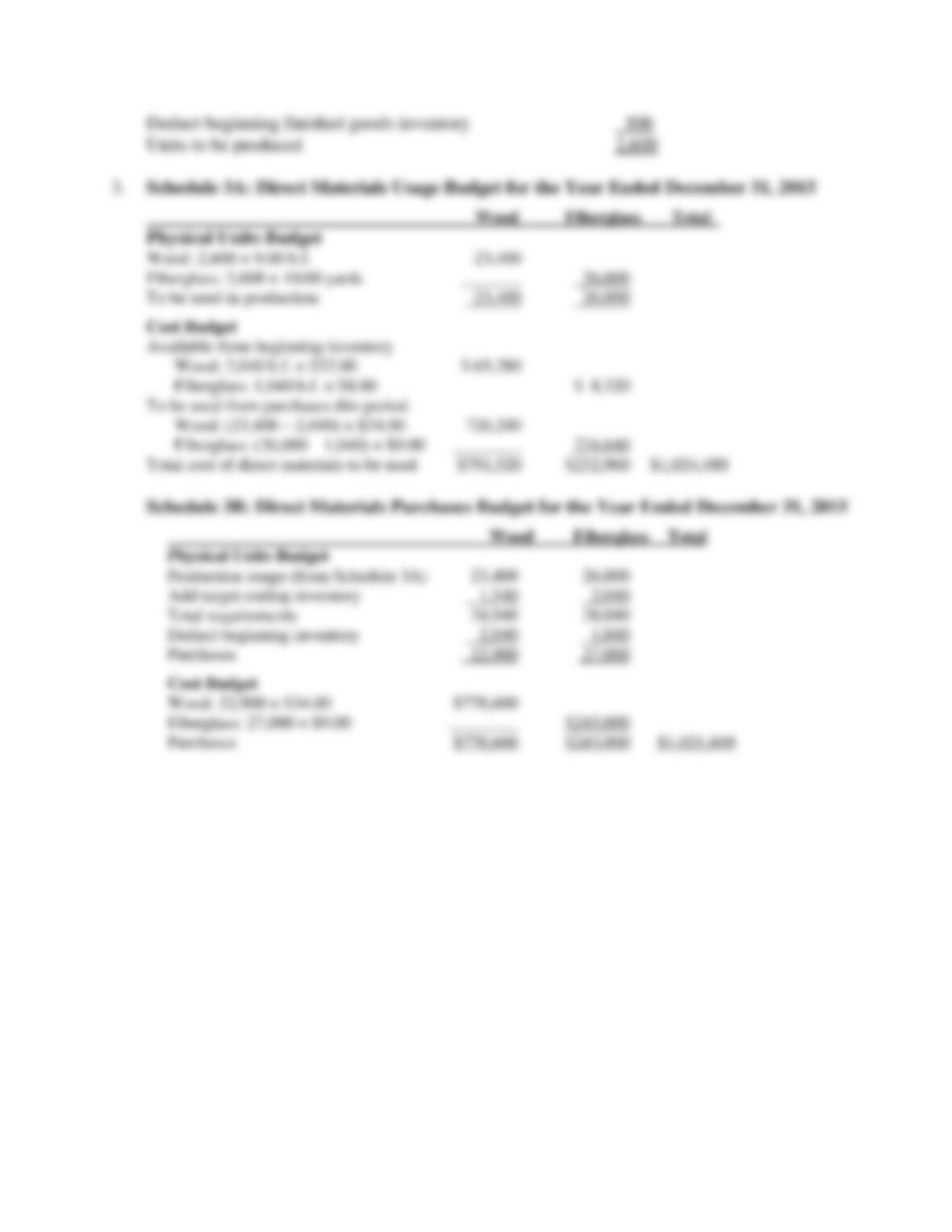
6-49
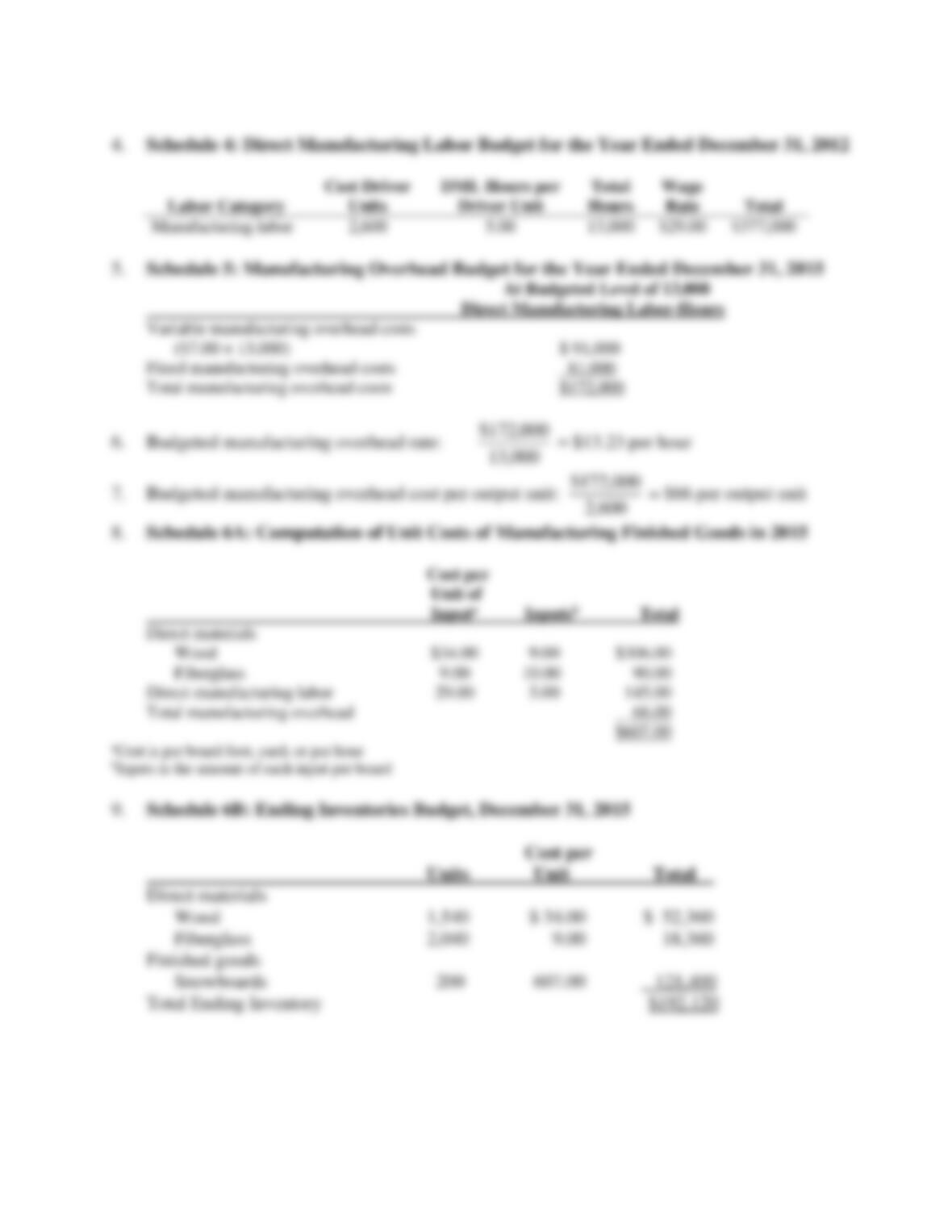
6-50
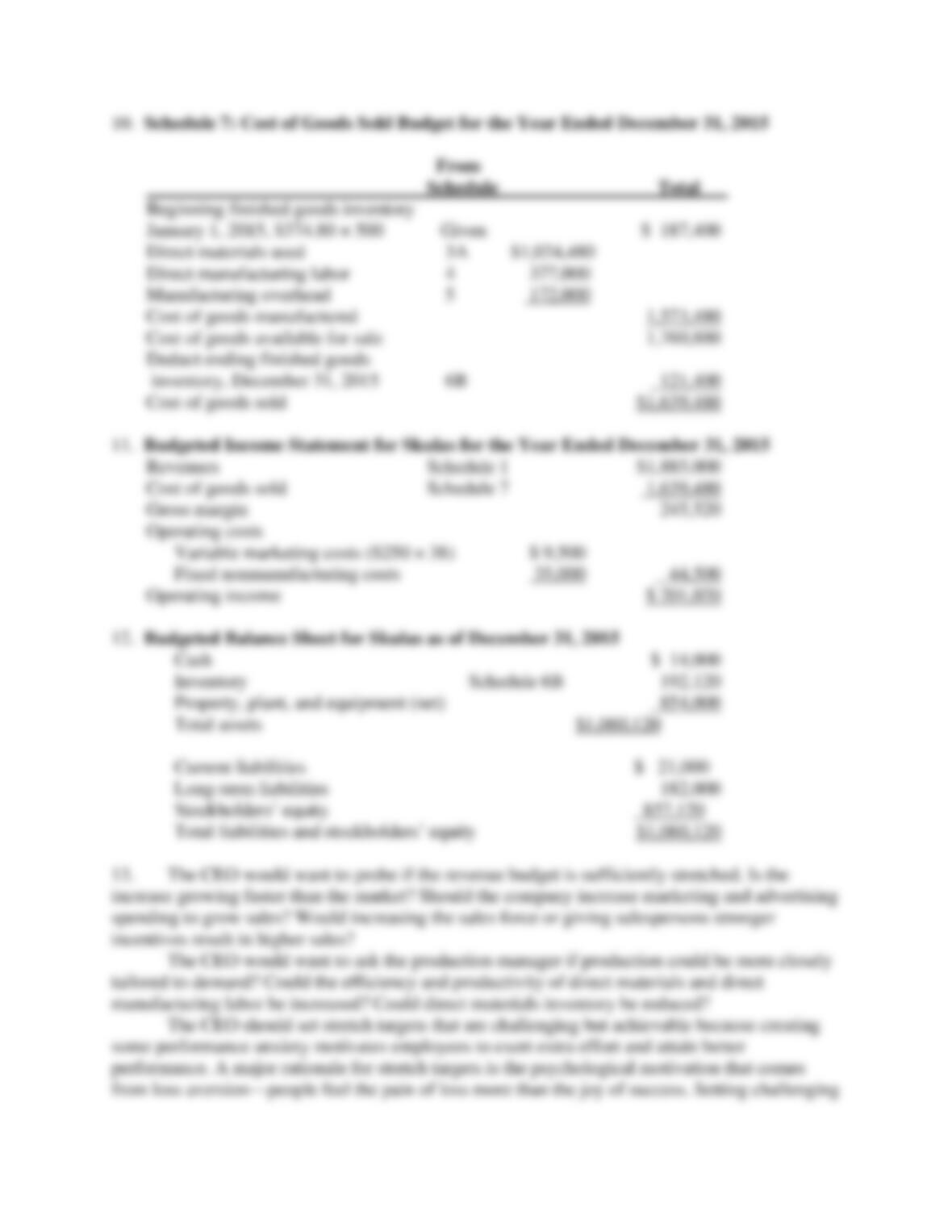
6-51
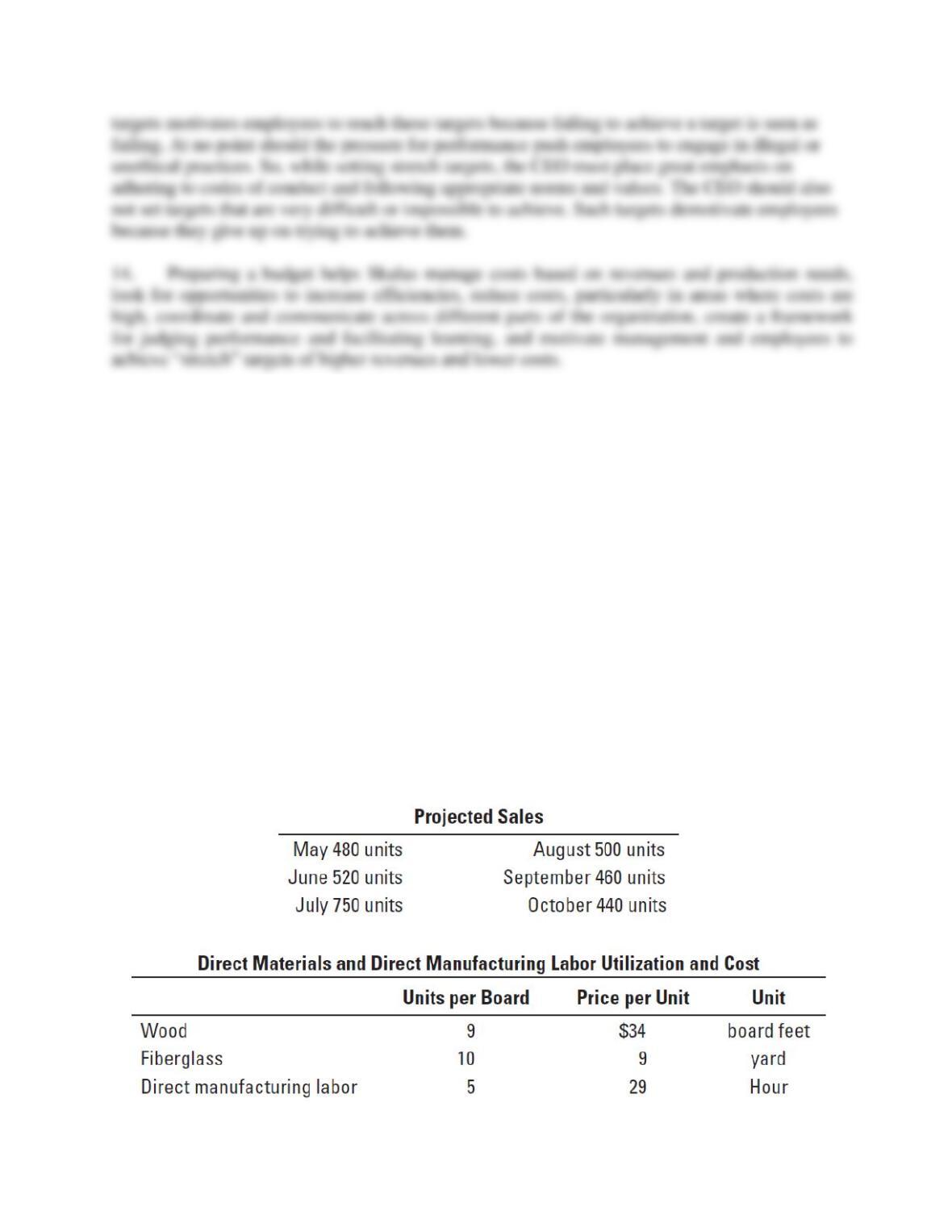
6-52
6-38 (30 min.) Cash budgeting, chapter appendix.
Retail outlets purchase snowboards from Skulas, Inc., throughout the year. However, in
anticipation of late summer and early fall purchases, outlets ramp up inventories from May
through August. Outlets are billed when boards are ordered. Invoices are payable within 60 days.
From past experience, Skulas’ accountant projects 40% of invoices will be paid in the month
invoiced, 45% will be paid in the following month, and 15% of invoices will be paid two months
after the month of invoice. The average selling price per snowboard is $650.
To meet demand, Skulas increases production from April through July because the
snowboards are produced a month prior to their projected sale. Direct materials are purchased in
the month of production and are paid for during the following month (terms are payment in full
within 30 days of the invoice date). During this period there is no production for inventory and
no materials are purchased for inventory.
Direct manufacturing labor and manufacturing overhead are paid monthly. Variable
manufacturing overhead is incurred at the rate of $7 per direct manufacturing labor-hour.
Variable marketing costs are driven by the number of sales visits. However, there are no sales
visits during the months studied. Skulas, Inc., also incurs fixed manufacturing overhead costs of
$7,500 per month and fixed nonmanufacturing overhead costs of $4,500 per month.
6-53
The beginning cash balance for July 1, 2015, is $14,000. On October 1, 2014, Skulas had a cash
crunch and borrowed $60,000 on a 12% one-year note with interest payable monthly. The note is
due October 1, 2015.
Required:
1. Prepare a cash budget for the months of July through September 2015. Show supporting
schedules for the calculation of receivables and payables.
2. Will Skulas be in a position to pay off the $60,000 one-year note that is due on October 1,
2015? If not, what actions would you recommend to Skulas’ management?
3. Suppose Skulas is interested in maintaining a minimum cash balance of $14,000. Will the
company be able to maintain such a balance during all three months analyzed? If not, suggest
a suitable cash management strategy.
4. Why do Skulas’ managers prepare a cash budget in addition to the revenue, expenses, and
operating income budget?
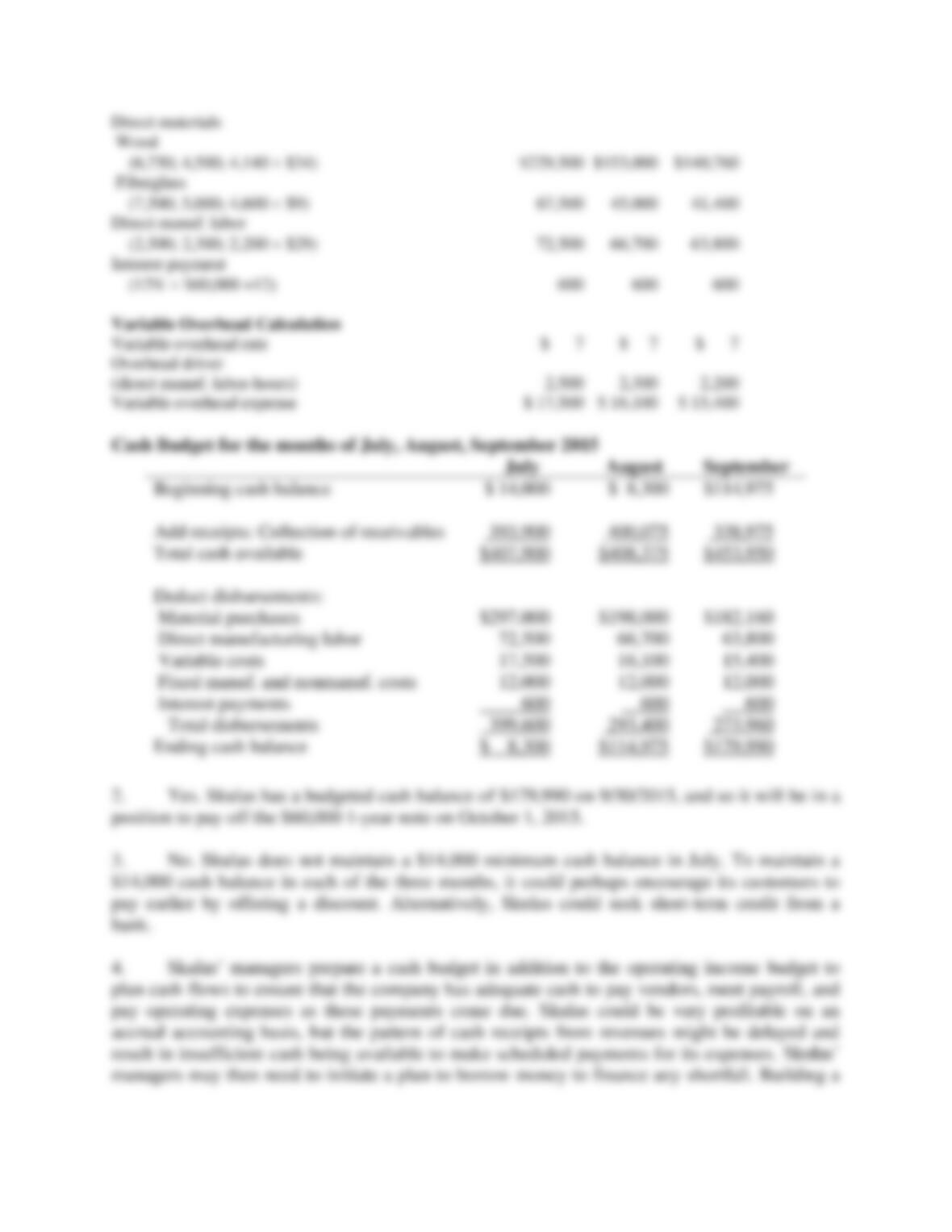
SOLUTION
6-54
6-55
6-39 (40–50 min.) Cash budgeting.
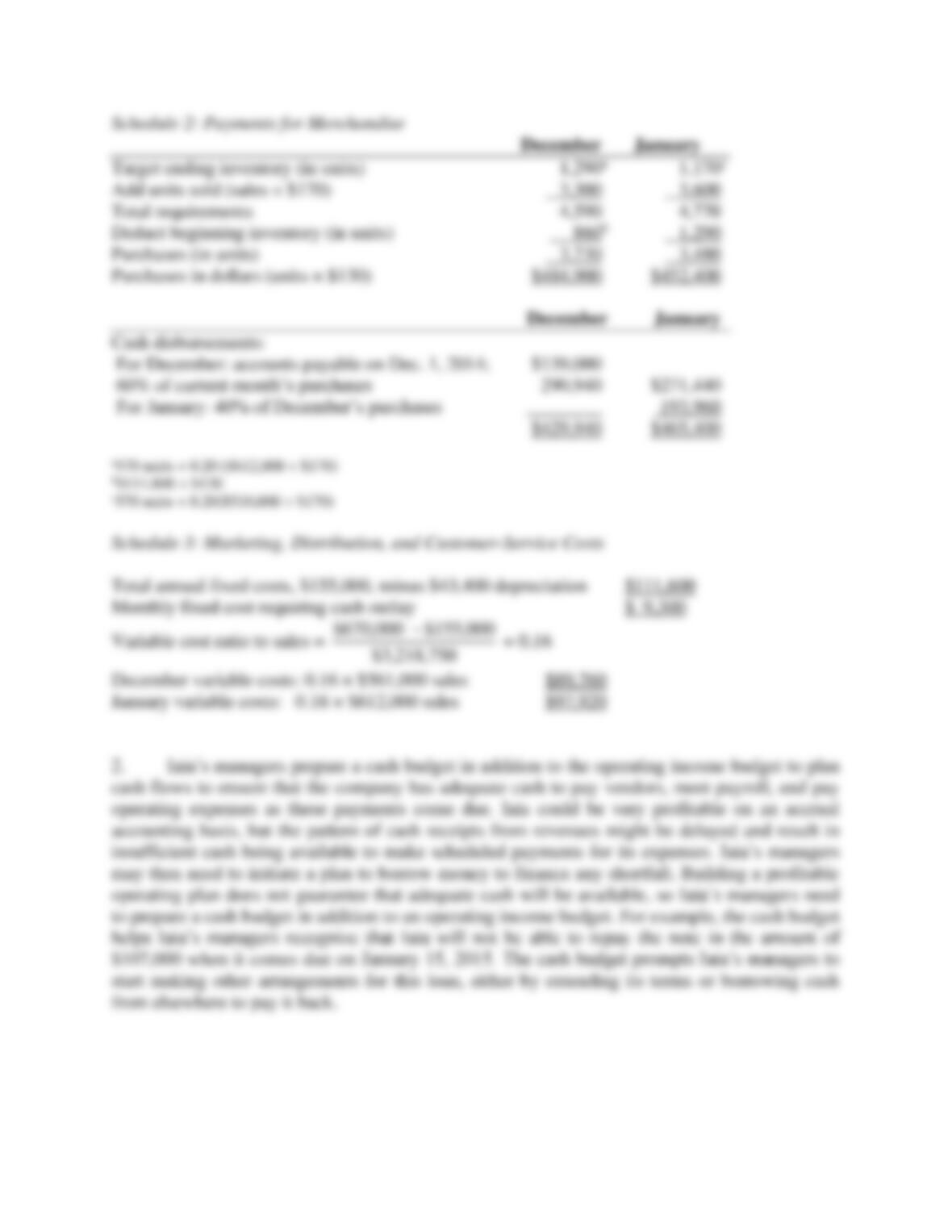
On December 1, 2014, the Iaia Wholesale Co. is attempting to project cash receipts and
disbursements through January 31, 2015. On this latter date, a note will be payable in the amount
of $107,000. This amount was borrowed in September to carry the company through the seasonal
peak in November and December.
Selected general ledger balances on December 1 are:
Sales terms call for a 3% discount if payment is made within the first 10 days of the month after
sale, with the balance due by the end of the month after sale. Experience has shown that 50% of
the billings will be collected within the discount period, 30% by the end of the month after
purchase, and 15% in the following month. The remaining 5% will be uncollectible. There are no
cash sales.
The average selling price of the company’s products is $170 per unit. Actual and
projected sales are:
All purchases are payable within 15 days. Approximately 60% of the purchases in a month are
paid that month and the rest the following month. The average unit purchase cost is $130. Target
ending inventories are 570 units plus 20% of the next month’s unit sales.
Total budgeted marketing, distribution, and customer-service costs for the year are $670,000.
Of this amount, $155,000 are considered fixed (and include depreciation of $43,400). The
remainder varies with sales. Both fixed and variable marketing, distribution, and customer–
service costs are paid as incurred.
6-56
Required:
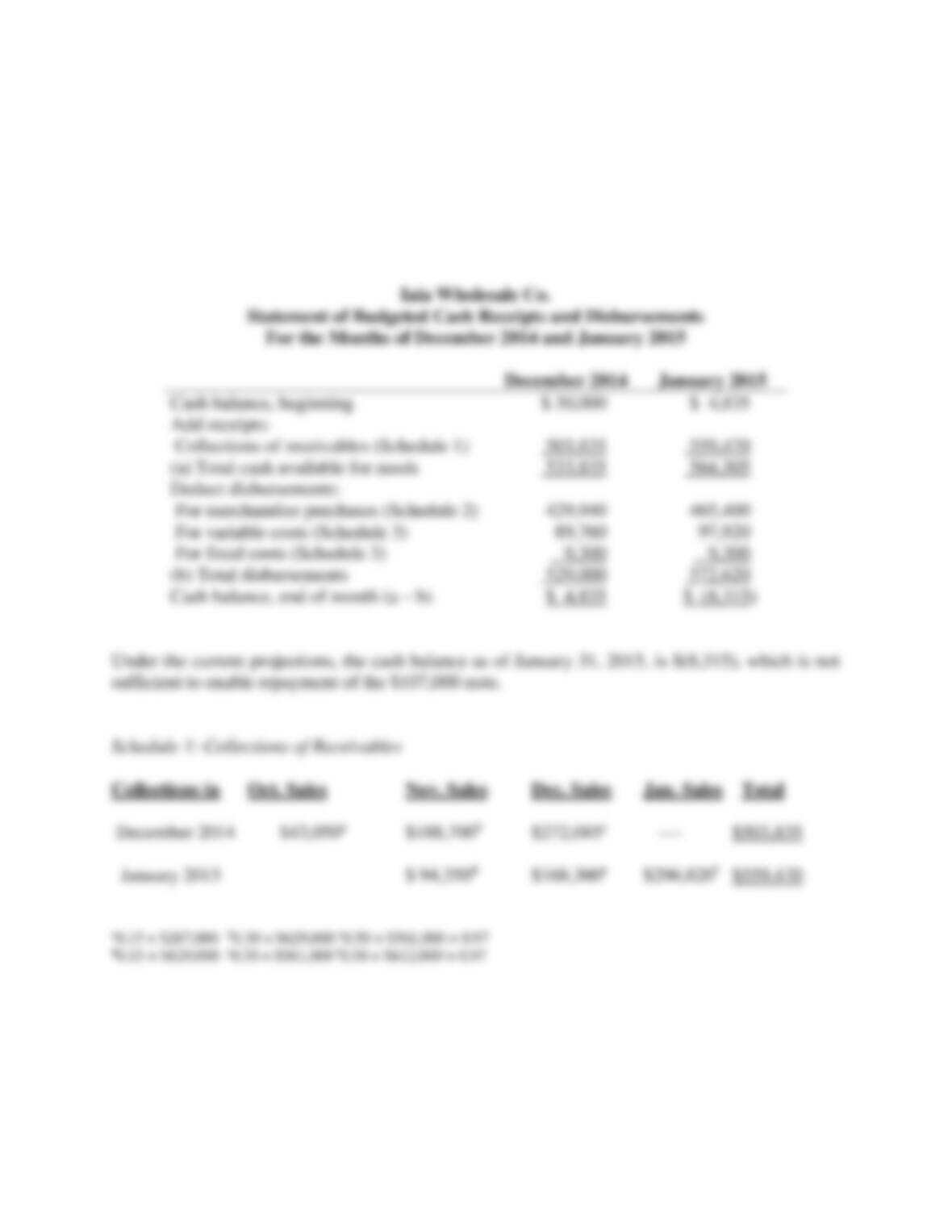
1. Prepare a cash budget for December 2014 and January 2015. Supply supporting schedules for
collections of receivables; payments for merchandise; and marketing, distribution, and
customer-service costs.
2. Why do Iaia’s managers prepare a cash budget in addition to the operating income budget?
SOLUTION
6-57
6-58
6-40 (60 min.) Comprehensive problem; ABC manufacturing, two products.
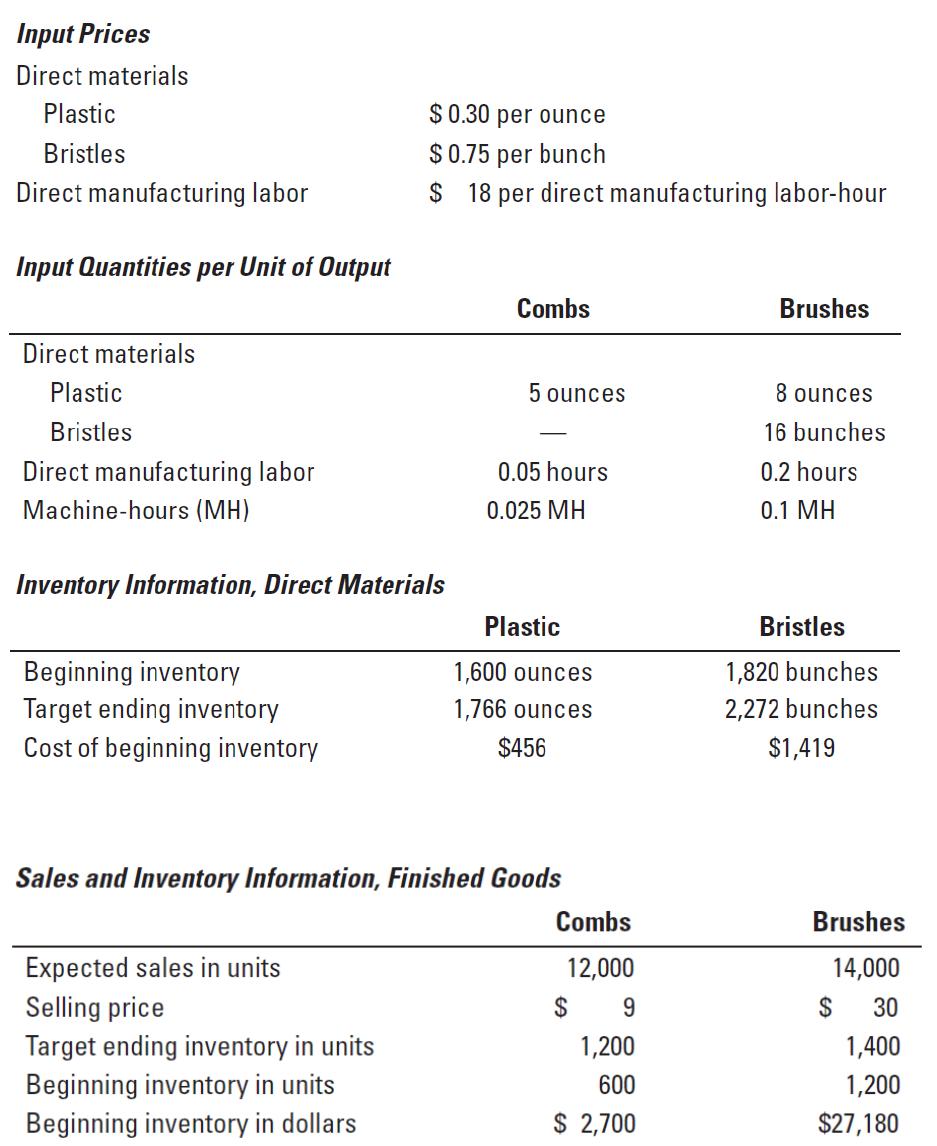
Hazlett, Inc., operates at capacity and makes plastic combs and hairbrushes. Although the combs
and brushes are a matching set, they are sold individually and so the sales mix is not 1:1.
Hazlett’s management is planning its annual budget for fiscal year 2015. Here is information for
2015:
Hazlett accounts for direct materials using a FIFO cost flow.