Chapter 6
Reporting and Interpreting Sales Revenue,
Receivables, and Cash
ANSWERS TO QUESTIONS
1. The difference between sales revenue and net sales includes the amount of
goods returned by customers because the goods were either unsatisfactory or
2. Gross profit or gross margin on sales is the difference between net sales and
cost of goods sold. For example, assuming sales of $100,000, and cost of goods
sold of $60,000, the gross profit on sales would be $40,000.
3. A credit card discount is the fee charged by the credit card company for services.
4. A sales discount is a discount given to customers for payment of accounts within
a specified short period of time. Sales discounts arise only when goods are sold
on credit and the seller extends credit terms that provide for a cash discount. For
5. A sales allowance is an amount allowed to a customer for unsatisfactory
merchandise or for an overcharge in the sales price. A sales allowance reduces
6. An account receivable is an amount owed to the business on open account by a
trade customer for merchandise or services purchased. In contrast, a note
receivable is a short-term obligation owed to the company based on a formal
written document.
7. In conformity with the expense (matching) principle, the allowance method
8. Using the allowance method, bad debt expense is recognized in the period in
which the sale related to the uncollectible account was recorded.
9. The write-off of bad debts using the allowance method decreases the asset
10. An increase in the receivables turnover ratio generally indicates faster collection
11. Cash includes money and any instrument, such as a check, money order, or
bank draft, which banks normally will accept for deposit and immediate credit to
12. The primary characteristics of an internal control system for cash are: (a)
separation of the functions of cash receiving from cash payments, (b) separation
Financial Accounting, 9/e 6-3
13. Cash-handling and cash-recording activities should be separated to remove the
opportunity for theft of cash and a cover-up by altering the records. This
14. The purposes of a bank reconciliation are (a) to determine the “true” cash
balance and (b) to provide data to adjust the Cash account to that balance. A
bank reconciliation involves reconciling the balance in the Cash account at the
end of the period with the balance shown on the bank statement (which is not the
15. The total amount of cash that should be reported on the balance sheet is the
sum of (a) the true cash balances in all checking accounts (verified by a bank
16. (Chapter Supplement) Under the gross method of recording sales discounts, the
amount of sales discount taken is recorded at the time the collection of the
account is recorded.
ANSWERS TO MULTIPLE CHOICE
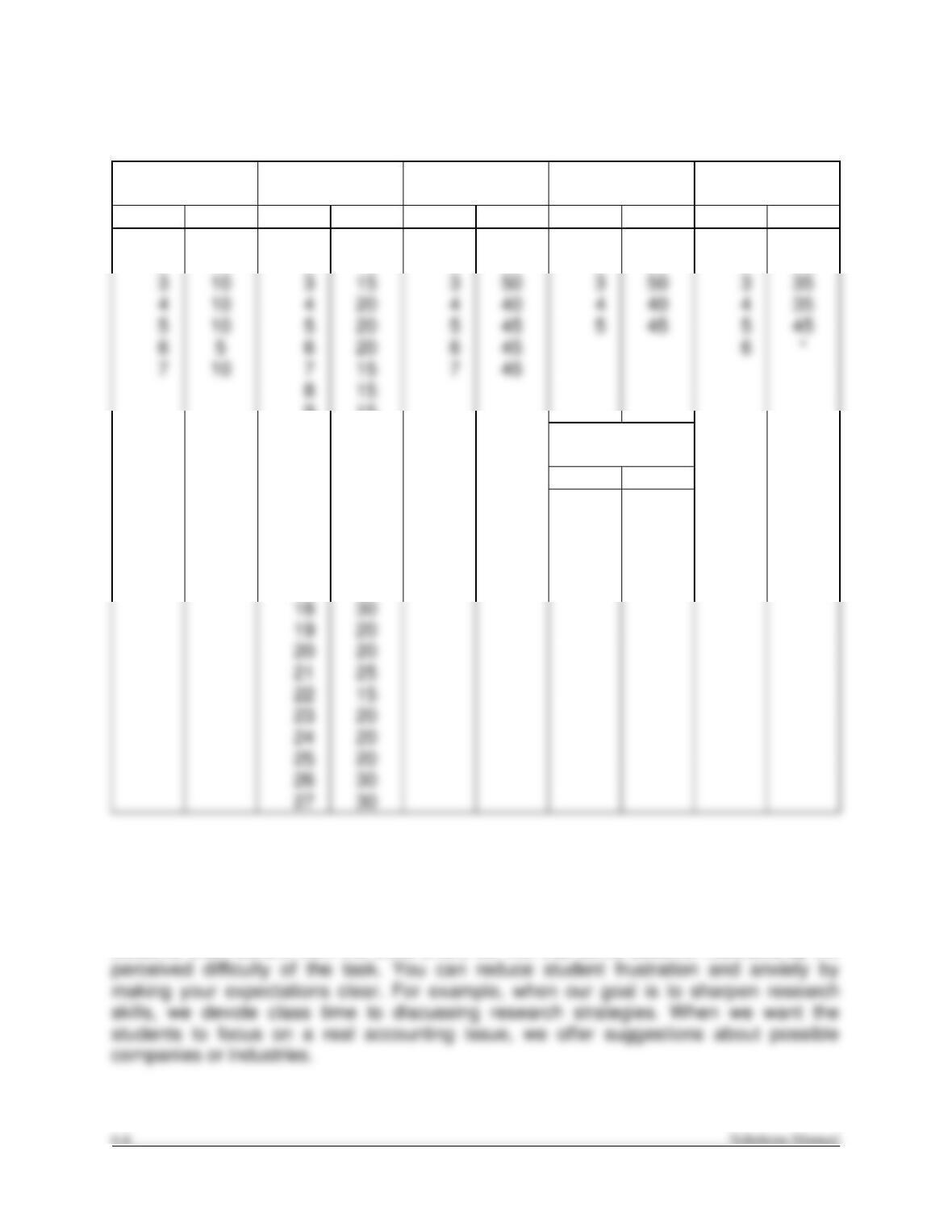
Authors’ Recommended Solution Time
(Time in minutes)
Mini-exercises
Exercises
Problems
Alternate
Problems
Cases and
Projects
No.
Time
No.
Time
No.
Time
No.
Time
No.
Time
1
5
1
15
1
35
1
35
1
25
2
10
2
15
2
35
2
35
2
30
3
10
3
15
3
50
3
50
3
35
4
10
4
20
4
40
4
40
4
35
5
10
5
20
5
45
5
45
5
45
6
5
6
20
6
45
6
7
10
7
15
7
45
8
15
9
15
10
15
Continuing
11
15
Problem
12
20
No.
Time
13
20
1
30
14
20
15
20
16
20
17
20
18
30
19
20
20
20
21
25
22
15
23
20
24
20
25
20
26
30
27
30
* Due to the nature of these cases and projects, it is very difficult to estimate the amount
of time students will need to complete the assignment. As with any open-ended project,
it is possible for students to devote a large amount of time to these assignments. While
students often benefit from the extra effort, we find that some become frustrated by the
Financial Accounting, 9/e 6-5
MINI-EXERCISES
M6–1.
If the buyer pays within the discount period, the income statement will report $9,405 as
net sales ($9,500 x 0.99).
M6–2.
Credit card sales (R)
$9,400.00
Less: Credit card discount (XR)
282.00
M6–3.
(a) Allowance for doubtful accounts (–XA, +A) ………….. 14,500
Accounts receivable (–A) ……………………………. 14,500
To write off specific bad debts.
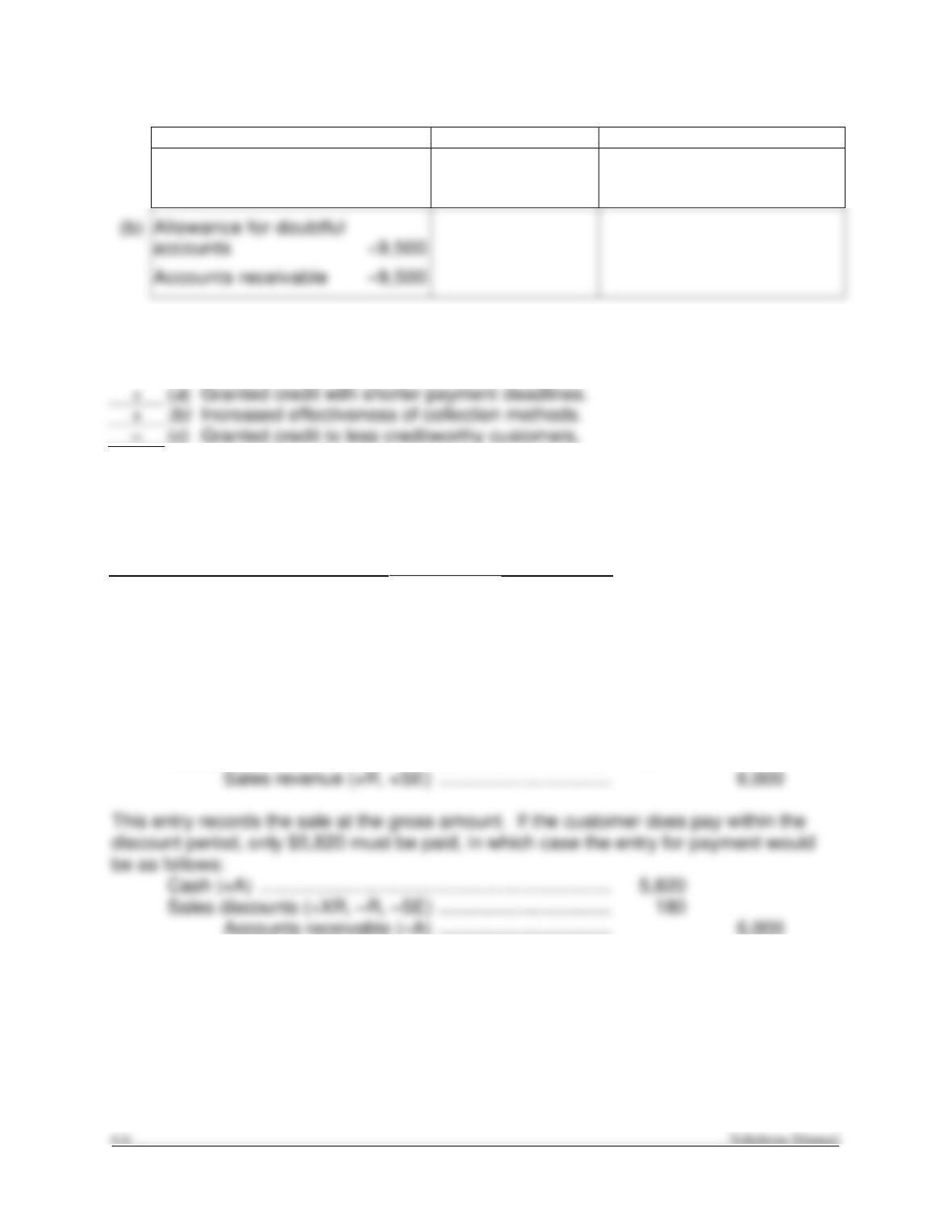
Net credit card sales
Sales on account (R)
Less: Sales returns (XR)
11,350.00
Less: Sales discounts (1/2 x $11,350 x 2%) (XR)
113.50
Net sales on account
Net sales (reported on income statement)
M6–4.
Assets
Liabilities
Stockholders’ Equity
(a)
Allowance for doubtful
accounts –15,000
Bad debt expense –15,000
M6–5.
M6–6.
Reconciling Item
Company’s
Books
Bank
Statement
(a) Outstanding checks
–
(b) Bank service charge
–
(c) Deposit in transit
+
M6–7. (Supplement)
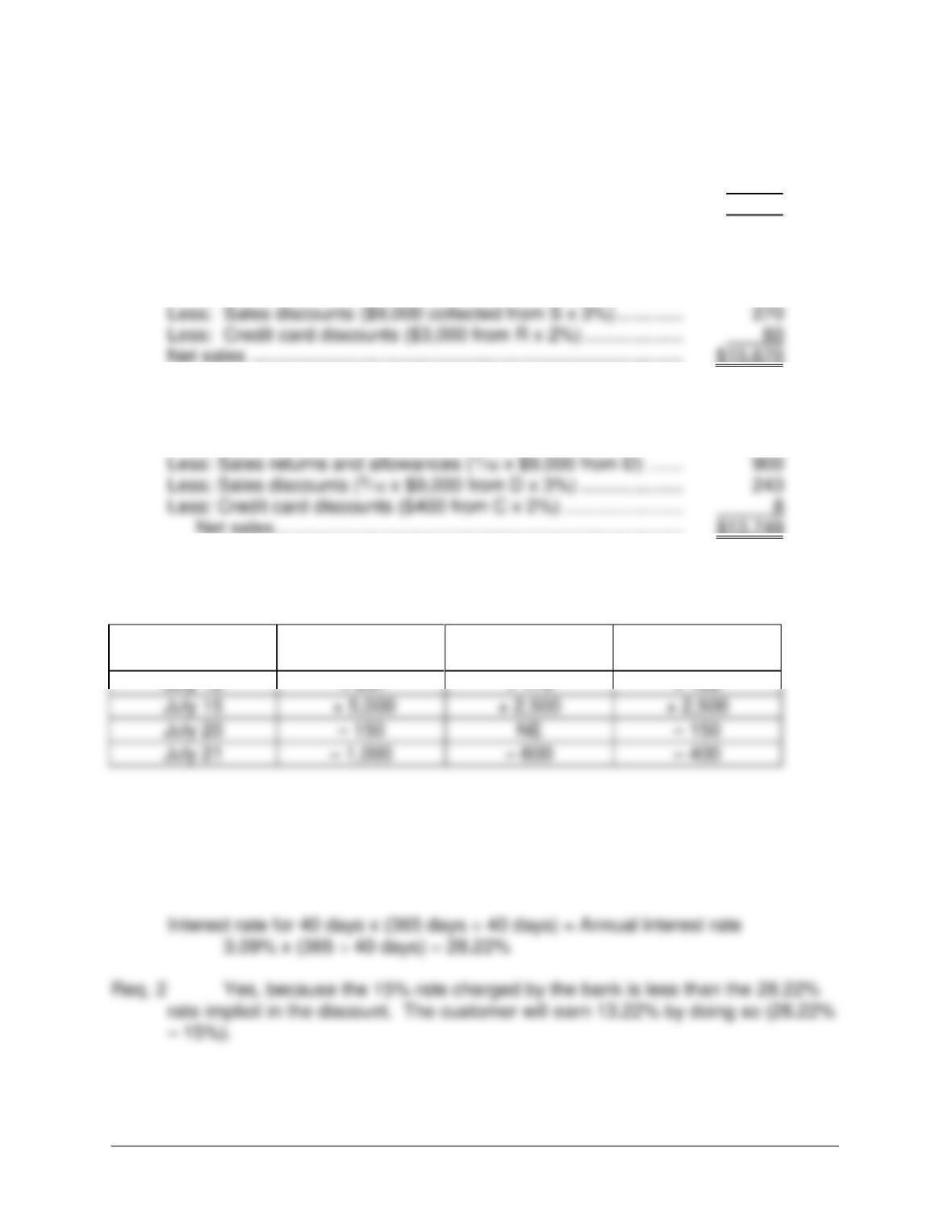
A $6,000 credit sale with terms, 3/10, n/30, should be recorded as follows:
Accounts receivable (+A) ……………………………………… 6,000
Financial Accounting, 9/e 6-7
EXERCISES
E6–1.
Sales revenue ($1,500 + $850 + $500) ………………………………. $2,850
Less: Sales discount ($1,500 collected from S. Green x 2%) … 30
Net sales ……………………………………………………………………….. $2,820
E6–2.
Sales revenue ($3,000 + $9,000 +$4,000) ………………………….. $16,000
E6–3.
Sales revenue ($5,500 + $400 + $9,000) ……………………………. $14,900
E6–4.
Cost of
Transaction
Net Sales
Goods Sold
Gross Profit
July 12
July 15
July 20
July 21
E6–5.
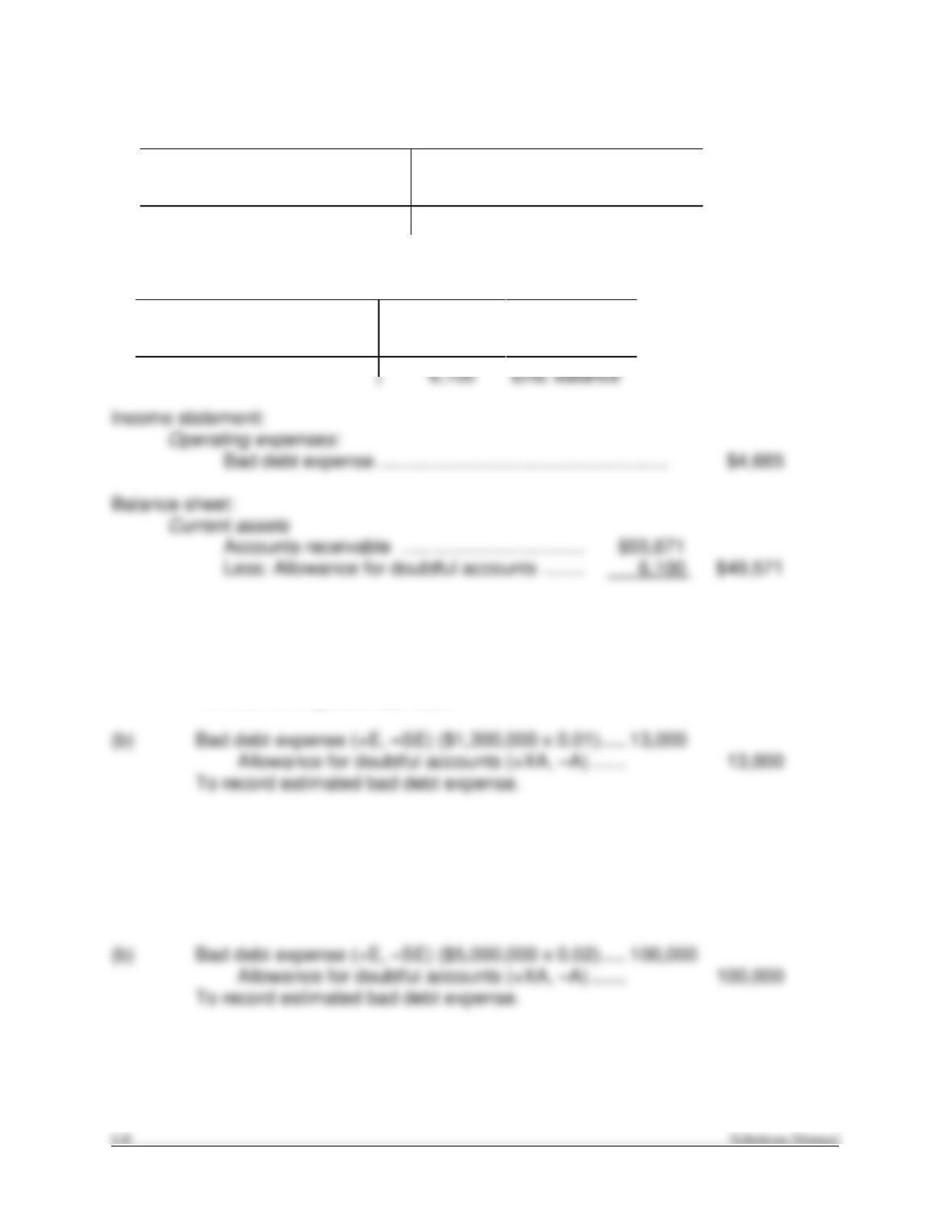
Req. 1 (Amount saved ÷ Amount paid) = Interest rate for 40 days.
(3% ÷ 97%) = 3.09% for 40 days.
E6–6.
Accounts Receivable (Gross)
Beg. balance
48,067
289,850
Collections on Acct.
Net sales
304,423
6,969
Write-offs
End. balance
55,671
Allowance for Doubtful Accounts
8,384
Beg. balance
Write-offs
6,969
4,685
Bad debt exp.
6,100
End. balance
E6–7.
(a) Allowance for doubtful accounts (–XA, +A) ………….. 4,000
Accounts receivable (–A) ……………………………. 4,000
To write off a specific bad debt.
E6–8.
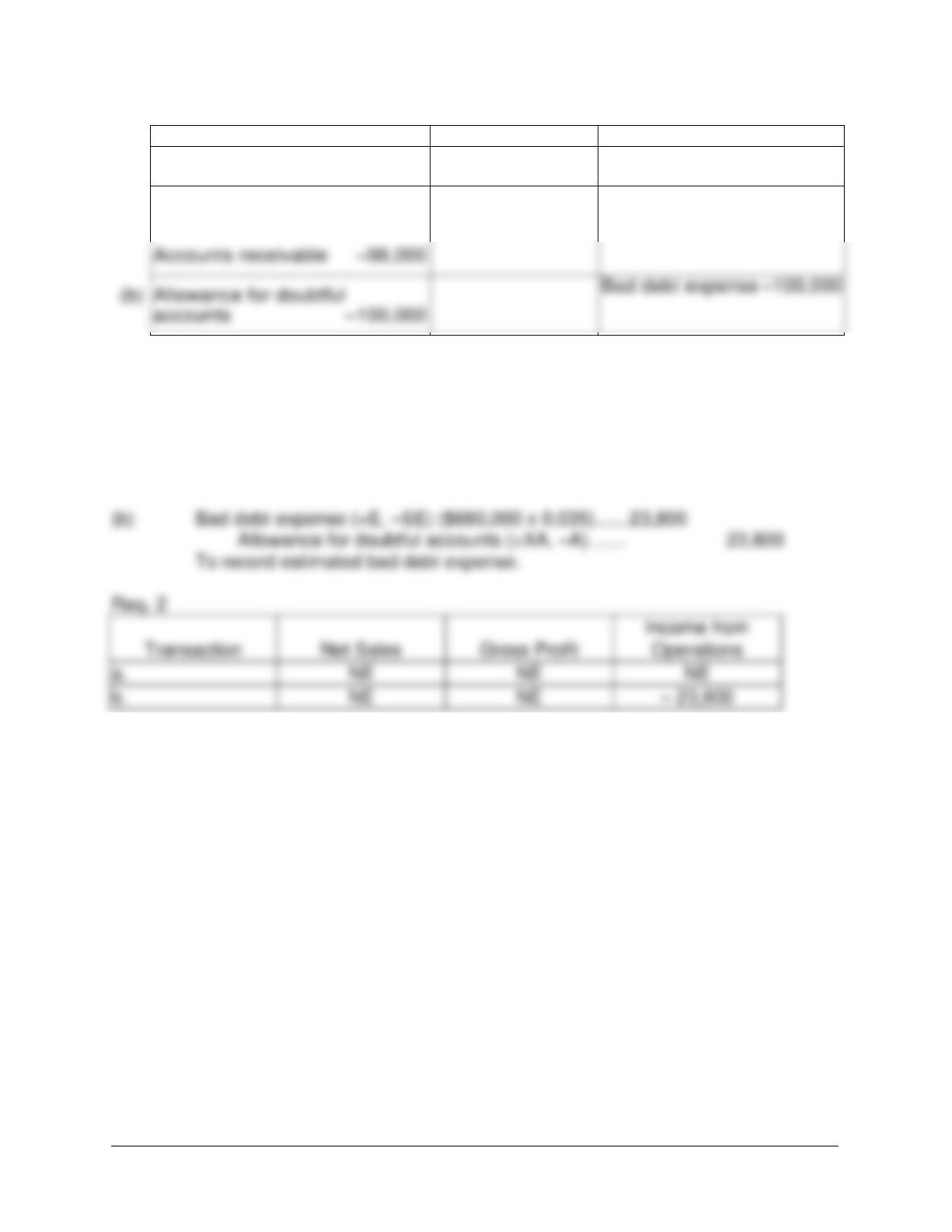
(a) Allowance for doubtful accounts (–XA, +A) ………….. 98,000
Accounts receivable (–A) ……………………………. 98,000
To write off a specific bad debt.
Financial Accounting, 9/e 6-9
E6–9.
Assets
Liabilities
Stockholders’ Equity
(a)
Allowance for doubtful
accounts +98,000
E6–10.
Req. 1
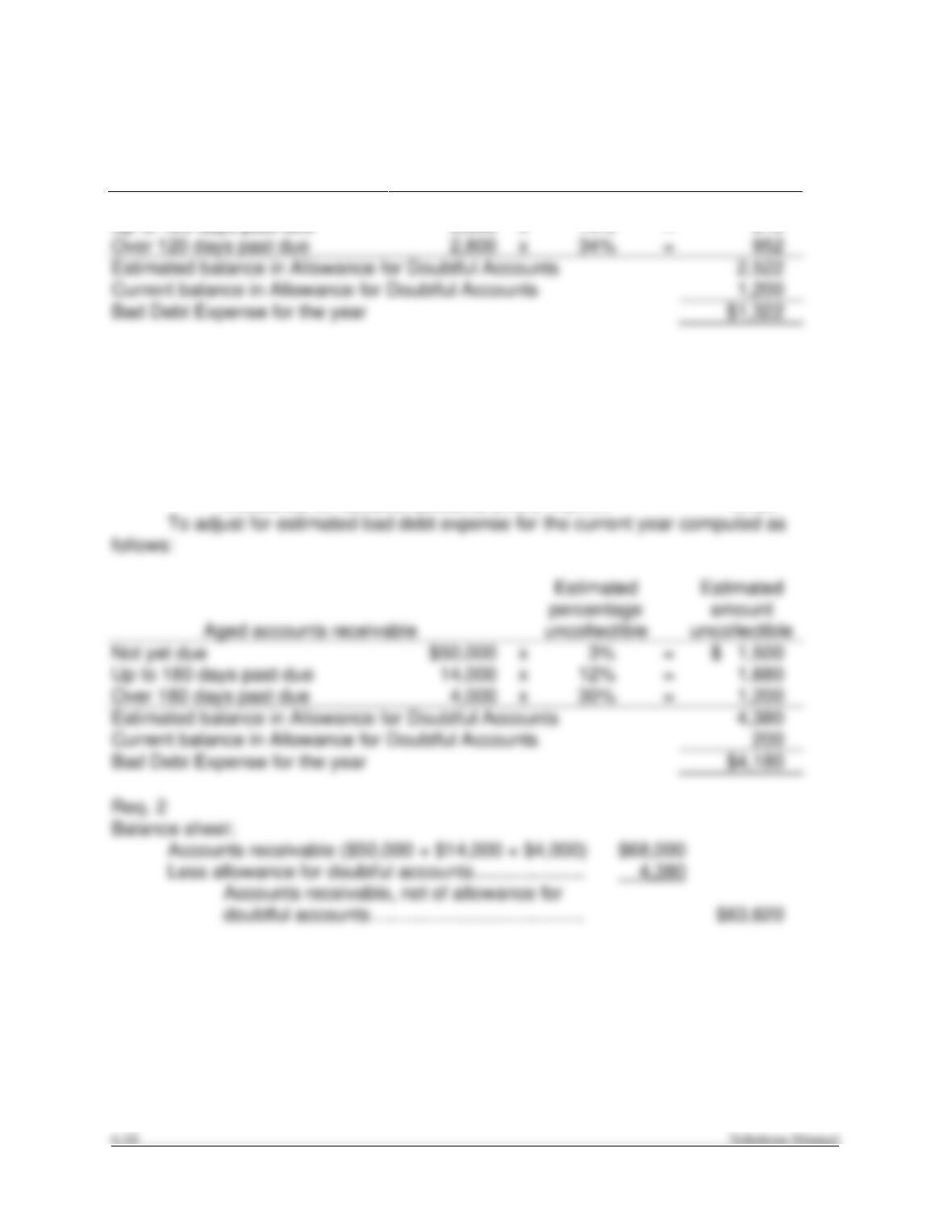
(a) Allowance for doubtful accounts (–XA, +A) ………….. 2,800
Accounts receivable (–A) ……………………………. 2,800
To write off a specific bad debt.
E6–11.
Aged accounts receivable
Estimated
percentage
uncollectible
Estimated
amount
uncollectible
Not yet due
$22,000
x
3%
=
$ 660
Up to 120 days past due
6,500
x
14%
=
910
Over 120 days past due
x
34%
=
952
Estimated balance in Allowance for Doubtful Accounts
Current balance in Allowance for Doubtful Accounts
Bad Debt Expense for the year
$1,322
E6–12.
Req. 1
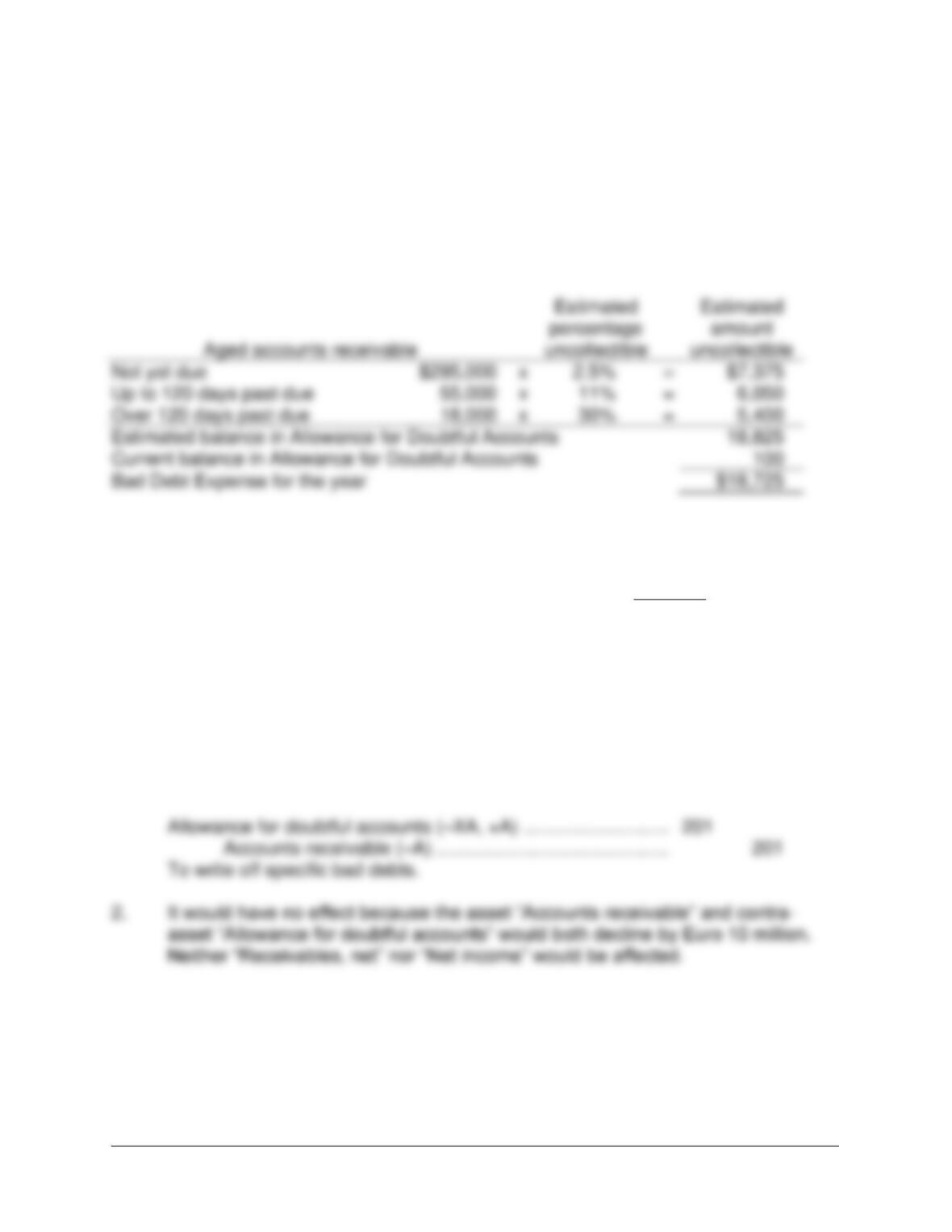
December 31-Adjusting entry:
Bad debt expense (+E, –SE) ………………………………… 4,180
Allowance for doubtful accounts (+XA, –A) ……. 4,180
Aged accounts receivable
Estimated
percentage
uncollectible
Estimated
amount
uncollectible
Not yet due
x
=
Up to 180 days past due
x
12%
=
Over 180 days past due
4,000
x
30%
=
Estimated balance in Allowance for Doubtful Accounts
Current balance in Allowance for Doubtful Accounts
200
Bad Debt Expense for the year
Financial Accounting, 9/e 6-11
E6–13.
Req. 1
December 31-Adjusting entry:
Bad debt expense (+E, –SE) ………………………………… 18,725
Allowance for doubtful accounts (+XA, –A) ……. 18,725
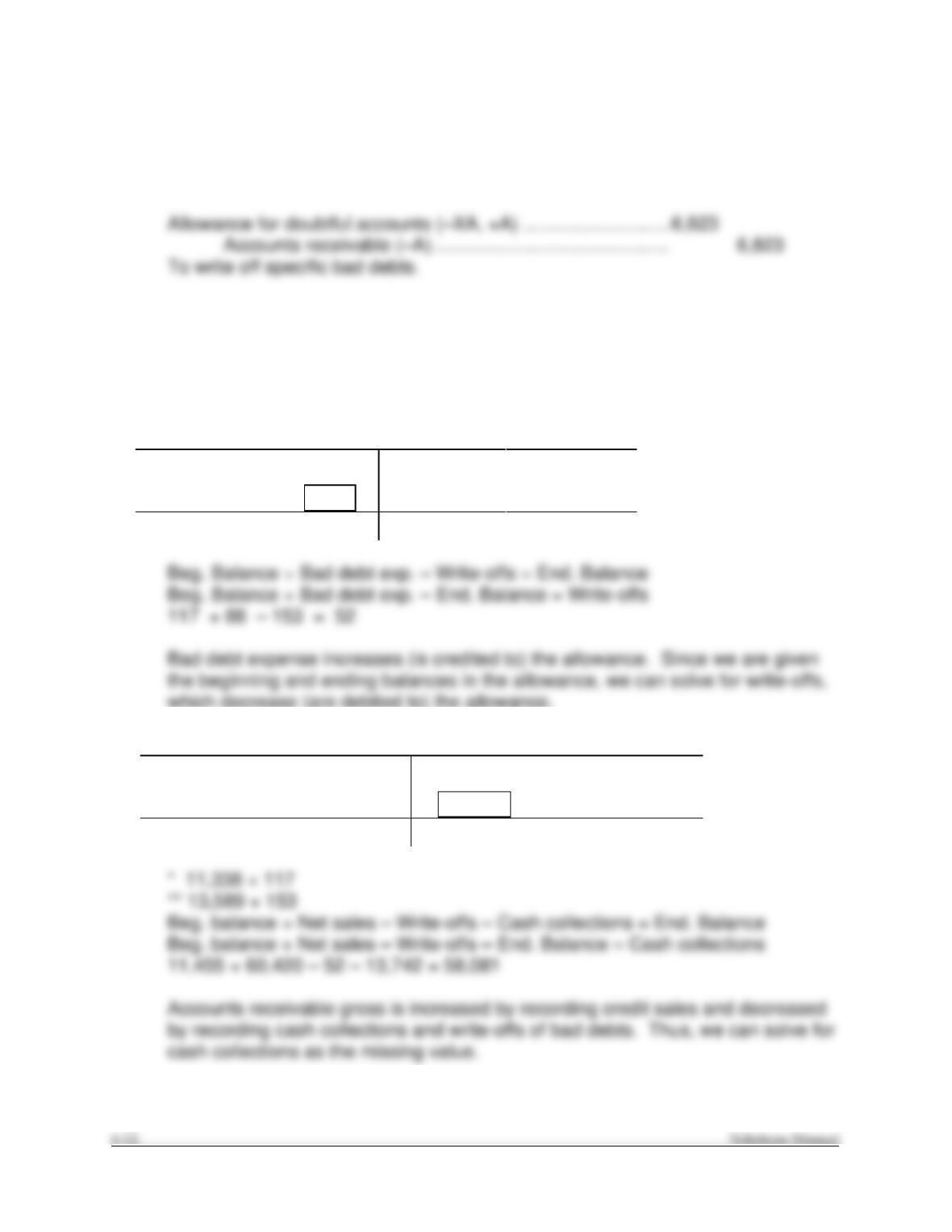
To adjust for estimated bad debt expense for the current year computed as
follows:
Req. 2
Balance sheet: December 31 current year
Accounts receivable ($295,000 + $55,000 + $18,000) $368,000
Less allowance for doubtful accounts ………………… 18,825
Accounts receivable, net of allowance for
doubtful accounts ………………………………….. $349,175
E6–14.
1. Bad debt expense (+E, –SE) …………………………………………. 213
Allowance for doubtful accounts (+XA, –A) ……………… 213
To record estimated bad debt expense.
E6–15.
1. Bad debt expense (+E, –SE) …………………………………………. 6,284
Allowance for doubtful accounts (+XA, –A) ……………… 6,284
To record estimated bad debt expense.
2. It would have no effect because the asset “Accounts receivable” and contra–
asset “Allowance for doubtful accounts” would both increase by $15 thousand.
Neither “Receivables, net” nor “Net income” would be affected.
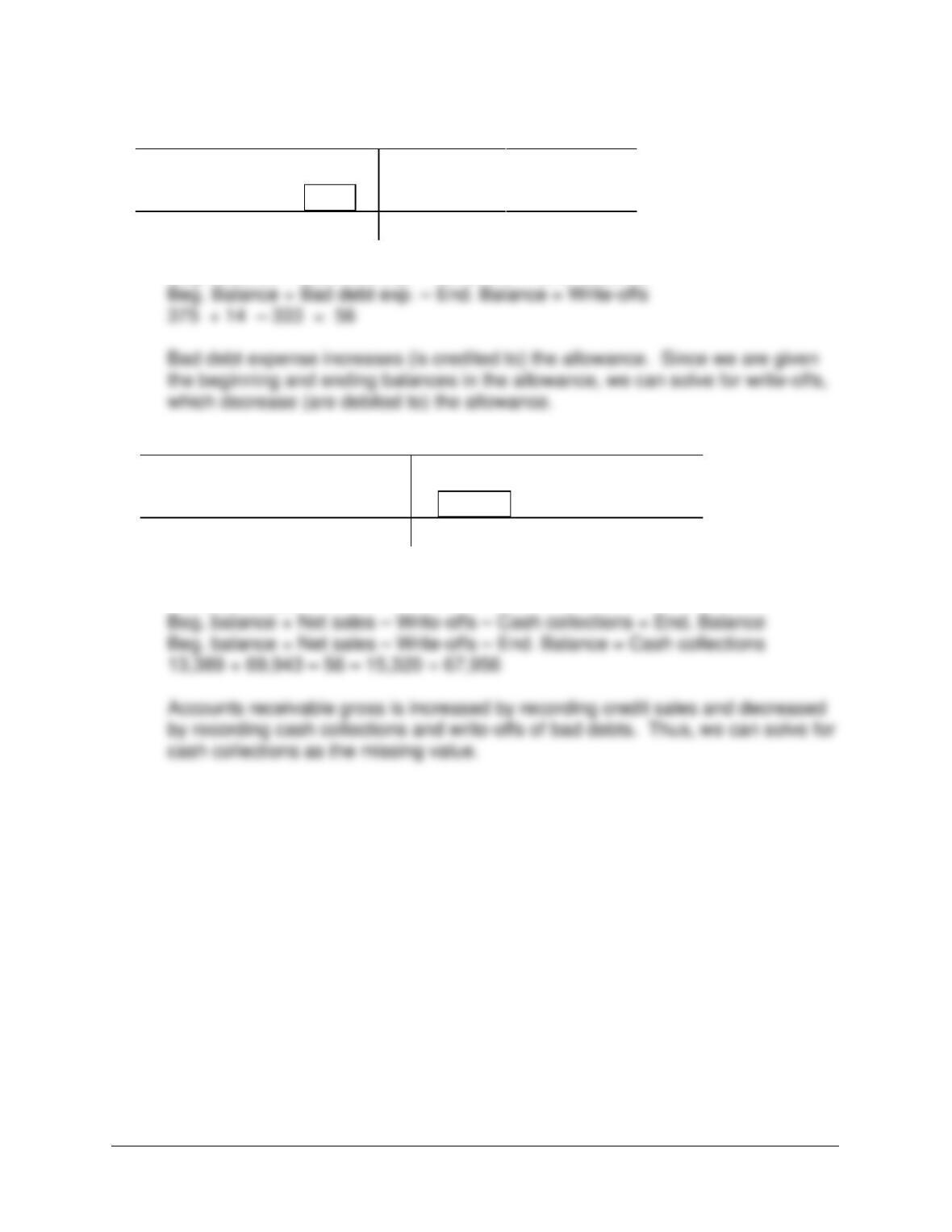
E6–16.
Req. 1 Allowance for Doubtful Accounts
117
Beg. balance
Write-offs
52
88
Bad debt exp.
153
End. balance
which decrease (are debited to) the allowance.
Req. 2 Accounts Receivable (Gross)
Beg. balance*
11,455
52
Write-offs
Net sales
60,420
58,081
Cash collections
End. balance **
13,742
Financial Accounting, 9/e 6-13
E6–17.
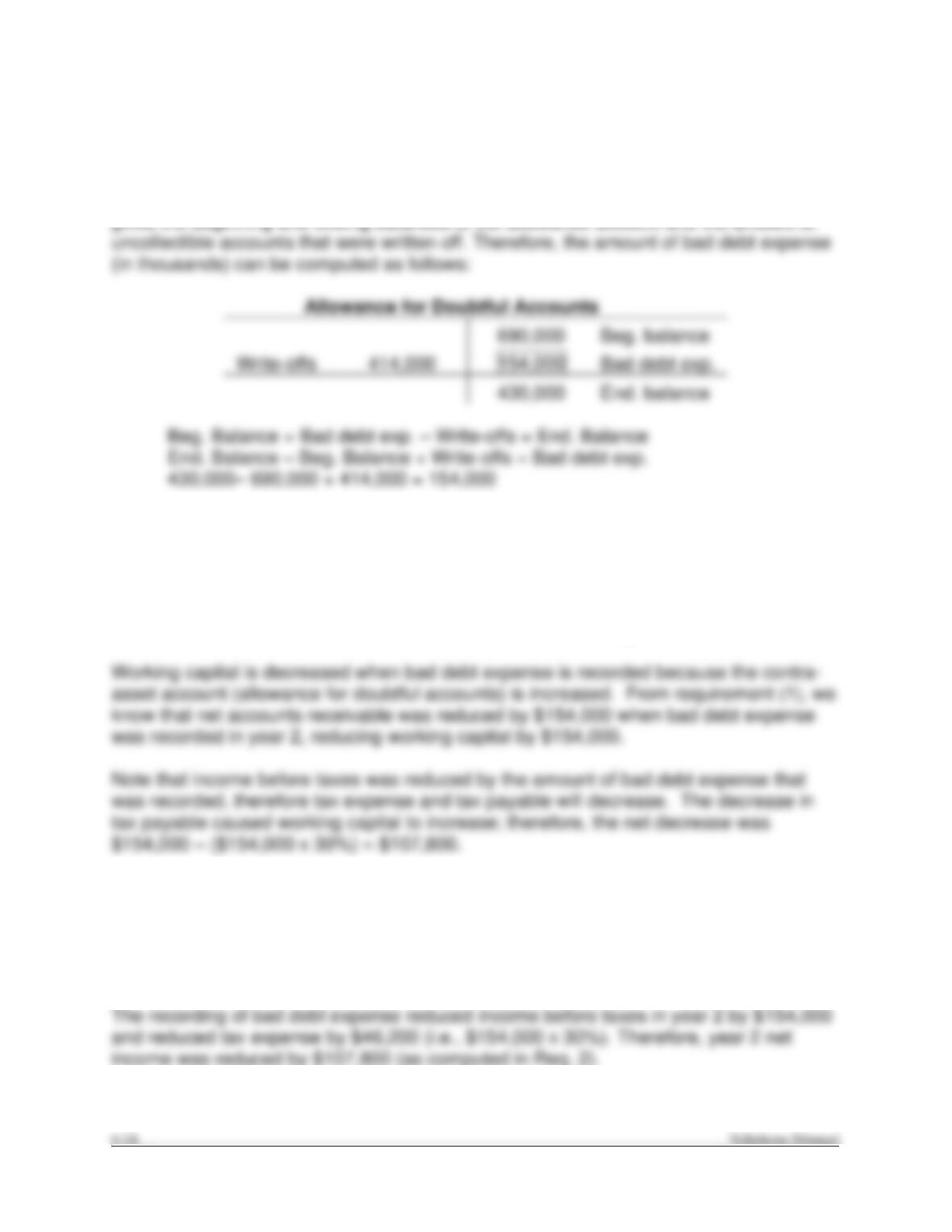
Req. 1 Allowance for Doubtful Accounts
375
Beg. balance
Write-offs
56
14
Bad debt exp.
333
End. balance
Beg. Balance + Bad debt exp. – Write-offs = End. Balance
Req. 2 Accounts Receivable (Gross)
Beg. balance*
13,389
56
Write-offs
Net sales
69,943
67,956
Cash collections
End. balance **
15,320
* 13,014 + 375
** 14,987 + 333
E6–18.
Req. 1
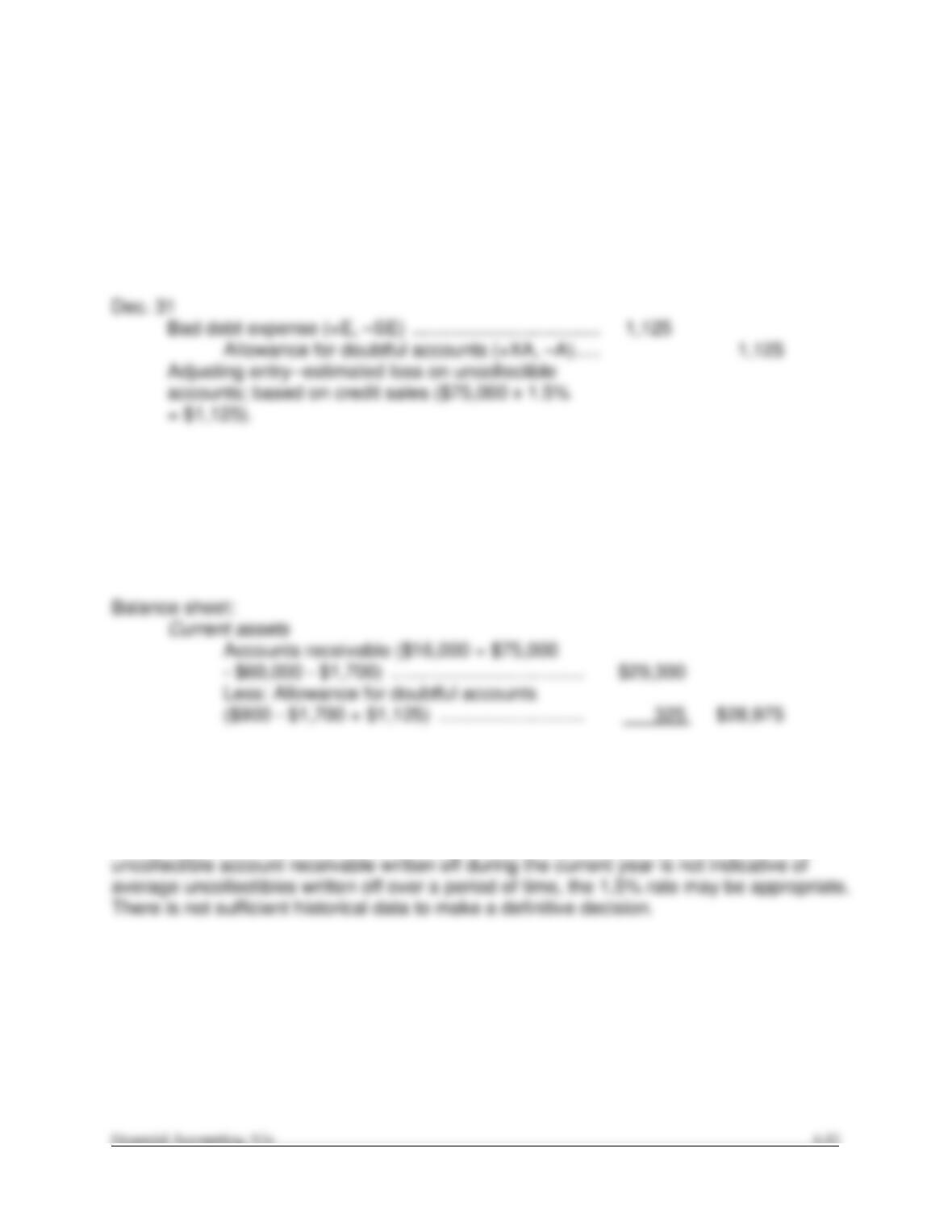
The allowance for doubtful accounts is increased (credited) when bad debt expense is
recorded and decreased (debited) when uncollectible accounts are written off. This case
Req. 2
Working capital is unaffected by the write-off of an uncollectible account when the
allowance method is used. The asset account (accounts receivable) and the contra–
asset account (allowance for doubtful accounts) are both reduced by the same amount;
therefore, the book value of net accounts receivable is unchanged.
Req. 3
The entry to record the write-off of an uncollectible account did not affect any income
statement accounts; therefore, net income is unaffected by the $414,000 write-off in
year 2.
E6–19.
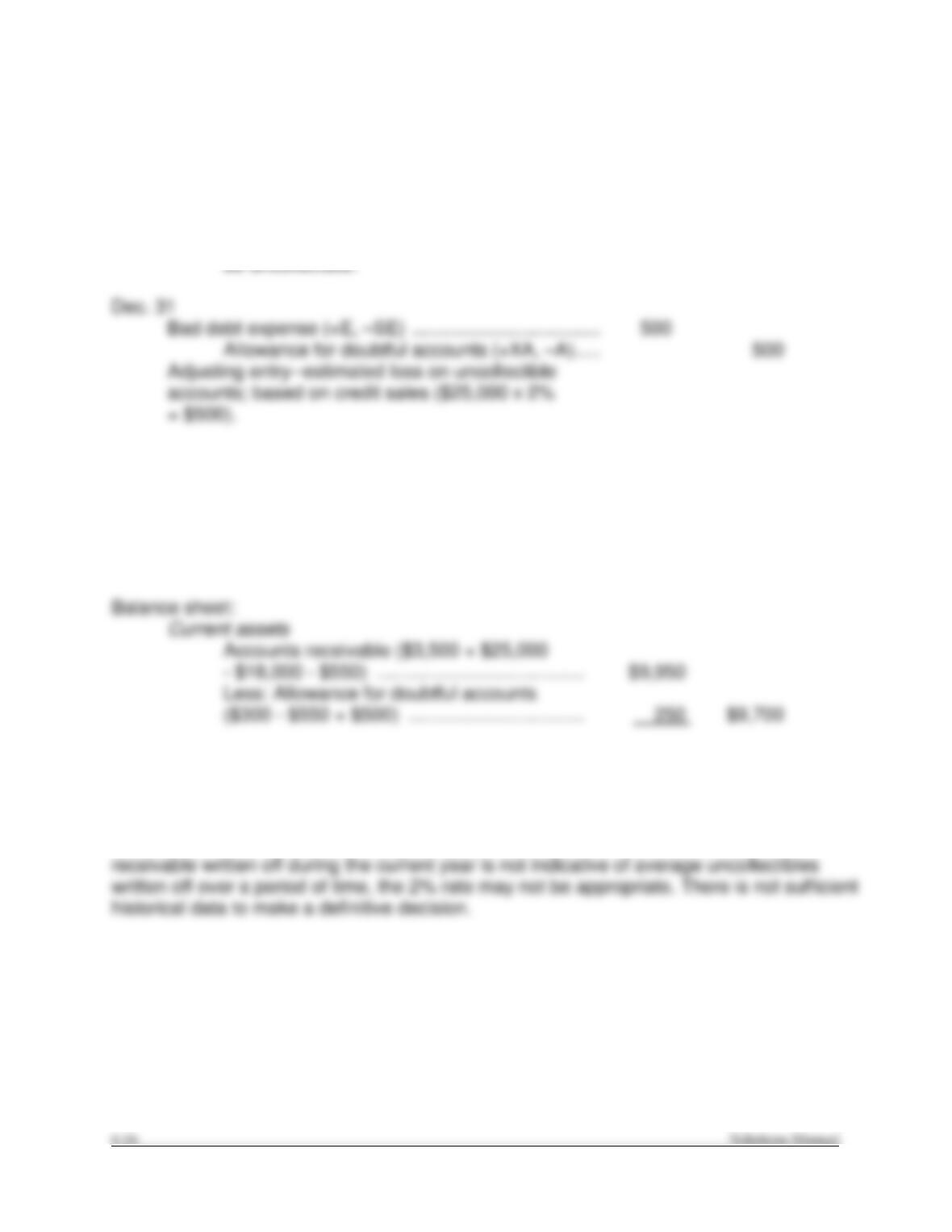
Req. 1
Dec. 31
Allowance for doubtful accounts (–XA, +A) …………… 1,700
Accounts receivable (J. Doe) (–A) ……………… 1,700
To write off an account receivable determined to
be uncollectible.
Req. 2
Income statement:
Operating expenses:
Bad debt expense ……………………………………………….. $1,125
Req. 3
The 1.5% rate on credit sales may be too low because it resulted in bad debt expense only
two-thirds the amount of receivables written off ($1,700) during the year. However, if the
E6–20.
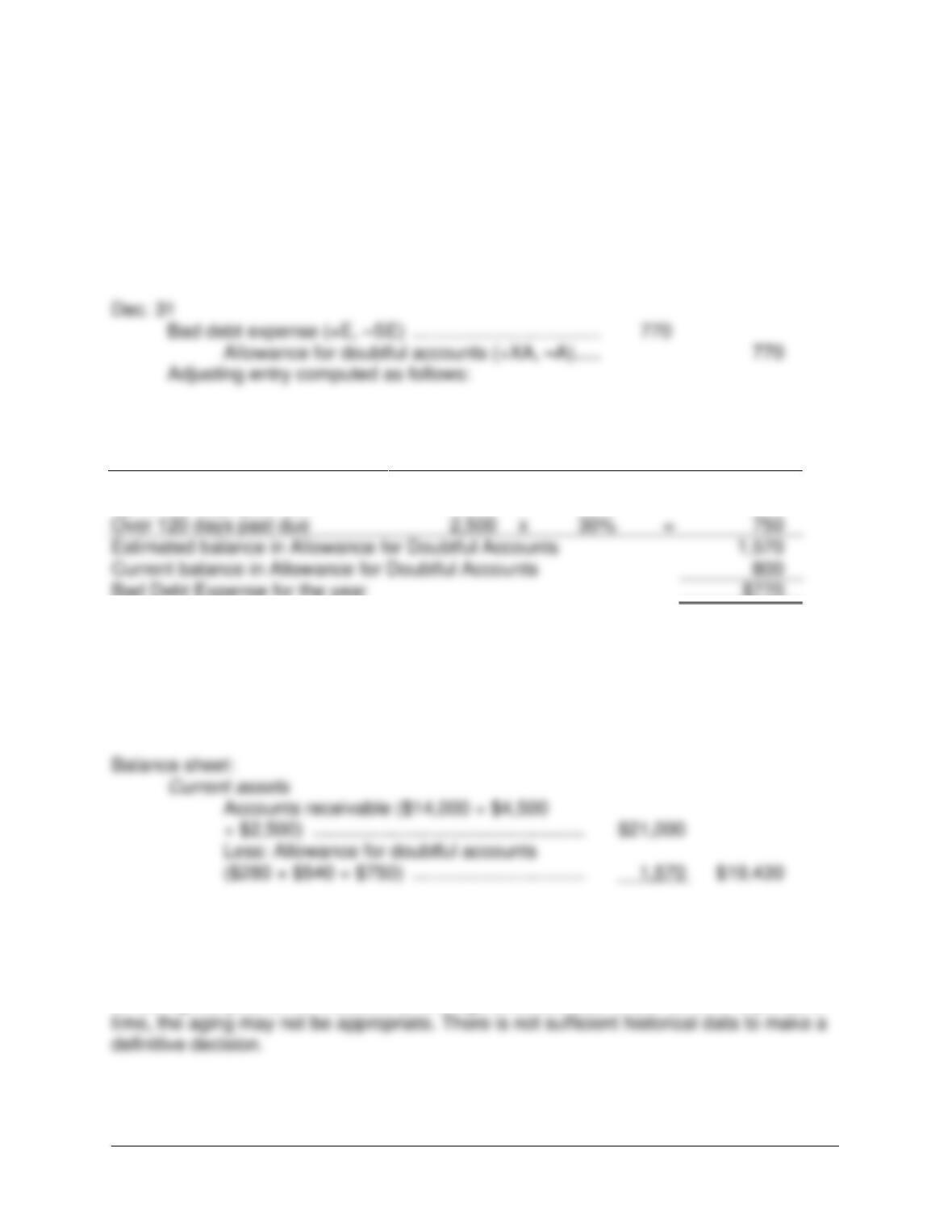
Req. 1
Dec. 31
Allowance for doubtful accounts (–XA, +A) …………… 550
Accounts receivable (Toby’s Gift Shop) (–A) .. 550
To write off an account receivable determined to
Req. 2
Income statement:
Operating expenses:
Bad debt expense ……………………………………………….. $500
Req. 3
The 2% rate on credit sales appears reasonable because it approximates the amount of
receivables written off ($550) during the year. However, if the uncollectible account
Financial Accounting, 9/e 6-17
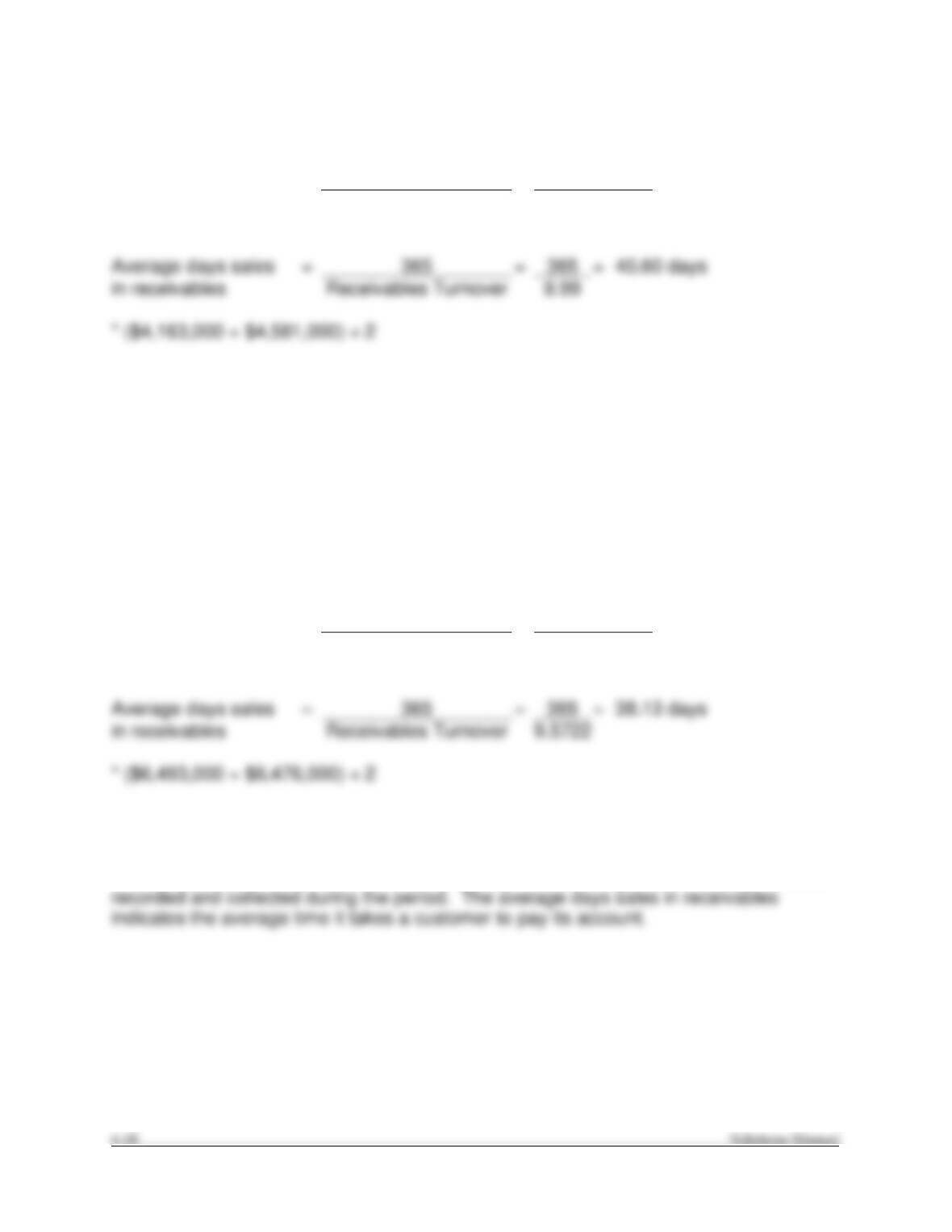
E6–21.
Req. 1
Dec. 31
Allowance for doubtful accounts (–XA, +A) …………… 750
Accounts receivable (Patty’s Bake Shop) (–A) 750
To write off an account receivable determined to
be uncollectible.
Aged accounts receivable
Estimated
percentage
uncollectible
Estimated
amount
uncollectible
Not yet due
$14,000
x
2%
=
$ 280
Up to 120 days past due
4,500
x
12%
=
540
Over 120 days past due
2,500
x
30%
=
750
Estimated balance in Allowance for Doubtful Accounts
Current balance in Allowance for Doubtful Accounts
800
Bad Debt Expense for the year
$770
Req. 2
Income statement:
Operating expenses:
Bad debt expense ……………………………………………….. $770
Req. 3
The aging analysis seems reasonable because it approximates the amount of receivables
written off ($750) during the year. However, if the uncollectible account receivable written
off during the year is not indicative of average uncollectibles written off over a period of
E6–22.
Req. 1
Receivables turnover
=
Net Sales
=
$39,304,000
=
8.99 times
Average Net Trade
Accounts Receivable
$4,372,000*
Average days sales
=
=
=
40.60 days
in receivables
Receivables Turnover
Req. 2
The receivables turnover ratio reflects how many times average trade receivables were
recorded and collected during the period. The average days sales in receivables
indicates the average time it takes a customer to pay its account.
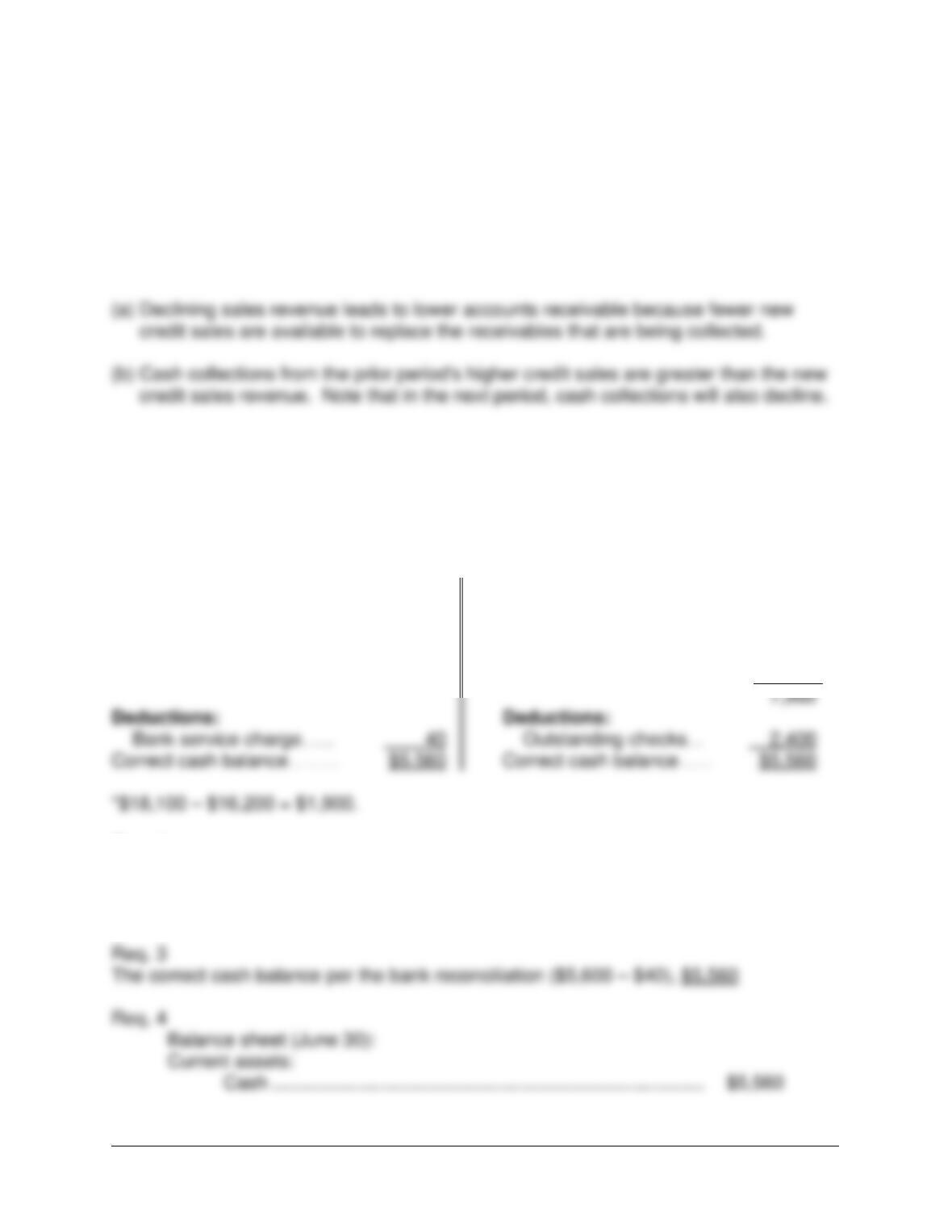
E6–23.
Req. 1
Receivables turnover
=
Net Sales
=
$62,071,000
=
9.5722 times
Average Net Trade
Accounts Receivable
$6,484,500*
Average days sales
=
=
=
38.13 days
in receivables
Receivables Turnover
Req. 2
The receivables turnover ratio reflects how many times average trade receivables were
Financial Accounting, 9/e 6-19
E6–24.
Req. 1
The change in the accounts receivable balance ($48,066 – 63,403 = –$15,337) would
increase cash flow from operations by $15,337 thousand. This happens because the
Company is collecting cash faster than it is recording credit sales revenue.
Req. 2
E6–25.
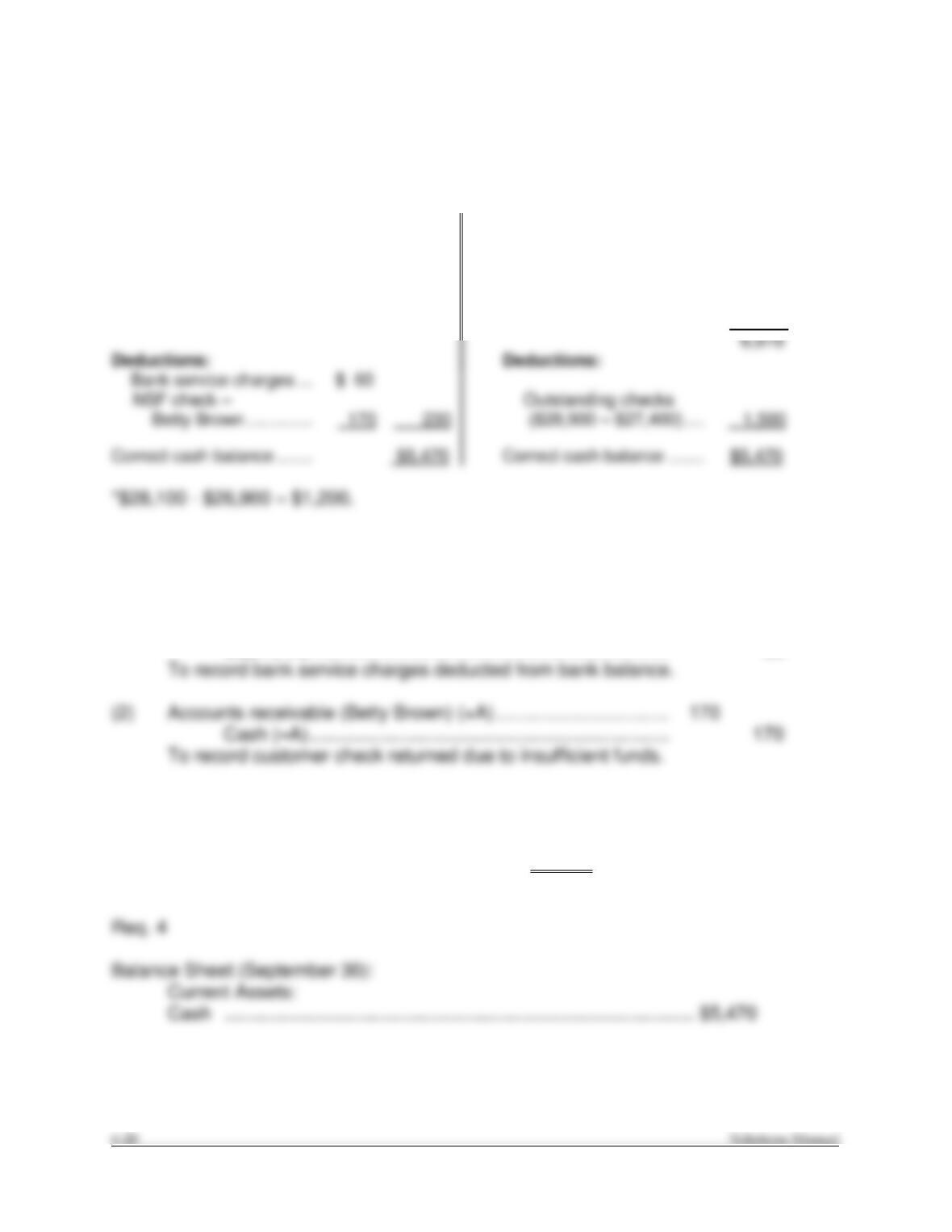
Req. 1
BENTLEY COMPANY
Bank Reconciliation, June 30
Company’s Books
Bank Statement
Ending balance per Cash
account………………………
$5,600
Ending balance per bank
statement………………
$6,060
Additions:
Additions:
None
Deposit in transit…………
1,900*
Deductions:
Deductions:
Bank service charge……
40
Outstanding checks…
Correct cash balance………
$5,560
Correct cash balance……
Req. 2
Bank service charge expense (+E, –SE) …………………………….. 40
Cash (–A) ……………………………………………………….…….. 40
To record deduction from bank account for service charges.
E6–26.
Req. 1
BENNETT COMPANY
Bank Reconciliation, September 30
Company’s Books
Bank Statement
Ending balance per Cash
account ………………………
$5,700
Ending balance per bank
statement ……………………
$5,770
Additions:
Additions:
None
Deposit in transit* ………
1,200*
Deductions:
Deductions:
Correct cash balance …….
$5,470
Correct cash balance …….
Req. 2
(1) Bank service charge expense (+E, –SE) ………………………….. 60
Cash (–A) ……………………………………………………….….. 60
Req. 3
Same as the correct balance on the reconciliation, $5,470.