Chapter 6
6-1 Absorption and variable costing differ in
how they handle fixed manufacturing overhead.
Under absorption costing, fixed manufacturing
overhead is treated as a product cost and hence
is an asset until products are sold. Under
variable costing, fixed manufacturing overhead
is treated as a period cost and is immediately
expensed on the income statement.
6-2 Selling and administrative expenses are
treated as period costs under both variable
costing and absorption costing.
6-3 Under absorption costing, fixed
manufacturing overhead costs are included in
6-4 Absorption costing advocates argue that
absorption costing does a better job of matching
6-5 Advocates of variable costing argue that
fixed manufacturing costs are not really the cost
of any particular unit of product. If a unit is
made or not, the total fixed manufacturing costs
will be exactly the same. Therefore, how can
one say that these costs are part of the costs of
the products? These costs are incurred to have
the capacity to make products during a
particular period and should be charged against
that period as period costs according to the
matching principle.
6-6 If production and sales are equal, net
operating income should be the same under
absorption and variable costing. When
production equals sales, inventories do not
increase or decrease and therefore under
absorption costing fixed manufacturing overhead
cost cannot be deferred in inventory or released
from inventory.
manufacturing overhead cost of the current
period is immediately expensed under variable
the level of production without any increase in
sales. If production exceeds sales, units of
product are added to inventory. These units
carry a portion of the current period’s fixed
manufacturing overhead costs into the inventory
account, reducing the current period’s reported
expenses and causing net operating income to
increase.
6-10 Differences in reported net operating
income between absorption and variable costing
arise because of changing levels of inventory. In
Lean Production, goods are produced strictly to
customers’ orders. With production tied to sales,
inventories are largely (or entirely) eliminated. If
inventories are completely eliminated, they
cannot change from one period to another and
absorption costing and variable costing will
report the same net operating income.
6-11 A segment is any part or activity of an
organization about which a manager seeks cost,
revenue, or profit data. Examples of segments
include departments, operations, sales
territories, divisions, and product lines.
6-12 Under the contribution approach, costs
6-13 A traceable fixed cost of a segment is a
cost that arises specifically because of the
existence of that segment. If the segment were
eliminated, the cost would disappear. A common
fixed cost, by contrast, is a cost that supports
more than one segment, but is not traceable in
depreciation of machines shared by several
departments.
6-14 The contribution margin is the difference
between sales revenue and variable expenses.
The segment margin is the amount remaining
after deducting traceable fixed expenses from
the contribution margin. The contribution margin
is useful as a planning tool for many decisions,
particularly those in which fixed costs don’t
change. The segment margin is useful in
assessing the overall profitability of a segment.
6-15 If common fixed costs were allocated to
segments, then the costs of segments would be
overstated and their margins would be
understated. As a consequence, some segments
may appear to be unprofitable and managers
may be tempted to eliminate them. If a segment
were eliminated because of the existence of
arbitrarily allocated common fixed costs, the
overall profit of the company would decline and
6-16 There are often limits to how far down
an organization a cost can be traced. Therefore,
fixed costs that are traceable to a segment may
become common as that segment is divided into
smaller segment units. For example, the costs of
national TV and print advertising might be
traceable to a specific product line, but be a
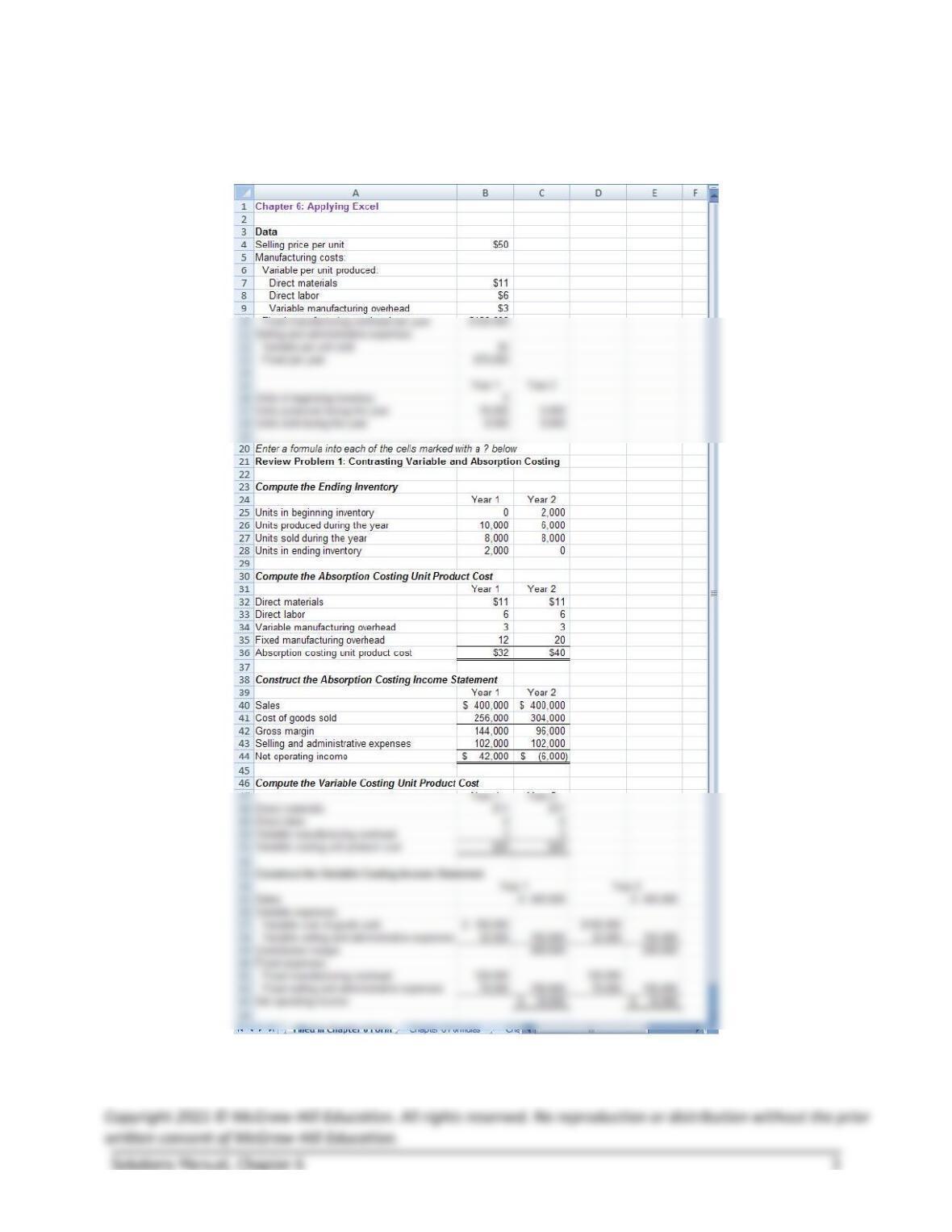
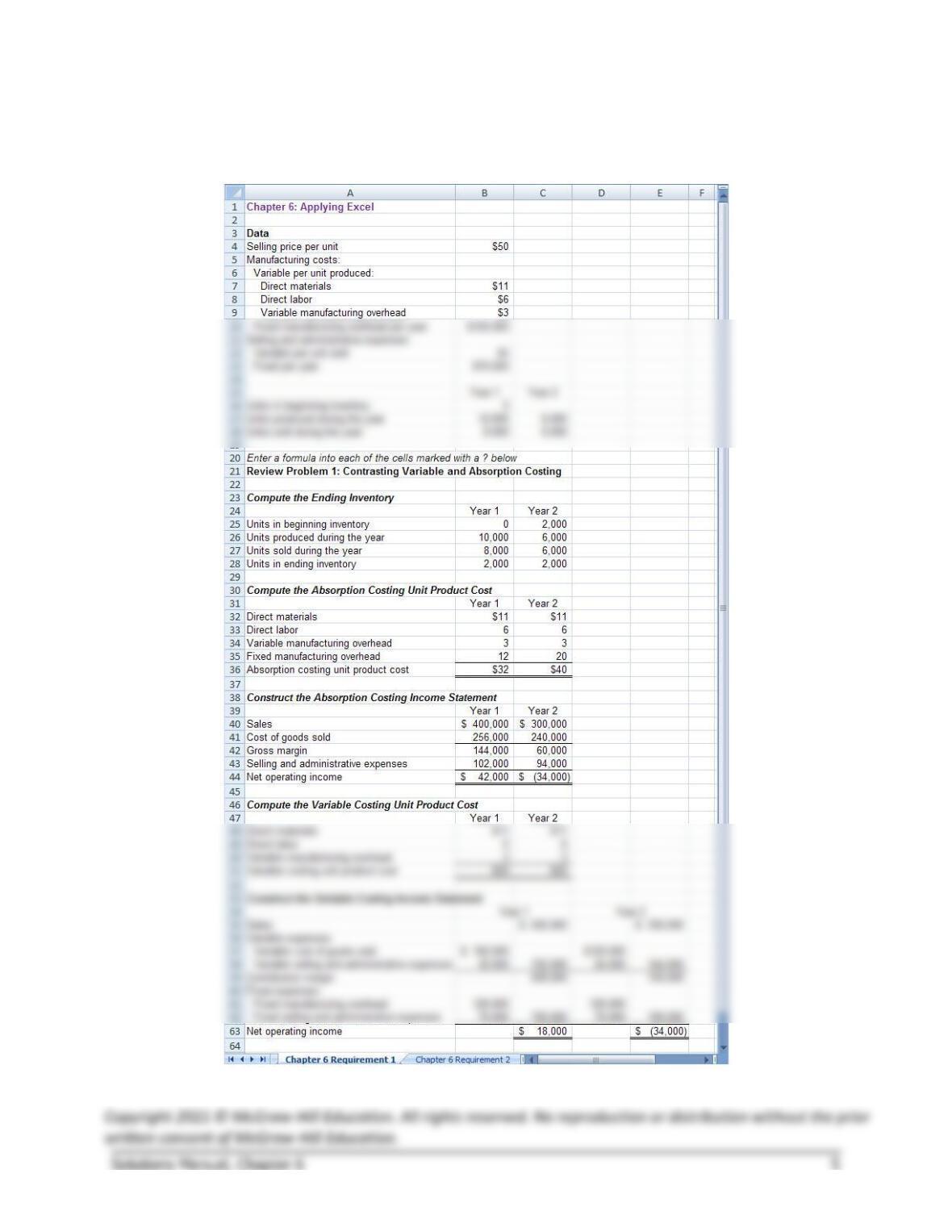
Chapter 6: Applying Excel
The completed worksheet is shown below.
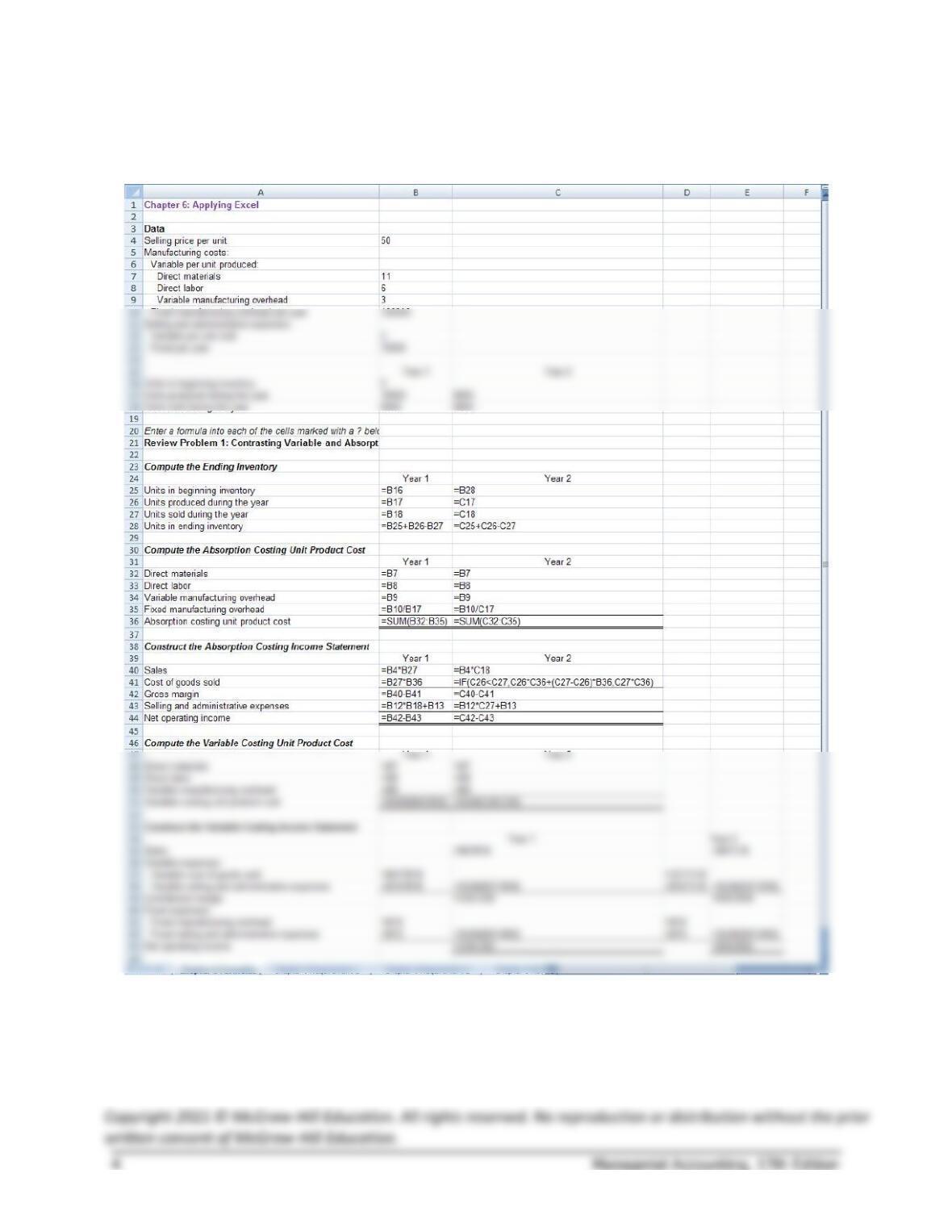
Chapter 6: Applying Excel (continued)
The completed worksheet, with formulas displayed, is shown below.
Note: This worksheet assumes that the beginning inventory in Year 1 is
zero. If this were not true, the worksheet would have to be modified. Also
note that the formula in Cell C41 contains an IF statement because of the
LIFO inventory flow assumption that is used throughout the chapter.
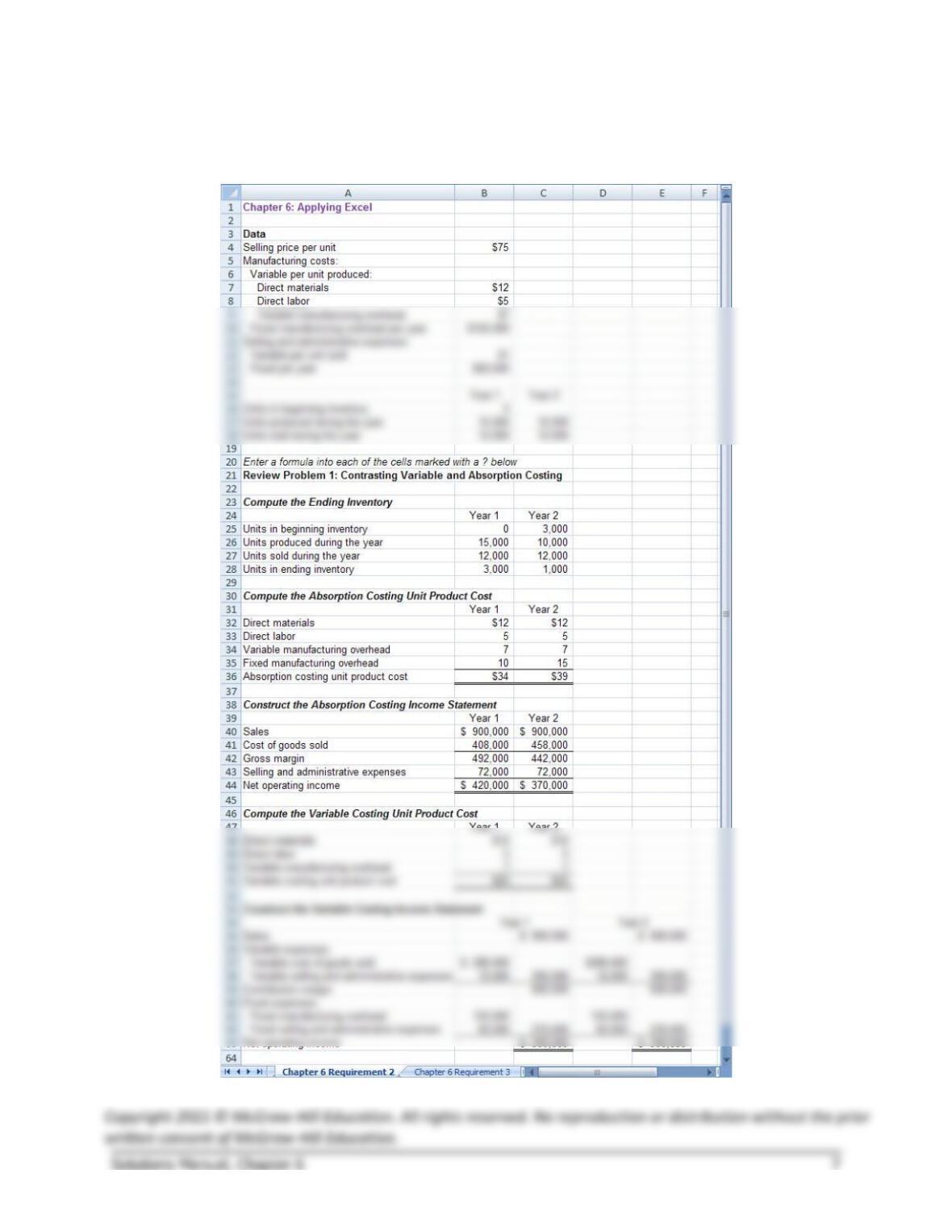
Chapter 6: Applying Excel (continued)
1. When the units sold in Year 2 are changed to 6,000, the result is:

Chapter 6: Applying Excel (continued)
If the units produced equals the units sold, under the LIFO assumption,
all of the fixed manufacturing overhead from Year 2 flows to the income
statement under absorption costing. No fixed manufacturing overhead is
released from or deferred in inventories. Therefore, absorption costing
net operating income equals variable costing net operating income.
Chapter 6: Applying Excel (continued)
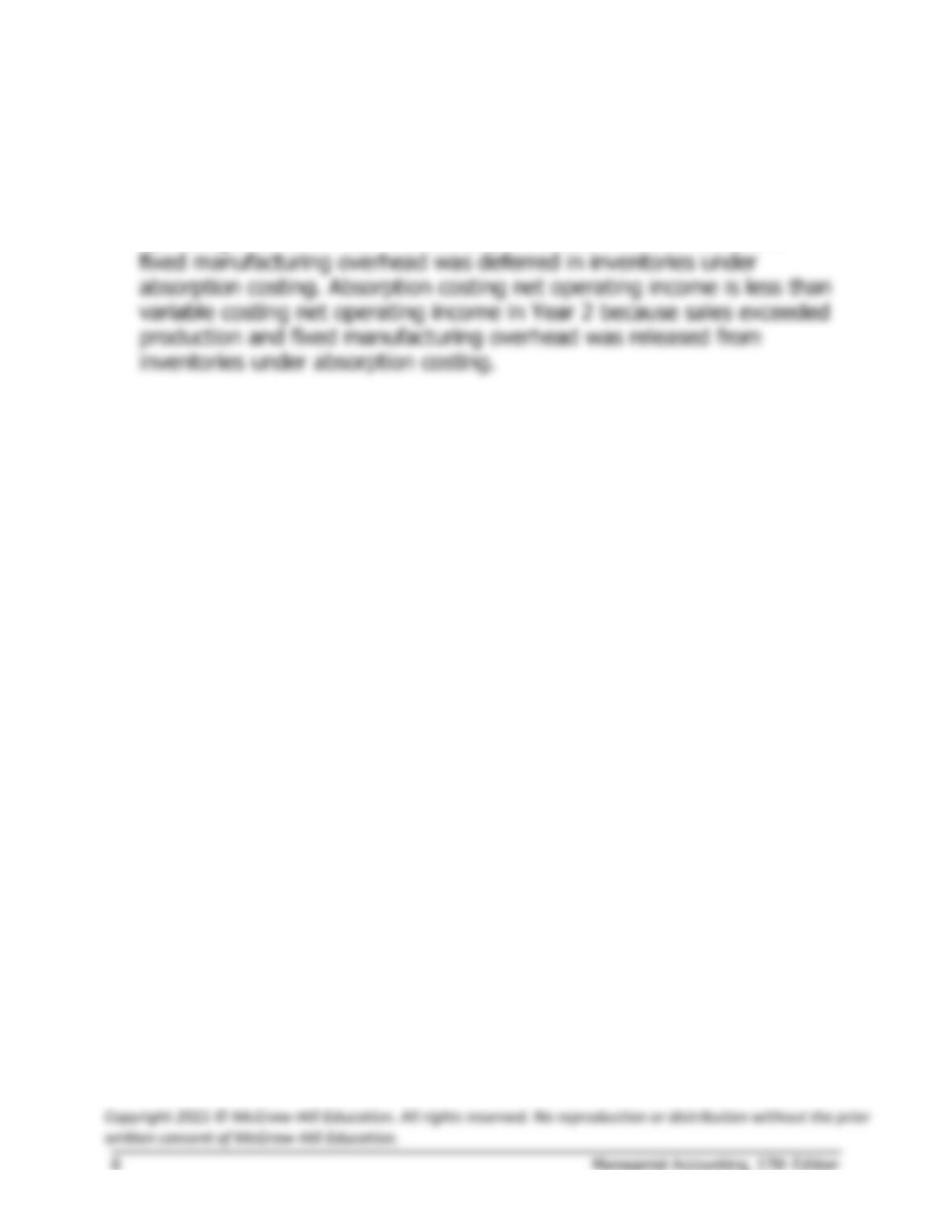
2. With the changes in the data, the worksheet should look like this:
Chapter 6: Applying Excel (continued)
The variable costing net operating income is the same in Year 1 and
Year 2 because the sales are the same in the two years—12,000 units.
Absorption costing net operating income exceeds variable costing net
operating income in Year 1 because production exceeded sales and
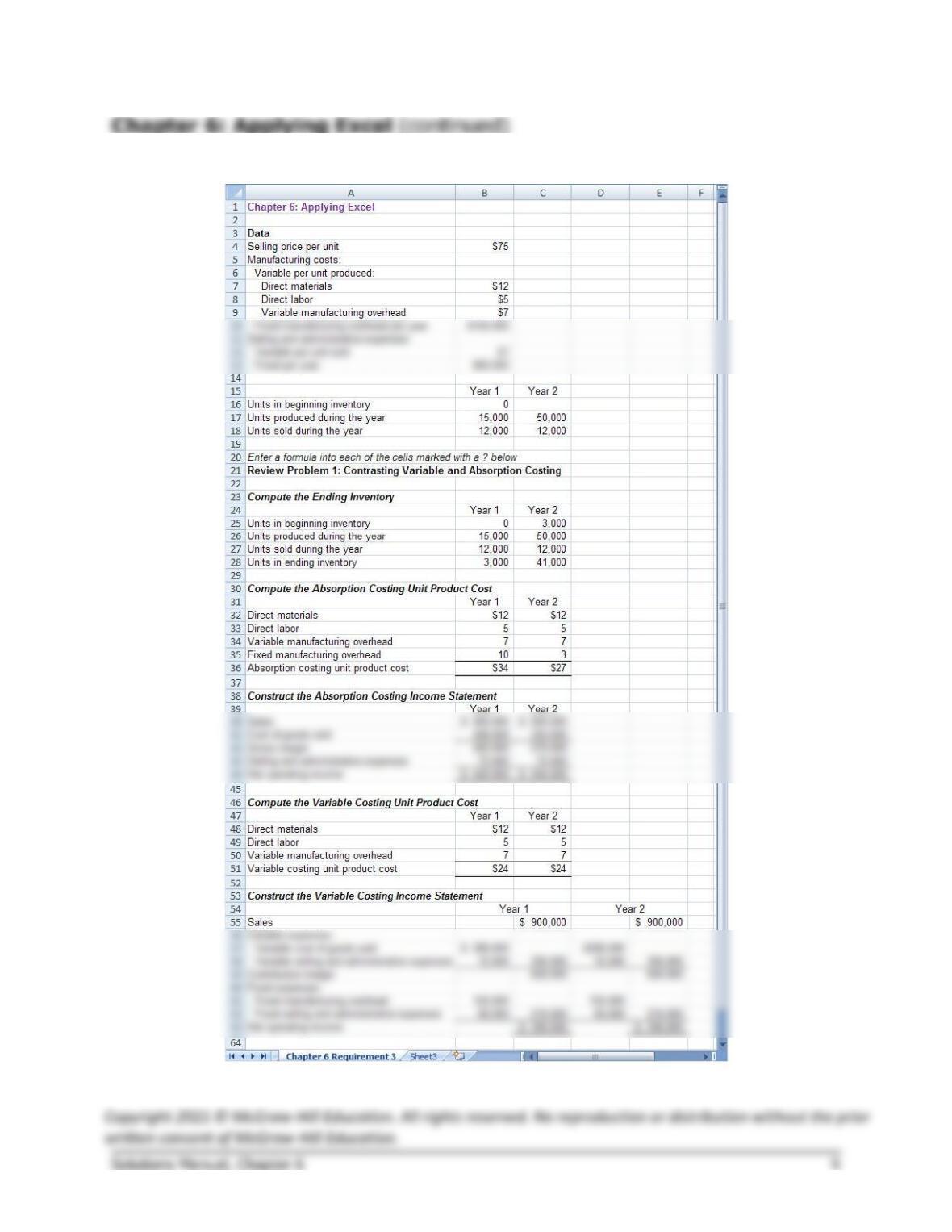
3. With the increase in units produced in Year 2, the result is:
Chapter 6: Applying Excel (continued)
Increasing the production in Year 2 to 50,000 units while keeping
everything else the same—including the unit sales—would result in
absorption costing net operating income of $504,000 and payment of
the bonus. However, it would also result in huge ending inventories that
exceed the normal sales by several times. These huge inventories are
The Foundational 15
1. and 2.
The unit product costs under variable costing and absorption costing are
computed as follows:
Variable
Costing
Absorption
Costing
Direct materials …………………………
$24
$24
Direct labor ………………………………
14
14
Variable manufacturing overhead ….
2
2
Fixed manufacturing overhead
($800,000 ÷ 40,000 units) ………..
—
20
Unit product cost ……………………….
$40
$60
3. and 4.
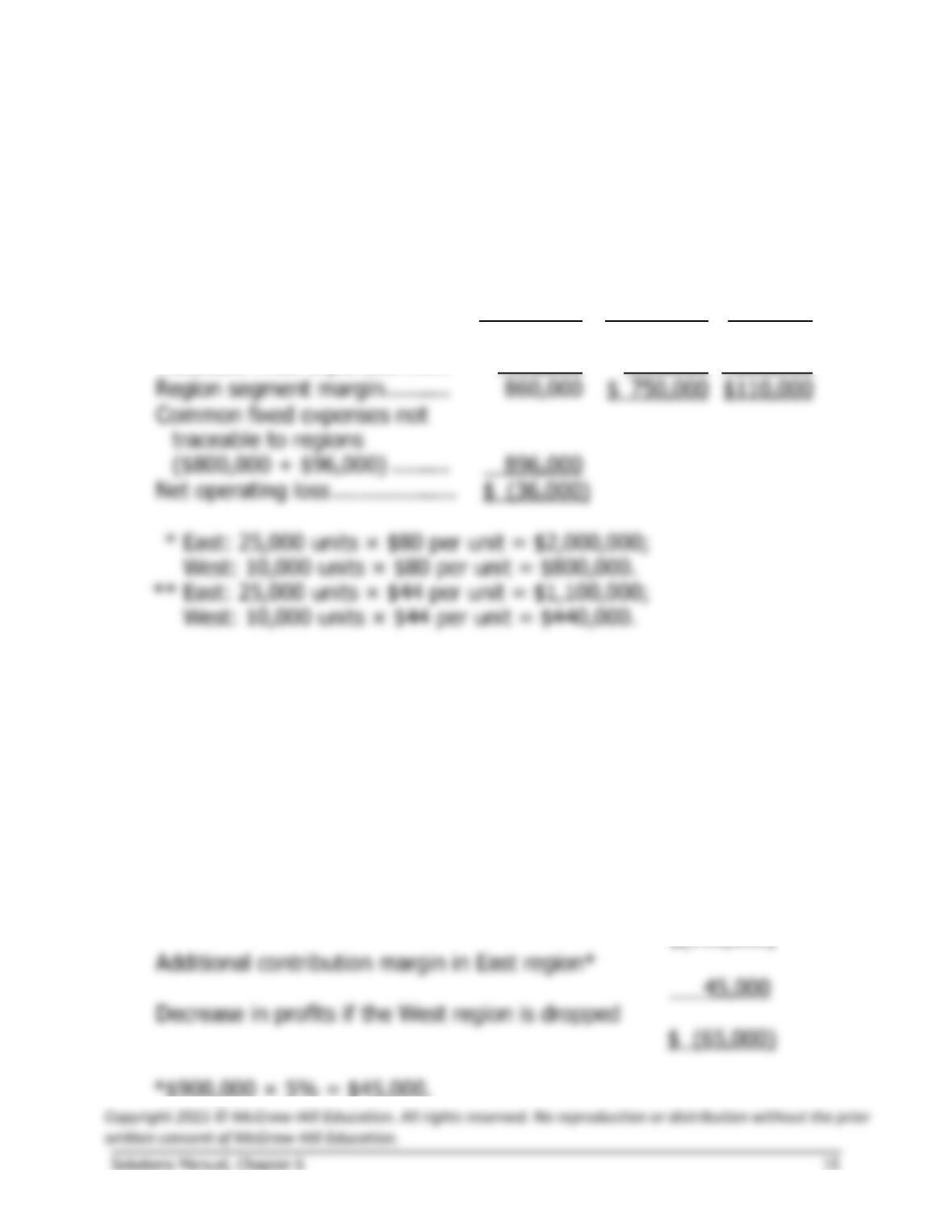
The total contribution margin and net operating income (loss) under
variable costing are computed as follows:
Sales (35,000 units × $80 per unit) …..
Variable expenses:
Contribution margin ……………………….
Fixed expenses:
Net operating loss …………………………
The Foundational 15 (continued)
5. and 6.
The total gross margin and net operating income under absorption
costing are computed as follows:
Sales (35,000 units × $80 per unit) ………………………
$2,800,000
Cost of goods sold (35,000 units × $60 per unit) …….
2,100,000
Gross margin …………………………………………………..
700,000
Selling and administrative expenses
[(35,000 units × $4 per unit) + $496,000] …………..
636,000
Net operating income ………………………………………..
$ 64,000
7. The difference between the absorption and variable costing net
operating incomes is explained as follows:
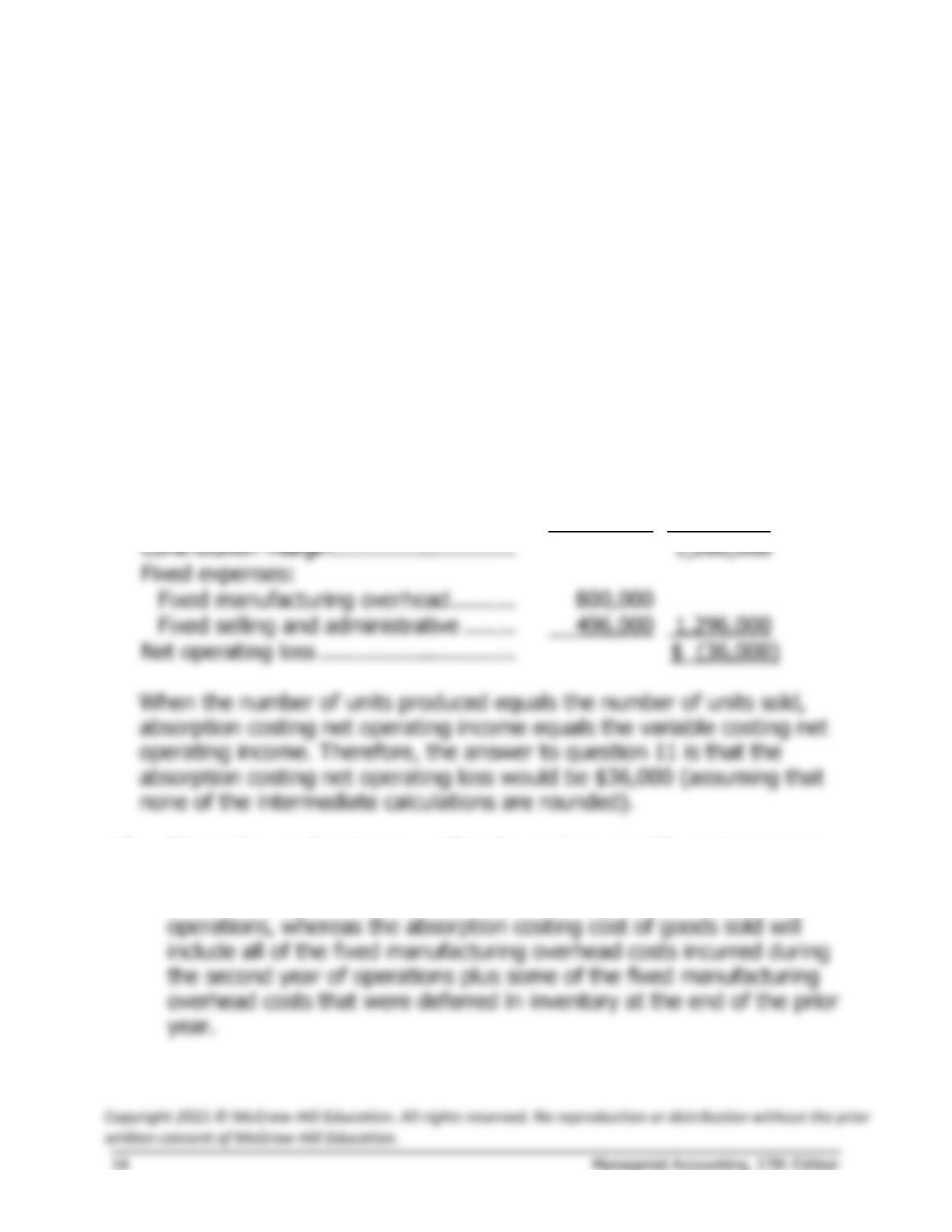
Absorption costing net operating income (see
8. The break-even point in units is computed as follows:
Profit
= Unit CM × Q − Fixed expenses
$0
= ($80 − $44) × Q − $1,296,000
$0
= ($36) × Q − $1,296,000
= $1,296,000
= $1,296,000 ÷ $36
= 36,000 units

costing.
The Foundational 15 (continued)
9. The break-even point of 36,000 units would remain the same. This
occurs because the contribution margin per unit is the same regardless
of whether a unit is sold in the East or West region. The total fixed cost
also remains unchanged so the break-even point stays at 36,000 units.
10. and 11.
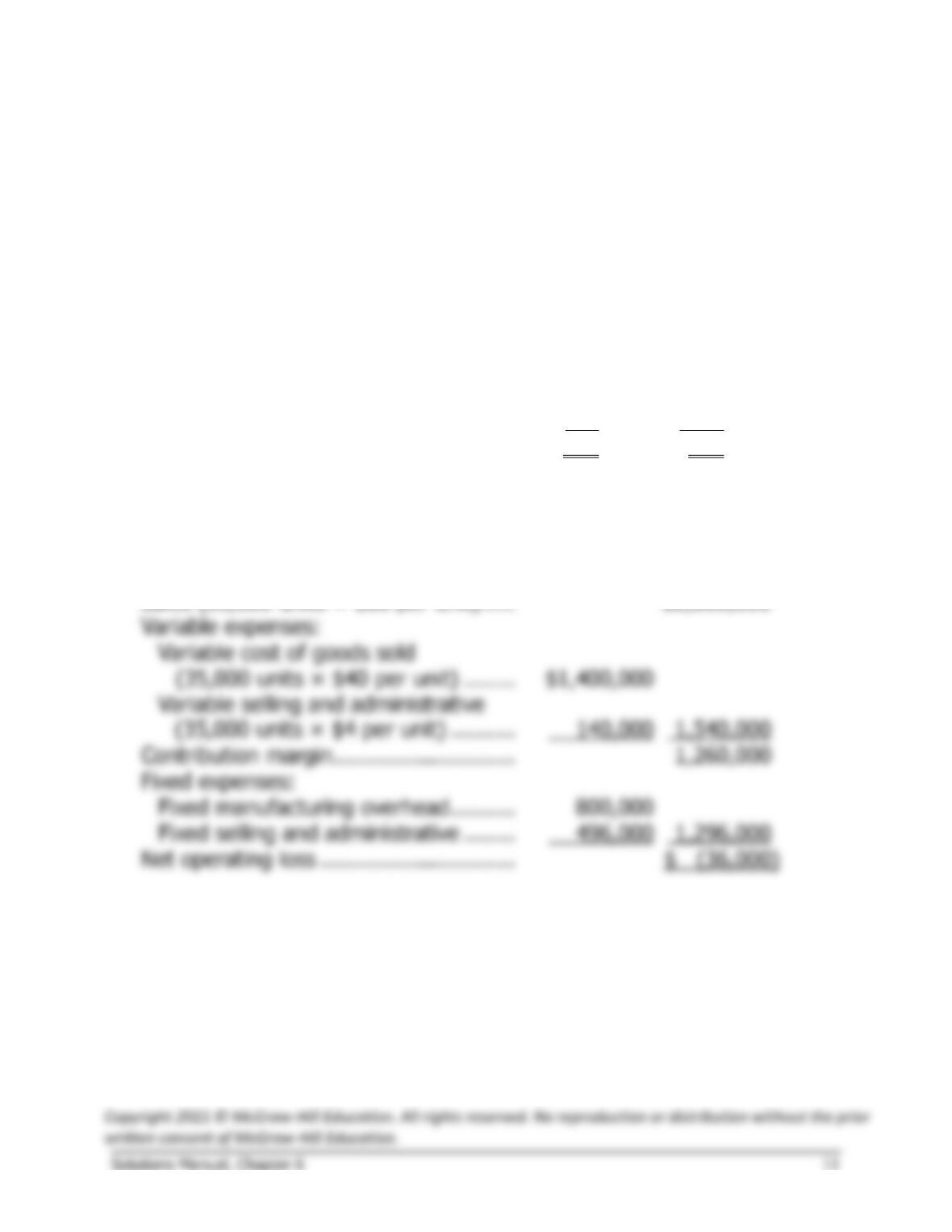
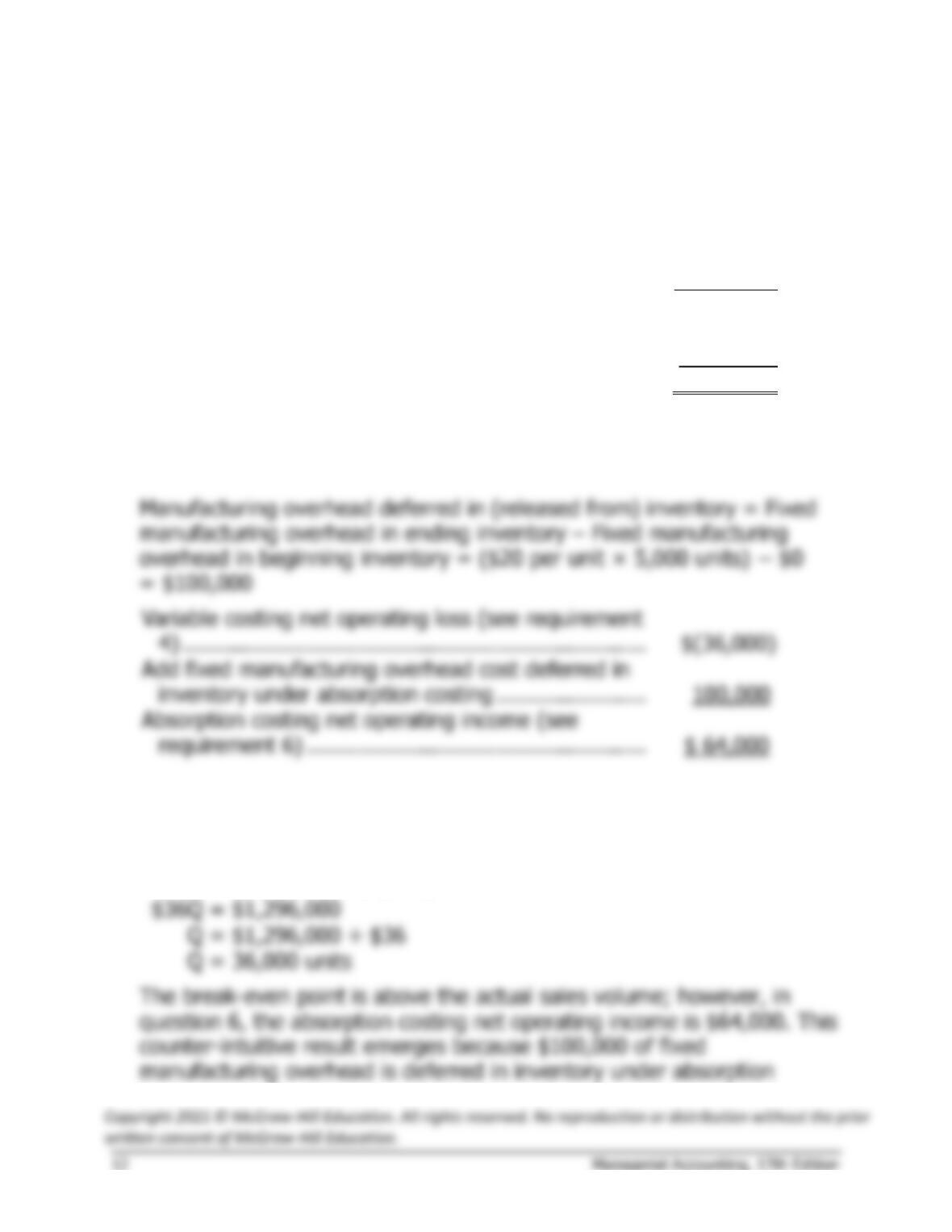
The variable costing net operating income would be the same as the
answer to question 4 as shown below:
Sales ………………………………………….
$2,800,000
Variable expenses:
Variable cost of goods sold
(35,000 units × $40 per unit) ……..
$1,400,000
Variable selling and administrative
(35,000 units × $4 per unit) ……….
140,000
1,540,000
Contribution margin ……………………….
1,260,000
Fixed expenses:
Fixed manufacturing overhead ……….
Fixed selling and administrative ……..
Net operating loss …………………………
12. Absorption costing income will be lower than variable costing income.
The variable costing income statement will only include the fixed
manufacturing overhead costs incurred during the second year of
The Foundational 15 (continued)
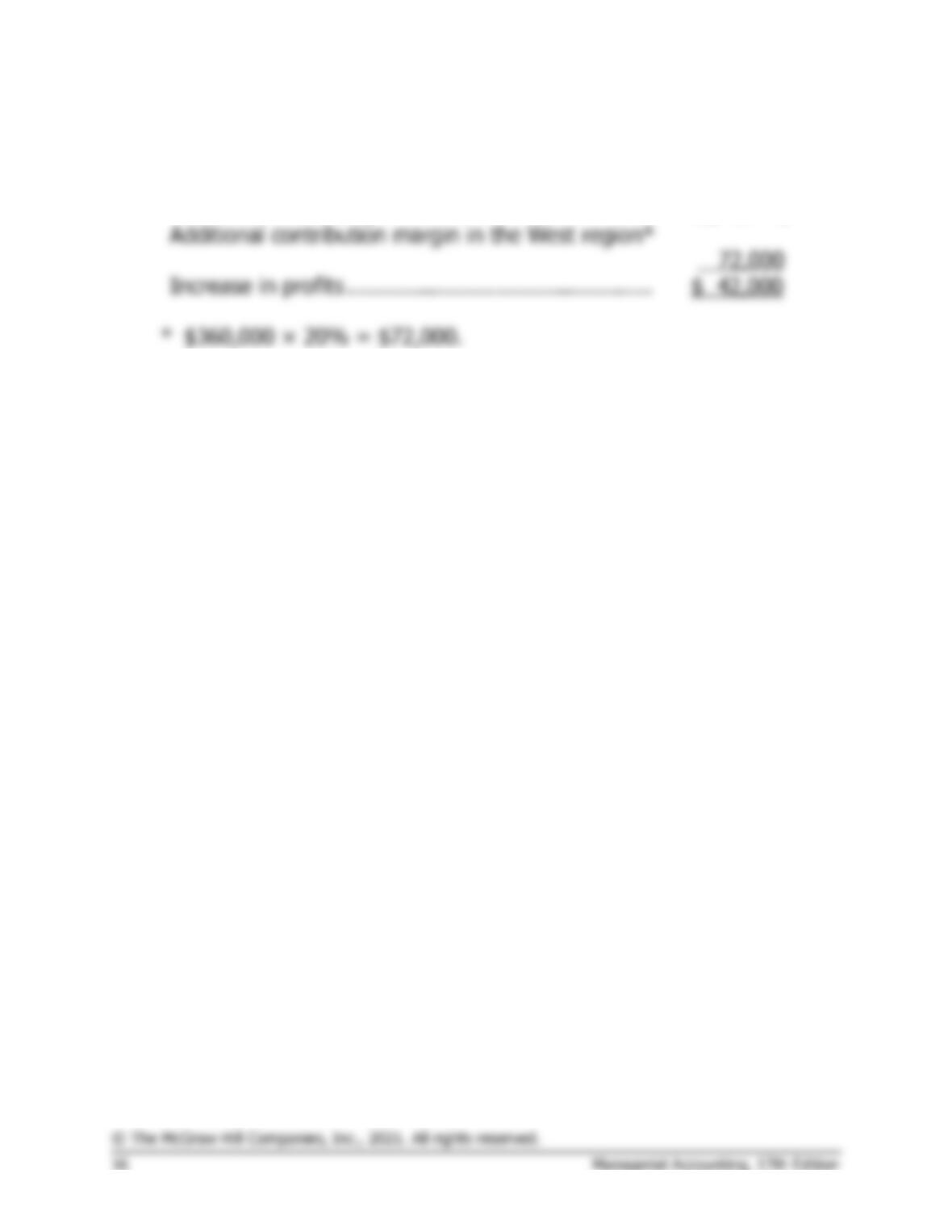
13. The segment margins for the East and West regions are computed as
follows:
Total
Company
East
West
Sales* ……………………………..
$2,800,000
$2,000,000
$800,000
Variable expenses** ……………
1,540,000
1,100,000
440,000
Contribution margin ……………
1,260,000
900,000
360,000
14. Diego has apparently determined that the total
gross margin
in the
West region equals $200,000. As computed in requirement 1, the unit
product cost under absorption costing is $60; therefore, the gross
margin per unit is $20 ($80 – $60). The West region’s total gross
margin of $200,000 (10,000 units × $20 per unit) is less than its
traceable fixed expenses of $250,000. This mode of analysis creates
the illusion that the West region should be discontinued.
The correct way to answer this question is to focus on the information
in the contribution format segmented income statements as follows:
Forgone segment margin in the West region
45,000
Decrease in profits if the West region is dropped
* $900,000 × 5% = $45,000.
The Foundational 15 (continued)
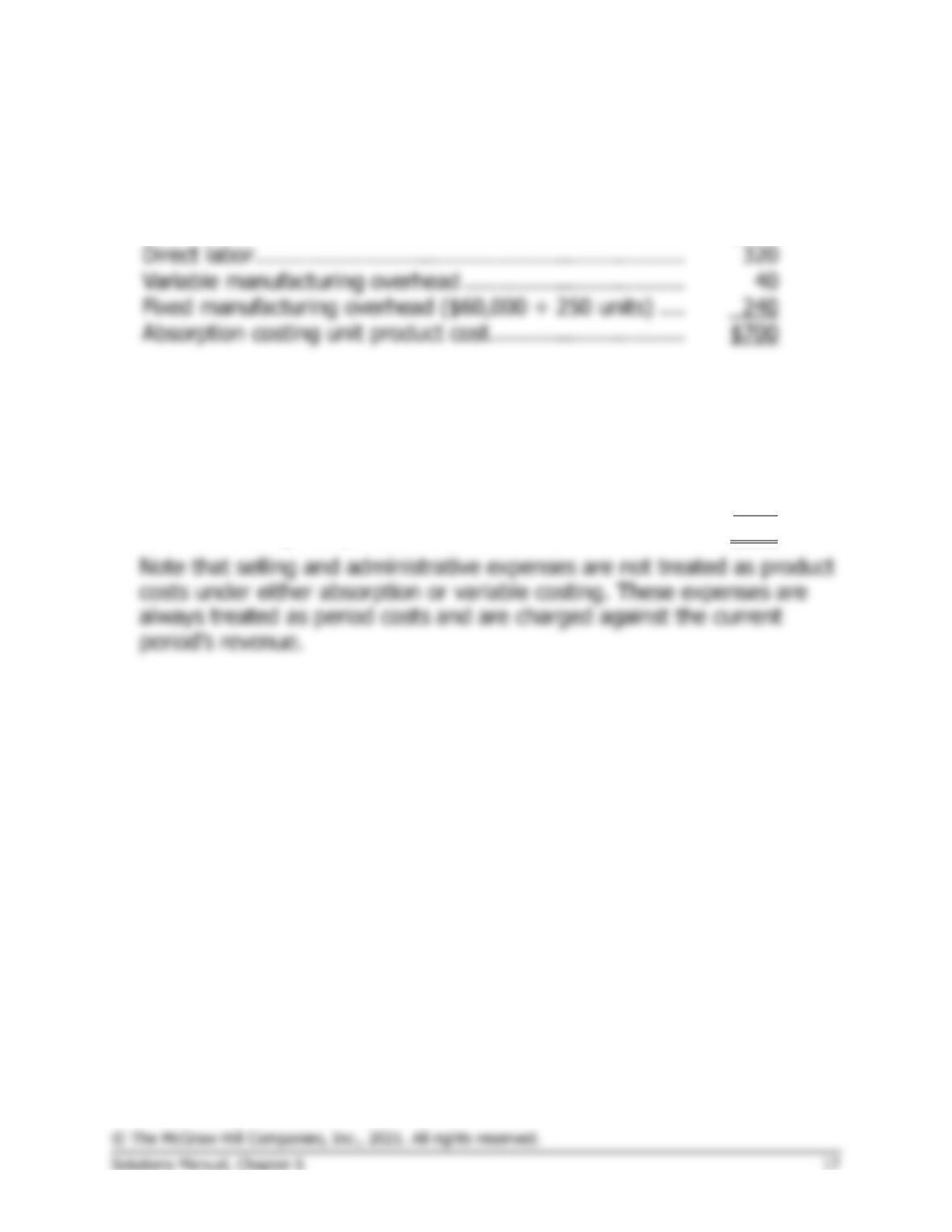
15. The profit impact is computed as follows:
Additional advertising ……………………………………
$(30,000)
Increase in profits ………………………………………..
Exercise 6-1 (15 minutes)
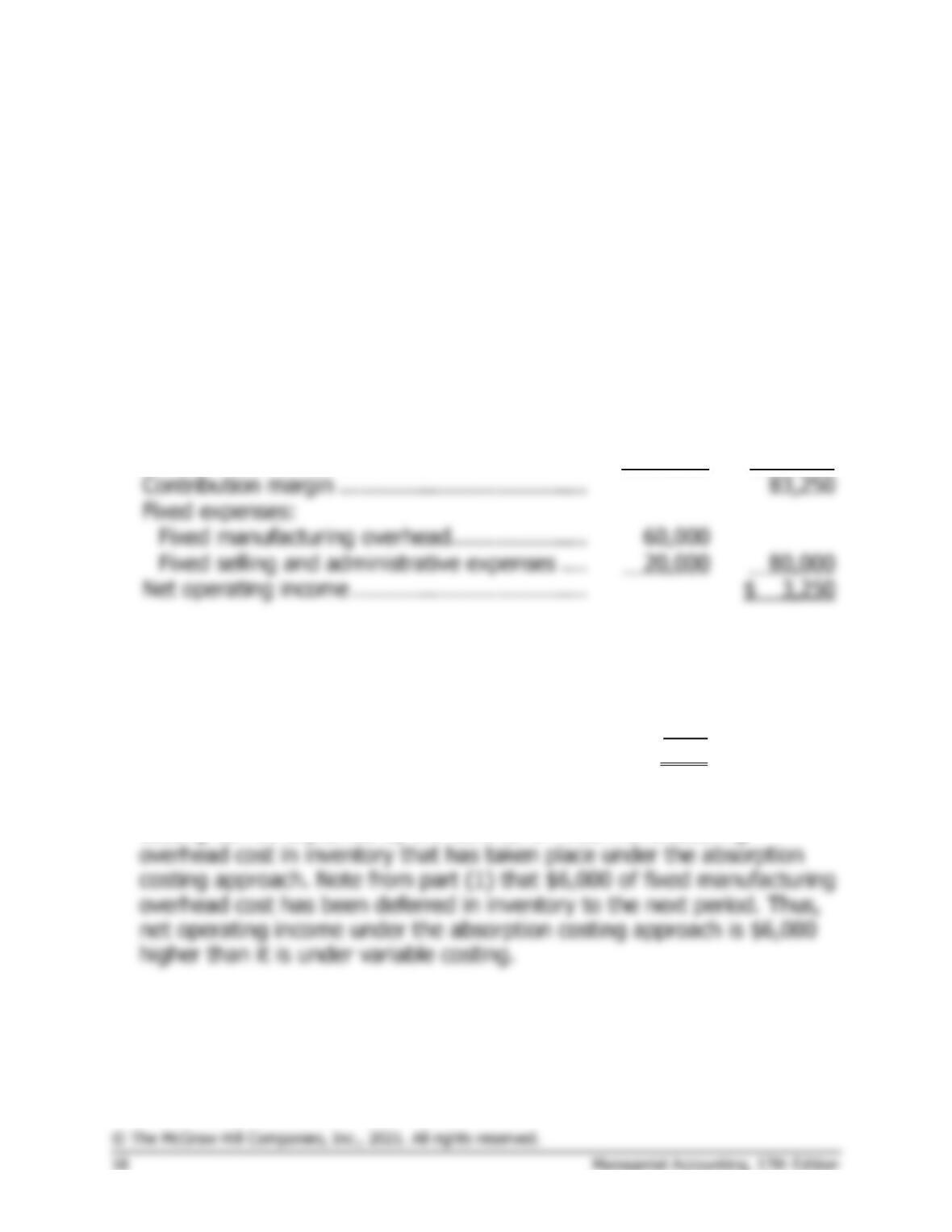
1. Under absorption costing, all manufacturing costs (variable and fixed)
are included in product costs.
Direct materials ……………………………………………………
$100
Direct labor …………………………………………………………
Variable manufacturing overhead …………………………….
Fixed manufacturing overhead ($60,000 ÷ 250 units) ….
Absorption costing unit product cost …………………………
$700
2. Under variable costing, only the variable manufacturing costs are
included in product costs.
Direct materials ……………………………………………………
$100
Direct labor …………………………………………………………
320
Variable manufacturing overhead …………………………….
40
Variable costing unit product cost …………………………….
$460
Exercise 6-2 (20 minutes)
1. Fixed manufacturing overhead cost deferred in inventory = 25 units in
ending inventory × $240 per unit* = $6,000
* $60,000 ÷ 250 units = $240 per unit
2. The variable costing income statement appears below:
Sales ……………………………………………………
$191,250
Variable expenses:
Variable cost of goods sold
(225 units sold × $460* per unit) ………….
$103,500
Variable selling and administrative expenses
(225 units × $20 per unit) ……………………
4,500
108,000
Contribution margin ………………………………..
Fixed selling and administrative expenses ….
Net operating income …………………………..….
* Variable cost of goods sold per unit:
Direct materials ………………………………………
$100
Direct labor ……………………………………………
320
Variable manufacturing overhead ……………….
40
Variable costing unit product cost ……………….
$460
The difference in net operating income between variable and absorption
costing can be explained by the deferral of fixed manufacturing
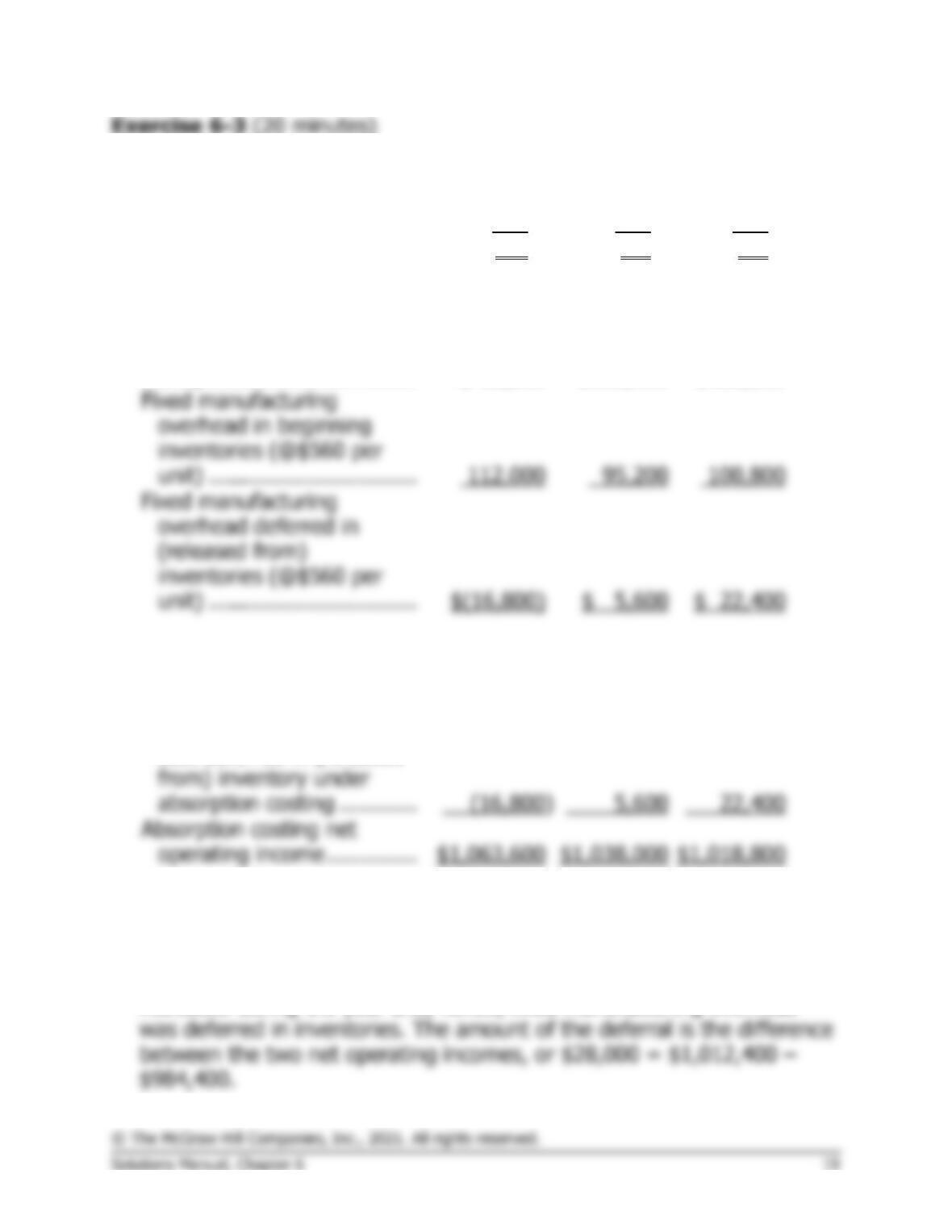
1.
Year 1
Year 2
Year 3
Beginning inventories ……….
200
170
180
Ending inventories ……………
170
180
220
Change in inventories ……….
(30)
10
40
Fixed manufacturing
overhead in ending
inventories (@$560 per
unit) …………………………..
$ 95,200
$100,800
$123,200
Variable costing net
operating income …………..
$1,080,400
$1,032,400
$ 996,400
Absorption costing net
operating income …………..
$1,063,600
$1,038,000
$1,018,800
Add (deduct) fixed
manufacturing overhead
cost deferred in (released
2a. and 2b.
Because absorption costing net operating income was greater than
variable costing net operating income in Year 4, inventories must have
Exercise 6-4 (10 minutes)
Total
Company
Weedban
Greengrow
Sales* ……………………………..
$300,000
$90,000
$210,000
Variable expenses** …………..
183,000
36,000
147,000
Contribution margin ……………
117,000
54,000
63,000
Traceable fixed expenses …….
66,000
45,000
21,000
Product line segment margin ..
51,000
$ 9,000
$ 42,000
Net operating income ………….