
6-1
CHAPTER 6
PROCESS COSTING
DISCUSSION QUESTIONS
1. A process is a series of activities (opera-
tions) that are linked to perform a certain ob-
jective. For example, the bottling process of
a pain medication manufacturer consists of
four linked activities: loading, counting, cap-
ping, and packing.
2. Process costing is typically used for indus-
tries where units are homogeneous and
mass produced. Process costing collects
costs by process (department) for a given pe–
riod of time. Unit costs are computed by di–
viding these costs by the department’s output
measured for the same period of time. Pro-
cess costing uses multiple work-in-process
accounts and uses a cost of production report
to summarize the cost and work activity for a
department. When work is completed in a
department, the cost of the work is trans-
ferred to the next department. The final de-
partment transfers the work to finished
goods. Job-order costing is used for indus-
tries, which produce heterogeneous products
(often custom made). Job-order costing col-
lects costs by job. Unit costs are computed
by dividing the job’s costs by the units pro–
duced in the job. There is a single work-in–
process account; costs and work activity are
collected on the job-order cost sheet. When
work is completed, it is transferred to finished
goods.
3. The work-in-process account of the receiv-
ing department is debited, and the work–in–
process account of the transferring depart-
ment is credited. The finished goods ac-
count is debited, and the work–in-process
account of the final department is credited
upon completion of the product.
4. Transferred-in costs are the manufacturing
costs transferred from a prior department to
the current receiving department.
5. Transferred-in units represent partially
completed units and are clearly a material for
the receiving department. To complete the
product (or further process it), additional
direct materials and conversion costs are
added by the receiving department.
6. A production report summarizes the activity
and costs associated with a process for a
given period. It shows the physical flow, the
equivalent units, the unit cost, and values of
ending work in process and goods trans-
ferred out. The report serves the same func-
tion as a job-order cost sheet in a job-order
costing system.
7. Process costing can be used for service or-
ganizations provided the services are homo-
geneous and repetitively produced. Check
processing in a bank, cleaning teeth, and
sorting mail are examples of services that
could use process costing. In fact, the use of
process costing for services is simplified by
the fact that there are no work-in-process in–
ventories. JIT has no inventories and so all
that is needed is to measure output and costs
for a period to calculate unit costs—thus, JIT
can use process costing, simplified by the
absence of inventories.
8. Equivalent units are the number of whole
units that could have been produced given
the amount of direct materials, direct labor,
and overhead used. Equivalent units are the
measure of a period’s output, a necessary
input for the computation of unit costs. They
are needed for output measurement when-
ever work-in-process inventories are pre-
sent.
9. Separate equivalent units must be calculat-
ed for direct materials and conversion costs.
10. The first step is the preparation of a physical
flow schedule. This schedule identifies the
physical units that must be accounted for
and provides an accounting for them. The
second step is the equivalent units sched-
ule. This schedule computes the equivalent
whole output for the period; its computations
rely on information from the physical flow
schedule. The next step is computation of
the unit cost. To compute the unit cost, the
manufacturing costs of the period for the
process are divided by the period’s output.

6-2
The output is obtained from the equivalent
units schedule. The fourth step uses the unit
cost to value goods transferred out and
those remaining in work in process. The final
step checks to see if the costs assigned in
Step 4 equal the total costs to account for.
11. In calculating this period’s unit cost, the
weighted average method treats prior-period
output and costs carried over to the current
period as belonging to the current period.
The FIFO method excludes any costs and
output carried over (from last period) from
the current period’s unit cost computation.
12. If the per-unit cost of the prior period is the
same as the per-unit cost of the current pe-
riod, there will be no difference between the
results of the weighted average and FIFO
methods. Additionally, if no beginning work-
in-process inventory exists, both the FIFO
and weighted average methods give the
same results.
13. The weighted average method uses the
same unit cost for all goods transferred out.
The FIFO method divides goods transferred
out into two categories: (1) started and com-
pleted and (2) units from beginning work in
process. This period’s unit cost is used to
value goods started and completed. The
cost of goods transferred out from beginning
work in process is obtained by first assigning
them all costs carried over from the prior pe-
riod and next by using the current period’s
unit cost to value the equivalent units com-
pleted this period.
14. Transferred-in costs are treated as a sepa-
rate input category when equivalent units
are computed. The category is viewed as a
material that is always added at the begin-
ning of the process.
15. Operation costing is a blend of job-order and
process-costing procedures. It is used
where batches of homogeneous products
are produced.
6-3
CORNERSTONE EXERCISES
Cornerstone Exercise 6.1
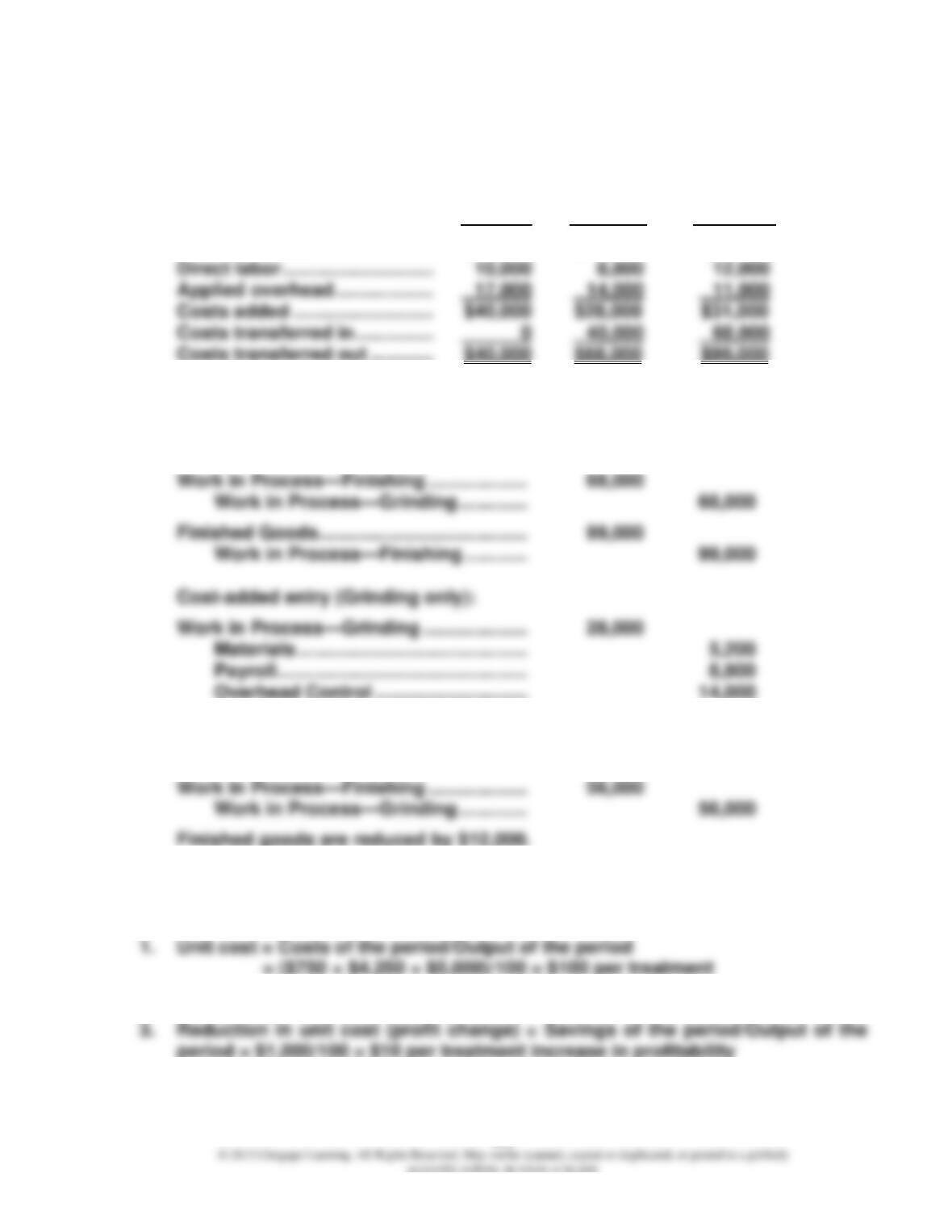
1. Molding Grinding Finishing
Direct materials …………………. $ 13,000 $ 5,200 $ 8,000
2. Transfer entries:
Work in Process—Grinding ……………….. 40,000
Work in Process—Molding ………….. 40,000
3. The cost transferred out would be $56,000 ($68,000 – $12,000). The journal
entry is:
Cornerstone Exercise 6.2
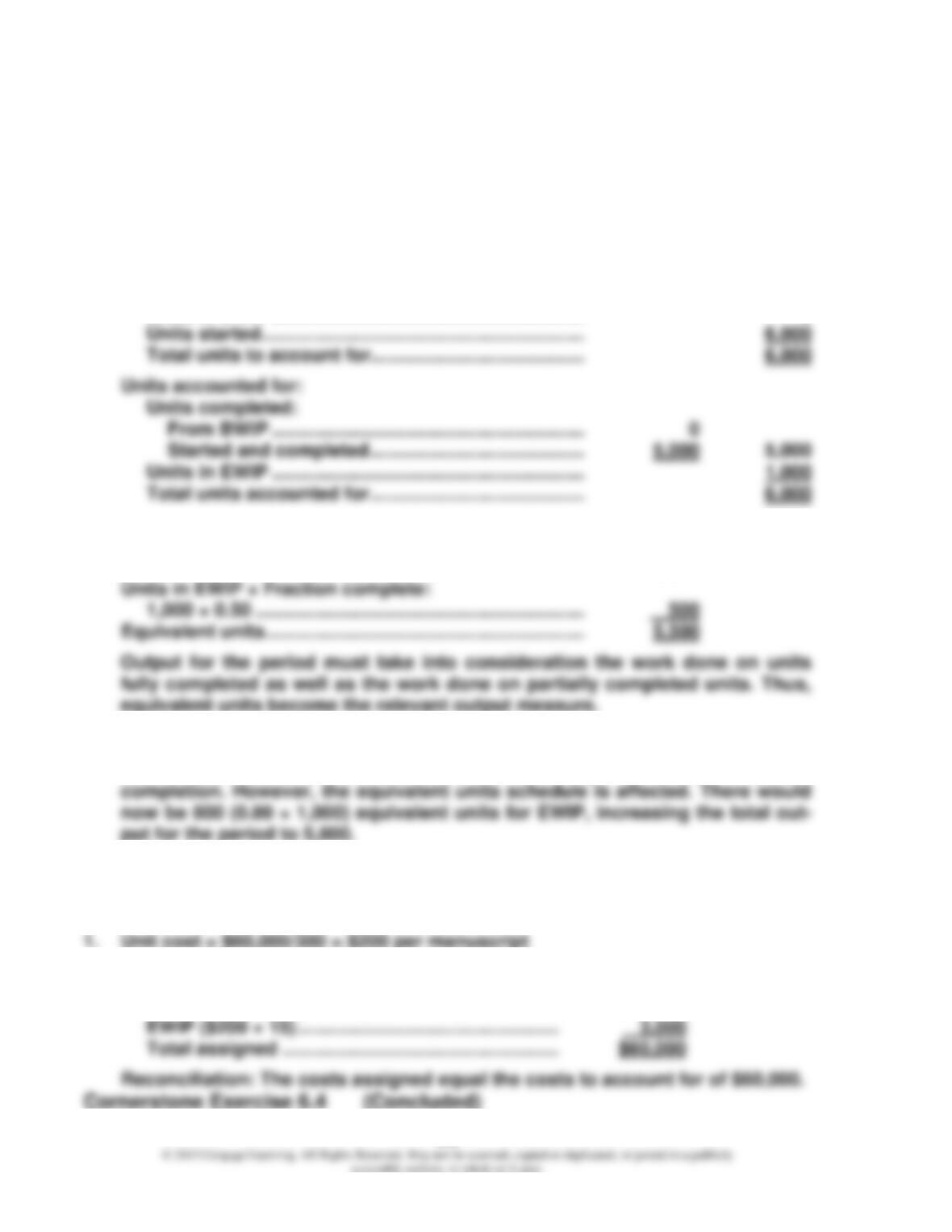
2. Cost of services sold = Unit cost × Output produced = $100 × 100 = $10,000
6-4
Cornerstone Exercise 6.3
1. Units started and completed = Units completed – Units, BWIP = 5,000 – 0 =
5,000
Units started = Units, EWIP + Units started and completed = 1,000 + 5,000 =
6,000
Physical flow schedule:
Units to account for:
Units in BWIP …………………………………………………… 0
2. Equivalent units schedule:
Units completed……………………………………………………. 5,000
3. Changing the degree of completion does not affect the physical flow sched-
ule. This schedule measures the flow of the units, regardless of their stage of
Cornerstone Exercise 6.4
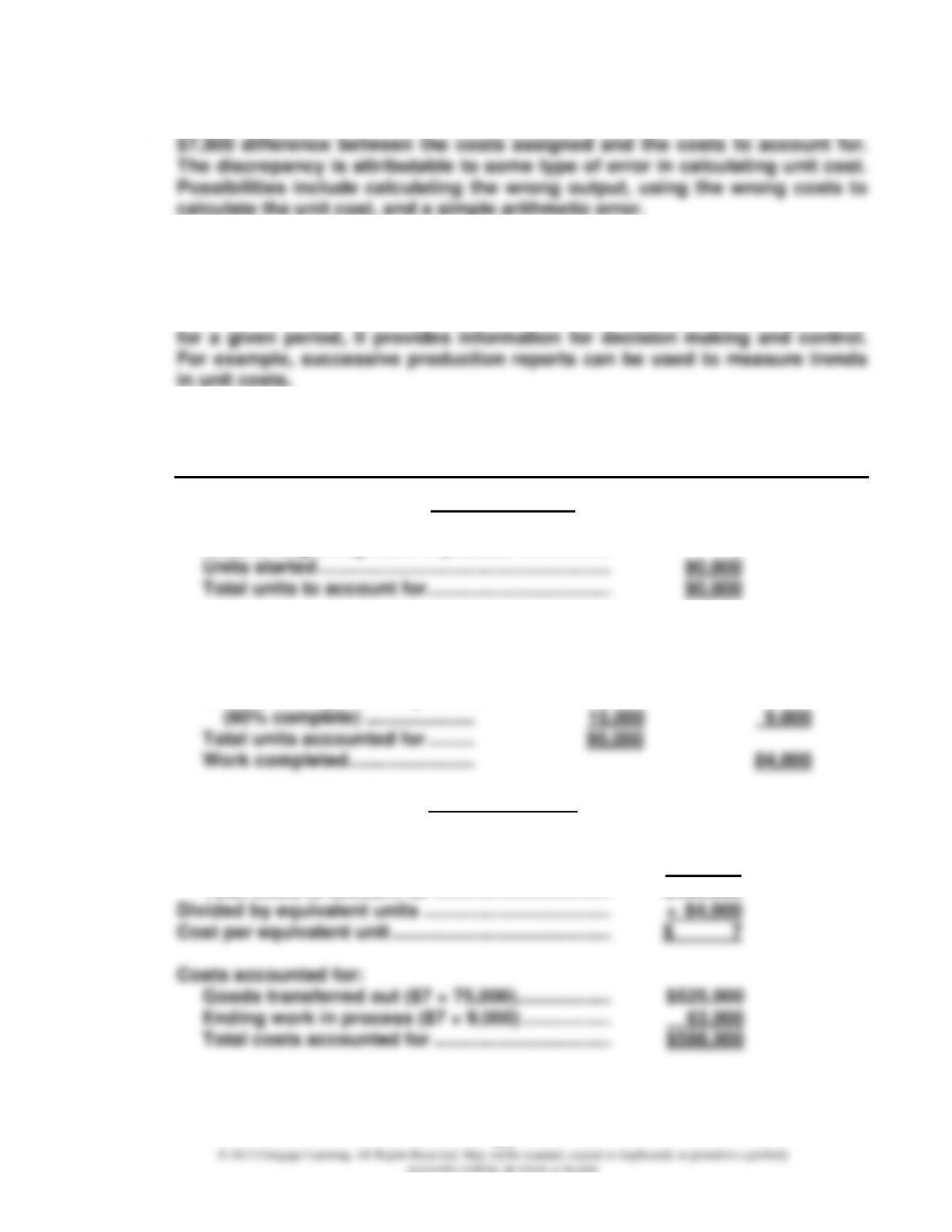
2. Costs assigned:
Manuscripts completed ($200 × 285) …………….. $57,000
6-5
3. Costs assigned would be $67,500 [($225 × 285) + ($225 × 15)]. There is a
Cornerstone Exercise 6.5
1. Since a production report summarizes the manufacturing and costing activity
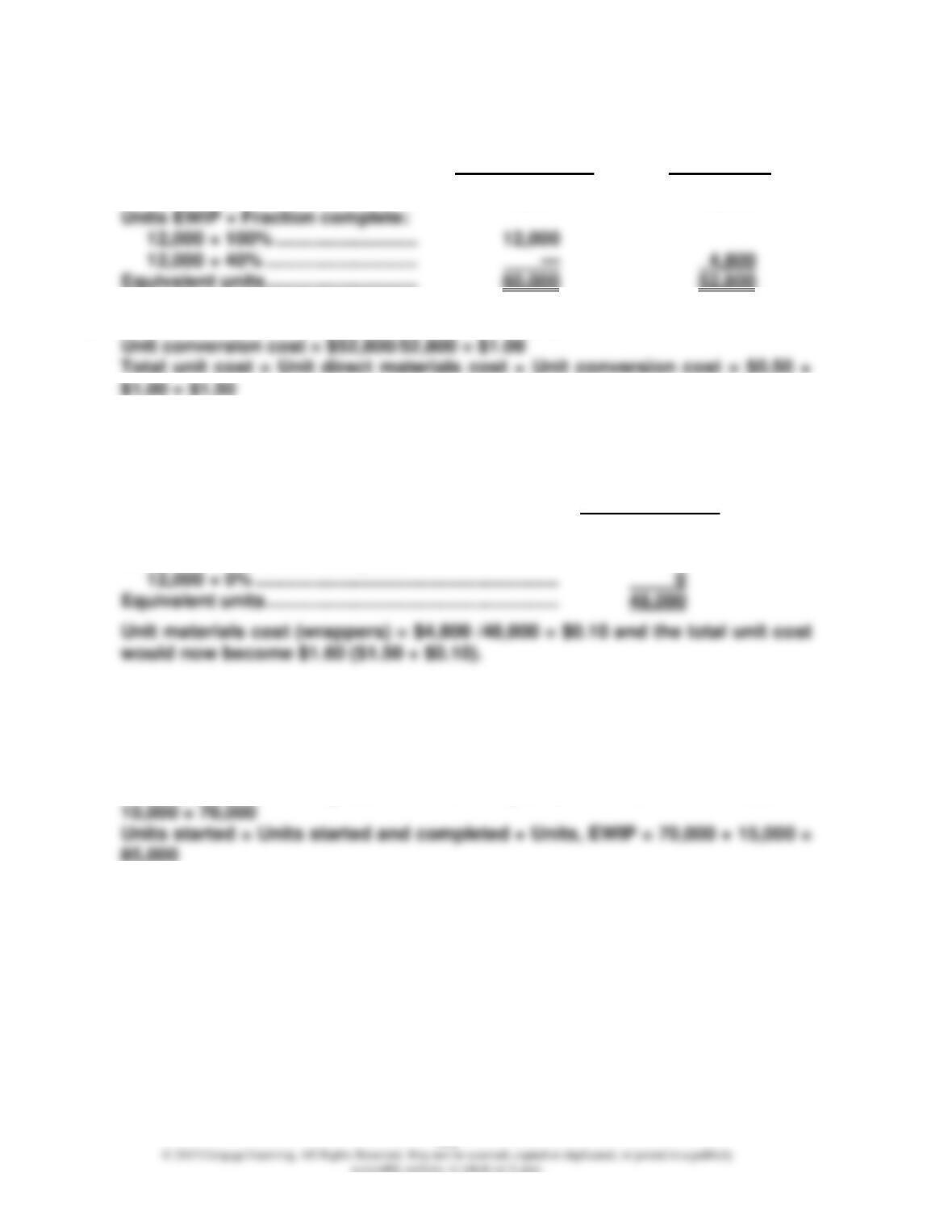
2. Tomar Company
Mixing Department
Production Report for April
Unit Information
Units to account for:
Units in beginning work in process ……………… 0
Physical Flow Equivalent Units
Units accounted for:
Units completed …………………… 75,000 75,000
Units in ending work in process
Cost Information
Costs to account for:
Beginning work in process ………………………….. $ 0
Incurred during the period …………………………... 588,000
Total costs to account for ……………………………. $588,000
6-6
Cornerstone Exercise 6.6
1. Direct Materials Conversion
Units completed……………………….. 48,000 48,000
2. Unit direct materials cost = $30,000/60,000 = $0.50
3. Now there would be another materials category (wrappers) and a third col-
umn of equivalent units:
Direct Materials
(wrappers)
Units completed……………………………………………….. 48,000
Units EWIP × Fraction complete:
Cornerstone Exercise 6.7
1. First, two calculations are needed:
Units started and completed = Units completed – Units, BWIP = 80,000 –
Cornerstone Exercise 6.7 (Concluded)
Step 1: Physical Flow Schedule: Cooking Department
Units to account for:
Units, beginning work in process (60% complete) 10,000
Units started during July …………………………………… 85,000
2. Step 2: Equivalent Units Schedule: Cooking Department
Direct Conversion
Materials Costs
Units started and completed ………………………………….. 70,000 70,000
Add: Units in beginning work in process
× Percentage to complete:
10,000 × 0% direct materials ………………………….. —
6-8
Cornerstone Exercise 6.8
1. Unit cost = Unit materials cost + Unit conversion cost
2. Using unit cost information and the information from the equivalent units
schedule:
Cost of goods transferred out:
From BWIP ………………………………………………………. $ 45,000
3. Since materials are added at the beginning, there are 5,000 equivalent units
of materials (100% complete); there are 2,500 equivalent units of conversion
6-9
Cornerstone Exercise 6.9
1. First, two calculations are needed:
Units started and completed = Units completed – Units, BWIP = 80,000 –
Step 1: Physical Flow Schedule: Cooking Department
Units to account for:
Units, beginning work in process (60% complete) 10,000
Units started during July …………………………………… 85,000
2. Step 2: Equivalent Units Schedule: Cooking Department
Direct Conversion
Materials Costs
3. Direct Conversion
Materials Costs
Cornerstone Exercise 6.10
1. Unit cost = Unit materials cost + Unit conversion cost
2. Valuation of inventories, using unit cost information and the information from
the equivalent units schedule:
Cost of goods transferred out:
Units completed ($15.20 × 45,000) …………………….. $684,000
EWIP:
3. Unit materials cost = (10,000/55,000)$6.60 + (45,000/55,000)$12.22
6-11
EXERCISES
Exercise 6.11
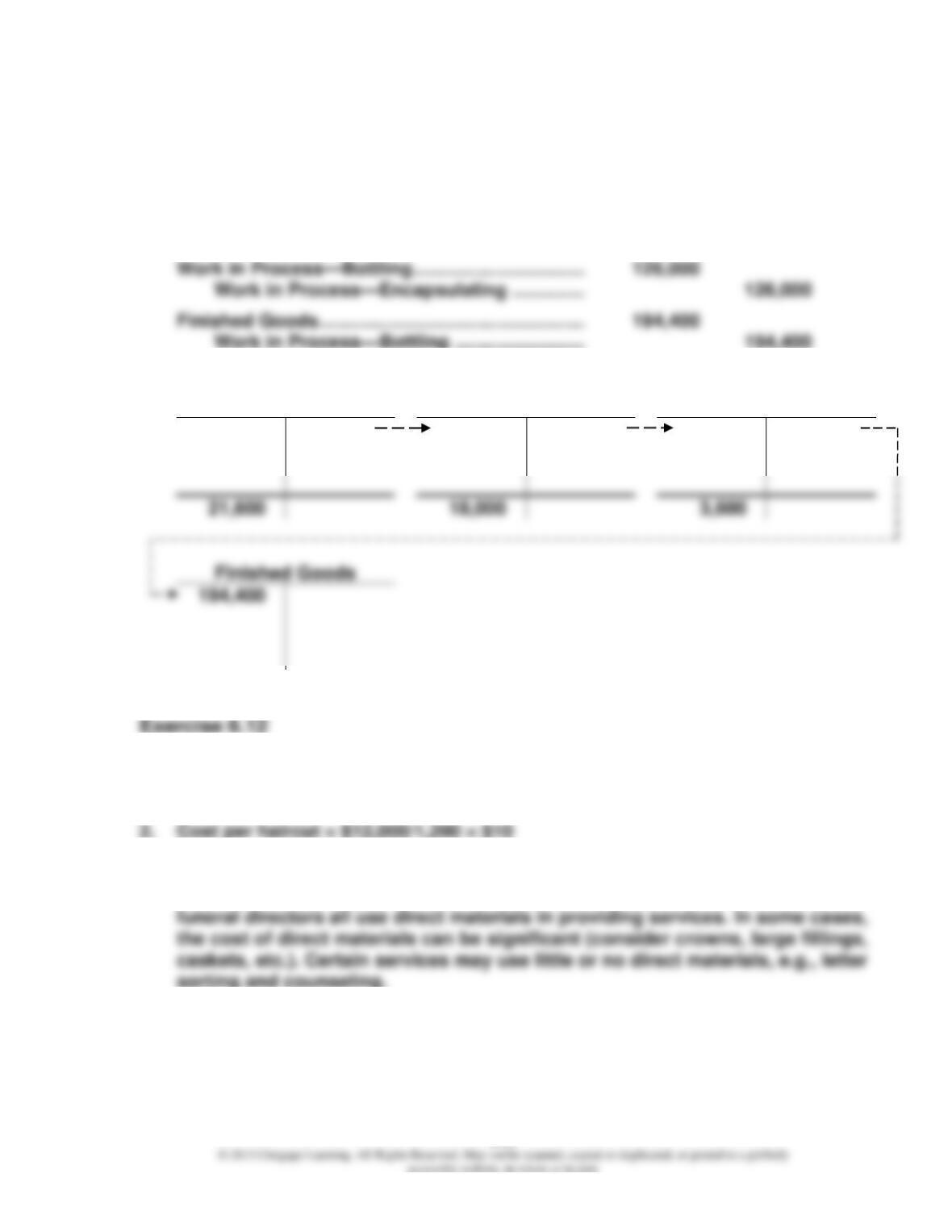
1. Work in Process—Encapsulating …………………. 64,800
Work in Process—Mixing ………………………. 64,800
2.
WIP—Mixing
WIP—Encapsulating
WIP—Bottling
86,400
64,800
64,800
126,000
126,000
194,400
79,200
72,000
3,600
1. Hair-cutting is a repetitive, homogeneous service. Thus, a process-costing
approach can be used.
3. Most services require the use of direct materials. Haircutting, for example,
may use water, shampoo, and talcum. Furthermore, dentists, doctors, and
Exercise 6.13
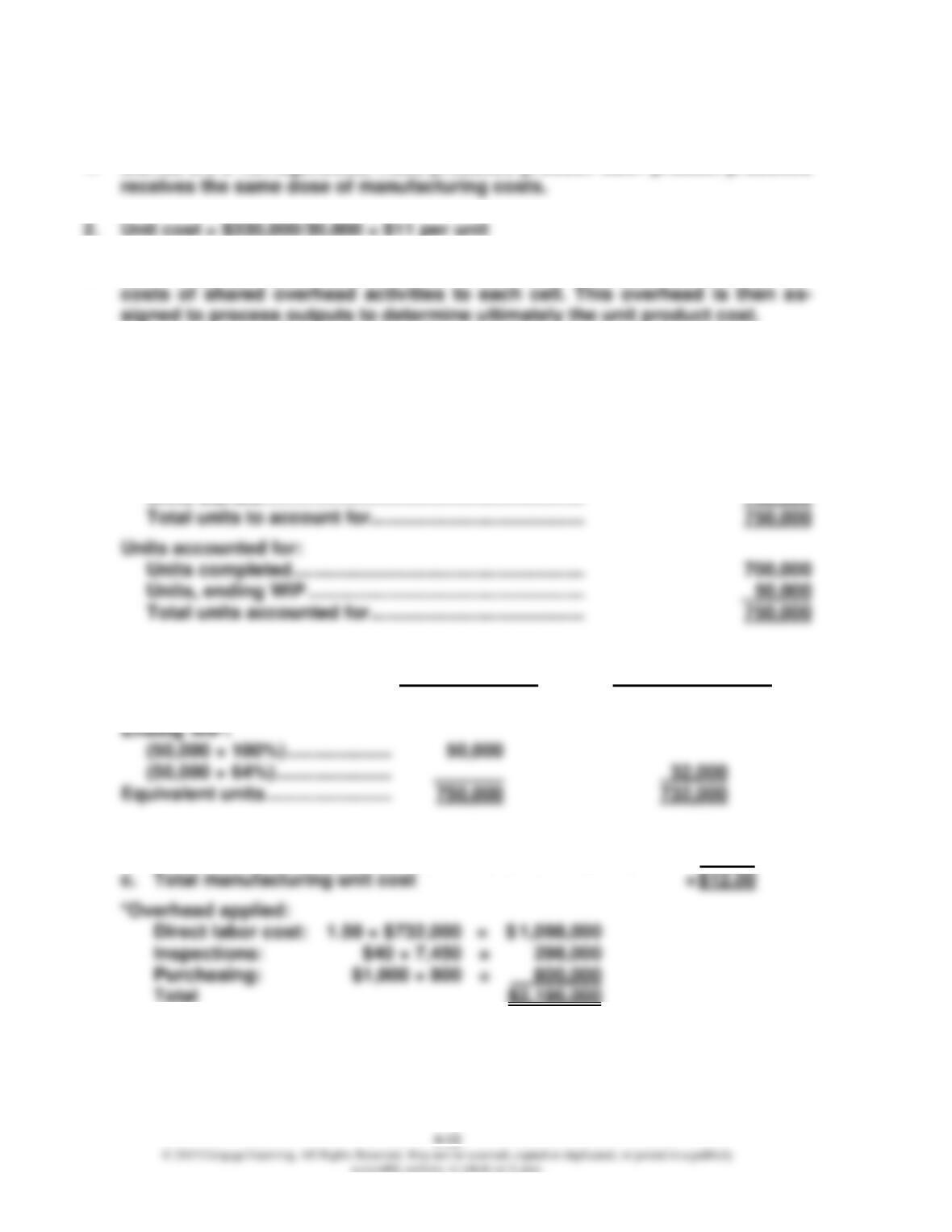
1. Stands are a homogeneous, mass-produced product. Each product produced
3. For multiple products, each with their own cells, ABC is used to assign the
Exercise 6.14
1. Physical flow schedule:
Units to account for:
Units, beginning WIP ………………………………………… 0
Units started …………………………………………………….. 750,000
2. (a) (b)
Direct Materials Conversion Costs
Completed …………………………... 700,000 700,000
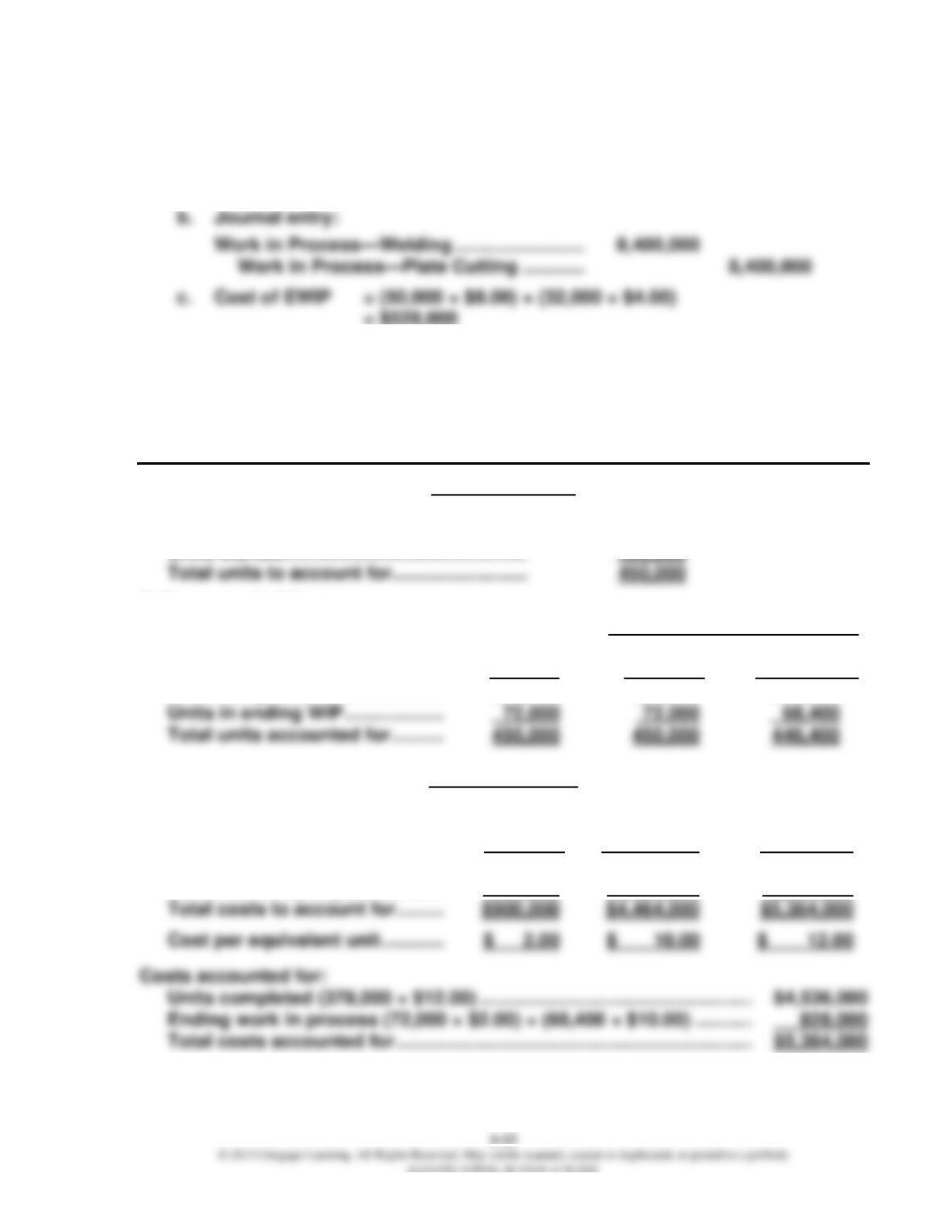
3. a. Unit direct materials = $6,000,000/750,000 = $ 8.00
b. Unit conversion costs = ($732,000 + $2,196,000*)/732,000 = 4.00
Exercise 6.14 (Concluded)
4. a. Cost of units transferred out:
700,000 × $12.00 = $8,400,000
Exercise 6.15
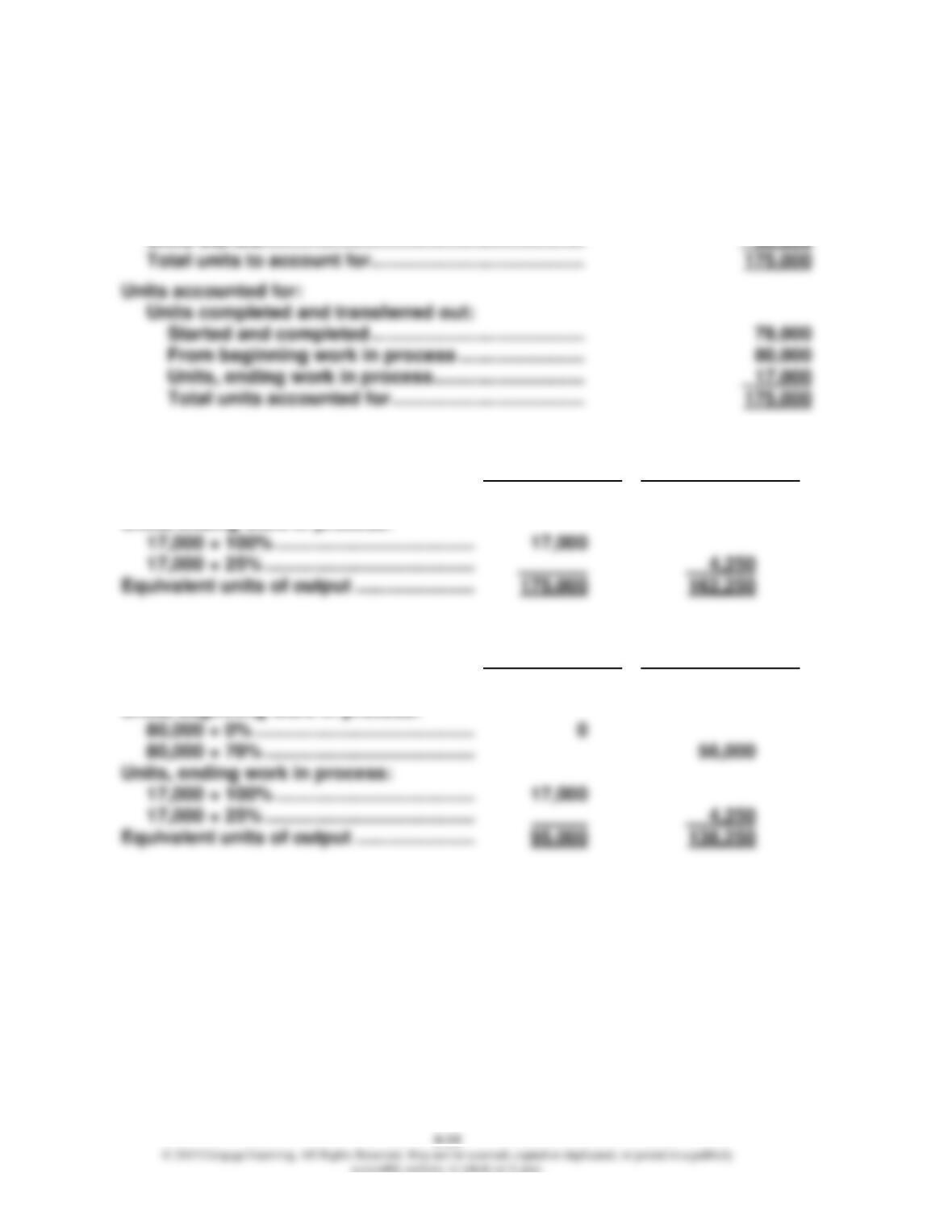
Softkin Company
Mixing Department
Production Report for the Current Year
Unit Information
Units to account for:
Units in beginning WIP ……………………….. 0
Units started ……………………………………….. 450,000
Units accounted for:
Equivalent Units
Physical Direct Conversion
Flow Materials Costs
Units completed ……………………. 378,000 378,000 378,000
Cost Information
Costs to account for:
Direct Conversion
Materials Costs Total
Costs in beginning WIP…………. $ 0 $ 0 $ 0
Costs added by department ….. 900,000 4,464,000 5,364,000
Exercise 6.16
1. Physical flow schedule:
Units to account for:
Units, beginning work in process ……………………… 80,000
Units started …………………………………………………….. 95,000
2. Equivalent units—Weighted average method:
Direct Materials Conversion Costs
Units completed…………………………………. 158,000 158,000
Units, ending work in process:
3. Equivalent units—FIFO method:
Direct Materials Conversion Costs
Units started and completed ………………. 78,000 78,000
Units, beginning work in process:
6-15
Exercise 6.17
1. Ending work in process:
Direct materials (6,000 × $2.00) …………………….. $ 12,000
Conversion costs (4,500 × $6.00) …………………. 27,000
Total ending work in process ………………………. $ 39,000
2. Physical flow schedule:
Units to account for:
Units, beginning work in process ……………………… 10,000
Units started …………………………………………………….. 34,000
Exercise 6.18
A B C D
Units completed …………….. 25,000a 24,000c 40,000d 70,000f
Exercise 6.19
A B C D
Completeda ……………………………………….. 25,000 24,000 40,000 70,000
Add: Ending work in processa ……………. 800 0 2,700 2,000
Exercise 6.20
1. Unit cost = Unit direct materials cost + Unit conversion costs
2. Cost of ending work in process:
Direct materials ($5.00 × 8,000) …………………….. $40,000
Exercise 6.21
1. Physical flow schedule:
Units to account for:
Units, beginning work in process ……………………… 10,000
Units started …………………………………………………….. 60,000
6-17
Exercise 6.21 (Concluded)
2. Unit cost = Unit direct material cost + Unit conversion costs
= $240,000/60,000 + $320,000/50,000
3. Cost of ending work in process:
Direct materials (20,000 × $4.00) …………………… $ 80,000
Conversion costs (5,000 × $6.40) …………………. 32,000
4. Work in Process—Sewing …………………. 548,000
Exercise 6.22
1. Equivalent units schedule:
Direct Conversion Transferred
Materials Costs In
Units completed ………………… 16,000 16,000 16,000
Ending WIP:
2. Costs charged to the department:
Direct Conversion Transferred
Materials Costs In Total
Costs in BWIP …………………….. $ 5,000 $ 6,000 $ 8,000 $ 19,000
6-18
Exercise 6.23
Equivalent units schedule:
Direct Conversion Transferred
Materials Costs In
Units started and completed …………… 12,000 12,000 12,000
Units in EWIP:
8,000 × 100% …………………………..…. 8,000
*Rounded.
Exercise 6.24
1. Journal entries:
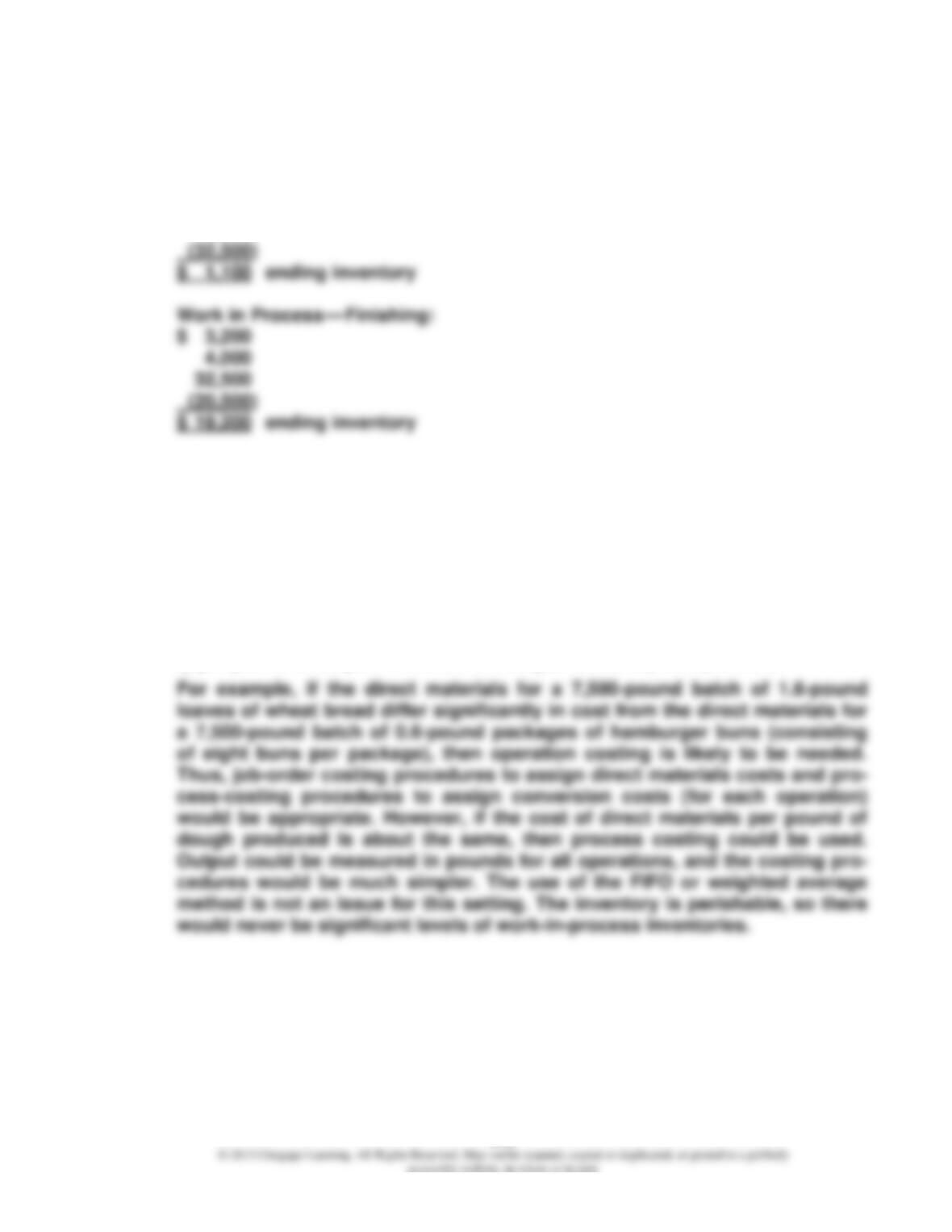
a. Work in Process—Assembly ………………… 24,000
Materials Inventory …………………………... 24,000
b. Work in Process—Assembly ………………… 4,600
6-19
Exercise 6.24 (Concluded)
2. Work in Process—Assembly:
$ 24,000
4,600
5,000
Exercise 6.25
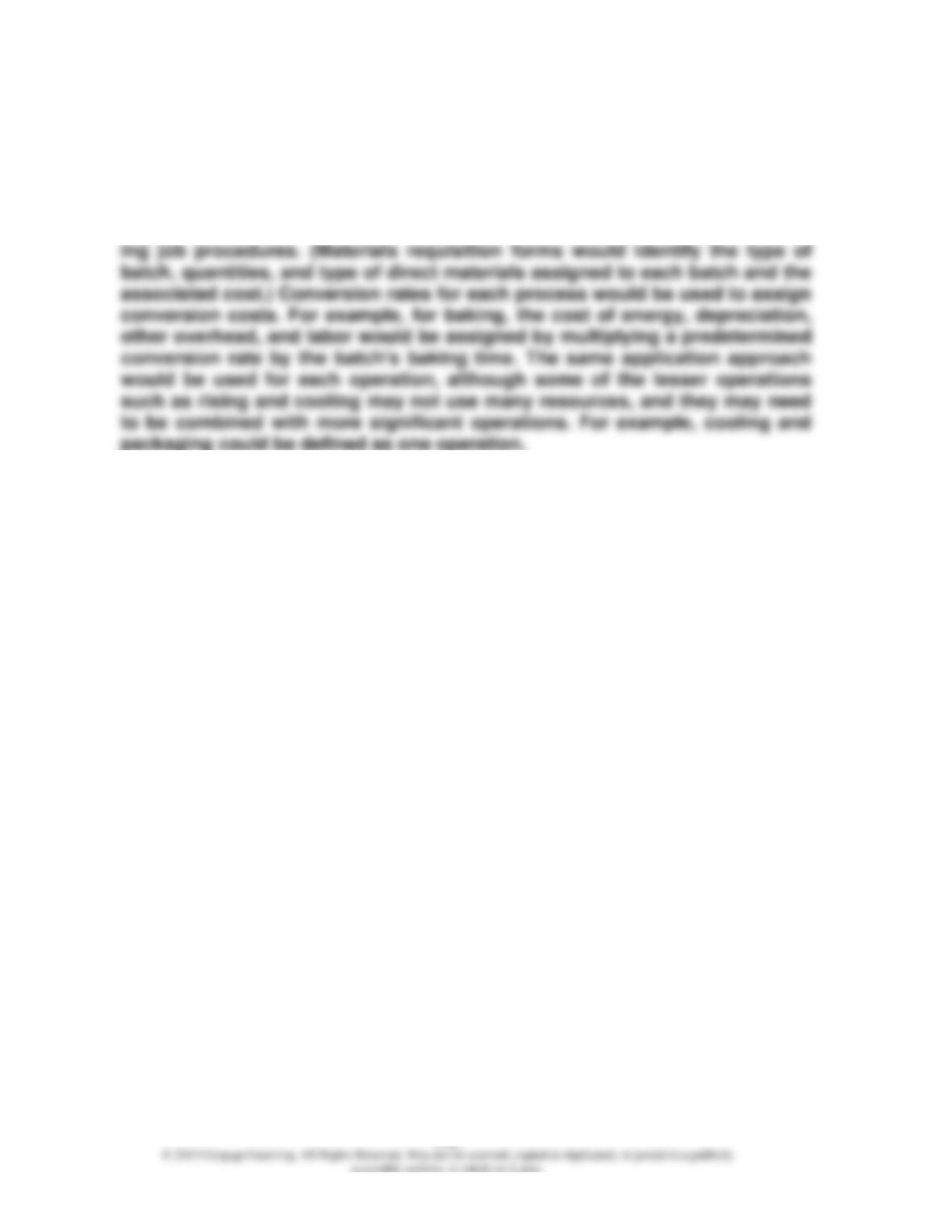
1. For operation costing to be appropriately applied, products must be pro-
duced in batches where there are significant differences in direct materials
costs but similar demands on conversion resources. This company produces
in batches, and it seems reasonable that the products would make similar
demands on the conversion resources for the operations used. Thus, for op-
eration costing to be used, the cost of direct materials must differ significant-
ly per pound of output—whether the output is loaves, buns, or rolls.
6-20
Exercise 6.25 (Concluded)
2. A work order would be needed for each batch, which identifies the direct ma-
terials, operations, and size of batches. The batch of whole wheat loaves
would use all operations, but the batch of dinner rolls would not use the slic-
ing operation. The cost of direct materials would be traced to each batch us-