Continuing Cookie Chronicle 1
Continuing Cookie Chronicle
(Note: This is a continuation of the Cookie Chronicle from Chapters 1 through 5.)
CCC6 Natalie is busy establishing both divisions of her business (cookie classes and mixer sales) and
completing her business degree. Her goals for the next 11 months are to sell one mixer per month and to
give two to three classes per week.
The cost of the fine European mixers is expected to increase. Natalie has just negotiated new terms
with Kzinski that include shipping costs in the negotiated purchase price (mixers will be shipped FOB
destination), but the supplier cannot guarantee the invoice price. Natalie has decided to use a periodic
inventory system and now must choose a cost flow assumption for her mixer inventory.
The following transactions occur in February to May 2015.
Feb. 2 Natalie buys two deluxe mixers on account from Kzinski Supply Co. for $1,150 ($575 each),
FOB destination, terms n/30.
16 She sells one deluxe mixer for $1,100 cash.
25 She pays the amount owed to Kzinski.
Mar. 2 She buys one deluxe mixer on account from Kzinski Supply Co. for $592, FOB destination,
terms n/30.
30 Natalie sells two deluxe mixers for a total of $2,200 cash.
31 She pays the amount owed to Kzinski.
Apr. 1 She buys two deluxe mixers on account from Kzinski Supply Co. for $1,172 ($586 each), FOB
destination, terms n/30.
13 She sells three deluxe mixers for a total of $3,300 cash.
30 Natalie pays the amount owed to Kzinski.
May 4 She buys three deluxe mixers on account from Kzinski Supply Co. for $1,800 ($600 each),
FOB destination, terms n/30.
27 She sells one deluxe mixer for $1,100 cash.
Instructions
(a) Prepare journal entries for each of the transactions.
(b) Determine the cost of goods available for sale. Recall from Chapter 5 that at the end of January,
Cookie Creations had three mixers on hand at a cost of $570 each.
(c) Calculate (i) ending inventory, (ii) cost of goods sold, (iii) gross profit, and (iv) gross profit rate
under each of the following methods: LIFO, FIFO, and average cost. (Round average unit cost to
three decimal places.)
(d) Natalie is thinking of getting a bank loan. If this is the only factor Natalie has to consider in
choosing an inventory cost flow assumption, which cost flow assumption would you recommend
that Natalie use? Why?
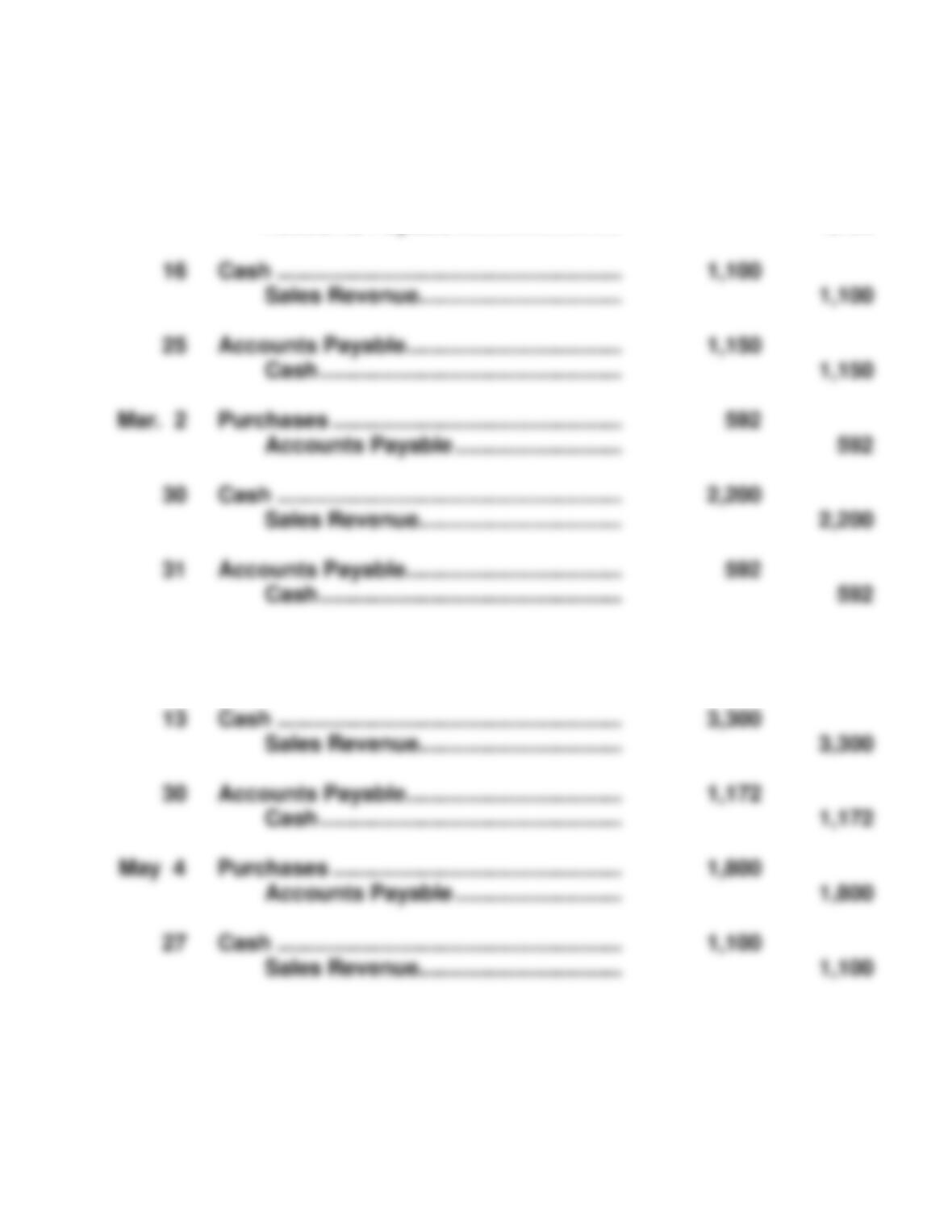
(a)
Feb. 2
Purchases ………………………………………..
1,150
Accounts Payable ………………………
1,150
Cash ………………………………………………..
1,100
Sales Revenue…………………………...
1,100
Accounts Payable ……………………………..
1,150
Cash ………………………………………….
1,150
Mar. 2
Purchases ………………………………………..
Accounts Payable ………………………
Cash ………………………………………………..
2,200
Sales Revenue…………………………...
2,200
Accounts Payable ……………………………..
Cash ………………………………………….
Apr. 1
Purchases ………………………………………..
1,172
Accounts Payable ………………………
1,172
Cash ………………………………………………..
3,300
Sales Revenue…………………………...
3,300
30
Accounts Payable ……………………………..
1,172
Cash ………………………………………….
1,172
May 4
Purchases ………………………………………..
1,800
Accounts Payable ………………………
1,800
Cash ………………………………………………..
1,100
Sales Revenue…………………………...
1,100
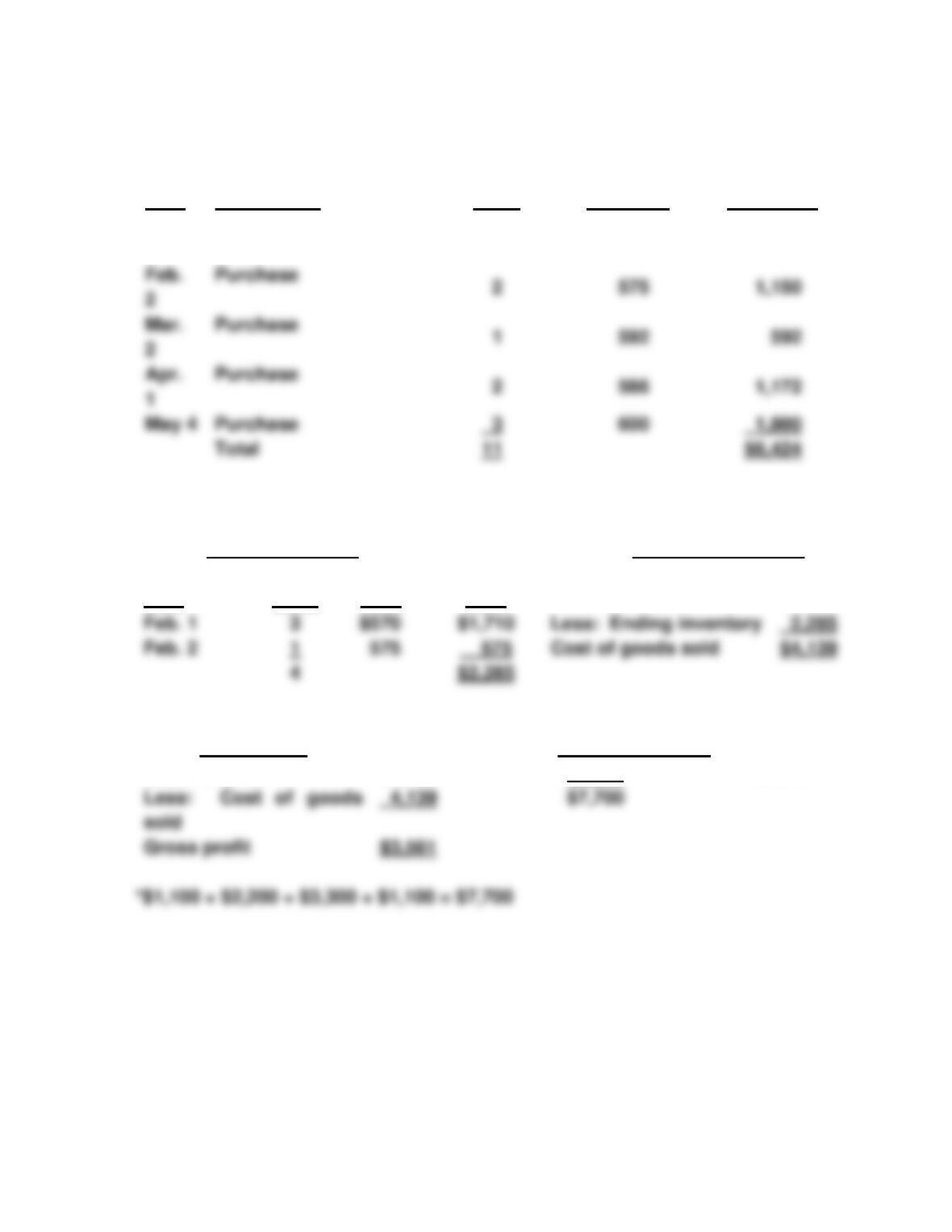
(b) COST OF GOODS AVAILABLE FOR SALE
Date
Explanation
Units
Unit Cost
Total Cost
Feb.
1
Beginning Inventory
3
$570
$1,710
Feb.
2
Purchase
2
2
1
1
2
May 4
Purchase
Total
(c)
LIFO
Ending Inventory
Cost of Goods sold
Date
Units
Unit
Cost
Total
Cost
Cost of goods
available for sale
$6,424
Feb. 1
3
Less: Ending inventory
Feb. 2
1
Cost of goods sold
$4,139
Gross Profit
Gross Profit Rate
Sales revenue
$7,700*
$3,561
46.25%
Less: Cost of goods
sold
$7,700
Gross profit
$3,561
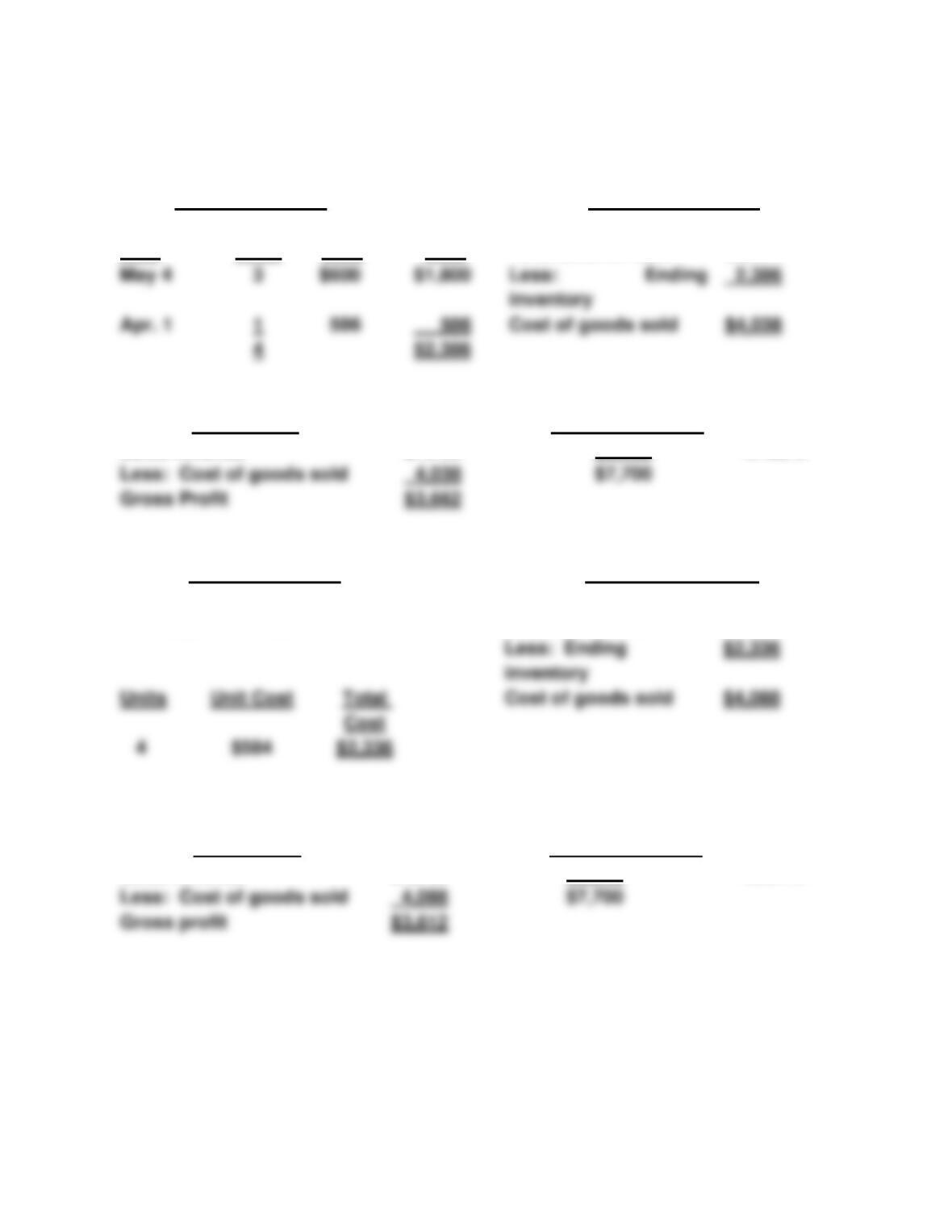
CONTINUING COOKIE CHRONICLE (Continued)
FIFO
Ending Inventory
Cost of Goods sold
Date
Units
Unit
Cost
Total
Cost
Cost of goods
available for sale
$6,424
May 4
Less: Ending
inventory
Apr. 1
Cost of goods sold
$4,038
Gross Profit
Gross Profit Rate
Sales revenue
$7,700
$3,662
47.56%
Less: Cost of goods sold
Gross Profit
Average Cost
Ending Inventory
Cost of Goods Sold
$6,424/11 = $584
Cost of goods
available for sale
$6,424
Less: Ending
inventory
$2,336
$2,336
Gross Profit
Gross Profit Rate
Sales revenue
$7,700
$3,612
46.91%
Less: Cost of goods sold
Gross profit
$3,612
(d) It shouldn’t actually matter which cost flow assumption Natalie
chooses for the purpose of the bank loan. Bankers should be able