Chapter 6
Fundamentals of Product and Service Costing
Learning Objectives
1. Explain the fundamental themes underlying the design of cost systems.
2. Explain how cost allocation is used in a cost management system.
4. Understand how overhead cost is allocated to products.
6. Describe the three basic types of product costing systems: job, process, and operations.
Chapter Overview
I. COST MANAGEMENT SYSTEMS
II. FUNDAMENTAL THEMES UNDERLYING THE DESIGN OF COST SYSTEMS
FOR MANAGERIAL PURPOSES
III. COSTING IN A SINGLE PRODUCT, CONTINUOUS PROCESS INDUSTRY
• Basic Cost Flow Model
• Costing with No Work-in-Process Inventories
• Costing with Ending Work-in-Process Inventories
IV. COSTING IN A MULTIPLE PRODUCT, DISCRETE PROCESS INDUSTRY
V. MULTIPLE ALLOCATION BASES AND TWO-STAGE SYSTEMS
• Choice of Allocation Bases
VI. DIFFERENT COMPANIES, DIFFERENT PRODUCTION AND COSTING SYSTEMS
• Operations Costing: An Illustration
Chapter Outline
LO 6-1 Explain the fundamental themes underlying the design of cost
systems.
COST MANAGEMENT SYSTEMS
• A cost management system is a system that provides information about the costs of
processes, products, and services used and produced by an organization.
o A well-designed cost management system accumulates and reports costs that are relevant
to the decisions that managers make.
• Reasons to Calculate Product or Service Costs
o The purposes of calculating individual product (and service) cost include:
LO 6-2 Explain how cost allocation is used in a cost management system.
• Cost Allocation and Product Costing
o Costs that are common to two or more cost objects are likely to be allocated to those cost
objects on a somewhat arbitrary basis; such cost allocations can result in misleading
information and poor decisions.
• Cost Flow Diagram
o A cost flow diagram provides a graphical representation of the product costing process.
▪ Exhibit 6.1 illustrates a basic cost flow diagram.
• The cost object is the product.
• In this example, manufacturing overhead costs are allocated based on direct labor.
FUNDAMENTAL THEMES UNDERLYING THE DESIGN OF COST SYSTEMS FOR
MANAGERIAL PURPOSES
• Questions that need addressing before undertaking the design of a new cost system:
o How will managers use the information the system is designed to provide?
o What type of decisions will be made using the cost information?
o Will the benefits of improved decision making outweigh the costs of implementing the
new cost system?
• The following points relate to designing a new cost system for managerial purposes:
LO 6-3 Explain how a basic product costing system works.
COSTING IN A SINGLE PRODUCT, CONTINUOUS PROCESS INDUSTRY
• Basic Cost Flow Model
o The fundamental framework for recording costs in any type of firm is the cost flow
model, which is the basic inventory equation.
o Another way to look at the inventory equation is the following statement format:
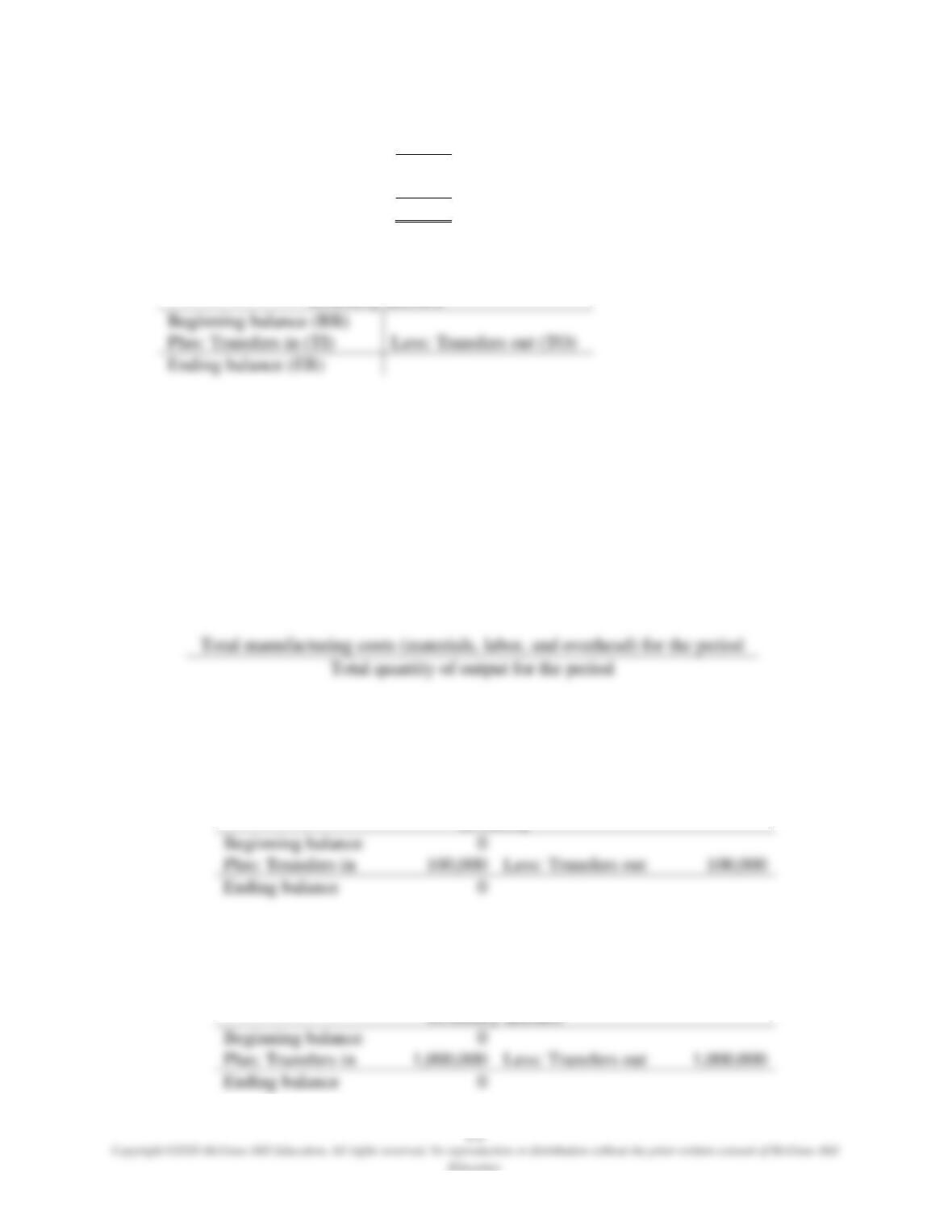
Beginning balance (BB)
xx
Plus: Transfers in (TI)
xx
Total to account for
xx
Less: Transfers out (TO)
xx
Ending balance (EB)
xx
o A third way to look at the inventory equation is the inventory T-account:
Beginning balance (BB)
Less: Transfers out (TO)
Plus: Transfers in (TI)
Ending balance (EB)
o The inventory equation applies to physical units and to the costs associated with the units.
• Costing with No Work-in-Process Inventories
o For a single product with a continuous production process, each individual unit of
product can be considered identical to every other one, so there is no need to trace costs
to individual units.
▪ When there are no work-in-process inventories, the cost assigned to each unit of
output produced can be calculated as:
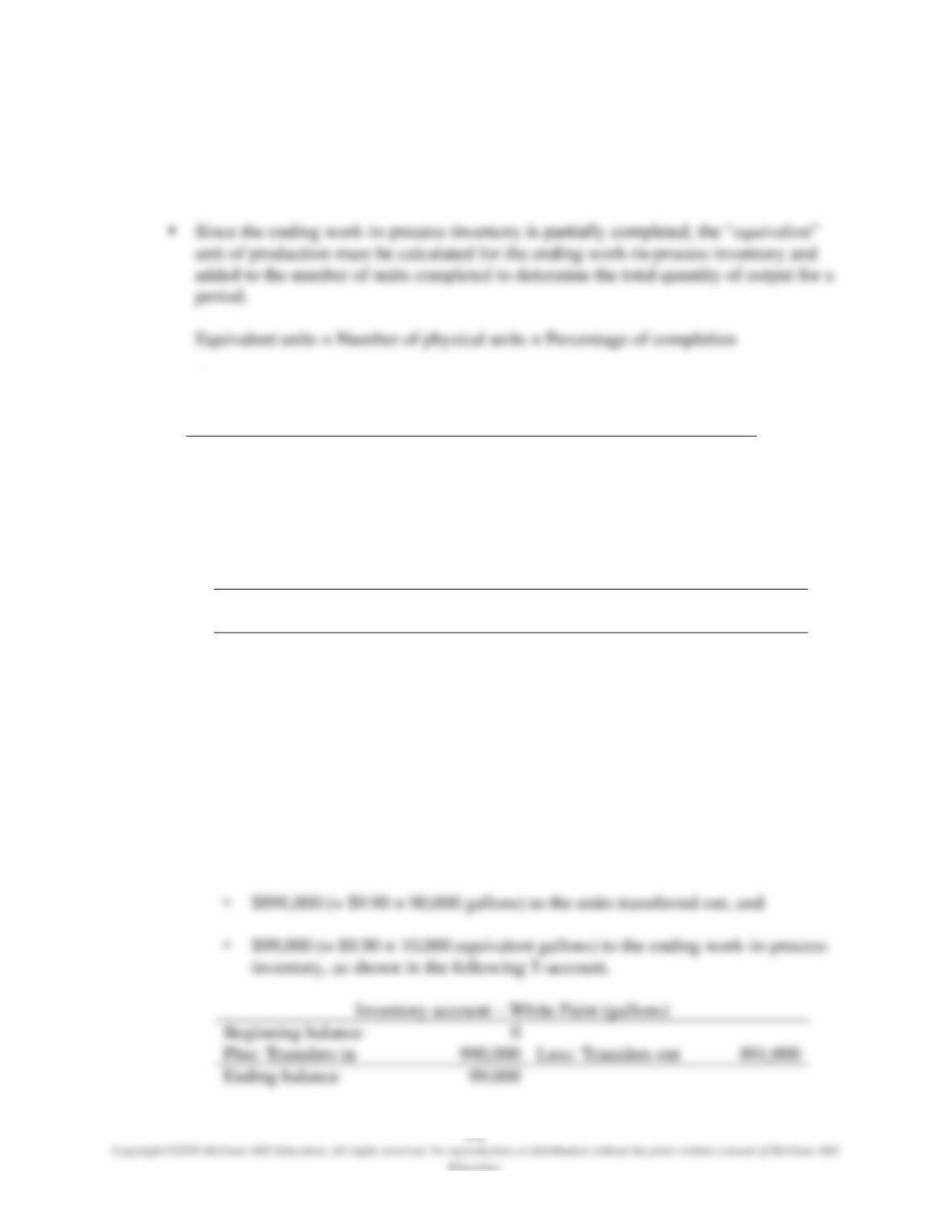
• Example 1: In April, Miller Paints started and completed production of 100,000
gallons of white paint. Total manufacturing costs incurred in April were
$1,000,000. There were no beginning and ending work-in-process inventories.
The following T-account shows the relations in terms of the physical units.
Beginning balance
Plus: Transfers in
Less: Transfers out
Ending balance
Each gallon of white paint was assigned a cost of $10 (= $1,000,000 ÷ 100,000
gallons). Since all 100,000 gallons of white paint were transferred out, the
following T-account in monetary term applies.
Beginning balance
Plus: Transfers in
1,000,000
Less: Transfers out
1,000,000
• Costing with Ending Work-in-Process Inventories
o When ending work-in-process inventory is present, the denominator of the unit-cost
calculation requires modification.
▪ The revised unit-cost calculation becomes
Total manufacturing costs (materials, labor, and overhead) for the period
(Equivalent units + Units completed) for the period
• Example 2: (Continued from Example 1): In May, Miller Paints incurred a total of
$990,000 manufacturing white paint. The accountant prepared the following T-
account in physical units.
Inventory account – White Paint (gallons)
Beginning balance
0
Plus: Transfers in
110,000
Less: Transfers out
90,000
Ending balance
20,000
(50% complete)
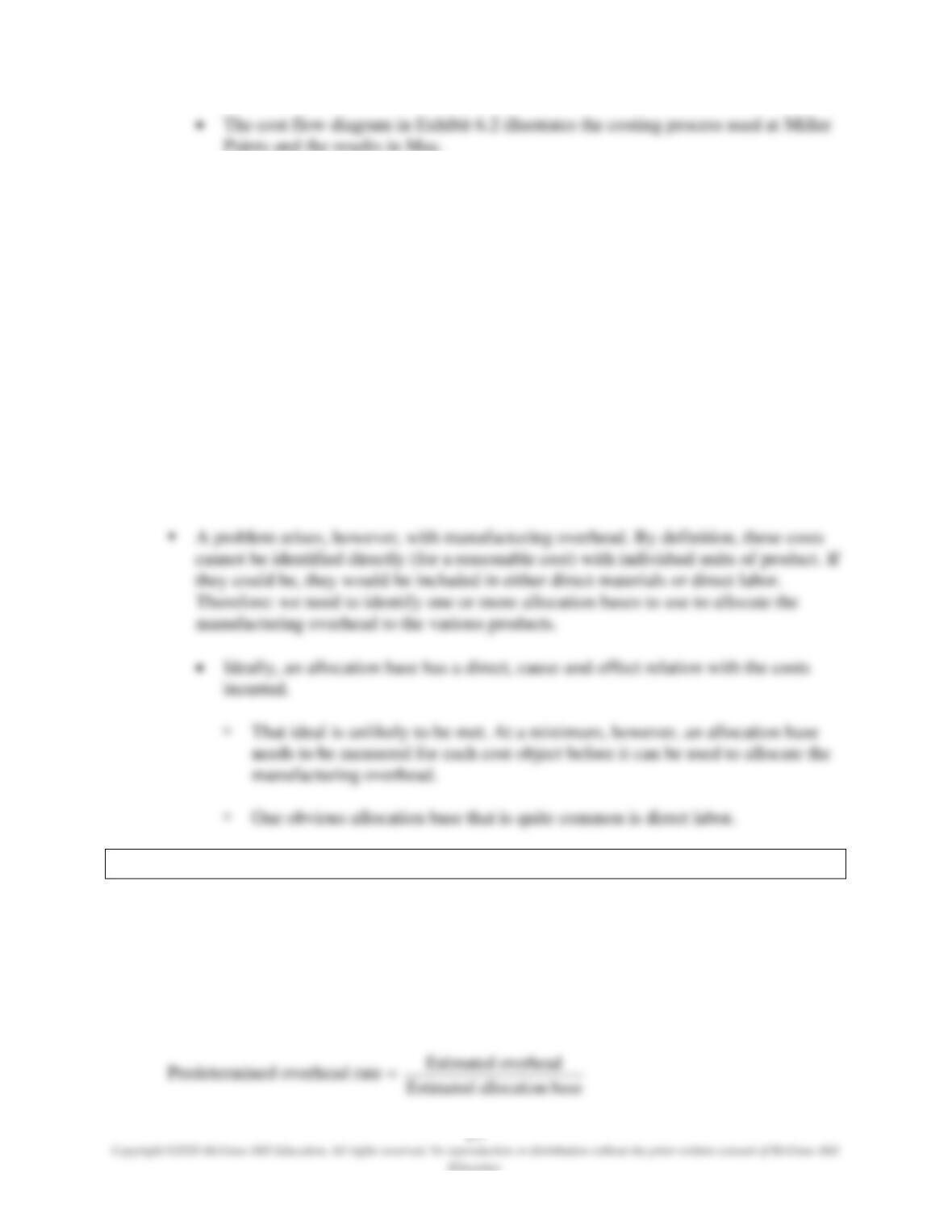
For the 20,000 gallons of paint in process at the end of May, they were on average
50 percent complete and was equivalent to 10,000 gallons of finished paint (=
20,000 gallons × 50%). Total quantity of output for May became 100,000 gallons
(= 90,000 gallons completed and transferred out + 10,000 equivalent gallons).
Each gallon of white paint was assigned a cost of $9.90 (= $990,000 ÷ 100,000
gallons). The $990,000 total manufacturing costs incurred were allocated to two
cost objects:
Inventory account – White Paint (gallons)
Beginning balance
0
Plus: Transfers in
990,000
Less: Transfers out
See Demonstration Problem 1
COSTING IN A MULTIPLE PRODUCT, DISCRETE PROCESS INDUSTRY
• When a firm manufactures multiple products using a manufacturing process that takes place
in a series of discrete steps that differ in detail depending on the product, the benefits of more
detailed costing often outweigh the costs.
o The cost flow diagram in Exhibit 6.3 describes the problem of taking costs from the three
basic cost pools (direct materials, direct labor, and manufacturing overhead) and
allocating them to the cost objects (various products).
▪ Direct costs (direct materials and direct labor) can be directly traced or assigned to the
products at relatively low cost. Work orders, inventory requisitions, and skilled
workers’ time spent are specific to the individual products.
LO 6-4 Understand how overhead cost is allocated to products.
• Predetermined Overhead Rates
o A predetermined overhead rate represents the cost per unit of the allocation base used
to charge manufacturing overhead to products.
o The predetermined overhead rate is calculated from the budgeted data (as estimated).
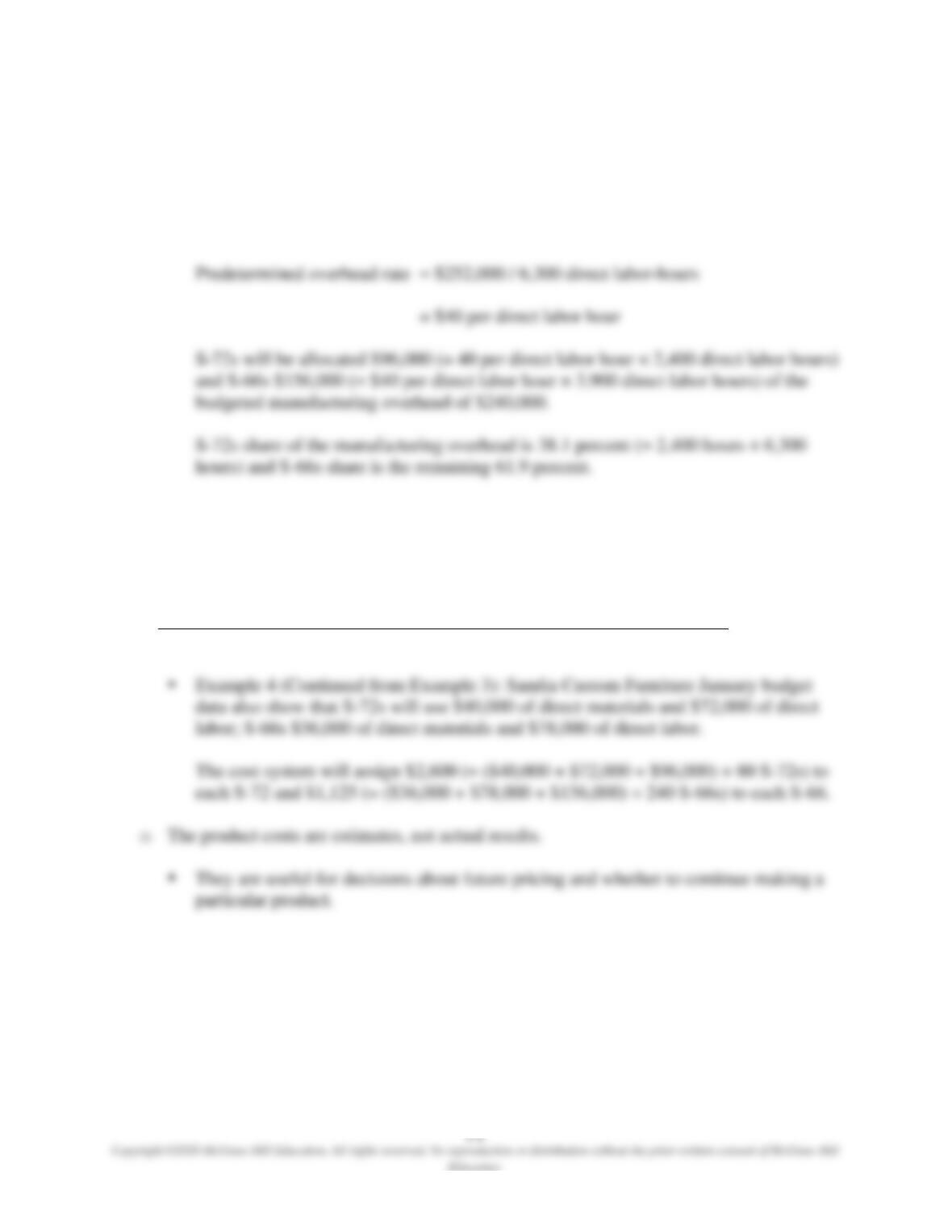
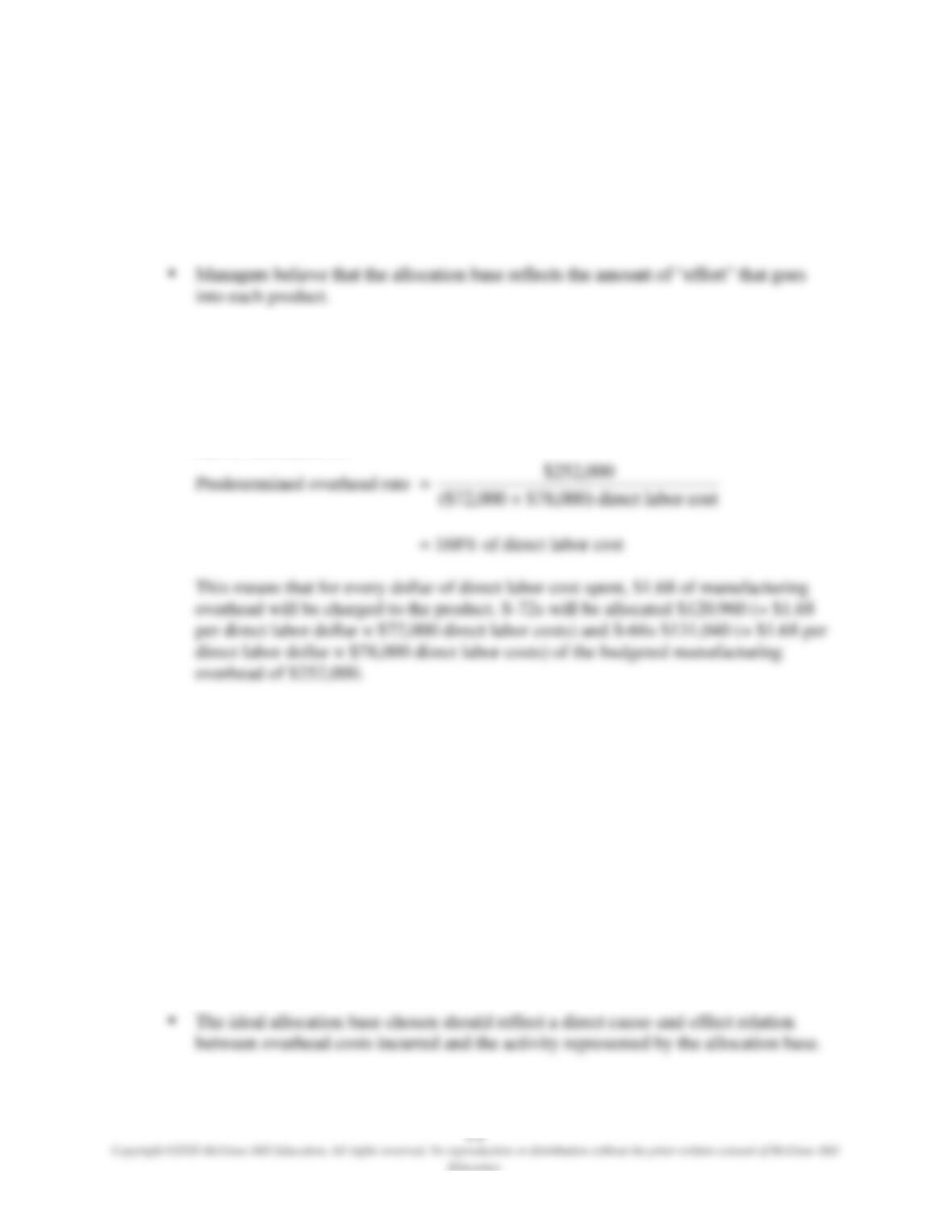
▪ Example 3: Sandia Custom Furniture makes two products, the S-66 and the S-72
mahogany desks, and uses direct labor hours to allocate manufacturing overhead to
products. For next January, the budget data indicate that 80 S-72’s and 240 S-66’s
will be produced using 2,400 and 3,900 direct labor hours, respectively. The total
manufacturing overhead is expected to be $252,000. The predetermined overhead rate
can be calculated as:
• Product Costing of Multiple Products
o The cost assigned to each unit of output produced in a multiple-product, discrete process
firm can be calculated as:
Total manufacturing costs (materials, labor, and overhead) for a product
Total quantity of output for a product
• Choice of the Allocation Base for Predetermined Overhead Rate
o There are at least two reasons why a particular allocation base is chosen:
▪ The cost system already captures information about the allocation base by product
line.
o Using direct labor dollars instead of direct labor hours as the allocation base changes the
unit cost (as illustrated below).
▪ Example 5 (Continued from Examples 3 and 4): If Sandia Custom Furniture selects
instead direct labor cost as the allocation base, then the predetermined overhead rate
can be calculated as:
S-72s share of manufacturing overhead is 48 percent (= $72,000 ÷ $150,000) and S-
66s share is the remaining 52 percent.
The revised unit cost will be $2,912 (= ($40,000 + $72,000 + $120,960) ÷ 80 S-72s)
for each S-72 and $1,021 (= ($36,000 + $78,000 + $131,040) ÷ 240 S-66s) for each
S-66.
See Demonstration Problem 2
• Choosing among Possible Allocation Bases
o The choice of possible allocation bases, though arbitrary, could have important
implications for decision making.
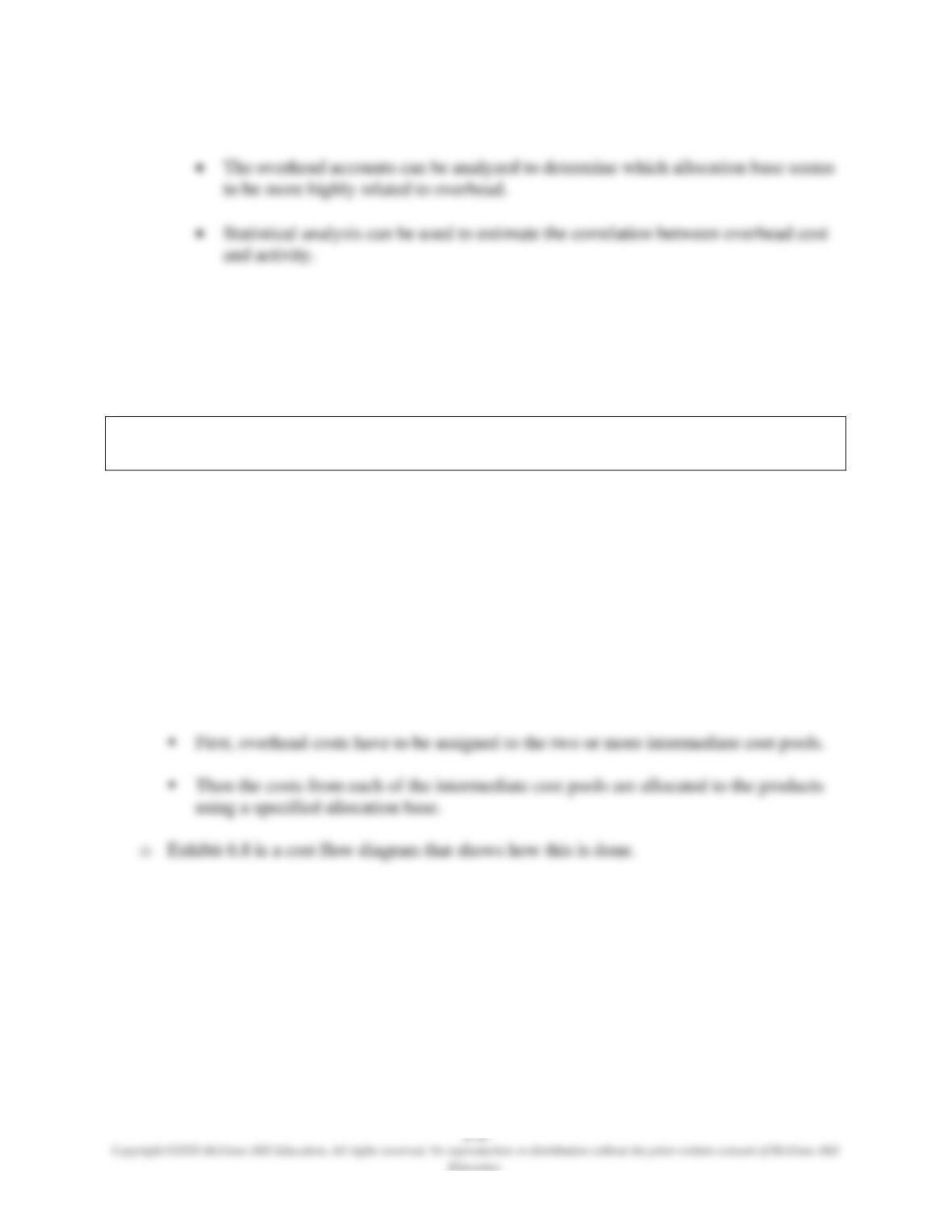
▪ Cost estimation methods can be applied to aid in making the choice.
▪ There is no “right” choice because, by definition, there is no direct relation between
activity and overhead cost that is economically feasible to measure.
• Allocation is inherently arbitrary and imprecise. The goal is to avoid distorting the
product costs “too much.”
LO 6-5 Explain the operation of a two-stage allocation system for product
costing.
MULTIPLE ALLOCATION BASES AND TWO-STAGE SYSTEMS
• Exhibit 6.7 provides more detail on the components of manufacturing overhead at Sandia
Custom Furniture.
• A close inspection of the components of manufacturing overhead may reveal that more than
one factor is driving the resource consumption during production. If this is the case, we can
use two or more allocation bases to allocate manufacturing overhead to the products.
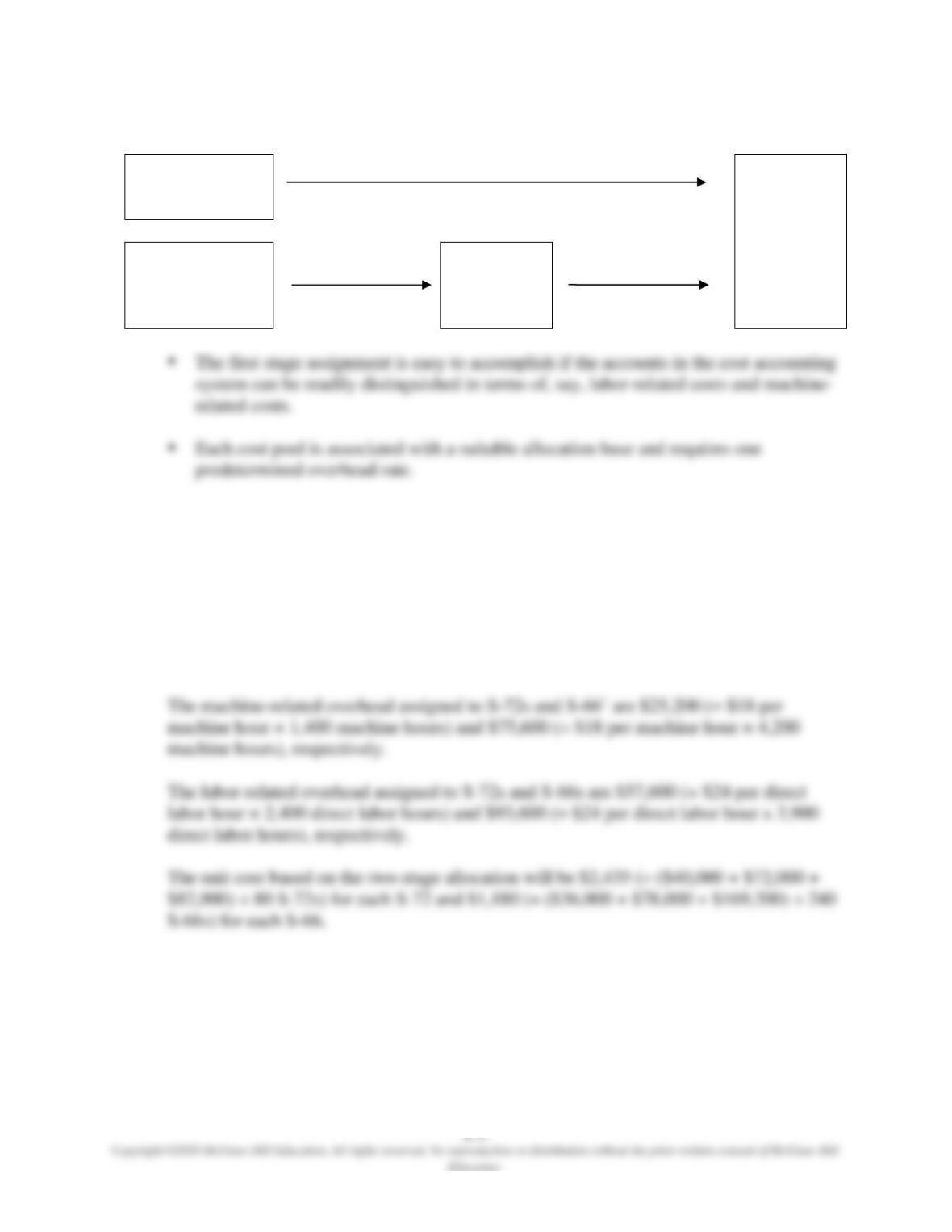
o The approach is referred to as a two-stage cost allocation. The process has two-steps:
o An alternative view is shown below.
Direct costs:
Direct materials
Direct labor
Assigned to
Cost
objects:
Products or
services
Indirect costs:
Manufacturing
overhead
First stage
allocation
Cost pools
Second stage
allocation
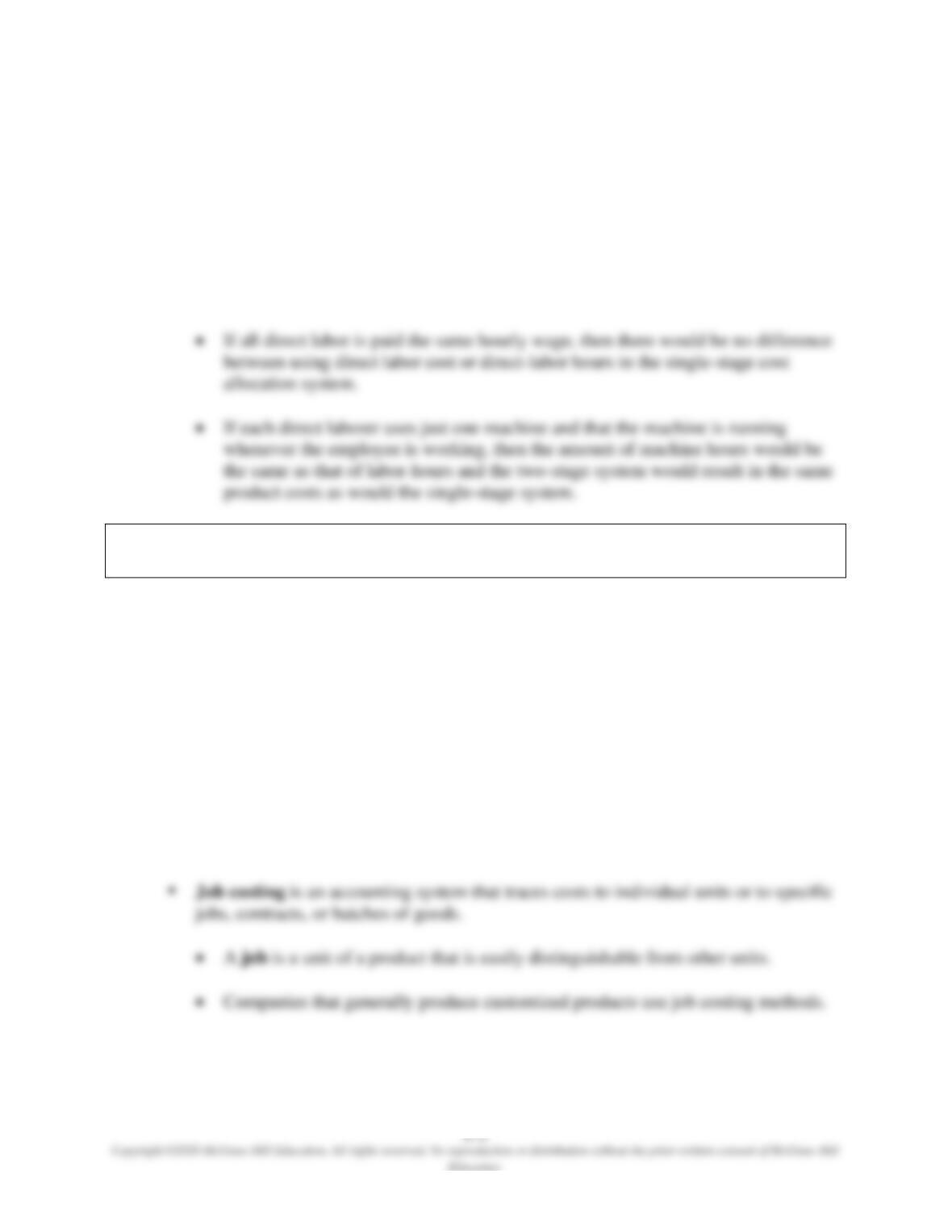
o Example 6 (Continued from Examples 3 and 4): An analysis of Sandia Custom Furniture
January budget data shows that the total machine-related overhead is $100,800 and there
are 5,600 machine hours, so the machine-related overhead rate is $18 per machine hour
(= $100,800 ÷ 5,600 machine hours).
The total labor-related overhead is $151,200 and the direct labor hours are 6,300, so the
labor-related overhead rate is 24% of direct labor hour (= $151,200 ÷ 6,300 direct labor-
hours).
• Choice of Allocation Bases
o In a two-stage allocation system:
▪ Allocation bases still have to be chosen that best reflect the relation between overhead
incurred and activity.
▪ A second criterion is the extent to which the choice of allocation base affects reported
product costs.
LO 6-6 Describe the three basic types of product costing systems: job,
process, and operations.
DIFFERENT COMPANIES, DIFFERENT PRODUCTION AND COSTING SYSTEMS
• Different companies have different production and costing systems.
o The two production processes that sit at the opposite end of the production spectrum can
be described as discrete (such as boat building) and continuous (such as paint
manufacturing), respectively.
o The product costing systems should reflect the differences in the production processes.
o Exhibit 6.10 shows a continuum of production methods ranging from those requiring job
costing to those needing process costing.
▪ Process costing is an accounting system used when identical units are produced
through a series of uniform production steps.
• Process costing does not separate and record costs for each unit.
• Process costing is an accounting system used when identical units are produced
through uniform production steps.
▪ Continuous flow processing is a system that generally mass-produces a single,
homogeneous output in a continuing process.
• Operations Costing: An Illustration
o The design of the cost system is fundamentally the same.
See Demonstration Problem 3