Ethical Obligations and Decision Making in Accounting, 4/e 1
Major Case 6 Waste Management
Case Overview
This case focuses on improper accounting and management decision making at Waste
Management, Inc., during the period of its accounting fraud from 1992 to 1997, and the role and
responsibilities of Arthur Andersen LLP (Andersen), the Waste Management auditors, with
respect to its audit of the company’s financial statements. The case illustrates the kinds of
financial statement frauds that were common during the late 1990s and early 2000s.
Management consistently refused to make the adjustments called for by the PAJEs. Instead,
defendants secretly entered into an agreement with Andersen fraudulently to write off the
accumulated errors over periods of up to ten years and to change the underlying accounting
practices, but to do so only in future periods.
The action steps were not followed by Waste Management. The company promised to look at its
cost deferral, capitalization, and reserve policies and make needed adjustments. It never followed
through, however, and the audit committee was either inattentive to the financial reporting
implications or chose to look the other way. According to Litigation Release 17435, off the
errors and changing the underlying accounting practices as prescribed in the agreement would
have prevented the company from meeting earnings targets and defendants from enriching
Waste Management today is a leading international provider of waste management services, with
45,000 employees serving over 20 million residential, industrial, municipal, and commercial
customers, and it earned about $15 billion of revenues in 2012. It was ranked number 203 in the
2012 Fortune 500 listing of the largest companies in the United States. Here is a brief description
of how and why the company committed fraud.
Ethical Obligations and Decision Making in Accounting, 4/e 2
Dean Buntrock founded Waste Management in 1968 and took the company public in 1971.
During the 1970s and 1980s, Buntrock built a vast waste disposal empire by acquiring and
Despite being a leader in the industry, Waste Management was under increasing pressure from
competitors and from changes in the environmental industry. Its 1996 financial statements
showed that, even though its consolidated revenue for the period from December 1994 to 1996
increased 8.3 percent, its net income declined during that period by 75.5 percent. The truth was
that the income numbers had been manipulated to minimize the declines over time.
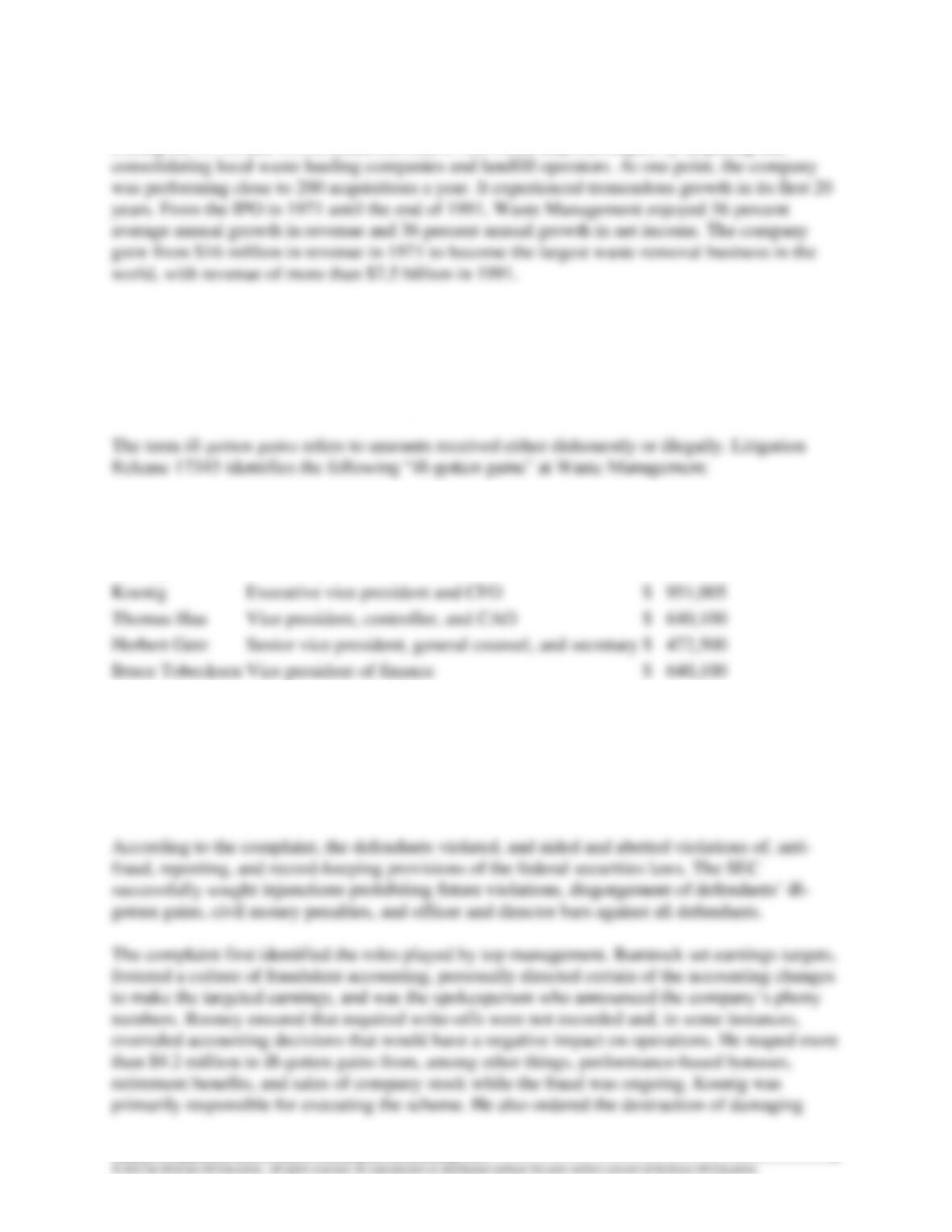
Name
Positions
Amount
Buntrock
CEO and chair of the board
$16,917,761
Rooney
Director, president, and COO
$ 9,286,124
Koenig
Executive vice president and CFO
$ 951,005
Thomas Hau
Vice president, controller, and CAO
$ 640,100
Herbert Getz
Senior vice president, general counsel, and secretary
$ 472,500
Bruce Tobecksen
Vice president of finance
$ 640,100
These ill-gotten gains were included in a lawsuit filed by the SEC on March 26, 2002, against the
six former top officers of Waste Management, Inc., charging them with perpetrating a massive
financial fraud lasting more than five years. The complaint, filed in U.S. District Court in
Chicago, charged that defendants engaged in a systematic scheme to falsify and misrepresent
Waste Management’s financial results between 1992 and 1997.
Ethical Obligations and Decision Making in Accounting, 4/e 3
Hau was the principal technician for the fraudulent accounting. Among other things, he devised
many one-off accounting manipulations to deliver the targeted earnings and carefully crafted the
deceptive disclosures. The explanation of these manipulations is that to reduce expenses and
inflate earnings artificially, management primarily used adjusting entries to conform the
company’s actual results to the predetermined earnings targets. The inflated earnings of prior
The defendants fraudulently manipulated the company’s revenues, because they were not
growing enough to meet predetermined earnings targets, by manipulating current and future asset
values, failing to write off asset impairments, using reserve accounting to mask operating
Overview of Accounting and Financial Reporting Fraud
Improper Accounting Practices
The accounting fraud involved a variety of practices, including improperly eliminating or
deferring current-period expenses in order to inflate earnings. For example, the company avoided
depreciation expenses by extending the estimated useful lives of its garbage trucks while at the
same time making unsupported increases to the trucks’ salvage values. In other words, the more
the trucks were used and the older they became, the more the defendants said they were worth.
Other improper accounting practices included:
• Making unsupported changes in depreciation estimates.
• Failing to record expenses for decreases in the value of landfills as they were filled with
waste.
• Failing to record expenses necessary to write off the costs of impaired and abandoned
landfill development projects.
Ethical Obligations and Decision Making in Accounting, 4/e 4
In February 1998, Waste Management announced that it was restating its financial statements for
the five-year period 1992–1996 and the first three quarters of 1997. The company admitted that
through 1996 it had materially overstated its reported pretax earnings by $1.43 billion and that it
had understated certain elements of its tax expense by $178 million, as reported in Accounting
and Auditing Enforcement Release (AAER) 1405:
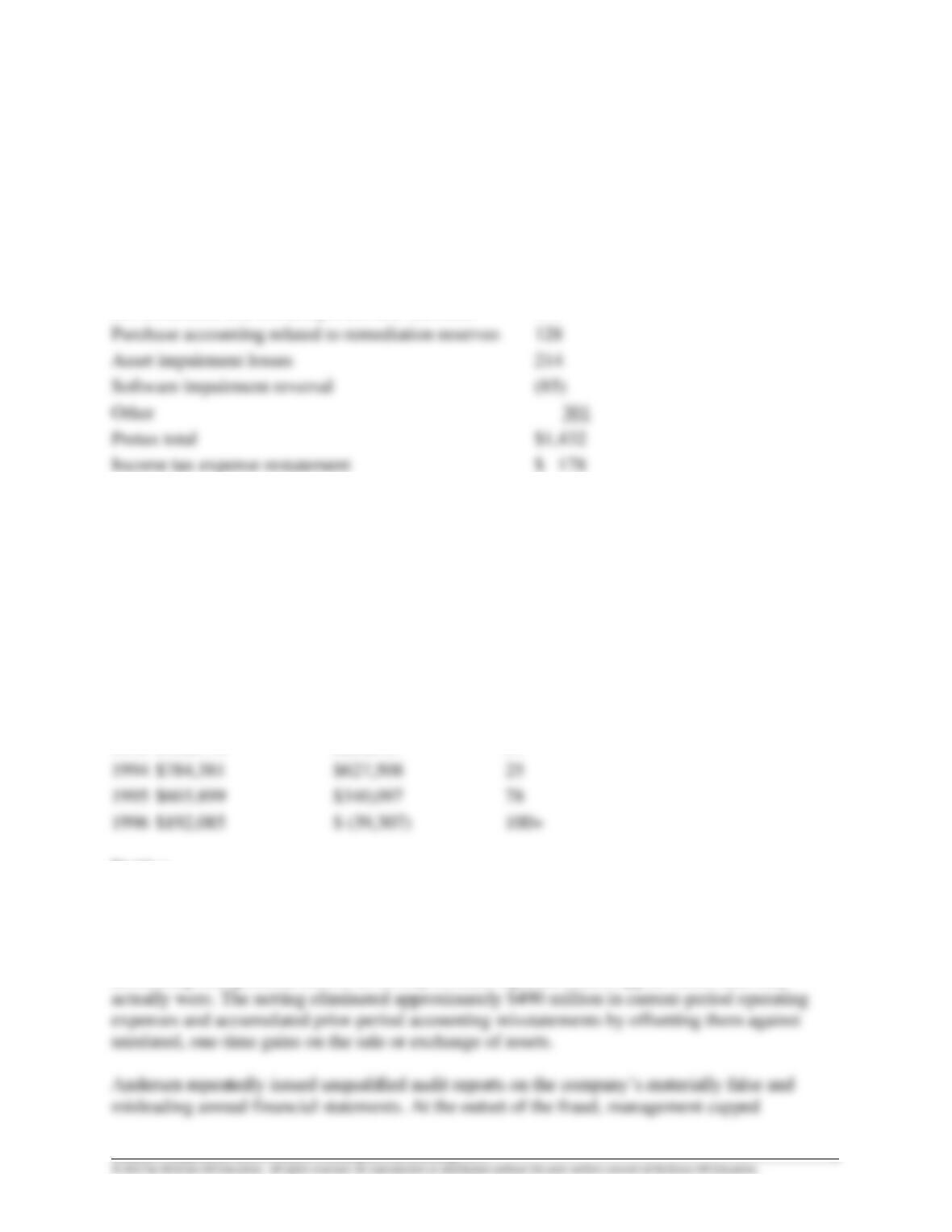
Vehicle, equipment, and container depreciation expense
$ 509
Capitalized interest
192
Environmental and closure/postclosure liabilities
173
Purchase accounting related to remediation reserves
128
Asset impairment losses
214
Software impairment reversal
(85)
Other
301
Pretax total
$1,432
Income tax expense restatement
$ 178
Andersen audited and issued an unqualified (i.e., unmodified) report on each of Waste
Management’s original financial statements and on the financial statements in the restatement. In
so doing, Andersen acknowledged that the company’s original financial statements for the
periods 1992 through 1996 were materially misstated and that its prior unqualified reports on
those financial statements should not be relied upon. In the restatement, the company admitted
that it had overstated its net after-tax income as follows:
Net Income
Year
Reported (thousands)
Restated (thousands)
Percent Overstated
1992
$850,036
$739,686
15
1993
$452,776
$288,707
57
1994
$784,381
$627,508
25
1995
$603,899
$340,097
78
1996
$192,085
$ (39,307)
100+
Netting
Top management concealed their scheme in a variety of ways, including making false and
misleading statements about the company’s accounting practices, financial condition, and future
prospects in filings with the SEC, reports to shareholders, and press releases, and using an
accounting manipulation known as netting to make reported results appear better than they
Ethical Obligations and Decision Making in Accounting, 4/e 5
PAJEs
Management consistently refused to make the adjustments called for by the PAJEs, and
Andersen accepted management’s decision even though the firm knew (or should have known)
that it was not in accordance with GAAP. To placate management and ease its conscience,
Andersen entered into an agreement with top management to write off the accumulated errors
fraudulently over periods of up to 10 years and to change the underlying accounting practices,
but to do so only in future periods. The four-page agreement or “treaty,” called a Summary of
SEC Sanctions against Andersen and Waste Management Officers
As for the Andersen auditors, the SEC found that the firm and four of its auditors violated the
anti-fraud provisions of Rule 10b-5 of the Securities Exchange Act of 1934. These provisions
make it unlawful for a CPA to (1) employ any device, scheme, or artifice to defraud; (2) make an
Litigation Release No. 17039 details the charges against four Andersen partners:
Partner
Position
Robert E. Allgyer
Partner in charge of Waste Management audit
Edward G. Maier
Risk management partner and engagement concurring partner
Ethical Obligations and Decision Making in Accounting, 4/e 6
Walter Cercavschi
Partner on the Waste Management engagement
Robert G. Kutsenda
Central Region audit practice director
The SEC charged that Kutsenda knew or should have known that the netting violated GAAP,
that prior misstatements that he knew about would not be disclosed to investors, that the impact
of the netting on the company’s 1995 financial statements was material, and that an unqualified
audit report was not warranted.
The distribution of the penalty was as follows:
• Buntrock—$19,447,670 total, comprised of $10,708,032 in disgorgement, $6,439,638 of
prejudgment interest, and a $2,300,000 civil penalty.
• Rooney—$8,692,738 total, comprised of $4,593,764 in disgorgement, $2,998,974 of
On November 7, 2001, Connecticut attorney general Richard Blumenthal and treasurer Denise L.
Nappier announced a $457 million settlement with Waste Management in a class action
securities fraud case that provided monetary benefits for shareholders; it was the third-largest
securities class action settlement in U.S. history at the time. Waste Management agreed to
institute important changes in its corporate governance structure, including greater independence
for the company’s audit committee and enhanced accountability for shareholders with respect to
Ethical Obligations and Decision Making in Accounting, 4/e 7
Details of Andersen’s Involvement in the Fraud
As previously mentioned, in order to conceal the understatement of expenses, top officials
resorted to an undisclosed practice known as netting. They used one-time gains realized on the
sale or exchange of assets to eliminate unrelated current-period operating expenses and
accounting misstatements that had accumulated from prior periods. These one-time gains were
offset against items that should have been reported as operating expenses in current or prior
periods, and thus concealed the impact of their fraudulent accounting and the deteriorating
Andersen’s Relationship with Waste Management
The SEC was very critical of Andersen’s relationship with Waste Management. Litigation
Release 17039 notes that the firm had audited Waste Management since before it became a
public company in 1971 and considered the client its “crown jewel.” Until 1997, every CFO and
CAO in Waste Management’s history as a public company had previously worked as an auditor
at Andersen. During the 1990s, approximately 14 former Andersen employees worked for Waste
Management, most often in key financial and accounting positions. Andersen selected Allgyer to
be the managing partner of the Waste Management audit because he had demonstrated a
Ethical Obligations and Decision Making in Accounting, 4/e 8
SEC Charges and Sanctions against Andersen and Partners
Allgyer was charged in connection with Andersen’s audit of Waste Management’s 1992
financial statements. The SEC alleged that he knew or was reckless in not knowing that the
firm’s audit report on the company’s 1992 financial statements was materially false and
misleading because, in addition to quantified misstatements totaling $93.5 million, which, if
corrected, would have reduced the company’s net income before accounting changes by 7.4
percent, there were additional known and likely misstatements that had not been quantified and
estimated. Allgyer further knew that the company had netted, without disclosure, $111 million of
each of the years 1993 through 1996 was materially false and misleading.
Allgyer, the partner responsible for the Waste Management engagement, consented (1) to the
entry of a permanent injunction enjoining him from violating Section 10(b) of the Exchange Act
and Rule 10b-5 thereunder and Section 17(a) of the Securities Act of 1933; (2) to pay a civil
money penalty of $50,000; and (3) in related administrative proceedings pursuant to Rule 102(e),
to the entry of an order denying him the privilege of appearing or practicing before the SEC as an
accountant, with the right to request his reinstatement after five years.
The SEC charged that Kutsenda, the central region audit practice director responsible for
Andersen’s Chicago, Kansas City, Indianapolis, and Omaha offices, engaged in improper
professional conduct within the meaning of Rule 102(e)(1)(ii) of the commission’s rules of
practice with respect to the 1995 audit. During that audit, he was informed of the non-GAAP
netting of a $160 million one-time gain against unrelated expenses and prior–period
Ethical Obligations and Decision Making in Accounting, 4/e 9
The SEC complaint against Andersen charged that the firm knew of Waste Management’s
exaggerated profits during its audits of the financial statements from 1992 through 1996 and
repeatedly pleaded with the company to make changes. Each year, Andersen gave in and issued
unqualified opinions on the company’s financial statements even though they did not conform to
GAAP. A summary of the findings against Andersen follows:
• Knowingly or recklessly issuing false and misleading unqualified audit reports on Waste
Management’s annual financial statements for the years 1993 through 1996.
• Failing to quantify and estimate all known and likely misstatements due to non-GAAP
accounting practices.
Corporate Governance at Waste Management
The fraud at Waste Management was perpetrated by top management. The board of directors
either did not know about it or chose to look the other way. Members of top management had
signed agreements with Andersen that included action steps to correct for past improper
accounting by adjusting future income and adopting proper accounting procedures. Top
management failed to live up to any of its agreements.
step down the ethical slippery slope in 1992 and couldn’t (or wouldn’t) find its way back up to
the high road. It hit rock bottom in 1997, when the fraud eventually unraveled. In mid-1997, the
company’s board of directors brought in a new CEO, who ordered a review of the accounting
and then resigned after barely four months because, reportedly, he thought that the accounting
1997. It concluded that, for this period, the company had overstated its reported pretax earnings
by approximately $1.7 billion and understated certain elements of its income tax expense by
approximately $190 million. In restating its financial statements, the company revised every
Questions
1. Characterize the ethical leadership at Waste Management and how it influenced
organizational ethics.
Despite being a leader in the industry, Waste Management was under increasing pressure
from competitors and from changes in the environmental industry. Its 1996 financial
statements showed that, even though its consolidated revenue for the period from December
1994 to 1996 increased 8.3 percent, its net income declined during that period by 75.5
percent. The truth was that the income numbers had been manipulated to minimize the
declines over time.
Ethical Obligations and Decision Making in Accounting, 4/e 11
17435
1
, writing off the errors and changing the underlying accounting practices as prescribed
in the agreement would have prevented the company from meeting earnings targets and
defendants from enriching themselves. Defendants got performance-based bonuses based on
the company’s inflated earnings, retained their high-paying jobs, and received stock options.
Some also received enhanced retirement benefits based on the improper bonuses, and some
The following managers were implicated in the accounting fraud at Waste Management and
cited in the SEC’s complaint
2
against the company for accounting fraud, failed internal
controls, and inadequate corporate governance.
Buntrock
CEO and chair of the board
Rooney
Director, president, and COO
Koenig
Executive vice president and CFO
Thomas Hau
Vice president, controller, and CAO
Herbert Getz
Senior vice president, general counsel, and secretary
Bruce Tobecksen
Vice president of finance
The complaint, filed in U.S. District Court in Chicago, charged that defendants engaged in a
systematic scheme to falsify and misrepresent Waste Management’s financial results between
1992 and 1997.
According to the complaint, the defendants violated, and aided and abetted violations of,
anti-fraud, reporting, and record-keeping provisions of the federal securities laws. The SEC
successfully sought injunctions prohibiting future violations, disgorgement of defendants’ ill–
gotten gains, civil money penalties, and officer and director bars against all defendants.
Ethical Obligations and Decision Making in Accounting, 4/e 12
accountants, and withheld information from the outside auditors. He profited by more than
$900,000 from his fraudulent acts.
Hau was the principal technician for the fraudulent accounting. Among other things, he
devised many one-off accounting manipulations to deliver the targeted earnings and carefully
crafted the deceptive disclosures. The explanation of these manipulations is that to reduce
expenses and inflate earnings artificially, management primarily used adjusting entries to
The defendants fraudulently manipulated the company’s revenues, because they were not
growing enough to meet predetermined earnings targets, by manipulating current and future
asset values, failing to write off asset impairments, using reserve accounting to mask
operating expenses, implementing improper capitalization policies, and failing to establish
reserves (liabilities) to pay for income taxes and other expenses.
The underlying principles of ethical leadership are: integrity, honesty, fairness, justice,
responsibility, accountability, and empathy. None of this was remotely apparent at Waste
2. The SEC charged Andersen with failing to quantify and estimate all known and
likely misstatements due to non-GAAP practices. Describe the failings of the firm
Ethical Obligations and Decision Making in Accounting, 4/e 13
with respect to professional judgment and ethical expectations under the AICPA
Code.
Auditors quantify all known and likely misstatements to evaluate the audit findings and
determine the appropriate audit opinion. To issue an unmodified opinion the auditors must
conclude that there is a low level of risk of material misstatement of the financial statements.
Known misstatements are specific misstatements identified during the course of the audit
Judgment occurs in a setting of uncertainty, risk, and often conflicts of interest. For an
auditor, professional skepticism is essential in making professional judgments. It helps to
frame auditors’ mindset of independent thought. Objectivity and due care are attitudes and
behaviors that enable judgments to be made. These ethical principles guide professional
judgment under the AICPA Code and enable auditors to meet their ethical and professional
responsibilities.
At the very center of professional judgment is mindset. Auditors should approach matters
objectively and independently, with inquiring and incisive minds. Professional skepticism is
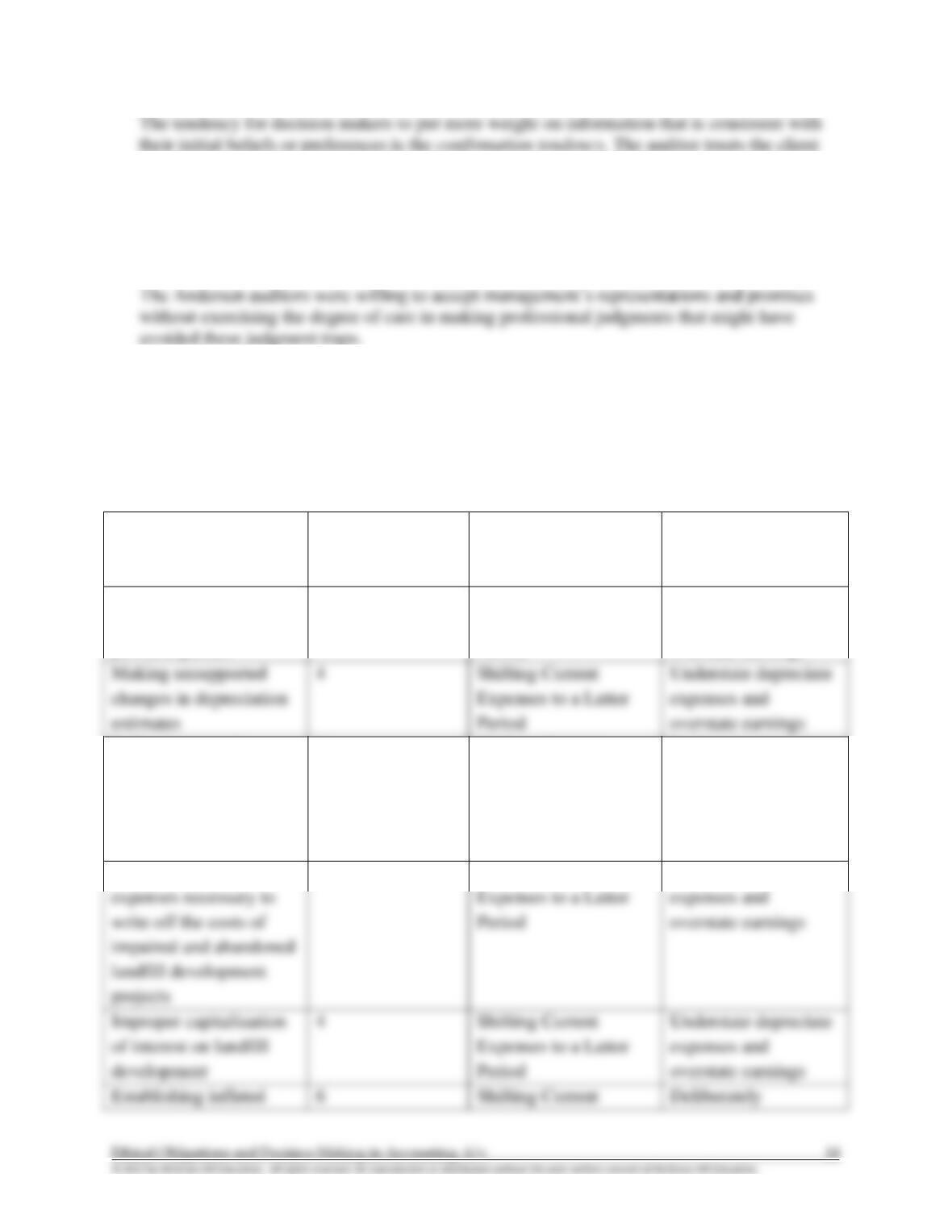
As decision makers navigate through professional judgments, judgment traps and tendencies
can lead to bias. One common judgment trap is the tendency to want to immediately solve a
problem by making a quick judgment. Andersen too readily accepted management’s
explanations and promises to adjust for its failure to properly reflect the PAJEs without
drilling down on whether the ethical leadership failures, overrides of internal controls, and
failed governance systems at Waste Management and the managers themselves were likely to
write off the costs of
impaired and abandoned
projects
Period
overstate earnings
development
Period
overstate earnings
Establishing inflated
6
Shifting Current
Deliberately
based on past experiences and is more willing to accept the copies. However, in many
instances, we cannot know something to be true unless we explicitly consider how and why it
may be false. Confirmation bias in auditing may occur when auditors over-rely on
management’s explanations for a significant difference between the auditor’s expectation and
management’s recorded value, even when the client’s explanation is inadequate.
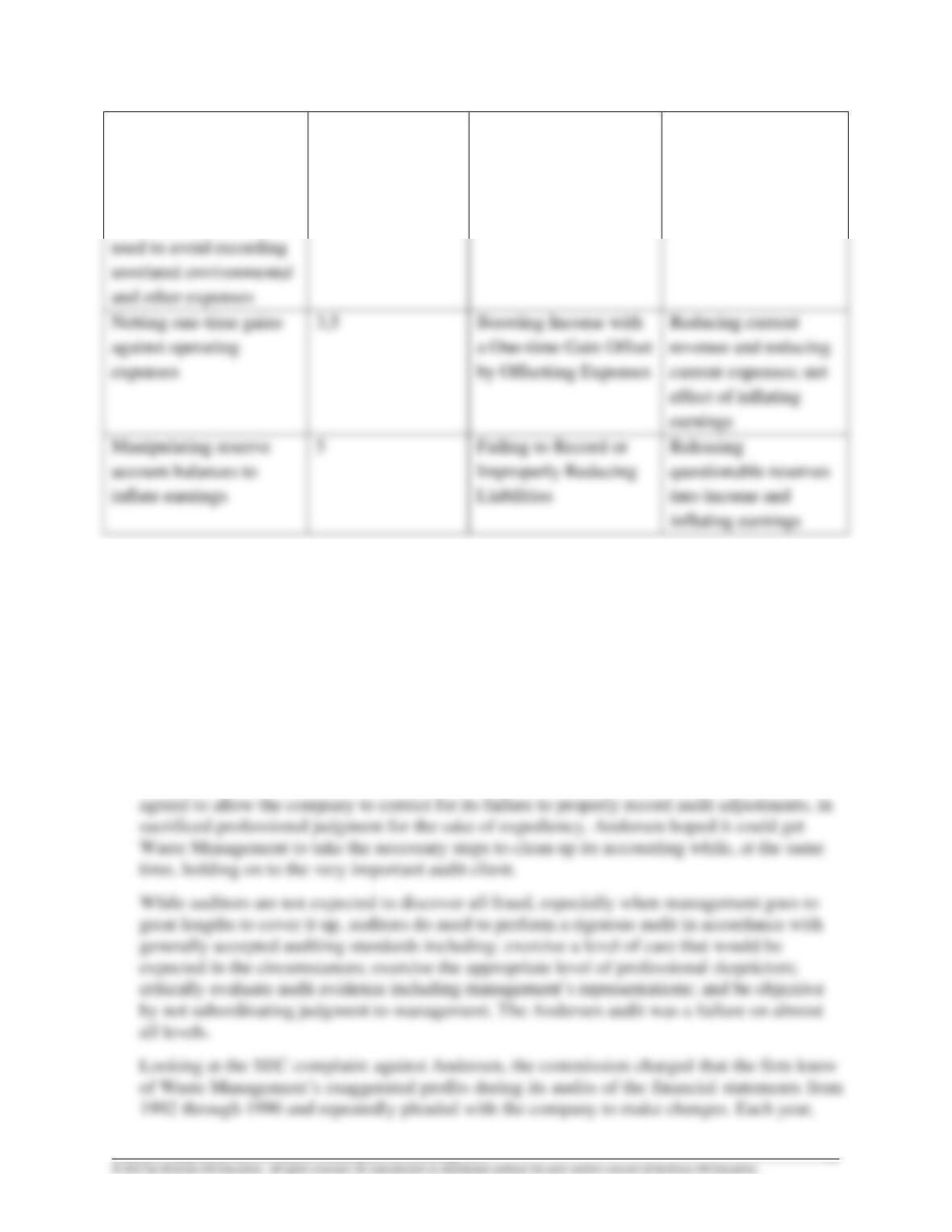
3. Classify each of the accounting techniques described in the case that contributed to
the fraud into one of Schilit’s accounting shenanigans. Include a brief discussion of
how each technique violated GAAP.
Waste Management used the following improper accounting practices paired with Schilit’s
shenanigans:
Description of
Improper Accounting
Practice
Schilit’s
Shenanigan
Number
Description of
Shenanigan
Effect on Financial
Statements
Improperly eliminating
or deferring current
period expenses
4
Shifting Current
Expenses to a Latter
Period
Understate depreciate
expenses and
overstate earnings
Making unsupported
estimates
4
Shifting Current
Period
Understate depreciate
overstate earnings
Failing to record
expenses for decreases
in the value of landfills
as they were filled with
waste
4
Shifting Current
Expenses to a Latter
Period
Understate depreciate
expenses and
overstate earnings
Failing to record
4
Shifting Current
Understate depreciate
Ethical Obligations and Decision Making in Accounting, 4/e 15
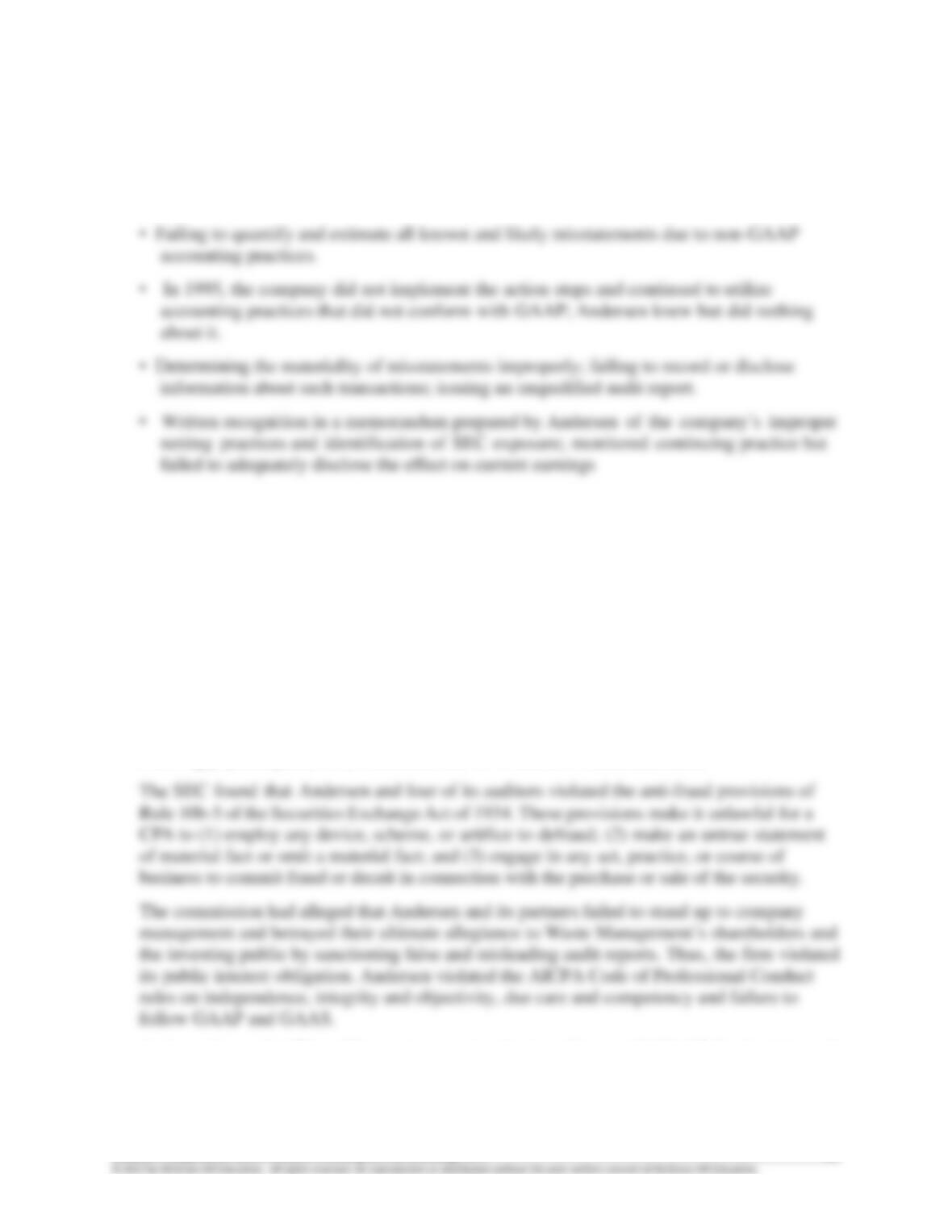
Manipulating reserve
5
Failing to Record or
Releasing
environmental reserves
(liabilities) in
connection with
acquisitions so that
excess reserves could be
Revenue to Later
Period
overstating
environmental
reserves and adjusting
it downward in future
period
4. Do you believe auditors should be expected to discover fraud when a client goes to
great lengths, as did Waste Management, to withhold evidence from the auditors
and mask the true financial effects of transactions? Explain.
Auditors are expected to assess the risk of material misstatements in the financial statements
and fraud. Numerous red flags existed at Waste Management that should have made it clear to
Andersen that fraud was occurring. Instead, it chose to ignore the red flags and take steps that
it hoped would correct the accumulated problems that developed in Waste Management’s
financial statements and the company’s unwillingness to record the PAJEs. When Andersen
Ethical Obligations and Decision Making in Accounting, 4/e 16
Andersen gave in and issued unqualified opinions on the company’s financial statements even
though they did not conform to GAAP. A summary of the findings against Andersen follows:
• Knowingly or recklessly issuing false and misleading unqualified audit reports on Waste
Management’s annual financial statements for the years 1993 through 1996.
Andersen annually presented company management with PAJEs to correct errors that
understated expenses and overstated earnings in the company’s financial statements.
Management consistently refused to make the adjustments called for by the PAJEs, and
Andersen accepted management’s decision even though the firm knew (or should have
known) that it was not in accordance with GAAP. To placate management and ease its
conscience, Andersen entered into an agreement with top management to write off the
accumulated errors fraudulently over periods of up to 10 years and to change the underlying
accounting practices, but to do so only in future periods. The four-page agreement or “treaty,”
called a Summary of Action Steps, identified improper accounting practices and prescribed
32 “must–do” steps for the company to follow to change those practices. The action steps
constituted an agreement between the company and Andersen to cover up past frauds by
committing additional frauds in the future. It was the smoking gun proving that Andersen
knowingly participated in a fraudulent act in violation of securities laws.
Andersen knew that Waste Management was not in compliance with GAAP. In planning and
performing the audit each year, Andersen should have assessed risks of material
misstatements by area, account, and overall. Andersen should have planned and performed
Ethical Obligations and Decision Making in Accounting, 4/e 17