Chapter 6 Discussion Questions
Suggested Discussion and Solutions
1. As discussed in the opening reflection, MF Global filed a complaint charging PwC
with professional malpractice, breach of contract, and unjust enrichment in
connection with its advice concerning, and approval of, the company’s off-balance-
sheet accounting for its investments. The court’s decision points out that absent
PwC’s advice, MF Global Holdings would not have invested heavily in European
sovereign debt to generate immediate revenues and would not have suffered the
massive damages that befell the company in 2011. Do you believe that auditors
should be held legally liable when they advise clients on matters related to the
company’s finances that turn out to be wrong? Explain with reference to legal and
professional standards.
In the MF Global case, PricewaterhouseCoopers (PwC) advised MF Global to invest in
European sovereign debt to generate immediate revenues that turned out to be risky
investments that lost money. MF Global also recorded the transactions as sales and not
financings, which wasn’t in accordance with generally accepted accounting principles
(GAAP). Thus, PwC was sued for failing to detect problems with MF Global’s financial
statements. The audits conducted by PwC gave MF Global a clean bill of health.
2. Distinguish between common-law liability and statutory liability for auditors. What
is the basis for the difference in liability?
Ethical Obligations and Decision Making in Accounting, 4/e 2
Common law liability arises from legal opinions issued by judges in deciding cases.
These opinions become legal precedents and guide other judges in deciding on similar
cases in the future. Common law cases are civil suits. Statutory liability reflects
legislation passed at the state or federal level; the legislation establishes certain courses of
conduct. Statutory law can either result in civil liability or criminal liability. A good
3. Is there a conceptual difference between an error and negligence from a reasonable
care perspective? Give examples of each of your response.
Errors are unintentional mistakes or omissions. Errors may involve mistakes in gathering
or processing data or testing, misinterpretation of facts, mistakes in the application of
GAAP or GAAS. A simple error is transposing numbers when entered into the data-base
system (i.e., $492 recorded as $429). There can be errors in math, disclosure, and even in
4. Distinguish between the legal concepts of actually foreseen third-party users and
reasonably foreseeable third-party users. How does each concept establish a basis
for an auditor’s legal liability to third parties?
Actually foreseen third party users are a limited range of individuals or organizations that
the client intends the information to benefit. The auditor need not know the exact identity
of the third party. However, it owes a duty to persons who the professional knows will
rely on the information. The auditor would be liable to any plaintiff that justifiably relied
on the information and suffered a loss from that reliance. An example would be if the
Ethical Obligations and Decision Making in Accounting, 4/e 3
5. Do you think that the provision of nonaudit services for a client with a failed audit is
evidence of negligence?
6. Explain the legal basis for a cause of action against an auditor. What are the
defenses available to the auditor to rebut such charges? How does adherence to the
ethical standards of the accounting profession relate to these defenses?
A client or a third party must prove that (1) the CPA accepted a duty of professional care
to exercise skill, prudence, and diligence; (2) the CPA breached his/her duty of due
7. Assume a third party such as a successor audit firm quickly discovers a fraud that
the predecessor auditor has overlooked for years. Do you think this provides
evidence supporting scienter? Explain.
Scienter means having knowledge of a falsehood. There is no way to know for sure
whether a predecessor auditor ended the engagement with a client because they
discovered a fraud. However, if fraud did exists and it went uncorrected, then a report
Extended Discussion
Ethical Obligations and Decision Making in Accounting, 4/e 4
Section 10A of the Securities Exchange Act of 1934, 15 U.S.C.§ 78j-1. Audit
requirements.
(a) In general
Each audit required pursuant to this chapter of the financial statements of an issuer by a
registered public accounting firm shall include, in accordance with generally accepted
auditing standards, as may be modified or supplemented from time to time by the
Commission—
(1) procedures designed to provide reasonable assurance of detecting illegal acts
(b) Required response to audit discoveries
(1) Investigation and report to management
If, in the course of conducting an audit pursuant to this chapter to which subsection (a) of
this section applies, the registered public accounting firm detects or otherwise becomes
aware of information indicating that an illegal act (whether or not perceived to have a
material effect on the financial statements of the issuer) has or may have occurred, the
firm shall, in accordance with generally accepted auditing standards, as may be modified
(2) Response to failure to take remedial action
If, after determining that the audit committee of the board of directors of the issuer, or
the board of directors of the issuer in the absence of an audit committee, is adequately
informed with respect to illegal acts that have been detected or have otherwise come to
the attention of the firm in the course of the audit of such firm, the registered public
accounting firm concludes that—
the registered public accounting firm shall, as soon as practicable, directly report
its conclusions to the board of directors.
(3) Notice to Commission; response to failure to notify
An issuer whose board of directors receives a report under paragraph (2) shall inform the
Commission by notice not later than 1 business day after the receipt of such report and
shall furnish the registered public accounting firm making such report with a copy of the
notice furnished to the Commission. If the registered public accounting firm fails to
(4) Report after resignation
If a registered public accounting firm resigns from an engagement under paragraph
(3)(A), the firm shall, not later than 1 business day following the failure by the issuer
8. What are the legal requirements for a third party to sue an auditor under Section 10
and Rule 10b-5 of the Securities Exchange Act of 1934? How do these requirements
relate to the Hochfelder decision?
9. Valley View Manufacturing Inc., sought a $500,000 loan from First National Bank.
First National insisted that audited financial statements be submitted before it
would extend credit. Valley View agreed to do so and an audit was performed by an
independent CPA who submitted her report to Valley View. First National, upon
reviewing the audited financial statements decided to extend the credit desired.
Certain ratios used by First National in reaching its decision were extremely positive
indicating a strong cash flow. It was subsequently learned that the CPA, despite the
exercise of reasonable care, had failed to discover a sophisticated embezzlement
scheme by Valley View’s chief accountant. Under these circumstances, what liability
might the CPA have?
Under this kind of situation, if the CPA can show due care and competency in the
performance of the audit, the CPA would not be liable. The CPA would need to show that
the audit was planned and performed to detect material misstatements, but that it is not
absolute assurance that all misstatements, and especially sophisticated embezzlement by
the chief accountant, will be discovered. The CPA did perform an audit with reasonable
10.
Nixon and Co., CPAs, issued an unmodified opinion on the 2015 financial
statements of Madison Corp. These financial statements were included in Madison’s
annual report and Form 10-K filed with the SEC. Nixon did not detect material
misstatements in the financial statements as a result of negligence in the
performance of the audit. Based upon the financial statements, Harry purchased
stock in Madison. Shortly thereafter, Madison became insolvent, causing the price
of the stock to decline drastically. Harry has commenced legal action against Nixon
for damages based upon Section 10(b) and Rule 10b-5 of the Securities Exchange
Act of 1934. What would be Nixon’s best defense to such an action? Explain.
Ethical Obligations and Decision Making in Accounting, 4/e 7
Harry must show that he suffered a loss, that the financial statements were misleading,
and that he relied on the financial statements to make his investment in Madison. Nixon’s
defense against the legal action would be evidence of the audit performed with in
11. The following pertains to auditor legal liability standards under the PSLRA:
a. The Reform Act requires that, in any private securities fraud action in which the
plaintiff is alleging a misleading statement or omission on the part of the defendant,
“the complaint shall specify each statement alleged to have been misleading, the
reason or reasons why the statement is misleading, and, if an allegation regarding
the statement or omission is made on information and belief, the complaint shall
state with particularity all facts on which that belief is formed.”
Do you believe this standard better protects auditors from legal liability than the
standards which existed before the PSLRA? Explain.
b. Do you believe the change in standards for auditors’ liability under the PSLRA
from joint-and-several to proportional liability was a good thing? Explain.
a. The PSLRA requires that a complaint specify each statement alleged to have been
misleading, the reason or reasons why the statement is misleading, and, if an allegation
regarding the statement or omission is made on information and belief, the complaint
shall state with particularity all facts on which the belief is formed.
The PSLRA also requires that a complaint, with respect to each act or omission:
Extended Discussion
Ethical Obligations and Decision Making in Accounting, 4/e 8
The Sixth Circuit addressed the liability of an outside auditor named as a primary violator
in a securities fraud action in Louisiana School Employees’ Retirement System v. Ernst &
Young, LLP, No. 08-6194 (6th Cir. Decided Sept. 22, 2010) There, the Circuit Court held
that a plaintiff “may survive a motion to dismiss only by pleading with particularity facts
that give rise to a strong inference that the defendant acted with knowledge or conscious
disregard of the fraud being committed . . .” as to a defendant. However, “[t]he standard
of recklessness is more stringent when the defendant is an outside auditor.”
The case is based on the acquisition by Accredo Health, Inc., of a division of Gentiva
Health Services, Inc. The deal closed in June 2002. EY issued an unqualified audit
opinion on Accredo’s 2002 fiscal year financial results.
The Sixth Circuit affirmed. The Court began by noting that the PSLRA requires a
securities law plaintiff to state with particularity both the facts constituting the alleged
violation of Section 10(b) and those establishing scienter. As Tellabs holds, the “strong
inference” standard of the PSLRA was intended to “raise the bar” for pleading scienter.
While reckless conduct will suffice, when the case is against an outside auditor, more is
required. In that instance “the complaint must identify specific, highly suspicious facts
and circumstances available to the auditor at the time of the audit and allege that these
Ethical Obligations and Decision Making in Accounting, 4/e 9
that its testing of the receivables was deficient because the firm used “old and stale” data.
Even if true, this type of allegation does not constitute securities fraud, the Court noted.
Plaintiffs’ claim is not bolstered by its assertion that the audit firm missed “red flags.” To
create a strong inference of scienter from such a claim, the factual allegations must
demonstrate an “egregious refusal to see the obvious, or to investigate the doubtful.”
Typically, courts look for multiple, obvious red flags before drawing an inference of
b.
Background
On December 22, 1995, the U.S. Senate voted to override President Clinton’s December
19, 1995 veto of the Private Securities Litigation Reform Act of 1995. With the House of
Representatives having similarly voted on December 20, 1995 to override the veto, the
Reform Act, which affects dramatically the ability of companies to defend themselves
against class actions brought under the Federal securities laws, became law on December
22, 1995; its provisions do not apply, however, to any private action commenced before
that date.
Ethical Obligations and Decision Making in Accounting, 4/e 10
investors were reasonably likely to rely on the misrepresentation or omission, will suffer
joint and several liability.
12. Some auditors claim that increased exposure under Section 404 of the SOX creates a
litigation environment that is unfairly risky for auditors. Do you think that the
inability of auditors to detect a financial statement misstatement due gross
deficiencies in internal controls over financial reporting should expose auditors to
litigation? Why or why not? Include reference to appropriate ethical standards in
your response.
An ethical person wants to perform honest work for an honest dollar. Auditors have an
obligation of due care and competency, or another way to say that is the auditors have an
obligation not to be negligent. Auditors should be held to such a standard and should be
liable for degrees of negligence and fraud. While a financial statement audit does not
13. Assume a U.S. company operates overseas and is approached by foreign
government officials with a request to provide family members with student
internships with the company. The company does business in that country with
foreign customers and is negotiating for a contract with one such customer to
Ethical Obligations and Decision Making in Accounting, 4/e 11
provide services. Under what circumstances might such a request violate the
FCPA?
This is an actual case. On August 18, 2015, the SEC announced that BNY Mellon had
agreed to pay $14.8 million to settle charges that it violated the Foreign Corrupt Practices
Act (FCPA) by providing valuable student internships to family members of foreign
government officials affiliated with a Middle Eastern sovereign wealth fund.3
An SEC investigation found that BNY Mellon did not evaluate or hire the family
members through its existing, highly competitive internship programs that have stringent
hiring standards and require a minimum grade point average and multiple
interviews. The family members did not meet the rigorous criteria yet were hired with
the knowledge and approval of senior BNY Mellon employees in order to corruptly
influence foreign officials and win or retain contracts to manage and service the assets of
the sovereign wealth fund.
Ethical Obligations and Decision Making in Accounting, 4/e 12
14.
Has the accounting profession created a situation in which the auditors’ ethical
behavior is impaired by their professional obligations? How does the profession’s
view of such obligations relate to how courts tend to view the legal liability of
auditors?
An example would be client confidentiality. Auditors do have not have auditor-client
privilege in federal courts. It is only available in a small number of state courts. Auditors
are not prohibited from reporting fraud and other violations externally. Under Dodd-
Frank they are called upon to make an ethical choice about what to do when they identify
possible violations of federal securities laws. The proper approach is first to report the
securities violations to their employers or clients in accordance with relevant rules and
regulations, and then work together to uncover the extent of wrongdoing and ensure that
those responsible are held accountable.
Extended Discussion
The audit profession has come under significant criticism during the past decade over the
ethical conduct of auditors and their roles in abetting (or, at least, failing to prevent) a
variety of financial scandals, such as Enron, Tyco and WorldCom. The heightened
attention led to the creation of SOX and revised professional standards, such as AU–C
240 which provides better guidance for the consideration of fraud during an audit.
However, at the same time that legislators and the audit profession are attempting to
guide auditors’ behavior, the profession’s standards of client confidentiality might be
working to limit the ethical choices of accountants.
This is not to say that client confidentiality should be abolished. On the contrary, pledges
of confidentiality are critical when gathering full disclosures of company information,
which can be sensitive and/or proprietary. However, disclosure in limited circumstances,
such as when a fraud is discovered, might help to prevent future harm without
compromising the quality of financial audits.
Accountants have traditionally asserted the right of confidentiality, which is articulated
most plainly in Section 1.700 of the AICPA Code (Confidential Client Information): A
member in public practice shall not disclose any confidential client information without
the specific consent of the client.
Using such criteria, the federal government has failed consistently to recognize any
privilege between accountants and their clients. The U.S. Supreme Court has made
compelling arguments against accountant-client privilege in both Couch v. United States
(1973) and United States v. Arthur Young & Co. (1984), noting in the latter that an
accountant’s “public watchdog” function demands that the accountant maintain total
independence from the client at all times and requires complete fidelity to the public
This isn’t to suggest that fraud is as heinous a crime to society as child abuse or murder.
However, the willful misstatement of public financial statements is probably the most
serious breach of trust within the context of the accounting practice. Given the
seriousness of the crime in this context and the “ultimate allegiance” to investors and
creditors asserted by the court, accountants would be hard-pressed to demonstrate that
greater damage results from breaching client confidentiality than from reporting a
suspected fraud to outside parties.
It’s common, however, to hear strong protests from practitioners against changing client
confidentiality standards, even in cases of client fraud. Proponents of complete
confidentiality normally assert one or more of the following arguments:
2. Faced with the possibility of exposure, clients will engage in yet more devious
methods to hide the fraud, which the auditors will be unable to find.
3. The damage to firms that are suspected of fraud, but later found not to be responsible,
will be significant and unwarranted either as a result of the accusation.
The seriousness of financial crimes and confidentiality breaches requires us to consider
these objections in some detail.
Ethical Obligations and Decision Making in Accounting, 4/e 15
15.
Consider the following statement and explain the relationship between legal
compliance on a global level and ethical responsibilities of accountants and auditors:
“Ethical values and legal principles are usually closely related, but ethical
obligations typically exceed legal duties.”
A relationship exists between law and ethics. In some instances, law and ethics overlap
and what is perceived as unethical is also illegal. In other situations, they do not overlap.
In some cases, what is perceived as unethical is still legal, and in others, what is illegal is
perceived as ethical. A behavior may be perceived as ethical to one person or group but
might not be perceived as ethical by another. Further complicating this dichotomy of
Laws and rules describe the ways in which people are required to act in their
relationships with others in a society. They are requirements to act in a given way, not
just expectations or suggestions to act in that way. Since the government establishes law,
the government can use police powers to enforce laws.
The word ethics is derived from the Greek word ethos (character), and from the Latin
word mores (customs). Together they combine to define how individuals choose to
[It is important to note that there is also a difference between ethics and morality.
Morality refers both to the standards of behavior by which individuals are judged, and to
the standards of behavior by which people in general are judged in their relationships
Ethical Obligations and Decision Making in Accounting, 4/e 16
with others. Ethics, on the other hand, encompasses the system of beliefs that supports a
particular view of morality.]
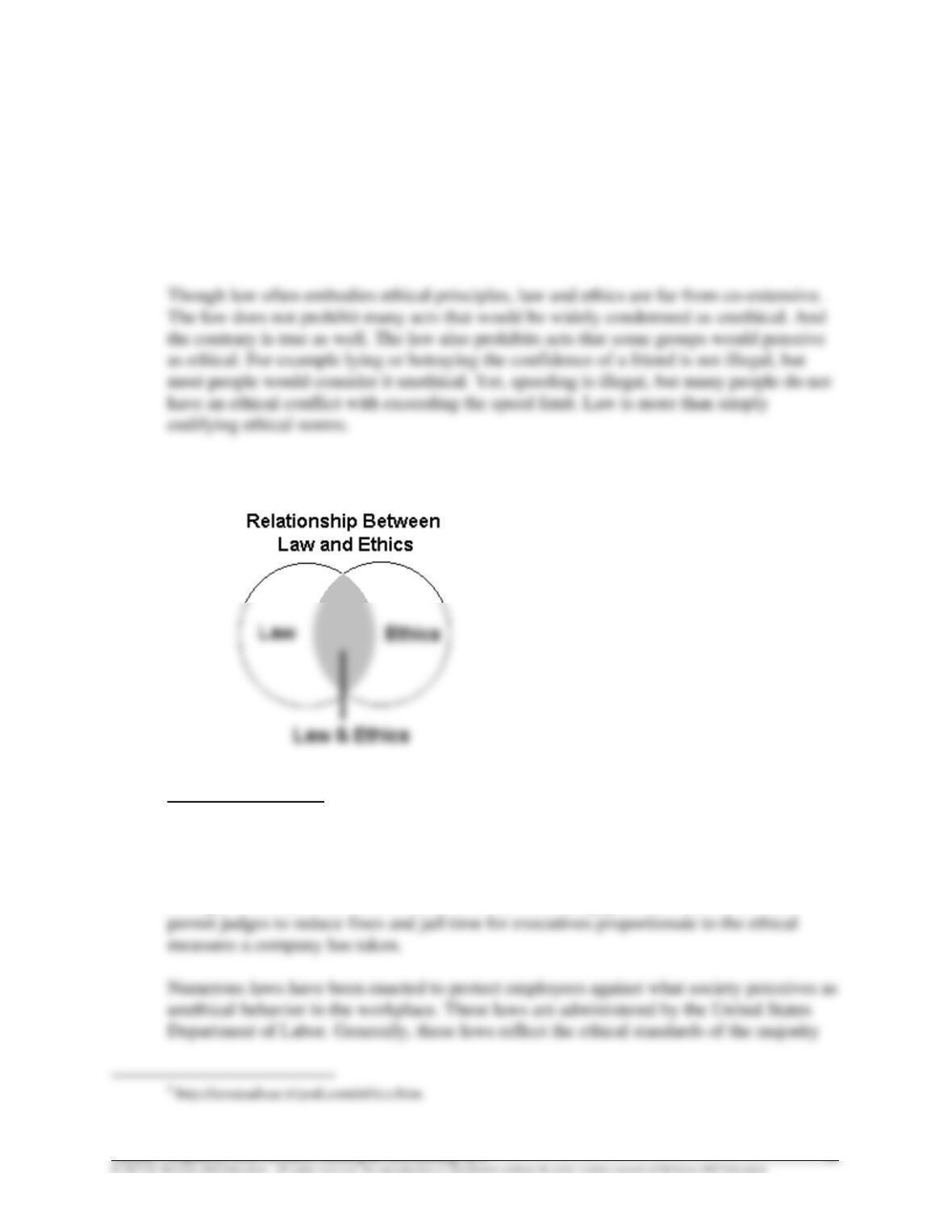
Ethical values and legal principles are usually closely related, but ethical obligations
typically exceed legal duties. In some cases, the law mandates ethical conduct. Examples
of the application of law or policy to ethics include employment law, federal regulations,
and codes of ethics.
The following diagram shows the relationship between law and ethics.5
Extended Discussion
Establishing a set of ethical guidelines for detecting, resolving, and forestalling ethical
breaches often prevents a company from getting into subsequent legal conflicts. Having
demonstrated a more positive approach to the problem may also ensure that punishment
for legal violations will be less severe. Federal sentencing guidelines passed in 1991
Ethical Obligations and Decision Making in Accounting, 4/e 17
of society. An example is the Americans with Disabilities Act of 1990 (ADA). According
to the ADA:
“No covered entity shall discriminate against a qualified individual with a disability
because of the disability of such individual in regard to job application procedures, the
16.
Business ethics is about managing ethics in an organizational context and involves
applying principles and standards that guide behavior in business conduct.
According to IFAC, “The decisions and behaviors of accountants should reinforce
good governance and ethical practices, develop and promote an ethical culture,
foster trust and transparency, bring credibility and value to decision making, and
present a faithful picture of organizational health to stakeholders.” Explain how
accountants and auditors can meet these expectations in a global environment and
protect the public interest.
Every individual has unique personal principles and values, and every organization has
its own set of values, rules, and organizational ethical culture. Business ethics must
consider the organizational culture and interdependent relationships between the
individual and other significant persons involved in organizational decision
making. E mp l o y ee s ca n no t m a k e t h e b es t , mo s t ethical decisions in a
vacuum devoid of the influence of organizational codes, policies, and culture. Most
employees and all managers are responsible not only for their own ethical conduct, but
for the conduct of coworkers and those who they supervise. Without effective guidance,
those in a business cannot make ethical decisions while facing a short–term